

A new definition of burnout syndrome based on Farber's proposal
Open accessThe DOI matches its Crossref record; 54 of the 56 references it cites were found in a registry or an index, and 1 are not checked yet.
Abstract
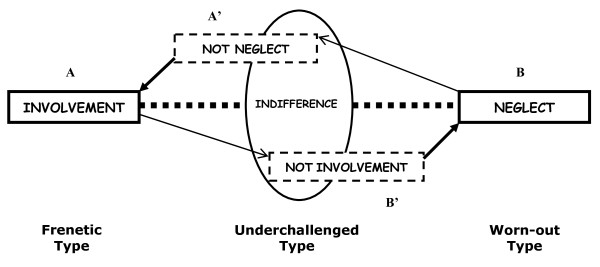
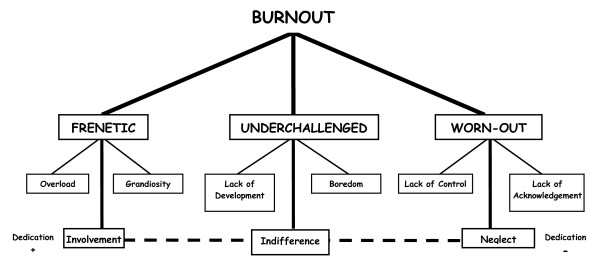
BACKGROUND: Although diverse definitions have been construed for burnout syndrome, most authors consider it to be a single phenomenon, the result of chronic work-related stress. However, in order to enable specific intervention strategies to be adopted, it is first necessary to establish different profiles for the syndrome. In this respect, have been proposed three burnout types ("frenetic", "underchallenged" and "worn-out"), each of which requires different means of dealing with frustration in the workplace. This study is an attempt to define and systematize the properties that characterize this typology proposal. METHODS: For this purpose, the documents considering preliminary typology were examined by means of qualitative content analysis supported by grounded theory. Semiotic analysis was then performed on the core category resulting from the previous analysis. RESULTS: A classification criterion, made up of three different burnout subtypes ("frenetic", "underchallenged", and "worn-out") capable of integrating the entire proposal was formulated. DISCUSSION: Understanding the development of burnout syndrome, as a succession of stages characterized by the progressive diminishing of dedication to work, could serve for the establishment of specific therapies and for the prevention of the syndrome.
Overview
The claims and statistics of this paper haven’t been checked yet.
Free: it reads the open-access text and checks the first 5 claims that cite a source we can check. Create a free account to check every claim.
Integrity signals
Registry
Cites
Statistics
Figures
Verification
Claims the paper makes
The claims and statistics of this paper haven’t been checked yet.
Free: it reads the open-access text and checks the first 5 claims that cite a source we can check. Create a free account to check every claim.
Claims other papers make about this one
Each is checked against this paper’s own text: does it say what the citing paper says it does?
The source backs part of the claim, not all of it — or backs it for a different population, condition or comparison.
In the citing paper
“Finally, the underchallenged and the worn-out subtypes were directly related to negative affect, and indirectly to positive affect, as expected, with higher values for the worn-out because of their theoretical lower levels of effort and persistence [17, 19].”
From Burnout Subtypes and Absence of Self-Compassion in Primary Healthcare Professionals: A Cross-Sectional Study (2016) · cites this paper as [17]
Experimental — accuracy not yet measuredThe cited source says what the claim attributes to it.
In the citing paper
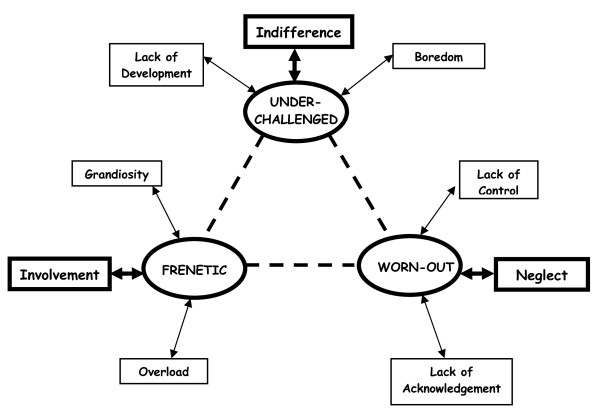
“The ‘worn-out’ subtype presents lack of acknowledgement for the effort they have invested; lack of control over the results of their work; and neglect, as a preferential response to difficulties [17, 19].”
From Burnout Subtypes and Absence of Self-Compassion in Primary Healthcare Professionals: A Cross-Sectional Study (2016) · cites this paper as [17]
The check wasn’t confident either way, so it gives no verdict — never disputed.
In the citing paper
“Each item measured the corresponding factor with the same degree of precision and amount of error, except for lack of acknowledgement, something that may be explained because this factor refers to different sources of gratification, those from the organization and from receptors of the service [17, 19].”
From Burnout Subtypes and Absence of Self-Compassion in Primary Healthcare Professionals: A Cross-Sectional Study (2016) · cites this paper as [17]
Experimental — accuracy not yet measuredIn the citing paper
“The ‘underchallenged’ subtype displays indifference, given that they perform their work-related tasks without interest and superficially; lack of development, as the absence of personal growth experiences together with their desire of take on other jobs; and boredom, given that they suffer from a lack of stimulus and monotony when performing tasks.”
From Burnout Subtypes and Absence of Self-Compassion in Primary Healthcare Professionals: A Cross-Sectional Study (2016) · cites this paper as [17]
In the citing paper
“Recently, a more comprehensive definition of burnout has been proposed to differentiate three clinical subtypes [17].”
From Burnout Subtypes and Absence of Self-Compassion in Primary Healthcare Professionals: A Cross-Sectional Study (2016) · cites this paper as [17]
2 more claims about this paper
Create a free account to see every claim other papers make about this one.
Self-check
Percentages, sums and reported differences re-computed from the paper’s own numbers.
The self-check needs the paper’s full text.
Citations
Cites
Self-efficacy: The exercise of control
Bandura, A., Freeman, W. H., & Lightsey, R. (1999) · Journal of Cognitive Psychotherapy · doi:10.1891/0889-8391.13.2.158 · Cited by 46,835
Basics of Qualitative Research: Grounded Theory Procedures and Techniques.
Ellis, C., Strauss, A., & Corbin, J. (1992) · Contemporary Sociology · doi:10.2307/2074814 · Cited by 29,249
Handbook of Qualitative Research
Crozier, G., Denzin, N., & Lincoln, Y. (1994) · British Journal of Educational Studies · doi:10.2307/3121684 · Cited by 26,666
The Discovery of Grounded Theory: Strategies for Qualitative Research
Glaser, B. G., & Strauss, A. L. (2017) · Aldine (Routledge reprint) · doi:10.4324/9780203793206 · Cited by 25,789
Self-efficacy: the exercise of control
(1997) · Choice Reviews Online · doi:10.5860/choice.35-1826 · Cited by 24,281
Basics of Qualitative Research: Grounded Theory Procedures and Techniques
Long, D. R., Strauss, A., & Corbin, J. (1993) · The Modern Language Journal · doi:10.2307/328955 · Cited by 17,576
Social Cognitive Theory: An Agentic Perspective
Bandura, A. (2001) · Annual Review of Psychology · doi:10.1146/annurev.psych.52.1.1 · Cited by 15,510
Maslach, C., Schaufeli, W. B., & Leiter, M. P. (2001) · Annual Review of Psychology · doi:10.1146/annurev.psych.52.1.397 · Cited by 12,852
Qualitative Analysis for Social Scientists
Strauss, A. L. (1987) · doi:10.1017/cbo9780511557842 · Cited by 12,277
The measurement of engagement and burnout: a two sample confirmatory factor analytic approach.
Schaufeli, W. B., Salanova, M., González-romá, V., & Bakker, A. B. (2002) · Journal of Happiness Studies · doi:10.1023/a:1015630930326 · Cited by 10,014
Job demands, job resources, and their relationship with burnout and engagement: a multi‐sample study
Schaufeli, W. B., & Bakker, A. B. (2004) · Journal of Organizational Behavior · doi:10.1002/job.248 · Cited by 9,297
Handbook of Qualitative Research.
DeVault, M. L., Denzin, N., & Lincoln, Y. (1995) · Contemporary Sociology · doi:10.2307/2076551 · Cited by 6,282
Freudenberger, H. J. (1974) · Journal of Social Issues · doi:10.1111/j.1540-4560.1974.tb00706.x · Cited by 5,463
Introduction : Entering the field of qualitative research
Denzin, N. (1994) · Medical Entomology and Zoology · Cited by 3,174
Handbook of Qualitative Research
Denzin, N. K., & Lincoln, Y. S. (2000) · Cited by 2,593
Champion, D. F., & Westbrook, B. W. (1984) · Measurement and Evaluation in Counseling and Development · doi:10.1080/07481756.1984.12022754 · Cited by 2,388
Maslach, C., & Jackson, S. E. (2024) · PsycTESTS Dataset · doi:10.1037/t55656-000 · Cited by 2,359
From Psychological Stress to the Emotions: A History of Changing Outlooks
Lazarus, R. S. (1993) · Annual Review of Psychology · doi:10.1146/annurev.ps.44.020193.000245 · Cited by 1,664
Maslach burnout inventory-general survey
김, 영. (2009) · Cited by 907
Burnout prevention: A review of intervention programs
Awa, W. L., Plaumann, M., & Walter, U. (2010) · Patient Education and Counseling · doi:10.1016/j.pec.2009.04.008 · Cited by 827
A Systematic Review of the Job-stress Intervention Evaluation Literature, 1990–2005
Lamontagne, A. D., Keegel, T., Louie, A. M., Ostry, A., & Landsbergis, P. A. (2007) · International Journal of Occupational and Environmental Health · doi:10.1179/oeh.2007.13.3.268 · Cited by 704
Understanding and Preventing Teacher Burnout: A Sourcebook of International Research and Practice
(1999) · Cambridge University Press eBooks · doi:10.1017/cbo9780511527784 · Cited by 645
Schaufeli, W. B., & Salanova, M. (2007) · Anxiety, Stress, & Coping · doi:10.1080/10615800701217878 · Cited by 589
Crisis in education: stress and burnout in the American teacher
(1991) · Choice Reviews Online · doi:10.5860/choice.29-1022 · Cited by 477
Técnicas cualitativas de investigación social
Vallés, M. S. (1999) · Cited by 474
Burnout in teachers: Shattered dreams of impeccable professional performance
Friedman, I. A. (2000) · Journal of Clinical Psychology · doi:10.1002/(sici)1097-4679(200005)56:5<595::aid-jclp2>3.0.co;2-q · Cited by 426
Epistemología, metodología y técnicas del análisis de contenido
Raigada, J. L. P. (2002) · Sociolinguistic Studies · doi:10.1558/sols.v3i1.1 · Cited by 360
Janssen, P. P. M., De Jonge, J., & Bakker, A. B. (1999) · Journal of Advanced Nursing · doi:10.1046/j.1365-2648.1999.01022.x · Cited by 357
Métodos y técnicas cualitativas de investigación en ciencias sociales
Delgado, J. M., & Fernández, J. G. (1995) · Saber7 UCAB · Cited by 296
Construct Dimensionality of Engagement and its Relation With Satisfaction
Wefald, A. J., & Downey, R. G. (2009) · The Journal of Psychology · doi:10.3200/jrlp.143.1.91-112 · Cited by 278
Job satisfaction among general practitioners: A systematic literature review
Van Ham, I., Verhoeven, A. A. H., Groenier, K. H., Groothoff, J. W., & De Haan, J. (2006) · European Journal of General Practice · doi:10.1080/13814780600994376 · Cited by 273
Salanova, M., Martínez, I. M., Schaufeli, W. B., & Prieto, L. L. (2015) · Cited by 256
Treatment strategies for different types of teacher burnout
Farber, B. A. (2000) · Journal of Clinical Psychology · doi:10.1002/(sici)1097-4679(200005)56:5<675::aid-jclp8>3.0.co;2-d · Cited by 211
Systematic review of interventions for reducing occupational stress in health care workers
Ruotsalainen, J., Serra, C., Marine, A., & Verbeek, J. (2008) · Scandinavian Journal of Work, Environment & Health · doi:10.5271/sjweh.1240 · Cited by 209
Borritz, M., Rugulies, R., Christensen, K. B., Villadsen, E., & Kristensen, T. S. (2006) · Occupational and Environmental Medicine · doi:10.1136/oem.2004.019364 · Cited by 205
Jiménez, B. M., de Bustos, R. C., Matallana, A., & Miralles, T. (1997) · Cited by 191
Borritz, M., B??ltmann, U., Rugulies, R., Christensen, K. B., Villadsen, E., & Kristensen, T. S. (2005) · Journal of Occupational and Environmental Medicine · doi:10.1097/01.jom.0000175155.50789.98 · Cited by 170
Magnusson Hanson, L. L., Theorell, T., Oxenstierna, G., Hyde, M., & Westerlund, H. (2008) · Scandinavian Journal of Public Health · doi:10.1177/1403494808090164 · Cited by 161
Introduction: Understanding and treating burnout in a changing culture
Farber, B. A. (2000) · Journal of Clinical Psychology · doi:10.1002/(sici)1097-4679(200005)56:5<589::aid-jclp1>3.0.co;2-s · Cited by 155
Gil-Monte, P. R. (2005) · Pirámide eBooks · doi:10.13140/2.1.4614.8806 · Cited by 152
Stress and burnout in forensic mental health nursing: a literature review
Dickinson, T., & Wright, K. M. (2008) · British Journal of Nursing · doi:10.12968/bjon.2008.17.2.28133 · Cited by 139
Burnout in Psychotherapists: Incidence, Types, and Trends
Farber, B. A. (1990) · Psychotherapy in Private Practice · doi:10.1300/j294v08n01_07 · Cited by 110
Burnout and Personality in Intensive Care: An Empirical Study
Bühler, K.-E., & Land, T. (2003) · Hospital Topics · doi:10.1080/00185860309598028 · Cited by 106
Burnout, psychological distress, and overwork: the case of Quebec's ophthalmologists
Viviers, S., Lachance, L., Maranda, M.-F., & Ménard, C. (2008) · Canadian Journal of Ophthalmology · doi:10.3129/i08-132 · Cited by 68
Moscoso, A., Sibeoni, J., Jovanovic, N., & Hohagen, F. (2016) · Psychiatry in Practice · doi:10.1093/med/9780198723646.003.0035 · Cited by 66
KNIGHT, P. G., & Parsons, A. J. (1990) · Nature · doi:10.1038/346310d0 · Cited by 65
Inconsequentiality – The Key to Understanding Teacher Burnout
Farber, B. A. (1999) · Understanding and Preventing Teacher Burnout · doi:10.1017/cbo9780511527784.009 · Cited by 51
de Colmenares, F. D. (2007) · Cited by 49
A Multi-Factor Analysis of Job Satisfaction Among School Nurses
Foley, M., Lee, J. A., Wilson, L., Cureton, V. Y., & Canham, D. (2004) · The Journal of School Nursing · doi:10.1177/10598405040200020701 · Cited by 33
Montero‐Marín, J., García‐Campayo, J., & Andres, E. M. (2009) · Revista de Psicopatología y Psicología Clínica · doi:10.5944/rppc.vol.14.num.2.2009.4071 · Cited by 25
Self-citationSemiótica, márketing y comunicación
Gómez, M. D. L. C. P. (1994) · Dialnet (Universidad de la Rioja) · Cited by 23
Floch, J.M. (1993): Semiótica. márketing y comunicación. Barcelona, Paidós.
Gómez, M. D. L. C. P. (1994) · Questiones Publicitarias · doi:10.5565/rev/qp.208 · Cited by 23
Análisis semiótico del discurso
Abril, G. (1995) · Dialnet (Universidad de la Rioja) · Cited by 22
Los discursos del cambio: imágenes e imaginarios sociales en la España de la transición (1976-1982)
Imbert, G., & Simo, B. F. (1990) · Dialnet (Universidad de la Rioja) · Cited by 15
Análisis exploratorio de un modelo clínico basado en tres tipos de Burnout
Marín, J. M., García‐Campayo, J., & Andres, E. M. (2008) · Hispana · Cited by 6
Self-citationPromoting Job Satisfaction—A Challenge for School Nurses
Denehy, J. (2004) · The Journal of School Nursing · doi:10.1177/10598405040200020101 · Cited by 3
Research works printed but not linked: 6
- Lazarus RS Folkman S Estrés y procesos cognitivos (Spanish translation of Stress, appraisal and coping) 1984 Barcelona: Martínez Roca 46
- Farber BA Subtypes of burnout: theory, research and practice 2001 Paper presented at the Annual Conference, American Psychological Association. San Francisco
- McKinney M Tipología constructiva y teoría social. (Spanish translation of Constructive typology and social theory) 1966 Buenos Aires: Amorrortu 23
- Gaitán JA Piñuel JL Técnicas de Investigación en comunicación social 1998 Madrid: Síntesis 281 311
- Glaser BG Strauss AL The Discovery of Grounded Theory 1967 Chicago: Aldine
- Barton AH Lazarsfeld PF Lipset SM, Smelser NJ Some functions of Qualitative Analysis in Social Research Sociology: The Progress of a Decade 1961 Englewood-Cliffs: Prentice-Hall 95 122
Cited by
Travis, D. J., Lizano, E. L., & Mor Barak, M. E. (2016) · British Journal of Social Work · doi:10.1093/bjsw/bct205 · Cited by 248
Coping with Stress and Types of Burnout: Explanatory Power of Different Coping Strategies
Montero-Marin, J., Prado-Abril, J., Piva Demarzo, M. M., Gascon, S., & García-Campayo, J. (2014) · PLoS ONE · doi:10.1371/journal.pone.0089090 · Cited by 140
Self-citationThe medical perspective on burnout
Kakiashvili, T., Leszek, J., & Rutkowski, K. (2013) · International Journal of Occupational Medicine and Environmental Health · doi:10.2478/s13382-013-0093-3 · Cited by 124
Montero-Marin, J., Tops, M., Manzanera, R., Piva Demarzo, M. M., Álvarez de Mon, M., & García-Campayo, J. (2015) · Frontiers in Psychology · doi:10.3389/fpsyg.2015.01895 · Cited by 120
Self-citationUchmanowicz, I., Manulik, S. K., Lomper, K., Rozensztrauch, A., Zborowska, A., Kolasińska, J., & Rosińćzuk, J. (2019) · BMJ Open · doi:10.1136/bmjopen-2018-024296 · Cited by 129
Metadata
- Authors
- Montero-Marín, J., García-Campayo, J., Mera, D. M., & del Hoyo, Y. L.
- Affiliations
- Universidad Nacional de Educación a Distancia (ES)
- Venue
- Journal of Occupational Medicine and Toxicology
- Published
- 2009-11-30
- Volume
- 4
- Issue
- 1
- Pages
- 31-31
- ISSN
- 1745-6673 (ISSN-L)
- PMC
- PMC2794272
- OpenAlex
- W2017570934
- Cited by
- 118
- References
- 53
- Citations by year
- 2026: 4 · 2025: 9 · 2024: 15 · 2023: 11 · 2022: 13 · 2021: 11 · 2020: 6 · 2019: 12 · 2018: 8 · 2017: 2 · 2016: 5 · 2015: 4 · 2014: 3 · 2013: 5 · 2012: 3
- FWCI
- 4.35
- Type
- journal article
- Language
- en
- Open access
- gold
- doi.org
- Licence
- cc-by
- Locations
- Journal of Occupational Medicine and Toxicology (publishedVersion, cc-by)
- PubMed Central (publishedVersion, cc-by)
- PubMed (publishedVersion)
- DOAJ (DOAJ: Directory of Open Access Journals) (submittedVersion, cc-by-sa)
- Topics
- Social Sciences › Psychology › Social Psychology › Stress and Burnout Research
- Health Sciences › Medicine › Public Health, Environmental and Occupational Health › Occupational Health and Burnout
- Health Sciences › Health Professions › General Health Professions › Healthcare professionals’ stress and burnout
- Keywords
- burnout, burnout stages, work commitment, burnout prevention
About these checks
Registry, retraction, Cites and statistics results are computed, not judged, with one exception: a printed reference that no index lists is read once by a model before it counts as a citation error. Claims are extracted by a model and kept only when their quote appears verbatim in the text; each cited source is then checked, with a model’s help, for whether it says what the claim relies on. Those verdicts can be wrong — read the claim’s quote and the cited source before relying on one.
Statistics and arithmetic are recomputed, not judged.
Confidence bands are shown only for fields calibrated on our annotated test set. None is calibrated yet, so no band is shown.
What counts as a claim ›How we measure confidence ›How we check this ›
Are you an author, or do you see a problem with this page? Request a review
Data sources
Bibliographic data: Semantic Scholar, OpenAlex, Crossref.
Contains information from the Semantic Scholar Academic Graph Datasets, made available under the ODC Attribution License (ODC-BY 1.0).
Semantic Scholar’s data is described in: Kinney, R., et al. (2023). The Semantic Scholar Open Data Platform. arXiv:2301.10140.
