

Improving outpatient safety through effective electronic communication: a study protocol
The DOI matches its Crossref record; 19 of the 19 references it cites were found in a registry or an index.
Abstract
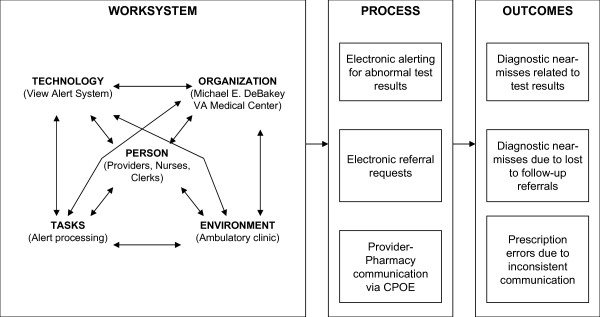
BACKGROUND: Health information technology and electronic medical records (EMRs) are potentially powerful systems-based interventions to facilitate diagnosis and treatment because they ensure the delivery of key new findings and other health related information to the practitioner. However, effective communication involves more than just information transfer; despite a state of the art EMR system, communication breakdowns can still occur. [1-3] In this project, we will adapt a model developed by the Systems Engineering Initiative for Patient Safety (SEIPS) to understand and improve the relationship between work systems and processes of care involved with electronic communication in EMRs. We plan to study three communication activities in the Veterans Health Administration's (VA) EMR: electronic communication of abnormal imaging and laboratory test results via automated notifications (i.e., alerts); electronic referral requests; and provider-to-pharmacy communication via computerized provider order entry (CPOE). AIM: Our specific aim is to propose a protocol to evaluate the systems and processes affecting outcomes of electronic communication in the computerized patient record system (related to diagnostic test results, electronic referral requests, and CPOE prescriptions) using a human factors engineering approach, and hence guide the development of interventions for work system redesign. DESIGN: This research will consist of multiple qualitative methods of task analysis to identify potential sources of error related to diagnostic test result alerts, electronic referral requests, and CPOE; this will be followed by a series of focus groups to identify barriers, facilitators, and suggestions for improving the electronic communication system. Transcripts from all task analyses and focus groups will be analyzed using methods adapted from grounded theory and content analysis.
Overview
The claims and statistics of this paper haven’t been checked yet.
Free: it reads the open-access text and checks the first 5 claims that cite a source we can check. Create a free account to check every claim.
Integrity signals
Registry
Cites
Statistics
Figures
Verification
Claims the paper makes
The claims and statistics of this paper haven’t been checked yet.
Free: it reads the open-access text and checks the first 5 claims that cite a source we can check. Create a free account to check every claim.
Claims other papers make about this one
Each is checked against this paper’s own text: does it say what the citing paper says it does?
The source backs part of the claim, not all of it — or backs it for a different population, condition or comparison.
In the citing paper
“Our findings thus highlighted the multiple dimensions of our model that need to be addressed to improve the safety of EHR-based notification systems and perhaps other forms of CDS (see Table 1) [59, 60, 61, 62].”
From A new sociotechnical model for studying health information technology in complex adaptive healthcare systems (2010) · cites this paper as [59]
Experimental — accuracy not yet measured
Self-check
Percentages, sums and reported differences re-computed from the paper’s own numbers.
The self-check needs the paper’s full text.
Citations
Cites
Donabedian, A. (1988) · JAMA · doi:10.1001/jama.260.12.1743 · Cited by 5,895 · cited 1×
“The SEIPS model integrates Donabedian's Structure-Process-Outcome framework to improve quality [18] and provides a comprehensive conceptual framework for application of systems engineering concepts to electronic communication.”
Bates, D. W. (1998) · JAMA · doi:10.1001/jama.280.15.1311 · Cited by 2,107 · cited 1×
“Several studies have found the use of CPOE systems reduce medication errors and overall patient harm [7-10].”
Work system design for patient safety: the SEIPS model
Carayon, P., Schoofs Hundt, A., Karsh, B.-T., Gurses, A. P., Alvarado, C. J., Smith, M., & Flatley Brennan, P. (2006) · Quality in Health Care · doi:10.1136/qshc.2005.015842 · Cited by 1,795
Improving Safety with Information Technology
Bates, D. W., & Gawande, A. A. (2003) · New England Journal of Medicine · doi:10.1056/nejmsa020847 · Cited by 1,544 · cited 1×
“The use of information technology (IT) and electronic medical records (EMR) holds promise in improving the quality of information transfer and is key to patient safety [4].”
Adverse Drug Events in Ambulatory Care
Gandhi, T. K., Weingart, S. N., Borus, J., Seger, A. C., Peterson, J., Burdick, E., Seger, D. L., Shu, K., Federico, F., Leape, L. L., et al. (2003) · New England Journal of Medicine · doi:10.1056/nejmsa020703 · Cited by 1,345
Cognitive and usability engineering methods for the evaluation of clinical information systems.
Kushniruk, A. W., & Patel, V. L. (2004) · Journal of Biomedical Informatics · doi:10.1016/j.jbi.2004.01.003 · Cited by 760
Missed and delayed diagnoses in the ambulatory setting: a study of closed malpractice claims
Gandhi, T. K., Kachalia, A., Thomas, E. J., Puopolo, A. L., Yoon, C., Brennan, T. A., & Studdert, D. M. (2006) · Annals of Internal Medicine · doi:10.7326/0003-4819-145-7-200610030-00006 · Cited by 662 · cited 1×
“Breakdowns in these three processes can lead to diagnostic and medication errors, which are common types of safety concerns [19-24].”
Communication breakdown in the outpatient referral process
Gandhi, T. K., Sittig, D. F., Franklin, M., Sussman, A. J., Fairchild, D. G., & Bates, D. W. (2000) · Journal of General Internal Medicine · doi:10.1046/j.1525-1497.2000.91119.x · Cited by 371
Self-citationA preliminary taxonomy of medical errors in family practice
Dovey, S. M. (2002) · Quality and Safety in Health Care · doi:10.1136/qhc.11.3.233 · Cited by 338
Phillips, R. L. (2004) · Quality and Safety in Health Care · doi:10.1136/qshc.2003.008029 · Cited by 233
Research works printed but not linked: 15
- Bates DW Kuperman G Teich JM Computerized physician order entry and quality of care Qual Manag Health Care 1994 2 18 27 10172133 · DOI · Paper page
- Institute of Medicine To Err is Human: Building a Safer Health System 1999 Washington, D.C.: National Academies Press 25077248
- Sittig DF Stead WW Computer-based physician order entry: the state of the art J Am Med Inform Assoc 1994 1 108 123 7719793 PMC116190 · DOI · Paper page
- Institute of Medicine of the National Academies Patient Safety: Achieving a New Standard for Care 2004 Washington, D.C.: National Academy Press 25009854
- Hickner JM Fernald DH Harris DM Poon EG Elder NC Mold JW Issues and initiatives in the testing process in primary care physician offices Jt Comm J Qual Patient Saf 2005 31 81 89 15791767 · DOI
- Preece J Rogers Y Sharp H Benyon D Holland S Carey T Human-computer interaction 1994 New York: Addison-Wesley Publishing Company
- Gandhi TK Sittig DF Franklin M Sussman AJ Fairchild DG Bates DW Communication breakdown in the outpatient referral process J Gen Intern Med 2000 15 626 631 11029676 10.1046/j.1525-1497.2000.91119.x PMC1495590 · DOI · Paper page
- Hammons T Piland NF Small SD Hatlie MJ Burstin HR Ambulatory patient safety. What we know and need to know J Ambul Care Manage 2003 26 63 82 12545516 · DOI
- DuBois D Shalin VL Schraagen JM, Chipman SF, Shalin VL Describing job expertise using cognitively oriented task analyses Cognitive Task Analysis 2000 Mahwah, NJ: Lawrence Erlbaum Associates 41 56
- Strauss AL Corbin J Basics of qualitative research: techniques and procedures for developing grounded theory 1998 2 Thousand Oaks, CA: Sage Publications
- Weber RP Basic Content Analysis 1990 2 Newbury Park: Sage · DOI · Paper page
- Muhr T User's Manual for ATLAS.ti 5.0. [ 5] 2004 Berlin, Germany, ATLAS.ti Scientific Software Development GmbH
- Best RG Pugh JA VHA primary care task database [CD-ROM] South Texas Veterans Health Care System 2006 San Antonio: South Texas Veterans Health Care System
- Best RG Hysong SJ Pugh JA Ghosh S Moore FI Task Overlap Among Primary Care Team Members: Opportunity for System Redesign? Journal of Healthcare Management 2006 51 295 307 17039689 · DOI
- Barbour R Doing Focus Groups 2008 London: Sage
Cited by
Holden, R. J., Carayon, P., Gurses, A. P., Hoonakker, P., Hundt, A. S., Ozok, A. A., & Rivera-Rodriguez, A. J. (2013) · Ergonomics · doi:10.1080/00140139.2013.838643 · Cited by 1,221
“…2008; Gürses & Carayon, 2007; Holden, Scanlon, et al., 2011; Karsh, et al., 2005) Evaluation of ways to improve electronic communication and alerts (Hysong et al., 2009) Evaluation of lean in healthcare (Holden, 2011b) Health information technology and medical devices References Technology…”
Sittig, D. F., & Singh, H. (2010) · Quality and Safety in Health Care · doi:10.1136/qshc.2010.042085 · Cited by 897
Self-citationHuman factors systems approach to healthcare quality and patient safety
Carayon, P., Wetterneck, T. B., Rivera-Rodriguez, A. J., Hundt, A. S., Hoonakker, P., Holden, R., & Gurses, A. P. (2014) · Applied Ergonomics · doi:10.1016/j.apergo.2013.04.023 · Cited by 717
Understanding the management of electronic test result notifications in the outpatient setting
Hysong, S. J., Sawhney, M. K., Wilson, L., Sittig, D. F., Esquivel, A., Singh, S., & Singh, H. (2011) · BMC Medical Informatics and Decision Making · doi:10.1186/1472-6947-11-22 · Cited by 68
“Details of our data collection and analysis procedures are published elsewhere [25] and are summarized here.”
Self-citationProvider management strategies of abnormal test result alerts: a cognitive task analysis
Hysong, S. J., Sawhney, M. K., Wilson, L., Sittig, D. F., Espadas, D., Davis, T., & Singh, H. (2010) · Journal of the American Medical Informatics Association · doi:10.1197/jamia.m3200 · Cited by 65
“to elicit the decision-making processes they used in alert-management (a study protocol with greater details about our task analysis procedures is currently in press).”
Self-citationLaxmisan, A., Sittig, D. F., Pietz, K., Espadas, D., Krishnan, B., & Singh, H. (2012) · Medical Care · doi:10.1097/mlr.0b013e31825f6619 · Cited by 26
Self-citation
Metadata
- Authors
- Hysong, S. J., Sawhney, M. K., Wilson, L., Sittig, D. F., Esquivel, A., Watford, M., Davis, T., Espadas, D., & Singh, H.
- Venue
- Implementation Science
- Published
- 2009-09-25
- Volume
- 4
- Issue
- 1
- ISSN
- 1748-5908
- PMC
- PMC2761849
- Cited by
- 17
- References
- 19
- Language
- en
About these checks
Registry, retraction, Cites and statistics results are computed, not judged, with one exception: a printed reference that no index lists is read once by a model before it counts as a citation error. Claims are extracted by a model and kept only when their quote appears verbatim in the text; each cited source is then checked, with a model’s help, for whether it says what the claim relies on. Those verdicts can be wrong — read the claim’s quote and the cited source before relying on one.
Statistics and arithmetic are recomputed, not judged.
Confidence bands are shown only for fields calibrated on our annotated test set. None is calibrated yet, so no band is shown.
What counts as a claim ›How we measure confidence ›How we check this ›
Are you an author, or do you see a problem with this page? Request a review
Data sources
Bibliographic data: Semantic Scholar, OpenAlex, Crossref.
Contains information from the Semantic Scholar Academic Graph Datasets, made available under the ODC Attribution License (ODC-BY 1.0).
Semantic Scholar’s data is described in: Kinney, R., et al. (2023). The Semantic Scholar Open Data Platform. arXiv:2301.10140.
