

Adaptive design methods in clinical trials–a review
Open accessThe DOI matches its Crossref record; 59 of the 60 references it cites were found in a registry or an index.
Abstract
In recent years, the use of adaptive design methods in clinical research and development based on accrued data has become very popular due to its flexibility and efficiency. Based on adaptations applied, adaptive designs can be classified into three categories: prospective, concurrent (ad hoc), and retrospective adaptive designs. An adaptive design allows modifications made to trial and/or statistical procedures of ongoing clinical trials. However, it is a concern that the actual patient population after the adaptations could deviate from the originally target patient population and consequently the overall type I error (to erroneously claim efficacy for an infective drug) rate may not be controlled. In addition, major adaptations of trial and/or statistical procedures of on-going trials may result in a totally different trial that is unable to address the scientific/medical questions the trial intends to answer. In this article, several commonly considered adaptive designs in clinical trials are reviewed. Impacts of ad hoc adaptations (protocol amendments), challenges in by design (prospective) adaptations, and obstacles of retrospective adaptations are described. Strategies for the use of adaptive design in clinical development of rare diseases are discussed. Some examples concerning the development of Velcade intended for multiple myeloma and non-Hodgkin's lymphoma are given. Practical issues that are commonly encountered when implementing adaptive design methods in clinical trials are also discussed.
Overview
The claims and statistics of this paper haven’t been checked yet.
Free: it reads the open-access text and checks the first 5 claims that cite a source we can check. Create a free account to check every claim.
Integrity signals
Registry
Cites
Statistics
Figures
Verification
Claims the paper makes
The claims and statistics of this paper haven’t been checked yet.
Free: it reads the open-access text and checks the first 5 claims that cite a source we can check. Create a free account to check every claim.
Claims other papers make about this one
Each is checked against this paper’s own text: does it say what the citing paper says it does?
The cited source says what the claim attributes to it.
In the citing paper
“This flexibility can improve the efficiency of trials, potentially saving time and resources, and can lead to more ethical studies by minimizing patient exposure to less effective treatments [23].”
From The Work-life Check-ins randomized controlled trial: a leader-based adaptive, semi-structured burnout intervention in primary care clinics (2024) · cites this paper as [23]
Self-check
Percentages, sums and reported differences re-computed from the paper’s own numbers.
The self-check needs the paper’s full text.
Citations
Cites
Continual Reassessment Method: A Practical Design for Phase 1 Clinical Trials in Cancer
O'Quigley, J., Pepe, M., & Fisher, L. (1990) · Biometrics · doi:10.2307/2531628 · Cited by 1,577 · cited 1×
“For adaptive dose finding design, the method of continual re-assessment method (CRM) in conjunction with Bayesian approach is usually considered [34-36].”
Group Sequential Methods with Applications to Clinical Trials
Jennison, C., & Turnbull, B. W. (1999) · Chapman & Hall/CRC eBooks · doi:10.1201/9780367805326 · Cited by 1,336 · cited 3×
“Various stopping boundaries based on different boundary functions for controlling an overall type I error rate are available in the literature (see, e.g., Lan and DeMets, 1987; Wang and Tsiatis, 1987; Rosenberger et al., 2001; Jennison and Turnbull, 2000, 2005; Chow and Chang, 2006).”
Forcing a sequential experiment to be balanced
EFRON, B. (1971) · Biometrika · doi:10.1093/biomet/58.3.403 · Cited by 873 · cited 2×
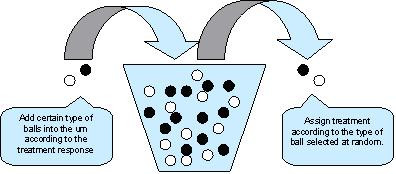
“Commonly applied adaptive randomization procedures include treatment-adaptive randomization [3,4], covariate-adaptive randomization, and response-adaptive randomization [5,6].”
Adaptive Sample Size Calculations in Group Sequential Trials
Lehmacher, W., & Wassmer, G. (1999) · Biometrics · doi:10.1111/j.0006-341x.1999.01286.x · Cited by 598 · cited 2×
“In recent years, the concept of two-stage adaptive design has led to the development of the adaptive group sequential design (e.g., Cui, Hung, and Wang, 1999; Posch and Bauer, 1999; Lehmacher and Wassmer, 1999; Liu, Proschan, and Pledger, 2002).”
Modification of Sample Size in Group Sequential Clinical Trials
Cui, L., Hung, H. M. J., & Wang, S. (1999) · Biometrics · doi:10.1111/j.0006-341x.1999.00853.x · Cited by 574
Designed Extension of Studies Based on Conditional Power
Proschan, M. A., & Hunsberger, S. A. (1995) · Biometrics · doi:10.2307/2533262 · Cited by 534
Continual Reassessment Method: A Likelihood Approach
O'Quigley, J., & Shen, L. Z. (1996) · Biometrics · doi:10.2307/2532905 · Cited by 382 · cited 1×
“For adaptive dose finding design, the method of continual re-assessment method (CRM) in conjunction with Bayesian approach is usually considered [34-36].”
Approximately Optimal One-Parameter Boundaries for Group Sequential Trials
Wang, S. K., & Tsiatis, A. A. (1987) · Biometrics · doi:10.2307/2531959 · Cited by 341 · cited 1×
“Various stopping boundaries based on different boundary functions for controlling an overall type I error rate are available in the literature (see, e.g., Lan and DeMets, 1987; Wang and Tsiatis, 1987; Rosenberger et al., 2001; Jennison and Turnbull, 2000, 2005; Chow and Chang, 2006).”
Adaptive Designs in Clinical Drug Development—An Executive Summary of the PhRMA Working Group
Gallo, P., Chuang-Stein, C., Dragalin, V., Gaydos, B., Krams, M., & Pinheiro, J. (2006) · Journal of Biopharmaceutical Statistics · doi:10.1080/10543400600614742 · Cited by 323
The Evaluation of Surrogate Endpoints
(2005) · Statistics for Biology and Health · doi:10.1007/b138566 · Cited by 310
Research works printed but not linked: 2
- Whitehead J Bayesian decision procedures with application to dose-finding studies International Journal of Pharmaceutical Medicine 1997 11 201 208
- Wang SJ Regulatory experience of adaptive designs in well-controlled clinical trials Presented at Adaptive Designs: Opportunities, Challenges and Scope in Drug Development, Washington, DC 2006
Cited by
Items 401–481 of 481
Adaptive designs for clinical trials in cardiovascular diseases
Mütze, T. (2018) · eDiss (Georg-August-Universität Göttingen) · doi:10.53846/goediss-7186
Application of Adaptive Designs in Clinical Trials in Japan and the United States
Yamakawa, N., Teramukai, S., HATTA, T., & Urushihara, H. (2019) · Rinsho yakuri/Japanese Journal of Clinical Pharmacology and Therapeutics · doi:10.3999/jscpt.50.149 · Cited by 1
Quinn, G. (2021) · Journal of the American Podiatric Medical Association · doi:10.7547/19-113
A Two-Stage Decision Making Approach for Safety Studies
Kim, J., & Huang, Z. (2021) · Journal of Biopharmaceutical Statistics · doi:10.1080/10543406.2021.1975127
A Multi-Armed Bandit Problem with the Optimal Arm Depending on a Hidden Markov Model
Gülcü, T. C. (2021) · IEEE Information Theory Workshop (ITW) · doi:10.1109/itw48936.2021.9611510 · Cited by 1
Translational Equation-Based Modeling
Clermont, G. (2020) · Springer eBooks · doi:10.1007/978-3-030-56510-7_2
(2012) · Wiley eBooks · doi:10.1002/9781118422878.refs
Chow, S., & Liu, J. (2013) · Wiley series in probability and statistics · doi:10.1002/9781118458167.refs
Meinert, C. L. (2012) · Wiley eBooks · doi:10.1002/9781118315293.refs
Early Phase Metabolic Research with Reference to Special Populations
Morrow, L., & Krentz, A. J. (2019) · Springer eBooks · doi:10.1007/978-3-030-11748-1_20
Friedman, S. L. (2013) · Journal of Hepatology · doi:10.1016/j.jhep.2013.04.008
Adaptive designs in clinical research
Ossorio, F. (2013) · Archivos Argentinos de Pediatria · doi:10.5546/aap.2013.eng.374
Methodological Foundations of Clinical Research
Bacchieri, A., & Cioppa, G. D. (2019) · Health informatics · doi:10.1007/978-3-319-98779-8_4
“Safe” oxygen saturation levels in extremely preterm infants: have we found a definite answer?
Vain, N. E. (2013) · Archivos Argentinos de Pediatria · doi:10.5546/aap.2013.eng.372
Antal, J., & Timár, A. (2011) · Orvosi Hetilap · doi:10.1556/oh.2011.29236
Methods for Blinded Sample Size Recalculation in Adaptive Enrichment Designs
Placzek, M. (2022) · eDiss (Georg-August-Universität Göttingen) · doi:10.53846/goediss-9638
Caveat Medicus: It’s Time to Re-Think Stratification, You May Not Be Helping
Arandjelović, O. (2023) · Biomarker Insights · doi:10.1177/11772719231174746
Adaptive designs were primarily used but inadequately reported in early phase drug trialsPreprint
Wang, Y., Yao, M., Liu, J., Liu, Y., Ma, Y., Luo, X., Mei, F., Xiang, H., Zou, K., Li, L., et al. (2023) · Research Square · doi:10.21203/rs.3.rs-2983270/v1
Network and covariate adjusted response‐adaptive design for binary response
Mei, H., Xie, J., Qin, Y., & Li, Y. (2023) · Statistics in Medicine · doi:10.1002/sim.9915
“3,4 Second, with the success of social network analysis, researchers have made efforts to analyze network interference in randomized controlled trials.”
BackgroundBen‐Eltriki, M., Chhabra, M., Rafiq, A., Afolabi, M., Paul, A., Prabhu, D., Bashaw, R., Neilson, C. J., Mahmud, S. M., Lacaze‐Masmonteil, T., et al. (2024) · Research Square · doi:10.21203/rs.3.rs-3829888/v1
Disease Models for Rare Genetic Disorders
Kanakarajan, S., Selvaraj, R., & Kaleena, P. K. (2024) · Springer eBooks · doi:10.1007/978-981-99-9323-9_4 · Cited by 4
Ye, J., & Nie, L. (2024) · ICSA book series in statistics · doi:10.1007/978-3-031-60843-8_9
Decentralized Clinical Trials and Opportunities with Artificial Intelligence
Dhar, S. (2024) · Premier Journal of Artificial Intelligence · doi:10.70389/pjai.100008 · Cited by 1
Farooq, H., Ali, S., Shah, I., Nafisah, I., & Almazah, M. M. A. (2025) · Stats · doi:10.3390/stats8020031
“One critical aspect of adaptive clinical trials is the sample size, which directly impacts the trial’s statistical power and the ability to draw meaningful conclusions [1].”
Streamlining Success: A Methodological Framework for Clinical Trial Implementation and Analysis
Wasiullah, M., Yadav, P., Yadav, S. Y. S., & Chauahan, M. R. C. M. R. (2025) · International Journal of Pharmaceutical Research and Applications · doi:10.35629/4494-100226442648
Mubarak, N., Mariño, G., McCall, M., & Collins, A. P. (2025) · Elsevier eBooks · doi:10.1016/b978-0-12-821426-8.00049-2
Agile evaluation including two pragmatic trials on the uptake of a digital screening service
Tillmann, T., Copas, A. J., Stokes, P., Udell, N., Stead, J., Lim, J., & Libow, G. (2025) · npj Digital Medicine · doi:10.1038/s41746-025-01672-5
“However,theirinterim fi ndings are not thought of as primary outcomes themselves 21 .”
An overview of adaptive study design
Mir, M., Boike, S., Brown, Z., Jain, S. M., Bawaadam, H. S., Obulareddy, S. U. J., & Jain, N. K. (2025) · Elsevier eBooks · doi:10.1016/b978-0-323-90391-2.00078-6
A practical guide to simulation for an adaptive trial design with a single interim analysis
Jayawardana, K. S., Dymock, M., Mahar, R. K., Marsh, J., & Lee, K. J. (2025) · Trials · doi:10.1186/s13063-025-09100-5 · Cited by 2
Integrating a pilot study and large trial into one adaptive design
Dai, J., Gajewski, B. J., Shergina, E., Mount, R. R., & Gibbs, H. (2025) · Contemporary Clinical Trials · doi:10.1016/j.cct.2025.108112
AI in targeted drug discovery for TNBC
Kothawade, S. N., Bhosale, S., Jedhe, R., Mhaske, P., & Makhare, S. (2025) · Elsevier eBooks · doi:10.1016/b978-0-443-33565-5.00020-7
Simultaneous Population and Dose Selection in Clinical Trials and Cluster Validation
Li, S. (2014) · D-Scholarship@Pitt (University of Pittsburgh)
Erőss, B., Molnár, Z., Szakács, Z., Zádori, N., Szakó, L., Váncsa, S., Juhász, M. F., Ocskay, K., Vörhendi, N., Márta, K., et al. (2020) · Figshare · doi:10.6084/m9.figshare.13023545
Dimairo, M., Pallmann, P., Wason, J. M. S., Todd, S., Jaki, T., Julious, S. A., Mander, A., Weir, C. J., Koenig, F., Walton, M. K., et al. (2020) · Figshare · doi:10.6084/m9.figshare.12494876
Dimairo, M., Pallmann, P., Wason, J. M. S., Todd, S., Jaki, T., Julious, S. A., Mander, A., Weir, C. J., Koenig, F., Walton, M. K., et al. (2020) · Figshare · doi:10.6084/m9.figshare.12494858
Manchon, P., Belhadi, D., Mentré, F., & Laouenan, C. (2021) · Figshare · doi:10.6084/m9.figshare.14544706
Wang, Y., Yao, M., Liu, J., Liu, Y., Ma, Y., Luo, X., Mei, F., Xiang, H., Zou, K., Li, L., et al. (2024) · Figshare · doi:10.6084/m9.figshare.25980539
Zhang, Q., Dimairo, M., Julious, S. A., Lewis, J., & Yu, Z. (2024) · Figshare · doi:10.6084/m9.figshare.27124117
Dimairo, M., Pallmann, P., Wason, J. M. S., Todd, S., Jaki, T., Julious, S. A., Mander, A., Weir, C. J., Koenig, F., Walton, M. K., et al. (2020) · Figshare · doi:10.6084/m9.figshare.12494891
Vinnat, V., & Chevret, S. (2022) · Figshare · doi:10.6084/m9.figshare.19246630
Erőss, B., Molnár, Z., Szakács, Z., Zádori, N., Szakó, L., Váncsa, S., Juhász, M. F., Ocskay, K., Vörhendi, N., Márta, K., et al. (2020) · Figshare · doi:10.6084/m9.figshare.13023548
Dimairo, M., Pallmann, P., Wason, J. M. S., Todd, S., Jaki, T., Julious, S. A., Mander, A., Weir, C. J., Koenig, F., Walton, M. K., et al. (2020) · Figshare · doi:10.6084/m9.figshare.12494900
Dimairo, M., Pallmann, P., Wason, J. M. S., Todd, S., Jaki, T., Julious, S. A., Mander, A., Weir, C. J., Koenig, F., Walton, M. K., et al. (2020) · Figshare · doi:10.6084/m9.figshare.12494870
Wang, Y., Travis, J., & Gajewski, B. (2022) · Figshare · doi:10.6084/m9.figshare.19634732
Brede, J. R., Skulberg, A. K., Rehn, M., Thorsen, K., Klepstad, P., Tylleskär, I., Farbu, B. H., Dale, J., Nordseth, T., Wiseth, R., et al. (2021) · Figshare · doi:10.6084/m9.figshare.15087548
Wang, Y., Travis, J., & Gajewski, B. (2022) · Figshare · doi:10.6084/m9.figshare.19634738
Dimairo, M., Pallmann, P., Wason, J. M. S., Todd, S., Jaki, T., Julious, S. A., Mander, A., Weir, C. J., Koenig, F., Walton, M. K., et al. (2020) · Figshare · doi:10.6084/m9.figshare.12494909
Erőss, B., Molnár, Z., Szakács, Z., Zádori, N., Szakó, L., Váncsa, S., Juhász, M. F., Ocskay, K., Vörhendi, N., Márta, K., et al. (2020) · Figshare · doi:10.6084/m9.figshare.13023551
Brede, J. R., Skulberg, A. K., Rehn, M., Thorsen, K., Klepstad, P., Tylleskär, I., Farbu, B. H., Dale, J., Nordseth, T., Wiseth, R., et al. (2021) · Figshare · doi:10.6084/m9.figshare.15087545
Kidwell, K., Roychoudhury, S., Wendelberger, B., Scott, J., Moroz, T., Yin, S., Majumder, M., Zhong, J., Huml, R. A., & Miller, V. (2022) · Figshare · doi:10.6084/m9.figshare.19728445
Flight, L., Julious, S., Brennan, A., Todd, S., & Hind, D. (2020) · Figshare · doi:10.6084/m9.figshare.11992530
Erőss, B., Molnár, Z., Szakács, Z., Zádori, N., Szakó, L., Váncsa, S., Juhász, M. F., Ocskay, K., Vörhendi, N., Márta, K., et al. (2020) · Figshare · doi:10.6084/m9.figshare.13023542
Dimairo, M., Pallmann, P., Wason, J. M. S., Todd, S., Jaki, T., Julious, S. A., Mander, A., Weir, C. J., Koenig, F., Walton, M. K., et al. (2020) · Figshare · doi:10.6084/m9.figshare.12494861
Dimairo, M., Pallmann, P., Wason, J. M. S., Todd, S., Jaki, T., Julious, S. A., Mander, A., Weir, C. J., Koenig, F., Walton, M. K., et al. (2020) · Figshare · doi:10.6084/m9.figshare.12494882
Dimairo, M., Pallmann, P., Wason, J. M. S., Todd, S., Jaki, T., Julious, S. A., Mander, A., Weir, C. J., Koenig, F., Walton, M. K., et al. (2020) · Figshare · doi:10.6084/m9.figshare.12494849
Evolution of clinical trials: An overview on adaptive designs
Dayanidhi, S., & Prasath, D. (2025) · Journal of Current Research in Scientific Medicine · doi:10.4103/jcrsm.jcrsm_42_25
Colonna, S., Maietti, G., & Cuoghi, F. (2026) · Cureus · doi:10.7759/cureus.100760 · Cited by 1
Belakhdar, S., & Merabet, H. (2025) · Boletim da Sociedade Paranaense de Matemática · doi:10.5269/bspm.77703
Allemang‐Trivalle, A., Giraudeau, B., & Maruani, A. (2026) · Scientific Reports · doi:10.1038/s41598-026-36295-7
“Several initiatives have aimed to overcome the methodological barriers in rare diseases, including adaptive designs 14,15 , Bayesian frameworks 16,17 , and platform trials 18,19 , which enable more flexible inference from small populations.”
Tomlinson, S. (2026) · Elsevier eBooks · doi:10.1016/b978-0-443-13750-1.00022-7
Randomization: Fixed or adaptive procedures
McCranie, A. S., & Kaoutzanis, C. (2026) · Elsevier eBooks · doi:10.1016/b978-0-323-91168-9.00025-9
Evaluation of Strategies Aimed at Optimizing the Uptake of HIV Testing Services
Salvadori, N. (2020) · theses.fr (ABES) · doi:10.70675/e7531dbaz8a32z4dbfzb3c8z687e1318caf1
Schémas bayésiens d'enrichissement pour l'intégration de biomarqueurs multiples
Vinnat, V. (2023) · theses.fr (ABES) · doi:10.70675/fe7b0ca3zd9f5z462ezb2eaz6cfcfe072e0f
Zhu, X., Li, Y., Wu, J., Tang, Y., Liu, L., Huang, S., & Hsieh, H. (2026) · Pharmaceutical Statistics · doi:10.1002/pst.70091
Zhang, W., Hudson, A., Petersen, M., & van der Laan, M. J. (2026) · Journal of the American Statistical Association · doi:10.1080/01621459.2026.2657052 · Cited by 5
Adaptive design increased success but does not significantly accelerate confirmatory oncology trials
Purja, S., & Kim, E. (2026) · JNCI Journal of the National Cancer Institute · doi:10.1093/jnci/djag129 · Cited by 1
Lytras, M. D., Alghamdi, R. M., Alharbi, L., Alhevdey, A. Z., Abdulhaq, N. M., Alsaywid, B. S., & Lytra, C.-C. (. (2026) · Elsevier eBooks · doi:10.1016/b978-0-443-27743-6.00017-8
Nolan, E., Holliday, E., Oldmeadow, C. J., Hall, A., Leigh, L., Nathan, N., & Barker, D. (2026) · Implementation Science Communications · doi:10.1186/s43058-026-01000-2
“Unlike frequentist methods that may have less clear inferential interpretations [6] Bayesian methods can readily incorporate accumulating data like that which is seen in adaptive designs [7, 8].”
Innovative clinical trial designs
Papiež, A., Součková, L., & Rychlíčková, J. (2026) · Klinická farmakologie a farmacie · doi:10.36290/far.2026.024
Azzolina, D., Scisciola, V., Stendardo, M., Iervolino, D., Pedarzani, E., Comoretto, R. I., Murri, M. B., & Gregori, D. (2026) · BMJ Open · doi:10.1136/bmjopen-2025-101527
Dil, N. (2026) · Springer eBooks · doi:10.1007/978-3-032-19175-5_6
Statistics of Randomized Clinical Trials
Nguyen, T., Liu, C., Ni, L., & Xie, R. (2026) · Springer eBooks · doi:10.1007/978-3-032-19175-5_11
Jang, D. G., & Park, J. (2026) · Journal of Biopharmaceutical Statistics · doi:10.1080/10543406.2026.2703578 · Cited by 1
Sandeep, B., Cheng, H., Liu, X., Huang, X., Yan, Y., Jiang, F., Xiong, D., Wu, Q., Gao, K., & Xiao, Z. (2026) · Current Problems in Cardiology · doi:10.1016/j.cpcardiol.2026.103398
Wang, Y., Pond, G. R., Ma, J., & Parpia, S. (2026) · Research Methods in Medicine & Health Sciences · doi:10.1177/26320843261474840
Holst‐Laubjerg, I., & Moreira, J. M. A. (2026) · Clinical Pharmacology & Therapeutics · doi:10.1002/cpt.70423
Holm, R., Konagurthu, S., Ahmed, T., Louit, G., Griffin, B. T., Holm, S., Jansook, P., Wu, W., Lü, Y., Allen, C., et al. (2026) · European Journal of Pharmaceutical Sciences · doi:10.1016/j.ejps.2026.107688
Bruno, J., Salerno, P., & Chávez-Guevara, I. A. (2026) · RESEARCH IN PHYSICAL EDUCATION SPORT AND HEALTH · doi:10.2478/rpesh-2026-0010
“Depending on the design, these modifications may involve sample size, treatment arms, stopping rules, or allocation probabilities (Bhatt & Mehta, 2016; Chow & Chang, 2008; Edson, 2017).”
Metadata
- Authors
- Chow, S.-C., & Chang, M.
- Affiliations
- Duke University (US)
- Takeda Oncology (United States) (US)
- Corresponding author
- Chow, Shein-Chung
- Venue
- Orphanet Journal of Rare Diseases
- Published
- 2008-05-02
- Volume
- 3
- Issue
- 1
- Pages
- 11-11
- ISSN
- 1750-1172 (ISSN-L)
- PMC
- PMC2422839
- OpenAlex
- W2044439361
- Cited by
- 482
- References
- 60
- Citations by year
- 2026: 20 · 2025: 21 · 2024: 25 · 2023: 26 · 2022: 27 · 2021: 27 · 2020: 38 · 2019: 25 · 2018: 26 · 2017: 35 · 2016: 30 · 2015: 34 · 2014: 32 · 2013: 36 · 2012: 36
- FWCI
- 2.11
- Type
- journal article
- Language
- en
- Open access
- gold
- doi.org
- Licence
- cc-by
- creativecommons.org/licenses/by/2.0 (tdm)
- Locations
- Orphanet Journal of Rare Diseases (publishedVersion, cc-by)
- PubMed Central (publishedVersion, cc-by)
- PubMed (publishedVersion)
- National University of Singapore (submittedVersion, cc-by)
- DOAJ (DOAJ: Directory of Open Access Journals) (submittedVersion)
- Funders
- School of Medicine, Duke University
- Takeda Oncology
- Topics
- Physical Sciences › Mathematics › Statistics and Probability › Statistical Methods in Clinical Trials
- Health Sciences › Medicine › Pediatrics, Perinatology and Child Health › Pharmaceutical studies and practices
- Physical Sciences › Mathematics › Statistics and Probability › Statistical Methods and Bayesian Inference
- Keywords
- adaptive trial design, protocol modification, type I error control, rare disease drug development, bortezomib, multiple myeloma, non-Hodgkin lymphoma
- MeSH terms
- Clinical Trials as Topic, Humans, Random Allocation, Research Design, Statistics as Topic, Clinical Trials, Phase II as Topic, Clinical Trials, Phase III as Topic, Rare Diseases
About these checks
Registry, retraction, Cites and statistics results are computed, not judged, with one exception: a printed reference that no index lists is read once by a model before it counts as a citation error. Claims are extracted by a model and kept only when their quote appears verbatim in the text; each cited source is then checked, with a model’s help, for whether it says what the claim relies on. Those verdicts can be wrong — read the claim’s quote and the cited source before relying on one.
Statistics and arithmetic are recomputed, not judged.
Confidence bands are shown only for fields calibrated on our annotated test set. None is calibrated yet, so no band is shown.
What counts as a claim ›How we measure confidence ›How we check this ›
Are you an author, or do you see a problem with this page? Request a review
Data sources
Bibliographic data: Semantic Scholar, OpenAlex, Crossref.
Contains information from the Semantic Scholar Academic Graph Datasets, made available under the ODC Attribution License (ODC-BY 1.0).
Semantic Scholar’s data is described in: Kinney, R., et al. (2023). The Semantic Scholar Open Data Platform. arXiv:2301.10140.
