

The DOI matches its Crossref record; 45 of the 46 references it cites were found in a registry or an index.
Disturbed functional brain networks and neurocognitive function in low-grade glioma patients: a graph theoretical analysis of resting-state MEG
Open accessAbstract
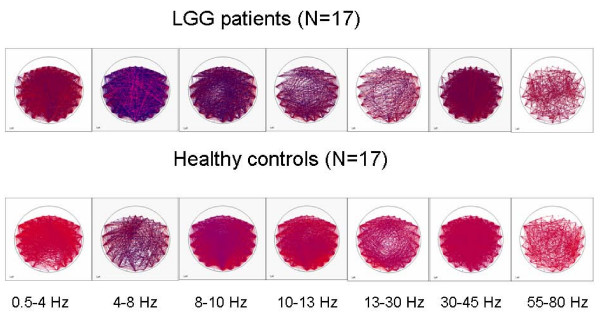
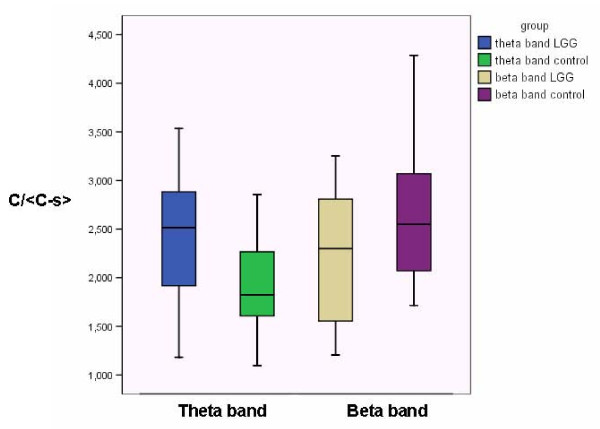
BACKGROUND: To understand neurophysiological mechanisms underlying cognitive dysfunction in low-grade glioma (LGG) patients by evaluating the spatial structure of 'resting-state' brain networks with graph theory. METHODS: Standardized tests measuring 6 neurocognitive domains were administered in 17 LGG patients and 17 healthy controls. Magnetoencephalography (MEG) recordings were conducted during eyes-closed 'resting state'. The phase lag index (PLI) was computed in seven frequency bands to assess functional connectivity between brain areas. Spatial patterns were characterized with graph theoretical measures such as clustering coefficient (local connectivity), path length (global integration), network small world-ness (ratio of clustering coefficient/path length) and degree correlation (the extent to which connected nodes have similar degrees). RESULTS: Compared to healthy controls, patients performed poorer on psychomotor functioning, attention, information processing, and working memory. Patients displayed higher short- and long-distance synchronization and clustering coefficient in the theta band, whereas a lower clustering coefficient and small world-ness were observed in the beta band. A lower degree correlation was found in the upper gamma band. LGG patients with higher clustering coefficient, longer path length, and lower degree correlations in delta and lower alpha band were characterized by poorer neurocognitive performance. CONCLUSION: LGG patients display higher short- and long-distance synchronization within the theta band. Network analysis revealed changes (in particularly the theta, beta, and upper gamma band) suggesting disturbed network architecture. Moreover, correlations between network characteristics and neurocognitive performance were found, Widespread changes in the strength and spatial organization of brain networks may be responsible for cognitive dysfunction in glioma patients.
Overview
The claims and statistics of this paper haven’t been checked yet.
Run the check — free, no account needed. It reads the open-access text and checks the sources it cites.
Integrity signals
Registry
Cites
Statistics
Figures
Verification
Claims the paper makes
The claims and statistics of this paper haven’t been checked yet.
Run the check — free, no account needed. It reads the open-access text and checks the sources it cites.
Claims other papers make about this one
Each is checked against this paper’s own text: does it say what the citing paper says it does?
The source backs part of the claim, not all of it — or backs it for a different population, condition or comparison.
In the citing paper
“The degree to which network features are perturbed has been correlated with neuropsychological deficits involving both local and diffuse brain regions with reduced global efficiency and small-worldness correlated with lower IQ scores.15,16,104”
From Graph theory analysis of complex brain networks: new concepts in brain mapping applied to neurosurgery (2016) · cites this paper as [16]
Experimental — accuracy not yet measured
Self-check
Percentages, sums and reported differences re-computed from the paper’s own numbers.
The self-check needs the paper’s full text.
Citations
Cites
Collective dynamics of ‘small-world’ networks
Watts, D. J., & Strogatz, S. H. (1998) · Nature · doi:10.1038/30918 · Cited by 43,060
Studies of interference in serial verbal reactions
Stroop, J. R. (1935) · Journal of Experimental Psychology · doi:10.1037/h0054651 · Cited by 18,622
Efficient behavior of small-world networks
Latora, V., & Marchiori, M. (2001) · Physical Review Letters · doi:10.1103/physrevlett.87.198701 · Cited by 5,119
The brainweb: phase synchronization and large-scale integration
Varela, F., Lachaux, J.-P., Rodriguez, E., & Martinerie, J. (2001) · Nature Reviews Neuroscience · doi:10.1038/35067550 · Cited by 4,761
Neuropsychological assessment.
Cipolotti, L., & Warrington, E. K. (1995) · Journal of Neurology Neurosurgery & Psychiatry · doi:10.1136/jnnp.58.6.655 · Cited by 3,267
Stam, C. J., Nolte, G., & Daffertshofer, A. (2007) · Human Brain Mapping · doi:10.1002/hbm.20346 · Cited by 2,083
Self-citationGeneralized synchronization of chaos in directionally coupled chaotic systems
Rulkov, N. F., Sushchik, M. M., Tsimring, L. S., & Abarbanel, H. D. I. (1995) · Physical review. E, Statistical physics, plasmas, fluids, and related interdisciplinary topics · doi:10.1103/physreve.51.980 · Cited by 1,803
Network ‘Small-World-Ness’: A Quantitative Method for Determining Canonical Network Equivalence
Humphries, M. D., & Gurney, K. (2008) · PLoS ONE · doi:10.1371/journal.pone.0002051 · Cited by 1,442
Small-World Networks and Functional Connectivity in Alzheimer's Disease
Stam, C. J., Jones, B. F., Nolte, G., Breakspear, M. J., & Scheltens, P. (2006) · Cerebral Cortex · doi:10.1093/cercor/bhj127 · Cited by 1,295
Self-citationPerret, E. (1974) · Neuropsychologia · doi:10.1016/0028-3932(74)90047-5 · Cited by 1,007
Graph theoretical analysis of magnetoencephalographic functional connectivity in Alzheimer's disease
Stam, C. J., de Haan, W., Daffertshofer, A., Jones, B. F., Manshanden, I., van Walsum, A. M. V. C., Montez, T., Verbunt, J. P. A., de Munck, J. C., van Dijk, B. W., et al. (2008) · Brain · doi:10.1093/brain/awn262 · Cited by 922
Self-citationMemory Scanning: New Findings and Current Controversies
Sternberg, S. (1975) · Quarterly Journal of Experimental Psychology · doi:10.1080/14640747508400459 · Cited by 900
Adaptive reconfiguration of fractal small-world human brain functional networks
Bassett, D. S., Meyer-Lindenberg, A., Achard, S., Duke, T., & Bullmore, E. (2006) · Proceedings of the National Academy of Sciences · doi:10.1073/pnas.0606005103 · Cited by 814
Cognitive deficits in adult patients with brain tumours
TAPHOORN, M. J. B., & Klein, M. (2004) · The Lancet Neurology · doi:10.1016/s1474-4422(04)00680-5 · Cited by 780
Self-citationKlein, M., Heimans, J. J., Aaronson, N. K., van der Ploeg, H. M., Grit, J., Muller, M. J., Postma, T. J., Mooij, J. J. A., Boerman, R. H., Beute, G. N., et al. (2002) · The Lancet · doi:10.1016/s0140-6736(02)11398-5 · Cited by 646
Self-citationStam, C. J., & van Dijk, B. W. (2002) · Physica D Nonlinear Phenomena · doi:10.1016/s0167-2789(01)00386-4 · Cited by 645
Self-citationUhlhaas, P. J., Haenschel, C., Nikolic, D., & Singer, W. (2008) · Schizophrenia Bulletin · doi:10.1093/schbul/sbn062 · Cited by 629
Transformations towards the normal distribution of broad band spectral parameters of the EEG
Gasser, T., Bächer, P., & Möcks, J. (1982) · Electroencephalography and Clinical Neurophysiology · doi:10.1016/0013-4694(82)90112-2 · Cited by 584
Fast Response and Temporal Coherent Oscillations in Small-World Networks
Lago-Fernández, L. F., Huerta, R., Corbacho, F., & Siguenza, J. A. (2000) · Physical Review Letters · doi:10.1103/physrevlett.84.2758 · Cited by 572
Stam, C. J. (2003) · Neuroscience Letters · doi:10.1016/j.neulet.2003.10.063 · Cited by 550
Self-citationResting State Cortical Connectivity Reflected in EEG Coherence in Individuals With Autism
Murias, M., Webb, S. J., Greenson, J., & Dawson, G. (2007) · Biological Psychiatry · doi:10.1016/j.biopsych.2006.11.012 · Cited by 550
Small‐world properties of nonlinear brain activity in schizophrenia
Rubinov, M., Knock, S. A., Stam, C. J., Micheloyannis, S., Harris, A. W. F., Williams, L. M., & Breakspear, M. J. (2007) · Human Brain Mapping · doi:10.1002/hbm.20517 · Cited by 465
Self-citationSmall-world networks and disturbed functional connectivity in schizophrenia
Micheloyannis, S., Pachou, E., Stam, C. J., Breakspear, M. J., Bitsios, P., Vourkas, M., Erimaki, S., & Zervakis, M. E. (2006) · Schizophrenia Research · doi:10.1016/j.schres.2006.06.028 · Cited by 435
Self-citationEpilepsy in low‐grade gliomas: The impact on cognitive function and quality of life
Klein, M., Engelberts, N. H. J., van der Ploeg, H. M., Trenité, D. G. A. K.-N., Aaronson, N. K., TAPHOORN, M. J. B., Baaijen, H., Vandertop, W. P., Muller, M. J., Postma, T. J., et al. (2003) · Annals of Neurology · doi:10.1002/ana.10712 · Cited by 433
Self-citationLearning and Retrieval Rate of Words Presented Auditorily and Visually
Brand, N., & JOLLES, J. (1985) · The Journal of General Psychology · doi:10.1080/00221309.1985.9711004 · Cited by 426
Magnetoencephalographic evaluation of resting-state functional connectivity in Alzheimer's disease
Stam, C. J., Jones, B. F., Manshanden, I., van Walsum, A. M. V. C., Montez, T., Verbunt, J. P. A., de Munck, J. C., van Dijk, B. W., Berendse, H. W., & Scheltens, P. (2006) · NeuroImage · doi:10.1016/j.neuroimage.2006.05.033 · Cited by 333
Self-citationImpaired functional connectivity at EEG alpha and theta frequency bands in major depression
Fingelkurts, A. A., Fingelkurts, A. A., Rytsälä, H. J., Suominen, K. H., Isometsä, E. T., & Kähkönen, S. (2006) · Human Brain Mapping · doi:10.1002/hbm.20275 · Cited by 283
Using graph theoretical analysis of multi channel EEG to evaluate the neural efficiency hypothesis
Micheloyannis, S., Pachou, E., Stam, C. J., Vourkas, M., Erimaki, S., & Tsirka, V. (2006) · Neuroscience Letters · doi:10.1016/j.neulet.2006.04.006 · Cited by 277
Self-citationBartolomei, F., Bosma, I., Klein, M., Baayen, J. C., Reijneveld, J. C., Postma, T. J., Heimans, J. J., van Dijk, B. W., de Munck, J. C., de Jongh, A., et al. (2006) · Clinical Neurophysiology · doi:10.1016/j.clinph.2006.05.018 · Cited by 276
Self-citationSmit, D. J. A., Stam, C. J., Posthuma, D., Boomsma, D. I., & de Geus, E. J. C. (2007) · Human Brain Mapping · doi:10.1002/hbm.20468 · Cited by 275
Self-citationThe Vulnerable Brain and Environmental Risks
(1992) · Springer eBooks · doi:10.1007/978-1-4615-3326-9 · Cited by 211
How do brain tumors alter functional connectivity? A magnetoencephalography study
Bartolomei, F., Bosma, I., Klein, M., Baayen, J. C., Reijneveld, J. C., Postma, T. J., Heimans, J. J., van Dijk, B. W., de Munck, J. C., de Jongh, A., et al. (2006) · Annals of Neurology · doi:10.1002/ana.20710 · Cited by 180
Self-citationThe influence of ageing on complex brain networks: A graph theoretical analysis
Micheloyannis, S., Vourkas, M., Tsirka, V., Karakonstantaki, E., Kanatsouli, K., & Stam, C. J. (2007) · Human Brain Mapping · doi:10.1002/hbm.20492 · Cited by 152
Self-citationBosma, I., Douw, L., Bartolomei, F., Heimans, J. J., van Dijk, B. W., Postma, T. J., Stam, C. J., Reijneveld, J. C., & Klein, M. (2008) · Neuro-Oncology · doi:10.1215/15228517-2008-034 · Cited by 145
Self-citationBook Review: Brain Function, Nonlinear Coupling, and Neuronal Transients
Friston, K. J. (2001) · The Neuroscientist · doi:10.1177/107385840100700510 · Cited by 141
How do brain tumors alter functional connectivity? A magnetoencephalography study
Timone, C. (2006) · Cited by 128
Pesticide exposure and risk of mild cognitive dysfunction
Bosma, H., van Boxtel, M., Ponds, R., Houx, P. J., & Jolles, J. (2000) · The Lancet · doi:10.1016/s0140-6736(00)02685-4 · Cited by 89
Douw, L., Baayen, H., Bosma, I., Klein, M., Vandertop, P., Heimans, J., Stam, K., de Munck, J., & Reijneveld, J. (2008) · Experimental Neurology · doi:10.1016/j.expneurol.2008.03.013 · Cited by 70
Self-citationAssessment of recovery from serious head injury.
Eson, M. E., Yen, J. K., & Bourke, R. S. (1978) · Journal of Neurology Neurosurgery & Psychiatry · doi:10.1136/jnnp.41.11.1036 · Cited by 57
Bosma, I., Stam, C. J., Douw, L., Bartoloméi, F., Heimans, J. J., van Dijk, B. W., Postma, T. J., Klein, M., & Reijneveld, J. C. (2008) · Journal of Neuro-Oncology · doi:10.1007/s11060-008-9535-3 · Cited by 55
Self-citationThe Brain Connectivity Workshops: Moving the frontiers of computational systems neuroscience
Stephan, K. E., Riera, J. J., Deco, G., & Horwitz, B. (2008) · NeuroImage · doi:10.1016/j.neuroimage.2008.04.167 · Cited by 51
Management of supratentorial low-grade gliomas
Shaw, E. G., Scheithauer, B. W., & O'Fallon, J. R. (1991) · Seminars in Radiation Oncology · doi:10.1016/1053-4296(91)90006-s · Cited by 45
Attention modulates hemispheric differences in functional connectivity: Evidence from MEG recordings
Gootjes, L., Bouma, A., Strien, J. W. V., Scheltens, P., & Stam, C. J. (2005) · NeuroImage · doi:10.1016/j.neuroimage.2005.09.015 · Cited by 41
Self-citationVulnerability factors for age-related cognitive decline
Houx, P. J., & Jolles, J. (1994) · Research Publications (Maastricht University) · Cited by 28
Future directions in 3-dimensional radiation treatment planning.
Rosenman, J. G. (1993) · PubMed · Cited by 19
Research works printed but not linked: 1
- Luteijn F, Ploeg van der FAE: Groningen Intelligence Test. revised manual Lisse Swets and Zeitlinger. 1983
Cited by
Sorted by citations
Comparing Brain Networks of Different Size and Connectivity Density Using Graph Theory
van Wijk, B. C. M., Stam, C. J., & Daffertshofer, A. (2010) · PLoS ONE · doi:10.1371/journal.pone.0013701 · Cited by 1,161
Self-citationFunctional network disruption in the degenerative dementias
Pievani, M., de Haan, W., Wu, T., Seeley, W. W., & Frisoni, G. B. (2011) · The Lancet Neurology · doi:10.1016/s1474-4422(11)70158-2 · Cited by 481
Functional and structural brain networks in epilepsy: What have we learned?
Diessen, E. G. A. L. V., Diederen, S., Braun, K. P. J., Jansen, F. E., & Stam, C. J. (2013) · Epilepsia · doi:10.1111/epi.12350 · Cited by 362
Self-citationGratton, C., Nomura, E. M., Pérez, F., & D’Esposito, M. (2012) · Journal of Cognitive Neuroscience · doi:10.1162/jocn_a_00222 · Cited by 353
Brain networks under attack: robustness properties and the impact of lesions
Aerts, H., Fias, W., Caeyenberghs, K., & Marinazzo, D. (2016) · Brain · doi:10.1093/brain/aww194 · Cited by 310
Metadata
- Authors
- Bosma, I., Reijneveld, J. C., Klein, M., Douw, L., van Dijk, B. W., Heimans, J. J., & Stam, C. J.
- Affiliations
- Amsterdam UMC Location Vrije Universiteit Amsterdam (NL)
- Amsterdam UMC Location University of Amsterdam (NL)
- Corresponding author
- Bosma, Ingeborg
- ORCID
- Venue
- Nonlinear Biomedical Physics
- Published
- 2009-08-23
- Volume
- 3
- Issue
- 1
- Pages
- 9-9
- ISSN
- 1753-4631 (ISSN-L)
- PMC
- PMC2745411
- OpenAlex
- W2162546175
- Cited by
- 139
- References
- 46
- Citations by year
- 2026: 2 · 2025: 6 · 2024: 5 · 2023: 12 · 2022: 5 · 2021: 9 · 2020: 6 · 2019: 6 · 2018: 9 · 2017: 13 · 2016: 10 · 2015: 4 · 2014: 8 · 2013: 15 · 2012: 12
- FWCI
- 4.69
- Type
- journal article
- Language
- en
- Open access
- hybrid
- doi.org
- Licence
- Locations
- Nonlinear Biomedical Physics (publishedVersion, cc-by)
- PubMed Central (publishedVersion, cc-by)
- PubMed (publishedVersion)
- Pure Amsterdam UMC (submittedVersion)
- Digital Academic REpository of VU University Amsterdam (Vrije Universiteit Amsterdam) (submittedVersion)
- Amsterdam UMC (VU Amsterdam) - Institutional Repository (submittedVersion)
- Data Archiving and Networked Services (DANS) (submittedVersion, other-oa)
- Topics
- Life Sciences › Neuroscience › Cognitive Neuroscience › Functional Brain Connectivity Studies
- Life Sciences › Neuroscience › Cognitive Neuroscience › Neural dynamics and brain function
- Health Sciences › Medicine › Radiology, Nuclear Medicine and Imaging › Advanced Neuroimaging Techniques and Applications
- Keywords
- low-grade glioma, resting-state brain networks, functional connectivity, graph theory, cognitive impairment, neuropsychological performance, phase lag index, beta band, gamma band, small-world networks, clustering coefficient, path length, degree correlation, working memory, attention, psychomotor performance
About these checks
Registry, retraction, Cites and statistics results are computed, not judged, with one exception: a printed reference that no index lists is read once by a model before it counts as a citation error. Claims are extracted by a model and kept only when their quote appears verbatim in the text; each cited source is then checked, with a model’s help, for whether it says what the claim relies on. Those verdicts can be wrong — read the claim’s quote and the cited source before relying on one.
Statistics and arithmetic are recomputed, not judged.
Confidence bands are shown only for fields calibrated on our annotated test set. None is calibrated yet, so no band is shown.
What counts as a claim ›How we measure confidence ›How we check this ›
Are you an author, or do you see a problem with this page? Request a review
