

EMT is the dominant program in human colon cancer
Open accessThe DOI matches its Crossref record; 32 of the 32 references it cites were found in a registry or an index.
Abstract
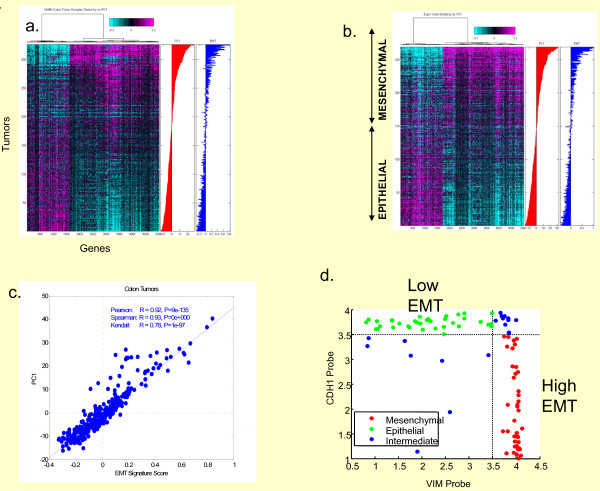
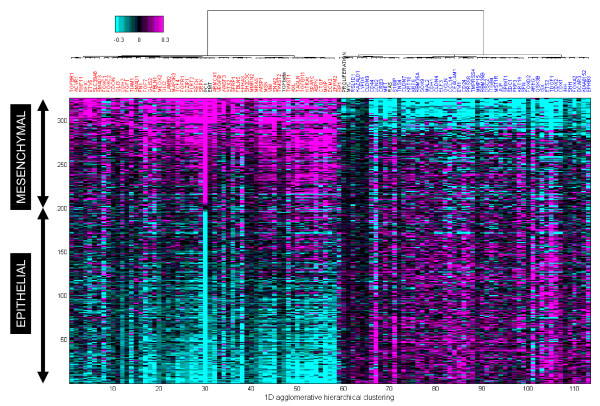
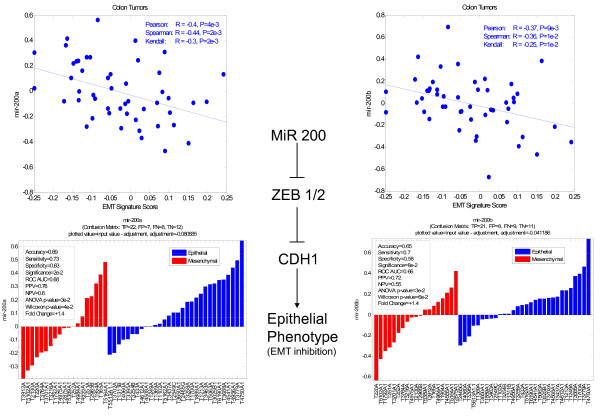
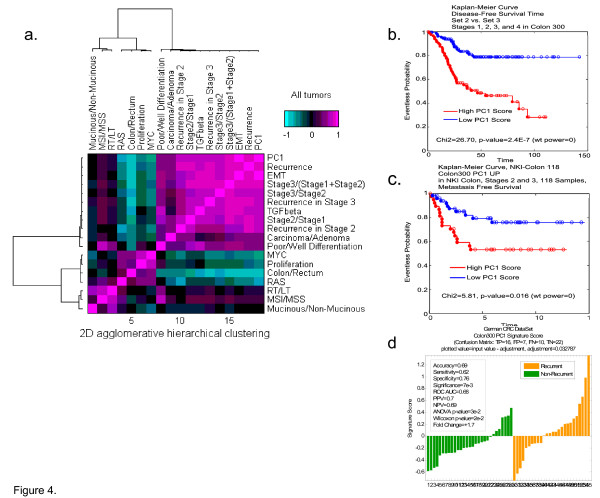
Background: Colon cancer has been classically described by clinicopathologic features that permit the prediction of outcome only after surgical resection and staging. Methods: We performed an unsupervised analysis of microarray data from 326 colon cancers to identify the first principal component (PC1) of the most variable set of genes. PC1 deciphered two primary, intrinsic molecular subtypes of colon cancer that predicted disease progression and recurrence. Results: Here we report that the most dominant pattern of intrinsic gene expression in colon cancer (PC1) was tightly correlated (Pearson R = 0.92, P < 10-135) with the EMT signature-- both in gene identity and directionality. In a global micro-RNA screen, we further identified the most anti-correlated microRNA with PC1 as MiR200, known to regulate EMT. Conclusions: These data demonstrate that the biology underpinning the native, molecular classification of human colon cancer--previously thought to be highly heterogeneous-- was clarified through the lens of comprehensive transcriptome analysis.
Overview
The claims and statistics of this paper haven’t been checked yet.
Free: it reads the open-access text and checks the first 5 claims that cite a source we can check. Create a free account to check every claim.
Integrity signals
Registry
Cites
Statistics
Figures
Verification
Claims the paper makes
The claims and statistics of this paper haven’t been checked yet.
Free: it reads the open-access text and checks the first 5 claims that cite a source we can check. Create a free account to check every claim.
Claims other papers make about this one
Each is checked against this paper’s own text: does it say what the citing paper says it does?
The cited source says what the claim attributes to it.
In the citing paper
“supporting the notion that EMT is arguably the dominant program in human CRC [25]”
From An integrative gene expression signature analysis identifies CMS4 KRAS-mutated colorectal cancers sensitive to combined MEK and SRC targeted therapy (2022) · cites this paper as [25]
The cited source says what the claim attributes to it.
In the citing paper
“Now our new analysis in 2250 CRC tumors confirmed this tight correlation between EMT and PC1 signature scores (Spearman r = 0.92, P < 10–320, Fig. 3a), supporting the notion that EMT is arguably the dominant program in human CRC [25].”
From An integrative gene expression signature analysis identifies CMS4 KRAS-mutated colorectal cancers sensitive to combined MEK and SRC targeted therapy (2022) · cites this paper as [25]
Self-check
Percentages, sums and reported differences re-computed from the paper’s own numbers.
The self-check needs the paper’s full text.
Citations
Cites
Hanahan, D., & Weinberg, R. A. (2000) · Cell · doi:10.1016/s0092-8674(00)81683-9 · Cited by 29,219
Gregory, P. A., Bert, A. G., Paterson, E. L., Barry, S. C., Tsykin, A., Farshid, G., Vadas, M. A., Khew-Goodall, Y., & Goodall, G. J. (2008) · Nature Cell Biology · doi:10.1038/ncb1722 · Cited by 3,863 · cited 1×
“It has been previously demonstrated that MiR 200 over-expression may result in inhibition of ZEB1/2, which in turn leads to inhibition of transcriptional repressors of CDH1, thereby permitting the expression of CDH1 and expression of the epithelial phenotype [26,27].”
BackgroundPark, S.-M., Gaur, A. B., Lengyel, E., & Peter, M. E. (2008) · Genes & Development · doi:10.1101/gad.1640608 · Cited by 2,272 · cited 1×
“It has been previously demonstrated that MiR 200 over-expression may result in inhibition of ZEB1/2, which in turn leads to inhibition of transcriptional repressors of CDH1, thereby permitting the expression of CDH1 and expression of the epithelial phenotype [26,27].”
BackgroundOncogenic pathway signatures in human cancers as a guide to targeted therapies
Bild, A. H., Yao, G., Chang, J. T., Wang, Q., Potti, A., Chasse, D., Joshi, M.-B., Harpole, D., Lancaster, J. M., Berchuck, A., et al. (2006) · Nature · doi:10.1038/nature04296 · Cited by 2,032 · cited 1×
“MYC and RAS signatures were obtained from Nevins et al [16,17].”
MethodEdwards, B. K., Ward, E., Kohler, B. A., Eheman, C., Zauber, A. G., Anderson, R. N., Jemal, A., Schymura, M. J., Lansdorp‐Vogelaar, I., Seeff, L. C., et al. (2010) · Cancer · doi:10.1002/cncr.24760 · Cited by 2,002 · cited 1×
“Analysis of other cancers such as pancreas and lung demonstrate a spectrum of EMT across diseases (colon < lung < pancreas) that may explain the differential survivability of these cancers (colon > lung > pancreas), variable recurrence rates, and responses to therapy [31].”
BackgroundDesmedt, C., Piette, F., Loi, S., Wang, Y., Lallemand, F., Haibe-Kains, B., Viale, G., Delorenzi, M., Zhang, Y., d'Assignies, M. S., et al. (2007) · Clinical Cancer Research · doi:10.1158/1078-0432.ccr-06-2765 · Cited by 968
Singh, A., Greninger, P., Rhodes, D., Koopman, L., Violette, S., Bardeesy, N., & Settleman, J. (2009) · Cancer Cell · doi:10.1016/j.ccr.2009.03.022 · Cited by 841 · cited 1×
“Alternatively, RAS activation/dependency/ addiction has been shown to anti-correlate with EMT [19].”
BackgroundBiological Processes Associated with Breast Cancer Clinical Outcome Depend on the Molecular Subtypes
Desmedt, C., Haibe-Kains, B., Wirapati, P., Buyse, M., Larsimont, D., Bontempi, G., Delorenzi, M., Piccart, M., & Sotiriou, C. (2008) · Clinical Cancer Research · doi:10.1158/1078-0432.ccr-07-4756 · Cited by 828 · cited 1×
“Colon cancer, unlike breast cancer where luminal and basal “intrinsic” subtypes have been identified [7-13], or bladder cancer where intrinsic signatures of recurrence have been established [14,15], has yet to be classified by unsupervised, molecular profiling approaches.”
BackgroundSmith, J. J., Deane, N. G., Wu, F., Merchant, N. B., Zhang, B., Jiang, A., Lu, P., Johnson, J. C., Schmidt, C., Bailey, C. E., et al. (2010) · Gastroenterology · doi:10.1053/j.gastro.2009.11.005 · Cited by 716 · cited 1×
“poor prognosis patient populations [2-6].”
Self-citationGene Expression Profiles and Molecular Markers To Predict Recurrence of Dukes' B Colon Cancer
Wang, Y., Jatkoe, T., Zhang, Y., Mutch, M. G., Talantov, D., Jiang, J., McLeod, H. L., & Atkins, D. (2004) · Journal of Clinical Oncology · doi:10.1200/jco.2004.08.186 · Cited by 460 · cited 1×
“poor prognosis patient populations [2-6].”
Cited by
Items 101–200 of 279
Sakunrangsit, N., Kalpongnukul, N., Pisitkun, T., & Ketchart, W. (2016) · Phytotherapy Research · doi:10.1002/ptr.5702 · Cited by 36
Mangalhara, K. C., Manvati, S., Saini, S. K., Ponnusamy, K., Agarwal, G., Abraham, S. K., & Bamezai, R. N. K. (2017) · Cancer Letters · doi:10.1016/j.canlet.2017.01.016 · Cited by 38
“18 expression [45; 46; 47; 48]; whereas, downregulatio n of ZEB1 in cells with active oncogenes has been shown to result in oncogene-induced senescence a d apoptosis [49; 50] which was”
BackgroundSMO Inhibition Modulates Cellular Plasticity and Invasiveness in Colorectal Cancer
Magistri, P., Battistelli, C., Strippoli, R., Petrucciani, N., Pellinen, T. S., Rossi, L., Mangogna, L. M., Aurello, P., D’Angelo, F., Tripodi, M., et al. (2018) · Frontiers in Pharmacology · doi:10.3389/fphar.2017.00956 · Cited by 36
“Subsequently, genomics studies identified EMT as a major program in CC (Loboda et al., 2011).”
BackgroundHiew, M. S. Y., Cheng, H. P., Huang, C.-J., Chong, K., Cheong, S. K., Choo, K., & Kamarul, T. (2018) · Journal of Biomedical Science · doi:10.1186/s12929-018-0461-1 · Cited by 38
“Different clones of the same cell line, and different CRC cell lines also showed different EMT/MET expression profiles, which could be explained by cellular heterogeneity and cancer stage-dependent expression modes of the EMT/MET genes in the cancer cells [44, 45].”
Yang, K., Jiang, L., Hu, Y., Yu, J. Y., Chen, H., Yao, Y., & Zhu, X. (2015) · Journal of Experimental & Clinical Cancer Research · doi:10.1186/s13046-015-0158-1 · Cited by 36
“EMT has been reported as a pivotal program in several human solid cancers, including CRC [34], gastric cancer [25] and breast cancer [16], which is considered as the first step of tumor invasion and metastasis.”
BackgroundZhou, X., Shang, Y., Lu, R., Fan, C., & Mo, X. (2019) · Future Oncology · doi:10.2217/fon-2018-0920 · Cited by 39
Jiao, J., & Zhang, S. (2019) · Molecular Medicine Reports · doi:10.3892/mmr.2019.10515 · Cited by 37
“eMT is involved in the progression of cancer metastasis (26).”
BackgroundHolzner, S., Senfter, D., Stadler, S., Staribacher, A., Nguyen, C. H., Gaggl, A., Geleff, S., Huttary, N., Krieger, S., Jäger, W. R., et al. (2016) · Oncology Reports · doi:10.3892/or.2016.5114 · Cited by 35
Busch, E. L., McGraw, K. A., & Sandler, R. S. (2014) · Cancer Epidemiology Biomarkers & Prevention · doi:10.1158/1055-9965.epi-14-0017 · Cited by 39
“Thismakes sense given that EMT consists of a global change in cellular phenotype in which expression levels of numerous proteins and RNA transcripts change.”
BackgroundInfluentialDavid, M. D., Naudin, C., Letourneur, M., Polrot, M., Renoir, J., Lazar, V., Dessen, P., Roche, S., Bertoglio, J. H., & Pierre, J. (2014) · Molecular Oncology · doi:10.1016/j.molonc.2014.03.014 · Cited by 35
Wang, Y., Guo, P.-T., Zhu, Z., Zhang, H., Xu, Y., Chen, Y.-Z., Liu, F., & Ma, S. (2017) · Oncology Reports · doi:10.3892/or.2017.5485 · Cited by 43
“EMT is the dominant program in human colon cancer, because robust EMT biology is highly prognostic for colon cancer recurrence (9).”
BackgroundAberrant expression of micro RNA s involved in epithelial–mesenchymal transition of HT ‐29 cell line
Cai, Z., Zhang, S., Zhang, H., Zhou, Y., Wu, H., & Xu, X. (2013) · Cell Biology International · doi:10.1002/cbin.10087 · Cited by 33
“However, at later stage, chemotherapy becomes the main option to slow tumour growth and to reduce metastasis (Loboda et al., 2011).”
BackgroundImplications of microRNAs in Colorectal Cancer Development, Diagnosis, Prognosis, and Therapeutics
Zhai, H., & Ju, J. (2011) · Frontiers in Genetics · doi:10.3389/fgene.2011.00078 · Cited by 34
Neuromedin U is upregulated by Snail at early stages of EMT in HT29 colon cancer cells
Przygodzka, P., Papiewska‐Pająk, I., Bogusz, H., Kryczka, J. M., Sobierajska, K., Kowalska, M. A., & Boncela, J. (2016) · Biochimica et Biophysica Acta (BBA) - General Subjects · doi:10.1016/j.bbagen.2016.07.012 · Cited by 34
SIRT7 Facilitates CENP-A Nucleosome Assembly and Suppresses Intestinal Tumorigenesis
Liu, X., Li, C., Li, Q., Chang, H.-C., & Tang, Y. (2020) · iScience · doi:10.1016/j.isci.2020.101461 · Cited by 35
Konen, J. M., Rodriguez, B. L., Padhye, A., Ochieng, J. K., Gibson, L., Diao, L., Fowlkes, N. W., Fradette, J. J., Peng, D. H., Cardnell, R. J., et al. (2021) · Cancer Research · doi:10.1158/0008-5472.can-20-1895 · Cited by 33
“org Cancer Res; 81(5) March 1, 2021 1405”
BackgroundInfluentialOverexpressed GRP78 affects EMT and cell-matrix adhesion via autocrine TGF-β/Smad2/3 signaling
Zhang, L., Li, Z., Fan, Y., Li, H., Li, Z., & Li, Y. (2015) · The International Journal of Biochemistry & Cell Biology · doi:10.1016/j.biocel.2015.04.012 · Cited by 33
Complex Behavior of ALDH1A1 and IGFBP1 in Liver Metastasis from a Colorectal Cancer
Kim, J. C., Ha, Y. J., Tak, K. H., Roh, S. A., Kim, C. W., Kim, T. W., Kim, S., Kim, S., Cho, D., & Kim, S. (2016) · PLoS ONE · doi:10.1371/journal.pone.0155160 · Cited by 34
“EMT/CSC is a critical early event in CRC invasion and metastasis, and it is characterized by the presence of specific markers for each phenotype [23].”
Frequent Alteration of the Tumor Suppressor Gene APC in Sporadic Canine Colorectal Tumors
Youmans, L., Taylor, C., Shin, E. H., Harrell, A., Ellis, A. E., Séguin, B., Ji, X., & Zhao, S. (2012) · PLoS ONE · doi:10.1371/journal.pone.0050813 · Cited by 35
Topoisomerase IIα mediates TCF-dependent epithelial–mesenchymal transition in colon cancer
Zhou, Q., Abraham, A. D., Li, L., Babalmorad, A., Bagby, S. M., Arcaroli, J. J., Hansen, R. J., Valeriote, F. A., Gustafson, D. L., Schaack, J. B., et al. (2016) · Oncogene · doi:10.1038/onc.2016.29 · Cited by 32
Care, M. A., Westhead, D. R., & Tooze, R. M. (2019) · npj Systems Biology and Applications · doi:10.1038/s41540-019-0090-7 · Cited by 39
Chen, J., Hsieh, Y., Lo, H.-L., Li, A., Chou, C.-J., & Yang, P. (2019) · Biomolecules · doi:10.3390/biom9090467 · Cited by 31
“Two CRC patient datasets (GSE28722 and GSE28814) [15] with values of overall and metastasis-free survival were selected.”
MethodCoptisine suppresses tumor growth and progression by down-regulating MFG-E8 in colorectal cancer
Cao, Q., Hong, S., Li, Y., Chen, H., Shen, Y., Shao, K., Lu, M., Dai, H., Ma, S., & Dai, G. (2018) · RSC Advances · doi:10.1039/c8ra05806g · Cited by 31
Self-citationLiu, Q., Halvey, P. J., Shyr, Y., Slebos, R. J. C., Liebler, D. C., & Zhang, B. (2013) · Molecular & Cellular Proteomics · doi:10.1074/mcp.m112.025783 · Cited by 30
“transcriptional program was recently reported in a study based on a large human CRC cohort with 326 tumors (45).”
Metronomic chemotherapy offsets HIFα induction upon maximum‐tolerated dose in metastatic cancers
Schito, L., Rey, S., Xu, P., Man, S., Cruz‐Muñoz, W., & Kerbel, R. S. (2020) · EMBO Molecular Medicine · doi:10.15252/emmm.201911416 · Cited by 33
Implications of Epithelial–Mesenchymal Plasticity for Heterogeneity in Colorectal Cancer
Pereira, L. A., Mariadason, J. M., Hannan, R. D., & Dhillon, A. S. (2015) · Frontiers in Oncology · doi:10.3389/fonc.2015.00013 · Cited by 36
“(41) defined two subsets, epithelial and mesenchymal, where the latter was linked to TGFβ signaling and low expression levels of anti-EMT miRNAs.”
BackgroundThe interplay between microRNAs and Twist1 transcription factor: a systematic review
Khanbabaei, H., Teimoori, A., & Mohammadi, M. (2016) · Tumor Biology · doi:10.1007/s13277-016-4960-y · Cited by 30
Intrinsic cancer subtypes-next steps into personalized medicine
Santos, C., Pamplona, R. S., Nadal, E., Grasselli, J., Pernas, S., Dienstmann, R., Moreno, V. R., Tabernero, J. M., & Salazar, R. (2015) · Cellular Oncology · doi:10.1007/s13402-014-0203-7 · Cited by 34
“Thus, CRC patients with tumors clustered into the poor prognostic EMT/mesenchymal subtype, which characteristically have activated TGF-β [57, 59–62], could be potential candidates for TGF-β or MET inhibitors.”
BackgroundInfluentialPEA15 promotes liver metastasis of colorectal cancer by upregulating the ERK/MAPK signaling pathway
Tang, B., Liang, W., Liao, Y., Li, Z., Wang, Y., & Yan, C. (2018) · Oncology Reports · doi:10.3892/or.2018.6825 · Cited by 31
“Current studies have revealed that EMT of colorectal cancer cells is a key factor in the distant metastasis of colorectal cancer (19).”
RetractedLv, L., Yi, Q., Yan, Y., Chao, F., & Li, M. (2021) · Frontiers in Oncology · doi:10.3389/fonc.2021.682773 · Cited by 31
“It is the dominant program in CRC, and promote metastasis of CRC cells (46, 47).”
BackgroundDevelopment of mesenchymal subtype gene signature for clinical application in gastric cancer
Lee, J., Cristescu, R., Kim, K., Kim, S. T., Kim, S. T., Park, S. H., & Kang, W. K. (2017) · Oncotarget · doi:10.18632/oncotarget.19985 · Cited by 28
“Original up (UP) and down (DN) arms of the EMT signature were previously defined [23].”
BackgroundTurano, M., Costabile, V., Cerasuolo, A., Duraturo, F., Liccardo, R., Delrio, P., Pace, U., Rega, D., Dodaro, C. A., Milone, M., et al. (2018) · International Journal of Oncology · doi:10.3892/ijo.2018.4565 · Cited by 27
“Of note, cells of the organoid-like bodies, exhibited mainly a plasma membrane and cytosolic localisation of CD133 and CD44v6, suggesting that changes in localisation between the membrane and nucleus of these specific proteins could allow the identification of cell plasticity in CRCs, a crucial feature of cancer cells…”
InfluentialTherapeutic Targeting of the Tumour Microenvironment in Metastatic Colorectal Cancer
Dmello, R. S., To, S. Q., & Chand, A. L. (2021) · International Journal of Molecular Sciences · doi:10.3390/ijms22042067 · Cited by 31
“nodes and blood vessels through a fragmented basement membrane [46,47].”
BackgroundReimers, M. S., Kuppen, P. J. K., Lee, M., Lopatin, M., Tezcan, H., Putter, H., Clark-Langone, K. M., Liefers, G., Shak, S., & van de Velde, C. J. �. (2014) · JNCI Journal of the National Cancer Institute · doi:10.1093/jnci/dju269 · Cited by 27
ELF3 is an antagonist of oncogenic-signalling-induced expression of EMT-TF ZEB1
Liu, D., Skomorovska, Y., Song, J., Bowler-Barnett, E., Harris, R., Ravasz, M., Bai, S., Ayati, M., Tamai, K., Koyutürk, M., et al. (2018) · Cancer Biology & Therapy · doi:10.1080/15384047.2018.1507256 · Cited by 27
“We also analysed an EMT signature previously identified across hundreds of colorectal cancer tumour samples.(25) Of the signature of 100 genes (46 epithelial, 54 mesenchymal), 29 were significantly differentially expressed in the RNA-Seq data (p < 0.”
MethodRole of SPARC in the epithelial-mesenchymal transition induced by PTHrP in human colon cancer cells
Carriere, P., Calvo, N., Díaz, M. B. N., López‐Moncada, F., Herrera, A., Torres, M. J., Alonso, E. G., Gandini, N. A., Gigola, G., Contreras, H. R., et al. (2021) · Molecular and Cellular Endocrinology · doi:10.1016/j.mce.2021.111253 · Cited by 27
Kim, S. T., Sa, J. K., Oh, S. Y., Kim, K., Hong, J. Y., Kang, W. K., Kim, K.-M., & Lee, J. (2021) · Genome Medicine · doi:10.1186/s13073-021-00826-w · Cited by 28
“For ACRG classification, we employed both MSI/ MSS and EMT signature activities to determine tumor classification [21, 22].”
MethodA Nodal Positivity Constant: New Perspectives in Lymph Node Evaluation and Colorectal Cancer
Hogan, N. M., & Winter, D. C. (2012) · World Journal of Surgery · doi:10.1007/s00268-012-1891-7 · Cited by 26
Colon cancer at the molecular level--usefulness of epithelial-mesenchymal transition analysis.
Todosi, A.-M., Gavrilescu, M.-M., Aniței, M.-G., Filip, B., & Scripcariu, V. (2012) · The Medical-Surgical Journal · Cited by 26
Liu, S., Li, Z.-Q., Wang, X., Liu, F., Xiao, Z., & Zhang, D. (2021) · Life Sciences · doi:10.1016/j.lfs.2021.119569 · Cited by 25
Identification of TRPV4 as a novel target in invasiveness of colorectal cancer
Zhang, P., Xu, J. Y., Zhang, H., & Liu, X. (2021) · BMC Cancer · doi:10.1186/s12885-021-08970-7 · Cited by 25
“During EMT process, the expression of E-cadherin, as an epithelial marker, is down-regulated, while the mesenchymal markers including Vimentin and Ncadherin are increased [15].”
BackgroundCalponin 3 promotes invasion and drug resistance of colon cancer cells
Nair, V. A., Alkhayyal, N., Sivaramakrishnan, S., & Abdel‐Rahman, W. M. (2019) · World Journal of Gastrointestinal Oncology · doi:10.4251/wjgo.v11.i11.971 · Cited by 25
Yilmaz-Ozcan, S., Sade, A., Küçükkaraduman, B., Kaygusuz, Y., Senses, K. M., Banerjee, S., & Gure, A. O. (2014) · PLoS ONE · doi:10.1371/journal.pone.0107905 · Cited by 27
“To determine if this occurred in parallel to the up-regulation of PAGE2 and SPANX-B, we analyzed the GSE1614 dataset for the expression of genes representing EMT in colorectal cancer [17], and selected 6 genes to be validated in our model.”
MethodGreco, L., Rubbino, F., Morelli, A., Gaiani, F., Grizzi, F., de’Angelis, G. L., Malesci, A., & Laghi, L. (2021) · International Journal of Molecular Sciences · doi:10.3390/ijms222111469 · Cited by 24
Picco, G., Petti, C., Sassi, F. P., Grillone, K., Migliardi, G., Rossi, T., Isella, C., Nicolantonio, F. D., Sarotto, I., Sapino, A., et al. (2016) · JNCI Journal of the National Cancer Institute · doi:10.1093/jnci/djw209 · Cited by 27
Zhu, J., Deane, N. G., Lewis, K. B., Padmanabhan, C., Washington, M. K., Ciombor, K. K., Timmers, C. D., Goldberg, R. M., Beauchamp, R. D., & Chen, X. (2016) · Scientific Reports · doi:10.1038/srep33273 · Cited by 25
Yang, M., Davis, T. B., Pflieger, L., Nebozhyn, M. V., Loboda, A., Wang, H., Schell, M. J., Thota, R., Pledger, W. J., & Yeatman, T. J. (2022) · BMC Cancer · doi:10.1186/s12885-022-09344-3 · Cited by 22
“92, P < 10–135) with the most dominant pattern of intrinsic gene expression in colon cancer (PC1, the first principal component)–both in gene identity and directionality in 326 colon tumors [25].”
BackgroundMethodSelf-citationMolecular classification and intratumoral heterogeneity of gastric adenocarcinoma
Kuwata, T. (2024) · Pathology International · doi:10.1111/pin.13427 · Cited by 25
Yadav, V. K., Kumar, A., Mann, A., Aggarwal, S., Kumar, M., Roy, S., Pore, S. K., Banerjee, R., Kumar, J. M., Thakur, R. K., et al. (2013) · Nucleic Acids Research · doi:10.1093/nar/gkt946 · Cited by 24
Repurposing EGFR Inhibitor Utility in Colorectal Cancer in Mutant APC and TP53 Subpopulations
Yang, M., Schell, M. J., Loboda, A. P., Nebozhyn, M., Li, J., Teer, J. K., Pledger, W. J., & Yeatman, T. J. (2019) · Cancer Epidemiology Biomarkers & Prevention · doi:10.1158/1055-9965.epi-18-1383 · Cited by 25
“The CTX-S score was not prognostic We have previously developed various gene expression signatures thatwere prognostic for colorectal cancer outcomes (14, 26).”
BackgroundResultSelf-citationPrognostic and predictive values of CXCL10 in colorectal cancer
Chen, J., Chen, Q.-L., Wang, W.-H., Chen, X., Hu, X., Liang, Z., Cao, Y., Cao, Y., & Su, S.-B. (2020) · Clinical & Translational Oncology · doi:10.1007/s12094-020-02299-6 · Cited by 24
Li, P., He, C. S., Gao, A., Yan, X., Xia, X., Zhou, J., & Wu, J. (2020) · Oncology Reports · doi:10.3892/or.2020.7590 · Cited by 22
An integrated multi-omics approach to identify regulatory mechanisms in cancer metastatic processes
Ghaffari, S., Hanson, C. R., Schmidt, R. E., Bouchonville, K. J., Offer, S. M., & Sinha, S. (2021) · Genome biology · doi:10.1186/s13059-020-02213-x · Cited by 22
Colorectal cancer: seed and soil hypothesis revisited.
Seretis, F., Seretis, C., Youssef, H., & Chapman, M. (2014) · PubMed · Cited by 25
Sunil, D., Ranjitha, C., Rama, M., & Pai, K. (2014) · International Journal of Innovative Research in Science Engineering and Technology · doi:10.15680/ijirset.2014.0308040 · Cited by 21
“Snail 1 is upregulated (in tumor-stroma interphase) in 60-70 % of colorectal adenoma and colorectal cancers [23].”
BackgroundWu, S., Huang, Y., Tzeng, Y., Huang, C. F., Hsiao, M., Wu, A. T. H., & Huang, T. (2018) · Cancers · doi:10.3390/cancers10100353 · Cited by 23
“To add support to our in vitro and in vivo results, we analyzed the public databases and demonstrated that the IGF1 mRNA level was significan ly higher in patients with olon c ncer [23] (Figure 2A).”
BackgroundResultWang, Z., Wang, L., Shi, B.-Y., Sun, X., Xie, Y.-R., Yang, H., Zi, C., Wang, X., & Sheng, J. (2021) · Cell Biochemistry and Function · doi:10.1002/cbf.3638 · Cited by 21
“EMT would be an efficient therapeutic candidate for aggressive colorectal cancer (CRC).(12,13) TGF-β expression promotes colon cells migration and invasion through the upregulated expression of TGF-β1 and Smad2 protein, playing an important role in the EMT regulation of colon cancer stem cells through its interactions…”
BackgroundA Claudin-Based Molecular Signature Identifies High-Risk, Chemoresistant Colorectal Cancer Patients
Gowrikumar, S., Primeaux, M., Pravoverov, K., Wu, C., Szeglin, B. C., Sauvé, C.-E. G., Thapa, I., Bastola, D. K., Chen, X., Smith, J. J., et al. (2021) · Cells · doi:10.3390/cells10092211 · Cited by 20
“Usually, surgery in combination with 5-fluorouracil (5-FU)-based adjuvant chemotherapy is the standard treatment option for Stage II and Stage III CRC patients, with unfavorable prognosis based on current methods of characterization.”
BackgroundZhu, J., Liu, C., Liu, F., Wang, Y., & Zhu, M. (2016) · Oncology Research Featuring Preclinical and Clinical Cancer Therapeutics · doi:10.3727/096504016x14611963142218 · Cited by 20
“EMT plays a critical role in driving colon cancer invasion and metastasis (3,12,13).”
BackgroundLi, Y., Lin, X., Liang, W., Fu, S., Lin, W., Tian, X., Gao, Y., Chen, H., Dai, J., & Ge, Z. (2017) · Oncotarget · doi:10.18632/oncotarget.18203 · Cited by 21
“EMT plays an important role in colon cancer invasion and metastasis [25, 26].”
BackgroundGroße-Wilde, A., Kuestner, R. E., Skelton, S. M., MacIntosh, E., d’Hérouël, A. F., Ertaylan, G., del Sol, A., Skupin, A., & Huang, S. (2018) · Oncotarget · doi:10.18632/oncotarget.25034 · Cited by 21
“E_ Tan and M_Tan signatures were based on breast cancer cell lines or tumors [63], and E_Loboda and M_Loboda signatures were derived from lung tumors [62].”
MethodSELENBP1 Inhibits Cell Proliferation and Migration in Colorectal Cancers by Suppressing EMT
Zhang, X., Hong, R., Bei, L., Hu, Z., Yang, X., Song, T., Chen, L., Meng, H., Niu, G., & Ke, C. (2021) · Open Medicine · doi:10.1515/med-2022-0532 · Cited by 20
“…both primary and metastatic CRCs were retrieved from GEO ( GSE6988 [ 33 ] , GSE18105 [ 36 ] , GSE21510 [ 34 ] , GSE27854 [ 37 ] , GSE28722 [ 38 ] , GSE29623 [ 39 ] , GSE38832 [ 40 ] , GSE40967 [ 41 ] , GSE41568 [ 42 ] , GSE51244 ( unpublished data ) , GSE62322 [ 35 ] , GSE71222 [ 43 ] ,…”
Sriramulu, S., Malayaperumal, S., Banerjee, A., Anbalagan, M., Kumar, M. M., Radha, R. K. N., Liu, X., Zhang, H., Hu, G., Sun, X., et al. (2024) · Current Gene Therapy · doi:10.2174/0115665232273077240104045022 · Cited by 19
Rothwell, D. G., Li, Y., Ayub, M., Tate, C., Newton, G., Hey, Y., Carter, L., Faulkner, S., Moro, M., Pepper, S. D. V., et al. (2014) · BMC Genomics · doi:10.1186/1471-2164-15-1129 · Cited by 24
“– EMT genes identified by Loboda and colleagues [21]; Blick et al.”
BackgroundResultInfluentialSystems Biology Approach for New Target and Biomarker Identification
Wang, I., Stone, D. J., Nickle, D. C., Loboda, A. P., Puig, Ó., & Roberts, C. (2012) · Current topics in microbiology and immunology · doi:10.1007/82_2012_252 · Cited by 22
“Other patterns can be traced to pathway activation status, such as the state of the RAS pathway (Loboda et al. 2010), Myc signaling (Huang et al. 2003), or the degree of epithelial-to-mesenchymal transition (Loboda et al. 2011) (see Sect.”
Self-citationComprehensive identification of long noncoding RNAs in colorectal cancer
de Bony, E. J., Bizet, M., Grembergen, O. V., Hassabi, B., Calonne, E., Putmans, P., Bontempi, G., & Fuks, F. (2018) · Oncotarget · doi:10.18632/oncotarget.25218 · Cited by 20
“We have further predicted potential functions of these lncRNAs, showing that they may be at play in major pathways/processes relevant to CRC, and most importantly in the TGF-β and WNT pathways, immunity, EMT, and angiogenesis [5, 9, 10, 12].”
BackgroundBismeijer, T., Canisius, S., & Wessels, L. F. A. (2018) · PLoS Computational Biology · doi:10.1371/journal.pcbi.1006520 · Cited by 21
“More generally, quite a number of gene expression signatures have been developed to detect various forms of EMT (For example, see [26]).”
BackgroundAssociation of DCBLD2 upregulation with tumor progression and poor survival in colorectal cancer
He, J., Huang, H., Du, Y., Peng, D., Zhou, Y., Li, Y., Wang, H., Zhou, Y., & Nie, Y. (2020) · Cellular Oncology · doi:10.1007/s13402-020-00495-8 · Cited by 26
Lumican inhibits immune escape and carcinogenic pathways in colorectal adenocarcinoma
Zang, Y., Dong, Q., Lü, Y., Dong, K., Wang, R., & Liang, Z. (2021) · Aging · doi:10.18632/aging.202401 · Cited by 25
“EMT is a dominant program in human colon cancer [74].”
BackgroundArtificial Intelligence-based Colon Cancer Prediction by Identifying Genomic Biomarkers
Paksoy, N., & Yağın, F. H. (2022) · Medical Records · doi:10.37990/medr.1077024 · Cited by 19
“For this reason, examination of colon cancer based on genetic biomarkers is very important in the diagnosis and treatment of the disease (3).”
BackgroundCHEN, Y.-S., HUANG, W.-L., CHANG, S.-H., Chang, K., Kao, S., Lo, J., & Su, P. (2013) · Oncology Reports · doi:10.3892/or.2013.2772 · Cited by 20
“Furthermore, epithelial-mesenchymal transition (EMT) is recognized as a crucial event in the metastatic process (8) and may enhance stemness and tumor-initiating properties (9-11).”
BackgroundUpregulation of NETO2 gene in colorectal cancer
Fedorova, M., Snezhkina, A. V., Pudova, E. A., Abramov, I. S., Lipatova, A. V., Kharitonov, S., Садритдинова, А. Ф., Nyushko, K. М., Klimina, K. M., Belyakov, M. M., et al. (2017) · BMC Genetics · doi:10.1186/s12863-017-0581-8 · Cited by 19
Non-coding RNAs as emerging regulators and biomarkers in colorectal cancer
Kishore, C., & Karunagaran, D. (2022) · Molecular and Cellular Biochemistry · doi:10.1007/s11010-022-04412-5 · Cited by 18
“CRC is having overexpression of the Wnt signaling pathway [4], dominant epithelial-mesenchymal transition (EMT) program [5], epigenetic dysregulations [6], and any drug inhibiting these pathways [7, 8] have the potential to inhibit colon carcinogenesis.”
BackgroundPirin Inhibits FAS‐Mediated Apoptosis to Support Colorectal Cancer Survival
Ma, H., Suleman, M., Zhang, F., Cao, T., Wen, S., Sun, D., Chen, L., Jiang, B., Wang, Y., Lin, F., et al. (2023) · Advanced Science · doi:10.1002/advs.202301476 · Cited by 18
Guebel, D. V., Schmitz, U., Wolkenhauer, O., & Vera, J. (2012) · Molecular BioSystems · doi:10.1039/c2mb05277f · Cited by 19
Hao, F., Liu, J., Zhong, M., Wang, J., & Liu, J. (2018) · PubMed · Cited by 18
Zhu, J., Wang, J., Shi, Z., Franklin, J. L., Deane, N. G., Coffey, R. J., Beauchamp, R. D., & Zhang, B. (2013) · PLoS ONE · doi:10.1371/journal.pone.0079282 · Cited by 17
“Next, we examined the expression pattern of a previously published EMT signature [30] in these three subtypes.”
BackgroundMethodResultInfluentialLong term response on Regorafenib in non-V600E BRAF mutated colon cancer: a case report
Callebout, E., Ribeiro, S. M., Laurent, S., Man, M. D., Ferdinande, L., Claes, K., der Meulen, J. V., & Geboes, K. (2019) · BMC Cancer · doi:10.1186/s12885-019-5763-5 · Cited by 18
“Similarly, mucinous tumors have been linked to local more than distant recurrence [14].”
BackgroundMolecular pathways driving disease-specific alterations of intestinal epithelial cells
López-Posadas, R., Neurath, M. F., & Atreya, I. (2016) · Cellular and Molecular Life Sciences · doi:10.1007/s00018-016-2363-2 · Cited by 18
“Upregulation of EMT gene expression within human colorectal tumors could clearly be shown by transcriptomic analysis [54].”
BackgroundHalim, S., Markert, E. K., & Vázquez, A. (2018) · British Journal of Cancer · doi:10.1038/s41416-018-0253-0 · Cited by 16
Li, Z., Jiang, Y. Q., Hu, J., Yang, C., & Liu, Q. (2018) · Oncology Letters · doi:10.3892/ol.2018.9810 · Cited by 16
“A previous study has suggested that the EMT process is a critical regulator in the progression of cancer metastasis (33).”
BackgroundRetractedTeixeira, A. F., Wu, S., Luwor, R. B., & Zhu, H. (2023) · Cells · doi:10.3390/cells12232740 · Cited by 16
“Among other results, evaluating gene expression alterations that are associated with cancer cell EMT contributed to portraying the many modifications triggered during cancer progression [47–50].”
BackgroundLi, F., Zhou, Y., Lin, X., Zhang, Y., Hu, Q., Zhao, E., Li, H. ‐., Pan, X., Shu, F., Zhang, K., et al. (2025) · Journal of Translational Medicine · doi:10.1186/s12967-024-06001-0 · Cited by 15
“Additionally, mRNA levels of USP4 were elevated in therapy-resistant CRC patients compared to those with therapy-sensitive tumors in the GSE28814 dataset [34] (Figure S1E).”
Clinicopathological significance of G9A expression in colorectal carcinoma
Qin, J., Zeng, Z. R., Luo, T., Li, Q., Hao, Y., & Chen, L. (2018) · Oncology Letters · doi:10.3892/ol.2018.8446 · Cited by 16
“A total of 6 independent data sets from GSE38832 (27) (n=122), GSE37892 (28) (n=130), GSE28722 (29) (n=125), GSE17536 (30,31) (n=177), GSE18088 (32) (n=53), and GSE33113 (33,34) (n=96) were utilized to analyze the expression level of G9A in CRC.”
Liu, D., Zhou, B., & Liu, R. (2020) · PeerJ · doi:10.7717/peerj.8504 · Cited by 15
Metge, B. J., Alsheikh, H. A., Kammerud, S. C., Chen, D., Das, D., Nebane, N. M., Bostwick, J. R., Shevde, L. A., & Samant, R. S. (2024) · Cell Death and Disease · doi:10.1038/s41419-024-06694-7 · Cited by 13
Xu, E., Huang, Z. Y., Zhu, K., Hu, J., Ma, X., Wang, Y., Zhu, J., & Zhang, C. (2025) · International Journal of Biological Sciences · doi:10.7150/ijbs.93678 · Cited by 13
“…vessels through adhesion and invasion, spread to distant locations, are absorbed by capillaries or lymphatic vessels at a specific site, and then undergo subsequent settling and malignant proliferation around the blood vessels in secondary sites, eventually leading to tumor metastasis[59-61].”
Deng, L., Niu, G., Ren, J., & Ke, C. (2020) · BioMed Research International · doi:10.1155/2020/2015648 · Cited by 13
“Moreover, the loss of cell polarity increased the EMT activity, which was associated with metastasis and poor prognosis in CRC [38].”
BackgroundEmerging role of caldesmon in cancer: A potential biomarker for colorectal cancer and other cancers
Alnuaimi, A. R., Nair, V. A., Malhab, L. J. B., Abu‐Gharbieh, E., Ranade, A. V., Pintus, G., Hamad, M., Busch, H. S., Kirfel, J., Hamoudi, R., et al. (2022) · World Journal of Gastrointestinal Oncology · doi:10.4251/wjgo.v14.i9.1637 · Cited by 13
Drugs for solid cancer the productivity crisis prompts a rethink
Brábek, J., Rösel, Veselý, P., & Fernandes, M. (2013) · OncoTargets and Therapy · doi:10.2147/ott.s45177 · Cited by 13
TrkC promotes colorectal cancer growth and metastasis
Kim, M. S., Suh, K. W., Hong, S., & Jin, W. (2017) · Oncotarget · doi:10.18632/oncotarget.17289 · Cited by 12
“In addition, TrkC expression in the GSE28722 [16] and TCGA [17, 18] datasets was significantly upregulated in other stages (III, IV) than in stage I of CRC; however, NT-3 expression did not significantly differ from between CRC stages (Figure 1B and Supplementary Figure 1A).”
Wang, B., Chen, W., Zhao, Z., Sun, Y., & Huang, Y. (2019) · Translational Cancer Research · doi:10.21037/tcr.2019.10.09 · Cited by 12
“In addition, recent studies have confirmed that EMT is a key factor in the distant metastasis of CRC (17).”
BackgroundWang, M., Meng, J., & He, S.-F. (2014) · Chinese Journal of Integrative Medicine · doi:10.1007/s11655-014-1812-8 · Cited by 12
“EMT increases cell mobility by damaging the cell polarity and the connection to the basement membrane of the epithelial cells.((3)) Loss of cell polarity leads to lack of intercellular junctions and abnormal asymmetrical division of stem cells.”
BackgroundDíaz, M. B. N., Carriere, P., Gigola, G., Zwenger, A. O., Calvo, N., & Gentili, C. (2022) · World Journal of Gastroenterology · doi:10.3748/wjg.v28.i26.3177 · Cited by 11
Willems, A., Panchy, N. L., & Hong, T. (2023) · Cells · doi:10.3390/cells12020228 · Cited by 12
Zhang, H., Li, Z., Jiang, J., Lei, Y., Xie, J., Liu, Y., & Yi, B. (2023) · Cell Cycle · doi:10.1080/15384101.2023.2244778 · Cited by 11
“Notably, abnormal EMT activation has been identified as the main program of human colon cancer [46].”
BackgroundAltered pathways and colorectal cancer prognosis
Moreno, V. R., & Pamplona, R. S. (2015) · BMC Medicine · doi:10.1186/s12916-015-0307-6 · Cited by 11
“Other studies on molecular subtypes using gene expression signatures have described “epithelial” tumors as highly proliferative and with better prognosis than tumors with a “mesenchymal” phenotype [10-12].”
BackgroundNygaard, V., Ree, A. H., Dagenborg, V. J., Børresen‐Dale, A., Edwin, B., Fretland, Å. A., Grzyb, K., Haugen, M. H., Mælandsmo, G. M., & Flatmark, K. (2023) · Cancer Research Communications · doi:10.1158/2767-9764.crc-22-0295 · Cited by 11
“The mesenchymal phenotype is a fundamental feature of primary colorectal cancer classification, and is strongly associated with poor prognosis, tumor recurrence, and drug resistance (5, 22, 23).”
Lipson, E. J., Dolfi, S. C., Tang, H., Tawbi, H. A., Medina-Soto, F., Gutiérrez, E. C., Rutkowski, P. L., Gogas, H. J., Murillo, E., Ascierto, P. A., et al. (2025) · Clinical Cancer Research · doi:10.1158/1078-0432.ccr-24-2499 · Cited by 11
Personalized risk stratification in colorectal cancer via PIANOS system
Cai, D., Qi, H., Yang, Q., Li, H., Li, C., Hu, C., Gai, B., Zhang, X., Mao, Y., Gao, F., et al. (2025) · Nature Communications · doi:10.1038/s41467-025-61713-1 · Cited by 12
Metadata
- Authors
- Loboda, A., Nebozhyn, M. V., Watters, J. W., Buser, C. A., Shaw, P. M., Huang, P. S., Van't Veer, L., Tollenaar, R. A., Jackson, D. B., Agrawal, D., Dai, H., & Yeatman, T. J.
- Affiliations
- Merck & Co., Inc., Rahway, NJ, USA (United States) (US)
- Leiden University Medical Center (NL)
- Moffitt Cancer Center (US)
- Corresponding author
- Yeatman, Timothy J
- ORCID
- Venue
- BMC Medical Genomics
- Published
- 2011-01-20
- Volume
- 4
- Issue
- 1
- Pages
- 9-9
- ISSN
- 1755-8794 (ISSN-L)
- PMC
- PMC3032646
- OpenAlex
- W1998558839
- Cited by
- 274
- References
- 32
- Citations by year
- 2026: 3 · 2025: 10 · 2024: 7 · 2023: 21 · 2022: 12 · 2021: 21 · 2020: 22 · 2019: 21 · 2018: 27 · 2017: 18 · 2016: 24 · 2015: 24 · 2014: 26 · 2013: 14 · 2012: 20
- FWCI
- 8.32
- Type
- journal article
- Language
- en
- Open access
- gold
- doi.org
- Licence
- Locations
- BMC Medical Genomics (publishedVersion, cc-by)
- PubMed Central (publishedVersion, cc-by)
- PubMed (publishedVersion)
- Data Archiving and Networked Services (DANS) (submittedVersion)
- Leiden Repository (Leiden University) (submittedVersion)
- DOAJ (DOAJ: Directory of Open Access Journals) (submittedVersion)
- Funders
- Florida Department of Health
- National Institutes of Health (08BR-02)
- National Cancer Institute (CA112215, R01CA112215, 08BR-02)
- Topics
- Life Sciences › Biochemistry, Genetics and Molecular Biology › Molecular Biology › Gene expression and cancer classification
- Health Sciences › Medicine › Oncology › Cancer Cells and Metastasis
- Life Sciences › Biochemistry, Genetics and Molecular Biology › Cancer Research › MicroRNA in disease regulation
- Keywords
- colon cancer, epithelial-mesenchymal transition, molecular subtypes, gene expression signatures, principal component analysis, microRNA, miR-200 family, recurrence, tumor progression, gene expression profiling
- MeSH terms
- Colonic Neoplasms, Humans, Recurrence, Vimentin, Disease Progression, Gene Expression Profiling, Principal Component Analysis, Cell Line, Tumor, Epithelial-Mesenchymal Transition
About these checks
Registry, retraction, Cites and statistics results are computed, not judged, with one exception: a printed reference that no index lists is read once by a model before it counts as a citation error. Claims are extracted by a model and kept only when their quote appears verbatim in the text; each cited source is then checked, with a model’s help, for whether it says what the claim relies on. Those verdicts can be wrong — read the claim’s quote and the cited source before relying on one.
Statistics and arithmetic are recomputed, not judged.
Confidence bands are shown only for fields calibrated on our annotated test set. None is calibrated yet, so no band is shown.
What counts as a claim ›How we measure confidence ›How we check this ›
Are you an author, or do you see a problem with this page? Request a review
Data sources
Bibliographic data: Semantic Scholar, OpenAlex, Crossref.
Contains information from the Semantic Scholar Academic Graph Datasets, made available under the ODC Attribution License (ODC-BY 1.0).
Semantic Scholar’s data is described in: Kinney, R., et al. (2023). The Semantic Scholar Open Data Platform. arXiv:2301.10140.
