

EMT is the dominant program in human colon cancer
Open accessThe DOI matches its Crossref record; 32 of the 32 references it cites were found in a registry or an index.
Abstract
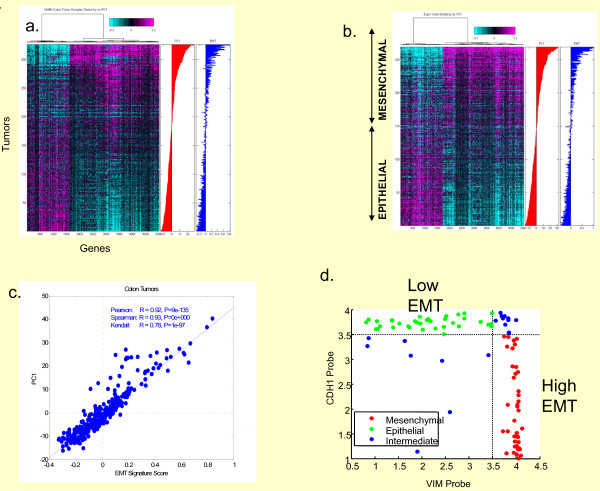
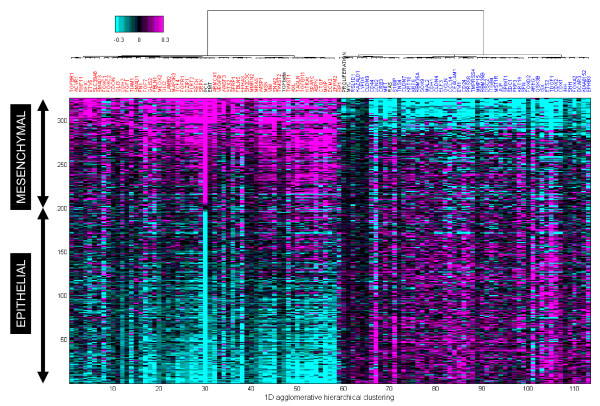
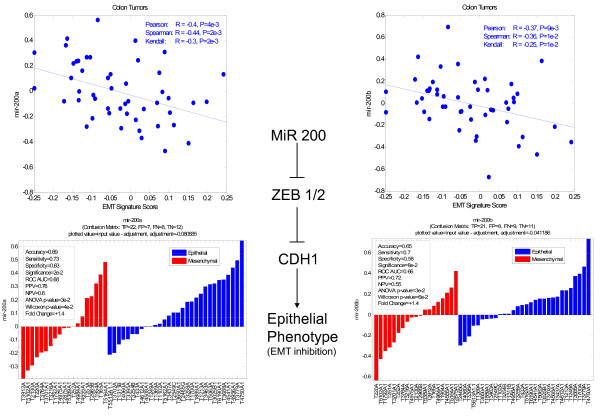
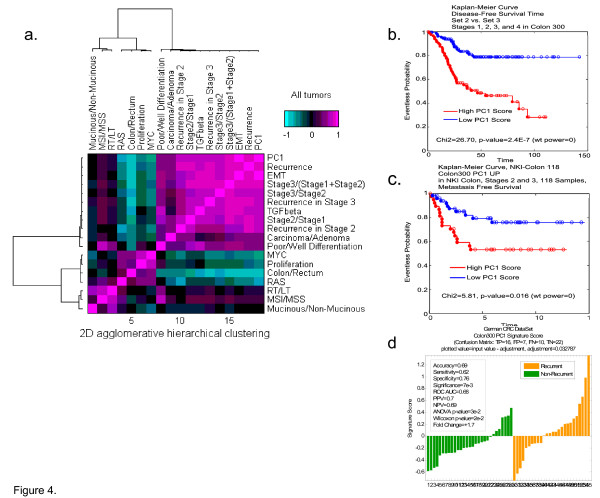
Background: Colon cancer has been classically described by clinicopathologic features that permit the prediction of outcome only after surgical resection and staging. Methods: We performed an unsupervised analysis of microarray data from 326 colon cancers to identify the first principal component (PC1) of the most variable set of genes. PC1 deciphered two primary, intrinsic molecular subtypes of colon cancer that predicted disease progression and recurrence. Results: Here we report that the most dominant pattern of intrinsic gene expression in colon cancer (PC1) was tightly correlated (Pearson R = 0.92, P < 10-135) with the EMT signature-- both in gene identity and directionality. In a global micro-RNA screen, we further identified the most anti-correlated microRNA with PC1 as MiR200, known to regulate EMT. Conclusions: These data demonstrate that the biology underpinning the native, molecular classification of human colon cancer--previously thought to be highly heterogeneous-- was clarified through the lens of comprehensive transcriptome analysis.
Overview
The claims and statistics of this paper haven’t been checked yet.
Free: it reads the open-access text and checks the first 5 claims that cite a source we can check. Create a free account to check every claim.
Integrity signals
Registry
Cites
Statistics
Figures
Verification
Claims the paper makes
The claims and statistics of this paper haven’t been checked yet.
Free: it reads the open-access text and checks the first 5 claims that cite a source we can check. Create a free account to check every claim.
Claims other papers make about this one
Each is checked against this paper’s own text: does it say what the citing paper says it does?
The cited source says what the claim attributes to it.
In the citing paper
“supporting the notion that EMT is arguably the dominant program in human CRC [25]”
From An integrative gene expression signature analysis identifies CMS4 KRAS-mutated colorectal cancers sensitive to combined MEK and SRC targeted therapy (2022) · cites this paper as [25]
The cited source says what the claim attributes to it.
In the citing paper
“Now our new analysis in 2250 CRC tumors confirmed this tight correlation between EMT and PC1 signature scores (Spearman r = 0.92, P < 10–320, Fig. 3a), supporting the notion that EMT is arguably the dominant program in human CRC [25].”
From An integrative gene expression signature analysis identifies CMS4 KRAS-mutated colorectal cancers sensitive to combined MEK and SRC targeted therapy (2022) · cites this paper as [25]
Self-check
Percentages, sums and reported differences re-computed from the paper’s own numbers.
The self-check needs the paper’s full text.
Citations
Cites
Hanahan, D., & Weinberg, R. A. (2000) · Cell · doi:10.1016/s0092-8674(00)81683-9 · Cited by 29,219
Gregory, P. A., Bert, A. G., Paterson, E. L., Barry, S. C., Tsykin, A., Farshid, G., Vadas, M. A., Khew-Goodall, Y., & Goodall, G. J. (2008) · Nature Cell Biology · doi:10.1038/ncb1722 · Cited by 3,863 · cited 1×
“It has been previously demonstrated that MiR 200 over-expression may result in inhibition of ZEB1/2, which in turn leads to inhibition of transcriptional repressors of CDH1, thereby permitting the expression of CDH1 and expression of the epithelial phenotype [26,27].”
BackgroundPark, S.-M., Gaur, A. B., Lengyel, E., & Peter, M. E. (2008) · Genes & Development · doi:10.1101/gad.1640608 · Cited by 2,272 · cited 1×
“It has been previously demonstrated that MiR 200 over-expression may result in inhibition of ZEB1/2, which in turn leads to inhibition of transcriptional repressors of CDH1, thereby permitting the expression of CDH1 and expression of the epithelial phenotype [26,27].”
BackgroundOncogenic pathway signatures in human cancers as a guide to targeted therapies
Bild, A. H., Yao, G., Chang, J. T., Wang, Q., Potti, A., Chasse, D., Joshi, M.-B., Harpole, D., Lancaster, J. M., Berchuck, A., et al. (2006) · Nature · doi:10.1038/nature04296 · Cited by 2,032 · cited 1×
“MYC and RAS signatures were obtained from Nevins et al [16,17].”
MethodEdwards, B. K., Ward, E., Kohler, B. A., Eheman, C., Zauber, A. G., Anderson, R. N., Jemal, A., Schymura, M. J., Lansdorp‐Vogelaar, I., Seeff, L. C., et al. (2010) · Cancer · doi:10.1002/cncr.24760 · Cited by 2,002 · cited 1×
“Analysis of other cancers such as pancreas and lung demonstrate a spectrum of EMT across diseases (colon < lung < pancreas) that may explain the differential survivability of these cancers (colon > lung > pancreas), variable recurrence rates, and responses to therapy [31].”
BackgroundDesmedt, C., Piette, F., Loi, S., Wang, Y., Lallemand, F., Haibe-Kains, B., Viale, G., Delorenzi, M., Zhang, Y., d'Assignies, M. S., et al. (2007) · Clinical Cancer Research · doi:10.1158/1078-0432.ccr-06-2765 · Cited by 968
Singh, A., Greninger, P., Rhodes, D., Koopman, L., Violette, S., Bardeesy, N., & Settleman, J. (2009) · Cancer Cell · doi:10.1016/j.ccr.2009.03.022 · Cited by 841 · cited 1×
“Alternatively, RAS activation/dependency/ addiction has been shown to anti-correlate with EMT [19].”
BackgroundBiological Processes Associated with Breast Cancer Clinical Outcome Depend on the Molecular Subtypes
Desmedt, C., Haibe-Kains, B., Wirapati, P., Buyse, M., Larsimont, D., Bontempi, G., Delorenzi, M., Piccart, M., & Sotiriou, C. (2008) · Clinical Cancer Research · doi:10.1158/1078-0432.ccr-07-4756 · Cited by 828 · cited 1×
“Colon cancer, unlike breast cancer where luminal and basal “intrinsic” subtypes have been identified [7-13], or bladder cancer where intrinsic signatures of recurrence have been established [14,15], has yet to be classified by unsupervised, molecular profiling approaches.”
BackgroundSmith, J. J., Deane, N. G., Wu, F., Merchant, N. B., Zhang, B., Jiang, A., Lu, P., Johnson, J. C., Schmidt, C., Bailey, C. E., et al. (2010) · Gastroenterology · doi:10.1053/j.gastro.2009.11.005 · Cited by 716 · cited 1×
“poor prognosis patient populations [2-6].”
Self-citationGene Expression Profiles and Molecular Markers To Predict Recurrence of Dukes' B Colon Cancer
Wang, Y., Jatkoe, T., Zhang, Y., Mutch, M. G., Talantov, D., Jiang, J., McLeod, H. L., & Atkins, D. (2004) · Journal of Clinical Oncology · doi:10.1200/jco.2004.08.186 · Cited by 460 · cited 1×
“poor prognosis patient populations [2-6].”
Cited by
Items 201–279 of 279
Heryanto, Y. D., & Imoto, S. (2023) · Scientific Reports · doi:10.1038/s41598-023-45792-y · Cited by 10
Translating colorectal cancer genetics into clinically useful biomarkers
Morley-Bunker, A. E., Walker, L. C., Currie, M. J., Pearson, J. F., & Eglinton, T. (2016) · Colorectal Disease · doi:10.1111/codi.13334 · Cited by 12
Heo, Y. J., Park, C., Yu, D., Lee, J., & Kim, K. (2019) · Scientific Reports · doi:10.1038/s41598-019-46216-6 · Cited by 11
Yeh, S., Chen, S., & Chen, B. (2020) · Frontiers in Genetics · doi:10.3389/fgene.2020.00117 · Cited by 10
“At this stage, TF TP53 and ZEB1 are two potential factors of tumor progression, which are modi fi ed by mutation to cause cell migration (Malkin et al., 1990; Ghosh et al., 2004; Loboda et al., 2011).”
BackgroundHow Can Next-Generation Sequencing (Genomics) Help Us in Treating Colorectal Cancer?
Ciombor, K. K., Haraldsdóttir, S., & Goldberg, R. M. (2014) · Current Colorectal Cancer Reports · doi:10.1007/s11888-014-0244-3 · Cited by 11
Identification of anticancer drugs to radiosensitise BRAF-wild-type and mutant colorectal cancer
Carter, R., Cheraghchi-Bashi, A., Westhorpe, A., Sheng, Y., Shanneik, Y., Elena, S., Ouaret, D., Yasuhiro, I., Catherine, K., Wilding, J., et al. (2019) · Cancer Biology and Medicine · doi:10.20892/j.issn.2095-3941.2018.0284 · Cited by 9
Kagawa, H., Hatakeyama, K., Shiomi, A., Hino, H., Manabe, S., Yamaoka, Y., Nagashima, T., Ohshima, K., Urakami, K., & Yamaguchi, K. (2022) · Biomedical Research · doi:10.2220/biomedres.43.201 · Cited by 9
Wu, J., Liu, S., Chen, X., Xu, H., & Tang, Y. (2020) · Journal of International Medical Research · doi:10.1177/0300060520958808 · Cited by 8
“GSE28722 contained 129 samples of CRC patients with survival information, which we used to validate the prognostic capacity of ARG signatures in this cohort.(37,38) The annotation files of these microarrays were downloaded from the GEO website.”
MethodJin, Q., Liu, G., Domeier, P. P., Ding, W., & Mulder, K. M. (2013) · PLoS ONE · doi:10.1371/journal.pone.0066439 · Cited by 8
“Since our current findings demonstrate that km23-1 depletion can decrease CRC migration and invasion in the nonEMT-correlated subtype of CRC, our data also indicate that inhibition of cell migration and invasion of human CRC cells can occur via mechanisms that do not involve EMT.”
BackgroundInfluentialmiR663a‑TTC22V1 axis inhibits colon cancer metastasis
Tian, W., Du, Y., Ma, Y., Zhang, B., Gu, L., Zhou, J., & Deng, D. (2019) · Oncology Reports · doi:10.3892/or.2019.6969 · Cited by 9
Mikula, M. W., Najjar, S. N., Jabbour, T. E., Dalvi, S., Umrau, K., Li, H., Koo, B. H., & Lee, H. (2020) · Applied immunohistochemistry & molecular morphology · doi:10.1097/pai.0000000000000888 · Cited by 8
Nair, V. A., Malhab, L. J. B., & Abdel‐Rahman, W. M. (2022) · International Journal of Molecular Sciences · doi:10.3390/ijms231911620 · Cited by 8
“Taken together, the majority of the genes dysregulated by BPA in colon epithelial cells augment EMT, which is the most dominant phenotype in colorectal cancer [43], and they contribute to the proliferation, invasion, and metastasis of cancer cells and/or the resistance to therapy.”
BackgroundAscierto, P. A., Tang, H., Dolfi, S. C., Nyakas, M., Svane, I. M., Muñoz‐Couselo, E., Grob, J., Gomez‐Roca, C., Chiarion‐Sileni, V., Peltola, K. J., et al. (2025) · Journal for ImmunoTherapy of Cancer · doi:10.1136/jitc-2024-009773 · Cited by 7
Tian, S., Wang, F., Lu, S., Wu, R., & Chen, G. (2020) · Cancer Investigation · doi:10.1080/07357907.2020.1843662 · Cited by 11
An, N., Zhao, C., Yu, Z., & Yang, X. C. (2018) · Oncology Letters · doi:10.3892/ol.2018.9632 · Cited by 9
Single-cell multiomic modelling of early metastatic events promoted by the extracellular matrix
Lee, H. J., Lee, J. H., Kang, J., Kim, K., Cho, Y., Park, J., Song, S., Kwon, J., Kim, Y., Park, W., et al. (2025) · British Journal of Cancer · doi:10.1038/s41416-025-03181-4 · Cited by 7
“The ssGSEA scores for gene sets associated with WNT targets [23], cancer stem cell [24], epithelial, mesenchymal feature [25], EMT activation [26], wound response (GO_BP), immune in fi ltration (GO_BP), JAK-STAT (KEGG), VEGF, VEGFR (R-HSA-194138), invasion signature [27], degradation of ECM…”
Pan, J., Xu, Z., Xu, M., Lin, X., Lin, B.-Q., & Lin, M. (2020) · Journal of International Medical Research · doi:10.1177/0300060520971453 · Cited by 6
“EMT plays a vital role in the progression of colon cancer.(17) To evaluate the effects of FOXA1 knockdown on EMT, we detected the expression of epithelial and mesenchymal markers using RT-qPCR and western blotting.”
MethodZhu, Z., Li, J., Fa, Z., Xu, X., Wang, Y., Zhou, J., & Xu, Y. (2024) · BMC Cancer · doi:10.1186/s12885-024-12996-y · Cited by 6
“The independent validation sets for the functional gene signature (FGS) included GSE39582 [22], GSE17538 [23– 26], GSE38832 [27], GSE28722 [28], and GSE103479 [29].”
MethodMolecular classification of esophagogastric junction carcinoma correlated with prognosis
Zou, L., Wu, Y., Ma, K., Fan, Y., Dong, D., Geng, N., & Li, E. (2017) · OncoTargets and Therapy · doi:10.2147/ott.s145912 · Cited by 6
“10 16–18 The classification includes four subtypes characterized by microsatellite-instable (MSI), microsatellite stable with markers of epithelial-to-mesenchymal transition (MSS/EMT), microsatellite stable with active tumor protein 53 (MSS/TP53 + ), and microsatellite stable with inactive TP53…”
Shi, Y., Zou, Y., Guo, Y., Liu, Y., & Wang, Q. (2023) · PubMed Central · Cited by 7
Molecular classification of colorectal cancer using the gene expression profile of tumor samples
Rashid, M., Vishwakarma, R. K., Deeb, A., Hussein, M., & Aziz, M. A. (2019) · Experimental Biology and Medicine · doi:10.1177/1535370219850788 · Cited by 6
Yang, M., Nebozhyn, M., Schell, M. J., Gandhi, N. S., Pflieger, L. T., Loboda, A. P., Pledger, W. J., Soundararajan, R., Maurin, M. M., Wang, H., et al. (2025) · BMC Cancer · doi:10.1186/s12885-025-13829-2 · Cited by 5
“We previously reported an epithelial-to-mesenchymal transition (EMT)-based gene expression signature score that was highly-correlated to the PC1 (the first principal component) signature score in human CRC tumors [19].”
Self-citationPrognosis and Therapeutic Implications for Emerging Colorectal Cancer Subtypes
Sanz‐García, E., Élez, E., Macarulla, T. M., Dienstmann, R., Salazar, R., & Tabernero, J. M. (2014) · Current Colorectal Cancer Reports · doi:10.1007/s11888-013-0205-2 · Cited by 8
Ghalehno, A. D., Boustan, A., Abdi, H., Aganj, Z., Mosaffa, F., & Jamialahmadi, K. (2022) · Nutrition and Cancer · doi:10.1080/01635581.2021.2022169 · Cited by 5
Liu, Y.-H., Shen, M.-M., Wu, Y.-C., Luo, K., Zhang, J., Wang, Z., Chen, Z., Li, J., Wu, S.-Y., Lin, N., et al. (2023) · Phytomedicine · doi:10.1016/j.phymed.2023.155204 · Cited by 6
Faleti, O. D., Gong, Y., Long, J., Luo, Q., Tan, H., Deng, S., Qiu, L., Lyu, X., Yao, J., & Wu, G. (2024) · Heliyon · doi:10.1016/j.heliyon.2024.e37714 · Cited by 5
“It is well established that epithelial-mesenchymal transition (EMT) plays a crucial role in colon cancer metastasis [19,20].”
Varlı, M., Lee, K., Kang, K. B., & Kim, H. (2024) · Molecules and Cells · doi:10.1016/j.mocell.2024.100143 · Cited by 5
Murcott, B., Honig, F., Halliwell, D. O., Tian, Y., Robson, J. L., Manasterski, P. J., Pinnell, J., Dix‐Peek, T., Uribe‐Lewis, S., Ibrahim, A. E. K., et al. (2025) · BMC Biology · doi:10.1186/s12915-025-02205-y · Cited by 5
“An independent data set [29, 30] demonstrated poor metastasis-free survival in patients with high TET2 expression levels and our zebrafish xenograft assays further support a role for TET2 in metastatic transformation in colon cancer.”
InfluentialCAsubtype: An R Package to Identify Gene Sets Predictive of Cancer Subtypes and Clinical Outcomes
Kong, H., Tong, P., Zhao, X., Sun, J., & Li, H. (2017) · Interdisciplinary Sciences Computational Life Sciences · doi:10.1007/s12539-016-0198-z · Cited by 5
“A gene set consisting of 310 genes was identified in lung cancer as an EMT gene signature that was significantly up-or downregulated in 93 lung cancer samples compared with cell lines exhibiting mesenchymal-like or epithelial-like gene expression patterns [16].”
BackgroundColorectal cancer heterogeneity co-evolves with tumor architecture to determine disease outcomePreprint
Bertillot, F., Hervé, S., Drobjazko, N., Kedei, N., Gendi, M. A. E., Hernandez, M. O., Kruse, K., Erkan, E. P., Binner, M., Punovuori, K., et al. (2025) · bioRxiv (Cold Spring Harbor Laboratory) · doi:10.1101/2025.08.11.669722 · Cited by 6
Mahajan, M., Sarkar, A., & Mondal, S. (2024) · Cancer Medicine · doi:10.1002/cam4.7391 · Cited by 4
Reliable Epithelial–Mesenchymal Transition Biomarkers for Colorectal Cancer Detection
Goettsch, K. A., Zhang, L., Singh, A. B., Dhawan, P., & Bastola, D. K. (2022) · Biomarkers in Medicine · doi:10.2217/bmm-2022-0071 · Cited by 4
Vonica, R. C., Morgovan, C., Butucă, A., Pumnea, M., Cipăian, R. C., Frum, A., Dobrea, C. M., Vonica-Țincu, A. L., Pacnejer, A.-M., Batâr, F., et al. (2025) · Cancers · doi:10.3390/cancers17040663 · Cited by 4
“The growth of tumor stem cells that contribute to tumor aggressiveness and insensitivity to the mechanism of action of PAN is associated with EMT [45].”
Davis, T. B., Gupta, S., Yang, M., Pflieger, L. T., Rajan, M., Wang, H., Thota, R., Yeatman, T. J., & Pledger, W. J. (2022) · Cancers · doi:10.3390/cancers14061451 · Cited by 4
“The signature scores were calculated as previously described [35,36].”
MethodSelf-citationHu, C., Cai, D., You, W., Zhou, Z., 刘军伟, Li, C., Lv, M., Gai, B., Chen, C., Huang, X., et al. (2026) · Cancer Letters · doi:10.1016/j.canlet.2026.218425 · Cited by 3
Comprehensive analysis of location-specific hub genes related to the pathogenesis of colon cancer
Shi, C., Ding, K., Li, K., Long, L., Li, J., & Hu, B.-L. (2020) · Medical Oncology · doi:10.1007/s12032-020-01402-9 · Cited by 5
Impact of somatic mutations and transcriptomic alterations on cancer aneuploidy
Hatakeyama, K., NAGASHIMA, T., Ohshima, K., Ohnami, S., Ohnami, S., Shimoda, Y., Naruoka, A., Maruyama, K., Iizuka, A., Ashizawa, T., et al. (2023) · Biomedical Research · doi:10.2220/biomedres.44.187 · Cited by 3
Yeom, J., Kang, M., Shin, D., Song, H. K., Lee, C., & Lee, J. E. (2015) · Analytical Biochemistry · doi:10.1016/j.ab.2015.03.005 · Cited by 3
Sparse relative risk regression models
Wit, E. C., Augugliaro, L., Pazira, H., González, J., & Abegaz, F. (2018) · Biostatistics · doi:10.1093/biostatistics/kxy060 · Cited by 3
“In particular, we focus on the identification of genes involved in the regulation of colon cancer (Loboda and others , 2011), prostate cancer (Ross and others , 2012), ovarian cancer (Gillet and others , 2012) and skin cancer (J¨onsson and others , 2010).”
BackgroundJun, X., Gao, S., Yu, L., & Wang, G. (2023) · Frontiers in Oncology · doi:10.3389/fonc.2023.1123455 · Cited by 3
“The signature list of CRC pathologic phenotypes and drug-related genes obtained from previous studies is as follows: intestinal stem cell signature (29), colon crypt signature (30), serrated CRC signature (31), EMT signature (32), FOLFIRI response signature (33), FOLFOX response signature (34) and VEFG/EGFRi signature…”
BackgroundPamplona, R. S., Santos, C., Grasselli, J., Molleví, D. G., Dienstmann, R., Paré, L., Sanjuán, X., Biondo, S., Capellá, G., Tabernero, J. M., et al. (2014) · Colorectal Cancer · doi:10.2217/crc.14.15 · Cited by 4
Shang, Z., Wang, Z., Zhang, Y., & Liu, S. (2023) · Translational Cancer Research · doi:10.21037/tcr-23-747 · Cited by 2
“Current in vivo and in vitro experimental evidence suggests that EMT plays an important role in primary invasion and secondary metastasis of CC. Due to the occurrence of EMT, the cells show loss of polarity, decreased adhesion and enhanced migration ability (46,47).”
BackgroundWang, H., Wang, J., Shi, X., & Ding, Y. (2018) · PubMed · Cited by 2
Evolutionary computation with noise perturbation and cluster analysis to discover biomarker sets
Mathur, R., Schaffer, J. D., LandJr., W. H., Heine, J., Eschrich, S. A., & Yeatman, T. J. (2011) · Procedia Computer Science · doi:10.1016/j.procs.2011.08.030 · Cited by 2
“This paper describes a GA-SVM hybrid along with Gaussian noise perturbation (with a manual noise gain) to combat over-fitting; determine the strongest signal in the dataset; and discover stable biomarker sets.”
BackgroundSelf-citationValoración de jóvenes escolares ante una experiencia de Kickboxing educativo
Santurio, J. I. M., & Fernández‐Río, J. (2014) · Dialnet (Universidad de la Rioja) · Cited by 2
Ang, K. S., Lee, H. K., Chevrier, M., Goh, M., Ling, J., Koh, V., Xu, H., Zhang, X., Tan, J. C., Lee, N. Y. S., et al. (2020) · bioRxiv (Cold Spring Harbor Laboratory) · doi:10.1101/2020.10.23.351726 · Cited by 3
“The enhanced motility and invasiveness of the cancer cells acquired through EMT is critical in the initiation of metastasis for cancer progression, and is strongly associated with poor disease prognosis in both colorectal (Loboda et al., 2011) and gastric cancers (Cristescu et al., 2015).”
BackgroundDu, J.-O., Huang, Q., Sun, X.-C., Hu, S., & Lin, T. (2026) · Science Progress · doi:10.1177/00368504261432995 · Cited by 1
Using gene sets to identify putative drugs for breast cancer
Hsiao, T., Chen, H.-I. H., Chen, Y., Chen, Y., & Chuang, E. Y.-Y. (2012) · IEEE International Conference on Bioinformatics and Biomedicine (BIBM) · doi:10.1109/bibm.2012.6392616 · Cited by 1
“[19] A. Loboda, et al., "EMT is the dominant program in human colon cancer," BMC Med Genomics, vol. 4, p. 9, 2011.”
BackgroundCancer Biomarkers and Targets in Digestive Organs
Yee, N. S., & Lee, N. P. Y. (2019) · MDPI eBooks · doi:10.3390/books978-3-03921-464-8 · Cited by 1
TBX2‐WNT3A Axis Mediates the Development of Colorectal Cancer In Vitro and In Vivo
Zhou, Y., Dong, M., & Li, X. (2023) · Advanced Therapeutics · doi:10.1002/adtp.202200306 · Cited by 1
Özcan, S. Y. (2014) · Bilkent University Institutional Repository (Bilkent University) · Cited by 1
Characterisation of cancer stem cells and the renin-angiotensin system in colon adenocarcinoma
Munro, M. J. (2021) · Open Access Victoria University of Wellington | Te Herenga Waka (Figshare) · doi:10.26686/wgtn.14331389 · Cited by 1
Kim, K., Lee, J. E., Cheong, J., Cho, I., & Choi, Y. Y. (2023) · bioRxiv (Cold Spring Harbor Laboratory) · doi:10.1101/2023.10.15.562367 · Cited by 1
“Comparing this set with well-established gene-sets in GC biology [8, 37-41] and consensus cancer driver genes, [42] most genes within the msEMT genes set were novel, suggesting the unique nature of this gene-set (Supplementary Tables 4).”
ResultMésange, P. (2014) · theses.fr (ABES) · doi:10.70675/b54b0ca3za773z4142z84b4z56f9d0182645
“L’EMT a été identifié comme la signature transcriptionnelle majeure dans le cancer colorectal [38].”
BackgroundElucidating the molecular aspects of colorectal cancer and their clinical importance
Sanz‐García, E., Marino, D., Élez, E., Macarulla, T. M., Capdevila, J., Alsina, M., Argilés, G., Saurí, T., & Tabernero, J. M. (2015) · Colorectal Cancer · doi:10.2217/crc.15.21
Towards functional multiscale analysis of colorectal cancer
Briffa, R. (2014) · ERA
Résistance aux inhibiteurs de tyrosine kinase : MED12, un médiateur à considérer !
Bénard, J. (2013) · Bulletin du Cancer · doi:10.1684/bdc.2013.1691
Investigating the Role of the Epithelial-Mesenchymal Plasticity in Prostate Cancer
Stylianou, N. (2017) · Queensland University of Technology · doi:10.5204/thesis.eprints.107979
Luk, I. Y. (2017) · Minerva Access (University of Melbourne)
Le phénotype mésenchymateux et la réponse aux agents anti-VEGF dans le cancer colorectal
Bouygues, A. (2017) · theses.fr (ABES) · doi:10.70675/d2cb47fcz0175z408fza7acz8b8a19d816ae · Cited by 1
Busch, E. L. (2015) · Carolina Digital Repository (University of North Carolina at Chapel Hill) · doi:10.17615/0qtz-bc18 · Cited by 1
Cai, X., Chen, Y., Zheng, C., & Xu, R. (2017) · PubMed Central
Scoping for RNA biomarkers in colorectal cancer
Morley-Bunker, A. E. (2020) · Otago University Research Archive (University of Otago)
Kadife, E. (2018) · Victoria University Research Repository (Victoria University)
Alsaihati, B. A., & Zhao, S. (2020) · bioRxiv (Cold Spring Harbor Laboratory) · doi:10.1101/2020.12.21.423844
“We retrieved published data for the stemness index scores (mDNAsi and mRNAsi) of TCGA samples [20] and gene signatures of tumor and immune microenvironments [21-26].”
MethodMolecular Classification of Colorectal Cancer Using Gene Expression Profile of Tumor SamplesPreprint
Rashid, M., Vishwakarma, R. K., Deeb, A., Hussein, M. A., & Aziz, M. A. (2018) · Preprints.org · doi:10.20944/preprints201804.0016.v1
Yang, K., Jiang, L., Hu, Y., Yu, J. X., Chen, H., Yao, Y., & Zhu, X. (2021) · Journal of Experimental & Clinical Cancer Research · doi:10.1186/s13046-021-01918-6
Using Differential Geometry for Sparse High-Dimensional Risk Regression Models
Augugliaro, L., Wit, E. C., Pazira, H., González, J., Abegaz, F., & Mineo, A. M. (2023) · Springer proceedings in mathematics & statistics · doi:10.1007/978-3-031-15885-8_2
Supplementary Appendices 1 and 2 from MicroRNA Signatures: Novel Biomarker for Colorectal Cancer?
Luo, X., Burwinkel, B., Tao, S., & Brenner, H. (2023) · doi:10.1158/1055-9965.22435297
Konen, J. M., Rodriguez, B. L., Padhye, A., Ochieng, J. K., Gibson, L., Diao, L., Fowlkes, N. W., Fradette, J. J., Peng, D. H., Cardnell, R. J., et al. (2023) · doi:10.1158/0008-5472.c.6512518.v1
Sun, L., Yang, X., Huang, X., Yao, Y., Wei, X., Yang, S., Zhou, D., Zhang, W., Long, Z., Xu, X., et al. (2023) · doi:10.1158/0008-5472.22427154.v1
Nygaard, V., Ree, A. H., Dagenborg, V. J., Børresen‐Dale, A., Edwin, B., Fretland, Å. A., Grzyb, K., Haugen, M. H., Mælandsmo, G. M., & Flatmark, K. (2023) · doi:10.1158/2767-9764.c.6551114
Bahrami-Banan, F., Taherkhani, A., Najafi, R., Alizadeh, N., Ghadimipour, H., Barati, N., Derakhshandeh, K., & Soleimani, M. (2025) · Research in Pharmaceutical Sciences · doi:10.4103/rps.rps_128_23
“The subject highlighted the significance of continuous research in uncovering novel biomarkers and molecular pathways distinguishing aggressive primary colorectal tumors with high metastatic preference (20).”
Additional file 1 of Identification of TRPV4 as a novel target in invasiveness of colorectal cancer
Zhang, P., Xu, J., Zhang, H., & Liu, X.-Y. (2021) · Figshare · doi:10.6084/m9.figshare.17073245
Classification et caractérisation des cancers colorectaux par approches omiques
Marisa, L. (2015) · theses.fr (ABES) · doi:10.70675/aa89d091z935fz4a92zaec1z016589810d2d · Cited by 1
Identification of new biomarkers for colorectal cancers
Hasanova, R. (2019) · theses.fr (ABES) · doi:10.70675/38dbe0adza892z41d3za889zbee31c0eb152
Cai, D., Qi, H., Yang, Q., Zhao, Y., Li, C., Hu, C., Zhang, Y., Huang, R., Mao, W., Wu, X., et al. (2026) · Research · doi:10.34133/research.1435
“Because tumor volume and maximum axial diameter were derived from the same ROI as the imaging features, tumor size may represent state associated with adverse outcome [ 4 – 6 , 19 , 20 ].”
Metadata
- Authors
- Loboda, A., Nebozhyn, M. V., Watters, J. W., Buser, C. A., Shaw, P. M., Huang, P. S., Van't Veer, L., Tollenaar, R. A., Jackson, D. B., Agrawal, D., Dai, H., & Yeatman, T. J.
- Affiliations
- Merck & Co., Inc., Rahway, NJ, USA (United States) (US)
- Leiden University Medical Center (NL)
- Moffitt Cancer Center (US)
- Corresponding author
- Yeatman, Timothy J
- ORCID
- Venue
- BMC Medical Genomics
- Published
- 2011-01-20
- Volume
- 4
- Issue
- 1
- Pages
- 9-9
- ISSN
- 1755-8794 (ISSN-L)
- PMC
- PMC3032646
- OpenAlex
- W1998558839
- Cited by
- 274
- References
- 32
- Citations by year
- 2026: 3 · 2025: 10 · 2024: 7 · 2023: 21 · 2022: 12 · 2021: 21 · 2020: 22 · 2019: 21 · 2018: 27 · 2017: 18 · 2016: 24 · 2015: 24 · 2014: 26 · 2013: 14 · 2012: 20
- FWCI
- 8.32
- Type
- journal article
- Language
- en
- Open access
- gold
- doi.org
- Licence
- Locations
- BMC Medical Genomics (publishedVersion, cc-by)
- PubMed Central (publishedVersion, cc-by)
- PubMed (publishedVersion)
- Data Archiving and Networked Services (DANS) (submittedVersion)
- Leiden Repository (Leiden University) (submittedVersion)
- DOAJ (DOAJ: Directory of Open Access Journals) (submittedVersion)
- Funders
- Florida Department of Health
- National Institutes of Health (08BR-02)
- National Cancer Institute (CA112215, R01CA112215, 08BR-02)
- Topics
- Life Sciences › Biochemistry, Genetics and Molecular Biology › Molecular Biology › Gene expression and cancer classification
- Health Sciences › Medicine › Oncology › Cancer Cells and Metastasis
- Life Sciences › Biochemistry, Genetics and Molecular Biology › Cancer Research › MicroRNA in disease regulation
- Keywords
- colon cancer, epithelial-mesenchymal transition, molecular subtypes, gene expression signatures, principal component analysis, microRNA, miR-200 family, recurrence, tumor progression, gene expression profiling
- MeSH terms
- Colonic Neoplasms, Humans, Recurrence, Vimentin, Disease Progression, Gene Expression Profiling, Principal Component Analysis, Cell Line, Tumor, Epithelial-Mesenchymal Transition
About these checks
Registry, retraction, Cites and statistics results are computed, not judged, with one exception: a printed reference that no index lists is read once by a model before it counts as a citation error. Claims are extracted by a model and kept only when their quote appears verbatim in the text; each cited source is then checked, with a model’s help, for whether it says what the claim relies on. Those verdicts can be wrong — read the claim’s quote and the cited source before relying on one.
Statistics and arithmetic are recomputed, not judged.
Confidence bands are shown only for fields calibrated on our annotated test set. None is calibrated yet, so no band is shown.
What counts as a claim ›How we measure confidence ›How we check this ›
Are you an author, or do you see a problem with this page? Request a review
Data sources
Bibliographic data: Semantic Scholar, OpenAlex, Crossref.
Contains information from the Semantic Scholar Academic Graph Datasets, made available under the ODC Attribution License (ODC-BY 1.0).
Semantic Scholar’s data is described in: Kinney, R., et al. (2023). The Semantic Scholar Open Data Platform. arXiv:2301.10140.
