

EMT is the dominant program in human colon cancer
Open accessThe DOI matches its Crossref record; 32 of the 32 references it cites were found in a registry or an index.
Abstract
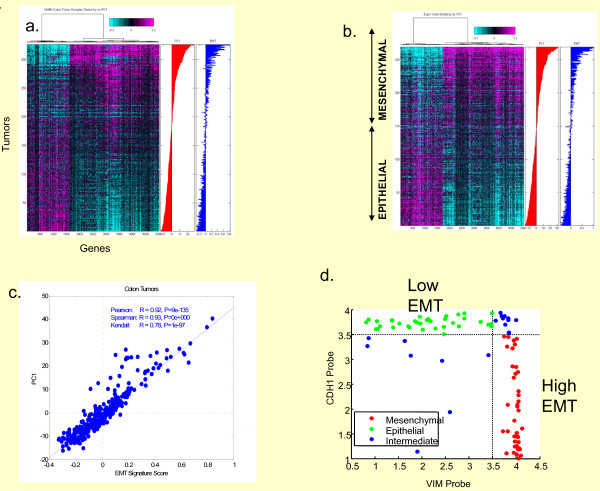
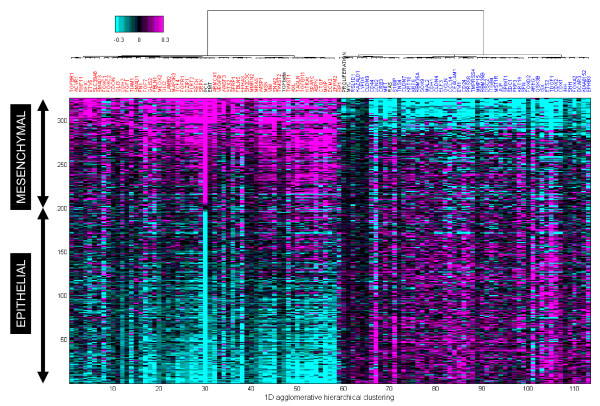
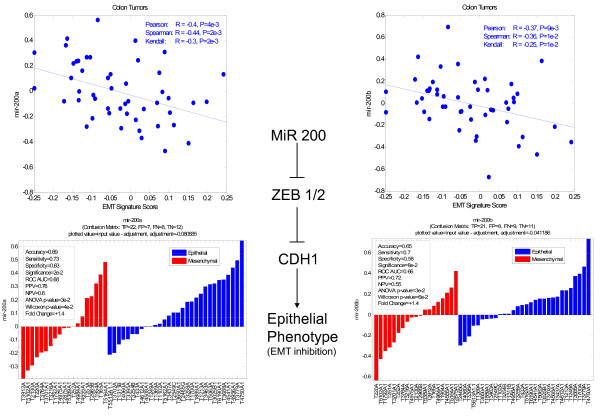
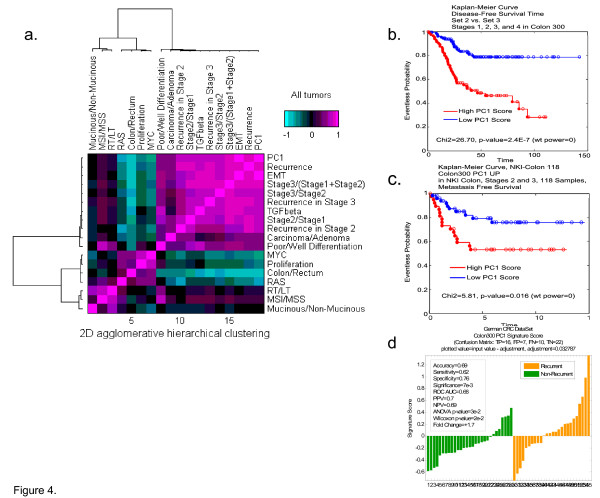
Background: Colon cancer has been classically described by clinicopathologic features that permit the prediction of outcome only after surgical resection and staging. Methods: We performed an unsupervised analysis of microarray data from 326 colon cancers to identify the first principal component (PC1) of the most variable set of genes. PC1 deciphered two primary, intrinsic molecular subtypes of colon cancer that predicted disease progression and recurrence. Results: Here we report that the most dominant pattern of intrinsic gene expression in colon cancer (PC1) was tightly correlated (Pearson R = 0.92, P < 10-135) with the EMT signature-- both in gene identity and directionality. In a global micro-RNA screen, we further identified the most anti-correlated microRNA with PC1 as MiR200, known to regulate EMT. Conclusions: These data demonstrate that the biology underpinning the native, molecular classification of human colon cancer--previously thought to be highly heterogeneous-- was clarified through the lens of comprehensive transcriptome analysis.
Overview
The claims and statistics of this paper haven’t been checked yet.
Free: it reads the open-access text and checks the first 5 claims that cite a source we can check. Create a free account to check every claim.
Integrity signals
Registry
Cites
Statistics
Figures
Verification
Claims the paper makes
The claims and statistics of this paper haven’t been checked yet.
Free: it reads the open-access text and checks the first 5 claims that cite a source we can check. Create a free account to check every claim.
Claims other papers make about this one
Each is checked against this paper’s own text: does it say what the citing paper says it does?
The cited source says what the claim attributes to it.
In the citing paper
“supporting the notion that EMT is arguably the dominant program in human CRC [25]”
From An integrative gene expression signature analysis identifies CMS4 KRAS-mutated colorectal cancers sensitive to combined MEK and SRC targeted therapy (2022) · cites this paper as [25]
The cited source says what the claim attributes to it.
In the citing paper
“Now our new analysis in 2250 CRC tumors confirmed this tight correlation between EMT and PC1 signature scores (Spearman r = 0.92, P < 10–320, Fig. 3a), supporting the notion that EMT is arguably the dominant program in human CRC [25].”
From An integrative gene expression signature analysis identifies CMS4 KRAS-mutated colorectal cancers sensitive to combined MEK and SRC targeted therapy (2022) · cites this paper as [25]
Self-check
Percentages, sums and reported differences re-computed from the paper’s own numbers.
The self-check needs the paper’s full text.
Citations
Cites
Hanahan, D., & Weinberg, R. A. (2000) · Cell · doi:10.1016/s0092-8674(00)81683-9 · Cited by 29,219
Gregory, P. A., Bert, A. G., Paterson, E. L., Barry, S. C., Tsykin, A., Farshid, G., Vadas, M. A., Khew-Goodall, Y., & Goodall, G. J. (2008) · Nature Cell Biology · doi:10.1038/ncb1722 · Cited by 3,863 · cited 1×
“It has been previously demonstrated that MiR 200 over-expression may result in inhibition of ZEB1/2, which in turn leads to inhibition of transcriptional repressors of CDH1, thereby permitting the expression of CDH1 and expression of the epithelial phenotype [26,27].”
BackgroundPark, S.-M., Gaur, A. B., Lengyel, E., & Peter, M. E. (2008) · Genes & Development · doi:10.1101/gad.1640608 · Cited by 2,272 · cited 1×
“It has been previously demonstrated that MiR 200 over-expression may result in inhibition of ZEB1/2, which in turn leads to inhibition of transcriptional repressors of CDH1, thereby permitting the expression of CDH1 and expression of the epithelial phenotype [26,27].”
BackgroundOncogenic pathway signatures in human cancers as a guide to targeted therapies
Bild, A. H., Yao, G., Chang, J. T., Wang, Q., Potti, A., Chasse, D., Joshi, M.-B., Harpole, D., Lancaster, J. M., Berchuck, A., et al. (2006) · Nature · doi:10.1038/nature04296 · Cited by 2,032 · cited 1×
“MYC and RAS signatures were obtained from Nevins et al [16,17].”
MethodEdwards, B. K., Ward, E., Kohler, B. A., Eheman, C., Zauber, A. G., Anderson, R. N., Jemal, A., Schymura, M. J., Lansdorp‐Vogelaar, I., Seeff, L. C., et al. (2010) · Cancer · doi:10.1002/cncr.24760 · Cited by 2,002 · cited 1×
“Analysis of other cancers such as pancreas and lung demonstrate a spectrum of EMT across diseases (colon < lung < pancreas) that may explain the differential survivability of these cancers (colon > lung > pancreas), variable recurrence rates, and responses to therapy [31].”
BackgroundDesmedt, C., Piette, F., Loi, S., Wang, Y., Lallemand, F., Haibe-Kains, B., Viale, G., Delorenzi, M., Zhang, Y., d'Assignies, M. S., et al. (2007) · Clinical Cancer Research · doi:10.1158/1078-0432.ccr-06-2765 · Cited by 968
Singh, A., Greninger, P., Rhodes, D., Koopman, L., Violette, S., Bardeesy, N., & Settleman, J. (2009) · Cancer Cell · doi:10.1016/j.ccr.2009.03.022 · Cited by 841 · cited 1×
“Alternatively, RAS activation/dependency/ addiction has been shown to anti-correlate with EMT [19].”
BackgroundBiological Processes Associated with Breast Cancer Clinical Outcome Depend on the Molecular Subtypes
Desmedt, C., Haibe-Kains, B., Wirapati, P., Buyse, M., Larsimont, D., Bontempi, G., Delorenzi, M., Piccart, M., & Sotiriou, C. (2008) · Clinical Cancer Research · doi:10.1158/1078-0432.ccr-07-4756 · Cited by 828 · cited 1×
“Colon cancer, unlike breast cancer where luminal and basal “intrinsic” subtypes have been identified [7-13], or bladder cancer where intrinsic signatures of recurrence have been established [14,15], has yet to be classified by unsupervised, molecular profiling approaches.”
BackgroundSmith, J. J., Deane, N. G., Wu, F., Merchant, N. B., Zhang, B., Jiang, A., Lu, P., Johnson, J. C., Schmidt, C., Bailey, C. E., et al. (2010) · Gastroenterology · doi:10.1053/j.gastro.2009.11.005 · Cited by 716 · cited 1×
“poor prognosis patient populations [2-6].”
Self-citationGene Expression Profiles and Molecular Markers To Predict Recurrence of Dukes' B Colon Cancer
Wang, Y., Jatkoe, T., Zhang, Y., Mutch, M. G., Talantov, D., Jiang, J., McLeod, H. L., & Atkins, D. (2004) · Journal of Clinical Oncology · doi:10.1200/jco.2004.08.186 · Cited by 460 · cited 1×
“poor prognosis patient populations [2-6].”
Cited by
The consensus molecular subtypes of colorectal cancer
Guinney, J., Dienstmann, R., Wang, X., de Reyniès, A., Schlicker, A., Soneson, C., Marisa, L., Roepman, P., Nyamundanda, G., Angelino, P., et al. (2015) · Nature Medicine · doi:10.1038/nm.3967 · Cited by 5,170
Molecular analysis of gastric cancer identifies subtypes associated with distinct clinical outcomes
Cristescu, R., Lee, J., Nebozhyn, M., Kim, K.-M., Ting, J. C., Wong, S. S., Liu, J., Yue, Y. G., Wang, J., Yu, K., et al. (2015) · Nature Medicine · doi:10.1038/nm.3850 · Cited by 2,223
Self-citationProteogenomic characterization of human colon and rectal cancer
CPTAC, T. N., Zhang, B., Wang, J., Wang, X., Zhu, J., Liu, Q., Shi, Z., Chambers, M. C., Zimmerman, L. J., Shaddox, K. F., et al. (2014) · Nature · doi:10.1038/nature13438 · Cited by 1,462
Tan, T. Z., Miow, Q. H., Miki, Y., Noda, T., Mori, S., Huang, R. Y., & Thiery, J. P. (2014) · EMBO Molecular Medicine · doi:10.15252/emmm.201404208 · Cited by 792
“Although many reports have associated the EMT status with survival (Witta et al , 2006; Arumugam et al , 2009; Hrstka et al , 2010; Sethi et al , 2010; Loboda et al , 2011; Cieply et al , 2012; Byers et al , 2013; Marchini et al , 2013), our EMT scoring does not wholly support these findings.”
Stromal contribution to the colorectal cancer transcriptome
Isella, C., Terrasi, A., Bellomo, S. E., Petti, C., Galatola, G., Muratore, A., Mellano, A., Senetta, R., Cassenti, A., Sonetto, C., et al. (2015) · Nature Genetics · doi:10.1038/ng.3224 · Cited by 640
Mak, M. P., Tong, P., Diao, L., Cardnell, R. J., Gibbons, D. L., William, W. N., Skoulidis, F., Parra, E. R., Rodriguez-Canales, J., Wistuba, I. I., et al. (2016) · Clinical Cancer Research · doi:10.1158/1078-0432.ccr-15-0876 · Cited by 535
Coppola, D., Nebozhyn, M., Khalil, F., Dai, H., Yeatman, T., Loboda, A., & Mulé, J. J. (2011) · The American Journal of Pathology · doi:10.1016/j.ajpath.2011.03.007 · Cited by 434
“Scores for these four MSI signatures were found to be highly concordant and correctly predicted status of 7 of the 7 MSI samples and 94 of the 100 MSS samples.(17)”
BackgroundMethodSelf-citationMED12 Controls the Response to Multiple Cancer Drugs through Regulation of TGF-β Receptor Signaling
Huang, S., Hölzel, M., Knijnenburg, T., Schlicker, A., Roepman, P., McDermott, U., Garnett, M., Grernrum, W., Sun, C., Prahallad, A., et al. (2012) · Cell · doi:10.1016/j.cell.2012.10.035 · Cited by 430
“Recently, EMT has been identified as a program in human CRC that correlates with poor prognosis (Loboda et al., 2011).”
Gene expression patterns unveil a new level of molecular heterogeneity in colorectal cancer
Budinska, E., Popovici, V., Tejpar, S., D'Ario, G., Lapique, N., Sikora, K. O., Di Narzo, A. F., Yan, P., Hodgson, J. G., Weinrich, S., et al. (2013) · The Journal of Pathology · doi:10.1002/path.4212 · Cited by 409
Grosse-Wilde, A., Fouquier d’Hérouël, A., McIntosh, E., Ertaylan, G., Skupin, A., Kuestner, R. E., del Sol, A., Walters, K.-A., & Huang, S. (2015) · PLOS ONE · doi:10.1371/journal.pone.0126522 · Cited by 373
“se/gobo/) [39], while mammaprint [38] and NOS-TFs (targets of NANOG, OCT4 and SOX2 that are transcription factors themselves)[46] were derived from the literature.”
A microRNA miR-34a-Regulated Bimodal Switch Targets Notch in Colon Cancer Stem Cells
Bu, P., Chen, K.-Y., Chen, J. H., Wang, L., Walters, J., Shin, Y. J., Goerger, J. P., Sun, J., Witherspoon, M., Rakhilin, N., et al. (2013) · Cell Stem Cell · doi:10.1016/j.stem.2013.03.002 · Cited by 357
“microRNA expression is globally altered in tumors relative to normal tissues, which potentially contributes to the lack of control for differentiation and arrest in cancer cells (Loboda et al., 2011).”
Roepman, P., Schlicker, A., Tabernero, J., Majewski, I., Tian, S., Moreno, V., Snel, M. H., Chresta, C. M., Rosenberg, R., Nitsche, U., et al. (2014) · International Journal of Cancer · doi:10.1002/ijc.28387 · Cited by 346
“activating mutation 25% (16) 26% (24) 35% (8) 46% (40) 28% (63) 31% (14) 0.”
Genetics, diagnosis and management of colorectal cancer (Review)
DE ROSA, M., PACE, U., REGA, D., COSTABILE, V., DURATURO, F., IZZO, P., & DELRIO, P. (2015) · Oncology Reports · doi:10.3892/or.2015.4108 · Cited by 317
“It is a reversible process that often occurs during embryonic development and tissue remodeling and also plays a critical role in early event occurring in invasion and metastasis of many types of cancer, including CRC (48).”
BackgroundBiomarker-guided therapy for colorectal cancer: strength in complexity
Sveen, A., Kopetz, S., & Lothe, R. A. (2020) · Nature Reviews Clinical Oncology · doi:10.1038/s41571-019-0241-1 · Cited by 320
Schlicker, A., Beran, G., Chresta, C. M., McWalter, G., Pritchard, A., Weston, S., Runswick, S., Davenport, S., Heathcote, K., Castro, D. A., et al. (2012) · BMC Medical Genomics · doi:10.1186/1755-8794-5-66 · Cited by 256
“We assembled an EMT expression signature by combining two published EMT signatures [32,44], with genes from the SABiosciences EMT PCR array (SABiosciences, Frederick, MD).”
BackgroundMethodResultInfluentialSurvival Outcomes in Cancer Patients Predicted by a Partial EMT Gene Expression Scoring Metric
George, J. T., Jolly, M. K., Xu, S., Somarelli, J. A., & Levine, H. (2017) · Cancer Research · doi:10.1158/0008-5472.can-16-3521 · Cited by 244
“While multiple previous studies have associated EMT with poor survival [16, 17, 49], our results are consistent with prior observations [38] and suggest that such correlation can be highly tissue- and subtype-specific, even after normalizing the data to minimize the effect of external factors such as platform-specific…”
Targeting FGFR overcomes EMT-mediated resistance in EGFR mutant non-small cell lung cancer
Raoof, S., Mulford, I. J., Frisco-Cabanos, H., Nangia, V., Timonina, D., Labrot, E., Hafeez, N., Bilton, S. J., Drier, Y., Ji, F., et al. (2019) · Oncogene · doi:10.1038/s41388-019-0887-2 · Cited by 216
A multigene mutation classification of 468 colorectal cancers reveals a prognostic role for APC
Schell, M. J., Yang, M., Teer, J. K., Lo, F. Y., Madan, A., Coppola, D., Monteiro, A. N. A., Nebozhyn, M. V., Yue, B., Loboda, A., et al. (2016) · Nature Communications · doi:10.1038/ncomms11743 · Cited by 207
“In support of this notion, our previous study showed that EMT was inversely associated with RAS activity 17 .”
InfluentialSelf-citationEpithelial–Mesenchymal Transitions
Savagner, P. (2015) · Current Topics in Developmental Biology · doi:10.1016/bs.ctdb.2014.11.021 · Cited by 176
Molecular genetics of colorectal cancer.
Bogaert, J. A., & Prenen, H. (2014) · PubMed Central · Cited by 283
Gröger, C. J., Grubinger, M., Waldhör, T., Vierlinger, K., & Mikulits, W. (2012) · PLoS ONE · doi:10.1371/journal.pone.0051136 · Cited by 184
“A meta-analysis usually describes the combination of a large number of studies from different samples and tissues or the comparison of own data with published data [7,8].”
ResultGenetic and Epigenetic Events Generate Multiple Pathways in Colorectal Cancer Progression
Pancione, M., Remo, A., & Colantuoni, V. (2012) · Pathology Research International · doi:10.1155/2012/509348 · Cited by 160
“The EMT program has been identified as a possible unifying molecular signature in CRC clinical behavior and thus as a dominant pathway in metastatic progression (Figure 1(b)) [81].”
BackgroundYue, B., Liu, C., Sun, H., Liu, M., Song, C., Cui, R., Qiu, S., & Zhong, M. (2018) · Molecular Therapy · doi:10.1016/j.ymthe.2018.02.024 · Cited by 175
“Notably, aberrant activation of EMT has been demonstrated as the dominant program of human colon cancer.(36) Recently, the involvement of LncRNAs in modulation of EMT and metastatic cascade has been widely reported.”
BackgroundYue, B., Qiu, S., Zhao, S., Liu, C., Zhang, D., Yu, F., Peng, Z., & Yan, D. (2016) · Journal of Gastroenterology and Hepatology · doi:10.1111/jgh.13206 · Cited by 175
Dunne, P. D., McArt, D. G., Bradley, C. A., O'Reilly, P. G., Barrett, H. L., Cummins, R., O'Grady, T., Arthur, K., Loughrey, M. B., Allen, W. L., et al. (2016) · Clinical Cancer Research · doi:10.1158/1078-0432.ccr-16-0032 · Cited by 161
“Many of the studies highlighted above (2, 4, 7) suggested that the identification of the CMS4 subtype was evidence of epithelial tumor cells undergoing changes associated with an extensive epithelial–mesenchymal transition (EMT), resulting in increased invasion and the acquisition of stem cell properties that are nece…”
BackgroundHuang, Y.-J., Yang, C.-K., Wei, P.-L., Huynh, T.-T., Whang-Peng, J., Meng, T.-C., Hsiao, M., Tzeng, Y.-M., Wu, A. T., & Yen, Y. (2017) · Journal of Hematology & Oncology · doi:10.1186/s13045-017-0421-3 · Cited by 152
Di, L.-J., Byun, J. S., Wong, M. M., Wakano, C., Taylor, T., Bilke, S., Baek, S., Hunter, K., Yang, H., Lee, M., et al. (2013) · Nature Communications · doi:10.1038/ncomms2438 · Cited by 151
Mouse models of intestinal cancer
Jackstadt, R., & Sansom, O. J. (2016) · The Journal of Pathology · doi:10.1002/path.4645 · Cited by 138
“Notably, EMT has been suggested to be a dominant process during human CRC progression [74].”
BackgroundNuclear Factor of Activated T-cell Activity Is Associated with Metastatic Capacity in Colon Cancer
Tripathi, M. K., Deane, N. G., Zhu, J., An, H., Mima, S., Wang, X., Padmanabhan, S., Shi, Z., Prodduturi, N., Ciombor, K. K., et al. (2014) · Cancer Research · doi:10.1158/0008-5472.can-14-1592 · Cited by 150
Jensen, D., Dabelsteen, E., Specht, L., Fiehn, A. K., Therkildsen, M. H., Jønson, L., Vikesaa, J., Nielsen, F. C., & von Buchwald, C. (2015) · The Journal of Pathology · doi:10.1002/path.4550 · Cited by 140
“Another case in point is the EMT signatures based on bulk tumour tissue [36] or on microdissected undefined total tumour tissue [37].”
BackgroundZhang, Z., Liu, X., Feng, B., Liu, N., Wu, Q., Han, Y., Nie, Y., Wu, K., Shi, Y., & Fan, D. (2015) · Oncogene · doi:10.1038/onc.2014.404 · Cited by 119
Grassian, A. R., Lin, F., Barrett, R., Liu, Y., Jiang, W., Korpal, M., Astley, H., Gitterman, D., Henley, T., Howes, R., et al. (2012) · Journal of Biological Chemistry · doi:10.1074/jbc.m112.417832 · Cited by 121
“The gene sets are color-coded to published EMT datasets as follows: green (41); purple (40); and red (42).”
BackgroundPan-cancer EMT-signature identifies RBM47 down-regulation during colorectal cancer progression
Rokavec, M., Kaller, M., Horst, D. A., & Hermeking, H. (2017) · Scientific Reports · doi:10.1038/s41598-017-04234-2 · Cited by 122
Crosstalk between the microbiome and cancer cells by quorum sensing peptides
Wynendaele, E., Verbeke, F., D’Hondt, M., Hendrix, A., de Wiele, C. V., Burvenich, C., Peremans, K. Y., Wever, O. D., Bracke, M., & Spiegeleer, B. M. J. D. (2015) · Peptides · doi:10.1016/j.peptides.2014.12.009 · Cited by 123
“observation of invasive cellular extensions) is one of the main mechanisms involved in colorectal cancer metastasis, establishing metastatic disseminations with potential lifethreatening consequences [21].”
Giacomini, C. P., Sun, S., Varma, S., Shain, A. H., Giacomini, M. M., Balagtas, J. M. S., Sweeney, R. T., Lai, E., Fitz, C. D. V., Forster, A. D., et al. (2013) · PLoS Genetics · doi:10.1371/journal.pgen.1003464 · Cited by 123
“0 microarrays [58], and a subset of the gene-expression profiling data (Affymetrix U133 plus 2.”
BackgroundLiu, C.-C., Cai, D.-L., Sun, F., Wu, Z.-H., Yue, B., Zhao, S.-L., Wu, X.-S., Zhang, M., Zhu, X.-W., Peng, Z.-H., et al. (2016) · Oncogene · doi:10.1038/onc.2016.339 · Cited by 123
Vellinga, T. T., den Uil, S., Rinkes, I. H. B., Marvin, D., Ponsioen, B., Alvarez-Varela, A., Fatrai, S., Scheele, C., Zwijnenburg, D. A., Snippert, H., et al. (2016) · Oncogene · doi:10.1038/onc.2016.60 · Cited by 115
Epithelial-to-mesenchymal and mesenchymal-to-epithelial transitions in the colon
Sipos, F. (2012) · World Journal of Gastroenterology · doi:10.3748/wjg.v18.i7.601 · Cited by 108
Colorectal carcinogenesis: Insights into the cell death and signal transduction pathways: A review
Pandurangan, A. K., Divya, T., Kumar, K., Dineshbabu, V., Velavan, B., & Sudhandiran, G. (2018) · World Journal of Gastrointestinal Oncology · doi:10.4251/wjgo.v10.i9.244 · Cited by 122
Zhang, Z., Liu, X., Feng, B., Liu, N., Wu, Q., Han, Y., Nie, Y., Wu, K., Shi, Y., & Fan, D. (2016) · Oncogene · doi:10.1038/onc.2016.140 · Cited by 108
Chen, B., Zeng, X., He, Y., Wang, X., Liang, Z., Liu, J., Zhang, P., Zhu, H., Xu, N., & Liang, S. (2016) · Oncotarget · doi:10.18632/oncotarget.12147 · Cited by 99
“We summarized STC2-mediated signaling pathways to involve in cancer EMT process (Figure 9), which is a pivotal step for colorectal cancer metastasis [16, 33].”
BackgroundDiesch, J., Sanij, E., Gilan, O., Love, C. G., Tran, H., Fleming, N. I., Ellul, J., Marcia, A., Haviv, I., Pearson, R. B., et al. (2014) · PLoS ONE · doi:10.1371/journal.pone.0088950 · Cited by 105
“More recently, several studies have identified EMT-related gene expression signatures as a common occurrence in primary CRCs, which are strongly associated with poor prognosis and resistance to targeted therapies [12–15].”
BackgroundLi, B., Jiang, Y., Li, G., Fisher, G. A., & Li, R. (2020) · JCI Insight · doi:10.1172/jci.insight.136570 · Cited by 96
“of patients 300 192 433 415 247 234 272 Median age in yrs (range) 64 (24–86) 67 (23–92) 62 (27–86) 67 (30–90) 57 (23–90) 55 (21–77) 58 (24–82) Male (%) 199 (66) 125 (65) 296 (68) 268 (65) 177 (72) 143 (61) 175 (64) Stage (%)A I 30 (10) 31 (16) – 57 (15) 31 (12) 37 (16) 45 (17) II 96 (32) 29 (15) – 123 (32) 56 (23) 35…”
BackgroundStromal-derived IGF2 promotes colon cancer progression via paracrine and autocrine mechanisms
Unger, C., Kramer, N., Unterleuthner, D., Scherzer, M., Burian, A., Rudisch, A., Stadler, M., Schlederer, M., Lenhardt, D., Riedl, A., et al. (2017) · Oncogene · doi:10.1038/onc.2017.116 · Cited by 92
Complementary Strand MicroRNAs Mediate Acquisition of Metastatic Potential in Colonic Adenocarcinoma
Chen, D., Hernandez, J. M., Shibata, D., McCarthy, S. M., Humphries, L. A., Clark, W., Elahi, A. H., Gruidl, M., Coppola, D., & Yeatman, T. J. (2012) · Journal of Gastrointestinal Surgery · doi:10.1007/s11605-011-1815-0 · Cited by 96
“We have recently demonstrated that an EMT signature is intrinsic to a large population of human colorectal cancers and that this signature is closely linked to the expression of miR200c and its inhibition of ZEB1 and ZEB2.(33) Here, we report the intriguing result that the complementary strand miR200c* is associated w…”
Self-citationKan, J., Yen, M., Wang, J., Wu, D., Chiu, Y., Ho, Y., & Kuo, P. (2016) · Oncotarget · doi:10.18632/oncotarget.9140 · Cited by 86
“Oncotarget31340www.impactjournals.com/oncotarget Oncotarget31341www.impactjournals.com/oncotarget NUCB-2 expression is associated with early metastasis in colon cancer To investigate whether NUCB-2 expression was associated with tumor metastasis, the expression array (GEO accession: GSE28722) which contains thirty-thr…”
MethodInfluentialGulei, D., Magdo, L., Jurj, A. M., Ráduly, L., Cojocneanu, R., Moldovan, A. I., Moldovan, C. S., Florea, A., Paşca, S., Pop, L., et al. (2018) · Cell Death and Disease · doi:10.1038/s41419-017-0102-8 · Cited by 89
CD47 expression in gastric cancer clinical correlates and association with macrophage infiltration
Shi, M., Gu, Y., Jin, K., Fang, H., Chen, Y., Cao, Y., Liu, X., Lv, K., He, X., Lin, C., et al. (2021) · Cancer Immunology Immunotherapy · doi:10.1007/s00262-020-02806-2 · Cited by 86
Tang, F., Pai, M., & Chiang, E. I. (2012) · The Journal of Nutritional Biochemistry · doi:10.1016/j.jnutbio.2011.07.011 · Cited by 82
“EMT is a crucial mechanism regulating the initial steps in tumor metastasis [7,27].”
BackgroundYang, J., Zhang, X., Zhang, Y., Zhu, D., Zhang, L., Li, Y., Zhu, Y., Li, D., & Zhou, J. (2016) · Journal of Experimental & Clinical Cancer Research · doi:10.1186/s13046-016-0298-y · Cited by 76
“As the first stage of invasion and metastasis, EMT was reported involving in the development of many solid cancers, including gastric cancer [21], colon cancer [22] and breast cancer [23].”
Dai, G., Sun, B., Gong, T., Pan, Z., Meng, Q., & Ju, W. (2018) · Phytomedicine · doi:10.1016/j.phymed.2018.10.025 · Cited by 78
EMT in breast cancer stem cell generation
Ansieau, S. (2012) · Cancer Letters · doi:10.1016/j.canlet.2012.05.014 · Cited by 82
Yang, X., Zheng, Y.-T., & Rong, W. (2019) · Life Sciences · doi:10.1016/j.lfs.2019.116916 · Cited by 76
Lee, C. G., McCarthy, S. M., Gruidl, M., Timme, C. R., & Yeatman, T. J. (2014) · PLoS ONE · doi:10.1371/journal.pone.0084597 · Cited by 78
“We recently reported an unsupervised, global gene expression analysis (Affymetrix GeneChip) of 250 frozen human colorectal cancer specimens (CRC) identified two intrinsic subpopulations of patients that were characterized by a signature strongly linked to the process of the epithelial-mesenchymal transition (EMT) [13].”
BackgroundSelf-citationmiR-196a-5p promotes metastasis of colorectal cancer via targeting IκBα
He, X., Wang, C., & Liu, Z. (2019) · BMC Cancer · doi:10.1186/s12885-018-5245-1 · Cited by 72
“Epithelial-mesenchymal transition is a reversible process which is been considered as a critical program during the metastatic cascade in several types of cancers including the CRC [22, 23].”
Lee, E.-W., Seong, D., Seo, J. H., Jeong, M., Lee, H.-K., & Song, J. J. (2015) · Cell Death and Differentiation · doi:10.1038/cdd.2014.234 · Cited by 73
“gov/gds) (GSE28814).(63) The melanoma survival rate was directly analyzed using the other GEO data set (GSE22153).”
MethodLi, B., Xu, W. W., Guan, X., Qin, Y., Law, S. Y.-K., Lee, N. P. Y., Chan, K. T., Tam, P. Y., Li, Y. Y., Chan, K. W., et al. (2016) · Clinical Cancer Research · doi:10.1158/1078-0432.ccr-15-1196 · Cited by 71
“15, 16), colon cancer (17,18), hepatocellular carcinoma(HCC; ref.”
Bone morphogenetic protein antagonist gremlin-1 regulates colon cancer progression
Karagiannis, G. S., Musrap, N., Saraon, P., Treacy, A. D., Schaeffer, D. F., Kirsch, R., Riddell, R. H., & Diamandis, E. P. (2014) · Biological Chemistry · doi:10.1515/hsz-2014-0221 · Cited by 69
“The meta-analysis comprised of a total of two studies (Smith et al., 2009; Loboda et al., 2011) (Loboda, GSE28814; Smith, GSE17536 and GSE17537), which included microarray data from 326 (Loboda), 55 (Smith; training dataset) and 177 (Smith; validation dataset) patients.”
MethodMolecular Characterization of Gastric Carcinoma: Therapeutic Implications for Biomarkers and Targets
Fonkoua, L. A. K., & Yee, N. S. (2018) · Biomedicines · doi:10.3390/biomedicines6010032 · Cited by 69
“These include epithelial-to-mesenchymal transition (EMT) [50], microsatellite instability (MSI) [51], cytokine signaling [52], cell proliferation [53], DNA methylation [54], p53 activity [55], and gastric tissue [56].”
BackgroundDown-Regulation of CDH1 Is Associated with Expression of SNAI1 in Colorectal Adenomas
Kröpil, F., Fluegen, G., Валерьевич, Т. З., Baldus, S. E., Vay, C., Schauer, M. C., Topp, S. A., Esch, J. S. A., Knoefel, W. T., & Stoecklein, N. H. (2012) · PLoS ONE · doi:10.1371/journal.pone.0046665 · Cited by 70
“The previously reported expression rates in CRC were 50–78% for SNAI1 [9] and 40%–80% for TWIST1 [8,10,13], respectively.”
BackgroundResultInfluentialJägle, S., Busch, H. S., Freihen, V., Beyes, S., Schrempp, M., Boerries, M., & Hecht, A. (2017) · PLoS Genetics · doi:10.1371/journal.pgen.1007109 · Cited by 68
Epigenetic Landscape of Liquid Biopsy in Colorectal Cancer
Rodríguez‐Casanova, A., Costa‐Fraga, N., Bao‐Caamano, A., López‐López, R., Muinelo‐Romay, L., & Díaz‐Lagares, Á. (2021) · Frontiers in Cell and Developmental Biology · doi:10.3389/fcell.2021.622459 · Cited by 62
“, 2017), which are genes related to epithelial-to-mesenchymal transition (EMT) and CRC metastasis (Shirahata et al., 2009; Loboda et al., 2011; Vincent and Postovit, 2017).”
BackgroundChristensen, J., El-Gebali, S., Natoli, M., Sengstag, T., Delorenzi, M., Bentz, S., Bouzourène, H., Rumbo, M., Felsani, A., Siissalo, S., et al. (2012) · BMC Genomics · doi:10.1186/1471-2164-13-274 · Cited by 66
“Furthermore, EMT has recently been linked in breast cancer to stem cell like properties [10] as well as resistance to chemotherapy in different tumor types including CRC [11-14].”
BackgroundResultIskit, S., Schlicker, A., Wessels, L. F. A., & Peeper, D. S. (2015) · Oncotarget · doi:10.18632/oncotarget.6454 · Cited by 64
“Moreover, several attempts to classify CRC based on gene expression data identified an EMT-related subtype associated with poor prognosis [34-37].”
BackgroundProliferation and tissue remodeling in cancer: the hallmarks revisited
Markert, E. K., Levine, A. J., & Vázquez, A. (2012) · Cell Death and Disease · doi:10.1038/cddis.2012.140 · Cited by 64
“Other studies have reported associations between signatures characteristic of remodeling, including hypoxia(39) and mesenchymal development.(35) Our comprehensive analysis reveals that proliferation and remodeling can indeed be thought of as two distinct metapathways characterizing cancers across sites; and that these”
BackgroundPan, M., Cao, J., & Fan, Y. (2020) · Chinese Medicine · doi:10.1186/s13020-020-00338-6 · Cited by 59
Na, D., Chae, J., Cho, S., Kang, W., Lee, A., Min, S., Kang, J., Kim, M. J., Choi, J., Lee, W., et al. (2021) · Nature Communications · doi:10.1038/s41467-021-25122-4 · Cited by 60
Xu, Z., Tao, J., Chen, P., Chen, L., Sharma, S. P., Wang, G., & Dong, Q. (2018) · Molecular Nutrition & Food Research · doi:10.1002/mnfr.201700844 · Cited by 58
Biology and significance of circulating and disseminated tumour cells in colorectal cancer
Steinert, G., Schölch, S., Koch, M., & Weitz, J. (2012) · Langenbeck s Archives of Surgery · doi:10.1007/s00423-012-0917-9 · Cited by 54
“92, P<10) EMT gene signature in 326 colon cancer samples [18].”
BackgroundFazio, C., Piazzi, G., Vitaglione, P., Fogliano, V., Munarini, A., Prossomariti, A., Milazzo, M., D’Angelo, L., Napolitano, M., Chieco, P., et al. (2016) · Scientific Reports · doi:10.1038/srep20670 · Cited by 58
Yang, Y., Chien, M., Lai, T., Su, C., Jan, Y., Hsiao, M., & Chen, C. (2020) · International Journal of Molecular Sciences · doi:10.3390/ijms21082813 · Cited by 52
Martínez-Ramírez, A. S., Díaz‐Muñoz, M., Butanda-Ochoa, A., & Vázquez‐Cuevas, F. G. (2016) · Purinergic Signalling · doi:10.1007/s11302-016-9550-3 · Cited by 51
Chang, Z., Huang, R., Fu, W., Li, J., Ji, G., Huang, J., Shi, W., Yin, H., Wang, W.-F., Meng, T., et al. (2020) · Frontiers in Cell and Developmental Biology · doi:10.3389/fcell.2020.00688 · Cited by 53
Measuring and Modelling the Epithelial- Mesenchymal Hybrid State in Cancer: Clinical Implications
Jolly, M. K., Murphy, R. J., Bhatia, S., Whitfield, H. J., Redfern, A. D., Davis, M. J., & Thompson, E. W. (2021) · Cells Tissues Organs · doi:10.1159/000515289 · Cited by 51
Intestinal stem cells and the colorectal cancer microenvironment
Ong, B. A., Vega, K. J., & Houchen, C. W. (2014) · World Journal of Gastroenterology · doi:10.3748/wjg.v20.i8.1898 · Cited by 49
Snail1 expression in colorectal cancer and its correlation with clinical and pathological parameters
Kröpil, F., Fluegen, G., Vallböhmer, D., Baldus, S. E., Dizdar, L., Raffel, A., Häfner, D., Stoecklein, N. H., & Knoefel, W. T. (2013) · BMC Cancer · doi:10.1186/1471-2407-13-145 · Cited by 49
“Snail1 RNA is not detectable in normal colon mucosa, but is upregulated in 60–70% of colorectal adenoma and colorectal cancers (CRC) [16,19-21].”
BackgroundWu, J., Chen, J., Xi, Y., Wang, F., Sha, H., Luo, L., Zhu, Y., Hong, X., & Bu, S. (2018) · Experimental and Therapeutic Medicine · doi:10.3892/etm.2018.6189 · Cited by 45
“Furthermore, EMT is highly prognostic for colon cancer recurrence (19).”
EMT Markers in Locally-Advanced Prostate Cancer: Predicting Recurrence?
Cheaito, K. A., Bahmad, H. F., Hadadeh, O., Saleh, E., Dagher, C., Hammoud, M. S., Shahait, M., Abou-Mrad, Z., Nassif, S., Tawil, A. N., et al. (2019) · Frontiers in Oncology · doi:10.3389/fonc.2019.00131 · Cited by 45
Mesenchymal stem cells in the colorectal tumor microenvironment: Recent progress and implications
Hogan, N. M., Dwyer, R. M., Joyce, M., & Kerin, M. J. (2012) · International Journal of Cancer · doi:10.1002/ijc.27458 · Cited by 47
“published a study describing unsupervised analysis of the most variable genes expressed in 326 human colon cancer samples with the aim of exploring the intrinsic biology of colon cancer.(44) They concluded that the most dominant pattern of intrinsic gene expression in colon cancer was tightly correlated with the epith…”
BackgroundRönsch, K., Jägle, S., Rose, K., Seidl, M., Baumgartner, F., Freihen, V., Yousaf, A., Metzger, E., Laßmann, S., Schüle, R., et al. (2014) · Molecular Oncology · doi:10.1016/j.molonc.2014.08.016 · Cited by 44
TAp63 suppress metastasis via miR-133b in colon cancer cells
Lin, C. W., Li, X. R., Zhang, Y., Hu, G., Guo, Y. H., Zhou, J. Y., Du, J., Lv, L., Gao, K., Zhang, Y., et al. (2014) · British Journal of Cancer · doi:10.1038/bjc.2014.118 · Cited by 42
“Epithelial– mesenchymal transition (EMT) is a key step of cancer metastasis (Loboda et al, 2011).”
BackgroundSchell, M. J., Yang, M., Missiaglia, E., Delorenzi, M., Soneson, C., Yue, B., Nebozhyn, M. V., Loboda, A., Bloom, G., & Yeatman, T. J. (2016) · Clinical Cancer Research · doi:10.1158/1078-0432.ccr-15-0143 · Cited by 42
“PC1 and EMT association was confirmed in 38 colorectal cancer cell lines, and was also verified by assessment of other known EMT-related genes and miRNAs in colorectal cancer tumors (8).”
BackgroundMethodSelf-citationCell-surface markers for colon adenoma and adenocarcinoma
Sewda, K., Coppola, D., Enkemann, S. A., Yue, B., Kim, J., Lopez, A. S., Wojtkowiak, J. W., Stark, V. E., Morse, B. G., Shibata, D., et al. (2016) · Oncotarget · doi:10.18632/oncotarget.7402 · Cited by 47
Ayers, M., Nebozhyn, M., Cristescu, R., McClanahan, T. K., Perini, R. F., Rubin, E. H., Cheng, J. D., Kaufman, D. R., & Loboda, A. P. (2019) · Clinical Cancer Research · doi:10.1158/1078-0432.ccr-18-1316 · Cited by 45
Self-citationTherapeutic effects of ginseng and ginsenosides on colorectal cancer
Zhao, L., Zhang, Y., Li, Y., Li, C., Shi, K., Zhang, K., & Liu, N. (2022) · Food & Function · doi:10.1039/d2fo00899h · Cited by 42
Zhu, X., Tian, X., Ji, L., Zhang, X., Cao, Y., Shen, C., Hu, Y., Wong, J. W. H., Fang, J.-Y., Hong, J., et al. (2021) · npj Precision Oncology · doi:10.1038/s41698-021-00142-x · Cited by 41
Bradford, J. R., Wappett, M., Beran, G. J., Logié, A., Delpuech, O., Brown, H., Boros, J., Camp, N. J., McEwen, R. K., Mazzola, A. M., et al. (2016) · Oncotarget · doi:10.18632/oncotarget.8014 · Cited by 42
“To understand whether this overlap was indicative of specific cell type, we also overlaid epithelial-mesenchymal transition [20] (EMT; Table S13B), breast cancer stem cell [21] (CSC; Table S13C) and reactive stromal [22] (Table S13D) signatures.”
BackgroundInfluentialFortunato, A. (2017) · Cellular Oncology · doi:10.1007/s13402-017-0328-6 · Cited by 43
“Genes involved in EMT regulation have been reported to play a key role in colorectal cancer development [3].”
InfluentialLoss of Myosin Vb in colorectal cancer is a strong prognostic factor for disease recurrence
Letellier, E., Schmitz, M., Ginolhac, A., Rodriguez, F., Ullmann, P., Qureshi-Baig, K., Frasquilho, S., Antunes, L., & Haan, S. (2017) · British Journal of Cancer · doi:10.1038/bjc.2017.352 · Cited by 42
“Accordingly, we investigated in a data set that contained clinical information on metastasis from 125 CRC patients (GSE28814 (Loboda et al, 2011)) whether MYO5B expression could predict the occurrence of metastasis and, by extension, disease relapse.”
BackgroundMethodZhu, G., Li, X., Guo, B., Ke, Q., Dong, M., & Li, F. (2015) · Oncogene · doi:10.1038/onc.2015.259 · Cited by 41
Peng, C., Li, Z., Niu, Z., Niu, W., Xu, Z., Gao, H., Niu, W., Wang, J., He, Z., Gao, C., et al. (2016) · Scientific Reports · doi:10.1038/srep20500 · Cited by 43
Cancer stem cell subpopulations in primary colon adenocarcinoma
Munro, M. J., Wickremesekera, S. K., Peng, L., Marsh, R. W., Itinteang, T., & Tan, S. T. (2019) · PLoS ONE · doi:10.1371/journal.pone.0221963 · Cited by 39
GABRD promotes progression and predicts poor prognosis in colorectal cancer
Niu, G., Deng, L., Zhang, X., Hu, Z., Han, S., Xu, K., Hong, R., Meng, H., & Ke, C. (2020) · Open Medicine · doi:10.1515/med-2020-0128 · Cited by 46
Dienstmann, R., Salazar, R., & Tabernero, J. (2014) · American Society of Clinical Oncology Educational Book · doi:10.14694/edbook_am.2014.34.91 · Cited by 38
Wang, J., Wang, T., Sun, Y., Yuan, F., Kisseberth, W. C., Henry, C. J., Mok, I., Lana, S. E., Dobbin, K. K., Northrup, N. C., et al. (2018) · Cancers · doi:10.3390/cancers10090330 · Cited by 38
“Guided by our canine findings (Figure S5A), we studied the distribution and clustering of ssGSEA enrichment scores of CRC signatures of: (1) proliferation [34]; (2) EMT (epithelial, mesenchymal, and EMT activation) [26,35]; (3) CAF and stroma [32]; and (4) central tumor and invasive front [30] (Figure S5B).”
BackgroundMethodLiu, J., Cho, Y. B., Hong, H. K., Wu, S., Ebert, P. J., Bray, S. M., Wong, S. S., Ting, J. C., Calley, J. N., Whittington, C. F., et al. (2020) · Scientific Reports · doi:10.1038/s41598-020-67842-5 · Cited by 42
ACPA decreases non-small cell lung cancer line growth through Akt/PI3K and JNK pathways in vitro
Boyacıoğlu, Ö., Bilgiç, E., Varan, C., Bilensoy, E., Nemutlu, E., Sevim, D. G., Kocaefe, Ç., & Korkusuz, P. (2021) · Cell Death and Disease · doi:10.1038/s41419-020-03274-3 · Cited by 38
The Anticancer Activity and Mechanisms of Ginsenosides: An Updated Review
Chen, H., Yang, H., Fan, D., & Deng, J. (2020) · eFood · doi:10.2991/efood.k.200512.001 · Cited by 37
“EMT plays an important role in the migration, invasion, and metastasis of many types of cancer including CRC [50].”
BackgroundCostabile, V., Duraturo, F., Delrio, P., Rega, D., Pace, U., Liccardo, R., Rossi, G. B., Genesio, R., Nitsch, L., Izzo, P., et al. (2015) · International Journal of Oncology · doi:10.3892/ijo.2015.2911 · Cited by 39
Ogunwobi, O. O., & Liu, C. (2011) · Critical Reviews in Oncology/Hematology · doi:10.1016/j.critrevonc.2011.11.007 · Cited by 36
“[58] Loboda A, Nebozhyn MV, Watters JW, et al.”
Background
Metadata
- Authors
- Loboda, A., Nebozhyn, M. V., Watters, J. W., Buser, C. A., Shaw, P. M., Huang, P. S., Van't Veer, L., Tollenaar, R. A., Jackson, D. B., Agrawal, D., Dai, H., & Yeatman, T. J.
- Affiliations
- Merck & Co., Inc., Rahway, NJ, USA (United States) (US)
- Leiden University Medical Center (NL)
- Moffitt Cancer Center (US)
- Corresponding author
- Yeatman, Timothy J
- ORCID
- Venue
- BMC Medical Genomics
- Published
- 2011-01-20
- Volume
- 4
- Issue
- 1
- Pages
- 9-9
- ISSN
- 1755-8794 (ISSN-L)
- PMC
- PMC3032646
- OpenAlex
- W1998558839
- Cited by
- 274
- References
- 32
- Citations by year
- 2026: 3 · 2025: 10 · 2024: 7 · 2023: 21 · 2022: 12 · 2021: 21 · 2020: 22 · 2019: 21 · 2018: 27 · 2017: 18 · 2016: 24 · 2015: 24 · 2014: 26 · 2013: 14 · 2012: 20
- FWCI
- 8.32
- Type
- journal article
- Language
- en
- Open access
- gold
- doi.org
- Licence
- Locations
- BMC Medical Genomics (publishedVersion, cc-by)
- PubMed Central (publishedVersion, cc-by)
- PubMed (publishedVersion)
- Data Archiving and Networked Services (DANS) (submittedVersion)
- Leiden Repository (Leiden University) (submittedVersion)
- DOAJ (DOAJ: Directory of Open Access Journals) (submittedVersion)
- Funders
- Florida Department of Health
- National Institutes of Health (08BR-02)
- National Cancer Institute (CA112215, R01CA112215, 08BR-02)
- Topics
- Life Sciences › Biochemistry, Genetics and Molecular Biology › Molecular Biology › Gene expression and cancer classification
- Health Sciences › Medicine › Oncology › Cancer Cells and Metastasis
- Life Sciences › Biochemistry, Genetics and Molecular Biology › Cancer Research › MicroRNA in disease regulation
- Keywords
- colon cancer, epithelial-mesenchymal transition, molecular subtypes, gene expression signatures, principal component analysis, microRNA, miR-200 family, recurrence, tumor progression, gene expression profiling
- MeSH terms
- Colonic Neoplasms, Humans, Recurrence, Vimentin, Disease Progression, Gene Expression Profiling, Principal Component Analysis, Cell Line, Tumor, Epithelial-Mesenchymal Transition
About these checks
Registry, retraction, Cites and statistics results are computed, not judged, with one exception: a printed reference that no index lists is read once by a model before it counts as a citation error. Claims are extracted by a model and kept only when their quote appears verbatim in the text; each cited source is then checked, with a model’s help, for whether it says what the claim relies on. Those verdicts can be wrong — read the claim’s quote and the cited source before relying on one.
Statistics and arithmetic are recomputed, not judged.
Confidence bands are shown only for fields calibrated on our annotated test set. None is calibrated yet, so no band is shown.
What counts as a claim ›How we measure confidence ›How we check this ›
Are you an author, or do you see a problem with this page? Request a review
Data sources
Bibliographic data: Semantic Scholar, OpenAlex, Crossref.
Contains information from the Semantic Scholar Academic Graph Datasets, made available under the ODC Attribution License (ODC-BY 1.0).
Semantic Scholar’s data is described in: Kinney, R., et al. (2023). The Semantic Scholar Open Data Platform. arXiv:2301.10140.
