

MicroRNAs from the same precursor have different targeting properties
The DOI matches its Crossref record; 16 of the 16 references it cites were found in a registry or an index.
Abstract
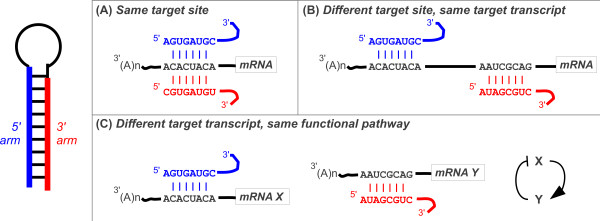
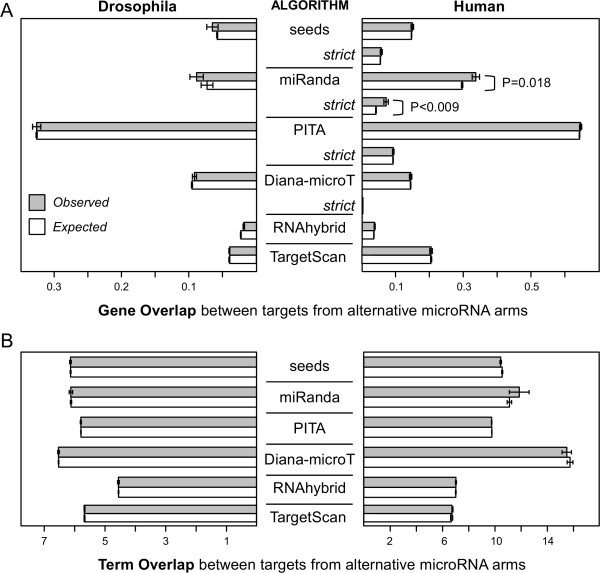
BACKGROUND: The processing of a microRNA results in an intermediate duplex of two potential mature products that derive from the two arms (5' and 3') of the precursor hairpin. It is often suggested that one of the sequences is degraded and the other is incorporated into the RNA-induced silencing complex. However, both precursor arms may give rise to functional levels of mature microRNA and the dominant product may change from species to species, from tissue to tissue, or between developmental stages. Therefore, both arms of the precursor have the potential to produce functional mature microRNAs. RESULTS: We have investigated the relationship between predicted mRNA targets of mature sequences derived from the 5' and 3' arms of the same pre-microRNAs. Using six state-of-the-art target prediction algorithms, we find that 5'/3' microRNA pairs target different sites in 3' untranslated regions of mRNAs. We also find that these pairs do not generally target overlapping sets of genes, or functionally related genes. CONCLUSIONS: We show that alternative mature products produced from the same precursor microRNAs have different targeting properties and therefore different biological functions. These data strongly suggest that developmental or evolutionary changes in arm choice will have significant functional consequences.
Overview
The claims and statistics of this paper haven’t been checked yet.
Free: it reads the open-access text and checks the first 5 claims that cite a source we can check. Create a free account to check every claim.
Integrity signals
Registry
Cites
Statistics
Figures
Verification
Claims the paper makes
The claims and statistics of this paper haven’t been checked yet.
Free: it reads the open-access text and checks the first 5 claims that cite a source we can check. Create a free account to check every claim.
Claims other papers make about this one
Each is checked against this paper’s own text: does it say what the citing paper says it does?
In the citing paper
“Consistent with previous studies,14,15 our analysis revealed a relatively low degree of target overlap between the 5p and 3p arms of miRNAs, which exhibited between 71,9% and 84,0% of non-overlapping targets.”
From MicroRNA Transcriptomes Reveal Prevalence of Rare and Species-Specific Arm Switching Events During Zebrafish Ontogenesis (2024) · cites this paper as [15]
In the citing paper
“This process can significantly impact the miRNA’s targeted genes and their biological functions, as the miRNA-target pairing is crucial for gene regulation. 15”
From MicroRNA Transcriptomes Reveal Prevalence of Rare and Species-Specific Arm Switching Events During Zebrafish Ontogenesis (2024) · cites this paper as [15]
In the citing paper
“These findings support previous reports that also observed limited overlap in the target gene lists for their analyzed miRNAs.14,15”
From MicroRNA Transcriptomes Reveal Prevalence of Rare and Species-Specific Arm Switching Events During Zebrafish Ontogenesis (2024) · cites this paper as [15]
Self-check
Percentages, sums and reported differences re-computed from the paper’s own numbers.
The self-check needs the paper’s full text.
Citations
Cites
The widespread regulation of microRNA biogenesis, function and decay
Krol, J., Loedige, I., & Filipowicz, W. (2010) · Nature Reviews Genetics · doi:10.1038/nrg2843 · Cited by 4,672 · cited 1×
“MicroRNAs are crucial regulators of gene expression whose biogenesis is tightly controlled by multiple enzymes [1,2].”
BackgroundmiRBase: integrating microRNA annotation and deep-sequencing data
Kozomara, A., & Griffiths-Jones, S. (2011) · Nucleic Acids Research · doi:10.1093/nar/gkq1027 · Cited by 3,634 · cited 3×
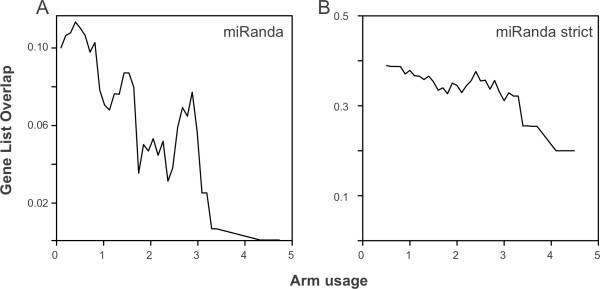
“Where a single mature sequence from a microRNA precursor is reported, we selected as the miR* sequence the most abundant read from the appropriate arm from high-throughput sequencing data displayed in miRBase (December 2010; [16]) and discarded sequences with no evidence for a miR* sequence.”
BackgroundMethodInfluentialSelf-citationMicroRNA targets in Drosophila
Enright, A. J., John, B., Gaul, U., Tuschl, T., Sander, C., & Marks, D. S. (2003) · Genome Biology · doi:10.1186/gb-2003-5-1-r1 · Cited by 3,597 · cited 3×
“The only exceptions derive from predictions made with the miRanda algorithm [21] of targets of mature sequences produced in equal concentrations from both arms of the precursor.”
BackgroundMethodAsymmetry in the Assembly of the RNAi Enzyme Complex
Schwarz, D. S., Hutvágner, G., Du, T., Xu, Z., Aronin, N., & Zamore, P. D. (2003) · Cell · doi:10.1016/s0092-8674(03)00759-1 · Cited by 2,922
The role of site accessibility in microRNA target recognition
Kertesz, M., Iovino, N., Unnerstall, U., Gaul, U., & Segal, E. (2007) · Nature Genetics · doi:10.1038/ng2135 · Cited by 2,460 · cited 5×
“We used six different algorithms to detect potential targets of mature microRNA sequences: canonical seeds as described in [14]; miRanda [21], a method based on hybrid energy and stability; PITA [26], which takes into account the site accessibility at 30 UTRs; Diana-microT [27], a predictor that combines multiple feat…”
InfluentialGrasping the intentions of others with one's own mirror neuron system
Iacoboni, M., Molnar-Szakacs, I., Gallese, V., Buccino, G., Mazziotta, J. C., & Rizzolatti, G. (2005) · PLoS Biology · doi:10.1371/journal.pbio.0030079 · Cited by 2,044
RNAhybrid: microRNA target prediction easy, fast and flexible
Kruger, J., & Rehmsmeier, M. (2006) · Nucleic Acids Research · doi:10.1093/nar/gkl243 · Cited by 1,941
Mammalian microRNAs: experimental evaluation of novel and previously annotated genes
Chiang, H. R., Schoenfeld, L. W., Ruby, J. G., Auyeung, V. C., Spies, N., Baek, D., Johnston, W. K., Russ, C., Luo, S., Babiarz, J. E., et al. (2010) · Genes & Development · doi:10.1101/gad.1884710 · Cited by 825 · cited 2×
“This process, called arm-switching, occurs both in different tissues and developmental stages [4,8,9] and during evolution [10-13].”
BackgroundCoexpression Analysis of Human Genes Across Many Microarray Data Sets
Lee, H. K., Hsu, A. K., Sajdak, J., Qin, J., & Pavlidis, P. (2004) · Genome Research · doi:10.1101/gr.1910904 · Cited by 770
Ruby, J. G., Stark, A., Johnston, W. K., Kellis, M., Bartel, D. P., & Lai, E. C. (2007) · Genome Research · doi:10.1101/gr.6597907 · Cited by 595
Research works printed but not linked: 17
- Bartel DP MicroRNAs: genomics, biogenesis, mechanism, and function Cell 2004 116 281 297 10.1016/S0092-8674(04)00045-5 14744438 · DOI
- Glazov EA Cottee PA Barris WC Moore RJ Dalrymple BP Tizard ML A microRNA catalog of the developing chicken embryo identified by a deep sequencing approach Genome Res 2008 18 957 964 10.1101/gr.074740.107 18469162 PMC2413163 · DOI · Paper page
- Czech B Zhou R Erlich Y Brennecke J Binari R Villalta C Gordon A Perrimon N Hannon GJ Hierarchical rules for Argonaute loading in Drosophila Mol Cell 2009 36 445 456 10.1016/j.molcel.2009.09.028 19917252 PMC2795325 · DOI · Paper page
- Jagadeeswaran G Zheng Y Sumathipala N Jiang H Arrese EL Soulages JL Zhang W Sunkar R Deep sequencing of small RNA libraries reveals dynamic regulation of conserved and novel microRNAs and microRNA-stars during silkworm development BMC Genomics 2010 11 52 10.1186/1471-2164-11-52 20089182 PMC2824724 · DOI · Paper page
- Bartel DP MicroRNAs: target recognition and regulatory functions Cell 2009 136 215 233 10.1016/j.cell.2009.01.002 19167326 PMC3794896 · DOI · Paper page
- Alexiou P Maragkakis M Papadopoulos GL Reczko M Hatzigeorgiou AG Lost in translation: an assessment and perspective for computational microRNA target identification Bioinformatics 2009 25 3049 3055 10.1093/bioinformatics/btp565 19789267 · DOI · Paper page
- Davis N Biddlecom N Hecht D Fogel GB On the relationship between GC content and the number of predicted microRNA binding sites by MicroInspector Comput Biol Chem 2008 32 222 226 10.1016/j.compbiolchem.2008.02.004 18407791 · doi:10.1016/j.compbiolchem.2008.02.004
- Lord PW Stevens RD Brass A Goble CA Semantic similarity measures as tools for exploring the gene ontology Pacific Symp Biocomput 2003 8 601 612 12603061
- Mistry M Pavlidis P Gene Ontology term overlap as a measure of gene functional similarity BMC Bioinformatics 2008 9 327 10.1186/1471-2105-9-327 18680592 PMC2518162 · DOI · Paper page
- Marco A Konikoff C Karr TL Kumar S Relationship between gene co-expression and sharing of transcription factor binding sites in Drosophila melanogaster Bioinformatics 2009 25 2473 2477 10.1093/bioinformatics/btp462 19633094 PMC2752616 · DOI · Paper page
- Davis E Caiment F Tordoir X Cavaillé J Ferguson-Smith A Cockett N Georges M Charlier C RNAi-mediated allelic trans-interaction at the imprinted Rtl1/Peg11 locus Curr Biol 2005 15 743 749 10.1016/j.cub.2005.02.060 15854907 · DOI · Paper page
- Thomas M Lieberman J Lal A Desperately seeking microRNA targets Nat Struct Mol Biol 2010 17 1169 1174 10.1038/nsmb.1921 20924405 · DOI · Paper page
- Chung W-J Okamura K Martin R Lai EC Endogenous RNA interference provides a somatic defense against Drosophila transposons Curr Biol 2008 18 795 802 10.1016/j.cub.2008.05.006 18501606 PMC2812477 · DOI · Paper page
- Maragkakis M Alexiou P Papadopoulos GL Reczko M Dalamagas T Giannopoulos G Goumas G Koukis E Kourtis K Simossis VA Sethupathy P Vergoulis T Koziris N Sellis T Tsanakas P Hatzigeorgiou AG Accurate microRNA target prediction correlates with protein repression levels BMC Bioinformatics 2009 10 295 10.1186/1471-2105-10-295 19765283 PMC2752464 · DOI · Paper page
- Lewis BP Burge CB Bartel DP Conserved seed pairing, often flanked by adenosines, indicates that thousands of human genes are microRNA targets Cell 2005 120 15 20 10.1016/j.cell.2004.12.035 15652477 · DOI · Paper page
- Gordon AD Classification 1999 2 Chapman and Hall/CRC Press, Boca Ratón
- Ashburner M Ball CA Blake JA Botstein D Butler H Cherry JM Davis AP Dolinski K Dwight SS Eppig JT Harris MA Hill DP Issel-Tarver L Kasarskis A Lewis S Matese JC Richardson JE Ringwald M Rubin GM Sherlock G Gene ontology: tool for the unification of biology Nat Genet 2000 25 25 29 10.1038/75556 10802651 PMC3037419 · DOI · Paper page
Cited by
MicroRNA Processing and Human Cancer
Ohtsuka, M., Ling, H., Doki, Y., Mori, M., & Calin, G. (2015) · Journal of Clinical Medicine · doi:10.3390/jcm4081651 · Cited by 170
“However, recent studies have shown that miRNA*s can also associate with the RISC complex and subsequently repress target mRNAs with biological effects similar to that of mature miRNAs [33].”
BackgroundGruzdev, S. K., Yakovlev, A. A., Druzhkova, T. A., Guekht, A. B., & Gulyaeva, N. V. (2019) · Cellular and Molecular Neurobiology · doi:10.1007/s10571-019-00684-6 · Cited by 75
miRNA arm switching identifies novel tumour biomarkers
Chen, L., Sun, H., Wang, C., Yang, Y., Zhang, M., & Wong, G. (2018) · eBioMedicine · doi:10.1016/j.ebiom.2018.11.003 · Cited by 44
Oliveira, A. C. D., Bovolenta, L. A., Figueiredo, L., Ribeiro, A. D. O., Pereira, B. J. A., de Almeida, T. R. A., Campos, V. F., Patton, J. G., & Pinhal, D. (2024) · Evolutionary Bioinformatics · doi:10.1177/11769343241263230 · Cited by 2
“15 Although the mechanisms driving arm switching are not fully understood, the thermodynamic properties and 5 ′ nucleotide identity of the miRNA duplex have been shown to play a key role.”
Background
Metadata
- Authors
- Marco, A., MacPherson, J. I., Ronshaugen, M., & Griffiths-Jones, S.
- Venue
- Silence
- Published
- 2012
- Volume
- 3
- Issue
- 1
- Pages
- 8
- ISSN
- 1758-907X
- PMC
- PMC3503882
- Cited by
- 62
- References
- 16
- Language
- en
About these checks
Registry, retraction, Cites and statistics results are computed, not judged, with one exception: a printed reference that no index lists is read once by a model before it counts as a citation error. Claims are extracted by a model and kept only when their quote appears verbatim in the text; each cited source is then checked, with a model’s help, for whether it says what the claim relies on. Those verdicts can be wrong — read the claim’s quote and the cited source before relying on one.
Statistics and arithmetic are recomputed, not judged.
Confidence bands are shown only for fields calibrated on our annotated test set. None is calibrated yet, so no band is shown.
What counts as a claim ›How we measure confidence ›How we check this ›
Are you an author, or do you see a problem with this page? Request a review
Data sources
Bibliographic data: Semantic Scholar, OpenAlex, Crossref.
Contains information from the Semantic Scholar Academic Graph Datasets, made available under the ODC Attribution License (ODC-BY 1.0).
Semantic Scholar’s data is described in: Kinney, R., et al. (2023). The Semantic Scholar Open Data Platform. arXiv:2301.10140.
