

Lenvatinib, an angiogenesis inhibitor targeting VEGFR/FGFR, shows broad antitumor activity in human tumor xenograft models associated with microvessel density and pericyte coverage.
Open accessThe DOI matches its Crossref record; 45 of the 45 references it cites were found in a registry or an index.
Abstract
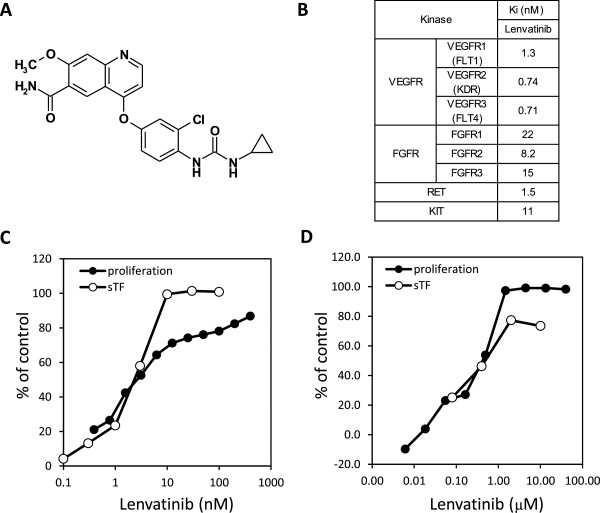
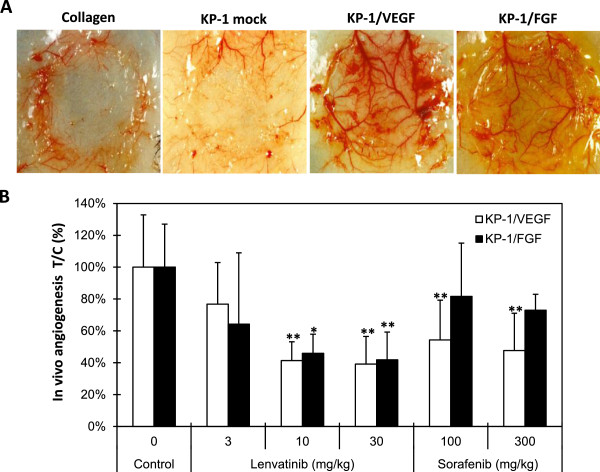
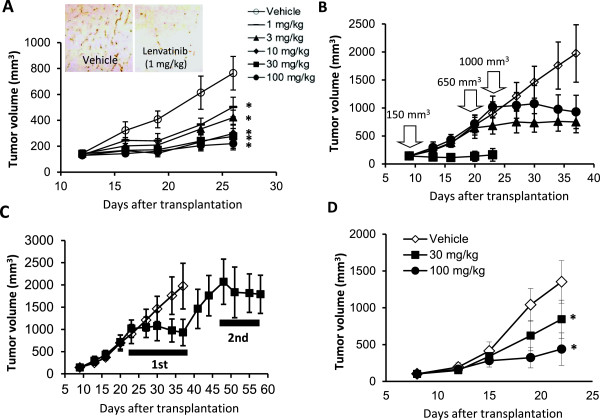
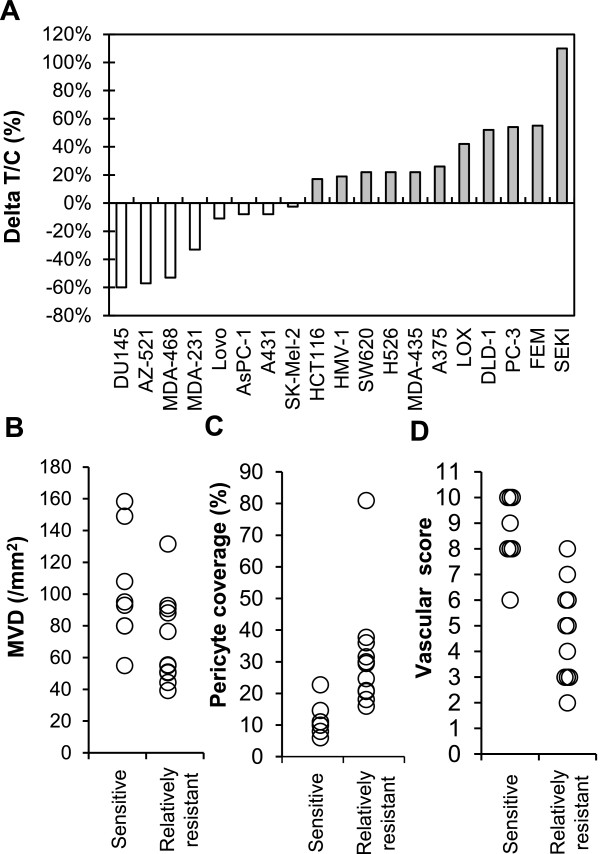
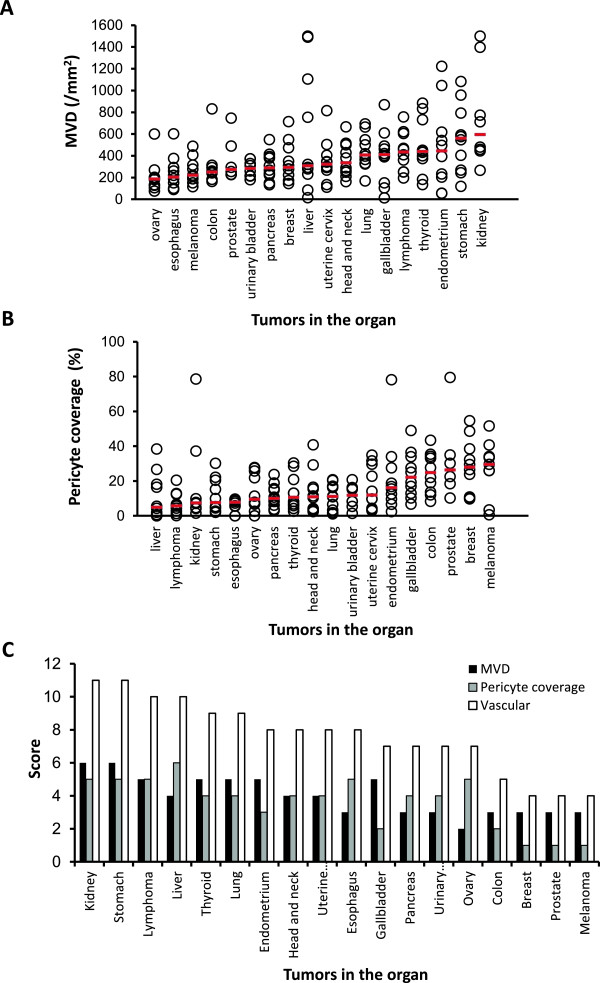
BACKGROUND: Lenvatinib is an oral inhibitor of multiple receptor tyrosine kinases (RTKs) targeting vascular endothelial growth factor receptor (VEGFR1-3), fibroblast growth factor receptor (FGFR1-4), platelet growth factor receptor α (PDGFR α), RET and KIT. Antiangiogenesis activity of lenvatinib in VEGF- and FGF-driven angiogenesis models in both in vitro and in vivo was determined. Roles of tumor vasculature (microvessel density (MVD) and pericyte coverage) as biomarkers for lenvatinib were also examined in this study. METHOD: We evaluated antiangiogenesis activity of lenvatinib against VEGF- and FGF-driven proliferation and tube formation of HUVECs in vitro. Effects of lenvatinib on in vivo angiogenesis, which was enhanced by overexpressed VEGF or FGF in human pancreatic cancer KP-1 cells, were examined in the mouse dorsal air sac assay. We determined antitumor activity of lenvatinib in a broad panel of human tumor xenograft models to test if vascular score, which consisted of high MVD and low pericyte coverage, was associated with sensitivity to lenvatinib treatment. Vascular score was also analyzed using human tumor specimens with 18 different types of human primary tumors. RESULT: Lenvatinib inhibited VEGF- and FGF-driven proliferation and tube formation of HUVECs in vitro. In vivo angiogenesis induced by overexpressed VEGF (KP-1/VEGF transfectants) or FGF (KP-1/FGF transfectants) was significantly suppressed with oral treatments of lenvatinib. Lenvatinib showed significant antitumor activity in KP-1/VEGF and five 5 of 7 different types of human tumor xenograft models at between 1 to 100 mg/kg. We divided 19 human tumor xenograft models into lenvatinib-sensitive (tumor-shrinkage) and relatively resistant (slow-growth) subgroups based on sensitivity to lenvatinib treatments at 100 mg/kg. IHC analysis showed that vascular score was significantly higher in sensitive subgroup than relatively resistant subgroup (p < 0.0004). Among 18 types of human primary tumors, kidney cancer had the highest MVD, while liver cancer had the lowest pericyte coverage, and cancers in Kidney and Stomach had highest vascular score. CONCLUSION: These results indicated that Lenvatinib inhibited VEGF- and FGF-driven angiogenesis and showed a broad spectrum of antitumor activity with a wide therapeutic window. MVD and pericyte-coverage of tumor vasculature might be biomarkers and suggest cases that would respond for lenvatinib therapy.
Overview
The claims and statistics of this paper haven’t been checked yet.
Free: it reads the open-access text and checks the first 5 claims that cite a source we can check. Create a free account to check every claim.
Integrity signals
Registry
Cites
Statistics
Figures
Verification
Claims the paper makes
The claims and statistics of this paper haven’t been checked yet.
Free: it reads the open-access text and checks the first 5 claims that cite a source we can check. Create a free account to check every claim.
Self-check
Percentages, sums and reported differences re-computed from the paper’s own numbers.
The self-check needs the paper’s full text.
Citations
Cites
Sorafenib in advanced hepatocellular carcinoma
Llovet, J. M., Ricci, S., Mazzaferro, V., Hilgard, P., Gane, E., Blanc, J.-F., de Oliveira, A. C., Santoro, A., Raoul, J.-L., Forner, A., et al. (2008) · New England Journal of Medicine · doi:10.1056/nejmoa0708857 · Cited by 13,097
Bevacizumab plus Irinotecan, Fluorouracil, and Leucovorin for Metastatic Colorectal Cancer
Hurwitz, H., Fehrenbacher, L., Novotny, W., Cartwright, T., Hainsworth, J., Heim, W., Berlin, J., Baron, A., Griffing, S., Holmgren, E., et al. (2004) · New England Journal of Medicine · doi:10.1056/nejmoa032691 · Cited by 10,968 · cited 1×
“Bevacizumab (a monoclonal antibody against VEGFA) was the first angiogenesis inhibitor, and was approved for the treatment of patients with metastatic colon cancer based on its survival benefit [3].”
Sunitinib versus Interferon Alfa in Metastatic Renal-Cell Carcinoma
Motzer, R. J., Hutson, T. E., Tomczak, P., Michaelson, M. D., Bukowski, R. M., Rixe, O., Oudard, S., Negrier, S., Szczylik, C., Kim, S. T., et al. (2007) · New England Journal of Medicine · doi:10.1056/nejmoa065044 · Cited by 5,775 · cited 1×
“Several small-molecule inhibitors of VEGFR2 kinase have been approved for treatments of multiple cancer types, such as sunitinib (RCC, gastrointestinal stromal tumor (GIST)) [8,9], sorafenib (RCC, HCC, differentiated thyroid cancer (DTC)) [10-12], pazopanib (RCC, soft-tissue sarcoma (STS)) [13,14], axitinib (RCC) [15]…”
Sorafenib in Advanced Hepatocellular Carcinoma
정, 재. (2008) · Cited by 5,586
Molecular mechanisms and clinical applications of angiogenesis
Carmeliet, P., & Jain, R. K. (2011) · Nature · doi:10.1038/nature10144 · Cited by 5,467 · cited 1×
“The development of novel inhibitors of multi-targeted RTKs in addition to VEGFR2 is still required to improve cancer therapy in the clinic [22], since one of the resistance mechanisms involved is the up-regulation of alternative pro-angiogenic signaling pathways that include FGF/FGFR, angiopoietin/TIE2 and ephrin/EPH…”
Sorafenib in Advanced Clear-Cell Renal-Cell Carcinoma
Escudier, B., Eisen, T., Stadler, W. M., Szczylik, C., Oudard, S., Siebels, M., Negrier, S., Chevreau, C., Solska, E., Desai, A. A., et al. (2007) · New England Journal of Medicine · doi:10.1056/nejmoa060655 · Cited by 4,802
Modes of resistance to anti-angiogenic therapy
Bergers, G., & Hanahan, D. (2008) · Nature Reviews Cancer · doi:10.1038/nrc2442 · Cited by 2,953 · cited 3×
“There are accumulating evidences that tumor vasculature evaluated by MVD and % of pericyte coverage has an impact on disease prognosis and/or acquired resistance to antiangiogenesis therapy in cancer patients [4,23].”
Grothey, A., Cutsem, E. V., Sobrero, A., Siena, S., Falcone, A., Ychou, M., Humblet, Y., Bouché, O., Mineur, L., Barone, C., et al. (2013) · The Lancet · doi:10.1016/s0140-6736(12)61900-x · Cited by 2,895 · cited 1×
“…(RCC, gastrointestinal stromal tumor (GIST)) [8,9], sorafenib (RCC, HCC, differentiated thyroid cancer (DTC)) [10-12], pazopanib (RCC, soft-tissue sarcoma (STS)) [13,14], axi-tinib (RCC) [15], vandetanib (medullary thyroid cancer (MTC)) [16] and regorafnib (colorectal cancer (CRC), GIST) [17,18].”
Sternberg, C. N., Davis, I. D., Mardiak, J., Szczylik, C., Lee, E., Wagstaff, J., Barrios, C. H., Salman, P., Gladkov, O. A., Kavina, A., et al. (2010) · Journal of Clinical Oncology · doi:10.1200/jco.2009.23.9764 · Cited by 2,471 · cited 1×
“…(RCC, gastrointestinal stromal tumor (GIST)) [8,9], sorafenib (RCC, HCC, differentiated thyroid cancer (DTC)) [10-12], pazopanib (RCC, soft-tissue sarcoma (STS)) [13,14], axi-tinib (RCC) [15], vandetanib (medullary thyroid cancer (MTC)) [16] and regorafnib (colorectal cancer (CRC), GIST) [17,18].”
van der Graaf, W. T., Blay, J.-Y., Chawla, S. P., Kim, D.-W., Bui-Nguyen, B., Casali, P. G., Schöffski, P., Aglietta, M., Staddon, A. P., Beppu, Y., et al. (2012) · The Lancet · doi:10.1016/s0140-6736(12)60651-5 · Cited by 2,102
Cited by
Items 501–522 of 522
Cheng, X., Zhang, Y., Qian, C., Holdridge, E. M., Ananda, G., Jiang, T., Ni, J., Xie, S., Gu, H., Ji, R., et al. (2026) · Nature Communications · doi:10.1038/s41467-026-72544-z
“Lenvatinib, a multiple tyrosine kinase inhibitor targeting FGFR1-4, VEGFR1-3, RET, and KIT, has demonstrated clinical activity in phase II/III trials 11,12 .”
Fukushima, M., Nakao, Y., Sasaki, R., Haraguchi, M., Miuma, S., & Miyaaki, H. (2026) · World Journal of Clinical Cases · doi:10.12998/wjcc.v14.i15.119781
Wang, H., Wu, X., Chen, X., Li, Q., Niu, J., Zhang, Q., Yu, M., Li, H., Cheng, L., & Li, S. (2026) · Research Square · doi:10.21203/rs.3.rs-9462092/v1
Xie, C., Luo, S., Shen, L., Huang, X., Weng, X., & Xu, X. (2026) · Naunyn-Schmiedeberg s Archives of Pharmacology · doi:10.1007/s00210-026-05427-1
Lai, K.-C., Liu, C., Lei, H.-J., & Chen, S. (2026) · Liver Cancer · doi:10.1159/000552861
Shiraiwa, K., Tanaka, R., Sueshige, Y., Ashikari, Y., Abe, H., Tatsuta, R., & Itoh, H. (2026) · Research Square · doi:10.21203/rs.3.rs-9631847/v1
Ji, H., Yoo, J., Kim, S. G., & Kim, Y. S. (2026) · Frontiers in Oncology · doi:10.3389/fonc.2026.1875434
Suzuki, K., Otoyama, Y., Matsumoto, N., Masuo, Y., Nakajima, Y., Sugiura, I., Fuji, T., Nomura, E., Ichikawa, Y., Shimozuma, Y., et al. (2026) · Clinical Pharmacokinetics · doi:10.1007/s40262-026-01662-0
Chen, X., Liao, H., Chen, J., Lin-hui, P., Zhang, J.-H., Xuyun, X.-X., Ya-jin, C. H. E. N., & Chen, T. (2026) · World Journal of Gastrointestinal Oncology · doi:10.4251/wjgo.v18.i7.118522
Li, S., Gr, Y., Wang, S., Wang, M., Zhu, C., Piao, M., Xun, Z., Li, C., Sun, B., Chao, J., et al. (2026) · BMC Cancer · doi:10.1186/s12885-026-16392-6
“Lenvatinib, a multi-targeted tyrosine kinase inhibitor that blocks vascular endothelial growth factor (VEGF) receptors 1–3, enhances anti-tumor activity by modulating the VEGF-VEGF receptor (VEGFR) axis [14, 15].”
Mohammed, F. Z., El-Metwaly, S., Shaaban, A. A., & Nabil, A. (2026) · Discover Nano · doi:10.1186/s11671-026-04802-4
“…lenvatinib, an orally active multitarget receptor tyrosine kinase inhibitor, has received approval from the United States Food and Drug Administration for the treatment of several cancers, including differentiated thyroid cancer, advanced renal cell carcinoma, and hepatocellular carcinoma [8].”
Identifying the angiogenic receptor expression in mantle cell lymphoma patients and murine models
Singh, S., Wang, Y. S., Sircar, A., Jindal, U., Srour, N., Ferlita, A. L., Distefano, R., Soni, A., Kumar, D., Peralta-Camacho, G. J., et al. (2026) · Biomarker Research · doi:10.1186/s40364-026-00975-3
“Next, to determine whether targeting angiogenic receptors in MCL can improve outcomes, we compared the small molecules lucitanib, lenvatinib, and PD173074, which have been reported to inhibit both targets [5, 6].”
Wang, W., Li, B., Wang, D., & Zhou, Y. (2026) · Expert Systems with Applications · doi:10.1016/j.eswa.2026.134384
Heterogeneous Graph Contrastive Learning for Drug-Gene-Disease Motif PredictionPreprint
Xie, H., Gao, Y., Ke, S., & Chen, C. (2026) · bioRxiv (Cold Spring Harbor Laboratory) · doi:10.64898/2026.09.21.752883
“FLT1 (fms related receptor tyrosine kinase 1) encodes VEGFR1 (vascular endothelial growth factor receptor 1), a kinase inhibited by lenvatinib, and experimental melanoma mod-182 els implicate VEGFR1 in tumor-cell vasculogenic mimicry and growth [48, 49].”
Çiçek, İ. B., & Küçükakçalı, Z. (2026) · ODÜ Tıp Dergisi · doi:10.56941/odutip.2005806
Fibroblast growth factor in pancreatic development, homeostasis, and disease
Dou, Z., Jian, Y., Liu, X., Liu, Z., 刘会生, Lin, H., & Guo, Y. (2026) · Cytokine & Growth Factor Reviews · doi:10.1016/j.cytogfr.2026.101535
Yao, W., Wang, Y., Song, X., Zhou, Q., Fan, Y., Mamun, A. A., Islam, M. S., Li, L., Shao, C., Wang, S., et al. (2026) · Journal of Photochemistry and Photobiology B Biology · doi:10.1016/j.jphotobiol.2026.113587
Metadata
- Authors
- Yamamoto, Y., Matsui, J., Matsushima, T., Obaishi, H., Miyazaki, K., Nakamura, K., Tohyama, O., Semba, T., Yamaguchi, A., Hoshi, S., Mimura, F., Haneda, T., Fukuda, Y., Kamata, J.-I., Takahashi, K., Matsukura, M., Wakabayashi, T., Asada, M., Nomoto, K.-I., Watanabe, T., Dezso, Z., Yoshimatsu, K., Funahashi, Y., & Tsuruoka, A.
- Affiliations
- Eisai (Japan) (JP)
- Eisai (United States) (US)
- Corresponding author
- Funahashi, Yasuhiro
- ORCID
- Venue
- Vascular Cell
- Publisher
- Publiverse Online SRL
- Published
- 2014
- Volume
- 6
- Issue
- 1
- Pages
- 18
- ISSN
- 2040-2384 (ISSN-L)
- 2045-824X
- PMC
- PMC4156793
- OpenAlex
- W2151600653
- Cited by
- 507
- References
- 45
- Citations by year
- 2026: 41 · 2025: 38 · 2024: 72 · 2023: 54 · 2022: 63 · 2021: 70 · 2020: 50 · 2019: 50 · 2018: 28 · 2017: 17 · 2016: 13 · 2015: 10 · 2014: 1
- FWCI
- 5.61
- Type
- journal article
- Language
- en
- Open access
- diamond
- doi.org
- Licence
- cc-by
- Locations
- Vascular Cell (publishedVersion, cc-by)
- Europe PMC (PubMed Central) (publishedVersion, cc-by)
- PubMed Central (publishedVersion, cc-by)
- PubMed (publishedVersion)
- Topics
- Life Sciences › Biochemistry, Genetics and Molecular Biology › Molecular Biology › Angiogenesis and VEGF in Cancer
- Health Sciences › Medicine › Oncology › Lymphatic System and Diseases
- Life Sciences › Biochemistry, Genetics and Molecular Biology › Molecular Biology › Fibroblast Growth Factor Research
- Keywords
- lenvatinib, anti-angiogenic therapy, VEGFR inhibition, FGFR inhibition, microvessel density, pericyte coverage, tumor xenografts, pancreatic cancer, kidney cancer, liver cancer, receptor tyrosine kinase inhibitors
About these checks
Registry, retraction, Cites and statistics results are computed, not judged, with one exception: a printed reference that no index lists is read once by a model before it counts as a citation error. Claims are extracted by a model and kept only when their quote appears verbatim in the text; each cited source is then checked, with a model’s help, for whether it says what the claim relies on. Those verdicts can be wrong — read the claim’s quote and the cited source before relying on one.
Statistics and arithmetic are recomputed, not judged.
Confidence bands are shown only for fields calibrated on our annotated test set. None is calibrated yet, so no band is shown.
What counts as a claim ›How we measure confidence ›How we check this ›
Are you an author, or do you see a problem with this page? Request a review
Data sources
Bibliographic data: Semantic Scholar, OpenAlex, Crossref.
Contains information from the Semantic Scholar Academic Graph Datasets, made available under the ODC Attribution License (ODC-BY 1.0).
Semantic Scholar’s data is described in: Kinney, R., et al. (2023). The Semantic Scholar Open Data Platform. arXiv:2301.10140.
