

Evidence summaries: the evolution of a rapid review approach
Open accessThe DOI matches its Crossref record; 18 of the 19 references it cites were found in a registry or an index; 2 of the 20 sources its claims cite were checked for support.
Abstract
Background: Rapid reviews have emerged as a streamlined approach to synthesizing evidence - typically for informing emergent decisions faced by decision makers in health care settings. Although there is growing use of rapid review 'methods', and proliferation of rapid review products, there is a dearth of published literature on rapid review methodology. This paper outlines our experience with rapidly producing, publishing and disseminating evidence summaries in the context of our Knowledge to Action (KTA) research program. Methods: The KTA research program is a two-year project designed to develop and assess the impact of a regional knowledge infrastructure that supports evidence-informed decision making by regional managers and stakeholders. As part of this program, we have developed evidence summaries - our form of rapid review - which have come to be a flagship component of this project. Our eight-step approach for producing evidence summaries has been developed iteratively, based on evidence (where available), experience and knowledge user feedback. The aim of our evidence summary approach is to deliver quality evidence that is both timely and user-friendly. Results: From November 2009 to March 2011 we have produced 11 evidence summaries on a diverse range of questions identified by our knowledge users. Topic areas have included questions of clinical effectiveness to questions on health systems and/or health services. Knowledge users have reported evidence summaries to be of high value in informing their decisions and initiatives. We continue to experiment with incorporating more of the established methods of systematic reviews, while maintaining our capacity to deliver a final product in a timely manner. Conclusions: The evolution of the KTA rapid review evidence summaries has been a positive one. We have developed an approach that appears to be addressing a need by knowledge users for timely, user-friendly, and trustworthy evidence and have transparently reported these methods here for the wider rapid review and scientific community.
Overview
CoChat Summary
TL;DR
This paper describes the Knowledge to Action (KTA) program’s iterative development of “evidence summaries,” a rapid review approach for producing timely, user-friendly evidence for health care decision makers. From November 2009 to March 2011, the program produced 11 evidence summaries using an eight-step process, while acknowledging inherent trade-offs between rigor and timeliness.
Key findings
- The KTA program produced 11 evidence summaries from November 2009 to March 2011 on diverse questions identified by knowledge users, ranging from clinical effectiveness to health systems and services topics.
- Evidence summaries were produced within a short timeframe of four to five weeks, compared with six months to two years for traditional systematic reviews, and most reports were 10 to 15 pages long, though knowledge users confirmed keeping them under 10 pages is likely important.
- The eight-step approach included needs assessment; question development and refinement; proposal development and approval; systematic literature search; screening and selection; narrative synthesis with evidence-level assignment; report production; and ongoing follow-up and dialogue with knowledge users.
- Knowledge users reported evidence summaries to be of high value in informing decisions and initiatives; the paper cites Watt et al. (2008) as finding that “the essential conclusions of the rapid and full reviews did not differ extensively,” though research comparing rapid and systematic reviews remains limited.
Methods
- Design: an experience-based methodological report describing the iterative development and refinement of KTA evidence summaries within a two-year KTA research program, a collaboration between the Ottawa Hospital Research Institute and the Champlain Local Health Integration Network.
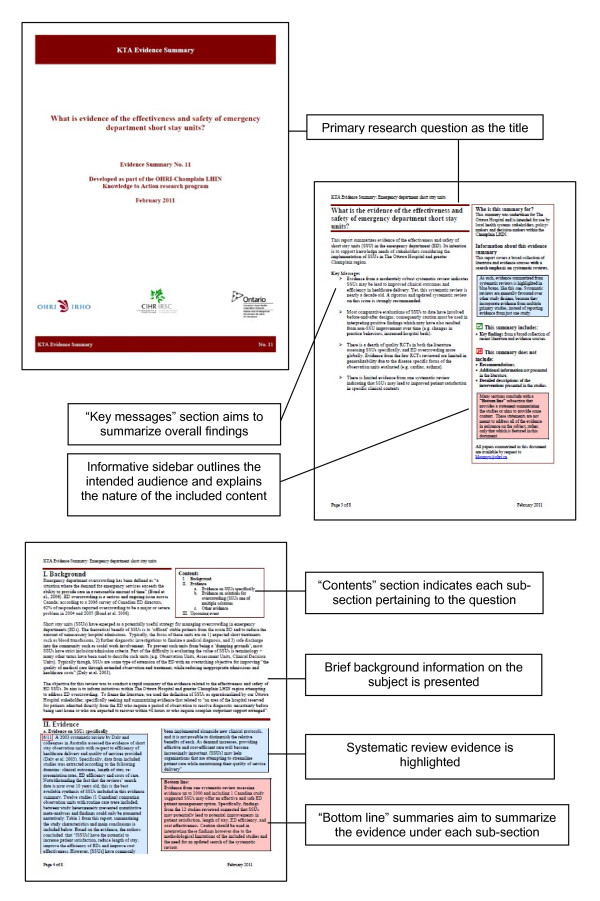
- Data or sample: 11 evidence summaries produced from November 2009 to March 2011, with topics listed in the paper; a case example describes an evidence summary on emergency department short stay units; formal evaluation through key informant interviews was ongoing.
- Main analysis: descriptive account of the eight-step production process, including narrative synthesis of included studies, assignment of evidence levels based on a modified Cochrane Musculoskeletal Group framework, and recent use of AMSTAR to assess included systematic reviews.
Limitations
- The paper states that rapid review products inherently harbor limitations relative to systematic reviews because they are produced within a short timeframe using limited resources, do not employ as much rigor, and may be subject to greater bias and/or error; it also states there is no clear evidence about decision makers’ willingness to compromise methodological rigor for quicker answers.
- The paper states that research comparing rapid with systematic review is limited, and that the purposes and context of rapid review use should be carefully considered when assessing their value.
- Evident from the text: early evidence summaries used a single reviewer for screening, excluded non-English reports and records not available electronically, did not undertake meta-analysis, relied on subjective selection of “high-quality” studies and extraction of relevant material, and in the most recent summary resolved conflicts by passing records to the next screening level rather than consensus.
Model-written summary. Check it against the paper before relying on it.
Integrity signals
Registry
Cites
Statistics
Figures
Verification
Claims the paper makes
2 Valid · 4 Not valid · 14 Not checked · 41 Own results and interpretations
The cited sources support only part of this claim — read each source’s verdict below.
In the paper
“Recent evidence summaries have also employed the 'assessment of multiple systematic reviews' (AMSTAR) tool as a means of assessing the methodological quality of included systematic reviews [13].”
§ Evidence summaries: the evolution of a rapid review approach > Evidence summary methods > Narrative synthesis of included studies (including risk-of-bias assessment)
What the sources say
- Partly supportedcites [13] 13. Shea BJ Grimshaw JM Wells GA Boers M Andersson N Hamel C Development of AMSTAR: a measurement tool to assess the methodological quality of systematic reviews BMC Med Res Methodol 2007 7 10 10.1186/1471-2288-7-10 17302989 PMC1810543 sourceExperimental — accuracy not yet measured
The Background identifies AMSTAR as a tool developed to assess the methodological quality of systematic reviews. The Discussion describes preliminary experience with the tool, but our copy does not establish that recent evidence summaries employed it to assess their included reviews. (LLM, conf=0.82)
plain- Asserted: passes — The authors put it forward as true.
- Checkable: passes — It can be checked against evidence.
- Load-bearing: unclear — It is unclear whether the paper’s conclusions depend on it.
- Based: passes — The paper gives a reason why it holds.
- Partly supported
Every source the paper cites for this claim was checked and supports it.
In the paper
“Parkill and colleagues have shown that, when compared to highly sensitive searches, pragmatically-based searches conducted for the purpose of populating an evidence map can produce a similar amount of relevant records, more quickly and at less cost [18].”
§ Evidence summaries: the evolution of a rapid review approach > Discussion
What the sources say
- Supportedcites [18] 18. Parkill A Clavisi R Pattuwage L Chau M Turner T Bragge P Searches for evidence mapping: effective, shorter, cheaper J Med Libr Assoc 2011 99 157 160 10.3163/1536-5050.99.2.008 21464854 PMC3066574 source
The RESULTS (p. 4 of our copy) report that the pragmatic evidence-mapping (EM) strategy retrieved 120 (77%) of included references versus 125 (81%) for the highly sensitive (HS) strategy — a similar yield of relevant records — while retrieving 781 fewer total citations, which 'would have resulted in a saving 19.5 hours of staff time over the 6 questions.' The DISCUSSION AND CONCLUSIONS states HS methods 'are not always cost effective for evidence mapping, in terms of resource use' and that the EM strings 'effectively identified relevant references using less staff time' (extrapolating to six extra weeks for the six questions, a year across all 55). The METHOD confirms the comparison was on yield, included studies retrieved/missed, and staff time. Only caveat: the evaluation covered six questions in traumatic brain/spinal cord injury on PubMed MEDLINE alone, so the finding is stated for that context, but the citing sentence's 'can produce' framing matches the paper's own conclusion. (LLM, conf=0.90)
plainstates a cause- Asserted: passes — The authors put it forward as true.
- Checkable: passes — It can be checked against evidence.
- Load-bearing: passes — The paper’s conclusions depend on it.
- Based: passes — The paper gives a reason why it holds.
- Supported
A result the paper reports from its own data — it cites no other source for it, so there is none to check. The quote shows it is in the paper.
In the paper
“Knowledge users have reported evidence summaries to be of high value in informing their decisions and initiatives.”
§ Evidence summaries: the evolution of a rapid review approach > Abstract > Results
plain- Asserted: passes — The authors put it forward as true.
- Checkable: passes — It can be checked against evidence.
- Load-bearing: passes — The paper’s conclusions depend on it.
- Based: passes — The paper gives a reason why it holds.
The paper states this without a source or data behind it here, so there is nothing to check it against. The quote shows it is in the paper.
In the paper
“Generally, knowledge users in our context have not demonstrated a strong capacity for formulating effective research questions”
§ Evidence summaries: the evolution of a rapid review approach > Evidence summary methods > Question development and refinement
boosted- Asserted: passes — The authors put it forward as true.
- Checkable: passes — It can be checked against evidence.
- Load-bearing: passes — The paper’s conclusions depend on it.
- Based: unclear — It is unclear why the paper says it holds.
A result the paper states — it cites no source for it, so there is none to check. The quote shows it is in the paper.
In the paper
“the first three evidence summaries were produced in the absence of a primary research question but rather using a series of research questions developed by the research team.”
§ Evidence summaries: the evolution of a rapid review approach > Evidence summary methods > Question development and refinement
plain- Asserted: passes — The authors put it forward as true.
- Checkable: passes — It can be checked against evidence.
- Load-bearing: passes — The paper’s conclusions depend on it.
- Based: passes — The paper gives a reason why it holds.
22 more claims
Create a free account to see all 61 claims and to verify the 18 references still open.
- Probably not a substantial claim. 28
- It may state two separate claims as one. 17
Claims other papers make about this one
Each is checked against this paper’s own text: does it say what the citing paper says it does?
The cited source doesn’t support the claim as written.
In the citing paper
“RRs are better suited for narrowly defined research questions where one or more SR steps may be reduced or omitted [4, 6, 21, 22, 24, 25].”
From How to conduct systematic reviews more expeditiously? (2015) · cites this paper as [4]
Checked by a reasoning model — may be wrong.
Experimental — accuracy not yet measuredThe source backs part of the claim, not all of it — or backs it for a different population, condition or comparison.
In the citing paper
“The conduct of SRs can be a time-consuming, cost- and resource-intensive task, which may take on average from 6 months to several years [4–6].”
From How to conduct systematic reviews more expeditiously? (2015) · cites this paper as [4]
Experimental — accuracy not yet measuredThe source backs part of the claim, not all of it — or backs it for a different population, condition or comparison.
In the citing paper
“In addition, the HTA process is time-consuming, generally taking over a year to complete, with the SLR and NMA part of this process taking several months each [8, 11].”
From Artificial Intelligence to Automate Network Meta-Analyses: Four Case Studies to Evaluate the Potential Application of Large Language Models (2024) · cites this paper as [11]
Experimental — accuracy not yet measuredThe source backs part of the claim, not all of it — or backs it for a different population, condition or comparison.
In the citing paper
“the methodological rigor and process that makes SR evidence trustworthy often take one to 2 years to complete [[1], [2], [3], [4]] and limit their utility to meet the time-sensitive needs of stakeholders.”
From Cochrane Rapid Reviews Methods Group offers evidence-informed guidance to conduct rapid reviews (2021) · cites this paper as [2]
Experimental — accuracy not yet measuredThe cited source says what the claim attributes to it.
In the citing paper
“We used a rapid review methodology developed by Khangura et al. (2012) which has been used within the context of various disciplines (Blakemore et al., 2017; Kadykalo et al., 2020).”
From Residential care as an alternative care option: A review of literature within a global context (2022) · cites this paper as Khangura et al., 2012
11 more claims about this paper
Create a free account to see every claim other papers make about this one.
Citations
Cites
Cochrane Handbook for Systematic Reviews of Interventions: Cochrane Book Series
(2008) · doi:10.1002/9780470712184 · Cited by 25,048 · cited 1×
“It uses explicit, systematic methods that are selected with a view to minimizing bias, thus providing more reliable findings from which conclusions can be drawn and decisions made” [1].”
MethodDevelopment of AMSTAR: A measurement tool to assess the methodological quality of systematic reviews
Shea, B. J., Grimshaw, J. M., Wells, G. A., Boers, M., Andersson, N., Hamel, C., Porter, A. C., Tugwell, P., Moher, D., & Bouter, L. M. (2007) · BMC Medical Research Methodology · doi:10.1186/1471-2288-7-10 · Cited by 4,374
Self-citationEpidemiology and reporting characteristics of systematic reviews.
Moher, D., Tetzlaff, J., Tricco, A. C., Sampson, M., & Altman, D. G. (2007) · PLoS Medicine · doi:10.1371/journal.pmed.0040078 · Cited by 891 · cited 1×
“While about half of published systematic reviews include a meta-analysis [11], the KTA evidence summaries do not undertake this level of quantitative synthesis (although we do report the results of included metaanalyses).”
BackgroundSelf-citationExpediting systematic reviews: methods and implications of rapid reviews
Ganann, R., Ciliska, D., & Thomas, H. (2010) · Implementation Science · doi:10.1186/1748-5908-5-56 · Cited by 752 · cited 3×
“A growing number of organizations, across various jurisdictions and countries, appear to be experimenting with this approach [3].”
BackgroundMoher, D., Pham, B., Lawson, M., & Klassen, T. (2003) · Health Technology Assessment · doi:10.3310/hta7410 · Cited by 500 · cited 1×
“Although exclusion of languages other than English is undesirable, it is considered to be a reasonable practice given limited time and resources and there is some evidence to suggest that it may not markedly bias review findings [9].”
BackgroundSelf-citationSingle data extraction generated more errors than double data extraction in systematic reviews
Buscemi, N., Hartling, L., Vandermeer, B., Tjosvold, L., & Klassen, T. P. (2006) · Journal of Clinical Epidemiology · doi:10.1016/j.jclinepi.2005.11.010 · Cited by 464 · cited 1×
“It is recognized, however, that a single reviewer introduces a level of error that is not desirable [10], and a second reviewer is now generally included on all evidence summaries, typically to review records excluded by the first reviewer - an approach we have labeled ‘liberal accelerated’.”
BackgroundRAPID VERSUS FULL SYSTEMATIC REVIEWS: VALIDITY IN CLINICAL PRACTICE?
Watt, A., Cameron, A., Sturm, L., Lathlean, T., Babidge, W., Blamey, S., Facey, K., Hailey, D., Norderhaug, I., & Maddern, G. (2008) · ANZ Journal of Surgery · doi:10.1111/j.1445-2197.2008.04730.x · Cited by 163 · cited 3×
“found that, despite “axiomatic differences” between the rapid and full reviews evaluated, “the essential conclusions of the rapid and full reviews did not differ extensively” [4], suggesting that products like the KTA evidence summaries may offer a useful and valid approach.”
BackgroundUsing Existing Systematic Reviews in Complex Systematic Reviews
Whitlock, E. P., Lin, J. S., Chou, R., Shekelle, P., & Robinson, K. A. (2008) · Annals of Internal Medicine · doi:10.7326/0003-4819-148-10-200805200-00010 · Cited by 144 · cited 1×
“Another consideration is a Grades of Recommendation, Assessment, Development and Evaluation-like assessment for the overall body of information included in the evidence summary as an important feature for knowledge users’ interpretation of the global evidence base [20].”
BackgroundEnd-user involvement in health technology assessment (HTA) development: A way to increase impact
McGregor, M., & Brophy, J. M. (2005) · International Journal of Technology Assessment in Health Care · doi:10.1017/s026646230505035x · Cited by 125 · cited 1×
“Usability has been an oft-neglected component in traditional systematic reviews despite evidence that has shown its capacity to improve the quality and cost effectiveness of health care [5,6].”
BackgroundLomas, J. (2005) · Healthcare Policy | Politiques de Santé · doi:10.12927/hcpol..17567 · Cited by 120
Research works printed but not linked: 2
- 1. Green S Higgins J Alderson P Clarke M Mulrow C Oxman A Higgins J, Green S Chapter 1 - Introduction Cochrane handbook for systematic reviews of interventions 2008 West Sussex, England: The Cochrane Collaboration and John Wiley & Sons Ltd
- 8. Information services CADTH Grey matters: A practical search tool for evidence-based medicine 2011 Ottawa, Canada: Canadian Agency for Drugs and Technologies in Health
Cited by
Items 901–1,000 of 1,003
Clinical guidelines and patient related outcomes: summary of evidence and recommendations
de Vasconcelos, L. P., Rodrigues, L. D. O., & Nobre, M. R. C. (2019) · International Journal of Health Governance · doi:10.1108/ijhg-12-2018-0073 · Cited by 3
Peltonen, K., Kurki, M., Reedtz, C., Kaiser, S., Rasmussen, L. P., Merikukka, M., Rye, M., Laajasalo, T., Kyrrestad, H., Karjalainen, P., et al. (2022) · European Journal of Developmental Psychology · doi:10.1080/17405629.2022.2067141 · Cited by 3
“The Rapid Review approach is a justified method when the research question is relatively narrow (here, the quality of a certain test) and the selection of studies is based on inclusion/exclusion criteria (Khangura et al., 2012).”
MethodGuidelines for conducting rapid reviews in psychology research
du Toit, R. E., & de Klerk, W. (2022) · Journal of Psychology in Africa · doi:10.1080/14330237.2022.2121468 · Cited by 3
“Types of rapid reviews Confusion between rapid reviews and systematic reviews, as well as unclear guidelines for methodological steps within rapid reviews, are prevalent (Garritty et al., 2017; Hamel et al., 2021; Khangura et al., 2012), and there is no consensus regarding a clear definition (Garritty et al.”
BackgroundInfluentialMcCloud, T. L., & Bann, D. (2018) · PsyArXiv (OSF Preprints) · doi:10.31234/osf.io/35djy · Cited by 3
“streamlined approach to traditional systematic review methods which can yield valid inferences on the research topic addressed, albeit with less certainty than a full systematic review.(16)”
What encourages citizens to use e-government? A rapid review and comprehensive modelPreprint
Faulkner, N., Jorgensen, B. S., & Borg, K. (2017) · OSF Preprints (OSF Preprints) · doi:10.31219/osf.io/e58bg · Cited by 3
ADEBIYI, S. K. (2023) · Research Square · doi:10.21203/rs.3.rs-3210901/v1 · Cited by 3
Menke, J. D., Ming, S., Radhakrishna, S., Kilicoglu, H., & Smalheiser, N. R. (2025) · medRxiv · doi:10.1101/2025.04.23.25326300 · Cited by 4
“The size and rapid expansion of biomedical literature poses a significant challenge, making the identification of relevant publications a lengthy and labor-intensive task [2, 3, 4].”
Granikov, V., Hong, Q. N., & Pluye, P. (2021) · Advances in knowledge acquisition, transfer, and management book series/Advances in knowledge acquisition, transfer and management book series · doi:10.4018/978-1-7998-8844-4.ch007 · Cited by 2
Sínteses de evidências para apoio à tomada de decisões relacionadas à pandemia de covid-19
de Andrade, K. R. C., Carvalho, V. K. D. S., Silva, R. B., Luquine, C. D., Farinasso, C. M., Oliveira, C. D. F., Mascarenhas, F., de Paula, G. A. R., de Toledo, I. P., Marinho, M. M. A., et al. (2024) · Revista de Saúde Pública · doi:10.11606/s1518-8787.2024058005226 · Cited by 2
Rutherford, R., Pashley, S., Bowes, N., Heggs, D. A., & Cornwell, R. (2025) · International Journal of Mental Health Nursing · doi:10.1111/inm.13483 · Cited by 2
Downey, H. J., Barbour, H., Adams, J., & Spelten, E. R. (2025) · Journal of Tourism Futures · doi:10.1108/jtf-05-2024-0088 · Cited by 3
A Narrative Review of BDSM/Kink in Technology-Mediated Sexual Interactions
Campbell, A., Becerra, A. K. E., Turner, N., & Shaughnessy, K. (2025) · Current Sexual Health Reports · doi:10.1007/s11930-025-00408-6 · Cited by 2
Kaiser, L., Awa, N. M. C. M. K. T. Ā., & Phibbs, S. (2022) · AlterNative An International Journal of Indigenous Peoples · doi:10.1177/11771801251334297 · Cited by 4
“A rapid literature review is a type of knowledge synthesis in which components of the systematic literature review process are simplified or omitted to produce information in a short period of time (Khangura et al., 2012).”
Leading a scoping review on L2 pronunciation: Some key elements of methodology
Terrier, L., Garnier, M., & Ali, S. (2025) · Research Methods in Applied Linguistics · doi:10.1016/j.rmal.2025.100216 · Cited by 4
Collins, J. P., & Krause, A. (2025) · Journal of Hospital Infection · doi:10.1016/j.jhin.2025.04.038 · Cited by 2
Hwang, J., & Heo, J. (2025) · 보건교육·건강증진학회지 · doi:10.14367/kjhep.2025.42.3.65 · Cited by 2
The firm-level AI-ESG performance nexus: a rapid literature review and future research agenda
Łudzińska, K. (2025) · Economics and Environment · doi:10.34659/eis.2025.95.4.1170 · Cited by 3
An umbrella review of systematic reviews on medical and health tourism worldwide
Singh, R., Kumar, A., Varshney, S., & Samyal, S. (2026) · Journal of Service Theory and Practice · doi:10.1108/jstp-04-2025-0123 · Cited by 2
Habre, C., Dhouib, A., de Horatio, L. T., & Rosendahl, K. (2026) · Pediatric Radiology · doi:10.1007/s00247-026-06550-0 · Cited by 2
Mapping Caregiver Needs’ Assessment Tools for Family and Friend Caregivers: A Rapid Scoping Review
Ding, X., Toussi, R. A., Pizzol, F. L. F. D., Grewal, A., Hyde, A. M., Parmar, J., Anderson, S., & Tandon, P. (2026) · International Journal of Environmental Research and Public Health · doi:10.3390/ijerph23030300 · Cited by 2
Umbrella review of healthcare dashboards: Applications, benefits, design, and challenges
Almasi, S., Rabiei, R., Hamedi, S. Z., Ghaderzadeh, M., & Bastani, P. (2026) · Digital Health · doi:10.1177/20552076261429609 · Cited by 6
“21,22 This study aims to synthesize the evidence on applications, bene fi ts, design features, and challenges of healthcare dashboards through an umbrella review.”
Wong, L. C., Lee, K.-P., Liang, R., Cheng, M. P. S., & Yip, J. Y. W. (2026) · Journal of Industrial Textiles · doi:10.1177/15280837261442766 · Cited by 2
Palazzo, C., Giordano, V., Chirico, A., Rea, T., & Guillari, A. (2026) · Journal of Advanced Nursing · doi:10.1111/jan.70570 · Cited by 2
“A Rapid Evidence Assessment (REA) was conducted following established methodological guidance for rapid evidence synthesis (Watt et al. 2008; Khangura et al. 2012; Varker et al. 2015).”
Lúcio, D. D. S., & Scalco, D. L. (2019) · Revista Brasileira de Medicina de Família e Comunidade · doi:10.5712/rbmfc14(41)1707 · Cited by 3
Oduaran, A. B., Oduaran, C. A., & Maroja, N. (2019) · Journal of Intergenerational Relationships · doi:10.1080/15350770.2019.1617592 · Cited by 2
Evaluation of Reinfection in COVID-19 Patients in the World: A Narrative Review
Eshrati, B., Baradaran, H. R., Moradi, G., Dehghanbanadaki, H., Azh, N., Soheili, M., Motamed-Gorji, N., & Moradi, Y. (2021) · Medical Journal of the Islamic Republic of Iran · doi:10.47176/mjiri.35.144 · Cited by 2
Migeot, V., Guihenneuc, J., Ouazzani, H. E., Albouy-Llaty, M., Dupuis, A., & Rabouan, S. (2022) · Environmental Health · doi:10.1186/s12940-022-00833-3 · Cited by 4
The Critical Role of the Chief Information Officer in Smart Management of Digital Transformation
Chawla, R. N., Saxena, D. K., & Goyal, P. (2022) · Advances in e-business research series · doi:10.4018/978-1-7998-9008-9.ch008 · Cited by 4
(2021) · Archives des maladies professionnelles et de médecine du travail/Archives des maladies professionnelles et de l'environnement · doi:10.1016/j.admp.2021.08.003 · Cited by 2
Baillargeon, R. H., Charette, M., Tessier, F., & Brand, K. P. (2022) · OBM Integrative and Complementary Medicine · doi:10.21926/obm.icm.2203031 · Cited by 2
A systematic mapping of public health primary prevention interventions with relevance for policing
Sondhi, A., & Williams, E. P. (2023) · International Journal of Police Science & Management · doi:10.1177/14613557231159551 · Cited by 2
“Two levels of screening were undertaken as recommended by Khangura et al. (2012).”
Hatchard, J. L., Buykx, P., Brennan, A., & Gillespie, D. (2023) · NIHR Open Research · doi:10.3310/nihropenres.13379.1 · Cited by 2
A rapid literature review on ensemble algorithms for COVID-19 classification using image-based exams
Portela, E. P., Cortes, O. A. C., & da Silva, J. C. (2023) · International Journal of Hybrid Intelligent Systems · doi:10.3233/his-230009 · Cited by 3
“A rapid review is a technique for synthesizing evidence for a comprehensive or systematic literature search, yet, it requires a briefer time frame than standard systematic approaches [35].”
Assessments Used for Summative Purposes during Internal Medicine Specialist Training: A Rapid Review
Patterson, S., Shaw, L., Rank, M. M., & Vaughan, B. (2023) · Education Sciences · doi:10.3390/educsci13101057 · Cited by 2
Leber, J., Heinemann, A., Sander, P., Ahmad, C., Meneghinello, L., & Peters, L. (2023) · Waxmann Verlag GmbH eBooks · doi:10.31244/9783830998464.03 · Cited by 4
Côté, I., Fournier, C., Aslett, A., & Lavoie, K. (2024) · Science of Nursing and Health Practices · doi:10.7202/1112376ar · Cited by 2
Talbot, R., Higham, R., Croft, J., Ainsworth, G., Brown, S. T., Kelly, R., Stocken, D. D., Thomson, S., & Rousseau, N. S. (2024) · Trials · doi:10.1186/s13063-024-08391-4 · Cited by 2
“Although rapid approaches are starting to be used more frequently in evaluation and appraisal research [43, 56, 57], they have been less widely used in trials [58].”
MethodIqbal, S., Chepo, M., Hébert, M., & Vindrola‐Padros, C. (2024) · Evaluation and Program Planning · doi:10.1016/j.evalprogplan.2024.102495 · Cited by 2
“Rapid evaluations have been proposed as a series of approaches to synthesize evidence in a timely manner to inform decision-making and disseminate information (Khangura et al., 2012).”
Employee adaptation in the return-to-office era within financial institutions
Magliozzi, P. (2024) · SAM Advanced Management Journal · doi:10.1108/samamj-05-2024-0016 · Cited by 3
Medicines management activity of advanced practice dietitians and therapeutic radiographers
Carey, N., Edwards, J., Babashahi, S., & Stenner, K. L. (2024) · Journal of Prescribing Practice · doi:10.12968/jprp.2024.0009 · Cited by 2
Pathak, S., Voigt, P. E., Bellon, M. B., Vadaparampil, S. T., & Quinn, G. P. (2024) · Expert Review of Endocrinology & Metabolism · doi:10.1080/17446651.2024.2448789 · Cited by 2
“Therefore, the preparation of this manuscript was guided by the Preferred Reporting Items for Systematic Reviews and Meta-Analysis (PRSMA) guidelines and reporting checklist [17].”
Outdoor Adventure Education Curriculum Framework for Youth Social and Emotional Learning
Vlček, P., Skotáková, A., Hřebíčková, S., Saaranen-Kauppinen, A., Muittari, J., Δανιά, Α., Anagnostopoulos, C., Kossyva, E., Ntalachani, K., Caballero, P., et al. (2025) · doi:10.5817/cz.muni.m280-0723-2025 · Cited by 2
Opoku-Ansah, N. A., Gallagher, J. E., & Niven, V. (2025) · BDJ Open · doi:10.1038/s41405-025-00314-y · Cited by 2
“…the reviews on the well-being of dentists and dental care professionals and provides evidence in a condensed timeframe and an understandable format, balancing the rigour employed to conduct a summary of evidence with the timetable within which the information is required [21, 23, 25, 28 – 30].”
The Development of a Rapid Review Planning Template for Educational Researchers
Farrell, M., & Seidel, T. (2025) · Zeitschrift für Psychologie · doi:10.1027/2151-2604/a000593 · Cited by 2
Umscheid, C. A., Mitchell, M. D., Leas, B. F., Lavenberg, J. G., Williams, K., & Brennan, P. J. (2016) · Springer eBooks · doi:10.1007/978-3-319-39205-9_18 · Cited by 2
A classification and summarization method for analysis of research activities in an academic faculty
Loures, E. D. F. R., Liao, Y., & Canciglieri, O. (2017) · Production · doi:10.1590/0103-6513.216316 · Cited by 2
“…can be divided into two kinds: (1) the systematic review methods that focus on investigating the contents in the articles, such as the rapid review (Khangura et al., 2012), the scoping study (Arksey & O’Malley, 2005), and the meta-analysis (Mullen, 1986); (2) the research productivity evaluation…”
BackgroundMethodSynthesising knowledge for physiotherapy practice. Key steps towards review methodology
Beenen, P., & Castro‐Caldas, A. (2017) · International Journal of Therapy and Rehabilitation · doi:10.12968/ijtr.2017.24.5.211 · Cited by 3
Moore, E., Lawn, S., Oster, C., & Morello, A. (2017) · Chronic Illness · doi:10.1177/1742395317750266 · Cited by 2
“The rapid review methodology outlined by Khangura et al.(15) was followed in order to develop an evidence summary from the review of peer-reviewed and grey literature that would meet COORDINAIRE’s needs.”
MethodA protocol for a scoping review of equity measurement in mental health care for children and youth
Gardner, W. P., Nicholls, S. G., Reid, G. J., Hutton, B., Hamel, C., Sikora, L., Salamatmanesh, M., Duncan, L., Georgiades, K., & Gilliland, J. (2020) · Systematic Reviews · doi:10.1186/s13643-020-01495-3 · Cited by 3
“The protocol is written in accordance with the Preferred Reporting Items for Systematic Reviews and Meta-Analyses Protocols (PRISMA-P) statement [49].”
MethodKaufman, S., Kirchherr, J., Curtis, J., Macklin, J., Saeri, A. K., Slattery, P., Kunstler, B., & Wild, A. (2021) · Monash University · doi:10.26180/13654511 · Cited by 2
Bolster-Foucault, C., Fane, B. H. M., & Blair, A. (2021) · Promotion de la santé et prévention des maladies chroniques au Canada · doi:10.24095/hpcdp.41.3.03f · Cited by 2
Rubin, G. J., Wessely, S. C., Greenberg, N. L., & Brooks, S. K. (2021) · BMJ Evidence-Based Medicine · doi:10.1136/bmjebm-2021-111760 · Cited by 2
From Centuries to Hours: The Journey of Research into Practice
Bragge, P. (2022) · Digital Government Research and Practice · doi:10.1145/3529166 · Cited by 2
“These changes to systematic review methods may include searching only for specific study designs such as reviews (‘review of reviews’) [Khangura et al. 2012]; searching fewer databases; reducing the year range of the search; and/or using one instead of two reviewers to screen and appraise studies…”
BackgroundThe Influence of Psychological Safety on Team Dynamics, Performance, and Society: A Rapid Review
Brown, V. (2023) · Zenodo (CERN European Organization for Nuclear Research) · doi:10.5281/zenodo.8053647 · Cited by 2
Hatchard, J. L., Buykx, P., Brennan, A., & Gillespie, D. (2023) · NIHR Open Research · doi:10.3310/nihropenres.13379.2 · Cited by 4
Boyd, B., Madhivanan, P., & Stephens, D. P. (2016) · Child Care Health and Development · doi:10.1111/cch.12381 · Cited by 2
“Two primary reviewers lower undesirable error significantly as opposed to one primary reviewer (Khangura et al. 2012).”
BackgroundThe Changing Nature of Knowledge and Service Work in the Age of Intelligent Machines
Coombs, C. R., Hislop, D. W., Taneva, S., & Barnard, S. H. (2020) · Oxford University Press eBooks · doi:10.1093/oxfordhb/9780190932596.013.11 · Cited by 2
Removing Gamification: A Research Agenda: Removing GamificationPreprint
Seaborn, K. (2021) · arXiv (Cornell University) · Cited by 5
Ahmed, S. K., Mitchell, P., & Trevitt, J. (2021) · ACEReSearch Repository (Australian Council for Educational Research) · doi:10.37517/978-1-74286-671-0 · Cited by 2
“Stages for a rapid review of literature adapted from Evidence summaries: the evolution of a rapid review approach (Khangura et al., 2012) Scope •Define the research scope based on the resources available”
BackgroundMethodFindings from a qualitative analysis of ADN Dignidad Program in Colombia
Isegoria, Gómez, I., Gordillo, A., & Isegoria (2023) · doi:10.23846/wp0056 · Cited by 2
King, K., Nicholas, A., Krysinska, K. E., Ross, A., & Pirkis, J. (2020) · doi:10.57022/gzxb5988 · Cited by 2
Lie, S. S., Fjetland, K. J., & Tokovská, M. (2022) · Universitetsforlaget eBooks · doi:10.18261/9788215053790-2022-05 · Cited by 1
Currens, J. B., Dayton, P. A., Buzzacott, P. L., & Papadopoulou, V. (2022) · PLoS ONE · doi:10.1371/journal.pone.0274241 · Cited by 1
“, where the primary reviewer will complete all screening steps and will defer to a second reviewer for article exclusion [26].”
BackgroundPatient Interaction Involving Older Adults: Provider vs. Caregiver Expectations
Shah, P. A., Donovan, K., & Hubal, R. C. (2022) · Geriatrics · doi:10.3390/geriatrics7050101 · Cited by 1
Bibliotecas digitais e a pandemia de covid-19: mapeamento de estratégias
Santos-d’Amorim, K., do Nascimento, B. L. C., Campos, S. R. D. L., & Corrêa, R. F. (2022) · BIBLOS · doi:10.14295/biblos.v36i1.14202 · Cited by 1
The early integration of palliative care into oncology care: A rapid review
Fadhlaoui, A., Mrad, H., Vinette, B., & Bilodeau, K. (2022) · Canadian Oncology Nursing Journal · doi:10.5737/23688076334505 · Cited by 1
Virtual Care Rapid Scoping: Main Report
CADTH (2022) · Canadian Journal of Health Technologies · doi:10.51731/cjht.2022.521 · Cited by 1
Dyer, T. A., Glenny, A., MacDonald, L. C., Marshman, Z., & Jones, K. (2023) · Community Dental Health · doi:10.1922/cdh_00242dyer07 · Cited by 2
Clay‐Williams, R., Zurynski, Y. A., Long, J. C., Meulenbroeks, I., Austin, E. E., Mahmoud, Z., Ellis, L. A., Knaggs, G. T., Pulido, D. F., Richardson, L., et al. (2023) · The International Journal of Health Planning and Management · doi:10.1002/hpm.3688 · Cited by 1
Castleman, A. M., Cho, M., Bourgeois, I., Fierro, L. A., & Lemire, S. T. (2023) · Journal of MultiDisciplinary Evaluation · doi:10.56645/jmde.v19i45.739 · Cited by 1
Raghuraman, S., Reh, S., Lundqvist, Å., Jeanes, E., Trigg, L. A., & Tischler, V. (2023) · European Journal of Workplace Innovation · doi:10.46364/ejwi.v8i1.1129 · Cited by 1
“Rapid reviews differ from systematic reviews in that they use various methods to accelerate the review process (see table 1 in Khangura et al., 2012, p. 2).”
BackgroundMethodDigitalisierung und Teilhabe in der Bildung
Wilmers, A., Keller, C., Stöbe-Blossey, S., Achenbach, M., & Nieding, I. (2023) · Waxmann Verlag GmbH eBooks · doi:10.31244/9783830998464.01 · Cited by 4
Kouassi, S. M., Salomon-Ibarra, C. C., Hosey, M. T., & Gallagher, J. E. (2024) · Community Dental Health · doi:10.1922/cdh_00107kouassi07 · Cited by 1
“The limitations of the rapid review approach are outlined by Khangura et al. (2012), in relation to its single search, speed, scope, and language.”
Sağlıkla İlgili Araştırmalarda Derleme (İnceleme) Türleri
İLÇE, A., Andsoy, İ. I., & Turgut, A. (2025) · Sağlık Akademisi Kastamonu · doi:10.25279/sak.1386841 · Cited by 3
Manis, D. R., & Ross, H. (2025) · Nursing Outlook · doi:10.1016/j.outlook.2025.102420 · Cited by 1
Digital Twins for Food Supply Chain Sustainability: Rapid Literature Review and Conceptual Model
Bouraya, S., & Korchi, A. E. (2025) · International Conference on Industrial Engineering and Operations Management (IEOM) · doi:10.46254/af6.20250148 · Cited by 2
GenAI Mapping of Dimensional-Slips to Classic Transcendental Spaces
Houran, J. (2025) · Journal of the Society for Psychical Research · doi:10.63499/hqsvdz77 · Cited by 1
Making sense of the Indigenous procurement policy literature using a policy life cycle lens
Manganda, A., Evans, M. M., Storey, M., Sojo, V. E., & Hippolyte-Blake, D. (2025) · Australian Journal of Management · doi:10.1177/03128962251365159 · Cited by 1
“Compared to traditional systematic reviews that take months or years to complete, systematic reviews are more streamlined and maintain methodological rigour while accelerating the review process to produce snapshots of timely evidence (Khangura et al., 2012).”
Crampton, P. E. S., Omer, U., Ellawala, A., Murphy, Z., Dennis, C. A., Tiffin, P. A., Soreskog‐Turp, J., Prescott‐Clements, L., & Kehoe, M. (2025) · The Clinical Teacher · doi:10.1111/tct.70272 · Cited by 1
“We followed rapid review standards discussed by [16].”
Drug-Checking Technologies to Detect Compositions of Unregulated Substance Samples
CDA-AMC (2026) · Canadian Journal of Health Technologies · doi:10.51731/cjht.2026.1328 · Cited by 1
A Standardized Definition of Rapid Evidence Assessment for Environmental Applications
Webb, J. A., Schofield, K. A., Cook, C. N., Fisher, J. R. B., Cheng, S. H., Christie, A. P., Cooke, S. J., Dubois, N. S., Frampton, G., Macura, B., et al. (2026) · Conservation Letters · doi:10.1111/con4.70005 · Cited by 2
“In response, evidence synthesizers and users seeking quicker approaches have developed more rapid evidence synthesis approaches that go beyond “literature scans” and other rapid but non-rigorous approaches (e.g., Khangura et al. 2012; Sutherland and Wordley 2018; Garritty et al. 2021; CEE 2022).”
Das, P., & Chaudhary, A. (2026) · Journal of Technology in Behavioral Science · doi:10.1007/s41347-025-00590-3 · Cited by 1
Table Tennis for Health and Wellbeing: A Rapid Scoping Review
Moustakas, L., & Patzsch, K. (2026) · Sports · doi:10.3390/sports14020063 · Cited by 1
“Thus, REAs aim to be systematic yet make concessions concerning the breadth, depth, and complexity of the process by limiting certain aspects typically associated with traditional systematic literature reviews [17,18].”
Tiwana, R., Bandyopadhyay, S., Chandan, J. S., Christie, C., Croxford, S., Hallett, N., Molloy, E., Rozanski, M., Nessa, Y., Simms-Williams, N., et al. (2026) · Health & Social Care in the Community · doi:10.1155/hsc/6944421 · Cited by 1
Carrasco, V. I. U., Asantewaa, S. M., Zuckerman, K. E., & Lindly, O. J. (2026) · Frontiers in Psychiatry · doi:10.3389/fpsyt.2026.1767829 · Cited by 1
“A rapid review streamlines or omits certain components of the systematic review process to generate information promptly (26), unlike the traditional comprehensive and explicit methods for identifying, appraising, and analyzing research data (27).”
McGregor, J. R., Ung, J., Roffee, J. A., & Long, K. (2026) · International Journal of Nursing Practice · doi:10.1111/ijn.70131 · Cited by 1
“The current study used a rapid review methodology, following the guidelines outlined by Khangura et al. (2012).”
Biomarker tests of progression from tuberculosis infection to disease: a systematic review
Tingley, K., Li, A., MacLean, E. L.-H., Skidmore, B., Maredia, N., Ravikumar, R., Alvarez, G., Matteelli, A., & Sulis, G. (2026) · European Respiratory Review · doi:10.1183/16000617.0151-2025 · Cited by 2
“To expedite the title and abstract screening process, a liberal accelerated approach [21] was employed, whereby any citation marked as “ include ” or “ unsure ” by either reviewer advanced to full-text screening.”
Weobong, B., Nyame, S., Attah, D. A., Ae-Ngibise, K. A., Osafo, J., Kirkwood, B. R., Ofori-Atta, A. L., Asante, K. P., & Adongo, P. B. (2026) · PLOS mental health. · doi:10.1371/journal.pmen.0000571 · Cited by 1
“We opted for the rapid review approach to narrow the scope of the research question and reduce the extent of data abstraction to provide evidence in a timely and cost-effective manner particularly because we had limited resources to conduct a full systematic review [26].”
Andrade, R. B. D. S., & Canedo, E. D. (2026) · International Workshop on Cooperative and Human Aspects of Software Engineering (CHASE) · doi:10.1145/3794860.3794900 · Cited by 1
Jafari, Y., Shakibazadeh, E., Rabiei, R., Sadr, H., Hosseini, S. H., & Rajabzadeh, R. (2026) · BMC Pregnancy and Childbirth · doi:10.1186/s12884-026-09677-y · Cited by 1
“Compared with a scoping review, which broadly maps available evidence, a rapid review is more focused on addressing specific research questions while applying time-efficient meth-ods [15].”
Coello, H. J. B., Pachucho, E. F. M., & Coronel, A. M. E. (2026) · Código Científico Revista de Investigación · doi:10.55813/gaea/ccri/v7/n1/1602 · Cited by 2
Currens, J. B., Dayton, P. A., Buzzacott, P. L., & Papadopoulou, V. (2026) · BMC Medical Imaging · doi:10.1186/s12880-026-02620-9 · Cited by 1
Wiajya, A., Subriadi, A. P., Nadlifatin, R., & Haryanti, T. (2026) · Journal of Organizational Effectiveness People and Performance · doi:10.1108/joepp-12-2025-1117 · Cited by 1
Using Rapid Review Methods for Topics in Religion
Fehrmann, P. G., & Hawkins, M. (2014) · Advances in the Study of Information and Religion · doi:10.21038/asir.2014.0003 · Cited by 1
“Although the methods are still new, the steps below can be viewed as typical of the rapid review process depicted in the literature (Khangura et al., 2012).”
BackgroundMethodInfluentialForero, V. H., Quintero, G. G. R., & Raad, J. E. (2018) · Revista Cuarzo · doi:10.26752/cuarzo.v24.n1.345 · Cited by 2
Peaks in substance use prior to treatment presentation – a re-evaluation
Jones, A., Emsley, R., & Hayhurst, K. P. (2019) · Addiction Research & Theory · doi:10.1080/16066359.2018.1510917 · Cited by 1
“Use of rapid review methodology may have led to the omission of relevant material and consequent risk of bias (Khangura et al. 2012), whilst the strength of the evidence may be misrepresented by the absence of quality assessment (Featherstone et al. 2015).”
BackgroundGonzález, Á. M. B., Montaño, C. A. C., & Cuenca, T. A. S. (2017) · Desarrollo Profesoral Universitario · doi:10.26852/2357593x.27 · Cited by 1
Adaptive Evolution in Rapid Assessments: A 25-Year Perspective
Corabian, P., Guo, B., Moga, C., & Scott, N. A. (2019) · International Journal of Technology Assessment in Health Care · doi:10.1017/s0266462319000035 · Cited by 1
Brand, T., Barbek, R., Gencer, H., Samkange‐Zeeb, F., & Zeeb, H. (2019) · Das Gesundheitswesen · doi:10.1055/a-0996-8406 · Cited by 1
Engagement in actions beyond basic professional duties – measurement and correlates
Bożek, A., Malinowska, D., & Tokarz, A. (2019) · Konference psychologie práce a organizace · doi:10.5817/cz.muni.p210-9488-2019-2 · Cited by 1
Metadata
- Authors
- Khangura, S., Konnyu, K., Cushman, R., Grimshaw, J., & Moher, D.
- Affiliations
- Ottawa Hospital Research Institute (CA)
- Champlain Local Health Integration Network (CA)
- University of Ottawa (CA)
- Corresponding author
- Moher, David
- Venue
- Systematic Reviews
- Published
- 2012-02-10
- Volume
- 1
- Issue
- 1
- Pages
- 10-10
- ISSN
- 2046-4053 (ISSN-L)
- PMC
- PMC3351736
- OpenAlex
- W2156100542
- Cited by
- 1,232
- References
- 19
- Citations by year
- 2026: 43 · 2025: 96 · 2024: 132 · 2023: 137 · 2022: 156 · 2021: 171 · 2020: 121 · 2019: 87 · 2018: 72 · 2017: 67 · 2016: 61 · 2015: 41 · 2014: 27 · 2013: 16 · 2012: 5
- FWCI
- 32.38
- Type
- journal article
- Language
- en
- Open access
- gold
- doi.org
- Licence
- Locations
- Systematic Reviews (publishedVersion, cc-by)
- PubMed Central (publishedVersion, cc-by)
- PubMed (publishedVersion)
- uO Research (University of Ottawa) (submittedVersion, public-domain)
- DOAJ (DOAJ: Directory of Open Access Journals) (submittedVersion)
- Funders
- University of Ottawa
- Canadian Institutes of Health Research (86796_1)
- Topics
- Social Sciences › Decision Sciences › Statistics, Probability and Uncertainty › Meta-analysis and systematic reviews
- Health Sciences › Health Professions › General Health Professions › Health Sciences Research and Education
- Health Sciences › Medicine › Public Health, Environmental and Occupational Health › Clinical practice guidelines implementation
- Keywords
- rapid review, evidence summaries, knowledge to action, evidence-informed decision-making, knowledge users, knowledge infrastructure, healthcare decision-making, evidence synthesis, evidence dissemination, regional health administration
- MeSH terms
- Decision Making, Humans, Publishing, Review Literature as Topic, Evidence-Based Medicine, Information Dissemination
About these checks
Registry, retraction, Cites and statistics results are computed, not judged, with one exception: a printed reference that no index lists is read once by a model before it counts as a citation error. Claims are extracted by a model and kept only when their quote appears verbatim in the text; each cited source is then checked, with a model’s help, for whether it says what the claim relies on. Those verdicts can be wrong — read the claim’s quote and the cited source before relying on one.
The claim verdicts this report counts are experimental: their accuracy is not yet measured.
A language model drew the claims from the paper on 2026-10-04, under version 3 of the claim definition (model deepseek-v4.1-flash, prompt extract-v3).
A second model labelled each claim on 2026-10-04 (model jev-1.13-20260917, definition revision gold-guideline-v0.2).
Cited sources are checked with a language model’s help (gpt-6-sol and qwen3.8-omni-flash).
Statistics and arithmetic are recomputed, not judged.
Confidence bands are shown only for fields calibrated on our annotated test set. None is calibrated yet, so no band is shown.
What counts as a claim ›How we measure confidence ›How we check this ›
Are you an author, or do you see a problem with this page? Request a review
Data sources
Bibliographic data: Semantic Scholar, OpenAlex, Crossref.
Contains information from the Semantic Scholar Academic Graph Datasets, made available under the ODC Attribution License (ODC-BY 1.0).
Semantic Scholar’s data is described in: Kinney, R., et al. (2023). The Semantic Scholar Open Data Platform. arXiv:2301.10140.
