

Evidence summaries: the evolution of a rapid review approach
Open accessThe DOI matches its Crossref record; 18 of the 19 references it cites were found in a registry or an index; 2 of the 20 sources its claims cite were checked for support.
Abstract
Background: Rapid reviews have emerged as a streamlined approach to synthesizing evidence - typically for informing emergent decisions faced by decision makers in health care settings. Although there is growing use of rapid review 'methods', and proliferation of rapid review products, there is a dearth of published literature on rapid review methodology. This paper outlines our experience with rapidly producing, publishing and disseminating evidence summaries in the context of our Knowledge to Action (KTA) research program. Methods: The KTA research program is a two-year project designed to develop and assess the impact of a regional knowledge infrastructure that supports evidence-informed decision making by regional managers and stakeholders. As part of this program, we have developed evidence summaries - our form of rapid review - which have come to be a flagship component of this project. Our eight-step approach for producing evidence summaries has been developed iteratively, based on evidence (where available), experience and knowledge user feedback. The aim of our evidence summary approach is to deliver quality evidence that is both timely and user-friendly. Results: From November 2009 to March 2011 we have produced 11 evidence summaries on a diverse range of questions identified by our knowledge users. Topic areas have included questions of clinical effectiveness to questions on health systems and/or health services. Knowledge users have reported evidence summaries to be of high value in informing their decisions and initiatives. We continue to experiment with incorporating more of the established methods of systematic reviews, while maintaining our capacity to deliver a final product in a timely manner. Conclusions: The evolution of the KTA rapid review evidence summaries has been a positive one. We have developed an approach that appears to be addressing a need by knowledge users for timely, user-friendly, and trustworthy evidence and have transparently reported these methods here for the wider rapid review and scientific community.
Overview
CoChat Summary
TL;DR
This paper describes the Knowledge to Action (KTA) program’s iterative development of “evidence summaries,” a rapid review approach for producing timely, user-friendly evidence for health care decision makers. From November 2009 to March 2011, the program produced 11 evidence summaries using an eight-step process, while acknowledging inherent trade-offs between rigor and timeliness.
Key findings
- The KTA program produced 11 evidence summaries from November 2009 to March 2011 on diverse questions identified by knowledge users, ranging from clinical effectiveness to health systems and services topics.
- Evidence summaries were produced within a short timeframe of four to five weeks, compared with six months to two years for traditional systematic reviews, and most reports were 10 to 15 pages long, though knowledge users confirmed keeping them under 10 pages is likely important.
- The eight-step approach included needs assessment; question development and refinement; proposal development and approval; systematic literature search; screening and selection; narrative synthesis with evidence-level assignment; report production; and ongoing follow-up and dialogue with knowledge users.
- Knowledge users reported evidence summaries to be of high value in informing decisions and initiatives; the paper cites Watt et al. (2008) as finding that “the essential conclusions of the rapid and full reviews did not differ extensively,” though research comparing rapid and systematic reviews remains limited.
Methods
- Design: an experience-based methodological report describing the iterative development and refinement of KTA evidence summaries within a two-year KTA research program, a collaboration between the Ottawa Hospital Research Institute and the Champlain Local Health Integration Network.
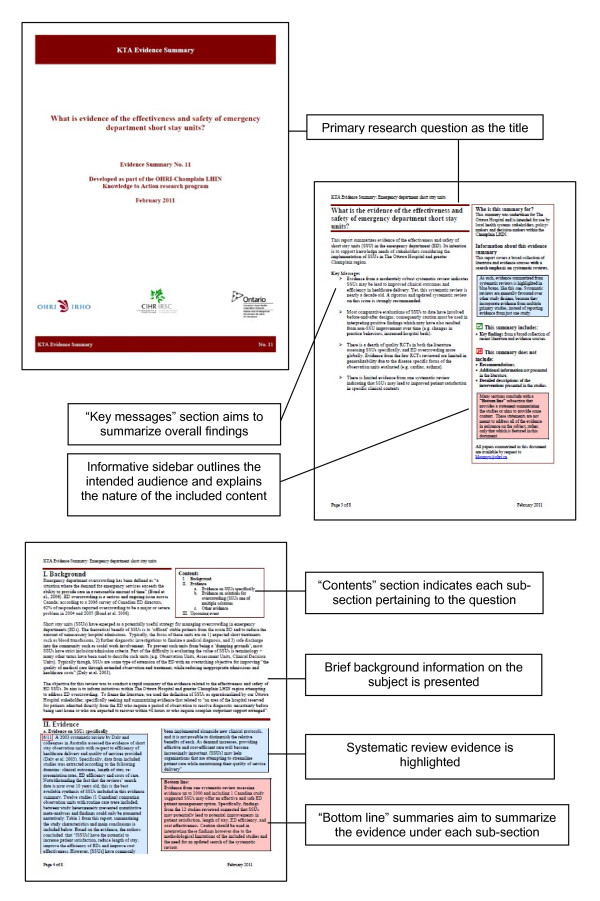
- Data or sample: 11 evidence summaries produced from November 2009 to March 2011, with topics listed in the paper; a case example describes an evidence summary on emergency department short stay units; formal evaluation through key informant interviews was ongoing.
- Main analysis: descriptive account of the eight-step production process, including narrative synthesis of included studies, assignment of evidence levels based on a modified Cochrane Musculoskeletal Group framework, and recent use of AMSTAR to assess included systematic reviews.
Limitations
- The paper states that rapid review products inherently harbor limitations relative to systematic reviews because they are produced within a short timeframe using limited resources, do not employ as much rigor, and may be subject to greater bias and/or error; it also states there is no clear evidence about decision makers’ willingness to compromise methodological rigor for quicker answers.
- The paper states that research comparing rapid with systematic review is limited, and that the purposes and context of rapid review use should be carefully considered when assessing their value.
- Evident from the text: early evidence summaries used a single reviewer for screening, excluded non-English reports and records not available electronically, did not undertake meta-analysis, relied on subjective selection of “high-quality” studies and extraction of relevant material, and in the most recent summary resolved conflicts by passing records to the next screening level rather than consensus.
Model-written summary. Check it against the paper before relying on it.
Integrity signals
Registry
Cites
Statistics
Figures
Verification
Claims the paper makes
2 Valid · 4 Not valid · 14 Not checked · 41 Own results and interpretations
The cited sources support only part of this claim — read each source’s verdict below.
In the paper
“Recent evidence summaries have also employed the 'assessment of multiple systematic reviews' (AMSTAR) tool as a means of assessing the methodological quality of included systematic reviews [13].”
§ Evidence summaries: the evolution of a rapid review approach > Evidence summary methods > Narrative synthesis of included studies (including risk-of-bias assessment)
What the sources say
- Partly supportedcites [13] 13. Shea BJ Grimshaw JM Wells GA Boers M Andersson N Hamel C Development of AMSTAR: a measurement tool to assess the methodological quality of systematic reviews BMC Med Res Methodol 2007 7 10 10.1186/1471-2288-7-10 17302989 PMC1810543 sourceExperimental — accuracy not yet measured
The Background identifies AMSTAR as a tool developed to assess the methodological quality of systematic reviews. The Discussion describes preliminary experience with the tool, but our copy does not establish that recent evidence summaries employed it to assess their included reviews. (LLM, conf=0.82)
plain- Asserted: passes — The authors put it forward as true.
- Checkable: passes — It can be checked against evidence.
- Load-bearing: unclear — It is unclear whether the paper’s conclusions depend on it.
- Based: passes — The paper gives a reason why it holds.
- Partly supported
Every source the paper cites for this claim was checked and supports it.
In the paper
“Parkill and colleagues have shown that, when compared to highly sensitive searches, pragmatically-based searches conducted for the purpose of populating an evidence map can produce a similar amount of relevant records, more quickly and at less cost [18].”
§ Evidence summaries: the evolution of a rapid review approach > Discussion
What the sources say
- Supportedcites [18] 18. Parkill A Clavisi R Pattuwage L Chau M Turner T Bragge P Searches for evidence mapping: effective, shorter, cheaper J Med Libr Assoc 2011 99 157 160 10.3163/1536-5050.99.2.008 21464854 PMC3066574 source
The RESULTS (p. 4 of our copy) report that the pragmatic evidence-mapping (EM) strategy retrieved 120 (77%) of included references versus 125 (81%) for the highly sensitive (HS) strategy — a similar yield of relevant records — while retrieving 781 fewer total citations, which 'would have resulted in a saving 19.5 hours of staff time over the 6 questions.' The DISCUSSION AND CONCLUSIONS states HS methods 'are not always cost effective for evidence mapping, in terms of resource use' and that the EM strings 'effectively identified relevant references using less staff time' (extrapolating to six extra weeks for the six questions, a year across all 55). The METHOD confirms the comparison was on yield, included studies retrieved/missed, and staff time. Only caveat: the evaluation covered six questions in traumatic brain/spinal cord injury on PubMed MEDLINE alone, so the finding is stated for that context, but the citing sentence's 'can produce' framing matches the paper's own conclusion. (LLM, conf=0.90)
plainstates a cause- Asserted: passes — The authors put it forward as true.
- Checkable: passes — It can be checked against evidence.
- Load-bearing: passes — The paper’s conclusions depend on it.
- Based: passes — The paper gives a reason why it holds.
- Supported
A result the paper reports from its own data — it cites no other source for it, so there is none to check. The quote shows it is in the paper.
In the paper
“Knowledge users have reported evidence summaries to be of high value in informing their decisions and initiatives.”
§ Evidence summaries: the evolution of a rapid review approach > Abstract > Results
plain- Asserted: passes — The authors put it forward as true.
- Checkable: passes — It can be checked against evidence.
- Load-bearing: passes — The paper’s conclusions depend on it.
- Based: passes — The paper gives a reason why it holds.
The paper states this without a source or data behind it here, so there is nothing to check it against. The quote shows it is in the paper.
In the paper
“Generally, knowledge users in our context have not demonstrated a strong capacity for formulating effective research questions”
§ Evidence summaries: the evolution of a rapid review approach > Evidence summary methods > Question development and refinement
boosted- Asserted: passes — The authors put it forward as true.
- Checkable: passes — It can be checked against evidence.
- Load-bearing: passes — The paper’s conclusions depend on it.
- Based: unclear — It is unclear why the paper says it holds.
A result the paper states — it cites no source for it, so there is none to check. The quote shows it is in the paper.
In the paper
“the first three evidence summaries were produced in the absence of a primary research question but rather using a series of research questions developed by the research team.”
§ Evidence summaries: the evolution of a rapid review approach > Evidence summary methods > Question development and refinement
plain- Asserted: passes — The authors put it forward as true.
- Checkable: passes — It can be checked against evidence.
- Load-bearing: passes — The paper’s conclusions depend on it.
- Based: passes — The paper gives a reason why it holds.
22 more claims
Create a free account to see all 61 claims and to verify the 18 references still open.
- Probably not a substantial claim. 28
- It may state two separate claims as one. 17
Claims other papers make about this one
Each is checked against this paper’s own text: does it say what the citing paper says it does?
The cited source doesn’t support the claim as written.
In the citing paper
“RRs are better suited for narrowly defined research questions where one or more SR steps may be reduced or omitted [4, 6, 21, 22, 24, 25].”
From How to conduct systematic reviews more expeditiously? (2015) · cites this paper as [4]
Checked by a reasoning model — may be wrong.
Experimental — accuracy not yet measuredThe source backs part of the claim, not all of it — or backs it for a different population, condition or comparison.
In the citing paper
“The conduct of SRs can be a time-consuming, cost- and resource-intensive task, which may take on average from 6 months to several years [4–6].”
From How to conduct systematic reviews more expeditiously? (2015) · cites this paper as [4]
Experimental — accuracy not yet measuredThe source backs part of the claim, not all of it — or backs it for a different population, condition or comparison.
In the citing paper
“In addition, the HTA process is time-consuming, generally taking over a year to complete, with the SLR and NMA part of this process taking several months each [8, 11].”
From Artificial Intelligence to Automate Network Meta-Analyses: Four Case Studies to Evaluate the Potential Application of Large Language Models (2024) · cites this paper as [11]
Experimental — accuracy not yet measuredThe source backs part of the claim, not all of it — or backs it for a different population, condition or comparison.
In the citing paper
“the methodological rigor and process that makes SR evidence trustworthy often take one to 2 years to complete [[1], [2], [3], [4]] and limit their utility to meet the time-sensitive needs of stakeholders.”
From Cochrane Rapid Reviews Methods Group offers evidence-informed guidance to conduct rapid reviews (2021) · cites this paper as [2]
Experimental — accuracy not yet measuredThe cited source says what the claim attributes to it.
In the citing paper
“We used a rapid review methodology developed by Khangura et al. (2012) which has been used within the context of various disciplines (Blakemore et al., 2017; Kadykalo et al., 2020).”
From Residential care as an alternative care option: A review of literature within a global context (2022) · cites this paper as Khangura et al., 2012
11 more claims about this paper
Create a free account to see every claim other papers make about this one.
Citations
Cites
Cochrane Handbook for Systematic Reviews of Interventions: Cochrane Book Series
(2008) · doi:10.1002/9780470712184 · Cited by 25,048 · cited 1×
“It uses explicit, systematic methods that are selected with a view to minimizing bias, thus providing more reliable findings from which conclusions can be drawn and decisions made” [1].”
MethodDevelopment of AMSTAR: A measurement tool to assess the methodological quality of systematic reviews
Shea, B. J., Grimshaw, J. M., Wells, G. A., Boers, M., Andersson, N., Hamel, C., Porter, A. C., Tugwell, P., Moher, D., & Bouter, L. M. (2007) · BMC Medical Research Methodology · doi:10.1186/1471-2288-7-10 · Cited by 4,374
Self-citationEpidemiology and reporting characteristics of systematic reviews.
Moher, D., Tetzlaff, J., Tricco, A. C., Sampson, M., & Altman, D. G. (2007) · PLoS Medicine · doi:10.1371/journal.pmed.0040078 · Cited by 891 · cited 1×
“While about half of published systematic reviews include a meta-analysis [11], the KTA evidence summaries do not undertake this level of quantitative synthesis (although we do report the results of included metaanalyses).”
BackgroundSelf-citationExpediting systematic reviews: methods and implications of rapid reviews
Ganann, R., Ciliska, D., & Thomas, H. (2010) · Implementation Science · doi:10.1186/1748-5908-5-56 · Cited by 752 · cited 3×
“A growing number of organizations, across various jurisdictions and countries, appear to be experimenting with this approach [3].”
BackgroundMoher, D., Pham, B., Lawson, M., & Klassen, T. (2003) · Health Technology Assessment · doi:10.3310/hta7410 · Cited by 500 · cited 1×
“Although exclusion of languages other than English is undesirable, it is considered to be a reasonable practice given limited time and resources and there is some evidence to suggest that it may not markedly bias review findings [9].”
BackgroundSelf-citationSingle data extraction generated more errors than double data extraction in systematic reviews
Buscemi, N., Hartling, L., Vandermeer, B., Tjosvold, L., & Klassen, T. P. (2006) · Journal of Clinical Epidemiology · doi:10.1016/j.jclinepi.2005.11.010 · Cited by 464 · cited 1×
“It is recognized, however, that a single reviewer introduces a level of error that is not desirable [10], and a second reviewer is now generally included on all evidence summaries, typically to review records excluded by the first reviewer - an approach we have labeled ‘liberal accelerated’.”
BackgroundRAPID VERSUS FULL SYSTEMATIC REVIEWS: VALIDITY IN CLINICAL PRACTICE?
Watt, A., Cameron, A., Sturm, L., Lathlean, T., Babidge, W., Blamey, S., Facey, K., Hailey, D., Norderhaug, I., & Maddern, G. (2008) · ANZ Journal of Surgery · doi:10.1111/j.1445-2197.2008.04730.x · Cited by 163 · cited 3×
“found that, despite “axiomatic differences” between the rapid and full reviews evaluated, “the essential conclusions of the rapid and full reviews did not differ extensively” [4], suggesting that products like the KTA evidence summaries may offer a useful and valid approach.”
BackgroundUsing Existing Systematic Reviews in Complex Systematic Reviews
Whitlock, E. P., Lin, J. S., Chou, R., Shekelle, P., & Robinson, K. A. (2008) · Annals of Internal Medicine · doi:10.7326/0003-4819-148-10-200805200-00010 · Cited by 144 · cited 1×
“Another consideration is a Grades of Recommendation, Assessment, Development and Evaluation-like assessment for the overall body of information included in the evidence summary as an important feature for knowledge users’ interpretation of the global evidence base [20].”
BackgroundEnd-user involvement in health technology assessment (HTA) development: A way to increase impact
McGregor, M., & Brophy, J. M. (2005) · International Journal of Technology Assessment in Health Care · doi:10.1017/s026646230505035x · Cited by 125 · cited 1×
“Usability has been an oft-neglected component in traditional systematic reviews despite evidence that has shown its capacity to improve the quality and cost effectiveness of health care [5,6].”
BackgroundLomas, J. (2005) · Healthcare Policy | Politiques de Santé · doi:10.12927/hcpol..17567 · Cited by 120
Research works printed but not linked: 2
- 1. Green S Higgins J Alderson P Clarke M Mulrow C Oxman A Higgins J, Green S Chapter 1 - Introduction Cochrane handbook for systematic reviews of interventions 2008 West Sussex, England: The Cochrane Collaboration and John Wiley & Sons Ltd
- 8. Information services CADTH Grey matters: A practical search tool for evidence-based medicine 2011 Ottawa, Canada: Canadian Agency for Drugs and Technologies in Health
Cited by
Items 801–900 of 1,003
Blockchain: What is the use case for physicians in 2024? A rapid review of the literature
Arif, A., Hussain, M., & Subbe, C. P. (2024) · Future Healthcare Journal · doi:10.1016/j.fhj.2024.100005 · Cited by 5
MacPherson, M., & Rourke, S. (2024) · Journal of Medical Internet Research · doi:10.2196/54821 · Cited by 5
“…care practitioners and policy makers often face [26], rapid reviews provide a more resource-and time-efficient means to conduct evidence syntheses that offer actionable evidence in a more relevant manner compared to other types of evidence syntheses such as systematic or scoping reviews [20,26-34].”
BackgroundResultAre the key welfare models effective for exotic pet animals?
Warwick, C., Steedman, C., Jessop, M., & Grant, R. (2024) · Discover Animals · doi:10.1007/s44338-024-00013-2 · Cited by 5
“The literature review followed the guidelines for rapid reviews [87, 88].”
MacPherson, M., Khaleghi, R., Rourke, S., Ramanaidu, R., & Montenegro, M. (2024) · BMC Digital Health · doi:10.1186/s44247-024-00119-3 · Cited by 5
“Following the approach of other rapid reviews [15], the collated results were synthesized and presented in a narrative or visual format, such as infographics, to the Virtual Health team members.”
Yang, Q., Xu, H., Chen, H., Chen, X., Ji, W., Cai, M., Fu, H., Li, H., Hou, C., & Gao, J. (2024) · Geriatric Nursing · doi:10.1016/j.gerinurse.2024.11.007 · Cited by 5
The Scenario Quality Assessment Method: A New Technique for Verifying the Quality of Scenarios
Curnin, S., Brooks, O., & Brooks, B. (2024) · Futures & Foresight Science · doi:10.1002/ffo2.205 · Cited by 6
IMPACTO SOCIAL E MISSÃO DAS UNIVERSIDADES PÚBLICAS BRASILEIRAS: HÁ CONVERGÊNCIA?
Fedato, G. A. D. L., Pires, V. M., & Bresciani, S. A. T. (2025) · Revista de Administração de Empresas · doi:10.1590/s0034-759020250304 · Cited by 5
Cartaxo, B. (2016) · International Conference on Evaluation and Assessment in Software Engineering (EASE) · doi:10.1145/2915970.2915973 · Cited by 6
“The Evidence Briefings we are proposing can be classified as an artifact medium, as well as are others from medicine [3, 9, 17].”
BackgroundMethodInfluentialNathanson, D., Woolfenden, S. R., & Zwi, K. J. (2016) · Child Abuse & Neglect · doi:10.1016/j.chiabu.2016.07.004 · Cited by 5
Brits, H., Bezuidenhout, J., & van der Merwe, L. J. (2020) · South African Family Practice · doi:10.4102/safp.v62i1.5030 · Cited by 6
Evidence-Based Interventions for Mental Health Consequences of Intimate Partner Violence
Yapp, E., Keynejad, R. C., & Oram, S. (2020) · Mental health and illness worldwide · doi:10.1007/978-981-10-2369-9_22 · Cited by 6
Value of conducting rapid reviews in nursing research
Raghunathan, K., McKenna, L., & Peddle, M. (2022) · Nurse author & editor · doi:10.1111/nae2.12042 · Cited by 6
Decentralization and Resource Capacity for Sustainable Sanitation Services Delivery in Ghana
Mariwah, S. (2022) · Advances in African economic, social and political development · doi:10.1007/978-3-031-12378-8_11 · Cited by 7
Towards Automated Meta-Analysis of Clinical Trials: An Overview
Christopoulou, S. C. (2023) · BioMedInformatics · doi:10.3390/biomedinformatics3010009 · Cited by 5
Timely, Efficient, and Living Systematic Reviews: Opportunities in International Development
Snilstveit, B., Stevenson, J., Shemilt, I., Clarke, M. J., Jiménez, E., & Thomas, J. (2018) · doi:10.51744/cip7 · Cited by 6
“There is no single definition of a rapid review and recent reviews of study methods have highlighted the variation in rapid review methods (Featherstone et al., 2015; Hartling et al., 2015; Khangura et al., 2012; Tricco et al., 2015).”
BackgroundHatchard, J. L., Buykx, P., Brennan, A., & Gillespie, D. (2023) · NIHR Open Research · doi:10.3310/nihropenres.13379.3 · Cited by 5
“It was also chosen as a way to produce a briefing for policy stakeholders and support policy discussion 34 .”
MethodDecision-Making Styles as Human Factors in Occupational Context
Efremov, L., Karaman, M. A., & Aslan, M. (2023) · Studies in systems, decision and control · doi:10.1007/978-3-031-38277-2_47 · Cited by 5
Wright, B., Baker, T. R., Lennox, A., Waxman, B. P., & Bragge, P. (2023) · Australian Journal of Rural Health · doi:10.1111/ajr.13080 · Cited by 5
Hidalgo, M., Hernán Astudillo, R., & Castro, L. M. (2024) · SN Computer Science · doi:10.1007/s42979-024-03044-4 · Cited by 5
“The paper repository was augmented with recommended sources [17], taking into account the research team’s expertise in software engineering education.”
Foundation of Evidence-Based Decision Making for Health Care Managers, Part 1
Forrestal, E. J. (2014) · The Health Care Manager · doi:10.1097/hcm.0000000000000003 · Cited by 5
“Unlike the tightly focused systematic reviews, rapid reviews generally conceptualize questions and succinctly summarize broad scopes of scientific evidence.(27) Rapid reviews are conducted when practitioners, decision makers, or policymakers need information quickly, typically within 1 to 6 months.”
BackgroundDesenvolvimento de um guia rápido para prática de atenção à saúde da população transgênero
Silva, B. P., & Schons, A. A. N. (2019) · Revista Brasileira de Medicina de Família e Comunidade · doi:10.5712/rbmfc14(41)2027 · Cited by 11
Azar, M., Benedetti, A., Riehm, K. E., Imran, M., Krishnan, A., Chiovitti, M. J., Sanchez, T., Shrier, I., & Thombs, B. D. (2020) · Journal of Clinical Epidemiology · doi:10.1016/j.jclinepi.2020.03.026 · Cited by 5
Senovilla-González, L., Ruiz, Á. H., & García-García, M. (2021) · Anales del Sistema Sanitario de Navarra · doi:10.23938/assn.0964 · Cited by 5
Hudson, É., Clavel, N., Kilpatrick, K., & Lavoie‐Tremblay, M. (2021) · Journal of Professional Nursing · doi:10.1016/j.profnurs.2021.08.012 · Cited by 5
Oosterhoff, P., & Yunus, R. M. (2022) · OpenDocs (Institute of Development Studies) · doi:10.19088/basic.2022.011 · Cited by 11
“Rapid review is a type of ‘knowledge synthesis in which components of the systematic review process are simplified or omitted to produce information in a timely manner’ (Khangura et al. 2012).”
BackgroundSystematic review automation methods
Norman, C. R. (2020) · theses.fr (ABES) · doi:10.70675/044ffa34z5c9bz433az99c8z64697dcd28a2 · Cited by 8
Adams, K., Taliano, J. M., Okorie, I., Alvendia, M., Patel, P., Garg, S., & Chang, L. W. (2025) · Human Vaccines & Immunotherapeutics · doi:10.1080/21645515.2025.2481005 · Cited by 4
Leiva-Araos, A., Kalasapudi, V. S., Jiang, A., & Kaushal, H. (2025) · IEEE Access · doi:10.1109/access.2025.3613246 · Cited by 5
“Unlike fully automated techniques, which may suffer from inaccuracies or lack contextual nuance, or traditional manual approaches that are resource-intensive and slow, this method is designed to provide a balanced solution [14], [15], [16].”
Grice-Jackson, T., Jaarsma, P., Friedrichsen, M., Wallin, M. I., de Graaf, E., Strömberg, A., & Jaarsma, T. (2025) · Current Heart Failure Reports · doi:10.1007/s11897-025-00715-y · Cited by 4
Identifying prior evidence for new trials (REVEAL): guidance for clinical researchers
Griebler, U., Ledinger, D., Klerings, I., Schandelmaier, S., Dobrescu, A. I., Deschodt, M., McLennan, S., Hemkens, L. G., Nußbaumer-Streit, B., & Briel, M. (2026) · BMJ · doi:10.1136/bmj-2024-083718 · Cited by 5
Análise de métodos de design de jogos sérios sob a ótica da Design Science Research
LEITÃO, T. M., Silva, F., & Xexeo, G. B. (2021) · Simpósio Brasileiro de Jogos e Entretenimento Digital (SBGames) · doi:10.5753/sbgames_estendido.2021.19623 · Cited by 4
“permite mapear e filtrar referências bibliográficas, em especial por conta do aumento de produção de conhecimento sobre jogos sérios [20].”
BackgroundShaver, N., Beck, A., Bennett, A., Wilson, B. J., Garritty, C., Subnath, M., Grad, R. M., Persaud, N., Thériault, G., Flemming, J. A., et al. (2024) · Systematic Reviews · doi:10.1186/s13643-023-02392-1 · Cited by 5
“Title and abstract screening will be completed independently by reviewers using the liberal accelerated approach [107].”
MethodSelf-citationImpact of the Usage of ChatGPT on Creativity Among Postgraduate Student
Padhiyar, R., & Modha, S. (2024) · International Journal of Sustainable Social Science (IJSSS) · doi:10.59890/ijsss.v2i1.1376 · Cited by 4
Improving Indigenous health equity within the emergency department: a global review of interventions
Marchand, T., Squires, K., Daodu, O. O., & Brindle, M. E. (2024) · Canadian Journal of Emergency Medicine · doi:10.1007/s43678-024-00687-3 · Cited by 5
“This review was conducted according to PRISMA guidelines [18, 19], and investigates the landscape of Indigenous equity interventions within acute care settings located in countries with original Indigenous inhabitants including Canada, United States, Australia, and New Zealand.”
MethodBaird, K., Buse, C. G., Hanna, K. S., Krehbiel, R., & Ogen, K. (2024) · Environmental Management · doi:10.1007/s00267-024-01975-5 · Cited by 18
“A rapid literature review (Ganann et al. 2010; Khangura et al. 2012) focused on two key literatures: the conceptual literature on IBA development to distill promising or leading practices, and the empirical literature that undertook a ‘ post mortem ’ of IBAs to understand expectations about…”
Murray, R. L., Leonardi‐Bee, J., Barker, A. B., Brown, O., & Langley, T. E. (2024) · Alcohol and Alcoholism · doi:10.1093/alcalc/agae045 · Cited by 6
Sumsuzzman, D. M., Kim, Y., Baek, S., & Hong, Y. (2024) · Journal of Lifestyle Medicine · doi:10.15280/jlm.2024.14.2.57 · Cited by 4
LaMarre, A., Porter, J., Silva‐Roy, P., & Obeid, N. (2025) · Early Intervention in Psychiatry · doi:10.1111/eip.70053 · Cited by 4
A Critical Reading of Solastalgia Through Indigenous and Care Ethics Lenses
Baker, E., Jones, D. K., & Brannelly, T. (2025) · Ethics and Social Welfare · doi:10.1080/17496535.2025.2539837 · Cited by 5
“The literature review approach is aligned with a rapid review (Khangura et al. 2012) where the literature findings support a critical reading that reflects depth of understanding of the topic, in this case through Māori knowledge (Mātauranga) and ethics of care.”
Ismail, M. I. B., Khan, A. J., Omar, N., Ahmad, M. S., Tahir, N. M., & Yusof, M. Y. P. M. (2025) · Digital Dentistry Journal · doi:10.1016/j.ddj.2025.100036 · Cited by 5
Nguyen‐Thanh, V., Clément, J., Thélot, B., Richard, J., Lamboy, B., & Arwidson, P. (2015) · Santé Publique · doi:10.3917/spub.154.0481 · Cited by 6
Exergames as Tools Used on Interventions to Cope with the Effects of Ageing: A Systematic Review
Velazquez, A., Campos-Francisco, W., Garćıa-Vázquez, J. P., López-Nava, I. H., Rodríguez, M. D., Pablo, A. P.-S., Martínez, A., Estrada, H., Martínez-García, A. I., Muñoz-Meléndez, A., et al. (2014) · Lecture notes in computer science · doi:10.1007/978-3-319-13105-4_59 · Cited by 4
“Which is a “streamlined approach to synthesizing evidence in a timely manner” [3].”
BackgroundDyer, T. A., Glenny, A., MacDonald, L. C., Weston-Price, S., Marshman, Z., Ireland, A., & Jones, K. (2023) · BDJ · doi:10.1038/s41415-023-6607-x · Cited by 6
Haidar, A. (2024) · Advances in educational marketing, administration, and leadership book series · doi:10.4018/979-8-3693-1536-1.ch004 · Cited by 8
Oral health in systemic sclerosis: A scoping review
Gagarine, M., Cañedo-Ayala, M., Cook, V., Discepola, M.-N., Guillot, G., Leader, D., Lim, M. A. W. T., Yap, T., Furst, D. E., Gietzen, A., et al. (2024) · Journal of Scleroderma and Related Disorders · doi:10.1177/23971983241252899 · Cited by 4
“26 Second, two investigators independently conducted a full-text review of all articles deemed potentially eligible in the title and abstract review.”
Agya, B. A., Agyemang, P., & Anokye, K. (2025) · Cleaner Waste Systems · doi:10.1016/j.clwas.2025.100291 · Cited by 5
Rapid Reviews: Sisyphos‘ Erlösung? – Eine Bestandsaufnahme
Mattivi, J. T., & Buchberger, B. (2015) · Das Gesundheitswesen · doi:10.1055/s-0035-1548857 · Cited by 4
Demellawy, D. E., Menzies-Toman, D. A., Murphy, M., Kabir, N., Shaw, A., Chernetsova, E., Serlo, J. A., & de Nanassy, J. (2019) · Asia-Pacific Journal of Clinical Oncology · doi:10.1111/ajco.13181 · Cited by 4
“Asian Pac J Cancer Prev 2014;15(12):4861-4864.”
Evidence-Based Interventions for Mental Health Consequences of Intimate Partner Violence
Yapp, E., Keynejad, R. C., & Oram, S. (2019) · Mental health and illness worldwide · doi:10.1007/978-981-10-0371-4_22-1 · Cited by 6
Reading and interpreting reviews for health professionals: a practical review
Antonelli, M., Firenzuoli, F., Salvarani, C., Gensini, G. F., & Donelli, D. (2020) · Internal and Emergency Medicine · doi:10.1007/s11739-020-02334-y · Cited by 4
Sandars, J. E., & Goh, P. S. (2020) · MedEdPublish · doi:10.15694/mep.2020.000154.1 · Cited by 7
“There are guides for conducting rapid research (Riley et al., 2012), and also rapid literature reviews (Khangura et al., 2012), and these guides highlight the importance of limiting the scope but to maintain high standards of conducting the data collection and analysis (McNall and Foster-Fishman,…”
BackgroundShimpi, T. R., Kulkarni, S. R., Bukhanov, K., Fleming, R., Scaranelo, A. M., Ghai, S., Au, F. W.-F., Beresford, M., Dua, H., Grant, A., et al. (2020) · European Journal of Radiology Open · doi:10.1016/j.ejro.2020.100265 · Cited by 4
“Thereafter, a streamlined approach to systematically identify and summarize emerging evidence was conducted [15].”
Spiteri, J. (2021) · World sustainability series · doi:10.1007/978-3-030-69284-1_15 · Cited by 4
Opportunities to improve reporting of rapid response in health technology assessment
de Almeida, M. O., Montezuma, T., de Oliveira, H. A., & Ferri, C. P. (2021) · International Journal of Technology Assessment in Health Care · doi:10.1017/s0266462321000635 · Cited by 4
“4) Number of publications in the screening 252 (650) Number of included studies 5 (7)”
BackgroundNarvaez, R. A., Canaria, A., Nifras, S., Listones, N., Topacio, R., & Baua, M. E. (2022) · International Journal of Palliative Nursing · doi:10.12968/ijpn.2022.28.12.583 · Cited by 4
Mental health and disability research in Ghana: a rapid review
Mwangi, G., Sakyi, L., Ae-Ngibise, K. A., Lund, C., & Weobong, B. (2023) · Pan African Medical Journal · doi:10.11604/pamj.2023.45.166.38808 · Cited by 6
“As mentioned, rapid reviews are particularly useful for providing timely information for decision-making, especially when resources to conduct a full systematic review are limited [8].”
BackgroundInfluentialPrevalência de anemia em gestantes das Américas: uma revisão rápida com metanálise
Souza, E. S., Batista, J. E. T., Lyrio, A. O., Guedes, E. D. M., Figueiredo, A. C. M. G., & da Cruz, S. S. (2023) · Saúde e Pesquisa · doi:10.17765/2176-9206.2023v16n2.e11484 · Cited by 8
Coad, J. E., Toft, A., Claridge, L. C., Ferguson, J., Hind, J., Jones, R. L., McClean, P., McKiernan, P. J., Samyn, M., & Taylor, R. M. (2017) · Progress in Transplantation · doi:10.1177/1526924817699958 · Cited by 4
Wang, L., Rouse, B., Marks‐Anglin, A., Duan, R., Shi, Q., Quach, K., Chen, Y., Cameron, C., Schmid, C. H., & Li, T. (2019) · Journal of Clinical Epidemiology · doi:10.1016/j.jclinepi.2019.06.010 · Cited by 4
Framing gay men’s sexual relationships: A rapid review of the literature from 2011–2018
Lemay, K. R., McKie, R. M., Braham, J., Levere, D. D., Furman, E., Sasso, T., Coleman, T. A., & Travers, R. (2020) · The Canadian Journal of Human Sexuality · doi:10.3138/cjhs.2019-0008 · Cited by 4
Development of an ethical guideline for adoption social workers in South Africa
Pieterse, K. (2019) · Boloka Institutional Repository (North-west University) · Cited by 6
Just Transition for Workers and Communities in Aberdeen and Aberdeenshire: Rapid Evidence Review
Shapovalova, D., Potts, T., Bone, J., & Bender, K. A. (2023) · University of Aberdeen · doi:10.57064/2164/19887 · Cited by 4
ChatGPT and U(X): A Rapid Review on Measuring the User ExperiencePreprint
Seaborn, K. (2025) · arXiv (Cornell University) · doi:10.48550/arxiv.2503.15808 · Cited by 4
“The work was also carried out by a single author, which is sufficient, if not common, for rapid reviews (Khangura, Konnyu, Cushman, Grimshaw, & Moher, 2012) but does not meet scoping review criteria (Munn et al., 2018).”
Patterson, P. D., Mcilvaine, Q. S., Nong, L., Liszka, M. K., Miller, R. S., Guyette, F. X., & Martin‐Gill, C. (2022) · Journal of the American College of Emergency Physicians Open · doi:10.1002/emp2.12699 · Cited by 3
Shen, B. H., Law, A. C., & Wilson, K. C. (2023) · CHEST Critical Care · doi:10.1016/j.chstcc.2023.100044 · Cited by 3
Kansanga, M. M., & Dinko, D. H. (2024) · Springer eBooks · doi:10.1007/978-3-031-60986-2_3 · Cited by 4
Mellifont, D. (2023) · Canadian Journal of Disability Studies · doi:10.15353/cjds.v12i3.1035 · Cited by 4
Evidence-Based Rapid Review of Clean Cooking: Lessons for Nigeria and Other Developing Economies
Ayodele-Olajire, D. O., Sesan, T., & Clifford, M. (2025) · Advances in Environmental and Engineering Research · doi:10.21926/aeer.2503027 · Cited by 4
Barriers to Knowledge Sharing During the Onboarding Process
Szeluga-Romańska, M. (2025) · European Conference on Knowledge Management · doi:10.34190/eckm.26.2.4092 · Cited by 3
“To review the proper existing literature, a narrative summary review was applied (Campbell et al ., 2018; Khangura et al ., 2012) in the form of a comprehensive web - based search.”
Rees-Davies, L. N., Bennett, A., Mellick, M., Bashir, F., Mackelworth, K., & Glennan, C. (2025) · International Journal of Mentoring and Coaching in Education · doi:10.1108/ijmce-01-2025-0006 · Cited by 3
MacRae, A., O'Connor, A., Berkovic, D. E., Ryan, J. L., Woolford, M., Ayton, D., & Morris, H. (2026) · Trauma Violence & Abuse · doi:10.1177/15248380261451829 · Cited by 3
Fear of Deportation and Latine Mental Health: A Rapid Review of Recent Literature
Gutiérrez, D., & Silverio, N. (2026) · Journal of Counseling & Development · doi:10.1002/jcad.70040 · Cited by 3
STEAM in tertiary and teacher education: A rapid review
Dahal, N. (2026) · Social Sciences & Humanities Open · doi:10.1016/j.ssaho.2026.103211 · Cited by 3
Mariwah, S. (2017) · Oguaa Journal of Social Sciences · doi:10.47963/joss.v8i2.314 · Cited by 3
“This approach has been regarded as a common way of obtaining synthetic, rigorous but relatively quick knowledge and evidence on specific fields of inquiry (Khangura et al. 2012; Tricco et al. 2015).”
BackgroundBrown, A. N. (2022) · International Journal of Environmental Research and Public Health · doi:10.3390/ijerph19127312 · Cited by 4
Patterns and Pitfalls of Short-cuts Used in Environmental Management Rapid Reviews
Harper, M., Rytwinski, T., & Cooke, S. J. (2023) · Environmental Management · doi:10.1007/s00267-023-01901-1 · Cited by 4
“…(Garritty et al. 2021), the Rapid Review Guidebook (Dobbins 2017), the STARR decision tool (Pandor et al. 2019), Collins et al. (2015), and Khangura et al. (2012) all recommend the inclusion of stakeholders (sometimes called the steering group), but only 6/26 RRs noted stakeholder…”
BackgroundMethodInfluentialComparing the Efficacy of Rapid Review With a Systematic Review in the Software Engineering Field
Pena, C., Cartaxo, B., Steinmacher, I., Badampudi, D., da Silva, D., Ferreira, W., Almeida, A., Kamei, F., & Soares, S. (2024) · Journal of Software Evolution and Process · doi:10.1002/smr.2748 · Cited by 5
McVey, L., Fitzgerald, M., Montague, J., Sutton, C., Branney, P., Briggs, A., Chater, M., Edwards, L., Eyers, E., Khan, K., et al. (2024) · PLOS Digital Health · doi:10.1371/journal.pdig.0000654 · Cited by 5
“This involved taking a liberal accelerated approach to screening abstracts and texts [20], where a proportion of abstracts and texts are dual-screened to test reviewer concordance, after which one reviewer screens the remaining materials and a second screens those excluded by the first reviewer.”
What happened next? A survey of review clients evaluating impacts of rapid reviews
Bragge, P., Clark, E., Delafosse, V., Cong‐Lem, N., Tsering, D., Kellner, P., Kostopoulos, A., & Dobbins, M. (2025) · Journal of Clinical Epidemiology · doi:10.1016/j.jclinepi.2025.111673 · Cited by 3
Morand-Grondin, D., Berthod, J., Sigouin, J., Beaulieu‐Bonneau, S., & Kairy, D. (2025) · JMIR Research Protocols · doi:10.2196/66639 · Cited by 3
“A rapid review is more suitable for efficiently synthesizing and summarizing evidence in a timely manner [24], providing actionable results for an emerging topic.”
African American Academic Librarians: An Evidence Map Case Study Using Rapid Review Methodology
Jefferson, J. L., & Fehrmann, P. G. (2016) · Behavioral & Social Sciences Librarian · doi:10.1080/01639269.2016.1283177 · Cited by 3
“Although rapid review methods are still developing, these steps have been listed as common practice (Khangura et al. 2012): Needs assessment.”
BackgroundMethodInfluentialHealth Planning for Indigenous Populations: A Rapid Evidence Review
Loutfi, D., Law, S., McCutcheon, C., Carlin, R., Torrie, J., & Macdonald, M. E. (2018) · International Indigenous Policy Journal · doi:10.18584/iipj.2018.9.1.7 · Cited by 4
Camilleri, M., Gogolishvili, D., Giliauskas, D. L., Globerman, J., & Wilson, M. G. (2019) · Health Research Policy and Systems · doi:10.1186/s12961-019-0476-4 · Cited by 3
“One particular study [52] describing the development and assessment of the rapid review process used in the Knowledge to Action research programme at the Ottawa Hospital Research Institute highlights the mutually beneficial effects of ongoing follow-up and collaboration for both knowledge users and researchers [52].”
BackgroundMethodResearch-Portfolio Performance Metrics: Rapid Review
Blumenthal, M. S., Taylor, J., Leidy, E., Anderson, B., Carew, D., Bordeaux, J., & Shanley, M. G. (2019) · RAND Corporation eBooks · doi:10.7249/rr2370 · Cited by 3
Karrow, D. D., & Howard, P. G. (2020) · Cited by 3
Moore, F., Grunch, B. H., Miller, L. E., & Musacchio, M. J. (2021) · Cureus · doi:10.7759/cureus.16528 · Cited by 3
Daudt, H., & Spargo, E. L. (2022) · Canadian Journal on Aging / La Revue canadienne du vieillissement · doi:10.1017/s071498082200023x · Cited by 4
Fadhlaoui, A., Mrad, H., Vinette, B., & Bilodeau, K. (2022) · Canadian Oncology Nursing Journal · doi:10.5737/23688076314498 · Cited by 3
Chirico, F., Nucera, G., Sacco, A., Taino, G., Szarpak, Ł., & Imbriani, M. (2022) · Giornale italiano di medicina del lavoro ed ergonomia · doi:10.4081/gimle.579 · Cited by 5
“…health emergency, a rapid review design, which is a “type of knowledge in which components of the systematic reviews process are simplified or omitted to produce information in a short period of time” (24), by limiting inclusion by date or language and reporting re-sults narratively, was used (25).”
Impact of COVID 19 on Digital Marketing: A Systematic Study on Sub Saharan African
Dadzie, I. O. (2023) · Asian Journal of Economics Business and Accounting · doi:10.9734/ajeba/2023/v23i7946 · Cited by 4
Intervenciones de la Escuela Activa: revisión de posibles propuestas.
Rodríguez, J. B., & Ríes, F. (2023) · Revista Española de Educación Física y Deportes · doi:10.55166/reefd.v437i2.1091 · Cited by 3
Ethics - Scientific Research, Ethical Issues, Artificial Intelligence and Education [Working Title]
Radenković, M. (2023) · IntechOpen eBooks · doi:10.5772/intechopen.1001548 · Cited by 4
Water Corruption in Central Asia: A Rapid Review
Mukhtarova, A. (2023) · Central Asian Journal of Water Research · doi:10.29258/cajwr/2023-r1.v9-2/35-56.eng · Cited by 3
Uma revisão rápida sobre revisões rápidas
Toma, T. S., & Soares, A. C. (2016) · BIS Boletim do Instituto de Saúde · doi:10.52753/bis.v17i1.35388 · Cited by 4
Riddering, L., Towns, A., Brunese, P., & Yih, Y. (2024) · Progress in Development Studies · doi:10.1177/14649934231211731 · Cited by 3
Communicating medical device recalls: A rapid review of the literature
Tennant, B., Tesfaye, C. L., Chansky, M. C., Lappin, B. M., Weinberg, J. P., Ritchey, M. E., MacLennan, L., & Tarver, M. E. (2024) · Patient Education and Counseling · doi:10.1016/j.pec.2024.108244 · Cited by 3
Taylor, J. A. T., Majeed, T., Rémond, M., Bagade, T., Edwards, L. M., Austin, K., Smith, E., Howard, M., & Sullivan, E. A. (2024) · BMJ Global Health · doi:10.1136/bmjgh-2023-012979 · Cited by 3
“21”
Fadhlaoui, A., Mrad, H., Vinette, B., & Bilodeau, K. (2022) · Canadian Oncology Nursing Journal · doi:10.5737/23688076324505 · Cited by 3
Ebrahim, A., Makwambeni, P. R., Damonse, S., Marais, J. C., Perumal, K., Philpott, S., Rooseboom, B., & Shefer, K. (2024) · African Journal of Health Professions Education · doi:10.7196/ajhpe.2024.v16i4.1658 · Cited by 3
Nguyen‐Thanh, V., Clément, J., Haroutunian, L., Léon, C., & Arwidson, P. (2015) · Santé Publique · doi:10.3917/spub.154.0471 · Cited by 4
Metadata
- Authors
- Khangura, S., Konnyu, K., Cushman, R., Grimshaw, J., & Moher, D.
- Affiliations
- Ottawa Hospital Research Institute (CA)
- Champlain Local Health Integration Network (CA)
- University of Ottawa (CA)
- Corresponding author
- Moher, David
- Venue
- Systematic Reviews
- Published
- 2012-02-10
- Volume
- 1
- Issue
- 1
- Pages
- 10-10
- ISSN
- 2046-4053 (ISSN-L)
- PMC
- PMC3351736
- OpenAlex
- W2156100542
- Cited by
- 1,232
- References
- 19
- Citations by year
- 2026: 43 · 2025: 96 · 2024: 132 · 2023: 137 · 2022: 156 · 2021: 171 · 2020: 121 · 2019: 87 · 2018: 72 · 2017: 67 · 2016: 61 · 2015: 41 · 2014: 27 · 2013: 16 · 2012: 5
- FWCI
- 32.38
- Type
- journal article
- Language
- en
- Open access
- gold
- doi.org
- Licence
- Locations
- Systematic Reviews (publishedVersion, cc-by)
- PubMed Central (publishedVersion, cc-by)
- PubMed (publishedVersion)
- uO Research (University of Ottawa) (submittedVersion, public-domain)
- DOAJ (DOAJ: Directory of Open Access Journals) (submittedVersion)
- Funders
- University of Ottawa
- Canadian Institutes of Health Research (86796_1)
- Topics
- Social Sciences › Decision Sciences › Statistics, Probability and Uncertainty › Meta-analysis and systematic reviews
- Health Sciences › Health Professions › General Health Professions › Health Sciences Research and Education
- Health Sciences › Medicine › Public Health, Environmental and Occupational Health › Clinical practice guidelines implementation
- Keywords
- rapid review, evidence summaries, knowledge to action, evidence-informed decision-making, knowledge users, knowledge infrastructure, healthcare decision-making, evidence synthesis, evidence dissemination, regional health administration
- MeSH terms
- Decision Making, Humans, Publishing, Review Literature as Topic, Evidence-Based Medicine, Information Dissemination
About these checks
Registry, retraction, Cites and statistics results are computed, not judged, with one exception: a printed reference that no index lists is read once by a model before it counts as a citation error. Claims are extracted by a model and kept only when their quote appears verbatim in the text; each cited source is then checked, with a model’s help, for whether it says what the claim relies on. Those verdicts can be wrong — read the claim’s quote and the cited source before relying on one.
The claim verdicts this report counts are experimental: their accuracy is not yet measured.
A language model drew the claims from the paper on 2026-10-04, under version 3 of the claim definition (model deepseek-v4.1-flash, prompt extract-v3).
A second model labelled each claim on 2026-10-04 (model jev-1.13-20260917, definition revision gold-guideline-v0.2).
Cited sources are checked with a language model’s help (gpt-6-sol and qwen3.8-omni-flash).
Statistics and arithmetic are recomputed, not judged.
Confidence bands are shown only for fields calibrated on our annotated test set. None is calibrated yet, so no band is shown.
What counts as a claim ›How we measure confidence ›How we check this ›
Are you an author, or do you see a problem with this page? Request a review
Data sources
Bibliographic data: Semantic Scholar, OpenAlex, Crossref.
Contains information from the Semantic Scholar Academic Graph Datasets, made available under the ODC Attribution License (ODC-BY 1.0).
Semantic Scholar’s data is described in: Kinney, R., et al. (2023). The Semantic Scholar Open Data Platform. arXiv:2301.10140.
