

Does use of the CONSORT Statement impact the completeness of reporting of randomised controlled trials published in medical journals? A Cochrane reviewa
Open accessThe DOI matches its Crossref record; 27 of the 29 references it cites were found in a registry or an index.
Abstract
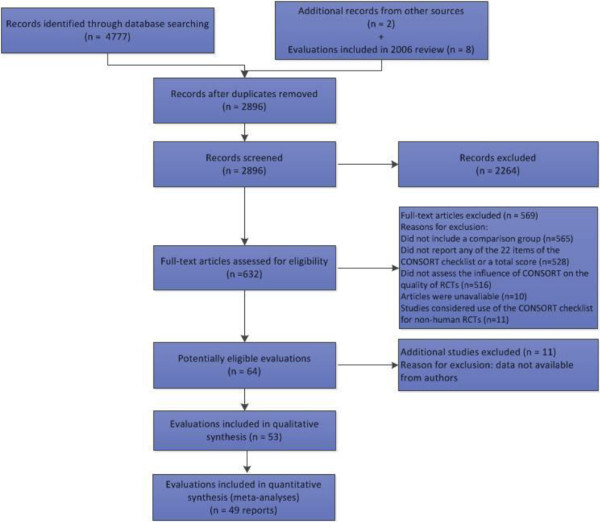
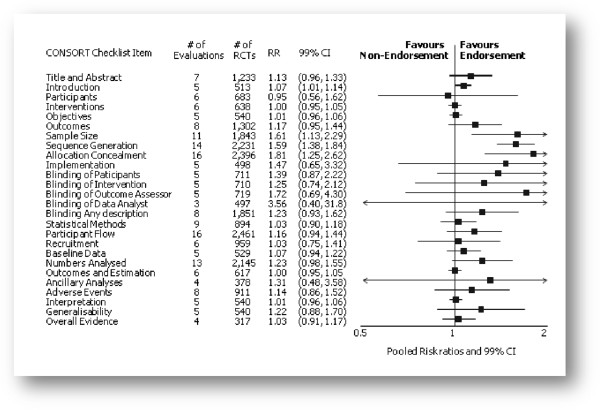
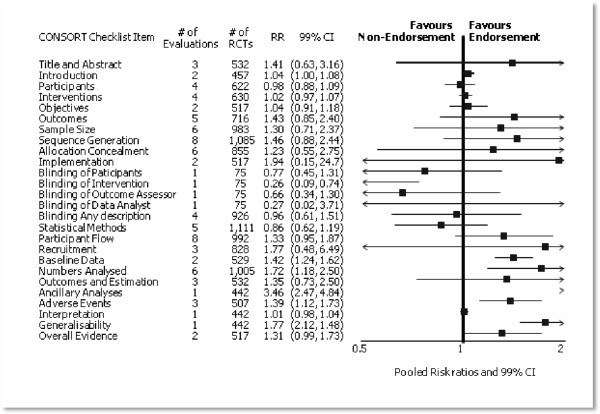
Background: The Consolidated Standards of Reporting Trials (CONSORT) Statement is intended to facilitate better reporting of randomised clinical trials (RCTs). A systematic review recently published in the Cochrane Library assesses whether journal endorsement of CONSORT impacts the completeness of reporting of RCTs; those findings are summarised here. Methods: Evaluations assessing the completeness of reporting of RCTs based on any of 27 outcomes formulated based on the 1996 or 2001 CONSORT checklists were included; two primary comparisons were evaluated. The 27 outcomes were: the 22 items of the 2001 CONSORT checklist, four sub-items describing blinding and a ‘total summary score’ of aggregate items, as reported. Relative risks (RR) and 99% confidence intervals were calculated to determine effect estimates for each outcome across evaluations. Results: Fifty-three reports describing 50 evaluations of 16,604 RCTs were assessed for adherence to at least one of 27 outcomes. Sixty-nine of 81 meta-analyses show relative benefit from CONSORT endorsement on completeness of reporting. Between endorsing and non-endorsing journals, 25 outcomes are improved with CONSORT endorsement, five of these significantly (α = 0.01). The number of evaluations per meta-analysis was often low with substantial heterogeneity; validity was assessed as low or unclear for many evaluations. Conclusions: The results of this review suggest that journal endorsement of CONSORT may benefit the completeness of reporting of RCTs they publish. No evidence suggests that endorsement hinders the completeness of RCT reporting. However, despite relative improvements when CONSORT is endorsed by journals, the completeness of reporting of trials remains sub-optimal. Journals are not sending a clear message about endorsement to authors submitting manuscripts for publication. As such, fidelity of endorsement as an ‘intervention’ has been weak to date. Journals need to take further action regarding their endorsement and implementation of CONSORT to facilitate accurate, transparent and complete reporting of trials.
Overview
The claims and statistics of this paper haven’t been checked yet.
Free: it reads the open-access text and checks the first 5 claims that cite a source we can check. Create a free account to check every claim.
Integrity signals
Registry
Cites
Statistics
Figures
Verification
Claims the paper makes
The claims and statistics of this paper haven’t been checked yet.
Free: it reads the open-access text and checks the first 5 claims that cite a source we can check. Create a free account to check every claim.
Claims other papers make about this one
Each is checked against this paper’s own text: does it say what the citing paper says it does?
The source backs part of the claim, not all of it — or backs it for a different population, condition or comparison.
In the citing paper
“Properly endorsed and implemented reporting guidelines offer a way for publishers, editors, peer reviewers, and authors to do a better job of completely and transparently describing what was done and found. 28”
From Better reporting of interventions: template for intervention description and replication (TIDieR) checklist and guide (2014) · cites this paper as [28]
Experimental — accuracy not yet measuredThe source backs part of the claim, not all of it — or backs it for a different population, condition or comparison.
In the citing paper
“However, the adherence of authors to these guidelines is low and the quality of reporting remains insufficient [9–21].”
From Impact of an online writing aid tool for writing a randomized trial report: the COBWEB (Consort-based WEB tool) randomized controlled trial (2015) · cites this paper as [18]
Experimental — accuracy not yet measuredThe cited source says what the claim attributes to it.
In the citing paper
“Use of the CONSORT statement for the reporting of two group parallel trials is associated with improved reporting quality.97”
From CONSORT 2010 statement: extension to randomised pilot and feasibility trials. (2016) · cites this paper as [97]
The cited source says what the claim attributes to it.
In the citing paper
“A Cochrane review of 50 evaluations of 16 604 trials assessed the association between journals’ endorsement of CONSORT and the reporting of trials they published; 25 of 27 CONSORT checklist items were more completely reported when a trial was published in a CONSORT endorsing as opposed to non-endorsing journal.2 14”
From CONSORT 2025 statement: updated guideline for reporting randomised trials (2025) · cites this paper as [2]
The cited source says what the claim attributes to it.
In the citing paper
“However, there is overwhelming evidence that the quality of reporting is not optimal.”
From CONSORT 2025 statement: updated guideline for reporting randomised trials (2025) · cites this paper as [2]
6 more claims about this paper
Create a free account to see every claim other papers make about this one.
Self-check
Percentages, sums and reported differences re-computed from the paper’s own numbers.
The self-check needs the paper’s full text.
Citations
Cites
Cochrane Handbook for Systematic Reviews of Interventions: Cochrane Book Series
(2008) · doi:10.1002/9780470712184 · Cited by 25,048
Assessing the quality of reports of randomized clinical trials: Is blinding necessary?
Jadad, A. R., Moore, R. A., Carroll, D., Jenkinson, C., Reynolds, D. J. M., Gavaghan, D. J., & McQuay, H. J. (1996) · Controlled Clinical Trials · doi:10.1016/0197-2456(95)00134-4 · Cited by 17,582 · cited 1×
“In addition, if quality of RCTs within included evaluations was assessed using a quality assessment tool however measured (for example, Jadad scale [13]), these data were extracted.”
MethodCONSORT 2010 Statement: updated guidelines for reporting parallel group randomised trials
the CONSORT Group, Schulz, K. F., Altman, D. G., & Moher, D. (2010) · BMC Medicine · doi:10.1186/1741-7015-8-18 · Cited by 13,371
Self-citationMoher, D., Hopewell, S., Schulz, K. F., Montori, V., Gotzsche, P. C., Devereaux, P. J., Elbourne, D., Egger, M., & Altman, D. G. (2010) · BMJ · doi:10.1136/bmj.c869 · Cited by 8,883 · cited 2×
“Across the 27 outcomes the number of studies per metaanalysis varied (median (IQR1, IQR3), 6 [5, 8]).”
BackgroundSelf-citationMoher, D., Schulz, K. F., & Altman, D. G. (2001) · The Lancet · doi:10.1016/s0140-6736(00)04337-3 · Cited by 5,373
Self-citationThe Revised CONSORT Statement for Reporting Randomized Trials: Explanation and Elaboration
Altman, D. G., Schulz, K. F., Moher, D., Egger, M., Davidoff, F., Elbourne, D., Gøtzsche, P. C., Lang, T., & for the CONSORT Group (2001) · Annals of Internal Medicine · doi:10.7326/0003-4819-134-8-200104170-00012 · Cited by 3,835
Self-citationAssessing Risk of Bias in Included Studies
Higgins, J. P., & Altman, D. G. (2008) · Cochrane Handbook for Systematic Reviews of Interventions · doi:10.1002/9780470712184.ch8 · Cited by 3,396 · cited 1×
“health interventions typically rely on reports of RCTs as their primary source of evidence [19].”
BackgroundSelf-citationImproving the Quality of Reporting of Randomized Controlled Trials: The CONSORT Statement
Begg, C. (1996) · JAMA · doi:10.1001/jama.1996.03540080059030 · Cited by 3,127
Moher, D., Schulz, K. F., & Altman, D. G. (2001) · BMC Medical Research Methodology · doi:10.1186/1471-2288-1-2 · Cited by 2,755 · cited 1×
“SORT) Statement [1], which has been revised and updated twice [2,3], each with a companion explanatory”
BackgroundSelf-citationMoher, D. (2001) · JAMA · doi:10.1001/jama.285.15.1987 · Cited by 2,545
Self-citation
Cited by
Items 101–200 of 633
Reporting Guideline for Chatbot Health Advice Studies: The CHART Statement
Collaborative, T. C., Huo, B., Collins, G. S., Chartash, D., Thirunavukarasu, A. J., Flanagin, A., Iorio, A., Cacciamani, G. E., Chen, X., Liu, N., et al. (2025) · JAMA Network Open · doi:10.1001/jamanetworkopen.2025.30220 · Cited by 84
Stevely, A., Dimairo, M., Todd, S., Julious, S. A., Nicholl, J., Hind, D., & Cooper, C. L. (2015) · PLOS ONE · doi:10.1371/journal.pone.0141104 · Cited by 59
“There has been marked general improvement in the conduct and reporting of RCTs since the advent of the first CONSORT statement [19–21], although there are still some suboptimal areas requiring improvements [21,22].”
Sansai, K., Takuathung, M. N., Khatsri, R., Teekachunhatean, S., Hanprasertpong, N., & Koonrungsesomboon, N. (2020) · Osteoporosis International · doi:10.1007/s00198-020-05476-z · Cited by 72
Lazarus, C., Haneef, R., Ravaud, P., Hopewell, S., Altman, D. G., & Boutron, I. (2016) · Journal of Clinical Epidemiology · doi:10.1016/j.jclinepi.2016.04.012 · Cited by 58
Self-citationWieschowski, S., Riedel, N., Wollmann, K., Kahrass, H., Müller-Ohlraun, S., Schuermann, C., Kelley, S., Kszuk, U., Siegerink, B., Dirnagl, U., et al. (2019) · Journal of Clinical Epidemiology · doi:10.1016/j.jclinepi.2019.06.002 · Cited by 60
Becker, K. D., & Chorpita, B. F. (2023) · Journal of Clinical Child & Adolescent Psychology · doi:10.1080/15374416.2023.2169926 · Cited by 57
“…in general and more usable for secondary synthesis in particular (e.g., Consolidated Standards of Reporting Trials [CONSORT]: Altman et al., 2001; Turner et al., 2012; Journal Article Reporting Standards [JARS]: APA Publications and Communications Board Working Group on Journal Article Reporting…”
BackgroundAssessing the Quality of Simulation-Based Research Articles: A Rating Rubric
Fey, M. K., Gloe, D. S., & Mariani, B. A. (2015) · Clinical Simulation in Nursing · doi:10.1016/j.ecns.2015.10.005 · Cited by 61
Collaborative, T. C. (2025) · BMJ Medicine · doi:10.1136/bmjmed-2025-001632 · Cited by 98
Reporting Quality of Observational Studies in Plastic Surgery Needs Improvement: A Systematic Review
Agha, R. A., Lee, S.-Y., Jeong, K. J. L., Fowler, A. J., & Orgill, D. P. (2016) · Annals of Plastic Surgery · doi:10.1097/sap.0000000000000419 · Cited by 55
“Much focus has been given to shortfalls in the reporting of RCTs in plastic surgery,(2) surgery more broadly(8) and medicine.(9) Although RCTs represent the criterion standard for evaluating the effectiveness of an intervention, most studies are observational in nature.”
BackgroundCavallini, G., Biagiotti, G., & Bolzon, E. (2013) · Asian Journal of Andrology · doi:10.1038/aja.2013.99 · Cited by 61
Slade, S. C., Finnegan, S., Dionne, C. E., Underwood, M., & Buchbinder, R. (2018) · Journal of Clinical Epidemiology · doi:10.1016/j.jclinepi.2018.07.009 · Cited by 55
Preliminary evidence on the uptake, use and benefits of the CONSORT-PRO extension
Mercieca‐Bebber, R., Rouette, J., Calvert, M., King, M. T., McLeod, L., Holch, P., Palmer, M., & Brundage, M. (2017) · Quality of Life Research · doi:10.1007/s11136-017-1508-6 · Cited by 56
Wilson, A. J., Rand, E., Webster, A. J., & Genever, P. G. (2021) · Stem Cell Research & Therapy · doi:10.1186/s13287-021-02435-1 · Cited by 55
“The introduction of the CONSORT reporting recommendations for RCT reporting has helped to improve the stringency and completeness of publications in the literature [76, 77].”
MethodThe Weak Spots in Contemporary Science (and How to Fix Them)
Wicherts, J. M. (2017) · Animals · doi:10.3390/ani7120090 · Cited by 60
Reporting of interventions in randomised trials: an audit of journal Instructions to Authors
Hoffmann, T., English, T., & Glasziou, P. (2014) · Trials · doi:10.1186/1745-6215-15-20 · Cited by 53
“CONSORT contains an item (item 5) about how interventions should be reported and provides general advice to report ‘the interventions for each group with sufficient details to allow replication, including how and when they were actually administered’ [7].”
BackgroundDimairo, M., Boote, J., Julious, S. A., Nicholl, J. P., & Todd, S. (2015) · Trials · doi:10.1186/s13063-015-0958-9 · Cited by 53
Hutton, B., Wolfe, D., Moher, D., & Shamseer, L. (2017) · Evidence Based Mental Health · doi:10.1136/eb-2017-102666 · Cited by 53
Self-citationManyara, A. M., Davies, P., Stewart, D., Weir, C. J., Young, A. E., Blazeby, J., Butcher, N. J., Bujkiewicz, S., Chan, A.-W., Dawoud, D., et al. (2024) · BMJ · doi:10.1136/bmj-2023-078524 · Cited by 53
The CONSORT Statement: Application within and adaptations for orthodontic trials
Pandis, N., Fleming, P. S., Hopewell, S., & Altman, D. G. (2015) · American Journal of Orthodontics and Dentofacial Orthopedics · doi:10.1016/j.ajodo.2015.03.014 · Cited by 52
Self-citationMethodology and reporting quality of reporting guidelines: systematic review
Wang, X., Chen, Y., Yang, N., Deng, W., Wang, Q., Li, N., Yao, L., Wei, D., Chen, G., & Yang, K. (2015) · BMC Medical Research Methodology · doi:10.1186/s12874-015-0069-z · Cited by 57
“Adoption of reporting guidelines is associated with improved reporting quality of research [8].”
BackgroundMethodological and reporting quality in laboratory studies of human eating behavior
Robinson, E., Bevelander, K. E., Field, M., & Jones, A. (2018) · Appetite · doi:10.1016/j.appet.2018.02.008 · Cited by 59
de Jong, Y., van der Willik, E. M., Milders, J., Voorend, C. G. N., Morton, R. L., Dekker, F. W., Meuleman, Y., & van Diepen, M. (2021) · BMC Medical Research Methodology · doi:10.1186/s12874-021-01363-1 · Cited by 70
“for quantitative reviews [19], clinical trials [13, 34], observational studies [15, 16], prediction- or prognostic studies [14, 17], show that, even with endorsement of journals, the completeness of reporting remains suboptimal although for some, reporting quality improved.”
Backgroundde Vries, A. C. Q., Thio, H. B., de Kort, W. J. A., Opmeer, B. C., van der Stok, H. M., de Jong, E. M. G. J., Horváth, B., Busschbach, J. J. V., Nijsten, T. E. C., & Spuls, P. I. (2017) · British Journal of Dermatology · doi:10.1111/bjd.14867 · Cited by 59
Nagendran, M., Harding, D., Teo, W. Z. W., Camm, C. F., Maruthappu, M., McCulloch, P. G., & Hopewell, S. (2013) · BMJ Open · doi:10.1136/bmjopen-2013-003898 · Cited by 58
“CONSORT mentioned in ITPR, n (%) 9 (27) 6 (27) 3 (10)”
Hussain, J. A., Bland, M., Langan, D., Johnson, M. J., Currow, D. C., & White, I. R. (2017) · Journal of Clinical Epidemiology · doi:10.1016/j.jclinepi.2017.05.009 · Cited by 53
RESERVE - REporting of SystEmatic ReViews in Ethics: development, explanations and examples
Kahrass, H., Borry, P., Gastmans, C., Ives, J., van der Graaf, R., Strech, D., & Mertz, M. (2023) · Bioethics Open Research · doi:10.12688/bioethopenres.17486.1 · Cited by 57
ESPACOMP Medication Adherence Reporting Guidelines (EMERGE): a reactive-Delphi study protocol
Helmy, R., Zullig, L. L., Dunbar-Jacob, J., Hughes, D. A., Vrijens, B., Wilson, I. B., & De Geest, S. (2017) · BMJ Open · doi:10.1136/bmjopen-2016-013496 · Cited by 49
‘Small Data’ for big insights in ecology
Todman, L., Bush, A., & Hood, A. S. C. (2023) · Trends in Ecology & Evolution · doi:10.1016/j.tree.2023.01.015 · Cited by 69
Artificial Intelligence in Dentistry: A Concise Review of Reporting Checklists and Guidelines
Khurshid, Z., Osathanon, T., Shire, M. A., Schwendicke, F., & Samaranayake, L. P. (2025) · International Dental Journal · doi:10.1016/j.identj.2025.109322 · Cited by 61
Liang, Z., Chen, X., Shi, J., Hu, H., Xue, Y., & Ung, C. O. L. (2021) · Chinese Medicine · doi:10.1186/s13020-020-00422-x · Cited by 54
“There were three categories [17] of the results: “low risk of bias”, “Unclear risk of bias” and “High risk of bias”.”
MethodFuller, T., Pearson, M., Peters, J., & Anderson, R. (2015) · PLOS ONE · doi:10.1371/journal.pone.0121585 · Cited by 47
“Editor 6: . . . the answer that seems to come back from the CONSORT group when they approach editors, is that editors say, "I've got enough to do. . .”
BackgroundMethodInfluentialGao, Q., Xie, Y.-J., Chen, Y., Tan, H., Guo, Q., & Lau, B. W.-M. (2020) · Neural Regeneration Research · doi:10.4103/1673-5374.300341 · Cited by 57
“The heterogeneity variance parameter ( τ 2 ) was used to assess the statistical heterogeneity of the NMA models (Turner et al., 2012).”
Community consensus on core open science practices to monitor in biomedicine
Cobey, K. D., Haustein, S., Brehaut, J., Dirnagl, U., Franzen, D. L., Hemkens, L. G., Presseau, J., Riedel, N., Strech, D., Alperin, J. P., et al. (2023) · PLOS Biology · doi:10.1371/journal.pbio.3001949 · Cited by 46
“Reporting guidelines are checklists of essential information to include in a manuscript; these are widely endorsed by medical journals and have been shown to improve the quality of reporting of publications [24].”
BackgroundSelf-citationTen simple rules for good research practice
Schwab, S., Janiaud, P., Dayan, M., Amrhein, V., Panczak, R., Palagi, P. M., Hemkens, L. G., Ramon, M., Rothen, N., Senn, S. J., et al. (2022) · PLoS Computational Biology · doi:10.1371/journal.pcbi.1010139 · Cited by 56
Grindlay, D. J. C., Dean, R. S., Christopher, M. M., & Brennan, M. L. (2014) · BMC Veterinary Research · doi:10.1186/1746-6148-10-10 · Cited by 54
“A recent systematic review found that medical journal endorsement of CONSORT was insufficient to ensure the completeness of reporting [37], and two studies found that the quality of articles on studies of diagnostic accuracy did not notably improve when STARD was included in author guidelines, largely because of lack…”
BackgroundBennett, D. A., Brayne, C., Feigin, V. L., Barker-Collo, S., Brainin, M., Davis, D., Gallo, V., Jetté, N., Karch, A., Kurtzke, J. F., et al. (2015) · European Journal of Epidemiology · doi:10.1007/s10654-015-0034-5 · Cited by 45
“There is substantial evidence that reporting guidelines improve the completeness of published reports based on natural experiments [20, 21].”
BackgroundMeulemeester, J. D., Fedyk, M., Jurkovic, L., Reaume, M., Dowlatshahi, D. D., Stotts, G., & Shamy, M. C. F. (2018) · Journal of Clinical Epidemiology · doi:10.1016/j.jclinepi.2017.12.027 · Cited by 49
Saltaji, H., Armijo-Olivo, S., Cummings, G. G., Amin, M., & Flores-Mir, C. (2017) · PLoS ONE · doi:10.1371/journal.pone.0190089 · Cited by 43
Owen, B. M., Hallett, C. S., Cosgrove, J. J., Tweedley, J. R., & Moheimani, N. R. (2022) · Limnology and Oceanography Methods · doi:10.1002/lom3.10496 · Cited by 53
Assessing Implementation Strategy Reporting in the Mental Health Literature: A Narrative Review
Hooley, C., Amano, T., Markovitz, L., Yaeger, L., & Proctor, E. (2020) · Administration and Policy in Mental Health and Mental Health Services Research · doi:10.1007/s10488-019-00965-8 · Cited by 42
Funnell, S., Jull, J., Mbuagbaw, L. C. E., Welch, V. A., Dewidar, O., Wang, X., Lesperance, M., Ghogomu, E. T., Rizvi, A., Akl, E. A., et al. (2023) · International Journal for Equity in Health · doi:10.1186/s12939-023-01854-1 · Cited by 45
“Reporting guidelines have been shown to improve the reporting of some aspects of their respective studies [52, 53].”
BackgroundSelf-citationWelch, V. A., Jull, J., Petkovic, J., Armstrong, R., Boyer, Y., Cuervo, L. G., Edwards, S., Lyddiatt, A., Gough, D., Grimshaw, J., et al. (2015) · Implementation Science · doi:10.1186/s13012-015-0332-z · Cited by 47
“CONSORT has been endorsed by over 50 % of the medical journals indexed in PubMed and has been shown by a systematic review to improve reporting [23].”
Self-citationIncreasing value and reducing waste in stroke research
Berge, E., Salman, R. A.-S., van der Worp, H. B., Stapf, C., Sandercock, P., Sprigg, N., Macleod, M. R., Kelly, P. J., Nederkoorn, P. J., Ford, G. A., et al. (2017) · The Lancet Neurology · doi:10.1016/s1474-4422(17)30078-9 · Cited by 41
Gates, A., Hartling, L., Vandermeer, B., Caldwell, P. H. Y., Contopoulos‐Ioannidis, D. G., Curtis, S. J., Fernandes, R. M., Klassen, T. P., Williams, K. J., & Dyson, M. P. (2017) · The Journal of Pediatrics · doi:10.1016/j.jpeds.2017.09.014 · Cited by 43
Catalá-López, F., Ridao-López, M., Alonso‐Arroyo, A., García‐Altés, A., Cameron, C. G., González‐Bermejo, D., Aleixandre‐Benavent, R., Bernal‐Delgado, E., Peiró, S., Tabarés‐Seisdedos, R., et al. (2016) · Systematic Reviews · doi:10.1186/s13643-015-0181-5 · Cited by 49
Jull, J., Graham, I. D., Kristjansson, E., Moher, D., Petkovic, J., Yoganathan, M., Tugwell, P., & Welch, V. A. (2019) · BMJ Open · doi:10.1136/bmjopen-2018-026866 · Cited by 40
Self-citationZhang, X., Tian, R., Lam, W. C., Duan, Y., Liu, F., Zhao, C., Wu, T., Shang, H., Tang, X., Lü, A., et al. (2020) · Chinese Medicine · doi:10.1186/s13020-020-0293-2 · Cited by 42
The Time Has Come to Register Diagnostic and Prognostic Research
Altman, D. G. (2014) · Clinical Chemistry · doi:10.1373/clinchem.2013.220335 · Cited by 39
Self-citationKloukos, D., Papageorgiou, S. N., Doulis, I., Petridis, H., & Pandis, N. (2015) · Journal of Oral Rehabilitation · doi:10.1111/joor.12325 · Cited by 39
“The CONSORT guidelines have been endorsed by over 580 journals (8), and there is evidence of a positive impact on RCT reporting (9).”
BackgroundTesting the PRISMA-Equity 2012 Reporting Guideline: the Perspectives of Systematic Review Authors
Burford, B. J., Welch, V., Waters, E., Tugwell, P., Moher, D., O’Neill, J., Koehlmoos, T., & Petticrew, M. (2013) · PLoS ONE · doi:10.1371/journal.pone.0075122 · Cited by 38
“individual trials[10,11] as well as systematic reviews and meta-”
BackgroundSelf-citationSekula, P., Mallett, S., Altman, D. G., & Sauerbrei, W. (2017) · PLoS ONE · doi:10.1371/journal.pone.0178531 · Cited by 40
“17 Evidence of a relation between reporting quality and endorsement of reporting guidelines by 18 journals is limited [54, 61].”
BackgroundMethodSelf-citationMore than one-third of systematic reviews did not fully report the adverse events outcome
Parsons, R., Golder, S., & Watt, I. S. (2018) · Journal of Clinical Epidemiology · doi:10.1016/j.jclinepi.2018.12.007 · Cited by 46
Bertizzolo, L., Bossuyt, P., Atal, I., Ravaud, P., & Dechartres, A. (2019) · BMJ Open · doi:10.1136/bmjopen-2018-028382 · Cited by 35
Fergusson, D. A., Avey, M. T., Barron, C. C., Bocock, M., Biefer, K., Boet, S., Bourque, S. L., Conic, I., Chen, K., Dong, Y., et al. (2019) · PLoS ONE · doi:10.1371/journal.pone.0215221 · Cited by 40
“The endorsement of similar efforts for the reporting of clinical trials and systematic reviews have led to significant improvements in the completeness of reporting for these types of studies [12, 13].”
BackgroundConsolidated Health Economic Evaluation Reporting Standards (CHEERS) statement
Husereau, D., Drummond, M., Petrou, S., Carswell, C., Moher, D., Greenberg, D., Augustovski, F., Briggs, A. H., Mauskopf, J., & Elizabeth Loder on behalf of the CHEERS Task Force (2013) · Journal of Medical Economics · doi:10.3111/13696998.2013.784591 · Cited by 51
Self-citationMunce, S., Gray, C. S., Pomeroy, B. C., Bayley, M. T., Kokorelias, K. M., Luong, D., Biddiss, E. A., Cave, T., Bragge, P., Chew-Graham, C. A., et al. (2023) · JMIR Research Protocols · doi:10.2196/50463 · Cited by 45
A living document: reincarnating the research article
Shanahan, D. R. (2015) · Trials · doi:10.1186/s13063-015-0666-5 · Cited by 42
Completeness of reporting of case reports in high‐impact medical journals
Calvache, J. A., Vera‐Montoya, M., Ordoñez, D., Hernández, A. V., Altman, D. G., & Moher, D. (2020) · European Journal of Clinical Investigation · doi:10.1111/eci.13215 · Cited by 43
Self-citationKrauth, D., Anglemyer, A., Philipps, R., & Bero, L. (2014) · PLoS Biology · doi:10.1371/journal.pbio.1001770 · Cited by 36
Koletsi, D., Fleming, P. S., Behrents, R. G., Lynch, C. D., & Pandis, N. (2017) · Journal of Dentistry · doi:10.1016/j.jdent.2017.09.009 · Cited by 35
“…published in the medical and dental literature have been suboptimal and, while some benefit has accrued from endorsement of reporting guidelines [5], expose the ineffectiveness of existing passive approaches to CONSORT compliance with more innovative or involved systems required to optimise…”
InfluentialRaising the bar in sports performance research
Abt, G., Jobson, S., Morin, J.-B., Passfield, L., Sampaio, J. E., Sunderland, C. D., & Twist, C. (2022) · Journal of Sports Sciences · doi:10.1080/02640414.2021.2024334 · Cited by 48
“Nevertheless, evidence suggests that the use of reporting guidelines improves reporting and study quality (Cobo et al., 2011; Plint et al., 2006; Turner et al., 2012).”
BackgroundSpeich, B., Schroter, S., Briel, M., Moher, D., Puebla, I., Clark, A., Maia Schlüssel, M., Ravaud, P., Boutron, I., & Hopewell, S. (2020) · BMJ Open · doi:10.1136/bmjopen-2019-035114 · Cited by 35
Self-citationReporting of master protocols towards a standardized approach: A systematic review
Siden, E. G., Park, J., Zoratti, M. J., Dron, L., Harari, O., Thorlund, K., & Mills, E. J. (2019) · Contemporary Clinical Trials Communications · doi:10.1016/j.conctc.2019.100406 · Cited by 39
Rao, A., Brück, K., Methven, S., Evans, R., Stel, V. S., Jager, K. J., Hooft, L., Ben-Shlomo, Y., & Caskey, F. (2016) · PLOS ONE · doi:10.1371/journal.pone.0155078 · Cited by 35
Risk of bias of randomized trials over time
Reveiz, L., Chapman, E., Asial, S., Munoz, S., Bonfill, X., & Alonso-Coello, P. (2015) · Journal of Clinical Epidemiology · doi:10.1016/j.jclinepi.2014.06.001 · Cited by 34
Yang, X., Xiong, X., Yang, G., & Wang, J. (2014) · Complementary Therapies in Medicine · doi:10.1016/j.ctim.2014.01.003 · Cited by 34
“To improve the trial design quality, future researchers should follow the basic guidelines for reporting clinical trials such as the CONSORT statement, and treatment process should be monitored rigorously and reported appropriately in the future clinical trials[38-42].”
MethodCaReL Guidelines: A Consensus-Based Guideline on Case Reports and Literature Review (CaReL)
Prasad, S., Nassar, M., Azzam, A. Y., José, F. G.-M.-S., Jamee, M., Sliman, R. K. A., Evola, G., Mustafa, A. M., Abdullah, H. O., Abdalla, B. A., et al. (2024) · Barw Medical Journal · doi:10.58742/bmj.v2i2.89 · Cited by 95
Search for unpublished data by systematic reviewers: an audit
Ziai, H., Zhang, R., Chan, A., & Persaud, N. (2017) · BMJ Open · doi:10.1136/bmjopen-2017-017737 · Cited by 38
Seidler, A. L., Hunter, K. E., Johnson, B. J., Ekambareshwar, M., Taki, S., Mauch, C. E., Mihrshahi, S., Askie, L. M., Campbell, K. J., Daniels, L., et al. (2020) · Pediatric Obesity · doi:10.1111/ijpo.12679 · Cited by 36
Chan, L. E., Heinemann, A. W., & Roberts, J. (2014) · American Journal of Occupational Therapy · doi:10.5014/ajot.2014.682004 · Cited by 36
Akl, E. A., Kahale, L. A., Ebrahim, S., Alonso‐Coello, P., Schünemann, H. J., & Guyatt, G. H. (2016) · Journal of Clinical Epidemiology · doi:10.1016/j.jclinepi.2016.02.022 · Cited by 31
“of CONSORT statement) [8], reporting of missing data remains suboptimal.”
BackgroundShi, J., Hu, H., Harnett, J., Zheng, X., Liang, Z., Wang, Y., & Ung, C. O. L. (2019) · Chinese Medicine · doi:10.1186/s13020-019-0276-3 · Cited by 34
Álvarez, G., Solà, I., Sitjà‐Rabert, M., Vanmeerhaeghe, A. F., Gich, I. J., Fernández, C., Bonfill, X., & Urrútia, G. (2020) · Journal of Clinical Epidemiology · doi:10.1016/j.jclinepi.2020.01.006 · Cited by 32
Pieracci, F. M., Schubl, S. D., Gasparri, M., Delaplain, P. T., Kirsch, J. M., Towe, C. W., White, T. W., Whitbeck, S. S., & Doben, A. R. (2021) · Injury · doi:10.1016/j.injury.2021.02.032 · Cited by 34
PAUTAS DE CHEQUEO, PARTE II: QUOROM Y PRISMA
Javier Moraga, C., & Cartes‐Velásquez, R. (2015) · Revista de Cirugía · doi:10.4067/s0718-40262015000300015 · Cited by 45
An International Perspective on Improving the Quality and Potential of Behavioral Clinical Trials
for the International Behavioural Trials Network (IBTN), Bacon, S., Lavoie, K., Ninot, G., Czajkowski, S. M., Freedland, K. E., Michie, S., Montgomery, P., Powell, L. H., & Spring, B. J. (2014) · Current Cardiovascular Risk Reports · doi:10.1007/s12170-014-0427-0 · Cited by 36
Sarkis‐Onofre, R., Poletto-Neto, V., Cenci, M. S., Pereira‐Cenci, T., & Moher, D. (2017) · Journal of Dentistry · doi:10.1016/j.jdent.2017.01.009 · Cited by 32
Self-citationReporting of context and implementation in studies of global health interventions: a pilot study
Luoto, J., Shekelle, P. G., Maglione, M. A., Johnsen, B., & Perry, T. (2014) · Implementation Science · doi:10.1186/1748-5908-9-57 · Cited by 29
Community standards for open cell migration data
Gonzalez-Beltran, A. N., Masuzzo, P., Ampè, C., Bakker, G., Besson, S., Eibl, R. H., Friedl, P., Gunzer, M., Kittisopikul, M., Dévédec, S. E. L., et al. (2020) · GigaScience · doi:10.1093/gigascience/giaa041 · Cited by 30
Hemming, K., Javid, I., & Taljaard, M. (2022) · Journal of Clinical Epidemiology · doi:10.1016/j.jclinepi.2022.01.014 · Cited by 40
Carriedo-Diez, B., Tosoratto-Venturi, J. L., Cantón-Manzano, C., Wanden-Berghe, C., & Sanz‐Valero, J. (2022) · International Journal of Environmental Research and Public Health · doi:10.3390/ijerph191610199 · Cited by 34
Bates, A. S., & Knepil, G. J. (2015) · International Journal of Oral and Maxillofacial Surgery · doi:10.1016/j.ijom.2015.08.983 · Cited by 29
“There were no randomized trials suitable for inclusion that followed the Consolidated Standards of Reporting Trials (CONSORT) statement.(17) Furthermore, the evaluation of patients often did not include standardized pain scales, or use validated patientreported satisfaction measures, such as those used to quantify pat…”
MethodA Duty to Describe: Better the Devil You Know Than the Devil You Don’t
Brown, S. D., Furrow, D. R., Hill, D. F., Gable, J. C., Porter, L. P., & Jacobs, W. J. (2014) · Perspectives on Psychological Science · doi:10.1177/1745691614551749 · Cited by 36
Haley, D. F., Matthews, S. A., Cooper, H. L. F., Haardörfer, R., Adimora, A. A., Wingood, G. M., & Kramer, M. R. (2016) · Social Science & Medicine · doi:10.1016/j.socscimed.2016.08.009 · Cited by 33
“(Plint et al., 2006; Turner et al., 2012) and numerous high impact peerreviewed public health journals already endorse the use of CONSORT (e.”
King, K. M., Pullmann, M. D., Lyon, A. R., Dorsey, S., & Lewis, C. C. (2019) · Journal of Abnormal Psychology · doi:10.1037/abn0000417 · Cited by 39
“One study suggested that journals that enforced reporting standards for RCTs (the CONSORT guidelines; Schulz et al., 2010) exhibited improved, but still suboptimal, reporting of clinical trials.”
BackgroundInfluentialSawin, V. I., & Robinson, K. A. (2015) · Journal of Clinical Epidemiology · doi:10.1016/j.jclinepi.2015.03.026 · Cited by 32
“11 conduct of trials, however adherence to such guidelines remains suboptimal [2, 13], as further illustrated by our results.”
BackgroundMethodResultAntequera, A., Lawson, D. O., Noorduyn, S. G., Dewidar, O., Avey, M. T., Bhutta, Z. A., Chamberlain, C., Ellingwood, H., Francis, D., Funnell, S., et al. (2021) · International Journal of Environmental Research and Public Health · doi:10.3390/ijerph18179357 · Cited by 31
Self-citationAzar, M., Riehm, K. E., McKay, D., & Thombs, B. D. (2015) · PLOS ONE · doi:10.1371/journal.pone.0142894 · Cited by 28
Sponsorship bias and quality of randomised controlled trials in veterinary medicine
Wareham, K., Hyde, R., Grindlay, D. J. C., Brennan, M. L., & Dean, R. S. (2017) · BMC Veterinary Research · doi:10.1186/s12917-017-1146-9 · Cited by 31
“In general, the adoption of the CONSORT checklist has improved the reporting of RCTs in the medical literature, but there are still reporting deficits [24, 25].”
Riehm, K. E., Azar, M., & Thombs, B. D. (2015) · Journal of Psychosomatic Research · doi:10.1016/j.jpsychores.2015.04.010 · Cited by 28
Making research articles fit for purpose: structured reporting of key methods and findings
Altman, D. G. (2015) · Trials · doi:10.1186/s13063-015-0575-7 · Cited by 30
Self-citationTrends and predictors of biomedical research quality, 1990-2015: a meta-research study
Catillon, M. (2019) · BMJ Open · doi:10.1136/bmjopen-2019-030342 · Cited by 27
Reporting guideline for Chatbot Health Advice studies: the CHART statement
Huo, B., Collins, G. S., Chartash, D., Thirunavukarasu, A. J., Flanagin, A., Iorio, A., Cacciamani, G. E., Chen, X., Liu, N., Mathur, P., et al. (2025) · BMC Medicine · doi:10.1186/s12916-025-04274-w · Cited by 40
“Following the publication of previous reporting guidelines, it has been shown that the reporting quality of applicable studies improve [29, 30].”
Dewidar, O., Shamseer, L., Meléndez‐Torres, G. J., Akl, E. A., Ramke, J., Wang, X., Oloyede, O., Young, T., Nicholls, S. G., Marshall, Z., et al. (2025) · JAMA Network Open · doi:10.1001/jamanetworkopen.2025.32512 · Cited by 41
Self-citationReporting on Interventions: Issues and Guidelines for Rehabilitation Researchers
Dijkers, M. P. J. M. (2015) · Archives of Physical Medicine and Rehabilitation · doi:10.1016/j.apmr.2015.01.017 · Cited by 33
Toward the Development of Reporting Standards for Evaluations
Montrosse‐Moorhead, B., & Griffith, J. C. (2017) · American Journal of Evaluation · doi:10.1177/1098214017699275 · Cited by 30
Twelve years after the ARRIVE guidelines: Animal research has not yet arrived at high standards
Song, J., Solmi, M., Carvalho, A. F., Shin, J. I., & Ioannidis, J. P. A. (2023) · Laboratory Animals · doi:10.1177/00236772231181658 · Cited by 28
“27 However, these evaluations are largely comparisons of journals that implemented the guidelines versus those that did not; or of papers published before versus after the adoption of the guidelines by a specific journal.”
BackgroundContacting of authors by systematic reviewers: protocol for a cross-sectional study and a survey
Reynders, R. M., Ladu, L., & Girolamo, N. D. (2017) · Systematic Reviews · doi:10.1186/s13643-017-0643-z · Cited by 29
“Although these guidelines are endorsed by many journals, improvements of reporting in research articles are still small or insufficient [15, 16].”
BackgroundHemming, K., Carroll, K., Thompson, J., Forbes, A., Taljaard, M., Dutton, S. J., Madurasinghe, V., Morgan, K., Stuart, B., Fielding, K., et al. (2019) · Journal of Clinical Epidemiology · doi:10.1016/j.jclinepi.2018.11.017 · Cited by 26
“Studies published in endorsing journals are more likely to report this minimum set of items than those that do not [26]; and reviews have suggested an increase in quality of reporting post publication of reporting guidelines [27,28].”
BackgroundThe SUPER reporting guideline suggested for reporting of surgical technique
Zhang, K., Ma, Y., Wu, J., Shi, Q., Barchi, L. C., Scarci, M., Petersen, R. H., Ng, C. S. H., Hochwald, S. N., Waseda, R., et al. (2023) · HepatoBiliary Surgery and Nutrition · doi:10.21037/hbsn-22-509 · Cited by 42
“The effectiveness of reporting guidelines in improving the reporting quality of publications has been proven (10).”
Background
Metadata
- Authors
- Turner, L., Shamseer, L., Altman, D. G., Schulz, K. F., & Moher, D.
- Affiliations
- Ottawa Hospital Research Institute (CA)
- University of Oxford (GB)
- University of North Carolina at Chapel Hill (US)
- University of Ottawa (CA)
- Corresponding author
- Moher, David
- Venue
- Systematic Reviews
- Published
- 2012-11-29
- Volume
- 1
- Issue
- 1
- Pages
- 60-60
- ISSN
- 2046-4053 (ISSN-L)
- PMC
- PMC3564748
- OpenAlex
- W2152445141
- Cited by
- 628
- References
- 29
- Citations by year
- 2026: 23 · 2025: 50 · 2024: 41 · 2023: 47 · 2022: 46 · 2021: 45 · 2020: 40 · 2019: 49 · 2018: 37 · 2017: 43 · 2016: 57 · 2015: 55 · 2014: 57 · 2013: 37
- FWCI
- 54.21
- Type
- journal article
- Language
- en
- Open access
- gold
- doi.org
- Licence
- Locations
- Systematic Reviews (publishedVersion, cc-by)
- Europe PMC (PubMed Central) (publishedVersion, cc-by)
- PubMed Central (publishedVersion, cc-by)
- PubMed (publishedVersion)
- DOAJ (DOAJ: Directory of Open Access Journals) (submittedVersion)
- uO Research (University of Ottawa) (submittedVersion, public-domain)
- Funders
- Agence Nationale pour la Gestion des Déchets Radioactifs
- Medical Research Council (MR/J004871/1)
- Topics
- Social Sciences › Decision Sciences › Statistics, Probability and Uncertainty › Meta-analysis and systematic reviews
- Social Sciences › Library and Information Sciences › Academic Publishing and Open Access
- Health Sciences › Nursing › Issues, ethics and legal aspects › Pharmaceutical industry and healthcare
- Keywords
- CONSORT statement, reporting completeness, randomized controlled trials, CONSORT checklist, trial reporting quality, medical journals
- MeSH terms
- Humans, Publishing, Quality Control, Randomized Controlled Trials as Topic, Checklist
About these checks
Registry, retraction, Cites and statistics results are computed, not judged, with one exception: a printed reference that no index lists is read once by a model before it counts as a citation error. Claims are extracted by a model and kept only when their quote appears verbatim in the text; each cited source is then checked, with a model’s help, for whether it says what the claim relies on. Those verdicts can be wrong — read the claim’s quote and the cited source before relying on one.
Statistics and arithmetic are recomputed, not judged.
Confidence bands are shown only for fields calibrated on our annotated test set. None is calibrated yet, so no band is shown.
What counts as a claim ›How we measure confidence ›How we check this ›
Are you an author, or do you see a problem with this page? Request a review
Data sources
Bibliographic data: Semantic Scholar, OpenAlex, Crossref.
Contains information from the Semantic Scholar Academic Graph Datasets, made available under the ODC Attribution License (ODC-BY 1.0).
Semantic Scholar’s data is described in: Kinney, R., et al. (2023). The Semantic Scholar Open Data Platform. arXiv:2301.10140.
