

Usability of mobile applications: literature review and rationale for a new usability model
Open accessThe DOI matches its Crossref record; 151 of the 152 references it cites were found in a registry or an index; none of the 11 sources its claims cite is checked for support yet.
Abstract
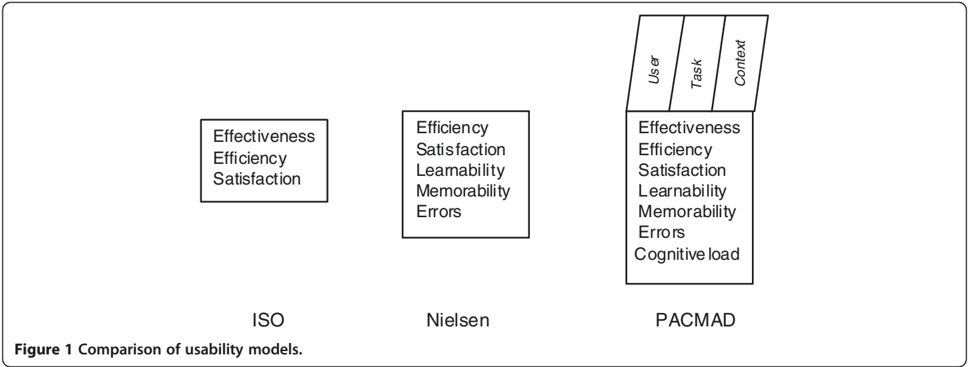
The usefulness of mobile devices has increased greatly in recent years allowing users to perform more tasks in a mobile context. This increase in usefulness has come at the expense of the usability of these devices in some contexts. We conducted a small review of mobile usability models and found that usability is usually measured in terms of three attributes; effectiveness, efficiency and satisfaction. Other attributes, such as cognitive load, tend to be overlooked in the usability models that are most prominent despite their likely impact on the success or failure of an application. To remedy this we introduces the PACMAD (People At the Centre of Mobile Application Development) usability model which was designed to address the limitations of existing usability models when applied to mobile devices. PACMAD brings together significant attributes from different usability models in order to create a more comprehensive model. None of the attributes that it includes are new, but the existing prominent usability models ignore one or more of them. This could lead to an incomplete usability evaluation. We performed a literature search to compile a collection of studies that evaluate mobile applications and then evaluated the studies using our model.
Overview
CoChat Summary
TL;DR
The paper reviews mobile usability models and proposes PACMAD, a model with three factors and seven attributes, including cognitive load, to address limitations of traditional models for mobile applications. A literature review of 131 papers from 2008–2010 found effectiveness, efficiency, and satisfaction most commonly evaluated, while memorability was rarely evaluated.
Key findings
- PACMAD identifies three factors—User, Task, and Context of use—and seven usability attributes: Effectiveness, Efficiency, Satisfaction, Learnability, Memorability, Errors, and Cognitive load; cognitive load is the main addition to existing prominent models.
- In the reviewed studies, the most commonly evaluated attributes were Satisfaction (58.02%, 76 studies), Efficiency (54.96%, 72), Effectiveness (51.15%, 67), Errors (32.82%, 43), Cognitive Load (22.90%, 30), Learnability (20.61%, 27), and Memorability (2.29%, 3).
- Task was the dominant research focus (46.92%, 61 papers), followed by Interaction (29.77%, 39), User (9.23%, 12), Context (8.46%, 11), and Development Methodology (6.15%, 8).
- Controlled experiments were the most common research methodology (59.51%, 97 studies), followed by field studies (26.99%, 44); the discussion states almost 23% of studies measured cognitive load, supporting its inclusion, while only 2% evaluated memorability.
Methods
- Literature review of papers published 2008–2010, searched via ACM digital library, IEEE digital library, and Google Scholar using search strings including “Mobile Application Evaluations,” “Usability of mobile applications,” and “Mobile application usability evaluations.”
- Sources included MobileHCI, IJMHCI, TOCHI, IJHCS, PUC, and IJHCI; CHI and IEEE TOMC were discarded because less than 5% of their papers were relevant. Abstract screening was done by the first two authors, with disagreements resolved by discussion.
- 131 papers were included (Table 3); 20 relevant papers without formal evaluations were excluded, and multiple studies within papers were considered independently, yielding 163 studies for methodology analysis. Data extraction was by one reviewer, with the first and second authors independently reviewing a 10% sample.
Limitations
- The paper states that 8 out of 139 relevant papers were unavailable (less than 6%), that omitting certain sources may have introduced bias, and that some outlying studies may have been omitted due to limited resources, though omitted papers were believed to be of borderline significance.
- The text makes evident that the review was limited to 2008–2010 and to selected venues; the studies often did not explicitly cite usability criteria, and the attributes are not orthogonal.
- The paper also notes that it adopts a relatively simple view of cognitive load, and that a more powerful multifactorial approach would be preferable but is beyond its scope.
Model-written summary. Check it against the paper before relying on it.
Integrity signals
Registry
Cites
Statistics
Figures
Verification
Claims the paper makes
0 Valid · 12 Not valid · 8 Not checked · 85 Own results and interpretations
A result the paper reports from its own data — it cites no other source for it, so there is none to check. The quote shows it is in the paper.
In the paper
“From our review it is apparent that many existing models for usability do not consider mobility and its consequences, such as additional cognitive load.”
hedged- Asserted: passes — The authors put it forward as true.
- Checkable: passes — It can be checked against evidence.
- Load-bearing: passes — The paper’s conclusions depend on it.
- Based: passes — The paper gives a reason why it holds.
A result the paper states — it cites no source for it, so there is none to check. The quote shows it is in the paper.
In the paper
“None of the attributes that it includes are new, but the existing prominent usability models ignore one or more of them.”
plain- Asserted: passes — The authors put it forward as true.
- Checkable: passes — It can be checked against evidence.
- Load-bearing: passes — The paper’s conclusions depend on it.
- Based: passes — The paper gives a reason why it holds.
A result the paper states — it cites no source for it, so there is none to check. The quote shows it is in the paper.
In the paper
“Other attributes, such as cognitive load, tend to be overlooked in the usability models that are most prominent despite their likely impact on the success or failure of an application.”
- Also stated in: § Introduction · plain
“This aspect of usability is often overlooked in existing usability models, which are outlined in the next section, as these models are designed for applications which are seldom used in a mobile context.”
- Also stated in: § Limitations for mobile applications · hedged
“From our review it is apparent that many existing models for usability do not consider mobility and its consequences, such as additional cognitive load.”
plain- Asserted: passes — The authors put it forward as true.
- Checkable: passes — It can be checked against evidence.
- Load-bearing: passes — The paper’s conclusions depend on it.
- Based: passes — The paper gives a reason why it holds.
- Also stated in: § Introduction · plain
A result the paper reports from its own data — it cites no other source for it, so there is none to check. The quote shows it is in the paper.
In the paper
“We conducted a small review of mobile usability models and found that usability is usually measured in terms of three attributes; effectiveness, efficiency and satisfaction.”
- Also stated in: § RQ1: What attributes are used when considering the usability of mobile applications? · plain
“The three most common attributes, Effectiveness, Efficiency and Satisfaction, correspond to the attributes identified by the ISO ' s standard for usability.”
plain- Asserted: passes — The authors put it forward as true.
- Checkable: passes — It can be checked against evidence.
- Load-bearing: passes — The paper’s conclusions depend on it.
- Based: passes — The paper gives a reason why it holds.
- Also stated in: § RQ1: What attributes are used when considering the usability of mobile applications? · plain
A result the paper reports from its own data — it cites no other source for it, so there is none to check. The quote shows it is in the paper.
In the paper
“Twenty papers that were identified as being relevant did not contain any formal evaluations of the proposed technologies.”
plain- Asserted: passes — The authors put it forward as true.
- Checkable: passes — It can be checked against evidence.
- Load-bearing: unclear — It is unclear whether the paper’s conclusions depend on it.
- Based: passes — The paper gives a reason why it holds.
46 more claims
Create a free account to see all 105 claims and every source verdict.
- Borderline: one of the tests for a substantial claim is unclear. 1
- Probably not a substantial claim. 45
- It may state two separate claims as one. 18
- The quote only partly states this claim. 1
Claims other papers make about this one
Each is checked against this paper’s own text: does it say what the citing paper says it does?
In the citing paper
“For example, different results can be obtained if more people that are elderly are taken into account, as their acceptance and use of technology are different from the younger generation [59].”
Self-check
Percentages, sums and reported differences re-computed from the paper’s own numbers.
Each contradiction between two passages listed here was confirmed by an independent check.
Rated minor: it would not touch a result — a value no result rests on, a p-value that stays on the same side of the significance level, or a conflict that is clerical, resolved elsewhere in the paper, or outside its own findings.
In the paper
§ RQ1: What attributes are used when considering the usability of mobile applications?
“About 26% of the studies considered cognitive load.”
§ RQ1: What attributes are used when considering the usability of mobile applications?
“| Cognitive Load | 22.90% | 30 |”
Citations
Cites
Development of NASA-TLX (Task Load Index): Results of Empirical and Theoretical Research
(1988) · Advances in Psychology · doi:10.1016/s0166-4115(08)62386-9 · Cited by 20,029
(1993) · Cited by 9,879
Challenges, Methodologies, and Issues in the Usability Testing of Mobile Applications
Zhang, D., & Adipat, B. (2005) · International Journal of Human-Computer Interaction · doi:10.1207/s15327590ijhc1803_3 · Cited by 613 · cited 3×
“Zhang and Adipat [6] highlighted a number of issues that have been introduced by the advent of mobile devices: Mobile Context: When using mobile applications the user is not tied to a single location.”
BackgroundInfluentialA Review of Mobile HCI Research Methods
Kjeldskov, J., & Graham, C. (2003) · Lecture Notes in Computer Science · doi:10.1007/978-3-540-45233-1_23 · Cited by 375 · cited 3×
“Previous work by Kjeldskov & Graham [3] has looked at the research methods used in mobile HCI, but did not examine the particular attributes of usability incorporated in the PACMAD model.”
MethodInfluentialUnderstanding and capturing people's privacy policies in a mobile social networking application
Sadeh, N., Hong, J., Cranor, L., Fette, I., Kelley, P., Prabaker, M., & Rao, J. (2009) · Personal and Ubiquitous Computing · doi:10.1007/s00779-008-0214-3 · Cited by 318
Foundations of Augmented Cognition
(2005) · CRC Press eBooks · doi:10.1201/9781482289701 · Cited by 315
Context of Use within usability activities
MAGUIRE, M. (2001) · International Journal of Human-Computer Studies · doi:10.1006/ijhc.2001.0486 · Cited by 275 · cited 1×
“Context of use can vary enormously and so should be considered an important factor of usability [5,33].”
BackgroundArvanitis, T. N., Petrou, A., Knight, J. F., Savas, S., Sotiriou, S., Gargalakos, M., & Gialouri, E. (2009) · Personal and Ubiquitous Computing · doi:10.1007/s00779-007-0187-7 · Cited by 245
An empirical investigation of mobile ticketing service adoption in public transportation
Mallat, N., Rossi, M., Tuunainen, V. K., & Öörni, A. (2007) · Personal and Ubiquitous Computing · doi:10.1007/s00779-006-0126-z · Cited by 223
An innovative mobile electronic tourist guide application
Kenteris, M., Gavalas, D., & Economou, D. (2009) · Personal and Ubiquitous Computing · doi:10.1007/s00779-007-0191-y · Cited by 210
Cited by
Items 201–300 of 736
Mobile Applications (Apps) to Support the Hepatitis C Treatment: A Systematic Search in App Stores
Rodrigues, A. T., Sousa, C. T., Pereira, J., Figueiredo, I. V., & Lima, T. D. M. (2020) · Therapeutic Innovation & Regulatory Science · doi:10.1007/s43441-020-00201-8 · Cited by 12
Afif, M. H. (2021) · Journal of Computer Science · doi:10.3844/jcssp.2021.275.283 · Cited by 16
Exploring the usability, security and privacy taxonomy for mobile health applications
Asaddok, N., & Ghazali, M. (2017) · International Conference on Research and Innovation in Information Systems · doi:10.1109/icriis.2017.8002472 · Cited by 15
Usability testing electronic rubric of performance assessment
Jubaedah, Y., Yulia, C., Muktiarni, M., & Maosul, A. (2020) · Journal of Physics Conference Series · doi:10.1088/1742-6596/1456/1/012016 · Cited by 14
Exploration of the usability quality attributes of mobile government services: a literature review
Desmal, A. J., Hamid, S. B., Othman, M. K. B., & Zolait, A. H. (2022) · PeerJ Computer Science · doi:10.7717/peerj-cs.1026 · Cited by 23
Moulaei, K., Bahaadinbeigy, K., Mashoof, E., & Dinari, F. (2023) · BMC Medical Informatics and Decision Making · doi:10.1186/s12911-023-02308-y · Cited by 19
eKichabi v2: Designing and Scaling a Dual-Platform Agricultural Technology in Rural Tanzania
Raghunath, A., Metzger, A. L., Easton, H., Liu, X., Wang, F. X., Wang, Y., Zhao, Y., Mpogole, H., & Anderson, R. (2024) · CHI Conference on Human Factors in Computing Systems · doi:10.1145/3613904.3642099 · Cited by 20
Usability Heuristics for M-Commerce Apps
Swaid, S. I., & Suid, T. Z. (2018) · Advances in intelligent systems and computing · doi:10.1007/978-3-319-94947-5_8 · Cited by 19
Designing age-friendly mobile apps: Insights from a mobility app study
Chua, C. S. W., Lim, W. M., & Teh, P. (2023) · Activities Adaptation & Aging · doi:10.1080/01924788.2023.2213028 · Cited by 21
Towards Usability Evaluation of Hybrid Mobile User Interfaces
(2017) · doi:10.1109/aiccsa.2017.10 · Cited by 13
X-Mech: an On-Demand Vehicle Express Repair Service Mobile Application
Rey, W. P., Rosario, E. J. P. D., Lasquety, M. K., & Tan, K. A. D. M. (2023) · International Conference on Software Technology and Engineering · doi:10.1109/icste61649.2023.00023 · Cited by 15
Performing User Acceptance Test with System Usability Scale for Graduation Application
Ahmad, N. N. N., & Sazali, P. N. N. M. (2021) · International Conference on Software Engineering and Computer Systems · doi:10.1109/icsecs52883.2021.00023 · Cited by 21
Psomadaki, O. I., Matsiola, M., Dimoulas, C. A., & Kalliris, G. M. (2022) · Sustainability · doi:10.3390/su14105975 · Cited by 25
Bekaroo, G., Roopowa, D., Zakari, A., & Niemeier, D. (2020) · Environmental Science and Pollution Research · doi:10.1007/s11356-020-11179-z · Cited by 15
Chirayus, K., & Nanthaamornphong, A. (2019) · International Computer Science and Engineering Conference · doi:10.1109/icsec47112.2019.8974698 · Cited by 11
Comparative Analysis of Usability of Data Entry Design Patterns for Mobile Applications
Myka, J., Indyka-Piasecka, A., Telec, Z., Trawiński, B., & Dac, H. C. (2019) · Lecture notes in computer science · doi:10.1007/978-3-030-14799-0_63 · Cited by 11
Alsabhan, W. M., & Dudin, B. (2023) · Multimodal Technologies and Interaction · doi:10.3390/mti7050044 · Cited by 13
Tablet use in primary education
Lorenzo, M. D. C. R., & Sánchez-Martínez, C. (2019) · Technology Pedagogy and Education · doi:10.1080/1475939x.2019.1608291 · Cited by 17
Mehdizadeh, H., Asadi, F., Nazemi, E., Mehrvar, A., Yazdanian, A., & Emami, H. (2023) · JMIR Pediatrics and Parenting · doi:10.2196/43867 · Cited by 13
Usability Evaluation Framework for Mobile Apps using Code Analysis
Mathur, N., Karre, S. A., & Reddy, Y. R. (2018) · International Conference on Evaluation and Assessment in Software Engineering (EASE) · doi:10.1145/3210459.3210480 · Cited by 15
Does GenAI Make Usability Testing Obsolete?
Pourasad, A. E., & Maalej, W. (2025) · ACM/IEEE International Conference on Software Engineering: Companion Proceedings (ICSE-Companion) · doi:10.1109/icse55347.2025.00138 · Cited by 33
Comparing Mobile APPs Usability Characteristics for Designers and Users
Cata, T., & Martz, B. (2015) · Journal of international technology and information management · doi:10.58729/1941-6679.1053 · Cited by 11
INNOVATION AT AIRPORTS: A SYSTEMATIC LITERATURE REVIEW (2000–2019)
Kılıç, S., Üçler, Ç., & Martín-Domingo, L. (2021) · Aviation · doi:10.3846/aviation.2021.14917 · Cited by 17
Badshah, S., Khan, A. A., Hussain, S., & Khan, B. (2020) · Multimedia Tools and Applications · doi:10.1007/s11042-020-10099-x · Cited by 14
A novel pervasive computing method to enhance efficiency of walking activity
Bodaghi, A. (2016) · Health and Technology · doi:10.1007/s12553-016-0138-2 · Cited by 11
Design and evaluation of mobile applications for people with visual impairments
Silva, G. M. S., Andrade, R. M. C., & Darin, T. (2019) · Brazilian Symposium on Human Factors in Computing Systems (IHC) · doi:10.1145/3357155.3358450 · Cited by 14
O’Brien, T., Russell, C. L., Tan, A., Washington, M., & Hathaway, D. (2018) · Progress in Transplantation · doi:10.1177/1526924818800051 · Cited by 14
LeBlanc, R., Czarnecki, P., Howard, J., Jacelon, C. S., & Marquard, J. L. (2022) · CIN Computers Informatics Nursing · doi:10.1097/cin.0000000000000911 · Cited by 14
Attard, C., Mountain, G. A., & Romano, D. M. (2016) · Computers in Human Behavior · doi:10.1016/j.chb.2016.03.001 · Cited by 18
Domingos, C., Costa, P., Santos, N. C., & Pêgo, J. M. (2021) · JMIR mhealth and uhealth · doi:10.2196/19245 · Cited by 15
Usability Evaluation Approaches for (Ubiquitous) Mobile Applications: A Systematic Mapping Study
Reis, R. D. A. C., Gomes, L. L. A., Dias‐Neto, A. C., & Fontão, A. (2015) · Ubiquitous Computing Systems · Cited by 12
A Process-Based Approach to Test Usability of Multi-platform Mobile Applications
Mendes, I. D. N., & Dias‐Neto, A. C. (2016) · Lecture notes in computer science · doi:10.1007/978-3-319-40409-7_43 · Cited by 12
Kaur, E., Haghighi, P. D., Cicuttini, F., & Urquhart, D. M. (2022) · Sensors · doi:10.3390/s22187095 · Cited by 13
Tidal, J. (2016) · Journal of Web Librarianship · doi:10.1080/19322909.2016.1243458 · Cited by 10
Rosa, I., Lages, M., Grilo, C., Barros, R., & Guarino, M. P. (2022) · Frontiers in Public Health · doi:10.3389/fpubh.2022.862065 · Cited by 14
Usability implications in software architecture: The case study of a mobile app
Capilla, R., Kazman, R., Romera, C., & Carrillo, C. (2020) · Software Practice and Experience · doi:10.1002/spe.2883 · Cited by 10
Kang, J. M., Kim, N., Yun, S. K., Seo, H., Bae, J. N., Kim, W., Na, K., Cho, S., Ryu, S., Noh, Y., et al. (2024) · Psychogeriatrics · doi:10.1111/psyg.13161 · Cited by 13
A Systematic Mapping Study of Software Usability Studies
Almazroi, A. A. (2021) · International Journal of Advanced Computer Science and Applications · doi:10.14569/ijacsa.2021.0120927 · Cited by 14
Usability of User-Centric Mobile Application Design from Visually Impaired People’s Perspective
Qureshi, H. H., & Wong, D. H.-T. (2020) · Lecture notes in computer science · doi:10.1007/978-3-030-49282-3_22 · Cited by 9
A novel approach for usability evaluation of mobile applications
Park, J., & Zahabi, M. (2021) · Proceedings of the Human Factors and Ergonomics Society Annual Meeting · doi:10.1177/1071181321651092 · Cited by 9
Hernández, M., Sharit, J., Pirolli, P. L. T., & Czaja, S. J. (2017) · International Journal of Human-Computer Interaction · doi:10.1080/10447318.2017.1358546 · Cited by 10
A Comparative Study of Spreadsheet Applications on Mobile Devices
Chintapalli, V. V. S. M., Tao, W., Meng, Z., Kang Zhang, A., Kong, J., & Ge, Y. (2016) · Mobile Information Systems · doi:10.1155/2016/9816152 · Cited by 9
A Methodology to Evaluate User Experience for People with Autism Spectrum Disorder
Valencia, K., Rusu, C., Botella, F., & Jamet, E. (2022) · Applied Sciences · doi:10.3390/app122211340 · Cited by 9
Kureerung, P., & Ramingwong, L. (2019) · International Conference on Awareness Science and Technology (iCAST) · doi:10.1109/icawst.2019.8923454 · Cited by 10
Dimensions for hearing-impaired mobile application usability model
Nathan, S. S., Hussain, A., Hashim, N. L., & Omar, M. A. (2017) · AIP conference proceedings · doi:10.1063/1.5005441 · Cited by 9
Evaluating the usability and usefulness of a storm preparedness and risk assessment mobile app
Lin, C. A. (2025) · International Journal of Disaster Risk Reduction · doi:10.1016/j.ijdrr.2024.105176 · Cited by 10
Maphosa, V., Dube, B., & Jita, T. (2021) · International Journal of Information and Education Technology · doi:10.18178/ijiet.2021.11.2.1493 · Cited by 9
An Evaluation Tool for Agricultural Health and Safety Mobile Applications
Reyes, I., Ellis, T. M., Yoder, A. M., & Keifer, M. (2016) · Journal of Agromedicine · doi:10.1080/1059924x.2016.1211054 · Cited by 13
Examining the Influence of Saliency in Mobile Interface Displays
Still, J. D., Hicks, J. M., & Cain, A. A. (2020) · AIS Transactions on Human-Computer Interaction · doi:10.17705/1thci.00127 · Cited by 12
Rey, W. P. (2023) · International Conference on Software Technology and Engineering · doi:10.1109/icste61649.2023.00014 · Cited by 9
Chrismanto, A. R., Purwadi, J., Wibowo, A., Santoso, H. B., Delima, R., & Balisa, D. (2020) · IAIC Transactions on Sustainable Digital Innovation (ITSDI) · doi:10.34306/itsdi.v2i2.401 · Cited by 10
A Pilot Study of an AI Chatbot for the Screening of Substance Use Disorder in a Healthcare Setting
Wright, T., Salyers, A. J., Howell, K., Harrison, J., Silvasstar, J., & Bull, S. (2025) · AI · doi:10.3390/ai6060113 · Cited by 14
USEFULNESS OF MOBILE TEACHING AND LEARNING AS PERCEIVED BY ROMANIAN AND LITHUANIAN SCIENCE TEACHERS
Gorghiu, G., Pribeanu, C., Lamanauskas, V., & Šlekienė, V. (2020) · Problems of Education in the 21st Century · doi:10.33225/pec/20.78.719 · Cited by 9
Dewan, N., Hossain, M. B., Kim, G.-G., Dunay, A., & Illés, C. B. (2022) · Cogent Business & Management · doi:10.1080/23311975.2022.2096998 · Cited by 16
Users Perception of the Mobile Usability of a Global Bicycle Sharing Platform
Hussain, A., Mkpojiogu, E. O. C., Nabeel, N., & Alathwari, A. (2019) · International Journal of Interactive Mobile Technologies (iJIM) · doi:10.3991/ijim.v13i11.11298 · Cited by 9
The mHealth Applications Usability Evaluation Review
Ansaar, M. Z., Hussain, J., Bang, J., Lee, S., Shin, K. Y., & Woo, K. Y. (2020) · International Conference on Information Networking · doi:10.1109/icoin48656.2020.9016509 · Cited by 16
CoKnowEMe: An Edge Evaluation Scheme for QoS of IoMT Microservices in 6G Scenario
Aiosa, G. V., Attanasio, B., Corte, A. L., & Scatà, M. (2021) · Future Internet · doi:10.3390/fi13070177 · Cited by 10
Working Memory Capacity for Gesture-Command Associations in Gestural Interaction
Gao, Q., Ma, Z., Gu, Q., Li, J., & Gao, Z. (2022) · International Journal of Human-Computer Interaction · doi:10.1080/10447318.2022.2091213 · Cited by 11
A Methodology to Develop a Mobile Application Model to Appraise Housing Design Quality
Chohan, A. H., Affandi, H. M., Awad, J., & Ani, A. I. C. (2017) · International Journal of Interactive Mobile Technologies (iJIM) · doi:10.3991/ijim.v11i6.6379 · Cited by 8
Zainuddin, N. F. F., Bakar, Z. B. A., Mohammad, N. M. B., & Mohamed, R. B. (2022) · International Journal of Advanced Computer Science and Applications · doi:10.14569/ijacsa.2022.0131028 · Cited by 10
Zainun, R., Lam, M. C., Bakar, K. A. A., & Ismail, A. K. (2018) · International Journal on Advanced Science Engineering and Information Technology · doi:10.18517/ijaseit.8.4-2.6836 · Cited by 8
Usability of Educational Websites for Tablet Computers
Vosylius, A. E., & Lapin, K. (2015) · doi:10.1145/2814464.2814467 · Cited by 10
Alshar’e, M., Al-Badi, A. H., Mustafa, M., Tahir, N., & Amri, M. A. (2022) · Advances in Human-Computer Interaction · doi:10.1155/2022/7527457 · Cited by 7
Duffy, P. L., Enneking, K. M., Harper-Gampp, T., Hakim, K. A., Coleman, A. F., Laforest, K., Paulson, D. M., Paulson, E. T., Shepard, J. D., Tiettmeyer, J. M., et al. (2018) · Journal of Chemical Education · doi:10.1021/acs.jchemed.8b00574 · Cited by 11
An Evaluation of the Effectiveness of Using Pedagogical Agents for Teaching in Inclusive Ways
Savin‐Baden, M., Bhakta, R., Mason-Robbie, V., & Burden, D. J. H. (2019) · Perspectives on rethinking and reforming education · doi:10.1007/978-981-13-8161-4_7 · Cited by 10
Artificial Intelligence and Predictive Modeling in Mental Health
Hilty, D. M., Cheng, Y., & Luxton, D. D. (2024) · Springer eBooks · doi:10.1007/978-3-031-59936-1_13 · Cited by 15
A Set of Usability Heuristics for Mobile Applications
da Costa, R. P., & Canedo, E. D. (2019) · Lecture notes in computer science · doi:10.1007/978-3-030-22646-6_13 · Cited by 17
Lee, G.-G., Choi, M., An, T., Mun, S., & Hong, H. (2023) · International Journal of Emerging Technologies in Learning (iJET) · doi:10.3991/ijet.v18i01.34843 · Cited by 13
Analysis of an eHealth app: Privacy, Security and Usability
Alturki, R., Gay, V. C., Awan, N., Alshehri, M. D., Mohammed, J. M. A. H., & Kundi, M. (2020) · International Journal of Advanced Computer Science and Applications · doi:10.14569/ijacsa.2020.0110428 · Cited by 9
Studies on deaf mobile application
(2016) · doi:10.1063/1.4960939 · Cited by 8
Towards a context based Evaluation Support System for Quality in Use assessment of mobile systems
Ayed, E. B., Kolski, C., Magdich, R., & Ezzedine, H. (2016) · Conference proceedings/Conference proceedings - IEEE International Conference on Systems, Man, and Cybernetics · doi:10.1109/smc.2016.7844915 · Cited by 10
Deriving Usability Goals for Mobile Applications
Lapin, K. (2014) · doi:10.1145/2643572.2643576 · Cited by 9
Software Quality Testing In Mobile Application (ArabEasy) Based on the PACMAD Model
Bagaskara, S. A., Wibowo, A. T., Izzuddin, M. A., Milad, M. K., Setyowati, R. D. N., Taufik, T., Ridwan, M., & Arifin, S. (2022) · International Journal of Interactive Mobile Technologies (iJIM) · doi:10.3991/ijim.v16i10.28433 · Cited by 9
Mobile Applications Usability Evaluation: Systematic Review and Reappraisal
Wu, J., & Duffy, V. G. (2022) · Lecture notes in computer science · doi:10.1007/978-3-031-17615-9_35 · Cited by 10
Park, E. (2022) · Mathematical Biosciences & Engineering · doi:10.3934/mbe.2022463 · Cited by 11
Usability of Mobile Applications: A Consolidated Model
Weichbroth, P. (2024) · IEEE Access · doi:10.1109/access.2024.3395528 · Cited by 19
Tuning up a CMLL toolbox: analyzing Web-based applications for critical media literacy learning
Afrilyasanti, R., Basthomi, Y., & Zen, E. L. (2022) · Interactive Technology and Smart Education · doi:10.1108/itse-07-2022-0088 · Cited by 15
Rice, R. E., Pearce, K. E., & Calderwood, K. J. (2022) · Mobile Media & Communication · doi:10.1177/20501579221142134 · Cited by 10
Mobile App Usability Index (MAUI) for Improving Mobile Banking Adoption
Sanagavarapu, L. M., Mathur, N., & Reddy, Y. R. (2015) · International Conference on Evaluation of Novel Approaches to Software Engineering · doi:10.5220/0005363003130320 · Cited by 7
Roh, W., & Lee, S.-W. (2017) · IEEE International Requirements Engineering Conference Workshops (REW) · doi:10.1109/rew.2017.44 · Cited by 8
Λαμπρόπουλος, Γ., & Chen, N. (2025) · Education and Information Technologies · doi:10.1007/s10639-025-13383-1 · Cited by 18
Omnichannel Heuristics for E-commerce
Kharel, S., Fernström, M., & Bal, B. K. (2021) · Electronic workshops in computing · doi:10.14236/ewic/hci2021.9 · Cited by 7
Su'a, T., Licorish, S. A., Savarimuthu, B. T. R., & Langlotz, T. (2017) · ACM International Conference on Intelligent User Interfaces (IUI) · doi:10.1145/3025171.3025178 · Cited by 7
Usability Features to Improve Mobile Apps Acceptance among the Senior Citizens in Malaysia
Thamutharam, Y. N., Mustafa, M. B., Musthafa, F. N., & Tajudeen, F. P. (2021) · ASM Science Journal · doi:10.32802/asmscj.2021.686 · Cited by 9
A Study on the Perceived Mobile Experience of Myeg Users
Hussain, A., Mkpojiogu, E. O. C., Ishak, N., & Mokhtar, N. (2019) · International Journal of Interactive Mobile Technologies (iJIM) · doi:10.3991/ijim.v13i11.11306 · Cited by 9
User experience of mobile devices: a three layer method of evaluation
Alshehri, F., & Freeman, M. B. (2014) · Tuwhera (Auckland University of Technology) · Cited by 8
Metadata
- Authors
- Harrison, R., Flood, D., & Duce, D.
- Affiliations
- Oxford Brookes University (GB)
- Corresponding author
- Harrison, Rachel
- Venue
- Journal of Interaction Science
- Published
- 2013
- Volume
- 1
- Issue
- 1
- Pages
- 1
- ISSN
- 2194-0827 (ISSN-L)
- OpenAlex
- W2120571425
- Cited by
- 736
- References
- 152
- Citations by year
- 2026: 33 · 2025: 44 · 2024: 50 · 2023: 58 · 2022: 74 · 2021: 62 · 2020: 84 · 2019: 77 · 2018: 49 · 2017: 72 · 2016: 55 · 2015: 49 · 2014: 27 · 2013: 1
- FWCI
- 79.76
- Type
- journal article
- Language
- en
- Open access
- hybrid
- doi.org
- Licence
- cc-by
- Locations
- Journal of Interaction Science (publishedVersion, cc-by)
- Radar (Oxford Brookes University) (submittedVersion, cc-by-nc-nd)
- Topics
- Physical Sciences › Computer Science › Human-Computer Interaction › Usability and User Interface Design
- Physical Sciences › Computer Science › Information Systems › Mobile and Web Applications
- Health Sciences › Health Professions › General Health Professions › Mobile Health and mHealth Applications
- Keywords
- software usability, usability model, cognitive load, effectiveness, efficiency and satisfaction, usability evaluation, mobile devices, user satisfaction
About these checks
Registry, retraction, Cites and statistics results are computed, not judged, with one exception: a printed reference that no index lists is read once by a model before it counts as a citation error. Claims are extracted by a model and kept only when their quote appears verbatim in the text; each cited source is then checked, with a model’s help, for whether it says what the claim relies on. Those verdicts can be wrong — read the claim’s quote and the cited source before relying on one.
A language model drew the claims from the paper on 2026-10-10, under version 3 of the claim definition (model deepseek-v4.1-flash, prompt extract-v3).
A second model labelled each claim on 2026-10-10 (model jev-1.13-20260917, definition revision gold-guideline-v0.2).
Statistics and arithmetic are recomputed, not judged.
Confidence bands are shown only for fields calibrated on our annotated test set. None is calibrated yet, so no band is shown.
What counts as a claim ›How we measure confidence ›How we check this ›
Are you an author, or do you see a problem with this page? Request a review
Data sources
Bibliographic data: Semantic Scholar, OpenAlex, Crossref.
Contains information from the Semantic Scholar Academic Graph Datasets, made available under the ODC Attribution License (ODC-BY 1.0).
Semantic Scholar’s data is described in: Kinney, R., et al. (2023). The Semantic Scholar Open Data Platform. arXiv:2301.10140.
