

Usability of mobile applications: literature review and rationale for a new usability model
Open accessThe DOI matches its Crossref record; 151 of the 152 references it cites were found in a registry or an index; none of the 11 sources its claims cite is checked for support yet.
Abstract
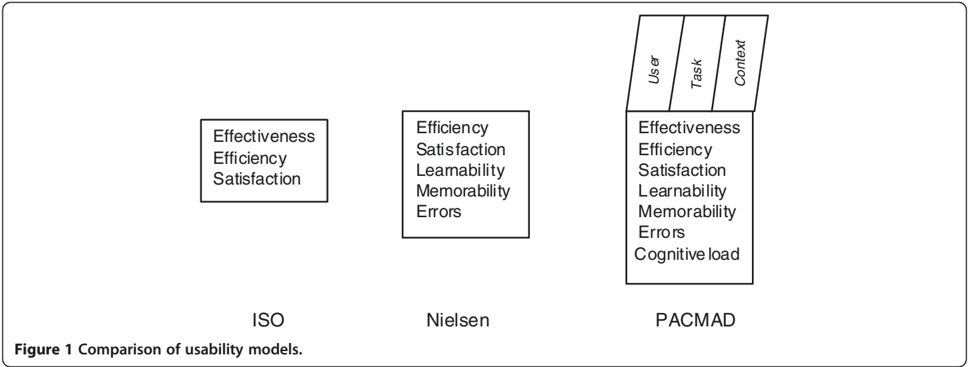
The usefulness of mobile devices has increased greatly in recent years allowing users to perform more tasks in a mobile context. This increase in usefulness has come at the expense of the usability of these devices in some contexts. We conducted a small review of mobile usability models and found that usability is usually measured in terms of three attributes; effectiveness, efficiency and satisfaction. Other attributes, such as cognitive load, tend to be overlooked in the usability models that are most prominent despite their likely impact on the success or failure of an application. To remedy this we introduces the PACMAD (People At the Centre of Mobile Application Development) usability model which was designed to address the limitations of existing usability models when applied to mobile devices. PACMAD brings together significant attributes from different usability models in order to create a more comprehensive model. None of the attributes that it includes are new, but the existing prominent usability models ignore one or more of them. This could lead to an incomplete usability evaluation. We performed a literature search to compile a collection of studies that evaluate mobile applications and then evaluated the studies using our model.
Overview
CoChat Summary
TL;DR
The paper reviews mobile usability models and proposes PACMAD, a model with three factors and seven attributes, including cognitive load, to address limitations of traditional models for mobile applications. A literature review of 131 papers from 2008–2010 found effectiveness, efficiency, and satisfaction most commonly evaluated, while memorability was rarely evaluated.
Key findings
- PACMAD identifies three factors—User, Task, and Context of use—and seven usability attributes: Effectiveness, Efficiency, Satisfaction, Learnability, Memorability, Errors, and Cognitive load; cognitive load is the main addition to existing prominent models.
- In the reviewed studies, the most commonly evaluated attributes were Satisfaction (58.02%, 76 studies), Efficiency (54.96%, 72), Effectiveness (51.15%, 67), Errors (32.82%, 43), Cognitive Load (22.90%, 30), Learnability (20.61%, 27), and Memorability (2.29%, 3).
- Task was the dominant research focus (46.92%, 61 papers), followed by Interaction (29.77%, 39), User (9.23%, 12), Context (8.46%, 11), and Development Methodology (6.15%, 8).
- Controlled experiments were the most common research methodology (59.51%, 97 studies), followed by field studies (26.99%, 44); the discussion states almost 23% of studies measured cognitive load, supporting its inclusion, while only 2% evaluated memorability.
Methods
- Literature review of papers published 2008–2010, searched via ACM digital library, IEEE digital library, and Google Scholar using search strings including “Mobile Application Evaluations,” “Usability of mobile applications,” and “Mobile application usability evaluations.”
- Sources included MobileHCI, IJMHCI, TOCHI, IJHCS, PUC, and IJHCI; CHI and IEEE TOMC were discarded because less than 5% of their papers were relevant. Abstract screening was done by the first two authors, with disagreements resolved by discussion.
- 131 papers were included (Table 3); 20 relevant papers without formal evaluations were excluded, and multiple studies within papers were considered independently, yielding 163 studies for methodology analysis. Data extraction was by one reviewer, with the first and second authors independently reviewing a 10% sample.
Limitations
- The paper states that 8 out of 139 relevant papers were unavailable (less than 6%), that omitting certain sources may have introduced bias, and that some outlying studies may have been omitted due to limited resources, though omitted papers were believed to be of borderline significance.
- The text makes evident that the review was limited to 2008–2010 and to selected venues; the studies often did not explicitly cite usability criteria, and the attributes are not orthogonal.
- The paper also notes that it adopts a relatively simple view of cognitive load, and that a more powerful multifactorial approach would be preferable but is beyond its scope.
Model-written summary. Check it against the paper before relying on it.
Integrity signals
Registry
Cites
Statistics
Figures
Verification
Claims the paper makes
0 Valid · 12 Not valid · 8 Not checked · 85 Own results and interpretations
A result the paper reports from its own data — it cites no other source for it, so there is none to check. The quote shows it is in the paper.
In the paper
“From our review it is apparent that many existing models for usability do not consider mobility and its consequences, such as additional cognitive load.”
hedged- Asserted: passes — The authors put it forward as true.
- Checkable: passes — It can be checked against evidence.
- Load-bearing: passes — The paper’s conclusions depend on it.
- Based: passes — The paper gives a reason why it holds.
A result the paper states — it cites no source for it, so there is none to check. The quote shows it is in the paper.
In the paper
“None of the attributes that it includes are new, but the existing prominent usability models ignore one or more of them.”
plain- Asserted: passes — The authors put it forward as true.
- Checkable: passes — It can be checked against evidence.
- Load-bearing: passes — The paper’s conclusions depend on it.
- Based: passes — The paper gives a reason why it holds.
A result the paper states — it cites no source for it, so there is none to check. The quote shows it is in the paper.
In the paper
“Other attributes, such as cognitive load, tend to be overlooked in the usability models that are most prominent despite their likely impact on the success or failure of an application.”
- Also stated in: § Introduction · plain
“This aspect of usability is often overlooked in existing usability models, which are outlined in the next section, as these models are designed for applications which are seldom used in a mobile context.”
- Also stated in: § Limitations for mobile applications · hedged
“From our review it is apparent that many existing models for usability do not consider mobility and its consequences, such as additional cognitive load.”
plain- Asserted: passes — The authors put it forward as true.
- Checkable: passes — It can be checked against evidence.
- Load-bearing: passes — The paper’s conclusions depend on it.
- Based: passes — The paper gives a reason why it holds.
- Also stated in: § Introduction · plain
A result the paper reports from its own data — it cites no other source for it, so there is none to check. The quote shows it is in the paper.
In the paper
“We conducted a small review of mobile usability models and found that usability is usually measured in terms of three attributes; effectiveness, efficiency and satisfaction.”
- Also stated in: § RQ1: What attributes are used when considering the usability of mobile applications? · plain
“The three most common attributes, Effectiveness, Efficiency and Satisfaction, correspond to the attributes identified by the ISO ' s standard for usability.”
plain- Asserted: passes — The authors put it forward as true.
- Checkable: passes — It can be checked against evidence.
- Load-bearing: passes — The paper’s conclusions depend on it.
- Based: passes — The paper gives a reason why it holds.
- Also stated in: § RQ1: What attributes are used when considering the usability of mobile applications? · plain
A result the paper reports from its own data — it cites no other source for it, so there is none to check. The quote shows it is in the paper.
In the paper
“Twenty papers that were identified as being relevant did not contain any formal evaluations of the proposed technologies.”
plain- Asserted: passes — The authors put it forward as true.
- Checkable: passes — It can be checked against evidence.
- Load-bearing: unclear — It is unclear whether the paper’s conclusions depend on it.
- Based: passes — The paper gives a reason why it holds.
46 more claims
Create a free account to see all 105 claims and every source verdict.
- Borderline: one of the tests for a substantial claim is unclear. 1
- Probably not a substantial claim. 45
- It may state two separate claims as one. 18
- The quote only partly states this claim. 1
Claims other papers make about this one
Each is checked against this paper’s own text: does it say what the citing paper says it does?
In the citing paper
“For example, different results can be obtained if more people that are elderly are taken into account, as their acceptance and use of technology are different from the younger generation [59].”
Self-check
Percentages, sums and reported differences re-computed from the paper’s own numbers.
Each contradiction between two passages listed here was confirmed by an independent check.
Rated minor: it would not touch a result — a value no result rests on, a p-value that stays on the same side of the significance level, or a conflict that is clerical, resolved elsewhere in the paper, or outside its own findings.
In the paper
§ RQ1: What attributes are used when considering the usability of mobile applications?
“About 26% of the studies considered cognitive load.”
§ RQ1: What attributes are used when considering the usability of mobile applications?
“| Cognitive Load | 22.90% | 30 |”
Citations
Cites
Development of NASA-TLX (Task Load Index): Results of Empirical and Theoretical Research
(1988) · Advances in Psychology · doi:10.1016/s0166-4115(08)62386-9 · Cited by 20,029
(1993) · Cited by 9,879
Challenges, Methodologies, and Issues in the Usability Testing of Mobile Applications
Zhang, D., & Adipat, B. (2005) · International Journal of Human-Computer Interaction · doi:10.1207/s15327590ijhc1803_3 · Cited by 613 · cited 3×
“Zhang and Adipat [6] highlighted a number of issues that have been introduced by the advent of mobile devices: Mobile Context: When using mobile applications the user is not tied to a single location.”
BackgroundInfluentialA Review of Mobile HCI Research Methods
Kjeldskov, J., & Graham, C. (2003) · Lecture Notes in Computer Science · doi:10.1007/978-3-540-45233-1_23 · Cited by 375 · cited 3×
“Previous work by Kjeldskov & Graham [3] has looked at the research methods used in mobile HCI, but did not examine the particular attributes of usability incorporated in the PACMAD model.”
MethodInfluentialUnderstanding and capturing people's privacy policies in a mobile social networking application
Sadeh, N., Hong, J., Cranor, L., Fette, I., Kelley, P., Prabaker, M., & Rao, J. (2009) · Personal and Ubiquitous Computing · doi:10.1007/s00779-008-0214-3 · Cited by 318
Foundations of Augmented Cognition
(2005) · CRC Press eBooks · doi:10.1201/9781482289701 · Cited by 315
Context of Use within usability activities
MAGUIRE, M. (2001) · International Journal of Human-Computer Studies · doi:10.1006/ijhc.2001.0486 · Cited by 275 · cited 1×
“Context of use can vary enormously and so should be considered an important factor of usability [5,33].”
BackgroundArvanitis, T. N., Petrou, A., Knight, J. F., Savas, S., Sotiriou, S., Gargalakos, M., & Gialouri, E. (2009) · Personal and Ubiquitous Computing · doi:10.1007/s00779-007-0187-7 · Cited by 245
An empirical investigation of mobile ticketing service adoption in public transportation
Mallat, N., Rossi, M., Tuunainen, V. K., & Öörni, A. (2007) · Personal and Ubiquitous Computing · doi:10.1007/s00779-006-0126-z · Cited by 223
An innovative mobile electronic tourist guide application
Kenteris, M., Gavalas, D., & Economou, D. (2009) · Personal and Ubiquitous Computing · doi:10.1007/s00779-007-0191-y · Cited by 210
Cited by
Items 501–600 of 736
A User-Centered Approach to the Development of E-Health Systems: A Case of Uganda
Zawedde, A., Engotoit, B., Omeja, O. O., & Kahiigi, P. (2019) · Lecture notes of the Institute for Computer Sciences, Social Informatics and Telecommunications Engineering · doi:10.1007/978-3-030-16042-5_22 · Cited by 1
LRAP: Layered Ring Based Adaptive and Personalized Usability Model for Mobile Commerce Apps
Ain, Q. U., Missen, M. M. S., & Prasath, V. B. S. (2023) · International Journal of Interactive Mobile Technologies (iJIM) · doi:10.3991/ijim.v17i12.37995 · Cited by 1
EMERGENCY RELATED MOBILE APPLICATIONS: USABILITY FRAMEWORK AND PROPOSED IMPLEMENTATION
Shin, H. S. W., & The Society of Digital Information and Wireless Communication (2015) · International Journal of New Computer Architectures and their Applications · doi:10.17781/p001984 · Cited by 1
An assessment framework for creative production in computing and engineering disciplines
Che, X., & Ip, B. (2024) · Computers and Education Open · doi:10.1016/j.caeo.2024.100220 · Cited by 1
UUDT-MA: Técnica Para Projeto da Usabilidade e Experiência do Usuário em Aplicações Móveis
Lopes, T., & Valentim, N. (2019) · Brazilian Symposium on Human Factors in Computing Systems (IHC) · doi:10.5753/ihc.2019.8418 · Cited by 3
Madni, T. M., Nayan, Y., Sulaiman, S. B., Tahir, M. S., & Abro, A. (2016) · doi:10.1145/2898459.2898474 · Cited by 1
Smartphone Ergonomics: A Proposal for Older People
Sheikh, J. A., Zafar, B., Pervez, A., & Bhutta, Z. I. (2016) · Advances in intelligent systems and computing · doi:10.1007/978-3-319-41983-1_75 · Cited by 3
Luis, C. P. S. (2021) · International Journal of Research Publications · doi:10.47119/ijrp100751420211896 · Cited by 1
Can Digital Technologies Tackle Gender Inequality? A ReviewPreprint
Shikongo, S., Iyawa, G. E., & Hamunyela, S. L. (2023) · SSRN Electronic Journal · doi:10.2139/ssrn.4663419 · Cited by 3
Serious games como apoio para avaliação e treinamento cognitivo na senescência
do Amaral, L. A. (2020) · Digital Library of Theses and Dissertations (Universidade de São Paulo) · doi:10.11606/t.55.2020.tde-08062020-092328 · Cited by 3
Raj, M., Peters, H., Bakare, J. O., Zhou, F., Lakshmikanth, V. C., Vaughan, J., Gatzke, L., Berry, M., Khan, N. A., Terán-Garcı́a, M., et al. (2025) · JAMIA Open · doi:10.1093/jamiaopen/ooaf129 · Cited by 1
MOBILE SYSTEMS DESIGN AND EVALUATION
Wei, J., & Dong, S. (2021) · Wiley eBooks · doi:10.1002/9781119636113.ch40 · Cited by 1
MoViT: A 3D Mobile Virtual Tour App of Panguil River Eco-Park
Urriza, S. A. I., Ferrer, M. R., Dizer, N. J., & Red, E. R. (2016) · Managing the Asian century · doi:10.1007/978-981-10-0087-4_7 · Cited by 1
Building Guidelines for UNESCO World Heritage Sites’ Apps
Dutra, J. P. (2020) · Advances in Computer-Human Interaction · Cited by 1
Nurses' Experiences of Internet for Patients Cares: A Systematic Review of Qualitative Evidence
Firouzkouhi, M., Abdollahimohammad, A., Farzi, J., & Masinaienezhad, N. (2022) · Frontiers in Health Informatics · doi:10.30699/fhi.v11i1.336 · Cited by 1
Rey, W. P. (2024) · International Conference on Communication and Information Systems (ICCIS) · doi:10.1109/iccis63642.2024.10779432 · Cited by 2
Rey, W. P. (2024) · IEEE International Conference on Advanced Infocomm Technology · doi:10.1109/icait62580.2024.10808103 · Cited by 1
Fohrholz, C., Lambeck, C., & Gronau, N. (2014) · Lecture notes in information systems and organisation · doi:10.1007/978-3-319-07055-1_15 · Cited by 1
Security and Privacy Concerns in Information Usability
Yang, L.-C. (2024) · IEEE/CVF Winter Conference on Applications of Computer Vision Workshops (WACVW) · doi:10.1109/wacvw60836.2024.00079 · Cited by 1
Kyungbo, M., & Lee, S. (2019) · International Journal of Human-Computer Interaction · doi:10.1080/10447318.2019.1565747 · Cited by 2
On the Impact of Development Frameworks on Mobile Apps
(2023) · doi:10.1109/apsec60848.2023.00023 · Cited by 1
A survey on android mobile based application and its security
(2022) · doi:10.26634/jmt.9.1.18910 · Cited by 1
PENERAPAN METODE HEURISTIC EVALUATION UNTUK EVALUASI USER INTERFACE APLIKASI LAZADA
Wirawan, D. K., & Maria, E. (2024) · Jurnal Pendidikan Teknologi Informasi (JUKANTI) · doi:10.37792/jukanti.v7i1.1236 · Cited by 19
A Study on Identifying, Categorizing and Reporting Usability Bugs and Challenges
Ain, Q. U., Rana, T. A., & Aamana (2023) · International Conference on Communication Technologies (ComTech) · doi:10.1109/comtech57708.2023.10165169 · Cited by 4
mORCA: sailing bioinformatics world with mobile devices
(2017) · doi:10.1093/bioinformatics/btx673 · Cited by 1
Tran, T. T. T. D., Le, L. V. H., & Nguyen, N. H. T. T. (2022) · The University of Danang - Journal of Science and Technology · doi:10.31130/ud-jst.2022.489e · Cited by 3
Bortlik, M., Heinrich, B., & Lohninger, D. (2023) · Information Systems Frontiers · doi:10.1007/s10796-023-10392-8 · Cited by 4
Improving Mobile Banking Usability Based on Sentiments
(2016) · doi:10.1007/978-3-319-30243-0_10 · Cited by 1
Upmanyu, N., & Chauhan, R. (2017) · Prestige International Journal of Management & IT - Sanchayan · doi:10.37922/pijmit.2017.v06i01.009 · Cited by 1
Net Generation Features that Enhance Mobile Learning
(2016) · doi:10.4018/978-1-5225-0256-2.ch005 · Cited by 1
(2018) · doi:10.1145/3197231.3197247 · Cited by 1
Identifying Usability Risks for Mobile Application
Hutahaean, H. A., Govindaraju, R., & Sudirman, I. (2020) · International Conference on Engineering and Information Technology for Sustainable Industry (ICONETSI) · doi:10.1145/3429789.3429813 · Cited by 4
Badkook, N., Sinnari, D., & Almakky, A. (2025) · Multimodal Technologies and Interaction · doi:10.3390/mti9070068 · Cited by 1
Designing an effective user interface for the Android tablet environment
Chang, G. (2015) · Open University of Cape Town (University of Cape Town) · Cited by 1
Marisse, K., & Dewi, R. H. (2020) · Russian Journal of Agricultural and Socio-Economic Sciences · doi:10.18551/rjoas.2020-12.14 · Cited by 1
A Usability Framework for Diabetic Health Applications in South Africa
Ngamntwini, B., & Cilliers, L. (2018) · Advances in intelligent systems and computing · doi:10.1007/978-3-030-02683-7_30 · Cited by 2
Meaningful Mobile Learning Framework to Improve Learning Performance of Natural Science Students
Parsazadeh, N., & Cheng, P.-Y. (2025) · Journal of Educational Technology Systems · doi:10.1177/00472395251363636 · Cited by 5
Development of Usable Security Heuristics for Fintech
(2021) · doi:10.14236/ewic/hci2021.12 · Cited by 1
Laubscher, D. J., Blignaut, A. S., & Nieuwoudt, H. (2021) · Advances in educational technologies and instructional design book series · doi:10.4018/978-1-7998-6940-5.ch005 · Cited by 1
Adu, A. S. Y., van Biljon, J. A., & van der Merwe, R. (2025) · Advances in Human-Computer Interaction · doi:10.1155/ahci/9694629 · Cited by 4
Unilateral Laterothoracic Exanthema: A Case Report
Almatrafi, S., & Aljabri, M. M. (2020) · Dermatology Case Reports · doi:10.35248/2684-124x.20.5.169 · Cited by 1
Mobility Technologies for Blind, Partially Sighted and Deafblind People: Design Issues
Hersh, M. A. (2026) · Signals and communication technology · doi:10.1007/978-3-031-91550-5_17 · Cited by 2
Towards Mobile Modeling of Knowledge and Business Processes
Peinl, R., Sultanow, E., & Brockmann, C. (2016) · Hawaii International Conference on System Sciences (HICSS) · doi:10.1109/hicss.2016.512 · Cited by 1
Models of Privacy and Security Issues on Mobile Applications
Zlatolas, L. N., Welzer, T., Heričko, M., & Hölbl, M. (2017) · Advances in e-business research series · doi:10.4018/978-1-5225-2469-4.ch006 · Cited by 3
Design and Implementation of a Usability-Framework for Smartwatches
Zenker, S., & Hobert, S. (2020) · Hawaii International Conference on System Sciences (HICSS) · doi:10.24251/hicss.2020.812 · Cited by 2
Schäfer, G., Kreisel, A., & Stopka, U. (2021) · Lecture notes in computer science · doi:10.1007/978-3-030-78358-7_7 · Cited by 1
Mazor, G., Perez, D., & Kronrod, A. (2024) · Journal of Advertising Research · doi:10.2501/jar-2024-025 · Cited by 1
Bahaddad, A. A. S. (2017) · International Journal of Computing Sciences Research · doi:10.25147/ijcsr.2017.001.1.04 · Cited by 1
Measuring Time Load Using a Mobile Application to Monitor Curriculum Workload
Kneissl, S. M., Tomiska, T., & Rehage, J. (2022) · Journal of Veterinary Medical Education · doi:10.3138/jvme-2021-0127 · Cited by 1
Mobile Virtual Reality to Enhance Subjective Well-Being
Pallavicini, F., Morganti, L., Diana, B., Realdon, O., Zurloni, V., & Mantovani, F. (2018) · Advances in computer and electrical engineering book series · doi:10.4018/978-1-5225-7598-6.ch076 · Cited by 1
Contextual Requirements for Mobile Native Applications
Pani, S., & Mishra, J. (2017) · International Journal of Advanced Computer Science and Applications · doi:10.14569/ijacsa.2017.081137 · Cited by 1
A Review on Usability, Security and Privacy for Mobile Health Applications
Asaddok, N., & Ghazali, M. (2017) · International Journal of Innovative Computing · doi:10.11113/ijic.v7n1.141 · Cited by 1
The Research Development of Cultural Mapping Libraries
Mousouris, S., & Styliaras, G. (2018) · International Conference on Information, Intelligence, Systems & Applications (IISA) · doi:10.1109/iisa.2018.8633684 · Cited by 1
(2021) · doi:10.2196/preprints.31130 · Cited by 16
Evaluation of an Intervention Program Based on Mobile Apps to Learn Sexism Prevention in Teenagers
Morillo, P., Pérez, J. J. N., Orduña, J. M., & Fernández, M. (2022) · ACM Transactions on Multimedia Computing Communications and Applications · doi:10.1145/3471139 · Cited by 2
Pengukuran Usability Aplikasi E-Wallet dengan Model PACMAD Menggunakan Metode Fuzzy-AHP dan TOPSIS
Agustiono, W., Prasetya, Y. D., & Kustiyahningsih, Y. (2023) · Jurnal Nasional Teknologi dan Sistem Informasi · doi:10.25077/teknosi.v9i1.2023.12-20 · Cited by 1
SnappView, a Software Development Kit for Supporting End-user Mobile Interface Review
de Ryckel, X., Sluÿters, A., & Vanderdonckt, J. M. (2022) · Proceedings of the ACM on Human-Computer Interaction · doi:10.1145/3534527 · Cited by 1
Hilty, D. M., Peled, A., & Luxton, D. D. (2024) · Springer eBooks · doi:10.1007/978-3-030-51366-5_152 · Cited by 1
Prafiantini, E., Agustina, R., Purwandari, B., Chandra, D. N., Bintari, D. R., Rajwadini, F. Z., Farhanah, J., & Hendarto, A. (2025) · Frontiers in Digital Health · doi:10.3389/fdgth.2025.1506952 · Cited by 7
Restuputri, D. P., Hakiki, R. N., & Mufti, W. F. (2022) · Advances in logistics, operations, and management science book series · doi:10.4018/978-1-6684-5882-2.ch019 · Cited by 1
Learning from Errors Designing Assistive Technology
Abascal, J. (2021) · Communications in computer and information science · doi:10.1007/978-3-030-67108-2_2 · Cited by 1
A Survey on Islamic Mobile Applications for Children
Machfud, F. M., & Mahmud, M. (2015) · Advances in wireless technologies and telecommunication book series · doi:10.4018/978-1-4666-9438-5.ch001 · Cited by 1
Handayeni, K. D. M. E., Kurniawati, U., & Hafidz, I. (2020) · IOP Conference Series Earth and Environmental Science · doi:10.1088/1755-1315/562/1/012024 · Cited by 2
Usability-Driven Mobile Application Development
Yahya, F., Ammar, L. B., & Gasmi, K. (2022) · Computer Systems Science and Engineering · doi:10.32604/csse.2023.030358 · Cited by 1
A comparative analysis of web-based GIS applications using usability metrics
Abdulmonim, D. A. (2015) · UTHM Institutional Repository (Universiti Tun Hussein Onn Malaysia) · Cited by 1
Conversation Moderator: A Mobile App for Tracking Individual Speaking in Group Conversations
Xiao, T., Tabashum, T., Metwally, B., Albert, M. V., Du, A., Jebamalaidass, R., Leal, M. S., & Oliviera, E. (2020) · IEEE International Conference on Semantic Computing (ICSC) · doi:10.1109/icsc.2020.00083 · Cited by 1
Usability of health information systems in rural and low-resource settings of Sudan
Osman, A. S. A., & Mahmoud, A. M. M. (2025) · International Journal of ADVANCED AND APPLIED SCIENCES · doi:10.21833/ijaas.2025.07.017
Restuputri, D. P., Yudiani, A. Y., & Masudin, I. (2026) · Journal of Electronic Business & Digital Economics · doi:10.1108/jebde-11-2024-0045
Palma, J. R. S. (2022) · International Journal of Research Publications · doi:10.47119/ijrp1001041720223537
Martorelli, I., Pooryousefi, A., van Thiel, H., Sicking, F., Ramackers, G. J., Merckx, V. S. F. T., & Verbeek, F. J. (2024) · Biodiversity Data Journal · doi:10.3897/bdj.12.e119660
Student Acceptance of Using Apps to Achieve Learning Outcomes in Architecture and Environment
Gunasagaran, S., Mari, T., Wahab, N. S. N. A., Sulaiman, A., & Jamal, K. A. A. (2023) · Advances in civil and industrial engineering book series · doi:10.4018/978-1-6684-8253-7.ch005 · Cited by 1
User interface design of an application to improve usability for users
Theresia, L., Herlambang, M. B., Sudri, N. M., Ranti, G., Febrianti, F., & Widianty, Y. (2024) · AIP conference proceedings · doi:10.1063/5.0210723
Users’ Review on Converged News: Indonesia News Apps Case
Irwansyah, I. (2019) · Jurnal Komunikasi Indonesia · doi:10.7454/jki.v8i3.11368
Mobile news service adoption: a South African case study
Adam, R., & Seymour, L. F. (2017) · South African Institute of Computer Scientists and Information Technologists · doi:10.1145/3129416.3129422
Muhaise, H., Mbabazi, P. B., Ssemaluulu, P. M., & Gloria, M. (2023) · International Journal of Research and Innovation in Applied Science · doi:10.51584/ijrias.2023.8505
User experience and ethical design for AI-driven behavioral health technologies
Armstrong, C. M., Luxton, D. D., & June, J. D. (2026) · Elsevier eBooks · doi:10.1016/b978-0-443-33151-0.00006-x
An empirical evaluation of a persuasive mobile interface: a case study in the Sapiens project
Ribeiro, V. M., Mota, F. P., Bicho, A. D. L., Pias, M. R., Ribeiro, L. M., & Botelho, S. S. D. C. (2018) · Anais do Simpósio Brasileiro de Sistemas de Informação (SBSI) · doi:10.1145/3229345.3229411
Una aplicación mHealth para autoinforme de síntomas de disfonía: e-VoiSS
Nicolás, A. P. V., Villazala, M. P., Roca, M. J. S., Garrido, E. N., Luque, F. C., & Gómez, J. Á. (2025) · Revista de Logopedia Foniatría y Audiología · doi:10.1016/j.rlfa.2025.100516 · Cited by 1
Algamdi, S. A. (2024) · University of North Texas Digital Library (University of North Texas) · doi:10.12794/metadc2356134
Greek Version of the mHealth App Usability Questionnaire (GR-MAUQ): Translation and Validation Study
Kouroutzis, I., Sarafis, P., & Malliarou, M. M. (2025) · Healthcare · doi:10.3390/healthcare13243285
Metadata
- Authors
- Harrison, R., Flood, D., & Duce, D.
- Affiliations
- Oxford Brookes University (GB)
- Corresponding author
- Harrison, Rachel
- Venue
- Journal of Interaction Science
- Published
- 2013
- Volume
- 1
- Issue
- 1
- Pages
- 1
- ISSN
- 2194-0827 (ISSN-L)
- OpenAlex
- W2120571425
- Cited by
- 736
- References
- 152
- Citations by year
- 2026: 33 · 2025: 44 · 2024: 50 · 2023: 58 · 2022: 74 · 2021: 62 · 2020: 84 · 2019: 77 · 2018: 49 · 2017: 72 · 2016: 55 · 2015: 49 · 2014: 27 · 2013: 1
- FWCI
- 79.76
- Type
- journal article
- Language
- en
- Open access
- hybrid
- doi.org
- Licence
- cc-by
- Locations
- Journal of Interaction Science (publishedVersion, cc-by)
- Radar (Oxford Brookes University) (submittedVersion, cc-by-nc-nd)
- Topics
- Physical Sciences › Computer Science › Human-Computer Interaction › Usability and User Interface Design
- Physical Sciences › Computer Science › Information Systems › Mobile and Web Applications
- Health Sciences › Health Professions › General Health Professions › Mobile Health and mHealth Applications
- Keywords
- software usability, usability model, cognitive load, effectiveness, efficiency and satisfaction, usability evaluation, mobile devices, user satisfaction
About these checks
Registry, retraction, Cites and statistics results are computed, not judged, with one exception: a printed reference that no index lists is read once by a model before it counts as a citation error. Claims are extracted by a model and kept only when their quote appears verbatim in the text; each cited source is then checked, with a model’s help, for whether it says what the claim relies on. Those verdicts can be wrong — read the claim’s quote and the cited source before relying on one.
A language model drew the claims from the paper on 2026-10-10, under version 3 of the claim definition (model deepseek-v4.1-flash, prompt extract-v3).
A second model labelled each claim on 2026-10-10 (model jev-1.13-20260917, definition revision gold-guideline-v0.2).
Statistics and arithmetic are recomputed, not judged.
Confidence bands are shown only for fields calibrated on our annotated test set. None is calibrated yet, so no band is shown.
What counts as a claim ›How we measure confidence ›How we check this ›
Are you an author, or do you see a problem with this page? Request a review
Data sources
Bibliographic data: Semantic Scholar, OpenAlex, Crossref.
Contains information from the Semantic Scholar Academic Graph Datasets, made available under the ODC Attribution License (ODC-BY 1.0).
Semantic Scholar’s data is described in: Kinney, R., et al. (2023). The Semantic Scholar Open Data Platform. arXiv:2301.10140.
