

Usability of mobile applications: literature review and rationale for a new usability model
Open accessThe DOI matches its Crossref record; 151 of the 152 references it cites were found in a registry or an index; none of the 11 sources its claims cite is checked for support yet.
Abstract
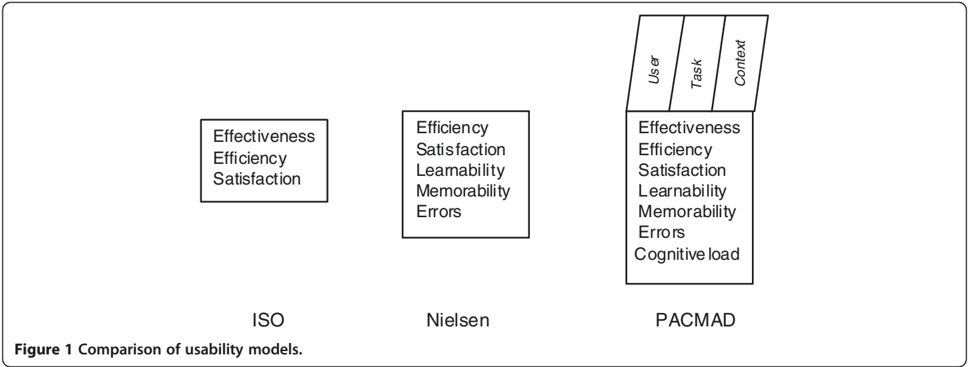
The usefulness of mobile devices has increased greatly in recent years allowing users to perform more tasks in a mobile context. This increase in usefulness has come at the expense of the usability of these devices in some contexts. We conducted a small review of mobile usability models and found that usability is usually measured in terms of three attributes; effectiveness, efficiency and satisfaction. Other attributes, such as cognitive load, tend to be overlooked in the usability models that are most prominent despite their likely impact on the success or failure of an application. To remedy this we introduces the PACMAD (People At the Centre of Mobile Application Development) usability model which was designed to address the limitations of existing usability models when applied to mobile devices. PACMAD brings together significant attributes from different usability models in order to create a more comprehensive model. None of the attributes that it includes are new, but the existing prominent usability models ignore one or more of them. This could lead to an incomplete usability evaluation. We performed a literature search to compile a collection of studies that evaluate mobile applications and then evaluated the studies using our model.
Overview
CoChat Summary
TL;DR
The paper reviews mobile usability models and proposes PACMAD, a model with three factors and seven attributes, including cognitive load, to address limitations of traditional models for mobile applications. A literature review of 131 papers from 2008–2010 found effectiveness, efficiency, and satisfaction most commonly evaluated, while memorability was rarely evaluated.
Key findings
- PACMAD identifies three factors—User, Task, and Context of use—and seven usability attributes: Effectiveness, Efficiency, Satisfaction, Learnability, Memorability, Errors, and Cognitive load; cognitive load is the main addition to existing prominent models.
- In the reviewed studies, the most commonly evaluated attributes were Satisfaction (58.02%, 76 studies), Efficiency (54.96%, 72), Effectiveness (51.15%, 67), Errors (32.82%, 43), Cognitive Load (22.90%, 30), Learnability (20.61%, 27), and Memorability (2.29%, 3).
- Task was the dominant research focus (46.92%, 61 papers), followed by Interaction (29.77%, 39), User (9.23%, 12), Context (8.46%, 11), and Development Methodology (6.15%, 8).
- Controlled experiments were the most common research methodology (59.51%, 97 studies), followed by field studies (26.99%, 44); the discussion states almost 23% of studies measured cognitive load, supporting its inclusion, while only 2% evaluated memorability.
Methods
- Literature review of papers published 2008–2010, searched via ACM digital library, IEEE digital library, and Google Scholar using search strings including “Mobile Application Evaluations,” “Usability of mobile applications,” and “Mobile application usability evaluations.”
- Sources included MobileHCI, IJMHCI, TOCHI, IJHCS, PUC, and IJHCI; CHI and IEEE TOMC were discarded because less than 5% of their papers were relevant. Abstract screening was done by the first two authors, with disagreements resolved by discussion.
- 131 papers were included (Table 3); 20 relevant papers without formal evaluations were excluded, and multiple studies within papers were considered independently, yielding 163 studies for methodology analysis. Data extraction was by one reviewer, with the first and second authors independently reviewing a 10% sample.
Limitations
- The paper states that 8 out of 139 relevant papers were unavailable (less than 6%), that omitting certain sources may have introduced bias, and that some outlying studies may have been omitted due to limited resources, though omitted papers were believed to be of borderline significance.
- The text makes evident that the review was limited to 2008–2010 and to selected venues; the studies often did not explicitly cite usability criteria, and the attributes are not orthogonal.
- The paper also notes that it adopts a relatively simple view of cognitive load, and that a more powerful multifactorial approach would be preferable but is beyond its scope.
Model-written summary. Check it against the paper before relying on it.
Integrity signals
Registry
Cites
Statistics
Figures
Verification
Claims the paper makes
0 Valid · 12 Not valid · 8 Not checked · 85 Own results and interpretations
A result the paper reports from its own data — it cites no other source for it, so there is none to check. The quote shows it is in the paper.
In the paper
“From our review it is apparent that many existing models for usability do not consider mobility and its consequences, such as additional cognitive load.”
hedged- Asserted: passes — The authors put it forward as true.
- Checkable: passes — It can be checked against evidence.
- Load-bearing: passes — The paper’s conclusions depend on it.
- Based: passes — The paper gives a reason why it holds.
A result the paper states — it cites no source for it, so there is none to check. The quote shows it is in the paper.
In the paper
“None of the attributes that it includes are new, but the existing prominent usability models ignore one or more of them.”
plain- Asserted: passes — The authors put it forward as true.
- Checkable: passes — It can be checked against evidence.
- Load-bearing: passes — The paper’s conclusions depend on it.
- Based: passes — The paper gives a reason why it holds.
A result the paper states — it cites no source for it, so there is none to check. The quote shows it is in the paper.
In the paper
“Other attributes, such as cognitive load, tend to be overlooked in the usability models that are most prominent despite their likely impact on the success or failure of an application.”
- Also stated in: § Introduction · plain
“This aspect of usability is often overlooked in existing usability models, which are outlined in the next section, as these models are designed for applications which are seldom used in a mobile context.”
- Also stated in: § Limitations for mobile applications · hedged
“From our review it is apparent that many existing models for usability do not consider mobility and its consequences, such as additional cognitive load.”
plain- Asserted: passes — The authors put it forward as true.
- Checkable: passes — It can be checked against evidence.
- Load-bearing: passes — The paper’s conclusions depend on it.
- Based: passes — The paper gives a reason why it holds.
- Also stated in: § Introduction · plain
A result the paper reports from its own data — it cites no other source for it, so there is none to check. The quote shows it is in the paper.
In the paper
“We conducted a small review of mobile usability models and found that usability is usually measured in terms of three attributes; effectiveness, efficiency and satisfaction.”
- Also stated in: § RQ1: What attributes are used when considering the usability of mobile applications? · plain
“The three most common attributes, Effectiveness, Efficiency and Satisfaction, correspond to the attributes identified by the ISO ' s standard for usability.”
plain- Asserted: passes — The authors put it forward as true.
- Checkable: passes — It can be checked against evidence.
- Load-bearing: passes — The paper’s conclusions depend on it.
- Based: passes — The paper gives a reason why it holds.
- Also stated in: § RQ1: What attributes are used when considering the usability of mobile applications? · plain
A result the paper reports from its own data — it cites no other source for it, so there is none to check. The quote shows it is in the paper.
In the paper
“Twenty papers that were identified as being relevant did not contain any formal evaluations of the proposed technologies.”
plain- Asserted: passes — The authors put it forward as true.
- Checkable: passes — It can be checked against evidence.
- Load-bearing: unclear — It is unclear whether the paper’s conclusions depend on it.
- Based: passes — The paper gives a reason why it holds.
46 more claims
Create a free account to see all 105 claims and every source verdict.
- Borderline: one of the tests for a substantial claim is unclear. 1
- Probably not a substantial claim. 45
- It may state two separate claims as one. 18
- The quote only partly states this claim. 1
Claims other papers make about this one
Each is checked against this paper’s own text: does it say what the citing paper says it does?
In the citing paper
“For example, different results can be obtained if more people that are elderly are taken into account, as their acceptance and use of technology are different from the younger generation [59].”
Self-check
Percentages, sums and reported differences re-computed from the paper’s own numbers.
Each contradiction between two passages listed here was confirmed by an independent check.
Rated minor: it would not touch a result — a value no result rests on, a p-value that stays on the same side of the significance level, or a conflict that is clerical, resolved elsewhere in the paper, or outside its own findings.
In the paper
§ RQ1: What attributes are used when considering the usability of mobile applications?
“About 26% of the studies considered cognitive load.”
§ RQ1: What attributes are used when considering the usability of mobile applications?
“| Cognitive Load | 22.90% | 30 |”
Citations
Cites
Development of NASA-TLX (Task Load Index): Results of Empirical and Theoretical Research
(1988) · Advances in Psychology · doi:10.1016/s0166-4115(08)62386-9 · Cited by 20,029
(1993) · Cited by 9,879
Challenges, Methodologies, and Issues in the Usability Testing of Mobile Applications
Zhang, D., & Adipat, B. (2005) · International Journal of Human-Computer Interaction · doi:10.1207/s15327590ijhc1803_3 · Cited by 613 · cited 3×
“Zhang and Adipat [6] highlighted a number of issues that have been introduced by the advent of mobile devices: Mobile Context: When using mobile applications the user is not tied to a single location.”
BackgroundInfluentialA Review of Mobile HCI Research Methods
Kjeldskov, J., & Graham, C. (2003) · Lecture Notes in Computer Science · doi:10.1007/978-3-540-45233-1_23 · Cited by 375 · cited 3×
“Previous work by Kjeldskov & Graham [3] has looked at the research methods used in mobile HCI, but did not examine the particular attributes of usability incorporated in the PACMAD model.”
MethodInfluentialUnderstanding and capturing people's privacy policies in a mobile social networking application
Sadeh, N., Hong, J., Cranor, L., Fette, I., Kelley, P., Prabaker, M., & Rao, J. (2009) · Personal and Ubiquitous Computing · doi:10.1007/s00779-008-0214-3 · Cited by 318
Foundations of Augmented Cognition
(2005) · CRC Press eBooks · doi:10.1201/9781482289701 · Cited by 315
Context of Use within usability activities
MAGUIRE, M. (2001) · International Journal of Human-Computer Studies · doi:10.1006/ijhc.2001.0486 · Cited by 275 · cited 1×
“Context of use can vary enormously and so should be considered an important factor of usability [5,33].”
BackgroundArvanitis, T. N., Petrou, A., Knight, J. F., Savas, S., Sotiriou, S., Gargalakos, M., & Gialouri, E. (2009) · Personal and Ubiquitous Computing · doi:10.1007/s00779-007-0187-7 · Cited by 245
An empirical investigation of mobile ticketing service adoption in public transportation
Mallat, N., Rossi, M., Tuunainen, V. K., & Öörni, A. (2007) · Personal and Ubiquitous Computing · doi:10.1007/s00779-006-0126-z · Cited by 223
An innovative mobile electronic tourist guide application
Kenteris, M., Gavalas, D., & Economou, D. (2009) · Personal and Ubiquitous Computing · doi:10.1007/s00779-007-0191-y · Cited by 210
Cited by
Items 101–200 of 736
Moorthy, P., Weinert, L., Schüttler, C., Svensson, L., Sedlmayr, B., Müller, J., & Nagel, T. (2024) · JMIR mhealth and uhealth · doi:10.2196/52179 · Cited by 43
Mobile Application Usability Evaluation: A Study Based on Demography
Ali, W., Riaz, O., Mumtaz, S., Rehman, A. U., Saba, T., & Bahaj, S. A. (2022) · IEEE Access · doi:10.1109/access.2022.3166893 · Cited by 48
Demystifying Hidden Privacy Settings in Mobile Apps
Chen, Y., Zha, M., Zhang, N., Xu, D., Zhao, Q., Feng, X., Yuan, K., Suya, F., Tian, Y., Chen, K., et al. (2019) · IEEE Symposium on Security and Privacy (S&P) · doi:10.1109/sp.2019.00054 · Cited by 49
Usability Attributes for Mobile Applications: A Systematic Review
Alturki, R., & Gay, V. C. (2019) · EAI/Springer Innovations in Communication and Computing · doi:10.1007/978-3-319-99966-1_5 · Cited by 32
Game Accessibility Evaluation Methods: A Literature Survey
Fortes, R. P. D. M., Salgado, A. D. L., Santos, F. D. S., do Amaral, L. A., & da Silva, E. A. N. (2017) · Lecture notes in computer science · doi:10.1007/978-3-319-58706-6_15 · Cited by 35
Jeyaraj, P. R., & Nadar, E. R. S. (2018) · Technology and Health Care · doi:10.3233/thc-171173 · Cited by 33
Galavi, Z., Norouzi, S., & Khajouei, R. (2024) · Digital Health · doi:10.1177/20552076241253539 · Cited by 61
Namoun, A., Alrehaili, A., Unnisa, Z., Almoamari, H., & Tufail, A. (2024) · Procedia Computer Science · doi:10.1016/j.procs.2024.06.076 · Cited by 51
Usability guideline for mobile learning apps: an empirical study
Kumar, B. A., & Mohite, P. (2016) · International Journal of Mobile Learning and Organisation · doi:10.1504/ijmlo.2016.079499 · Cited by 38
The UX of amila pregnancy on mobile device
Hussain, A., Mkpojiogu, E. O. C., Fadzil, N. M., & Hassan, N. M. (2017) · AIP conference proceedings · doi:10.1063/1.5005394 · Cited by 28
Debasa, F., Gelashvili, V., Martínez‐Navalón, J. G., & Saura, J. R. (2022) · European Research on Management and Business Economics · doi:10.1016/j.iedeen.2022.100205 · Cited by 37
Student Information System: Investigating User Experience (UX)
Al-Hunaiyyan, A. A., Alhajri, R. A., AlGhannam, B. A., & Al-Shaher, A. (2021) · International Journal of Advanced Computer Science and Applications · doi:10.14569/ijacsa.2021.0120210 · Cited by 42
Intelligent Mobile, Wearable, and Ambient Technologies for Behavioral Health Care
Luxton, D. D., Armstrong, C. M., June, J. D., Bickmore, T., & Sano, A. (2015) · Elsevier eBooks · doi:10.1016/b978-0-12-420248-1.00006-4 · Cited by 38
Lee, J., An, T., Chu, H., Hong, H., & Martin, S. N. (2023) · Asia-Pacific Science Education · doi:10.1163/23641177-bja10070 · Cited by 55
Patient’s Intention to Use Mobile Health App
Yee, T. S., Lim, C. S., & Chin, W. S. (2019) · Journal of Management Research · doi:10.5296/jmr.v11i3.14776 · Cited by 41
Alhuwail, D., Albaj, R., Ahmad, F., & Aldakheel, K. (2019) · International Journal of Medical Informatics · doi:10.1016/j.ijmedinf.2019.104056 · Cited by 25
Az-Zahra, H. M., Fauzi, N., & Kharisma, A. P. (2019) · International Conference on Sustainable Information Engineering and Technology (SIET) · doi:10.1109/siet48054.2019.8986067 · Cited by 30
Assessing the quality of mobile graphical user interfaces using multi-objective optimization
Soui, M., Chouchane, M., Mkaouer, M. W., Kessentini, M., & Ghédira, K. (2019) · Soft Computing · doi:10.1007/s00500-019-04391-8 · Cited by 35
Quifer‐Rada, P., Aguilar‐Camprubí, L., Gómez-Sebastià, I., Padró‐Arocas, A., & Tudela, D. M. (2023) · International Journal of Medical Informatics · doi:10.1016/j.ijmedinf.2023.105062 · Cited by 29
Mobility Technologies for Blind, Partially Sighted and Deafblind People: Design Issues
Hersh, M. A. (2017) · Springer eBooks · doi:10.1007/978-3-319-54446-5_13 · Cited by 28
Quality-in-use characteristics for clinical decision support system assessment
Souza-Pereira, L., Ouhbi, S., & Pombo, N. G. C. C. (2021) · Computer Methods and Programs in Biomedicine · doi:10.1016/j.cmpb.2021.106169 · Cited by 28
Gelashvili, V., Martínez‐Navalón, J. G., & Herrera-Enríquez, G. (2021) · Journal of Indian Business Research · doi:10.1108/jibr-08-2020-0276 · Cited by 27
Korać, D., & Simić, D. (2019) · Computers & Security · doi:10.1016/j.cose.2019.05.011 · Cited by 26
An Empirical Study of Mobile Application Usability: A Unified Hierarchical Approach
Huang, Z. H., & Benyoucef, M. (2022) · International Journal of Human-Computer Interaction · doi:10.1080/10447318.2022.2082021 · Cited by 37
Qorbani, H. S., Dalili, S., Arya, A., & Joslin, C. G. (2024) · Education Sciences · doi:10.3390/educsci14050476 · Cited by 50
Deep Learning-Based Model Using DensNet201 for Mobile User Interface Evaluation
Soui, M., & Haddad, Z. (2023) · International Journal of Human-Computer Interaction · doi:10.1080/10447318.2023.2175494 · Cited by 31
Userbility: A Technique for the Evaluation of User Experience and Usability on Mobile Applications
Nascimento, I., Silva, W., Gadelha, B., & Conte, T. U. (2016) · Lecture notes in computer science · doi:10.1007/978-3-319-39510-4_35 · Cited by 32
Zhang, L., & Cui, H. (2022) · Frontiers in Neuroscience · doi:10.3389/fnins.2022.1011475 · Cited by 39
Usability Evaluation Model for Mobile Visually Impaired Applications
Hussain, A., & Omar, A. M. (2020) · International Journal of Interactive Mobile Technologies (iJIM) · doi:10.3991/ijim.v14i05.13349 · Cited by 32
Sherlock: Experimental Evaluation of a Conversational Agent for Mobile Information Tasks
Preece, A. D., Webberley, W., Braines, D., Zaroukian, E. G., & Bakdash, J. Z. (2017) · IEEE Transactions on Human-Machine Systems · doi:10.1109/thms.2017.2700625 · Cited by 26
ASSESSMENT METRICS, CHALLENGES AND STRATEGIES FOR MOBILE HEALTH APPS
Zhang, C., Zhang, X., & Halstead-Nussloch, R. (2014) · Issues in Information Systems · doi:10.48009/2_iis_2014_59-66 · Cited by 36
A Mobile Phone Application for the Collection of Opinion Data for Forest Planning Purposes
Kangas, A. S., Rasinmäki, J., Eyvindson, K., & Chambers, P. L. (2015) · Environmental Management · doi:10.1007/s00267-014-0438-0 · Cited by 28
A checklist for assessing blind users’ usability of educational smartphone applications
Lee, Y., & Lee, J. (2017) · Universal Access in the Information Society · doi:10.1007/s10209-017-0585-1 · Cited by 26
Iacobelli, F., Adler, R. F., Buitrago, D., Buscemi, J., Corden, M. E., Perez-Tamayo, A. M., Penedo, F. J., Rodriguez, M., & Yanez, B. R. (2018) · Design for Health · doi:10.1080/24735132.2018.1452871 · Cited by 24
Usability Evaluation of Open Source Learning Management Systems
Başaran, S., & Khalleefah, R. (2020) · International Journal of Advanced Computer Science and Applications · doi:10.14569/ijacsa.2020.0110652 · Cited by 22
The Development of an Arabic Weight-Loss App Akser Waznk: Qualitative Results
Alturki, R., & Gay, V. (2019) · JMIR Formative Research · doi:10.2196/11785 · Cited by 22
“The important usability attributes expected in any mobile app include effectiveness, satisfaction, efficiency, learnability, errors, and memorability as well as cognitive load [23,24].”
A Framework for Designing Usability: Usability Redesign of a Mobile Government Application
Kureerung, P., Ramingwong, L., Ramingwong, S., Cosh, K., & Eiamkanitchat, N. (2022) · Information · doi:10.3390/info13100470 · Cited by 21
Development of Usability Guidelines: A Systematic Literature Review
Goundar, M. S., Kumar, B. A., & Ali, A. B. M. S. (2022) · International Journal of Human-Computer Interaction · doi:10.1080/10447318.2022.2141009 · Cited by 24
Seiler-Hwang, S., Arias-Cabarcos, P., Marín, A., Almenárez, F., Díaz-Sánchez, D., & Becker, C. (2019) · ACM SIGSAC Conference on Computer and Communications Security (CCS) · doi:10.1145/3319535.3354192 · Cited by 49
Evaluating Usability for Mobile Application: A MAUEM Approach
Saleh, A. M., Ismail, R., & Fabil, N. (2017) · International Conference on Software and e-Business (ICSEB) · doi:10.1145/3178212.3178232 · Cited by 32
Type 2 Diabetes Mobile Application for Supporting for Clinical Treatment: Case Development Report
Thinnukool, O., Khuwuthyakorn, P., Wientong, P., Suksati, B., & Waisayanand, N. (2019) · International Journal of Online and Biomedical Engineering (iJOE) · doi:10.3991/ijoe.v15i02.9769 · Cited by 17
EUHSA: Extending Usability Heuristics for Smartphone Application
Bashir, M. S., & Farooq, A. (2019) · IEEE Access · doi:10.1109/access.2019.2923720 · Cited by 27
Kumar, B. A., & Mohite, P. (2017) · Education in the Asia-Pacific region · doi:10.1007/978-981-10-4944-6_29 · Cited by 26
Hussain, M., Khan, H. U., Khan, A. W., & Khan, S. U. (2021) · IEEE Access · doi:10.1109/access.2021.3049226 · Cited by 24
Chumkasian, W., Fernandez, R. S., Win, K. T., Petsoglou, C., & Lord, H. (2021) · International Journal of Medical Informatics · doi:10.1016/j.ijmedinf.2021.104462 · Cited by 22
Bartenschlager, C. C., Grieger, M., Erber, J., Neidel, T., Borgmann, S., Vehreschild, J. J., Steinbrecher, M., Rieg, S., Stecher, M., Dhillon, C., et al. (2023) · Health Care Management Science · doi:10.1007/s10729-023-09647-2 · Cited by 24
List of Most Usability Evaluation in Mobile Application: A Systematic Literature Review
Sunardi, S., Desak, G. F. P., & Gintoro (2020) · International Conference on Information Management and Technology (ICIMTech) · doi:10.1109/icimtech50083.2020.9211160 · Cited by 18
Firdaus, H., & Zakiah, A. (2021) · International Journal of Modern Education and Computer Science · doi:10.5815/ijmecs.2021.05.06 · Cited by 32
User Interface Matters: Analysing the Complexity of Mobile Applications from a Visual Perspective
Corral, L., Fronza, I., & Mikkonen, T. (2021) · Procedia Computer Science · doi:10.1016/j.procs.2021.07.039 · Cited by 24
Fink, M. C., Eisenlauer, V., & Ertl, B. (2023) · Computers & Education X Reality · doi:10.1016/j.cexr.2023.100043 · Cited by 32
Evaluation of Mobile Applications Usability of Logistics in Life Startups
Byun, D., Yang, H.-N., & Dong-Seop, C. (2020) · Sustainability · doi:10.3390/su12219023 · Cited by 22
Monfort, G. M., Paluzié, G., Díaz-Gegúndez, M., & Chabrera, C. (2023) · Scientific Reports · doi:10.1038/s41598-023-29640-7 · Cited by 29
Assessing the Usability of Six Data Entry Mobile Interfaces for Caregivers: A Randomized Trial
Ehrler, F., Haller, G., Sarrey, E., Walesa, M., Wipfli, R., & Lovis, C. (2015) · JMIR Human Factors · doi:10.2196/humanfactors.4093 · Cited by 22
Usability of Mobile Assisted Language Learning App
Ishaq, K., Azan, N., Rosdi, F., Abid, A., & Ali, Q. (2020) · International Journal of Advanced Computer Science and Applications · doi:10.14569/ijacsa.2020.0110145 · Cited by 24
Assessing the usability of Shazam mobile app
(2017) · doi:10.1063/1.5005390 · Cited by 18
Status of Mobile Agricultural Apps in the Global Mobile Ecosystem.
Kumar, S. A., & Karthikeyan, C. (2019) · Cited by 18
A real time multi-objective cyclists route choice model for a bike-sharing mobile application
Caggiani, L., Camporeale, R., & Ottomanelli, M. (2017) · IEEE International Conference on Models and Technologies for Intelligent Transportation Systems · doi:10.1109/mtits.2017.8005593 · Cited by 26
Bahaddad, A. A. S. (2017) · Journal of Business Theory and Practice · doi:10.22158/jbtp.v5n3p156 · Cited by 22
Automated User Experience (UX) Testing for Mobile Application: Strengths and Limitations
Abuaddous, H. Y., Saleh, A. M., Enaizan, O., Ghabban, F. M., & Al-Badareen, A. B. (2022) · International Journal of Interactive Mobile Technologies (iJIM) · doi:10.3991/ijim.v16i04.26471 · Cited by 28
Koitz, R., & Slany, W. (2014) · Evaluation and Usability of Programming Languages and Tools · doi:10.1145/2688204.2688209 · Cited by 20
Kbar, G., Al-Daraiseh, A. A., Mian, S. H., & Abidi, M. H. (2016) · International Journal of Distributed Sensor Networks · doi:10.1177/1550147716658606 · Cited by 25
Understanding user experience for mobile applications: a systematic literature review
Lu, G., Qu, S., & Chen, Y. (2025) · Discover Applied Sciences · doi:10.1007/s42452-025-07170-3 · Cited by 66
Development of smart application for house condition survey
Chohan, A. H., Awad, J., Jung, C., & Ani, A. I. C. (2021) · Ain Shams Engineering Journal · doi:10.1016/j.asej.2021.10.023 · Cited by 17
Usability Testing of a Responsive Web System for a School for Disabled Children
Krzewińska, J., Indyka-Piasecka, A., Kopel, M., Kukla, E., Telec, Z., & Trawiński, B. (2018) · Lecture notes in computer science · doi:10.1007/978-3-319-75417-8_66 · Cited by 19
Heuristic evaluation checklist for mobile ERP user interfaces
Omar, K., Rapp, B., & Gómez, J. M. (2016) · International Conference on Information and Communication Systems (ICICS) · doi:10.1109/iacs.2016.7476107 · Cited by 20
Li, J. (2016) · Multimedia Tools and Applications · doi:10.1007/s11042-016-3662-1 · Cited by 16
Münster, S., Maiwald, F., Lehmann, C. U., Lazariv, T., Hofmann, M., & Niebling, F. (2020) · Workshop on Structuring and Understanding of Multimedia heritAge Contents (SUMAC) · doi:10.1145/3423323.3425748 · Cited by 18
(2021) · doi:10.2196/31130 · Cited by 16
Schobel, J., Pryss, R. C., Probst, T., Schlee, W., Schickler, M., & Reichert, M. (2018) · JMIR mhealth and uhealth · doi:10.2196/mhealth.9826 · Cited by 21
Vega-Barbas, M., Pau, I., Augusto, J. C., & Seoane, F. (2017) · IEEE Access · doi:10.1109/access.2017.2777999 · Cited by 22
Factors influencing usage and loyalty for payment app customers in Saudi Arabia
Bajwa, F. A., Fu, J., Bajwa, I. A., Ahmad, S., & Mahmood, F. (2025) · Acta Psychologica · doi:10.1016/j.actpsy.2025.104961 · Cited by 34
UsAge guidelines: Toward usable Saudi M-Government applications for elderly users
Alkhomsan, M. N., Alturayeif, N., Alwadei, S., & Baslyman, M. (2022) · Journal of King Saud University - Computer and Information Sciences · doi:10.1016/j.jksuci.2022.11.011 · Cited by 20
Brusk, J. J., & Bensley, R. J. (2016) · JMIR Research Protocols · doi:10.2196/resprot.6608 · Cited by 15
Factors Supporting User Interface Design of Mobile Government Application
Kureerung, P., & Ramingwong, L. (2019) · International Conference on Information Science and Systems (ICISS) · doi:10.1145/3322645.3322663 · Cited by 19
Kristjánsdóttir, Ó. B., Børøsund, E., Westeng, M., Ruland, C. M., Stenberg, U., Zangi, H. A., Stange, K. C., & Mirković, J. (2020) · JMIR Formative Research · doi:10.2196/16831 · Cited by 15
Should I Use Laptop or Smartphone? a Usability Study on an Online Learning Application
Nurhudatiana, A., Hiu, A. N., & Ce, W. (2018) · International Conference on Information Management and Technology (ICIMTech) · doi:10.1109/icimtech.2018.8528134 · Cited by 20
Autili, M., Malavolta, I., Perucci, A., Scoccia, G. L., & Verdecchia, R. (2021) · Journal of Internet Services and Applications · doi:10.1186/s13174-021-00134-x · Cited by 19
Grab mobile application: A usability evaluation
Hussain, A., Mkpojiogu, E. O. C., Isse, A. J., & Mohammed, R. A. (2018) · AIP conference proceedings · doi:10.1063/1.5055456 · Cited by 18
Hussain, A., Mkpojiogu, E. O. C., Ishak, N., Mokhtar, N., & Ani, Z. C. (2019) · International Journal of Interactive Mobile Technologies (iJIM) · doi:10.3991/ijim.v13i10.11286 · Cited by 19
Systematic review and usability evaluation of writing mobile apps for children
Missen, M. M. S., Javed, A., Asmat, H., Nosheen, M., Coustaty, M., Salamat, N., & Prasath, V. B. S. (2019) · New Review of Hypermedia and Multimedia · doi:10.1080/13614568.2019.1677787 · Cited by 15
Unobtrusive interaction: a systematic literature review and expert survey
Kwok, T. C. K., Kiefer, P., & Raubal, M. (2023) · Human-Computer Interaction · doi:10.1080/07370024.2022.2162404 · Cited by 23
A Context-Aware Usability Model for Mobile Health Applications
Kaur, E., & Haghighi, P. D. (2016) · International Conference on Advances in Mobile Computing and Multimedia (MoMM) · doi:10.1145/3007120.3007135 · Cited by 19
Usability Testing of Fitness Mobile Application : Case Study Aded Surat App
Alturki, R., & Gay, V. C. (2017) · International Journal of Computer Science and Information Technology · doi:10.5121/ijcsit.2017.9509 · Cited by 20
Usability evaluation of a real-time water quality monitoring mobile application
Bokingkito, P. B., & Caparida, L. T. (2022) · Procedia Computer Science · doi:10.1016/j.procs.2021.12.185 · Cited by 15
Bull, S., Hood, S., Mumby, S., Hendrickson, A., Silvasstar, J., & Salyers, A. J. (2024) · Digital Health · doi:10.1177/20552076241308994 · Cited by 25
de Godoi, T. X., Junior, D. P. D. S., & Valentim, N. (2020) · Lecture notes in computer science · doi:10.1007/978-3-030-49108-6_6 · Cited by 19
Addressing Mobile Usability and Elderly Users: Validating Contextualized Heuristics
Salgado, A. D. L., do Amaral, L. A., Fortes, R. P. D. M., Chagas, M. H. N., & Joyce, G. (2017) · Lecture notes in computer science · doi:10.1007/978-3-319-58634-2_28 · Cited by 16
Kim, M. S., Aro, M. R., Lage, K. J., Ingalls, K. L., Sindhwani, V., & Markey, M. K. (2016) · Journal of the American College of Radiology · doi:10.1016/j.jacr.2015.07.021 · Cited by 14
Yang, M.-J., Brandon, K. O., Sutton, S. K., Kleinjan, M., Sawyer, L. E., Brandon, T. H., & Vinci, C. (2022) · Annals of Medicine · doi:10.1080/07853890.2022.2140451 · Cited by 15
Hemati, M., Rivaz, M., & Khademian, Z. (2024) · BMC Cancer · doi:10.1186/s12885-024-12744-2 · Cited by 18
Identifying Tertiary Students’ Perception of Usabilities of Rain Classroom
Yu, Z., & Yu, L. (2021) · Technology Knowledge and Learning · doi:10.1007/s10758-021-09524-3 · Cited by 15
Supporting deafblind in congregational prayer using speech recognition and vibro-tactile stimuli
Hussain, M. A., Ahsan, K., Iqbal, S., & Nadeem, A. (2018) · International Journal of Human-Computer Studies · doi:10.1016/j.ijhcs.2018.11.002 · Cited by 19
Developing Usability Guidelines for mHealth Applications (UGmHA)
Nasr, E., Alsaggaf, W., & Sinnari, D. (2023) · Multimodal Technologies and Interaction · doi:10.3390/mti7030026 · Cited by 24
An Adaptive M-Learning Usability Model for Facilitating M-Learning for Slow Learners
Hassan, J. U., Missen, M. M. S., Firdous, A., Maham, A., & Ikram, A. (2023) · International Journal of Interactive Mobile Technologies (iJIM) · doi:10.3991/ijim.v17i19.42153 · Cited by 17
Herman, H., Grobbelaar, S. S. S., & Pistorius, C. W. I. (2020) · BMC Medical Informatics and Decision Making · doi:10.1186/s12911-020-1028-0 · Cited by 20
Mobile Application Tutorials: Perception of Usefulness from an HCI Expert Perspective
Joyce, G., Lilley, M., Barker, T., & Jefferies, A. (2016) · Lecture notes in computer science · doi:10.1007/978-3-319-39516-6_29 · Cited by 18
Metadata
- Authors
- Harrison, R., Flood, D., & Duce, D.
- Affiliations
- Oxford Brookes University (GB)
- Corresponding author
- Harrison, Rachel
- Venue
- Journal of Interaction Science
- Published
- 2013
- Volume
- 1
- Issue
- 1
- Pages
- 1
- ISSN
- 2194-0827 (ISSN-L)
- OpenAlex
- W2120571425
- Cited by
- 736
- References
- 152
- Citations by year
- 2026: 33 · 2025: 44 · 2024: 50 · 2023: 58 · 2022: 74 · 2021: 62 · 2020: 84 · 2019: 77 · 2018: 49 · 2017: 72 · 2016: 55 · 2015: 49 · 2014: 27 · 2013: 1
- FWCI
- 79.76
- Type
- journal article
- Language
- en
- Open access
- hybrid
- doi.org
- Licence
- cc-by
- Locations
- Journal of Interaction Science (publishedVersion, cc-by)
- Radar (Oxford Brookes University) (submittedVersion, cc-by-nc-nd)
- Topics
- Physical Sciences › Computer Science › Human-Computer Interaction › Usability and User Interface Design
- Physical Sciences › Computer Science › Information Systems › Mobile and Web Applications
- Health Sciences › Health Professions › General Health Professions › Mobile Health and mHealth Applications
- Keywords
- software usability, usability model, cognitive load, effectiveness, efficiency and satisfaction, usability evaluation, mobile devices, user satisfaction
About these checks
Registry, retraction, Cites and statistics results are computed, not judged, with one exception: a printed reference that no index lists is read once by a model before it counts as a citation error. Claims are extracted by a model and kept only when their quote appears verbatim in the text; each cited source is then checked, with a model’s help, for whether it says what the claim relies on. Those verdicts can be wrong — read the claim’s quote and the cited source before relying on one.
A language model drew the claims from the paper on 2026-10-10, under version 3 of the claim definition (model deepseek-v4.1-flash, prompt extract-v3).
A second model labelled each claim on 2026-10-10 (model jev-1.13-20260917, definition revision gold-guideline-v0.2).
Statistics and arithmetic are recomputed, not judged.
Confidence bands are shown only for fields calibrated on our annotated test set. None is calibrated yet, so no band is shown.
What counts as a claim ›How we measure confidence ›How we check this ›
Are you an author, or do you see a problem with this page? Request a review
Data sources
Bibliographic data: Semantic Scholar, OpenAlex, Crossref.
Contains information from the Semantic Scholar Academic Graph Datasets, made available under the ODC Attribution License (ODC-BY 1.0).
Semantic Scholar’s data is described in: Kinney, R., et al. (2023). The Semantic Scholar Open Data Platform. arXiv:2301.10140.
