

Usability of mobile applications: literature review and rationale for a new usability model
Open accessThe DOI matches its Crossref record; 151 of the 152 references it cites were found in a registry or an index; none of the 11 sources its claims cite is checked for support yet.
Abstract
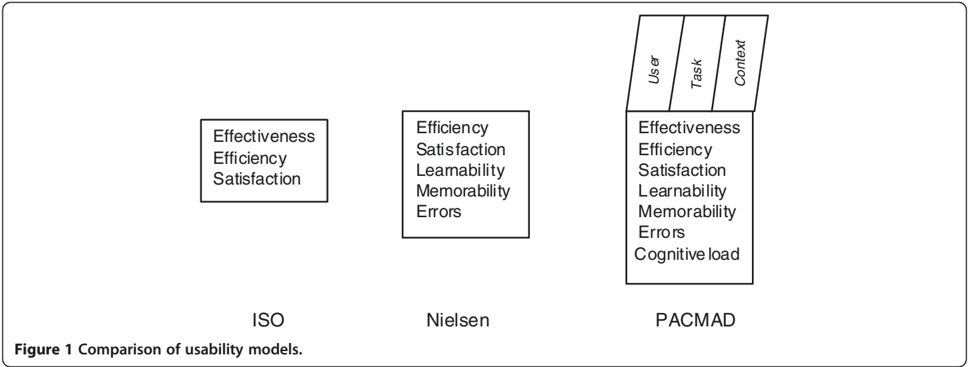
The usefulness of mobile devices has increased greatly in recent years allowing users to perform more tasks in a mobile context. This increase in usefulness has come at the expense of the usability of these devices in some contexts. We conducted a small review of mobile usability models and found that usability is usually measured in terms of three attributes; effectiveness, efficiency and satisfaction. Other attributes, such as cognitive load, tend to be overlooked in the usability models that are most prominent despite their likely impact on the success or failure of an application. To remedy this we introduces the PACMAD (People At the Centre of Mobile Application Development) usability model which was designed to address the limitations of existing usability models when applied to mobile devices. PACMAD brings together significant attributes from different usability models in order to create a more comprehensive model. None of the attributes that it includes are new, but the existing prominent usability models ignore one or more of them. This could lead to an incomplete usability evaluation. We performed a literature search to compile a collection of studies that evaluate mobile applications and then evaluated the studies using our model.
Overview
CoChat Summary
TL;DR
The paper reviews mobile usability models and proposes PACMAD, a model with three factors and seven attributes, including cognitive load, to address limitations of traditional models for mobile applications. A literature review of 131 papers from 2008–2010 found effectiveness, efficiency, and satisfaction most commonly evaluated, while memorability was rarely evaluated.
Key findings
- PACMAD identifies three factors—User, Task, and Context of use—and seven usability attributes: Effectiveness, Efficiency, Satisfaction, Learnability, Memorability, Errors, and Cognitive load; cognitive load is the main addition to existing prominent models.
- In the reviewed studies, the most commonly evaluated attributes were Satisfaction (58.02%, 76 studies), Efficiency (54.96%, 72), Effectiveness (51.15%, 67), Errors (32.82%, 43), Cognitive Load (22.90%, 30), Learnability (20.61%, 27), and Memorability (2.29%, 3).
- Task was the dominant research focus (46.92%, 61 papers), followed by Interaction (29.77%, 39), User (9.23%, 12), Context (8.46%, 11), and Development Methodology (6.15%, 8).
- Controlled experiments were the most common research methodology (59.51%, 97 studies), followed by field studies (26.99%, 44); the discussion states almost 23% of studies measured cognitive load, supporting its inclusion, while only 2% evaluated memorability.
Methods
- Literature review of papers published 2008–2010, searched via ACM digital library, IEEE digital library, and Google Scholar using search strings including “Mobile Application Evaluations,” “Usability of mobile applications,” and “Mobile application usability evaluations.”
- Sources included MobileHCI, IJMHCI, TOCHI, IJHCS, PUC, and IJHCI; CHI and IEEE TOMC were discarded because less than 5% of their papers were relevant. Abstract screening was done by the first two authors, with disagreements resolved by discussion.
- 131 papers were included (Table 3); 20 relevant papers without formal evaluations were excluded, and multiple studies within papers were considered independently, yielding 163 studies for methodology analysis. Data extraction was by one reviewer, with the first and second authors independently reviewing a 10% sample.
Limitations
- The paper states that 8 out of 139 relevant papers were unavailable (less than 6%), that omitting certain sources may have introduced bias, and that some outlying studies may have been omitted due to limited resources, though omitted papers were believed to be of borderline significance.
- The text makes evident that the review was limited to 2008–2010 and to selected venues; the studies often did not explicitly cite usability criteria, and the attributes are not orthogonal.
- The paper also notes that it adopts a relatively simple view of cognitive load, and that a more powerful multifactorial approach would be preferable but is beyond its scope.
Model-written summary. Check it against the paper before relying on it.
Integrity signals
Registry
Cites
Statistics
Figures
Verification
Claims the paper makes
0 Valid · 12 Not valid · 8 Not checked · 85 Own results and interpretations
A result the paper reports from its own data — it cites no other source for it, so there is none to check. The quote shows it is in the paper.
In the paper
“From our review it is apparent that many existing models for usability do not consider mobility and its consequences, such as additional cognitive load.”
hedged- Asserted: passes — The authors put it forward as true.
- Checkable: passes — It can be checked against evidence.
- Load-bearing: passes — The paper’s conclusions depend on it.
- Based: passes — The paper gives a reason why it holds.
A result the paper states — it cites no source for it, so there is none to check. The quote shows it is in the paper.
In the paper
“None of the attributes that it includes are new, but the existing prominent usability models ignore one or more of them.”
plain- Asserted: passes — The authors put it forward as true.
- Checkable: passes — It can be checked against evidence.
- Load-bearing: passes — The paper’s conclusions depend on it.
- Based: passes — The paper gives a reason why it holds.
A result the paper states — it cites no source for it, so there is none to check. The quote shows it is in the paper.
In the paper
“Other attributes, such as cognitive load, tend to be overlooked in the usability models that are most prominent despite their likely impact on the success or failure of an application.”
- Also stated in: § Introduction · plain
“This aspect of usability is often overlooked in existing usability models, which are outlined in the next section, as these models are designed for applications which are seldom used in a mobile context.”
- Also stated in: § Limitations for mobile applications · hedged
“From our review it is apparent that many existing models for usability do not consider mobility and its consequences, such as additional cognitive load.”
plain- Asserted: passes — The authors put it forward as true.
- Checkable: passes — It can be checked against evidence.
- Load-bearing: passes — The paper’s conclusions depend on it.
- Based: passes — The paper gives a reason why it holds.
- Also stated in: § Introduction · plain
A result the paper reports from its own data — it cites no other source for it, so there is none to check. The quote shows it is in the paper.
In the paper
“We conducted a small review of mobile usability models and found that usability is usually measured in terms of three attributes; effectiveness, efficiency and satisfaction.”
- Also stated in: § RQ1: What attributes are used when considering the usability of mobile applications? · plain
“The three most common attributes, Effectiveness, Efficiency and Satisfaction, correspond to the attributes identified by the ISO ' s standard for usability.”
plain- Asserted: passes — The authors put it forward as true.
- Checkable: passes — It can be checked against evidence.
- Load-bearing: passes — The paper’s conclusions depend on it.
- Based: passes — The paper gives a reason why it holds.
- Also stated in: § RQ1: What attributes are used when considering the usability of mobile applications? · plain
A result the paper reports from its own data — it cites no other source for it, so there is none to check. The quote shows it is in the paper.
In the paper
“Twenty papers that were identified as being relevant did not contain any formal evaluations of the proposed technologies.”
plain- Asserted: passes — The authors put it forward as true.
- Checkable: passes — It can be checked against evidence.
- Load-bearing: unclear — It is unclear whether the paper’s conclusions depend on it.
- Based: passes — The paper gives a reason why it holds.
46 more claims
Create a free account to see all 105 claims and every source verdict.
- Borderline: one of the tests for a substantial claim is unclear. 1
- Probably not a substantial claim. 45
- It may state two separate claims as one. 18
- The quote only partly states this claim. 1
Claims other papers make about this one
Each is checked against this paper’s own text: does it say what the citing paper says it does?
In the citing paper
“For example, different results can be obtained if more people that are elderly are taken into account, as their acceptance and use of technology are different from the younger generation [59].”
Self-check
Percentages, sums and reported differences re-computed from the paper’s own numbers.
Each contradiction between two passages listed here was confirmed by an independent check.
Rated minor: it would not touch a result — a value no result rests on, a p-value that stays on the same side of the significance level, or a conflict that is clerical, resolved elsewhere in the paper, or outside its own findings.
In the paper
§ RQ1: What attributes are used when considering the usability of mobile applications?
“About 26% of the studies considered cognitive load.”
§ RQ1: What attributes are used when considering the usability of mobile applications?
“| Cognitive Load | 22.90% | 30 |”
Citations
Cites
Development of NASA-TLX (Task Load Index): Results of Empirical and Theoretical Research
(1988) · Advances in Psychology · doi:10.1016/s0166-4115(08)62386-9 · Cited by 20,029
(1993) · Cited by 9,879
Challenges, Methodologies, and Issues in the Usability Testing of Mobile Applications
Zhang, D., & Adipat, B. (2005) · International Journal of Human-Computer Interaction · doi:10.1207/s15327590ijhc1803_3 · Cited by 613 · cited 3×
“Zhang and Adipat [6] highlighted a number of issues that have been introduced by the advent of mobile devices: Mobile Context: When using mobile applications the user is not tied to a single location.”
BackgroundInfluentialA Review of Mobile HCI Research Methods
Kjeldskov, J., & Graham, C. (2003) · Lecture Notes in Computer Science · doi:10.1007/978-3-540-45233-1_23 · Cited by 375 · cited 3×
“Previous work by Kjeldskov & Graham [3] has looked at the research methods used in mobile HCI, but did not examine the particular attributes of usability incorporated in the PACMAD model.”
MethodInfluentialUnderstanding and capturing people's privacy policies in a mobile social networking application
Sadeh, N., Hong, J., Cranor, L., Fette, I., Kelley, P., Prabaker, M., & Rao, J. (2009) · Personal and Ubiquitous Computing · doi:10.1007/s00779-008-0214-3 · Cited by 318
Foundations of Augmented Cognition
(2005) · CRC Press eBooks · doi:10.1201/9781482289701 · Cited by 315
Context of Use within usability activities
MAGUIRE, M. (2001) · International Journal of Human-Computer Studies · doi:10.1006/ijhc.2001.0486 · Cited by 275 · cited 1×
“Context of use can vary enormously and so should be considered an important factor of usability [5,33].”
BackgroundArvanitis, T. N., Petrou, A., Knight, J. F., Savas, S., Sotiriou, S., Gargalakos, M., & Gialouri, E. (2009) · Personal and Ubiquitous Computing · doi:10.1007/s00779-007-0187-7 · Cited by 245
An empirical investigation of mobile ticketing service adoption in public transportation
Mallat, N., Rossi, M., Tuunainen, V. K., & Öörni, A. (2007) · Personal and Ubiquitous Computing · doi:10.1007/s00779-006-0126-z · Cited by 223
An innovative mobile electronic tourist guide application
Kenteris, M., Gavalas, D., & Economou, D. (2009) · Personal and Ubiquitous Computing · doi:10.1007/s00779-007-0191-y · Cited by 210
Cited by
Items 401–500 of 736
Affective Design of Food Delivery Order Packaging
Rahmawati, N., Astutı, P., Rofifah, F., & Habyba, A. N. (2020) · International Journal of Engineering and Advanced Technology · doi:10.35940/ijeat.b1961.1210220 · Cited by 5
Die Optimierung der Usability von mobilen Applikationen
Stumpp, S., Willems, K., & Michelis, D. (2022) · Wirtschaftsinformatik & Management · doi:10.1365/s35764-022-00430-6 · Cited by 5
Developing hybrid mobile applications for learning
(2018) · doi:10.1109/isetc.2018.8584005 · Cited by 3
Usability Analysis of Adaptive Characteristics in Mobile Phones for Visually Impaired People
Qureshi, H. H., & Wong, D. H.-T. (2020) · International Conference on Computer Communication and Information Systems (CCCIS) · doi:10.1145/3418994.3419005 · Cited by 4
Hilty, D. M., Peled, A., & Luxton, D. D. (2023) · Springer eBooks · doi:10.1007/978-3-030-42825-9_152-1 · Cited by 6
Understanding E-Mental Health for People with Depression: An Evaluation Study
Blankenhagel, K. J., Werner, J., Mayer, G., Schultz, J., & Zarnekow, R. (2021) · Lecture notes of the Institute for Computer Sciences, Social Informatics and Telecommunications Engineering · doi:10.1007/978-3-030-70569-5_3 · Cited by 2
InApp Questions – an Approach for Contextual Evaluation of Applications
Abreu, J., Almeida, P., & Beça, P. (2017) · Communications in computer and information science · doi:10.1007/978-3-319-63321-3_12 · Cited by 4
Comparative Usability Analysis of Selected Data Entry Methods for Web Systems
Osada, K., Muke, P. Z., Piwowarczyk, M., Telec, Z., & Trawiński, B. (2020) · Cybernetics & Systems · doi:10.1080/01969722.2019.1705552 · Cited by 5
Usability Assessment Methods for Mobile Apps for Physical Rehabilitation: Umbrella Review
Hach, S., Alder, G., Stavric, V., Taylor, D., & Signal, N. (2024) · JMIR mhealth and uhealth · doi:10.2196/49449 · Cited by 10
Usability Study of Mobile Applications with Cognitive Load Resulting from Environmental Factors
Karczewska, B., Kukla, E., Muke, P. Z., Telec, Z., & Trawiński, B. (2021) · Lecture notes in computer science · doi:10.1007/978-3-030-73280-6_67 · Cited by 3
Development and Launch of a Comprehensive Fish and Wildlife Reporting Mobile Application
Flamm, R. O. (2019) · Journal of Fish and Wildlife Management · doi:10.3996/072018-jfwm-064 · Cited by 3
Sustainability-Driven Consumer Experience Design of an Online Retail System for Household Appliances
Lu, Y., & Yan, T. (2023) · ICST Transactions on Scalable Information Systems · doi:10.4108/eetsis.3331 · Cited by 11
Maphosa, V. (2018) · ResearchSpace (University of KwaZulu-Natal) · Cited by 3
Approximate vs. precise location in popular location-based services
Heitmann, S., Pagotto, A., & Kray, C. (2024) · Journal of Location Based Services · doi:10.1080/17489725.2024.2310006 · Cited by 3
Katz, D. (2016) · ACM International Joint Conference on Pervasive and Ubiquitous Computing (UbiComp) · doi:10.1145/2968219.2971356 · Cited by 4
Wardhana, S. R., & Purwitasari, D. (2019) · INTEGER Journal of Information Technology · doi:10.31284/j.integer.2019.v4i1.474 · Cited by 3
Gómez, W. O. C., & Ricaurte, J. A. B. (2015) · Revista Científica · doi:10.14483/udistrital.jour.rc.2015.21.a4 · Cited by 5
Net Generation Features that Enhance Mobile Learning
(2016) · doi:10.4018/97891952259025692 · Cited by 3
Azem, J. Y., Salminen, J. O., Aldous, K. K., Gueye, F., & Jansen, B. J. J. (2025) · Designing Interactive Systems Conference · doi:10.1145/3715336.3735770 · Cited by 4
Rahmat, R. W. O. K., Afera, C. N. S., Basri, N. A. H., Madzin, H., & Hod, R. (2023) · Journal of Advanced Research in Applied Sciences and Engineering Technology · doi:10.37934/araset.33.2.151159 · Cited by 4
Usability of "Fatchum": A Mobile Application Recipe Recommender System
Cruz, Z. M. C., Alpay, J. J. R., Depeno, J. D. D., Altabirano, M. J. C., & Bringula, R. P. (2017) · ACM Annual Conference on Research in Information Technology (RIIT) · doi:10.1145/3125649.3125650 · Cited by 3
Mujeye, S. (2023) · Information and Computer Security · doi:10.1108/ics-05-2023-0086 · Cited by 4
Júnior, S. F. R., & Leite, L. L. (2024) · iSys - Brazilian Journal of Information Systems · doi:10.5753/isys.2024.4141 · Cited by 5
UI/UX design and usage effectiveness of mHealth applications: review paper
Golubović, G., Dedijer, S., Kerac, J., Keresteš, N. M., Vladić, G., Petrović, S., & Kašıkovıć, N. (2025) · Universal Access in the Information Society · doi:10.1007/s10209-025-01204-8 · Cited by 7
Maps for Easy Paths (MEP): A Mobile Application for City Accessibility
Comai, S., Bernardi, E. D., Salice, F., & Vali, A. (2018) · EAI/Springer Innovations in Communication and Computing · doi:10.1007/978-3-319-93491-4_6 · Cited by 5
A mobile bank application loyalty model: The young bank customer perspective
Nourallah, M. (2020) · doi:10.13140/rg.2.2.35638.86089 · Cited by 6
A New Subjective Audiovisual & Video Quality Testing Recommendation
(2014) · Cited by 3
Haley, J. A., Rhind, D. J. A., & Maidment, D. W. (2025) · PLoS ONE · doi:10.1371/journal.pone.0321109 · Cited by 6
Holzinger, A., Sommerauer, B., Spitzer, P., Jurič, S., Žalik, B., Debevc, M., Lidynia, C., Valdez, A. S. C., Roecker, C., & Ziefle, M. (2014) · Lecture notes in computer science · doi:10.1007/978-3-319-10975-6_8 · Cited by 3
COG Tool: An Automated Cognitive Measurement of Workload for Mobile Event Logging
Saleh, A. M., & Enaizan, O. (2022) · International Journal of Interactive Mobile Technologies (iJIM) · doi:10.3991/ijim.v16i20.33363 · Cited by 5
Lessons learned from evaluating a mobile app out in the field
McDonald, K., Abell, W., Smith, C. M. S., & Gibbs, S. (2016) · International Conference on User Science and Engineering · doi:10.1109/iuser.2016.7857925 · Cited by 3
Development of hearing-impaired evaluation model for mobile phone
Hussain, A., Hashim, N. L., & Nathan, S. S. (2018) · Journal of Telecommunication Electronic and Computer Engineering (JTEC) · Cited by 3
Mustafa, U.-K., Sauli, E., Kreppel, K. S., Boenecke, J., & Brinkel, J. (2025) · BMC Public Health · doi:10.1186/s12889-025-23286-y · Cited by 4
A Context-Aware Approach for Generating User Interfaces Based on Usability Requirements
Zaibi, D., Riahi, M., & Moussa, F. (2019) · Journal of Information Technology Research · doi:10.4018/jitr.2019040106 · Cited by 5
Tingog: Reading and Speech Application for Children with Repaired Cleft Palate
Belen, G. M. A., Cabonita, K. B. P., Pena, V. A. D., Dimakuta, H. A., Hoyle, F. G., & Laviste, R. P. (2018) · IEEE International Conference on Humanoid, Nanotechnology, Information Technology, Communication and Control, Environment, and Management (HNICEM) · doi:10.1109/hnicem.2018.8666309 · Cited by 4
Mobile Application Software Usability Evaluation: Issues, Methods and Future Research Directions
Attah, B. I., Alhassan, J. K., Oyefolahan, I. O., & Bashir, S. A. (2021) · Communications in computer and information science · doi:10.1007/978-3-030-69143-1_43 · Cited by 4
Development of A New Model for the Usability Evaluation of M-commerce Applications
Ajibola, A. S., Abiodun, E., & Goosen, L. (2022) · Journal of Telecommunication Electronic and Computer Engineering (JTEC) · doi:10.54554/jtec.2022.14.03.001 · Cited by 6
Hamouda, H. N., Matraf, M. S. B., Hashim, N. L., Hussain, A., Ghazali, O., Habbal, A., & Alshenaifi, R. (2025) · International Journal of Human-Computer Interaction · doi:10.1080/10447318.2025.2561775 · Cited by 4
A Measure of the Effectiveness and Efficiency of an M-Cinema App
(2019) · International Journal of Recent Technology and Engineering (IJRTE) · doi:10.35940/ijrte.b1024.0782s219 · Cited by 3
Adu, A. S. Y., & van Biljon, J. A. (2023) · Communications in computer and information science · doi:10.1007/978-3-031-28472-4_16 · Cited by 5
Bricker, J. B., Santiago‐Torres, M., Sullivan, B. M., Mull, K. E., Clark, H. W., Fogel, C. A., Hwang, S. B., Keith, A., Kornacki, C., Lightning-Craddock, T. A. O., et al. (2026) · JMIR Formative Research · doi:10.2196/88768 · Cited by 1
Usability of Mobile Applications Supporting Training in Diagnostic Decision-Making by Radiologists
Kim, M. S., Ramadan, A. A. B., Clarke, M. A., Markey, M. K., Lage, K. J., Aro, M. R., Ingalls, K. L., & Sindhwani, V. (2015) · Lecture notes in computer science · doi:10.1007/978-3-319-21070-4_45 · Cited by 4
Assessing the Hands-on Usability of the Healthy Jeart App Specifically Tailored to Young Users
Roldán, A. M., Merino-Godoy, M.-D.-L.-Á., Peregrín, A., Yot‐Domínguez, C., & Costa, E. (2024) · Healthcare · doi:10.3390/healthcare12030408 · Cited by 3
(2020) · doi:10.2196/preprints.24457 · Cited by 69
Usability Study of Data Entry Design Patterns for Mobile Applications
Waloszek, S., Muke, P. Z., Piwowarczyk, M., Telec, Z., Trawiński, B., & Nguyen, L. T. T. (2020) · Lecture notes in computer science · doi:10.1007/978-3-030-63007-2_70 · Cited by 2
Social and Technical Perspective of Individual's Intention to Purchase Mobile Application
Ahmad, I. H., Mohamed, N., & Hussain, A. R. C. (2015) · Advances in wireless technologies and telecommunication book series · doi:10.4018/978-1-4666-9438-5.ch003 · Cited by 2
Proposing an initial model for the heuristic evaluation of mHealth applications
Galavi, Z., & Khajouei, R. (2023) · Informatics in Medicine Unlocked · doi:10.1016/j.imu.2023.101322 · Cited by 4
Yang, S.-C. (2025) · The Review of Socionetwork Strategies · doi:10.1007/s12626-025-00183-9 · Cited by 2
Eye-Tracking and Usability in (Mobile) ERP Systems
Dobhan, A., Wüllerich, T., & Röhner, D. (2022) · Lecture notes in business information processing · doi:10.1007/978-3-031-08965-7_21 · Cited by 2
Katz, D. (2017) · CHI Conference Extended Abstracts on Human Factors in Computing Systems (CHI EA) · doi:10.1145/3027063.3027127 · Cited by 2
Floresca, H. M. A., Diño, M. J. S., Ong, I. L., Orte, C. J. S., & Aggari, M. I. (2021) · CIN Computers Informatics Nursing · doi:10.1097/cin.0000000000000816 · Cited by 3
Remote Operation of CeCi Social Robot
Barbecho-Jimbo, E., Vallejo-Ramírez, D., Cobos-Torres, J.-C., Ángulo, C., & Flores-Vázquez, C. (2023) · Robotics · doi:10.3390/robotics12010019 · Cited by 3
Redes sociales en aplicaciones móviles: aspectos que dificultan el uso en adultos mayores
Villavicencio, O. E. C., Carrión, J. L. A., Ríos, J. R. M., & Leiva, Y. M. P. (2020) · 3C TIC Cuadernos de desarrollo aplicados a las TIC · doi:10.17993/3ctic.2020.92.59-81 · Cited by 2
Bartel, S. J., Huguet, A., Rao, S., Wozney, L., Varalli, V., Rozari, S., McGrath, P. J., Kits, O., & Stewart, S. H. (2020) · Journal of Gambling Issues · doi:10.4309/jgi.2020.45.8 · Cited by 2
Understanding Cognitive Load’s Effect on Mobile Application Usability: A Review
Jailani, A. S. C., Omar, R., Sharudin, S. A., Faudzi, M. A., & Cob, Z. C. (2025) · Information systems engineering and management · doi:10.1007/978-3-031-91485-0_26 · Cited by 2
Evaluation of mobile health education applications for health professionals and patients
Gordon, N. A., & Aljaber, T. (2016) · Repository@Hull (Worktribe) (University of Hull) · Cited by 4
KAMP KARAVAN TURİZMİ MOBİL UYGULAMALARINA İLİŞKİN GÖRÜŞLER
YORGUN, B., İLAL, N. Ç., Çalışkan, U., & Ulusoy, H. E. (2023) · Dokuz Eylül Üniversitesi Sosyal Bilimler Enstitüsü Dergisi · doi:10.16953/deusosbil.1280693 · Cited by 2
Social and Technical Perspective of Individual's Intention to Purchase Mobile Application
Ahmad, I. H., Mohamed, N., & Hussain, A. R. C. (2016) · IGI Global eBooks · doi:10.4018/978-1-4666-9845-1.ch070 · Cited by 2
A hierarchical framework to evaluate the usability of smartphone health applications
Siddique, A., Sajjad, Q., Algamdi, S. A., Shahzad, B., & Hussien, J. M. (2026) · Scientific Reports · doi:10.1038/s41598-025-32910-1 · Cited by 2
Tjhin, V. U., Abbas, B. S., Budiastuti, D., & Kosala, R. (2017) · International Conference on Information Management · doi:10.1109/infoman.2017.7950342 · Cited by 2
Net Generation Features that Enhance Mobile Learning
(2016) · doi:10.4018/978-1-5225-0783-3.ch105 · Cited by 2
Smart toothbrush app user interface usability study
(2022) · doi:10.1109/cipae55637.2022.00092 · Cited by 2
Impacto das tecnologias inovadoras na vida de diabéticos adultos: revisão integrativa
de Souza, R. D., Júnior, M. A. F., Ikeda, L. H. M., Loureiro, M. D. R., dos Reis, M. G., & Frota, O. P. (2019) · Revista Enfermagem UERJ · doi:10.12957/reuerj.2019.39055 · Cited by 2
USABILITY ASSESSMENT OF AGRICULTURAL MOBILE APPLICATIONS IN THE GREEK MARKET
Demestichas, K. P., Adamopoulou, E., Chasta, D., & Costopoulou, C. (2020) · Russian Journal of Agricultural and Socio-Economic Sciences · doi:10.18551/rjoas.2020-09.01 · Cited by 2
Digital 3D Modelling for Heritage Research and Education from an Information Studies Perspective
Münster, S. (2021) · Lecture notes in computer science · doi:10.1007/978-3-030-73043-7_56 · Cited by 2
Objective Measurements Analysis for Usability Evaluation of Mobile Applications for Deaf People
Nathan, S. S., Hussain, A., & Hashim, N. L. (2017) · Journal of Telecommunication Electronic and Computer Engineering (JTEC) · Cited by 2
Validating the Assessment Metrics for Mobile Health Apps
(2015) · doi:10.1145/2808062.2808064 · Cited by 2
Integrating Sensors in a Mobile Application Authoring Environment
Justo, A., Duarte, L., Rodrigues, A., & Carriço, L. M. (2014) · Electronic workshops in computing · doi:10.14236/ewic/hci2014.25 · Cited by 2
New Technologies for Infection Prevention
Doll, M. E., Stevens, M., & Bearman, G. M. (2017) · Springer eBooks · doi:10.1007/978-3-319-60980-5_7 · Cited by 3
Abingosa, D., Bokingkito, P. B., Pasandalan, S. N. B., Alovera, J. R., & Otano, J. (2025) · Informatics · doi:10.3390/informatics12030090 · Cited by 10
(2022) · doi:10.1007/978-3-030-02391-1_3 · Cited by 2
Kostiuk, M. A., Moore, S. L., Kramer, E. S., Gilens, J. F., Sarwal, A., Saxon, D. R., Thomas, J. F., & Oser, T. K. (2025) · JMIR Research Protocols · doi:10.2196/62916 · Cited by 4
Mehler, J., Guo, Z. P., Zhang, A., & Rau, P. P. (2021) · Lecture notes in computer science · doi:10.1007/978-3-030-77431-8_27 · Cited by 2
Usability Testing of VLASTWA: A Vocabulary and Strategy Teaching Web App
Mirzaei, S., Lewis, T. W., Wyra, M., & Wilkinson, B. (2020) · Australian Conference on Human-Computer Interaction (OzCHI) · doi:10.1145/3441000.3441056 · Cited by 4
Remgtc Framework for Mobile Application TestingPreprint
Pareek, P., & Chande, S. V. (2022) · SSRN Electronic Journal · doi:10.2139/ssrn.4117551 · Cited by 1
User Interface Redesigning Based on a Usability Design Framework
Kureerung, P., Ramingwong, L., & Ramingwong, S. (2021) · International Conference on Electrical Engineering/Electronics, Computer, Telecommunications and Information Technology (ECTI-CON) · doi:10.1109/ecti-con51831.2021.9454792 · Cited by 2
Predictive Cognitive Modelling of Applications
Prezenski, S., Bruechner, D., & Rußwinkel, N. (2017) · International Joint Conference on Computer Vision, Imaging and Computer Graphics Theory and Applications (VISIGRAPP) · doi:10.5220/0006273301650171 · Cited by 2
Weichbroth, P., & Kuciapski, M. (2019) · Lecture notes in business information processing · doi:10.1007/978-3-030-29608-7_3 · Cited by 2
Ghabban, F. M., & Ghaban, W. (2025) · Journal of Computer and Communications · doi:10.4236/jcc.2025.138013 · Cited by 2
New Way of Identification of a Place and Tracking
(2020) · doi:10.4236/ijg.2020.116019 · Cited by 1
Innovating the Innovation: Applying Mobile Research Methods to Experience Sampling
Youngs, A., & Graf, A. S. (2017) · Journal of Social Behavioral and Health Sciences · doi:10.5590/jsbhs.2017.11.1.08 · Cited by 2
Matraf, M. S. B., Hashim, N. L., & Hussain, A. (2022) · Research Square · doi:10.21203/rs.3.rs-2098056/v1 · Cited by 1
Díaz-Gegúndez, M., Monfort, G. M., García-Vilches, J., & de Argila, I. G. (2019) · Hospital a Domicilio · doi:10.22585/hospdomic.v3i3.80 · Cited by 1
A Spatio-Situation-Based Access Control Model for Dynamic Permission on Mobile Applications
Shao, X., Demurjian, S. A., & Agresta, T. P. (2016) · Advances in multimedia and interactive technologies book series · doi:10.4018/978-1-5225-0945-5.ch007 · Cited by 1
Metadata
- Authors
- Harrison, R., Flood, D., & Duce, D.
- Affiliations
- Oxford Brookes University (GB)
- Corresponding author
- Harrison, Rachel
- Venue
- Journal of Interaction Science
- Published
- 2013
- Volume
- 1
- Issue
- 1
- Pages
- 1
- ISSN
- 2194-0827 (ISSN-L)
- OpenAlex
- W2120571425
- Cited by
- 736
- References
- 152
- Citations by year
- 2026: 33 · 2025: 44 · 2024: 50 · 2023: 58 · 2022: 74 · 2021: 62 · 2020: 84 · 2019: 77 · 2018: 49 · 2017: 72 · 2016: 55 · 2015: 49 · 2014: 27 · 2013: 1
- FWCI
- 79.76
- Type
- journal article
- Language
- en
- Open access
- hybrid
- doi.org
- Licence
- cc-by
- Locations
- Journal of Interaction Science (publishedVersion, cc-by)
- Radar (Oxford Brookes University) (submittedVersion, cc-by-nc-nd)
- Topics
- Physical Sciences › Computer Science › Human-Computer Interaction › Usability and User Interface Design
- Physical Sciences › Computer Science › Information Systems › Mobile and Web Applications
- Health Sciences › Health Professions › General Health Professions › Mobile Health and mHealth Applications
- Keywords
- software usability, usability model, cognitive load, effectiveness, efficiency and satisfaction, usability evaluation, mobile devices, user satisfaction
About these checks
Registry, retraction, Cites and statistics results are computed, not judged, with one exception: a printed reference that no index lists is read once by a model before it counts as a citation error. Claims are extracted by a model and kept only when their quote appears verbatim in the text; each cited source is then checked, with a model’s help, for whether it says what the claim relies on. Those verdicts can be wrong — read the claim’s quote and the cited source before relying on one.
A language model drew the claims from the paper on 2026-10-10, under version 3 of the claim definition (model deepseek-v4.1-flash, prompt extract-v3).
A second model labelled each claim on 2026-10-10 (model jev-1.13-20260917, definition revision gold-guideline-v0.2).
Statistics and arithmetic are recomputed, not judged.
Confidence bands are shown only for fields calibrated on our annotated test set. None is calibrated yet, so no band is shown.
What counts as a claim ›How we measure confidence ›How we check this ›
Are you an author, or do you see a problem with this page? Request a review
Data sources
Bibliographic data: Semantic Scholar, OpenAlex, Crossref.
Contains information from the Semantic Scholar Academic Graph Datasets, made available under the ODC Attribution License (ODC-BY 1.0).
Semantic Scholar’s data is described in: Kinney, R., et al. (2023). The Semantic Scholar Open Data Platform. arXiv:2301.10140.
