

Usability of mobile applications: literature review and rationale for a new usability model
Open accessThe DOI matches its Crossref record; 151 of the 152 references it cites were found in a registry or an index; none of the 11 sources its claims cite is checked for support yet.
Abstract
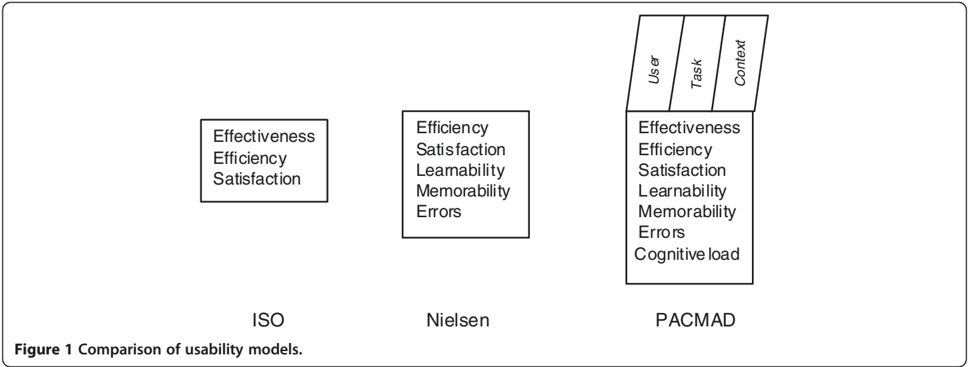
The usefulness of mobile devices has increased greatly in recent years allowing users to perform more tasks in a mobile context. This increase in usefulness has come at the expense of the usability of these devices in some contexts. We conducted a small review of mobile usability models and found that usability is usually measured in terms of three attributes; effectiveness, efficiency and satisfaction. Other attributes, such as cognitive load, tend to be overlooked in the usability models that are most prominent despite their likely impact on the success or failure of an application. To remedy this we introduces the PACMAD (People At the Centre of Mobile Application Development) usability model which was designed to address the limitations of existing usability models when applied to mobile devices. PACMAD brings together significant attributes from different usability models in order to create a more comprehensive model. None of the attributes that it includes are new, but the existing prominent usability models ignore one or more of them. This could lead to an incomplete usability evaluation. We performed a literature search to compile a collection of studies that evaluate mobile applications and then evaluated the studies using our model.
Overview
CoChat Summary
TL;DR
The paper reviews mobile usability models and proposes PACMAD, a model with three factors and seven attributes, including cognitive load, to address limitations of traditional models for mobile applications. A literature review of 131 papers from 2008–2010 found effectiveness, efficiency, and satisfaction most commonly evaluated, while memorability was rarely evaluated.
Key findings
- PACMAD identifies three factors—User, Task, and Context of use—and seven usability attributes: Effectiveness, Efficiency, Satisfaction, Learnability, Memorability, Errors, and Cognitive load; cognitive load is the main addition to existing prominent models.
- In the reviewed studies, the most commonly evaluated attributes were Satisfaction (58.02%, 76 studies), Efficiency (54.96%, 72), Effectiveness (51.15%, 67), Errors (32.82%, 43), Cognitive Load (22.90%, 30), Learnability (20.61%, 27), and Memorability (2.29%, 3).
- Task was the dominant research focus (46.92%, 61 papers), followed by Interaction (29.77%, 39), User (9.23%, 12), Context (8.46%, 11), and Development Methodology (6.15%, 8).
- Controlled experiments were the most common research methodology (59.51%, 97 studies), followed by field studies (26.99%, 44); the discussion states almost 23% of studies measured cognitive load, supporting its inclusion, while only 2% evaluated memorability.
Methods
- Literature review of papers published 2008–2010, searched via ACM digital library, IEEE digital library, and Google Scholar using search strings including “Mobile Application Evaluations,” “Usability of mobile applications,” and “Mobile application usability evaluations.”
- Sources included MobileHCI, IJMHCI, TOCHI, IJHCS, PUC, and IJHCI; CHI and IEEE TOMC were discarded because less than 5% of their papers were relevant. Abstract screening was done by the first two authors, with disagreements resolved by discussion.
- 131 papers were included (Table 3); 20 relevant papers without formal evaluations were excluded, and multiple studies within papers were considered independently, yielding 163 studies for methodology analysis. Data extraction was by one reviewer, with the first and second authors independently reviewing a 10% sample.
Limitations
- The paper states that 8 out of 139 relevant papers were unavailable (less than 6%), that omitting certain sources may have introduced bias, and that some outlying studies may have been omitted due to limited resources, though omitted papers were believed to be of borderline significance.
- The text makes evident that the review was limited to 2008–2010 and to selected venues; the studies often did not explicitly cite usability criteria, and the attributes are not orthogonal.
- The paper also notes that it adopts a relatively simple view of cognitive load, and that a more powerful multifactorial approach would be preferable but is beyond its scope.
Model-written summary. Check it against the paper before relying on it.
Integrity signals
Registry
Cites
Statistics
Figures
Verification
Claims the paper makes
0 Valid · 12 Not valid · 8 Not checked · 85 Own results and interpretations
A result the paper reports from its own data — it cites no other source for it, so there is none to check. The quote shows it is in the paper.
In the paper
“From our review it is apparent that many existing models for usability do not consider mobility and its consequences, such as additional cognitive load.”
hedged- Asserted: passes — The authors put it forward as true.
- Checkable: passes — It can be checked against evidence.
- Load-bearing: passes — The paper’s conclusions depend on it.
- Based: passes — The paper gives a reason why it holds.
A result the paper states — it cites no source for it, so there is none to check. The quote shows it is in the paper.
In the paper
“None of the attributes that it includes are new, but the existing prominent usability models ignore one or more of them.”
plain- Asserted: passes — The authors put it forward as true.
- Checkable: passes — It can be checked against evidence.
- Load-bearing: passes — The paper’s conclusions depend on it.
- Based: passes — The paper gives a reason why it holds.
A result the paper states — it cites no source for it, so there is none to check. The quote shows it is in the paper.
In the paper
“Other attributes, such as cognitive load, tend to be overlooked in the usability models that are most prominent despite their likely impact on the success or failure of an application.”
- Also stated in: § Introduction · plain
“This aspect of usability is often overlooked in existing usability models, which are outlined in the next section, as these models are designed for applications which are seldom used in a mobile context.”
- Also stated in: § Limitations for mobile applications · hedged
“From our review it is apparent that many existing models for usability do not consider mobility and its consequences, such as additional cognitive load.”
plain- Asserted: passes — The authors put it forward as true.
- Checkable: passes — It can be checked against evidence.
- Load-bearing: passes — The paper’s conclusions depend on it.
- Based: passes — The paper gives a reason why it holds.
- Also stated in: § Introduction · plain
A result the paper reports from its own data — it cites no other source for it, so there is none to check. The quote shows it is in the paper.
In the paper
“We conducted a small review of mobile usability models and found that usability is usually measured in terms of three attributes; effectiveness, efficiency and satisfaction.”
- Also stated in: § RQ1: What attributes are used when considering the usability of mobile applications? · plain
“The three most common attributes, Effectiveness, Efficiency and Satisfaction, correspond to the attributes identified by the ISO ' s standard for usability.”
plain- Asserted: passes — The authors put it forward as true.
- Checkable: passes — It can be checked against evidence.
- Load-bearing: passes — The paper’s conclusions depend on it.
- Based: passes — The paper gives a reason why it holds.
- Also stated in: § RQ1: What attributes are used when considering the usability of mobile applications? · plain
A result the paper reports from its own data — it cites no other source for it, so there is none to check. The quote shows it is in the paper.
In the paper
“Twenty papers that were identified as being relevant did not contain any formal evaluations of the proposed technologies.”
plain- Asserted: passes — The authors put it forward as true.
- Checkable: passes — It can be checked against evidence.
- Load-bearing: unclear — It is unclear whether the paper’s conclusions depend on it.
- Based: passes — The paper gives a reason why it holds.
46 more claims
Create a free account to see all 105 claims and every source verdict.
- Borderline: one of the tests for a substantial claim is unclear. 1
- Probably not a substantial claim. 45
- It may state two separate claims as one. 18
- The quote only partly states this claim. 1
Claims other papers make about this one
Each is checked against this paper’s own text: does it say what the citing paper says it does?
In the citing paper
“For example, different results can be obtained if more people that are elderly are taken into account, as their acceptance and use of technology are different from the younger generation [59].”
Self-check
Percentages, sums and reported differences re-computed from the paper’s own numbers.
Each contradiction between two passages listed here was confirmed by an independent check.
Rated minor: it would not touch a result — a value no result rests on, a p-value that stays on the same side of the significance level, or a conflict that is clerical, resolved elsewhere in the paper, or outside its own findings.
In the paper
§ RQ1: What attributes are used when considering the usability of mobile applications?
“About 26% of the studies considered cognitive load.”
§ RQ1: What attributes are used when considering the usability of mobile applications?
“| Cognitive Load | 22.90% | 30 |”
Citations
Cites
Development of NASA-TLX (Task Load Index): Results of Empirical and Theoretical Research
(1988) · Advances in Psychology · doi:10.1016/s0166-4115(08)62386-9 · Cited by 20,029
(1993) · Cited by 9,879
Challenges, Methodologies, and Issues in the Usability Testing of Mobile Applications
Zhang, D., & Adipat, B. (2005) · International Journal of Human-Computer Interaction · doi:10.1207/s15327590ijhc1803_3 · Cited by 613 · cited 3×
“Zhang and Adipat [6] highlighted a number of issues that have been introduced by the advent of mobile devices: Mobile Context: When using mobile applications the user is not tied to a single location.”
BackgroundInfluentialA Review of Mobile HCI Research Methods
Kjeldskov, J., & Graham, C. (2003) · Lecture Notes in Computer Science · doi:10.1007/978-3-540-45233-1_23 · Cited by 375 · cited 3×
“Previous work by Kjeldskov & Graham [3] has looked at the research methods used in mobile HCI, but did not examine the particular attributes of usability incorporated in the PACMAD model.”
MethodInfluentialUnderstanding and capturing people's privacy policies in a mobile social networking application
Sadeh, N., Hong, J., Cranor, L., Fette, I., Kelley, P., Prabaker, M., & Rao, J. (2009) · Personal and Ubiquitous Computing · doi:10.1007/s00779-008-0214-3 · Cited by 318
Foundations of Augmented Cognition
(2005) · CRC Press eBooks · doi:10.1201/9781482289701 · Cited by 315
Context of Use within usability activities
MAGUIRE, M. (2001) · International Journal of Human-Computer Studies · doi:10.1006/ijhc.2001.0486 · Cited by 275 · cited 1×
“Context of use can vary enormously and so should be considered an important factor of usability [5,33].”
BackgroundArvanitis, T. N., Petrou, A., Knight, J. F., Savas, S., Sotiriou, S., Gargalakos, M., & Gialouri, E. (2009) · Personal and Ubiquitous Computing · doi:10.1007/s00779-007-0187-7 · Cited by 245
An empirical investigation of mobile ticketing service adoption in public transportation
Mallat, N., Rossi, M., Tuunainen, V. K., & Öörni, A. (2007) · Personal and Ubiquitous Computing · doi:10.1007/s00779-006-0126-z · Cited by 223
An innovative mobile electronic tourist guide application
Kenteris, M., Gavalas, D., & Economou, D. (2009) · Personal and Ubiquitous Computing · doi:10.1007/s00779-007-0191-y · Cited by 210
Cited by
Items 301–400 of 736
Blankenhagel, K. J. (2019) · International Conference on Pervasive Computing Technologies for Healthcare · doi:10.1145/3329189.3329195 · Cited by 9
Amiruddin, A., Dewi, R. S., & Widodo, E. (2021) · IOP Conference Series Materials Science and Engineering · doi:10.1088/1757-899x/1072/1/012024 · Cited by 8
Zali, Z., & Fadzlah, A. F. A. (2016) · doi:10.1109/icictm.2016.7890800 · Cited by 8
A mixed-methods measurement and evaluation methodology for mobile application usability studies
Weichbroth, P. (2019) · Annals of Computer Science and Information Systems · doi:10.15439/2019f299 · Cited by 12
Usability evaluation model for mobile e-book applications
Matraf, M. S. B., & Hussain, A. (2017) · AIP conference proceedings · doi:10.1063/1.5005388 · Cited by 7
Engdahl, P., Svedberg, P., Lexén, A., Tjörnstrand, C., Strid, C., & Bejerholm, U. (2023) · JMIR Formative Research · doi:10.2196/39422 · Cited by 7
Sonnenberg, C. (2019) · Journal of Media Management and Entrepreneurship · doi:10.4018/jmme.2020010106 · Cited by 6
Prezenski, S., & Rußwinkel, N. (2014) · International journal on advances in intelligent systems · Cited by 7
Improving Usability with TRIZ: A Review
Batemanazan, V., Jaafar, A., Kadir, R. A., & Nayan, N. M. (2017) · Lecture notes in computer science · doi:10.1007/978-3-319-70010-6_58 · Cited by 7
Plessis, C. D. (2017) · Communitas · doi:10.18820/24150525/comm.v22.3 · Cited by 9
Iteratively Digitizing an Analogue Syllable-Based Reading Intervention
Riedmann, A., Schäper, P., Donnermann, M., Lein, M., Steinhaeusser, S. C., Karageorgos, P., Müller, B., Richter, T., & Lugrin, B. (2021) · Interacting with Computers · doi:10.1093/iwc/iwac005 · Cited by 9
Pruebas a aplicaciones móviles: avances y retos
(2019) · doi:10.21501/21454086.2983 · Cited by 6
A Guidance and Evaluation Approach for mHealth Education Applications
Aljaber, T., & Gordon, N. A. (2017) · Lecture notes in computer science · doi:10.1007/978-3-319-58515-4_26 · Cited by 6
User Experience of Mobile Application's Interface: Measurement Development
Yang, S., Lee, T.-L., & Feng, T.-T. (2018) · Multidisciplinary International Social Networks Conference (MISNC) · doi:10.1145/3227696.3227698 · Cited by 9
Kersey, J., Kringle, E. A., Setiawan, I. M. A., Parmanto, B., & Skidmore, E. R. (2022) · Topics in Stroke Rehabilitation · doi:10.1080/10749357.2022.2077522 · Cited by 6
Angsupanich, S., & Matayong, S. (2023) · Universal Access in the Information Society · doi:10.1007/s10209-023-01016-8 · Cited by 8
Johnson, S. G., Potrebny, T., Larun, L., Ciliska, D. K., & Olsen, N. R. (2020) · JMIR Research Protocols · doi:10.2196/19072 · Cited by 10
Usage of Mobile Phones Amongst Elderly People in Pakistan
Bhutta, Z. I., Sheikh, J. A., & Yousaf, A. (2017) · Advances in intelligent systems and computing · doi:10.1007/978-3-319-60582-1_62 · Cited by 10
Validation of android-based mobile application for retrieving network signal level
Adeniji, K. A., Surajudeen-Bakinde, N. T., Omitola, O. O., & Ajibade, A. O. (2021) · Indonesian Journal of Electrical Engineering and Computer Science · doi:10.11591/ijeecs.v21.i1.pp296-304 · Cited by 8
Stiles‐Shields, C., Garcia, B., Villota, K., Wartman, E. C., Winning, A. M., & Holmbeck, G. N. (2019) · JMIR Pediatrics and Parenting · doi:10.2196/15153 · Cited by 9
Usability Evaluation of Heart Disease Monitoring Mobile Applications: A Comparative Study
Sobri, M., Ijab, M. T., & Nayan, N. M. (2019) · Lecture notes in computer science · doi:10.1007/978-3-030-34032-2_58 · Cited by 6
Developing Usability Heuristics for Recommendation Systems Within the Mobile Context
Huang, Z. H. (2019) · Lecture notes in computer science · doi:10.1007/978-3-030-23535-2_10 · Cited by 9
Design and validation of a usability evaluation questionnaire (UEQ) for mobile learning applications
Kumar, B. A., & Chand, S. S. (2023) · Interactive Technology and Smart Education · doi:10.1108/itse-07-2023-0122 · Cited by 10
Craig, P., & Huang, X. (2015) · IEEE International Conference on Computer and Information Technology (CIT) · doi:10.1109/cit/iucc/dasc/picom.2015.331 · Cited by 7
Q-IBADAH MOBILE APPLICATION: A USABILITY PILOT TESTING
(2015) · doi:10.11113/jt.v77.6812 · Cited by 6
What is interaction science? Revisiting the aims and scope of JoIS
Bahr, G. S., & Stary, C. (2016) · Journal of Interaction Science · doi:10.1186/s40166-016-0015-5 · Cited by 8
Comprehensive framework for developing mHealth-based behavior change interventions
Rachad, T., Hafidy, A. E., Aabbad, M., & Idri, A. (2024) · Digital Health · doi:10.1177/20552076241289979 · Cited by 10
Mobile Quality of Social Web Applications Designed for Collaborative Writing
Orehovački, T., & Babić, S. (2016) · Lecture notes in computer science · doi:10.1007/978-3-319-39483-1_34 · Cited by 6
Beauchesne, A., Sénécal, S., Frédette, M., Chen, S. L., Demolin, B., Fabio, M.-L. D., & Léger, P. (2019) · Lecture notes in computer science · doi:10.1007/978-3-030-23541-3_10 · Cited by 7
An evaluation framework for mobile health education software
(2015) · doi:10.1109/sai.2015.7237233 · Cited by 6
Usability Evaluation on an Indonesian Mobile Application for Small Business Lending
Baskoro, K., & Widyanti, A. (2018) · International Conference on Information Technology Systems and Innovation · doi:10.1109/icitsi.2018.8695957 · Cited by 5
Feroz, I., & Ahmad, N. (2024) · Blockchain in Healthcare Today · doi:10.30953/bhty.v7.357 · Cited by 11
An Interactive Design using Human Computer Interaction for Autonomous Vehicles
Shaikh, A. (2020) · International Journal of Engineering Trends and Technology · doi:10.14445/22315381/cati3p226 · Cited by 5
Chiaradia, T. S., Seabra, R. D., & Mattedi, A. P. (2019) · Advances in intelligent systems and computing · doi:10.1007/978-3-030-14070-0_60 · Cited by 7
Revisiting the Usability of Smartphone User Interface for Elderly Users
Salman, H. M., Ahmad, W. F. W., & Sulaiman, S. B. (2017) · Lecture notes on data engineering and communications technologies · doi:10.1007/978-3-319-59427-9_17 · Cited by 8
A Proposed Web Based Real Time Brain Computer Interface (BCI) System for Usability Testing
A., H. P. C., Rao, P. R. V., bin, M. A. M. S. A., Jing, T. W., Murugesan, R. K., & Hamzah, M. D. (2019) · International Journal of Online and Biomedical Engineering (iJOE) · doi:10.3991/ijoe.v15i07.10447 · Cited by 5
Understanding in-context interaction: An investigation into on-the-go mobile search
Harvey, M., & Pointon, M. (2019) · Information Processing & Management · doi:10.1016/j.ipm.2019.102089 · Cited by 6
Ramrecha, V., Bekaroo, G., Santokhee, A., & Juddoo, S. (2017) · International Conference on Soft Computing & Machine Intelligence (ISCMI) · doi:10.1109/iscmi.2017.8279617 · Cited by 5
Non-Visual Menu Navigation: the Effect of an Audio-Tactile Display
Metatla, O., Martin, F., Stockman, T., & Bryan–Kinns, N. (2014) · Electronic workshops in computing · doi:10.14236/ewic/hci2014.33 · Cited by 6
Sarmiento, L. H. T., Capdevila, M. G., Granollers, A., Lamos-Díaz, H., & Rodrigues, K. A. P. (2024) · Big Data and Cognitive Computing · doi:10.3390/bdcc8060069 · Cited by 26
Medina, J. D. L. R. (2021) · Revista Tecnología Ciencia y Educación · doi:10.51302/tce.2021.567 · Cited by 20
Chang, Y., Wong, S. F., Sugumar, P. A. P., & Maruthappa, M. (2015) · International Journal of u- and e- Service Science and Technology · doi:10.14257/ijunesst.2015.8.8.13 · Cited by 8
Chatsatrian, M., Kunde, K., Bosompem, J., Dieris-Hirche, J., Timmesfeld, N., Wirth, R., Juckel, G., Pape, M., Mai, A., Giehl, C., et al. (2025) · JMIR Human Factors · doi:10.2196/66271 · Cited by 4
(2017) · Research Journal of Mathematics and Computer Science · doi:10.28933/rjmcs-2017-10-1401 · Cited by 5
Assessing Students' Perceptions of Mobile Applications Usability using System Usability Scale
Afif, M. H. (2023) · Journal of Computer Science · doi:10.3844/jcssp.2023.11.19 · Cited by 15
Judging a book by its cover: significance of UX design in gamification and computing systems
Sushra, T., Iyengar, N., Shah, M., & Kshirsagar, A. (2022) · Iran Journal of Computer Science · doi:10.1007/s42044-021-00096-0 · Cited by 7
Sellung, R. A., Hölscher, M., & Burgstaller, L. (2022) · Lecture notes in computer science · doi:10.1007/978-3-031-12673-4_10 · Cited by 7
Wearable activity trackers for nurses' health: A qualitative acceptability study
Mahoney, C., Hoyle, L. P., van Splunter, C., & Kyle, R. G. (2023) · Nursing Open · doi:10.1002/nop2.1884 · Cited by 6
Outsourcing in Palestinian IT Sector: A Qualitative Study
(2019) · doi:10.1109/ismsit.2019.8932919 · Cited by 5
Matraf, M. S. B., Hashim, N. L., Hussain, A., Habbal, A., Hamouda, H. N., & Ghazali, O. (2025) · Journal of King Saud University - Computer and Information Sciences · doi:10.1007/s44443-025-00180-6 · Cited by 6
Considerations for the Usability and Implementation of Augmented Reality in Production Environments
Perez, A. A., Hidalgo, M., Lediaeva, I., Mouloua, M., & Hancock, P. A. (2019) · Proceedings of the Human Factors and Ergonomics Society Annual Meeting · doi:10.1177/1071181319631453 · Cited by 5
Role of Occupational Therapy Practitioners in Mass Market Technology Research and Development
Proffitt, R. M., Schwartz, J. K., Foreman, M., & Smith, R. O. (2019) · American Journal of Occupational Therapy · doi:10.5014/ajot.2019.028167 · Cited by 7
A User-App Interaction Reference Model for Mobility Requirements Analysis
Li, X., & Zhang, Z. (2015) · International Conference on Software Engineering Advances · Cited by 7
Zhang, L., & Cui, H. (2024) · International Journal of Human-Computer Interaction · doi:10.1080/10447318.2024.2327186 · Cited by 6
Batsaikhan, A., Kurtz, W., & Hachinger, S. (2022) · Digital · doi:10.3390/digital2010004 · Cited by 9
Gündoğdu, F. K., Cotari, E., Çebi, S., & Kahraman, C. (2020) · Studies in fuzziness and soft computing · doi:10.1007/978-3-030-45461-6_18 · Cited by 4
Park, S., Park, S., & Ma, K. (2018) · Sensors · doi:10.3390/s18092963 · Cited by 6
Sobri, M., Ijab, M. T., Nayan, N. M., Tondas, A. E., & Paisal, P. (2020) · Journal of Information System and Technology Management · doi:10.35631/jistm.518007 · Cited by 5
Mobile Usability: Review, Classifications and Future Directions
Huang, Z. H. (2020) · Lecture notes in computer science · doi:10.1007/978-3-030-49760-6_19 · Cited by 4
Design Variations for Improved Usability of Mobile Data Capture in Rural Uganda
Krumsvik, O. A., Babić, A., & Mugisha, A. (2018) · World Congress on Medical Physics and Biomedical Engineering, September 7 - 12, 2009, Munich, Germany · doi:10.1007/978-981-10-9035-6_81 · Cited by 4
SERIOUS GAME AGAINST DOPING: EVALUATION OF GAME USABILITY, EASE AND USERS’ ENJOYMENT
(2020) · Discobolul · doi:10.35189/dpeskj.2020.59.s.2 · Cited by 4
Development of mobile applications from existing Web-based enterprise systems
Filho, I. D. M. B., & de Aquino, G. S. (2015) · International Journal of Web Information Systems · doi:10.1108/ijwis-11-2014-0041 · Cited by 7
Yafooz, W. M. S., & Alsaeedi, A. (2024) · Computers, materials & continua/Computers, materials & continua (Print) · doi:10.32604/cmc.2024.048270 · Cited by 7
Veneman, T., Koopman, F. S., Oorschot, S., Koomen, P. G., Nollet, F., & Voorn, E. L. (2024) · JMIR Human Factors · doi:10.2196/49808 · Cited by 8
Are social media and mobile applications threatening retail websites
Moro, S., Ramos, R. F., & Rita, P. (2022) · International Journal of Internet Marketing and Advertising · doi:10.1504/ijima.2023.128150 · Cited by 6
Users’ Behavioral Strategies Toward Mobile App Problems: Fight or Flight
İnal, Y., & Hacaloğlu, T. (2019) · Lecture notes in computer science · doi:10.1007/978-3-030-29374-1_4 · Cited by 4
LOYALITAS NASABAH DARI KEMUDAHAN PENGGUNAAN MOBILE BANKING
Susanti, E. Y., & Parera, N. O. (2021) · International Journal of Digital Entrepreneurship and Business · doi:10.52238/ideb.v2i1.37 · Cited by 44
Niat Menggunakan Aplikasi TikTok: Faktor-faktor Dominan Apa Yang Mempengaruhi?
Kholifah, N., Azizeh, N., Denia, R., Romadhon, N. F., Kurniasih, V., & Suhud, U. (2021) · Jurnal Bisnis Manajemen dan Keuangan · Cited by 4
Accessing Urban History using Spatial Historical Photographs
Niebling, F., Maiwald, F., Münster, S., Bruschke, J., & Henze, F. (2018) · Digital Heritage International Congress · doi:10.1109/digitalheritage.2018.8809998 · Cited by 5
Kulemeka, O. (2015) · doi:10.5194/nhessd-3-4555-2015 · Cited by 4
A Framework for Evaluating the Usability of Mobile Learning Applications in Universities
Paul, A. (2023) · Journal of Science and Technology · doi:10.46243/jst.2022.v7.i05.pp42-59 · Cited by 6
Users’ Perception of their Satisfaction and Experience on a Mobile Cinema Application
(2019) · International Journal of Recent Technology and Engineering (IJRTE) · doi:10.35940/ijrte.b1025.0782s219 · Cited by 4
Survey of designing user interface for mobile applications
(2017) · doi:10.20474/jater-3.2.4 · Cited by 4
Münster, S., Lehmann, C. U., Lazariv, T., Maiwald, F., & Karsten, S. (2021) · Communications in computer and information science · doi:10.1007/978-3-030-93186-5_5 · Cited by 7
Mathur, P., & Chande, S. V. (2019) · Springer eBooks · doi:10.1007/978-981-15-0128-9_9 · Cited by 4
Applying User-Centered Design Methods to Improve The Experience of the NHS APPPreprint
Okafor, E. J., & Akcay, E. E. (2024) · Qeios · doi:10.32388/byaenm · Cited by 5
Usability Evaluation of SMS-Based System: Basis for Systems Development
Maggay, J. G. (2019) · International Journal of Interactive Mobile Technologies (iJIM) · doi:10.3991/ijim.v13i09.10918 · Cited by 4
Alkhomsan, M. N., Al-Arjan, A., Al-Amro, A., & Alnafjan, K. (2015) · International Conference for Internet Technology and Secured Transactions · doi:10.1109/icitst.2015.7412139 · Cited by 4
Investigando Heurísticas de Usabilidade no Contexto Móvel de um App de Saúde
Junior, D. P. D. S., Oliveira, C. M., Galvão, L. F. O., Rodrigues, J. D. S., & Puska, A. (2018) · Brazilian Symposium on Human Factors in Computing Systems (IHC) · doi:10.5753/ihc.2018.4206 · Cited by 4
Usability of 4to24: A Transition Application for Parents of Students With Visual Impairments
Antonelli, K. B., Steverson, A., & Cmar, J. L. (2023) · Journal of Visual Impairment & Blindness · doi:10.1177/0145482x221150239 · Cited by 7
Mobile Interface Attentional Priority Model
Still, J. D., & Hicks, J. M. (2020) · SN Computer Science · doi:10.1007/s42979-020-00166-3 · Cited by 4
Expert Review on Usefulness of an Integrated Checklist-based Mobile Usability Evaluation Framework
Zulzalil, H. B., Rahmat, H., Ghani, A., & Kamaruddin, A. B. (2023) · Journal of Computer Science Research · doi:10.30564/jcsr.v5i3.5816 · Cited by 7
Metadata
- Authors
- Harrison, R., Flood, D., & Duce, D.
- Affiliations
- Oxford Brookes University (GB)
- Corresponding author
- Harrison, Rachel
- Venue
- Journal of Interaction Science
- Published
- 2013
- Volume
- 1
- Issue
- 1
- Pages
- 1
- ISSN
- 2194-0827 (ISSN-L)
- OpenAlex
- W2120571425
- Cited by
- 736
- References
- 152
- Citations by year
- 2026: 33 · 2025: 44 · 2024: 50 · 2023: 58 · 2022: 74 · 2021: 62 · 2020: 84 · 2019: 77 · 2018: 49 · 2017: 72 · 2016: 55 · 2015: 49 · 2014: 27 · 2013: 1
- FWCI
- 79.76
- Type
- journal article
- Language
- en
- Open access
- hybrid
- doi.org
- Licence
- cc-by
- Locations
- Journal of Interaction Science (publishedVersion, cc-by)
- Radar (Oxford Brookes University) (submittedVersion, cc-by-nc-nd)
- Topics
- Physical Sciences › Computer Science › Human-Computer Interaction › Usability and User Interface Design
- Physical Sciences › Computer Science › Information Systems › Mobile and Web Applications
- Health Sciences › Health Professions › General Health Professions › Mobile Health and mHealth Applications
- Keywords
- software usability, usability model, cognitive load, effectiveness, efficiency and satisfaction, usability evaluation, mobile devices, user satisfaction
About these checks
Registry, retraction, Cites and statistics results are computed, not judged, with one exception: a printed reference that no index lists is read once by a model before it counts as a citation error. Claims are extracted by a model and kept only when their quote appears verbatim in the text; each cited source is then checked, with a model’s help, for whether it says what the claim relies on. Those verdicts can be wrong — read the claim’s quote and the cited source before relying on one.
A language model drew the claims from the paper on 2026-10-10, under version 3 of the claim definition (model deepseek-v4.1-flash, prompt extract-v3).
A second model labelled each claim on 2026-10-10 (model jev-1.13-20260917, definition revision gold-guideline-v0.2).
Statistics and arithmetic are recomputed, not judged.
Confidence bands are shown only for fields calibrated on our annotated test set. None is calibrated yet, so no band is shown.
What counts as a claim ›How we measure confidence ›How we check this ›
Are you an author, or do you see a problem with this page? Request a review
Data sources
Bibliographic data: Semantic Scholar, OpenAlex, Crossref.
Contains information from the Semantic Scholar Academic Graph Datasets, made available under the ODC Attribution License (ODC-BY 1.0).
Semantic Scholar’s data is described in: Kinney, R., et al. (2023). The Semantic Scholar Open Data Platform. arXiv:2301.10140.
