

Usability of mobile applications: literature review and rationale for a new usability model
Open accessThe DOI matches its Crossref record; 151 of the 152 references it cites were found in a registry or an index; none of the 11 sources its claims cite is checked for support yet.
Abstract
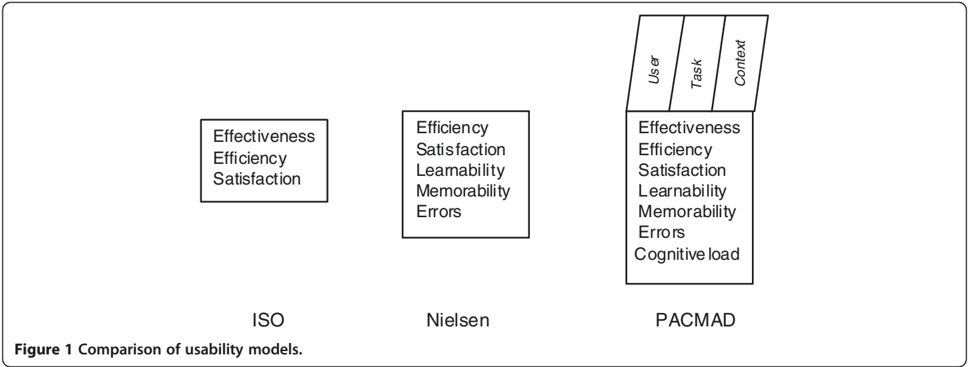
The usefulness of mobile devices has increased greatly in recent years allowing users to perform more tasks in a mobile context. This increase in usefulness has come at the expense of the usability of these devices in some contexts. We conducted a small review of mobile usability models and found that usability is usually measured in terms of three attributes; effectiveness, efficiency and satisfaction. Other attributes, such as cognitive load, tend to be overlooked in the usability models that are most prominent despite their likely impact on the success or failure of an application. To remedy this we introduces the PACMAD (People At the Centre of Mobile Application Development) usability model which was designed to address the limitations of existing usability models when applied to mobile devices. PACMAD brings together significant attributes from different usability models in order to create a more comprehensive model. None of the attributes that it includes are new, but the existing prominent usability models ignore one or more of them. This could lead to an incomplete usability evaluation. We performed a literature search to compile a collection of studies that evaluate mobile applications and then evaluated the studies using our model.
Overview
CoChat Summary
TL;DR
The paper reviews mobile usability models and proposes PACMAD, a model with three factors and seven attributes, including cognitive load, to address limitations of traditional models for mobile applications. A literature review of 131 papers from 2008–2010 found effectiveness, efficiency, and satisfaction most commonly evaluated, while memorability was rarely evaluated.
Key findings
- PACMAD identifies three factors—User, Task, and Context of use—and seven usability attributes: Effectiveness, Efficiency, Satisfaction, Learnability, Memorability, Errors, and Cognitive load; cognitive load is the main addition to existing prominent models.
- In the reviewed studies, the most commonly evaluated attributes were Satisfaction (58.02%, 76 studies), Efficiency (54.96%, 72), Effectiveness (51.15%, 67), Errors (32.82%, 43), Cognitive Load (22.90%, 30), Learnability (20.61%, 27), and Memorability (2.29%, 3).
- Task was the dominant research focus (46.92%, 61 papers), followed by Interaction (29.77%, 39), User (9.23%, 12), Context (8.46%, 11), and Development Methodology (6.15%, 8).
- Controlled experiments were the most common research methodology (59.51%, 97 studies), followed by field studies (26.99%, 44); the discussion states almost 23% of studies measured cognitive load, supporting its inclusion, while only 2% evaluated memorability.
Methods
- Literature review of papers published 2008–2010, searched via ACM digital library, IEEE digital library, and Google Scholar using search strings including “Mobile Application Evaluations,” “Usability of mobile applications,” and “Mobile application usability evaluations.”
- Sources included MobileHCI, IJMHCI, TOCHI, IJHCS, PUC, and IJHCI; CHI and IEEE TOMC were discarded because less than 5% of their papers were relevant. Abstract screening was done by the first two authors, with disagreements resolved by discussion.
- 131 papers were included (Table 3); 20 relevant papers without formal evaluations were excluded, and multiple studies within papers were considered independently, yielding 163 studies for methodology analysis. Data extraction was by one reviewer, with the first and second authors independently reviewing a 10% sample.
Limitations
- The paper states that 8 out of 139 relevant papers were unavailable (less than 6%), that omitting certain sources may have introduced bias, and that some outlying studies may have been omitted due to limited resources, though omitted papers were believed to be of borderline significance.
- The text makes evident that the review was limited to 2008–2010 and to selected venues; the studies often did not explicitly cite usability criteria, and the attributes are not orthogonal.
- The paper also notes that it adopts a relatively simple view of cognitive load, and that a more powerful multifactorial approach would be preferable but is beyond its scope.
Model-written summary. Check it against the paper before relying on it.
Integrity signals
Registry
Cites
Statistics
Figures
Verification
Claims the paper makes
0 Valid · 12 Not valid · 8 Not checked · 85 Own results and interpretations
A result the paper reports from its own data — it cites no other source for it, so there is none to check. The quote shows it is in the paper.
In the paper
“From our review it is apparent that many existing models for usability do not consider mobility and its consequences, such as additional cognitive load.”
hedged- Asserted: passes — The authors put it forward as true.
- Checkable: passes — It can be checked against evidence.
- Load-bearing: passes — The paper’s conclusions depend on it.
- Based: passes — The paper gives a reason why it holds.
A result the paper states — it cites no source for it, so there is none to check. The quote shows it is in the paper.
In the paper
“None of the attributes that it includes are new, but the existing prominent usability models ignore one or more of them.”
plain- Asserted: passes — The authors put it forward as true.
- Checkable: passes — It can be checked against evidence.
- Load-bearing: passes — The paper’s conclusions depend on it.
- Based: passes — The paper gives a reason why it holds.
A result the paper states — it cites no source for it, so there is none to check. The quote shows it is in the paper.
In the paper
“Other attributes, such as cognitive load, tend to be overlooked in the usability models that are most prominent despite their likely impact on the success or failure of an application.”
- Also stated in: § Introduction · plain
“This aspect of usability is often overlooked in existing usability models, which are outlined in the next section, as these models are designed for applications which are seldom used in a mobile context.”
- Also stated in: § Limitations for mobile applications · hedged
“From our review it is apparent that many existing models for usability do not consider mobility and its consequences, such as additional cognitive load.”
plain- Asserted: passes — The authors put it forward as true.
- Checkable: passes — It can be checked against evidence.
- Load-bearing: passes — The paper’s conclusions depend on it.
- Based: passes — The paper gives a reason why it holds.
- Also stated in: § Introduction · plain
A result the paper reports from its own data — it cites no other source for it, so there is none to check. The quote shows it is in the paper.
In the paper
“We conducted a small review of mobile usability models and found that usability is usually measured in terms of three attributes; effectiveness, efficiency and satisfaction.”
- Also stated in: § RQ1: What attributes are used when considering the usability of mobile applications? · plain
“The three most common attributes, Effectiveness, Efficiency and Satisfaction, correspond to the attributes identified by the ISO ' s standard for usability.”
plain- Asserted: passes — The authors put it forward as true.
- Checkable: passes — It can be checked against evidence.
- Load-bearing: passes — The paper’s conclusions depend on it.
- Based: passes — The paper gives a reason why it holds.
- Also stated in: § RQ1: What attributes are used when considering the usability of mobile applications? · plain
A result the paper reports from its own data — it cites no other source for it, so there is none to check. The quote shows it is in the paper.
In the paper
“Twenty papers that were identified as being relevant did not contain any formal evaluations of the proposed technologies.”
plain- Asserted: passes — The authors put it forward as true.
- Checkable: passes — It can be checked against evidence.
- Load-bearing: unclear — It is unclear whether the paper’s conclusions depend on it.
- Based: passes — The paper gives a reason why it holds.
46 more claims
Create a free account to see all 105 claims and every source verdict.
- Borderline: one of the tests for a substantial claim is unclear. 1
- Probably not a substantial claim. 45
- It may state two separate claims as one. 18
- The quote only partly states this claim. 1
Claims other papers make about this one
Each is checked against this paper’s own text: does it say what the citing paper says it does?
In the citing paper
“For example, different results can be obtained if more people that are elderly are taken into account, as their acceptance and use of technology are different from the younger generation [59].”
Self-check
Percentages, sums and reported differences re-computed from the paper’s own numbers.
Each contradiction between two passages listed here was confirmed by an independent check.
Rated minor: it would not touch a result — a value no result rests on, a p-value that stays on the same side of the significance level, or a conflict that is clerical, resolved elsewhere in the paper, or outside its own findings.
In the paper
§ RQ1: What attributes are used when considering the usability of mobile applications?
“About 26% of the studies considered cognitive load.”
§ RQ1: What attributes are used when considering the usability of mobile applications?
“| Cognitive Load | 22.90% | 30 |”
Citations
Cites
Development of NASA-TLX (Task Load Index): Results of Empirical and Theoretical Research
(1988) · Advances in Psychology · doi:10.1016/s0166-4115(08)62386-9 · Cited by 20,029
(1993) · Cited by 9,879
Challenges, Methodologies, and Issues in the Usability Testing of Mobile Applications
Zhang, D., & Adipat, B. (2005) · International Journal of Human-Computer Interaction · doi:10.1207/s15327590ijhc1803_3 · Cited by 613 · cited 3×
“Zhang and Adipat [6] highlighted a number of issues that have been introduced by the advent of mobile devices: Mobile Context: When using mobile applications the user is not tied to a single location.”
BackgroundInfluentialA Review of Mobile HCI Research Methods
Kjeldskov, J., & Graham, C. (2003) · Lecture Notes in Computer Science · doi:10.1007/978-3-540-45233-1_23 · Cited by 375 · cited 3×
“Previous work by Kjeldskov & Graham [3] has looked at the research methods used in mobile HCI, but did not examine the particular attributes of usability incorporated in the PACMAD model.”
MethodInfluentialUnderstanding and capturing people's privacy policies in a mobile social networking application
Sadeh, N., Hong, J., Cranor, L., Fette, I., Kelley, P., Prabaker, M., & Rao, J. (2009) · Personal and Ubiquitous Computing · doi:10.1007/s00779-008-0214-3 · Cited by 318
Foundations of Augmented Cognition
(2005) · CRC Press eBooks · doi:10.1201/9781482289701 · Cited by 315
Context of Use within usability activities
MAGUIRE, M. (2001) · International Journal of Human-Computer Studies · doi:10.1006/ijhc.2001.0486 · Cited by 275 · cited 1×
“Context of use can vary enormously and so should be considered an important factor of usability [5,33].”
BackgroundArvanitis, T. N., Petrou, A., Knight, J. F., Savas, S., Sotiriou, S., Gargalakos, M., & Gialouri, E. (2009) · Personal and Ubiquitous Computing · doi:10.1007/s00779-007-0187-7 · Cited by 245
An empirical investigation of mobile ticketing service adoption in public transportation
Mallat, N., Rossi, M., Tuunainen, V. K., & Öörni, A. (2007) · Personal and Ubiquitous Computing · doi:10.1007/s00779-006-0126-z · Cited by 223
An innovative mobile electronic tourist guide application
Kenteris, M., Gavalas, D., & Economou, D. (2009) · Personal and Ubiquitous Computing · doi:10.1007/s00779-007-0191-y · Cited by 210
Cited by
Items 601–700 of 736
Greek Version of the mHealth App Usability Questionnaire (GR-MAUQ): Translation and Validation Study
Kouroutzis, I., Sarafis, P., & Malliarou, M. M. (2025) · Healthcare · doi:10.3390/healthcare13243285
Sani, A., Andrianingsih, A., Sholihati, I. D., Jusuf, H., Subiyakto, A., & Durrachman, Y. (2026) · AIP conference proceedings · doi:10.1063/5.0338671
Engdahl, P., Svedberg, P., & Bejerholm, U. (2026) · JMIR Formative Research · doi:10.2196/92617
Towards a Framework for Usability Testing of Interactive Touchless Applications.
Kuhar, S., & Kosic, K. (2014)
AfriBit: A People-Oriented Wallet Fostering Financial Inclusion in Kibera
Leder, M., Schumm, D., Rodrigues, B., & Stiller, B. (2024) · Conference on Blockchain Research & Applications for Innovative Networks and Services (BRAINS) · doi:10.1109/brains63024.2024.10732060
Empirical study of user experience on mobile data collection for chronic low back pain
Goh, T. Y., Frada.Burstein@Monash.Edu, Haghighi, P. D., Flavia.Cicuttini@Monash.Edu, & Donna.Urquhart@Monash.Edu (2018) · Monash University Research Portal (Monash University) · doi:10.4225/03/5ab842064e3ce
Mackaness, W., Duchateau, R., & Cross, J. (2018) · Proceedings of the ICA · doi:10.5194/ica-proc-1-72-2018
Towards a prior validation of a model-based approach for mobile usability evaluation
Ammar, L. B. (2020) · International Journal of ADVANCED AND APPLIED SCIENCES · doi:10.21833/ijaas.2020.11.009
Hippocratic data sharing in e-government space with contract management
Aiyadurai, Y. (2015) · DUT Open Scholar (Durban University of Technology) · doi:10.51415/10321/1375
Educable Learning for Human-AI Coevolution
Vanderhaegen, F. (2026) · Lecture notes of the Institute for Computer Sciences, Social Informatics and Telecommunications Engineering · doi:10.1007/978-3-032-14055-5_8
Aplikasi Mudah Alih I-Rehlah untuk Memartabatkan Pelancongan Islam di Selangor pada Era Globalisasi
Ahmad, M. I., Adnan, A. S., Jaffar, M. N., & Masrop, N. A. M. (2024) · Jurnal Pengajian Islam · doi:10.53840/jpi.v17i1.306 · Cited by 2
Evaluation of Mobile-based Learning Media Application for Python Programming Learning
Devi, F., Hatta, P., & Ariyuana, R. (2023) · doi:10.46254/an12.20221070
Development of E-Achievements for Mapping Student Achievements in Vocational High Schools
Hidayat, W. N., & Pratama, P. E. A. K. (2024) · Letters in Information Technology Education (LITE) · doi:10.17977/um010v7i12024p07-11 · Cited by 2
Uzoma, I. R., Nathan, S. S., Hashim, N. L., & Hanif (2023) · Journal of Digital System Development · doi:10.32890/jdsd2023.1.5
Palacpac, E. P., Balingit, K. A. M. P., Bonifacio, A. A. D., Villanueva, M. A., Tolentino, R. B., Uy-DeGuia, M. R. D. L., Llantada, P. L. T., Castillo, C. I., Brul, B. J., Rubio, H. C. A., et al. (2024) · Journal of Buffalo Science · doi:10.6000/1927-520x.2024.13.04 · Cited by 2
EFFECTIVE METHODS AND TOOLS FOR MINING APP STORE REVIEWS
Jha, N. N. (2018) · Louisiana State University · doi:10.31390/gradschool_dissertations.4730
Chung, K. C. W., Takemura, N., Ho, M. M., Lam, W. W. T., Lee, A. M., Chan, W. Y. Y., Lam, S. H. S., Foo, C. C., Shum, N. F., & Fong, D. (2026) · International Journal of Medical Informatics · doi:10.1016/j.ijmedinf.2026.106439 · Cited by 1
Developing Elements of User Experience for Cellular Phones and Services: Evidence from Pakistan
Asim, S., Waheed, U., & Anwar, H. (2019) · International Journal of Computer Applications · doi:10.5120/ijca2019918994
Krishnan, A., Khurana, P., Stankus, A. R., de Leon, S. J. G., Sánchez, J., & Altice, F. L. (2026) · JMIR Formative Research · doi:10.2196/85108
A Mobile Electronic Record for Lifestyle Coaches in Gestational Diabetes Prevention
Simmons, D. S., Daniels, T., Simmons, D., van Poppel, M. N. M., Harreiter, J., Desoyé, G., Simmons, D. S., Corcoy, R., Damm, P., Mathiesen, E. R., et al. (2019) · Journal of Mobile Technology in Medicine · doi:10.7309/jmtm.vol8iss1
García, M. R., & Gómez, E. M. D. (2018) · RENOTE · doi:10.22456/1679-1916.85931
Mobile Application for Improvement of Self-Management of Type 2 Diabetes: Usability Studies
Pinto, A., Conceição, G., Viana, J., Santos, C., Miranda, G., Santos, P. J., & Freitas, A. (2026) · Lecture notes in networks and systems · doi:10.1007/978-3-032-01234-0_31
Muhideen, S., Chu, J., Akintunde, T. Y., Rufai, O. H., Shahani, R., & Jin, M. (2022) · Digital Health · doi:10.1177/20552076221132092 · Cited by 1
Alzahrani, A., Gay, V. C., Alturki, R., & Alanazi, F. (2025) · Communications in computer and information science · doi:10.1007/978-3-031-79086-7_5
Mubuke, F., Najeeb, A. A.-S., & Namakula, S. J. (2024) · i-manager s Journal on Mobile Applications and Technologies · doi:10.26634/jmt.11.2.21448
WITHDRAWN: A Hierarchical Model to Evaluate Usability of Smartphone Health Applications
Siddique, A., Sajjad, Q., Zia, H. U., Amin, F.-E., Saleem, K., & Agbinya, J. I. (2025) · Computers in Human Behavior Reports · doi:10.1016/j.chbr.2025.100658 · Cited by 1
RetractedBricker, J. B., Santiago‐Torres, M., Mull, K. E., Sullivan, B. M., & Mehrotra, R. (2025) · doi:10.2196/preprints.71619
Ethical and Professional Complications in the Construction of Multi-Developer Hobbyist Games
Heron, M. J. (2016) · The Computer Games Journal · doi:10.1007/s40869-016-0025-0 · Cited by 1
이, 지., & 전, 재. (2025) · Journal of the Korean Society of Clothing and Textiles · doi:10.5850/jksct.2025.49.5.911
Geowissenschaftsdidaktische Forschung
Felzmann, D., Henninger, S. M., Kaiser, T., Sauer, M., Kauertz, A., & Nitz, S. (2023) · Springer eBooks · doi:10.1007/978-3-662-66354-7_15
Click, Watch, Enjoy! But Which Platform Is More User-Friendly
Dursun, F. (2026) · Yeni Medya Dergisi · doi:10.55609/yenimedya.1877962
Usability and Security in Medication Administration Applications
Pradhan, R. (2016) · UTUPub (University of Turku) · Cited by 1
Bricker, J., Santiago-Torres, M., Mull, K. E., Sullivan, B. M., & Mehrotra, R. (2025) · JMIR mHealth and uHealth · doi:10.2196/71619 · Cited by 2
Mobile health apps and self-management for spinal cord injury rehabilitation
Singh, G., MacGillivray, M. K., Simpson, E., Sawatzky, B., & Mortenson, W. B. (2022) · Elsevier eBooks · doi:10.1016/b978-0-12-822498-4.00042-7
E-Ligtas in Focus: A PACMAD-Based Usability Evaluation of Emergency Reporting in the Philippines
Rey, W. P. (2024) · World Symposium on Software Engineering (WSSE) · doi:10.1145/3698062.3698078 · Cited by 2
Engdahl, P., Svedberg, P., & Bejerholm, U. (2026) · doi:10.2196/preprints.92617
Zhou, H., Zhu, M., & Hossain, L. (2025) · IEEE Frontiers in Education Conference (FIE) · doi:10.1109/fie63693.2025.11328223
User perception of mobile application usability: do individual differences matter?
Huang, Z. H., & Benyoucef, M. (2026) · Cognitive Systems Research · doi:10.1016/j.cogsys.2026.101459 · Cited by 2
When Good Intentions Meet Bad Experiences among Users of Prosocial Mobile Applications
Phan, T. A., Ninh, T. T., Tran-Pham, T. A., Pham, M. T., Tran, H. P., & Dang, T.-D. (2026) · Journal of Global Marketing · doi:10.1080/08911762.2026.2710247 · Cited by 2
Rey, W. P., & Rey, K. W. J. D. (2024) · International Conference on Internet and E-Business (ICIEB) · doi:10.1145/3690001.3690029
Magableh, A. A. A. R., & Al-Tahat, K. S. (2026) · Advances in Human-Computer Interaction · doi:10.1155/ahci/7907504
AALT: um framework com soluções práticas para melhorar a acessibilidade em aplicativos Android
Garcia, A. C. (2023) · Digital Library of Theses and Dissertations (Universidade de São Paulo) · doi:10.11606/d.55.2023.tde-18122023-175415 · Cited by 1
Rey, W. P., & Villaluz, A. C. (2025) · Lecture notes on data engineering and communications technologies · doi:10.1007/978-3-031-92449-1_6
Osman, W. N., Radzuan, K., Zulhumadi, F., & Nawi, M. N. M. (2020) · Journal of Information System and Technology Management · doi:10.35631/jistm.518006 · Cited by 1
Bolshakova, V. (2022) · theses.fr (ABES) · doi:10.70675/f62065f3zfc55z41b9z9d77z95505df7376a · Cited by 2
Nurses' Experiences of Web-Based Care Plans: A systematic Review of Qualitative Evidence (Preprint)Preprint
Firouzkouhi, M., Safdari, R., Abdollahimohammad, A., Farzi, J., & Noori, T. (2020) · doi:10.2196/preprints.19142
السید, ن. م. م. (2023) · تکنولوجيا التعليم سلسلة دراسات وبحوث · doi:10.21608/tesr.2023.301671
Localizing Non-functional Code Bugs in User Interfaces Using Deep Learning Techniques
Ahmed, A., Salah, A. T., Khoriba, G. A., & Arafa, T. (2023) · Lecture notes in computer science · doi:10.1007/978-3-031-49333-1_27
Chiu, H., Lo, C.-H., Hung, C.-H., & Fan, S.-C. (2026) · International Journal of Human-Computer Interaction · doi:10.1080/10447318.2026.2735501
Interfaces de Usuario en tecnologías XR (Extended Reality) para el aprendizaje y entrenamiento
Cesarino-Vargas, P., Galvis, P., Gutiérrez, S., Mantilla, A., Moreno, L., Reyes, E., & Rojas, L. E. B. (2021) · Encuentro de investigación formativa en Diseño - Semilleros y Grupos de investigación RAD · doi:10.53972/rad.eifd.2020.3.7
Medical Impact of Learning Apps:Fault Tree Analysis
Khan, R., Mohd, N., & Pujahari, R. M. (2025) · International Conference on Emerging Technologies in Computer Engineering: Machine Learning and Internet of Things (ICETCE) · doi:10.1109/icetce66848.2025.11387867 · Cited by 1
Promoting Healthy Food Habits Through an mHealth Application
Carvalho, I., & Almeida, F. L. (2020) · Advances in medical technologies and clinical practice book series · doi:10.4018/978-1-7998-2521-0.ch001
Rehaoui, R. A., & Remacle, A. (2026) · Logopedics Phoniatrics Vocology · doi:10.1080/14015439.2026.2731231
Digitising India through mobile applications – Measuring the success of the Indian Government
Srivastava, R., & Singh, A. R. (2020) · Journal of Management Research and Analysis · doi:10.18231/2394-2770.2018.0010
Exploring Short- and Long-Term Variation in Time Perception Across Ages
Vasisht, U., Nayak, B. K., & Kaushik, S. (2025) · Lecture notes in mechanical engineering · doi:10.1007/978-981-96-5503-8_32
Digital practices and preferred devices of Japanese language students
Muranaka-Vuletich, H. (2026) · Discover Education · doi:10.1007/s44217-026-01741-1 · Cited by 1
Sadi, M. R. K., Naeem, G. M., Tasin, T. R., Moosa, S. M., Emon, M. H., Rashid, M., & Ahmed, F. (2026) · SSRN Electronic Journal · doi:10.2139/ssrn.6771787
Identification of frequently used features of smartphone web browsers
Amin, F.-E., Alghamdi, A. S., & Ahmad, I. (2014) · IEEE Conference on Open Systems · doi:10.1109/icos.2014.7042643
Communication Papers of the 2019 Federated Conference on Computer Science and Information Systems
(2019) · Annals of Computer Science and Information Systems · doi:10.15439/978-83-955416-3-6
The interplay of cognitive load and user experience: a systematic literature review across domains
Jafar, A., Shabnam, S., & Khan, A. (2026) · Theoretical Issues in Ergonomics Science · doi:10.1080/1463922x.2026.2644284 · Cited by 2
Li, M. (2022) · MOspace Institutional Repository (University of Missouri) · doi:10.32469/10355/94075 · Cited by 1
Nurrachman, A. P., Priyandari, Y., & Yuniaristanto, Y. (2022) · Techno Com · doi:10.33633/tc.v21i3.6307 · Cited by 9
Usability and Quality of the JoyPop App: Prospective Evaluation Study
Malik, I., Neufeld, T., & Mushquash, A. R. (2025) · JMIR Human Factors · doi:10.2196/65472 · Cited by 1
Prabowo, F. W. (2025) · Anuva Jurnal Kajian Budaya Perpustakaan dan Informasi · doi:10.14710/anuva.9.2.367-377
A Survey on Islamic Mobile Applications for Children
Machfud, F. M., & Mahmud, M. (2019) · IGI Global eBooks · doi:10.4018/978-1-7998-1757-4.ch035
Carrillo, A., Falgueras, J., & Díaz-Mohedo, E. (2026) · JMIR mhealth and uhealth · doi:10.2196/64787
Metadata
- Authors
- Harrison, R., Flood, D., & Duce, D.
- Affiliations
- Oxford Brookes University (GB)
- Corresponding author
- Harrison, Rachel
- Venue
- Journal of Interaction Science
- Published
- 2013
- Volume
- 1
- Issue
- 1
- Pages
- 1
- ISSN
- 2194-0827 (ISSN-L)
- OpenAlex
- W2120571425
- Cited by
- 736
- References
- 152
- Citations by year
- 2026: 33 · 2025: 44 · 2024: 50 · 2023: 58 · 2022: 74 · 2021: 62 · 2020: 84 · 2019: 77 · 2018: 49 · 2017: 72 · 2016: 55 · 2015: 49 · 2014: 27 · 2013: 1
- FWCI
- 79.76
- Type
- journal article
- Language
- en
- Open access
- hybrid
- doi.org
- Licence
- cc-by
- Locations
- Journal of Interaction Science (publishedVersion, cc-by)
- Radar (Oxford Brookes University) (submittedVersion, cc-by-nc-nd)
- Topics
- Physical Sciences › Computer Science › Human-Computer Interaction › Usability and User Interface Design
- Physical Sciences › Computer Science › Information Systems › Mobile and Web Applications
- Health Sciences › Health Professions › General Health Professions › Mobile Health and mHealth Applications
- Keywords
- software usability, usability model, cognitive load, effectiveness, efficiency and satisfaction, usability evaluation, mobile devices, user satisfaction
About these checks
Registry, retraction, Cites and statistics results are computed, not judged, with one exception: a printed reference that no index lists is read once by a model before it counts as a citation error. Claims are extracted by a model and kept only when their quote appears verbatim in the text; each cited source is then checked, with a model’s help, for whether it says what the claim relies on. Those verdicts can be wrong — read the claim’s quote and the cited source before relying on one.
A language model drew the claims from the paper on 2026-10-10, under version 3 of the claim definition (model deepseek-v4.1-flash, prompt extract-v3).
A second model labelled each claim on 2026-10-10 (model jev-1.13-20260917, definition revision gold-guideline-v0.2).
Statistics and arithmetic are recomputed, not judged.
Confidence bands are shown only for fields calibrated on our annotated test set. None is calibrated yet, so no band is shown.
What counts as a claim ›How we measure confidence ›How we check this ›
Are you an author, or do you see a problem with this page? Request a review
Data sources
Bibliographic data: Semantic Scholar, OpenAlex, Crossref.
Contains information from the Semantic Scholar Academic Graph Datasets, made available under the ODC Attribution License (ODC-BY 1.0).
Semantic Scholar’s data is described in: Kinney, R., et al. (2023). The Semantic Scholar Open Data Platform. arXiv:2301.10140.
