

Characterizing and measuring bias in sequence data
Open accessThe DOI matches its Crossref record; 48 of the 49 references it cites were found in a registry or an index.
Abstract
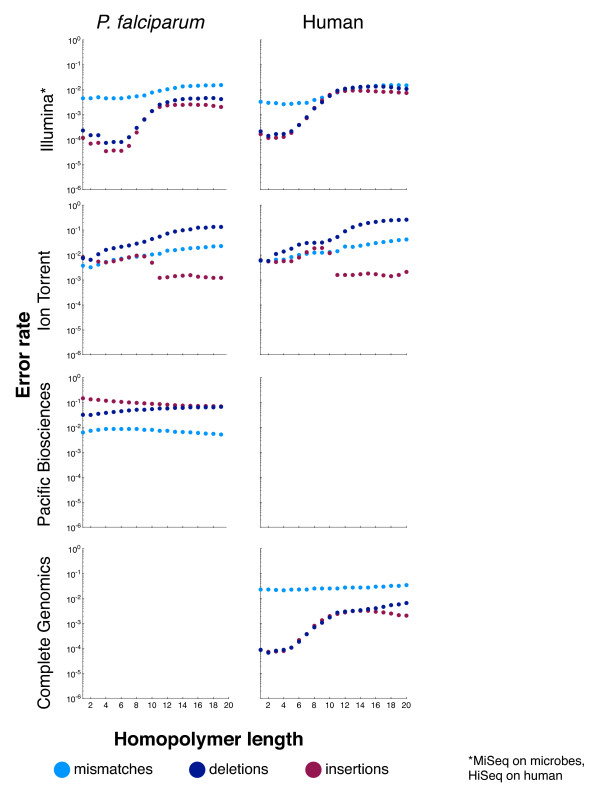
Background: DNA sequencing technologies deviate from the ideal uniform distribution of reads. These biases impair scientific and medical applications. Accordingly, we have developed computational methods for discovering, describing and measuring bias. Results: We applied these methods to the Illumina, Ion Torrent, Pacific Biosciences and Complete Genomics sequencing platforms, using data from human and from a set of microbes with diverse base compositions. As in previous work, library construction conditions significantly influence sequencing bias. Pacific Biosciences coverage levels are the least biased, followed by Illumina, although all technologies exhibit error-rate biases in high- and low-GC regions and at long homopolymer runs. The GC-rich regions prone to low coverage include a number of human promoters, so we therefore catalog 1,000 that were exceptionally resistant to sequencing. Our results indicate that combining data from two technologies can reduce coverage bias if the biases in the component technologies are complementary and of similar magnitude. Analysis of Illumina data representing 120-fold coverage of a well-studied human sample reveals that 0.20% of the autosomal genome was covered at less than 10% of the genome-wide average. Excluding locations that were similar to known bias motifs or likely due to sample-reference variations left only 0.045% of the autosomal genome with unexplained poor coverage. Conclusions: The assays presented in this paper provide a comprehensive view of sequencing bias, which can be used to drive laboratory improvements and to monitor production processes. Development guided by these assays should result in improved genome assemblies and better coverage of biologically important loci.
Overview
The claims and statistics of this paper haven’t been checked yet.
Free: it reads the open-access text and checks the first 5 claims that cite a source we can check. Create a free account to check every claim.
Integrity signals
Registry
Cites
Statistics
Figures
Verification
Claims the paper makes
The claims and statistics of this paper haven’t been checked yet.
Free: it reads the open-access text and checks the first 5 claims that cite a source we can check. Create a free account to check every claim.
Claims other papers make about this one
Each is checked against this paper’s own text: does it say what the citing paper says it does?
The source backs part of the claim, not all of it — or backs it for a different population, condition or comparison.
In the citing paper
“The limit of detection in these experiments is based on the inherent error rate of the Illumina platform (up to 0.4%), which has previously been described for genome editing experiment analyzed by NGS71–73.”
From A high-fidelity Cas9 mutant delivered as a ribonucleoprotein complex enables efficient gene editing in human hematopoietic stem and progenitor cells (2018) · cites this paper as [71]
Experimental — accuracy not yet measuredThe source backs part of the claim, not all of it — or backs it for a different population, condition or comparison.
In the citing paper
“The homopolymer can lead to low coupling efficiency in DNA synthesis (especially for G and C), and quantification of the number of identical nucleotides in DNA sequencing can also be problematic (39, 53).”
From Electrochemical DNA synthesis and sequencing on a single electrode with scalability for integrated data storage (2021) · cites this paper as [53]
Experimental — accuracy not yet measuredThe cited source says what the claim attributes to it.
In the citing paper
“GC content of individual sequences were previously found to affect PCR amplification efficiency in biological DNA15–17.”
From Quantifying Molecular Bias in DNA Data Storage (2019) · cites this paper as [15]
The cited source says what the claim attributes to it.
In the citing paper
“Although previous studies observed PCR bias in genomic biological sample amplification15–17, it remained unclear whether such bias is significant in DNA data storage.”
From Quantifying Molecular Bias in DNA Data Storage (2019) · cites this paper as [15]
The cited source says what the claim attributes to it.
In the citing paper
“Illumina sequencing was previously observed to have bias on GC-extreme sequences15,27,28, but GC content in our files did not show practically significant bias in the PCR GC bias test. Therefore, high-throughput sequencing and sample dilution are modeled using random sampling.”
From Quantifying Molecular Bias in DNA Data Storage (2019) · cites this paper as [15]
Self-check
Percentages, sums and reported differences re-computed from the paper’s own numbers.
The self-check needs the paper’s full text.
Citations
Cites
DNA sequencing with chain-terminating inhibitors
Sanger, F., Nicklen, S., & Coulson, A. R. (1977) · Proceedings of the National Academy of Sciences · doi:10.1073/pnas.74.12.5463 · Cited by 68,572
The Sequence Alignment/Map format and SAMtools
Li, H., Handsaker, B., Wysoker, A., Fennell, T., Ruan, J., Homer, N., Marth, G., Abecasis, G., Durbin, R., & 1000 Genome Project Data Processing Subgroup (2009) · Bioinformatics · doi:10.1093/bioinformatics/btp352 · Cited by 62,041
Fast and accurate short read alignment with Burrows-Wheeler transform
Li, H., & Durbin, R. (2009) · Bioinformatics · doi:10.1093/bioinformatics/btp324 · Cited by 58,607
The Genome Analysis Toolkit: A MapReduce framework for analyzing next-generation DNA sequencing data
McKenna, A., Hanna, M., Banks, E., Sivachenko, A., Cibulskis, K., Kernytsky, A., Garimella, K., Altshuler, D., Gabriel, S., Daly, M., et al. (2010) · Genome Research · doi:10.1101/gr.107524.110 · Cited by 27,895
Fast and accurate long-read alignment with Burrows-Wheeler transform.
Li, H., & Durbin, R. (2010) · Bioinformatics · doi:10.1093/bioinformatics/btp698 · Cited by 12,063 · cited 2×
“Because the default TMAP aligner [46] cannot align to references with more than 4.3 billion bases, it was necessary to use the BWA-SW aligner [47] to realign the Ion data to the diploid NA12878 reference for the error-rate comparison presented in Table S2 in Additional file 3, Figure S1 in…”
MethodInfluentialA framework for variation discovery and genotyping using next-generation DNA sequencing data
DePristo, M. A., Banks, E., Poplin, R., Garimella, K. V., Maguire, J. R., Hartl, C., Philippakis, A. A., del Angel, G., Rivas, M. A., Hanna, M., et al. (2011) · Nature Genetics · doi:10.1038/ng.806 · Cited by 11,456
A map of human genome variation from population-scale sequencing.
The 1000 Genomes Project Consortium (2010) · Nature · doi:10.1038/nature09534 · Cited by 7,877
Self-citationGenome sequencing in microfabricated high-density picolitre reactors
Margulies, M., Egholm, M., Altman, W. E., Attiya, S., Bader, J. S., Bemben, L. A., Berka, J., Braverman, M. S., Chen, Y.-J., Chen, Z., et al. (2005) · Nature · doi:10.1038/nature03959 · Cited by 7,693
Real-Time DNA Sequencing from Single Polymerase Molecules
Eid, J., Fehr, A., Gray, J., Luong, K., Lyle, J., Otto, G., Peluso, P., Rank, D., Baybayan, P., Bettman, B., et al. (2009) · Science · doi:10.1126/science.1162986 · Cited by 3,732
Accurate whole human genome sequencing using reversible terminator chemistry
Bentley, D. R., Balasubramanian, S., Swerdlow, H. P., Smith, G. P., Milton, J., Brown, C. G., Hall, K. P., Evers, D. J., Barnes, C. L., Bignell, H. R., et al. (2008) · Nature · doi:10.1038/nature07517 · Cited by 3,684
Self-citationAn integrated semiconductor device enabling non-optical genome sequencing
Rothberg, J. M., Hinz, W., Rearick, T. M., Schultz, J., Mileski, W., Davey, M., Leamon, J. H., Johnson, K., Milgrew, M. J., Edwards, M., et al. (2011) · Nature · doi:10.1038/nature10242 · Cited by 2,172
Quail, M., Smith, M. E., Coupland, P., Otto, T. D., Harris, S. R., Connor, T. R., Bertoni, A., Swerdlow, H. P., & Gu, Y. (2012) · BMC Genomics · doi:10.1186/1471-2164-13-341 · Cited by 2,031 · cited 4×
“Illumina sequencing [18] has been shown to lose coverage in regions of high or low GC [19-22], a phenomenon also seen in other ‘ next-generation ’ technologies [3,6].”
BackgroundResultInfluentialHigh-quality draft assemblies of mammalian genomes from massively parallel sequence data
Gnerre, S., MacCallum, I., Przybylski, D., Ribeiro, F. J., Burton, J. N., Walker, B. J., Sharpe, T., Hall, G., Shea, T. P., Sykes, S., et al. (2011) · Proceedings of the National Academy of Sciences · doi:10.1073/pnas.1017351108 · Cited by 1,533
Self-citationComparison of Next-Generation Sequencing Systems
Liu, L., Li, Y., Li, S., Hu, N., He, Y., Pong, R., Lin, D., Lu, L., & Law, M. (2012) · Journal of Biomedicine and Biotechnology · doi:10.1155/2012/251364 · Cited by 1,533
Performance comparison of benchtop high-throughput sequencing platforms
Loman, N. J., Misra, R. V., Dallman, T. J., Constantinidou, C., Gharbia, S. E., Wain, J., & Pallen, M. J. (2012) · Nature Biotechnology · doi:10.1038/nbt.2198 · Cited by 1,337
Accuracy and quality of massively parallel DNA pyrosequencing
Huse, S. M., Huber, J. A., Morrison, H. G., Sogin, M. L., & Welch, D. M. (2007) · Genome Biology · doi:10.1186/gb-2007-8-7-r143 · Cited by 1,282
Human Genome Sequencing Using Unchained Base Reads on Self-Assembling DNA Nanoarrays
Drmanac, R., Sparks, A. B., Callow, M. J., Halpern, A. L., Burns, N. L., Kermani, B. G., Carnevali, P., Nazarenko, I., Nilsen, G. B., Yeung, G., et al. (2010) · Science · doi:10.1126/science.1181498 · Cited by 1,212 · cited 1×
“Complete Genomics [29] also uses amplification along with a complex library construction process.”
MethodAnalyzing and minimizing PCR amplification bias in Illumina sequencing libraries
Aird, D., Ross, M. G., Chen, W.-S., Danielsson, M., Fennell, T., Russ, C., Jaffe, D. B., Nusbaum, C., & Gnirke, A. (2011) · Genome Biology · doi:10.1186/gb-2011-12-2-r18 · Cited by 1,174
Self-citationSubstantial biases in ultra-short read data sets from high-throughput DNA sequencing
Dohm, J. C., Lottaz, C., Borodina, T., & Himmelbauer, H. (2008) · Nucleic Acids Research · doi:10.1093/nar/gkn425 · Cited by 1,088 · cited 2×
“Illumina sequencing [18] has been shown to lose coverage in regions of high or low GC [19-22], a phenomenon also seen in other ‘ next-generation ’ technologies [3,6].”
BackgroundHybrid error correction and de novo assembly of single-molecule sequencing reads
Koren, S., Schatz, M. C., Walenz, B. P., Martin, J., Howard, J. T., Ganapathy, G., Wang, Z., Rasko, D. A., McCombie, W. R., Jarvis, E. D., et al. (2012) · Nature Biotechnology · doi:10.1038/nbt.2280 · Cited by 1,011
Summarizing and correcting the GC content bias in high-throughput sequencing
Benjamini, Y., & Speed, T. P. (2012) · Nucleic Acids Research · doi:10.1093/nar/gks001 · Cited by 913
PCR fidelity of pfu DNA polymerase and other thermostable DNA polymerases
Cline, J. (1996) · Nucleic Acids Research · doi:10.1093/nar/24.18.3546 · Cited by 718
Fisher, S., Barry, A., Abreu, J., Minie, B., Nolan, J., Delorey, T. M., Young, G., Fennell, T. J., Allen, A., Ambrogio, L., et al. (2011) · Genome Biology · doi:10.1186/gb-2011-12-1-r1 · Cited by 682
Self-citationOptimizing illumina next-generation sequencing library preparation for extremely at-biased genomes
Oyola, S. O., Otto, T. D., Gu, Y., Maslen, G., Manske, M., Campino, S., Turner, D. J., MacInnis, B., Kwiatkowski, D. P., Swerdlow, H. P., et al. (2012) · BMC Genomics · doi:10.1186/1471-2164-13-1 · Cited by 653
Evaluation of next generation sequencing platforms for population targeted sequencing studies
Harismendy, O., Ng, P. C., Strausberg, R. L., Wang, X., Stockwell, T. B., Beeson, K. Y., Schork, N. J., Murray, S. S., Topol, E. J., Levy, S., et al. (2009) · Genome Biology · doi:10.1186/gb-2009-10-3-r32 · Cited by 614
Sequence-specific error profile of Illumina sequencers
Nakamura, K., Oshima, T., Morimoto, T., Ikeda, S., Yoshikawa, H., Shiwa, Y., Ishikawa, S., Linak, M. C., Hirai, A., Takahashi, H., et al. (2011) · Nucleic Acids Research · doi:10.1093/nar/gkr344 · Cited by 600
Fidelity of DNA polymerases in DNA amplification.
Keohavong, P., & Thilly, W. G. (1989) · Proceedings of the National Academy of Sciences · doi:10.1073/pnas.86.23.9253 · Cited by 477
Genome-Wide Experimental Determination of Barriers to Horizontal Gene Transfer
Sorek, R., Zhu, Y., Creevey, C. J., Francino, M. P., Bork, P., & Rubin, E. M. (2007) · Science · doi:10.1126/science.1147112 · Cited by 412
Progress in Ion Torrent semiconductor chip based sequencing
Merriman, B., R&D Team, I. T., & Rothberg, J. M. (2012) · ELECTROPHORESIS · doi:10.1002/elps.201200424 · Cited by 358
Hu, Y., Li, J., Liu, P., Chen, X., Guo, D.-H., Li, Q.-S., & Rahman, K. (2012) · Journal of Biomedicine and Biotechnology · doi:10.1155/2012/728342 · Cited by 311
Performance comparison of whole-genome sequencing platforms
Lam, H. Y. K., Clark, M. J., Chen, R., Chen, R., Natsoulis, G., O'Huallachain, M., Dewey, F. E., Habegger, L., Ashley, E. A., Gerstein, M. B., et al. (2012) · Nature Biotechnology · doi:10.1038/nbt.2065 · Cited by 308
Pacific biosciences sequencing technology for genotyping and variation discovery in human data
Carneiro, M. O., Russ, C., Ross, M. G., Gabriel, S. B., Nusbaum, C., & DePristo, M. A. (2012) · BMC Genomics · doi:10.1186/1471-2164-13-375 · Cited by 254
Self-citationFinished bacterial genomes from shotgun sequence data
Ribeiro, F. J., Przybylski, D., Yin, S., Sharpe, T., Gnerre, S., Abouelleil, A., Berlin, A. M., Montmayeur, A., Shea, T. P., Walker, B. J., et al. (2012) · Genome Research · doi:10.1101/gr.141515.112 · Cited by 211
Self-citationTsujimoto, T., Jeromin, A., Saitoh, N., Roder, J. C., & Takahashi, T. (2002) · Science · doi:10.1126/science.1068278 · Cited by 210
A hybrid approach for the automated finishing of bacterial genomes
Bashir, A., Klammer, A. A., Robins, W. P., Chin, C.-S., Webster, D., Paxinos, E., Hsu, D., Ashby, M., Wang, S., Peluso, P., et al. (2012) · Nature Biotechnology · doi:10.1038/nbt.2288 · Cited by 186
Lee, L. G., Connell, C. R., Woo, S. L., Cheng, R. D., McArdle, B. F., Fuller, C. W., Halloran, N. D., & Wilson, R. K. (1992) · Nucleic Acids Research · doi:10.1093/nar/20.10.2471 · Cited by 170
Ioerger, T. R., Koo, S., No, E.-G., Chen, X., Larsen, M. H., Jacobs, W. R., Pillay, M., Sturm, A. W., & Sacchettini, J. C. (2009) · PLoS ONE · doi:10.1371/journal.pone.0007778 · Cited by 165
Instability of Palindromic DNA in Escherichia coli
Collins, J. (1981) · Cold Spring Harbor Symposia on Quantitative Biology · doi:10.1101/sqb.1981.045.01.055 · Cited by 141
Cariello, N. F., Swenberg, J. A., & Skopek, T. R. (1991) · Nucleic Acids Research · doi:10.1093/nar/19.15.4193 · Cited by 120
Linear plasmid vector for cloning of repetitive or unstable sequences in Escherichia coli
Godiska, R., Mead, D., Dhodda, V., Wu, C., Hochstein, R., Karsi, A., Usdin, K., Entezam, A., & Ravin, N. (2010) · Nucleic Acids Research · doi:10.1093/nar/gkp1181 · Cited by 107
Are nucleosome positions in vivo primarily determined by histone–DNA sequence preferences?
Stein, A., Takasuka, T. E., & Collings, C. K. (2009) · Nucleic Acids Research · doi:10.1093/nar/gkp1043 · Cited by 95
Computational Techniques for Human Genome Resequencing Using Mated Gapped Reads
Carnevali, P., Baccash, J., Halpern, A. L., Nazarenko, I., Nilsen, G. B., Pant, K. P., Ebert, J. C., Brownley, A., Morenzoni, M., Karpinchyk, V., et al. (2012) · Journal of Computational Biology · doi:10.1089/cmb.2011.0201 · Cited by 87
A vast collection of microbial genes that are toxic to bacteria
Kimelman, A., Levy, A., Sberro, H., Kidron, S., Leavitt, A., Amitai, G., Yoder-Himes, D. R., Wurtzel, O., Zhu, Y., Rubin, E. M., et al. (2012) · Genome Research · doi:10.1101/gr.133850.111 · Cited by 77
[14] Host strains that alleviate underrepresentation of specific sequences: Overview
Wyman, A. R., & Wertman, K. F. (1987) · Methods in enzymology on CD-ROM/Methods in enzymology · doi:10.1016/0076-6879(87)52017-1 · Cited by 33
In vivo loss of supercoiled DNA carrying a palindromic sequence
Leach, D. R. F., & Lindsey, J. C. (1986) · Molecular and General Genetics MGG · doi:10.1007/bf00425517 · Cited by 31
Unlocking hidden genomic sequence
Keith, J. M., Cochran, D. A. E., Lala, G. H., Adams, P., Bryant, D., & Mitchelson, K. R. (2004) · Nucleic Acids Research · doi:10.1093/nar/gnh022 · Cited by 23
Large Scale Sequencing and Analysis of AT Rich Eukaryote Genomes
Glöckner, G. (2000) · Current Genomics · doi:10.2174/1389202003351472 · Cited by 22
Chissoe, S. L., Marra, M. A., Hillier, L., Brinkman, R., Wilson, R. K., & Waterston, R. H. (1997) · Nucleic Acids Research · doi:10.1093/nar/25.15.2960 · Cited by 21
Research works printed but not linked: 1
- Pruitt K, Brown G, Tatusova T, Maglott D: Chapter 18: The Reference Sequence (RefSeq) Database. The NCBI Handbook [Internet]. Edited by: McEntyre J, Ostell J Bethesda (MD): National Center for Biotechnology Information (US). 2002, [http://www.ncbi.nlm.nih.gov/books/NBK21091/]
Cited by
Walker, B. J., Abeel, T., Shea, T., Priest, M., Abouelliel, A., Sakthikumar, S., Cuomo, C. A., Zeng, Q., Wortman, J., Young, S. K., et al. (2014) · PLoS ONE · doi:10.1371/journal.pone.0112963 · Cited by 9,197
Canu: scalable and accurate long-read assembly via adaptive k -mer weighting and repeat separation
Koren, S., Walenz, B. P., Berlin, K., Miller, J. R., Bergman, N. H., & Phillippy, A. M. (2017) · Genome Research · doi:10.1101/gr.215087.116 · Cited by 7,304
NOVOPlasty: de novo assembly of organelle genomes from whole genome data
Dierckxsens, N., Mardulyn, P., & Smits, G. (2016) · Nucleic Acids Research · doi:10.1093/nar/gkw955 · Cited by 2,838
Qualimap 2: advanced multi-sample quality control for high-throughput sequencing data
Okonechnikov, K., Conesa, A., & García-Alcalde, F. (2016) · Bioinformatics · doi:10.1093/bioinformatics/btv566 · Cited by 2,145
(2015) · doi:10.7717/peerj.1165 · Cited by 1,960
Metadata
- Authors
- Ross, M. G., Russ, C., Costello, M., Hollinger, A., Lennon, N. J., Hegarty, R., Nusbaum, C., & Jaffe, D. B.
- Affiliations
- Broad Institute (US)
- Corresponding author
- Ross, Michael G
- Venue
- Genome Biology
- Published
- 2013-05-29
- Volume
- 14
- Issue
- 5
- Pages
- R51-R51
- ISSN
- 1465-6906 (ISSN-L)
- 1474-760X
- PMC
- PMC4053816
- OpenAlex
- W1971584645
- Cited by
- 909
- References
- 49
- Citations by year
- 2026: 36 · 2025: 49 · 2024: 60 · 2023: 61 · 2022: 59 · 2021: 85 · 2020: 75 · 2019: 76 · 2018: 71 · 2017: 83 · 2016: 105 · 2015: 83 · 2014: 60 · 2013: 6
- FWCI
- 37.71
- Type
- journal article
- Language
- en
- Open access
- gold
- doi.org
- Licence
- cc-by
- creativecommons.org/licenses/by/2.0/ (tdm)
- creativecommons.org/licenses/by/2.0/ (vor)
- Locations
- Genome biology (publishedVersion, cc-by)
- Europe PMC (PubMed Central) (publishedVersion, cc-by)
- PubMed Central (publishedVersion, cc-by)
- PubMed (publishedVersion)
- Funders
- U.S. Department of Health and Human Services (HHSN272200900018C)
- Broad Institute (U54HG003067)
- National Institutes of Health (HHSN272200900018C)
- National Human Genome Research Institute (U54HG003067, R01HG003474)
- National Institute of Allergy and Infectious Diseases (HHSN272200900018C)
- Topics
- Life Sciences › Biochemistry, Genetics and Molecular Biology › Molecular Biology › Genomics and Phylogenetic Studies
- Life Sciences › Biochemistry, Genetics and Molecular Biology › Molecular Biology › Fractal and DNA sequence analysis
- Life Sciences › Biochemistry, Genetics and Molecular Biology › Genetics › Genomic variations and chromosomal abnormalities
- Keywords
- sequencing bias, GC content bias, human promoters, library construction, genome assembly, PacBio, Illumina, Ion Torrent, microbial genomes
- MeSH terms
- Algorithms, Base Composition, Humans, Promoter Regions, Genetic, Genome, Human, Genome, Bacterial, Sequence Analysis, DNA, Genome, Protozoan, Genomics
About these checks
Registry, retraction, Cites and statistics results are computed, not judged, with one exception: a printed reference that no index lists is read once by a model before it counts as a citation error. Claims are extracted by a model and kept only when their quote appears verbatim in the text; each cited source is then checked, with a model’s help, for whether it says what the claim relies on. Those verdicts can be wrong — read the claim’s quote and the cited source before relying on one.
Statistics and arithmetic are recomputed, not judged.
Confidence bands are shown only for fields calibrated on our annotated test set. None is calibrated yet, so no band is shown.
What counts as a claim ›How we measure confidence ›How we check this ›
Are you an author, or do you see a problem with this page? Request a review
Data sources
Bibliographic data: Semantic Scholar, OpenAlex, Crossref.
Contains information from the Semantic Scholar Academic Graph Datasets, made available under the ODC Attribution License (ODC-BY 1.0).
Semantic Scholar’s data is described in: Kinney, R., et al. (2023). The Semantic Scholar Open Data Platform. arXiv:2301.10140.
