

The DOI matches its Crossref record; 70 of the 70 references it cites were found in a registry or an index; 2 of the 25 sources its claims cite were checked for support.
PU.1 target genes undergo Tet2-coupled demethylation and DNMT3b-mediated methylation in monocyte-to-osteoclast differentiation
Open accessAbstract
Background: DNA methylation is a key epigenetic mechanism for driving and stabilizing cell-fate decisions. Local deposition and removal of DNA methylation are tightly coupled with transcription factor binding, although the relationship varies with the specific differentiation process. Conversion of monocytes to osteoclasts is a unique terminal differentiation process within the hematopoietic system. This differentiation model is relevant to autoimmune disease and cancer, and there is abundant knowledge on the sets of transcription factors involved. Results: Here we focused on DNA methylation changes during osteoclastogenesis. Hypermethylation and hypomethylation changes took place in several thousand genes, including all relevant osteoclast differentiation and function categories. Hypomethylation occurred in association with changes in 5-hydroxymethylcytosine, a proposed intermediate toward demethylation. Transcription factor binding motif analysis revealed an over-representation of PU.1, NF-κB, and AP-1 (Jun/Fos) binding motifs in genes undergoing DNA methylation changes. Among these, only PU.1 motifs were significantly enriched in both hypermethylated and hypomethylated genes; ChIP-seq data analysis confirmed its association to both gene sets. Moreover, PU.1 interacts with both DNMT3b and TET2, suggesting its participation in driving hypermethylation and hydroxymethylation-mediated hypomethylation. Consistent with this, siRNA-mediated PU.1 knockdown in primary monocytes impaired the acquisition of DNA methylation and expression changes, and reduced the association of TET2 and DNMT3b at PU.1 targets during osteoclast differentiation. Conclusions: The work described here identifies key changes in DNA methylation during monocyte-to-osteoclast differentiation and reveals novel roles for PU.1 in this process.
Overview
AI snapshot
Written from the paper’s full text.
TL;DR
In matched human monocyte-to-osteoclast differentiation samples, DNA methylation is extensively remodeled, with thousands of genes gaining or losing methylation. PU.1 binds both hypo- and hypermethylated targets and recruits TET2 or DNMT3b, and PU.1 knockdown impairs these methylation and expression changes.
Key findings
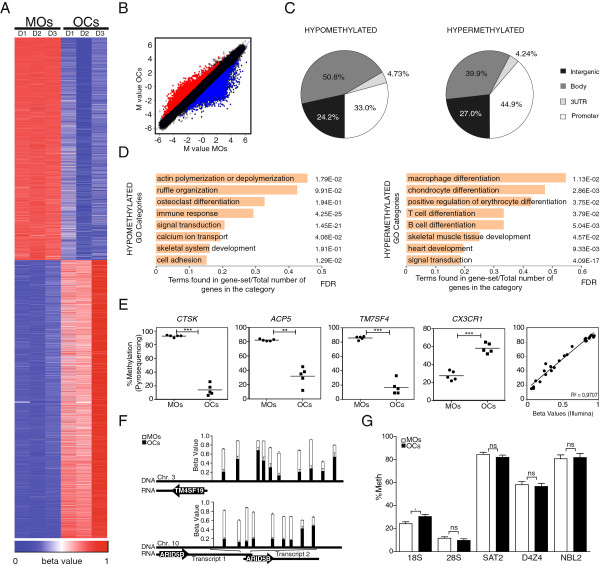
- In three matched CD14+ monocyte/osteoclast pairs, 3,515 genes (8,028 CpGs) were differentially methylated (FC ≥2 or ≤0.5; FDR ≤0.05): 1,895 hypomethylated genes (3,597 CpGs) and 2,054 hypermethylated genes (4,429 CpGs).
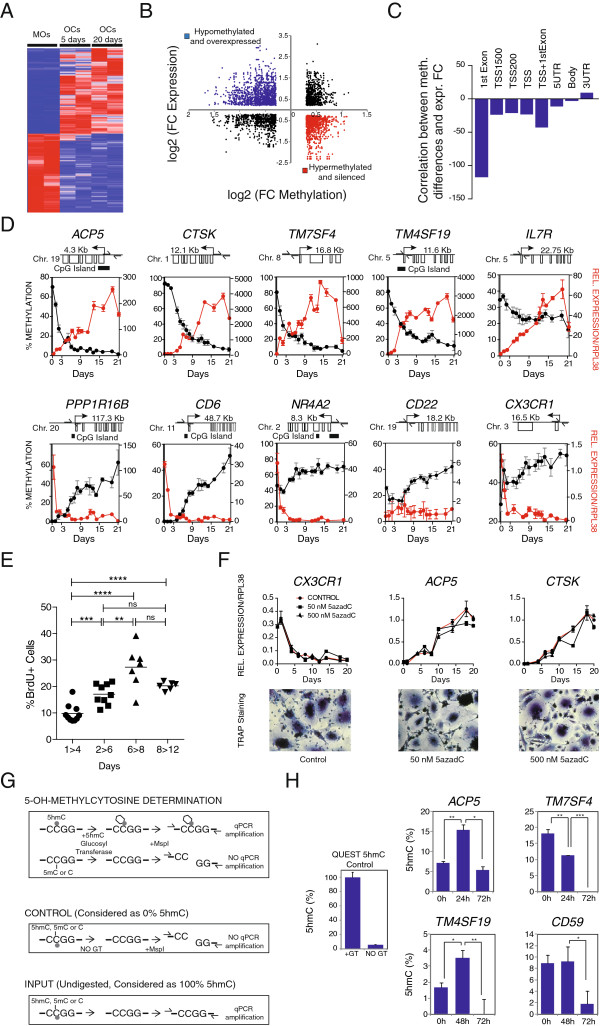
- Hypomethylation occurred early (about 60% of the range by days 0–4), without replication (BrdU-positive cells <9.8% between days 1 and 4; 5azadC treatment had no significant effect on osteoclastogenesis), and was associated with 5hmC changes at genes such as ACP5 and TM4SF19.
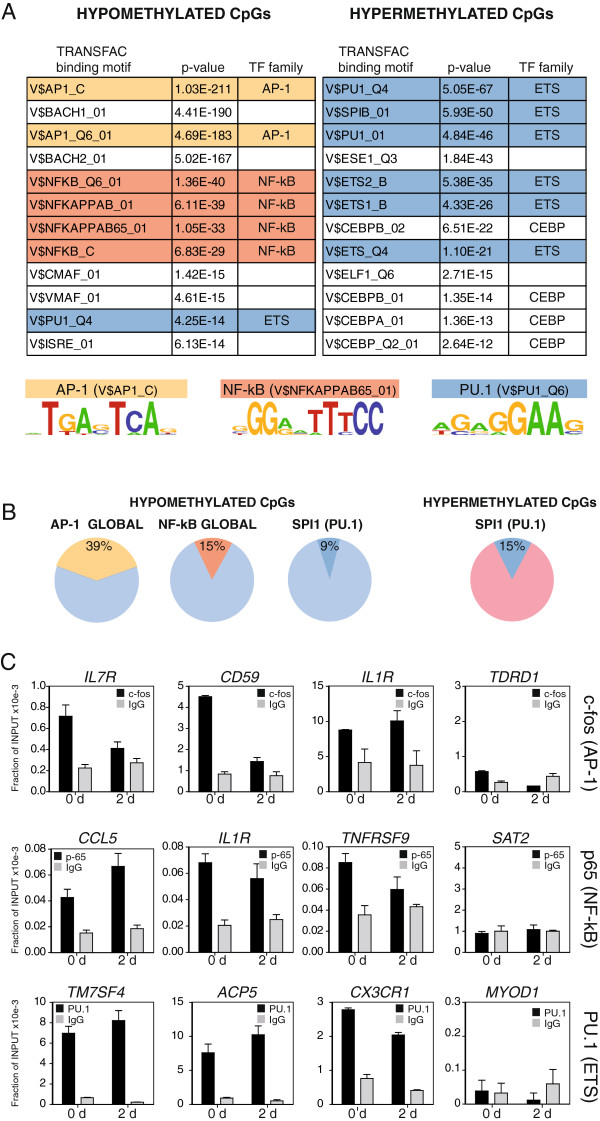
- Motif analysis found PU.1 enrichment in both directions: 15% of hypomethylated genes had PU.1/ETS motifs (PU.1 alone 9%) and 15% of hypermethylated genes had PU.1 motifs; ChIP-seq showed PU.1 peaks within 500 bp of 10.7% of promoter hypomethylated CpGs and 25.1% of promoter hypermethylated CpGs.
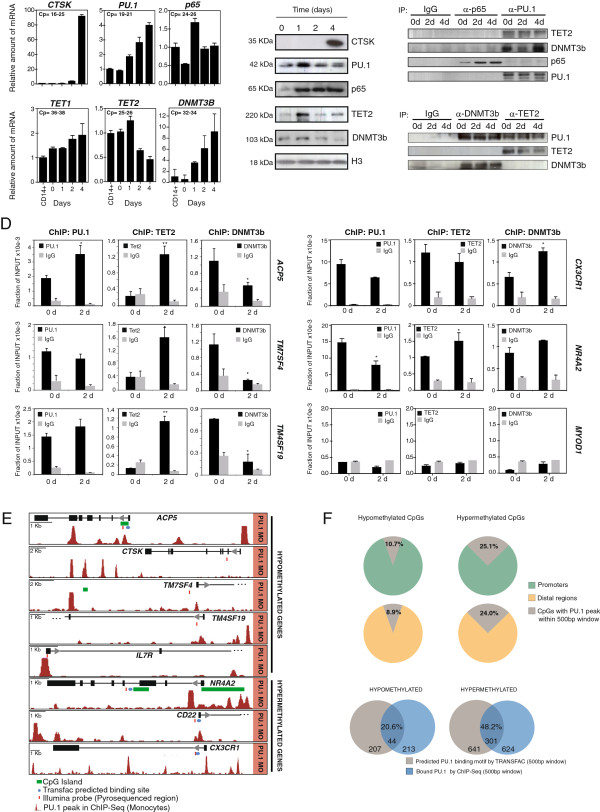
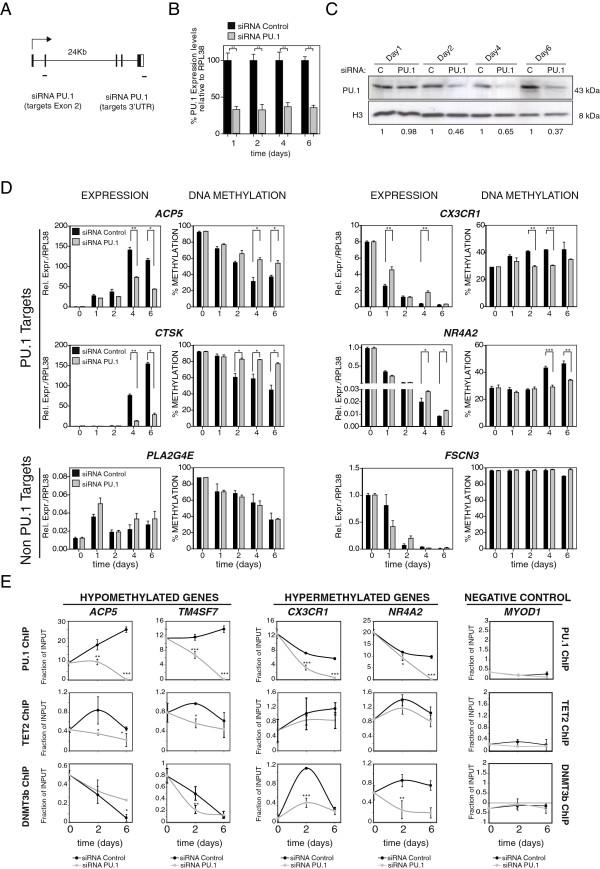
- PU.1 co-immunoprecipitated with DNMT3b and TET2; siRNA PU.1 knockdown (~60%) impaired acquisition of DNA methylation and expression changes at PU.1 targets and reduced TET2 and DNMT3b association at those promoters.
Methods
- Primary human CD14+ monocytes from buffy coats were differentiated to osteoclasts with M-CSF and RANKL for 21 days; three matched monocyte/osteoclast pairs were profiled.
- Genome-wide DNA methylation used Illumina HumanMethylation450 arrays, with differential methylation by paired limma (FC ≥2 or ≤0.5; P<0.01; FDR<0.05), validated by bisulfite pyrosequencing; expression data came from ArrayExpress E-MEXP-2019.
- Mechanistic assays included TRANSFAC/STORM motif analysis, PU.1 ChIP-seq (GSE31621), ChIP, immunoprecipitation, siRNA knockdown, 5hmC detection, BrdU, and 5azadC treatment.
Limitations
- Stated: PU.1 knockdown only partially impaired DNA methylation/expression changes and only partially reduced TET2/DNMT3b binding, indicating additional transcription factors participate; TM7SF4 showed no effect, possibly because it demethylates before PU.1 knockdown is effective.
- Stated: the detailed mechanisms coupling 5mC hydroxylation and demethylation remain debated, and the study did not address whether PU.1 interactions involve different subpopulations or post-translational modifications.
- Evident: array analyses used three matched pairs, and some ChIP experiments are described as three biological triplicates but only one experiment is shown; TRANSFAC predictions had limited overlap with ChIP-seq (20.6% hypomethylated, 46.9% hypermethylated), which the authors note reveals weakness in predictive motif searches.
Model-written summary. Check it against the paper before relying on it.
Integrity signals
Registry
Cites
Statistics
Figures
Verification
Claims the paper makes
82 Own result · 24 Own interpretation · 18 Not checked yet · 14 Own method · 1 Supported · 1 No basis given
A result the paper reports from its own data — it cites no other source for it, so there is none to check. The quote shows it is in the paper.
In the paper
“although DNA methylation changes also occurred at a similar scale in gene bodies (51% for hypomethylated CpGs, 40% for hypermethylated CpGs)”
§ PU.1 target genes undergo Tet2-coupled demethylation and DNMT3b-mediated methylation in monocyte-to-osteoclast differentiation > Results > Cell differentiation and fusion in osteoclastogenesis are accompanied by hypomethylation and hypermethylation of key functional pathways and genes
plain- Asserted: passes — The authors put it forward as true.
- Checkable: passes — It can be checked against evidence.
- Load-bearing: unclear — It is unclear whether the paper’s conclusions depend on it.
- Based: passes — The paper gives a reason why it holds.
A result the paper reports from its own data — it cites no other source for it, so there is none to check. The quote shows it is in the paper.
In the paper
“Conversely, CX3CR1, an important factor for MO adhesion to blood vessels that is downregulated during osteoclastogenesis, displayed an increase in methylation of over 28%”
§ PU.1 target genes undergo Tet2-coupled demethylation and DNMT3b-mediated methylation in monocyte-to-osteoclast differentiation > Results > Cell differentiation and fusion in osteoclastogenesis are accompanied by hypomethylation and hypermethylation of key functional pathways and genes
plaindirect- Asserted: passes — The authors put it forward as true.
- Checkable: passes — It can be checked against evidence.
- Load-bearing: unclear — It is unclear whether the paper’s conclusions depend on it.
- Based: passes — The paper gives a reason why it holds.
A result the paper reports from its own data — it cites no other source for it, so there is none to check. The quote shows it is in the paper.
In the paper
“TM7SF4, which encodes for DC-STAMP, a seven-pass transmembrane protein involved in signal transduction in OCs and dendritic cells, undergoes 59% hypomethylation.”
§ PU.1 target genes undergo Tet2-coupled demethylation and DNMT3b-mediated methylation in monocyte-to-osteoclast differentiation > Results > Cell differentiation and fusion in osteoclastogenesis are accompanied by hypomethylation and hypermethylation of key functional pathways and genes
plain- Asserted: passes — The authors put it forward as true.
- Checkable: passes — It can be checked against evidence.
- Load-bearing: unclear — It is unclear whether the paper’s conclusions depend on it.
- Based: passes — The paper gives a reason why it holds.
A result the paper reports from its own data — it cites no other source for it, so there is none to check. The quote shows it is in the paper.
In the paper
“Hypermethylation and hypomethylation occur in many relevant functional categories and key genes, including those whose functions are crucial to OC biology, like CTSK, ACP5, and DC-STAMP.”
§ PU.1 target genes undergo Tet2-coupled demethylation and DNMT3b-mediated methylation in monocyte-to-osteoclast differentiation > Background
plain- Asserted: passes — The authors put it forward as true.
- Checkable: passes — It can be checked against evidence.
- Load-bearing: passes — The paper’s conclusions depend on it.
- Based: passes — The paper gives a reason why it holds.
A result the paper reports from its own data — it cites no other source for it, so there is none to check. The quote shows it is in the paper.
In the paper
“associated with a change in 5-hydroxymethylcytosine”
§ PU.1 target genes undergo Tet2-coupled demethylation and DNMT3b-mediated methylation in monocyte-to-osteoclast differentiation > Background
plaincorrelational- Asserted: passes — The authors put it forward as true.
- Checkable: passes — It can be checked against evidence.
- Load-bearing: passes — The paper’s conclusions depend on it.
- Based: passes — The paper gives a reason why it holds.
A result the paper reports from its own data — it cites no other source for it, so there is none to check. The quote shows it is in the paper.
In the paper
“ChIP-seq data analysis confirmed its association to both gene sets.”
§ PU.1 target genes undergo Tet2-coupled demethylation and DNMT3b-mediated methylation in monocyte-to-osteoclast differentiation > Abstract > Results
plaincorrelational- Asserted: passes — The authors put it forward as true.
- Checkable: passes — It can be checked against evidence.
- Load-bearing: passes — The paper’s conclusions depend on it.
- Based: passes — The paper gives a reason why it holds.
A result the paper reports from its own data — it cites no other source for it, so there is none to check. The quote shows it is in the paper.
In the paper
“PU.1 interacts with both DNMT3b and TET2”
§ PU.1 target genes undergo Tet2-coupled demethylation and DNMT3b-mediated methylation in monocyte-to-osteoclast differentiation > Abstract > Results
plaincorrelational- Asserted: passes — The authors put it forward as true.
- Checkable: passes — It can be checked against evidence.
- Load-bearing: passes — The paper’s conclusions depend on it.
- Based: passes — The paper gives a reason why it holds.
A result the paper reports from its own data — it cites no other source for it, so there is none to check. The quote shows it is in the paper.
In the paper
“Statistical analysis of the combined data from the three pairs of samples revealed that 3,515 genes (8,028 CpGs) displayed differential methylation (FC ≥2 or FC ≤0.5; false discovery rate (FDR) ≤0.05).”
§ PU.1 target genes undergo Tet2-coupled demethylation and DNMT3b-mediated methylation in monocyte-to-osteoclast differentiation > Results > Cell differentiation and fusion in osteoclastogenesis are accompanied by hypomethylation and hypermethylation of key functional pathways and genes
plainn = 3- Asserted: passes — The authors put it forward as true.
- Checkable: passes — It can be checked against evidence.
- Load-bearing: passes — The paper’s conclusions depend on it.
- Based: passes — The paper gives a reason why it holds.
A result the paper reports from its own data — it cites no other source for it, so there is none to check. The quote shows it is in the paper.
In the paper
“This analysis showed a very close correlation between the array and the pyrosequencing data (R2 = 0.9707)”
§ PU.1 target genes undergo Tet2-coupled demethylation and DNMT3b-mediated methylation in monocyte-to-osteoclast differentiation > Results > Cell differentiation and fusion in osteoclastogenesis are accompanied by hypomethylation and hypermethylation of key functional pathways and genes
plaincorrelational- Asserted: passes — The authors put it forward as true.
- Checkable: passes — It can be checked against evidence.
- Load-bearing: passes — The paper’s conclusions depend on it.
- Based: passes — The paper gives a reason why it holds.
A result the paper reports from its own data — it cites no other source for it, so there is none to check. The quote shows it is in the paper.
In the paper
“Gene ontology analysis of hypomethylated CpGs revealed significant enrichment (FDR ≤0.05) for a variety of functional categories of relevance in OC differentiation and function”
§ PU.1 target genes undergo Tet2-coupled demethylation and DNMT3b-mediated methylation in monocyte-to-osteoclast differentiation > Results > Cell differentiation and fusion in osteoclastogenesis are accompanied by hypomethylation and hypermethylation of key functional pathways and genes
plaincorrelational- Asserted: passes — The authors put it forward as true.
- Checkable: passes — It can be checked against evidence.
- Load-bearing: passes — The paper’s conclusions depend on it.
- Based: passes — The paper gives a reason why it holds.
- Probably not a substantial claim. 21
- It may state two separate claims as one. 31
- The quote only partly states this claim. 1
Every source the paper cites for this claim was checked and supports it.
In the paper
“TET proteins are responsible for conversion of 5mC in 5hmC [34], 5fC, and 5cac [36].”
§ PU.1 target genes undergo Tet2-coupled demethylation and DNMT3b-mediated methylation in monocyte-to-osteoclast differentiation > Results > PU.1 recruits DNMT3b and TET2 to hypermethylated and hypomethylated genes
What the sources say
- Supportedcites [34] Tahiliani M, Koh KP, Shen Y, Pastor WA, Bandukwala H, Brudno Y, Agarwal S, Iyer LM, Liu DR, Aravind L, Rao A: Conversion of 5-methylcytosine to 5-hydroxymethylcytosine in mammalian DNA by MLL partner TET1. Science. 2009, 324: 930-935. 10.1126/science.1170116. source
Citation [34] is attached to the conversion of 5mC to 5hmC, not to the later products cited to [36]. The paper’s Abstract and its account of the purified-protein experiments state that TET1 catalyzes that conversion; no page number is supplied in our copy. (LLM, conf=0.94)
- Supportedcites [36] Ito S, Shen L, Dai Q, Wu SC, Collins LB, Swenberg JA, He C, Zhang Y: Tet proteins can convert 5-methylcytosine to 5-formylcytosine and 5-carboxylcytosine. Science. 2011, 333: 1300-1303. 10.1126/science.1210597. source
The passage labeled Abstract states that Tet proteins convert 5mC not only to 5hmC but also to 5fC and 5caC. This directly supports the 5fC and 5caC portion attached to this citation; it also supports the broader paraphrase. (LLM, conf=0.94)
plaindirect- Asserted: passes — The authors put it forward as true.
- Checkable: passes — It can be checked against evidence.
- Load-bearing: passes — The paper’s conclusions depend on it.
- Based: passes — The paper gives a reason why it holds.
Probably not a substantial claim.
- Supported
A result the paper reports from its own data — it cites no other source for it, so there is none to check. The quote shows it is in the paper.
In the paper
“Specifically, we identified 1,895 hypomethylated genes (3,597 CpG sites) and 2,054 hypermethylated genes (4,429 CpGs)”
§ PU.1 target genes undergo Tet2-coupled demethylation and DNMT3b-mediated methylation in monocyte-to-osteoclast differentiation > Results > Cell differentiation and fusion in osteoclastogenesis are accompanied by hypomethylation and hypermethylation of key functional pathways and genes
plainn = 3- Asserted: passes — The authors put it forward as true.
- Checkable: passes — It can be checked against evidence.
- Load-bearing: passes — The paper’s conclusions depend on it.
- Based: passes — The paper gives a reason why it holds.
It may state two separate claims as one.
A result the paper reports from its own data — it cites no other source for it, so there is none to check. The quote shows it is in the paper.
In the paper
“siRNA-mediated PU.1 knockdown in primary monocytes impaired the acquisition of DNA methylation and expression changes, and reduced the association of TET2 and DNMT3b at PU.1 targets during osteoclast differentiation.”
§ PU.1 target genes undergo Tet2-coupled demethylation and DNMT3b-mediated methylation in monocyte-to-osteoclast differentiation > Abstract > Results
plaindirect- Asserted: passes — The authors put it forward as true.
- Checkable: passes — It can be checked against evidence.
- Load-bearing: passes — The paper’s conclusions depend on it.
- Based: passes — The paper gives a reason why it holds.
It may state two separate claims as one.
A result the paper reports from its own data — it cites no other source for it, so there is none to check. The quote shows it is in the paper.
In the paper
“We observed very high significance for terms like immune response (FDR = 4.25E-25) and signal transduction (FDR = 1.45E-21), but also more specific categories such as ruffle organization (FDR = 9.91E-2), calcium ion transport (FDR = 4.6E-2), and OC differentiation (FDR = 1.94E-1).”
§ PU.1 target genes undergo Tet2-coupled demethylation and DNMT3b-mediated methylation in monocyte-to-osteoclast differentiation > Results > Cell differentiation and fusion in osteoclastogenesis are accompanied by hypomethylation and hypermethylation of key functional pathways and genes
plaincorrelational- Asserted: passes — The authors put it forward as true.
- Checkable: passes — It can be checked against evidence.
- Load-bearing: passes — The paper’s conclusions depend on it.
- Based: passes — The paper gives a reason why it holds.
It may state two separate claims as one. The quote only partly states this claim.
In the paper
“The 0-to-20-day comparison showed that 2,895 genes were upregulated (FC >2; FDR <0.05) and 1,858 were downregulated (FC <0.5; FDR <0.05).”
§ PU.1 target genes undergo Tet2-coupled demethylation and DNMT3b-mediated methylation in monocyte-to-osteoclast differentiation > Results > Hypomethylation is replication-independent and involves changes in 5-hydroxymethylcytosine
What the sources say
- Not checked yetcites [32] Gallois A, Lachuer J, Yvert G, Wierinckx A, Brunet F, Rabourdin-Combe C, Delprat C, Jurdic P, Mazzorana M: Genome-wide expression analyses establish dendritic cells as a new osteoclast precursor able to generate bone-resorbing cells more efficiently than monocytes. J Bone Miner Res. 2010, 25: 661-672. 10.1359/jbmr.090829. source
plain- Asserted: passes — The authors put it forward as true.
- Checkable: passes — It can be checked against evidence.
- Load-bearing: unclear — It is unclear whether the paper’s conclusions depend on it.
- Based: passes — The paper gives a reason why it holds.
It may state two separate claims as one.
A result the paper reports from its own data — it cites no other source for it, so there is none to check. The quote shows it is in the paper.
In the paper
“In the case of hypermethylated genes, we also found highly significant enrichment of signal transduction (FDR = 4.09E-17), and enrichment of categories related to other hematopoietic cell types”
§ PU.1 target genes undergo Tet2-coupled demethylation and DNMT3b-mediated methylation in monocyte-to-osteoclast differentiation > Results > Cell differentiation and fusion in osteoclastogenesis are accompanied by hypomethylation and hypermethylation of key functional pathways and genes
plaincorrelational- Asserted: passes — The authors put it forward as true.
- Checkable: passes — It can be checked against evidence.
- Load-bearing: passes — The paper’s conclusions depend on it.
- Based: passes — The paper gives a reason why it holds.
It may state two separate claims as one.
A result the paper reports from its own data — it cites no other source for it, so there is none to check. The quote shows it is in the paper.
In the paper
“reveals that all relevant functional categories and the majority of key genes for differentiation or the activity of functional OCs undergo DNA methylation changes and that genes within all relevant functional categories undergo DNA methylation changes.”
§ PU.1 target genes undergo Tet2-coupled demethylation and DNMT3b-mediated methylation in monocyte-to-osteoclast differentiation > Discussion
plaincorrelational- Asserted: passes — The authors put it forward as true.
- Checkable: passes — It can be checked against evidence.
- Load-bearing: passes — The paper’s conclusions depend on it.
- Based: passes — The paper gives a reason why it holds.
It may state two separate claims as one.
A result the paper reports from its own data — it cites no other source for it, so there is none to check. The quote shows it is in the paper.
In the paper
“Interestingly, the analysis of the presence of transcription factor binding sites in sequences that undergo DNA methylation changes shows a significant enrichment in binding motifs of transcription factors that are key in OC differentiation, some of which we have validated for a selection of putative target genes.”
§ PU.1 target genes undergo Tet2-coupled demethylation and DNMT3b-mediated methylation in monocyte-to-osteoclast differentiation > Discussion
plaincorrelational- Asserted: passes — The authors put it forward as true.
- Checkable: passes — It can be checked against evidence.
- Load-bearing: unclear — It is unclear whether the paper’s conclusions depend on it.
- Based: passes — The paper gives a reason why it holds.
It may state two separate claims as one.
A result the paper reports from its own data — it cites no other source for it, so there is none to check. The quote shows it is in the paper.
In the paper
“Our results showed that PU.1 directly interacted with both DNMT3b and TET2 (Figure 4C).”
- Also stated in: § PU.1 recruits DNMT3b and TET2 to hypermethylated and hypomethylated genes · boosted
“These confirmed the direct interaction with PU.1 (Figure 4C).”
§ PU.1 target genes undergo Tet2-coupled demethylation and DNMT3b-mediated methylation in monocyte-to-osteoclast differentiation > Results > PU.1 recruits DNMT3b and TET2 to hypermethylated and hypomethylated genes
boosteddirect- Asserted: passes — The authors put it forward as true.
- Checkable: passes — It can be checked against evidence.
- Load-bearing: passes — The paper’s conclusions depend on it.
- Based: passes — The paper gives a reason why it holds.
It may state two separate claims as one.
- Also stated in: § PU.1 recruits DNMT3b and TET2 to hypermethylated and hypomethylated genes · boosted
A result the paper reports from its own data — it cites no other source for it, so there is none to check. The quote shows it is in the paper.
In the paper
“Comparing DNA methylation and expression data revealed that 452 genes were both hypomethylated and overexpressed and 280 genes were both hypermethylated and repressed at the selected thresholds”
§ PU.1 target genes undergo Tet2-coupled demethylation and DNMT3b-mediated methylation in monocyte-to-osteoclast differentiation > Results > Hypomethylation is replication-independent and involves changes in 5-hydroxymethylcytosine
plaincorrelational- Asserted: passes — The authors put it forward as true.
- Checkable: passes — It can be checked against evidence.
- Load-bearing: passes — The paper’s conclusions depend on it.
- Based: passes — The paper gives a reason why it holds.
It may state two separate claims as one.
A result the paper reports from its own data — it cites no other source for it, so there is none to check. The quote shows it is in the paper.
In the paper
“In fact, 39% of all hypomethylated genes had binding motifs for AP-1, 15% genes had NF-kB binding motifs, and another 15% genes had binding motifs for PU.1 or other ETS-related factors (PU.1 alone, 9%)”
§ PU.1 target genes undergo Tet2-coupled demethylation and DNMT3b-mediated methylation in monocyte-to-osteoclast differentiation > Results > Sequences undergoing DNA methylation changes are enriched for binding motifs for AP-1, NF-kB, and PU.1, key transcription factors in osteoclastogenesis
plaincorrelational- Asserted: passes — The authors put it forward as true.
- Checkable: passes — It can be checked against evidence.
- Load-bearing: passes — The paper’s conclusions depend on it.
- Based: passes — The paper gives a reason why it holds.
It may state two separate claims as one.
A result the paper reports from its own data — it cites no other source for it, so there is none to check. The quote shows it is in the paper.
In the paper
“In genes that become hypermethylated (CX3CR1 and NR4A2), we also observed association of PU.1 at both 0 and 2 days. However we again observed a slight decrease at 2 days together.”
§ PU.1 target genes undergo Tet2-coupled demethylation and DNMT3b-mediated methylation in monocyte-to-osteoclast differentiation > Results > PU.1 recruits DNMT3b and TET2 to hypermethylated and hypomethylated genes
plaincorrelational- Asserted: passes — The authors put it forward as true.
- Checkable: passes — It can be checked against evidence.
- Load-bearing: passes — The paper’s conclusions depend on it.
- Based: passes — The paper gives a reason why it holds.
It may state two separate claims as one.
A result the paper reports from its own data — it cites no other source for it, so there is none to check. The quote shows it is in the paper.
In the paper
“we also confirmed the presence of DNMT3b, a de novo DNA methyltransferase, and the ten eleven translocation (TET) protein TET2, as enzymatic activities potentially related with DNA demethylation (Figure 4A and 4B).”
§ PU.1 target genes undergo Tet2-coupled demethylation and DNMT3b-mediated methylation in monocyte-to-osteoclast differentiation > Results > PU.1 recruits DNMT3b and TET2 to hypermethylated and hypomethylated genes
hedged- Asserted: passes — The authors put it forward as true.
- Checkable: passes — It can be checked against evidence.
- Load-bearing: passes — The paper’s conclusions depend on it.
- Based: passes — The paper gives a reason why it holds.
It may state two separate claims as one.
A result the paper reports from its own data — it cites no other source for it, so there is none to check. The quote shows it is in the paper.
In the paper
“The two activities are very specific to particular gene sets and there are no indications of changes in repetitive elements.”
§ PU.1 target genes undergo Tet2-coupled demethylation and DNMT3b-mediated methylation in monocyte-to-osteoclast differentiation > Discussion
plain- Asserted: passes — The authors put it forward as true.
- Checkable: passes — It can be checked against evidence.
- Load-bearing: unclear — It is unclear whether the paper’s conclusions depend on it.
- Based: passes — The paper gives a reason why it holds.
It may state two separate claims as one.
A result the paper reports from its own data — it cites no other source for it, so there is none to check. The quote shows it is in the paper.
In the paper
“These data are closely correlated with gene expression changes, and a majority of genes that undergo hypomethylation or hypermethylation at their promoters or gene bodies also experience a change in expression, although the relationship varies between different gene sets.”
§ PU.1 target genes undergo Tet2-coupled demethylation and DNMT3b-mediated methylation in monocyte-to-osteoclast differentiation > Discussion
plaincorrelational- Asserted: passes — The authors put it forward as true.
- Checkable: passes — It can be checked against evidence.
- Load-bearing: passes — The paper’s conclusions depend on it.
- Based: passes — The paper gives a reason why it holds.
It may state two separate claims as one.
A result the paper reports from its own data — it cites no other source for it, so there is none to check. The quote shows it is in the paper.
In the paper
“At any rate, the observed effects only occurred in PU.1 targets. It did not affect genes that are not targeted by PU.1 (PLA2G4E, FSCN3).”
§ PU.1 target genes undergo Tet2-coupled demethylation and DNMT3b-mediated methylation in monocyte-to-osteoclast differentiation > Results > Dowregulation of PU.1 in MOs impairs activation of OC markers, hypomethylation, and recruitment of DNMT3b and TET2
plain- Asserted: passes — The authors put it forward as true.
- Checkable: passes — It can be checked against evidence.
- Load-bearing: passes — The paper’s conclusions depend on it.
- Based: passes — The paper gives a reason why it holds.
It may state two separate claims as one.
A result the paper reports from its own data — it cites no other source for it, so there is none to check. The quote shows it is in the paper.
In the paper
“In fact TET1 and TET3 were undetectable in western blot (not shown) and qRT-PCR evidenced their low levels in this cell type (Figure 4A, only shown for TET1).”
§ PU.1 target genes undergo Tet2-coupled demethylation and DNMT3b-mediated methylation in monocyte-to-osteoclast differentiation > Results > PU.1 recruits DNMT3b and TET2 to hypermethylated and hypomethylated genes
plain- Asserted: passes — The authors put it forward as true.
- Checkable: passes — It can be checked against evidence.
- Load-bearing: passes — The paper’s conclusions depend on it.
- Based: passes — The paper gives a reason why it holds.
It may state two separate claims as one.
A result the paper reports from its own data — it cites no other source for it, so there is none to check. The quote shows it is in the paper.
In the paper
“Hypomethylation takes place in relevant functional categories related with OC differentiation and most of the genes that are necessary for OC function undergo hypomethylation including ACP5, CTSK, and TM7SF4 among others.”
§ PU.1 target genes undergo Tet2-coupled demethylation and DNMT3b-mediated methylation in monocyte-to-osteoclast differentiation > Conclusions
plaincorrelational- Asserted: passes — The authors put it forward as true.
- Checkable: passes — It can be checked against evidence.
- Load-bearing: passes — The paper’s conclusions depend on it.
- Based: passes — The paper gives a reason why it holds.
It may state two separate claims as one.
None of the sources cited for this claim have been checked yet.
In the paper
“MOs stimulated with RANKL and M-CSF generate functional OCs [27], which degrade bone and express OC markers [28].”
§ PU.1 target genes undergo Tet2-coupled demethylation and DNMT3b-mediated methylation in monocyte-to-osteoclast differentiation > Background
What the sources say
- Not checked yetcites [27] Nicholson GC, Malakellis M, Collier FM, Cameron PU, Holloway WR, Gough TJ, Gregorio-King C, Kirkland MA, Myers DE: Induction of osteoclasts from CD14-positive human peripheral blood mononuclear cells by receptor activator of nuclear factor kappaB ligand (RANKL). Clin Sci (Lond). 2000, 99: 133-140. 10.1042/CS19990355. source
- Not checked yetcites [28] Sorensen MG, Henriksen K, Schaller S, Henriksen DB, Nielsen FC, Dziegiel MH, Karsdal MA: Characterization of osteoclasts derived from CD14+ monocytes isolated from peripheral blood. J Bone Miner Metab. 2007, 25: 36-45. source
plaindirect- Asserted: passes — The authors put it forward as true.
- Checkable: passes — It can be checked against evidence.
- Load-bearing: passes — The paper’s conclusions depend on it.
- Based: passes — The paper gives a reason why it holds.
Probably not a substantial claim. It may state two separate claims as one.
None of the sources cited for this claim have been checked yet.
In the paper
“however very few reports have analyzed the role of epigenetic changes during osteoclastogenesis, and these focus mainly on histone modifications [29,30].”
§ PU.1 target genes undergo Tet2-coupled demethylation and DNMT3b-mediated methylation in monocyte-to-osteoclast differentiation > Background
What the sources say
- Not checked yetcites [29] Youn MY, Takada I, Imai Y, Yasuda H, Kato S: Transcriptionally active nuclei are selective in mature multinucleated osteoclasts. Genes Cells. 2010, 15: 1025-1035. 10.1111/j.1365-2443.2010.01441.x. source
- Not checked yetcites [30] Saltman LH, Javed A, Ribadeneyra J, Hussain S, Young DW, Osdoby P, Amcheslavsky A, van Wijnen AJ, Stein JL, Stein GS, Lian JB, Bar-Shavit Z: Organization of transcriptional regulatory machinery in osteoclast nuclei: compartmentalization of Runx1. J Cell Physiol. 2005, 204: 871-880. 10.1002/jcp.20329. source
plain- Asserted: passes — The authors put it forward as true.
- Checkable: passes — It can be checked against evidence.
- Load-bearing: passes — The paper’s conclusions depend on it.
- Based: passes — The paper gives a reason why it holds.
It may state two separate claims as one.
What the paper did — it cites no source for this, so there is none to check. The quote shows it is in the paper.
In the paper
“The quality of mature, bone-resorbing OCs obtained under these conditions was confirmed by several methods, including the presence of more than three nuclei in TRAP-positive cells (in some cases, up to 40 nuclei per cell were counted), the upregulation of OC markers, such as CA2, CTSK, ACP5/TRACP, and MMP9, and downregulation of the monocytic gene CX3CR1”
§ PU.1 target genes undergo Tet2-coupled demethylation and DNMT3b-mediated methylation in monocyte-to-osteoclast differentiation > Results > Cell differentiation and fusion in osteoclastogenesis are accompanied by hypomethylation and hypermethylation of key functional pathways and genes
plaincorrelationaln = 3- Asserted: passes — The authors put it forward as true.
- Checkable: passes — It can be checked against evidence.
- Load-bearing: passes — The paper’s conclusions depend on it.
- Based: passes — The paper gives a reason why it holds.
It may state two separate claims as one.
None of the sources cited for this claim have been checked yet.
In the paper
“OCs differentiate from monocyte/macrophage progenitors following M-CSF [5] and RANKL [6] stimulation.”
§ PU.1 target genes undergo Tet2-coupled demethylation and DNMT3b-mediated methylation in monocyte-to-osteoclast differentiation > Background
What the sources say
- Not checked yetcites [5] Wiktor-Jedrzejczak W, Bartocci A, Ferrante AW, Ahmed-Ansari A, Sell KW, Pollard JW, Stanley ER: Total absence of colony-stimulating factor 1 in the macrophage-deficient osteopetrotic (op/op) mouse. Proc Natl Acad Sci USA. 1990, 87: 4828-4832. 10.1073/pnas.87.12.4828. source
- Not checked yetcites [6] Lacey DL, Timms E, Tan HL, Kelley MJ, Dunstan CR, Burgess T, Elliott R, Colombero A, Elliott G, Scully S, et al: Osteoprotegerin ligand is a cytokine that regulates osteoclast differentiation and activation. Cell. 1998, 93: 165-176. 10.1016/S0092-8674(00)81569-X. source
plaindirect- Asserted: passes — The authors put it forward as true.
- Checkable: passes — It can be checked against evidence.
- Load-bearing: passes — The paper’s conclusions depend on it.
- Based: passes — The paper gives a reason why it holds.
Probably not a substantial claim.
A conclusion the paper draws from its own results — it cites no other source for it, so there is none to check. The quote shows it is in the paper.
In the paper
“Together, these data indicate that DNA hypomethylation is targeted to genomic regions that are activated during osteoclastogenesis, and hypermethylation silences alternative lineage genes that are not expressed in OCs.”
§ PU.1 target genes undergo Tet2-coupled demethylation and DNMT3b-mediated methylation in monocyte-to-osteoclast differentiation > Results > Cell differentiation and fusion in osteoclastogenesis are accompanied by hypomethylation and hypermethylation of key functional pathways and genes
hedgeddirect- Asserted: passes — The authors put it forward as true.
- Checkable: passes — It can be checked against evidence.
- Load-bearing: passes — The paper’s conclusions depend on it.
- Based: passes — The paper gives a reason why it holds.
It may state two separate claims as one.
A conclusion the paper draws from its own results — it cites no other source for it, so there is none to check. The quote shows it is in the paper.
In the paper
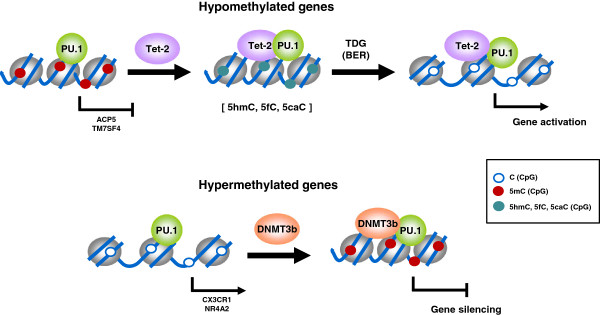
“First, we have identified the association of PU.1 with genes that become repressed through hypermethylation and describe its direct interaction with DNMT3b in the context of osteoclastogenesis.”
§ PU.1 target genes undergo Tet2-coupled demethylation and DNMT3b-mediated methylation in monocyte-to-osteoclast differentiation > Discussion
plaincorrelational- Asserted: passes — The authors put it forward as true.
- Checkable: passes — It can be checked against evidence.
- Load-bearing: passes — The paper’s conclusions depend on it.
- Based: passes — The paper gives a reason why it holds.
It may state two separate claims as one.
None of the sources cited for this claim have been checked yet.
In the paper
“Recent evidences support a role for TET-dependent active DNA demethylation process [42,43].”
§ PU.1 target genes undergo Tet2-coupled demethylation and DNMT3b-mediated methylation in monocyte-to-osteoclast differentiation > Results > PU.1 recruits DNMT3b and TET2 to hypermethylated and hypomethylated genes
What the sources say
- Not checked yetcites [42] Shen L, Wu H, Diep D, Yamaguchi S, D’Alessio AC, Fung HL, Zhang K, Zhang Y: Genome-wide analysis reveals TET- and TDG-dependent 5-methylcytosine oxidation dynamics. Cell. 2013, 153: 692-706. 10.1016/j.cell.2013.04.002. source
- Not checked yetcites [43] Cortellino S, Xu J, Sannai M, Moore R, Caretti E, Cigliano A, Le Coz M, Devarajan K, Wessels A, Soprano D, Abramowitz LK, Bartolomei MS, Rambow F, Bassi MR, Bruno T, Fanciulli M, Renner C, Klein-Szanto AJ, Matsumoto Y, Kobi D, Davidson I, Alberti C, Larue L, Bellacosa A: Thymine DNA glycosylase is essential for active DNA demethylation by linked deamination-base excision repair. Cell. 2011, 146: 67-79. 10.1016/j.cell.2011.06.020. source
plain- Asserted: passes — The authors put it forward as true.
- Checkable: passes — It can be checked against evidence.
- Load-bearing: fails — The paper’s conclusions may not depend on it.
- Based: passes — The paper gives a reason why it holds.
Probably not a substantial claim. The paper’s conclusions may not depend on it.
In the paper
“recent data shows that TET2 is required for active DNA demethylation in primary human MOs [45].”
§ PU.1 target genes undergo Tet2-coupled demethylation and DNMT3b-mediated methylation in monocyte-to-osteoclast differentiation > Results > PU.1 recruits DNMT3b and TET2 to hypermethylated and hypomethylated genes
What the sources say
- Not checked yetcites [45] Klug M, Schmidhofer S, Gebhard C, Andreesen R, Rehli M: 5-Hydroxymethylcytosine is an essential intermediate of active DNA demethylation processes in primary human monocytes. Genome Biol. 2013, 14: R46-10.1186/gb-2013-14-5-r46. source
plaindirect- Asserted: passes — The authors put it forward as true.
- Checkable: passes — It can be checked against evidence.
- Load-bearing: passes — The paper’s conclusions depend on it.
- Based: passes — The paper gives a reason why it holds.
Probably not a substantial claim.
In the paper
“This is compatible with previous data on genome wide DNA methylation profiling comparing cell types across the hematopietic differentiation system where an over-representation of ETS transcription factor binding sites was found [2].”
§ PU.1 target genes undergo Tet2-coupled demethylation and DNMT3b-mediated methylation in monocyte-to-osteoclast differentiation > Discussion
What the sources say
- Not checked yetcites [2] Hogart A, Lichtenberg J, Ajay SS, Anderson S, Margulies EH, Bodine DM: Genome-wide DNA methylation profiles in hematopoietic stem and progenitor cells reveal overrepresentation of ETS transcription factor binding sites. Genome Res. 2012, 22: 1407-1418. 10.1101/gr.132878.111. source
plaincorrelational- Asserted: passes — The authors put it forward as true.
- Checkable: passes — It can be checked against evidence.
- Load-bearing: fails — The paper’s conclusions may not depend on it.
- Based: passes — The paper gives a reason why it holds.
Probably not a substantial claim. The paper’s conclusions may not depend on it.
A conclusion the paper draws from its own results — it cites no other source for it, so there is none to check. The quote shows it is in the paper.
In the paper
“however, it also reveals the weakness in the predictive power of TRANSFAC motif searches and the need of experimental validation of its results.”
§ PU.1 target genes undergo Tet2-coupled demethylation and DNMT3b-mediated methylation in monocyte-to-osteoclast differentiation > Results > PU.1 recruits DNMT3b and TET2 to hypermethylated and hypomethylated genes
plain- Asserted: passes — The authors put it forward as true.
- Checkable: passes — It can be checked against evidence.
- Load-bearing: passes — The paper’s conclusions depend on it.
- Based: passes — The paper gives a reason why it holds.
It may state two separate claims as one.
In the paper
“This initial analysis was validated in several candidate genes and using ChIPseq data for human primary monocytes [1].”
§ PU.1 target genes undergo Tet2-coupled demethylation and DNMT3b-mediated methylation in monocyte-to-osteoclast differentiation > Discussion
What the sources say
- Not checked yetcites [1] Pham TH, Benner C, Lichtinger M, Schwarzfischer L, Hu Y, Andreesen R, Chen W, Rehli M: Dynamic epigenetic enhancer signatures reveal key transcription factors associated with monocytic differentiation states. Blood. 2012, 119: e161-e171. 10.1182/blood-2012-01-402453. source
plain- Asserted: passes — The authors put it forward as true.
- Checkable: passes — It can be checked against evidence.
- Load-bearing: unclear — It is unclear whether the paper’s conclusions depend on it.
- Based: passes — The paper gives a reason why it holds.
It may state two separate claims as one.
In the paper
“we have recently reported that TET2 plays a role in derepressing genes in pre-B cell to macrophage differentiation [44]”
§ PU.1 target genes undergo Tet2-coupled demethylation and DNMT3b-mediated methylation in monocyte-to-osteoclast differentiation > Results > PU.1 recruits DNMT3b and TET2 to hypermethylated and hypomethylated genes
What the sources say
- Not checked yetcites [44] Kallin EM, Rodriguez-Ubreva J, Christensen J, Cimmino L, Aifantis I, Helin K, Ballestar E, Graf T: Tet2 facilitates the derepression of myeloid target genes during CEBPalpha-induced transdifferentiation of pre-B cells. Mol Cell. 2012, 48: 266-276. 10.1016/j.molcel.2012.08.007. source
plaindirect- Asserted: passes — The authors put it forward as true.
- Checkable: passes — It can be checked against evidence.
- Load-bearing: fails — The paper’s conclusions may not depend on it.
- Based: passes — The paper gives a reason why it holds.
Probably not a substantial claim. The paper’s conclusions may not depend on it.
A conclusion the paper draws from its own results — it cites no other source for it, so there is none to check. The quote shows it is in the paper.
In the paper
“Second, we identify a novel interaction between PU.1 and TET2 and their association with genes that become demethylated.”
§ PU.1 target genes undergo Tet2-coupled demethylation and DNMT3b-mediated methylation in monocyte-to-osteoclast differentiation > Discussion
plaincorrelational- Asserted: passes — The authors put it forward as true.
- Checkable: passes — It can be checked against evidence.
- Load-bearing: passes — The paper’s conclusions depend on it.
- Based: passes — The paper gives a reason why it holds.
It may state two separate claims as one.
What the paper did — it cites no source for this, so there is none to check. The quote shows it is in the paper.
In the paper
“These experiments were performed with three biological replicates.”
§ PU.1 target genes undergo Tet2-coupled demethylation and DNMT3b-mediated methylation in monocyte-to-osteoclast differentiation > Materials and methods > Transfection of primary human MOs
plain- Asserted: passes — The authors put it forward as true.
- Checkable: passes — It can be checked against evidence.
- Load-bearing: fails — The paper’s conclusions may not depend on it.
- Based: passes — The paper gives a reason why it holds.
Probably not a substantial claim. The paper’s conclusions may not depend on it.
What the paper did — it cites no source for this, so there is none to check. The quote shows it is in the paper.
In the paper
“In the case of repetitive elements (Sat2, D4Z4, NBL2, 18S rRNA, and 28 rRNA) we performed standard bisulfite sequencing of a minimum of 10 clones.”
§ PU.1 target genes undergo Tet2-coupled demethylation and DNMT3b-mediated methylation in monocyte-to-osteoclast differentiation > Materials and methods > Bisulfite sequencing and pyrosequencing
plain- Asserted: passes — The authors put it forward as true.
- Checkable: passes — It can be checked against evidence.
- Load-bearing: fails — The paper’s conclusions may not depend on it.
- Based: passes — The paper gives a reason why it holds.
Probably not a substantial claim. The paper’s conclusions may not depend on it.
In the paper
“PU.1 has been shown to act in concert with MITF to recruit co-repressors to osteoclast-specific in committed myeloid precursors capable of forming either macrophages or OC [50].”
§ PU.1 target genes undergo Tet2-coupled demethylation and DNMT3b-mediated methylation in monocyte-to-osteoclast differentiation > Discussion
What the sources say
- Not checked yetcites [50] Hu R, Sharma SM, Bronisz A, Srinivasan R, Sankar U, Ostrowski MC: Eos, MITF, and PU.1 recruit corepressors to osteoclast-specific genes in committed myeloid progenitors. Mol Cell Biol. 2007, 27: 4018-4027. 10.1128/MCB.01839-06. source
plaindirect- Asserted: passes — The authors put it forward as true.
- Checkable: passes — It can be checked against evidence.
- Load-bearing: fails — The paper’s conclusions may not depend on it.
- Based: passes — The paper gives a reason why it holds.
Probably not a substantial claim. The paper’s conclusions may not depend on it.
What the paper did — it cites no source for this, so there is none to check. The quote shows it is in the paper.
In the paper
“IgG was used as a negative control.”
§ PU.1 target genes undergo Tet2-coupled demethylation and DNMT3b-mediated methylation in monocyte-to-osteoclast differentiation > Materials and methods > Chromatin immunoprecipitation (ChIP) assays and immunoprecipitation experiments
plain- Asserted: passes — The authors put it forward as true.
- Checkable: passes — It can be checked against evidence.
- Load-bearing: fails — The paper’s conclusions may not depend on it.
- Based: passes — The paper gives a reason why it holds.
Probably not a substantial claim. The paper’s conclusions may not depend on it.
What the paper did — it cites no source for this, so there is none to check. The quote shows it is in the paper.
In the paper
“Validation of expression data was performed by quantitative RT-PCR.”
§ PU.1 target genes undergo Tet2-coupled demethylation and DNMT3b-mediated methylation in monocyte-to-osteoclast differentiation > Materials and methods > Gene expression data analysis and comparison of DNA expression data versus DNA methylation data
plain- Asserted: passes — The authors put it forward as true.
- Checkable: passes — It can be checked against evidence.
- Load-bearing: fails — The paper’s conclusions may not depend on it.
- Based: passes — The paper gives a reason why it holds.
Probably not a substantial claim. The paper’s conclusions may not depend on it.
In the paper
“previous studies have shown that PU.1 can form a complex with DNMT3a and DNMT3b [46].”
§ PU.1 target genes undergo Tet2-coupled demethylation and DNMT3b-mediated methylation in monocyte-to-osteoclast differentiation > Discussion
What the sources say
- Not checked yetcites [46] Suzuki M, Yamada T, Kihara-Negishi F, Sakurai T, Hara E, Tenen DG, Hozumi N, Oikawa T: Site-specific DNA methylation by a complex of PU.1 and Dnmt3a/b. Oncogene. 2006, 25: 2477-2488. 10.1038/sj.onc.1209272. source
plaincorrelational- Asserted: passes — The authors put it forward as true.
- Checkable: passes — It can be checked against evidence.
- Load-bearing: fails — The paper’s conclusions may not depend on it.
- Based: passes — The paper gives a reason why it holds.
Probably not a substantial claim. The paper’s conclusions may not depend on it.
A conclusion the paper draws from its own results — it cites no other source for it, so there is none to check. The quote shows it is in the paper.
In the paper
“Our study has allowed us to identify key DNA methylation changes during OC differentiation and has revealed an implication of PU.1 in the acquisition of DNA methylation and expression changes as well as identifying novel interactions with DNMT3b and TET2.”
§ PU.1 target genes undergo Tet2-coupled demethylation and DNMT3b-mediated methylation in monocyte-to-osteoclast differentiation > Discussion
plaincorrelational- Asserted: passes — The authors put it forward as true.
- Checkable: passes — It can be checked against evidence.
- Load-bearing: passes — The paper’s conclusions depend on it.
- Based: passes — The paper gives a reason why it holds.
It may state two separate claims as one.
In the paper
“Several recent reports have pointed at TET2-mediated hydroxylation of 5-methylcytosine as an intermediate step towards demethylation [51]”
§ PU.1 target genes undergo Tet2-coupled demethylation and DNMT3b-mediated methylation in monocyte-to-osteoclast differentiation > Discussion
What the sources say
- Not checked yetcites [51] Vincent JJ, Huang Y, Chen PY, Feng S, Calvopina JH, Nee K, Lee SA, Le T, Yoon AJ, Faull K, Fan G, Rao A, Jacobsen SE, Pellegrini M, Clark AT: Stage-specific roles for tet1 and tet2 in DNA demethylation in primordial germ cells. Cell Stem Cell. 2013, 12: 470-478. 10.1016/j.stem.2013.01.016. source
plaindirect- Asserted: passes — The authors put it forward as true.
- Checkable: passes — It can be checked against evidence.
- Load-bearing: passes — The paper’s conclusions depend on it.
- Based: passes — The paper gives a reason why it holds.
Probably not a substantial claim.
What the paper did — it cites no source for this, so there is none to check. The quote shows it is in the paper.
In the paper
“Multiple test correction to account for the multiple hypotheses tested (one for each GO term) was applied to reduce false-positive results.”
§ PU.1 target genes undergo Tet2-coupled demethylation and DNMT3b-mediated methylation in monocyte-to-osteoclast differentiation > Materials and methods > Gene ontology analysis
plaindirect- Asserted: passes — The authors put it forward as true.
- Checkable: passes — It can be checked against evidence.
- Load-bearing: fails — The paper’s conclusions may not depend on it.
- Based: passes — The paper gives a reason why it holds.
Probably not a substantial claim. The paper’s conclusions may not depend on it.
What the paper did — it cites no source for this, so there is none to check. The quote shows it is in the paper.
In the paper
“OCs (TRAP-positive cells with more than three nuclei) were also analyzed at the mRNA level: upregulation of key OC markers (TRAP/ACP5, CA2, MMP9, and CTSK) and the downregulation of the MO marker CX3CR1 were confirmed.”
§ PU.1 target genes undergo Tet2-coupled demethylation and DNMT3b-mediated methylation in monocyte-to-osteoclast differentiation > Materials and methods > Differentiation of OCs from peripheral blood mononuclear cells
plaincorrelational- Asserted: passes — The authors put it forward as true.
- Checkable: passes — It can be checked against evidence.
- Load-bearing: passes — The paper’s conclusions depend on it.
- Based: passes — The paper gives a reason why it holds.
It may state two separate claims as one.
A conclusion the paper draws from its own results — it cites no other source for it, so there is none to check. The quote shows it is in the paper.
In the paper
“our data show changes in 5hmC at genes that become demethylated in osteoclastogenesis, reinforcing the possibility that PU.1-mediated recruitment of TET2 is leading to 5hmC-mediated demethylation.”
§ PU.1 target genes undergo Tet2-coupled demethylation and DNMT3b-mediated methylation in monocyte-to-osteoclast differentiation > Discussion
hedgedconditional- Asserted: passes — The authors put it forward as true.
- Checkable: passes — It can be checked against evidence.
- Load-bearing: passes — The paper’s conclusions depend on it.
- Based: passes — The paper gives a reason why it holds.
It may state two separate claims as one.
In the paper
“however for statistics purposes it is more adequate the use of M values [54].”
§ PU.1 target genes undergo Tet2-coupled demethylation and DNMT3b-mediated methylation in monocyte-to-osteoclast differentiation > Materials and methods > DNA methylation profiling using universal bead arrays
What the sources say
- Not checked yetcites [54] Du P, Zhang X, Huang CC, Jafari N, Kibbe WA, Hou L, Lin SM: Comparison of Beta-value and M-value methods for quantifying methylation levels by microarray analysis. BMC Bioinforma. 2010, 11: 587-10.1186/1471-2105-11-587. source
plain- Asserted: passes — The authors put it forward as true.
- Checkable: passes — It can be checked against evidence.
- Load-bearing: fails — The paper’s conclusions may not depend on it.
- Based: passes — The paper gives a reason why it holds.
Probably not a substantial claim. The paper’s conclusions may not depend on it.
In the paper
“PU.1 is known to generate a repressive chromatin structure characterized by H3K9me3 in myeloid and erythroid differentiation [49].”
§ PU.1 target genes undergo Tet2-coupled demethylation and DNMT3b-mediated methylation in monocyte-to-osteoclast differentiation > Discussion
What the sources say
- Not checked yetcites [49] Stopka T, Amanatullah DF, Papetti M, Skoultchi AI: PU.1 inhibits the erythroid program by binding to GATA-1 on DNA and creating a repressive chromatin structure. EMBO J. 2005, 24: 3712-3723. 10.1038/sj.emboj.7600834. source
boosteddirect- Asserted: passes — The authors put it forward as true.
- Checkable: passes — It can be checked against evidence.
- Load-bearing: fails — The paper’s conclusions may not depend on it.
- Based: passes — The paper gives a reason why it holds.
Probably not a substantial claim. The paper’s conclusions may not depend on it.
A conclusion the paper draws from its own results — it cites no other source for it, so there is none to check. The quote shows it is in the paper.
In the paper
“These changes occur in the virtual absence of DNA replication suggesting the participation of active mechanisms, particularly relevant for hypomethylation events, for which the mechanisms are still subject of debate.”
§ PU.1 target genes undergo Tet2-coupled demethylation and DNMT3b-mediated methylation in monocyte-to-osteoclast differentiation > Conclusions
hedgedconditional- Asserted: passes — The authors put it forward as true.
- Checkable: passes — It can be checked against evidence.
- Load-bearing: passes — The paper’s conclusions depend on it.
- Based: passes — The paper gives a reason why it holds.
It may state two separate claims as one.
What the paper did — it cites no source for this, so there is none to check. The quote shows it is in the paper.
In the paper
“We used bisulfite pyrosequencing to validate CpG methylation changes resulting from the analysis with the Infinium HumanMethylation450 BeadChips.”
§ PU.1 target genes undergo Tet2-coupled demethylation and DNMT3b-mediated methylation in monocyte-to-osteoclast differentiation > Materials and methods > Bisulfite sequencing and pyrosequencing
plain- Asserted: passes — The authors put it forward as true.
- Checkable: passes — It can be checked against evidence.
- Load-bearing: fails — The paper’s conclusions may not depend on it.
- Based: passes — The paper gives a reason why it holds.
Probably not a substantial claim. The paper’s conclusions may not depend on it.
What the paper did — it cites no source for this, so there is none to check. The quote shows it is in the paper.
In the paper
“These experiments were performed with three biological replicates.”
§ PU.1 target genes undergo Tet2-coupled demethylation and DNMT3b-mediated methylation in monocyte-to-osteoclast differentiation > Materials and methods > Transfection of primary human MOs
plain- Asserted: fails — The authors may not put it forward as true.
- Checkable: passes — It can be checked against evidence.
- Load-bearing: fails — The paper’s conclusions may not depend on it.
- Based: fails — The paper may give no reason why it holds.
Probably not a substantial claim. The authors may not put it forward as true. The paper’s conclusions may not depend on it. The paper may give no reason why it holds.
What the paper did — it cites no source for this, so there is none to check. The quote shows it is in the paper.
In the paper
“We calculated two-tailed probabilities, and a final adjusted FDR P value (with 0.25 cutoff) was considered statistically significant.”
§ PU.1 target genes undergo Tet2-coupled demethylation and DNMT3b-mediated methylation in monocyte-to-osteoclast differentiation > Materials and methods > Analysis of transcription factor binding
plain- Asserted: passes — The authors put it forward as true.
- Checkable: passes — It can be checked against evidence.
- Load-bearing: fails — The paper’s conclusions may not depend on it.
- Based: passes — The paper gives a reason why it holds.
Probably not a substantial claim. The paper’s conclusions may not depend on it.
A conclusion the paper draws from its own results — it cites no other source for it, so there is none to check. The quote shows it is in the paper.
In the paper
“as well as showing how impaired association of PU.1 results in defective acquisition of DNA methylation changes in both directions as well as reduced effect on gene expression changes.”
§ PU.1 target genes undergo Tet2-coupled demethylation and DNMT3b-mediated methylation in monocyte-to-osteoclast differentiation > Discussion
plaindirect- Asserted: passes — The authors put it forward as true.
- Checkable: passes — It can be checked against evidence.
- Load-bearing: passes — The paper’s conclusions depend on it.
- Based: passes — The paper gives a reason why it holds.
It may state two separate claims as one.
In the paper
“Ser phosphorylation of PU.1 has already been shown to play a role in its recruitment to promoters [52]”
§ PU.1 target genes undergo Tet2-coupled demethylation and DNMT3b-mediated methylation in monocyte-to-osteoclast differentiation > Discussion
What the sources say
- Not checked yetcites [52] Azim AC, Wang X, Park GY, Sadikot RT, Cao H, Mathew B, Atchison M, van Breemen RB, Joo M, Christman JW: NF-kappaB-inducing kinase regulates cyclooxygenase 2 gene expression in macrophages by phosphorylation of PU.1. J Immunol. 2007, 179: 7868-7875. source
plaindirect- Asserted: passes — The authors put it forward as true.
- Checkable: passes — It can be checked against evidence.
- Load-bearing: fails — The paper’s conclusions may not depend on it.
- Based: passes — The paper gives a reason why it holds.
Probably not a substantial claim. The paper’s conclusions may not depend on it.
What the paper did — it cites no source for this, so there is none to check. The quote shows it is in the paper.
In the paper
“A phalloidin/DAPI stain allowed us to confirm that the populations were highly enriched in multinuclear cells, some of them containing more than 40 nuclei.”
§ PU.1 target genes undergo Tet2-coupled demethylation and DNMT3b-mediated methylation in monocyte-to-osteoclast differentiation > Materials and methods > Differentiation of OCs from peripheral blood mononuclear cells
plain- Asserted: passes — The authors put it forward as true.
- Checkable: passes — It can be checked against evidence.
- Load-bearing: unclear — It is unclear whether the paper’s conclusions depend on it.
- Based: passes — The paper gives a reason why it holds.
It may state two separate claims as one.
The paper relies on this without support.
PU.1 and NF-kB (p65) are representative examples of transcription factors involved in the acquisition of DNA methylation changes during osteoclastogenesis.
“To investigate the potential role of the aforementioned transcription factors in the acquisition of DNA methylation changes we chose PU.1 and NF-kB (p65 subunit) as two representative examples.”
The paper relies on this without support.
The Infinium HumanMethylation450 BeadChip interrogates >485,000 methylation sites per sample at single-nucleotide resolution, covering 99% of RefSeq genes, with an average of 17 CpG sites per gene region, and covers 96% of CpG islands plus additional coverage in CpG island shores and flanking regions.
“This array allows interrogating >485,000 methylation sites per sample at single-nucleotide resolution, covering 99% of RefSeq genes, with an average of 17 CpG sites per gene region distributed across the promoter, 5′UTR, first exon, gene body and 3′UTR. It covers 96% of CpG islands, with additional coverage in CpG island shores and the regions flanking them.”
The authors state this as an assumption.
Differentially methylated regions (DMRs) are more robust signals than differentially methylated probes (DMPs).
“We considered that DMR are more robust signals than DMPs.”
The paper relies on this without support.
In many cases, methylation changes are observed over a range of CpGs, which may be identified at shores close to transcription starting sites.
“It has been shown that in many cases methylation changes are observed over a range of CpGs, which may be identified for instance at shores close to transcription starting sites.”
The paper relies on this without support.
Under the conditions used to prepare monocytes for transfection, over 80% of the cells are monocytes.
“Under these conditions over 80% are MOs.”
Claims other papers make about this one
Each is checked against this paper’s own text: does it say what the citing paper says it does?
The source backs part of the claim, not all of it — or backs it for a different population, condition or comparison.
In the citing paper
“Considering PU.1 participates in the entire process of osteoclast differentiation and promotes osteoclast commitment and maturity of osteoclast33,57,58”
From Targeting Msx2 as a brake in the fusion fate of osteoclasts and an anabolic therapy in pre-clinical models of osteoporosis (2025) · cites this paper as [58]
Experimental — accuracy not yet measuredThe source backs part of the claim, not all of it — or backs it for a different population, condition or comparison.
In the citing paper
“Interestingly, PU.1 and TET2 have been reported to form a complex to co-regulate myeloid-specific genes25,26,32.”
From HIV-1 Vpr combats the PU.1-driven antiviral response in primary human macrophages (2024) · cites this paper as [32]
Experimental — accuracy not yet measuredThe cited source says what the claim attributes to it.
In the citing paper
“In monocytes, TET2 interacts with PU.1, leading to interaction with genetic targets32.”
From HIV-1 Vpr combats the PU.1-driven antiviral response in primary human macrophages (2024) · cites this paper as [32]
The cited source says what the claim attributes to it.
In the citing paper
“It is also reported to act as a repressor by direct recruitment of Dnmt3b (102).”
From Mechanisms of Action of Hematopoietic Transcription Factor PU.1 in Initiation of T-Cell Development (2019) · cites this paper as [102]
In the citing paper
“Distinct mechanisms according to haematopoietic lineages with direct or indirect binding to regulatory regions of repressed genes have been reported (12,14–16).”
From HDAC1 and PRC2 mediate combinatorial control in SPI1/PU.1-dependent gene repression in murine erythroleukaemia (2022) · cites this paper as [12]
In the citing paper
“We observe significant overlap between vitC-induced DMRs and PU.1-binding sites, consistent with previously described physical association between PU.1 and TET2.46”
From Vitamin C-induced epigenomic remodelling in IDH1 mutant acute myeloid leukaemia (2018) · cites this paper as [46]
In the citing paper
“These observations support a model in which PU.1 guides TET2 to a specific subset of genomic regions to facilitate the oxidation of 5mC to 5hmC, a reaction that is inhibited by 2-hydroxyglutarate47 and enhanced by vitamin C13 (Figure 5d).”
From Vitamin C-induced epigenomic remodelling in IDH1 mutant acute myeloid leukaemia (2018) · cites this paper as [46]
Self-check
Percentages, sums and reported differences re-computed from the paper’s own numbers.
Each contradiction between two passages listed here was confirmed by an independent check.
Rated minor: it would not touch a result — a value no result rests on, a p-value that stays on the same side of the significance level, or a conflict that is clerical, resolved elsewhere in the paper, or outside its own findings.
In the paper
§ PU.1 target genes undergo Tet2-coupled demethylation and DNMT3b-mediated methylation in monocyte-to-osteoclast differentiation > Results > Hypomethylation is replication-independent and involves changes in 5-hydroxymethylcytosine
“Effects of 5azadC treatment (50 nM, 500 nM) on osteoclastogenesis monitoring ACP5, CTSK, and CX3CR1 levels and TRAP staining over time.”
§ PU.1 target genes undergo Tet2-coupled demethylation and DNMT3b-mediated methylation in monocyte-to-osteoclast differentiation > Materials and methods > Treatment of MOs with 5-aza-2-deoxycytidine
“In some cases we performed monocyte-to-osteoclast differentiation experiments in the presence of different subtoxic concentrations of the DNA replication-coupled demethylating drug 5-aza-2-deoxycytidine (at 50 nM, 500 mM) for 72 h.”
Rated minor: it would not touch a result — a value no result rests on, a p-value that stays on the same side of the significance level, or a conflict that is clerical, resolved elsewhere in the paper, or outside its own findings.
In the paper
§ PU.1 target genes undergo Tet2-coupled demethylation and DNMT3b-mediated methylation in monocyte-to-osteoclast differentiation > Results > Hypomethylation is replication-independent and involves changes in 5-hydroxymethylcytosine
“Heatmap showing expression levels on 0, 5, and 20 days for genes displaying significant methylation and expression changes (4,753 in total with FC ≥2 or FC ≤0.5; P ≤0.01 and FDR ≤0.05)”
§ PU.1 target genes undergo Tet2-coupled demethylation and DNMT3b-mediated methylation in monocyte-to-osteoclast differentiation > Results > Cell differentiation and fusion in osteoclastogenesis are accompanied by hypomethylation and hypermethylation of key functional pathways and genes
“Statistical analysis of the combined data from the three pairs of samples revealed that 3,515 genes (8,028 CpGs) displayed differential methylation”
Rated minor: it would not touch a result — a value no result rests on, a p-value that stays on the same side of the significance level, or a conflict that is clerical, resolved elsewhere in the paper, or outside its own findings.
In the paper
§ PU.1 target genes undergo Tet2-coupled demethylation and DNMT3b-mediated methylation in monocyte-to-osteoclast differentiation > Results > Cell differentiation and fusion in osteoclastogenesis are accompanied by hypomethylation and hypermethylation of key functional pathways and genes
“Two examples of regions with more than nine consecutive CpGs differentially methylated are shown.”
§ PU.1 target genes undergo Tet2-coupled demethylation and DNMT3b-mediated methylation in monocyte-to-osteoclast differentiation > Results > Cell differentiation and fusion in osteoclastogenesis are accompanied by hypomethylation and hypermethylation of key functional pathways and genes
“including 10 CpGs at the promoter of the TM4SF19 gene, also known as OC maturation-associated gene 4 protein, and nine CpGs in the gene body of ARID5B, the AT-rich interactive domain 5B (MRF1-like) (Figure 1F).”
Rated minor: it would not touch a result — a value no result rests on, a p-value that stays on the same side of the significance level, or a conflict that is clerical, resolved elsewhere in the paper, or outside its own findings.
In the paper
§ PU.1 target genes undergo Tet2-coupled demethylation and DNMT3b-mediated methylation in monocyte-to-osteoclast differentiation > Results > Cell differentiation and fusion in osteoclastogenesis are accompanied by hypomethylation and hypermethylation of key functional pathways and genes
“Gene ontology analysis of hypomethylated CpGs revealed significant enrichment (FDR ≤0.05) for a variety of functional categories of relevance in OC differentiation and function (Figure 1D).”
§ PU.1 target genes undergo Tet2-coupled demethylation and DNMT3b-mediated methylation in monocyte-to-osteoclast differentiation > Results > Cell differentiation and fusion in osteoclastogenesis are accompanied by hypomethylation and hypermethylation of key functional pathways and genes
“but also more specific categories such as ruffle organization (FDR = 9.91E-2), calcium ion transport (FDR = 4.6E-2), and OC differentiation (FDR = 1.94E-1).”
Citations
Cites
R: A Language and Environment for Statistical Computing
R Core Team (2000) · doi:10.32614/r.manuals · Cited by 355,893
Conversion of 5-Methylcytosine to 5-Hydroxymethylcytosine in Mammalian DNA by MLL Partner TET1
Tahiliani, M., Koh, K. P., Shen, Y., Pastor, W. A., Bandukwala, H., Brudno, Y., Agarwal, S., Iyer, L. M., Liu, D. R., Aravind, L., et al. (2009) · Science · doi:10.1126/science.1170116 · Cited by 5,836 · cited 2×
“TET proteins are responsible for conversion of 5mC in 5hmC [34], 5fC, and 5cac [36].”
limma: Linear Models for Microarray Data
Smyth, G. K. (2005) · Statistics for Biology and Health · doi:10.1007/0-387-29362-0_23 · Cited by 5,796 · cited 3×
“In order to process Illumina Infinium HumanMethylation450 methylation data, we used the methods supplied in limma [56], genefilter, and lumi [57] packages from Bioconductor repository.”
Methylation-specific PCR: a novel PCR assay for methylation status of CpG islands.
Herman, J. G., Graff, J. R., Myöhänen, S., Nelkin, B. D., & Baylin, S. B. (1996) · Proceedings of the National Academy of Sciences · doi:10.1073/pnas.93.18.9821 · Cited by 5,634
Osteoprotegerin ligand is a cytokine that regulates osteoclast differentiation and activation.
Lacey, D. L., Timms, E., Tan, H.-L., Kelley, M. J., Dunstan, C. R., Burgess, T., Elliott, R., Colombero, A., Elliott, G., Scully, S., et al. (1998) · Cell · doi:10.1016/s0092-8674(00)81569-x · Cited by 5,439 · cited 21×
“We also observed increased recruitment of DNMT3b at 2 days after M - CSF / RANKL stimulation .”
Influentialaffy—analysis of Affymetrix GeneChip data at the probe level
Gautier, L., Cope, L., Bolstad, B. M., & Irizarry, R. A. (2004) · Bioinformatics · doi:10.1093/bioinformatics/btg405 · Cited by 5,221 · cited 1×
“0 expression data was processed using limma [56] and affy [62] packages from bioconductor.”
Summaries of Affymetrix GeneChip probe level data
Irizarry, R. A. (2003) · Nucleic Acids Research · doi:10.1093/nar/gng015 · Cited by 4,837
Bioinformatics and Computational Biology Solutions Using R and Bioconductor
Gentleman, R. C., Carey, V. J., Huber, W. K., Irizarry, R. A., & Dudoit, S. (2005) · Statistics in the health sciences · doi:10.1007/0-387-29362-0 · Cited by 3,470
Tet proteins can convert 5-methylcytosine to 5-formylcytosine and 5-carboxylcytosine
Ito, S., Shen, L., Dai, Q., Wu, S. C., Collins, L. B., Swenberg, J. A., He, C., & Zhang, Y. (2011) · Science · doi:10.1126/science.1210597 · Cited by 3,451 · cited 2×
“TET proteins are responsible for conversion of 5mC in 5hmC [34], 5fC, and 5cac [36].”
Scott, D. L., Wolfe, F., & Huizinga, T. W. J. (2010) · The Lancet · doi:10.1016/s0140-6736(10)60826-4 · Cited by 3,263
Cited by
Sorted by citations
Items 101–200 of 217
Epigenetic Regulation of Dendritic Cell Development and Function
Tian, Y., Meng, L., & Zhang, Y. (2017) · The Cancer Journal · doi:10.1097/ppo.0000000000000280 · Cited by 33
Woźniak, E., Reszka, E., Jabłońska, E., Michałowicz, J., Huras, B., & Bukowska, B. (2021) · International Journal of Molecular Sciences · doi:10.3390/ijms22062966 · Cited by 31
Shin, Y., Ghate, N. B., Moon, B.-S., Park, K., Lu, W., & An, W. (2019) · Epigenetics & Chromatin · doi:10.1186/s13072-019-0270-0 · Cited by 31
Asa’ad, F., Monje, A., & Larsson, L. (2019) · European Journal Of Oral Sciences · doi:10.1111/eos.12657 · Cited by 31
A novel protein complex that regulates active DNA demethylation in Arabidopsis
Liu, P., Nie, W., Xiong, X., Wang, Y., Jiang, Y., Huang, P., Lin, X., Qin, G., Huang, H., Niu, Q., et al. (2020) · Journal of Integrative Plant Biology · doi:10.1111/jipb.13045 · Cited by 30
Decano, J. L., Maiorino, E., Matamalas, J. T., Chelvanambi, S., Tiemeijer, B. M., Yanagihara, Y., Mukai, S., Jha, P. K., Pestana, D. V. S., D'Souza, E. D. A., et al. (2023) · Circulation · doi:10.1161/circulationaha.123.064794 · Cited by 30
DNA or Protein Methylation-Dependent Regulation of Activator Protein-1 Function
Kim, E., Ahuja, A., Kim, M., & Cho, J. Y. (2021) · Cells · doi:10.3390/cells10020461 · Cited by 30
Macrophage migration inhibitory factor is overproduced through EGR1 in TET2low resting monocytes
Pronier, E., Imanci, A., Selimoglu‐Buet, D., Badaoui, B., Itzykson, R., Roger, T., Jego, C., Naimo, A., Francillette, M., Breckler, M., et al. (2022) · Communications Biology · doi:10.1038/s42003-022-03057-w · Cited by 33
Gregoricchio, S., Polit, L., Esposito, M., Berthelet, J., Delestré, L., Evanno, E., Diop, M., Gallais, I., Aleth, H., Poplineau, M., et al. (2022) · Nucleic Acids Research · doi:10.1093/nar/gkac613 · Cited by 27
Tanaka, T., Izawa, K., Maniwa, Y., et al. (2018) · Scientific Reports · doi:10.1038/s41598-018-23937-8 · Cited by 30
Godoy‐Tena, G., Barmada, A., Morante-Palacios, O., de la Calle‐Fabregat, C., Martins-Ferreira, R., Ferreté-Bonastre, A. G., Ciudad, L., Ruiz-Sanmartín, A., Martínez‐Gallo, M., Ferrer, R., et al. (2022) · Genome Medicine · doi:10.1186/s13073-022-01137-4 · Cited by 29
Self-citationEpigenetic dynamics during CD4+ T cells lineage commitment
Rodríguez, R. M. A., López‐Larrea, C., & Suárez-Álvarez, B. (2015) · The International Journal of Biochemistry & Cell Biology · doi:10.1016/j.biocel.2015.04.020 · Cited by 29
The Influence of DNA Methylation on Bone Cells
Reppe, S., Datta, H. K., & Gautvik, K. M. (2015) · Current Genomics · doi:10.2174/1389202916666150817202913 · Cited by 28
Purdue, P. E., Crotti, T. N., Shen, Z., Swantek, J. L., Li, J., Hill, J. A., Hanidu, A., Dimock, J., Nabozny, G. H., Goldring, S. R., et al. (2014) · Scientific Reports · doi:10.1038/srep07595 · Cited by 29
Modeling the Hematopoietic Landscape
Brown, G., & Ceredig, R. (2019) · Frontiers in Cell and Developmental Biology · doi:10.3389/fcell.2019.00104 · Cited by 27
Epigenetic Regulation of Myeloid Cells
Ivashkiv, L. B., & Park, S. H. (2016) · Microbiology Spectrum · doi:10.1128/microbiolspec.mchd-0010-2015 · Cited by 27
PARP1 Hinders Histone H2B Occupancy at the NFATc1 Promoter to Restrain Osteoclast Differentiation
Wang, C., Xiao, J., Nowak, K., Gunasekera, K., Alippe, Y., Speckman, S., Yang, T., Kress, D., Abu‐Amer, Y., Hottiger, M. O., et al. (2019) · Journal of Bone and Mineral Research · doi:10.1002/jbmr.3927 · Cited by 23
Dissecting TET2 Regulatory Networks in Blood Differentiation and Cancer
Lazarenkov, A., & Sardina, J. L. (2022) · Cancers · doi:10.3390/cancers14030830 · Cited by 26
Salmerón-Bárcenas, E. G., Illades‐Aguiar, B., Moral-Hernández, Ó. D., Ortega, A., & Hernández‐Sotelo, D. (2019) · Cellular Physiology and Biochemistry · doi:10.33594/000000188 · Cited by 26
Rauner, M., Foessl, I., Formosa, M. M., Kague, É., Prijatelj, V., Alonso, N., Banerjee, B., Bergen, D. J. M., Busse, B., Calado, Â., et al. (2021) · Frontiers in Endocrinology · doi:10.3389/fendo.2021.731217 · Cited by 23
Huang, E., & Wells, C. A. (2014) · The Journal of Immunology · doi:10.4049/jimmunol.1303410 · Cited by 23
Garrett-Bakelman, F. E., & Melnick, A. M. (2016) · Epigenomics · doi:10.2217/epi-2016-0008 · Cited by 25
TET2 mutation as prototypic clonal hematopoiesis lesion
Guarnera, L., & Jha, B. K. (2024) · Seminars in Hematology · doi:10.1053/j.seminhematol.2024.01.013 · Cited by 24
Zhao, Z., Lan, M., Li, J., Dong, Q., Li, X., Liu, B., Li, G., Wang, H., Zhang, Z., & Zhu, B. (2019) · Journal of Biological Chemistry · doi:10.1074/jbc.ra118.006255 · Cited by 23
Decitabine represses osteoclastogenesis through inhibition of RANK and NF-κB
Guan, H., Mi, B., Li, Y., Wu, W., Tan, P., Fang, Z., Li, J., Zhang, Y., & Li, F. (2015) · Cellular Signalling · doi:10.1016/j.cellsig.2015.02.006 · Cited by 23
Gene activation precedes DNA demethylation in response to infection in human dendritic cellsPreprint
Pacis, A., Mailhot-Léonard, F., Tailleux, L., et al. (2018) · bioRxiv (Cold Spring Harbor Laboratory) · doi:10.1101/358531 · Cited by 20
Molecular basis of mast cell disease
Soucie, E. L., Brenet, F. A., & Dubreuil, P. C. (2014) · Molecular Immunology · doi:10.1016/j.molimm.2014.03.013 · Cited by 17
Logic and lineage impacts on functional transcription factor deployment for T-cell fate commitment
Rothenberg, E. V. (2021) · Biophysical Journal · doi:10.1016/j.bpj.2021.04.002 · Cited by 17
Yu, F., Shen, H., & Deng, H. (2017) · Bone Reports · doi:10.1016/j.bonr.2017.04.001 · Cited by 19
DNA methylation and histone modifications drive the trained immunity duration
Liu, M., Shen, X., & Xu, L. (2025) · Trends in Immunology · doi:10.1016/j.it.2025.10.004 · Cited by 20
Lafontaine, N., Campbell, P. J., Castillo-Fernandez, J. E., Mullin, S., Lim, E. M., Kendrew, P., Lewer, M., Brown, S. J., Huang, R.-C., Melton, P. E., et al. (2021) · The Journal of Clinical Endocrinology & Metabolism · doi:10.1210/clinem/dgaa975 · Cited by 17
Ma, Q., Wang, S., Xue, H., Ni, L., Yuan, P., Shen, Y., Zheng, B., Wang, Q., Zhang, J., Wang, H., et al. (2025) · Nature Communications · doi:10.1038/s41467-025-61938-0 · Cited by 16
LncRNAs Ride the Storm of Epigenetic Marks
Gaggi, G., Hausman, C., Cho, S., Badalamenti, B., Trinh, B. Q., Ruscio, A. D., & Ummarino, S. (2025) · Genes · doi:10.3390/genes16030313 · Cited by 19
Modulating immune cell fate and inflammation through CRISPR-mediated DNA methylation editing
Valcárcel, G., López-Rubio, A. V., Lazarenkov, A., Berenguer, C., Calafell-Segura, J., Rodríguez‐Ubreva, J., Ballestar, E., & Sardina, J. L. (2025) · Science Advances · doi:10.1126/sciadv.adt1644 · Cited by 23
Self-citationThe HDAC7–TET2 epigenetic axis is essential during early B lymphocyte development
Azagra, A., Meler, A., de Barrios, O., Tomás-Daza, L., Collazo, O., Monterde, B., Obiols, M., Rovirosa, L., Vila-Casadesús, M., Cabrera-Pasadas, M., et al. (2022) · Nucleic Acids Research · doi:10.1093/nar/gkac619 · Cited by 13
Epigenetic mechanisms of myeloid differentiation in the tumor microenvironment
Rodríguez‐Ubreva, J., García-Gómez, A., & Ballestar, E. (2017) · Current Opinion in Pharmacology · doi:10.1016/j.coph.2017.04.008 · Cited by 13
Self-citationZeng, X., Tsui, J. C.-C., Shi, M., Peng, J., Cao, C. Y., Kan, L. L., Lau, C., Liang, Y., Wang, L., Liu, L., et al. (2020) · Frontiers in Immunology · doi:10.3389/fimmu.2020.02131 · Cited by 11
Epigenetics and tissue immunity—Translating environmental cues into functional adaptations*
Tuong, Z. K., Stewart, B. J., Guo, S. A., & Clatworthy, M. R. (2021) · Immunological Reviews · doi:10.1111/imr.13036 · Cited by 13
Maity, J., Majumder, S., Pal, R., Saha, B., & Mukhopadhyay, P. K. (2023) · BioEssays · doi:10.1002/bies.202300035 · Cited by 15
Kim, M. S., Kang, J.-W., Park, Y. S., Lee, D. H., Bak, Y., Kwon, T., & Yoon, D. (2015) · Oncotarget · doi:10.18632/oncotarget.3013 · Cited by 12
Epigenetic aspects of DC development and differentiation
Chauvistré, H., & Seré, K. (2020) · Molecular Immunology · doi:10.1016/j.molimm.2020.10.011 · Cited by 10
Lameira, A. G., Françoso, B. G., Absy, S., Pecorari, V. G. A., Casati, M. Z., Ribeiro, F. V., & Andia, D. C. (2018) · DNA and Cell Biology · doi:10.1089/dna.2018.4237 · Cited by 11
TET mediated epigenetic regulation of iNKT cell lineage fate choice and function
Tsagaratou, A. (2018) · Molecular Immunology · doi:10.1016/j.molimm.2018.08.020 · Cited by 10
HIV-1 Vpr combats the PU.1-driven antiviral response in primary human macrophages
Virgilio, M. C., Ramnani, B., Chen, T., Disbennett, W. M., Lubow, J., Welch, J. D., & Collins, K. L. (2024) · Nature Communications · doi:10.1038/s41467-024-49635-w · Cited by 14
Giesche, J. P., Mellert, K., Geißler, S., et al. (2022) · The Journal of Pathology · doi:10.1002/path.5925 · Cited by 10
Miyajima, Y., Noguchi, S., Tanaka, Y., Li, J., Nishimura, H., Kishima, M., Lim, J., Furuhata, E., Suzuki, T., Kasukawa, T., et al. (2022) · Chromosome Research · doi:10.1007/s10577-022-09685-6 · Cited by 10
A Novel Pax5-Binding Regulatory Element in the Igκ Locus
Levin-Klein, R., Kirillov, A., Rosenbluh, C., Cedar, H., & Bergman, Y. (2014) · Frontiers in Immunology · doi:10.3389/fimmu.2014.00240 · Cited by 10
Hop, P. J., Luijk, R., Daxinger, L., et al. (2019) · bioRxiv (Cold Spring Harbor Laboratory) · doi:10.1101/823807 · Cited by 10
Fu, H., Gao, B., Zhou, X., Hao, Y., Liu, C., Lan, A., Tang, J., & Zhou, F. (2025) · Cellular & Molecular Biology Letters · doi:10.1186/s11658-025-00739-1 · Cited by 10
Qu, L., Wang, T., Kong, J., Wu, X. T., Li, Q., Long, T., An, X., Lu, Y., Mu, Y., Ran, Y., et al. (2025) · Scientific Reports · doi:10.1038/s41598-025-06713-3 · Cited by 11
Zhu, C., Cai, Y., Mo, S., Zhu, J., Wang, W., Peng, B., Guo, J., Zhang, Z., & Chen, X. (2021) · Tuberculosis · doi:10.1016/j.tube.2021.102108 · Cited by 9
TET2 regulates immune tolerance in chronically activated mast cells
Rigo, R., Chelbi, R., Agopian, J., Letard, S., Griffon, A., Ghamlouch, H., Vernerey, J., Ladopoulos, V., Voisset, E., Sepulveda, P. D., et al. (2022) · JCI Insight · doi:10.1172/jci.insight.154191 · Cited by 8
Epigenetic Control of Infant B Cell Precursor Acute Lymphoblastic Leukemia
de Barrios, O., & Parra, M. (2021) · International Journal of Molecular Sciences · doi:10.3390/ijms22063127 · Cited by 10
de Dieuleveult, M., Bizet, M., Colin, L., Calonne, E., Bachman, M., Li, C., Stancheva, I., Miotto, B., Fuks, F., & Deplus, R. (2021) · Epigenetics · doi:10.1080/15592294.2021.1917152 · Cited by 13
Beck, D., Cao, H., Tian, F., Huang, Y., Jiang, M., Zhao, H., Tai, X., Xu, W., Kosasih, H. J., Kealy, D. J., et al. (2024) · Nature Communications · doi:10.1038/s41467-024-54096-2 · Cited by 9
“…EBF1, and TCF3, can initiate nucleosome remodeling during lymphocyte development, regulate the transcription of lineage-speci fi c genes 37,38 , and recruit TET2 and DNMT3b to modulate DNA methylation of target genes, which in turn regulates gene expression during hematopoietic differentiation 39 .”
Liu, L., Liu, Z.-R., Xiao, Y., Xiao, J.-H., Huang, W., Liu, W.-Y., Zhao, K., & Ye, Y.-J. (2023) · Molecular and Cellular Endocrinology · doi:10.1016/j.mce.2023.112103 · Cited by 6
RUNX1 induces DNA replication independent active DNA demethylation at SPI1 regulatory regions
Goyal, S., Suzuki, T., Li, J., Maeda, S., Kishima, M., Nishimura, H., Shimizu, Y., & Suzuki, H. (2017) · BMC Molecular Biology · doi:10.1186/s12867-017-0087-y · Cited by 7
Khawar, M. B., Mukhtar, M., Abbasi, M. H., & Sheikh, N. (2017) · Europe PMC (PubMed Central) · Cited by 8
Vento‐Tormo, R., Álvarez‐Errico, D., Rodríguez‐Ubreva, J., & Ballestar, E. (2014) · FEBS Journal · doi:10.1111/febs.13045 · Cited by 7
Self-citationAging and menopause reprogram osteoclast precursors for aggressive bone resorption
Møller, A. M. J., Delaissé, J.-M., Olesen, J. B., Madsen, J. S., Canto, L. M., Bechmann, T., Rogatto, S. R., & Søe, K. (2020) · Bone Research · doi:10.1038/s41413-020-0102-7 · Cited by 6
Cai, M., Guo, H., Wang, D., et al. (2024) · Cell Communication and Signaling · doi:10.1186/s12964-024-01849-7 · Cited by 6
Emergence of CpG-cluster blanket methylation in aged tissues: a novel signature of epigenomic aging
Kang, Y., Min, B., Eom, J., Park, J. S., Jang, J., & Jeong, S. (2025) · Nucleic Acids Research · doi:10.1093/nar/gkaf354 · Cited by 7
Dynamics and Function of DNA Methylation During Development
Lennartsson, A. (2016) · Elsevier eBooks · doi:10.1016/b978-0-12-803395-1.00003-4 · Cited by 5
Unraveling the Mechanisms That Regulate Osteoclast Differentiation: A Review of Current Advances
Zhang, S., Gao, M., Song, S., Zhao, T., Zhou, B.-H., Wang, H., Tian, W., Zhao, W., & Zhao, J. (2025) · genesis · doi:10.1002/dvg.70012 · Cited by 7
A variegated model of transcription factor function in the immune system
Chowdhary, K., & Benoist, C. O. (2023) · Trends in Immunology · doi:10.1016/j.it.2023.05.001 · Cited by 5
Vanzan, L., Soldati, H., Ythier, V., et al. (2020) · bioRxiv (Cold Spring Harbor Laboratory) · doi:10.1101/2020.02.10.941682 · Cited by 5
Lemma, R. B., Fleischer, T., Martinsen, E., et al. (2021) · bioRxiv (Cold Spring Harbor Laboratory) · doi:10.1101/2021.05.10.443359 · Cited by 5
Menezes, N. A., Peterson, K. J., Guo, X., Castiglioni, V., Kalviša, A., Filimonow, K., Schachter, K. A., Schuh, C. M. A. P., Pasias, A., Mariani, L., et al. (2025) · Nature Communications · doi:10.1038/s41467-025-60348-6 · Cited by 5
Cellular Reprogramming Technology for Dissecting Cancer Epigenome in Vivo
Ito, K., & Yamada, Y. (2017) · Epigenomics · doi:10.2217/epi-2017-0018 · Cited by 4
The potential targets in immunotherapy of atherosclerosis
Aghamajidi, A., Gorgani, M., Shahba, F., Shafaghat, Z., & Mojtabavi, N. (2021) · International Reviews of Immunology · doi:10.1080/08830185.2021.1988591 · Cited by 6
Cid-Samper, F., Gelabert‐Baldrich, M., Lang, B., Lorenzo-Gotor, N., Ponti, R. D., Severijnen, L.-A. W. F. M., Bolognesi, B., Gelpí, E., Hukema, R. K., Botta‐Orfila, T., et al. (2018) · bioRxiv (Cold Spring Harbor Laboratory) · doi:10.1101/298943 · Cited by 4
Green, H. L. H., Sum, H., Sinha, P., Visnagri, A., Lee, S. H., Baffour-Kyei, A., Lee, H., Santos, F. G. D. A., Theofilatos, K., & Brewer, A. C. (2025) · Journal of Biological Chemistry · doi:10.1016/j.jbc.2025.110520 · Cited by 4
Retinoic acid and ascorbate synergize to suppress myeloid leukemia via TET2 activation
Leesang, T. E., Brabson, J. P., Yap, Y. S., Barbieri, D. A., Klimas, A. S., Pinzone, J., Ahearn, E. L., Lam, M. Q., Lyon, P. D., Swirski, A., et al. (2025) · Cell Reports · doi:10.1016/j.celrep.2025.116379 · Cited by 3
Mitochondrial metabolism regulates the immunogenic responsiveness of dendritic cells
Heras‐Murillo, I., Mañanes, D., Calafell-Segura, J., García, A. B., Borràs-Eroles, C., Munné, P., Mastrangelo, A., Martínez-Cano, S., Hernansanz‐Agustín, P., Zuriaga, M. A., et al. (2026) · Cell Metabolism · doi:10.1016/j.cmet.2026.03.012 · Cited by 4
Self-citationLorzadeh, A., Ye, G., Sharma, S., & Jadhav, U. (2025) · Nature Communications · doi:10.1038/s41467-025-56187-0 · Cited by 4
Immune Cell Development and Epigenetics
Sekiya, T. (2018) · Elsevier eBooks · doi:10.1016/b978-0-12-809912-4.00002-7 · Cited by 4
Chronic Myelomonocytic Leukemia Gold Jubilee
Solary, É., & Itzykson, R. (2021) · Hemato · doi:10.3390/hemato2030026 · Cited by 3
Vitamin D receptor and STAT3 cooperate to establish TET2-mediated tolerogenesisPreprint
Català‐Moll, F., Li, T., Ciudad, L., Rodríguez‐Ubreva, J., & Ballestar, E. (2020) · bioRxiv (Cold Spring Harbor Laboratory) · doi:10.1101/2020.02.28.969634 · Cited by 4
Self-citationBone Development in Children and Adolescents
Boyanov, M. (2016) · Springer eBooks · doi:10.1007/978-3-319-32122-6_6 · Cited by 3
Zand, H., Hosseini, S. A., Cheraghpour, M., Alipour, M., & Sedaghat, F. (2024) · Advanced Biomedical Research · doi:10.4103/abr.abr_75_24 · Cited by 2
Xie, J., Zhou, D., Shi, Y., & Xu, G. (2025) · Chinese Science Bulletin (Chinese Version) · doi:10.1360/tb-2025-0136 · Cited by 2
Dual DNA demethylation mechanisms implement epigenetic memory driven by the pioneer factor PAX7
Harris, J., Mayran, A., Gouhier, A., et al. (2025) · Science Advances · doi:10.1126/sciadv.adu6632 · Cited by 2
Exploring Epigenetic Drugs in the Regulation of Inflammatory Autoimmune Diseases
Doñas, C., Loyola, A., & Rosemblatt, M. S. (2019) · IntechOpen eBooks · doi:10.5772/intechopen.85168 · Cited by 2
Modulating immune cell fate and inflammation through CRISPR-mediated DNA methylation editingPreprint
Valcárcel, G., Lazarenkov, A., López-Rubio, A. V., Berenguer, C., Calafell-Segura, J., Rodríguez-Ubreva, J., Ballestar, E., & Sardina, J. (2024) · bioRxiv · doi:10.1101/2024.07.10.599183 · Cited by 17
Self-citationTranscriptional and chromatin dynamics in macrophage differentiation and activation
Hoeksema, M. A., Neele, A. E., Prange, K. H. M., Glass, C. K., & de Winther, M. P. J. (2026) · Science Immunology · doi:10.1126/sciimmunol.aec1740 · Cited by 4
Direct reprogramming based on transcriptional regulatory network analysis
Suzuki, T., & Suzuki, H. (2014) · Inflammation and Regeneration · doi:10.2492/inflammregen.34.224 · Cited by 1
Postnatal Social Factors: The Epigenome and the Skeleton
Santurtún, A., del Real, Á., & Riancho, J. A. (2019) · Springer eBooks · doi:10.1007/978-981-13-7256-8_9 · Cited by 1
Yang, W., Wang, X. Q. D., Wenger, A. M., Fan, W., Yu, J., Dou, Y., & Dou, Y. (2025) · Genome biology · doi:10.1186/s13059-025-03592-9 · Cited by 3
Uncovering Sequence-Specific Transcription Factors Interacting with TET2
Tian, T. V., & Sardina, J. L. (2021) · Methods in molecular biology · doi:10.1007/978-1-0716-1294-1_14 · Cited by 1
A novel protein complex that regulates active DNA demethylation in ArabidopsisPreprint
Liu, P., Nie, W., Xiong, X., et al. (2020) · bioRxiv (Cold Spring Harbor Laboratory) · doi:10.1101/2020.02.21.958371 · Cited by 1
Li, T., Ortiz, L., Andrés‐León, E., Ciudad, L., Javierre, B. M., López‐Isac, E., del Castillo, A. G., Simeón‐Aznar, C. P., Ballestar, E., & Martin, J. J. (2020) · medRxiv · doi:10.1101/2020.03.14.20036061 · Cited by 1
Self-citationLutsik, P., Baude, A., Mancarella, D., et al. (2020) · medRxiv · doi:10.1101/2020.05.26.20089888 · Cited by 1
Suzuki, T., Furuhata, E., Maeda, S., Kishima, M., Miyajima, Y., Tanaka, Y., Lim, J., Nishimura, H., Nakanish, Y., Shojima, A., et al. (2020) · bioRxiv (Cold Spring Harbor Laboratory) · doi:10.1101/2020.12.16.423165 · Cited by 1
Lorzadeh, A., Ye, G., Sharma, S., & Jadhav, U. (2024) · bioRxiv (Cold Spring Harbor Laboratory) · doi:10.1101/2024.02.11.579850 · Cited by 1
Context-dependent epigenome rewiring during neuronal differentiationPreprint
Manelli, V., Diwakar, J., Beşkardeş, S., Gil, D. A., Forné, I., Chong, F., Imhof, A., & Bonev, B. (2024) · bioRxiv (Cold Spring Harbor Laboratory) · doi:10.1101/2024.10.18.618996 · Cited by 1
Second German-Catalan workshop on epigenetics & cancer
Gonzalez, B., Forcales, S. V., & Perucho, M. (2015) · Epigenetics · doi:10.1080/15592294.2015.1023499
Plotkin, L. I. (2014) · Revista de Osteoporosis y Metabolismo Mineral · doi:10.4321/s1889-836x2014000200001
The role of thymine DNA glycosylase (TDG) and DNA demethylation in TGF beta signaling
Maitland, M. E. R. (2015) · Scholarship@Western (Western University)
Single-cell analysis of Non-CG methylation dynamics and gene expression in human oocyte maturationPreprint
Yu, B., Jayavelu, N. D., Battle, S. L., et al. (2019) · bioRxiv (Cold Spring Harbor Laboratory) · doi:10.1101/651141
MAFB surrogates the glucocorticoid receptor ability to induce tolerogenesis in dendritic cellsPreprint
Morante-Palacios, O., Ciudad, L., Micheroli, R., de la Calle‐Fabregat, C., Li, T., Barbisan, G., Houtman, M., Edalat, S. G., Frank‐Bertoncelj, M., Ospelt, C., et al. (2021) · bioRxiv (Cold Spring Harbor Laboratory) · doi:10.1101/2021.07.27.453975
Self-citation
Metadata
- Authors
- de la Rica, L., Rodríguez-Ubreva, J., García, M., Islam, A. B., Urquiza, J. M., Hernando, H., Christensen, J., Helin, K., Gómez-Vaquero, C., & Ballestar, E.
- Affiliations
- Bellvitge University Hospital (ES)
- Institut d'Investigació Biomédica de Bellvitge (ES)
- University of Copenhagen (DK)
- Corresponding author
- Ballestar, Esteban
- Venue
- Genome Biology
- Published
- 2013-09-12
- Volume
- 14
- Issue
- 9
- Pages
- R99-R99
- ISSN
- 1465-6906 (ISSN-L)
- 1474-760X
- PMC
- PMC4054781
- OpenAlex
- W2123115454
- Semantic Scholar
- 1bf13dc677b7a6bf2895c59587e6626186b9efa9
- Cited by
- 211
- References
- 70
- Citations by year
- 2026: 5 · 2025: 18 · 2024: 12 · 2023: 9 · 2022: 18 · 2021: 21 · 2020: 24 · 2019: 26 · 2018: 13 · 2017: 23 · 2016: 15 · 2015: 14 · 2014: 12 · 2013: 1
- FWCI
- 6.23
- Type
- journal article
- Language
- en
- Open access
- gold
- doi.org
- Locations
- Genome biology (publishedVersion, cc-by)
- Europe PMC (PubMed Central) (publishedVersion, cc-by)
- PubMed Central (publishedVersion, cc-by)
- PubMed (publishedVersion)
- RECERCAT (Consorci de Serveis Universitaris de Catalunya) (publishedVersion, other-oa)
- Dipòsit Digital de la Universitat de Barcelona (Universitat de Barcelona) (submittedVersion, cc-by)
- Research at the University of Copenhagen (University of Copenhagen) (submittedVersion)
- Repositori digital de la UPF (Universitat Pompeu Fabra) (submittedVersion, cc-by)
- Funders
- Fundación Ramón Areces
- Ministerio de Ciencia e Innovación (2009SGR184, SAF2011-29635)
- Agència de Gestió d'Ajuts Universitaris i de Recerca
- Topics
- Life Sciences › Biochemistry, Genetics and Molecular Biology › Molecular Biology › Epigenetics and DNA Methylation
- Life Sciences › Biochemistry, Genetics and Molecular Biology › Molecular Biology › Genomics and Chromatin Dynamics
- Life Sciences › Biochemistry, Genetics and Molecular Biology › Molecular Biology › Bone Metabolism and Diseases
- Keywords
- PU.1, TET2, DNMT3B, DNA methylation, 5-hydroxymethylcytosine, demethylation, osteoclastogenesis, monocyte differentiation, transcription factor binding motifs, epigenetic regulation, NF-κB, AP-1, transcription factor binding
- MeSH terms
- DNA Methyltransferase 3B, Proto-Oncogene Protein Spi-1, Binding Sites, Cell Differentiation, Cytosine, DNA (Cytosine-5-)-Methyltransferases, DNA-Binding Proteins, Humans, Monocytes, Osteoclasts, Protein Binding, Proto-Oncogene Proteins, Trans-Activators, NF-kappa B, Transcription Factor AP-1, CpG Islands, DNA Methylation, RNA, Small Interfering, Epigenesis, Genetic, 5-Methylcytosine, Dioxygenases, Protein Interaction Domains and Motifs
About these checks
Registry, retraction, Cites and statistics results are computed, not judged, with one exception: a printed reference that no index lists is read once by a model before it counts as a citation error. Claims are extracted by a model and kept only when their quote appears verbatim in the text; each cited source is then checked, with a model’s help, for whether it says what the claim relies on. Those verdicts can be wrong — read the claim’s quote and the cited source before relying on one.
A language model drew the claims from the paper on 2026-10-07, under version 3 of the claim definition (model deepseek-v4.1-flash, prompt extract-v3).
A second model labelled each claim on 2026-10-07 (model jev-1.13-20260917, definition revision gold-guideline-v0.2).
Cited sources are checked with a language model’s help (gpt-6-sol).
Statistics and arithmetic are recomputed, not judged.
Confidence bands are shown only for fields calibrated on our annotated test set. None is calibrated yet, so no band is shown.
What counts as a claim ›How we measure confidence ›How we check this ›
Are you an author, or do you see a problem with this page? Request a review
