

Reduced engagement with social stimuli in 6-month-old infants with later autism spectrum disorder: a longitudinal prospective study of infants at high familial risk
Open accessThe DOI matches its Crossref record; 103 of the 103 references it cites were found in a registry or an index; 30 of the 125 sources its claims cite were checked for support.
Abstract
BACKGROUND: Autism spectrum disorder (ASD) is a neurodevelopmental disorder that affects more than 1 % of the population and close to 20 % of prospectively studied infants with an older sibling with ASD. Although significant progress has been made in characterizing the emergence of behavioral symptoms of ASD, far less is known about the underlying disruptions to early learning. Recent models suggest that core aspects of the causal path to ASD may only be apparent in early infancy. Here, we investigated social attention in 6- and 12-month-old infants who did and did not meet criteria for ASD at 24 months using both cognitive and electrophysiological methods. We hypothesized that a reduction in attention engagement to faces would be associated with later ASD. METHODS: In a prospective longitudinal design, we used measures of both visual attention (habituation) and brain function (event-related potentials to faces and objects) at 6 and 12 months and investigated the relationship to ASD outcome at 24 months. RESULTS: High-risk infants who met criteria for ASD at 24 months showed shorter epochs of visual attention, faster but less prolonged neural activation to faces, and delayed sensitization responses (increases in looking) to faces at 6 months; these differences were less apparent at 12 months. These findings are consistent with disrupted engagement of sustained attention to social stimuli. CONCLUSIONS: These findings suggest that there may be fundamental early disruptions to attention engagement that may have cascading consequences for later social functioning.
Overview
CoChat Summary
TL;DR
In a prospective longitudinal study, 6-month-old infants at high familial risk who later met criteria for ASD at 24 months showed shorter visual attention epochs and faster, less sustained neural responses to faces than infants without later ASD. These differences were less apparent at 12 months, suggesting early disruptions in sustained attention to social stimuli.
Key findings
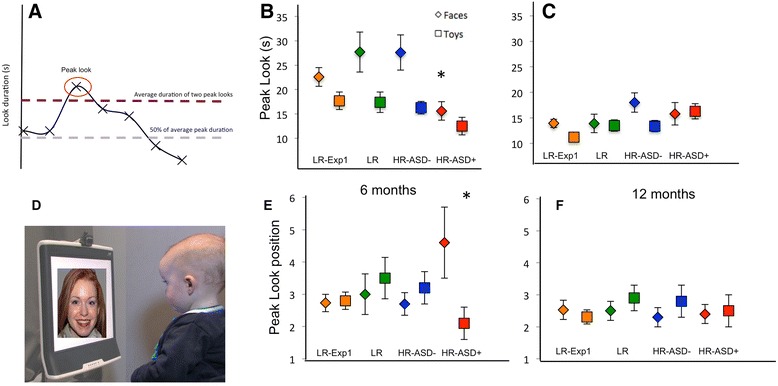
- At 6 months, infants with later ASD (ASD+ n = 9) had significantly shorter peak look durations during face and object habituation than ASD-Neg infants (n = 43; F(1,48) = 4.11, p = 0.04, η² = 0.08).
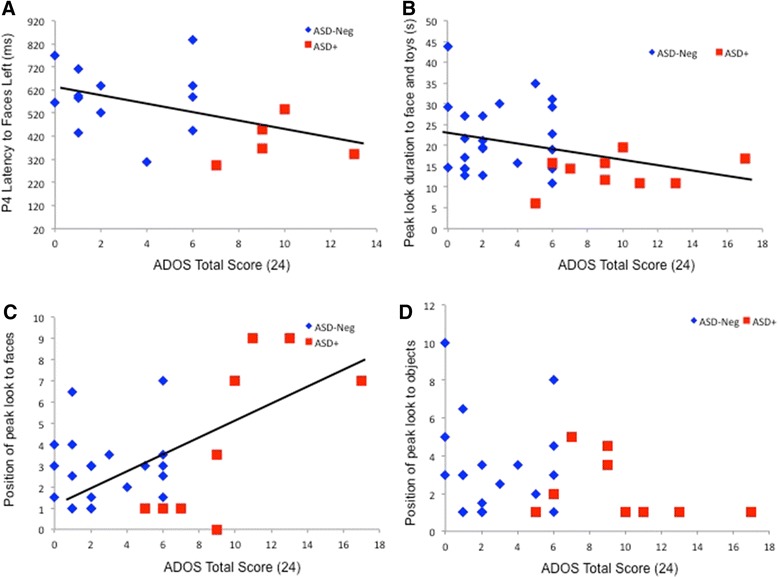
- At 6 months, the ASD+ group showed a later peak look to faces than the ASD-Neg group (F(1,50) = 3.97, p = 0.05, η² = 0.07), but not to objects; this delayed face peak look correlated with higher 24-month ADOS total scores (r(30) = 0.58, p = 0.001).
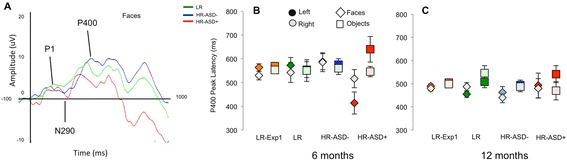
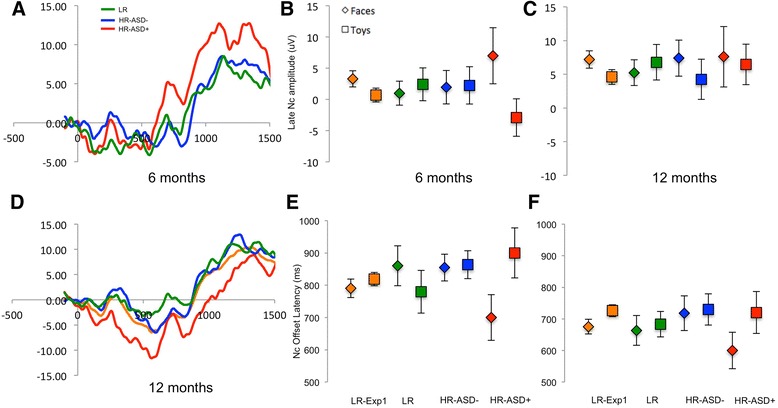
- At 6 months, the ASD+ group showed faster P400 latency to faces (F(1,29) = 5.74, p = 0.023, η² = 0.17), especially over the left hemisphere, and a smaller late Nc to faces versus objects (F(1,29) = 5.84, p = 0.022, η² = 0.17), plus a faster Nc offset to faces than objects (F(1,24) = 4.2, p = 0.05, η² = 0.15).
- These group differences were not significant at 12 months; a cluster analysis found 3 clusters, with cluster 3 (n = 6; 4 ASD+) showing no decrease in peak look duration and a later peak look to faces, and infants with ASD in cluster 3 had poorer Vineland socialization (F(1,8) = 15.9, p = 0.007, η² = 0.73) and higher ADOS total scores (F(1,8) = 6.23, p = 0.047, η² = 0.51) than those in cluster 2.
Methods
- Prospective longitudinal design: Experiment 1 provided normative data from 114 6-month-old and 104 12-month-old typically developing infants; Experiment 2 followed high-risk infants with an older sibling with ASD (n = 43) and low-risk infants (n = 45) at 6, 12, 18, and 24 months.
- ASD outcome at 24 months was determined by clinical best-estimate DSM-IV diagnosis; analyses compared infants who did (ASD+, n = 12) versus did not (ASD-Neg, n = 49) meet criteria, collapsed across risk groups.
- Measures included a visual habituation task with faces and objects (peak look duration, peak look position, dishabituation) and an ERP task to faces and objects (P400 latency/amplitude; Nc amplitude and duration), analyzed with repeated-measures ANOVAs, correlations, and cluster analysis.
Limitations
- The paper states that the relatively small number of children with later ASD in the ERP analyses is an important limitation, despite sufficient power to detect complementary 6-month effects.
- The paper states that the study used two-dimensional static screen-based stimuli, and it will be important to examine whether results generalize to more naturalistic live or dynamic social stimuli.
- The paper notes that diagnostic outcome was assessed at age 2 years and that diagnostic stability and symptom trajectories can change; also evident is that most low-risk controls did not receive an in-person 24-month assessment, with only a subset (n = 22) having follow-up questionnaire and 18-month clinical information.
Model-written summary. Check it against the paper before relying on it.
Integrity signals
Registry
Cites
Statistics
Figures
Verification
Claims the paper makes
19 Valid · 2 Not valid · 53 Not checked · 156 Own results and interpretations
At least one cited source doesn’t support this claim or points to a different paper, and none confirmed it — see the verdicts below.
In the paper
“Indeed two reports have observed greater attention to faces or eyes in the first 6 months in infants with later ASD relative to low-risk typically developing infants [11, 21].”
§ Reduced engagement with social stimuli in 6-month-old infants with later autism spectrum disorder: a longitudinal prospective study of infants at high familial risk > Discussion > Perceptual processing in ASD
What the sources say
- Not checked yetcites [11] Ozonoff S A prospective study of the emergence of early behavioral signs of autism J Am Acad Child Adolesc Psychiatry 2010 49 256 266 20410715 PMC2923050
- Disputedcites [21] Jones W & Klin A. Attention to eyes is present but in decline in 2-6-month-old infants later diagnosed with autism. Nature 2013; 504.7480; 427–431. PMC4035120 24196715 sourceExperimental — accuracy not yet measured
Our copy of Jones et al. (2013) studies exactly this contrast — eye fixation in the first 6 months in infants later diagnosed with ASD versus low-risk typically developing infants (Abstract p. 2: N=51 low-risk, TD group all from the low-risk cohort) — but reports the opposite direction: eye fixation declines at -4.8% per month in the later-ASD group while increasing at +3.6% per month in TD infants (Results, p. 4), and 'average levels of ASD eye looking ... appear to begin in the normative range' rather than above it (Results, p. 3; Abstract p. 1: eye looking 'is not immediately diminished ... instead, eye looking appears to begin at normative levels prior to decline'). The paper also found no between-group differences in overall levels of fixation or saccading (p. 4). Nothing in our copy supports 'greater attention to faces or eyes' in the later-ASD infants; the cited finding is a decline relative to low-risk TD controls. (LLM, conf=0.80)
Checked by a reasoning model — may be wrong.
plainstates an association- Asserted: passes — The authors put it forward as true.
- Checkable: passes — It can be checked against evidence.
- Load-bearing: unclear — It is unclear whether the paper’s conclusions depend on it.
- Based: passes — The paper gives a reason why it holds.
Every source the paper cites for this claim was checked and supports it.
In the paper
“Since infants with an older sibling with ASD have close to a 20 % risk of developing ASD themselves [7], researchers can examine the neural and cognitive precursors to symptom emergence by following a cohort of “infant siblings” from early infancy to early childhood.”
§ Reduced engagement with social stimuli in 6-month-old infants with later autism spectrum disorder: a longitudinal prospective study of infants at high familial risk > Background
What the sources say
- Supportedcites [7] Ozonoff S Recurrence risk for autism spectrum disorders: a Baby Siblings Research Consortium study Pediatrics 2011 128 e488 e495 21844053 PMC3164092 source
The Abstract/RESULTS (p. 1) of Ozonoff et al. (2011) report that 18.7% of the 664 infants followed prospectively from early life to 36 months, all of whom had at least one older biological sibling with ASD, developed ASD (95% CI: 13.34-25.5), and the Discussion (p. ~) restates this as '18.7% of infants with at least 1 older sibling with ASD developed the disorder.' 'Close to a 20% risk' is an accurate rounding/paraphrase of that figure; the paper's own conclusion is that this rate is substantially higher than prior 3-14% estimates. The remainder of the citing sentence (using infant siblings to study precursors) is the citing authors' framing, not attributed to this source. (LLM, conf=0.92)
plainstates an association- Asserted: passes — The authors put it forward as true.
- Checkable: passes — It can be checked against evidence.
- Load-bearing: passes — The paper’s conclusions depend on it.
- Based: passes — The paper gives a reason why it holds.
- Supported
The sources with a verdict support this claim; the rest weren’t checked yet, have no full text we could read, or their verdicts aren’t rated yet.
In the paper
“These early deficits may thus have cascading effects on social communication development.”
§ Reduced engagement with social stimuli in 6-month-old infants with later autism spectrum disorder: a longitudinal prospective study of infants at high familial risk > Background
What the sources say
- Supportedcites [13] Chevallier C Kohls G Troiani V Brodkin ES Schultz RT The social motivation theory of autism Trends Cogn Sci 2012 16 231 239 10.1016/j.tics.2012.02.007 22425667 PMC3329932 source
The Behavioral level section says early-onset impairments in social attention can deprive children of social learning experiences and further disrupt social skill development. The Conclusion explicitly describes cascading effects on the development of social cognitive skills. Together, these support the citing sentence’s hedged claim about social communication development. (LLM, conf=0.93)
- Not checked yetcites [14] Dawson G Meltzoff AN Osterling J Rinaldi J Brown E Children with autism fail to orient to naturally occurring social stimuli J Autism Dev Disord 1998 28 479 485 10.1023/A:1026043926488 9932234 source
- Not checked yetcites [15] Dawson G Webb SJ McPartland J Understanding the nature of face processing impairment in autism: insights from behavioral and electrophysiological studies Dev Neuropsychol 2005 27 403 424 10.1207/s15326942dn2703_6 15843104 source
- Not checked yetcites [16] Mundy P & Neal RA. in International review of research in mental retardation (ed. Laraine Masters Glidden) Volume 23, 139–168 (Academic Press, 2000). source
hedgedstates a possible cause- Asserted: passes — The authors put it forward as true.
- Checkable: passes — It can be checked against evidence.
- Load-bearing: passes — The paper’s conclusions depend on it.
- Based: passes — The paper gives a reason why it holds.
- Supported
The cited sources support only part of this claim — read each source’s verdict below.
In the paper
“In infancy, this component is sensitive to complex aspects of face processing.”
§ Reduced engagement with social stimuli in 6-month-old infants with later autism spectrum disorder: a longitudinal prospective study of infants at high familial risk > Background
What the sources say
- Supportedcites [43] de Haan M Pascalis O Johnson MH Specialization of neural mechanisms underlying face recognition in human infants J Cogn Neurosci 2002 14 199 209 10.1162/089892902317236849 11970786 source
The DISCUSSION (p. of the specialization discussion) states that although the infant N170 was unaffected by inversion, 'infants did process this information: The P400 following the N170 was larger for upright than inverted faces,' and that the infant P400 'displays some functional characteristics of the adult N170' (shorter latency for faces than objects, de Haan & Nelson, 1999), so it 'may in part reflect processes that at a later age are integrated into the N170.' The Results ('Upright') report the main effect of orientation on P400 amplitude, F(1,32) = 7.49, p = 0.01, with a Species × Orientation × Electrode interaction showing topographic differences for human versus monkey faces. Together these support the paraphrase that in infancy this later component is sensitive to aspects of face processing that in adults are carried by the specialized N170; the paper's own hedge applies to the developmental interpretation, not to the P400's sensitivity. (LLM, conf=0.80)
- Supportedcites [36] Elsabbagh M Infant neural sensitivity to dynamic eye gaze is associated with later emerging autism Curr Biol 2012 22 338 342 10.1016/j.cub.2011.12.056 22285033 PMC3314921 source
The Results and Discussion opening (p. null, 'Results and Discussion') states that 'The P1, N290, and the P400 components ... are modulated in a number of face-perception tasks, including tests of sensitivity to the direction of eye gaze in infants as young as four months', framed as precursors of the adult face-sensitive N170, and that the authors examined 'more general face-processing mechanisms' (static direct vs. averted gaze, face vs. visual noise) in 6-10 month-olds. Their own data bear this out: the 'Face-Related ERPs Distinguish Infants at Risk from the Control Group' section reports a significant P400 risk group x condition interaction to dynamic gaze shifts toward versus away, with effects extending to static gaze and face vs. noise (Figure S1; Table S1), and the 36-month section reports a higher infant P400 amplitude for gaze away versus toward in controls. Thus our copy treats the infant P400 as sensitive to multiple, non-trivial (gaze-direction/dynamic) aspects of face processing; the claim's vague 'complex aspects' is the only soft element and is consistent with the dynamic-gaze and face-vs-noise contrasts described. (LLM, conf=0.82)
- Partly supportedcites [41] Dawson G Neural correlates of face and object recognition in young children with autism spectrum disorder, developmental delay, and typical development Child Dev 2002 73 700 717 10.1111/1467-8624.00433 12038546 PMC3651041 sourceExperimental — accuracy not yet measured
Our copy's only infancy material on the P400 is in the INTRODUCTION, where it reports (crediting de Haan & Nelson, 1997, 1999) that in 6-month-olds the P400 'peaked earlier over posterior scalp locations for faces than for objects, suggesting a temporal advantage in processing faces over objects' — so the component does show face-related sensitivity in infancy, but only a face-versus-object timing distinction, and the same passage states that 'Differences in P400 amplitude were not found for familiar versus unfamiliar stimuli, however.' Nothing in our copy describes the infant P400 as sensitive to 'complex aspects' of face processing, and the paper's own P400 data (Results, 'Event-Related Potentials to Faces'; Table 4) come from 3- to 4-year-olds with ASD, developmental delay, or typical development, not from infancy. (LLM, conf=0.68)
- Not checked yetcites [44] de Haan M Nelson CA Brain activity differentiates face and object processing in 6-month-old infants Dev Psychol 1999 35 1113 1121 10.1037/0012-1649.35.4.1113 10442879 source
plainstates an association- Asserted: passes — The authors put it forward as true.
- Checkable: passes — It can be checked against evidence.
- Load-bearing: passes — The paper’s conclusions depend on it.
- Based: passes — The paper gives a reason why it holds.
- Supported
Every source the paper cites for this claim was checked and supports it.
In the paper
“For example, in typical development, the P400 is modulated by face inversion [43], dynamic gaze shifts [36], and peaks earlier and with smaller amplitude to faces than objects, consistent with greater attention capture or depth of processing by unfamiliar objects than faces in this age range [41, 44].”
§ Reduced engagement with social stimuli in 6-month-old infants with later autism spectrum disorder: a longitudinal prospective study of infants at high familial risk > Background
What the sources say
- Supportedcites [43] de Haan M Pascalis O Johnson MH Specialization of neural mechanisms underlying face recognition in human infants J Cogn Neurosci 2002 14 199 209 10.1162/089892902317236849 11970786 source
The Results section 'Upright' (p. ~5) reports a main effect of Orientation on P400 peak amplitude, F(1,32) = 7.49, p = 0.01, with larger P400 amplitudes for upright than inverted human and monkey faces, and the Discussion states 'The P400 following the N170 was larger for upright than inverted faces.' The summary paragraph likewise confirms 'a P400 was elicited that was influenced by stimulus inversion.' The sample is typically developing 6-month-old infants, matching the claim's 'typical development' framing. (LLM, conf=0.90)
plainstates an association- Asserted: passes — The authors put it forward as true.
- Checkable: passes — It can be checked against evidence.
- Load-bearing: passes — The paper’s conclusions depend on it.
- Based: passes — The paper gives a reason why it holds.
- Supported
95 more claims · 4 with their cited sources checked
Create a free account to see all 230 claims and to verify the 95 references still open.
- Probably not a substantial claim. 83
- It may state two separate claims as one. 65
- The quote only partly states this claim. 1
Claims other papers make about this one
Each is checked against this paper’s own text: does it say what the citing paper says it does?
The source backs part of the claim, not all of it — or backs it for a different population, condition or comparison.
In the citing paper
“Interestingly, results from MEG and EEG studies jointly point toward two physiological mechanisms of ASD: excitation/inhibition (E/I) imbalance and alteration of large-scale functional interactions of brain systems as quantified through connectivity analysis 110”
From Autism spectrum disorder (2020) · cites this paper as [110]
Experimental — accuracy not yet measured
Statistics that don’t add up
Each reported p-value recomputed from its test statistic and degrees of freedom, each partial η² from its F, and each ratio, mean difference or B printed with a p checked against its own confidence interval.
Rated major: it would touch a result — a value a result rests on, reported and recomputed p-values on opposite sides of the significance level, two passages that conflict with no sign which is right, or a cited work retracted before this paper was published.
In the paper
“χ2(50) = 14.3, p = 0.001”
§ Reduced engagement with social stimuli in 6-month-old infants with later autism spectrum disorder: a longitudinal prospective study of infants at high familial risk > Results > Habituation to faces and objects by ASD outcome
Reported p = .001 · recomputed p = 1.000
Rated minor: it would not touch a result — a value no result rests on, a p-value that stays on the same side of the significance level, or a conflict that is clerical, resolved elsewhere in the paper, or outside its own findings.
In the paper
“F(1,48) = 4.11, p = 0.04”
§ Reduced engagement with social stimuli in 6-month-old infants with later autism spectrum disorder: a longitudinal prospective study of infants at high familial risk > Results > Habituation to faces and objects by ASD outcome
Reported p = .04 · recomputed p = .048
Rated minor: it would not touch a result — a value no result rests on, a p-value that stays on the same side of the significance level, or a conflict that is clerical, resolved elsewhere in the paper, or outside its own findings.
In the paper
“F(1,8) = 15.9, p = 0.007”
§ Reduced engagement with social stimuli in 6-month-old infants with later autism spectrum disorder: a longitudinal prospective study of infants at high familial risk > Results > Habituation to faces and objects by ASD outcome
Reported p = .007 · recomputed p = .004
Rated minor: it would not touch a result — a value no result rests on, a p-value that stays on the same side of the significance level, or a conflict that is clerical, resolved elsewhere in the paper, or outside its own findings.
In the paper
“r(18) = −0.46, p = 0.05”
§ Reduced engagement with social stimuli in 6-month-old infants with later autism spectrum disorder: a longitudinal prospective study of infants at high familial risk > Results > Correlations with behavior
Reported p = .05 · recomputed p = .041
Rated minor: it would not touch a result — a value no result rests on, a p-value that stays on the same side of the significance level, or a conflict that is clerical, resolved elsewhere in the paper, or outside its own findings.
In the paper
“r(41) = 0.38, p = 0.014”
§ Reduced engagement with social stimuli in 6-month-old infants with later autism spectrum disorder: a longitudinal prospective study of infants at high familial risk > Results > Correlations within neural responses
Reported p = .014 · recomputed p = .012
4 more findings
Create a free account to see every finding of this check.
Statistics recomputed
Every reported test result, recomputed from its test statistic and degrees of freedom. A result shows as not adding up only once an independent check has confirmed it.
- Doesn’t add upχ²(50) = 14.3reported p = .001 · recomputed p = 1.000The two fall on opposite sides of .05
“χ2(50) = 14.3, p = .001”
- Doesn’t add upF(1, 104) = 9.9reported p < .001 · recomputed p = .002
“F(1,104) = 9.9, p < .001”
- Doesn’t add upr(41) = 0.38reported p = .014 · recomputed p = .012
“r(41) = 0.38, p = .014”
- Doesn’t add upF(1, 48) = 4.11reported p = .04 · recomputed p = .048
“F(1,48) = 4.11, p = .04”
- Doesn’t add upF(1, 8) = 4.53reported p = .06 · recomputed p = .066
“F(1,8) = 4.53, p = .06”
51 more recomputed tests
Create a free account to see every test the Stats check recomputed.
Self-check
Percentages, sums and reported differences re-computed from the paper’s own numbers.
Each contradiction between two passages listed here was confirmed by an independent check.
Rated minor: it would not touch a result — a value no result rests on, a p-value that stays on the same side of the significance level, or a conflict that is clerical, resolved elsewhere in the paper, or outside its own findings.
In the paper
“analysis showed significant differences in Vineland socialization scores (F(1,8) = 15.9, p = 0.007, η2 = 0.73) and ADOS total scores (F(1,8) = 6.23, p = 0.047, η2 = 0.51)”
§ Reduced engagement with social stimuli in 6-month-old infants with later autism spectrum disorder: a longitudinal prospective study of infants at high familial risk > Results > Habituation to faces and objects by ASD outcome
Reported 8 · recomputed 7
Rated minor: it would not touch a result — a value no result rests on, a p-value that stays on the same side of the significance level, or a conflict that is clerical, resolved elsewhere in the paper, or outside its own findings.
In the paper
§ Reduced engagement with social stimuli in 6-month-old infants with later autism spectrum disorder: a longitudinal prospective study of infants at high familial risk > Results > Neural responses to faces and objects by ASD Outcome
“As can be seen in Fig. 3f, the effects of Nc offset latency were not significant but were in the same direction at 12 months as 6 months”
§ Reduced engagement with social stimuli in 6-month-old infants with later autism spectrum disorder: a longitudinal prospective study of infants at high familial risk > Results > Neural responses to faces and objects by ASD Outcome
“f Mean amplitude of the late Nc component to faces or objects at 12 months.”
Rated minor: it would not touch a result — a value no result rests on, a p-value that stays on the same side of the significance level, or a conflict that is clerical, resolved elsewhere in the paper, or outside its own findings.
In the paper
“A chi-squared analysis showed that there was a significant difference between the number of children falling into the ASD+ and ASD-Neg groups across clusters (χ2(50) = 14.3, p = 0.001).”
§ Reduced engagement with social stimuli in 6-month-old infants with later autism spectrum disorder: a longitudinal prospective study of infants at high familial risk > Results > Habituation to faces and objects by ASD outcome
Reported 50 · recomputed 2
Rated minor: it would not touch a result — a value no result rests on, a p-value that stays on the same side of the significance level, or a conflict that is clerical, resolved elsewhere in the paper, or outside its own findings.
In the paper
§ Reduced engagement with social stimuli in 6-month-old infants with later autism spectrum disorder: a longitudinal prospective study of infants at high familial risk > Results > Neural responses to faces and objects by ASD Outcome
“late Nc amplitude (stimulus by group F(1,29) = 0.25, p = 0.62, η2 = 0.008; Fig. 3c)”
§ Reduced engagement with social stimuli in 6-month-old infants with later autism spectrum disorder: a longitudinal prospective study of infants at high familial risk > Results > Neural responses to faces and objects by ASD Outcome
“c Mean amplitude of the late Nc component to faces or objects at 6 months in the three groups (low-risk control, HR-ASD+, and HR ASD-Neg).”
Rated minor: it would not touch a result — a value no result rests on, a p-value that stays on the same side of the significance level, or a conflict that is clerical, resolved elsewhere in the paper, or outside its own findings.
In the paper
§ Reduced engagement with social stimuli in 6-month-old infants with later autism spectrum disorder: a longitudinal prospective study of infants at high familial risk > Results > Habituation to faces and objects by ASD outcome
“infants showed longer peak looks to faces than objects (F(1,50) = 4.13, p = 0.05, η2 = 0.08).”
§ Reduced engagement with social stimuli in 6-month-old infants with later autism spectrum disorder: a longitudinal prospective study of infants at high familial risk > Results > Habituation to faces and objects by ASD outcome
“main effect of outcome group: F(1,48) = 4.11, p = 0.04, η2 = 0.08”
Citations
Cites
Diagnostic and Statistical Manual of Mental Disorders
American Psychiatric Association (2013) · doi:10.1176/appi.books.9780890425596 · Cited by 116,369
The American Psychological Association
Langfeld, H. S. (1919) · Science · doi:10.1126/science.49.1254.51 · Cited by 7,475
Dawson, G., Rogers, S., Munson, J., Smith, M., Winter, J., Greenson, J., Donaldson, A., & Varley, J. (2010) · Pediatrics · doi:10.1542/peds.2009-0958 · Cited by 2,835
Self-citationThe social motivation theory of autism
Chevallier, C., Kohls, G., Troiani, V., Brodkin, E. S., & Schultz, R. T. (2012) · Trends in Cognitive Sciences · doi:10.1016/j.tics.2012.02.007 · Cited by 2,072 · cited 1×
“Social attention models of ASD propose that deficits in social attention and orienting begin to emerge in the second half of the first year of life, leading to reduced engagement with social stimuli, and thus reduced opportunities for social learning [13–16].”
BackgroundRankin, C. H., Abrams, T., Barry, R. J., Bhatnagar, S., Clayton, D. F., Colombo, J., Coppola, G., Geyer, M. A., Glanzman, D. L., Marsland, S., et al. (2009) · Neurobiology of Learning and Memory · doi:10.1016/j.nlm.2008.09.012 · Cited by 1,665 · cited 1×
“We used a reorient cue to maximize participant retention and to reduce the potential effect of differences in endogenous orienting on look spacing and habituation times [49]; for examples, see [50–53].”
MethodRecurrence Risk for Autism Spectrum Disorders: A Baby Siblings Research Consortium Study
Ozonoff, S., Young, G. S., Carter, A., Messinger, D., Yirmiya, N., Zwaigenbaum, L., Bryson, S., Carver, L. J., Constantino, J. N., Dobkins, K., et al. (2011) · Pediatrics · doi:10.1542/peds.2010-2825 · Cited by 1,429 · cited 1×
“Since infants with an older sibling with ASD have close to a 20 % risk of developing ASD themselves [7], researchers can examine the neural and cognitive precursors to * Correspondence: e.”
BackgroundDevelopment itself is the key to understanding developmental disorders
Karmiloff-Smith, A. (1998) · Trends in Cognitive Sciences · doi:10.1016/s1364-6613(98)01230-3 · Cited by 1,299
Attention to eyes is present but in decline in 2–6-month-old infants later diagnosed with autism
Jones, W., & Klin, A. (2013) · Nature · doi:10.1038/nature12715 · Cited by 1,293
Kuhl, P. K., Tsao, F.-M., & Liu, H.-M. (2003) · Proceedings of the National Academy of Sciences · doi:10.1073/pnas.1532872100 · Cited by 1,237 · cited 1×
“, [97, 98]).”
Children with Autism Fail to Orient to Naturally Occurring Social Stimuli
Dawson, G., Meltzoff, A. N., Osterling, J., Rinaldi, J., & Brown, E. (1998) · Journal of Autism and Developmental Disorders · doi:10.1023/a:1026043926488 · Cited by 1,065 · cited 1×
“Developmental decreases in allocation of attention to social stimuli in ASD could be a consequence of earlieremerging difficulties with processing social information [6, 14, 22].”
BackgroundSelf-citation
Research works printed but not linked: 3
- Robledo M, Deak GO & Kolling T. in Proceedings of the 32nd Annual Conference of the Cognitive Science Society 2482–2487 (Austin, TX: Cognitive Science Society, 2010).
- Colombo J, et al. in Infant pathways to language 143–168 (Hove, UK: Psychology Press, 2009).
- Barnes K, et al. One year old infants who develop autism symptoms show increased frontal brain activity while viewing nonsocial stimuli. Infancy (In press.).
Cited by
Lord, C., Brugha, T. S., Charman, T., Cusack, J., Dumas, G., Frazier, T., Jones, E. J. H., Jones, R. M., Pickles, A., State, M. W., et al. (2020) · Nature Reviews Disease Primers · doi:10.1038/s41572-019-0138-4 · Cited by 1,859
Self-citationToward Neurosubtypes in Autism
Hong, S.-J., Vogelstein, J. T., Gozzi, A., Bernhardt, B. C., Yeo, B. T. T., Milham, M. P., & Di Martino, A. (2020) · Biological Psychiatry · doi:10.1016/j.biopsych.2020.03.022 · Cited by 171
Toward a conceptual framework for early brain and behavior development in autism
Piven, J., Elison, J. T., & Zylka, M. J. (2017) · Molecular Psychiatry · doi:10.1038/mp.2017.131 · Cited by 163
Jones, E. J. H., Dawson, G., Kelly, J., Estes, A., & Webb, S. J. (2017) · Autism Research · doi:10.1002/aur.1754 · Cited by 151
“We have included data from the ControlCross and ControlLong groups in the figures to confirm the nature of normative performance on our battery; data from these groups have been previously published [Jones, Venema, Lowy, Earl, & Webb, 2015; Jones et al., 2016].”
InfluentialSelf-citationBast, N., Poustka, L., & Freitag, C. M. (2018) · European Journal of Neuroscience · doi:10.1111/ejn.13795 · Cited by 121
“Closing the loop, top-down signalling initiates a phasic alerting response with NE release (Kalwani et al., 2014) and transient spiking of LC activity (phasic LC–NE activity; Joshi et al., 2016; M€uckschel et al., 2016).”
BackgroundMethodInfluentialCortical responses before 6 months of life associate with later autism
Lloyd‐Fox, S., Blasi, A., Pasco, G., Gliga, T., Jones, E. J. H., Murphy, D. G. M., Elwell, C. E., Charman, T., Johnson, M. H., & the BASIS Team (2018) · European Journal of Neuroscience · doi:10.1111/ejn.13757 · Cited by 120
“Taken together with other recent findings in prospective infant-risk studies (Elsabbagh et al., 2012; Jones et al., 2016a), one possible explanation may be that the rapid temporal and high fidelity processing required by dynamic stimuli is affected in infants who go on to a later diagnosis.”
Self-citationFilial responses as predisposed and learned preferences: Early attachment in chicks and babies
Giorgio, E. D., Loveland, J. L., Mayer, U., Salva, O. R., Versace, E., & Vallortígara, G. (2016) · Behavioural Brain Research · doi:10.1016/j.bbr.2016.09.018 · Cited by 122
Prediction of autism in infants: progress and challenges
Dawson, G., Rieder, A. D., & Johnson, M. H. (2022) · The Lancet Neurology · doi:10.1016/s1474-4422(22)00407-0 · Cited by 152
Self-citationEGGER, H. L., Dawson, G., Hashemi, J., Carpenter, K. L. H., Espinosa, S., Campbell, K. M., Brotkin, S. M., Borg, J. S., Qiu, Q., Tepper, M., et al. (2018) · npj Digital Medicine · doi:10.1038/s41746-018-0024-6 · Cited by 125
“18,19 The order of the movie list on the app corresponded with the response rates: the greatest number of participants completing the movie at the top of the list (bubbles) and the least number of caregivers completing the last movie (songs/toys) in the list.”
BackgroundSelf-citationBrain and behavior development in autism from birth through infancy
Shen, M. D., & Piven, J. (2017) · Dialogues in Clinical Neuroscience · doi:10.31887/dcns.2017.19.4/mshen · Cited by 127
Face Perception and Learning in Autism Spectrum Disorders
Webb, S. J., Neuhaus, E., & Faja, S. (2017) · Quarterly Journal of Experimental Psychology · doi:10.1080/17470218.2016.1151059 · Cited by 113
Self-citationBraukmann, R., Lloyd‐Fox, S., Blasi, A., Johnson, M. H., Bekkering, H., Buitelaar, J. K., & Hunnius, S. (2017) · European Journal of Neuroscience · doi:10.1111/ejn.13751 · Cited by 92
“Our findings complement previous studies reporting early social processing differences in at-risk infants compared to typically developing controls (Elsabbagh et al., 2012; Lloyd-Fox et al., 2013; Jones et al., 2016).”
ResultVarcin, K. J., & Jeste, S. (2016) · Current Opinion in Psychiatry · doi:10.1097/yco.0000000000000312 · Cited by 99
Autism and Epilepsy in Patients With Tuberous Sclerosis Complex
Specchio, N., Pietrafusa, N., Trivisano, M., Moavero, R., De Palma, L., Ferretti, A., Vigevano, F., & Curatolo, P. (2020) · Frontiers in Neurology · doi:10.3389/fneur.2020.00639 · Cited by 75
“(50) 117 16 (14%) 2 (9) (n = 27%) 101 (86) 25 (93%) (n = 27) – – 14 (12%)”
BackgroundAutism Spectrum Disorder Symptoms in Infants with Fragile X Syndrome: A Prospective Case Series
Hogan, A. L., Caravella, K. E., Ezell, J. A., Rague, L., Hills, K. J., & Roberts, J. E. (2017) · Journal of Autism and Developmental Disorders · doi:10.1007/s10803-017-3081-9 · Cited by 86
“Potential markers identified in the first 12 months include a decline in eye fixation, reduced social gaze, disrupted attention to social stimuli, enhanced visual search abilities, and increased atypical vocalizations (Chawarska et al. 2013; Gliga et al. 2015; Jones et al. 2016; Jones and Klin 2013).”
BackgroundDigital Behavioral Phenotyping Detects Atypical Pattern of Facial Expression in Toddlers with Autism
Carpenter, K. L. H., Hahemi, J., Campbell, K. M., Lippmann, S., Baker, J. P., EGGER, H. L., Espinosa, S., Vermeer, S., Sapiro, G., & Dawson, G. (2020) · Autism Research · doi:10.1002/aur.2391 · Cited by 83
Self-citationJohnson, M. H., Charman, T., Pickles, A. R., & Jones, E. J. H. (2021) · Journal of Child Psychology and Psychiatry · doi:10.1111/jcpp.13372 · Cited by 88
“…2013), a declining trajectory of face looking from 6 to 24 months (Ozonoff et al., 2010), reduced sensitivity of the temporal lobe to dynamic social stimuli at 5 months (Lloyd-Fox et al., 2018) and altered neural processing of faces at 6 to 10 months (Elsabbagh et al., 2012; Jones et al., 2016).”
Self-citationJones, E. J. H., Dawson, G., & Webb, S. J. (2017) · Developmental Cognitive Neuroscience · doi:10.1016/j.dcn.2017.04.001 · Cited by 74
Self-citationMoavero, R., Benvenuto, A., Emberti Gialloreti, L., Siracusano, M., Kotulska, K., Weschke, B., Riney, K., Jansen, F., Feucht, M., Krsek, P., et al. (2019) · Journal of Clinical Medicine · doi:10.3390/jcm8060788 · Cited by 66
“In the last five years, some longitudinal studies have explored the early emerging symptoms and prompt intervention in infants with high familial risk for ASD [12,13].”
BackgroundDevelopment of attention from birth to 5 months in infants at risk for autism spectrum disorder
Bradshaw, J. L., Klin, A. J., Evans, L. M., Klaiman, C., Saulnier, C. A., & McCracken, C. (2019) · Development and Psychopathology · doi:10.1017/s0954579419000233 · Cited by 74
“Deeper levels of attention, such as sustained attention and sensitization to social stimuli, have also been found to be reduced in 6-month-olds later diagnosed with ASD (Jones et al., 2016).”
BackgroundWebb, S. J., Shic, F., Murias, M., Sugar, C. A., Naples, A. J., Barney, E. C., Borland, H., Hellemann, G. S., Johnson, S. P., Kim, M., et al. (2020) · Frontiers in Integrative Neuroscience · doi:10.3389/fnint.2019.00071 · Cited by 68
Self-citationVernetti, A., Senju, A., Charman, T., Johnson, M. H., & Gliga, T. (2017) · Developmental Cognitive Neuroscience · doi:10.1016/j.dcn.2017.08.004 · Cited by 72
“However, in contrast to typical orienting mechanisms, other work points to atypical processing of social information in the early development of infants that later receive a diagnosis of ASD (e.g. Elsabbagh et al., 2013; Jones et al., 2016).”
ResultEarly development of infants with neurofibromatosis type 1: a case series
the EDEN-BASIS Team+, Kolesnik, A., Jones, E. J. H., Garg, S., Green, J., Charman, T., & Johnson, M. H. (2017) · Molecular Autism · doi:10.1186/s13229-017-0178-0 · Cited by 60
“although neurocognitive measures reveal subtle vulnerabilities in social engagement [14], response to eye gaze [15], and declining interest in eyes [16].”
BackgroundSelf-citationEurosibs: Towards robust measurement of infant neurocognitive predictors of autism across Europe
Jones, E. J. H., Mason, L., Ali, J. B., van den Boomen, C., Braukmann, R., Cauvet, É., Demurie, E., Hessels, R. S., Ward, E. K., Hunnius, S., et al. (2019) · Infant Behavior and Development · doi:10.1016/j.infbeh.2019.03.007 · Cited by 59
Self-citationReisinger, D. L., Shaffer, R. C., Horn, P. S., Hong, M. P., Pedapati, E. V., Dominick, K. C., & Erickson, C. A. (2020) · Frontiers in Integrative Neuroscience · doi:10.3389/fnint.2019.00076 · Cited by 57
The Bidirectional Social-Cognitive Mechanisms of the Social-Attention Symptoms of Autism
Mundy, P. C., & Bullen, J. C. (2022) · Frontiers in Psychiatry · doi:10.3389/fpsyt.2021.752274 · Cited by 61
“Recent studies have also confirmed that data from experimental social orienting and joint attention measures display convergent validity, or significant correlations with structured clinical observations of social attention on SA scale of the ADOS-2 in studies of infants (21, 61, 62).”
BackgroundClinical and Translational Implications of an Emerging Developmental Substructure for Autism
Constantino, J. N., Charman, T., & Jones, E. J. H. (2021) · Annual Review of Clinical Psychology · doi:10.1146/annurev-clinpsy-081219-110503 · Cited by 60
“…of the reductions in social engagement discussed above (Klin et al. 2015); alternatively, they may arise from difficulties in sensory processing of specific perceptual features like structural details of the face ( Jones et al. 2016) or syllables within language streams (Seery et al. 2013).”
BackgroundResultInfluentialSelf-citationShephard, E., Milosavljevic, B., Mason, L., Elsabbagh, M., Tye, C., Gliga, T., Jones, E. J. H., Charman, T., Johnson, M. H., Baron‐Cohen, S., et al. (2020) · Cortex · doi:10.1016/j.cortex.2020.02.008 · Cited by 53
“…indicative of reduced attention to face stimuli have also been reported in the first year of life, although these were restricted to high-risk infants who later (at age 2 years) met diagnostic criteria for ASD and were not present in high-risk infants without later ASD (Jones et al., 2016).”
InfluentialSelf-citationMacari, S. L., Milgramm, A., Reed, J., Shic, F., Powell, K. K., Macris, D. M., & Chawarska, K. (2020) · Journal of the American Academy of Child & Adolescent Psychiatry · doi:10.1016/j.jaac.2019.12.012 · Cited by 53
Huberty, S., Leno, V. C., van Noordt, S. J. R., Bedford, R., Pickles, A. R., Desjardins, J. A., Webb, S. J., The BASIS Team, & Elsabbagh, M. (2021) · Autism Research · doi:10.1002/aur.2518 · Cited by 44
“Each contributing site has published data from origin studies (Elsabbagh et al., 2012; Orekhova et al., 2014; Gabard-Durnam et al., 2019; Levin et al., 2017; Righi et al., 2014; Tierney et al., 2012; Jones et al., 2015; Jones et al., 2016; Jones, Dawson, et al., 2017; Jones, Venema, et al., 2017), as well as contribut…”
BackgroundSelf-citationStratifying the autistic phenotype using electrophysiological indices of social perception
Mason, L., Moessnang, C., Chatham, C., Ham, L. M., Tillmann, J., Dumas, G., Ellis, C. L., Leblond, C. S., Cliquet, F., Bourgeron, T., et al. (2022) · Science Translational Medicine · doi:10.1126/scitranslmed.abf8987 · Cited by 52
“If so, our results may indicate some very early-stage alteration in face processing systems that could compromise subsequent social development (54, 55).”
ResultSelf-citationInfant social attention: an endophenotype of ASD ‐related traits?
Jones, E. J. H., Venema, K., Earl, R. K., Lowy, R., & Webb, S. J. (2016) · Journal of Child Psychology and Psychiatry · doi:10.1111/jcpp.12650 · Cited by 45
“Based on previous work (Elsabbagh et al., 2012; Jones et al., 2016), we predicted that infants with parents with lower social motivation would show a more negative P400 face/object difference for latency (faster response to faces) and a more negative P400 face/object difference for amplitude (smaller response to faces…”
InfluentialSelf-citationLook duration at the face as a developmental endophenotype: elucidating pathways to autism and ADHD
Gui, A., Mason, L., Gliga, T., Hendry, A. J., Ali, J. B., Pasco, G., Shephard, E., Curtis, C. J. C., Charman, T., Johnson, M. H., et al. (2020) · Development and Psychopathology · doi:10.1017/s0954579420000930 · Cited by 46
“Peak look durations were averaged across the trials to provide a more stable characterization of individual differences (Colombo & Mitchell, 1990; Wass, 2014), and following previous research (Hendry et al., 2018; Jones et al., 2016).”
Self-citationAttentive brain states in infants with and without later autism
Gui, A., Bussu, G., Tye, C., Elsabbagh, M., Pasco, G., Charman, T., Johnson, M. H., & Jones, E. J. H. (2021) · Translational Psychiatry · doi:10.1038/s41398-021-01315-9 · Cited by 40
Self-citationAlvari, G., Furlanello, C., & Venuti, P. (2021) · Journal of Clinical Medicine · doi:10.3390/jcm10081776 · Cited by 42
“However, there is limited knowledge about primary components that precede the progressive failure in developing adequate socio-communicative skills in ASD [30].”
BackgroundInfluentialBovery, M. D. M. J., Dawson, G., Hashemi, J., & Sapiro, G. (2019) · IEEE Transactions on Affective Computing · doi:10.1109/taffc.2018.2890610 · Cited by 42
Self-citationSaccade dysmetria indicates attenuated visual exploration in autism spectrum disorder
Bast, N., Mason, L., Freitag, C. M., Smith, T. J., Portugal, A. M., Poustka, L., Banaschewski, T., Johnson, M. H., & The EU‐AIMS LEAP Group (2020) · Journal of Child Psychology and Psychiatry · doi:10.1111/jcpp.13267 · Cited by 40
“, 2017), which has been established as predictor of ASD diagnosis (Jones et al., 2016).”
Ayoub, M. J., Keegan, L., Tager-Flusberg, H. B., & Gill, S. V. (2022) · Brain Sciences · doi:10.3390/brainsci12050602 · Cited by 38
“, less sustained) Nc responses to faces [61].”
BackgroundComparing virtual vs real faces expressing emotions in children with autism: An eye-tracking study
Pino, M. C., Vagnetti, R., Valenti, M., & Mazza, M. (2021) · Education and Information Technologies · doi:10.1007/s10639-021-10552-w · Cited by 39
Clairmont, C. D., Wang, J., Tariq, S., Sherman, H. T., Zhao, M., & Kong, X. (2022) · Frontiers in Neuroscience · doi:10.3389/fnins.2021.812946 · Cited by 47
Social attention: What is it, how can we measure it, and what can it tell us about autism and ADHD?
Braithwaite, E., Gui, A., & Jones, E. J. H. (2020) · Progress in brain research · doi:10.1016/bs.pbr.2020.05.007 · Cited by 39
Self-citationAbnormal visual attention to simple social stimuli in 4-month-old infants at high risk for Autism
Giorgio, E. D., Salva, O. R., Frasnelli, E., Calcagnì, A., Lunghi, M., Scattoni, M. L., Simion, F., & Vallortígara, G. (2021) · Scientific Reports · doi:10.1038/s41598-021-95418-4 · Cited by 31
Neuroimaging Markers of Risk and Pathways to Resilience in Autism Spectrum Disorder
Molnar-Szakacs, I., Kupis, L. B., & Uddin, L. Q. (2020) · Biological Psychiatry Cognitive Neuroscience and Neuroimaging · doi:10.1016/j.bpsc.2020.06.017 · Cited by 31
“, 2016 (41) 88(43, 45) 6–24 EEG EEG responses to social stimuli Social outcomes US/not reported Longitudinal**”
BackgroundUnderstanding the nature of face processing in early autism: A prospective study.
Tye, C., BASIS team, Bussu, G., Gliga, T., Elsabbagh, M., Pasco, G., Johnsen, K., Charman, T., Jones, E. J. H., Buitelaar, J. K., et al. (2022) · Journal of Psychopathology and Clinical Science · doi:10.1037/abn0000648 · Cited by 33
“The reduced N290 latency difference between the social versus nonsocial stimuli in EL-ASD is in line with previous studies of EL siblings (E. Jones et al., 2016), and in the comparison of familiar and unfamiliar faces (Dawson et al., 2002; Key & Stone, 2012).”
BackgroundResultSelf-citationvan Noordt, S. J. R., Desjardins, J. A., Huberty, S., Abou-Abbas, L., Webb, S. J., Levin, A. R., Segalowitz, S. J., Evans, A. C., & Elsabbagh, M. (2020) · Molecular Medicine · doi:10.1186/s10020-020-00149-3 · Cited by 31
“Channels in grey were taken from selection used in Jones et al. (2016).”
MethodSelf-citationIsaev, D., Major, S. T., Murias, M., Carpenter, K. L. H., Carlson, D., Sapiro, G., & Dawson, G. (2020) · Scientific Reports · doi:10.1038/s41598-020-57902-1 · Cited by 25
Self-citationDisruptions of the Meshed Architecture in Autism Spectrum Disorder
Gallagher, S., Sparaci, L., & Varga, S. (2022) · Psychoanalytic Inquiry · doi:10.1080/07351690.2022.2007032 · Cited by 25
“Longitudinal studies of infant siblings who are at heightened risk (HR) for ASD are of particular relevance; not only because they allow for the unpacking of complex patterns of social behavior, but also because they support outlines of how symptoms emerge and develop from early ages (Jones et al., 2016; Rogers, 2009).”
BackgroundAtypical Value-Driven Selective Attention in Young Children With Autism Spectrum Disorder
Wang, Q., Chang, J. T., & Chawarska, K. (2020) · JAMA Network Open · doi:10.1001/jamanetworkopen.2020.4928 · Cited by 26
Autism Spectrum Disorder in Children: Early Signs and Therapeutic Interventions
Abualait, T., Alabbad, M., Kaleem, I., Imran, H., Khan, H. R., Kiyani, M. M., & Bashir, S. (2024) · Children · doi:10.3390/children11111311 · Cited by 47
Heart rate-defined sustained attention in infants at risk for autism
Tonnsen, B. L., Richards, J. E., & Roberts, J. E. (2018) · Journal of Neurodevelopmental Disorders · doi:10.1186/s11689-018-9224-2 · Cited by 25
“differences were no longer significant at 12 months [42].”
Social endophenotypes in autism spectrum disorder: A scoping review
Tiede, G., & Walton, K. M. (2020) · Development and Psychopathology · doi:10.1017/s0954579420000577 · Cited by 22
“Several other groups report that vulnerable infants without ASD outcomes perform similarly to low-risk infants on both behavioral (Chawarska, Macari, & Shic, 2013) and neural (Jones et al., 2016) measures of attention to social scenes, whereas only vulnerable infants with ASD outcomes show aberrant responding.”
BackgroundImpaired Value Learning for Faces in Preschoolers With Autism Spectrum Disorder
Wang, Q., DiNicola, L. M., Heymann, P., Hampson, M., & Chawarska, K. (2017) · Journal of the American Academy of Child & Adolescent Psychiatry · doi:10.1016/j.jaac.2017.10.014 · Cited by 22
Genetics, molecular control and clinical relevance of habituation learning
Blok, L. E. R., Boon, M., van Reijmersdal, B., Höffler, K. D., Fencková, M., & Schenck, A. (2022) · Neuroscience & Biobehavioral Reviews · doi:10.1016/j.neubiorev.2022.104883 · Cited by 26
Hopkins, W. D., Mulholland, M. M., Reamer, L. A., Mareno, M. C., & Schapiro, S. J. (2020) · Scientific Reports · doi:10.1038/s41598-020-64051-y · Cited by 21
Kaliukhovich, D. A., Manyakov, N. V., Bangerter, A., Ness, S. L., Skalkin, A., Goodwin, M. S., Dawson, G., Hendren, R. L., LEVENTHAL, B. L., Hudac, C. M., et al. (2020) · Molecular Autism · doi:10.1186/s13229-020-00388-5 · Cited by 25
Self-citationLorenzo, R. D., van den Boomen, C., Kemner, C., & Junge, C. (2020) · Developmental Cognitive Neuroscience · doi:10.1016/j.dcn.2020.100840 · Cited by 23
Lorenzo, R. D., Munsters, N. M., Ward, E. K., de Jonge, M. V., Kemner, C., & van den Boomen, C. (2020) · Journal of Autism and Developmental Disorders · doi:10.1007/s10803-020-04560-x · Cited by 19
Babu, P. R. K., Aikat, V., Martino, J. M. D., Chang, Z., Perochon, S., Espinosa, S., Aiello, R. E., Carpenter, K. L. H., Compton, S. N., Davis, N. O., et al. (2023) · Scientific Reports · doi:10.1038/s41598-023-34293-7 · Cited by 23
Self-citationPuppets facilitate attention to social cues in children with ASD
Macari, S. L., Chen, X., Brunissen, L., Yhang, E., Brennan‐Wydra, E., Vernetti, A., Volkmar, F. R., Chang, J. T., & Chawarska, K. (2021) · Autism Research · doi:10.1002/aur.2552 · Cited by 33
English, M. S., Tenenbaum, E. J., Levine, T. P., Lester, B. M., & Sheinkopf, S. J. (2018) · Journal of Autism and Developmental Disorders · doi:10.1007/s10803-018-3788-2 · Cited by 21
Gui, A., Jones, E. J. H., Wong, C. C. Y., Meaburn, E. L., Xia, B., Pasco, G., Lloyd‐Fox, S., Charman, T., Bolton, P., & Johnson, M. H. (2020) · Infant Behavior and Development · doi:10.1016/j.infbeh.2019.101409 · Cited by 20
Self-citationHaartsen, R., Mason, L., Braithwaite, E., Bianco, T. D., Johnson, M. H., & Jones, E. J. H. (2021) · Developmental Psychobiology · doi:10.1002/dev.22157 · Cited by 15
“First, traditional ERP paradigms with infants and toddlers are often associated with high dropout rates with a range of 21%–50% (De Haan et al., 2002; Halit et al., 2003; Jones et al., 2016; Stets et al., 2012; van der Velde& Junge, 2020;Webb et al., 2011).”
BackgroundSelf-citationBussu, G., Llera, A., Jones, E. J. H., Tye, C., Charman, T., Johnson, M. H., Beckmann, C. F., & Buitelaar, J. K. (2021) · Journal of Psychiatry and Neuroscience · doi:10.1503/jpn.190148 · Cited by 18
Self-citationGeng, X., Kang, X., & Wong, P. C. M. (2020) · Progress in molecular biology and translational science · doi:10.1016/bs.pmbts.2020.04.015 · Cited by 18
Neural mechanisms of language development in infancy
Huberty, S., O’Reilly, C., Leno, V. C., Steiman, M., Webb, S. J., Elsabbagh, M., & The BASIS Team (2023) · Infancy · doi:10.1111/infa.12540 · Cited by 20
“21 of the participants received a diagnosis of ASD (12 males, 9 females) 1 based on 24-or 36-month ADOS assessment and clinical judgment (Jones et al., 2016; Orekhova et al., 2014).”
Self-citationMessina, A., Sovrano, V. A., Baratti, G., Musa, A., Gobbo, A., Adiletta, A., & Sgadó, P. (2024) · Scientific Reports · doi:10.1038/s41598-024-54356-7 · Cited by 14
Can stratification biomarkers address the heterogeneity of autism spectrum disorder?
Molloy, C. J., & Gallagher, L. (2021) · Irish Journal of Psychological Medicine · doi:10.1017/ipm.2021.73 · Cited by 17
“Differences in electrophysiological responses to faces have also been reported in infants with high familial likelihood that subsequently go on to develop autism (Jones et al. 2016).”
BackgroundHaartsen, R., Charman, T., Pasco, G., Johnson, M. H., Jones, E. J. H., The BASIS Team, Baron‐Cohen, S., Bedford, R., Blasi, A., Bolton, P., et al. (2022) · Scientific Reports · doi:10.1038/s41598-022-24870-7 · Cited by 17
Self-citationvan Noordt, S. J. R., Desjardins, J. A., The BASIS Team, & Elsabbagh, M. (2022) · Autism Research · doi:10.1002/aur.2701 · Cited by 16
“A bilateral posterior regionof-interest was used and corresponded to locations previously used for ERP analyses in this sample (see Figure 1) and in other studies on face processing in ASD (Elsabbagh et al., 2012; Guy et al., 2018; Jones et al., 2016; Key & Stone, 2012; Luyster et al., 2014).”
MethodInfant sustained attention differs by context and social content in the first 2 years of life
Bradshaw, J. L., Fu, X., & Richards, J. E. (2024) · Developmental Science · doi:10.1111/desc.13500 · Cited by 17
“Jones et al. (2016) noted that infants later diagnosed with ASD show disrupted SA to social stimuli at 6 months of age, but not at 12 months.”
Robain, F., Kojovic, N., Solazzo, S., Glaser, B., Franchini, M., & Schaer, M. (2021) · BMC Psychology · doi:10.1186/s40359-021-00553-2 · Cited by 19
Whittingham, K., McGlade, A., Kulasinghe, K., Mitchell, A. E., Heussler, H., & Boyd, R. N. (2020) · BMJ Open · doi:10.1136/bmjopen-2019-034315 · Cited by 16
Measuring social orienting in preschoolers with autism spectrum disorder using cartoons stimuli
Robain, F., Godel, M., Kojovic, N., Franchini, M., Journal, F., & Schaer, M. (2022) · Journal of Psychiatric Research · doi:10.1016/j.jpsychires.2022.10.039 · Cited by 13
Understanding the nature of face processing in early autism: A prospective studyPreprint
Tye, C., Bussu, G., Gliga, T., Elsabbagh, M., Pasco, G., Johnsen, K., Charman, T., Jones, E. J. H., Buitelaar, J. K., Johnson, M. H., et al. (2020) · medRxiv · doi:10.1101/2020.05.06.20092619 · Cited by 10
Self-citationA Developmental Social Neuroscience Perspective on Infant Autism Interventions
Dawson, G., Rieder, A. D., & Johnson, M. H. (2023) · Annual Review of Developmental Psychology · doi:10.1146/annurev-devpsych-120621-042753 · Cited by 15
“…(EEG) spectral power densities and microstates, and near-infrared spectroscopy, have identified reduced responsiveness to faces in infants later diagnosed with autism (Gui et al. 2021a, 2021b; van Noordt et al. 2022), evident by 4–6 months of age (Jones et al. 2016, Lloyd-Fox et al. 2018).”
InfluentialSelf-citationMulti-site EEG studies in early infancy: Methods to enhance data quality
Dickinson, A. H., Booth, M., Daniel, M., Campbell, A., Miller, N. C., Lau, B. K., Zempel, J. M., Webb, S. J., Elison, J. T., Lee, A. K. C., et al. (2024) · Developmental Cognitive Neuroscience · doi:10.1016/j.dcn.2024.101425 · Cited by 9
“…in spectral power and connectivity during the first year of life that precede ASD diagnosis or its associated behavioral symptoms (Dickinson et al., 2020; Gabard-Durnam et al., 2019; Haartsen et al., 2019; Jones et al., 2016; Orekhova et al., 2014; Peck et al., 2021; Righi et al., 2014).”
BackgroundSelf-citationBruce, M. D., Panneton, R., & Taylor, C. (2021) · Journal of Experimental Child Psychology · doi:10.1016/j.jecp.2021.105304 · Cited by 13
Zivan, M., Morag, I., Yarmolovsky, J., & Geva, R. (2021) · Frontiers in Psychiatry · doi:10.3389/fpsyt.2021.646838 · Cited by 10
The Dynamics of Looking and Smiling Differ for Young Infants at Elevated Likelihood for ASD
Yurkovic‐Harding, J., & Bradshaw, J. L. (2024) · Infancy · doi:10.1111/infa.12646 · Cited by 9
Walsh, Ó., Linehan, C., & Ryan, C. (2025) · Journal of Autism and Developmental Disorders · doi:10.1007/s10803-025-06869-x · Cited by 10
The developing visual system: A building block on the path to autism
Girault, J. B. (2025) · Developmental Cognitive Neuroscience · doi:10.1016/j.dcn.2025.101547 · Cited by 7
“…ASD and HL infants (Bradshaw et al., 2022b, 2019; Giorgio et al., 2021, 2016; Jones and Klin, 2013), with differences that are prominent and detectable across multiple cohorts by approximately 6 months of age (Chawarska et al., 2013; Elison et al., 2013a; Jones et al., 2016; Jones and Klin, 2013).”
Doyle, F. L., Diaz, A. M., Eapen, V., Frick, P. J., Kimonis, E. R., Hawes, D. J., Moul, C., Richmond, J. L., Mehta, D., Sareen, S., et al. (2020) · Frontiers in Psychiatry · doi:10.3389/fpsyt.2020.00553 · Cited by 8
Ward, E. K., Braukmann, R., Buitelaar, J. K., & Hunnius, S. (2020) · Journal of Abnormal Psychology · doi:10.1037/abn0000518 · Cited by 8
Sensitivity to vocal emotions emerges in newborns at 37 weeks gestational age
Hou, X., Zhang, P., Mo, L., Peng, C., & Zhang, D. (2024) · eLife · doi:10.7554/elife.95393 · Cited by 11
Riva, V., Riboldi, E. M., Urbani, B., Molteni, M., & Villa, L. M. (2021) · Brain Sciences · doi:10.3390/brainsci11111381 · Cited by 6
“In typically developing children, the ability to imitate, initiate, or respond to bids for joint attention is a developmental milestone that appears between the ages of 8 and 15 months [21].”
BackgroundFraile, M., Fawcett, C. A., Lindblad, J., Sladoje, N., & Castellano, G. (2022) · INTERNATIONAL CONFERENCE ON MULTIMODAL INTERACTION · doi:10.1145/3536221.3556629 · Cited by 6
Intrinsic Functional Connectivity Alterations of the Fusiform Face Area in Autism Spectrum Disorder
Kleinhans, N. M., Larsen, S. F., Estes, A. M., & Aylward, E. (2025) · NeuroSci · doi:10.3390/neurosci6020029 · Cited by 8
“Social deficits in ASD may be mediated by abnormalities in face processing, which emerge during infancy [1,2].”
Self-citationBrain-wide electrical dynamics encode an appetitive socioemotional statePreprint
Mague, S. D., Talbot, A., Blount, C., Duffney, L. J., Walder-Christensen, K. K., Adamson, E., Bey, A. L., Ndubuizu, N., Thomas, G. E., Hughes, D. N., et al. (2020) · bioRxiv (Cold Spring Harbor Laboratory) · doi:10.1101/2020.07.01.181347 · Cited by 8
“For example, high‐risk infants who later develop ASD show atypical neural responses when viewing face stimuli and dynamic complex social stimuli (Jones et al., 2016), and EEG studies demonstrate impaired face and facial affect processing in children and adults with ASD (Dawson et al.”
BackgroundWang, B. M., Mills, Z., Jones, H. F., Montgomery, J. M., & Lee, K. Y. (2025) · Journal of Neurochemistry · doi:10.1111/jnc.70088 · Cited by 8
Srishyla, D., Webb, S. J., Elsabbagh, M., O’Reilly, C., & The BASIS Team (2024) · Journal of Neuroscience Methods · doi:10.1016/j.jneumeth.2025.110405 · Cited by 7
Self-citationNeurodevelopmental trajectories of face processing in infants: A review and future directions
Stavropoulos, K. K. M., & Ryczek, C. A. (2025) · Infant Behavior and Development · doi:10.1016/j.infbeh.2025.102132 · Cited by 6
Early development of social attention in toddlers at high familial risk for autism spectrum disorder
Hu, Y., Xiong, Q., Wang, Q., Song, C., Wang, D., Lu, H., Shi, W., Han, Y., Liu, J., Li, X., et al. (2021) · Infant Behavior and Development · doi:10.1016/j.infbeh.2021.101662 · Cited by 4
Fu, X., Platt, E., Shic, F., & Bradshaw, J. L. (2024) · Journal of Autism and Developmental Disorders · doi:10.1007/s10803-024-06360-z · Cited by 5
“This finding aligns with existing evidence indicating that EL infants later diagnosed with ASD exhibited disrupted social attention (Chawarska et al., 2013; Jones et al., 2016; Jones & Klin, 2013).”
EEG Biomarkers for Autism: Rational, Support, and the Qualification Process
Hudac, C. M., & Webb, S. J. (2024) · Advances in neurobiology · doi:10.1007/978-3-031-69491-2_19 · Cited by 9
Self-citationIdentifying phenotypic and physiological subgroups of preschoolers with autism spectrum disorder
Bazelmans, T., Jones, E. J. H., Ghods, S. S., Corrigan, S., Toth, K., Charman, T., & Webb, S. J. (2021) · Psychological Medicine · doi:10.1017/s0033291721003172 · Cited by 6
Self-citationEstrin, G. L., Bhavnani, S., Goodwin, A., Arora, R., Divan, G., Haartsen, R., Mason, L., Patel, V., Johnson, M. H., & Jones, E. J. H. (2022) · Wellcome Open Research · doi:10.12688/wellcomeopenres.17334.1 · Cited by 8
Self-citationKuang, C., Chen, F., Yan, J., & Peng, G. (2025) · Journal of Autism and Developmental Disorders · doi:10.1007/s10803-025-06775-2 · Cited by 3
“…2 and 6 months (Jones & Klin, 2013), reduced face looking from 6 to 24 months (Ozonoff et al., 2010), diminished temporal lobe sensitivity to social stimuli at 5 months (Lloyd-Fox et al., 2018), and altered neural processing of faces from 6 to 10 months (Elsabbagh et al., 2012; Jones et al., 2016).”
Mottron, L., Desrosiers, J., McGuire, O. L., Lestage, G., Krikorian, A.-L., Ostrolenk, A., & Gagnon, D. (2026) · Autism & Developmental Language Impairments · doi:10.1177/23969415261454212 · Cited by 3
“…the earliest signs associated with a later diagnosis in cohorts of at-risk infants are prolonged fi xation on objects, or “ sticky gaze ” (Elsabbagh et al., 2011), and atypical object exploration at 12 months of age (Cheung et al., 2018; Gliga et al., 2015; Jones et al., 2016; Ozonoff et al., 2008).”
Chen, J., Wei, Z., Xu, C., Peng, Z., Yang, J., Wan, G., Chen, B., Gong, J., & Zhou, K. (2023) · Frontiers in Psychiatry · doi:10.3389/fpsyt.2023.1132284 · Cited by 3
“Meanwhile, reduced visual preference for social stimuli can further exacerbate symptoms (69).”
BackgroundSaint‐Georges, C., & Ouss, L. (2022) · Cahiers de PréAut · doi:10.3917/capre1.018.0029 · Cited by 3
Metadata
- Authors
- Jones, E. J. H., Venema, K., Earl, R., Lowy, R., Barnes, K., Estes, A., Dawson, G., & Webb, S. J.
- Affiliations
- University of London (GB)
- University of Washington (US)
- Seattle Children's Hospital (US)
- Duke University (US)
- Corresponding author
- Jones, E. J. H.
- Webb, S. J.
- Venue
- Journal of Neurodevelopmental Disorders
- Published
- 2016-03-15
- Volume
- 8
- Issue
- 1
- Pages
- 7-7
- ISSN
- 1866-1947 (ISSN-L)
- 1866-1955
- PMC
- PMC4791854
- OpenAlex
- W2300306554
- Semantic Scholar
- d3facb422adf99c419627a5a573dd6adfbe40e42
- Cited by
- 164
- References
- 101
- Citations by year
- 2026: 5 · 2025: 15 · 2024: 21 · 2023: 7 · 2022: 14 · 2021: 22 · 2020: 49 · 2019: 7 · 2018: 5 · 2017: 15 · 2016: 4
- FWCI
- 6.58
- Type
- journal article
- Language
- en
- Open access
- gold
- doi.org
- Licence
- cc-by
- Locations
- Journal of Neurodevelopmental Disorders (publishedVersion, cc-by)
- PubMed Central (publishedVersion, cc-by)
- PubMed (publishedVersion)
- BIROn (Birkbeck, University of London) (acceptedVersion)
- Funders
- Autism Speaks
- University of Washington
- Autism Science Foundation
- Eunice Kennedy Shriver National Institute of Child Health and Human Development (R01HD064820, P50HD055782, U54HD083091)
- Topics
- Life Sciences › Neuroscience › Cognitive Neuroscience › Autism Spectrum Disorder Research
- Social Sciences › Psychology › Developmental and Educational Psychology › Child and Animal Learning Development
- Life Sciences › Neuroscience › Cognitive Neuroscience › Face Recognition and Perception
- Keywords
- autism spectrum disorder, social attention, face attention, visual attention, event-related potentials, sustained attention, siblings of autistic children
About these checks
Registry, retraction, Cites and statistics results are computed, not judged, with one exception: a printed reference that no index lists is read once by a model before it counts as a citation error. Claims are extracted by a model and kept only when their quote appears verbatim in the text; each cited source is then checked, with a model’s help, for whether it says what the claim relies on. Those verdicts can be wrong — read the claim’s quote and the cited source before relying on one.
The claim verdicts this report counts are experimental: their accuracy is not yet measured.
A language model drew the claims from the paper on 2026-10-05, under version 3 of the claim definition (model deepseek-v4.1-flash, prompt extract-v3).
A second model labelled each claim on 2026-10-05 (model jev-1.13-20260917, definition revision gold-guideline-v0.2).
Cited sources are checked with a language model’s help (qwen3.8-omni-flash and gpt-6-sol).
Statistics and arithmetic are recomputed, not judged.
Confidence bands are shown only for fields calibrated on our annotated test set. None is calibrated yet, so no band is shown.
What counts as a claim ›How we measure confidence ›How we check this ›
Are you an author, or do you see a problem with this page? Request a review
Data sources
Bibliographic data: Semantic Scholar, OpenAlex, Crossref.
Contains information from the Semantic Scholar Academic Graph Datasets, made available under the ODC Attribution License (ODC-BY 1.0).
Semantic Scholar’s data is described in: Kinney, R., et al. (2023). The Semantic Scholar Open Data Platform. arXiv:2301.10140.
