

HH-suite3 for fast remote homology detection and deep protein annotation
Open accessPublished version of a preprint
The DOI matches its Crossref record; 38 of the 38 references it cites were found in a registry or an index.
Abstract
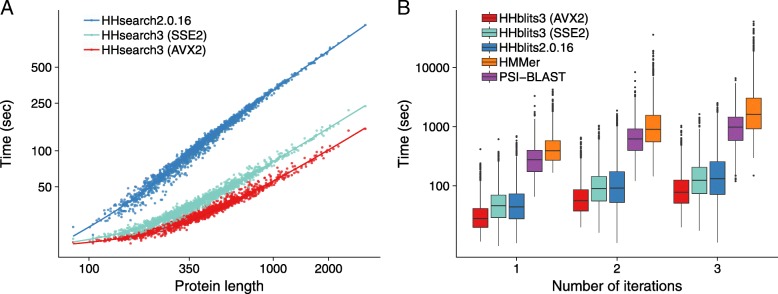
Background: HH-suite is a widely used open source software suite for sensitive sequence similarity searches and protein fold recognition. It is based on pairwise alignment of profile Hidden Markov models (HMMs), which represent multiple sequence alignments of homologous proteins. Results: We developed a single-instruction multiple-data (SIMD) vectorized implementation of the Viterbi algorithm for profile HMM alignment and introduced various other speed-ups. These accelerated the search methods HHsearch by a factor 4 and HHblits by a factor 2 over the previous version 2.0.16. HHblits3 is ∼10× faster than PSI-BLAST and ∼20× faster than HMMER3. Jobs to perform HHsearch and HHblits searches with many query profile HMMs can be parallelized over cores and over cluster servers using OpenMP and message passing interface (MPI). The free, open-source, GPLv3-licensed software is available at https://github.com/soedinglab/hh-suite . Conclusion: The added functionalities and increased speed of HHsearch and HHblits should facilitate their use in large-scale protein structure and function prediction, e.g. in metagenomics and genomics projects.
Overview
The claims and statistics of this paper haven’t been checked yet.
Free: it reads the open-access text and checks the first 5 claims that cite a source we can check. Create a free account to check every claim.
Integrity signals
Registry
Cites
Statistics
Figures
Verification
Claims the paper makes
The claims and statistics of this paper haven’t been checked yet.
Free: it reads the open-access text and checks the first 5 claims that cite a source we can check. Create a free account to check every claim.
Claims other papers make about this one
Each is checked against this paper’s own text: does it say what the citing paper says it does?
The cited source says what the claim attributes to it.
In the citing paper
“Although some advanced sequence-based methods can already assist in this task39–41, the availability of predicted structures may help identify meaningful evolutionary relationships.”
From Clustering predicted structures at the scale of the known protein universe (2023) · cites this paper as [39]
The cited source says what the claim attributes to it.
In the citing paper
“Amino acid sequence analysis27 also detects the previously observed lipase sequence motifs HG and GXSXG (where X is a wildcard) from Mycoplasma mycoides subsp. mycoides LC.70”
From Toward the Complete Functional Characterization of a Minimal Bacterial Proteome (2022) · cites this paper as [27]
The check wasn’t confident either way, so it gives no verdict — never disputed.
In the citing paper
“Two methods were used to identify non-interacting proteins, first a set of proteins with no reported interaction signal in Yeast Two-Hybrid Experiments41 and secondly complexes whose individual proteins were found in different APMS benchmark complexes42. This dataset contains in total 3989 non-interacting pairs.”
From Improved prediction of protein-protein interactions using AlphaFold2 (2021) · cites this paper as [41]
Experimental — accuracy not yet measuredThe check wasn’t confident either way, so it gives no verdict — never disputed.
In the citing paper
“Fortunately, the Continuous Automated Model Evaluation (CAMEO) experiment (7) tests structure prediction servers blindly on protein structures as they are submitted to the PDB.”
From Accurate prediction of protein structures and interactions using a 3-track network (2021) · cites this paper as [7]
Experimental — accuracy not yet measured
Self-check
Percentages, sums and reported differences re-computed from the paper’s own numbers.
The self-check needs the paper’s full text.
Citations
Cites
Gapped BLAST and PSI-BLAST: a new generation of protein database search programs
Altschul, S. (1997) · Nucleic Acids Research · doi:10.1093/nar/25.17.3389 · Cited by 73,302
Berman, H. M. (2000) · Nucleic Acids Research · doi:10.1093/nar/28.1.235 · Cited by 40,196 · cited 2×
“The PDB70 contains profile HMMs for a representative set of sequences from the PDB [22], filtered with a maximum pairwise sequence identity of 70%.”
MethodSearch and clustering orders of magnitude faster than BLAST
Edgar, R. C. (2010) · Bioinformatics · doi:10.1093/bioinformatics/btq461 · Cited by 20,826
Kabsch, W., & Sander, C. (1983) · Biopolymers · doi:10.1002/bip.360221211 · Cited by 15,320 · cited 3×
“pl, and we added structurally defined secondary structure states from DSSP [36] using addss.”
MethodInfluentialFast and sensitive protein alignment using DIAMOND
Buchfink, B., Xie, C., & Huson, D. H. (2015) · Nature Methods · doi:10.1038/nmeth.3176 · Cited by 14,201 · cited 1×
“In recent years, various sequence search tools have been developed that are up to four orders of magnitude faster than BLAST [15–18].”
MethodAccelerated Profile HMM Searches
Eddy, S. R. (2011) · PLoS Computational Biology · doi:10.1371/journal.pcbi.1002195 · Cited by 6,975
Eddy, S. R. (1998) · Bioinformatics · doi:10.1093/bioinformatics/14.9.755 · Cited by 5,515
MMseqs2 enables sensitive protein sequence searching for the analysis of massive data sets
Steinegger, M., & Söding, J. (2017) · Nature Biotechnology · doi:10.1038/nbt.3988 · Cited by 4,840
Self-citationSWISS-MODEL: modelling protein tertiary and quaternary structure using evolutionary information
Biasini, M., Bienert, S., Waterhouse, A., Arnold, K., Studer, G., Schmidt, T., Kiefer, F., Cassarino, T. G., Bertoni, M., Bordoli, L., et al. (2014) · Nucleic Acids Research · doi:10.1093/nar/gku340 · Cited by 4,632
The Pfam protein families database in 2019
El-Gebali, S., Mistry, J., Bateman, A., Eddy, S. R., Luciani, A., Potter, S. C., Qureshi, M., Richardson, L. J., Salazar, G. A., Smart, A., et al. (2019) · Nucleic Acids Research · doi:10.1093/nar/gky995 · Cited by 4,602
Protein homology detection by HMM–HMM comparison
Söding, J. (2005) · Bioinformatics · doi:10.1093/bioinformatics/bti125 · Cited by 2,423
Self-citationHHblits: lightning-fast iterative protein sequence searching by HMM-HMM alignment
Remmert, M., Biegert, A., Hauser, A., & Söding, J. (2012) · Nature Methods · doi:10.1038/nmeth.1818 · Cited by 2,288
Self-citationTwilight zone of protein sequence alignments
Rost, B. (1999) · Protein Engineering, Design and Selection · doi:10.1093/protein/12.2.85 · Cited by 1,833 · cited 1×
“HHblits can help to annotate proteins beyond the twilight zone [19].”
BackgroundThe Protein-Folding Problem, 50 Years On
Dill, K. A., & MacCallum, J. L. (2012) · Science · doi:10.1126/science.1219021 · Cited by 1,699
InterPro in 2019: improving coverage, classification and access to protein sequence annotations
Mitchell, A. L., Attwood, T. K., Babbitt, P. C., Blum, M., Bork, P., Bridge, A., Brown, S. D., Chang, H.-Y., El-Gebali, S., Fraser, M. I., et al. (2019) · Nucleic Acids Research · doi:10.1093/nar/gky1100 · Cited by 1,426 · cited 1×
“Additional computation costs would be marginal, since the version of HHblits presented in this work runs 20 times faster than HMMER, the standard tool for Pfam [20] and InterPro [21] annotations.”
MethodA NEW GENERATION OF HOMOLOGY SEARCH TOOLS BASED ON PROBABILISTIC INFERENCE
EDDY, S. R. (2009) · Genome Informatics 2009 · doi:10.1142/9781848165632_0019 · Cited by 1,285 · cited 10×
“Therefore, to find template proteins for comparative protein structure modeling and for deep functional annotation, the most sensitive search tools such as HMMER [3, 4] and HHblits [5] are often used [6–9].”
MethodInfluentialAdaptive seeds tame genomic sequence comparison
Kiełbasa, S. M., Wan, R., Sato, K., Horton, P., & Frith, M. C. (2011) · Genome Research · doi:10.1101/gr.113985.110 · Cited by 1,281
Data growth and its impact on the SCOP database: new developments
Andreeva, A., Howorth, D., Chandonia, J.-M., Brenner, S. E., Hubbard, T. J. P., Chothia, C., & Murzin, A. G. (2007) · Nucleic Acids Research · doi:10.1093/nar/gkm993 · Cited by 944
Uniclust databases of clustered and deeply annotated protein sequences and alignments
Mirdita, M., von den Driesch, L., Galiez, C., Martin, M. J., Söding, J., & Steinegger, M. (2017) · Nucleic Acids Research · doi:10.1093/nar/gkw1081 · Cited by 759
Self-citationNew CRISPR–Cas systems from uncultivated microbes
Burstein, D., Harrington, L. B., Strutt, S. C., Probst, A. J., Anantharaman, K., Thomas, B. C., Doudna, J. A., & Banfield, J. F. (2017) · Nature · doi:10.1038/nature21059 · Cited by 582
CUDA compatible GPU cards as efficient hardware accelerators for Smith-Waterman sequence alignment
Manavski, S. A., & Valle, G. (2008) · BMC Bioinformatics · doi:10.1186/1471-2105-9-s2-s10 · Cited by 468
Comparison of sequence profiles. Strategies for structural predictions using sequence information
Rychlewski, L., Li, W., Jaroszewski, L., & Godzik, A. (2000) · Protein Science · doi:10.1110/ps.9.2.232 · Cited by 462
Striped Smith–Waterman speeds database searches six times over other SIMD implementations
Farrar, M. (2007) · Bioinformatics · doi:10.1093/bioinformatics/btl582 · Cited by 415 · cited 1×
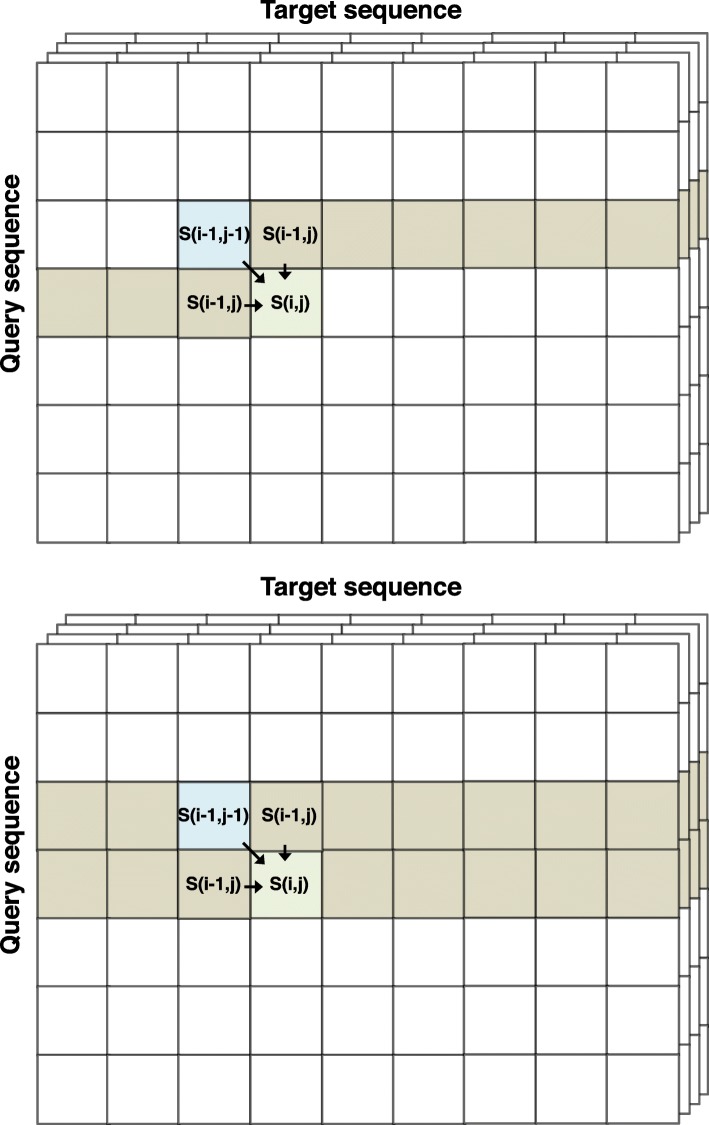
“(i + 15 × D, j) where D := ceil(query_length/16)) [34] and (4) where 16 cells (i, j) of 16 target sequences are processed in parallel [35].”
Corpus annotation for mining biomedical events from literature
Kim, J.-D., Ohta, T., & Tsujii, J. (2008) · BMC Bioinformatics · doi:10.1186/1471-2105-9-10 · Cited by 395
Tackling soil diversity with the assembly of large, complex metagenomes
Howe, A. C., Jansson, J. K., Malfatti, S. A., Tringe, S. G., Tiedje, J. M., & Brown, C. T. (2014) · Proceedings of the National Academy of Sciences · doi:10.1073/pnas.1402564111 · Cited by 321
Sadreyev, R., & Grishin, N. (2003) · Journal of Molecular Biology · doi:10.1016/s0022-2836(02)01371-2 · Cited by 278
Liu, Y., Maskell, D. L., & Schmidt, B. (2009) · BMC Research Notes · doi:10.1186/1756-0500-2-73 · Cited by 261
Rognes, T., & Seeberg, E. (2000) · Bioinformatics · doi:10.1093/bioinformatics/16.8.699 · Cited by 240
Faster Smith-Waterman database searches with inter-sequence SIMD parallelisation
Rognes, T. (2011) · BMC Bioinformatics · doi:10.1186/1471-2105-12-221 · Cited by 206
160-fold acceleration of the Smith-Waterman algorithm using a field programmable gate array (FPGA)
Li, I. T. S., Shum, W., & Truong, K. (2007) · BMC Bioinformatics · doi:10.1186/1471-2105-8-185 · Cited by 150
De novo identification of highly diverged protein repeats by probabilistic consistency
Biegert, A., & Söding, J. (2008) · Bioinformatics · doi:10.1093/bioinformatics/btn039 · Cited by 142
Self-citationUsing video-oriented instructions to speed up sequence comparison
Wozniak, A. (1997) · Bioinformatics · doi:10.1093/bioinformatics/13.2.145 · Cited by 141
SWPS3 – fast multi-threaded vectorized Smith-Waterman for IBM Cell/B.E. and ×86/SSE2
Szalkowski, A. M., Ledergerber, C., Krähenbühl, P., & Dessimoz, C. (2008) · BMC Research Notes · doi:10.1186/1756-0500-1-107 · Cited by 134
Protein sequence comparison and fold recognition: progress and good-practice benchmarking
Söding, J., & Remmert, M. (2011) · Current Opinion in Structural Biology · doi:10.1016/j.sbi.2011.03.005 · Cited by 91
Self-citationZhang, W., Liu, S., & Zhou, Y. (2008) · PLoS ONE · doi:10.1371/journal.pone.0002325 · Cited by 75
Using HHsearch to tackle proteins of unknown function: A pilot study with PH domains
Fidler, D. R., Murphy, S. E., Courtis, K., Antonoudiou, P., El‐Tohamy, R., Ient, J., & Levine, T. P. (2016) · Traffic · doi:10.1111/tra.12432 · Cited by 58
Discriminative modelling of context-specific amino acid substitution probabilities
Angermueller, C., Biegert, A., & Söding, J. (2012) · Bioinformatics · doi:10.1093/bioinformatics/bts622 · Cited by 54 · cited 2×
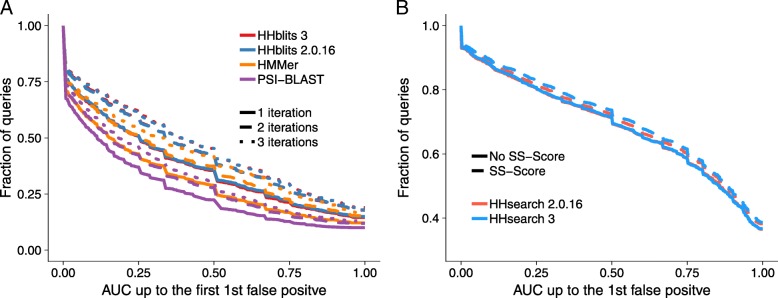
“Consistent with earlier results [5, 26], HHblits is considerably more sensitive than HMMER3 and PSI-BLAST.”
MethodResultSelf-citationMargelevičius, M., & Venclovas, Č. (2010) · BMC Bioinformatics · doi:10.1186/1471-2105-11-89 · Cited by 48
Cited by
Highly accurate protein structure prediction with AlphaFold
Jumper, J., Evans, R., Pritzel, A., Green, T., Figurnov, M., Ronneberger, O., Tunyasuvunakool, K., Bates, R., Žídek, A., Potapenko, A., et al. (2021) · Nature · doi:10.1038/s41586-021-03819-2 · Cited by 43,764
Self-citationColabFold - Making protein folding accessible to all
Mirdita, M., Schütze, K., Moriwaki, Y., Heo, L., Ovchinnikov, S., & Steinegger, M. (2021) · doi:10.1101/2021.08.15.456425 · Cited by 9,391
Self-citationAccurate prediction of protein structures and interactions using a 3-track network
Baek, M., DiMaio, F., Anishchenko, I., Dauparas, J., Ovchinnikov, S., Lee, G. R., Wang, J., Cong, Q., Kinch, L. N., Schaeffer, R. D., et al. (2021) · doi:10.1101/2021.06.14.448402 · Cited by 5,549
Rives, A., Meier, J., Sercu, T., Goyal, S., Lin, Z., Liu, J., Guo, D., Ott, M., Zitnick, C. L., Ma, J., et al. (2021) · Proceedings of the National Academy of Sciences · doi:10.1073/pnas.2016239118 · Cited by 3,286
Fast and accurate protein structure search with Foldseek
van Kempen, M., Kim, S. S., Tumescheit, C., Mirdita, M., Lee, J., Gilchrist, C. L. M., Söding, J., & Steinegger, M. (2022) · doi:10.1101/2022.02.07.479398 · Cited by 2,598
Self-citation
Metadata
- Authors
- Steinegger, M., Meier, M., Mirdita, M., Vöhringer, H., Haunsberger, S. J., & Söding, J.
- Affiliations
- Johns Hopkins University (US)
- Max Planck Institute for Biophysical Chemistry (DE)
- European Bioinformatics Institute (GB)
- Royal College of Surgeons in Ireland (IE)
- Corresponding author
- Söding, Johannes
- Venue
- BMC Bioinformatics
- Published
- 2019-09-14
- Volume
- 20
- Issue
- 1
- Pages
- 473-473
- ISSN
- 1471-2105 (ISSN-L)
- PMC
- PMC6744700
- OpenAlex
- W2972411752
- Cited by
- 1,145
- References
- 38
- Citations by year
- 2026: 106 · 2025: 167 · 2024: 208 · 2023: 248 · 2022: 168 · 2021: 176 · 2020: 63 · 2019: 7
- FWCI
- 35.23
- Type
- journal article
- Language
- en
- Open access
- gold
- doi.org
- Licence
- cc-by
- creativecommons.org/licenses/by/4.0/ (tdm)
- creativecommons.org/licenses/by/4.0/ (vor)
- Locations
- BMC Bioinformatics (publishedVersion, cc-by)
- bioRxiv (Cold Spring Harbor Laboratory) (acceptedVersion, cc-by-nc-nd)
- PubMed Central (publishedVersion, cc-by)
- PubMed (publishedVersion)
- DOAJ (DOAJ: Directory of Open Access Journals) (submittedVersion)
- Figshare (submittedVersion, cc-by)
- GoeScholar The Publication Server of the Georg-August-Universität Göttingen (Georg-August-Universität Göttingen) (submittedVersion, cc-by)
- MPG.PuRe (Max Planck Society) (submittedVersion, other-oa)
- Seoul National University Open Repository (Seoul National University) (submittedVersion)
- Funders
- Horizon 2020 (685778)
- Topics
- Life Sciences › Biochemistry, Genetics and Molecular Biology › Molecular Biology › Genomics and Phylogenetic Studies
- Life Sciences › Biochemistry, Genetics and Molecular Biology › Molecular Biology › Protein Structure and Dynamics
- Life Sciences › Biochemistry, Genetics and Molecular Biology › Molecular Biology › Machine Learning in Bioinformatics
- Keywords
- profile hidden Markov models, Viterbi algorithm, SIMD vectorization, remote homology detection, protein fold recognition, protein annotation, sequence similarity search, parallel computing, protein structure prediction, metagenomics
- MeSH terms
- Algorithms, Markov Chains, Software, Sequence Alignment, Sequence Analysis, Protein, Molecular Sequence Annotation
About these checks
Registry, retraction, Cites and statistics results are computed, not judged, with one exception: a printed reference that no index lists is read once by a model before it counts as a citation error. Claims are extracted by a model and kept only when their quote appears verbatim in the text; each cited source is then checked, with a model’s help, for whether it says what the claim relies on. Those verdicts can be wrong — read the claim’s quote and the cited source before relying on one.
Statistics and arithmetic are recomputed, not judged.
Confidence bands are shown only for fields calibrated on our annotated test set. None is calibrated yet, so no band is shown.
What counts as a claim ›How we measure confidence ›How we check this ›
Are you an author, or do you see a problem with this page? Request a review
Data sources
Bibliographic data: Semantic Scholar, OpenAlex, Crossref.
Contains information from the Semantic Scholar Academic Graph Datasets, made available under the ODC Attribution License (ODC-BY 1.0).
Semantic Scholar’s data is described in: Kinney, R., et al. (2023). The Semantic Scholar Open Data Platform. arXiv:2301.10140.
