

The DOI matches its Crossref record; 101 of the 104 references it cites were found in a registry or an index; 2 of the 27 sources its claims cite were checked for support.
The advantages of the Matthews correlation coefficient (MCC) over F1 score and accuracy in binary classification evaluation
Open accessAbstract
Background: To evaluate binary classifications and their confusion matrices, scientific researchers can employ several statistical rates, accordingly to the goal of the experiment they are investigating. Despite being a crucial issue in machine learning, no widespread consensus has been reached on a unified elective chosen measure yet. Accuracy and F 1 score computed on confusion matrices have been (and still are) among the most popular adopted metrics in binary classification tasks. However, these statistical measures can dangerously show overoptimistic inflated results, especially on imbalanced datasets. Results: The Matthews correlation coefficient (MCC), instead, is a more reliable statistical rate which produces a high score only if the prediction obtained good results in all of the four confusion matrix categories (true positives, false negatives, true negatives, and false positives), proportionally both to the size of positive elements and the size of negative elements in the dataset. Conclusions: In this article, we show how MCC produces a more informative and truthful score in evaluating binary classifications than accuracy and F 1 score, by first explaining the mathematical properties, and then the asset of MCC in six synthetic use cases and in a real genomics scenario. We believe that the Matthews correlation coefficient should be preferred to accuracy and F 1 score in evaluating binary classification tasks by all scientific communities.
Overview
AI snapshot
Written from the paper’s full text.
TL;DR
The paper argues that the Matthews correlation coefficient (MCC) is a more reliable metric than accuracy and F1 score for evaluating binary classifications, especially on imbalanced datasets, because MCC requires good performance on both positive and negative classes. It supports this through mathematical analysis, six synthetic use cases, and a real colon cancer gene expression experiment.
Key findings
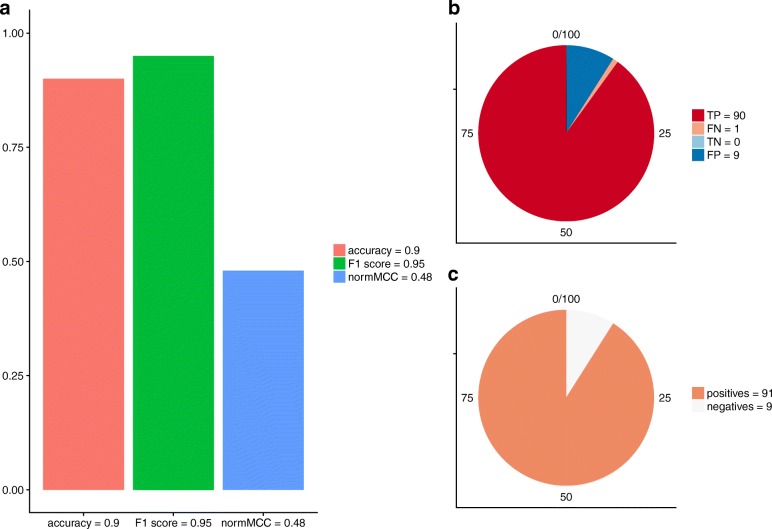
- In six synthetic use cases, MCC was the only metric that correctly indicated the prediction problem in all six. For Use case A1 (91 positives, 9 negatives; TP=90, FN=1, TN=0, FP=9), accuracy=0.90 and F1=0.95, but MCC=−0.03. For Use case C2 (11 positives, 89 negatives; TP=2, FN=9, TN=88, FP=1), accuracy=0.90, F1=0.29, and MCC=+0.31.
- Correlation analysis over all possible confusion matrices showed MCC and accuracy were strongly correlated, while F1 correlated less than 0.8 with the other two measures. For N=1000, PCC(MCC,F1)=0.775982, PCC(MCC,accuracy)=0.921030, and PCC(accuracy,F1)=0.778652.
- In the colon cancer gene expression dataset (2,000 gene probesets, 62 patients: 22 healthy controls and 40 colon cancer; 35.48% negatives, 64.52% positives), rankings differed by metric. MCC ranked gradient boosting top (MCC=+0.55, TP rate=0.85, TN rate=0.69), while F1 and accuracy ranked k-NN top (F1=0.87, accuracy=0.80, TP rate=0.92, TN rate=0.52). Radial SVM had F1=0.75 and accuracy=0.67 but TN rate=0.40 and MCC=+0.29.
- MCC produces a high score only if the classifier correctly predicts the majority of positive and negative instances; F1 is independent of true negatives and is not symmetric for class swapping, while accuracy can be overoptimistic on imbalanced datasets.
Methods
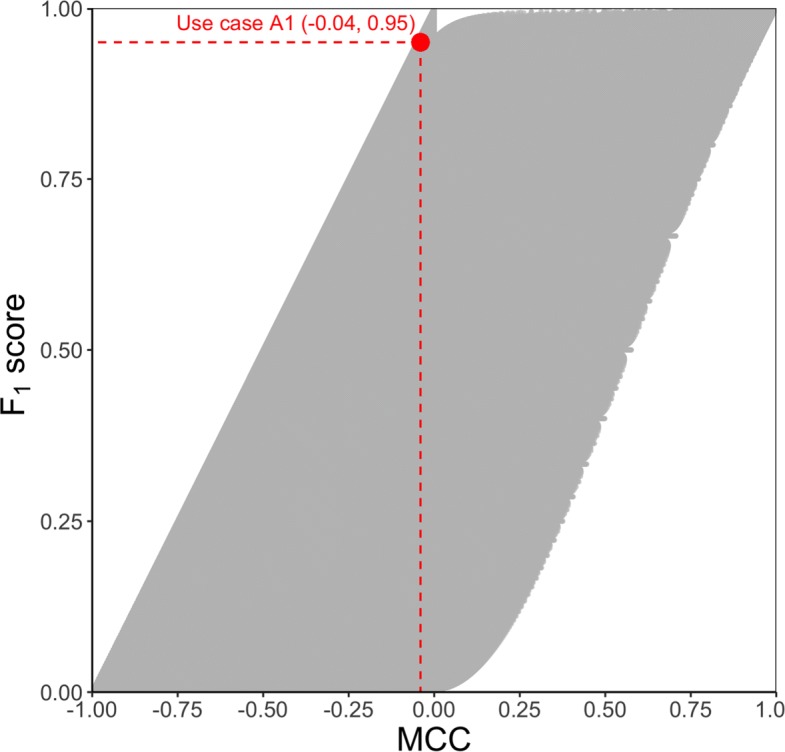
- The paper defines accuracy, MCC, and F1 score mathematically, explores their relationships using Pearson correlation coefficient over all possible confusion matrices for N≥10 up to 1000, and plots all 21,084,251 possible confusion matrices for a 500-sample dataset on the MCC/F1 plane.
- Six synthetic use cases vary class balance and imbalance with specified confusion matrices to compare metric behavior.
- The real genomics experiment uses colon cancer gene expression data from Alon et al. via the plsgenomics R package, applying gradient boosting, decision tree, k-nearest neighbors, linear SVM, and radial SVM. Training/test splits were 80/20 or 60/20/20 with validation for hyperparameter grid search; experiments were repeated ten times and averaged for MCC, F1, accuracy, TP rate, and TN rate.
Limitations
- The paper states that additional comparisons with other rates such as Cohen’s Kappa, Cramér’s V, and K measure would have provided further information, but the authors focused on accuracy and F1 because they are more commonly used in biomedical machine learning studies.
- The paper notes that MCC can be undefined when a whole row or column of the confusion matrix is zero, and handles these cases via an approximation using an arbitrarily small value ε; it also cites situations where MCC can display large fluctuations due to imbalanced outcomes.
- Evident from the text: the real-world validation uses a single colon cancer gene expression dataset, the six use cases are synthetic, and Table 5 excludes standard deviations to keep the table simple.
Model-written summary. Check it against the paper before relying on it.
Integrity signals
Registry
Cites
Statistics
Figures
Verification
Claims the paper makes
29 Own interpretation · 28 Own result · 14 Not checked yet · 13 No basis given · 1 Partly supported · accuracy not yet measured
The paper states this without a source or data behind it here, so there is nothing to check it against. The quote shows it is in the paper.
In the paper
“A potential problem with MCC lies in the fact that MCC is undefined when a whole row or column of M is zero, as it happens in the previously cited case of the trivial majority classifier.”
§ The advantages of the Matthews correlation coefficient (MCC) over F1 score and accuracy in binary classification evaluation > Methods > Notation and mathematical foundations
plainn = 4- Asserted: passes — The authors put it forward as true.
- Checkable: passes — It can be checked against evidence.
- Load-bearing: passes — The paper’s conclusions depend on it.
- Based: passes — The paper gives a reason why it holds.
The paper states this without a source or data behind it here, so there is nothing to check it against. The quote shows it is in the paper.
In the paper
“Second, F1 score is independent from the number of samples correctly classified as negative.”
§ The advantages of the Matthews correlation coefficient (MCC) over F1 score and accuracy in binary classification evaluation > Background
plain- Asserted: passes — The authors put it forward as true.
- Checkable: passes — It can be checked against evidence.
- Load-bearing: passes — The paper’s conclusions depend on it.
- Based: passes — The paper gives a reason why it holds.
A result the paper reports from its own data — it cites no other source for it, so there is none to check. The quote shows it is in the paper.
In the paper
“she/he would notice good results (F1 score = 0.75 and accuracy = 0.67)”
§ The advantages of the Matthews correlation coefficient (MCC) over F1 score and accuracy in binary classification evaluation > Results and discussion > Genomics scenario: colon cancer gene expression
hedged- Asserted: passes — The authors put it forward as true.
- Checkable: passes — It can be checked against evidence.
- Load-bearing: unclear — It is unclear whether the paper’s conclusions depend on it.
- Based: passes — The paper gives a reason why it holds.
A result the paper reports from its own data — it cites no other source for it, so there is none to check. The quote shows it is in the paper.
In the paper
“For the Use case A1 (negatively imbalanced dataset), the machine learning classifier was unable to correctly predict negative data instances, and it therefore produced confusion matrices featuring few true negatives (TN).”
§ The advantages of the Matthews correlation coefficient (MCC) over F1 score and accuracy in binary classification evaluation > Results and discussion > Use cases
plaindirect- Asserted: passes — The authors put it forward as true.
- Checkable: passes — It can be checked against evidence.
- Load-bearing: passes — The paper’s conclusions depend on it.
- Based: passes — The paper gives a reason why it holds.
A result the paper reports from its own data — it cites no other source for it, so there is none to check. The quote shows it is in the paper.
In the paper
“First, the top classifier changes when we consider the ranking based on MCC, F1 score, or accuracy.”
§ The advantages of the Matthews correlation coefficient (MCC) over F1 score and accuracy in binary classification evaluation > Results and discussion > Genomics scenario: colon cancer gene expression
plaindirect- Asserted: passes — The authors put it forward as true.
- Checkable: passes — It can be checked against evidence.
- Load-bearing: passes — The paper’s conclusions depend on it.
- Based: passes — The paper gives a reason why it holds.
A result the paper reports from its own data — it cites no other source for it, so there is none to check. The quote shows it is in the paper.
In the paper
“MCC = +0.31 in the [–1, +1] interval”
§ The advantages of the Matthews correlation coefficient (MCC) over F1 score and accuracy in binary classification evaluation > Results and discussion > Use cases
plain- Asserted: passes — The authors put it forward as true.
- Checkable: passes — It can be checked against evidence.
- Load-bearing: unclear — It is unclear whether the paper’s conclusions depend on it.
- Based: passes — The paper gives a reason why it holds.
A result the paper reports from its own data — it cites no other source for it, so there is none to check. The quote shows it is in the paper.
In the paper
“In the Use case B1 (balanced dataset), the machine learning method was unable to correctly predict negative data instances, and therefore produced a confusion matrix featuring few true negatives (TN).”
§ The advantages of the Matthews correlation coefficient (MCC) over F1 score and accuracy in binary classification evaluation > Results and discussion > Use cases
plaindirect- Asserted: passes — The authors put it forward as true.
- Checkable: passes — It can be checked against evidence.
- Load-bearing: passes — The paper’s conclusions depend on it.
- Based: passes — The paper gives a reason why it holds.
A result the paper reports from its own data — it cites no other source for it, so there is none to check. The quote shows it is in the paper.
In the paper
“Finally, in the last Use case C2 (positively imbalanced dataset), the prediction technique failed in predicting negative elements, and therefore its confusion matrix showed a low percentage of true negatives.”
§ The advantages of the Matthews correlation coefficient (MCC) over F1 score and accuracy in binary classification evaluation > Results and discussion > Use cases
plaindirect- Asserted: passes — The authors put it forward as true.
- Checkable: passes — It can be checked against evidence.
- Load-bearing: passes — The paper’s conclusions depend on it.
- Based: passes — The paper gives a reason why it holds.
A result the paper reports from its own data — it cites no other source for it, so there is none to check. The quote shows it is in the paper.
In the paper
“F1 score = 0.29 in the [0, 1] interval”
§ The advantages of the Matthews correlation coefficient (MCC) over F1 score and accuracy in binary classification evaluation > Results and discussion > Use cases
plain- Asserted: passes — The authors put it forward as true.
- Checkable: passes — It can be checked against evidence.
- Load-bearing: unclear — It is unclear whether the paper’s conclusions depend on it.
- Based: passes — The paper gives a reason why it holds.
A result the paper reports from its own data — it cites no other source for it, so there is none to check. The quote shows it is in the paper.
In the paper
“the radial SVM has performed poorly on the true negatives (TN rate = 0.40), by correctly predicting less than half patients.”
§ The advantages of the Matthews correlation coefficient (MCC) over F1 score and accuracy in binary classification evaluation > Results and discussion > Genomics scenario: colon cancer gene expression
plain- Asserted: passes — The authors put it forward as true.
- Checkable: passes — It can be checked against evidence.
- Load-bearing: passes — The paper’s conclusions depend on it.
- Based: passes — The paper gives a reason why it holds.
- Probably not a substantial claim. 15
- The quote only partly states this claim. 5
- It may state two separate claims as one. 36
The cited sources support only part of this claim — read each source’s verdict below.
In the paper
“The effectiveness of MCC has been shown in other scientific fields as well [43, 44].”
§ The advantages of the Matthews correlation coefficient (MCC) over F1 score and accuracy in binary classification evaluation > Background
What the sources say
- Partly supportedcites [43] Liu Y, Cheng J, Yan C, Wu X, Chen F. Research on the Matthews correlation coefficients metrics of personalized recommendation algorithm evaluation. Int J Hybrid Informa Technol. 2015; 8(1):163–72. sourceExperimental — accuracy not yet measured
The Introduction and the recommendation-algorithm results report that the authors tested MCCP, an MCC-based metric, and found it applicable to evaluating recommendation systems. This supports an example of effectiveness in another field, but the paper does not establish MCC’s effectiveness across multiple other scientific fields. (LLM, conf=0.82)
- Could not verifycites [44] Naulaerts S, Dang CC, Ballester PJ. Precision and recall oncology: combining multiple gene mutations for improved identification of drug-sensitive tumours. Oncotarget. 2017; 8(57):97025. sourceExperimental — accuracy not yet measured
The Materials and Methods section defines MCC as a measure of classifier performance, and the Results section uses it to assess predictions of drug sensitivity. Neither section reports that MCC has been shown effective in other scientific fields; searches for that claim found only its use in this oncology study. Page numbers were not available in our copy. (LLM, conf=0.72)
plain- Asserted: passes — The authors put it forward as true.
- Checkable: passes — It can be checked against evidence.
- Load-bearing: fails — The paper’s conclusions may not depend on it.
- Based: passes — The paper gives a reason why it holds.
Probably not a substantial claim. The paper’s conclusions may not depend on it.
- Partly supported
A result the paper reports from its own data — it cites no other source for it, so there is none to check. The quote shows it is in the paper.
In the paper
“Here, accuracy showed a high value: 0.90 in the [0, 1] interval.”
§ The advantages of the Matthews correlation coefficient (MCC) over F1 score and accuracy in binary classification evaluation > Results and discussion > Use cases
plain- Asserted: passes — The authors put it forward as true.
- Checkable: passes — It can be checked against evidence.
- Load-bearing: passes — The paper’s conclusions depend on it.
- Based: passes — The paper gives a reason why it holds.
Probably not a substantial claim. The quote only partly states this claim.
A result the paper reports from its own data — it cites no other source for it, so there is none to check. The quote shows it is in the paper.
In the paper
“In this case, all three statistical rates showed a low score which emphasized the deficiency in the prediction process (accuracy = 0.24, F1 score = 0.12, and MCC = −0.24).”
§ The advantages of the Matthews correlation coefficient (MCC) over F1 score and accuracy in binary classification evaluation > Results and discussion > Use cases
plain- Asserted: passes — The authors put it forward as true.
- Checkable: passes — It can be checked against evidence.
- Load-bearing: unclear — It is unclear whether the paper’s conclusions depend on it.
- Based: passes — The paper gives a reason why it holds.
It may state two separate claims as one.
The paper states this without a source or data behind it here, so there is nothing to check it against. The quote shows it is in the paper.
In the paper
“It ranges in the interval [−1,+1], with extreme values –1 and +1 reached in case of perfect misclassification and perfect classification, respectively, while MCC=0 is the expected value for the coin tossing classifier.”
§ The advantages of the Matthews correlation coefficient (MCC) over F1 score and accuracy in binary classification evaluation > Methods > Notation and mathematical foundations
plain- Asserted: passes — The authors put it forward as true.
- Checkable: passes — It can be checked against evidence.
- Load-bearing: passes — The paper’s conclusions depend on it.
- Based: passes — The paper gives a reason why it holds.
Probably not a substantial claim. It may state two separate claims as one.
The paper states this without a source or data behind it here, so there is nothing to check it against. The quote shows it is in the paper.
In the paper
“F1 ranges in [0,1], where the minimum is reached for TP=0, that is, when all the positive samples are misclassified, and the maximum for FN=FP=0, that is for perfect classification.”
§ The advantages of the Matthews correlation coefficient (MCC) over F1 score and accuracy in binary classification evaluation > Methods > Notation and mathematical foundations
plain- Asserted: passes — The authors put it forward as true.
- Checkable: passes — It can be checked against evidence.
- Load-bearing: fails — The paper’s conclusions may not depend on it.
- Based: passes — The paper gives a reason why it holds.
Probably not a substantial claim. The paper’s conclusions may not depend on it. It may state two separate claims as one.
A result the paper reports from its own data — it cites no other source for it, so there is none to check. The quote shows it is in the paper.
In the paper
“Like for the Use case A2, accuracy, F1 and MCC show average or low result scores (accuracy = 0.56, F1 score = 0.31, and MCC = +0.17), correctly informing you about the non-optimal performance of the prediction method (Additional file 3a).”
§ The advantages of the Matthews correlation coefficient (MCC) over F1 score and accuracy in binary classification evaluation > Results and discussion > Use cases
plain- Asserted: passes — The authors put it forward as true.
- Checkable: passes — It can be checked against evidence.
- Load-bearing: unclear — It is unclear whether the paper’s conclusions depend on it.
- Based: passes — The paper gives a reason why it holds.
It may state two separate claims as one.
The paper states this without a source or data behind it here, so there is nothing to check it against. The quote shows it is in the paper.
In the paper
“If M has only one non-zero entry, this means that all samples in the dataset belong to one class, and they are either all correctly (for TP≠0 or TN≠0) or incorrectly (for FP≠0 or FN≠0) classified. In this situations, MCC=1 for the former case and MCC=−1 for the latter case.”
§ The advantages of the Matthews correlation coefficient (MCC) over F1 score and accuracy in binary classification evaluation > Methods > Notation and mathematical foundations
plaindirectSingle case- Asserted: passes — The authors put it forward as true.
- Checkable: passes — It can be checked against evidence.
- Load-bearing: unclear — It is unclear whether the paper’s conclusions depend on it.
- Based: passes — The paper gives a reason why it holds.
It may state two separate claims as one.
The paper states this without a source or data behind it here, so there is nothing to check it against. The quote shows it is in the paper.
In the paper
“If the dataset is highly unbalanced, ni≈1, and thus the accuracy measure gives an unreliable estimation of the goodness of the classifier.”
§ The advantages of the Matthews correlation coefficient (MCC) over F1 score and accuracy in binary classification evaluation > Methods > Notation and mathematical foundations
plaindirect- Asserted: passes — The authors put it forward as true.
- Checkable: passes — It can be checked against evidence.
- Load-bearing: passes — The paper’s conclusions depend on it.
- Based: passes — The paper gives a reason why it holds.
It may state two separate claims as one.
A result the paper reports from its own data — it cites no other source for it, so there is none to check. The quote shows it is in the paper.
In the paper
“Checking only F1, one would read a good value (0.66 in the [0, 1] interval), and would be overall satisfied about the prediction (Additional file 2a).”
- Also stated in: § Use cases · hedged
“The Matthews correlation coefficient, instead, by showing a score close to random guessing (+0.07 in the [–1, +1] interval) would be able to inform that the machine learning method has been on the wrong track. Also, it is worth noticing that accuracy would provide with an informative result in this case (0.52 in the [0, 1] interval).”
§ The advantages of the Matthews correlation coefficient (MCC) over F1 score and accuracy in binary classification evaluation > Results and discussion > Use cases
hedged- Asserted: passes — The authors put it forward as true.
- Checkable: passes — It can be checked against evidence.
- Load-bearing: passes — The paper’s conclusions depend on it.
- Based: passes — The paper gives a reason why it holds.
It may state two separate claims as one. The quote only partly states this claim.
- Also stated in: § Use cases · hedged
A result the paper reports from its own data — it cites no other source for it, so there is none to check. The quote shows it is in the paper.
In the paper
“However, accuracy and of F1 showed high values in this case: accuracy = 0.90 and F1 score = 0.95, both close to the best possible value 1.00 in the [0, 1] interval (Fig. 2a).”
- Also stated in: § Use cases · hedged
“Instead, if one decided to take advantage of the Matthews correlation coefficient in the Use case A1, he/she would notice the resulting MCC = –0.03 (Fig. 2a).”
§ The advantages of the Matthews correlation coefficient (MCC) over F1 score and accuracy in binary classification evaluation > Results and discussion > Use cases
plainSingle case- Asserted: passes — The authors put it forward as true.
- Checkable: passes — It can be checked against evidence.
- Load-bearing: passes — The paper’s conclusions depend on it.
- Based: passes — The paper gives a reason why it holds.
It may state two separate claims as one. The quote only partly states this claim.
- Also stated in: § Use cases · hedged
A result the paper reports from its own data — it cites no other source for it, so there is none to check. The quote shows it is in the paper.
In the paper
“Similar to the Use case A2 and B2, all three statistical scores generated low results that reflect the mediocre quality of the prediction: F1 score = 0.17 and accuracy = 0.10 in the [0, 1] interval, and MCC = −0.19 in the [–1, +1] interval (Additional file 4a).”
§ The advantages of the Matthews correlation coefficient (MCC) over F1 score and accuracy in binary classification evaluation > Results and discussion > Use cases
plainSingle case- Asserted: passes — The authors put it forward as true.
- Checkable: passes — It can be checked against evidence.
- Load-bearing: unclear — It is unclear whether the paper’s conclusions depend on it.
- Based: passes — The paper gives a reason why it holds.
It may state two separate claims as one.
The paper states this without a source or data behind it here, so there is nothing to check it against. The quote shows it is in the paper.
In the paper
“On the other hand, for a given value MCC=μ, the F1 score can range in [0,μ+1] if μ≤0 and in [μ,1] if μ>0, so that the width of the range is 1−|μ|, that is, it depends on the MCC value μ.”
§ The advantages of the Matthews correlation coefficient (MCC) over F1 score and accuracy in binary classification evaluation > Methods > Relationship between measures
plaincorrelational- Asserted: passes — The authors put it forward as true.
- Checkable: passes — It can be checked against evidence.
- Load-bearing: passes — The paper’s conclusions depend on it.
- Based: passes — The paper gives a reason why it holds.
It may state two separate claims as one.
The paper states this without a source or data behind it here, so there is nothing to check it against. The quote shows it is in the paper.
In the paper
“The two measures are reasonably concordant, but the scatterplot cloud is wide, implying that for each value of F1 score there is a corresponding range of values of MCC and vice versa, although with different width.”
§ The advantages of the Matthews correlation coefficient (MCC) over F1 score and accuracy in binary classification evaluation > Methods > Relationship between measures
plaincorrelational- Asserted: passes — The authors put it forward as true.
- Checkable: passes — It can be checked against evidence.
- Load-bearing: passes — The paper’s conclusions depend on it.
- Based: passes — The paper gives a reason why it holds.
It may state two separate claims as one.
The paper states this without a source or data behind it here, so there is nothing to check it against. The quote shows it is in the paper.
In the paper
“Overall, accuracy, F1, and MCC show reliable concordant scores for predictions that correctly classify both positives and negatives (having therefore many TP and TN), and for predictions that incorrectly classify both positives and negatives (having therefore few TP and TN); however, these measures show discordant behaviors when the prediction performs well just with one of the two binary classes.”
§ The advantages of the Matthews correlation coefficient (MCC) over F1 score and accuracy in binary classification evaluation > Methods > Relationship between measures
plaincorrelational- Asserted: passes — The authors put it forward as true.
- Checkable: passes — It can be checked against evidence.
- Load-bearing: passes — The paper’s conclusions depend on it.
- Based: passes — The paper gives a reason why it holds.
It may state two separate claims as one.
The paper states this without a source or data behind it here, so there is nothing to check it against. The quote shows it is in the paper.
In the paper
“First, F1 varies for class swapping, while MCC is invariant if the positive class is renamed negative and vice versa.”
§ The advantages of the Matthews correlation coefficient (MCC) over F1 score and accuracy in binary classification evaluation > Background
plaindirect- Asserted: passes — The authors put it forward as true.
- Checkable: passes — It can be checked against evidence.
- Load-bearing: passes — The paper’s conclusions depend on it.
- Based: passes — The paper gives a reason why it holds.
It may state two separate claims as one.
A result the paper reports from its own data — it cites no other source for it, so there is none to check. The quote shows it is in the paper.
In the paper
“Interestingly, the correlation grows with N, but the increments are limited.”
§ The advantages of the Matthews correlation coefficient (MCC) over F1 score and accuracy in binary classification evaluation > Methods > Relationship between measures
plaincorrelational- Asserted: passes — The authors put it forward as true.
- Checkable: passes — It can be checked against evidence.
- Load-bearing: fails — The paper’s conclusions may not depend on it.
- Based: passes — The paper gives a reason why it holds.
Probably not a substantial claim. The paper’s conclusions may not depend on it. It may state two separate claims as one.
The paper states this without a source or data behind it here, so there is nothing to check it against. The quote shows it is in the paper.
In the paper
“With these positions MCC is now defined for all confusion matrices M. As a consequences, MCC=0 for the trivial majority classifier, and 0 is also the expected value for the coin tossing classifier.”
§ The advantages of the Matthews correlation coefficient (MCC) over F1 score and accuracy in binary classification evaluation > Methods > Notation and mathematical foundations
plainn = 4- Asserted: passes — The authors put it forward as true.
- Checkable: passes — It can be checked against evidence.
- Load-bearing: passes — The paper’s conclusions depend on it.
- Based: passes — The paper gives a reason why it holds.
Probably not a substantial claim. It may state two separate claims as one.
A result the paper reports from its own data — it cites no other source for it, so there is none to check. The quote shows it is in the paper.
In the paper
“MCC and accuracy resulted strongly correlated, while the Pearson coefficient is less than 0.8 for the correlation of F1 with the other two measures (Table 3).”
§ The advantages of the Matthews correlation coefficient (MCC) over F1 score and accuracy in binary classification evaluation > Methods > Relationship between measures
boostedcorrelational- Asserted: passes — The authors put it forward as true.
- Checkable: passes — It can be checked against evidence.
- Load-bearing: passes — The paper’s conclusions depend on it.
- Based: passes — The paper gives a reason why it holds.
It may state two separate claims as one.
The paper states this without a source or data behind it here, so there is nothing to check it against. The quote shows it is in the paper.
In the paper
“In fact, for any value F1=ϕ, the MCC varies approximately between [ϕ−1,ϕ], so that the width of the variability range is 1, independent from the value of ϕ.”
§ The advantages of the Matthews correlation coefficient (MCC) over F1 score and accuracy in binary classification evaluation > Methods > Relationship between measures
hedgedcorrelational- Asserted: passes — The authors put it forward as true.
- Checkable: passes — It can be checked against evidence.
- Load-bearing: passes — The paper’s conclusions depend on it.
- Based: passes — The paper gives a reason why it holds.
It may state two separate claims as one.
None of the sources cited for this claim have been checked yet.
In the paper
“The micro/macro averaged F1 is invariant for class swapping and its behaviour is more similar to MCC.”
§ The advantages of the Matthews correlation coefficient (MCC) over F1 score and accuracy in binary classification evaluation > Background
plaincorrelational- Asserted: passes — The authors put it forward as true.
- Checkable: passes — It can be checked against evidence.
- Load-bearing: unclear — It is unclear whether the paper’s conclusions depend on it.
- Based: passes — The paper gives a reason why it holds.
It may state two separate claims as one.
A result the paper reports from its own data — it cites no other source for it, so there is none to check. The quote shows it is in the paper.
In the paper
“Here, accuracy showed a high value: 0.90 in the [0, 1] interval.”
§ The advantages of the Matthews correlation coefficient (MCC) over F1 score and accuracy in binary classification evaluation > Results and discussion > Use cases
plain- Asserted: passes — The authors put it forward as true.
- Checkable: passes — It can be checked against evidence.
- Load-bearing: fails — The paper’s conclusions may not depend on it.
- Based: passes — The paper gives a reason why it holds.
Probably not a substantial claim. The paper’s conclusions may not depend on it.
A result the paper reports from its own data — it cites no other source for it, so there is none to check. The quote shows it is in the paper.
In the paper
“linear SVM is ranked forth in the MCC ranking and in the accuracy ranking, but ranked second in the F1 score ranking.”
§ The advantages of the Matthews correlation coefficient (MCC) over F1 score and accuracy in binary classification evaluation > Results and discussion > Genomics scenario: colon cancer gene expression
plain- Asserted: passes — The authors put it forward as true.
- Checkable: passes — It can be checked against evidence.
- Load-bearing: unclear — It is unclear whether the paper’s conclusions depend on it.
- Based: passes — The paper gives a reason why it holds.
It may state two separate claims as one.
A result the paper reports from its own data — it cites no other source for it, so there is none to check. The quote shows it is in the paper.
In the paper
“k-NN, that is the top performing method both in the F1 score ranking and in the accuracy ranking, instead, obtained an excellent score for recall (TP rate = 0.92) but just sufficient on the specificity (TN rate = 0.52).”
§ The advantages of the Matthews correlation coefficient (MCC) over F1 score and accuracy in binary classification evaluation > Results and discussion > Genomics scenario: colon cancer gene expression
plain- Asserted: passes — The authors put it forward as true.
- Checkable: passes — It can be checked against evidence.
- Load-bearing: passes — The paper’s conclusions depend on it.
- Based: passes — The paper gives a reason why it holds.
It may state two separate claims as one.
None of the sources cited for this claim have been checked yet.
In the paper
“However, ROC AUC presents several flaws [92], and it is sensitive to class imbalance [93].”
§ The advantages of the Matthews correlation coefficient (MCC) over F1 score and accuracy in binary classification evaluation > Background
What the sources say
- Not checked yetcites [92] Lobo JM, Jiménez-Valverde A, Real R. AUC: a misleading measure of the performance of predictive distribution models. Glob Ecol Biogeogr. 2008; 17(2):145–51. source
- Not checked yetcites [93] Hanczar B, Hua J, Sima C, Weinstein J, Bittner M, Dougherty ER. Small-sample precision of ROC-related estimates. Bioinformatics. 2010; 26(6):822–30. source
plaincorrelational- Asserted: passes — The authors put it forward as true.
- Checkable: passes — It can be checked against evidence.
- Load-bearing: passes — The paper’s conclusions depend on it.
- Based: passes — The paper gives a reason why it holds.
It may state two separate claims as one.
A conclusion the paper draws from its own results — it cites no other source for it, so there is none to check. The quote shows it is in the paper.
In the paper
“Once again, this score would hide the truth: the classification algorithm has performed poorly on the negative subset.”
§ The advantages of the Matthews correlation coefficient (MCC) over F1 score and accuracy in binary classification evaluation > Results and discussion > Use cases
hedgeddirect- Asserted: passes — The authors put it forward as true.
- Checkable: passes — It can be checked against evidence.
- Load-bearing: passes — The paper’s conclusions depend on it.
- Based: passes — The paper gives a reason why it holds.
It may state two separate claims as one. The quote only partly states this claim.
None of the sources cited for this claim have been checked yet.
In the paper
“Even if less common than the ROC curve, several scientists consider the PR curve more informative than the ROC curve, especially on imbalanced biological and medical datasets [48, 97, 98].”
§ The advantages of the Matthews correlation coefficient (MCC) over F1 score and accuracy in binary classification evaluation > Background
What the sources say
- Not checked yetcites [48] Saito T, Rehmsmeier M. The precision-recall plot is more informative than the ROC plot when evaluating binary classifiers on imbalanced datasets. PLoS ONE. 2015; 10(3):0118432. source
- Not checked yetcites [97] Chicco D. Ten quick tips for machine learning in computational biology. BioData Min. 2017; 10(35):1–17.
- Not checked yetcites [98] Ozenne B, Subtil F, Maucort-Boulch D. The precision–recall curve overcame the optimism of the receiver operating characteristic curve in rare diseases. J Clin Epidemiol. 2015; 68(8):855–9. source
plain- Asserted: passes — The authors put it forward as true.
- Checkable: passes — It can be checked against evidence.
- Load-bearing: fails — The paper’s conclusions may not depend on it.
- Based: passes — The paper gives a reason why it holds.
Probably not a substantial claim. The paper’s conclusions may not depend on it.
None of the sources cited for this claim have been checked yet.
In the paper
“MCC was re-proposed by Baldi and colleagues [39] in 2000 as a standard performance metric for machine learning with a natural extension to the multiclass case [40].”
§ The advantages of the Matthews correlation coefficient (MCC) over F1 score and accuracy in binary classification evaluation > Background
What the sources say
- Not checked yetcites [39] Baldi P, Brunak S, Chauvin Y, Andersen CA, Nielsen H. Assessing the accuracy of prediction algorithms for classification: an overview. Bioinformatics. 2000; 16(5):412–24. source
- Not checked yetcites [40] Gorodkin J. Comparing two K-category assignments by a K-category correlation coefficient. Comput Biol Chem. 2004; 28(5–6):367–74. source
plain- Asserted: passes — The authors put it forward as true.
- Checkable: passes — It can be checked against evidence.
- Load-bearing: fails — The paper’s conclusions may not depend on it.
- Based: passes — The paper gives a reason why it holds.
Probably not a substantial claim. The paper’s conclusions may not depend on it. It may state two separate claims as one.
None of the sources cited for this claim have been checked yet.
In the paper
“For example, when Whalen and colleagues released TargetFinder, a tool to predict enhancer-promoters interactions in genomics, they showed its results measured only by F1 score [13], making it impossible to detect the actual true positive rate and true negative rate of their tests [69].”
§ The advantages of the Matthews correlation coefficient (MCC) over F1 score and accuracy in binary classification evaluation > Background
What the sources say
- Not checked yetcites [13] Whalen S, Truty RM, Pollard KS. Enhancer–promoter interactions are encoded by complex genomic signatures on looping chromatin. Nat Genet. 2016; 48(5):488. source
- Not checked yetcites [69] Xi W, Beer MA. Local epigenomic state cannot discriminate interacting and non-interacting enhancer–promoter pairs with high accuracy. PLoS Comput Biol. 2018; 14(12):1006625. source
plaindirect- Asserted: passes — The authors put it forward as true.
- Checkable: passes — It can be checked against evidence.
- Load-bearing: fails — The paper’s conclusions may not depend on it.
- Based: passes — The paper gives a reason why it holds.
Probably not a substantial claim. The paper’s conclusions may not depend on it. It may state two separate claims as one.
In the paper
“Although being widely acknowledged as a reliable metric, there are situations - albeit extreme - where either MCC cannot be defined or it displays large fluctuations [45], due to imbalanced outcomes in the classification.”
§ The advantages of the Matthews correlation coefficient (MCC) over F1 score and accuracy in binary classification evaluation > Background
What the sources say
- Not checked yetcites [45] Brown JB. Classifiers and their metrics quantified. Mol Inform. 2018; 37:1700127. source
plaindirect- Asserted: passes — The authors put it forward as true.
- Checkable: passes — It can be checked against evidence.
- Load-bearing: fails — The paper’s conclusions may not depend on it.
- Based: passes — The paper gives a reason why it holds.
Probably not a substantial claim. The paper’s conclusions may not depend on it. It may state two separate claims as one.
In the paper
“An effective solution overcoming the class imbalance issue comes from the Matthews correlation coefficient (MCC), a special case of the ϕ phi coefficient [36].”
§ The advantages of the Matthews correlation coefficient (MCC) over F1 score and accuracy in binary classification evaluation > Background
What the sources say
- Not checked yetcites [36] Guilford JP. Psychometric Methods. New York City: McGraw-Hill; 1954.
plain- Asserted: passes — The authors put it forward as true.
- Checkable: passes — It can be checked against evidence.
- Load-bearing: fails — The paper’s conclusions may not depend on it.
- Based: passes — The paper gives a reason why it holds.
Probably not a substantial claim. The paper’s conclusions may not depend on it.
None of the sources cited for this claim have been checked yet.
In the paper
“for instance, the Food and Drug Administration (FDA) agency of the USA employed the MCC as the main evaluation measure in the MicroArray II / Sequencing Quality Control (MAQC/SEQC) projects [41, 42].”
§ The advantages of the Matthews correlation coefficient (MCC) over F1 score and accuracy in binary classification evaluation > Background
What the sources say
- Not checked yetcites [41] The MicroArray Quality Control (MAQC) Consortium. The MAQC-II Project: a comprehensive study of common practices for the development and validation of microarray-based predictive models. Nat Biotechnol. 2010; 28(8):827–38. source
- Not checked yetcites [42] The SEQC/MAQC-III Consortium. A comprehensive assessment of RNA-seq accuracy, reproducibility and information content by the Sequence Quality Control consortium. Nat Biotechnol. 2014; 32:903–14. source
plain- Asserted: passes — The authors put it forward as true.
- Checkable: passes — It can be checked against evidence.
- Load-bearing: fails — The paper’s conclusions may not depend on it.
- Based: passes — The paper gives a reason why it holds.
Probably not a substantial claim. The paper’s conclusions may not depend on it.
In the paper
“However, this procedure is biased [65], and it is still far from being accepted as a standard practice by the community.”
§ The advantages of the Matthews correlation coefficient (MCC) over F1 score and accuracy in binary classification evaluation > Background
What the sources say
- Not checked yetcites [65] Van Asch V. Macro-and micro-averaged evaluation measures. Technical report. 2013:1–27.
plain- Asserted: passes — The authors put it forward as true.
- Checkable: passes — It can be checked against evidence.
- Load-bearing: unclear — It is unclear whether the paper’s conclusions depend on it.
- Based: passes — The paper gives a reason why it holds.
It may state two separate claims as one.
A conclusion the paper draws from its own results — it cites no other source for it, so there is none to check. The quote shows it is in the paper.
In the paper
“In this case, the algorithm showed its ability to predict the positive data instances (90 sick patients out of 91 were correctly predicted), but it also displayed its lack of talent in identifying healthy controls (only 1 healthy individual out of 9 was correctly recognized) (Fig. 2b). Therefore, the overall performance should be judged poor.”
§ The advantages of the Matthews correlation coefficient (MCC) over F1 score and accuracy in binary classification evaluation > Results and discussion > Use cases
plaindirectSingle case- Asserted: passes — The authors put it forward as true.
- Checkable: passes — It can be checked against evidence.
- Load-bearing: passes — The paper’s conclusions depend on it.
- Based: passes — The paper gives a reason why it holds.
It may state two separate claims as one.
A conclusion the paper draws from its own results — it cites no other source for it, so there is none to check. The quote shows it is in the paper.
In the paper
“Similar to the Use case A1 and B1, the method was able to correctly identify multiple negative data instances (88 healthy patients out of 89), but unable to correctly predict most of sick patients (only 2 true positives out of 11 possible elements).”
§ The advantages of the Matthews correlation coefficient (MCC) over F1 score and accuracy in binary classification evaluation > Results and discussion > Use cases
plainn = 88- Asserted: passes — The authors put it forward as true.
- Checkable: passes — It can be checked against evidence.
- Load-bearing: passes — The paper’s conclusions depend on it.
- Based: passes — The paper gives a reason why it holds.
It may state two separate claims as one.
In the paper
“Originally developed by Matthews in 1975 for comparison of chemical structures [38]”
§ The advantages of the Matthews correlation coefficient (MCC) over F1 score and accuracy in binary classification evaluation > Background
What the sources say
- Not checked yetcites [38] Matthews BW. Comparison of the predicted and observed secondary structure of T4 phage lysozyme. Biochim Biophys Acta (BBA) Protein Struct. 1975; 405(2):442–51. source
plain- Asserted: passes — The authors put it forward as true.
- Checkable: passes — It can be checked against evidence.
- Load-bearing: fails — The paper’s conclusions may not depend on it.
- Based: passes — The paper gives a reason why it holds.
Probably not a substantial claim. The paper’s conclusions may not depend on it.
None of the sources cited for this claim have been checked yet.
In the paper
“Despite its popularity, in the learning context there are a number of issues causing the kappa measure to produce unreliable results (for instance, its high sensitivity to the distribution of the marginal totals [73–75])”
§ The advantages of the Matthews correlation coefficient (MCC) over F1 score and accuracy in binary classification evaluation > Background
What the sources say
- Not checked yetcites [73] Flight L, Julious SA. The disagreeable behaviour of the kappa statistic. Pharm Stat. 2015; 14:74–8. source
- Not checked yetcites [74] Powers DMW. The problem with Kappa. In: Proceedings of EACL 2012 – the 13th Conference of the European Chapter of the Association for Computational Linguistics. Avignon: ACL: 2012. p. 345–55.
- Not checked yetcites [75] Delgado R, Tibau X-A. Why Cohen’s Kappa should be avoided as performance measure in classification. PloS ONE. 2019; 14(9):0222916.
plaindirect- Asserted: passes — The authors put it forward as true.
- Checkable: passes — It can be checked against evidence.
- Load-bearing: passes — The paper’s conclusions depend on it.
- Based: passes — The paper gives a reason why it holds.
It may state two separate claims as one.
A conclusion the paper draws from its own results — it cites no other source for it, so there is none to check. The quote shows it is in the paper.
In the paper
“In fact, when a prediction displays many true positives but few true negatives (or many true negatives but few true positives) we will show that F1 and accuracy can provide misleading information, while MCC always generates results that reflect the overall prediction issues.”
§ The advantages of the Matthews correlation coefficient (MCC) over F1 score and accuracy in binary classification evaluation > Methods > Relationship between measures
plaindirect- Asserted: passes — The authors put it forward as true.
- Checkable: passes — It can be checked against evidence.
- Load-bearing: passes — The paper’s conclusions depend on it.
- Based: passes — The paper gives a reason why it holds.
It may state two separate claims as one.
A conclusion the paper draws from its own results — it cites no other source for it, so there is none to check. The quote shows it is in the paper.
In the paper
“These results show that, while accuracy and F1 score often generate high scores that do not inform the user about ongoing prediction issues, the MCC is a robust, useful, reliable, truthful statistical measure able to correctly reflect the deficiency of any prediction in any dataset.”
§ The advantages of the Matthews correlation coefficient (MCC) over F1 score and accuracy in binary classification evaluation > Results and discussion > Use cases
boosteddirectn = 6- Asserted: passes — The authors put it forward as true.
- Checkable: passes — It can be checked against evidence.
- Load-bearing: passes — The paper’s conclusions depend on it.
- Based: passes — The paper gives a reason why it holds.
It may state two separate claims as one. The quote only partly states this claim.
A conclusion the paper draws from its own results — it cites no other source for it, so there is none to check. The quote shows it is in the paper.
In the paper
“Here accuracy again generated overoptimistic, misleading, and inflated high results”
§ The advantages of the Matthews correlation coefficient (MCC) over F1 score and accuracy in binary classification evaluation > Results and discussion > Use cases
plaindirectSingle case- Asserted: passes — The authors put it forward as true.
- Checkable: passes — It can be checked against evidence.
- Load-bearing: passes — The paper’s conclusions depend on it.
- Based: passes — The paper gives a reason why it holds.
It may state two separate claims as one.
A conclusion the paper draws from its own results — it cites no other source for it, so there is none to check. The quote shows it is in the paper.
In the paper
“The F1 score ranking and the accuracy ranking, in conclusion, are hiding this important flaw of the top classifier: k-NN was unable top correctly predict a high percentage of patients.”
§ The advantages of the Matthews correlation coefficient (MCC) over F1 score and accuracy in binary classification evaluation > Results and discussion > Genomics scenario: colon cancer gene expression
boosteddirect- Asserted: passes — The authors put it forward as true.
- Checkable: passes — It can be checked against evidence.
- Load-bearing: passes — The paper’s conclusions depend on it.
- Based: passes — The paper gives a reason why it holds.
It may state two separate claims as one.
A conclusion the paper draws from its own results — it cites no other source for it, so there is none to check. The quote shows it is in the paper.
In the paper
“There, accuracy and F1 generated overoptimistic and inflated results”
§ The advantages of the Matthews correlation coefficient (MCC) over F1 score and accuracy in binary classification evaluation > Results and discussion > Use cases
plaindirect- Asserted: passes — The authors put it forward as true.
- Checkable: passes — It can be checked against evidence.
- Load-bearing: passes — The paper’s conclusions depend on it.
- Based: passes — The paper gives a reason why it holds.
It may state two separate claims as one.
A conclusion the paper draws from its own results — it cites no other source for it, so there is none to check. The quote shows it is in the paper.
In the paper
“Accuracy and F1 score, although popular, can generate misleading results on imbalanced datasets, because they fail to consider the ratio between positive and negative elements.”
- Also stated in: § Conclusions · plain
“F1 and accuracy, instead, generate reliable results only when applied to balanced datasets, and produce misleading results when applied to imbalanced cases.”
§ The advantages of the Matthews correlation coefficient (MCC) over F1 score and accuracy in binary classification evaluation > Conclusions
plaindirect- Asserted: passes — The authors put it forward as true.
- Checkable: passes — It can be checked against evidence.
- Load-bearing: passes — The paper’s conclusions depend on it.
- Based: passes — The paper gives a reason why it holds.
It may state two separate claims as one.
- Also stated in: § Conclusions · plain
A conclusion the paper draws from its own results — it cites no other source for it, so there is none to check. The quote shows it is in the paper.
In the paper
“With its low value (MCC = +0.29), the MCC informs the readers about the poor general outcome of the radial SVM, while the accuracy and F1 score show misleading values.”
§ The advantages of the Matthews correlation coefficient (MCC) over F1 score and accuracy in binary classification evaluation > Results and discussion > Genomics scenario: colon cancer gene expression
plaindirect- Asserted: passes — The authors put it forward as true.
- Checkable: passes — It can be checked against evidence.
- Load-bearing: passes — The paper’s conclusions depend on it.
- Based: passes — The paper gives a reason why it holds.
It may state two separate claims as one.
In the paper
“The dataset contains 2,000 gene probsets for 62 patients, of which 22 are healthy controls and 40 have colon cancer (35.48% negatives and 64.52% positives) [106].”
§ The advantages of the Matthews correlation coefficient (MCC) over F1 score and accuracy in binary classification evaluation > Results and discussion > Genomics scenario: colon cancer gene expression
What the sources say
- Not checked yetcites [106] Alon U, Barkai N, Notterman DA, Gish K, Ybarra S, Mack D, Levine AJ. Data pertaining to the article ‘Broad patterns of gene expression revealed by clustering of tumor and normal colon tissues probed by oligonucleotide arrays’. 2000. http://genomics-pubs.princeton.edu/oncology/affydata/index.html. Accessed 10 Dec 2019.
plainn = 62- Asserted: passes — The authors put it forward as true.
- Checkable: passes — It can be checked against evidence.
- Load-bearing: fails — The paper’s conclusions may not depend on it.
- Based: passes — The paper gives a reason why it holds.
Probably not a substantial claim. The paper’s conclusions may not depend on it.
The paper relies on this without support.
Accuracy and F1 score are the most common metrics used for binary classification in machine learning.
“We decided to focus on accuracy and F1 score because they are the most common metrics used for binary classification in machine learning.”
The paper relies on this without support.
The synthetic use cases are realistic representations of binary classification scenarios.
“here we describe some synthetic, realistic scenarios where MCC results are more informative and truthful than the other two measures analyzed.”
The paper relies on this without support.
Accuracy and F1 score are more commonly used in machine learning studies related to biomedical applications than other rates.
“because accuracy and F1 score are more commonly used in machine learning studies related to biomedical applications.”
Claims other papers make about this one
Each is checked against this paper’s own text: does it say what the citing paper says it does?
The cited source says what the claim attributes to it.
In the citing paper
“(3) the absolute value of F1 changes by simply switching the outcome labels (ie, when 1 becomes 0 and 0 becomes 1).”
From Evaluation of performance measures in predictive artificial intelligence models to support medical decisions: overview and guidance (2025) · cites this paper as [77]
The cited source says what the claim attributes to it.
In the citing paper
“MCC is a more reliable metric, whereby a high score is assigned only if the prediction was correct for the four base categories (TP, FP, TN and FP), taking into account the size of P and N [85].”
From A Survey of Underwater Acoustic Data Classification Methods Using Deep Learning for Shoreline Surveillance (2022) · cites this paper as [85]
In the citing paper
“since it has been shown to present a balanced score when dealing with imbalanced data [11, 6] as is our case with fewer manipulated images.”
From BioFors: A Large Biomedical Image Forensics Dataset (2021) · cites this paper as [11]
In the citing paper
“(2) F1 has no intuitive interpretation”
From Evaluation of performance measures in predictive artificial intelligence models to support medical decisions: overview and guidance (2025) · cites this paper as [77]
In the citing paper
“(1) F1 ignores true negatives”
From Evaluation of performance measures in predictive artificial intelligence models to support medical decisions: overview and guidance (2025) · cites this paper as [77]
In the citing paper
“F1 and MCC were introduced to address the challenges caused by class imbalance, where classification accuracy can be inflated by classifying all patients as low risk when the event is rare.”
From Evaluation of performance measures in predictive artificial intelligence models to support medical decisions: overview and guidance (2025) · cites this paper as [77]
Self-check
Percentages, sums and reported differences re-computed from the paper’s own numbers.
Each contradiction between two passages listed here was confirmed by an independent check.
Rated major: it would touch a result — a value a result rests on, reported and recomputed p-values on opposite sides of the significance level, two passages that conflict with no sign which is right, or a cited work retracted before this paper was published.
In the paper
§ The advantages of the Matthews correlation coefficient (MCC) over F1 score and accuracy in binary classification evaluation > Results and discussion > Use cases
“Here, accuracy again generated an overoptimistic inflated score”
§ The advantages of the Matthews correlation coefficient (MCC) over F1 score and accuracy in binary classification evaluation > Results and discussion > Use cases
“all three statistical scores generated low results that reflect the mediocre quality of the prediction: F1 score = 0.17 and accuracy = 0.10 in the [0, 1] interval”
Rated minor: it would not touch a result — a value no result rests on, a p-value that stays on the same side of the significance level, or a conflict that is clerical, resolved elsewhere in the paper, or outside its own findings.
In the paper
§ The advantages of the Matthews correlation coefficient (MCC) over F1 score and accuracy in binary classification evaluation > Results and discussion > Use cases
“the prediction technique failed in predicting negative elements, and therefore its confusion matrix showed a low percentage of true negatives”
§ The advantages of the Matthews correlation coefficient (MCC) over F1 score and accuracy in binary classification evaluation > Results and discussion > Use cases
“the method was able to correctly identify multiple negative data instances (88 healthy patients out of 89), but unable to correctly predict most of sick patients (only 2 true positives out of 11 possible elements)”
Rated minor: it would not touch a result — a value no result rests on, a p-value that stays on the same side of the significance level, or a conflict that is clerical, resolved elsewhere in the paper, or outside its own findings.
In the paper
§ The advantages of the Matthews correlation coefficient (MCC) over F1 score and accuracy in binary classification evaluation > Results and discussion > Use cases
“Even if accuracy showed an excessively high result score”
§ The advantages of the Matthews correlation coefficient (MCC) over F1 score and accuracy in binary classification evaluation > Results and discussion > Use cases
“all three statistical rates showed a low score which emphasized the deficiency in the prediction process (accuracy = 0.24, F1 score = 0.12, and MCC = −0.24)”
Rated minor: it would not touch a result — a value no result rests on, a p-value that stays on the same side of the significance level, or a conflict that is clerical, resolved elsewhere in the paper, or outside its own findings.
In the paper
§ The advantages of the Matthews correlation coefficient (MCC) over F1 score and accuracy in binary classification evaluation > Results and discussion > Genomics scenario: colon cancer gene expression
“the best classifier resulted being k-NN (F1 score = 0.87 and accuracy = 0.81)”
§ The advantages of the Matthews correlation coefficient (MCC) over F1 score and accuracy in binary classification evaluation > Results and discussion > Genomics scenario: colon cancer gene expression
“k-nearest neighbors | +0.48 | 0.87 | 0.80 | 0.92 | 0.52”
Rated minor: it would not touch a result — a value no result rests on, a p-value that stays on the same side of the significance level, or a conflict that is clerical, resolved elsewhere in the paper, or outside its own findings.
In the paper
§ The advantages of the Matthews correlation coefficient (MCC) over F1 score and accuracy in binary classification evaluation > Results and discussion > Use cases
“only 1 healthy individual out of 9 was correctly recognized”
§ The advantages of the Matthews correlation coefficient (MCC) over F1 score and accuracy in binary classification evaluation > Results and discussion > Use cases
“TP=90, FN=1, TN=0, FP=9”
Rated minor: it would not touch a result — a value no result rests on, a p-value that stays on the same side of the significance level, or a conflict that is clerical, resolved elsewhere in the paper, or outside its own findings.
In the paper
§ The advantages of the Matthews correlation coefficient (MCC) over F1 score and accuracy in binary classification evaluation > Results and discussion > Use cases
“Finally, in the last Use case C2 (positively imbalanced dataset)”
§ The advantages of the Matthews correlation coefficient (MCC) over F1 score and accuracy in binary classification evaluation > Results and discussion > Use cases
“Use case C2 Negatively imbalanced dataset | 11 | 89 | 2 | 9 | 88 | 1”
Rated minor: it would not touch a result — a value no result rests on, a p-value that stays on the same side of the significance level, or a conflict that is clerical, resolved elsewhere in the paper, or outside its own findings.
In the paper
§ The advantages of the Matthews correlation coefficient (MCC) over F1 score and accuracy in binary classification evaluation > Results and discussion > Use cases
“For the Use case A1 (negatively imbalanced dataset)”
§ The advantages of the Matthews correlation coefficient (MCC) over F1 score and accuracy in binary classification evaluation > Results and discussion > Use cases
“made of 9 healthy individuals (negatives =9%) and 91 sick patients (positives =91%)”
Rated minor: it would not touch a result — a value no result rests on, a p-value that stays on the same side of the significance level, or a conflict that is clerical, resolved elsewhere in the paper, or outside its own findings.
In the paper
§ The advantages of the Matthews correlation coefficient (MCC) over F1 score and accuracy in binary classification evaluation > Results and discussion > Use cases
“Also in the Use case C1 (positively imbalanced dataset)”
§ The advantages of the Matthews correlation coefficient (MCC) over F1 score and accuracy in binary classification evaluation > Results and discussion > Use cases
“90 healthy controls (negatives =90%) and 10 sick patients (positives =10%)”
Rated minor: it would not touch a result — a value no result rests on, a p-value that stays on the same side of the significance level, or a conflict that is clerical, resolved elsewhere in the paper, or outside its own findings.
In the paper
§ The advantages of the Matthews correlation coefficient (MCC) over F1 score and accuracy in binary classification evaluation > Results and discussion > Use cases
“only 5 sick patients out of 70”
§ The advantages of the Matthews correlation coefficient (MCC) over F1 score and accuracy in binary classification evaluation > Results and discussion > Use cases
“TP = 5, FN = 70, TN = 19, FP = 6”
Rated minor: it would not touch a result — a value no result rests on, a p-value that stays on the same side of the significance level, or a conflict that is clerical, resolved elsewhere in the paper, or outside its own findings.
In the paper
§ The advantages of the Matthews correlation coefficient (MCC) over F1 score and accuracy in binary classification evaluation > Results and discussion > Use cases
“the resulting MCC = –0.03”
§ The advantages of the Matthews correlation coefficient (MCC) over F1 score and accuracy in binary classification evaluation > Methods > Relationship between measures
“In red, the (−0.04, 0.95) point corresponding to use case A1”
Citations
Cites
Breiman, L. (2001) · Machine Learning · doi:10.1023/a:1010933404324 · Cited by 133,538
LeCun, Y., Bengio, Y., & Hinton, G. (2015) · Nature · doi:10.1038/nature14539 · Cited by 84,126
The Measurement of Observer Agreement for Categorical Data
Landis, J. R., & Koch, G. G. (1977) · Biometrics · doi:10.2307/2529310 · Cited by 81,148
XGBoost: A Scalable Tree Boosting System
Chen, T., & Guestrin, C. (2016) · Proceedings of the 22nd ACM SIGKDD International Conference on Knowledge Discovery and Data Mining · doi:10.1145/2939672.2939785 · Cited by 54,569
A Coefficient of Agreement for Nominal Scales
Cohen, J. (1960) · Educational and Psychological Measurement · doi:10.1177/001316446002000104 · Cited by 42,398
An introduction to ROC analysis
Fawcett, T. (2006) · Pattern Recognition Letters · doi:10.1016/j.patrec.2005.10.010 · Cited by 21,879
The meaning and use of the area under a receiver operating characteristic (ROC) curve.
Hanley, J. A., & McNeil, B. J. (1982) · Radiology · doi:10.1148/radiology.143.1.7063747 · Cited by 21,856
Interrater reliability: The kappa statistic
McHugh, M. L. (2012) · Biochemia Medica · doi:10.11613/bm.2012.031 · Cited by 19,877
Measures of the Amount of Ecologic Association Between Species
Dice, L. R. (1945) · Ecology · doi:10.2307/1932409 · Cited by 12,187
Statistical Comparisons of Classifiers over Multiple Data Sets
Demšar, J. (2006) · doi:10.5555/1248547.1248548 · Cited by 12,051
Research works printed but not linked: 7
- Akosa JS. Predictive accuracy: a misleading performance measure for highly imbalanced data. In: Proceedings of the SAS Global Forum 2017 Conference. Cary, North Carolina: SAS Institute Inc.: 2017. p. 942–2017.
- Guilford JP. Psychometric Methods. New York City: McGraw-Hill; 1954.
- van Rijsbergen CJ, Joost C. Information Retrieval. New York City: Butterworths; 1979.
- Sasaki Y. The truth of the F-measure. Teach Tutor Mater. 2007; 1(5):1–5.
- Dubey A, Tarar S. Evaluation of approximate rank-order clustering using Matthews correlation coefficient. Int J Eng Adv Technol. 2018; 8(2):106–13.
- Suresh Babu N. Various performance measures in binary classification – An overview of ROC study. Int J Innov Sci Eng Technol. 2015; 2(9):596–605.
- Ferri C, Hernández-Orallo J, Flach PA. A coherent interpretation of AUC as a measure of aggregated classification performance. In: Proceedings of ICML 2011 – the 28th International Conference on Machine Learning. Norristown: Omnipress: 2011. p. 657–64.
Cited by
Sorted by citations
Items 601–700 of 1,016
Biometric-Based Human Recognition Systems: An Overview
Palma, D., & Montessoro, P. L. (2022) · IntechOpen eBooks · doi:10.5772/intechopen.101686 · Cited by 37
Vietnamese hate and offensive detection using PhoBERT-CNN and social media streaming data
Tran, K. Q., Nguyen, A. T., Hoang, P. G., Luu, C. D., Do, T.-H., & Nguyen, K. V. (2022) · Neural Computing and Applications · doi:10.1007/s00521-022-07745-w · Cited by 38
“However, due to the significantly unbalanced classes in the given datasets, the average macro F1-score, which is the harmonic mean of Precision and Recall, is the most suitable metric for this task [66, 67].”
BackgroundRafid, A. K. M. R. H., Azam, S., Montaha, S., et al. (2022) · Biology · doi:10.3390/biology11111654 · Cited by 33
“Evaluation Matrices Various statistical measures including Accuracy (ACC) [43], Matthews Correlation Coefficient (MCC), F1 score [43] and AUC value are calculated for evaluating the performance of the machine learning models [44].”
MethodMartorell‐Marugán, J., Chierici, M., Jurman, G., Alarcón-Riquelme, M. E., & Carmona‐Sáez, P. (2022) · Computers in Biology and Medicine · doi:10.1016/j.compbiomed.2022.106373 · Cited by 35
“However, it has been reported that these metrics may be inflated [41].”
Self-citationAssessing the external validity of machine learning-based detection of glaucoma
Li, C., Chua, J., Schwarzhans, F., et al. (2023) · Scientific Reports · doi:10.1038/s41598-023-27783-1 · Cited by 33
“Accuracy was defined as the ratio between the number of properly classified samples over the overall number of samples 36 .”
BackgroundMethodAutomated Detection of Diabetes From Exhaled Human Breath Using Deep Hybrid Architecture
Bhaskar, N., Bairagi, V. K., Boonchieng, E., & Munot, M. V. (2023) · IEEE Access · doi:10.1109/access.2023.3278278 · Cited by 41
“In addition to accuracy, we have evaluated the sensitivity, specificity, precision, F1 score, Matthews Correlation Coefficient (MCC), False Discovery Rate (FDR), False Omission Rate (FOR) and error rates of the classification networks [37].”
MethodArtificial intelligence, machine learning, and deep learning in rhinology: a systematic review
Bulfamante, A. M., Ferella, F., Miller, A. M., Rosso, C., Pipolo, C., Fuccillo, E., Felisati, G., & Saibene, A. M. (2022) · European Archives of Oto-Rhino-Laryngology · doi:10.1007/s00405-022-07701-3 · Cited by 32
“As this issue is common to many AI applications, the choice of reporting metrics is a matter of debate among data scientists [45], which led to the development of dedicated metrics, such as F 1 score and Matthews correlation coefficient to replace accuracy, which might be affected by data set…”
BackgroundPredicting entrepreneurial activity using machine learning
Schade, P., & Schuhmacher, M. C. (2022) · Journal of Business Venturing Insights · doi:10.1016/j.jbvi.2022.e00357 · Cited by 37
The XGBoost Approach Tuned by TLB Metaheuristics for Fraud Detection
Petrović, A., Antonijević, M., Strumberger, I., et al. (2023) · doi:10.2991/978-94-6463-110-4_16 · Cited by 32
Pérez, E., & Ventura, S. (2023) · Artificial Intelligence in Medicine · doi:10.1016/j.artmed.2023.102556 · Cited by 33
Automatic Detection of Cage-Free Dead Hens with Deep Learning Methods
Bist, R. B., Subedi, S., Yang, X. Y., & Chai, L. (2023) · AgriEngineering · doi:10.3390/agriengineering5020064 · Cited by 38
“The F1-score is a harmonic mean of precision and recall and is a widely used metric in machine learning for evaluating the performance of binary classification models [34].”
MethodRauch, L., & Braml, T. (2023) · Applied Sciences · doi:10.3390/app13169146 · Cited by 36
Application of machine learning techniques for obesity prediction: a comparative study
Dirik, M. (2023) · Journal of Complexity in Health Sciences · doi:10.21595/chs.2023.23193 · Cited by 38
TCR-ESM: Employing protein language embeddings to predict TCR-peptide-MHC binding
Yadav, S., Vora, D. S., Sundar, D., & Dhanjal, J. K. (2023) · Computational and Structural Biotechnology Journal · doi:10.1016/j.csbj.2023.11.037 · Cited by 32
“We report improved prediction capacity based on the Matthews correlation coefficient (MCC) score, which has been established as a more reliable performance metrics in binary classification on imbalanced data rather than precision, recall and ROC AUC [27 , 28].”
MethodAristizabal, F., Chegini, T., Petrochenkov, G., Salas, F. R., & Judge, J. (2024) · Hydrology and earth system sciences · doi:10.5194/hess-28-1287-2024 · Cited by 34
“However, it does value both conditions (inundated and not inundated) to have equal impact (Chicco and Jurman, 2020; Chicco et al., 2021a, b; Boughorbel et al., 2017).”
BackgroundMethodUnveiling Code Pre-Trained Models: Investigating Syntax and Semantics Capacities
Ma, W., Liu, S., Zhao, M., Xie, X., Wang, W., Hu, Q., Zhang, J., & Liu, Y. (2024) · ACM Transactions on Software Engineering and Methodology · doi:10.1145/3664606 · Cited by 57
“MCC is one reliable alternative to F1-score for binary classification [5, 74], and it considers the whole confusion matrix.”
MethodNessari, S., Ghanavati-Nejad, M., Jolai, F., et al. (2024) · Engineering Applications of Artificial Intelligence · doi:10.1016/j.engappai.2024.108608 · Cited by 32
A systematic survey of fuzzy deep learning for uncertain medical data
Zheng, Y., Xu, Z., Wu, T. Q., & Zhang, Y. (2024) · Artificial Intelligence Review · doi:10.1007/s10462-024-10871-7 · Cited by 44
“The Matthews correlation coefficient (MCC) (Chicco and Jurman 2020; Ramya et al. 2021) combines the four basic assessment indicators in the confusion matrix, namely TP, FP, TN and FN. the MCC describes the correlation coefficient between the actual and predicted samples, with values ranging from…”
InfluentialLevra, A. G., Gatti, M., Menè, R., Shiffer, D., Costantino, G., Solbiati, M., Furlan, R., & Dipaola, F. (2024) · European Journal of Internal Medicine · doi:10.1016/j.ejim.2024.09.017 · Cited by 39
1D Convolutional Neural Networks for Detecting Nystagmus
Newman, J. L., Phillips, J. S., & Cox, S. J. (2020) · IEEE Journal of Biomedical and Health Informatics · doi:10.1109/jbhi.2020.3025381 · Cited by 32
“More detail regarding the F1 score can be found in [31], but in summary it provides the harmonic mean of precision and”
BackgroundChicco, D., & Oneto, L. (2021) · Health Informatics Journal · doi:10.1177/1460458220984205 · Cited by 31
“36,56 Our results show that all the methods were able to correctly predict most of the survived patients (positive data instances) and all the methods except MLP were capable of correctly pre-cicting the majority of deceased patients (negative data instances), by obtaining MCC from + 0.295 to +…”
BackgroundResultInfluentialSelf-citationRaju, B., Verma, H., Narendra, G., Sapra, B., & Silakari, O. (2021) · Journal of Biomolecular Structure and Dynamics · doi:10.1080/07391102.2021.1905552 · Cited by 32
Wood Species Recognition with Small Data: A Deep Learning Approach
Sun, Y., Lin, Q., He, X., Zhao, Y., Dai, F., Qiu, J., & Cao, Y. (2021) · International Journal of Computational Intelligence Systems · doi:10.2991/ijcis.d.210423.001 · Cited by 32
“…F1 are used in many classification methods. they are focused on different evaluation index, and defined as formula (6–9). where, the TP is correctly predicted positives, the FP is wrongly predicted positives, the TN is correctly predicted negatives and the FN is wrongly predicted negatives [34].”
MethodHaziness Degree Evaluator: A Knowledge-Driven Approach for Haze Density Estimation
Ngo, D., Lee, G., & Kang, B. (2021) · Sensors · doi:10.3390/s21113896 · Cited by 33
“A brief review of terminologies and derivations, as presented by Chicco and Jur-man [46], is discussed next as the preliminary stage of accuracy computation.”
BackgroundPhase segmentation of uncured prepreg X-Ray CT micrographs
Galvez-Hernandez, P., Gąska, K., & Kratz, J. (2021) · Composites Part A Applied Science and Manufacturing · doi:10.1016/j.compositesa.2021.106527 · Cited by 32
“As a result, MCC returns a high score only if the segmentation approach produces a good estimation of all categories [50].”
BackgroundManavalan, B., Basith, S., & Lee, G. (2021) · Briefings in Bioinformatics · doi:10.1093/bib/bbab412 · Cited by 32
“As the dataset was imbalanced, we ranked the AVP prediction methods according to MCC, as recommended [76].”
MethodClassification Efficiency of Pre-Trained Deep CNN Models on Camera Trap Images
Stančić, A., Vyroubal, V., & Slijepčević, V. (2022) · Journal of Imaging · doi:10.3390/jimaging8020020 · Cited by 39
“Matthew’s correlation coefficient (also called the measure of the quality of the classifications) takes into account all four values (TP, TN, FP, and FN) and “MCC is high only if your classifier is doing well on both the negative and the positive elements [74]”.”
BackgroundZhang, X., Shen, C., Liao, B., Jiang, D., Wang, J., Wu, Z., Du, H., Wang, T., Huo, W., Xu, L., et al. (2022) · Journal of Medicinal Chemistry · doi:10.1021/acs.jmedchem.2c00460 · Cited by 33
Sizemore, N. E., Nogueira, M. L., Greis, N. P., et al. (2022) · Journal of Manufacturing Systems · doi:10.1016/j.jmsy.2022.09.001 · Cited by 32
A comprehensive survey on computational learning methods for analysis of gene expression data
Bhandari, N., Walambe, R. A., Kotecha, K. V., & Khare, S. (2022) · Frontiers in Molecular Biosciences · doi:10.3389/fmolb.2022.907150 · Cited by 40
“ROC and MCC are more robust measures as compared to accuracy since accuracy is affected by class imbalance (Chicco and Jurman, 2020).”
BackgroundDeep Transfer Learning Enables Robust Prediction of Antimicrobial Resistance for Novel Antibiotics
Ren, Y., Chakraborty, T., Doijad, S. P., Falgenhauer, L., Falgenhauer, J. C., Goesmann, A., Schwengers, O., & Heider, D. (2022) · Antibiotics · doi:10.3390/antibiotics11111611 · Cited by 33
DCAE: A dual conditional autoencoder framework for the reconstruction from EEG into image
Zeng, H., Xia, N., Tao, M., Pan, D., Zheng, H., Wang, C., Xu, F., Zakaria, W., & Dai, G. (2022) · Biomedical Signal Processing and Control · doi:10.1016/j.bspc.2022.104440 · Cited by 34
Yang, H. S., Hare, J., Kargaltsev, O., et al. (2022) · The Astrophysical Journal · doi:10.3847/1538-4357/ac952b · Cited by 32
“The MCC takes into account TP, FP, TN, and FN and is designed to be a classification metric resistant to class imbalance (Chicco & Jurman 2020).”
BackgroundRashidi, H. H., Bowers, K., & Gil, M. R. (2023) · Journal of Thrombosis and Haemostasis · doi:10.1016/j.jtha.2022.12.019 · Cited by 33
Sripathi, K. N., Moscarella, R. A., Steele, M. M., Yoho, R. A., You, H. S., Prevost, L. B., Urban‐Lurain, M., MERRILL, J. E., & Haudek, K. C. (2023) · Journal of Mixed Methods Research · doi:10.1177/15586898231153946 · Cited by 34
Taner, A., Mengstu, M. T., Selvi, K., Duran, H., Kabaş, Ö., Gür, İ., Karaköse, T., & Gheorghiță, N. E. (2023) · Applied Sciences · doi:10.3390/app13137682 · Cited by 36
Sctensor detects many-to-many cell–cell interactions from single cell RNA-sequencing data
Tsuyuzaki, K., Ishii, M., & Nikaido, I. (2023) · BMC Bioinformatics · doi:10.1186/s12859-023-05490-y · Cited by 77
“MCC is defined as follows: MCC is widely used for binary classification evaluation and especially known for its robustness against the class imbalance, compared with the other metrics such as accuracy, balanced accuracy, bookmaker informedness, markedness, and F-measure [126– 128].”
MethodIntelligent Decision Forest Models for Customer Churn Prediction
Usman-Hamza, F. E., Balogun, A. O., Capretz, L. F., Mojeed, H. A., Mahamad, S., Salihu, S. A., Akintola, A. G., Basri, S. B., Amosa, R. T., & Salahdeen, N. K. (2022) · Applied Sciences · doi:10.3390/app12168270 · Cited by 32
Transformer-based factorized encoder for classification of pneumoconiosis on 3D CT images
Huang, Y., Si, Y., Hu, B., Zhang, Y., Wu, S., Wu, D., & Wang, Q. (2022) · Computers in Biology and Medicine · doi:10.1016/j.compbiomed.2022.106137 · Cited by 33
Leingang, O., Riedl, S., Mai, J., Reiter, G. S., Faustmann, G., Fuchs, P., Scholl, H. P. N., Sivaprasad, S., Rueckert, D., Lotery, A. J., et al. (2023) · Scientific Reports · doi:10.1038/s41598-023-46626-7 · Cited by 35
Velásquez, C., Aleixos, N., Gómez‐Sanchís, J., et al. (2023) · Postharvest Biology and Technology · doi:10.1016/j.postharvbio.2023.112732 · Cited by 31
Yang, P.-K., Filtjens, B., Ginis, P., Goris, M., Nieuwboer, A., Gilat, M., Slaets, P., & Vanrumste, B. (2024) · Journal of NeuroEngineering and Rehabilitation · doi:10.1186/s12984-024-01320-1 · Cited by 31
Advancing microplastic surveillance through photoacoustic imaging and deep learning techniques
Huang, M., Han, K., Liu, W., Wang, Z., Liu, X., & Guo, Q. (2024) · Journal of Hazardous Materials · doi:10.1016/j.jhazmat.2024.134188 · Cited by 30
Alsubai, S. (2024) · PeerJ Computer Science · doi:10.7717/peerj-cs.1996 · Cited by 36
“The Matthews correlation coefficient, commonly abbreviated as MCC, was introduced by Brian Matthews in 1975 ( Chicco & Jurman, 2020 ).”
MethodZoppi, T., Gazzini, S., & Ceccarelli, A. (2024) · Future Generation Computer Systems · doi:10.1016/j.future.2024.06.051 · Cited by 39
Coluzzi, R., Perrone, A., Samela, C., et al. (2025) · Scientific Reports · doi:10.1038/s41598-025-89542-8 · Cited by 31
An attention based hybrid approach using CNN and BiLSTM for improved skin lesion classification
Shaik, A., Dutta, S. S., Sawant, I. M., Kumar, S. R., Balasundaram, A., & De, K. (2025) · Scientific Reports · doi:10.1038/s41598-025-00025-2 · Cited by 31
Machine learning-enabled optoelectronic material discovery: a comprehensive review
Shu, Y., Miao, N., Li, R., Lin, Y., Han, S., Zhou, J., & Sun, Z. (2025) · Journal of Materials Informatics · doi:10.20517/jmi.2025.13 · Cited by 34
Deng, Z., Sun, R., Xue, M., Ma, W., Wen, S., Nepal, ., & Xiang, Y. (2025) · IEEE Transactions on Information Forensics and Security · doi:10.1109/tifs.2025.3581103 · Cited by 36
“) [47] measures the model utility.”
Abromavičius, V., Plonis, D., Tarasevičius, D., & Serackis, A. (2020) · Electronics · doi:10.3390/electronics9071133 · Cited by 29
“Lately, MCC measure was shown to be more advantageous over F-measure in the binary classification of imbalanced data [30].”
BackgroundSequence-Based Prediction of Metamorphic Behavior in Proteins
Chen, N., Das, M., LiWang, A., & Wang, L. (2020) · Biophysical Journal · doi:10.1016/j.bpj.2020.07.034 · Cited by 32
Cuesta–Frau, D., Dakappa, P. H., Mahabala, C., & Gupta, A. R. (2020) · Entropy · doi:10.3390/e22091034 · Cited by 32
“For balanced sets, there is a good correspondence between accuracy and MCC [30], whereas for imbalanced cases, accuracy can be overoptimistic.”
BackgroundThe flood cooking book: ingredients and regional flavors of floods across Germany
Merz, R., Tarasova, L., & Basso, S. (2020) · Environmental Research Letters · doi:10.1088/1748-9326/abb9dd · Cited by 30
“Although no single metric can summarize all possible strengths and weaknesses of a classifier, MCC has proven to outperform other classification metrics in highly imbalanced data (Giuseppe 2012, Boughorbel 2017, Chicco and Jurman 2020).”
Using CarcassonNet to automatically detect and trace hollow roads in LiDAR data from the Netherlands
Verschoof, W. B., & Landauer, J. (2020) · Journal of Cultural Heritage · doi:10.1016/j.culher.2020.10.009 · Cited by 32
Zheng, Y., Huang, W., Zhang, X., et al. (2020) · Journal of Cancer · doi:10.7150/jca.48589 · Cited by 31
“The F1 score is the weighted average of precision and recall; data distribution is considered and particularly suitable for unbalanced datasets [38].”
BackgroundGovindarajan, S., & Swaminathan, R. (2021) · Computer Methods and Programs in Biomedicine · doi:10.1016/j.cmpb.2021.106058 · Cited by 31
Kumar, D., Verma, C., Dahiya, S., Singh, P. K., Raboacă, M. S., Illés, Z., & Bakariya, B. (2021) · Sensors · doi:10.3390/s21196584 · Cited by 32
“It would be a more accurate statistical measure that only yields a high score if the prediction performed well in all four CMs groups (true positives, false negatives, true negatives, and false positives) despite imbalance dataset [63].”
BackgroundAl-Imran, M., & Ripon, S. (2021) · International Journal of Computational Intelligence Systems · doi:10.1007/s44196-021-00047-4 · Cited by 38
“26 to 29 [43], When the dataset is imbalanced, Matthews Correlation Coefficient (MCC) overcomes the class unbalanced raised accuracy bias issue of the classifier [48].”
Backgroundde Moura, L. V., Mattjie, C., Dartora, C. M., et al. (2022) · Frontiers in Digital Health · doi:10.3389/fdgth.2021.662343 · Cited by 31
“Each metric is calculated as follows (53):”
Explainable Steel Quality Prediction System Based on Gradient Boosting Decision Trees
Takalo-Mattila, J., Heiskanen, M., Kyllönen, V., Maatta, L., & Bogdanoff, A. (2022) · IEEE Access · doi:10.1109/access.2022.3185607 · Cited by 32
“However, for an imbalanced dataset, this metric can be extremely misleading and show overly optimistic results [41].”
BackgroundAutomatic ECG Quality Assessment Techniques: A Systematic Review
van der Bijl, K., Elgendi, M., & Menon, C. (2022) · Diagnostics · doi:10.3390/diagnostics12112578 · Cited by 32
“AUC = < Sensitivity, 1 − Specificity > (4) Table 1 shows a summary of the data gathered on the different papers.”
BackgroundMethodInfluentialDeep Learning and Vision-Based Early Drowning Detection
Shatnawi, M., Albreiki, F., Alkhoori, A., & Alhebshi, M. (2023) · Information · doi:10.3390/info14010052 · Cited by 32
“MCC is a numeric scale that goes from − 1, which denotes an inverse prediction, through 0, which stands for a random classifier, to +1, which denotes a flawless prediction [34–36].”
BackgroundAutomated ischemic acute infarction detection using pre-trained CNN models’ deep features
Taşçı, B. (2023) · Biomedical Signal Processing and Control · doi:10.1016/j.bspc.2023.104603 · Cited by 31
A machine-learning-based tool for open cluster membership determination in Gaia DR3
van Groeningen, M. G. J., Castro-Ginard, A., Brown, A. G. A., et al. (2023) · Astronomy and Astrophysics · doi:10.1051/0004-6361/202345952 · Cited by 31
Taouktsis, X., & Zikopoulos, C. (2023) · Expert Systems with Applications · doi:10.1016/j.eswa.2023.122010 · Cited by 32
Pre- and within-season attendance forecasting in Major League Baseball: a random forest approach
Mueller, S. Q. (2020) · Applied Economics · doi:10.1080/00036846.2020.1736502 · Cited by 31
Meta learning addresses noisy and under-labeled data in machine learning-guided antibody engineering
Minot, M., & Reddy, S. T. (2024) · Cell Systems · doi:10.1016/j.cels.2023.12.003 · Cited by 35
Metrics Related to Confusion Matrix as Tools for Conformity Assessment Decisions
Božić, D., Runje, B., Lisjak, D., & Kolar, D. (2023) · Applied Sciences · doi:10.3390/app13148187 · Cited by 30
Qiang, Y., Dong, X., & Yang, Y. (2023) · Biomedical Signal Processing and Control · doi:10.1016/j.bspc.2023.105766 · Cited by 30
Multimodal Analysis of Unbalanced Dermatological Data for Skin Cancer Recognition
Lyakhov, P. A., Lyakhova, U. A., & Ивановна, К. Д. (2023) · IEEE Access · doi:10.1109/access.2023.3336289 · Cited by 36
“A high MCC score indicates that the neural network system performs well in all four categories of the confusion matrix in proportion to the number of benign and malignant cases in the data set [79].”
BackgroundThalakkottukara, N. T., Thomas, J., Watkins, M. K., et al. (2024) · Earth Science Informatics · doi:10.1007/s12145-023-01218-x · Cited by 30
“The F1 Scores of the models also show a similar pattern as the score is independent of the number of data that are correctly clas - sified as non-inundated (Chicco and Jurman 2020).”
InfluentialHegarty, B., Riddell, J. A., Bastien, E., et al. (2024) · mSystems · doi:10.1128/msystems.01105-23 · Cited by 30
Conv-RGNN: An efficient Convolutional Residual Graph Neural Network for ECG classification
Qiang, Y., Dong, X., Liu, X., Yang, Y., Fang, Y., & Dou, J. (2024) · Computer Methods and Programs in Biomedicine · doi:10.1016/j.cmpb.2024.108406 · Cited by 36
de Carvalho, L. S. F., Benseñor, I. M., Nogueira, A. C. C., Duncan, B. B., Schmidt, M. I., Blaha, M. J., Toth, P. P., Jones, S. R., Santos, R. D., Lotufo, P. A., et al. (2020) · Diabetologia · doi:10.1007/s00125-020-05322-1 · Cited by 30
Forecasting the Preparatory Phase of Induced Earthquakes by Recurrent Neural Network
Picozzi, M., & Iaccarino, A. G. (2021) · Forecasting · doi:10.3390/forecast3010002 · Cited by 34
“To assess the quality of our binary classification, we also exploited the Matthews correlation coefficient (MCC), which taking into account the rate of negatives and positives provides a measure of the correlation coefficient between the observed and predicted classifications [74,75].”
BackgroundMethodApp-based symptom tracking to optimize SARS-CoV-2 testing strategy using machine learning
Dantas, L. F., Peres, I. T., Bastos, L. D. S. L., Marchesi, J. F., Souza, G., Gelli, J. G. M., Baião, F., Maçaira, P., Hamacher, S., & Bozza, F. A. (2021) · PLoS ONE · doi:10.1371/journal.pone.0248920 · Cited by 31
“, participants with a probability higher than 50% were classified as "positive," otherwise "negative" [14].”
Chaudhuri, C., Gray, A., & Robertson, C. (2021) · Geoscientific model development · doi:10.5194/gmd-14-3295-2021 · Cited by 30
“…the evaluation of the flood model, including true positive rate (TPR), true negative rate (TNR), accuracy, Matthews correlation coefficient (MCC) (Chicco and Jurman, 2020; Esfandiari et al., 2020; Rahmati et al., 2020), and the critical success index (CSI) (e.g., Papaioannou et al., 2016;…”
BackgroundMethodInfluentialZoppi, T., & Ceccarelli, A. (2021) · Journal of Network and Computer Applications · doi:10.1016/j.jnca.2021.103106 · Cited by 30
Sharan, T. S., Tripathi, S., Sharma, S., & Sharma, N. (2021) · IETE Technical Review · doi:10.1080/02564602.2021.1955760 · Cited by 30
“The Matthews correlation coefficient (MCC) is more mathematically balanced and produces a high score when all the four metrics of confusion metrics give optimum values [59,60].”
BackgroundEEG ‐based automatic multi‐class classification of epileptic seizure types using recurrence plots
Khosla, A., Khandnor, P., & Chand, T. (2021) · Expert Systems · doi:10.1111/exsy.12923 · Cited by 28
“Since the dataset is multi-class and imbalanced in nature, rigorous performance evaluation of the proposed systems has been done adopting the five-fold cross validation (CV) method and using seven evaluation metrics-accuracy, precision, recall (sensitivity), specificity, MCC, G-mean and F1-score.”
MethodInfluentialMalik, A., Subramaniyam, S., Kim, C.-B., & Manavalan, B. (2021) · Computational and Structural Biotechnology Journal · doi:10.1016/j.csbj.2021.12.014 · Cited by 31
“[45] have recently demonstrated the importance of the MCCmetrics by using the datasets that are imbalanced.”
BackgroundSeparation and Classification of Corona Discharges Under Low Pressures Based on Deep Learning Method
Borghei, M., & Ghassemi, M. (2022) · IEEE Transactions on Dielectrics and Electrical Insulation · doi:10.1109/tdei.2022.3146608 · Cited by 30
Călburean, P., Grebenișan, P., Nistor, I.-A., Pál, K., Vacariu, V., Drincal, R.-K., Țepeș, O., Bârlea, I., Şuş, I., Somkereki, C., et al. (2022) · Atherosclerosis · doi:10.1016/j.atherosclerosis.2022.03.028 · Cited by 31
Suresh, A., Jacobs, J., Perkoff, M., Martin, J., & Sumner, T. (2022) · Workshop on Innovative Use of NLP for Building Educational Applications · doi:10.18653/v1/2022.bea-1.11 · Cited by 32
“In order to understand the gaps in this model’s performance, (Suresh et al., 2022) conducted an error analysis using a confusion matrix to consider examples where the Talk-Moves models were underperforming and often generated misclassifications.”
BackgroundNeto, E. J. D. M., & Clementino, M. B. M. (2022) · PLoS ONE · doi:10.1371/journal.pone.0272287 · Cited by 38
“As explained by Chicco and Jurman [26], accuracy and F1-score can show overly optimistic results, especially on unbalanced datasets.”
BackgroundChen, S., Li, Q., Zhao, J., Bin, Y., & Zheng, C.-H. (2022) · Briefings in Bioinformatics · doi:10.1093/bib/bbac319 · Cited by 37
Kaushal, C., Islam, M. K., Althubiti, S. A., Alenezi, F. S., & Mansour, R. F. (2022) · Computational Intelligence and Neuroscience · doi:10.1155/2022/7935346 · Cited by 30
“If all of the probabilistic methods, including true positives, true negatives, false negatives, and false positives, provide a high score, then the MCC algorithm will generate a higher score [39].”
BackgroundRocha, É. D. S., Morais, F. L., de Mello, M. E. F., Figueiroa, B., Sampaio, V. D. S., & Endo, P. T. (2022) · BMC Medical Informatics and Decision Making · doi:10.1186/s12911-022-02082-3 · Cited by 31
“According to Chicco et al. [50], accuracy and AUC ROC are metrics sensitive to the imbalance of classes, while precision, sensitivity, specificity, and F1-score are metrics that do not analyze all the confusion matrix values, which can lead to unfair observations of the results.”
BackgroundMethodOn the Design of Iterative Approximate Floating-Point Multipliers
Towhidy, A., Omidi, R., & Mohammadi, K. (2022) · IEEE Transactions on Computers · doi:10.1109/tc.2022.3216465 · Cited by 31
“We used accuracy (ACC) and Matthews’s correlation coefficient (MCC) [43] as measures for the validation of classifier efficiency.”
MethodA Machine Learning Ensemble Classifier for Prediction of Brain Strokes
Mostafa, S. A., Elzanfaly, D. S., & Yakoub, A. (2022) · International Journal of Advanced Computer Science and Applications · doi:10.14569/ijacsa.2022.0131232 · Cited by 30
“5) In addition to the classical evaluation metrics, the MCC (Matthews Correlation Coefficient) value [20] has been used to evaluate the proposed model as it is more realistic for unbalanced datasets.”
Wang, X. R., Ding, Z., Wang, R., & Lin, X. (2023) · Briefings in Bioinformatics · doi:10.1093/bib/bbac631 · Cited by 33
Automated detection of scaphoid fractures using deep neural networks in radiographs
Singh, A., Ardakani, A. A., Loh, H. W., Anamika, P. V., Acharya, U. R., Kamath, S., & Bhat, A. K. (2023) · Engineering Applications of Artificial Intelligence · doi:10.1016/j.engappai.2023.106165 · Cited by 30
epitope1D: accurate taxonomy-aware B-cell linear epitope prediction
Silva¹, B. F. D., Ascher, D. B., & Pires, D. E. V. (2023) · Briefings in Bioinformatics · doi:10.1093/bib/bbad114 · Cited by 29
“Performance evaluation for each model was done based on MCC, which is a robust statistical measure appropriate for imbalanced data sets [34].”
MethodPCBSegClassNet — A light-weight network for segmentation and classification of PCB component
Makwana, D., Sai Chandra Teja, R., & Mittal, S. (2022) · Expert Systems with Applications · doi:10.1016/j.eswa.2023.120029 · Cited by 31
Wu, J., Xiao, Y., Lin, M., Cai, H., Zhao, D., Li, Y., Luo, H., Tang, C., & Wang, L. (2023) · European Journal of Medicinal Chemistry · doi:10.1016/j.ejmech.2023.115401 · Cited by 31
Deep learning approaches for bad smell detection: a systematic literature review
Alazba, A., Aljamaan, H., & Alshayeb, M. (2023) · Empirical Software Engineering · doi:10.1007/s10664-023-10312-z · Cited by 30
“, Brier score (Brier 1950) and MCC (Chicco and Jurman 2020)) is usually recommended for binary classification problems.”
MethodInfluentialOng, S. Q., Isawasan, P., Ngesom, A. M. M., Shahar, H., Lasim, A. M., & Gomesh, N. (2023) · Scientific Reports · doi:10.1038/s41598-023-46342-2 · Cited by 33
“We also used standard evaluation matrices for precision (1) and the F-measure, also known as F1-score (2), which can be simply interpreted as a harmonic mean of precision and recall (Table 1) and is often used to evaluate the performance of classification algorithms 30,31 .”
MethodPrediction of Dilatory Behavior in eLearning: A Comparison of Multiple Machine Learning Models
Imhof, C., Comşa, I.-S., Hlosta, M., Parsaeifard, B., Moser, I., & Bergamin, P. B. (2022) · IEEE Transactions on Learning Technologies · doi:10.1109/tlt.2022.3221495 · Cited by 33
“Generally, the MCC is reportedly more informative compared to other measures [51], [52].”
Zhou, Y., Ping, X., Guo, Y., Heng, B. C., Wang, Y., Meng, Y., Jiang, S., Wei, Y., Lai, B., Zhang, X., et al. (2023) · Advanced Materials · doi:10.1002/adma.202210637 · Cited by 29
Dong, Y., Fu, Y., Liu, H., Che, X., Sun, L., & Luo, Y. (2023) · Journal of Applied Physics · doi:10.1063/5.0138021 · Cited by 40
Metadata
- Authors
- Chicco, D., & Jurman, G.
- Affiliations
- Krembil Research Institute (CA)
- Fondazione Bruno Kessler (IT)
- Corresponding author
- Chicco, Davide
- Venue
- BMC Genomics
- Published
- 2020-01-02
- Volume
- 21
- Issue
- 1
- Pages
- 6-6
- ISSN
- 1471-2164 (ISSN-L)
- PMC
- PMC6941312
- OpenAlex
- W2999309192
- Semantic Scholar
- 44858b662822d291a5e1e9e3501ad19a9f1572c2
- Cited by
- 6,143
- References
- 104
- Citations by year
- 2026: 1118 · 2025: 1152 · 2024: 1060 · 2023: 1032 · 2022: 883 · 2021: 682 · 2020: 211
- FWCI
- 276.55
- Type
- journal article
- Language
- en
- Open access
- gold
- doi.org
- Locations
- BMC Genomics (publishedVersion, cc-by)
- Europe PMC (PubMed Central) (publishedVersion, cc-by)
- PubMed Central (publishedVersion, cc-by)
- PubMed (publishedVersion)
- BOA (University of Milano-Bicocca) (submittedVersion, cc-by)
- DOAJ (DOAJ: Directory of Open Access Journals) (submittedVersion)
- Iris (University of Trento) (submittedVersion)
- Funders
- University of Toronto
- Topics
- Physical Sciences › Computer Science › Artificial Intelligence › Imbalanced Data Classification Techniques
- Physical Sciences › Computer Science › Artificial Intelligence › Machine Learning and Data Classification
- Physical Sciences › Mathematics › Statistics and Probability › Statistical Methods in Epidemiology
- Keywords
- Matthews correlation coefficient, F1 score, accuracy, confusion matrix, class imbalance, classification metrics
- MeSH terms
- Machine Learning, Correlation of Data, Algorithms, Data Interpretation, Statistical, Computational Biology
About these checks
Registry, retraction, Cites and statistics results are computed, not judged, with one exception: a printed reference that no index lists is read once by a model before it counts as a citation error. Claims are extracted by a model and kept only when their quote appears verbatim in the text; each cited source is then checked, with a model’s help, for whether it says what the claim relies on. Those verdicts can be wrong — read the claim’s quote and the cited source before relying on one.
A language model drew the claims from the paper on 2026-10-09, under version 3 of the claim definition (model deepseek-v4.1-flash, prompt extract-v3).
A second model labelled each claim on 2026-10-09 (model jev-1.13-20260917, definition revision gold-guideline-v0.2).
Cited sources are checked with a language model’s help (gpt-6-sol).
Statistics and arithmetic are recomputed, not judged.
Confidence bands are shown only for fields calibrated on our annotated test set. None is calibrated yet, so no band is shown.
What counts as a claim ›How we measure confidence ›How we check this ›
Are you an author, or do you see a problem with this page? Request a review
