

The DOI matches its Crossref record; 101 of the 104 references it cites were found in a registry or an index; none of the 27 sources its claims cite is checked for support yet.
The advantages of the Matthews correlation coefficient (MCC) over F1 score and accuracy in binary classification evaluation
Open accessAbstract
Background: To evaluate binary classifications and their confusion matrices, scientific researchers can employ several statistical rates, accordingly to the goal of the experiment they are investigating. Despite being a crucial issue in machine learning, no widespread consensus has been reached on a unified elective chosen measure yet. Accuracy and F 1 score computed on confusion matrices have been (and still are) among the most popular adopted metrics in binary classification tasks. However, these statistical measures can dangerously show overoptimistic inflated results, especially on imbalanced datasets. Results: The Matthews correlation coefficient (MCC), instead, is a more reliable statistical rate which produces a high score only if the prediction obtained good results in all of the four confusion matrix categories (true positives, false negatives, true negatives, and false positives), proportionally both to the size of positive elements and the size of negative elements in the dataset. Conclusions: In this article, we show how MCC produces a more informative and truthful score in evaluating binary classifications than accuracy and F 1 score, by first explaining the mathematical properties, and then the asset of MCC in six synthetic use cases and in a real genomics scenario. We believe that the Matthews correlation coefficient should be preferred to accuracy and F 1 score in evaluating binary classification tasks by all scientific communities.
Overview
AI snapshot
Written from the paper’s full text.
TL;DR
The paper argues that the Matthews correlation coefficient (MCC) is a more reliable metric than accuracy and F1 score for evaluating binary classifications, especially on imbalanced datasets, because MCC requires good performance on both positive and negative classes. It supports this through mathematical analysis, six synthetic use cases, and a real colon cancer gene expression experiment.
Key findings
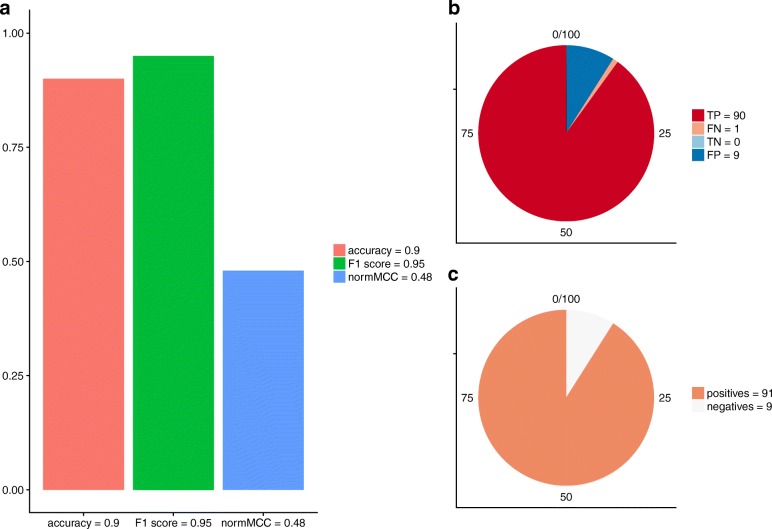
- In six synthetic use cases, MCC was the only metric that correctly indicated the prediction problem in all six. For Use case A1 (91 positives, 9 negatives; TP=90, FN=1, TN=0, FP=9), accuracy=0.90 and F1=0.95, but MCC=−0.03. For Use case C2 (11 positives, 89 negatives; TP=2, FN=9, TN=88, FP=1), accuracy=0.90, F1=0.29, and MCC=+0.31.
- Correlation analysis over all possible confusion matrices showed MCC and accuracy were strongly correlated, while F1 correlated less than 0.8 with the other two measures. For N=1000, PCC(MCC,F1)=0.775982, PCC(MCC,accuracy)=0.921030, and PCC(accuracy,F1)=0.778652.
- In the colon cancer gene expression dataset (2,000 gene probesets, 62 patients: 22 healthy controls and 40 colon cancer; 35.48% negatives, 64.52% positives), rankings differed by metric. MCC ranked gradient boosting top (MCC=+0.55, TP rate=0.85, TN rate=0.69), while F1 and accuracy ranked k-NN top (F1=0.87, accuracy=0.80, TP rate=0.92, TN rate=0.52). Radial SVM had F1=0.75 and accuracy=0.67 but TN rate=0.40 and MCC=+0.29.
- MCC produces a high score only if the classifier correctly predicts the majority of positive and negative instances; F1 is independent of true negatives and is not symmetric for class swapping, while accuracy can be overoptimistic on imbalanced datasets.
Methods
- The paper defines accuracy, MCC, and F1 score mathematically, explores their relationships using Pearson correlation coefficient over all possible confusion matrices for N≥10 up to 1000, and plots all 21,084,251 possible confusion matrices for a 500-sample dataset on the MCC/F1 plane.
- Six synthetic use cases vary class balance and imbalance with specified confusion matrices to compare metric behavior.
- The real genomics experiment uses colon cancer gene expression data from Alon et al. via the plsgenomics R package, applying gradient boosting, decision tree, k-nearest neighbors, linear SVM, and radial SVM. Training/test splits were 80/20 or 60/20/20 with validation for hyperparameter grid search; experiments were repeated ten times and averaged for MCC, F1, accuracy, TP rate, and TN rate.
Limitations
- The paper states that additional comparisons with other rates such as Cohen’s Kappa, Cramér’s V, and K measure would have provided further information, but the authors focused on accuracy and F1 because they are more commonly used in biomedical machine learning studies.
- The paper notes that MCC can be undefined when a whole row or column of the confusion matrix is zero, and handles these cases via an approximation using an arbitrarily small value ε; it also cites situations where MCC can display large fluctuations due to imbalanced outcomes.
- Evident from the text: the real-world validation uses a single colon cancer gene expression dataset, the six use cases are synthetic, and Table 5 excludes standard deviations to keep the table simple.
Model-written summary. Check it against the paper before relying on it.
Integrity signals
Registry
Cites
Statistics
Figures
Verification
Claims the paper makes
29 Own interpretation · 28 Own result · 15 Not checked yet · 13 No basis given
The paper states this without a source or data behind it here, so there is nothing to check it against. The quote shows it is in the paper.
In the paper
“A potential problem with MCC lies in the fact that MCC is undefined when a whole row or column of M is zero, as it happens in the previously cited case of the trivial majority classifier.”
§ The advantages of the Matthews correlation coefficient (MCC) over F1 score and accuracy in binary classification evaluation > Methods > Notation and mathematical foundations
plainn = 4- Asserted: passes — The authors put it forward as true.
- Checkable: passes — It can be checked against evidence.
- Load-bearing: passes — The paper’s conclusions depend on it.
- Based: passes — The paper gives a reason why it holds.
The paper states this without a source or data behind it here, so there is nothing to check it against. The quote shows it is in the paper.
In the paper
“Second, F1 score is independent from the number of samples correctly classified as negative.”
§ The advantages of the Matthews correlation coefficient (MCC) over F1 score and accuracy in binary classification evaluation > Background
plain- Asserted: passes — The authors put it forward as true.
- Checkable: passes — It can be checked against evidence.
- Load-bearing: passes — The paper’s conclusions depend on it.
- Based: passes — The paper gives a reason why it holds.
A result the paper reports from its own data — it cites no other source for it, so there is none to check. The quote shows it is in the paper.
In the paper
“she/he would notice good results (F1 score = 0.75 and accuracy = 0.67)”
§ The advantages of the Matthews correlation coefficient (MCC) over F1 score and accuracy in binary classification evaluation > Results and discussion > Genomics scenario: colon cancer gene expression
hedged- Asserted: passes — The authors put it forward as true.
- Checkable: passes — It can be checked against evidence.
- Load-bearing: unclear — It is unclear whether the paper’s conclusions depend on it.
- Based: passes — The paper gives a reason why it holds.
A result the paper reports from its own data — it cites no other source for it, so there is none to check. The quote shows it is in the paper.
In the paper
“For the Use case A1 (negatively imbalanced dataset), the machine learning classifier was unable to correctly predict negative data instances, and it therefore produced confusion matrices featuring few true negatives (TN).”
§ The advantages of the Matthews correlation coefficient (MCC) over F1 score and accuracy in binary classification evaluation > Results and discussion > Use cases
plaindirect- Asserted: passes — The authors put it forward as true.
- Checkable: passes — It can be checked against evidence.
- Load-bearing: passes — The paper’s conclusions depend on it.
- Based: passes — The paper gives a reason why it holds.
A result the paper reports from its own data — it cites no other source for it, so there is none to check. The quote shows it is in the paper.
In the paper
“First, the top classifier changes when we consider the ranking based on MCC, F1 score, or accuracy.”
§ The advantages of the Matthews correlation coefficient (MCC) over F1 score and accuracy in binary classification evaluation > Results and discussion > Genomics scenario: colon cancer gene expression
plaindirect- Asserted: passes — The authors put it forward as true.
- Checkable: passes — It can be checked against evidence.
- Load-bearing: passes — The paper’s conclusions depend on it.
- Based: passes — The paper gives a reason why it holds.
A result the paper reports from its own data — it cites no other source for it, so there is none to check. The quote shows it is in the paper.
In the paper
“MCC = +0.31 in the [–1, +1] interval”
§ The advantages of the Matthews correlation coefficient (MCC) over F1 score and accuracy in binary classification evaluation > Results and discussion > Use cases
plain- Asserted: passes — The authors put it forward as true.
- Checkable: passes — It can be checked against evidence.
- Load-bearing: unclear — It is unclear whether the paper’s conclusions depend on it.
- Based: passes — The paper gives a reason why it holds.
A result the paper reports from its own data — it cites no other source for it, so there is none to check. The quote shows it is in the paper.
In the paper
“In the Use case B1 (balanced dataset), the machine learning method was unable to correctly predict negative data instances, and therefore produced a confusion matrix featuring few true negatives (TN).”
§ The advantages of the Matthews correlation coefficient (MCC) over F1 score and accuracy in binary classification evaluation > Results and discussion > Use cases
plaindirect- Asserted: passes — The authors put it forward as true.
- Checkable: passes — It can be checked against evidence.
- Load-bearing: passes — The paper’s conclusions depend on it.
- Based: passes — The paper gives a reason why it holds.
A result the paper reports from its own data — it cites no other source for it, so there is none to check. The quote shows it is in the paper.
In the paper
“Finally, in the last Use case C2 (positively imbalanced dataset), the prediction technique failed in predicting negative elements, and therefore its confusion matrix showed a low percentage of true negatives.”
§ The advantages of the Matthews correlation coefficient (MCC) over F1 score and accuracy in binary classification evaluation > Results and discussion > Use cases
plaindirect- Asserted: passes — The authors put it forward as true.
- Checkable: passes — It can be checked against evidence.
- Load-bearing: passes — The paper’s conclusions depend on it.
- Based: passes — The paper gives a reason why it holds.
A result the paper reports from its own data — it cites no other source for it, so there is none to check. The quote shows it is in the paper.
In the paper
“F1 score = 0.29 in the [0, 1] interval”
§ The advantages of the Matthews correlation coefficient (MCC) over F1 score and accuracy in binary classification evaluation > Results and discussion > Use cases
plain- Asserted: passes — The authors put it forward as true.
- Checkable: passes — It can be checked against evidence.
- Load-bearing: unclear — It is unclear whether the paper’s conclusions depend on it.
- Based: passes — The paper gives a reason why it holds.
A result the paper reports from its own data — it cites no other source for it, so there is none to check. The quote shows it is in the paper.
In the paper
“the radial SVM has performed poorly on the true negatives (TN rate = 0.40), by correctly predicting less than half patients.”
§ The advantages of the Matthews correlation coefficient (MCC) over F1 score and accuracy in binary classification evaluation > Results and discussion > Genomics scenario: colon cancer gene expression
plain- Asserted: passes — The authors put it forward as true.
- Checkable: passes — It can be checked against evidence.
- Load-bearing: passes — The paper’s conclusions depend on it.
- Based: passes — The paper gives a reason why it holds.
- Probably not a substantial claim. 15
- The quote only partly states this claim. 5
- It may state two separate claims as one. 36
A result the paper reports from its own data — it cites no other source for it, so there is none to check. The quote shows it is in the paper.
In the paper
“Here, accuracy showed a high value: 0.90 in the [0, 1] interval.”
§ The advantages of the Matthews correlation coefficient (MCC) over F1 score and accuracy in binary classification evaluation > Results and discussion > Use cases
plain- Asserted: passes — The authors put it forward as true.
- Checkable: passes — It can be checked against evidence.
- Load-bearing: passes — The paper’s conclusions depend on it.
- Based: passes — The paper gives a reason why it holds.
Probably not a substantial claim. The quote only partly states this claim.
A result the paper reports from its own data — it cites no other source for it, so there is none to check. The quote shows it is in the paper.
In the paper
“In this case, all three statistical rates showed a low score which emphasized the deficiency in the prediction process (accuracy = 0.24, F1 score = 0.12, and MCC = −0.24).”
§ The advantages of the Matthews correlation coefficient (MCC) over F1 score and accuracy in binary classification evaluation > Results and discussion > Use cases
plain- Asserted: passes — The authors put it forward as true.
- Checkable: passes — It can be checked against evidence.
- Load-bearing: unclear — It is unclear whether the paper’s conclusions depend on it.
- Based: passes — The paper gives a reason why it holds.
It may state two separate claims as one.
The paper states this without a source or data behind it here, so there is nothing to check it against. The quote shows it is in the paper.
In the paper
“It ranges in the interval [−1,+1], with extreme values –1 and +1 reached in case of perfect misclassification and perfect classification, respectively, while MCC=0 is the expected value for the coin tossing classifier.”
§ The advantages of the Matthews correlation coefficient (MCC) over F1 score and accuracy in binary classification evaluation > Methods > Notation and mathematical foundations
plain- Asserted: passes — The authors put it forward as true.
- Checkable: passes — It can be checked against evidence.
- Load-bearing: passes — The paper’s conclusions depend on it.
- Based: passes — The paper gives a reason why it holds.
Probably not a substantial claim. It may state two separate claims as one.
The paper states this without a source or data behind it here, so there is nothing to check it against. The quote shows it is in the paper.
In the paper
“F1 ranges in [0,1], where the minimum is reached for TP=0, that is, when all the positive samples are misclassified, and the maximum for FN=FP=0, that is for perfect classification.”
§ The advantages of the Matthews correlation coefficient (MCC) over F1 score and accuracy in binary classification evaluation > Methods > Notation and mathematical foundations
plain- Asserted: passes — The authors put it forward as true.
- Checkable: passes — It can be checked against evidence.
- Load-bearing: fails — The paper’s conclusions may not depend on it.
- Based: passes — The paper gives a reason why it holds.
Probably not a substantial claim. The paper’s conclusions may not depend on it. It may state two separate claims as one.
A result the paper reports from its own data — it cites no other source for it, so there is none to check. The quote shows it is in the paper.
In the paper
“Like for the Use case A2, accuracy, F1 and MCC show average or low result scores (accuracy = 0.56, F1 score = 0.31, and MCC = +0.17), correctly informing you about the non-optimal performance of the prediction method (Additional file 3a).”
§ The advantages of the Matthews correlation coefficient (MCC) over F1 score and accuracy in binary classification evaluation > Results and discussion > Use cases
plain- Asserted: passes — The authors put it forward as true.
- Checkable: passes — It can be checked against evidence.
- Load-bearing: unclear — It is unclear whether the paper’s conclusions depend on it.
- Based: passes — The paper gives a reason why it holds.
It may state two separate claims as one.
The paper states this without a source or data behind it here, so there is nothing to check it against. The quote shows it is in the paper.
In the paper
“If M has only one non-zero entry, this means that all samples in the dataset belong to one class, and they are either all correctly (for TP≠0 or TN≠0) or incorrectly (for FP≠0 or FN≠0) classified. In this situations, MCC=1 for the former case and MCC=−1 for the latter case.”
§ The advantages of the Matthews correlation coefficient (MCC) over F1 score and accuracy in binary classification evaluation > Methods > Notation and mathematical foundations
plaindirectSingle case- Asserted: passes — The authors put it forward as true.
- Checkable: passes — It can be checked against evidence.
- Load-bearing: unclear — It is unclear whether the paper’s conclusions depend on it.
- Based: passes — The paper gives a reason why it holds.
It may state two separate claims as one.
The paper states this without a source or data behind it here, so there is nothing to check it against. The quote shows it is in the paper.
In the paper
“If the dataset is highly unbalanced, ni≈1, and thus the accuracy measure gives an unreliable estimation of the goodness of the classifier.”
§ The advantages of the Matthews correlation coefficient (MCC) over F1 score and accuracy in binary classification evaluation > Methods > Notation and mathematical foundations
plaindirect- Asserted: passes — The authors put it forward as true.
- Checkable: passes — It can be checked against evidence.
- Load-bearing: passes — The paper’s conclusions depend on it.
- Based: passes — The paper gives a reason why it holds.
It may state two separate claims as one.
A result the paper reports from its own data — it cites no other source for it, so there is none to check. The quote shows it is in the paper.
In the paper
“Checking only F1, one would read a good value (0.66 in the [0, 1] interval), and would be overall satisfied about the prediction (Additional file 2a).”
- Also stated in: § Use cases · hedged
“The Matthews correlation coefficient, instead, by showing a score close to random guessing (+0.07 in the [–1, +1] interval) would be able to inform that the machine learning method has been on the wrong track. Also, it is worth noticing that accuracy would provide with an informative result in this case (0.52 in the [0, 1] interval).”
§ The advantages of the Matthews correlation coefficient (MCC) over F1 score and accuracy in binary classification evaluation > Results and discussion > Use cases
hedged- Asserted: passes — The authors put it forward as true.
- Checkable: passes — It can be checked against evidence.
- Load-bearing: passes — The paper’s conclusions depend on it.
- Based: passes — The paper gives a reason why it holds.
It may state two separate claims as one. The quote only partly states this claim.
- Also stated in: § Use cases · hedged
A result the paper reports from its own data — it cites no other source for it, so there is none to check. The quote shows it is in the paper.
In the paper
“However, accuracy and of F1 showed high values in this case: accuracy = 0.90 and F1 score = 0.95, both close to the best possible value 1.00 in the [0, 1] interval (Fig. 2a).”
- Also stated in: § Use cases · hedged
“Instead, if one decided to take advantage of the Matthews correlation coefficient in the Use case A1, he/she would notice the resulting MCC = –0.03 (Fig. 2a).”
§ The advantages of the Matthews correlation coefficient (MCC) over F1 score and accuracy in binary classification evaluation > Results and discussion > Use cases
plainSingle case- Asserted: passes — The authors put it forward as true.
- Checkable: passes — It can be checked against evidence.
- Load-bearing: passes — The paper’s conclusions depend on it.
- Based: passes — The paper gives a reason why it holds.
It may state two separate claims as one. The quote only partly states this claim.
- Also stated in: § Use cases · hedged
A result the paper reports from its own data — it cites no other source for it, so there is none to check. The quote shows it is in the paper.
In the paper
“Similar to the Use case A2 and B2, all three statistical scores generated low results that reflect the mediocre quality of the prediction: F1 score = 0.17 and accuracy = 0.10 in the [0, 1] interval, and MCC = −0.19 in the [–1, +1] interval (Additional file 4a).”
§ The advantages of the Matthews correlation coefficient (MCC) over F1 score and accuracy in binary classification evaluation > Results and discussion > Use cases
plainSingle case- Asserted: passes — The authors put it forward as true.
- Checkable: passes — It can be checked against evidence.
- Load-bearing: unclear — It is unclear whether the paper’s conclusions depend on it.
- Based: passes — The paper gives a reason why it holds.
It may state two separate claims as one.
The paper states this without a source or data behind it here, so there is nothing to check it against. The quote shows it is in the paper.
In the paper
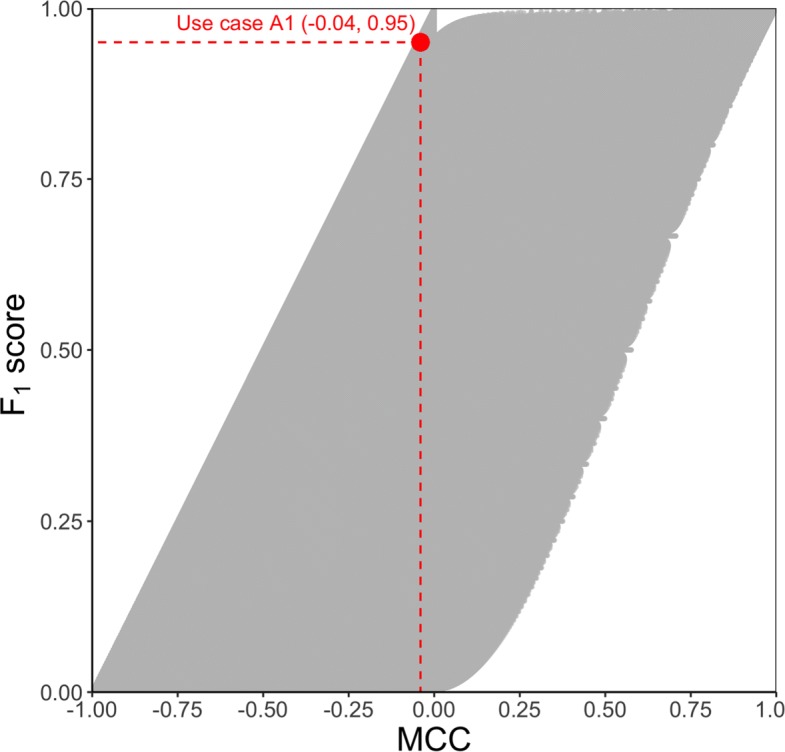
“On the other hand, for a given value MCC=μ, the F1 score can range in [0,μ+1] if μ≤0 and in [μ,1] if μ>0, so that the width of the range is 1−|μ|, that is, it depends on the MCC value μ.”
§ The advantages of the Matthews correlation coefficient (MCC) over F1 score and accuracy in binary classification evaluation > Methods > Relationship between measures
plaincorrelational- Asserted: passes — The authors put it forward as true.
- Checkable: passes — It can be checked against evidence.
- Load-bearing: passes — The paper’s conclusions depend on it.
- Based: passes — The paper gives a reason why it holds.
It may state two separate claims as one.
The paper states this without a source or data behind it here, so there is nothing to check it against. The quote shows it is in the paper.
In the paper
“The two measures are reasonably concordant, but the scatterplot cloud is wide, implying that for each value of F1 score there is a corresponding range of values of MCC and vice versa, although with different width.”
§ The advantages of the Matthews correlation coefficient (MCC) over F1 score and accuracy in binary classification evaluation > Methods > Relationship between measures
plaincorrelational- Asserted: passes — The authors put it forward as true.
- Checkable: passes — It can be checked against evidence.
- Load-bearing: passes — The paper’s conclusions depend on it.
- Based: passes — The paper gives a reason why it holds.
It may state two separate claims as one.
The paper states this without a source or data behind it here, so there is nothing to check it against. The quote shows it is in the paper.
In the paper
“Overall, accuracy, F1, and MCC show reliable concordant scores for predictions that correctly classify both positives and negatives (having therefore many TP and TN), and for predictions that incorrectly classify both positives and negatives (having therefore few TP and TN); however, these measures show discordant behaviors when the prediction performs well just with one of the two binary classes.”
§ The advantages of the Matthews correlation coefficient (MCC) over F1 score and accuracy in binary classification evaluation > Methods > Relationship between measures
plaincorrelational- Asserted: passes — The authors put it forward as true.
- Checkable: passes — It can be checked against evidence.
- Load-bearing: passes — The paper’s conclusions depend on it.
- Based: passes — The paper gives a reason why it holds.
It may state two separate claims as one.
The paper states this without a source or data behind it here, so there is nothing to check it against. The quote shows it is in the paper.
In the paper
“First, F1 varies for class swapping, while MCC is invariant if the positive class is renamed negative and vice versa.”
§ The advantages of the Matthews correlation coefficient (MCC) over F1 score and accuracy in binary classification evaluation > Background
plaindirect- Asserted: passes — The authors put it forward as true.
- Checkable: passes — It can be checked against evidence.
- Load-bearing: passes — The paper’s conclusions depend on it.
- Based: passes — The paper gives a reason why it holds.
It may state two separate claims as one.
A result the paper reports from its own data — it cites no other source for it, so there is none to check. The quote shows it is in the paper.
In the paper
“Interestingly, the correlation grows with N, but the increments are limited.”
§ The advantages of the Matthews correlation coefficient (MCC) over F1 score and accuracy in binary classification evaluation > Methods > Relationship between measures
plaincorrelational- Asserted: passes — The authors put it forward as true.
- Checkable: passes — It can be checked against evidence.
- Load-bearing: fails — The paper’s conclusions may not depend on it.
- Based: passes — The paper gives a reason why it holds.
Probably not a substantial claim. The paper’s conclusions may not depend on it. It may state two separate claims as one.
The paper states this without a source or data behind it here, so there is nothing to check it against. The quote shows it is in the paper.
In the paper
“With these positions MCC is now defined for all confusion matrices M. As a consequences, MCC=0 for the trivial majority classifier, and 0 is also the expected value for the coin tossing classifier.”
§ The advantages of the Matthews correlation coefficient (MCC) over F1 score and accuracy in binary classification evaluation > Methods > Notation and mathematical foundations
plainn = 4- Asserted: passes — The authors put it forward as true.
- Checkable: passes — It can be checked against evidence.
- Load-bearing: passes — The paper’s conclusions depend on it.
- Based: passes — The paper gives a reason why it holds.
Probably not a substantial claim. It may state two separate claims as one.
A result the paper reports from its own data — it cites no other source for it, so there is none to check. The quote shows it is in the paper.
In the paper
“MCC and accuracy resulted strongly correlated, while the Pearson coefficient is less than 0.8 for the correlation of F1 with the other two measures (Table 3).”
§ The advantages of the Matthews correlation coefficient (MCC) over F1 score and accuracy in binary classification evaluation > Methods > Relationship between measures
boostedcorrelational- Asserted: passes — The authors put it forward as true.
- Checkable: passes — It can be checked against evidence.
- Load-bearing: passes — The paper’s conclusions depend on it.
- Based: passes — The paper gives a reason why it holds.
It may state two separate claims as one.
The paper states this without a source or data behind it here, so there is nothing to check it against. The quote shows it is in the paper.
In the paper
“In fact, for any value F1=ϕ, the MCC varies approximately between [ϕ−1,ϕ], so that the width of the variability range is 1, independent from the value of ϕ.”
§ The advantages of the Matthews correlation coefficient (MCC) over F1 score and accuracy in binary classification evaluation > Methods > Relationship between measures
hedgedcorrelational- Asserted: passes — The authors put it forward as true.
- Checkable: passes — It can be checked against evidence.
- Load-bearing: passes — The paper’s conclusions depend on it.
- Based: passes — The paper gives a reason why it holds.
It may state two separate claims as one.
None of the sources cited for this claim have been checked yet.
In the paper
“The micro/macro averaged F1 is invariant for class swapping and its behaviour is more similar to MCC.”
§ The advantages of the Matthews correlation coefficient (MCC) over F1 score and accuracy in binary classification evaluation > Background
plaincorrelational- Asserted: passes — The authors put it forward as true.
- Checkable: passes — It can be checked against evidence.
- Load-bearing: unclear — It is unclear whether the paper’s conclusions depend on it.
- Based: passes — The paper gives a reason why it holds.
It may state two separate claims as one.
A result the paper reports from its own data — it cites no other source for it, so there is none to check. The quote shows it is in the paper.
In the paper
“Here, accuracy showed a high value: 0.90 in the [0, 1] interval.”
§ The advantages of the Matthews correlation coefficient (MCC) over F1 score and accuracy in binary classification evaluation > Results and discussion > Use cases
plain- Asserted: passes — The authors put it forward as true.
- Checkable: passes — It can be checked against evidence.
- Load-bearing: fails — The paper’s conclusions may not depend on it.
- Based: passes — The paper gives a reason why it holds.
Probably not a substantial claim. The paper’s conclusions may not depend on it.
A result the paper reports from its own data — it cites no other source for it, so there is none to check. The quote shows it is in the paper.
In the paper
“linear SVM is ranked forth in the MCC ranking and in the accuracy ranking, but ranked second in the F1 score ranking.”
§ The advantages of the Matthews correlation coefficient (MCC) over F1 score and accuracy in binary classification evaluation > Results and discussion > Genomics scenario: colon cancer gene expression
plain- Asserted: passes — The authors put it forward as true.
- Checkable: passes — It can be checked against evidence.
- Load-bearing: unclear — It is unclear whether the paper’s conclusions depend on it.
- Based: passes — The paper gives a reason why it holds.
It may state two separate claims as one.
A result the paper reports from its own data — it cites no other source for it, so there is none to check. The quote shows it is in the paper.
In the paper
“k-NN, that is the top performing method both in the F1 score ranking and in the accuracy ranking, instead, obtained an excellent score for recall (TP rate = 0.92) but just sufficient on the specificity (TN rate = 0.52).”
§ The advantages of the Matthews correlation coefficient (MCC) over F1 score and accuracy in binary classification evaluation > Results and discussion > Genomics scenario: colon cancer gene expression
plain- Asserted: passes — The authors put it forward as true.
- Checkable: passes — It can be checked against evidence.
- Load-bearing: passes — The paper’s conclusions depend on it.
- Based: passes — The paper gives a reason why it holds.
It may state two separate claims as one.
None of the sources cited for this claim have been checked yet.
In the paper
“However, ROC AUC presents several flaws [92], and it is sensitive to class imbalance [93].”
§ The advantages of the Matthews correlation coefficient (MCC) over F1 score and accuracy in binary classification evaluation > Background
What the sources say
- Not checked yetcites [92] Lobo JM, Jiménez-Valverde A, Real R. AUC: a misleading measure of the performance of predictive distribution models. Glob Ecol Biogeogr. 2008; 17(2):145–51. source
- Not checked yetcites [93] Hanczar B, Hua J, Sima C, Weinstein J, Bittner M, Dougherty ER. Small-sample precision of ROC-related estimates. Bioinformatics. 2010; 26(6):822–30. source
plaincorrelational- Asserted: passes — The authors put it forward as true.
- Checkable: passes — It can be checked against evidence.
- Load-bearing: passes — The paper’s conclusions depend on it.
- Based: passes — The paper gives a reason why it holds.
It may state two separate claims as one.
A conclusion the paper draws from its own results — it cites no other source for it, so there is none to check. The quote shows it is in the paper.
In the paper
“Once again, this score would hide the truth: the classification algorithm has performed poorly on the negative subset.”
§ The advantages of the Matthews correlation coefficient (MCC) over F1 score and accuracy in binary classification evaluation > Results and discussion > Use cases
hedgeddirect- Asserted: passes — The authors put it forward as true.
- Checkable: passes — It can be checked against evidence.
- Load-bearing: passes — The paper’s conclusions depend on it.
- Based: passes — The paper gives a reason why it holds.
It may state two separate claims as one. The quote only partly states this claim.
None of the sources cited for this claim have been checked yet.
In the paper
“The effectiveness of MCC has been shown in other scientific fields as well [43, 44].”
§ The advantages of the Matthews correlation coefficient (MCC) over F1 score and accuracy in binary classification evaluation > Background
What the sources say
- Not checked yetcites [43] Liu Y, Cheng J, Yan C, Wu X, Chen F. Research on the Matthews correlation coefficients metrics of personalized recommendation algorithm evaluation. Int J Hybrid Informa Technol. 2015; 8(1):163–72. source
- Not checked yetcites [44] Naulaerts S, Dang CC, Ballester PJ. Precision and recall oncology: combining multiple gene mutations for improved identification of drug-sensitive tumours. Oncotarget. 2017; 8(57):97025. source
plain- Asserted: passes — The authors put it forward as true.
- Checkable: passes — It can be checked against evidence.
- Load-bearing: fails — The paper’s conclusions may not depend on it.
- Based: passes — The paper gives a reason why it holds.
Probably not a substantial claim. The paper’s conclusions may not depend on it.
None of the sources cited for this claim have been checked yet.
In the paper
“Even if less common than the ROC curve, several scientists consider the PR curve more informative than the ROC curve, especially on imbalanced biological and medical datasets [48, 97, 98].”
§ The advantages of the Matthews correlation coefficient (MCC) over F1 score and accuracy in binary classification evaluation > Background
What the sources say
- Not checked yetcites [48] Saito T, Rehmsmeier M. The precision-recall plot is more informative than the ROC plot when evaluating binary classifiers on imbalanced datasets. PLoS ONE. 2015; 10(3):0118432. source
- Not checked yetcites [97] Chicco D. Ten quick tips for machine learning in computational biology. BioData Min. 2017; 10(35):1–17.
- Not checked yetcites [98] Ozenne B, Subtil F, Maucort-Boulch D. The precision–recall curve overcame the optimism of the receiver operating characteristic curve in rare diseases. J Clin Epidemiol. 2015; 68(8):855–9. source
plain- Asserted: passes — The authors put it forward as true.
- Checkable: passes — It can be checked against evidence.
- Load-bearing: fails — The paper’s conclusions may not depend on it.
- Based: passes — The paper gives a reason why it holds.
Probably not a substantial claim. The paper’s conclusions may not depend on it.
None of the sources cited for this claim have been checked yet.
In the paper
“MCC was re-proposed by Baldi and colleagues [39] in 2000 as a standard performance metric for machine learning with a natural extension to the multiclass case [40].”
§ The advantages of the Matthews correlation coefficient (MCC) over F1 score and accuracy in binary classification evaluation > Background
What the sources say
- Not checked yetcites [39] Baldi P, Brunak S, Chauvin Y, Andersen CA, Nielsen H. Assessing the accuracy of prediction algorithms for classification: an overview. Bioinformatics. 2000; 16(5):412–24. source
- Not checked yetcites [40] Gorodkin J. Comparing two K-category assignments by a K-category correlation coefficient. Comput Biol Chem. 2004; 28(5–6):367–74. source
plain- Asserted: passes — The authors put it forward as true.
- Checkable: passes — It can be checked against evidence.
- Load-bearing: fails — The paper’s conclusions may not depend on it.
- Based: passes — The paper gives a reason why it holds.
Probably not a substantial claim. The paper’s conclusions may not depend on it. It may state two separate claims as one.
None of the sources cited for this claim have been checked yet.
In the paper
“For example, when Whalen and colleagues released TargetFinder, a tool to predict enhancer-promoters interactions in genomics, they showed its results measured only by F1 score [13], making it impossible to detect the actual true positive rate and true negative rate of their tests [69].”
§ The advantages of the Matthews correlation coefficient (MCC) over F1 score and accuracy in binary classification evaluation > Background
What the sources say
- Not checked yetcites [13] Whalen S, Truty RM, Pollard KS. Enhancer–promoter interactions are encoded by complex genomic signatures on looping chromatin. Nat Genet. 2016; 48(5):488. source
- Not checked yetcites [69] Xi W, Beer MA. Local epigenomic state cannot discriminate interacting and non-interacting enhancer–promoter pairs with high accuracy. PLoS Comput Biol. 2018; 14(12):1006625. source
plaindirect- Asserted: passes — The authors put it forward as true.
- Checkable: passes — It can be checked against evidence.
- Load-bearing: fails — The paper’s conclusions may not depend on it.
- Based: passes — The paper gives a reason why it holds.
Probably not a substantial claim. The paper’s conclusions may not depend on it. It may state two separate claims as one.
In the paper
“Although being widely acknowledged as a reliable metric, there are situations - albeit extreme - where either MCC cannot be defined or it displays large fluctuations [45], due to imbalanced outcomes in the classification.”
§ The advantages of the Matthews correlation coefficient (MCC) over F1 score and accuracy in binary classification evaluation > Background
What the sources say
- Not checked yetcites [45] Brown JB. Classifiers and their metrics quantified. Mol Inform. 2018; 37:1700127. source
plaindirect- Asserted: passes — The authors put it forward as true.
- Checkable: passes — It can be checked against evidence.
- Load-bearing: fails — The paper’s conclusions may not depend on it.
- Based: passes — The paper gives a reason why it holds.
Probably not a substantial claim. The paper’s conclusions may not depend on it. It may state two separate claims as one.
In the paper
“An effective solution overcoming the class imbalance issue comes from the Matthews correlation coefficient (MCC), a special case of the ϕ phi coefficient [36].”
§ The advantages of the Matthews correlation coefficient (MCC) over F1 score and accuracy in binary classification evaluation > Background
What the sources say
- Not checked yetcites [36] Guilford JP. Psychometric Methods. New York City: McGraw-Hill; 1954.
plain- Asserted: passes — The authors put it forward as true.
- Checkable: passes — It can be checked against evidence.
- Load-bearing: fails — The paper’s conclusions may not depend on it.
- Based: passes — The paper gives a reason why it holds.
Probably not a substantial claim. The paper’s conclusions may not depend on it.
None of the sources cited for this claim have been checked yet.
In the paper
“for instance, the Food and Drug Administration (FDA) agency of the USA employed the MCC as the main evaluation measure in the MicroArray II / Sequencing Quality Control (MAQC/SEQC) projects [41, 42].”
§ The advantages of the Matthews correlation coefficient (MCC) over F1 score and accuracy in binary classification evaluation > Background
What the sources say
- Not checked yetcites [41] The MicroArray Quality Control (MAQC) Consortium. The MAQC-II Project: a comprehensive study of common practices for the development and validation of microarray-based predictive models. Nat Biotechnol. 2010; 28(8):827–38. source
- Not checked yetcites [42] The SEQC/MAQC-III Consortium. A comprehensive assessment of RNA-seq accuracy, reproducibility and information content by the Sequence Quality Control consortium. Nat Biotechnol. 2014; 32:903–14. source
plain- Asserted: passes — The authors put it forward as true.
- Checkable: passes — It can be checked against evidence.
- Load-bearing: fails — The paper’s conclusions may not depend on it.
- Based: passes — The paper gives a reason why it holds.
Probably not a substantial claim. The paper’s conclusions may not depend on it.
In the paper
“However, this procedure is biased [65], and it is still far from being accepted as a standard practice by the community.”
§ The advantages of the Matthews correlation coefficient (MCC) over F1 score and accuracy in binary classification evaluation > Background
What the sources say
- Not checked yetcites [65] Van Asch V. Macro-and micro-averaged evaluation measures. Technical report. 2013:1–27.
plain- Asserted: passes — The authors put it forward as true.
- Checkable: passes — It can be checked against evidence.
- Load-bearing: unclear — It is unclear whether the paper’s conclusions depend on it.
- Based: passes — The paper gives a reason why it holds.
It may state two separate claims as one.
A conclusion the paper draws from its own results — it cites no other source for it, so there is none to check. The quote shows it is in the paper.
In the paper
“In this case, the algorithm showed its ability to predict the positive data instances (90 sick patients out of 91 were correctly predicted), but it also displayed its lack of talent in identifying healthy controls (only 1 healthy individual out of 9 was correctly recognized) (Fig. 2b). Therefore, the overall performance should be judged poor.”
§ The advantages of the Matthews correlation coefficient (MCC) over F1 score and accuracy in binary classification evaluation > Results and discussion > Use cases
plaindirectSingle case- Asserted: passes — The authors put it forward as true.
- Checkable: passes — It can be checked against evidence.
- Load-bearing: passes — The paper’s conclusions depend on it.
- Based: passes — The paper gives a reason why it holds.
It may state two separate claims as one.
A conclusion the paper draws from its own results — it cites no other source for it, so there is none to check. The quote shows it is in the paper.
In the paper
“Similar to the Use case A1 and B1, the method was able to correctly identify multiple negative data instances (88 healthy patients out of 89), but unable to correctly predict most of sick patients (only 2 true positives out of 11 possible elements).”
§ The advantages of the Matthews correlation coefficient (MCC) over F1 score and accuracy in binary classification evaluation > Results and discussion > Use cases
plainn = 88- Asserted: passes — The authors put it forward as true.
- Checkable: passes — It can be checked against evidence.
- Load-bearing: passes — The paper’s conclusions depend on it.
- Based: passes — The paper gives a reason why it holds.
It may state two separate claims as one.
In the paper
“Originally developed by Matthews in 1975 for comparison of chemical structures [38]”
§ The advantages of the Matthews correlation coefficient (MCC) over F1 score and accuracy in binary classification evaluation > Background
What the sources say
- Not checked yetcites [38] Matthews BW. Comparison of the predicted and observed secondary structure of T4 phage lysozyme. Biochim Biophys Acta (BBA) Protein Struct. 1975; 405(2):442–51. source
plain- Asserted: passes — The authors put it forward as true.
- Checkable: passes — It can be checked against evidence.
- Load-bearing: fails — The paper’s conclusions may not depend on it.
- Based: passes — The paper gives a reason why it holds.
Probably not a substantial claim. The paper’s conclusions may not depend on it.
None of the sources cited for this claim have been checked yet.
In the paper
“Despite its popularity, in the learning context there are a number of issues causing the kappa measure to produce unreliable results (for instance, its high sensitivity to the distribution of the marginal totals [73–75])”
§ The advantages of the Matthews correlation coefficient (MCC) over F1 score and accuracy in binary classification evaluation > Background
What the sources say
- Not checked yetcites [73] Flight L, Julious SA. The disagreeable behaviour of the kappa statistic. Pharm Stat. 2015; 14:74–8. source
- Not checked yetcites [74] Powers DMW. The problem with Kappa. In: Proceedings of EACL 2012 – the 13th Conference of the European Chapter of the Association for Computational Linguistics. Avignon: ACL: 2012. p. 345–55.
- Not checked yetcites [75] Delgado R, Tibau X-A. Why Cohen’s Kappa should be avoided as performance measure in classification. PloS ONE. 2019; 14(9):0222916.
plaindirect- Asserted: passes — The authors put it forward as true.
- Checkable: passes — It can be checked against evidence.
- Load-bearing: passes — The paper’s conclusions depend on it.
- Based: passes — The paper gives a reason why it holds.
It may state two separate claims as one.
A conclusion the paper draws from its own results — it cites no other source for it, so there is none to check. The quote shows it is in the paper.
In the paper
“In fact, when a prediction displays many true positives but few true negatives (or many true negatives but few true positives) we will show that F1 and accuracy can provide misleading information, while MCC always generates results that reflect the overall prediction issues.”
§ The advantages of the Matthews correlation coefficient (MCC) over F1 score and accuracy in binary classification evaluation > Methods > Relationship between measures
plaindirect- Asserted: passes — The authors put it forward as true.
- Checkable: passes — It can be checked against evidence.
- Load-bearing: passes — The paper’s conclusions depend on it.
- Based: passes — The paper gives a reason why it holds.
It may state two separate claims as one.
A conclusion the paper draws from its own results — it cites no other source for it, so there is none to check. The quote shows it is in the paper.
In the paper
“These results show that, while accuracy and F1 score often generate high scores that do not inform the user about ongoing prediction issues, the MCC is a robust, useful, reliable, truthful statistical measure able to correctly reflect the deficiency of any prediction in any dataset.”
§ The advantages of the Matthews correlation coefficient (MCC) over F1 score and accuracy in binary classification evaluation > Results and discussion > Use cases
boosteddirectn = 6- Asserted: passes — The authors put it forward as true.
- Checkable: passes — It can be checked against evidence.
- Load-bearing: passes — The paper’s conclusions depend on it.
- Based: passes — The paper gives a reason why it holds.
It may state two separate claims as one. The quote only partly states this claim.
A conclusion the paper draws from its own results — it cites no other source for it, so there is none to check. The quote shows it is in the paper.
In the paper
“Here accuracy again generated overoptimistic, misleading, and inflated high results”
§ The advantages of the Matthews correlation coefficient (MCC) over F1 score and accuracy in binary classification evaluation > Results and discussion > Use cases
plaindirectSingle case- Asserted: passes — The authors put it forward as true.
- Checkable: passes — It can be checked against evidence.
- Load-bearing: passes — The paper’s conclusions depend on it.
- Based: passes — The paper gives a reason why it holds.
It may state two separate claims as one.
A conclusion the paper draws from its own results — it cites no other source for it, so there is none to check. The quote shows it is in the paper.
In the paper
“The F1 score ranking and the accuracy ranking, in conclusion, are hiding this important flaw of the top classifier: k-NN was unable top correctly predict a high percentage of patients.”
§ The advantages of the Matthews correlation coefficient (MCC) over F1 score and accuracy in binary classification evaluation > Results and discussion > Genomics scenario: colon cancer gene expression
boosteddirect- Asserted: passes — The authors put it forward as true.
- Checkable: passes — It can be checked against evidence.
- Load-bearing: passes — The paper’s conclusions depend on it.
- Based: passes — The paper gives a reason why it holds.
It may state two separate claims as one.
A conclusion the paper draws from its own results — it cites no other source for it, so there is none to check. The quote shows it is in the paper.
In the paper
“There, accuracy and F1 generated overoptimistic and inflated results”
§ The advantages of the Matthews correlation coefficient (MCC) over F1 score and accuracy in binary classification evaluation > Results and discussion > Use cases
plaindirect- Asserted: passes — The authors put it forward as true.
- Checkable: passes — It can be checked against evidence.
- Load-bearing: passes — The paper’s conclusions depend on it.
- Based: passes — The paper gives a reason why it holds.
It may state two separate claims as one.
A conclusion the paper draws from its own results — it cites no other source for it, so there is none to check. The quote shows it is in the paper.
In the paper
“Accuracy and F1 score, although popular, can generate misleading results on imbalanced datasets, because they fail to consider the ratio between positive and negative elements.”
- Also stated in: § Conclusions · plain
“F1 and accuracy, instead, generate reliable results only when applied to balanced datasets, and produce misleading results when applied to imbalanced cases.”
§ The advantages of the Matthews correlation coefficient (MCC) over F1 score and accuracy in binary classification evaluation > Conclusions
plaindirect- Asserted: passes — The authors put it forward as true.
- Checkable: passes — It can be checked against evidence.
- Load-bearing: passes — The paper’s conclusions depend on it.
- Based: passes — The paper gives a reason why it holds.
It may state two separate claims as one.
- Also stated in: § Conclusions · plain
A conclusion the paper draws from its own results — it cites no other source for it, so there is none to check. The quote shows it is in the paper.
In the paper
“With its low value (MCC = +0.29), the MCC informs the readers about the poor general outcome of the radial SVM, while the accuracy and F1 score show misleading values.”
§ The advantages of the Matthews correlation coefficient (MCC) over F1 score and accuracy in binary classification evaluation > Results and discussion > Genomics scenario: colon cancer gene expression
plaindirect- Asserted: passes — The authors put it forward as true.
- Checkable: passes — It can be checked against evidence.
- Load-bearing: passes — The paper’s conclusions depend on it.
- Based: passes — The paper gives a reason why it holds.
It may state two separate claims as one.
In the paper
“The dataset contains 2,000 gene probsets for 62 patients, of which 22 are healthy controls and 40 have colon cancer (35.48% negatives and 64.52% positives) [106].”
§ The advantages of the Matthews correlation coefficient (MCC) over F1 score and accuracy in binary classification evaluation > Results and discussion > Genomics scenario: colon cancer gene expression
What the sources say
- Not checked yetcites [106] Alon U, Barkai N, Notterman DA, Gish K, Ybarra S, Mack D, Levine AJ. Data pertaining to the article ‘Broad patterns of gene expression revealed by clustering of tumor and normal colon tissues probed by oligonucleotide arrays’. 2000. http://genomics-pubs.princeton.edu/oncology/affydata/index.html. Accessed 10 Dec 2019.
plainn = 62- Asserted: passes — The authors put it forward as true.
- Checkable: passes — It can be checked against evidence.
- Load-bearing: fails — The paper’s conclusions may not depend on it.
- Based: passes — The paper gives a reason why it holds.
Probably not a substantial claim. The paper’s conclusions may not depend on it.
The paper relies on this without support.
Accuracy and F1 score are the most common metrics used for binary classification in machine learning.
“We decided to focus on accuracy and F1 score because they are the most common metrics used for binary classification in machine learning.”
The paper relies on this without support.
The synthetic use cases are realistic representations of binary classification scenarios.
“here we describe some synthetic, realistic scenarios where MCC results are more informative and truthful than the other two measures analyzed.”
The paper relies on this without support.
Accuracy and F1 score are more commonly used in machine learning studies related to biomedical applications than other rates.
“because accuracy and F1 score are more commonly used in machine learning studies related to biomedical applications.”
Claims other papers make about this one
Each is checked against this paper’s own text: does it say what the citing paper says it does?
The cited source says what the claim attributes to it.
In the citing paper
“MCC is a more reliable metric, whereby a high score is assigned only if the prediction was correct for the four base categories (TP, FP, TN and FP), taking into account the size of P and N [85].”
From A Survey of Underwater Acoustic Data Classification Methods Using Deep Learning for Shoreline Surveillance (2022) · cites this paper as [85]
In the citing paper
“since it has been shown to present a balanced score when dealing with imbalanced data [11, 6] as is our case with fewer manipulated images.”
From BioFors: A Large Biomedical Image Forensics Dataset (2021) · cites this paper as [11]
In the citing paper
“(3) the absolute value of F1 changes by simply switching the outcome labels (ie, when 1 becomes 0 and 0 becomes 1).”
From Evaluation of performance measures in predictive artificial intelligence models to support medical decisions: overview and guidance (2025) · cites this paper as [77]
In the citing paper
“(2) F1 has no intuitive interpretation”
From Evaluation of performance measures in predictive artificial intelligence models to support medical decisions: overview and guidance (2025) · cites this paper as [77]
In the citing paper
“(1) F1 ignores true negatives”
From Evaluation of performance measures in predictive artificial intelligence models to support medical decisions: overview and guidance (2025) · cites this paper as [77]
In the citing paper
“F1 and MCC were introduced to address the challenges caused by class imbalance, where classification accuracy can be inflated by classifying all patients as low risk when the event is rare.”
From Evaluation of performance measures in predictive artificial intelligence models to support medical decisions: overview and guidance (2025) · cites this paper as [77]
Self-check
Percentages, sums and reported differences re-computed from the paper’s own numbers.
Each contradiction between two passages listed here was confirmed by an independent check.
Rated major: it would touch a result — a value a result rests on, reported and recomputed p-values on opposite sides of the significance level, two passages that conflict with no sign which is right, or a cited work retracted before this paper was published.
In the paper
§ The advantages of the Matthews correlation coefficient (MCC) over F1 score and accuracy in binary classification evaluation > Results and discussion > Use cases
“Here, accuracy again generated an overoptimistic inflated score”
§ The advantages of the Matthews correlation coefficient (MCC) over F1 score and accuracy in binary classification evaluation > Results and discussion > Use cases
“all three statistical scores generated low results that reflect the mediocre quality of the prediction: F1 score = 0.17 and accuracy = 0.10 in the [0, 1] interval”
Rated minor: it would not touch a result — a value no result rests on, a p-value that stays on the same side of the significance level, or a conflict that is clerical, resolved elsewhere in the paper, or outside its own findings.
In the paper
§ The advantages of the Matthews correlation coefficient (MCC) over F1 score and accuracy in binary classification evaluation > Results and discussion > Use cases
“the prediction technique failed in predicting negative elements, and therefore its confusion matrix showed a low percentage of true negatives”
§ The advantages of the Matthews correlation coefficient (MCC) over F1 score and accuracy in binary classification evaluation > Results and discussion > Use cases
“the method was able to correctly identify multiple negative data instances (88 healthy patients out of 89), but unable to correctly predict most of sick patients (only 2 true positives out of 11 possible elements)”
Rated minor: it would not touch a result — a value no result rests on, a p-value that stays on the same side of the significance level, or a conflict that is clerical, resolved elsewhere in the paper, or outside its own findings.
In the paper
§ The advantages of the Matthews correlation coefficient (MCC) over F1 score and accuracy in binary classification evaluation > Results and discussion > Use cases
“Even if accuracy showed an excessively high result score”
§ The advantages of the Matthews correlation coefficient (MCC) over F1 score and accuracy in binary classification evaluation > Results and discussion > Use cases
“all three statistical rates showed a low score which emphasized the deficiency in the prediction process (accuracy = 0.24, F1 score = 0.12, and MCC = −0.24)”
Rated minor: it would not touch a result — a value no result rests on, a p-value that stays on the same side of the significance level, or a conflict that is clerical, resolved elsewhere in the paper, or outside its own findings.
In the paper
§ The advantages of the Matthews correlation coefficient (MCC) over F1 score and accuracy in binary classification evaluation > Results and discussion > Genomics scenario: colon cancer gene expression
“the best classifier resulted being k-NN (F1 score = 0.87 and accuracy = 0.81)”
§ The advantages of the Matthews correlation coefficient (MCC) over F1 score and accuracy in binary classification evaluation > Results and discussion > Genomics scenario: colon cancer gene expression
“k-nearest neighbors | +0.48 | 0.87 | 0.80 | 0.92 | 0.52”
Rated minor: it would not touch a result — a value no result rests on, a p-value that stays on the same side of the significance level, or a conflict that is clerical, resolved elsewhere in the paper, or outside its own findings.
In the paper
§ The advantages of the Matthews correlation coefficient (MCC) over F1 score and accuracy in binary classification evaluation > Results and discussion > Use cases
“only 1 healthy individual out of 9 was correctly recognized”
§ The advantages of the Matthews correlation coefficient (MCC) over F1 score and accuracy in binary classification evaluation > Results and discussion > Use cases
“TP=90, FN=1, TN=0, FP=9”
Rated minor: it would not touch a result — a value no result rests on, a p-value that stays on the same side of the significance level, or a conflict that is clerical, resolved elsewhere in the paper, or outside its own findings.
In the paper
§ The advantages of the Matthews correlation coefficient (MCC) over F1 score and accuracy in binary classification evaluation > Results and discussion > Use cases
“Finally, in the last Use case C2 (positively imbalanced dataset)”
§ The advantages of the Matthews correlation coefficient (MCC) over F1 score and accuracy in binary classification evaluation > Results and discussion > Use cases
“Use case C2 Negatively imbalanced dataset | 11 | 89 | 2 | 9 | 88 | 1”
Rated minor: it would not touch a result — a value no result rests on, a p-value that stays on the same side of the significance level, or a conflict that is clerical, resolved elsewhere in the paper, or outside its own findings.
In the paper
§ The advantages of the Matthews correlation coefficient (MCC) over F1 score and accuracy in binary classification evaluation > Results and discussion > Use cases
“For the Use case A1 (negatively imbalanced dataset)”
§ The advantages of the Matthews correlation coefficient (MCC) over F1 score and accuracy in binary classification evaluation > Results and discussion > Use cases
“made of 9 healthy individuals (negatives =9%) and 91 sick patients (positives =91%)”
Rated minor: it would not touch a result — a value no result rests on, a p-value that stays on the same side of the significance level, or a conflict that is clerical, resolved elsewhere in the paper, or outside its own findings.
In the paper
§ The advantages of the Matthews correlation coefficient (MCC) over F1 score and accuracy in binary classification evaluation > Results and discussion > Use cases
“Also in the Use case C1 (positively imbalanced dataset)”
§ The advantages of the Matthews correlation coefficient (MCC) over F1 score and accuracy in binary classification evaluation > Results and discussion > Use cases
“90 healthy controls (negatives =90%) and 10 sick patients (positives =10%)”
Rated minor: it would not touch a result — a value no result rests on, a p-value that stays on the same side of the significance level, or a conflict that is clerical, resolved elsewhere in the paper, or outside its own findings.
In the paper
§ The advantages of the Matthews correlation coefficient (MCC) over F1 score and accuracy in binary classification evaluation > Results and discussion > Use cases
“only 5 sick patients out of 70”
§ The advantages of the Matthews correlation coefficient (MCC) over F1 score and accuracy in binary classification evaluation > Results and discussion > Use cases
“TP = 5, FN = 70, TN = 19, FP = 6”
Rated minor: it would not touch a result — a value no result rests on, a p-value that stays on the same side of the significance level, or a conflict that is clerical, resolved elsewhere in the paper, or outside its own findings.
In the paper
§ The advantages of the Matthews correlation coefficient (MCC) over F1 score and accuracy in binary classification evaluation > Results and discussion > Use cases
“the resulting MCC = –0.03”
§ The advantages of the Matthews correlation coefficient (MCC) over F1 score and accuracy in binary classification evaluation > Methods > Relationship between measures
“In red, the (−0.04, 0.95) point corresponding to use case A1”
Citations
Cites
Breiman, L. (2001) · Machine Learning · doi:10.1023/a:1010933404324 · Cited by 133,538
LeCun, Y., Bengio, Y., & Hinton, G. (2015) · Nature · doi:10.1038/nature14539 · Cited by 84,126
The Measurement of Observer Agreement for Categorical Data
Landis, J. R., & Koch, G. G. (1977) · Biometrics · doi:10.2307/2529310 · Cited by 81,148
XGBoost: A Scalable Tree Boosting System
Chen, T., & Guestrin, C. (2016) · Proceedings of the 22nd ACM SIGKDD International Conference on Knowledge Discovery and Data Mining · doi:10.1145/2939672.2939785 · Cited by 54,569
A Coefficient of Agreement for Nominal Scales
Cohen, J. (1960) · Educational and Psychological Measurement · doi:10.1177/001316446002000104 · Cited by 42,398
An introduction to ROC analysis
Fawcett, T. (2006) · Pattern Recognition Letters · doi:10.1016/j.patrec.2005.10.010 · Cited by 21,879
The meaning and use of the area under a receiver operating characteristic (ROC) curve.
Hanley, J. A., & McNeil, B. J. (1982) · Radiology · doi:10.1148/radiology.143.1.7063747 · Cited by 21,856
Interrater reliability: The kappa statistic
McHugh, M. L. (2012) · Biochemia Medica · doi:10.11613/bm.2012.031 · Cited by 19,877
Measures of the Amount of Ecologic Association Between Species
Dice, L. R. (1945) · Ecology · doi:10.2307/1932409 · Cited by 12,187
Statistical Comparisons of Classifiers over Multiple Data Sets
Demšar, J. (2006) · doi:10.5555/1248547.1248548 · Cited by 12,051
Research works printed but not linked: 7
- Akosa JS. Predictive accuracy: a misleading performance measure for highly imbalanced data. In: Proceedings of the SAS Global Forum 2017 Conference. Cary, North Carolina: SAS Institute Inc.: 2017. p. 942–2017.
- Guilford JP. Psychometric Methods. New York City: McGraw-Hill; 1954.
- van Rijsbergen CJ, Joost C. Information Retrieval. New York City: Butterworths; 1979.
- Sasaki Y. The truth of the F-measure. Teach Tutor Mater. 2007; 1(5):1–5.
- Dubey A, Tarar S. Evaluation of approximate rank-order clustering using Matthews correlation coefficient. Int J Eng Adv Technol. 2018; 8(2):106–13.
- Suresh Babu N. Various performance measures in binary classification – An overview of ROC study. Int J Innov Sci Eng Technol. 2015; 2(9):596–605.
- Ferri C, Hernández-Orallo J, Flach PA. A coherent interpretation of AUC as a measure of aggregated classification performance. In: Proceedings of ICML 2011 – the 28th International Conference on Machine Learning. Norristown: Omnipress: 2011. p. 657–64.
Cited by
Sorted by citations
Items 501–600 of 1,016
Jiang, L., & Wu, L. (2024) · Ecological Informatics · doi:10.1016/j.ecoinf.2024.102856 · Cited by 37
Klontzas, M. E., Lipman, K. B. W. G., D’Antonoli, T. A., Андрейченко, А. Е., Cuocolo, R., Dietzel, M., Gitto, S., Huisman, H. J., Santinha, J., Vernuccio, F., et al. (2025) · European Radiology · doi:10.1007/s00330-025-11890-w · Cited by 51
Valuing free-form text data from maintenance logs through transfer learning with CamemBERT
Cadavid, J. P. U., Grabot, B., Lamouri, S., Pellerin, R., & Fortin, A. (2020) · Enterprise Information Systems · doi:10.1080/17517575.2020.1790043 · Cited by 38
“More specifically, the F1-score globally measures the quality of the classifier.”
MethodHow to Bring Surgery to the Next Level: Interpretable Skills Assessment in Robotic-Assisted Surgery
Brown, K. C., Bhattacharyya, K., Kulason, S., Zia, A., & Jarc, A. (2020) · Visceral Medicine · doi:10.1159/000512437 · Cited by 36
Pathway information extracted from 25 years of pathway figures
Hanspers, K., Riutta, A., Kutmon, M., & Pico, A. R. (2020) · Genome biology · doi:10.1186/s13059-020-02181-2 · Cited by 34
“The second and final round relied on a set of 15,406 figures manually classified by a domain expert to train a model distinguishing pathway figures from other figures with 91.88% precision, 91.88% recall, and a Matthews Correlation Coefficient [26] of 0.82.”
MethodInfluentialFlores, C. A., Figueroa, R. L., & Pezoa, J. E. E. (2021) · IEEE Access · doi:10.1109/access.2021.3064000 · Cited by 37
“…evaluates the number of correctly classified examples over all test examples, the pair precision and recall give information on the classifier’s behavior regarding what percentage of positive predictions were correctly classified and what percentage of positive cases were captured, respectively [45].”
BackgroundConsiderations on Performance Evaluation of Atrial Fibrillation Detectors
Butkuvienė, M., Petrėnas, A., Sološenko, A., Martín-Yebra, A., Marozas, V., & Sörnmo, L. (2021) · IEEE Transactions on Biomedical Engineering · doi:10.1109/tbme.2021.3067698 · Cited by 35
Siamese Recurrent Neural Network with a Self-Attention Mechanism for Bioactivity Prediction
Fernández-Llaneza, D., Ulander, S., Gogishvili, D., Nittinger, E., Zhao, H., & Tyrchan, C. (2021) · ACS Omega · doi:10.1021/acsomega.1c01266 · Cited by 39
Hordofa, A. T., Leta, O. T., Alamirew, T., Kawo, N. S., & Chukalla, A. D. (2021) · Climate · doi:10.3390/cli9070113 · Cited by 40
“On the other hand, r values of 1 and −1 show perfect positive and negative correlations, respectively [69,70], as summarized in (Table 2).”
BackgroundLBCEPred: a machine learning model to predict linear B-cell epitopes
Alghamdi, W., Attique, M., Alzahrani, E. O., Ullah, M. Z., & Khan, Y. D. (2022) · Briefings in Bioinformatics · doi:10.1093/bib/bbac035 · Cited by 38
Automating Materials Exploration with a Semantic Knowledge Graph for Li‐Ion Battery Cathodes
Nie, Z., Zheng, S., Liu, Y., Chen, Z., Li, S., Lei, K., & Pan, F. (2022) · Advanced Functional Materials · doi:10.1002/adfm.202201437 · Cited by 40
Towards automated eye cancer classification via VGG and ResNet networks using transfer learning
Santos, D. F., Nguyen, B. M., & Espitia, H. (2022) · Engineering Science and Technology an International Journal · doi:10.1016/j.jestch.2022.101214 · Cited by 39
Wadhera, T., & Mahmud, M. (2022) · IEEE International Joint Conference on Neural Network · doi:10.1109/ijcnn55064.2022.9892799 · Cited by 17
“…model’s overall performance), Precision (to assess the positive predictability of the model), Recall (to assess the correctness of the classification), F1-Score (to assess the impact of errors), and Mathew’s Correlation Coefficient (MCC) [25] to balancedly summarise the classifier’s performance.”
BackgroundAssessing the Relative Performance of GNSS-R Flood Extent Observations: Case Study in South Sudan
Downs, B., Kettner, A. J., Chapman, B., Brakenridge, G. R., O’Brien, A. J., & Zuffada, C. (2023) · IEEE Transactions on Geoscience and Remote Sensing · doi:10.1109/tgrs.2023.3237461 · Cited by 41
“Finally, the MCC represents all possible prediction outcomes and accounts for imbalanced data [34].”
BackgroundHernández, B. C., Lopez-Villalobos, N., & Vignes, M. (2021) · Animals · doi:10.3390/ani11082154 · Cited by 36
“Matthews correlation coefficient (MCC): According to Chicco and Jurman [35], this alternative measure is not influenced by unbalanced data.”
BackgroundMethodInfluentialAn Efficient Two-Stage Network Intrusion Detection System in the Internet of Things
Zhang, H., Zhang, B., Huang, L., Zhang, Z., & Huang, H. (2023) · Information · doi:10.3390/info14020077 · Cited by 45
Choi, J., & Im, S. (2023) · Applied Sciences · doi:10.3390/app13052845 · Cited by 45
“MCC can also be used to evaluate the performance of a model with an unbalanced ratio of data between classes, such as F1-score [39,40].”
MethodAn Efficient SMOTE-Based Deep Learning Model for Voice Pathology Detection
Lee, J., & Lee, J.-Y. (2023) · Applied Sciences · doi:10.3390/app13063571 · Cited by 36
Python code smells detection using conventional machine learning models
Sandouka, R., & Aljamaan, H. (2023) · PeerJ Computer Science · doi:10.7717/peerj-cs.1370 · Cited by 36
Gao, S., Gao, X., Zhu, R., Wu, D., Feng, Z., Jiao, N., Sun, R., Gao, W., He, Q., Liu, Z., et al. (2023) · Gut Microbes · doi:10.1080/19490976.2023.2221428 · Cited by 40
“…of our models and facilitate the comparisons between similar diagnostic studies, we assessed the model performance with various metrics, especially the normalized Matthews correlation coefficient (MCC) 46 that can produce a more accurate and informative score in evaluating binary classifications.”
MethodKhan, M. A., Asad, B., Vaimann, T., et al. (2023) · Machines · doi:10.3390/machines11100963 · Cited by 36
A survey on crack detection in concrete surface using image processing and machine learning
Kirthiga, R., & Elavenil, S. (2023) · Journal of Building Pathology and Rehabilitation · doi:10.1007/s41024-023-00371-6 · Cited by 37
“The minimum value is obtained when there is positive data while the maximum value is obtained for false negative or positive data [117, 118].”
Szabó, S., Holb, I. J., Molnár, V. É., Szatmári, G., Singh, S. K., & Abriha, D. (2024) · Applied Soft Computing · doi:10.1016/j.asoc.2024.111468 · Cited by 37
Epileptic seizure detection using CHB-MIT dataset: The overlooked perspectives
Ali, E., Angelova, M. N., & Karmakar, C. K. (2024) · Royal Society Open Science · doi:10.1098/rsos.230601 · Cited by 40
Birds, bats and beyond: evaluating generalization in bioacoustics models
van Merriënboer, B., Hamer, J., Dumoulin, V., Triantafillou, E., & Denton, T. (2024) · Frontiers in Bird Science · doi:10.3389/fbirs.2024.1369756 · Cited by 51
Wu, J., Chen, P.-Y., Li, C.-M., Kuo, Y., Pai, N., & Lin, C. (2020) · IEEE Access · doi:10.1109/access.2020.3000186 · Cited by 34
“Recall (%), precision (%), accuracy (%), and F1 score (F measurement) [41] were used as indices to validate the screening performance by using true positive (TP), false positive (FP), and false negative (FN).”
MethodQuiver mutations, Seiberg duality, and machine learning
Bao, J., Franco, S., He, Y., Hirst, E., Musiker, G., & Xiao, Y. (2020) · Physical review. D/Physical review. D. · doi:10.1103/physrevd.102.086013 · Cited by 33
“These factors make MCC a more favorable measure in this style of binary classification problem [72].”
BackgroundAnalisis Perbandingan Performa Metode Klasifikasi pada Dataset Multiclass Citra Busur Panah
Azis, H., Admojo, F. T., & Susanti, E. (2020) · Techno Com · doi:10.33633/tc.v19i3.3646 · Cited by 36
Puentes, P. R., Henao, M. C., Torres, C. E., Gómez, S. C., Gómez, L. A., Burgos, J. C., Arbeláez, P., Osma, J. F., Muñoz-Camargo, C., Reyes, L. H., et al. (2020) · Antibiotics · doi:10.3390/antibiotics9120854 · Cited by 38
“This phenomenon can be explained by their consideration of predictions for true negatives that are not of interest to accomplish the task [128].”
BackgroundRamachandran, S., Niyas, P., Vinekar, A. S., & John, R. (2021) · Journal of Applied Biomedicine · doi:10.1016/j.bbe.2021.02.005 · Cited by 38
Balancing Approaches towards ML for IDS: A Survey for the CSE-CIC IDS Dataset
Gopalan, S. S., Ravikumar, D., Linekar, D., Raza, A., & Hasib, M. (2021) · International Conference on Communications, Signal Processing, and their Applications (ICCSPA) · doi:10.1109/iccspa49915.2021.9385742 · Cited by 38
“In [10] and [11] the authors have reported on the accuracy of proposed ML techniques which account for the imbalance of the dataset.”
BackgroundChest radiographs and machine learning – Past, present and future
Jones, C. M., Buchlak, Q. D., Oakden‐Rayner, L., Milne, M., Seah, J. C. Y., Esmaili, N., & Hachey, B. (2021) · Journal of Medical Imaging and Radiation Oncology · doi:10.1111/1754-9485.13274 · Cited by 47
“The Matthews correlation coefficient (MCC) has been highlighted as a preferred metric for binary classification.(13) Model performance may be compared to that of clinicians and clinician performance with and without model assistance can be assessed.”
BackgroundBeating Naive Bayes at Taxonomic Classification of 16S rRNA Gene Sequences
Ziemski, M., Wisanwanichthan, T., Bokulich, N. A., & Kaehler, B. D. (2021) · Frontiers in Microbiology · doi:10.3389/fmicb.2021.644487 · Cited by 37
“We also tested final results using the Matthews correlation coefficient (MCC) (Chicco and Jurman, 2020).”
MethodTesting the reliability and validity of risk assessment methods in Human Factors and Ergonomics
Hulme, A., Stanton, N. A., Walker, G. H., et al. (2021) · Ergonomics · doi:10.1080/00140139.2021.1962969 · Cited by 36
“…2), were computed: Hitrate ¼ H HþM (1) Falsealarmrate ¼ FA FAþ CR (2) Whilst HR and FAR are useful at conveying the accuracy of a single prediction, such rates are nevertheless limited insofar as they only account for two of four categories in the confusion matrix (Chicco and Jurman 2020).”
MethodReliable sleep staging of unseen subjects with fusion of multiple EEG features and RUSBoost
Jain, R., & Ramakrishnan, A. G. (2021) · Biomedical Signal Processing and Control · doi:10.1016/j.bspc.2021.103061 · Cited by 36
Albattah, A., & Rassam, M. A. (2022) · Sensors · doi:10.3390/s22051951 · Cited by 36
“The classification models predict the class of each data instance, assigning a predicted label (positive or negative) to each sample [38].”
BackgroundACGCN: Graph Convolutional Networks for Activity Cliff Prediction between Matched Molecular Pairs
Park, J., Sung, G., Lee, S., Kang, S., & Park, C. (2022) · Journal of Chemical Information and Modeling · doi:10.1021/acs.jcim.2c00327 · Cited by 39
Caveats to Deep Learning Approaches to RNA Secondary Structure Prediction
Christoph Flamm, A., Wielach, J., Wolfinger, M. T., Badelt, S., Lorenz, R., & Hofacker, I. L. (2022) · Frontiers in Bioinformatics · doi:10.3389/fbinf.2022.835422 · Cited by 35
Pal, S., & Singha, P. (2022) · Environmental Science and Pollution Research · doi:10.1007/s11356-022-22761-y · Cited by 36
“Therefore, it offers a better product that is even better in uneven classes (Chicco and Jurman 2020).”
BackgroundDual Inhibitors of AChE and BACE-1 for Reducing Aβ in Alzheimer’s Disease: From In Silico to In Vivo
Stern, N., Gacs, A., Tátrai, E., Flachner, B., Hajdú, I., Dobi, K., Bágyi, I., Dormán, G., Lőrincz, Z., Cseh, S., et al. (2022) · International Journal of Molecular Sciences · doi:10.3390/ijms232113098 · Cited by 35
UC-NfNet: Deep learning-enabled assessment of ulcerative colitis from colonoscopy images
Turan, M., & Durmuş, F. (2022) · Medical Image Analysis · doi:10.1016/j.media.2022.102587 · Cited by 38
Barnes, L. D., Lee, K., Kempa-Liehr, A. W., & Hallum, L. E. (2022) · PLoS ONE · doi:10.1371/journal.pone.0272167 · Cited by 43
Prediction of Intensive Care Unit Length of Stay in the MIMIC-IV Dataset
Hempel, L., Sadeghi, S., & Kirsten, T. (2023) · Applied Sciences · doi:10.3390/app13126930 · Cited by 42
Lee, Y., Cappellato, M., & Camillo, B. D. (2022) · GigaScience · doi:10.1093/gigascience/giad083 · Cited by 36
Karlas, A., Katsouli, N., Fasoula, N., Bariotakis, M., Chlis, N., Omar, M., He, H., Iakovakis, D., Schäffer, C., Kallmayer, M. A., et al. (2023) · Nature Biomedical Engineering · doi:10.1038/s41551-023-01151-w · Cited by 42
Viral Immunogenicity Prediction by Machine Learning Methods
Doneva, N., & Dimitrov, I. (2024) · International Journal of Molecular Sciences · doi:10.3390/ijms25052949 · Cited by 38
“Whereby the algorithms with an optimized number of variables from 125 to 108 were applied to the training set and validated on the test set.”
MethodLi, J., Zhang, X., Yue, K., Chen, J., Chen, Z., & Li, W. (2024) · Expert Systems with Applications · doi:10.1016/j.eswa.2024.123836 · Cited by 38
Khanna, V. V., Chadaga, K., Sampathila, N., Prabhu, S., Chadaga, R., Bhat, D., & Swathi, K. S. (2024) · Cogent Engineering · doi:10.1080/23311916.2024.2330266 · Cited by 37
“A higher MCC indicates good results (Chicco & Jurman, 2020).”
Kroll, A., Ranjan, S., & Lercher, M. J. (2024) · PLoS Computational Biology · doi:10.1371/journal.pcbi.1012100 · Cited by 44
“Notably, the accuracy (percentage of correct predictions) increased from 91.5% to 94.2%, the ROC-AUC score increased from 0.956 to 0.972, and the Matthews correlation coefficient (MCC), which measures correlation in binary data [52], increased from 0.78 to 0.85.”
InfluentialLyakhova, U. A., & Lyakhov, P. A. (2024) · Computers in Biology and Medicine · doi:10.1016/j.compbiomed.2024.108742 · Cited by 42
Attention-ConvNet Network for Ocean-Front Prediction via Remote Sensing SST Images
Yang, Y., Sun, X., Dong, J., et al. (2024) · IEEE Transactions on Geoscience and Remote Sensing · doi:10.1109/tgrs.2024.3496660 · Cited by 35
“Taking into account both the recall rate REC and prediction precision P , in our implementation, balanced F _Score is applied to evaluate the model performance [52].”
Scaling convolutional neural networks achieves expert level seizure detection in neonatal EEG
Hogan, R., Mathieson, S., Luca, A., Ventura, S., Griffin, S., Boylan, G. B., & O’Toole, J. M. (2025) · npj Digital Medicine · doi:10.1038/s41746-024-01416-x · Cited by 38
Tsai, Y.-Y., Chen, Y.-J., Lin, K., Hsiao, F., Hsu, C., & Liao, L. (2025) · APL Bioengineering · doi:10.1063/5.0256590 · Cited by 44
Multi-fault diagnosis with wavelet assisted stacked image fusion and dual branch CNN
Mishra, R. K., Choudhary, A., Fatima, S., Mohanty, A. R., & Panigrahi, B. K. (2025) · Applied Soft Computing · doi:10.1016/j.asoc.2025.113183 · Cited by 36
Papa, R., Garzoli, S., Vrenna, G., et al. (2020) · International Journal of Molecular Sciences · doi:10.3390/ijms21239258 · Cited by 35
Machine learning model to predict hypotension after starting continuous renal replacement therapy
Kang, M. W., Kim, S., Kim, Y. C., et al. (2021) · Scientific Reports · doi:10.1038/s41598-021-96727-4 · Cited by 35
Prediction of kinase inhibitors binding modes with machine learning and reduced descriptor sets
Abdelbaky, I., Tayara, H., & Chong, K. T. (2021) · Scientific Reports · doi:10.1038/s41598-020-80758-4 · Cited by 35
Artificial intelligence in oncology: From bench to clinic
Elkhader, J. A., & Elemento, O. (2021) · Seminars in Cancer Biology · doi:10.1016/j.semcancer.2021.04.013 · Cited by 39
Haque, F., Reaz, M. B. I., Chowdhury, M. E. H., Srivastava, G., Ali, S. H. M., Bakar, A. A. A., & Bhuiyan, M. A. S. (2021) · Diagnostics · doi:10.3390/diagnostics11050801 · Cited by 36
“For the performance analysis of the ML models, ANOVA was used to find the statistical significance, Cohen’s kappa statistic [42] was used to find the reliability of the performance of the ML models, and Matthews Correlation Coefficient [43] was used to find the correlations between the observed and predicted classific…”
MethodNeris, R., Rodríguez-Molina, A., Guerra, R., López, S., & Sarmiento, R. (2022) · IEEE Journal of Selected Topics in Applied Earth Observations and Remote Sensing · doi:10.1109/jstars.2022.3169330 · Cited by 41
Developing a Credit Card Fraud Detection Model using Machine Learning Approaches
Khan, S., Alourani, A., Mishra, B., et al. (2022) · International Journal of Advanced Computer Science and Applications · doi:10.14569/ijacsa.2022.0130350 · Cited by 35
“Matthews correlation coefficient (MCC) provides a more accurate evaluation of the overall performance of the binary classifier than other performance measures such as precision, recall, F1score, and accuracy [5].”
MethodToğaçar, M., Ergen, B., & Tümen, V. (2022) · Journal of Applied Biomedicine · doi:10.1016/j.bbe.2022.05.005 · Cited by 36
An N-glycosylation hotspot in immunoglobulin κ light chains is associated with AL amyloidosis
Nevone, A., Girelli, M., Mangiacavalli, S., et al. (2022) · Leukemia · doi:10.1038/s41375-022-01599-w · Cited by 35
“We then applied this rule to our cohort of merged sequences, defined each sequence as true or false positive and true or false negative based on the presence or absence of the predictor and the corresponding clinical category, and we computed the MCC.”
MethodInfluentialBarua, P. D., Bayğın, N., Doğan, Ş., Bayğın, M., Arunkumar, N., Fujita, H., Tuncer, T., Tan, R., Palmer, E. E., Azizan, M. M., et al. (2022) · Scientific Reports · doi:10.1038/s41598-022-21380-4 · Cited by 35
“Standard classification performance metrics, namely F1-score, precision, recall, accuracy, Cohen’s kappa, Matthew’s correlation coefficient 33 , and confusion matrices (category-wise recall, precision, and F1-score), were used to evaluate the model.”
MethodToğan, V., Mostofi, F., Ayözen, Y. E., & Tokdemir, O. B. (2022) · Buildings · doi:10.3390/buildings12111933 · Cited by 38
Cyberbullying Detection With Fairness Constraints
Gencoglu, O. (2021) · IEEE Internet Computing · doi:10.1109/mic.2020.3032461 · Cited by 53
“As accuracy, area under the receiver operating characteristic curve, and F1 score may lead to misleading conclusions on imbalanced datasets (such as here), we evaluate our models with Matthews correlation coefficient (MCC) which does not exhibit such drawback [60], [61], [62], [63].”
BackgroundMethodZhang, L., Fan, S., Vera, J., & Lai, X. (2022) · Computational and Structural Biotechnology Journal · doi:10.1016/j.csbj.2022.11.037 · Cited by 37
“MCC is recommended when the number of positive and negative samples is imbalanced [38,39].”
BackgroundShial, G., Sahoo, S., & Panigrahi, S. (2023) · Applied Artificial Intelligence · doi:10.1080/08839514.2023.2166232 · Cited by 34
“MCC generates a high score if the binary classifier is producing high true positive instances and high true negative instances (Chicco and Jurman 2020).”
BackgroundSNELM: SqueezeNet-Guided ELM for COVID-19 Recognition
Zhang, Y., Khan, M. A., Zhu, Z., et al. (2023) · Computer Systems Science and Engineering · doi:10.32604/csse.2023.034172 · Cited by 34
Extreme flooding controlled by stream network organization and flow regime
Basso, S., Merz, R., Tarasova, L., & Miniussi, A. (2023) · Nature Geoscience · doi:10.1038/s41561-023-01155-w · Cited by 33
ResNet Based on Multi-Feature Attention Mechanism for Sound Classification in Noisy Environments
Yang, C., Gan, X., Antao, P., et al. (2023) · Sustainability · doi:10.3390/su151410762 · Cited by 34
Mastour, H., Dehghani, T., Moradi, E., & Eslami, S. (2023) · Heliyon · doi:10.1016/j.heliyon.2023.e18248 · Cited by 36
Vergaray, A. D., Arroyo-Paz, A., Cornelio, J. B., Pérez, O. G. A., & Pinto, J. (2023) · Informatics in Medicine Unlocked · doi:10.1016/j.imu.2023.101340 · Cited by 39
Bag, H. G., Yağın, F. H., Görmez, Y., Prieto-González, P., Çolak, C., Gülü, M., Bădicu, G., & Ardigò, L. P. (2023) · Diagnostics · doi:10.3390/diagnostics13182949 · Cited by 46
“F1-score is useful to balance precision and recall in evaluation [38].”
MethodVillegas-Ch, W. E., Govea, J., & Revelo-Tapia, S. (2023) · Sustainability · doi:10.3390/su151914512 · Cited by 57
“This work has made progress in the accuracy of predicting student retention compared to traditional approaches.”
ResultGround Truth in Classification Accuracy Assessment: Myth and Reality
Foody, G. M. (2024) · Geomatics · doi:10.3390/geomatics4010005 · Cited by 49
“F 1 has been widely promoted, especially in cases of concerns about class balance [21], and the MCC has been promoted as a truthful metric for all classification analyses in all subject areas [22].”
MethodPétremand, R., Chiffelle, J., Bobisse, S., Perez, M. A. S., Schmidt, J., Arnaud, M., Barras, D., Lozano-Rabella, M., Genolet, R., Sauvage, C., et al. (2024) · Nature Biotechnology · doi:10.1038/s41587-024-02232-0 · Cited by 38
“This extensive analysis yielded an average MCC of 0 and an average accuracy of 50%, indicative of the model’s immunity to spurious learning and providing strong validation for its credibility.”
InfluentialFerreira, Z. A., Almeida, B., Costa, A. C., Fernandes, M. D. C., & Cabral, P. (2025) · Geomatics Natural Hazards and Risk · doi:10.1080/19475705.2025.2471019 · Cited by 37
“The F1 score is characterized by the harmonic mean of sensitivity and precision (PPV), with values varying between 0 and 1, where a higher value indicates a better model’s function (Chicco and Jurman 2020; Al-Najjar et al. 2021; Liu, Khojandi, et al. 2021; Varoquaux and Colliot 2023).”
Machine Learning Applications in Endocrinology and Metabolism Research: An Overview
Hong, N., Park, H., & Rhee, Y. (2020) · Endocrinology and Metabolism · doi:10.3803/enm.2020.35.1.71 · Cited by 39
Finding Quasars behind the Galactic Plane. I. Candidate Selections with Transfer Learning
Fu, Y., Wu, X.-B., Yang, Q., Brown, A. G. A., Feng, X., Ma, Q., & Li, S. (2021) · The Astrophysical Journal Supplement Series · doi:10.3847/1538-4365/abe85e · Cited by 35
“The MCC takes the four confusion matrix categories (TP, TN, FP, and FN) into account, and it is high only if the classifier makes good predictions on both positive and negative classes, independently of their ratios in the overall data set (Chicco & Jurman 2020).”
BackgroundKobat, M. A., & Sengul, M. K. (2021) · Applied Acoustics · doi:10.1016/j.apacoust.2021.108040 · Cited by 30
Fan, Z., Wu, Y., Zhou, C., Zhang, X., & Tao, Z. (2021) · Applied Sciences · doi:10.3390/app11083450 · Cited by 34
“This is because learning with imbalanced datasets usually results in a biased classifier that obtains a higher detection accuracy in majority classes and a lower one in minority classes [7].”
BackgroundCloud detection using convolutional neural networks on remote sensing images
Matsunobu, L. M., Pedro, H. T. C., & Coimbra, C. F. M. (2021) · Solar Energy · doi:10.1016/j.solener.2021.10.065 · Cited by 34
“The Matthews correlation coefficient (MCC) is widely suggested for evaluation of binary classification with unbalanced classes (Chicco and Jurman, 2020; Brown, 2018; Sokolova and Lapalme, 2019; Luque et al., 2019).”
BackgroundMethodInfluentialMohammadshirazi, A., Kalkhorani, V. A., Humes, J., Speno, B., Rike, J., Ramnath, R., & Clark, J. D. (2022) · Building and Environment · doi:10.1016/j.buildenv.2022.108833 · Cited by 41
XGBoost-Based Feature Learning Method for Mining COVID-19 Novel Diagnostic Markers
Song, X., Zhu, J., Tan, X., Yu, W., Wang, Q., Shen, D., & Chen, W. (2022) · Frontiers in Public Health · doi:10.3389/fpubh.2022.926069 · Cited by 35
“The IFS curve was drawn based on 10-fold cross-validation, resulting in Matthews correlation coefficient (MCC) for each classifier, which is a parameter that can effectively reflect the classifier’s effectiveness (17).”
MethodAutomatically detecting Crohn’s disease and Ulcerative Colitis from endoscopic imaging
Chierici, M., Puica, N., Pozzi, M., Capistrano, A., Donzella, M. D., Colangelo, A., Osmani, V., & Jurman, G. (2022) · BMC Medical Informatics and Decision Making · doi:10.1186/s12911-022-02043-w · Cited by 35
“The MCC was used as the main metric because it is particularly suitable for binary and multiclass classification [22], and it is generally regarded as a balanced performance measure that can be used even if the classes are of very different sizes.”
MethodSelf-citationDavari, A., Islam, S., Seehaus, T., Hartmann, A., Braun, M., Maier, A., & Christlein, V. (2021) · IEEE Transactions on Geoscience and Remote Sensing · doi:10.1109/tgrs.2021.3115883 · Cited by 35
“Mathews Correlation Coefficient (MCC) is theoretically argued to have a higher tolerance over class imbalance than f1-score and confusion entropy [17], [18] and was for example used to compare between a vast range of classifiers for evaluation of models on micro-array gene expression and genotyping data [19].”
MethodA General Monte Carlo Method for Sample Size Analysis in the Context of Network ModelsPreprint
Constantin, M. A., Schuurman, N. K., & Vermunt, J. K. (2021) · doi:10.31234/osf.io/j5v7u · Cited by 34
Sharma, Y., & Singh, B. K. (2022) · Expert Systems with Applications · doi:10.1016/j.eswa.2022.119219 · Cited by 33
Evaluation of deep learning models for classification of asphalt pavement distresses
Apeagyei, A. K., Ademolake, T. E., & Adom‐Asamoah, M. (2023) · International Journal of Pavement Engineering · doi:10.1080/10298436.2023.2180641 · Cited by 36
“…score only if the prediction obtained correct results in all of the four confusion matrix categories (true positives, false negatives, true negatives, and false positives), proportional both to the size of positive elements and the size of negative elements in the dataset (Chicco and Jurman 2020).”
BackgroundSnapshots of daily life: Situations investigated through the lens of smartphone sensing.
Schoedel, R., Kunz, F., Bergmann, M., Bemmann, F., Bühner, M., & Sust, L. N. N. (2023) · Journal of Personality and Social Psychology · doi:10.1037/pspp0000469 · Cited by 37
Gao, W., Gao, X., Zhu, L., Gao, S., Sun, R., Feng, Z., Wu, D., Liu, Z., Zhu, R., & Jiao, N. (2023) · Gut Microbes · doi:10.1080/19490976.2023.2245562 · Cited by 34
“5 as the average value of the coin tossing classifier.(53)”
BackgroundAn Intrusion Detection Model using election-Based Feature Selection and K-NN
Mohy-eddine, M., Guezzaz, A., Benkirane, S., et al. (2023) · Microprocessors and Microsystems · doi:10.1016/j.micpro.2023.104966 · Cited by 33
Reference Materials for Improving Reliability of Multiomics Profiling
Ren, L., Shi, L. M., & Zheng, Y. (2024) · Phenomics · doi:10.1007/s43657-023-00153-7 · Cited by 37
Chen, H., Shin, T.-S., Park, B., Ro, K. S., Jeong, C., Jeon, H., & Tan, P.-L. (2024) · Journal of Hazardous Materials · doi:10.1016/j.jhazmat.2024.134346 · Cited by 33
Huang, Y., Hu, X., Chen, F., Cao, J., He, Y., Ming, Q., Wang, H., Wang, J., & Tang, T. (2025) · Advanced Engineering Informatics · doi:10.1016/j.aei.2025.104132 · Cited by 40
Nawabi, J., Kniep, H. C., Kabiri, R., Broocks, G., Faizy, T. D., Thaler, C. P., Schön, G., Fiehler, J., & Hanning, U. M. P. (2020) · Frontiers in Neurology · doi:10.3389/fneur.2020.00285 · Cited by 32
Cuesta–Frau, D., Schneider, J., Bakštein, E., Vostatek, P., Španiel, F., & Novák, D. (2020) · Entropy · doi:10.3390/e22111243 · Cited by 34
“MCC ranges from −1 to 1, with 1 for a perfect classification, 0.5 for 75% correct prediction, and 0 for a random guess [21].”
MethodInfluentialDiagnosing Schizophrenia Using Effective Connectivity of Resting-State EEG Data
Ciprian, C., Masychev, K., Ravan, M., Manimaran, A., & Deshmukh, A. (2021) · Algorithms · doi:10.3390/a14050139 · Cited by 33
“MCC is more reliable than the F1 score and total accuracy in binary classification since it produces a high value only if we have high TP and TN rates and low FP and FN rates [59].”
MethodGe, F., Zhu, Y., Xu, J., Arif, M., Song, J., & Yu, D. (2021) · Computational and Structural Biotechnology Journal · doi:10.1016/j.csbj.2021.11.024 · Cited by 34
“Generally, the larger the metric’s value, the better the model’s predictive performance [56].”
Background
Metadata
- Authors
- Chicco, D., & Jurman, G.
- Affiliations
- Krembil Research Institute (CA)
- Fondazione Bruno Kessler (IT)
- Corresponding author
- Chicco, Davide
- Venue
- BMC Genomics
- Published
- 2020-01-02
- Volume
- 21
- Issue
- 1
- Pages
- 6-6
- ISSN
- 1471-2164 (ISSN-L)
- PMC
- PMC6941312
- OpenAlex
- W2999309192
- Semantic Scholar
- 44858b662822d291a5e1e9e3501ad19a9f1572c2
- Cited by
- 6,143
- References
- 104
- Citations by year
- 2026: 1118 · 2025: 1152 · 2024: 1060 · 2023: 1032 · 2022: 883 · 2021: 682 · 2020: 211
- FWCI
- 276.55
- Type
- journal article
- Language
- en
- Open access
- gold
- doi.org
- Locations
- BMC Genomics (publishedVersion, cc-by)
- Europe PMC (PubMed Central) (publishedVersion, cc-by)
- PubMed Central (publishedVersion, cc-by)
- PubMed (publishedVersion)
- BOA (University of Milano-Bicocca) (submittedVersion, cc-by)
- DOAJ (DOAJ: Directory of Open Access Journals) (submittedVersion)
- Iris (University of Trento) (submittedVersion)
- Funders
- University of Toronto
- Topics
- Physical Sciences › Computer Science › Artificial Intelligence › Imbalanced Data Classification Techniques
- Physical Sciences › Computer Science › Artificial Intelligence › Machine Learning and Data Classification
- Physical Sciences › Mathematics › Statistics and Probability › Statistical Methods in Epidemiology
- Keywords
- Matthews correlation coefficient, F1 score, accuracy, confusion matrix, class imbalance, classification metrics
- MeSH terms
- Machine Learning, Correlation of Data, Algorithms, Data Interpretation, Statistical, Computational Biology
About these checks
Registry, retraction, Cites and statistics results are computed, not judged, with one exception: a printed reference that no index lists is read once by a model before it counts as a citation error. Claims are extracted by a model and kept only when their quote appears verbatim in the text; each cited source is then checked, with a model’s help, for whether it says what the claim relies on. Those verdicts can be wrong — read the claim’s quote and the cited source before relying on one.
A language model drew the claims from the paper on 2026-10-09, under version 3 of the claim definition (model deepseek-v4.1-flash, prompt extract-v3).
A second model labelled each claim on 2026-10-09 (model jev-1.13-20260917, definition revision gold-guideline-v0.2).
Statistics and arithmetic are recomputed, not judged.
Confidence bands are shown only for fields calibrated on our annotated test set. None is calibrated yet, so no band is shown.
What counts as a claim ›How we measure confidence ›How we check this ›
Are you an author, or do you see a problem with this page? Request a review
