

The DOI matches its Crossref record; 101 of the 104 references it cites were found in a registry or an index; none of the 27 sources its claims cite is checked for support yet.
The advantages of the Matthews correlation coefficient (MCC) over F1 score and accuracy in binary classification evaluation
Open accessAbstract
Background: To evaluate binary classifications and their confusion matrices, scientific researchers can employ several statistical rates, accordingly to the goal of the experiment they are investigating. Despite being a crucial issue in machine learning, no widespread consensus has been reached on a unified elective chosen measure yet. Accuracy and F 1 score computed on confusion matrices have been (and still are) among the most popular adopted metrics in binary classification tasks. However, these statistical measures can dangerously show overoptimistic inflated results, especially on imbalanced datasets. Results: The Matthews correlation coefficient (MCC), instead, is a more reliable statistical rate which produces a high score only if the prediction obtained good results in all of the four confusion matrix categories (true positives, false negatives, true negatives, and false positives), proportionally both to the size of positive elements and the size of negative elements in the dataset. Conclusions: In this article, we show how MCC produces a more informative and truthful score in evaluating binary classifications than accuracy and F 1 score, by first explaining the mathematical properties, and then the asset of MCC in six synthetic use cases and in a real genomics scenario. We believe that the Matthews correlation coefficient should be preferred to accuracy and F 1 score in evaluating binary classification tasks by all scientific communities.
Overview
AI snapshot
Written from the paper’s full text.
TL;DR
The paper argues that the Matthews correlation coefficient (MCC) is a more reliable metric than accuracy and F1 score for evaluating binary classifications, especially on imbalanced datasets, because MCC requires good performance on both positive and negative classes. It supports this through mathematical analysis, six synthetic use cases, and a real colon cancer gene expression experiment.
Key findings
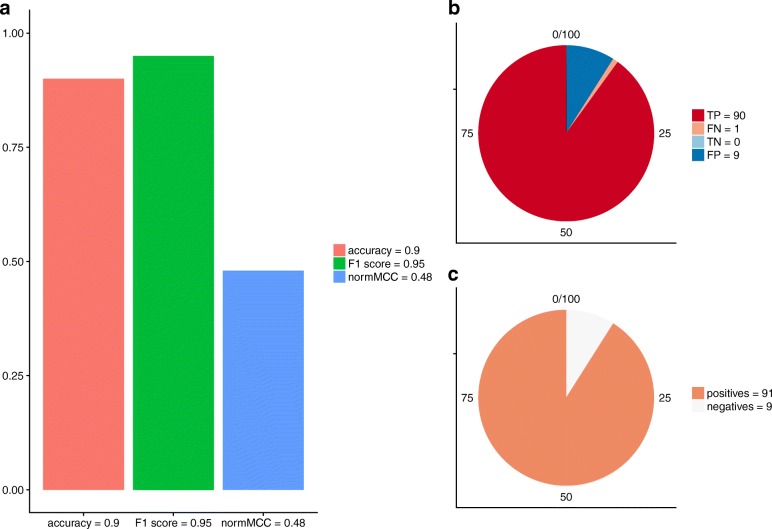
- In six synthetic use cases, MCC was the only metric that correctly indicated the prediction problem in all six. For Use case A1 (91 positives, 9 negatives; TP=90, FN=1, TN=0, FP=9), accuracy=0.90 and F1=0.95, but MCC=−0.03. For Use case C2 (11 positives, 89 negatives; TP=2, FN=9, TN=88, FP=1), accuracy=0.90, F1=0.29, and MCC=+0.31.
- Correlation analysis over all possible confusion matrices showed MCC and accuracy were strongly correlated, while F1 correlated less than 0.8 with the other two measures. For N=1000, PCC(MCC,F1)=0.775982, PCC(MCC,accuracy)=0.921030, and PCC(accuracy,F1)=0.778652.
- In the colon cancer gene expression dataset (2,000 gene probesets, 62 patients: 22 healthy controls and 40 colon cancer; 35.48% negatives, 64.52% positives), rankings differed by metric. MCC ranked gradient boosting top (MCC=+0.55, TP rate=0.85, TN rate=0.69), while F1 and accuracy ranked k-NN top (F1=0.87, accuracy=0.80, TP rate=0.92, TN rate=0.52). Radial SVM had F1=0.75 and accuracy=0.67 but TN rate=0.40 and MCC=+0.29.
- MCC produces a high score only if the classifier correctly predicts the majority of positive and negative instances; F1 is independent of true negatives and is not symmetric for class swapping, while accuracy can be overoptimistic on imbalanced datasets.
Methods
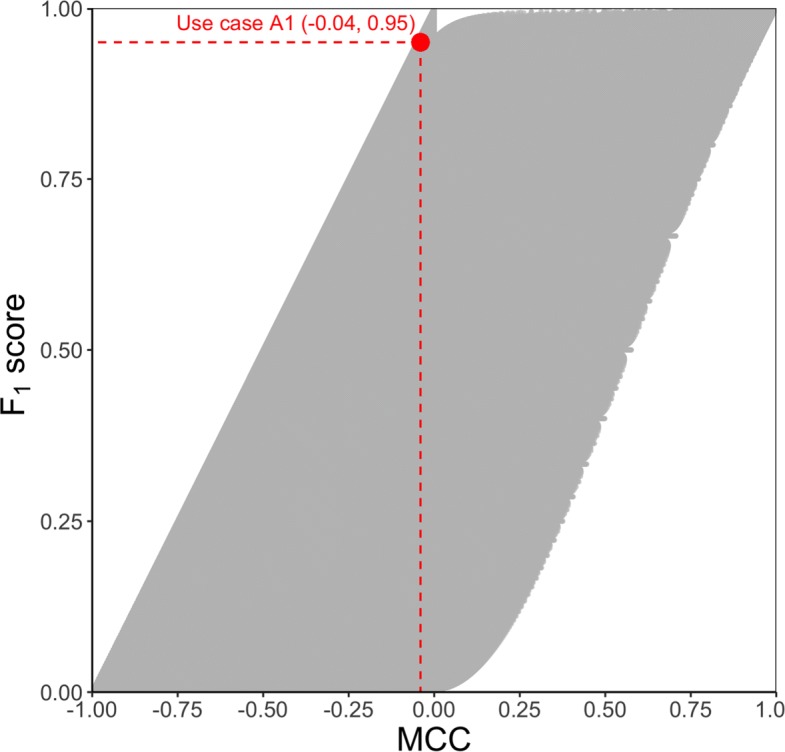
- The paper defines accuracy, MCC, and F1 score mathematically, explores their relationships using Pearson correlation coefficient over all possible confusion matrices for N≥10 up to 1000, and plots all 21,084,251 possible confusion matrices for a 500-sample dataset on the MCC/F1 plane.
- Six synthetic use cases vary class balance and imbalance with specified confusion matrices to compare metric behavior.
- The real genomics experiment uses colon cancer gene expression data from Alon et al. via the plsgenomics R package, applying gradient boosting, decision tree, k-nearest neighbors, linear SVM, and radial SVM. Training/test splits were 80/20 or 60/20/20 with validation for hyperparameter grid search; experiments were repeated ten times and averaged for MCC, F1, accuracy, TP rate, and TN rate.
Limitations
- The paper states that additional comparisons with other rates such as Cohen’s Kappa, Cramér’s V, and K measure would have provided further information, but the authors focused on accuracy and F1 because they are more commonly used in biomedical machine learning studies.
- The paper notes that MCC can be undefined when a whole row or column of the confusion matrix is zero, and handles these cases via an approximation using an arbitrarily small value ε; it also cites situations where MCC can display large fluctuations due to imbalanced outcomes.
- Evident from the text: the real-world validation uses a single colon cancer gene expression dataset, the six use cases are synthetic, and Table 5 excludes standard deviations to keep the table simple.
Model-written summary. Check it against the paper before relying on it.
Integrity signals
Registry
Cites
Statistics
Figures
Verification
Claims the paper makes
29 Own interpretation · 28 Own result · 15 Not checked yet · 13 No basis given
The paper states this without a source or data behind it here, so there is nothing to check it against. The quote shows it is in the paper.
In the paper
“A potential problem with MCC lies in the fact that MCC is undefined when a whole row or column of M is zero, as it happens in the previously cited case of the trivial majority classifier.”
§ The advantages of the Matthews correlation coefficient (MCC) over F1 score and accuracy in binary classification evaluation > Methods > Notation and mathematical foundations
plainn = 4- Asserted: passes — The authors put it forward as true.
- Checkable: passes — It can be checked against evidence.
- Load-bearing: passes — The paper’s conclusions depend on it.
- Based: passes — The paper gives a reason why it holds.
The paper states this without a source or data behind it here, so there is nothing to check it against. The quote shows it is in the paper.
In the paper
“Second, F1 score is independent from the number of samples correctly classified as negative.”
§ The advantages of the Matthews correlation coefficient (MCC) over F1 score and accuracy in binary classification evaluation > Background
plain- Asserted: passes — The authors put it forward as true.
- Checkable: passes — It can be checked against evidence.
- Load-bearing: passes — The paper’s conclusions depend on it.
- Based: passes — The paper gives a reason why it holds.
A result the paper reports from its own data — it cites no other source for it, so there is none to check. The quote shows it is in the paper.
In the paper
“she/he would notice good results (F1 score = 0.75 and accuracy = 0.67)”
§ The advantages of the Matthews correlation coefficient (MCC) over F1 score and accuracy in binary classification evaluation > Results and discussion > Genomics scenario: colon cancer gene expression
hedged- Asserted: passes — The authors put it forward as true.
- Checkable: passes — It can be checked against evidence.
- Load-bearing: unclear — It is unclear whether the paper’s conclusions depend on it.
- Based: passes — The paper gives a reason why it holds.
A result the paper reports from its own data — it cites no other source for it, so there is none to check. The quote shows it is in the paper.
In the paper
“For the Use case A1 (negatively imbalanced dataset), the machine learning classifier was unable to correctly predict negative data instances, and it therefore produced confusion matrices featuring few true negatives (TN).”
§ The advantages of the Matthews correlation coefficient (MCC) over F1 score and accuracy in binary classification evaluation > Results and discussion > Use cases
plaindirect- Asserted: passes — The authors put it forward as true.
- Checkable: passes — It can be checked against evidence.
- Load-bearing: passes — The paper’s conclusions depend on it.
- Based: passes — The paper gives a reason why it holds.
A result the paper reports from its own data — it cites no other source for it, so there is none to check. The quote shows it is in the paper.
In the paper
“First, the top classifier changes when we consider the ranking based on MCC, F1 score, or accuracy.”
§ The advantages of the Matthews correlation coefficient (MCC) over F1 score and accuracy in binary classification evaluation > Results and discussion > Genomics scenario: colon cancer gene expression
plaindirect- Asserted: passes — The authors put it forward as true.
- Checkable: passes — It can be checked against evidence.
- Load-bearing: passes — The paper’s conclusions depend on it.
- Based: passes — The paper gives a reason why it holds.
A result the paper reports from its own data — it cites no other source for it, so there is none to check. The quote shows it is in the paper.
In the paper
“MCC = +0.31 in the [–1, +1] interval”
§ The advantages of the Matthews correlation coefficient (MCC) over F1 score and accuracy in binary classification evaluation > Results and discussion > Use cases
plain- Asserted: passes — The authors put it forward as true.
- Checkable: passes — It can be checked against evidence.
- Load-bearing: unclear — It is unclear whether the paper’s conclusions depend on it.
- Based: passes — The paper gives a reason why it holds.
A result the paper reports from its own data — it cites no other source for it, so there is none to check. The quote shows it is in the paper.
In the paper
“In the Use case B1 (balanced dataset), the machine learning method was unable to correctly predict negative data instances, and therefore produced a confusion matrix featuring few true negatives (TN).”
§ The advantages of the Matthews correlation coefficient (MCC) over F1 score and accuracy in binary classification evaluation > Results and discussion > Use cases
plaindirect- Asserted: passes — The authors put it forward as true.
- Checkable: passes — It can be checked against evidence.
- Load-bearing: passes — The paper’s conclusions depend on it.
- Based: passes — The paper gives a reason why it holds.
A result the paper reports from its own data — it cites no other source for it, so there is none to check. The quote shows it is in the paper.
In the paper
“Finally, in the last Use case C2 (positively imbalanced dataset), the prediction technique failed in predicting negative elements, and therefore its confusion matrix showed a low percentage of true negatives.”
§ The advantages of the Matthews correlation coefficient (MCC) over F1 score and accuracy in binary classification evaluation > Results and discussion > Use cases
plaindirect- Asserted: passes — The authors put it forward as true.
- Checkable: passes — It can be checked against evidence.
- Load-bearing: passes — The paper’s conclusions depend on it.
- Based: passes — The paper gives a reason why it holds.
A result the paper reports from its own data — it cites no other source for it, so there is none to check. The quote shows it is in the paper.
In the paper
“F1 score = 0.29 in the [0, 1] interval”
§ The advantages of the Matthews correlation coefficient (MCC) over F1 score and accuracy in binary classification evaluation > Results and discussion > Use cases
plain- Asserted: passes — The authors put it forward as true.
- Checkable: passes — It can be checked against evidence.
- Load-bearing: unclear — It is unclear whether the paper’s conclusions depend on it.
- Based: passes — The paper gives a reason why it holds.
A result the paper reports from its own data — it cites no other source for it, so there is none to check. The quote shows it is in the paper.
In the paper
“the radial SVM has performed poorly on the true negatives (TN rate = 0.40), by correctly predicting less than half patients.”
§ The advantages of the Matthews correlation coefficient (MCC) over F1 score and accuracy in binary classification evaluation > Results and discussion > Genomics scenario: colon cancer gene expression
plain- Asserted: passes — The authors put it forward as true.
- Checkable: passes — It can be checked against evidence.
- Load-bearing: passes — The paper’s conclusions depend on it.
- Based: passes — The paper gives a reason why it holds.
- Probably not a substantial claim. 15
- The quote only partly states this claim. 5
- It may state two separate claims as one. 36
A result the paper reports from its own data — it cites no other source for it, so there is none to check. The quote shows it is in the paper.
In the paper
“Here, accuracy showed a high value: 0.90 in the [0, 1] interval.”
§ The advantages of the Matthews correlation coefficient (MCC) over F1 score and accuracy in binary classification evaluation > Results and discussion > Use cases
plain- Asserted: passes — The authors put it forward as true.
- Checkable: passes — It can be checked against evidence.
- Load-bearing: passes — The paper’s conclusions depend on it.
- Based: passes — The paper gives a reason why it holds.
Probably not a substantial claim. The quote only partly states this claim.
A result the paper reports from its own data — it cites no other source for it, so there is none to check. The quote shows it is in the paper.
In the paper
“In this case, all three statistical rates showed a low score which emphasized the deficiency in the prediction process (accuracy = 0.24, F1 score = 0.12, and MCC = −0.24).”
§ The advantages of the Matthews correlation coefficient (MCC) over F1 score and accuracy in binary classification evaluation > Results and discussion > Use cases
plain- Asserted: passes — The authors put it forward as true.
- Checkable: passes — It can be checked against evidence.
- Load-bearing: unclear — It is unclear whether the paper’s conclusions depend on it.
- Based: passes — The paper gives a reason why it holds.
It may state two separate claims as one.
The paper states this without a source or data behind it here, so there is nothing to check it against. The quote shows it is in the paper.
In the paper
“It ranges in the interval [−1,+1], with extreme values –1 and +1 reached in case of perfect misclassification and perfect classification, respectively, while MCC=0 is the expected value for the coin tossing classifier.”
§ The advantages of the Matthews correlation coefficient (MCC) over F1 score and accuracy in binary classification evaluation > Methods > Notation and mathematical foundations
plain- Asserted: passes — The authors put it forward as true.
- Checkable: passes — It can be checked against evidence.
- Load-bearing: passes — The paper’s conclusions depend on it.
- Based: passes — The paper gives a reason why it holds.
Probably not a substantial claim. It may state two separate claims as one.
The paper states this without a source or data behind it here, so there is nothing to check it against. The quote shows it is in the paper.
In the paper
“F1 ranges in [0,1], where the minimum is reached for TP=0, that is, when all the positive samples are misclassified, and the maximum for FN=FP=0, that is for perfect classification.”
§ The advantages of the Matthews correlation coefficient (MCC) over F1 score and accuracy in binary classification evaluation > Methods > Notation and mathematical foundations
plain- Asserted: passes — The authors put it forward as true.
- Checkable: passes — It can be checked against evidence.
- Load-bearing: fails — The paper’s conclusions may not depend on it.
- Based: passes — The paper gives a reason why it holds.
Probably not a substantial claim. The paper’s conclusions may not depend on it. It may state two separate claims as one.
A result the paper reports from its own data — it cites no other source for it, so there is none to check. The quote shows it is in the paper.
In the paper
“Like for the Use case A2, accuracy, F1 and MCC show average or low result scores (accuracy = 0.56, F1 score = 0.31, and MCC = +0.17), correctly informing you about the non-optimal performance of the prediction method (Additional file 3a).”
§ The advantages of the Matthews correlation coefficient (MCC) over F1 score and accuracy in binary classification evaluation > Results and discussion > Use cases
plain- Asserted: passes — The authors put it forward as true.
- Checkable: passes — It can be checked against evidence.
- Load-bearing: unclear — It is unclear whether the paper’s conclusions depend on it.
- Based: passes — The paper gives a reason why it holds.
It may state two separate claims as one.
The paper states this without a source or data behind it here, so there is nothing to check it against. The quote shows it is in the paper.
In the paper
“If M has only one non-zero entry, this means that all samples in the dataset belong to one class, and they are either all correctly (for TP≠0 or TN≠0) or incorrectly (for FP≠0 or FN≠0) classified. In this situations, MCC=1 for the former case and MCC=−1 for the latter case.”
§ The advantages of the Matthews correlation coefficient (MCC) over F1 score and accuracy in binary classification evaluation > Methods > Notation and mathematical foundations
plaindirectSingle case- Asserted: passes — The authors put it forward as true.
- Checkable: passes — It can be checked against evidence.
- Load-bearing: unclear — It is unclear whether the paper’s conclusions depend on it.
- Based: passes — The paper gives a reason why it holds.
It may state two separate claims as one.
The paper states this without a source or data behind it here, so there is nothing to check it against. The quote shows it is in the paper.
In the paper
“If the dataset is highly unbalanced, ni≈1, and thus the accuracy measure gives an unreliable estimation of the goodness of the classifier.”
§ The advantages of the Matthews correlation coefficient (MCC) over F1 score and accuracy in binary classification evaluation > Methods > Notation and mathematical foundations
plaindirect- Asserted: passes — The authors put it forward as true.
- Checkable: passes — It can be checked against evidence.
- Load-bearing: passes — The paper’s conclusions depend on it.
- Based: passes — The paper gives a reason why it holds.
It may state two separate claims as one.
A result the paper reports from its own data — it cites no other source for it, so there is none to check. The quote shows it is in the paper.
In the paper
“Checking only F1, one would read a good value (0.66 in the [0, 1] interval), and would be overall satisfied about the prediction (Additional file 2a).”
- Also stated in: § Use cases · hedged
“The Matthews correlation coefficient, instead, by showing a score close to random guessing (+0.07 in the [–1, +1] interval) would be able to inform that the machine learning method has been on the wrong track. Also, it is worth noticing that accuracy would provide with an informative result in this case (0.52 in the [0, 1] interval).”
§ The advantages of the Matthews correlation coefficient (MCC) over F1 score and accuracy in binary classification evaluation > Results and discussion > Use cases
hedged- Asserted: passes — The authors put it forward as true.
- Checkable: passes — It can be checked against evidence.
- Load-bearing: passes — The paper’s conclusions depend on it.
- Based: passes — The paper gives a reason why it holds.
It may state two separate claims as one. The quote only partly states this claim.
- Also stated in: § Use cases · hedged
A result the paper reports from its own data — it cites no other source for it, so there is none to check. The quote shows it is in the paper.
In the paper
“However, accuracy and of F1 showed high values in this case: accuracy = 0.90 and F1 score = 0.95, both close to the best possible value 1.00 in the [0, 1] interval (Fig. 2a).”
- Also stated in: § Use cases · hedged
“Instead, if one decided to take advantage of the Matthews correlation coefficient in the Use case A1, he/she would notice the resulting MCC = –0.03 (Fig. 2a).”
§ The advantages of the Matthews correlation coefficient (MCC) over F1 score and accuracy in binary classification evaluation > Results and discussion > Use cases
plainSingle case- Asserted: passes — The authors put it forward as true.
- Checkable: passes — It can be checked against evidence.
- Load-bearing: passes — The paper’s conclusions depend on it.
- Based: passes — The paper gives a reason why it holds.
It may state two separate claims as one. The quote only partly states this claim.
- Also stated in: § Use cases · hedged
A result the paper reports from its own data — it cites no other source for it, so there is none to check. The quote shows it is in the paper.
In the paper
“Similar to the Use case A2 and B2, all three statistical scores generated low results that reflect the mediocre quality of the prediction: F1 score = 0.17 and accuracy = 0.10 in the [0, 1] interval, and MCC = −0.19 in the [–1, +1] interval (Additional file 4a).”
§ The advantages of the Matthews correlation coefficient (MCC) over F1 score and accuracy in binary classification evaluation > Results and discussion > Use cases
plainSingle case- Asserted: passes — The authors put it forward as true.
- Checkable: passes — It can be checked against evidence.
- Load-bearing: unclear — It is unclear whether the paper’s conclusions depend on it.
- Based: passes — The paper gives a reason why it holds.
It may state two separate claims as one.
The paper states this without a source or data behind it here, so there is nothing to check it against. The quote shows it is in the paper.
In the paper
“On the other hand, for a given value MCC=μ, the F1 score can range in [0,μ+1] if μ≤0 and in [μ,1] if μ>0, so that the width of the range is 1−|μ|, that is, it depends on the MCC value μ.”
§ The advantages of the Matthews correlation coefficient (MCC) over F1 score and accuracy in binary classification evaluation > Methods > Relationship between measures
plaincorrelational- Asserted: passes — The authors put it forward as true.
- Checkable: passes — It can be checked against evidence.
- Load-bearing: passes — The paper’s conclusions depend on it.
- Based: passes — The paper gives a reason why it holds.
It may state two separate claims as one.
The paper states this without a source or data behind it here, so there is nothing to check it against. The quote shows it is in the paper.
In the paper
“The two measures are reasonably concordant, but the scatterplot cloud is wide, implying that for each value of F1 score there is a corresponding range of values of MCC and vice versa, although with different width.”
§ The advantages of the Matthews correlation coefficient (MCC) over F1 score and accuracy in binary classification evaluation > Methods > Relationship between measures
plaincorrelational- Asserted: passes — The authors put it forward as true.
- Checkable: passes — It can be checked against evidence.
- Load-bearing: passes — The paper’s conclusions depend on it.
- Based: passes — The paper gives a reason why it holds.
It may state two separate claims as one.
The paper states this without a source or data behind it here, so there is nothing to check it against. The quote shows it is in the paper.
In the paper
“Overall, accuracy, F1, and MCC show reliable concordant scores for predictions that correctly classify both positives and negatives (having therefore many TP and TN), and for predictions that incorrectly classify both positives and negatives (having therefore few TP and TN); however, these measures show discordant behaviors when the prediction performs well just with one of the two binary classes.”
§ The advantages of the Matthews correlation coefficient (MCC) over F1 score and accuracy in binary classification evaluation > Methods > Relationship between measures
plaincorrelational- Asserted: passes — The authors put it forward as true.
- Checkable: passes — It can be checked against evidence.
- Load-bearing: passes — The paper’s conclusions depend on it.
- Based: passes — The paper gives a reason why it holds.
It may state two separate claims as one.
The paper states this without a source or data behind it here, so there is nothing to check it against. The quote shows it is in the paper.
In the paper
“First, F1 varies for class swapping, while MCC is invariant if the positive class is renamed negative and vice versa.”
§ The advantages of the Matthews correlation coefficient (MCC) over F1 score and accuracy in binary classification evaluation > Background
plaindirect- Asserted: passes — The authors put it forward as true.
- Checkable: passes — It can be checked against evidence.
- Load-bearing: passes — The paper’s conclusions depend on it.
- Based: passes — The paper gives a reason why it holds.
It may state two separate claims as one.
A result the paper reports from its own data — it cites no other source for it, so there is none to check. The quote shows it is in the paper.
In the paper
“Interestingly, the correlation grows with N, but the increments are limited.”
§ The advantages of the Matthews correlation coefficient (MCC) over F1 score and accuracy in binary classification evaluation > Methods > Relationship between measures
plaincorrelational- Asserted: passes — The authors put it forward as true.
- Checkable: passes — It can be checked against evidence.
- Load-bearing: fails — The paper’s conclusions may not depend on it.
- Based: passes — The paper gives a reason why it holds.
Probably not a substantial claim. The paper’s conclusions may not depend on it. It may state two separate claims as one.
The paper states this without a source or data behind it here, so there is nothing to check it against. The quote shows it is in the paper.
In the paper
“With these positions MCC is now defined for all confusion matrices M. As a consequences, MCC=0 for the trivial majority classifier, and 0 is also the expected value for the coin tossing classifier.”
§ The advantages of the Matthews correlation coefficient (MCC) over F1 score and accuracy in binary classification evaluation > Methods > Notation and mathematical foundations
plainn = 4- Asserted: passes — The authors put it forward as true.
- Checkable: passes — It can be checked against evidence.
- Load-bearing: passes — The paper’s conclusions depend on it.
- Based: passes — The paper gives a reason why it holds.
Probably not a substantial claim. It may state two separate claims as one.
A result the paper reports from its own data — it cites no other source for it, so there is none to check. The quote shows it is in the paper.
In the paper
“MCC and accuracy resulted strongly correlated, while the Pearson coefficient is less than 0.8 for the correlation of F1 with the other two measures (Table 3).”
§ The advantages of the Matthews correlation coefficient (MCC) over F1 score and accuracy in binary classification evaluation > Methods > Relationship between measures
boostedcorrelational- Asserted: passes — The authors put it forward as true.
- Checkable: passes — It can be checked against evidence.
- Load-bearing: passes — The paper’s conclusions depend on it.
- Based: passes — The paper gives a reason why it holds.
It may state two separate claims as one.
The paper states this without a source or data behind it here, so there is nothing to check it against. The quote shows it is in the paper.
In the paper
“In fact, for any value F1=ϕ, the MCC varies approximately between [ϕ−1,ϕ], so that the width of the variability range is 1, independent from the value of ϕ.”
§ The advantages of the Matthews correlation coefficient (MCC) over F1 score and accuracy in binary classification evaluation > Methods > Relationship between measures
hedgedcorrelational- Asserted: passes — The authors put it forward as true.
- Checkable: passes — It can be checked against evidence.
- Load-bearing: passes — The paper’s conclusions depend on it.
- Based: passes — The paper gives a reason why it holds.
It may state two separate claims as one.
None of the sources cited for this claim have been checked yet.
In the paper
“The micro/macro averaged F1 is invariant for class swapping and its behaviour is more similar to MCC.”
§ The advantages of the Matthews correlation coefficient (MCC) over F1 score and accuracy in binary classification evaluation > Background
plaincorrelational- Asserted: passes — The authors put it forward as true.
- Checkable: passes — It can be checked against evidence.
- Load-bearing: unclear — It is unclear whether the paper’s conclusions depend on it.
- Based: passes — The paper gives a reason why it holds.
It may state two separate claims as one.
A result the paper reports from its own data — it cites no other source for it, so there is none to check. The quote shows it is in the paper.
In the paper
“Here, accuracy showed a high value: 0.90 in the [0, 1] interval.”
§ The advantages of the Matthews correlation coefficient (MCC) over F1 score and accuracy in binary classification evaluation > Results and discussion > Use cases
plain- Asserted: passes — The authors put it forward as true.
- Checkable: passes — It can be checked against evidence.
- Load-bearing: fails — The paper’s conclusions may not depend on it.
- Based: passes — The paper gives a reason why it holds.
Probably not a substantial claim. The paper’s conclusions may not depend on it.
A result the paper reports from its own data — it cites no other source for it, so there is none to check. The quote shows it is in the paper.
In the paper
“linear SVM is ranked forth in the MCC ranking and in the accuracy ranking, but ranked second in the F1 score ranking.”
§ The advantages of the Matthews correlation coefficient (MCC) over F1 score and accuracy in binary classification evaluation > Results and discussion > Genomics scenario: colon cancer gene expression
plain- Asserted: passes — The authors put it forward as true.
- Checkable: passes — It can be checked against evidence.
- Load-bearing: unclear — It is unclear whether the paper’s conclusions depend on it.
- Based: passes — The paper gives a reason why it holds.
It may state two separate claims as one.
A result the paper reports from its own data — it cites no other source for it, so there is none to check. The quote shows it is in the paper.
In the paper
“k-NN, that is the top performing method both in the F1 score ranking and in the accuracy ranking, instead, obtained an excellent score for recall (TP rate = 0.92) but just sufficient on the specificity (TN rate = 0.52).”
§ The advantages of the Matthews correlation coefficient (MCC) over F1 score and accuracy in binary classification evaluation > Results and discussion > Genomics scenario: colon cancer gene expression
plain- Asserted: passes — The authors put it forward as true.
- Checkable: passes — It can be checked against evidence.
- Load-bearing: passes — The paper’s conclusions depend on it.
- Based: passes — The paper gives a reason why it holds.
It may state two separate claims as one.
None of the sources cited for this claim have been checked yet.
In the paper
“However, ROC AUC presents several flaws [92], and it is sensitive to class imbalance [93].”
§ The advantages of the Matthews correlation coefficient (MCC) over F1 score and accuracy in binary classification evaluation > Background
What the sources say
- Not checked yetcites [92] Lobo JM, Jiménez-Valverde A, Real R. AUC: a misleading measure of the performance of predictive distribution models. Glob Ecol Biogeogr. 2008; 17(2):145–51. source
- Not checked yetcites [93] Hanczar B, Hua J, Sima C, Weinstein J, Bittner M, Dougherty ER. Small-sample precision of ROC-related estimates. Bioinformatics. 2010; 26(6):822–30. source
plaincorrelational- Asserted: passes — The authors put it forward as true.
- Checkable: passes — It can be checked against evidence.
- Load-bearing: passes — The paper’s conclusions depend on it.
- Based: passes — The paper gives a reason why it holds.
It may state two separate claims as one.
A conclusion the paper draws from its own results — it cites no other source for it, so there is none to check. The quote shows it is in the paper.
In the paper
“Once again, this score would hide the truth: the classification algorithm has performed poorly on the negative subset.”
§ The advantages of the Matthews correlation coefficient (MCC) over F1 score and accuracy in binary classification evaluation > Results and discussion > Use cases
hedgeddirect- Asserted: passes — The authors put it forward as true.
- Checkable: passes — It can be checked against evidence.
- Load-bearing: passes — The paper’s conclusions depend on it.
- Based: passes — The paper gives a reason why it holds.
It may state two separate claims as one. The quote only partly states this claim.
None of the sources cited for this claim have been checked yet.
In the paper
“The effectiveness of MCC has been shown in other scientific fields as well [43, 44].”
§ The advantages of the Matthews correlation coefficient (MCC) over F1 score and accuracy in binary classification evaluation > Background
What the sources say
- Not checked yetcites [43] Liu Y, Cheng J, Yan C, Wu X, Chen F. Research on the Matthews correlation coefficients metrics of personalized recommendation algorithm evaluation. Int J Hybrid Informa Technol. 2015; 8(1):163–72. source
- Not checked yetcites [44] Naulaerts S, Dang CC, Ballester PJ. Precision and recall oncology: combining multiple gene mutations for improved identification of drug-sensitive tumours. Oncotarget. 2017; 8(57):97025. source
plain- Asserted: passes — The authors put it forward as true.
- Checkable: passes — It can be checked against evidence.
- Load-bearing: fails — The paper’s conclusions may not depend on it.
- Based: passes — The paper gives a reason why it holds.
Probably not a substantial claim. The paper’s conclusions may not depend on it.
None of the sources cited for this claim have been checked yet.
In the paper
“Even if less common than the ROC curve, several scientists consider the PR curve more informative than the ROC curve, especially on imbalanced biological and medical datasets [48, 97, 98].”
§ The advantages of the Matthews correlation coefficient (MCC) over F1 score and accuracy in binary classification evaluation > Background
What the sources say
- Not checked yetcites [48] Saito T, Rehmsmeier M. The precision-recall plot is more informative than the ROC plot when evaluating binary classifiers on imbalanced datasets. PLoS ONE. 2015; 10(3):0118432. source
- Not checked yetcites [97] Chicco D. Ten quick tips for machine learning in computational biology. BioData Min. 2017; 10(35):1–17.
- Not checked yetcites [98] Ozenne B, Subtil F, Maucort-Boulch D. The precision–recall curve overcame the optimism of the receiver operating characteristic curve in rare diseases. J Clin Epidemiol. 2015; 68(8):855–9. source
plain- Asserted: passes — The authors put it forward as true.
- Checkable: passes — It can be checked against evidence.
- Load-bearing: fails — The paper’s conclusions may not depend on it.
- Based: passes — The paper gives a reason why it holds.
Probably not a substantial claim. The paper’s conclusions may not depend on it.
None of the sources cited for this claim have been checked yet.
In the paper
“MCC was re-proposed by Baldi and colleagues [39] in 2000 as a standard performance metric for machine learning with a natural extension to the multiclass case [40].”
§ The advantages of the Matthews correlation coefficient (MCC) over F1 score and accuracy in binary classification evaluation > Background
What the sources say
- Not checked yetcites [39] Baldi P, Brunak S, Chauvin Y, Andersen CA, Nielsen H. Assessing the accuracy of prediction algorithms for classification: an overview. Bioinformatics. 2000; 16(5):412–24. source
- Not checked yetcites [40] Gorodkin J. Comparing two K-category assignments by a K-category correlation coefficient. Comput Biol Chem. 2004; 28(5–6):367–74. source
plain- Asserted: passes — The authors put it forward as true.
- Checkable: passes — It can be checked against evidence.
- Load-bearing: fails — The paper’s conclusions may not depend on it.
- Based: passes — The paper gives a reason why it holds.
Probably not a substantial claim. The paper’s conclusions may not depend on it. It may state two separate claims as one.
None of the sources cited for this claim have been checked yet.
In the paper
“For example, when Whalen and colleagues released TargetFinder, a tool to predict enhancer-promoters interactions in genomics, they showed its results measured only by F1 score [13], making it impossible to detect the actual true positive rate and true negative rate of their tests [69].”
§ The advantages of the Matthews correlation coefficient (MCC) over F1 score and accuracy in binary classification evaluation > Background
What the sources say
- Not checked yetcites [13] Whalen S, Truty RM, Pollard KS. Enhancer–promoter interactions are encoded by complex genomic signatures on looping chromatin. Nat Genet. 2016; 48(5):488. source
- Not checked yetcites [69] Xi W, Beer MA. Local epigenomic state cannot discriminate interacting and non-interacting enhancer–promoter pairs with high accuracy. PLoS Comput Biol. 2018; 14(12):1006625. source
plaindirect- Asserted: passes — The authors put it forward as true.
- Checkable: passes — It can be checked against evidence.
- Load-bearing: fails — The paper’s conclusions may not depend on it.
- Based: passes — The paper gives a reason why it holds.
Probably not a substantial claim. The paper’s conclusions may not depend on it. It may state two separate claims as one.
In the paper
“Although being widely acknowledged as a reliable metric, there are situations - albeit extreme - where either MCC cannot be defined or it displays large fluctuations [45], due to imbalanced outcomes in the classification.”
§ The advantages of the Matthews correlation coefficient (MCC) over F1 score and accuracy in binary classification evaluation > Background
What the sources say
- Not checked yetcites [45] Brown JB. Classifiers and their metrics quantified. Mol Inform. 2018; 37:1700127. source
plaindirect- Asserted: passes — The authors put it forward as true.
- Checkable: passes — It can be checked against evidence.
- Load-bearing: fails — The paper’s conclusions may not depend on it.
- Based: passes — The paper gives a reason why it holds.
Probably not a substantial claim. The paper’s conclusions may not depend on it. It may state two separate claims as one.
In the paper
“An effective solution overcoming the class imbalance issue comes from the Matthews correlation coefficient (MCC), a special case of the ϕ phi coefficient [36].”
§ The advantages of the Matthews correlation coefficient (MCC) over F1 score and accuracy in binary classification evaluation > Background
What the sources say
- Not checked yetcites [36] Guilford JP. Psychometric Methods. New York City: McGraw-Hill; 1954.
plain- Asserted: passes — The authors put it forward as true.
- Checkable: passes — It can be checked against evidence.
- Load-bearing: fails — The paper’s conclusions may not depend on it.
- Based: passes — The paper gives a reason why it holds.
Probably not a substantial claim. The paper’s conclusions may not depend on it.
None of the sources cited for this claim have been checked yet.
In the paper
“for instance, the Food and Drug Administration (FDA) agency of the USA employed the MCC as the main evaluation measure in the MicroArray II / Sequencing Quality Control (MAQC/SEQC) projects [41, 42].”
§ The advantages of the Matthews correlation coefficient (MCC) over F1 score and accuracy in binary classification evaluation > Background
What the sources say
- Not checked yetcites [41] The MicroArray Quality Control (MAQC) Consortium. The MAQC-II Project: a comprehensive study of common practices for the development and validation of microarray-based predictive models. Nat Biotechnol. 2010; 28(8):827–38. source
- Not checked yetcites [42] The SEQC/MAQC-III Consortium. A comprehensive assessment of RNA-seq accuracy, reproducibility and information content by the Sequence Quality Control consortium. Nat Biotechnol. 2014; 32:903–14. source
plain- Asserted: passes — The authors put it forward as true.
- Checkable: passes — It can be checked against evidence.
- Load-bearing: fails — The paper’s conclusions may not depend on it.
- Based: passes — The paper gives a reason why it holds.
Probably not a substantial claim. The paper’s conclusions may not depend on it.
In the paper
“However, this procedure is biased [65], and it is still far from being accepted as a standard practice by the community.”
§ The advantages of the Matthews correlation coefficient (MCC) over F1 score and accuracy in binary classification evaluation > Background
What the sources say
- Not checked yetcites [65] Van Asch V. Macro-and micro-averaged evaluation measures. Technical report. 2013:1–27.
plain- Asserted: passes — The authors put it forward as true.
- Checkable: passes — It can be checked against evidence.
- Load-bearing: unclear — It is unclear whether the paper’s conclusions depend on it.
- Based: passes — The paper gives a reason why it holds.
It may state two separate claims as one.
A conclusion the paper draws from its own results — it cites no other source for it, so there is none to check. The quote shows it is in the paper.
In the paper
“In this case, the algorithm showed its ability to predict the positive data instances (90 sick patients out of 91 were correctly predicted), but it also displayed its lack of talent in identifying healthy controls (only 1 healthy individual out of 9 was correctly recognized) (Fig. 2b). Therefore, the overall performance should be judged poor.”
§ The advantages of the Matthews correlation coefficient (MCC) over F1 score and accuracy in binary classification evaluation > Results and discussion > Use cases
plaindirectSingle case- Asserted: passes — The authors put it forward as true.
- Checkable: passes — It can be checked against evidence.
- Load-bearing: passes — The paper’s conclusions depend on it.
- Based: passes — The paper gives a reason why it holds.
It may state two separate claims as one.
A conclusion the paper draws from its own results — it cites no other source for it, so there is none to check. The quote shows it is in the paper.
In the paper
“Similar to the Use case A1 and B1, the method was able to correctly identify multiple negative data instances (88 healthy patients out of 89), but unable to correctly predict most of sick patients (only 2 true positives out of 11 possible elements).”
§ The advantages of the Matthews correlation coefficient (MCC) over F1 score and accuracy in binary classification evaluation > Results and discussion > Use cases
plainn = 88- Asserted: passes — The authors put it forward as true.
- Checkable: passes — It can be checked against evidence.
- Load-bearing: passes — The paper’s conclusions depend on it.
- Based: passes — The paper gives a reason why it holds.
It may state two separate claims as one.
In the paper
“Originally developed by Matthews in 1975 for comparison of chemical structures [38]”
§ The advantages of the Matthews correlation coefficient (MCC) over F1 score and accuracy in binary classification evaluation > Background
What the sources say
- Not checked yetcites [38] Matthews BW. Comparison of the predicted and observed secondary structure of T4 phage lysozyme. Biochim Biophys Acta (BBA) Protein Struct. 1975; 405(2):442–51. source
plain- Asserted: passes — The authors put it forward as true.
- Checkable: passes — It can be checked against evidence.
- Load-bearing: fails — The paper’s conclusions may not depend on it.
- Based: passes — The paper gives a reason why it holds.
Probably not a substantial claim. The paper’s conclusions may not depend on it.
None of the sources cited for this claim have been checked yet.
In the paper
“Despite its popularity, in the learning context there are a number of issues causing the kappa measure to produce unreliable results (for instance, its high sensitivity to the distribution of the marginal totals [73–75])”
§ The advantages of the Matthews correlation coefficient (MCC) over F1 score and accuracy in binary classification evaluation > Background
What the sources say
- Not checked yetcites [73] Flight L, Julious SA. The disagreeable behaviour of the kappa statistic. Pharm Stat. 2015; 14:74–8. source
- Not checked yetcites [74] Powers DMW. The problem with Kappa. In: Proceedings of EACL 2012 – the 13th Conference of the European Chapter of the Association for Computational Linguistics. Avignon: ACL: 2012. p. 345–55.
- Not checked yetcites [75] Delgado R, Tibau X-A. Why Cohen’s Kappa should be avoided as performance measure in classification. PloS ONE. 2019; 14(9):0222916.
plaindirect- Asserted: passes — The authors put it forward as true.
- Checkable: passes — It can be checked against evidence.
- Load-bearing: passes — The paper’s conclusions depend on it.
- Based: passes — The paper gives a reason why it holds.
It may state two separate claims as one.
A conclusion the paper draws from its own results — it cites no other source for it, so there is none to check. The quote shows it is in the paper.
In the paper
“In fact, when a prediction displays many true positives but few true negatives (or many true negatives but few true positives) we will show that F1 and accuracy can provide misleading information, while MCC always generates results that reflect the overall prediction issues.”
§ The advantages of the Matthews correlation coefficient (MCC) over F1 score and accuracy in binary classification evaluation > Methods > Relationship between measures
plaindirect- Asserted: passes — The authors put it forward as true.
- Checkable: passes — It can be checked against evidence.
- Load-bearing: passes — The paper’s conclusions depend on it.
- Based: passes — The paper gives a reason why it holds.
It may state two separate claims as one.
A conclusion the paper draws from its own results — it cites no other source for it, so there is none to check. The quote shows it is in the paper.
In the paper
“These results show that, while accuracy and F1 score often generate high scores that do not inform the user about ongoing prediction issues, the MCC is a robust, useful, reliable, truthful statistical measure able to correctly reflect the deficiency of any prediction in any dataset.”
§ The advantages of the Matthews correlation coefficient (MCC) over F1 score and accuracy in binary classification evaluation > Results and discussion > Use cases
boosteddirectn = 6- Asserted: passes — The authors put it forward as true.
- Checkable: passes — It can be checked against evidence.
- Load-bearing: passes — The paper’s conclusions depend on it.
- Based: passes — The paper gives a reason why it holds.
It may state two separate claims as one. The quote only partly states this claim.
A conclusion the paper draws from its own results — it cites no other source for it, so there is none to check. The quote shows it is in the paper.
In the paper
“Here accuracy again generated overoptimistic, misleading, and inflated high results”
§ The advantages of the Matthews correlation coefficient (MCC) over F1 score and accuracy in binary classification evaluation > Results and discussion > Use cases
plaindirectSingle case- Asserted: passes — The authors put it forward as true.
- Checkable: passes — It can be checked against evidence.
- Load-bearing: passes — The paper’s conclusions depend on it.
- Based: passes — The paper gives a reason why it holds.
It may state two separate claims as one.
A conclusion the paper draws from its own results — it cites no other source for it, so there is none to check. The quote shows it is in the paper.
In the paper
“The F1 score ranking and the accuracy ranking, in conclusion, are hiding this important flaw of the top classifier: k-NN was unable top correctly predict a high percentage of patients.”
§ The advantages of the Matthews correlation coefficient (MCC) over F1 score and accuracy in binary classification evaluation > Results and discussion > Genomics scenario: colon cancer gene expression
boosteddirect- Asserted: passes — The authors put it forward as true.
- Checkable: passes — It can be checked against evidence.
- Load-bearing: passes — The paper’s conclusions depend on it.
- Based: passes — The paper gives a reason why it holds.
It may state two separate claims as one.
A conclusion the paper draws from its own results — it cites no other source for it, so there is none to check. The quote shows it is in the paper.
In the paper
“There, accuracy and F1 generated overoptimistic and inflated results”
§ The advantages of the Matthews correlation coefficient (MCC) over F1 score and accuracy in binary classification evaluation > Results and discussion > Use cases
plaindirect- Asserted: passes — The authors put it forward as true.
- Checkable: passes — It can be checked against evidence.
- Load-bearing: passes — The paper’s conclusions depend on it.
- Based: passes — The paper gives a reason why it holds.
It may state two separate claims as one.
A conclusion the paper draws from its own results — it cites no other source for it, so there is none to check. The quote shows it is in the paper.
In the paper
“Accuracy and F1 score, although popular, can generate misleading results on imbalanced datasets, because they fail to consider the ratio between positive and negative elements.”
- Also stated in: § Conclusions · plain
“F1 and accuracy, instead, generate reliable results only when applied to balanced datasets, and produce misleading results when applied to imbalanced cases.”
§ The advantages of the Matthews correlation coefficient (MCC) over F1 score and accuracy in binary classification evaluation > Conclusions
plaindirect- Asserted: passes — The authors put it forward as true.
- Checkable: passes — It can be checked against evidence.
- Load-bearing: passes — The paper’s conclusions depend on it.
- Based: passes — The paper gives a reason why it holds.
It may state two separate claims as one.
- Also stated in: § Conclusions · plain
A conclusion the paper draws from its own results — it cites no other source for it, so there is none to check. The quote shows it is in the paper.
In the paper
“With its low value (MCC = +0.29), the MCC informs the readers about the poor general outcome of the radial SVM, while the accuracy and F1 score show misleading values.”
§ The advantages of the Matthews correlation coefficient (MCC) over F1 score and accuracy in binary classification evaluation > Results and discussion > Genomics scenario: colon cancer gene expression
plaindirect- Asserted: passes — The authors put it forward as true.
- Checkable: passes — It can be checked against evidence.
- Load-bearing: passes — The paper’s conclusions depend on it.
- Based: passes — The paper gives a reason why it holds.
It may state two separate claims as one.
In the paper
“The dataset contains 2,000 gene probsets for 62 patients, of which 22 are healthy controls and 40 have colon cancer (35.48% negatives and 64.52% positives) [106].”
§ The advantages of the Matthews correlation coefficient (MCC) over F1 score and accuracy in binary classification evaluation > Results and discussion > Genomics scenario: colon cancer gene expression
What the sources say
- Not checked yetcites [106] Alon U, Barkai N, Notterman DA, Gish K, Ybarra S, Mack D, Levine AJ. Data pertaining to the article ‘Broad patterns of gene expression revealed by clustering of tumor and normal colon tissues probed by oligonucleotide arrays’. 2000. http://genomics-pubs.princeton.edu/oncology/affydata/index.html. Accessed 10 Dec 2019.
plainn = 62- Asserted: passes — The authors put it forward as true.
- Checkable: passes — It can be checked against evidence.
- Load-bearing: fails — The paper’s conclusions may not depend on it.
- Based: passes — The paper gives a reason why it holds.
Probably not a substantial claim. The paper’s conclusions may not depend on it.
The paper relies on this without support.
Accuracy and F1 score are the most common metrics used for binary classification in machine learning.
“We decided to focus on accuracy and F1 score because they are the most common metrics used for binary classification in machine learning.”
The paper relies on this without support.
The synthetic use cases are realistic representations of binary classification scenarios.
“here we describe some synthetic, realistic scenarios where MCC results are more informative and truthful than the other two measures analyzed.”
The paper relies on this without support.
Accuracy and F1 score are more commonly used in machine learning studies related to biomedical applications than other rates.
“because accuracy and F1 score are more commonly used in machine learning studies related to biomedical applications.”
Claims other papers make about this one
Each is checked against this paper’s own text: does it say what the citing paper says it does?
The cited source says what the claim attributes to it.
In the citing paper
“(3) the absolute value of F1 changes by simply switching the outcome labels (ie, when 1 becomes 0 and 0 becomes 1).”
From Evaluation of performance measures in predictive artificial intelligence models to support medical decisions: overview and guidance (2025) · cites this paper as [77]
The cited source says what the claim attributes to it.
In the citing paper
“MCC is a more reliable metric, whereby a high score is assigned only if the prediction was correct for the four base categories (TP, FP, TN and FP), taking into account the size of P and N [85].”
From A Survey of Underwater Acoustic Data Classification Methods Using Deep Learning for Shoreline Surveillance (2022) · cites this paper as [85]
In the citing paper
“since it has been shown to present a balanced score when dealing with imbalanced data [11, 6] as is our case with fewer manipulated images.”
From BioFors: A Large Biomedical Image Forensics Dataset (2021) · cites this paper as [11]
In the citing paper
“(2) F1 has no intuitive interpretation”
From Evaluation of performance measures in predictive artificial intelligence models to support medical decisions: overview and guidance (2025) · cites this paper as [77]
In the citing paper
“(1) F1 ignores true negatives”
From Evaluation of performance measures in predictive artificial intelligence models to support medical decisions: overview and guidance (2025) · cites this paper as [77]
In the citing paper
“F1 and MCC were introduced to address the challenges caused by class imbalance, where classification accuracy can be inflated by classifying all patients as low risk when the event is rare.”
From Evaluation of performance measures in predictive artificial intelligence models to support medical decisions: overview and guidance (2025) · cites this paper as [77]
Self-check
Percentages, sums and reported differences re-computed from the paper’s own numbers.
Each contradiction between two passages listed here was confirmed by an independent check.
Rated major: it would touch a result — a value a result rests on, reported and recomputed p-values on opposite sides of the significance level, two passages that conflict with no sign which is right, or a cited work retracted before this paper was published.
In the paper
§ The advantages of the Matthews correlation coefficient (MCC) over F1 score and accuracy in binary classification evaluation > Results and discussion > Use cases
“Here, accuracy again generated an overoptimistic inflated score”
§ The advantages of the Matthews correlation coefficient (MCC) over F1 score and accuracy in binary classification evaluation > Results and discussion > Use cases
“all three statistical scores generated low results that reflect the mediocre quality of the prediction: F1 score = 0.17 and accuracy = 0.10 in the [0, 1] interval”
Rated minor: it would not touch a result — a value no result rests on, a p-value that stays on the same side of the significance level, or a conflict that is clerical, resolved elsewhere in the paper, or outside its own findings.
In the paper
§ The advantages of the Matthews correlation coefficient (MCC) over F1 score and accuracy in binary classification evaluation > Results and discussion > Use cases
“the prediction technique failed in predicting negative elements, and therefore its confusion matrix showed a low percentage of true negatives”
§ The advantages of the Matthews correlation coefficient (MCC) over F1 score and accuracy in binary classification evaluation > Results and discussion > Use cases
“the method was able to correctly identify multiple negative data instances (88 healthy patients out of 89), but unable to correctly predict most of sick patients (only 2 true positives out of 11 possible elements)”
Rated minor: it would not touch a result — a value no result rests on, a p-value that stays on the same side of the significance level, or a conflict that is clerical, resolved elsewhere in the paper, or outside its own findings.
In the paper
§ The advantages of the Matthews correlation coefficient (MCC) over F1 score and accuracy in binary classification evaluation > Results and discussion > Use cases
“Even if accuracy showed an excessively high result score”
§ The advantages of the Matthews correlation coefficient (MCC) over F1 score and accuracy in binary classification evaluation > Results and discussion > Use cases
“all three statistical rates showed a low score which emphasized the deficiency in the prediction process (accuracy = 0.24, F1 score = 0.12, and MCC = −0.24)”
Rated minor: it would not touch a result — a value no result rests on, a p-value that stays on the same side of the significance level, or a conflict that is clerical, resolved elsewhere in the paper, or outside its own findings.
In the paper
§ The advantages of the Matthews correlation coefficient (MCC) over F1 score and accuracy in binary classification evaluation > Results and discussion > Genomics scenario: colon cancer gene expression
“the best classifier resulted being k-NN (F1 score = 0.87 and accuracy = 0.81)”
§ The advantages of the Matthews correlation coefficient (MCC) over F1 score and accuracy in binary classification evaluation > Results and discussion > Genomics scenario: colon cancer gene expression
“k-nearest neighbors | +0.48 | 0.87 | 0.80 | 0.92 | 0.52”
Rated minor: it would not touch a result — a value no result rests on, a p-value that stays on the same side of the significance level, or a conflict that is clerical, resolved elsewhere in the paper, or outside its own findings.
In the paper
§ The advantages of the Matthews correlation coefficient (MCC) over F1 score and accuracy in binary classification evaluation > Results and discussion > Use cases
“only 1 healthy individual out of 9 was correctly recognized”
§ The advantages of the Matthews correlation coefficient (MCC) over F1 score and accuracy in binary classification evaluation > Results and discussion > Use cases
“TP=90, FN=1, TN=0, FP=9”
Rated minor: it would not touch a result — a value no result rests on, a p-value that stays on the same side of the significance level, or a conflict that is clerical, resolved elsewhere in the paper, or outside its own findings.
In the paper
§ The advantages of the Matthews correlation coefficient (MCC) over F1 score and accuracy in binary classification evaluation > Results and discussion > Use cases
“Finally, in the last Use case C2 (positively imbalanced dataset)”
§ The advantages of the Matthews correlation coefficient (MCC) over F1 score and accuracy in binary classification evaluation > Results and discussion > Use cases
“Use case C2 Negatively imbalanced dataset | 11 | 89 | 2 | 9 | 88 | 1”
Rated minor: it would not touch a result — a value no result rests on, a p-value that stays on the same side of the significance level, or a conflict that is clerical, resolved elsewhere in the paper, or outside its own findings.
In the paper
§ The advantages of the Matthews correlation coefficient (MCC) over F1 score and accuracy in binary classification evaluation > Results and discussion > Use cases
“For the Use case A1 (negatively imbalanced dataset)”
§ The advantages of the Matthews correlation coefficient (MCC) over F1 score and accuracy in binary classification evaluation > Results and discussion > Use cases
“made of 9 healthy individuals (negatives =9%) and 91 sick patients (positives =91%)”
Rated minor: it would not touch a result — a value no result rests on, a p-value that stays on the same side of the significance level, or a conflict that is clerical, resolved elsewhere in the paper, or outside its own findings.
In the paper
§ The advantages of the Matthews correlation coefficient (MCC) over F1 score and accuracy in binary classification evaluation > Results and discussion > Use cases
“Also in the Use case C1 (positively imbalanced dataset)”
§ The advantages of the Matthews correlation coefficient (MCC) over F1 score and accuracy in binary classification evaluation > Results and discussion > Use cases
“90 healthy controls (negatives =90%) and 10 sick patients (positives =10%)”
Rated minor: it would not touch a result — a value no result rests on, a p-value that stays on the same side of the significance level, or a conflict that is clerical, resolved elsewhere in the paper, or outside its own findings.
In the paper
§ The advantages of the Matthews correlation coefficient (MCC) over F1 score and accuracy in binary classification evaluation > Results and discussion > Use cases
“only 5 sick patients out of 70”
§ The advantages of the Matthews correlation coefficient (MCC) over F1 score and accuracy in binary classification evaluation > Results and discussion > Use cases
“TP = 5, FN = 70, TN = 19, FP = 6”
Rated minor: it would not touch a result — a value no result rests on, a p-value that stays on the same side of the significance level, or a conflict that is clerical, resolved elsewhere in the paper, or outside its own findings.
In the paper
§ The advantages of the Matthews correlation coefficient (MCC) over F1 score and accuracy in binary classification evaluation > Results and discussion > Use cases
“the resulting MCC = –0.03”
§ The advantages of the Matthews correlation coefficient (MCC) over F1 score and accuracy in binary classification evaluation > Methods > Relationship between measures
“In red, the (−0.04, 0.95) point corresponding to use case A1”
Citations
Cites
Breiman, L. (2001) · Machine Learning · doi:10.1023/a:1010933404324 · Cited by 133,538
LeCun, Y., Bengio, Y., & Hinton, G. (2015) · Nature · doi:10.1038/nature14539 · Cited by 84,126
The Measurement of Observer Agreement for Categorical Data
Landis, J. R., & Koch, G. G. (1977) · Biometrics · doi:10.2307/2529310 · Cited by 81,148
XGBoost: A Scalable Tree Boosting System
Chen, T., & Guestrin, C. (2016) · Proceedings of the 22nd ACM SIGKDD International Conference on Knowledge Discovery and Data Mining · doi:10.1145/2939672.2939785 · Cited by 54,569
A Coefficient of Agreement for Nominal Scales
Cohen, J. (1960) · Educational and Psychological Measurement · doi:10.1177/001316446002000104 · Cited by 42,398
An introduction to ROC analysis
Fawcett, T. (2006) · Pattern Recognition Letters · doi:10.1016/j.patrec.2005.10.010 · Cited by 21,879
The meaning and use of the area under a receiver operating characteristic (ROC) curve.
Hanley, J. A., & McNeil, B. J. (1982) · Radiology · doi:10.1148/radiology.143.1.7063747 · Cited by 21,856
Interrater reliability: The kappa statistic
McHugh, M. L. (2012) · Biochemia Medica · doi:10.11613/bm.2012.031 · Cited by 19,877
Measures of the Amount of Ecologic Association Between Species
Dice, L. R. (1945) · Ecology · doi:10.2307/1932409 · Cited by 12,187
Statistical Comparisons of Classifiers over Multiple Data Sets
Demšar, J. (2006) · doi:10.5555/1248547.1248548 · Cited by 12,051
Research works printed but not linked: 7
- Akosa JS. Predictive accuracy: a misleading performance measure for highly imbalanced data. In: Proceedings of the SAS Global Forum 2017 Conference. Cary, North Carolina: SAS Institute Inc.: 2017. p. 942–2017.
- Guilford JP. Psychometric Methods. New York City: McGraw-Hill; 1954.
- van Rijsbergen CJ, Joost C. Information Retrieval. New York City: Butterworths; 1979.
- Sasaki Y. The truth of the F-measure. Teach Tutor Mater. 2007; 1(5):1–5.
- Dubey A, Tarar S. Evaluation of approximate rank-order clustering using Matthews correlation coefficient. Int J Eng Adv Technol. 2018; 8(2):106–13.
- Suresh Babu N. Various performance measures in binary classification – An overview of ROC study. Int J Innov Sci Eng Technol. 2015; 2(9):596–605.
- Ferri C, Hernández-Orallo J, Flach PA. A coherent interpretation of AUC as a measure of aggregated classification performance. In: Proceedings of ICML 2011 – the 28th International Conference on Machine Learning. Norristown: Omnipress: 2011. p. 657–64.
Cited by
Sorted by citations
Items 701–800 of 1,016
Park, B., Shin, T.-S., Kang, R., Fong, A. Y., McDonogh, B., & Yoon, S.-C. (2023) · Computers and Electronics in Agriculture · doi:10.1016/j.compag.2023.107802 · Cited by 31
A hybrid CNN-RNN approach for survival analysis in a Lung Cancer Screening study
Lu, Y., Aslani, S., Zhao, A., Shahin, A. H., Barber, D., Emberton, M., Alexander, D. C., & Jacob, J. (2023) · Heliyon · doi:10.1016/j.heliyon.2023.e18695 · Cited by 30
Kumar, A., & Gorai, A. K. (2023) · Advances in Space Research · doi:10.1016/j.asr.2023.08.057 · Cited by 33
Automatically identifying customer needs in user-generated content using token classification
Ettrich, O., Stahlmann, S., Leopold, H., & Barrot, C. (2023) · Decision Support Systems · doi:10.1016/j.dss.2023.114107 · Cited by 30
Empirical exploration of whale optimisation algorithm for heart disease prediction
Atimbire, S. A., Appati, J. K., & Owusu, E. (2024) · Scientific Reports · doi:10.1038/s41598-024-54990-1 · Cited by 29
“F1 score is the balance mean precision and recall 65 and defined by the Eq.”
BackgroundVijay, E. V., & Aparna, K. (2024) · e-Prime - Advances in Electrical Engineering Electronics and Energy · doi:10.1016/j.prime.2024.100659 · Cited by 38
A systematic review on deep learning based methods for cervical cell image analysis
Fang, M., Liao, B., Lei, X., & Wu, F. (2024) · Neurocomputing · doi:10.1016/j.neucom.2024.128630 · Cited by 41
Wang, J., Liu, Y., & Tian, B. (2024) · Journal of Cheminformatics · doi:10.1186/s13321-024-00920-2 · Cited by 28
Sheik, A. G., Kumar, A., Sharanya, A. G., Amabati, S. R., Bux, F., & Kumari, S. (2024) · Environmental Science and Pollution Research · doi:10.1007/s11356-024-35529-3 · Cited by 33
“Additional metrics, such as training and testing accuracy of unseen data, Cohen’s kappa score, and Matthew correlation coefficient (MCC), are available to verify whether the models are truly generalizing or are just guessing or memorization (Li et al. 2023; Chicco and Jurman 2020).”
Purkovic, S., Jovanović, L., Zivkovic, M. Z., Antonijević, M., Dolićanin, E., Tuba, E., Tuba, M., Bačanin, N., & Spalević, P. (2024) · Journal of King Saud University - Computer and Information Sciences · doi:10.1016/j.jksuci.2024.102261 · Cited by 32
Li, W., Li, G., Tong, X., Yang, P., Huang, J., Xu, L., & Dai, S. (2020) · Aging · doi:10.18632/aging.103253 · Cited by 30
Padierna, L. C., Amador-Medina, L. F., Murillo-Ortiz, B. O., & Villaseñor‐Mora, C. (2020) · Infrared Physics & Technology · doi:10.1016/j.infrared.2020.103531 · Cited by 29
BLSTM-API: Bi-LSTM Recurrent Neural Network-Based Approach for Arabic Paraphrase Identification
Mahmoud, A., & Zrigui, M. (2021) · Arabian Journal for Science and Engineering · doi:10.1007/s13369-020-05320-w · Cited by 29
“The classification model forecasts the class of each data instance, attributing to each sample its predicted label according to the following four cases [42]:”
BackgroundCharacterizing soot in TEM images using a convolutional neural network
Sipkens, T. A., Frei, M., Baldelli, A., et al. (2021) · Powder Technology · doi:10.1016/j.powtec.2021.04.026 · Cited by 29
“An overall measure of the accuracy is computed from these quantities as [42], + = + + + agg bg”
Methoddo Nascimento, J. M. A., Maitelli, A. L., Maitelli, C. W. S. D. P., & Cavalcanti, A. L. D. O. (2021) · Sensors · doi:10.3390/s21134546 · Cited by 28
“However, in imbalanced datasets, the accuracy can provide an overoptimistic estimation of the classifier ability on the majority class [41,42].”
BackgroundFiok, K., Karwowski, W., Gutiérrez-Franco, E., Davahli, M. R., Wilamowski, M., Ahram, T., Aljuaid, A. M., & Zurada, J. (2021) · IEEE Access · doi:10.1109/access.2021.3099758 · Cited by 36
“Following the recommendation of [24], we employed the Matthews correlation coefficient (MCC) as a performance metric.”
MethodSalinas-Martínez, R., de Bie, J., Marzocchi, N., & Sandberg, F. (2021) · Frontiers in Physiology · doi:10.3389/fphys.2021.673819 · Cited by 26
MacLeod, N., Canty, R., & Polaszek, A. (2021) · Systematic Biology · doi:10.1093/sysbio/syab098 · Cited by 31
“The Matthews correlation coefficient (MCC) is typically used to obtain an accuracy index value that corrects for this source bias (Matthews 1975; Chicco and Jurman 2020).”
MethodCimini, G., Mastrandrea, R., & Squartini, T. (2021) · Cambridge University Press eBooks · doi:10.1017/9781108771030 · Cited by 40
Kaladevi, P., Janakiraman, S., Ramalingam, P., & Muthusankar, D. (2022) · Journal of Intelligent & Fuzzy Systems · doi:10.3233/jifs-221615 · Cited by 29
“The Matthews Correlation Coefficient (MCC) is referred [3] as the ratio defined using the TP, TN, FP and False FN as defined in Equation (11).”
Transcriptomic Harmonization as the Way for Suppressing Cross-Platform Bias and Batch Effect
Borisov, N. M., & Buzdin, A. A. (2022) · Biomedicines · doi:10.3390/biomedicines10092318 · Cited by 35
“0 Array; Agilent Human Genome Whole Microarray; Illumina HiSeq 2000 — R2 score (R2 is the proportion of the variation in the dependent variable that is predictable from the independent variable [102] analysis; F1 score (F1 score is the harmonic mean of precision and recall [103,104]) analysis MM”
Milewski, D., Jung, H. M., Brown, G. T., Liu, Y., Somerville, B. J., Lisle, C. R., Ladanyi, M., Rudzinski, E. R., Choo‐Wosoba, H., Barkauskas, D. A., et al. (2022) · Clinical Cancer Research · doi:10.1158/1078-0432.ccr-22-1663 · Cited by 29
“We tested the model ’ s performance on holdout test data and observed an impressive ability to predict fusion status when evaluated with multiple statistical metrics including a high Matthew ’ s correlation coef fi cient (33) of 0.81 ( Fig.”
InfluentialUse of Machine Learning in Stroke Rehabilitation: A Narrative Review
Choo, Y. J., & Chang, M. C. (2022) · Brain & Neurorehabilitation · doi:10.12786/bn.2022.15.e26 · Cited by 32
“In recent research, the precision-recall curve and Matthews correlation coefficient have been considered as ways to evaluate the performance of AI algorithms that use an imbalanced dataset, such as clinical data [40,41].”
MethodDeep-learning model for sea surface temperature prediction near the Korean Peninsula
Choi, H.-M., Kim, M.-K., & Yang, H. (2023) · Deep Sea Research Part II Topical Studies in Oceanography · doi:10.1016/j.dsr2.2023.105262 · Cited by 34
Li, X., Dessi, M., Marcus, D. M., Russell, J., Aboagye, E. O., Ellis, L. B., Sheeka, A., Park, W.-H. E., Bharwani, N., Ghaem‐Maghami, S., et al. (2023) · Cancers · doi:10.3390/cancers15082209 · Cited by 32
Martinez-Ríos, E. A., Bustamante-Bello, R., & Navarro-Tuch, S. A. (2023) · Engineering Applications of Artificial Intelligence · doi:10.1016/j.engappai.2023.106355 · Cited by 35
Application of Machine Learning Methods for Pallet Loading Problem
Aylak, B. L., İnce, M., Oral, O., et al. (2021) · Applied Sciences · doi:10.3390/app11188304 · Cited by 28
“The evaluation metrics are typically used to quantify, analyze, and test the success of classification and estimation methods [56].”
MethodLiu, J., Zhang, Q., Chen, M., et al. (2022) · Chemical Engineering Journal · doi:10.1016/j.cej.2022.138940 · Cited by 28
Abdulla, A. R., & Jameel, N. G. M. (2023) · UHD Journal of Science and Technology · doi:10.21928/uhdjst.v7n1y2023.pp53-65 · Cited by 28
CAJAL enables analysis and integration of single-cell morphological data using metric geometry
Govek, K. W., Nicodemus, P., Lin, Y., Crawford, J., Saturnino, A. B., Cui, H., Zoga, K., Hart, M. P., & Cámara, P. G. (2023) · Nature Communications · doi:10.1038/s41467-023-39424-2 · Cited by 28
Retracted: Improving Multi-Organ Cancer Diagnosis through a Machine Learning Ensemble Approach
Khan, M. S., Dixit, R. R., Majumdar, A., Koti, V. M., Bhushan, S., & Yadav, V. (2023) · International Conference on Electronics, Communication and Aerospace Technology (ICECA) · doi:10.1109/iceca58529.2023.10394923 · Cited by 28
“Neural networks can generalize training and anticipate new things based on how they have evolved [10].”
BackgroundRetractedBaek, J., Kim, D., & Choi, B. (2024) · Developments in the Built Environment · doi:10.1016/j.dibe.2024.100382 · Cited by 28
Wang, X., & Braun, M. (2024) · International Journal of Fatigue · doi:10.1016/j.ijfatigue.2024.108588 · Cited by 28
Federated learning-based natural language processing: a systematic literature review
Khan, Y., Sánchez, D., & Domingo‐Ferrer, J. (2024) · Artificial Intelligence Review · doi:10.1007/s10462-024-10970-5 · Cited by 35
“It considers true/false positives and negatives for a more robust evaluation, especially in imbalanced datasets (Chicco and Jurman 2020 ).”
Breast Cancer Classification With Enhanced Interpretability: DALAResNet50 and DT Grad-CAM
Liu, S., Himel, G. M. S., & Wang, J. (2024) · IEEE Access · doi:10.1109/access.2024.3520608 · Cited by 36
“To assess our model’s performance holistically, we used four metrics: Accuracy [38]–[40], F1 Score [41], [42] Imbalance Balanced Accuracy (IBA) [43], [44], and Geometric Mean (GMean) [45], [46].”
Hama, T., Alsaleh, M. M., Allery, F., Choi, J. W., Tomlinson, C., Wu, H., Lai, A. G., Pontikos, N., & Thygesen, J. H. (2025) · Journal of Medical Internet Research · doi:10.2196/57358 · Cited by 35
“Alternatively, a study suggested using the Matthews correlation coefficient for model evaluation because it provides a more balanced assessment of positive and negative predictions [113].”
Naseer, S., Ali, R. F., Fati, S. M., & Muneer, A. (2021) · IEEE Access · doi:10.1109/access.2021.3080041 · Cited by 26
“Although the sensitivity and accuracy scores of pNitro-Tyr are slightly higher then the proposed CNN model, the MCC score, which is shown to be a better performance evaluator of predictors in non-balanced class problems [66], is far lower than the proposed CNN model.”
Result5G/B5G Service Classification Using Supervised Learning
Preciado-Velasco, J. E., Gonzalez-Franco, J. D., Calderón, C. A., et al. (2021) · Applied Sciences · doi:10.3390/app11114942 · Cited by 28
“At the same time, MCC = 0 is the expected value for the coin-tossing classifier [30].”
BackgroundBlondheim, D. (2021) · International Journal of Metalcasting · doi:10.1007/s40962-021-00637-0 · Cited by 28
State of the Art of Artificial Intelligence Applied for False Alarms in Wind Turbines
Chacón, A. M. P., Ramírez, I. S., & Márquez, F. P. G. (2021) · Archives of Computational Methods in Engineering · doi:10.1007/s11831-021-09671-x · Cited by 28
Machine Learning Prediction of Treatment Outcome in Late-Life Depression
Grzenda, A. L., Speier, W. F., Siddarth, P., Pant, A., Krause, B., Narr, K. L., & Lavretsky, H. (2021) · Frontiers in Psychiatry · doi:10.3389/fpsyt.2021.738494 · Cited by 30
“On the clinical feature set, the classifiers performed as follows: LR (Train: AUC 0.84 ± 0.04; Test: AUC 0.65± 0.16, MCC 0.19± 0.30; Overall: AUC 0.64 ± 0.16); RF (Train: AUC 0.99 ± 0.01; Test: AUC 0.79 ± 0.14, MCC 0.41 ± 0.22; Overall: 0.79 ± 0.14) and SVMRBF (Train: AUC 0.99 ± 0.01; Test: 0.64 ± 0.16, MCC 0.13 ± 0.2…”
BackgroundMethodInfluentialArchila, J. F., Manzanera, A., & Martínez, F. (2021) · Computer Methods and Programs in Biomedicine · doi:10.1016/j.cmpb.2021.106607 · Cited by 28
Colorectal multi-class image classification using deep learning models
Raju, M. S. N., & Rao, B. S. (2022) · Bulletin of Electrical Engineering and Informatics · doi:10.11591/eei.v11i1.3299 · Cited by 31
Evidence for the Late Arrival of Hot Jupiters in Systems with High Host-star Obliquities
Hamer, J. H., & Schlaufman, K. C. (2022) · The Astronomical Journal · doi:10.3847/1538-3881/ac69ef · Cited by 31
“…metrics such as the F1 score and accuracy as it only takes on high values when a classifier effectively reproduces both true positives and true negatives, and as it is effective even for the imbalanced data sets that may result from our crossvalidation technique (e.g., Chicco & Jurman 2020).”
Predicting the binding of small molecules to nuclear receptors using machine learning
Ramaprasad, A. S. E., Smith, M. T., McCoy, D., Hubbard, A., Merrill, M. A. L., & Durkin, K. A. (2022) · Briefings in Bioinformatics · doi:10.1093/bib/bbac114 · Cited by 28
Uhl, J. H., & Leyk, S. (2022) · Remote Sensing of Environment · doi:10.1016/j.rse.2022.113117 · Cited by 27
“While this experiment considers strict mathematical definitions, some of these non-definition problems can be mitigated by identifying the problematic cases and setting the measures to 0 (Chicco and Jurman 2020).”
BackgroundMethodAn Initial Investigation for Detecting Vocoder Fingerprints of Fake Audio
Yan, X., Yi, J., Tao, J., Wang, C., Ma, H., Wang, T., Wang, S., & Fu, R. (2022) · Proceedings of the 1st International Workshop on Deepfake Detection for Audio Multimedia · doi:10.1145/3552466.3556525 · Cited by 30
“The performance of our forensic countermeasures is evaluated via Precision,Recall and F1−score [38].”
MethodA performant deep learning model for sentiment analysis of climate change
Lydiri, M., Mourabit, Y. E., Habouz, Y. E., & Fakir, M. (2022) · Social Network Analysis and Mining · doi:10.1007/s13278-022-01014-3 · Cited by 27
“…tweets, while the recall is the percentage of the total amount of relevant tweets that were actually retrieved, and the F1-measure or F1-score F1 (Chicco and Jurman 2020) score is the harmonic mean of precision and recall and it is calculated as: 2 × ( Precision ∗ Recall )∕( Precision + Recall )…”
Murariu, M.-G., Dorobanțu, F. R., & Tarniceriu, D. G. (2023) · Electronics · doi:10.3390/electronics12091958 · Cited by 30
Chatterjee, A., Prinz, A., Riegler, M. A., et al. (2023) · Scientific Reports · doi:10.1038/s41598-023-37233-7 · Cited by 28
Categorization of Alzheimer’s disease stages using deep learning approaches with McNemar’s test
Şener, B., Açıcı, K., & Sümer, E. (2024) · PeerJ Computer Science · doi:10.7717/peerj-cs.1877 · Cited by 27
A multi-omics approach for biomarker discovery in neuroblastoma: a network-based framework
Hussein, R., Abou‐Shanab, A. M., & Badr, E. (2024) · npj Systems Biology and Applications · doi:10.1038/s41540-024-00371-3 · Cited by 29
“MCC algorithm in the Cytoscape plugin, CytoHubba, was utilized to identify the hub nodes in theregulatorynetworkasitshowedhigh-qualityperformanceandaccuracy overothermeasures,includingradiality,stress,clusteringcoef fi cient, and betweenness 138 – 142 .”
Interpretation of Artificial Intelligence Models in Healthcare
Ardakani, A. A., Airom, O., Khorshidi, H., Bureau, N. J., Salvi, M., Molinari, F., & Acharya, U. R. (2024) · Journal of Ultrasound in Medicine · doi:10.1002/jum.16524 · Cited by 30
“42,43 Compared with the AUC, the MCC gives a sum-mary of the overall performance of a model, while the AUC shows how well the model performs in differentiating and distinguishing the classes within the problem.”
Zhao, L. Q., van Duynhoven, A., & Dragićević, S. (2024) · Land · doi:10.3390/land13081288 · Cited by 27
“Resulting values similarly adhere to a range of 0 to 1, where 1 indicates perfect precision and 0 indicates that the ML classifier could not classify any data sample correctly [71].”
BackgroundFrom Code to Life: The AI‐Driven Revolution in Genome Editing
Li, Z., Khan, W. U., Bai, G., Chao, D., Wang, J., Zhang, Y., Wang, C., Zhang, H., Wang, W., Luo, M., et al. (2025) · Advanced Science · doi:10.1002/advs.202417029 · Cited by 31
Incorporating Handcrafted Features into Deep Learning for Point Cloud Classification
Hsu, P., & Zhuang, Z.-Y. (2020) · Remote Sensing · doi:10.3390/rs12223713 · Cited by 27
“As an alternative measure unaffected by the imbalanced dataset issue, MCC_k is more informative than average F1-score and OA in evaluating classification problems [45,60]”
MethodPrathap, L. (2021) · Bioinformation · doi:10.6026/97320630017348 · Cited by 28
Ahuja, A., Al-Zogbi, L., & Krieger, A. (2021) · Computers in Biology and Medicine · doi:10.1016/j.compbiomed.2021.104576 · Cited by 27
Hicks, S., Goes, S. D. B., Whittaker, A. C., & Stafford, P. J. (2021) · Journal of Geophysical Research Solid Earth · doi:10.1029/2021jb022768 · Cited by 27
“These are described as follows: (a) the F1 score which accounts for model precision and recall, especially due to the large class imbalance (more true negatives than true positives) for our target feature (e.g., Chicco & Jurman, 2020).”
BackgroundHadrup, N., Frederiksen, M., Wedebye, E. B., Nikolov, N. G., Carøe, T. K., Sørli, J. B., Frydendall, K. B., Liguori, B., Sejbæk, C. S., Wolkoff, P., et al. (2021) · Journal of Applied Toxicology · doi:10.1002/jat.4215 · Cited by 27
“…and, to our knowledge, there are no available data on this substance on respiratory irritation or sensitisation, although dermal sensitisation has been described in several cases (e.g. Cheng et al., n.d.; Warshaw et al., n.d.; Choudry et al., 2002; Podmore, 2000; Shaughnessy et al., 2014).”
BackgroundLi, K.-Y., Burnside, N. G., de Lima, R. S., Villoslada, M., Sepp, K., Pinheiro, V. H. C., de Lima, B. R. C. A., Yang, M., Vain, A., & Sepp, K. (2021) · Remote Sensing · doi:10.3390/rs13163190 · Cited by 27
“We can also compare the precision, recall, and F1-score results of various cultivation method sub-classes to evaluate the classification accuracy from the heatmap (Figure 6c).”
BackgroundInfluentialPredicting unstable software benchmarks using static source code features
Laaber, C., Basmaci, M., & Salza, P. (2021) · Empirical Software Engineering · doi:10.1007/s10664-021-09996-y · Cited by 30
“The literature shows that AUC (Bradley 1997) and MCC (Chicco and Jurman 2020) are reliable metrics, especially in the case of binary classification.”
BackgroundMethodBogaerts, B., Winand, R., Braekel, J. V., et al. (2021) · Microbial Genomics · doi:10.1099/mgen.0.000699 · Cited by 27
Farber, C., & Kurouski, D. (2022) · Frontiers in Plant Science · doi:10.3389/fpls.2022.887511 · Cited by 27
“For example, when a model is binary, or contains only two groups, it can be evaluated using the Matthews Correlation Coefficient (MCC), a value that ranges from 1, where all data are assigned correctly, to − 1, where all data are assigned to the wrong category.”
ResultInfluentialBennett, M., Kleczyk, E. J., Hayes, K., & Mehta, R. (2022) · Artificial intelligence · doi:10.5772/intechopen.105116 · Cited by 27
Predicting In Vivo Compound Brain Penetration Using Multi-task Graph Neural Networks
Hamzic, S., Lewis, R. A., Desrayaud, S., Soylu, C., Fortunato, M., Gerebtzoff, G., & Rodríguez-Pérez, R. (2022) · Journal of Chemical Information and Modeling · doi:10.1021/acs.jcim.2c00412 · Cited by 30
Bhattacharjee, S., Saha, B., Bhattacharyya, P., & Saha, S. (2022) · Journal of Computational Science · doi:10.1016/j.jocs.2022.101768 · Cited by 28
Random Forest Classification Method for Predicting Intertidal Wetland Migration Under Sea Level Rise
Hughes, M. G., Glasby, T. M., Hanslow, D. J., et al. (2022) · Frontiers in Environmental Science · doi:10.3389/fenvs.2022.749950 · Cited by 27
“The F1 score is commonly used to assess accuracy in the machine learning literature, but it is undesirably asymmetric and is independent of the number of samples correctly classified as negative (Chicco and Jurman, 2020).”
Gupta, S., Agarwal, A., Gaur, M., Roy, K., Narayanan, V., Kumaraguru, P., & Sheth, A. (2022) · Proceedings of the Eighth Workshop on Computational Linguistics and Clinical Psychology · doi:10.18653/v1/2022.clpsych-1.12 · Cited by 27
“As PRIMATE shows a disproportional distribution of AQs (yes) and FQs (no), MCC is an appropriate metric (Chicco and Jurman, 2020).”
Maji, A. K., Marwaha, S., Kumar, S., et al. (2022) · Frontiers in Plant Science · doi:10.3389/fpls.2022.889853 · Cited by 27
“As the detection also performs the classification of detected objects, other metrics like F1 score and MCC have also proved to be efficient in choosing the best classifier (Chicco and Jurman, 2020).”
MethodA field-deployable water quality monitoring with machine learning-based smartphone colorimetry
Doğan, V., Isık, T., Kılıç, V., & Horzum, N. (2022) · Analytical Methods · doi:10.1039/d2ay00785a · Cited by 27
BOFRF: A Novel Boosting-Based Federated Random Forest Algorithm on Horizontally Partitioned Data
Gençtürk, M., Sınacı, A. A., & Çiçekli, N. K. (2022) · IEEE Access · doi:10.1109/access.2022.3202008 · Cited by 27
“It has been shown that it is more robust and reliable than the aforecited performance metrics when evaluating the classifier performance in both balanced and imbalanced cases [43].”
BackgroundOptimized Anfis Model with Hybrid Metaheuristic Algorithms for Facial Emotion Recognition
Di̇ri̇k, M. (2022) · International Journal of Fuzzy Systems · doi:10.1007/s40815-022-01402-z · Cited by 28
“The confusion matrix [62] is a performance metric for the classification problem in machine learning.”
BackgroundSun, R., Wang, X., Jiang, H., Yan, Y., Dong, Y., Yan, W., Luo, X., Miu, H., Qi, L., & Huang, Z. (2022) · Frontiers in Cardiovascular Medicine · doi:10.3389/fcvm.2022.1035675 · Cited by 27
“The main index of the performance evaluation was the area under the receiver operating characteristic curve (AUC), and the secondary indexes were Matthews correlation coefficient (MCC) score (34), F1 score, accuracy, and recall.”
MethodBuilding Change Detection in Remote Sensing Images Based on Dual Multi-Scale Attention
Zhang, J., Pan, B., Zhang, Y., et al. (2022) · Remote Sensing · doi:10.3390/rs14215405 · Cited by 27
Jiang, Y., Weng, J., Zhang, X., Yang, Z., & Hu, W. (2022) · IEEE Transactions on Fuzzy Systems · doi:10.1109/tfuzz.2022.3215566 · Cited by 26
“In terms of performance measures, we adopt accuracy and F1-score [46] for classification evaluation.”
MethodGanerød, A. J., Lindsay, E., Fredin, O., Myrvoll, T.-A., Nordal, S., & Rød, J. K. (2023) · Remote Sensing · doi:10.3390/rs15040895 · Cited by 28
Wu, Y., Feng, Y., Peng, S., et al. (2023) · Environmental Science and Pollution Research · doi:10.1007/s11356-023-26007-3 · Cited by 27
“For classification models, the F1 score was selected as a measurement of classifier performance (Chicco and Jurman 2020).”
MethodGuidelines for the prediction of species interactions through binary classification
Poisot, T. (2023) · Methods in Ecology and Evolution · doi:10.1111/2041-210x.14071 · Cited by 27
“…sciences is focused on genomics (which has very specific challenges: see a recent discussion by Whalen et al., 2021); this sub-field has generated recommendations that do not necessarily match the current best-practices for SDMs, and therefore hint at the importance of domain-specific guidelines.”
BackgroundMethodSheehy, J. J., Rutledge, H., Acharya, U. R., Loh, H. W., Gururajan, R., Tao, X., Zhou, X., Li, Y., Gurney, T., & Kondalsamy‐Chennakesavan, S. (2023) · Artificial Intelligence in Medicine · doi:10.1016/j.artmed.2023.102536 · Cited by 28
Berthold, J., Pietsch, J., Piplack, N., et al. (2023) · International Journal of Radiation Oncology*Biology*Physics · doi:10.1016/j.ijrobp.2023.05.002 · Cited by 27
Abubakar, G. A., Wang, K., Koko, A. F., et al. (2023) · Remote Sensing · doi:10.3390/rs15112835 · Cited by 27
McFall, G. P., Bohn, L., Gee, M., Drouin, S. M., Fah, H., Han, W., Li, L., Camicioli, R. M., & Dixon, R. A. (2023) · Frontiers in Aging Neuroscience · doi:10.3389/fnagi.2023.1124232 · Cited by 29
“However, normalized Matthews Correlation Coefficient, a reliable metric for small and unbalanced samples (Chicco and Jurman, 2020), was strong.”
BackgroundImproved logistic models of crown fire probability in Canadian conifer forests
Perrakis, D. D. B., Cruz, M. G., Alexander, M. E., et al. (2023) · International Journal of Wildland Fire · doi:10.1071/wf23074 · Cited by 27
Detection and counting of root-knot nematodes using YOLO models with mosaic augmentation
Pun, T. B., Neupane, A., Koech, R., et al. (2023) · Biosensors and Bioelectronics X · doi:10.1016/j.biosx.2023.100407 · Cited by 27
Interpretable Machine Learning Assessment
Han, H., Wu, Y., Wang, J., & Han, A. (2022) · Neurocomputing · doi:10.1016/j.neucom.2023.126891 · Cited by 31
Predicting Anti-inflammatory Peptides by Ensemble Machine Learning and Deep Learning
Guan, J., Yao, L., Chung, C., et al. (2023) · Journal of Chemical Information and Modeling · doi:10.1021/acs.jcim.3c01602 · Cited by 27
Kanwal, N., López-Pérez, M., Kiraz, U., Zuiverloon, T. C. M., Molina, R., & Engan, K. (2023) · Computerized Medical Imaging and Graphics · doi:10.1016/j.compmedimag.2023.102321 · Cited by 35
Zahoor, J., & Zafar, K. (2020) · Genes · doi:10.3390/genes11070819 · Cited by 27
Enhancing missense variant pathogenicity prediction with protein language models using VariPred
Lin, W., Wells, J., Wang, Z., Orengo, C., & Martin, A. C. R. (2024) · Scientific Reports · doi:10.1038/s41598-024-51489-7 · Cited by 34
Information Retrieval for Cancer Cell Detection Based on Advanced Machine Learning Techniques
Shaker, A. S., & Ahmed, S. R. (2022) · Al-Mustansiriyah Journal of Sciences · doi:10.23851/mjs.v33i3.1069 · Cited by 26
“A small demonstration where aligner picks one of the possible alignments and tells the read best fitted here, and then stores this result in a specific format [9].”
BackgroundPrediction of Patients’ Incurable Diseases Utilizing Deep Learning Approach
Praveenkumar, S., Veeraiah, V., Pramanik, S., et al. (2023) · Lecture notes in networks and systems · doi:10.1007/978-981-99-3315-0_4 · Cited by 26
Zhang, Y., Zong, R., Shang, L., & Wang, D. (2023) · Knowledge-Based Systems · doi:10.1016/j.knosys.2023.110864 · Cited by 27
Predicting Antibiotic Resistance in ICUs Patients by Applying Machine Learning in Vietnam
Quoc, V. T., Ngoc, D. N. T., Hoang, T. N., Thị, H. V., Tong, M. D., Nguyet, T. D. P., Van, T. N., Ngoc, D. H. M., Son, G. V., & Duc, T. B. (2023) · Infection and Drug Resistance · doi:10.2147/idr.s415885 · Cited by 26
“than accuracy or F1-score for the binary classification.(20) LightGBM model was fast and gave high-performance results,(21,24) but its specificity score was not as high as those of other algorithms like Random Forest and XGBoost.”
MethodQSAR in natural non-peptidic food-related compounds: Current status and future perspective
Zhao, Y. C., Xia, Y., Yu, Y., & Liang, G. (2023) · Trends in Food Science & Technology · doi:10.1016/j.tifs.2023.104165 · Cited by 29
Classifying rockburst with confidence: A novel conformal prediction approach
Ibrahim, B., & Ahenkorah, I. (2024) · International Journal of Mining Science and Technology · doi:10.1016/j.ijmst.2023.12.005 · Cited by 28
Bhatti, D. S., Hussain, M. M., Suh, B., Ali, Z., Akobir, I., & Kim, K. (2024) · IEEE Access · doi:10.1109/access.2024.3382508 · Cited by 26
“It accounts for true positives, true negatives, false positives, and false negatives and gives an equitable metric even when the groups are of varying sizes [41].”
BackgroundHobeika, C., Ronot, M., Guiu, B., Ferraioli, G., Iijima, H., Tada, T., Lee, D. H., Kuroda, H., Lee, Y. H., Lee, J. M., et al. (2024) · Hepatology · doi:10.1097/hep.0000000000000895 · Cited by 28
“Each optimal threshold was estimated based on maximizing the Matthews correlation coefficient (MCC) [28] and stabilized (boot-strap resampling [2000 × ]).”
A Deep Learning Hybrid Approach for Automated Leaf Disease Identification in Paddy Crops
Bhaskar, N., Pratiksha Churya, A., Tupe-Waghmare, P., et al. (2024) · doi:10.1109/icdcot61034.2024.10515926 · Cited by 26
“The F1 score strikes a balance between precision and recall, and it is particularly effective when the classes are uneven [16].”
BackgroundYan, F., Zhang, M., Wei, B., Ren, K., & Jiang, W. (2024) · Alexandria Engineering Journal · doi:10.1016/j.aej.2024.08.103 · Cited by 29
Metadata
- Authors
- Chicco, D., & Jurman, G.
- Affiliations
- Krembil Research Institute (CA)
- Fondazione Bruno Kessler (IT)
- Corresponding author
- Chicco, Davide
- Venue
- BMC Genomics
- Published
- 2020-01-02
- Volume
- 21
- Issue
- 1
- Pages
- 6-6
- ISSN
- 1471-2164 (ISSN-L)
- PMC
- PMC6941312
- OpenAlex
- W2999309192
- Semantic Scholar
- 44858b662822d291a5e1e9e3501ad19a9f1572c2
- Cited by
- 6,143
- References
- 104
- Citations by year
- 2026: 1118 · 2025: 1152 · 2024: 1060 · 2023: 1032 · 2022: 883 · 2021: 682 · 2020: 211
- FWCI
- 276.55
- Type
- journal article
- Language
- en
- Open access
- gold
- doi.org
- Locations
- BMC Genomics (publishedVersion, cc-by)
- Europe PMC (PubMed Central) (publishedVersion, cc-by)
- PubMed Central (publishedVersion, cc-by)
- PubMed (publishedVersion)
- BOA (University of Milano-Bicocca) (submittedVersion, cc-by)
- DOAJ (DOAJ: Directory of Open Access Journals) (submittedVersion)
- Iris (University of Trento) (submittedVersion)
- Funders
- University of Toronto
- Topics
- Physical Sciences › Computer Science › Artificial Intelligence › Imbalanced Data Classification Techniques
- Physical Sciences › Computer Science › Artificial Intelligence › Machine Learning and Data Classification
- Physical Sciences › Mathematics › Statistics and Probability › Statistical Methods in Epidemiology
- Keywords
- Matthews correlation coefficient, F1 score, accuracy, confusion matrix, class imbalance, classification metrics
- MeSH terms
- Machine Learning, Correlation of Data, Algorithms, Data Interpretation, Statistical, Computational Biology
About these checks
Registry, retraction, Cites and statistics results are computed, not judged, with one exception: a printed reference that no index lists is read once by a model before it counts as a citation error. Claims are extracted by a model and kept only when their quote appears verbatim in the text; each cited source is then checked, with a model’s help, for whether it says what the claim relies on. Those verdicts can be wrong — read the claim’s quote and the cited source before relying on one.
A language model drew the claims from the paper on 2026-10-09, under version 3 of the claim definition (model deepseek-v4.1-flash, prompt extract-v3).
A second model labelled each claim on 2026-10-09 (model jev-1.13-20260917, definition revision gold-guideline-v0.2).
Statistics and arithmetic are recomputed, not judged.
Confidence bands are shown only for fields calibrated on our annotated test set. None is calibrated yet, so no band is shown.
What counts as a claim ›How we measure confidence ›How we check this ›
Are you an author, or do you see a problem with this page? Request a review
