

Triple null mutations in starch synthase SSIIa gene homoeologs lead to high amylose and resistant starch in hexaploid wheat
Open accessPublished version of a preprint
The DOI matches its Crossref record; 52 of the 53 references it cites were found in a registry or an index.
Abstract
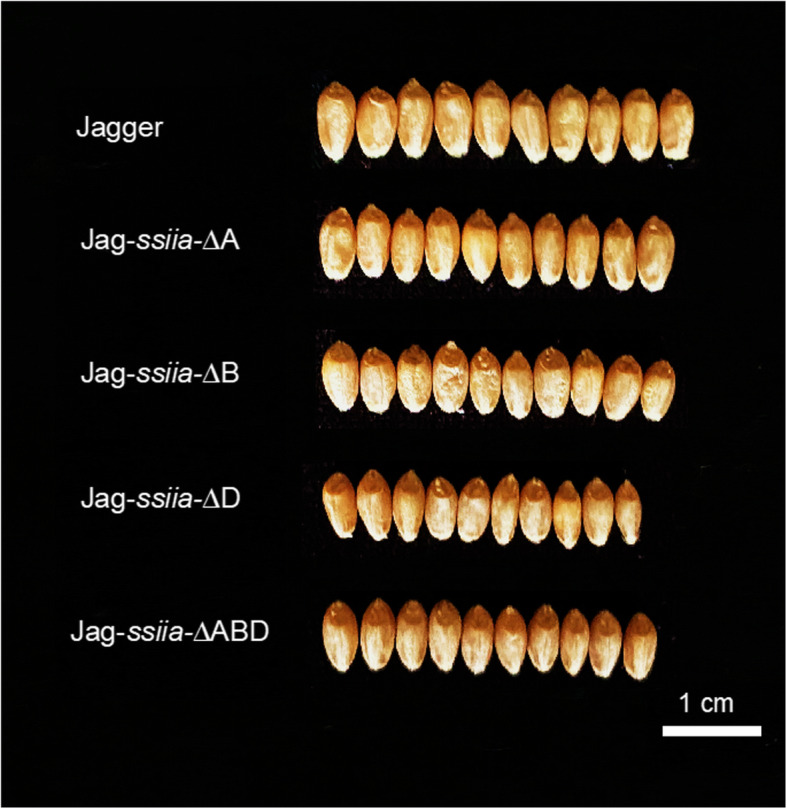
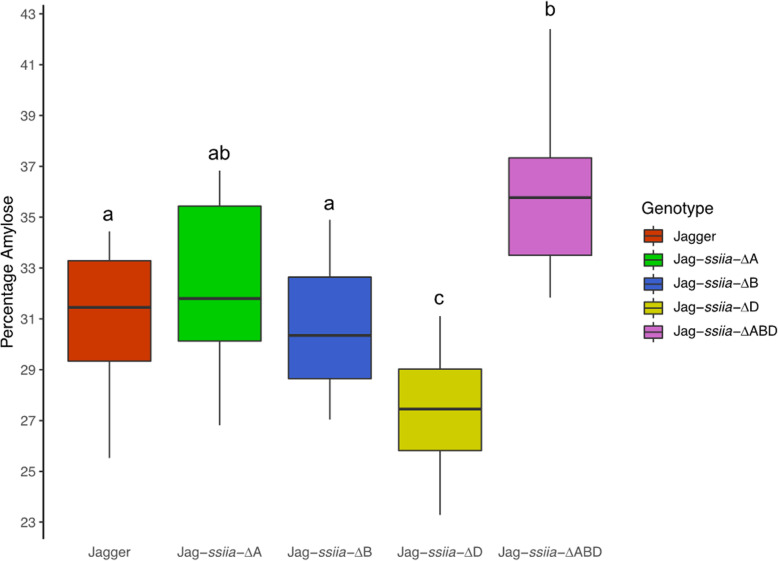
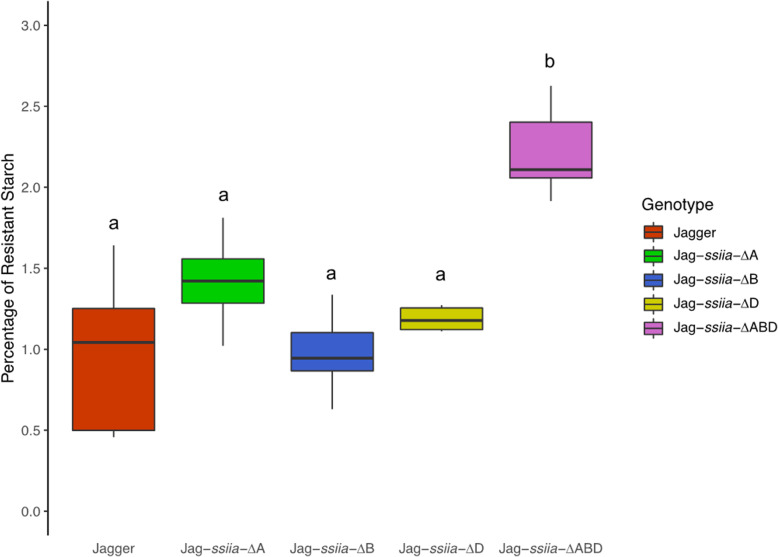
Background: Lack of nutritionally appropriate foods is one of the leading causes of obesity in the US and worldwide. Wheat ( Triticum aestivum ) provides 20% of the calories consumed daily across the globe. The nutrients in the wheat grain come primarily from the starch composed of amylose and amylopectin. Resistant starch content, which is known to have significant human health benefits, can be increased by modifying starch synthesis pathways. Starch synthase enzyme SSIIa, also known as starch granule protein isoform-1 ( SGP-1 ), is integral to the biosynthesis of the branched and readily digestible glucose polymer amylopectin. The goal of this work was to develop a triple null mutant genotype for SSIIa locus in the elite hard red winter wheat variety ‘Jagger’ and evaluate the effect of the knock-out mutations on resistant starch content in grains with respect to wild type. Results: Knock-out mutations in SSIIa in the three genomes of wheat variety ‘Jagger’ were identified using TILLING. Subsequently, these loss-of function mutations on A, B, and D genomes were combined by crossing to generate a triple knockout mutant genotype Jag- ssiia -∆ABD. The Jag- ssiia -∆ABD had an amylose content of 35.70% compared to 31.15% in Jagger, leading to ~ 118% increase in resistant starch in the Jag- ssiia -∆ABD genotype of Jagger wheat. The single individual genome mutations also had various effects on starch composition. Conclusions: Our full null Jag- ssiia -∆ABD mutant showed a significant increase in RS without the shriveled grain phenotype seen in other ssiia knockouts in elite wheat cultivars. Moreover, this study shows the potential for developing nutritionally improved foods in a non-GM approach. Since all the mutants have been developed in an elite wheat cultivar, their adoption in production and supply will be feasible in future.
Overview
The claims and statistics of this paper haven’t been checked yet.
Free: it reads the open-access text and checks the first 5 claims that cite a source we can check. Create a free account to check every claim.
Integrity signals
Registry
Cites
Statistics
Figures
Verification
Claims the paper makes
The claims and statistics of this paper haven’t been checked yet.
Free: it reads the open-access text and checks the first 5 claims that cite a source we can check. Create a free account to check every claim.
Self-check
Percentages, sums and reported differences re-computed from the paper’s own numbers.
The self-check needs the paper’s full text.
Citations
Cites
Topping, D. L., & Clifton, P. M. (2001) · Physiological Reviews · doi:10.1152/physrev.2001.81.3.1031 · Cited by 3,091
Obesity and Diabetes in the Developing World — A Growing Challenge
Hossain, P., Kawar, B., & El Nahas, M. (2007) · New England Journal of Medicine · doi:10.1056/nejmp068177 · Cited by 2,200
Starch—composition, fine structure and architecture
Tester, R. F., Karkalas, J., & Qi, X. (2004) · Journal of Cereal Science · doi:10.1016/j.jcs.2003.12.001 · Cited by 1,750
Sajilata, M. G., Singhal, R. S., & Kulkarni, P. R. (2006) · Comprehensive Reviews in Food Science and Food Safety · doi:10.1111/j.1541-4337.2006.tb00076.x · Cited by 1,660
Dietary Guidelines for Americans
DeSalvo, K. B., Olson, R., & Casavale, K. O. (2016) · JAMA · doi:10.1001/jama.2015.18396 · Cited by 1,059
Wheat: chemistry and technology.
Pomeranz, Y. (1988) · AACC International eBooks · Cited by 1,035
The transcriptional landscape of polyploid wheat
Ramírez-González, R. H., Borrill, P., Lang, D., Harrington, S. A., Brinton, J., Venturini, L., Davey, M., Jacobs, J., van Ex, F., Pasha, A., et al. (2018) · Science · doi:10.1126/science.aar6089 · Cited by 1,018 · cited 2×
“It is known that ~ 30% of wheat genes show a non-balanced expression among the A, B and D genomes [36].”
BackgroundSelf-citationApplication of cereals and cereal components in functional foods: a review
Charalampopoulos, D., Wang, R., Pandiella, S. S., & Webb, C. (2002) · International Journal of Food Microbiology · doi:10.1016/s0168-1605(02)00187-3 · Cited by 743
Fredriksson, H., Silverio, J., Andersson, R., Eliasson, A.-C., & Åman, P. (1998) · Carbohydrate Polymers · doi:10.1016/s0144-8617(97)00247-6 · Cited by 701
Dietary Guidelines for Americans, 2020–2025
Phillips, J. A. (2021) · Workplace Health & Safety · doi:10.1177/21650799211026980 · Cited by 693
WHEAT: Chemistry and Technology
(2009) · AACC International eBooks · doi:10.1094/9781891127557 · Cited by 667
Stein, C. J., & Colditz, G. A. (2004) · The Journal of Clinical Endocrinology & Metabolism · doi:10.1210/jc.2004-0288 · Cited by 615
Nullisomic-Tetrasomic Combinations in Hexaploid Wheat
Sears, E. R. (1966) · Chromosome Manipulations and Plant Genetics · doi:10.1007/978-1-4899-6561-5_4 · Cited by 556 · cited 3×
“Genome speci city was tested using Nullisomic tetrasomic genetic stocks for chromosome 7 from the Wheat Genetics Resource Center, Kansas State University [49].”
MethodInfluentialStarch synthesis in the cereal endosperm
James, M. G., Denyer, K., & Myers, A. M. (2003) · Current Opinion in Plant Biology · doi:10.1016/s1369-5266(03)00042-6 · Cited by 556
High-amylose wheat generated by RNA interference improves indices of large-bowel health in rats
Regina, A., Bird, A., Topping, D., Bowden, S., Freeman, J., Barsby, T., Kosar-Hashemi, B., Li, Z., Rahman, S., & Morell, M. (2006) · Proceedings of the National Academy of Sciences · doi:10.1073/pnas.0510737103 · Cited by 539
Biochemical and Genetic Analysis of the Effects of Amylose-Extender Mutation in Rice Endosperm
Nishi, A. (2001) · PLANT PHYSIOLOGY · doi:10.1104/pp.127.2.459 · Cited by 520
Production of waxy (amylose-free) wheats
Nakamura, T., Yamamori, M., Hirano, H., Hidaka, S., & Nagamine, T. (1995) · Molecular and General Genetics MGG · doi:10.1007/bf02191591 · Cited by 454
Digestion and physiological properties of resistant starch in the human large bowel
Cummings, J. H., Beatty, E. R., Kingman, S. M., Bingham, S. A., & Englyst, H. N. (1996) · British Journal of Nutrition · doi:10.1079/bjn19960177 · Cited by 412
Cereal complex carbohydrates and their contribution to human health
Topping, D. (2007) · Journal of Cereal Science · doi:10.1016/j.jcs.2007.06.004 · Cited by 276
Effects of environmental factors on cereal starch biosynthesis and composition
Thitisaksakul, M., Jiménez, R. C., Arias, M. C., & Beckles, D. M. (2012) · Journal of Cereal Science · doi:10.1016/j.jcs.2012.04.002 · Cited by 259
Yamamori, M., Fujita, S., Hayakawa, K., Matsuki, J., & Yasui, T. (2000) · Theoretical and Applied Genetics · doi:10.1007/s001220051444 · Cited by 252
Development of high amylose wheat through TILLING
Slade, A. J., McGuire, C., Loeffler, D., Mullenberg, J., Skinner, W., Fazio, G., Holm, A., Brandt, K. M., Steine, M. N., Goodstal, J. F., et al. (2012) · BMC Plant Biology · doi:10.1186/1471-2229-12-69 · Cited by 226 · cited 3×
“Previous studies have shown the effects of null SBE and SS genes on starch composition in durum and hexaploid wheat backgrounds [7, 28, 29, 31, 32, 35, 42, 43].”
BackgroundMethodGreater satiety response with resistant starch and corn bran in human subjects
Willis, H. J., Eldridge, A. L., Beiseigel, J., Thomas, W., & Slavin, J. L. (2009) · Nutrition Research · doi:10.1016/j.nutres.2009.01.004 · Cited by 208
Perpiñá, G., Esteras, C., Gibon, Y., Monforte, A. J., & Picó, B. (2016) · BMC Plant Biology · doi:10.1186/s12870-016-0842-0 · Cited by 186
The epidemic of obesity and diabetes: trends and treatments.
Barnes, A. S. (2011) · Europe PMC (PubMed Central) · Cited by 169
Boyer, C. D., & Preiss, J. (1981) · Plant Physiology · doi:10.1104/pp.67.6.1141 · Cited by 167
Dough and Baking Properties of High‐Amylose and Waxy Wheat Flours
Morita, N., Maeda, T., Miyazaki, M., Yamamori, M., Miura, H., & Ohtsuka, I. (2002) · Cereal Chemistry · doi:10.1094/cchem.2002.79.4.491 · Cited by 165
High resolution melting analysis for the detection of EMS induced mutations in wheat Sbella genes
Botticella, E., Sestili, F., Hernández‐López, A., Phillips, A. L., & Lafiandra, D. (2011) · BMC Plant Biology · doi:10.1186/1471-2229-11-156 · Cited by 143 · cited 4×
“Studies in durum wheat have shown similar results [6, 24, 25].”
BackgroundResultInfluentialProgress in TILLING as a tool for functional genomics and improvement of crops
Chen, L., Hao, L., Parry, M. A. J., Phillips, A. L., & Hu, Y. (2014) · Journal of Integrative Plant Biology · doi:10.1111/jipb.12192 · Cited by 136
Hazard, B. A., Zhang, X., Colasuonno, P., Uauy, C., Beckles, D. M., & Dubcovsky, J. (2012) · Crop Science · doi:10.2135/cropsci2012.02.0126 · Cited by 129 · cited 2×
“77% on average respectively in amylose content [5, 15, 42, 45].”
BackgroundEffect of Bread Containing Resistant Starch on Postprandial Blood Glucose Levels in Humans
YAMADA, Y., HOSOYA, S., NISHIMURA, S., TANAKA, T., KAJIMOTO, Y., NISHIMURA, A., & KAJIMOTO, O. (2005) · Bioscience, Biotechnology, and Biochemistry · doi:10.1271/bbb.69.559 · Cited by 114
A diploid wheat TILLING resource for wheat functional genomics
Rawat, N., Sehgal, S. K., Joshi, A., Rothe, N., Wilson, D. L., McGraw, N., Vadlani, P. V., Li, W., & Gill, B. S. (2012) · BMC Plant Biology · doi:10.1186/1471-2229-12-205 · Cited by 86
Self-citationCase report of 5 siblings: malnutrition? Rickets? DiGeorge syndrome? Developmental delay?
Cundiff, D. K., & Harris, W. (2006) · Nutrition Journal · doi:10.1186/1475-2891-5-1 · Cited by 85
Yamamori, M., Kato, M., Yui, M., & Kawasaki, M. (2006) · Australian Journal of Agricultural Research · doi:10.1071/ar05176 · Cited by 84
Botticella, E., Sestili, F., Sparla, F., Moscatello, S., Marri, L., Cuesta-Seijo, J. A., Falini, G., Battistelli, A., Trost, P., & Lafiandra, D. (2018) · Plant Biotechnology Journal · doi:10.1111/pbi.12908 · Cited by 82
PARK, O. J., EKANG, N., CHANG, M. J., & KIM, W. K. (2004) · Journal of Nutritional Science and Vitaminology · doi:10.3177/jnsv.50.93 · Cited by 80
Gaines, C. S., Raeker, M. Ö., Tilley, M., Finney, P. L., Wilson, J. D., Bechtel, D. B., Martin, R. J., Seib, P. A., Lookhart, G. L., & Donelson, T. (2000) · Cereal Chemistry · doi:10.1094/cchem.2000.77.2.163 · Cited by 77
Registration of ‘Jagger’ Wheat
Sears, R. G., Moffatt, J. M., Martin, T. J., Cox, T. S., Bequette, R. K., Curran, S. P., Chung, O. K., Heer, W. F., Long, J. H., & Witt, M. D. (1997) · Crop Science · doi:10.2135/cropsci1997.0011183x003700030062x · Cited by 77
Mishra, A., Singh, A., Sharma, M., Kumar, P., & Roy, J. K. (2016) · BMC Plant Biology · doi:10.1186/s12870-016-0896-z · Cited by 77
Creation of a high-amylose durum wheat through mutagenesis of starch synthase II (SSIIa)
Hogg, A. C., Gause, K., Hofer, P., Martin, J. M., Graybosch, R. A., Hansen, L. E., & Giroux, M. J. (2013) · Journal of Cereal Science · doi:10.1016/j.jcs.2013.01.001 · Cited by 75
Mutations in wheat starch synthase II genes and PCR-based selection of a SGP-1 null line
Shimbata, T., Nakamura, T., Vrinten, P. L., Saito, M., Yonemaru, J., Seto, Y., & Yasuda, H. (2005) · Theoretical and Applied Genetics · doi:10.1007/s00122-005-0032-1 · Cited by 57
Hazard, B. A., Zhang, X., Naemeh, M., Hamilton, M. K., RUST, B. M., Raybould, H. E., Newman, J. W. I., Martin, R. J., & Dubcovsky, J. (2015) · Crop Science · doi:10.2135/cropsci2015.03.0179 · Cited by 46
The impact of the SSIIa null mutations on grain traits and composition in durum wheat
Botticella, E., Sestili, F., Ferrazzano, G., Mantovani, P., Cammerata, A., D’Egidio, M. G., & Lafiandra, D. (2016) · Ikushugaku zasshi · doi:10.1270/jsbbs.16025 · Cited by 38
HIGGINS, J. A., Brown, M. A., & Storlien, L. H. (2006) · Nutrition Journal · doi:10.1186/1475-2891-5-25 · Cited by 35
Schönhofen, A., Hazard, B. A., Zhang, X., & Dubcovsky, J. (2016) · Journal of Plant Registrations · doi:10.3198/jpr2015.10.0066crg · Cited by 34
Nutritional and Quality Traits of Pasta Made from SSIIa Null High‐Amylose Durum Wheat
Hogg, A. C., Martin, J. M., Manthey, F. A., & Giroux, M. J. (2015) · Cereal Chemistry · doi:10.1094/cchem-12-14-0246-r · Cited by 33
TILL-D: An Aegilops tauschii TILLING Resource for Wheat Improvement
Rawat, N., Schoen, A. W., Singh, L., Mahlandt, A., Wilson, D. L., Liu, S., Lin, G., Gill, B. S., & Tiwari, V. K. (2018) · Frontiers in Plant Science · doi:10.3389/fpls.2018.01665 · Cited by 29 · cited 1×
“Tetraploid and diploid wheat species require signi cantly larger populations to have the same effect, ~ 3000 and ~ 5500 individuals, respectively [39, 40].”
BackgroundSelf-citationBattling Obesity with Resistant Starch
Hendrich, S. (2010) · Iowa State University Digital Repository (Iowa State University) · Cited by 26
A TILLING Resource for Hard Red Winter Wheat Variety Jagger
Rawat, N., Joshi, A., Pumphrey, M., Singh, L., Mahlandt, A., Chhabra, B., Wilson, D., Gill, B. S., Poland, J., & Tiwari, V. K. (2019) · Crop Science · doi:10.2135/cropsci2019.01.0011 · Cited by 25
Self-citationExtraction and identification of internal granule proteins from waxy wheat starch
Wang, S., Hassani, M. E., Crossett, B., & Copeland, L. (2012) · Starch - Stärke · doi:10.1002/star.201200093 · Cited by 16
Patten, G. S., Conlon, M. A., Bird, A. R., Adams, M. J., Topping, D. L., & Abeywardena, M. Y. (2006) · Digestive Diseases and Sciences · doi:10.1007/s10620-006-3121-3 · Cited by 13
Singh, L., Schoen, A. W., Mahlandt, A., Chhabra, B., Steadham, J., Tiwari, V. K., & Rawat, N. (2019) · Journal of Visualized Experiments · doi:10.3791/59743 · Cited by 5
Self-citation
Research works printed but not linked: 2
- Ritchie H Roser M Obesity - our world in data 2016
- FAOSTAT Food supply- crops primary equivalent 2020
Cited by
Resistant starch formation in rice: Genetic regulation and beyond
Shen, L., Li, J., & Li, Y. (2022) · Plant Communications · doi:10.1016/j.xplc.2022.100329 · Cited by 111
“…in RS content, which was accompanied by significant increases in the AC and short branch chains of amylopectin (6 % DP % 10) and a decrease in the mid-length chains of amylopectin (11 % DP % 24) (Morell et al., 2003; Bird et al., 2004; Shimbata et al., 2012; Schoen et al., 2021; Yang et al., 2022).”
BackgroundIs it the end of TILLING era in plant science?
Szurman‐Zubrzycka, M., Kurowska, M. M., Till, B. J., & Szarejko, I. (2023) · Frontiers in Plant Science · doi:10.3389/fpls.2023.1160695 · Cited by 28
Fahy, B. F., González-Navarro, O. E., Savva, G. M., Ahn‐Jarvis, J. H., Warren, F. J., Dunn, J., Lovegrove, A., & Hazard, B. A. (2022) · Scientific Reports · doi:10.1038/s41598-022-14995-0 · Cited by 26
Schoen, A. W., Yadav, I. S., Wu, S., Poland, J., Rawat, N., & Tiwari, V. K. (2023) · Functional & Integrative Genomics · doi:10.1007/s10142-023-01084-2 · Cited by 18
“Because of this, the methods used in mapping tin3 and tin5 in diploid wheat could be translated to hexaploid wheat; however, implementing the genes in breeding programs may be difficult due to the need to combine knockouts in all three copies to see the effect (Schoen et al. 2021).”
MethodSelf-citationChhabra, B., Singh, L., Wallace, S., Schoen, A. W., Dong, Y., Tiwari, V. K., & Rawat, N. (2021) · Plant Disease · doi:10.1094/pdis-03-21-0670-re · Cited by 17
Self-citation
Metadata
- Authors
- Schoen, A., Joshi, A., Tiwari, V., Gill, B. S., & Rawat, N.
- Affiliations
- University of Maryland, College Park (US)
- Kansas State University (US)
- Corresponding author
- Gill, Bikram S.
- Rawat, Nidhi
- Venue
- BMC Plant Biology
- Published
- 2021-02-03
- Volume
- 21
- Issue
- 1
- Pages
- 74-74
- ISSN
- 1471-2229 (ISSN-L)
- PMC
- PMC7860177
- OpenAlex
- W3112342010
- Cited by
- 20
- References
- 53
- Citations by year
- 2026: 7 · 2025: 3 · 2024: 1 · 2023: 4 · 2022: 4 · 2021: 1
- FWCI
- 1.59
- Type
- journal article
- Language
- en
- Open access
- gold
- doi.org
- Licence
- cc-by
- creativecommons.org/licenses/by/4.0 (tdm)
- creativecommons.org/licenses/by/4.0 (vor)
- Locations
- BMC Plant Biology (publishedVersion, cc-by)
- Research Square (acceptedVersion, cc-by)
- Europe PMC (PubMed Central) (publishedVersion, other-oa)
- PubMed Central (publishedVersion, cc-by)
- PubMed (publishedVersion)
- DOAJ (DOAJ: Directory of Open Access Journals) (submittedVersion, cc-by-sa)
- University Libraries (University of Maryland) (submittedVersion)
- Digital Repository at the University of Maryland (University of Maryland College Park)
- Topics
- Health Sciences › Nursing › Nutrition and Dietetics › Food composition and properties
- Life Sciences › Agricultural and Biological Sciences › Plant Science › Wheat and Barley Genetics and Pathology
- Life Sciences › Agricultural and Biological Sciences › Plant Science › Plant Genetic and Mutation Studies
- Keywords
- resistant starch, amylose content, amylopectin, hexaploid wheat, loss-of-function mutations, TILLING, hard red winter wheat, grain shrinkage
- MeSH terms
- Resistant Starch, Amylose, Mutation, Organ Size, Polyploidy, Seeds, Starch Synthase, Triticum, Sequence Homology, Amino Acid
About these checks
Registry, retraction, Cites and statistics results are computed, not judged, with one exception: a printed reference that no index lists is read once by a model before it counts as a citation error. Claims are extracted by a model and kept only when their quote appears verbatim in the text; each cited source is then checked, with a model’s help, for whether it says what the claim relies on. Those verdicts can be wrong — read the claim’s quote and the cited source before relying on one.
Statistics and arithmetic are recomputed, not judged.
Confidence bands are shown only for fields calibrated on our annotated test set. None is calibrated yet, so no band is shown.
What counts as a claim ›How we measure confidence ›How we check this ›
Are you an author, or do you see a problem with this page? Request a review
Data sources
Bibliographic data: Semantic Scholar, OpenAlex, Crossref.
Contains information from the Semantic Scholar Academic Graph Datasets, made available under the ODC Attribution License (ODC-BY 1.0).
Semantic Scholar’s data is described in: Kinney, R., et al. (2023). The Semantic Scholar Open Data Platform. arXiv:2301.10140.
