

The DOI matches its Crossref record; 29 of the 29 references it cites were found in a registry or an index.
The Diabetes Remission Clinical Trial (DiRECT): protocol for a cluster randomised trial
Open accessAbstract
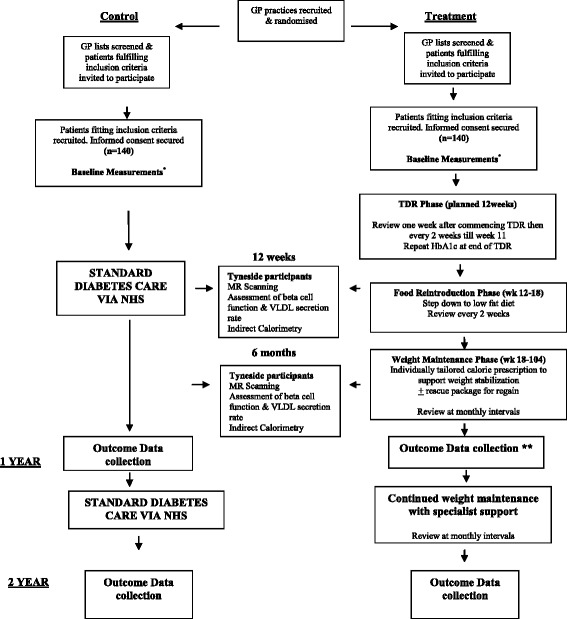
BACKGROUND: Despite improving evidence-based practice following clinical guidelines to optimise drug therapy, Type 2 diabetes (T2DM) still exerts a devastating toll from vascular complications and premature death. Biochemical remission of T2DM has been demonstrated with weight loss around 15kg following bariatric surgery and in several small studies of non-surgical energy-restriction treatments. The non-surgical Counterweight-Plus programme, running in Primary Care where obesity and T2DM are routinely managed, produces >15 kg weight loss in 33% of all enrolled patients. The Diabetes UK-funded Counterpoint study suggested that this should be sufficient to reverse T2DM by removing ectopic fat in liver and pancreas, restoring first-phase insulin secretion. The Diabetes Remission Clinical Trial (DiRECT) was designed to determine whether a structured, intensive, weight management programme, delivered in a routine Primary Care setting, is a viable treatment for achieving durable normoglycaemia. Other aims are to understand the mechanistic basis of remission and to identify psychological predictors of response. METHODS/DESIGN: Cluster-randomised design with GP practice as the unit of randomisation: 280 participants from around 30 practices in Scotland and England will be allocated either to continue usual guideline-based care or to add the Counterweight-Plus weight management programme, which includes primary care nurse or dietitian delivery of 12-20weeks low calorie diet replacement, food reintroduction, and long-term weight loss maintenance. Main inclusion criteria: men and women aged 20-65 years, all ethnicities, T2DM 0-6years duration, BMI 27-45 kg/m(2). Tyneside participants will undergo Magnetic Resonance (MR) studies of pancreatic and hepatic fat, and metabolic studies to determine mechanisms underlying T2DM remission. Co-primary endpoints: weight reduction ≥ 15 kg and HbA1c <48 mmol/mol at one year. Further follow-up at 2 years. DISCUSSION: This study will establish whether a structured weight management programme, delivered in Primary Care by practice nurses or dietitians, is a viable treatment to achieve T2DM remission. Results, available from 2018 onwards, will inform future service strategy. TRIAL REGISTRATION: Current Controlled Trials ISRCTN03267836 . Date of Registration 20/12/2013.
Overview
The claims and statistics of this paper haven’t been checked yet.
Run the check — free, no account needed. It reads the open-access text and checks the sources it cites.
Integrity signals
Registry
Cites
Statistics
Figures
Verification
Claims the paper makes
The claims and statistics of this paper haven’t been checked yet.
Run the check — free, no account needed. It reads the open-access text and checks the sources it cites.
Claims other papers make about this one
Each is checked against this paper’s own text: does it say what the citing paper says it does?
The source backs part of the claim, not all of it — or backs it for a different population, condition or comparison.
In the citing paper
“as both excess weight and higher glucose exert their effects through aggregated exposure. 15,16”
From 5-year follow-up of the randomised Diabetes Remission Clinical Trial (DiRECT) of continued support for weight loss maintenance in the UK: an extension study (2024) · cites this paper as [16]
Experimental — accuracy not yet measuredThe source backs part of the claim, not all of it — or backs it for a different population, condition or comparison.
In the citing paper
“Bariatric surgery has dominated discussions of type 2 diabetes remission as the most effective way of producing major weight loss.8,9,10”
From Primary care-led weight management for remission of type 2 diabetes (DiRECT): an open-label, cluster-randomised trial (2018) · cites this paper as [10]
Experimental — accuracy not yet measuredThe check wasn’t confident either way, so it gives no verdict — never disputed.
In the citing paper
“the overall loss to follow up of 14·1% over 2 years is modest for a weight loss study in real-life conditions. 14”
From Durability of a primary care-led weight-management intervention for remission of type 2 diabetes: 2-year results of the DiRECT open-label, cluster-randomised trial (2019) · cites this paper as [14]
Experimental — accuracy not yet measured
Self-check
Percentages, sums and reported differences re-computed from the paper’s own numbers.
The self-check needs the paper’s full text.
Citations
Cites
Reduction in the incidence of type 2 diabetes with lifestyle intervention or metformin
(2002) · New England Journal of Medicine · doi:10.1056/nejmoa012512 · Cited by 19,011
What is an adequate sample size? Operationalising data saturation for theory-based interview studies
Francis, J. J., Johnston, M., Robertson, C., Glidewell, L., Entwistle, V., Eccles, M. P., & Grimshaw, J. M. (2010) · Psychology & Health · doi:10.1080/08870440903194015 · Cited by 3,429
Obesity, Fat Distribution, and Weight Gain as Risk Factors for Clinical Diabetes in Men
Chan, J. M., Rimm, E. B., Colditz, G. A., Stampfer, M. J., & Willett, W. C. (1994) · Diabetes Care · doi:10.2337/diacare.17.9.961 · Cited by 1,808
Dixon, J. B., O’Brien, P. E., Playfair, J., Chapman, L., Schachter, L. M., Skinner, S., Proietto, J., Bailey, M., & Anderson, M. (2008) · JAMA · doi:10.1001/jama.299.3.316 · Cited by 1,434
Lim, E. L., Hollingsworth, K. G., Aribisala, B. S., Chen, M. J., Mathers, J. C., & Taylor, R. (2011) · Diabetologia · doi:10.1007/s00125-011-2204-7 · Cited by 1,164
Self-citationAssociation of cardiometabolic multimorbidity with mortality
Di Angelantonio, E., Kaptoge, S., Wormser, D., Willeit, P., Butterworth, A. S., Bansal, N., O’Keeffe, L. M., Gao, P., Wood, A. M., Burgess, S., et al. (2015) · JAMA · doi:10.1001/jama.2015.7008 · Cited by 1,155
Self-citationHow many steps/day are enough? for adults
Tudor-Locke, C., Craig, C. L., Brown, W. J., Clemes, S. A., De Cocker, K., Giles-Corti, B., Hatano, Y., Inoue, S., Matsudo, S. M., Mutrie, N., et al. (2011) · International Journal of Behavioral Nutrition and Physical Activity · doi:10.1186/1479-5868-8-79 · Cited by 1,087
(2018) · doi:10.1001/jama · Cited by 932
Hex, N., Bartlett, C., Wright, D., Taylor, M., & Varley, D. (2012) · Diabetic Medicine · doi:10.1111/j.1464-5491.2012.03698.x · Cited by 819
Association of an intensive lifestyle intervention with remission of type 2 diabetes
Gregg, E. W., Chen, H., Wagenknecht, L. E., Clark, J. M., Delahanty, L. M., Bantle, J., Pownall, H. J., Johnson, K. C., Safford, M. M., Kitabchi, A. E., et al. (2012) · JAMA · doi:10.1001/jama.2012.67929 · Cited by 752
UK prospective diabetes study (UKPDS)
UK Prospective Diabetes Study Group (1991) · Diabetologia · doi:10.1007/bf00400195 · Cited by 565
Taylor, R. (2013) · Diabetes Care · doi:10.2337/dc12-1805 · Cited by 485
Self-citationMechanisms of Recovery From Type 2 Diabetes After Malabsorptive Bariatric Surgery
Guidone, C., Manco, M., Valera-Mora, E., Iaconelli, A., Gniuli, D., Mari, A., Nanni, G., Castagneto, M., Calvani, M., & Mingrone, G. (2006) · Diabetes · doi:10.2337/db06-0068 · Cited by 367
Obesity, weight loss and prognosis in type 2 diabetes
Lean, M. E. J., Powrie, J. K., Anderson, A. S., & Garthwaite, P. H. (1990) · Diabetic Medicine · doi:10.1111/j.1464-5491.1990.tb01375.x · Cited by 318
Self-citationUK Prospective Diabetes Study (UKPDS). VIII. Study design, progress and performance.
(1991) · PubMed · Cited by 191
Physical Activity Patterns in the National Weight Control Registry
Catenacci, V. A., Ogden, L. G., Stuht, J., Phelan, S., Wing, R. R., Hill, J. O., & Wyatt, H. R. (2008) · Obesity · doi:10.1038/oby.2007.6 · Cited by 187
Penn, L., White, M. J., Lindström, J., den Boer, A. T., Blaak, E. E., Eriksson, J. G., Feskens, E. J. M., Ilanne‐Parikka, P., Keinanen-Kiukaanniemi, S. M., Walker, M., et al. (2013) · PLoS ONE · doi:10.1371/journal.pone.0057143 · Cited by 148
Self-citationSteven, S., & Taylor, R. (2015) · Diabetic Medicine · doi:10.1111/dme.12722 · Cited by 124
Self-citationRedmon, J. B., Bertoni, A. G., Connelly, S., Feeney, P. A., Glasser, S. P., Glick, H. A., Greenway, F. L., Hesson, L. A., Lawlor, M. S., Montez, M. G., et al. (2010) · Diabetes Care · doi:10.2337/dc09-2090 · Cited by 117
Lean, M., Brosnahan, N., McLoone, P., McCombie, L., Higgs, A. B., Ross, H., Mackenzie, M., Grieve, E., Finer, N., Reckless, J., et al. (2013) · British Journal of General Practice · doi:10.3399/bjgp13x663073 · Cited by 87
Self-citationPopulation response to information on reversibility of Type 2 diabetes
Steven, S., Lim, E. L., & Taylor, R. (2013) · Diabetic Medicine · doi:10.1111/dme.12116 · Cited by 70
Self-citationMiras, A. D., Chuah, L. L., Lascaratos, G., Faruq, S., Mohite, A., Shah, P. R., Gill, M., Jackson, S. N., Johnston, D. G., Olbers, T., et al. (2012) · Diabetes Care · doi:10.2337/dc11-2353 · Cited by 69
Blond, E., Maitrepierre, C., Normand, S., Sothier, M., Roth, H., Goudable, J., & Laville, M. (2011) · e-SPEN the European e-Journal of Clinical Nutrition and Metabolism · doi:10.1016/j.eclnm.2010.12.001 · Cited by 68
Rehackova, L., Arnott, B., Araujo‐Soares, V., Adamson, A. A., Taylor, R., & Sniehotta, F. F. (2016) · Diabetic Medicine · doi:10.1111/dme.13005 · Cited by 60
Self-citationSteven, S., Carey, P. E., Small, P. K., & Taylor, R. (2015) · Diabetic Medicine · doi:10.1111/dme.12567 · Cited by 55
Self-citationPenn, L., Dombrowski, S. U., Sniehotta, F. F., & White, M. (2013) · BMJ Open · doi:10.1136/bmjopen-2013-002949 · Cited by 55
Self-citationThe effects of orlistat in patients with diabetes: improvement in glycaemic control and weight loss
Rowe, R., Cowx, M., Poole, C., McEwan, P., Morgan, C., & Walker, M. (2005) · Current Medical Research and Opinion · doi:10.1185/030079905x74943 · Cited by 28
Development of a novel method to determine very low density lipoprotein kinetics
Al-Shayji, I. A. R., Gill, J. M. R., Cooney, J., Siddiqui, S., & CASLAKE, M. J. (2007) · Journal of Lipid Research · doi:10.1194/jlr.d600044-jlr200 · Cited by 17
Nwaneri, C., Bowen-Jones, D., Cooper, H., Chikkaveerappa, K., & Afolabi, B. A. (2012) · Postgraduate Medical Journal · doi:10.1136/postgradmedj-2012-130877 · Cited by 15
Research works printed but not linked: 1
- Diabetes Prevention Programme Research Group. Reduction in the incidence of type 2 diabetes with lifestyle intervention or metformin. N Engl J Med. 2002;346:393–403. · DOI · Paper page
Cited by
Sorted by citations
Lean, M. E., Leslie, W. S., Barnes, A. C., Brosnahan, N., Thom, G., McCombie, L., Peters, C., Zhyzhneuskaya, S., Al-Mrabeh, A., Hollingsworth, K. G., et al. (2018) · The Lancet · doi:10.1016/s0140-6736(17)33102-1 · Cited by 2,095
Self-citationLean, M. E. J., Leslie, W. S., Barnes, A. C., Brosnahan, N., Thom, G., McCombie, L., Peters, C., Zhyzhneuskaya, S., Al-Mrabeh, A., Hollingsworth, K. G., et al. (2019) · The Lancet Diabetes & Endocrinology · doi:10.1016/s2213-8587(19)30068-3 · Cited by 1,017
“Other pre-specified outcomes included programme acceptability, sleep quality, blood pressure, and serious adverse events collected from GP records, as detailed in the trial protocol.(14) We additionally assessed changes in medications as exploratory outcomes.”
BackgroundMethodSelf-citationTaylor, R., Al-Mrabeh, A., Zhyzhneuskaya, S., Peters, C., Barnes, A. C., Aribisala, B. S., Hollingsworth, K. G., Mathers, J. C., Sattar, N., & Lean, M. E. J. (2018) · Cell Metabolism · doi:10.1016/j.cmet.2018.07.003 · Cited by 450
Self-citationIntermittent Fasting in Cardiovascular Disorders—An Overview
Malinowski, B., Zalewska, K., Węsierska, A., Sokołowska, M. M., Socha, M., Liczner, G., Pawlak-Osińska, K., & Wiciński, M. (2019) · Nutrients · doi:10.3390/nu11030673 · Cited by 290
Developing Behavior Change Interventions for Self-Management in Chronic Illness
Araújo‐Soares, V., Hankonen, N. E., Presseau, J., Rodrigues, A., & Sniehotta, F. F. (2018) · European Psychologist · doi:10.1027/1016-9040/a000330 · Cited by 259
Self-citation
Metadata
- Authors
- Leslie, W. S., Ford, I., Sattar, N., Hollingsworth, K. G., Adamson, A., Sniehotta, F. F., McCombie, L., Brosnahan, N., Ross, H., Mathers, J. C., Peters, C., Thom, G., Barnes, A., Kean, S., McIlvenna, Y., Rodrigues, A., Rehackova, L., Zhyzhneuskaya, S., Taylor, R., & Lean, M. E. J.
- Affiliations
- University of Glasgow (GB)
- Newcastle University (GB)
- Corresponding author
- Leslie, Wilma S.
- ORCID
- Venue
- BMC Family Practice
- Published
- 2016-02-16
- Volume
- 17
- Issue
- 1
- Pages
- 20-20
- ISSN
- 1471-2296 (ISSN-L)
- PMC
- PMC4754868
- OpenAlex
- W2282195952
- Semantic Scholar
- 0f0410d96cb805bf52b3e656880025aa434012bb
- Cited by
- 132
- References
- 28
- Citations by year
- 2026: 9 · 2025: 10 · 2024: 14 · 2023: 8 · 2022: 12 · 2021: 30 · 2020: 11 · 2019: 14 · 2018: 10 · 2017: 12 · 2016: 1
- FWCI
- 12.39
- Type
- journal article
- Language
- en
- Open access
- gold
- doi.org
- Locations
- BMC Family Practice (publishedVersion)
- PubMed Central (publishedVersion, cc-by)
- PubMed (publishedVersion)
- Northumbria Research Link (Northumbria University) (acceptedVersion)
- ENLIGHTEN (Jurnal Bimbingan dan Konseling Islam) (acceptedVersion)
- Newcastle University ePrints (Newcastle Univesity) (cc-by)
- Funders
- Diabetes UK (13/0004691)
- Topics
- Health Sciences › Medicine › Endocrinology, Diabetes and Metabolism › Diabetes Treatment and Management
- Health Sciences › Medicine › Surgery › Bariatric Surgery and Outcomes
- Health Sciences › Medicine › Endocrinology, Diabetes and Metabolism › Diabetes, Cardiovascular Risks, and Lipoproteins
- Keywords
- type 2 diabetes remission, weight management, hypocaloric diet, primary care, normoglycemia, HbA1c, pancreatic fat, liver fat, insulin secretion, obesity, weight loss maintenance
- MeSH terms
- Adult, Aged, Diabetes Mellitus, Type 2, Diet, Reducing, England, Female, Glycated Hemoglobin, Humans, Hypoglycemic Agents, Male, Middle Aged, Obesity, Primary Health Care, Remission Induction, Scotland, Young Adult, Weight Reduction Programs
About these checks
Registry, retraction, Cites and statistics results are computed, not judged, with one exception: a printed reference that no index lists is read once by a model before it counts as a citation error. Claims are extracted by a model and kept only when their quote appears verbatim in the text; each cited source is then checked, with a model’s help, for whether it says what the claim relies on. Those verdicts can be wrong — read the claim’s quote and the cited source before relying on one.
Statistics and arithmetic are recomputed, not judged.
Confidence bands are shown only for fields calibrated on our annotated test set. None is calibrated yet, so no band is shown.
What counts as a claim ›How we measure confidence ›How we check this ›
Are you an author, or do you see a problem with this page? Request a review
