

Feasibility and acceptability of an acceptance and commitment therapy intervention for caregivers of adults with Alzheimer’s disease and related dementias
Open accessThe DOI matches its Crossref record; 52 of the 52 references it cites were found in a registry or an index; 10 of the 31 sources its claims cite were checked for support.
Abstract
Background: Caregivers of patients with Alzheimer’s disease or a related dementia (ADRD) report high levels of distress, including symptoms of anxiety and depression, caregiving burden, and existential suffering; however, those with support and healthy coping strategies have less stress and burden. Acceptance and Commitment Therapy (ACT) aims to foster greater acceptance of internal events while promoting actions aligned with personal values to increase psychological flexibility in the face of challenges. The objective of this single-arm pilot, Telephone Acceptance and Commitment Therapy Intervention for Caregivers (TACTICs), was to evaluate the feasibility, acceptability, and preliminary effects of an ACT intervention on ADRD caregiver anxiety, depressive symptoms, burden, caregiver suffering, and psychological flexibility. Methods: ADRD caregivers ≥21 years of age with a Generalized Anxiety Disorder Scale (GAD-7) score ≥ 10 indicative of moderate or higher symptoms of anxiety were enrolled (N = 15). Participants received a telephone-based ACT intervention delivered by a non-licensed, bachelor’s-prepared trained interventionist over 6 weekly 1-h sessions that included engaging experiential exercises and metaphors designed to increase psychological flexibility. The following outcome measures were administered at baseline (T1), immediately post-intervention (T2), 3 months post-intervention (T3), and 6 months post-intervention (T4): anxiety symptoms (GAD-7; primary outcome); secondary outcomes of depressive symptoms (Patient Health Questionnaire–9), burden (Zarit Burden Interview), suffering (The Experience of Suffering measure), psychological flexibility/experiential avoidance (Acceptance and Action Questionnaire-II), and coping skills (Brief COPE). Results: All 15 participants completed the study and 93.3% rated their overall satisfaction with their TACTICs experience as “completely satisfied.” At T2, caregivers showed large reduction in anxiety symptoms (SRM 1.42, 95% CI [0.87, 1.97], p < 0.001) that were maintained at T3 and T4. At T4, psychological suffering (SRM 0.99, 95% CI [0.41, 1.56], p = 0.0027) and caregiver burden (SRM 0.79, 95% CI [0.21, 1.37], p = 0.0113) also decreased. Conclusions: Despite a small sample size, the 6-session manualized TACTICs program was effective in reducing anxiety, suggesting that non-clinically trained staff may be able to provide an effective therapeutic intervention by phone to maximize intervention scalability and reach. Trial registration: Institutional Review Board (IRB) protocol #1904631305 version 05-14-2019. Recruitment began 06-14-2019 and was concluded on 12-09-2019. Recruitment began 06-14-2019 and was concluded on 12-09-2019. © 2021, The Author(s).
Overview
CoChat Summary
## TL;DR
This single-arm pilot tested a 6-session telephone Acceptance and Commitment Therapy program (TACTICs) for 15 Alzheimer’s/dementia caregivers with at least moderate anxiety. The intervention was highly feasible and acceptable, and it was associated with large reductions in anxiety that persisted to 6 months.
## Key findings
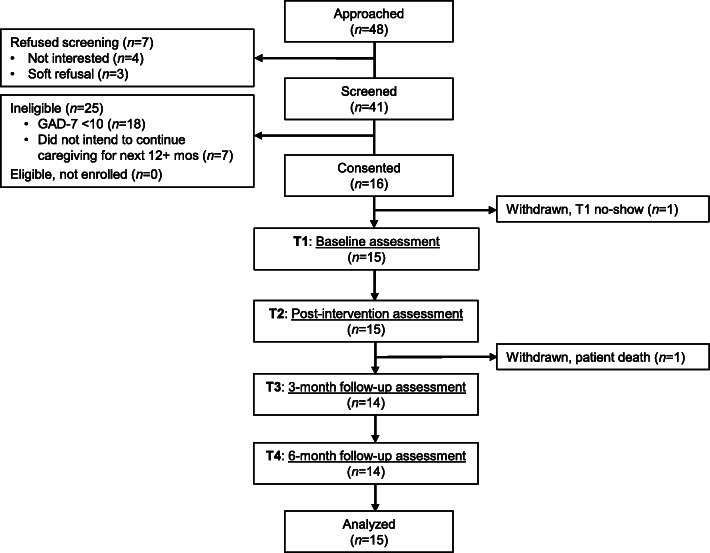
- Of 48 caregivers approached, 41 were screened, 16 were eligible, and all 16 enrolled; 15 completed the study, giving an overall retention rate of 87.5% at T4.
- Adherence and acceptability were very high: 100% of caregivers who began TACTICs completed all 6 sessions, and 93.3% rated their overall satisfaction as “completely satisfied.”
- Anxiety improved substantially: at T2 the reduction was large (SRM 1.42, 95% CI [0.87, 1.97], p < 0.001), and at T3 and T4 improvements remained large and significant (SRM 1.28 and 1.94; p = 0.0003 and p < 0.0001).
- At T4, caregiver psychological suffering and burden also decreased significantly (suffering SRM 0.99, 95% CI [0.41, 1.56], p = 0.0027; burden SRM 0.79, 95% CI [0.21, 1.37], p = 0.0113).
## Methods
- Single-arm pilot study of TACTICs, a 6-week telephone ACT intervention delivered by a non-licensed, bachelor’s-prepared trained interventionist.
- Participants were 15 ADRD caregivers aged ≥21 years with GAD-7 scores ≥ 10; caregivers were recruited in Indiana, USA from primary care, geriatric psychiatry, neurology, community sites, and an Aging Brain Care Program.
- Outcomes were measured by phone at baseline, post-intervention, 3 months, and 6 months; analysis used descriptive statistics, paired t tests, and standardized response means (SRMs) to estimate effects.
## Limitations
- The paper explicitly notes the small sample size and limited power as a limitation.
- The authors state that TACTICs was tested outside traditional care/support systems, and that it is unclear whether other caregiver needs made the intervention more or less effective.
- The paper says future studies should include equal representation across ADRD severity; the sample was mostly caregivers of people with mild-to-moderate/moderate ADRD, which limits generalizability (stated in the paper).
Model-written summary. Check it against the paper before relying on it.
Integrity signals
Registry
Cites
Statistics
Figures
Verification
Claims the paper makes
3 Valid · 2 Not valid · 8 Not checked · 33 Own results and interpretations
At least one cited source doesn’t support this claim or points to a different paper, and none confirmed it — see the verdicts below.
In the paper
“The average fidelity rating across all sessions rated was 98.6% (SD = 0.03), suggesting the interventionist delivered TACTICs in a manner that was highly adherent to the intervention manual.”
§ Feasibility and acceptability of an acceptance and commitment therapy intervention for caregivers of adults with Alzheimer’s disease and related dementias > Methods > Intervention and procedures
What the sources say
- Disputedcites [36] Johns SA Stutz PV Talib TL Cohee AA Beck-Coon KA Brown LF Wilhelm LR Monahan PO LaPradd ML Champion VL Acceptance and commitment therapy for breast cancer survivors with fear of cancer recurrence: a 3-arm pilot randomized controlled trial Cancer 2020 126 1 211 218 31539169 PMC6906228 sourceExperimental — accuracy not yet measured
The Methods > Interventions > Treatment Fidelity passage reports average fidelity ratings of 95.6% for ACT and 93.8% for survivorship education, not 98.6%. It does not identify an intervention called TACTICs or report an SD of 0.03. No page number is available in our copy. (LLM, conf=0.90)
Checked by a reasoning model — may be wrong.
hedged- Asserted: passes — The authors put it forward as true.
- Checkable: passes — It can be checked against evidence.
- Load-bearing: unclear — It is unclear whether the paper’s conclusions depend on it.
- Based: passes — The paper gives a reason why it holds.
- Disputed
The cited sources support only part of this claim — read each source’s verdict below.
In the paper
“Multi-component psychotherapeutic interventions, such as cognitive-behavioral therapy (CBT), have proven moderately effective in targeting caregiver distress and adaptive coping [17, 18].”
§ Feasibility and acceptability of an acceptance and commitment therapy intervention for caregivers of adults with Alzheimer’s disease and related dementias > Background
What the sources say
- Partly supportedcites [17] Kishita N Hammond L Dietrich CM Mioshi E Which interventions work for dementia family carers?: an updated systematic review of randomized controlled trials of carer interventions Int Psychogeriatr 2018 30 11 1679 1696 30017008 sourceExperimental — accuracy not yet measured
The Effects of interventions section reports a moderate effect of CBT-based psychotherapy on depression and a large effect on anxiety among dementia family carers. It does not report improved adaptive coping as an outcome, and the Discussion cautions that substantial heterogeneity may make the effect sizes less robust. Thus, the evidence supports reduced distress but not the full claim that these interventions have proven moderately effective for both targets. (LLM, conf=0.87)
- Partly supportedcites [18] Pinquart M Sörensen S Helping caregivers of persons with dementia: which interventions work and how large are their effects? Int Psychogeriatr 2006 18 4 577 595 16686964 sourceExperimental — accuracy not yet measured
The Results report that CBT improved caregiver burden and depression, with a small-to-moderate effect on burden and a large effect on depression. But the paper treats CBT separately from multicomponent interventions; the Results say multicomponent interventions had no significant effects on most outcomes, and do not establish an improvement in adaptive coping. No page numbers are available in our copy. (LLM, conf=0.88)
boostedstates a cause- Asserted: passes — The authors put it forward as true.
- Checkable: passes — It can be checked against evidence.
- Load-bearing: passes — The paper’s conclusions depend on it.
- Based: passes — The paper gives a reason why it holds.
- Partly supported
The cited sources support only part of this claim — read each source’s verdict below.
In the paper
“ADRD caregivers report higher distress, including symptoms of anxiety and depression [5–9], caregiving burden [10], and existential suffering [11], than caregivers of people with other chronic diseases, such as heart failure or cancer.”
§ Feasibility and acceptability of an acceptance and commitment therapy intervention for caregivers of adults with Alzheimer’s disease and related dementias > Background
What the sources say
- Partly supportedcites [5] Cooper C Balamurali TB Livingston G A systematic review of the prevalence and covariates of anxiety in caregivers of people with dementia Int Psychogeriatr 2007 19 2 175 195 17005068 sourceExperimental — accuracy not yet measured
Cooper et al. (2007) supports the general direction of the claim for anxiety: the Cross-sectional studies section reports that 'CGs have higher anxiety levels than those reported for healthy controls and normal reference values (grade B)' and that 'caregivers for people with dementia are more anxious than caregivers for people who are cognitively intact' (Crespo et al., 2005), and the Prevalence studies section reports more anxiety disorders in caregivers than matched controls (Russo et al., 1995; Dura et al., 1991; Kolanowski et al., 2004). However, the comparator the citing sentence attributes to this source — caregivers of people with other chronic diseases such as heart failure or cancer — is not in our copy; every comparison is against healthy/non-caregiver controls or caregivers of cognitively intact older persons. Depression is also not established as a comparative finding here: the review's scope is anxiety, and depression appears only as a covariate (Sansoni et al., 2004) or comorbidity (81.3% of depressed cases also anxiety cases in Mahoney et al., 2005), with the introduction noting that distress and depressive symptomatology links come from Pinquart and Sorensen (2003), not from this review's own synthesis. (LLM, conf=0.75)
- Not checked — no full text of the sourcecites [6] Crespo M Lopez J Zarit SH Depression and anxiety in primary caregivers: a comparative study of caregivers of demented and nondemented older persons Int J Geriatr Psychiatry 2005 20 6 591 592 15962352 source
- Not checked — no full text of the sourcecites [7] Cuijpers P Depressive disorders in caregivers of dementia patients: a systematic review Aging Ment Health 2005 9 4 325 330 16019288 source
- Not checked — no full text of the sourcecites [8] Joling KJ van Marwijk HW Veldhuijzen AE van der Horst HE Scheltens P Smit F van Hout HP The two-year incidence of depression and anxiety disorders in spousal caregivers of persons with dementia: who is at the greatest risk? Am J Geriatr Psychiatry 2015 23 3 293 303 24935785 source
- Not checked — no full text of the sourcecites [9] Pinquart M Sorensen S Differences between caregivers and noncaregivers in psychological health and physical health: a meta-analysis Psychol Aging 2003 18 2 250 267 12825775 source
- Partly supportedcites [10] Cheng ST Dementia caregiver burden: a research update and critical analysis Curr Psychiatry Rep 2017 19 9 64 28795386 PMC5550537 sourceExperimental — accuracy not yet measured
The Introduction (page unavailable) reports that dementia caregivers were more stressed and had more serious depressive symptoms than non-dementia caregivers. It also reports elevated anxiety symptoms among dementia caregivers, but does not establish that their anxiety is higher than that of caregivers for people with heart failure or cancer. (LLM, conf=0.86)
- Partly supportedcites [11] Schulz R Monin JK Czaja SJ Lingler JH Beach SR Martire LM Dodds A Hebert RS Zdaniuk B Cook TB Measuring the experience and perception of suffering Gerontologist 2010 50 6 774 784 20478899 PMC3003549 sourceExperimental — accuracy not yet measured
In Convergent and Discriminant Validity (page unavailable), caregivers in one Alzheimer’s disease sample rated their care recipients’ suffering higher on all three scales, including existential suffering, than caregivers in the other samples. This concerns caregivers’ ratings of care recipients’ suffering, not caregivers’ own existential distress; the comparison samples did not include heart failure or cancer caregivers. (LLM, conf=0.82)
plainstates an association- Asserted: passes — The authors put it forward as true.
- Checkable: passes — It can be checked against evidence.
- Load-bearing: passes — The paper’s conclusions depend on it.
- Based: passes — The paper gives a reason why it holds.
- Partly supported
The cited sources support only part of this claim — read each source’s verdict below.
In the paper
“Studies have found psychological flexibility to be a significant buffer against psychological distress (i.e., anxiety, depressive symptoms) in family caregivers [55].”
§ Feasibility and acceptability of an acceptance and commitment therapy intervention for caregivers of adults with Alzheimer’s disease and related dementias > Discussion
What the sources say
- Partly supportedcites [55] Jansen JE Haahr UH Lyse HG Pedersen MB Trauelsen AM Simonsen E Psychological flexibility as a buffer against caregiver distress in families with psychosis Front Psychol 2017 8 1625 29046649 PMC5632725 sourceExperimental — accuracy not yet measured
The Abstract and Discussion report a significant association between greater psychological flexibility and lower distress among caregivers of people with first-episode psychosis. However, the Methods measured overall distress with the GHQ-30, not anxiety and depressive symptoms separately; the Discussion also cautions that the cross-sectional design cannot establish a causal buffering effect. (LLM, conf=0.86)
plainstates an association- Asserted: passes — The authors put it forward as true.
- Checkable: passes — It can be checked against evidence.
- Load-bearing: passes — The paper’s conclusions depend on it.
- Based: passes — The paper gives a reason why it holds.
- Partly supported
A result the paper reports from its own data — it cites no other source for it, so there is none to check. The quote shows it is in the paper.
In the paper
“and a medium reduction in caregiver physical suffering that approached statistical significance (SRM 0.50, 95% CI [0.05, 1.05], p = 0.07).”
§ Feasibility and acceptability of an acceptance and commitment therapy intervention for caregivers of adults with Alzheimer’s disease and related dementias > Results > Intervention effects
plainstates a cause- Asserted: passes — The authors put it forward as true.
- Checkable: passes — It can be checked against evidence.
- Load-bearing: unclear — It is unclear whether the paper’s conclusions depend on it.
- Based: passes — The paper gives a reason why it holds.
22 more claims
Create a free account to see all 46 claims and every source verdict.
- It may state two separate claims as one. 15
- Probably not a substantial claim. 4
Claims other papers make about this one
Each is checked against this paper’s own text: does it say what the citing paper says it does?
The source backs part of the claim, not all of it — or backs it for a different population, condition or comparison.
In the citing paper
“Additionally, all TACTICs sessions were audio-recorded and assessed for fidelity and ACT skill level using a standardized fidelity checklist adopted from our previous ACT pilots (Fowler et al., 2021; Johns et al., 2020).”
From Feasibility and acceptability of a telephone-based ACT intervention for caregivers (TACTICs) of adults with Alzheimer's disease and related dementias (ADRD): a randomized pilot during the COVID-19 pandemic. (2025) · cites this paper as Fowler et al., 2021
Experimental — accuracy not yet measuredThe source backs part of the claim, not all of it — or backs it for a different population, condition or comparison.
In the citing paper
“These studies showed how ACT was effective in reducing depressive (15, 43–47), and anxiety symptoms (15, 42, 44, 47).”
From Is acceptance and commitment therapy helpful in reducing anxiety symptomatology in people aged 65 or over? A systematic review (2022) · cites this paper as [42]
Experimental — accuracy not yet measuredThe source backs part of the claim, not all of it — or backs it for a different population, condition or comparison.
In the citing paper
“These studies found promising results, including decreased depressive symptoms, anxiety, stress, and caregiving burden after participants completed ACT sessions, and evidence to support the feasibility and acceptability of ACT sessions delivered by methods other than in-person sessions”
From The feasibility and preliminary effects of a pilot randomized controlled trial: Videoconferencing acceptance and commitment therapy in distressed family caregivers of people with dementia. (2023) · cites this paper as Fowler et al., 2021
Experimental — accuracy not yet measuredThe cited source says what the claim attributes to it.
In the citing paper
“Prior to the COVID-19 pandemic, we conducted a single arm pilot of Telephone Acceptance and Commitment Therapy intervention for ADRD caregivers (TACTICs) and the results were favorable, demonstrating significant reductions in caregiver anxiety after the TACTICs intervention (Fowler et al., 2021).”
From Feasibility and acceptability of a telephone-based ACT intervention for caregivers (TACTICs) of adults with Alzheimer's disease and related dementias (ADRD): a randomized pilot during the COVID-19 pandemic. (2025) · cites this paper as Fowler et al., 2021
The cited source says what the claim attributes to it.
In the citing paper
“Although pilot studies are primarily designed to examine feasibility and implementation, preliminary outcomes and effects were measured and were not as strong as expected based on the results of the initial pilot study (Fowler et al., 2021).”
From Feasibility and acceptability of a telephone-based ACT intervention for caregivers (TACTICs) of adults with Alzheimer's disease and related dementias (ADRD): a randomized pilot during the COVID-19 pandemic. (2025) · cites this paper as Fowler et al., 2021
4 more claims about this paper
Create a free account to see every claim other papers make about this one.
Self-check
Percentages, sums and reported differences re-computed from the paper’s own numbers.
Each contradiction between two passages listed here was confirmed by an independent check.
Rated minor: it would not touch a result — a value no result rests on, a p-value that stays on the same side of the significance level, or a conflict that is clerical, resolved elsewhere in the paper, or outside its own findings.
In the paper
§ Feasibility and acceptability of an acceptance and commitment therapy intervention for caregivers of adults with Alzheimer’s disease and related dementias > Results > Feasibility and acceptability
“Of the 41 caregivers screened for eligibility, 16 (39%) were eligible and all 16 (100%) enrolled in the study.”
§ Feasibility and acceptability of an acceptance and commitment therapy intervention for caregivers of adults with Alzheimer’s disease and related dementias > Abstract > Methods
“ADRD caregivers ≥21 years of age with a Generalized Anxiety Disorder Scale (GAD-7) score ≥ 10 indicative of moderate or higher symptoms of anxiety were enrolled (N = 15).”
Citations
Cites
The PHQ-9: Validity of a brief depression severity measure
Kroenke, K., Spitzer, R. L., & Williams, J. B. W. (2001) · Journal of General Internal Medicine · doi:10.1046/j.1525-1497.2001.016009606.x · Cited by 44,910
A Brief Measure for Assessing Generalized Anxiety Disorder: The GAD-7
Spitzer, R. L., Kroenke, K., Williams, J. B. W., & Löwe, B. (2006) · Archives of Internal Medicine · doi:10.1001/archinte.166.10.1092 · Cited by 31,765 · cited 10×
“If the caregiver was interested, the research assistant administered an eligibility screener, which included the GAD-7.”
BackgroundResultInfluentialYou want to measure coping but your protocol’ too long: Consider the brief cope
Carver, C. S. (1997) · International Journal of Behavioral Medicine · doi:10.1207/s15327558ijbm0401_6 · Cited by 7,361 · cited 1×
“coping strategies used in response to stressors [44].”
BackgroundCaregiving and the stress process: an overview of concepts and their measures
Pearlin, L. I., Mullan, J. T., Semple, S. J., & Skaff, M. M. (1990) · The Gerontologist · doi:10.1093/geront/30.5.583 · Cited by 4,810
Anxiety disorders in primary care: prevalence, impairment, comorbidity, and detection
Kroenke, K., Spitzer, R. L., Williams, J. B. W., Monahan, P. O., & Löwe, B. (2007) · Annals of Internal Medicine · doi:10.7326/0003-4819-146-5-200703060-00004 · Cited by 4,741 · cited 8×
“If the caregiver was interested, the research assistant administered an eligibility screener, which included the GAD-7.”
BackgroundInfluentialBond, F. W., Hayes, S. C., Baer, R. A., Carpenter, K. M., Guenole, N., Orcutt, H. K., Waltz, T., & Zettle, R. D. (2011) · Behavior Therapy · doi:10.1016/j.beth.2011.03.007 · Cited by 3,950 · cited 3×
“AAQ-II: Acceptance and Action Questionnaire; ACT: Acceptance and Commitment Therapy; ADRD: Alzheimer’s Disease and Related Dementias; CI: Confidence interval; GAD-7: General Anxiety Disorder Scale; IRB: Institutional Review Board; PHQ-9: Patient Health Questionnaire; ZBI: Zarit Burden Interview”
MethodPinquart, M., & Sörensen, S. (2003) · Psychology and Aging · doi:10.1037/0882-7974.18.2.250 · Cited by 2,857
2018 Alzheimer's disease facts and figures
Alzheimer's Association (2018) · Alzheimer's & Dementia · doi:10.1016/j.jalz.2018.02.001 · Cited by 1,912
Monitoring Depression Treatment Outcomes With the Patient Health Questionnaire-9
L??we, B., Un??tzer, J., Callahan, C. M., Perkins, A. J., & Kroenke, K. (2004) · Medical Care · doi:10.1097/00005650-200412000-00006 · Cited by 1,354 · cited 1×
“Depressive symptoms were measured with the Patient Health Questionnaire–9 (PHQ-9) that consists of 9 items that assess somatic and non-somatic symptoms of depression [39, 40].”
MethodFamily Caregiving of Persons With Dementia: Prevalence, Health Effects, and Support Strategies
Schulz, R., & Martire, L. M. (2004) · The American Journal of Geriatric Psychiatry · doi:10.1097/00019442-200405000-00002 · Cited by 1,189 · cited 1×
“with Alzheimer’s disease or a related dementia (ADRD) [1], 75% are cared for by family caregivers [2].”
Background
Research works printed but not linked: 2
- Hayes SC Strosahl KD Wilson KG Acceptance and commitment therapy: the process and practice of mindful change 2011 New York Guilford Press
- Cohen J Statistical power analysis for Behavioural sciences 1988 Hillsdale Lawrence Erlbaum
Cited by
Arnold, T., Haubrick, K. K., Klasko-Foster, L. B., Rogers, B. G., Barnett, A., Ramirez- Sanchez, N. A., Bertone, Z., & Gaudiano, B. A. (2022) · Journal of Contextual Behavioral Science · doi:10.1016/j.jcbs.2022.05.005 · Cited by 37
Han, A., Yuen, H. K., & Jenkins, J. (2023) · Journal of Health Psychology · doi:10.1177/13591053221141131 · Cited by 30
“…design studies were conducted in the USA (three studies) and in the UK (one study) that involved six weekly individual telephone-based ACT sessions (Fowler et al., 2021), ten selfguided online ACT sessions plus online dementia education resources (Fauth et al., 2022), eight guided self-help online…”
BackgroundInfluentialAtefi, G. L., de Vugt, M. E., van Knippenberg, R. J. M., Levin, M. E., Verhey, F. R. J., & Bartels, S. L. (2023) · Clinical Psychology Review · doi:10.1016/j.cpr.2023.102341 · Cited by 33
Pinto, C., Geraghty, A. W. A., McLoughlin, C., Pagnini, F., Yardley, L., & Dennison, L. (2022) · Health Psychology Review · doi:10.1080/17437199.2022.2073901 · Cited by 39
“Approaches like Acceptance and Commitment Therapy (ACT) have been proposed as more suitable and acceptable as they focus on accepting distress and fi nding new ways to carry out valued activities (Fowler et al., 2021; Graham et al., 2015).”
Tan, K. P., Ang, J. K., Koh, E. B. Y., Pang, N. T. P., & Mat Saher, Z. (2023) · International Journal of Environmental Research and Public Health · doi:10.3390/ijerph20054232 · Cited by 23
Metadata
- Authors
- Fowler, N. R., Judge, K. S., Lucas, K., Gowan, T., Stutz, P., Shan, M., Wilhelm, L., Parry, T., & Johns, S. A.
- Affiliations
- Regenstrief Institute (US)
- Cleveland State University (US)
- Indiana University Indianapolis (US)
- West Virginia University (US)
- Indiana University – Purdue University Indianapolis (US)
- Corresponding author
- Fowler, Nicole R.
- Venue
- BMC Geriatrics
- Published
- 2021-02-16
- Volume
- 21
- Issue
- 1
- Pages
- 127-127
- ISSN
- 1471-2318 (ISSN-L)
- PMC
- PMC7885205
- OpenAlex
- W3131104043
- Semantic Scholar
- 4360479456dbffacb5fab60bdf2bba2fb472bd3b
- Cited by
- 39
- References
- 51
- Citations by year
- 2026: 4 · 2025: 7 · 2024: 11 · 2023: 10 · 2022: 5 · 2021: 2
- FWCI
- 4.77
- Type
- journal article
- Language
- en
- Open access
- gold
- doi.org
- Licence
- cc-by
- creativecommons.org/licenses/by/4.0/ (tdm)
- creativecommons.org/licenses/by/4.0/ (vor)
- Locations
- BMC Geriatrics (publishedVersion, cc-by)
- PubMed Central (publishedVersion, cc-by)
- PubMed (publishedVersion)
- DOAJ (DOAJ: Directory of Open Access Journals) (submittedVersion, cc-by-sa)
- IUScholarWorks (Indiana University) (submittedVersion, cc-by)
- Purdue University Indianapolis (Indiana University) (submittedVersion, cc-by)
- Topics
- Social Sciences › Psychology › Clinical Psychology › Mindfulness and Compassion Interventions
- Health Sciences › Medicine › Psychiatry and Mental health › Dementia and Cognitive Impairment Research
- Health Sciences › Nursing › Research and Theory › Nursing care and research
- Keywords
- acceptance and commitment therapy, caregiver anxiety, Alzheimer's disease and related dementias, dementia caregivers, telephone-delivered intervention, psychological flexibility, experiential avoidance, caregiver burden, psychological suffering, depressive symptoms, coping strategies, feasibility and acceptability, tactics, caregiver distress, experiential exercises, metaphor, values-based action
- MeSH terms
- Alzheimer Disease, Feasibility Studies, Humans, Quality of Life, Caregivers, Acceptance and Commitment Therapy
About these checks
Registry, retraction, Cites and statistics results are computed, not judged, with one exception: a printed reference that no index lists is read once by a model before it counts as a citation error. Claims are extracted by a model and kept only when their quote appears verbatim in the text; each cited source is then checked, with a model’s help, for whether it says what the claim relies on. Those verdicts can be wrong — read the claim’s quote and the cited source before relying on one.
The claim verdicts this report counts are experimental: their accuracy is not yet measured.
A language model drew the claims from the paper on 2026-10-11, under version 3 of the claim definition (model deepseek-v4.1-flash, prompt extract-v3).
A second model labelled each claim on 2026-10-11 (model jev-1.13-20260917, definition revision gold-guideline-v0.2).
Cited sources are checked with a language model’s help (gpt-6-sol and qwen3.8-omni-flash).
Statistics and arithmetic are recomputed, not judged.
Confidence bands are shown only for fields calibrated on our annotated test set. None is calibrated yet, so no band is shown.
What counts as a claim ›How we measure confidence ›How we check this ›
Are you an author, or do you see a problem with this page? Request a review
Data sources
Bibliographic data: Semantic Scholar, OpenAlex, Crossref.
Contains information from the Semantic Scholar Academic Graph Datasets, made available under the ODC Attribution License (ODC-BY 1.0).
Semantic Scholar’s data is described in: Kinney, R., et al. (2023). The Semantic Scholar Open Data Platform. arXiv:2301.10140.
