

Serial interval and incubation period of COVID-19: a systematic review and meta-analysis
Open accessThe DOI matches its Crossref record; 37 of the 39 references it cites were found in a registry or an index.
Abstract
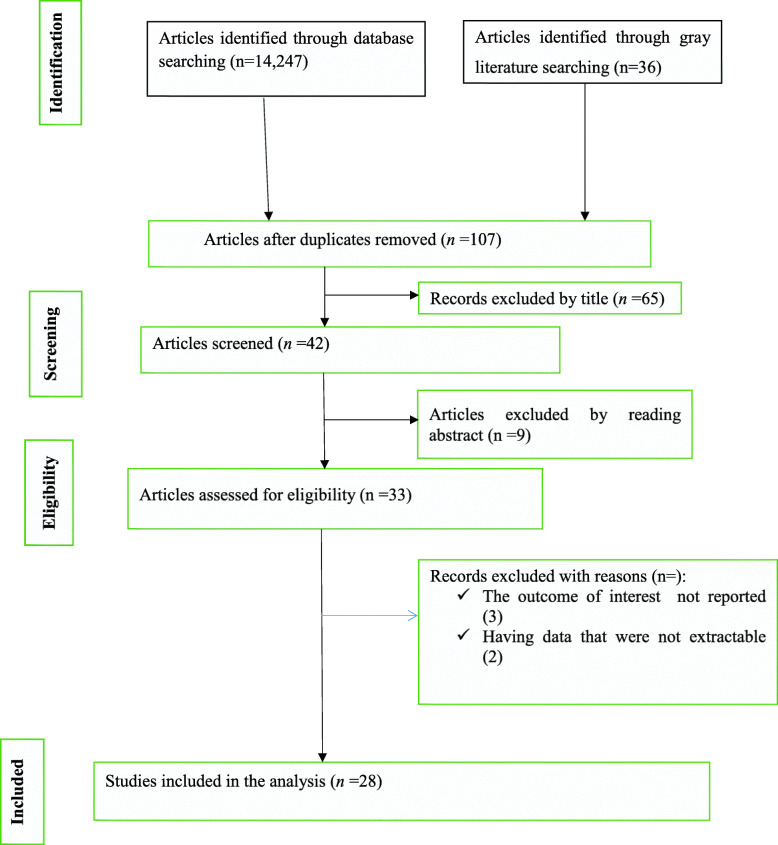
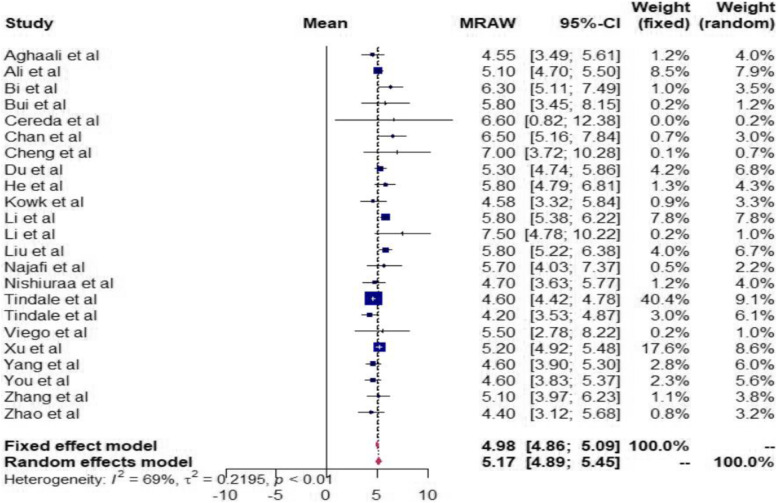
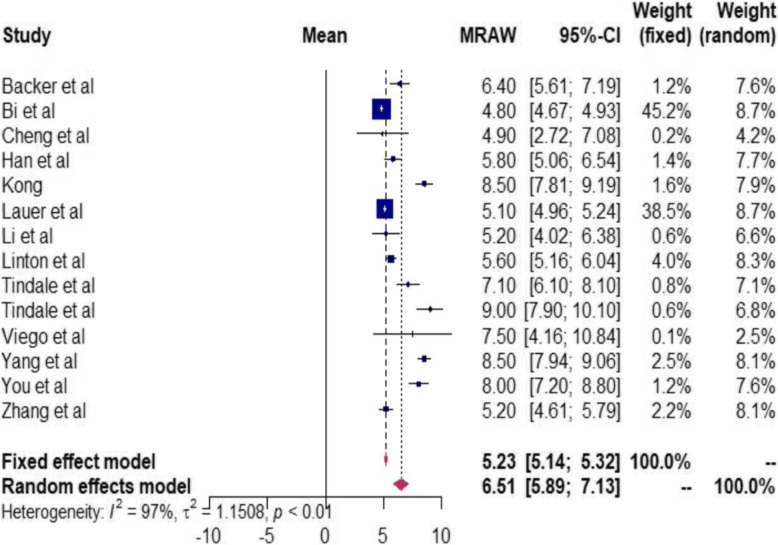
Background: Understanding the epidemiological parameters that determine the transmission dynamics of COVID-19 is essential for public health intervention. Globally, a number of studies were conducted to estimate the average serial interval and incubation period of COVID-19. Combining findings of existing studies that estimate the average serial interval and incubation period of COVID-19 significantly improves the quality of evidence. Hence, this study aimed to determine the overall average serial interval and incubation period of COVID-19. Methods: We followed the PRISMA checklist to present this study. A comprehensive search strategy was carried out from international electronic databases (Google Scholar, PubMed, Science Direct, Web of Science, CINAHL, and Cochrane Library) by two experienced reviewers (MAA and DBK) authors between the 1st of June and the 31st of July 2020. All observational studies either reporting the serial interval or incubation period in persons diagnosed with COVID-19 were included in this study. Heterogeneity across studies was assessed using the I 2 and Higgins test. The NOS adapted for cross-sectional studies was used to evaluate the quality of studies. A random effect Meta-analysis was employed to determine the pooled estimate with 95% (CI). Microsoft Excel was used for data extraction and R software was used for analysis. Results: We combined a total of 23 studies to estimate the overall mean serial interval of COVID-19. The mean serial interval of COVID-19 ranged from 4. 2 to 7.5 days. Our meta-analysis showed that the weighted pooled mean serial interval of COVID-19 was 5.2 (95%CI: 4.9–5.5) days. Additionally, to pool the mean incubation period of COVID-19, we included 14 articles. The mean incubation period of COVID-19 also ranged from 4.8 to 9 days. Accordingly, the weighted pooled mean incubation period of COVID-19 was 6.5 (95%CI: 5.9–7.1) days. Conclusions: This systematic review and meta-analysis showed that the weighted pooled mean serial interval and incubation period of COVID-19 were 5.2, and 6.5 days, respectively. In this study, the average serial interval of COVID-19 is shorter than the average incubation period, which suggests that substantial numbers of COVID-19 cases will be attributed to presymptomatic transmission.
Overview
The claims and statistics of this paper haven’t been checked yet.
Free: it reads the open-access text and checks the first 5 claims that cite a source we can check. Create a free account to check every claim.
Integrity signals
Registry
Cites
Statistics
Figures
Verification
Claims the paper makes
The claims and statistics of this paper haven’t been checked yet.
Free: it reads the open-access text and checks the first 5 claims that cite a source we can check. Create a free account to check every claim.
Claims other papers make about this one
Each is checked against this paper’s own text: does it say what the citing paper says it does?
The cited source says what the claim attributes to it.
In the citing paper
“The mean incubation period was better characterised, enabling a meta-analysis yielding a pooled random effects model estimate of 5⋅42 days (95% CI 4⋅75-6⋅09; appendix 1 p 65), similar to estimates for SARS-CoV-2.123”
From Severe acute respiratory syndrome (SARS) mathematical models and disease parameters: a systematic review (2025) · cites this paper as [123]
Self-check
Percentages, sums and reported differences re-computed from the paper’s own numbers.
The self-check needs the paper’s full text.
Citations
Cites
Preferred Reporting Items for Systematic Reviews and Meta-Analyses: the PRISMA statement
Moher, D., Liberati, A., Tetzlaff, J., Altman, D. G., & for the PRISMA Group (2009) · BMJ · doi:10.1136/bmj.b2535 · Cited by 83,823
Preferred Reporting Items for Systematic Reviews and Meta-Analyses: The PRISMA Statement
Moher, D., Liberati, A., Tetzlaff, J., Altman, D. G., & The PRISMA Group (2009) · PLoS Medicine · doi:10.1371/journal.pmed.1000097 · Cited by 64,042
Preferred reporting items for systematic reviews and meta-analyses: the PRISMA Statement.
(2009) · PubMed Central · Cited by 44,859
Wang, G., Ma, R., Qiao, G., Wada, K., Aizawa, Y., & Satoh, T. (2015) · Integrative Medicine International · doi:10.1159/000368408 · Cited by 18,657
Early transmission dynamics in Wuhan, China, of novel coronavirus-infected pneumonia
Li, Q., Guan, X., Wu, P., Wang, X., Zhou, L., Tong, Y., Ren, R., Leung, K. S. M., Lau, E. H. Y., Wong, J. Y., et al. (2020) · New England Journal of Medicine · doi:10.1056/nejmoa2001316 · Cited by 16,575 · cited 2×
“Among those, the minimum sample size was 10 [17] and the maximum was 183 [20].”
BackgroundWan, X., Wang, W., Liu, J., & Tong, T. (2014) · BMC Medical Research Methodology · doi:10.1186/1471-2288-14-135 · Cited by 11,735 · cited 1×
“In order to pool the results of included studies in a consistent format, we estimated the sample mean and standard deviation for studies that report median and interquartile range [14].”
BackgroundPharmacologic Treatments for Coronavirus Disease 2019 (COVID-19): A Review
Sanders, J. M., Monogue, M. L., Jodlowski, T. Z., & Cutrell, J. B. (2020) · JAMA · doi:10.1001/jama.2020.6019 · Cited by 2,347 · cited 1×
“Effective treatment to block the spread of COVID19 is not developed yet, hence countries implement non-treatment intervention such as social distancing, isolation, face mask and quarantine to reduce its rapid transmission [4, 5].”
BackgroundBi, Q., Wu, Y., Mei, S., Ye, C., Zou, X., Zhang, Z., Liu, X., Wei, L., Truelove, S. A., Zhang, T., et al. (2020) · The Lancet Infectious Diseases · doi:10.1016/s1473-3099(20)30287-5 · Cited by 1,958 · cited 1×
“Among those, the minimum sample size was 10 [17] and the maximum was 183 [20].”
BackgroundTransmission Dynamics and Control of Severe Acute Respiratory Syndrome
Lipsitch, M., Cohen, T., Cooper, B., Robins, J. M., Ma, S., James, L., Gopalakrishna, G., Chew, S. K., Tan, C. C., Samore, M. H., et al. (2003) · Science · doi:10.1126/science.1086616 · Cited by 1,485 · cited 2×
“Tindale et al Singapore January 19 to February 26,2020 93 4.6 0.9 2.7–6.4 17.”
ResultInfluentialCOVID-19, SARS and MERS: are they closely related?
Petrosillo, N., Viceconte, G., Ergonul, O., Ippolito, G., & Petersen, E. (2020) · Clinical Microbiology and Infection · doi:10.1016/j.cmi.2020.03.026 · Cited by 1,108
Research works printed but not linked: 2
- WHO Media briefing on COVID-19 2020
- Newcastle-Ottawa Scale customized for cross-sectional studies In. available from https://static-content.springer.com/esm/.../12889_2012_5111_MOESM3_ESM.doc. Accessed 24 July 2020.
Cited by
Items 301–337 of 337
Nikiforuk, A. M., Kuchinski, K. S., Short, K., Roman, S., Irvine, M. A., Prystajecky, N., Jassem, A. N., Patrick, D. M., & Sekirov, I. (2024) · Figshare · doi:10.6084/m9.figshare.26685768
Cohen, C., Kleynhans, J., von Gottberg, A., McMorrow, M. L., Wolter, N., Bhiman, J. N., Moyes, J., du Plessis, M., Carrim, M., Buys, A., et al. (2024) · Figshare · doi:10.6084/m9.figshare.26696319
Madewell, Z. J., Yang, Y., M, L. I., Halloran, M. E., Vespignani, A., & Dean, N. E. (2023) · Figshare · doi:10.6084/m9.figshare.23583615
Additional file 1 of Predicting subnational incidence of COVID-19 cases and deaths in EU countries
Robert, A., Chapman, L. A. C., Grah, R., Niehus, R., Sandmann, F., Prasse, B., Funk, S., & Kucharski, A. J. (2024) · Figshare · doi:10.6084/m9.figshare.26680978
Pung, R., Clapham, H., Russell, T., Lee, V. J., & Kucharski, A. J. (2023) · Figshare · doi:10.6084/m9.figshare.22624679
Xu, X., Wu, Y., Kummer, A. G., Zhao, Y., Hu, Z., Wang, Y., Liu, H., Ajelli, M., & Yu, H. (2023) · Figshare · doi:10.6084/m9.figshare.24223741
Nikiforuk, A. M. (2024) · cIRcle (University of British Columbia) · doi:10.14288/1.0438747
Abeysuriya, R., Delport, D., Stuart, R. M., Sacks‐Davis, R., Kerr, C. C., Mistry, D., Klein, D. J., Hellard, M., & Scott, N. (2022) · Figshare · doi:10.6084/m9.figshare.19321175
Yu, G., Garee, M. J., Ventresca, M., & Yih, Y. (2024) · Figshare · doi:10.6084/m9.figshare.25449051
Neuberger, F. S., Grgic, M., Buchholz, U., Maly-Motta, H. L., Fackler, S., Lehfeld, A.-S., Haas, W., Kalicki, B., & Kuger, S. (2022) · Figshare · doi:10.6084/m9.figshare.21582682
Kim, H. K., Min, K.-D., & Cho, S.-I. (2023) · Figshare · doi:10.6084/m9.figshare.24431928
Infectious Disease Surveillance and Control for Pandemic Prevention, Preparedness, and Response
Cohen, B. L. M. (2024) · Digital Access to Scholarship at Harvard (DASH) (Harvard University)
The uncertainty in effective reproduction number estimation from heterogeneous case reporting
Wang, L., Ni, S., & Yu, S. (2026) · Journal of Safety Science and Resilience · doi:10.1016/j.jnlssr.2026.100289
Bayou, B., Sisay, A., Davids, E. L., Yalew, A., & Setswe, G. (2026) · PLoS ONE · doi:10.1371/journal.pone.0330581
Lorenzo, F., Paul, R., Monteserin, J., Masciotra, N., Mazzeo, E., Wainmayer, I., Pérez‐Lago, L., Matteo, M. J., Gamberale, A., Fernández, H. F., et al. (2026) · medRxiv · doi:10.64898/2026.01.27.26344616
Digital Adherence Support for Tuberculosis Treatment: A Multicentre Randomized Trial in KenyaPreprint
Yoeli, E., Rathauser, J., Nyakan, E., Boutilier, J. J., Campbell, J. R., Chilo, M., Irungu, L. M., Jónasson, J. O., Kimenye, M. K., Muchiri, F. K., et al. (2026) · medRxiv · doi:10.64898/2026.02.11.26346015
Amon, D., Juma, B. W., Muriuki, J. K., Ochieng, C., Koech, N. C., Kikwai, G. K., Mwasi, L., Ochieng, M., Ngugi, C. W., Davis, E. H., et al. (2026) · Archives of Virology · doi:10.1007/s00705-026-06729-8
Mbogo, L., Boyce, C. L., Sambai, B., Hawes, S. E., Guthrie, B. L., Min, W. S. D., Kimani, D. E., Adhanja, V., Chohan, B. H., Smith, R. A., et al. (2026) · medRxiv · doi:10.64898/2026.02.26.26347230
Guerrero-Toapanta, F., Tapia, J. H., Godoy-Miketta, A., Herrera-Parra, Y. D. C., Cando, F. M. M., Montalvo, G. R. G., Vinueza-Rivadeneira, J., López-Altamirano, J., Ramos-Tituaña, E., & Cruz-Betancourt, C. (2026) · Bionatura journal : · doi:10.70099/bj/2026.03.01.11
Comparative transcriptomic profiling of pyrazinamide resistance in Mycobacterium tuberculosis
Rajendran, A., Refaya, A. K., & Palaniyandi, K. (2026) · Journal of Applied Microbiology · doi:10.1093/jambio/lxag064
Development and analysis of SARS-CoV-2 spike receptor binding domain-targeting aptamers
Chan, R. (2025) · Mspace (University of Manitoba)
Estimation of serial interval distribution based on integration of genomic and non-genomic data
Mobarakeh, N. S. (n.d.) · Summit (Simon Fraser University)
Chen, T., Li, J., Chen, B., Zhao, Y., Lin, Y. H., Peng, Y., Zhang, Y., Wan, Y., Pan, J., Pan, X., et al. (2026) · Research Square · doi:10.21203/rs.3.rs-9168824/v1
Ripoll, J., & Saldaña, J. (2026) · Infectious Disease Modelling · doi:10.1016/j.idm.2026.09.003 · Cited by 2
“…et al., 2014). b (Alimohamadi et al., 2020; McEvoy et al., 2021), periods (Lauer et al., 2020; Byrne et al., 2020; Harrison et al., 2024), serial: (Alene et al., 2021; Griffin et al., 2020; Madewell et al., 2023). c (Yaari et al., 2016; Shaikh et al., 2023), periods: (WHO, 2025b; Estivariz et…”
Using Animal Models to Inform Pandemic to Endemic Transition of COVID-19 in Humans
Mullin, S., Compton, S. R., Ibemgbo, S., & Zeiß, C. (2026) · Sustainable development goals series · doi:10.1007/978-3-032-06125-6_2
Decoding Immune Reconstitution Failure in People Living with HIV through Single-cell GenomicsPreprint
Wang, Y., Yang, S., Yuan, Y., Zhu, M., Chen, J., Bai, Y., Duan, S., Shi, X., Lu, T., Yang, Z., et al. (2026) · bioRxiv (Cold Spring Harbor Laboratory) · doi:10.64898/2026.05.21.726797
Who infects whom in an epidemic?
Zúñiga-Macías, R., & Barradas, I. (2026) · Acta Biotheoretica · doi:10.1007/s10441-026-09531-w
Nwojiji, E. C., Nwambeke, N. O., Shih, P., Chukwunenye, C. U., Odeh, E. C., Ekuma, M. I., Azuogu, B. N., Iroezindu, M. O., Liesenborghs, L., & Dijck, C. V. (2026) · medRxiv · doi:10.64898/2026.07.02.26357189
Otim, P., Bongomin, F., & Ochola, E. (2026) · medRxiv · doi:10.64898/2026.08.04.26359659
Covid-19 and beyond: lessons learned in pandemic prevention, rapid diagnosis, and patient management
P, P. P. (2026) · Journal of Prevention Diagnosis and Management of Human Diseases · doi:10.55529/jpdmhd.61.52.62
Noninvasive detection of bacterial biofilms using an insect olfactory brain-based gas sensor
Parnas, M., McLane-Svoboda, A. K., Shahab, M., Stout, C., McLane-Svoboda, S. B., Cox, E., Vaske, M., Hardy, J. W., & Saha, D. (2026) · Communications Biology · doi:10.1038/s42003-026-10943-0 · Cited by 2
Estimating Effective Reproductive Number of COVID-19 in Shiraz, Iran, from April to October in 2021
Taherian, M. R., Khodakarim, S., Majd, H. A., & Alipour, A. (2023) · Archives of Advances in Biosciences · doi:10.22037/aab.v14i1.39403
IQC: A Novel Criterion for Assessing Feature Selection Stability in High-Dimensional AnalysesPreprint
Moxley, T. A., & Ridenhour, B. J. (2026) · bioRxiv (Cold Spring Harbor Laboratory) · doi:10.64898/2026.09.26.754480
Arcos-Jiménez, J. C. D., Quintero-Salgado, E., Robles-Martínez, A. K., Carrillo-Quintanar, J. L., Vera-Cuevas, V. C., Martínez-Ayala, P., Mendoza-Mújica, C., Gomez-Abundis, G. F., Ambriz-Alarcón, M. A., Rubio-Mora, B. R., et al. (2026) · Frontiers in Public Health · doi:10.3389/fpubh.2026.1967103
“The reference outcome is also a smoothed reproduction-number estimate rather than notified cases (27, 28, 58, 59).”
Emmanuel, E. G., Khamis, A., Michael, E., Muhizi, D., Thomas, J. J., Okamo, B. C., Mkassy, F. I., Konje, E. T., Silago, V., Mushi, M. F., et al. (2026) · PLOS Global Public Health · doi:10.1371/journal.pgph.0005638 · Cited by 1
Practical Machine Learning Approaches for Forecasting Respiratory Infectious Diseases in Korea
Ha, J., Chu, S., Park, J., Cho, S., Chun, A. Y., & Min, K. (2026) · Journal of Korean Medical Science · doi:10.3346/jkms.2026.41.e336
Oliverio, C. L., Meo, A. M., Chen, S. H., & Williams, G. J. (2026) · bioRxiv (Cold Spring Harbor Laboratory) · doi:10.64898/2026.10.16.759199
Metadata
- Authors
- Alene, M., Yismaw, L., Assemie, M. A., Ketema, D. B., Gietaneh, W., & Birhan, T. Y.
- Affiliations
- Debre Markos University (ET)
- University of Gondar (ET)
- Corresponding author
- Birhan, Tilahun Yemanu
- ORCID
- Venue
- BMC Infectious Diseases
- Published
- 2021-03-11
- Volume
- 21
- Issue
- 1
- Pages
- 257-257
- ISSN
- 1471-2334 (ISSN-L)
- PMC
- PMC7948654
- OpenAlex
- W3134238461
- Semantic Scholar
- 793e6a39b41863f36dc1112c766c637ddd3a845c
- Cited by
- 354
- References
- 36
- Citations by year
- 2026: 30 · 2025: 44 · 2024: 48 · 2023: 81 · 2022: 110 · 2021: 41
- FWCI
- 6.98
- Type
- journal article
- Language
- en
- Open access
- gold
- doi.org
- Licence
- cc-by
- creativecommons.org/licenses/by/4.0/ (tdm)
- creativecommons.org/licenses/by/4.0/ (vor)
- Locations
- BMC Infectious Diseases (publishedVersion, cc-by)
- PubMed Central (publishedVersion, cc-by)
- PubMed (publishedVersion)
- DOAJ (DOAJ: Directory of Open Access Journals) (submittedVersion, cc-by-sa)
- Topics
- Physical Sciences › Mathematics › Modeling and Simulation › COVID-19 epidemiological studies
- Health Sciences › Medicine › Infectious Diseases › SARS-CoV-2 and COVID-19 Research
- Health Sciences › Medicine › Infectious Diseases › COVID-19 Clinical Research Studies
- Keywords
- COVID-19 pandemic, serial interval, incubation period, pre-symptomatic transmission, transmission dynamics, SARS-CoV-2
- MeSH terms
- COVID-19, SARS-CoV-2, Cross-Sectional Studies, Humans, Infectious Disease Incubation Period, Asymptomatic Infections
About these checks
Registry, retraction, Cites and statistics results are computed, not judged, with one exception: a printed reference that no index lists is read once by a model before it counts as a citation error. Claims are extracted by a model and kept only when their quote appears verbatim in the text; each cited source is then checked, with a model’s help, for whether it says what the claim relies on. Those verdicts can be wrong — read the claim’s quote and the cited source before relying on one.
Statistics and arithmetic are recomputed, not judged.
Confidence bands are shown only for fields calibrated on our annotated test set. None is calibrated yet, so no band is shown.
What counts as a claim ›How we measure confidence ›How we check this ›
Are you an author, or do you see a problem with this page? Request a review
Data sources
Bibliographic data: Semantic Scholar, OpenAlex, Crossref.
Contains information from the Semantic Scholar Academic Graph Datasets, made available under the ODC Attribution License (ODC-BY 1.0).
Semantic Scholar’s data is described in: Kinney, R., et al. (2023). The Semantic Scholar Open Data Platform. arXiv:2301.10140.
