

Associations of maternal pre-pregnancy BMI and gestational weight gain with the risks of adverse pregnancy outcomes in Chinese women with gestational diabetes mellitus
Open accessThe DOI matches its Crossref record; 50 of the 50 references it cites were found in a registry or an index; 17 of the 28 sources its claims cite were checked for support.
Abstract
Study of pre-pregnancy BMI and gestational weight gain in women with gestational diabetes and associations with adverse pregnancy outcomes.
Overview
CoChat Summary
TL;DR
In 764 Chinese women with gestational diabetes mellitus, maternal pre-pregnancy overweight/obesity and gestational weight gain outside the 2009 IOM recommendations were associated with adverse pregnancy outcomes. The combination of overweight/obesity and excessive GWG conferred the greatest risk of any pregnancy complication.
Key findings
- Compared with normal weight, pre-pregnancy overweight/obesity was associated with higher odds of pregnancy-induced hypertension (aOR 2.828, 95% CI 1.382–5.787), cesarean delivery (aOR 2.466, 95% CI 1.694–3.590), preterm delivery (aOR 2.466, 95% CI 1.233–4.854), LGA (aOR 1.664, 95% CI 1.120–2.472), macrosomia (aOR 2.682, 95% CI 1.511–4.760), and any pregnancy complication (aOR 2.766, 95% CI 1.840–4.158).
- Inadequate GWG was associated with lower odds of PIH (aOR 0.215, 95% CI 0.055–0.835), cesarean delivery (aOR 0.612, 95% CI 0.421–0.889), and any pregnancy complication (aOR 0.628, 95% CI 0.435–0.907), but higher odds of preterm birth (aOR 2.261, 95% CI 1.089–4.692).
- Excessive GWG was associated with higher odds of LGA (aOR 1.929, 95% CI 1.272–2.923), macrosomia (aOR 2.753, 95% CI 1.519–4.989), and any pregnancy complication (aOR 1.548, 95% CI 1.006–2.382).
- Compared with normal-weight mothers with adequate GWG, overweight/obese mothers with excessive GWG had the highest risk of any pregnancy complication (aOR 3.064, 95% CI 1.636–5.739), as well as higher risks of PIH, cesarean delivery, preterm delivery, LGA, and macrosomia.
Methods
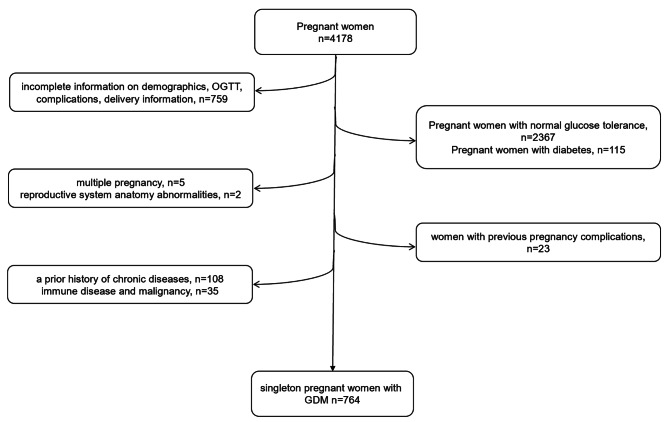
- Retrospective cohort study of 764 singleton pregnant women diagnosed with GDM at Shanghai Sixth People’s Hospital Affiliated to Shanghai Jiao Tong University School of Medicine, continuously observed from January to December 2016.
- Women were stratified by pre-pregnancy BMI using Chinese adult standards: underweight (<18.5 kg/m²), normal weight (18.5–23.9 kg/m²), and overweight/obesity (≥24 kg/m²); and by 2009 IOM GWG categories: inadequate, adequate, or excessive.
- Univariate and multivariate logistic regression estimated odds ratios for adverse pregnancy outcomes, adjusted for maternal age, primiparity, gestational weeks, GWG, fasting blood glucose, and implementation of doctors’ advice; neonatal outcome models were also adjusted for PIH and preeclampsia.
Limitations
- The authors state participants were Chinese Han pregnant women, so findings may not generalize to other races or nationalities.
- The authors state they lacked complete data on demographic characteristics such as education and occupation, and lifestyle factors such as smoking, drinking, and physical activity during pregnancy; they used implementation of doctors’ advice as a partial proxy.
- The authors state subgroup analysis by GWG was not conducted in the underweight group because of its small sample size, and causality could not be established because of the retrospective design.
Model-written summary. Check it against the paper before relying on it.
Integrity signals
Registry
Cites
Statistics
Figures
Verification
Claims the paper makes
8 Valid · 1 Not valid · 4 Not checked · 35 Own results and interpretations
A result the paper reports from its own data — it cites no other source for it, so there is none to check. The quote shows it is in the paper.
In the paper
“our present study did not observe an association between gestational hypertension and EGWG in GDM women.”
§ Associations of maternal pre-pregnancy BMI and gestational weight gain with the risks of adverse pregnancy outcomes in Chinese women with gestational diabetes mellitus > Discussion
plain- Asserted: passes — The authors put it forward as true.
- Checkable: passes — It can be checked against evidence.
- Load-bearing: passes — The paper’s conclusions depend on it.
- Based: passes — The paper gives a reason why it holds.
A result the paper reports from its own data — it cites no other source for it, so there is none to check. The quote shows it is in the paper.
In the paper
“any pregnancy complication (aOR 2.766, 95%CI 1.840–4.158) compared with healthy weight.”
- Also stated in: § Maternal ppBMI status and risks of adverse pregnancy outcomes in GDM women · plain
“overweight/obesity mothers had 2.766-higher risk of any pregnancy complication even after multivariable adjustments.”
§ Associations of maternal pre-pregnancy BMI and gestational weight gain with the risks of adverse pregnancy outcomes in Chinese women with gestational diabetes mellitus > Abstract > Results
plainstates an association- Asserted: passes — The authors put it forward as true.
- Checkable: passes — It can be checked against evidence.
- Load-bearing: passes — The paper’s conclusions depend on it.
- Based: passes — The paper gives a reason why it holds.
- Also stated in: § Maternal ppBMI status and risks of adverse pregnancy outcomes in GDM women · plain
A result the paper reports from its own data — it cites no other source for it, so there is none to check. The quote shows it is in the paper.
In the paper
“Interestingly, normal weight mothers with iGWG had obviously lower risks of PIH (aOR 0.086, 95%CI 0.009–0.812) and preeclampsia (aOR 0.094, 95%CI 0.009–0.999).”
§ Associations of maternal pre-pregnancy BMI and gestational weight gain with the risks of adverse pregnancy outcomes in Chinese women with gestational diabetes mellitus > Results > Maternal ppBMI and GWG status and risks of adverse pregnancy outcomes in GDM women
boostedstates an association- Asserted: passes — The authors put it forward as true.
- Checkable: passes — It can be checked against evidence.
- Load-bearing: passes — The paper’s conclusions depend on it.
- Based: passes — The paper gives a reason why it holds.
A result the paper reports from its own data — it cites no other source for it, so there is none to check. The quote shows it is in the paper.
In the paper
“preterm birth (aOR 2.261, 95%CI 1.089–4.692)”
- Also stated in: § Maternal GWG and risks of adverse pregnancy outcomes in GDM women · plain
“preterm birth (aOR 2.261, 95%CI 1.089–4.692)”
§ Associations of maternal pre-pregnancy BMI and gestational weight gain with the risks of adverse pregnancy outcomes in Chinese women with gestational diabetes mellitus > Abstract > Results
plainstates an association- Asserted: passes — The authors put it forward as true.
- Checkable: passes — It can be checked against evidence.
- Load-bearing: passes — The paper’s conclusions depend on it.
- Based: passes — The paper gives a reason why it holds.
- Also stated in: § Maternal GWG and risks of adverse pregnancy outcomes in GDM women · plain
A result the paper reports from its own data — it cites no other source for it, so there is none to check. The quote shows it is in the paper.
In the paper
“preterm delivery (aOR 2.466, 95%CI 1.233–4.854)”
- Also stated in: § Maternal ppBMI status and risks of adverse pregnancy outcomes in GDM women · plain
“preterm delivery (aOR 2.466, 95%CI 1.233–4.854)”
§ Associations of maternal pre-pregnancy BMI and gestational weight gain with the risks of adverse pregnancy outcomes in Chinese women with gestational diabetes mellitus > Abstract > Results
plainstates an association- Asserted: passes — The authors put it forward as true.
- Checkable: passes — It can be checked against evidence.
- Load-bearing: passes — The paper’s conclusions depend on it.
- Based: passes — The paper gives a reason why it holds.
- Also stated in: § Maternal ppBMI status and risks of adverse pregnancy outcomes in GDM women · plain
24 more claims
Create a free account to see all 48 claims and to verify the 2 references still open.
- Probably not a substantial claim. 16
- It may state two separate claims as one. 5
- The quote only partly states this claim. 1
Citations
Cites
Prevalence and Trends in Obesity Among US Adults, 1999-2008
Flegal, K. M. (2010) · JAMA · doi:10.1001/jama.2009.2014 · Cited by 7,580 · cited 1×
“5%, respectively) [15, 16], while these figures were lower in China (27.”
BackgroundInternational Association of Diabetes and Pregnancy Study Groups Consensus Panel (2010) · Diabetes Care · doi:10.2337/dc09-1848 · Cited by 5,390
Standards of medical care in diabetes—2014
American Diabetes Association (2014) · Diabetes Care · doi:10.2337/dc14-s014 · Cited by 4,572
Association of Gestational Weight Gain With Adverse Maternal and Infant Outcomes
LifeCycle Project-Maternal Obesity and Childhood Outcomes Study Group, Voerman, E., Santos, S., Inskip, H., Amiano, P., Barros, H., Charles, M.-A., Chatzi, L., Chrousos, G. P., Corpeleijn, E., et al. (2019) · JAMA · doi:10.1001/jama.2019.3820 · Cited by 630
Santos, S., Voerman, E., Amiano, P., Barros, H., Beilin, L., Bergström, A., Charles, M., Chatzi, L., Chevrier, C., Chrousos, G., et al. (2019) · BJOG: An International Journal of Obstetrics & Gynaecology · doi:10.1111/1471-0528.15661 · Cited by 591
Gestational Weight Gain and Risk of Gestational Diabetes Mellitus
Hedderson, M. M., Gunderson, E. P., & Ferrara, A. (2010) · Obstetrics & Gynecology · doi:10.1097/aog.0b013e3181cfce4f · Cited by 568
Effect of BMI on Lifetime Risk for Diabetes in the U.S.
Narayan, K. M. V., Boyle, J. P., Thompson, T. J., Gregg, E. W., & Williamson, D. F. (2007) · Diabetes Care · doi:10.2337/dc06-2544 · Cited by 510
Leunissen, R. W. J. (2009) · JAMA · doi:10.1001/jama.2009.761 · Cited by 507
Risk factors and outcomes of maternal obesity and excessive weight gain during pregnancy
Gaillard, R., Durmuş, B., Hofman, A., Mackenbach, J. P., Steegers, E. A. P., & Jaddoe, V. W. V. (2013) · Obesity · doi:10.1002/oby.20088 · Cited by 490
Kominiarek, M. A., & Peaceman, A. M. (2017) · American Journal of Obstetrics and Gynecology · doi:10.1016/j.ajog.2017.05.040 · Cited by 421
Maternal Prepregnancy Body Mass Index and Gestational Weight Gain on Pregnancy Outcomes
Li, N., Liu, E., Guo, J., Pan, L., Li, B., Wang, P., Liu, J., Wang, Y., Liu, G., Baccarelli, A. A., et al. (2013) · PLoS ONE · doi:10.1371/journal.pone.0082310 · Cited by 356 · cited 1×
“In China, overweight/obese is common in 10–24% of pregnant women while almost 11–13% pregnant women were underweight [2, 3].”
BackgroundMaternal obesity during pregnancy and cardiovascular development and disease in the offspring
Gaillard, R. (2015) · European Journal of Epidemiology · doi:10.1007/s10654-015-0085-7 · Cited by 322 · cited 1×
“PpBMI reflects the nutritional conditions of pregnant women before conception, while GWG stands for the nutritional status of pregnant women during pregnancy [45, 46].”
BackgroundSun, Y., Shen, Z., Zhan, Y., Wang, Y., Ma, S., Zhang, S., Liu, J., Wu, S., Feng, Y., Chen, Y., et al. (2020) · BMC Pregnancy and Childbirth · doi:10.1186/s12884-020-03071-y · Cited by 319 · cited 1×
“In addition, most of the current evidences displayed that inadequate and excessive GWG were related to poor pregnancy outcomes for non-diabetic women in Western or high-income countries [9, 19, 20], there is limited information regarding the impacts of the revised IOM’s GWG targets on pregnancy outcomes in Asian women…”
BackgroundSelf-citation[Chinese neonatal birth weight curve for different gestational age].
Zhu, L., Zhang, R., Zhang, S., Shi, W., Yan, W., Wang, X., Lyu, Q., Liu, L., Zhou, Q., Qiu, Q., et al. (2015) · PubMed · Cited by 316
Self-citationPercentage of Gestational Diabetes Mellitus Attributable to Overweight and Obesity
Kim, S. Y., England, L., Wilson, H. G., Bish, C., Satten, G. A., & Dietz, P. (2010) · American Journal of Public Health · doi:10.2105/ajph.2009.172890 · Cited by 302
Effect of prepregnancy body mass index categories on obstetrical and neonatal outcomes
Abenhaim, H. A., Kinch, R. A., Morin, L., Benjamin, A., & Usher, R. (2006) · Archives of Gynecology and Obstetrics · doi:10.1007/s00404-006-0219-y · Cited by 285
Severe obesity, gestational weight gain, and adverse birth outcomes
Bodnar, L. M., Siega-Riz, A. M., Simhan, H. N., Himes, K. P., & Abrams, B. (2010) · The American Journal of Clinical Nutrition · doi:10.3945/ajcn.2009.29008 · Cited by 270
Nutrition during pregnancy : part I, weight gain : part II, nutrient supplements
Pregnancy, N. S. D. (1990) · National Academies Press eBooks · Cited by 260
Margerison Zilko, C. E., Rehkopf, D., & Abrams, B. (2010) · American Journal of Obstetrics and Gynecology · doi:10.1016/j.ajog.2009.12.007 · Cited by 245
Alberico, S., Montico, M., Barresi, V., Monasta, L., Businelli, C., Soini, V., Erenbourg, A., Ronfani, L., Maso, G., & for the Multicentre Study Group on Mode of Delivery in Friuli Venezia Giulia (2014) · BMC Pregnancy and Childbirth · doi:10.1186/1471-2393-14-23 · Cited by 222
Lower BMI cutoffs to define overweight and obesity in China
He, W., Li, Q., Yang, M., Jiao, J., Ma, X., Zhou, Y., Song, A., Heymsfield, S. B., Zhang, S., & Zhu, S. (2015) · Obesity · doi:10.1002/oby.20995 · Cited by 217 · cited 1×
“9 kg/m2) and overweight/obesity (≥ 24 kg/m2) [30].”
Nutrition During Pregnancy: Part I, Weight Gain; Part II, Nutrient Supplements
Luke, B. (1991) · JAMA: The Journal of the American Medical Association · doi:10.1001/jama.1991.03460020139044 · Cited by 205
Liu, Y., Dai, W., Dai, X., & Li, Z. (2012) · Archives of Gynecology and Obstetrics · doi:10.1007/s00404-012-2403-6 · Cited by 148
Association Between Gestational Weight Gain and Perinatal Outcomes
Kominiarek, M. A., Saade, G., Mele, L., Bailit, J., Reddy, U. M., Wapner, R. J., Varner, M. W., Thorp, J. M., Caritis, S. N., Prasad, M., et al. (2018) · Obstetrics & Gynecology · doi:10.1097/aog.0000000000002854 · Cited by 148 · cited 1×
“In addition, most of the current evidences displayed that inadequate and excessive GWG were related to poor pregnancy outcomes for non-diabetic women in Western or high-income countries [9, 19, 20], there is limited information regarding the impacts of the revised IOM’s GWG targets on pregnancy outcomes in Asian women…”
BackgroundAssociation of Second and Third Trimester Weight Gain in Pregnancy with Maternal and Fetal Outcomes
Drehmer, M., Duncan, B. B., Kac, G., & Schmidt, M. I. (2013) · PLoS ONE · doi:10.1371/journal.pone.0054704 · Cited by 128
Egan, A. M., Dennedy, M. C., Al-Ramli, W., Heerey, A., Avalos, G., & Dunne, F. (2014) · The Journal of Clinical Endocrinology & Metabolism · doi:10.1210/jc.2013-2684 · Cited by 125
Li, C., Liu, Y., & Zhang, W. (2015) · PLOS ONE · doi:10.1371/journal.pone.0136850 · Cited by 125 · cited 2×
“In China, overweight/obese is common in 10–24% of pregnant women while almost 11–13% pregnant women were underweight [2, 3].”
BackgroundMiao, M., Dai, M., Zhang, Y., Sun, F., Guo, X., & Sun, G. (2017) · Scientific Reports · doi:10.1038/s41598-017-00441-z · Cited by 107
Yao, D., Chang, Q., Wu, Q.-J., Gao, S.-Y., Zhao, H., Liu, Y.-S., Jiang, Y.-T., & Zhao, Y.-H. (2020) · Journal of Diabetes Research · doi:10.1155/2020/6303820 · Cited by 106
Gestational diabetes: weight gain during pregnancy and its relationship to pregnancy outcomes
Gou, B.-H., Guan, H.-M., Bi, Y.-X., & Ding, B.-J. (2019) · Chinese Medical Journal · doi:10.1097/cm9.0000000000000036 · Cited by 91 · cited 1×
“[41] and our results displayed that insufficient GWG dramatically increased the risk for preterm birth, but was not related to SGA, macrosomia and LGA.”
ResultLangford, A., Joshu, C., Chang, J. J., Myles, T., & Leet, T. (2011) · Maternal and Child Health Journal · doi:10.1007/s10995-008-0318-4 · Cited by 90
Chen, C.-N., Chen, H.-S., & Hsu, H.-C. (2020) · International Journal of Environmental Research and Public Health · doi:10.3390/ijerph17041221 · Cited by 81
Leng, J., Li, W., Zhang, S., Liu, H., Wang, L., Liu, G., Li, N., Redman, L. M., Baccarelli, A. A., Hou, L., et al. (2015) · PLOS ONE · doi:10.1371/journal.pone.0129536 · Cited by 71
Tang, J., Zhu, X., Chen, Y., Huang, D., Tiemeier, H., Chen, R., Bao, W., & Zhao, Q. (2021) · Scientific Reports · doi:10.1038/s41598-021-82064-z · Cited by 65
Wong, T., Barnes, R. A., Ross, G. P., Cheung, N. W., & Flack, J. R. (2017) · Diabetologia · doi:10.1007/s00125-016-4173-3 · Cited by 54
Shi, P., Liu, A., & Yin, X. (2021) · BMC Pregnancy and Childbirth · doi:10.1186/s12884-021-03982-4 · Cited by 49
Ferrari, N., Mallmann, P., Brockmeier, K., Strüder, H. K., & Graf, C. (2014) · BMC Pregnancy and Childbirth · doi:10.1186/1471-2393-14-228 · Cited by 43 · cited 1×
“5%, respectively) [15, 16], while these figures were lower in China (27.”
BackgroundGestational Weight Gain and Pregnancy Outcomes among Nulliparous Women
Dude, A. M., Grobman, W., Haas, D., Mercer, B. M., Parry, S., Silver, R. M., Wapner, R., Wing, D., Saade, G., Reddy, U., et al. (2021) · American Journal of Perinatology · doi:10.1055/s-0039-1696640 · Cited by 39 · cited 1×
“Next to maternal pre-pregnancy body mass index (ppBMI), too little or excessive gestational weight gain (GWG) during pregnancy could also generate widespread damages to mothers and infants [7, 8].”
BackgroundMastroeni, M. F., Czarnobay, S. A., Kroll, C., Figueirêdo, K. B. W., Mastroeni, S. S. B. S., Silva, J. C., Khan, M. K. A., Loehr, S., & Veugelers, P. J. (2017) · Maternal and Child Health Journal · doi:10.1007/s10995-016-2156-0 · Cited by 37 · cited 1×
“Pre-pregnancy overweight/obesity and EGWG as determinant factors of pregnancy outcomes are arousing more interests because it comes to the well-beings of both mothers and their babies [1, 2, 47].”
BackgroundBlackwell, S. C., Landon, M. B., Mele, L., Reddy, U. M., Casey, B. M., Wapner, R. J., Varner, M. W., Rouse, D. J., Thorp, J. M., Sciscione, A., et al. (2016) · Obstetrics & Gynecology · doi:10.1097/aog.0000000000001773 · Cited by 33 · cited 1×
“Both a multicenter randomized clinical trial and the ATLANTIC Gestational Diabetes Program showed that pregnancies with EGWG were more prone to CS, macrosomia and LGA [12, 39]; however, these two studies included the inadequate and adequate GWG into the non-excessive group as control.”
MethodZheng, Q.-X., Wang, H., Jiang, X., Lin, Y., Liu, G., Pan, M., Ge, L., Chen, X.-Q., Wu, J.-L., Zhang, X., et al. (2022) · Scientific Reports · doi:10.1038/s41598-022-06733-3 · Cited by 31
Adverse maternal and neonatal outcomes in pregnant women with abnormal glucose metabolism
Li, M.-F., Ma, L., Yu, T.-P., Zhu, Y., Chen, M.-Y., Liu, Y., & Li, L.-X. (2020) · Diabetes Research and Clinical Practice · doi:10.1016/j.diabres.2020.108085 · Cited by 31 · cited 5×
“To assess the impacts of maternal ppBMI and GWG on adverse pregnancy outcomes in GDM women, multiple logistic regression models were used and odds ratios were obtained after adjustment for the following covariates that were the statistically significant features in Table 1 and had indeed proven influences on maternal…”
BackgroundMethodResultInfluentialSelf-citationSun, D., Li, F., Zhang, Y., & Xu, X. (2014) · PubMed · Cited by 28
Li, M.-F., Ma, L., Feng, Q.-M., Zhu, Y., Yu, T.-P., Ke, J.-F., Zhang, Z.-H., Liu, Y., & Li, L.-X. (2020) · Frontiers in Endocrinology · doi:10.3389/fendo.2020.580380 · Cited by 27 · cited 1×
“Subjects and study design We conducted a retrospective cohort study using data from our previous studies [21, 26, 27].”
MethodSelf-citationFayed, A., Wahabi, H. A., Esmaeil, S., Elkouny, R., Elmorshedy, H., & Bakhsh, H. (2022) · PLOS ONE · doi:10.1371/journal.pone.0262437 · Cited by 25 · cited 2×
“Next to maternal pre-pregnancy body mass index (ppBMI), too little or excessive gestational weight gain (GWG) during pregnancy could also generate widespread damages to mothers and infants [7, 8].”
BackgroundMacrì, F., Pitocco, D., di Pasquo, E., Salvi, S., Rizzi, A., Leo, M. A. S. D., Tartaglione, L., Stasio, E. D., Lanzone, A., & Carolis, S. D. (2018) · PubMed · doi:10.26355/eurrev_201807_15490 · Cited by 24
Li, M.-F., Ke, J.-F., Ma, L., Wang, J.-W., Zhang, Z.-H., Li, J.-B., & Li, L.-X. (2022) · Frontiers in Endocrinology · doi:10.3389/fendo.2021.754406 · Cited by 20 · cited 1×
“Subjects and study design We conducted a retrospective cohort study using data from our previous studies [21, 26, 27].”
MethodSelf-citationBadon, S. E., Dublin, S., Nance, N., Hedderson, M. M., Neugebauer, R. S., Easterling, T. R., Cheetham, T. C., Chen, L., Holt, V. L., & Avalos, L. A. (2020) · Pregnancy Hypertension · doi:10.1016/j.preghy.2020.10.009 · Cited by 19
Gujski, M., Szukiewicz, D., Chołuj, M., Sawicki, W., & Bojar, I. (2020) · Journal of Clinical Medicine · doi:10.3390/jcm9113530 · Cited by 14
(2005) · PubMed
Cited by
Yu, Z., Zheng, Q., Pan, Y., Jiang, X., Li, J., Liu, R., & Huang, L. (2024) · BMJ Open · doi:10.1136/bmjopen-2023-075226 · Cited by 51
Progress in Research on Biomarkers of Gestational Diabetes Mellitus and Preeclampsia
Liu, Y., Li, D., Bolatai, A., & Wu, N. (2023) · Diabetes Metabolic Syndrome and Obesity · doi:10.2147/dmso.s433179 · Cited by 26
Pathophysiology of Maternal Obesity and Hypertension in Pregnancy
Lourenço, J., & Guedes‐Martins, L. (2025) · Journal of Cardiovascular Development and Disease · doi:10.3390/jcdd12030091 · Cited by 58
“The combined risk for PIH that accompanies obesity and high GWG makes obese women with an excessive GWG the ones at highest risk for adverse pregnancy outcomes, including PIH and, specifically, PE [138–141].”
Li, Q., Piaseu, N., Phumonsakul, S., & Thadakant, S. (2024) · Nutrients · doi:10.3390/nu16020217 · Cited by 30
Chen, X., Zhang, J., Tang, Y., Zhang, Y., Ma, Z., & Hu, Y. (2024) · Diabetes Metabolic Syndrome and Obesity · doi:10.2147/dmso.s469957 · Cited by 9
Metadata
- Authors
- Ke, J.-F., Liu, S., Ge, R.-L., Ma, L., & Li, M.-F.
- Affiliations
- Fujian Medical University (CN)
- Shanghai Jiao Tong University (CN)
- Corresponding author
- Ma, Li
- Venue
- BMC Pregnancy and Childbirth
- Published
- 2023-06-03
- Volume
- 23
- Issue
- 1
- Pages
- 414-414
- ISSN
- 1471-2393 (ISSN-L)
- PMC
- PMC10239605
- OpenAlex
- W4379260276
- Semantic Scholar
- 576c59605cf5953190ba9d39892f9ab8d9b91ac5
- Cited by
- 50
- References
- 50
- Citations by year
- 2026: 13 · 2025: 23 · 2024: 10 · 2023: 3
- FWCI
- 15.28
- Type
- journal article
- Language
- en
- Open access
- gold
- doi.org
- Licence
- cc-by
- creativecommons.org/licenses/by/4.0 (tdm)
- creativecommons.org/licenses/by/4.0 (vor)
- Locations
- BMC Pregnancy and Childbirth (publishedVersion, cc-by)
- PubMed Central (publishedVersion, cc-by)
- PubMed (publishedVersion)
- DOAJ (DOAJ: Directory of Open Access Journals) (submittedVersion, cc-by-sa)
- Funders
- National Natural Science Foundation of China (81502316)
- Translational Medicine National Key Science and Technology Infrastructure Open Project (TMSK-2021-116)
- Exploratory Clinical Research Project of Shanghai Jiao Tong University Affiliated Sixth People’s Hospital (ynts202105)
- Topics
- Health Sciences › Medicine › Obstetrics and Gynecology › Gestational Diabetes Research and Management
- Health Sciences › Medicine › Pediatrics, Perinatology and Child Health › Maternal and Neonatal Healthcare
- Health Sciences › Medicine › Pediatrics, Perinatology and Child Health › Birth, Development, and Health
- Keywords
- gestational diabetes mellitus, pre-pregnancy body mass index, gestational weight gain, maternal overweight and obesity, adverse pregnancy outcomes, gestational hypertension, cesarean section, preterm birth, large for gestational age, macrosomia, pregnancy complications, Chinese women, excessive weight gain, inadequate weight gain, singleton pregnancy
- MeSH terms
- Gestational Weight Gain, Pregnancy in Obesity, East Asian People, Adult, Female, Fetal Macrosomia, Humans, Infant, Newborn, Mothers, Obesity, Pregnancy, Pregnancy Complications, Pregnancy Outcome, Weight Gain, Body Mass Index, Diabetes, Gestational, Premature Birth, Overweight
About these checks
Registry, retraction, Cites and statistics results are computed, not judged, with one exception: a printed reference that no index lists is read once by a model before it counts as a citation error. Claims are extracted by a model and kept only when their quote appears verbatim in the text; each cited source is then checked, with a model’s help, for whether it says what the claim relies on. Those verdicts can be wrong — read the claim’s quote and the cited source before relying on one.
The claim verdicts this report counts are experimental: their accuracy is not yet measured.
A language model drew the claims from the paper on 2026-10-10, under version 3 of the claim definition (model deepseek-v4.1-flash, prompt extract-v3).
A second model labelled each claim on 2026-10-10 (model jev-1.13-20260917, definition revision gold-guideline-v0.2).
Statistics and arithmetic are recomputed, not judged.
Confidence bands are shown only for fields calibrated on our annotated test set. None is calibrated yet, so no band is shown.
What counts as a claim ›How we measure confidence ›How we check this ›
Are you an author, or do you see a problem with this page? Request a review
Data sources
Bibliographic data: Semantic Scholar, OpenAlex, Crossref.
Contains information from the Semantic Scholar Academic Graph Datasets, made available under the ODC Attribution License (ODC-BY 1.0).
Semantic Scholar’s data is described in: Kinney, R., et al. (2023). The Semantic Scholar Open Data Platform. arXiv:2301.10140.
