

Study protocol for the ACTIVE SCHOOL study investigating two different strategies of physical activity to improve academic performance in Schoolchildren
Open accessThe DOI matches its Crossref record; 65 of the 66 references it cites were found in a registry or an index.
Abstract
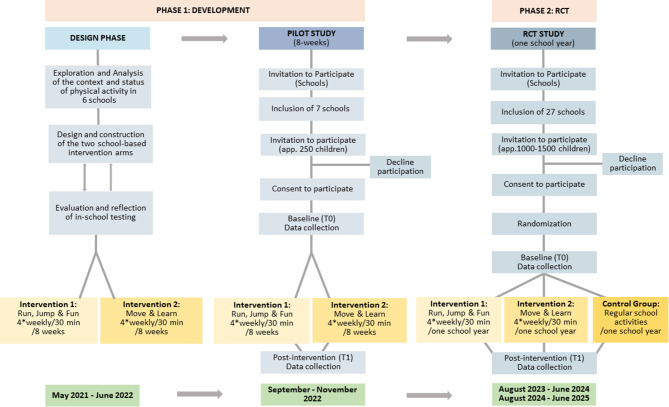
Background: Previous research has suggested that school-based physical activity (PA) interventions may have a positive impact on academic performance. However, existing literature on school-based interventions encompasses various forms of PA, spanning from vigorous intensity PA outside the academic classes to light intensity PA and movement integrated into academic learning tasks, and results on academic performance are inconclusive. ACTIVE SCHOOL will implement two different PA interventions for one school year and assess the effects on the pupils’ academic performance, with math performance as the primary outcome. Methods/design: The ACTIVE SCHOOL project consists of two phases: 1) Development phase and 2) Randomized Controlled Trial (RCT). In phase one, two interventions were developed in collaboration with school staff. The two interventions were tested in an 8-weeks feasibility study. In phase two, a RCT-study with three arms will be conducted in 9-10-year-old children for one school year. The RCT-study will be carried out in two intervention rounds during the school years 2023/2024 and 2024/2025. Schools will be randomized to one of two interventions or control;1)Run, Jump & Fun intervention(4 × 30 min/week of moderate-to-vigorous physical activity; 2)Move & Learn intervention(4 × 30 min/week focusing on embodied learning in math and Danish lessons); or 3) a control condition, consisting of normal teaching practices. Outcome measures include academic performance, PA level, cognitive functions, cardiorespiratory fitness, anthropometry, well-being and school motivation (collected before, during and after the intervention period). A process evaluation will be conducted to assess implementation. Discussion: The ACTIVE SCHOOL study will expand knowledge regarding the impact of PA on academic performance. The study will have the potential to significantly contribute to future research, as well as the scientific and educational debate on the best way to implement PA to support education and learning. Trial registration: The study was registered on the 25th of October 2022 in ClinicalTrials.gov, NCT05602948.
Overview
The claims and statistics of this paper haven’t been checked yet.
Free: it reads the open-access text and checks the first 5 claims that cite a source we can check. Create a free account to check every claim.
Integrity signals
Registry
Cites
Statistics
Figures
Verification
Claims the paper makes
The claims and statistics of this paper haven’t been checked yet.
Free: it reads the open-access text and checks the first 5 claims that cite a source we can check. Create a free account to check every claim.
Self-check
Percentages, sums and reported differences re-computed from the paper’s own numbers.
The self-check needs the paper’s full text.
Citations
Cites
Ryan, R. M., & Deci, E. L. (2000) · American Psychologist · doi:10.1037//0003-066x.55.1.68 · Cited by 54,599 · cited 2×
“SRQ-A is a domain specific, self-reported questionnaire developed and validated for children in primary and lower secondary school [37].”
BackgroundEstablishing a standard definition for child overweight and obesity worldwide: international survey
Cole, T. J. (2000) · BMJ · doi:10.1136/bmj.320.7244.1240 · Cited by 16,480 · cited 1×
“Overweight and obesity will be determined based on age-and gender-specific body mass index (BMI) reference values [47].”
BackgroundMoher, D., Hopewell, S., Schulz, K. F., Montori, V., Gotzsche, P. C., Devereaux, P. J., Elbourne, D., Egger, M., & Altman, D. G. (2010) · BMJ · doi:10.1136/bmj.c869 · Cited by 8,883
Proctor, E., Silmere, H., Raghavan, R., Hovmand, P., Aarons, G., Bunger, A., Griffey, R., & Hensley, M. (2011) · Administration and Policy in Mental Health and Mental Health Services Research · doi:10.1007/s10488-010-0319-7 · Cited by 8,721 · cited 1×
“Finally, the process evaluation guided by the well-documented and comprehensive RE-AIM framework is considered a strength of the study ensuring assessments of relevant implementation outcomes, advancing the knowledge gained in the study [58, 67, 68].”
MethodSPIRIT 2013 Statement: Defining Standard Protocol Items for Clinical Trials
Chan, A.-W., Tetzlaff, J. M., Altman, D. G., Laupacis, A., Gøtzsche, P. C., Krleža-Jerić, K., Hróbjartsson, A., Mann, H., Dickersin, K., Berlin, J. A., et al. (2013) · Annals of Internal Medicine · doi:10.7326/0003-4819-158-3-201302050-00583 · Cited by 7,363 · cited 1×
“An additional strength is the application of the SPIRIT 33-item checklist and thereby following the recommendations for reporting [66] (see Supplementary Material 1).”
MethodBarsalou, L. W. (2008) · Annual Review of Psychology · doi:10.1146/annurev.psych.59.103006.093639 · Cited by 5,936 · cited 1×
“This theory suggests that sensory-motor experiences can be linked to the cognitive processes involved in complex problem-solving and strategy use, and therefore, that PA can play a crucial role in the knowledge retention and retrieval [23–25].”
BackgroundSkivington, K., Matthews, L., Simpson, S. A., Craig, P., Baird, J., Blazeby, J. M., Boyd, K. A., Craig, N., French, D. P., McIntosh, E., et al. (2021) · BMJ · doi:10.1136/bmj.n2061 · Cited by 5,808 · cited 4×
“…before performing an effect study, implementation outcomes (e.g., acceptability and feasibility) of the two interventions were assessed during an eight-week feasibility study conducted between September and November, 2022 [33, 36] (will be reported else-where – manuscript under preparation).”
BackgroundMethodInfluentialDurlak, J. A., & DuPre, E. P. (2008) · American Journal of Community Psychology · doi:10.1007/s10464-008-9165-0 · Cited by 5,304
Making sense of implementation theories, models and frameworks
Nilsen, P. (2015) · Implementation Science · doi:10.1186/s13012-015-0242-0 · Cited by 4,447 · cited 1×
“Finally, the process evaluation guided by the well-documented and comprehensive RE-AIM framework is considered a strength of the study ensuring assessments of relevant implementation outcomes, advancing the knowledge gained in the study [58, 67, 68].”
MethodMoral Identity and Developmental Theory
Lapsley, D. (2015) · Human Development · doi:10.1159/000435926 · Cited by 3,819
Perceived locus of causality and internalization: Examining reasons for acting in two domains.
Ryan, R. M., & Connell, J. P. (1989) · Journal of Personality and Social Psychology · doi:10.1037/0022-3514.57.5.749 · Cited by 3,311
RE-AIM Planning and Evaluation Framework: Adapting to New Science and Practice With a 20-Year Review
Glasgow, R. E., Harden, S. M., Gaglio, B., Rabin, B., Smith, M. L., Porter, G. C., Ory, M. G., & Estabrooks, P. A. (2019) · Frontiers in Public Health · doi:10.3389/fpubh.2019.00064 · Cited by 2,528 · cited 2×
“Finally, the process evaluation guided by the well-documented and comprehensive RE-AIM framework is considered a strength of the study ensuring assessments of relevant implementation outcomes, advancing the knowledge gained in the study [58, 67, 68].”
MethodDonnelly, J. E., Hillman, C. H., Castelli, D., Etnier, J. L., Lee, S., Tomporowski, P., Lambourne, K., & Szabo-Reed, A. N. (2016) · Medicine & Science in Sports & Exercise · doi:10.1249/mss.0000000000000901 · Cited by 1,864 · cited 2×
“Enhanced PA might have a positive impact not only on health and wellbeing [3, 19], but also on cognitive skills and academic performance [7, 8, 11–13 , 26 ].”
BackgroundSelf-citationConducting Educational Design Research
McKenney, S., & Reeves, T. C. (2018) · Routledge eBooks · doi:10.4324/9781315105642 · Cited by 1,354 · cited 1×
“It was guided by McKenney and Reeves´ Generic Model for conducting research in education [34].”
MethodExplaining Math: Gesturing Lightens the Load
Goldin-Meadow, S., Nusbaum, H., Kelly, S. D., & Wagner, S. (2001) · Psychological Science · doi:10.1111/1467-9280.00395 · Cited by 842 · cited 1×
“This theory suggests that sensory-motor experiences can be linked to the cognitive processes involved in complex problem-solving and strategy use, and therefore, that PA can play a crucial role in the knowledge retention and retrieval [23–25].”
BackgroundRavens-Sieberer, U., Auquier, P., Erhart, M., Gosch, A., Rajmil, L., Bruil, J., Power, M., Duer, W., Cloetta, B., Czemy, L., et al. (2007) · Quality of Life Research · doi:10.1007/s11136-007-9240-2 · Cited by 778 · cited 1×
“The questionnaire has been used in various research projects to gain insights into the subjective experiences and perceptions of young people regarding their quality of life and well-being [56].”
MethodCarel, J.-C., & Léger, J. (2008) · New England Journal of Medicine · doi:10.1056/nejmcp0800459 · Cited by 761
Watson, A., Timperio, A., Brown, H., Best, K., & Hesketh, K. D. (2017) · International Journal of Behavioral Nutrition and Physical Activity · doi:10.1186/s12966-017-0569-9 · Cited by 689 · cited 3×
“Enhanced PA might have a positive impact not only on health and wellbeing [3, 19], but also on cognitive skills and academic performance [7, 8, 11–13 , 26 ].”
BackgroundFedewa, A. L., & Ahn, S. (2011) · Research Quarterly for Exercise and Sport · doi:10.1080/02701367.2011.10599785 · Cited by 624
Perceptions of perceptual symbols
Barsalou, L. W. (1999) · Behavioral and Brain Sciences · doi:10.1017/s0140525x99532147 · Cited by 620
The Influence of Exercise on Cognitive Abilities
Gomez‐Pinilla, F., & Hillman, C. (2013) · Comprehensive Physiology · doi:10.1002/cphy.c110063 · Cited by 599
Self-citationEmbodiment as a unifying perspective for psychology
Glenberg, A. M. (2010) · WIREs Cognitive Science · doi:10.1002/wcs.55 · Cited by 597
Singh, A. S., Saliasi, E., van den Berg, V., Uijtdewilligen, L., de Groot, R. H. M., Jolles, J., Andersen, L. B., Bailey, R., Chang, Y.-K., Diamond, A., et al. (2019) · British Journal of Sports Medicine · doi:10.1136/bjsports-2017-098136 · Cited by 588 · cited 3×
“This body of research has been summarized in several reviews concluding that most studies report either a positive relation of PA to academic performance, or no relationship between these constructs [2, 7, 11–15].”
BackgroundSelf-citationThe Econometrics of Randomized Experiments
(2017) · Handbook of Economic Field Experiments · doi:10.1016/bs.hefe.2016.10.003 · Cited by 562 · cited 1×
“Mixed-effects models will be used to test the between-group difference (intervention vs. control) for the main outcome (general Math), controlling for base-line values and including school and class as random effects [41].”
MethodGrowth and Maturation during Adolescence
Tanner, J. M. (2009) · Nutrition Reviews · doi:10.1111/j.1753-4887.1981.tb06734.x · Cited by 543 · cited 1×
“Participants will self-report their puberty stage using a questionnaire, which consists of five categories of secondary sex characteristics defined by Tanner [48], using standardized color images as suggested by Carel and Leger [49].”
MethodGuidance for conducting feasibility and pilot studies for implementation trials
Pearson, N., Naylor, P.-J., Ashe, M. C., Fernandez, M., Yoong, S. L., & Wolfenden, L. (2020) · Pilot and Feasibility Studies · doi:10.1186/s40814-020-00634-w · Cited by 475 · cited 1×
“…before performing an effect study, implementation outcomes (e.g., acceptability and feasibility) of the two interventions were assessed during an eight-week feasibility study conducted between September and November, 2022 [33, 36] (will be reported else-where – manuscript under preparation).”
MethodDetection of Physical Activity Types Using Triaxial Accelerometers
Skotte, J., Korshøj, M., Kristiansen, J., Hanisch, C., & Holtermann, A. (2014) · Journal of Physical Activity and Health · doi:10.1123/jpah.2011-0347 · Cited by 446 · cited 1×
“The amount of time spent on each activity type each day will be calculated and time spent in different PA intensity levels according to the recommendations will be reported [55].”
MethodLuciana, M., & Nelson, C. A. (2002) · Developmental Neuropsychology · doi:10.1207/s15326942dn2203_3 · Cited by 400 · cited 1×
“Working Memory (VSWM) task is a self-ordered search task, which assesses an individual’s ability to store and manipulate information about the location of objects on a computer screen [50].”
BackgroundAcademic Achievement and Physical Activity: A Meta-analysis
Álvarez-Bueno, C., Pesce, C., Cavero-Redondo, I., Sánchez-López, M., Garrido-Miguel, M., & Martínez-Vizcaíno, V. (2017) · Pediatrics · doi:10.1542/peds.2017-1498 · Cited by 391
Pesce, C. (2012) · Journal of Sport and Exercise Psychology · doi:10.1123/jsep.34.6.766 · Cited by 383
Embodied learning: introducing a taxonomy based on bodily engagement and task integration
Skulmowski, A., & Rey, G. D. (2018) · Cognitive Research: Principles and Implications · doi:10.1186/s41235-018-0092-9 · Cited by 310 · cited 1×
“This research line focuses, for example, on gestures and bodily engagement closely related to and integrated into curricular learning tasks [20], and suggests that forming actions with the body can lead to the construction of enhanced mental representations that positively affect memory recall [21,…”
BackgroundThe effects of aerobic activity on brain structure.
Thomas, A. G., Dennis, A., Bandettini, P. A., & Johansen-Berg, H. (2012) · Frontiers in Psychology · doi:10.3389/fpsyg.2012.00086 · Cited by 303 · cited 1×
“Animal models provide cellular and molecular explanations for altered brain function after PA training, and imaging models on humans show how specific brain structures are affected by PA [9, 10].”
BackgroundNorris, E., van Steen, T., Direito, A., & Stamatakis, E. (2020) · British Journal of Sports Medicine · doi:10.1136/bjsports-2018-100502 · Cited by 293 · cited 2×
“Furthermore, emerging evidence suggests positive associations between physical activity (PA), aerobic fitness, and academic outcome in children and adolescents [3], and several school-based studies have found that enhancing PA in schools can improve academic performance [4–8].”
BackgroundExercise, sports, and performance arts benefit cognition via a common process.
Tomporowski, P. D., & Pesce, C. (2019) · Psychological Bulletin · doi:10.1037/bul0000200 · Cited by 290 · cited 1×
“This line of research has focused on the qualitative aspects of PA, such as cognitive and coordi-native demands [26–28].”
BackgroundGetting a clinical innovation into practice: An introduction to implementation strategies
Kirchner, J. E., Smith, J. L., Powell, B. J., Waltz, T. J., & Proctor, E. K. (2020) · Psychiatry Research · doi:10.1016/j.psychres.2019.06.042 · Cited by 258 · cited 3×
“The intervention dose were defined as 30 min of PA delivered four times per week, with several implementation strategies to facilitate adoption and practice of the interventions [35].”
BackgroundMethodPlanning for Implementation Success Using RE-AIM and CFIR Frameworks: A Qualitative Study
King, D. K., Shoup, J. A., Raebel, M. A., Anderson, C. B., Wagner, N. M., Ritzwoller, D. P., & Bender, B. G. (2020) · Frontiers in Public Health · doi:10.3389/fpubh.2020.00059 · Cited by 247 · cited 1×
“Maintenance Maintenance will be measured six months after the beginning of an intervention and onwards [63].”
BackgroundDaly-Smith, A., Quarmby, T., Archbold, V. S. J., Corrigan, N., Wilson, D., Resaland, G. K., Bartholomew, J. B., Singh, A., Tjomsland, H. E., Sherar, L. B., et al. (2020) · International Journal of Behavioral Nutrition and Physical Activity · doi:10.1186/s12966-020-0917-z · Cited by 237 · cited 1×
“Due to the challenge of implementing PA in schools, both interventions have been co-developed with school staff, as recommended [31].”
BackgroundSelf-citationMarques, A., Santos, D. A., Hillman, C. H., & Sardinha, L. B. (2018) · British Journal of Sports Medicine · doi:10.1136/bjsports-2016-097361 · Cited by 213 · cited 4×
“This body of research has been summarized in several reviews concluding that most studies report either a positive relation of PA to academic performance, or no relationship between these constructs [2, 7, 11–15].”
BackgroundInfluentialSelf-citationDonnelly, J. E., Hillman, C. H., Castelli, D., Etnier, J. L., Lee, S., Tomporowski, P., Lambourne, K., & Szabo-Reed, A. N. (2016) · Medicine & Science in Sports & Exercise · doi:10.1249/mss.0000000000000966 · Cited by 212
Self-citationBriesch, A. M., Chafouleas, S. M., Neugebauer, S. R., & Riley-Tillman, T. C. (2013) · Journal of School Psychology · doi:10.1016/j.jsp.2012.08.006 · Cited by 210 · cited 1×
“Teachers and pedagogues will complete the survey Usage Rating Profile-Intervention (URP-I) before the interventions begin, midway and at the end of the intervention period [59].”
BackgroundNorris, E., Shelton, N., Dunsmuir, S., Duke-Williams, O., & Stamatakis, E. (2015) · Preventive Medicine · doi:10.1016/j.ypmed.2014.12.027 · Cited by 200 · cited 2×
“This line of research has focused on the qualitative aspects of PA, such as cognitive and coordi-native demands [26–28].”
BackgroundMullender-Wijnsma, M. J., Hartman, E., de Greeff, J. W., Doolaard, S., Bosker, R. J., & Visscher, C. (2016) · Pediatrics · doi:10.1542/peds.2015-2743 · Cited by 187 · cited 1×
“A conservative power estimation with an expected effect size of 0.42 for the main outcome (general math, based on results from [17]) and an intra class correlation of 0.15, resulted in a sample of ≥ 9 schools per intervention arm (27 in total), with a mean of 20 children per class and a minimum of…”
MethodInfluentialMemory for action events: A new field of research
Engelkamp, J., & Zimmer, H. D. (1989) · Psychological Research · doi:10.1007/bf00309142 · Cited by 168 · cited 1×
“…research line focuses, for example, on gestures and bodily engagement closely related to and integrated into curricular learning tasks [20], and suggests that forming actions with the body can lead to the construction of enhanced mental representations that positively affect memory recall [21, 22].”
BackgroundNormative data on the n-back task for children and young adolescents
Pelegrina, S., Lechuga, M. T., García-Madruga, J. A., Elosúa, M. R., Macizo, P., Carreiras, M., Fuentes, L. J., & Bajo, M. T. (2015) · Frontiers in Psychology · doi:10.3389/fpsyg.2015.01544 · Cited by 155 · cited 1×
“Normative data on the n-back task for children and young adolescents have previously been reported [51].”
BackgroundBangsbo, J., Krustrup, P., Duda, J., Hillman, C., Andersen, L. B., Weiss, M., Williams, C. A., Lintunen, T., Green, K., Hansen, P. R., et al. (2016) · British Journal of Sports Medicine · doi:10.1136/bjsports-2016-096325 · Cited by 149 · cited 3×
“Furthermore, emerging evidence suggests positive associations between physical activity (PA), aerobic fitness, and academic outcome in children and adolescents [3], and several school-based studies have found that enhancing PA in schools can improve academic performance [4–8].”
Self-citationMacdonald, K., Milne, N., Orr, R., & Pope, R. (2018) · International Journal of Environmental Research and Public Health · doi:10.3390/ijerph15081603 · Cited by 136 · cited 1×
“This body of research has been summarized in several reviews concluding that most studies report either a positive relation of PA to academic performance, or no relationship between these constructs [2, 7, 11–15].”
Donnelly, J. E., Hillman, C. H., Greene, J. L., Hansen, D. M., Gibson, C. A., Sullivan, D. K., Poggio, J., Mayo, M. S., Lambourne, K., Szabo-Reed, A. N., et al. (2017) · Preventive Medicine · doi:10.1016/j.ypmed.2017.02.006 · Cited by 135
Self-citationAhler, T., Bendiksen, M., Krustrup, P., & Wedderkopp, N. (2011) · European Journal of Applied Physiology · doi:10.1007/s00421-011-2039-4 · Cited by 119 · cited 1×
“This test has been proven valid and reliable compared to direct measures of maximum oxygen uptake in a similar cohort [53].”
MethodDaly-Smith, A., Morris, J. L., Norris, E., Williams, T. L., Archbold, V. S. J., Kallio, J., Tammelin, T., Singh, A. S., Mota, J. A. P. S., von Seelen, J., et al. (2021) · International Journal of Behavioral Nutrition and Physical Activity · doi:10.1186/s12966-021-01221-9 · Cited by 116 · cited 1×
“First, the two interventions were developed in collaboration with school staff, which should increase the chances of acceptability and feasibility [33, 65].”
BackgroundSelf-citationAn intermittent running test to estimate maximal oxygen uptake: the Andersen test.
Andersen, L. B., Andersen, T. E., Andersen, E., & Anderssen, S. A. (2008) · PubMed · Cited by 104
Schmidt, M., Benzing, V., Wallman-Jones, A., Mavilidi, M.-F., Lubans, D. R., & Paas, F. (2019) · Psychology of Sport and Exercise · doi:10.1016/j.psychsport.2018.12.017 · Cited by 99 · cited 1×
“Some school-based studies have shown promising results on academic performance following interventions containing elements of embodied learning [4, 29, 30].”
Backgroundon behalf of the ASK study group, Resaland, G. K., Moe, V. F., Aadland, E., Steene-Johannessen, J., Glosvik, Ø., Andersen, J. R., Kvalheim, O. M., McKay, H. A., & Anderssen, S. A. (2015) · BMC Public Health · doi:10.1186/s12889-015-2049-y · Cited by 84
Self-citationHave, M., Nielsen, J. H., Ernst, M. T., Gejl, A. K., Fredens, K., Grøntved, A., & Kristensen, P. L. (2018) · PLOS ONE · doi:10.1371/journal.pone.0208787 · Cited by 83
Moore, P. J. (2019) · Educational Psychology · doi:10.1080/01443410.2019.1643971 · Cited by 82 · cited 1×
“Academic performance is important both in formal education and for success later in life [1].”
BackgroundMullender-Wijnsma, M. J., Hartman, E., de Greeff, J. W., Bosker, R. J., Doolaard, S., & Visscher, C. (2015) · BMC Public Health · doi:10.1186/s12889-015-1745-y · Cited by 66
Brown, K. M., & Elliott, S. J. (2015) · Universal Journal of Public Health · doi:10.13189/ujph.2015.030204 · Cited by 59 · cited 1×
“To account for these differences, interventions for each participating school were adapted and tailored to fit each school’s unique context to optimize implementation [69–72].”
MethodTranslation and validation of the Canadian assessment of physical literacy-2 in a Danish sample
Elsborg, P., Melby, P. S., Kurtzhals, M., Tremblay, M. S., Nielsen, G., & Bentsen, P. (2021) · BMC Public Health · doi:10.1186/s12889-021-12301-7 · Cited by 53 · cited 1×
“The original URP-I is translated into Danish following a protocol of a four-step-process inspired by WHO guidelines [60].”
MethodSelf-citationMavilidi, M. F., Lubans, D. R., Miller, A. A., Eather, N., Morgan, P. J., Lonsdale, C., Noetel, M., Karayanidis, F., Shaw, K. M., & Riley, N. (2020) · International Journal of Educational Research · doi:10.1016/j.ijer.2020.101592 · Cited by 46
The Andersen Aerobic Fitness Test: Reliability and Validity in 10-Year-Old Children
Aadland, E., Terum, T., Mamen, A., Andersen, L. B., & Resaland, G. K. (2014) · PLoS ONE · doi:10.1371/journal.pone.0110492 · Cited by 45 · cited 1×
“The Andersen-test has demonstrated reliability and validity for the target age group [54].”
BackgroundSelf-citationLerum, Ø., Bartholomew, J. B., McKay, H. A., Resaland, G. K., Tjomsland, H. E., Anderssen, S. A., Leirhaug, P. E., & Moe, V. F. (2019) · Translational Journal of the American College of Sports Medicine · doi:10.1249/tjx.0000000000000104 · Cited by 45 · cited 1×
“To ensure the sustainability of the interventions, a gradual introduction to the intervention principles has proven effective in previous studies [38–40].”
MethodSelf-citationSolberg, R. B., Steene-Johannessen, J., Anderssen, S. A., Ekelund, U., Säfvenbom, R., Haugen, T., Berntsen, S., Åvitsland, A., Lerum, Ø., Resaland, G. K., et al. (2021) · BMC Public Health · doi:10.1186/s12889-021-10901-x · Cited by 37
Self-citationImplementation of physically active lessons: A 2-year follow-up
Skage, I., Ertesvåg, S. K., Roland, P., & Dyrstad, S. M. (2020) · Evaluation and Program Planning · doi:10.1016/j.evalprogplan.2020.101874 · Cited by 28 · cited 1×
“To ensure the sustainability of the interventions, a gradual introduction to the intervention principles has proven effective in previous studies [38–40].”
MethodNielsen, J. V., Bredahl, T. V. G., Bugge, A., Klakk, H., & Skovgaard, T. (2019) · Evaluation and Program Planning · doi:10.1016/j.evalprogplan.2019.101674 · Cited by 20 · cited 1×
“To account for these differences, interventions for each participating school were adapted and tailored to fit each school’s unique context to optimize implementation [69–72].”
MethodSelf-citationBarriers to Implementation of Physical Activity in Danish Public Schools
Koch, S., Troelsen, J., Cassar, S., & Pawlowski, C. S. (2020) · Journal of Teaching in Physical Education · doi:10.1123/jtpe.2019-0158 · Cited by 15
Developing ACTIVE SCHOOL—The Design Process for Two School-Based Physical Activity Interventions
Jeppesen, L. S., Bugge, A., Smedegaard, S., Wienecke, J., & Melcher, J. N. S. (2024) · Translational Journal of the American College of Sports Medicine · doi:10.1249/tjx.0000000000000251 · Cited by 2 · cited 2×
“The design phase is described in more details and published elsewhere [32].”
BackgroundMethodSelf-citation
Research works printed but not linked: 4
- 16. Solberg R, Steene-Johannessen J, Ekelund U, Lerum Ø, Åvitsland A, Haugen T, et al. Effect of a School-based physical activity intervention on academic performance in Norwegian adolescents: the School in Motion Study - A Cluster Randomized Controlled Trial. Med Sci Sport Exerc. 2020;52(7S):196–6. doi: 10.1186/s12889-021-10901-x. · DOI · Paper page
- 22. Barsalou LW. Perceptions of perceptual symbols. Vol. 22, behavioral and Brain sciences. Cambridge University Press; 1999. pp. 637–60. · DOI · Paper page
- 61. Braun V, Clarke V. Thematic Analysis. 1st ed. SAGE Publications Ltd; 2021. 376 p. Available from: https://study.sagepub.com/thematicanalysis.
- 62. Lashley MC. Observational research methods. In: The SAGE Encyclopedia of Communication Research Methods. Thousand Oaks: SAGE Publications, Inc; 2017. p. 1116–8. Available from: https://sk.sagepub.com/reference/the-sage-encyclopedia-of-communication-research-methods.
Cited by
Killing the Stereotype Of Women Leadership at Senior High School
Maharromiyati, Sumaryanto, S., Yuliana, L., & Suhardiman, S. (2024) · Journal of Ecohumanism · doi:10.62754/joe.v3i5.3958 · Cited by 6
“Increased motivation and support for teachers results in better teaching techniques (Jeppesen et al., 2024).”
BackgroundJeppesen, L. S., Melcher, J. N. S., Smedegaard, S., Nielsen, G., Mandelid, M. B., Stolpe, M. N., Wienecke, J., & Bugge, A. (2025) · International Journal of Environmental Research and Public Health · doi:10.3390/ijerph22010067 · Cited by 8
Self-citationFirouzjah, M. H., Pourazar, M., Kakvandi, S. N., & Dalasm, R. A. (2025) · Early Human Development · doi:10.1016/j.earlhumdev.2025.106350 · Cited by 5
The Effect of Physical Activity Levels on Cognitive Performance: Research in Portuguese Adolescents
Rodrigues, A. J. A., Antunes, H. R. L., Sabino, B., Sousa, D., Correia, A. L., Alves, R. R., & Lopes, H. (2024) · Sports · doi:10.3390/sports12060146 · Cited by 7
“Despite the results obtained, Jeppesen, et al. [46] advocate for light-intensity PA. Future interventions aimed at enhancing CP and, subsequently, academic performance ought to consider strategies that encourage vigorous and very vigorous PA.”
ResultThe impact of physical activity on academic performance in children and adolescents: a meta-analysis
Feng, Z., Zhao, Z., Chen, R., & Liu, Y. (2026) · Frontiers in Psychology · doi:10.3389/fpsyg.2026.1836195
“These subgroup classifications were defined with reference to previous research and school physical activity guidelines (Jeppesen et al., 2024; Xu et al., 2023; He et al., 2025).”
Metadata
- Authors
- Jeppesen, L. S., Damsgaard, L., Stolpe, M. N., Melcher, J. N. S., Wienecke, J., Nielsen, G., Smedegaard, S., Henriksen, A. H., Hansen, R. A., Hillman, C. H., Tammelin, T. H., Resaland, G. K., Daly-Smith, A., & Bugge, A.
- Affiliations
- University of Copenhagen (DK)
- University College Copenhagen (DK)
- University College Lillebaelt (DK)
- Northeastern University (US)
- JAMK University of Applied Sciences (FI)
- Western Norway University of Applied Sciences (NO)
- Corresponding author
- Jeppesen, Lise Sohl
- ORCID
- Venue
- BMC Pediatrics
- Published
- 2024-03-09
- Volume
- 24
- Issue
- 1
- Pages
- 174-174
- ISSN
- 1471-2431 (ISSN-L)
- PMC
- PMC10924402
- OpenAlex
- W4392620731
- Semantic Scholar
- eb888b080dc45485c1b2a72085f852c82e5b1980
- Cited by
- 6
- References
- 66
- Citations by year
- 2026: 2 · 2025: 3 · 2024: 1
- FWCI
- 1.71
- Type
- journal article
- Language
- en
- Open access
- gold
- doi.org
- Licence
- cc-by
- creativecommons.org/licenses/by/4.0 (tdm)
- creativecommons.org/licenses/by/4.0 (vor)
- Locations
- BMC Pediatrics (publishedVersion, cc-by)
- PubMed Central (publishedVersion, cc-by)
- PubMed (publishedVersion)
- Research at the University of Copenhagen (University of Copenhagen) (publishedVersion, cc-by)
- DOAJ (DOAJ: Directory of Open Access Journals) (submittedVersion)
- Theseus (Ammattikorkeakoulujen) (submittedVersion, cc-by-nc-nd)
- Funders
- Copenhagen University
- Topics
- Health Sciences › Medicine › Public Health, Environmental and Occupational Health › Physical Activity and Health
- Social Sciences › Psychology › Developmental and Educational Psychology › Children's Physical and Motor Development
- Health Sciences › Medicine › Public Health, Environmental and Occupational Health › School Health and Nursing Education
- Keywords
- school-based physical activity intervention, academic performance, mathematics achievement, embodied learning, moderate-to-vigorous physical activity, children aged 9-10, cardiorespiratory fitness, cognitive function, academic motivation, well-being, intervention development, process evaluation
- MeSH terms
- Academic Performance, Child, Cognition, Health Promotion, Humans, Learning, School Health Services, Schools, Exercise, Randomized Controlled Trials as Topic
About these checks
Registry, retraction, Cites and statistics results are computed, not judged, with one exception: a printed reference that no index lists is read once by a model before it counts as a citation error. Claims are extracted by a model and kept only when their quote appears verbatim in the text; each cited source is then checked, with a model’s help, for whether it says what the claim relies on. Those verdicts can be wrong — read the claim’s quote and the cited source before relying on one.
Statistics and arithmetic are recomputed, not judged.
Confidence bands are shown only for fields calibrated on our annotated test set. None is calibrated yet, so no band is shown.
What counts as a claim ›How we measure confidence ›How we check this ›
Are you an author, or do you see a problem with this page? Request a review
Data sources
Bibliographic data: Semantic Scholar, OpenAlex, Crossref.
Contains information from the Semantic Scholar Academic Graph Datasets, made available under the ODC Attribution License (ODC-BY 1.0).
Semantic Scholar’s data is described in: Kinney, R., et al. (2023). The Semantic Scholar Open Data Platform. arXiv:2301.10140.
