

A pilot randomized controlled trial of a tailored cognitive behavioural therapy based intervention for depressive symptoms in those newly diagnosed with multiple sclerosis
Open accessThe DOI matches its Crossref record; 40 of the 41 references it cites were found in a registry or an index; 5 of the 21 sources its claims cite were checked for support.
Abstract
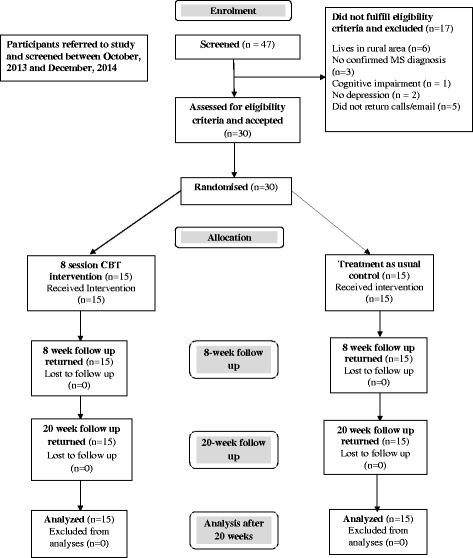
Background: To examine the effectiveness and acceptability of an 8-week individual tailored cognitive behavioural therapy (CBT) intervention for the treatment of depressive symptoms in those newly diagnosed with multiple sclerosis. Methods: The current study presents a pilot, parallel group randomized controlled trial (RCT) with an allocation ratio of 1:1 conducted in a large research and teaching hospital in Melbourne, Australia. 30 individuals with a mean age of 36.93years (SD=9.63) who were newly diagnosed with multiple sclerosis (MS) (X=24.87months, SD=15.61) were randomized to the CBT intervention (n=15) or treatment as usual (TAU) (n=15). The primary outcome was level of depressive symptoms using the Beck Depression Inventory-II (BDI-II). Secondary outcomes were level of anxiety, fatigue and pain impact, sleep quality, coping, acceptance of MS illness, MS related quality of life, social support, and resilience. Tertiary outcomes were acceptability and adherence to the intervention. Results: Large between group treatment effects were found for level of depressive symptoms at post and at 20weeks follow-up (d=1.66-1.34). There were also small to large group treatment effects for level of anxiety, fatigue and pain impact, sleep quality, MS related quality of life, resilience, and social support at post and at 20weeks follow-up (d=0.17-1.63). There were no drop-outs and participants completed all treatment modules. All participants reported the treatment as 'very useful', and most (73.4%) reported that the intervention had addressed their problems 'completely'. Conclusions: These data suggest that the tailored early intervention is appropriate and clinically effective for the treatment of depressive symptoms in those newly diagnosed with MS. A larger RCT comparing the CBT intervention with an active comparative treatment with longer term follow-up and cost effectiveness analyses is warranted. The pilot trial has been retrospectively registered on 28/04/2016 with the ISRCTN registry (trial ID ISRCTN10423371). © 2016 The Author(s).
Overview
CoChat Summary
TL;DR
This pilot 1:1 randomized controlled trial tested an 8-week individualized CBT intervention for people newly diagnosed with MS and found large reductions in depressive symptoms versus treatment as usual at post-treatment and 20 weeks. The intervention was also reported as highly acceptable, with no dropouts and very high satisfaction.
Key findings
- In 30 participants (15 CBT, 15 TAU), the CBT group had significantly lower BDI-II scores at post-treatment and 20-week follow-up, with between-group effect sizes ranging from d = 1.34 to 1.66.
- Secondary outcomes favored CBT for fatigue impact and pain effects scores, with significant group differences at post and 20 weeks; reported effect sizes ranged from d = 0.75 to 1.03 for MFIS/PES.
- CBT also improved MS-related quality of life: significant differences were reported for the MSQOL physical health composite and mental health composite at post and 20 weeks, with effect sizes ranging from d = 0.70 to 1.04 and d = 1.00 to 1.03, respectively.
- All intervention participants (n = 15) reported the treatment as “very useful,” completed all homework and modules, had a very strong therapeutic alliance, and 100% said they would “definitely” recommend it to a close friend with MS; 73.4% said it addressed their problems “completely.”
Methods
- Pilot, parallel-group randomized controlled trial with 1:1 allocation to tailored CBT (n = 15) or treatment as usual (n = 15), conducted in a hospital setting in Melbourne, Australia.
- Included 30 individuals newly diagnosed with MS; all were within 5 years of diagnosis, and the sample had a mean age of 36.93 years (SD 9.63) and mean time since diagnosis of 24.87 months (SD 15.61).
- Baseline group differences were tested with ANOVAs; post-treatment and 20-week outcomes were tested with ANCOVAs controlling for baseline scores, gender, and ambulation status; effect sizes were calculated with Cohen’s d.
Limitations
- The paper states it was a preliminary pilot with a small sample size, only two therapists, reliance on self-report measures, a mostly educated and employed sample, and no active comparative intervention.
- It also states the follow-up was limited to 20 weeks and that treatment fidelity was not monitored by an independent rater and there were no audio recordings for therapist competency ratings.
- Evident from the text: blinding was not maintained after assignment, and clinicians who delivered the intervention also helped provide assessment questionnaires, which could introduce bias.
Model-written summary. Check it against the paper before relying on it.
Integrity signals
Registry
Cites
Statistics
Figures
Verification
Claims the paper makes
4 Valid · 1 Not valid · 6 Not checked · 45 Own results and interpretations
At least one cited source doesn’t support this claim or points to a different paper, and none confirmed it — see the verdicts below.
In the paper
“Firstly, the time around receiving a MS diagnosis has been shown to be when individuals experience significantly higher levels of depression and anxiety [2, 4, 11, 16].”
§ A pilot randomized controlled trial of a tailored cognitive behavioural therapy based intervention for depressive symptoms in those newly diagnosed with multiple sclerosis > Background
What the sources say
- Not checked — no full text of the sourcecites [2] Giordano A Granella F Lugaresi A Martinelli V Trojano M Confalonieri P Radice D Solari A SIMS-Trial group Anxiety and depression in multiple sclerosis patients around diagnosis J Neurol Sci 2011 307 86 91 10.1016/j.jns.2011.05.008 21621796 source
- Not checked — no full text of the sourcecites [4] Tan-Kristanto S Kiropoulos LA Resilience, self-efficacy, coping styles and depressive and anxiety symptoms in those newly diagnosed with multiple sclerosis Psychol Health Med 2015 14 1 14 25588098 source
- Disputedcites [11] Janssens A van Dorn P de Boer J van der Meche F Passchier J Hintzen R Impact of recently diagnosed multiple sclerosis on quality of life, anxiety, depression and distress of patients and partners Acta Neurol Scand 2003 108 389 95 10.1034/j.1600-0404.2003.00166.x 14616290 sourceExperimental — accuracy not yet measured
Our copy supports only the anxiety half: in the Anxiety, depression, and psychological distress results section, patients and partners had significantly higher anxiety than Dutch population controls (6.6 vs 5.1, P = 0.003; partners 6.4 vs 5.1, P = 0.012), and the Discussion concludes a 'substantial emotional burden' in the early phase after diagnosis. However, the same section states that patients and partners did NOT differ from controls in depression scores (3.8 vs 3.4, P = 0.41; 3.7 vs 3.4, P = 0.56), and the Discussion makes this explicit: 'significantly increased levels of anxiety but not of depression were found.' Moreover, the paper reports that anxiety, depression and distress were not associated with time since diagnosis, so it does not establish the diagnostic moment as the peak of depression or anxiety. (LLM, conf=0.78)
Checked by a reasoning model — may be wrong.
- Not checked — no full text of the sourcecites [16] Lode K Bru E Klevan G Myhr KM Nyland H Larsen JP Depressive symptoms and coping in newly diagnosed patients with multiple sclerosis Mult Scler 2009 15 638 43 10.1177/1352458509102313 19299438 source
boostedstates an association- Asserted: passes — The authors put it forward as true.
- Checkable: passes — It can be checked against evidence.
- Load-bearing: passes — The paper’s conclusions depend on it.
- Based: passes — The paper gives a reason why it holds.
Every source the paper cites for this claim was checked and supports it.
In the paper
“A review of seven CBT studies (individual (3 studies), group (3 studies) and by computer (1 study)) found a medium treatment effect of 0.5 SD [12].”
§ A pilot randomized controlled trial of a tailored cognitive behavioural therapy based intervention for depressive symptoms in those newly diagnosed with multiple sclerosis > Background
What the sources say
- Supportedcites [12] Hind D Cotter J Thake A Bradburn M Cooper C Isaac C House A Cognitive behavioural therapy for the treatment of depression in people with multiple sclerosis: a systematic review and meta-analysis BMC Psychiatry 2014 14 5 10.1186/1471-244X-14-5 24406031 PMC3890565 source
The Abstract (Results) identifies seven eligible studies: three individual, three group, and one computer-delivered. The Discussion (Principal findings) explicitly describes a medium treatment effect of 0.5 SD for depression in people with MS. The Results (Synthesis) show that this approximates the sensitivity-analysis estimate of 0.46 SD after an outlying study was removed. (LLM, conf=0.95)
plainstates a cause- Asserted: passes — The authors put it forward as true.
- Checkable: passes — It can be checked against evidence.
- Load-bearing: passes — The paper’s conclusions depend on it.
- Based: passes — The paper gives a reason why it holds.
- Supported
The cited sources support only part of this claim — read each source’s verdict below.
In the paper
“Two studies suggest that up to 36% of MS patients continue to have high levels of depressive and anxiety symptoms in the first years after diagnosis [3, 11].”
§ A pilot randomized controlled trial of a tailored cognitive behavioural therapy based intervention for depressive symptoms in those newly diagnosed with multiple sclerosis > Background
What the sources say
- Not checked — no full text of the sourcecites [3] Janssens ACJW Buljevac D van Doorn PA van der Meche FGA Polman CH Passchier J Prediction of anxiety and distress following diagnosis of multiple sclerosis: a two-year longitudinal study Mult Scler 2006 12 794 801 10.1177/1352458506070935 17263009 source
- Partly supportedcites [11] Janssens A van Dorn P de Boer J van der Meche F Passchier J Hintzen R Impact of recently diagnosed multiple sclerosis on quality of life, anxiety, depression and distress of patients and partners Acta Neurol Scand 2003 108 389 95 10.1034/j.1600-0404.2003.00166.x 14616290 sourceExperimental — accuracy not yet measured
Our copy supports only part: in the 'Anxiety, depression, and psychological distress' results, 34% of recently diagnosed patients (mean 8 months, range 0-24 months) had clinically relevant anxiety (HADS >= 8), while the 36% figure belongs to severe disease-related distress on the Impact of Event Scale, not to depressive symptoms. Depression is not reported as elevated overall — patients' mean HADS depression score (3.8) did not differ from controls (3.4, P = 0.41) — and no percentage of patients with high depression is given. The claim's persistence element ('continue to have ... in the first years after diagnosis') is not this study's finding: it is cross-sectional, and the Discussion states that 'further follow-up studies are needed to elucidate the course of anxiety and distress ... to identify those who will remain anxious and distressed for a longer period'. (LLM, conf=0.75)
hedged- Asserted: passes — The authors put it forward as true.
- Checkable: passes — It can be checked against evidence.
- Load-bearing: unclear — It is unclear whether the paper’s conclusions depend on it.
- Based: passes — The paper gives a reason why it holds.
A result the paper reports from its own data — it cites no other source for it, so there is none to check. The quote shows it is in the paper.
In the paper
“There was also a significant group difference on the RSA at post and at 20 week follow up (ds ranging from 0.44 to 0.57).”
§ A pilot randomized controlled trial of a tailored cognitive behavioural therapy based intervention for depressive symptoms in those newly diagnosed with multiple sclerosis > Results > Analysis of secondary outcomes
plain- Asserted: passes — The authors put it forward as true.
- Checkable: passes — It can be checked against evidence.
- Load-bearing: unclear — It is unclear whether the paper’s conclusions depend on it.
- Based: passes — The paper gives a reason why it holds.
A result the paper reports from its own data — it cites no other source for it, so there is none to check. The quote shows it is in the paper.
In the paper
“Linear models revealed that those in the CBT group, when compared to the TAU group, had significantly lower scores on the BDI-II at post and at 20 week follow up (ds ranging from 1.34 to 1.66).”
§ A pilot randomized controlled trial of a tailored cognitive behavioural therapy based intervention for depressive symptoms in those newly diagnosed with multiple sclerosis > Results > Analysis of primary outcomes
plainstates a cause- Asserted: passes — The authors put it forward as true.
- Checkable: passes — It can be checked against evidence.
- Load-bearing: passes — The paper’s conclusions depend on it.
- Based: passes — The paper gives a reason why it holds.
11 more claims
Create a free account to see all 56 claims and every source verdict.
- It may state two separate claims as one. 30
- Probably not a substantial claim. 16
Claims other papers make about this one
Each is checked against this paper’s own text: does it say what the citing paper says it does?
The source backs part of the claim, not all of it — or backs it for a different population, condition or comparison.
In the citing paper
“cognitive behavioral therapy (CBT), mindfulness, acceptance and commitment therapy (ACT) have considered as the most practical therapeutic methods in treating anxiety in patients affected by MS.”
From Psychological interventions for decreasing anxiety in people with multiple sclerosis (MS): A systematic review (2023) · cites this paper as [29]
Experimental — accuracy not yet measuredThe cited source says what the claim attributes to it.
In the citing paper
“Relatedly, a recent study found significant reductions in levels of depressive and anxiety symptoms and higher levels of illness acceptance in individuals who were newly diagnosed with MS who undertook a tailored 8-week cognitive behavioural therapy programme for depression and anxiety (Kiropoulos et al., 2016).”
From Self-concept, illness acceptance and depressive and anxiety symptoms in people with multiple sclerosis. (2021) · cites this paper as Kiropoulos et al., 2016
Statistics that don’t add up
Each reported p-value recomputed from its test statistic and degrees of freedom, each partial η² from its F, and each ratio, mean difference or B printed with a p checked against its own confidence interval.
Rated minor: it would not touch a result — a value no result rests on, a p-value that stays on the same side of the significance level, or a conflict that is clerical, resolved elsewhere in the paper, or outside its own findings.
In the paper
“F(1, 29) = 10.54, p < 0.001”
§ A pilot randomized controlled trial of a tailored cognitive behavioural therapy based intervention for depressive symptoms in those newly diagnosed with multiple sclerosis > Results > Analysis of secondary outcomes
Reported p < .001 · recomputed p = .003
Statistics recomputed
Every reported test result, recomputed from its test statistic and degrees of freedom. A result shows as not adding up only once an independent check has confirmed it.
- Doesn’t add upF(1, 29) = 10.54reported p < .001 · recomputed p = .003
“F(1, 29) = 10.54, p < .001”
- ConsistentF(1, 29) = 2.95reported p > .05 · recomputed p = .097
“F(1, 29) = 2.95, p > .05”
- ConsistentF(1, 29) = 8.2reported p < .01 · recomputed p = .008
“F(1, 29) = 8.20, p < .01”
- ConsistentF(1, 29) = 17.97reported p < .001 · recomputed p < .001
“F(1, 29) = 17.97, p < .001”
- ConsistentF(1, 29) = 7.7reported p < .01 · recomputed p = .010
“F(1, 29) = 7.70, p < .01”
Self-check
Percentages, sums and reported differences re-computed from the paper’s own numbers.
Self-check results appear here once an independent check has confirmed them.
Citations
Cites
The Pittsburgh Sleep Quality Index: a new instrument for psychiatric practice and research
Buysse, D. J., Reynolds, C. F., Monk, T. H., Berman, S. R., & Kupfer, D. J. (1989) · Psychiatry Research · doi:10.1016/0165-1781(89)90047-4 · Cited by 35,234 · cited 3×
“There were significant group differences on the PSQI score at post and at 20 week follow up (ds ranging from 1.06 to 1.31).”
MethodInfluential(1970) · Cited by 24,983
Beck, A. T., Steer, R. A., & Brown, G. (2011) · PsycTESTS Dataset · doi:10.1037/t00742-000 · Cited by 7,535
Design and analysis of pilot studies: recommendations for good practice
Lancaster, G. A., Dodd, S., & Williamson, P. R. (2004) · Journal of Evaluation in Clinical Practice · doi:10.1111/j..2002.384.doc.x · Cited by 2,572 · cited 1×
“A sample size of 30 was selected as this number has been recommended for pilot studies [27].”
MethodSTAI manual for the State-trait anxiety inventory
Cd, S. (1970) · Medical Entomology and Zoology · Cited by 2,492
A health-related quality of life measure for multiple sclerosis
Vickrey, B. G., Hays, R. D., Harooni, R., Myers, L. W., & Ellison, G. W. (1995) · Quality of Life Research · doi:10.1007/bf02260859 · Cited by 1,132 · cited 1×
“The Multiple Sclerosis Quality of Life (MSQOL-54) [32] was used to measure MS related quality of life.”
MethodResilience in relation to personality and intelligence
Friborg, O., Barlaug, D., Martinussen, M., Rosenvinge, J. H., & Hjemdal, O. (2005) · International Journal of Methods in Psychiatric Research · doi:10.1002/mpr.15 · Cited by 751 · cited 5×
“The 33-item Resilience Scale for Adults (RSA) [37] was used to measure level of resilience and investigates five main protective factors: personal competence, social competence, personal structure, family cohesion and social resources.”
MethodInfluentialDepression in multiple sclerosis: a review
Siegert, R. J. (2005) · Journal of Neurology, Neurosurgery & Psychiatry · doi:10.1136/jnnp.2004.054635 · Cited by 718 · cited 1×
“The lifetime prevalence of depression among individuals with MS has been found to be 50% [5] and point prevalence rates range from 15 to 26% [6].”
BackgroundSocial support, type A behavior, and coronary artery disease.
Blumenthal, J. A., Burg, M. M., Barefoot, J., Williams, R. B., Haney, T., & Zimet, G. (1987) · Psychosomatic Medicine · doi:10.1097/00006842-198707000-00002 · Cited by 642
Folkman, S., & Lazarus, R. S. (2012) · PsycTESTS Dataset · doi:10.1037/t06501-000 · Cited by 440
Research works printed but not linked: 4
- Beck AT Steer RA Brown GK Beck depression inventory-second edition manual 1996 San Antonio The Psychological Corporation
- First MB Spitzer RL Gibbon M Williams JBW Structured clinical interview for DSM-IV-TR axis I disorders, research version, patient edition. (SCID-I/P) 2002 New York Biometrics Research, New York State Psychiatric Institute
- Ritvo PG Fischer JS Miller DM Andrews H Paty DW LaRocca NG Multiple sclerosis quality of life inventory: a user’s manual 1997 NY New York, National Multiple Sclerosis Society 10467384
- Cohen J Statistical power for the behavioural sciences 1988 2 Hillsdale Erlbaum
Cited by
Quality of life in adults with multiple sclerosis: A systematic review
Gil-González, I., Martín-Rodríguez, A., Conrad, R., & Pérez-San-Gregorio, M. Á. (2020) · BMJ Open · doi:10.1136/bmjopen-2020-041249 · Cited by 263
“As in Ehde et al , 128 improvements in QoL were still maintained at 6-month follow-up.”
Psychological Interventions for the Treatment of Chronic Pain in Adults
Driscoll, M. A., Edwards, R. R., Becker, W. C., Kaptchuk, T. J., & Kerns, R. D. (2021) · Psychological Science in the Public Interest · doi:10.1177/15291006211008157 · Cited by 176
Depression in Multiple Sclerosis: Epidemiology, Aetiology, Diagnosis and Treatment
Solaro, C. M., Gamberini, G., & Masuccio, F. G. (2018) · CNS Drugs · doi:10.1007/s40263-018-0489-5 · Cited by 203
Harrison, A. M., Safari, R., Mercer, T. H., Picariello, F., van der Linden, M. L., White, C. M., Moss-Morris, R. E., & Norton, S. (2021) · Multiple Sclerosis Journal · doi:10.1177/1352458521996002 · Cited by 104
Ghielen, I., Rutten, S., Boeschoten, R. E., Houniet-de Gier, M., van Wegen, E. E. H., van den Heuvel, O. A., & Cuijpers, P. (2019) · Journal of Psychosomatic Research · doi:10.1016/j.jpsychores.2019.05.001 · Cited by 74
“(2016) [35] MS Depressive symptoms BDI-II 15 CBT 15 TAU BDI-II 0–0–1-1-0-00 (2) STAI”
BackgroundInfluentialPsychosocial interventions for adults with newly diagnosed chronic disease: A systematic review
Akyirem, S., Forbes, A., Wad, J. L., & Due-Christensen, M. (2022) · Journal of Health Psychology · doi:10.1177/1359105321995916 · Cited by 60
“Although fidelity of intervention protocol was explicitly reported by only three studies, other studies hinted on fidelity by mentioning the use of treatment manuals (Kiropoulos et al., 2016; Sharpe et al., 2001).”
BackgroundFerreira, M., Marques, A. J., & Gomes, P. V. (2021) · International Journal of Environmental Research and Public Health · doi:10.3390/ijerph18147564 · Cited by 71
“[34] Individuals with Congenital Heart Disease Kovacs et al.”
BackgroundResultLiterature Review: Psychological Resilience Factors in People with Neurodegenerative Diseases
Ovaska-Stafford, N., Maltby, J., & Dale, M. (2019) · Archives of Clinical Neuropsychology · doi:10.1093/arclin/acz063 · Cited by 57
Phyo, A. Z. Z., Demaneuf, T., De Livera, A. M., Jelinek, G. A., Brown, C. R., Marck, C. H., Neate, S. L., Taylor, K. L., Mills, T., O’Kearney, E., et al. (2018) · Frontiers in Neurology · doi:10.3389/fneur.2018.00149 · Cited by 49
“(43) delivered a tailored CBT-based intervention for depressive symptoms among newly diagnosed PwMS.”
BackgroundInfluentialBarta, T., & Kiropoulos, L. A. (2022) · International Journal of Behavioral Medicine · doi:10.1007/s12529-022-10078-6 · Cited by 43
“In addition, depression and anxiety are common in MS populations [2, 3, 53], and reported psychological treatment for comorbid depression and anxiety has been found to be low [4, 54].”
BackgroundSelf-citationOnline psychological interventions to improve symptoms in multiple sclerosis: A systematic review
Montañés‐Masias, B., Bort‐Roig, J., Pascual, J. C., Soler, J., & Briones‐Buixassa, L. (2022) · Acta Neurologica Scandinavica · doi:10.1111/ane.13709 · Cited by 27
Kiropoulos, L., Ward, N., & Rozenblat, V. (2021) · Journal of Health Psychology · doi:10.1177/1359105319871639 · Cited by 24
“…acceptance in individuals with MS (Pakenham and Fleming, 2011) and that illness acceptance was found to increase after individuals newly diagnosed with MS undertook an 8-week tailored Cognitive Behavioural Therapy (CBT) intervention for depression and anxiety symptoms (Kiropoulos et al., 2016).”
BackgroundResultInfluentialSelf-citationKnowles, L. M., Arewasikporn, A., Kratz, A. L., Turner, A. P., Alschuler, K. N., & Ehde, D. M. (2020) · Annals of Behavioral Medicine · doi:10.1093/abm/kaaa102 · Cited by 26
Hadoush, H., Alawneh, A., Kassab, M. I., Al-Wardat, M. S., & Al-Jarrah, M. D. (2022) · Neurorehabilitation · doi:10.3233/nre-210328 · Cited by 30
“…two studies of muscle relaxation (Jensen et al., 2016; Masoudi et al., 2013), two studies of cognitive-behavioral therapy (Gromisch et al., 2020; Kiropoulos et al., 2016), four studies of mind-fulness; two were mindfulness-based stress reduction (Jensen et al., 2018; Senders et al., 2019) and…”
Gajofatto, A., Donisi, V., Busch, I. M., Gobbin, F., Butturini, E., Calabrese, M., de Prati, A. C., Cesari, P., Piccolo, L. D., Donadelli, M., et al. (2019) · BMJ Open · doi:10.1136/bmjopen-2019-030469 · Cited by 25
The emotional disorders associated with multiple sclerosis
Raimo, S., Santangelo, G., & Trojano, L. (2021) · Handbook of clinical neurology · doi:10.1016/b978-0-12-822290-4.00009-8 · Cited by 24
Donisi, V., Gajofatto, A., Mazzi, M. A., Gobbin, F., Busch, I. M., Ghellere, A., Klonova, A., Rudi, D., Vitali, F., Schena, F. F., et al. (2021) · Frontiers in Psychology · doi:10.3389/fpsyg.2021.598726 · Cited by 24
Pinto, T. M., Veiga, V. M. N., & de Macedo, E. C. (2024) · Journal of Behavioral and Cognitive Therapy · doi:10.1016/j.jbct.2024.100495 · Cited by 36
Janitra, F. E., Chen, R., Lin, H., Sung, C., Chu, H., Lee, C., Niu, S., Liu, H., Chang, L., Banda, K. J., et al. (2024) · International Journal of Mental Health Nursing · doi:10.1111/inm.13334 · Cited by 18
Eccles, F. J. R., Craufurd, D., Smith, A. M. S., Davies, R., Glenny, K., Homberger, M., Peeren, S., Rogers, D., Rose, L., Skitt, Z., et al. (2020) · Pilot and Feasibility Studies · doi:10.1186/s40814-020-00631-z · Cited by 21
Computerized Cognitive Behavioral Therapy for Treatment of Depression in Multiple Sclerosis
Ratajska, A. M., Zurawski, J. D., Healy, B. C., & Glanz, B. I. (2018) · International Journal of MS Care · doi:10.7224/1537-2073.2017-094 · Cited by 18
Development of the RMT20, a composite screener to identify common mental disorders
Batterham, P. J., Sunderland, M., Carragher, N., & Calear, A. L. (2020) · BJPsych Open · doi:10.1192/bjo.2020.37 · Cited by 14
“3 Accurate screening measures may also be used to identify individuals who require more comprehensive assessment, 4,5 used to guide the tailoring of treatment in the context of internet-based and face-to-face interventions (for example Batterham et al 6 and Kiropoulos et al 7 ), or used to assist individuals in the co…”
Turkowitch, D., Donkers, S. J., Costa, S. L., Vaduvathiriyan, P., Williams, J. A., & Siengsukon, C. F. (2024) · International Journal of MS Care · doi:10.7224/1537-2073.2022-110 · Cited by 11
Kiropoulos, L. A., Rozenblat, V., & Baes, N. (2024) · Brain Behavior & Immunity - Health · doi:10.1016/j.bbih.2024.100939 · Cited by 16
“Higher levels of depression have been found in the first two years of an MS diagnosis (Janssens et al., 2003; Kiropoulos et al., 2016; Marrie et al., 2015; Tan-Kristanto and Kiropoulos, 2015).”
Self-citationAlis, C., Kose, N., Sen Kilic, S., Genc, G., & Bulut, S. (2025) · Sleep Medicine · doi:10.1016/j.sleep.2025.106691 · Cited by 8
A case-control study assessing parenting sense of competence in people with multiple sclerosis.
Uccelli, M. M., & Ponzio, M. (2018) · Rehabilitation Psychology · doi:10.1037/rep0000211 · Cited by 8
Occupational Therapy Practice Guidelines for Adults With Multiple Sclerosis
Cunningham, R., Simon, A. U., & Preissner, K. L. (2022) · American Journal of Occupational Therapy · doi:10.5014/ajot.2022.050088 · Cited by 14
Kiropoulos, L. A., Kilpatrick, T. J., Kalincek, T., Cherulov, L., McDonald, E. A., Wijeratne, T., Threader, J., Rozenblat, V., O’brien-simpson, N. M., van der Walt, A., et al. (2020) · Trials · doi:10.1186/s13063-019-4018-8 · Cited by 8
Self-citationBuschner, A., Makiol, C., Huang, J., Mauche, N., & Strauß, M. (2025) · Journal of Affective Disorders · doi:10.1016/j.jad.2025.02.104 · Cited by 12
Use of pragmatic randomized trials in multiple sclerosis: A systematic overview
Hirt, J., Janiaud, P., Düblin, P., Nicoletti, G. J., Dembowska, K., Nguyen, T. V. T., Woelfle, T., Axfors, C., Yaldizli, Ö., Granziera, C., et al. (2024) · Multiple Sclerosis Journal · doi:10.1177/13524585231221938 · Cited by 7
“Other factors limiting pragmatism included an artificially intensive resource use for participant recruitment (e.g. advertisement 42 ), that unusual measures were used to monitor and promote intervention adherence (e.g. monitored through phone calls 30 ), or that there were artificially intensive…”
BackgroundBacaro, V., Buonanno, C., Mancini, F., & Baglioni, C. (2021) · Journal of Behavioral and Cognitive Therapy · doi:10.1016/j.jbct.2020.12.001 · Cited by 6
Shahkaram, H., Lotfinia, S., Mojahed, A., Farhangian, E., & Madadjoo, Y. (2020) · SN Comprehensive Clinical Medicine · doi:10.1007/s42399-020-00331-y · Cited by 6
Kiropoulos, L. A., Krug, I., & Dang, P. L. (2025) · Nutrients · doi:10.3390/nu17101609 · Cited by 5
“This is consistent with previous research that has found high rates of depression and anxiety in individuals with MS [24].”
Self-citationUnderstanding Resilience in Persons with Multiple Sclerosis
Turpin, K. V. L. (2020) · ERA: Education and Research Archive (University of Alberta) · doi:10.7939/r3-ajte-h345 · Cited by 4
Wang, S., Wang, W., & Wang, N. (2025) · BMC Psychology · doi:10.1186/s40359-025-03640-w · Cited by 5
Chinchilla-Fonseca, P., Marín-Picado, B., Moncada‐Jiménez, J., & Solórzano, A. M. J. (2022) · Revista de Psicología Aplicada al Deporte y el Ejercicio Físico · doi:10.5093/rpadef2022a7 · Cited by 10
Early intervention for depressive symptoms in multiple sclerosis
Kiropoulos, L. A. (2023) · The Lancet Digital Health · doi:10.1016/s2589-7500(23)00162-0 · Cited by 2
Self-citationKikuchi, H., Niino, M., Hirotani, M., Miyazaki, Y., & Kikuchi, S. (2019) · Clinical and Experimental Neuroimmunology · doi:10.1111/cen3.12529 · Cited by 2
“In contrast, there is another report of the effectiveness of CBT for improving depressive symptoms for the long term.(21) In the present study, there was a possibility that the scores of thinking/fatigue of FAMS might be improved after the CBT intervention in some patients.”
ResultKiropoulos, L., Kilpatrick, T., Kalincik, T., Churilov, L., McDonald, E., Wijeratne, T., Threader, J., Rozenblat, V., O’Brien-Simpson, N., Van Der Walt, A., et al. (2020) · Trials · doi:10.1186/s13063-020-04261-x · Cited by 2
Self-citationStrathdee, C. J., Krug, I., Malpas, C. B., & Kiropoulos, L. A. (2026) · Multiple Sclerosis and Related Disorders · doi:10.1016/j.msard.2026.107102 · Cited by 3
Self-citationLiu, Y., Zhao, X., Luo, C., Chen, A. L., & Zeng, X. (2026) · PeerJ · doi:10.7717/peerj.20900 · Cited by 1
Pain in multiple sclerosis – highlighting the issue
Stasiak, M., Woźniak, A., Woźniak, K., Żyro, W., Kopczyński, M., & Dzierżanowski, T. (2024) · Medycyna Paliatywna · doi:10.5114/pm.2024.139987 · Cited by 2
Sauder, T., Keune, P. M., Schenk, T., & Hansen, S. (2024) · Zeitschrift für Neuropsychologie · doi:10.1024/1016-264x/a000398 · Cited by 1
Turkowitch, D., Donkers, S. J., Costa, S. L., Vaduvathiriyan, P., Williams, J. A., & Siengsukon, C. F. (2022) · medRxiv · doi:10.1101/2022.10.29.22281670 · Cited by 1
Department of Culture and Society (IKOS), L. U., Afsharzada, M. S., Keshavarz, A., Department of Psychology, P. N. U., Keshavarz, A., Department of Psychology, P. N. U., Saadat, S., & Neuroscience Research Center, G. U. O. M. S. (2023) · Romanian Medical Journal · doi:10.37897/rmj.2023.4.7
Kiropoulos, L. A. (2021) · touchREVIEWS in Neurology · doi:10.17925/usn.2021.17.2.68
Self-citationCampese, S., Lyons, J. N., Learmonth, Y. C., Metse, A. P., Kermode, A. G., Marck, C. H., & Karahalios, A. (2024) · Multiple Sclerosis and Related Disorders · doi:10.1016/j.msard.2024.105763
Xu, W., Shen, B., Xu, H., Zhou, Y., & Wang, Y. (2026) · Medicine · doi:10.1097/md.0000000000048327
Kiropoulos, L. A., Kilpatrick, T. J., Kalincik, T., Churilov, L., Macdonell, R. A. L., Shuey, N. H., & Wijeratne, T. (2026) · Journal of Affective Disorders · doi:10.1016/j.jad.2026.121917 · Cited by 1
Self-citationPhillips, C. S., Ha, R., Dhillon, S., & Stuifbergen, A. M. (2026) · Multiple Sclerosis and Related Disorders · doi:10.1016/j.msard.2026.107883
Metadata
- Authors
- Kiropoulos, L. A., Kilpatrick, T., Holmes, A., & Threader, J.
- Affiliations
- The Royal Melbourne Hospital (AU)
- The University of Melbourne (AU)
- Corresponding author
- Kiropoulos, Litza A.
- Venue
- BMC Psychiatry
- Published
- 2016-12
- Volume
- 16
- Issue
- 1
- Pages
- 435-435
- ISSN
- 1471-244X (ISSN-L)
- PMC
- PMC5142334
- OpenAlex
- W2560152410
- Semantic Scholar
- 8417b1fa0dde2398037bacfc46f3d6cdd8e56e4a
- Cited by
- 50
- References
- 41
- Citations by year
- 2026: 6 · 2025: 4 · 2024: 7 · 2023: 3 · 2022: 6 · 2021: 8 · 2020: 7 · 2019: 5 · 2018: 4
- FWCI
- 2.73
- Type
- journal article
- Language
- en
- Open access
- gold
- doi.org
- Licence
- Locations
- BMC Psychiatry (publishedVersion, cc-by)
- Europe PMC (PubMed Central) (publishedVersion, cc-by)
- PubMed Central (publishedVersion, cc-by)
- PubMed (publishedVersion)
- Minerva Access (University of Melbourne) (submittedVersion, cc-by)
- Funders
- University of Melbourne Neurosciences and Behavioural Science domain research grant
- Topics
- Health Sciences › Medicine › Clinical Neurology › Multiple Sclerosis Research Studies
- Social Sciences › Psychology › Experimental and Cognitive Psychology › Anxiety, Depression, Psychometrics, Treatment, Cognitive Processes
- Social Sciences › Psychology › Clinical Psychology › Mindfulness and Compassion Interventions
- Keywords
- multiple sclerosis, depressive symptoms, cognitive behavioral therapy, personalized interventions, newly diagnosed multiple sclerosis, anxiety, fatigue, sleep quality, resilience, social support, quality of life, treatment acceptability, early psychological intervention
- MeSH terms
- Adaptation, Psychological, Adult, Anxiety, Australia, Cost-Benefit Analysis, Depression, Fatigue, Female, Health Services, Humans, Male, Multiple Sclerosis, Pilot Projects, Psychiatric Status Rating Scales, Quality of Life, Sleep Wake Disorders, Social Support, Cognitive Behavioral Therapy, Treatment Outcome
About these checks
Registry, retraction, Cites and statistics results are computed, not judged, with one exception: a printed reference that no index lists is read once by a model before it counts as a citation error. Claims are extracted by a model and kept only when their quote appears verbatim in the text; each cited source is then checked, with a model’s help, for whether it says what the claim relies on. Those verdicts can be wrong — read the claim’s quote and the cited source before relying on one.
The claim verdicts this report counts are experimental: their accuracy is not yet measured.
A language model drew the claims from the paper on 2026-10-11, under version 3 of the claim definition (model deepseek-v4.1-flash, prompt extract-v3).
A second model labelled each claim on 2026-10-11 (model jev-1.13-20260917, definition revision gold-guideline-v0.2).
Cited sources are checked with a language model’s help (qwen3.8-omni-flash and gpt-6-sol).
Statistics and arithmetic are recomputed, not judged.
Confidence bands are shown only for fields calibrated on our annotated test set. None is calibrated yet, so no band is shown.
What counts as a claim ›How we measure confidence ›How we check this ›
Are you an author, or do you see a problem with this page? Request a review
Data sources
Bibliographic data: Semantic Scholar, OpenAlex, Crossref.
Contains information from the Semantic Scholar Academic Graph Datasets, made available under the ODC Attribution License (ODC-BY 1.0).
Semantic Scholar’s data is described in: Kinney, R., et al. (2023). The Semantic Scholar Open Data Platform. arXiv:2301.10140.
