

What’s wrong with John? a randomised controlled trial of Mental Health First Aid (MHFA) training with nursing students
Open accessThe DOI matches its Crossref record; 58 of the 58 references it cites were found in a registry or an index.
Abstract
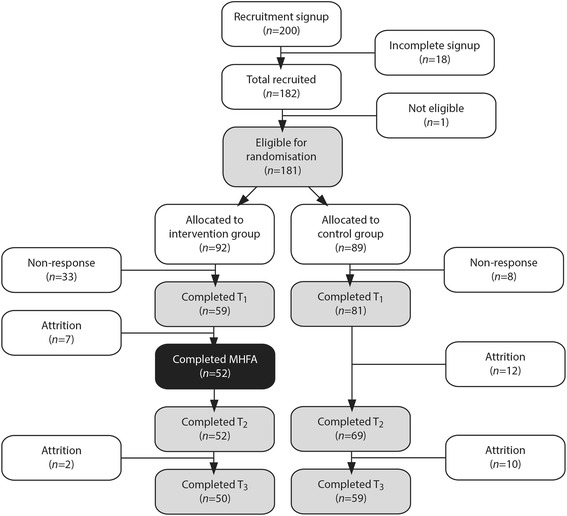
The prevalence of mental health problems have been found to be higher among university students compared to their non-student peers. Nursing students in particular face a range of additional stressors which may impact their undergraduate performance and their careers. Mental Health First Aid (MHFA) aims to increase mental health literacy and to reduce stigma and may positively impact on the student population. This paper describes a MHFA randomised controlled trial targeting nursing students at a large Australian university. This study aimed to measure the impact of the MHFA course on mental health literacy, mental health first aid intentions, confidence in helping someone with a mental health problem and stigmatising attitudes including social distance. Participants were first year nursing students (n = 181) randomly allocated to the intervention (n = 92) or control (n = 89) group. Intervention group participants received the standardised MHFA course for nursing students. Online self-report questionnaires were completed at three time intervals: baseline (one week prior to the intervention: T1) (n = 140), post intervention (T2) (n = 120), and two months post intervention (T3) (n = 109). Measures included demographics, mental health knowledge, recognition of depression, confidence in helping, mental health first aid intentions and stigmatising attitudes including social distance. Repeated measures ANOVA was computed to measure if the impact of time (T1, T2, T3) and group (intervention and control) on the outcome variables. There was a significant improvement among intervention compared to control group participants across the three time periods for knowledge scores (p < 0.001), confidence in helping (p < 0.001), mental health first aid intentions (p < 0.001), total personal stigma (p < 0.05), personal dangerous/unpredictable stigma (p < 0.05) and social distance (p < 0.05) scores. MHFA is useful training to embed in university courses and has the potential to enhance mental health literacy and reduce stigmatising attitudes and social distance. While this course has particular salience for nursing and other health science students, there are broader benefits to the general university population that should be considered and opportunities accordingly explored for all students to complete the course. Australian New Zealand Clinical Trials Registry ACTRN12614000861651 . Retrospectively registered 11 August 2014.
Overview
The claims and statistics of this paper haven’t been checked yet.
Free: it reads the open-access text and checks the first 5 claims that cite a source we can check. Create a free account to check every claim.
Integrity signals
Registry
Cites
Statistics
Figures
Verification
Claims the paper makes
The claims and statistics of this paper haven’t been checked yet.
Free: it reads the open-access text and checks the first 5 claims that cite a source we can check. Create a free account to check every claim.
Claims other papers make about this one
Each is checked against this paper’s own text: does it say what the citing paper says it does?
The cited source says what the claim attributes to it.
In the citing paper
“We attempted to contact authors to resolve any uncertainties or to obtain missing information, and received information from 10 studies [13–22].”
From Systematic review and meta-analysis of Mental Health First Aid training: Effects on knowledge, stigma, and helping behaviour (2018) · cites this paper as [14]
The cited source says what the claim attributes to it.
In the citing paper
“A final 18 studies were included in the review, with a total of 5936 participants [13–22, 42–49].”
From Systematic review and meta-analysis of Mental Health First Aid training: Effects on knowledge, stigma, and helping behaviour (2018) · cites this paper as [14]
Self-check
Percentages, sums and reported differences re-computed from the paper’s own numbers.
The self-check needs the paper’s full text.
Citations
Cites
CONSORT 2010 Statement: updated guidelines for reporting parallel group randomised trials
the CONSORT Group, Schulz, K. F., Altman, D. G., & Moher, D. (2010) · BMC Medicine · doi:10.1186/1741-7015-8-18 · Cited by 13,371
Foundations of Clinical Research: Applications to Practice,
(2002) · Survey of Ophthalmology · doi:10.1016/s0039-6257(02)00362-4 · Cited by 9,489 · cited 3×
“MHFA is a standardised course [36, 37], facilitated by accredited professionals therefore enhancing the fidelity of the course and reducing risk of Type 111 error [38].”
BackgroundCONSORT 2010 Statement: updated guidelines for reporting parallel group randomised trials
Schulz, K. F., Altman, D. G., Moher, D., & for the CONSORT Group (2010) · BMJ · doi:10.1136/bmj.c332 · Cited by 9,329
Diagnostic and Statistical Manual of Mental Disorders ( DSM ‐ IV ‐ TR )
Segal, D. L. (2010) · The Corsini Encyclopedia of Psychology · doi:10.1002/9780470479216.corpsy0271 · Cited by 4,666
Mental health of young people: A global public-health challenge
Patel, V., Flisher, A. J., Hetrick, S., & McGorry, P. (2007) · The Lancet · doi:10.1016/s0140-6736(07)60368-7 · Cited by 3,126 · cited 2×
“employment and contribution to community [1, 2].”
BackgroundA systematic review of studies of depression prevalence in university students
Ibrahim, A. K., Kelly, S. J., Adams, C. E., & Glazebrook, C. (2013) · Journal of Psychiatric Research · doi:10.1016/j.jpsychires.2012.11.015 · Cited by 1,988 · cited 1×
“6% among undergraduate university students [8].”
Public conceptions of mental illness: labels, causes, dangerousness, and social distance.
Link, B. G., Phelan, J. C., Bresnahan, M., Stueve, A., & Pescosolido, B. A. (1999) · American Journal of Public Health · doi:10.2105/ajph.89.9.1328 · Cited by 1,949 · cited 5×
“Social distance was measured by a scale adapted from the previously validated Social Distance Scale (SDS) [44] and used in other MHFA studies [27, 46].”
MethodInfluentialBlanco, C., Okuda, M., Wright, C., Hasin, D. S., Grant, B. F., Liu, S.-M., & Olfson, M. (2008) · Archives of General Psychiatry · doi:10.1001/archpsyc.65.12.1429 · Cited by 1,582 · cited 1×
“Financial strain and lower socio economic status, being in first or second year of study, being female, and living off campus or alone increases the risk of poorer mental health outcomes for students [4, 5, 7, 9, 10].”
BackgroundPsychological distress in university students: A comparison with general population data
Stallman, H. M. (2010) · Australian Psychologist · doi:10.1080/00050067.2010.482109 · Cited by 1,372 · cited 1×
“Financial strain and lower socio economic status, being in first or second year of study, being female, and living off campus or alone increases the risk of poorer mental health outcomes for students [4, 5, 7, 9, 10].”
BackgroundWhen and how do young people seek professional help for mental health problems?
Rickwood, D. J., Deane, F. P., & Wilson, C. J. (2007) · Medical Journal of Australia · doi:10.5694/j.1326-5377.2007.tb01334.x · Cited by 1,195
Foundations of clinical research application to practice
Portney, L. (1993) · Medical Entomology and Zoology · Cited by 1,135
Help-Seeking and Access to Mental Health Care in a University Student Population
Eisenberg, D., Golberstein, E., & Gollust, S. E. (2007) · Medical Care · doi:10.1097/mlr.0b013e31803bb4c1 · Cited by 1,131 · cited 2×
“Uptake of mental health services among university students has been found to be poor, with one Australian study finding up to 84% of students that met criteria for depression (Patient Health Questionnaire-9) and anxiety (Patient Health Questionnaire anxiety module) did not access services [17].”
BackgroundThe relation of depression and anxiety to life-stress and achievement in students
Andrews, B., & Wilding, J. M. (2004) · British Journal of Psychology · doi:10.1348/0007126042369802 · Cited by 919 · cited 1×
“Financial strain and lower socio economic status, being in first or second year of study, being female, and living off campus or alone increases the risk of poorer mental health outcomes for students [4, 5, 7, 9, 10].”
BackgroundGriffiths, K. M., Christensen, H., Jorm, A. F., Evans, K., & Groves, C. (2004) · British Journal of Psychiatry · doi:10.1192/bjp.185.4.342 · Cited by 789 · cited 3×
“While the DSS measures beliefs about people with mental health illnesses, the SDS measures intended avoidance behaviour [45].”
MethodFoundations of clinical research. Applications to practice
Fortney, L. (1993) · Medical Entomology and Zoology · Cited by 701
(2005) · PubMed · Cited by 649
Measuring the impact of programs that challenge the public stigma of mental illness
Corrigan, P. W., & Shapiro, J. R. (2010) · Clinical Psychology Review · doi:10.1016/j.cpr.2010.06.004 · Cited by 569 · cited 1×
“Scores were computed then divided by 5 to derive a mean [44] with higher scores representing less social distance and lower stigmatising attitudes [47].”
MethodSources of stress in nursing students: a systematic review of quantitative studies
Pulido‐Martos, M., Augusto‐Landa, J. M., & Lopez‐Zafra, E. (2012) · International Nursing Review · doi:10.1111/j.1466-7657.2011.00939.x · Cited by 510 · cited 2×
“Although nursing students face similar stressors to other tertiary students, additional factors have been identified which place them at risk for developing mental health problems [20].”
BackgroundHadlaczky, G., Hökby, S., Mkrtchian, A., Carli, V., & Wasserman, D. (2014) · International Review of Psychiatry · doi:10.3109/09540261.2014.924910 · Cited by 433 · cited 3×
“literacy and improve help seeking actions [49].”
BackgroundOccupational stress, job characteristics, coping, and the mental health of nurses
Mark, G., & Smith, A. P. (2012) · British Journal of Health Psychology · doi:10.1111/j.2044-8287.2011.02051.x · Cited by 417 · cited 2×
“Prolonged exposure to this type of work environment can negatively affect mental health which in turn may lead to absenteeism, high turnover of staff and burnout [23].”
BackgroundPerceived stress and social support in undergraduate nursing students' educational experiences
Reeve, K. L., Shumaker, C. J., Yearwood, E. L., Crowell, N. A., & Riley, J. B. (2013) · Nurse Education Today · doi:10.1016/j.nedt.2012.11.009 · Cited by 372 · cited 3×
“Utilising social supports has had a range of positive outcomes on the mental health of students including lowering stress; increasing coping mechanisms for stress; and promoting positive wellbeing [21].”
BackgroundMental health first aid training for high school teachers: a cluster randomized trial
Jorm, A. F., Kitchener, B. A., Sawyer, M. G., Scales, H., & Cvetkovski, S. (2010) · BMC Psychiatry · doi:10.1186/1471-244x-10-51 · Cited by 349 · cited 12×
“A RCT measuring the impact of MHFA among teachers [29] found a significant increase in the intervention group compared to the control group, although, similar to the current study, there was some attenuation in knowledge at follow up compared to post intervention.”
BackgroundMethodResultInfluentialStockings, E. A., Degenhardt, L., Dobbins, T., Lee, Y. Y., Erskine, H. E., Whiteford, H. A., & Patton, G. (2016) · Psychological Medicine · doi:10.1017/s0033291715001725 · Cited by 345 · cited 1×
“Accessing help for mental health problems is recognised as a protective factor [18] with indicated and early intervention programs likely to be most beneficial to adolescents and young adults [18, 19].”
BackgroundKitchener, B. A., & Jorm, A. F. (2004) · BMC Psychiatry · doi:10.1186/1471-244x-4-23 · Cited by 266
Mental Health First aid Training: Review of Evaluation Studies
Kitchener, B. A., & Jorm, A. F. (2006) · Australian & New Zealand Journal of Psychiatry · doi:10.1080/j.1440-1614.2006.01735.x · Cited by 258
Cvetkovski, S., Reavley, N. J., & Jorm, A. F. (2012) · Australian & New Zealand Journal of Psychiatry · doi:10.1177/0004867411435290 · Cited by 252 · cited 1×
“Financial strain and lower socio economic status, being in first or second year of study, being female, and living off campus or alone increases the risk of poorer mental health outcomes for students [4, 5, 7, 9, 10].”
BackgroundMental health literacy in higher education students
Reavley, N. J., McCann, T. V., & Jorm, A. F. (2012) · Early Intervention in Psychiatry · doi:10.1111/j.1751-7893.2011.00314.x · Cited by 244 · cited 2×
“There is a recognised need to enhance mental health literacy among the university population [6] and among allied health [26] and nursing students [24].”
BackgroundJorm, A. F., & Wright, A. (2008) · British Journal of Psychiatry · doi:10.1192/bjp.bp.107.039404 · Cited by 240 · cited 8×
“Yap MB, Wright A, Jorm AF.”
BackgroundResultInfluentialLeahy, C. M., Peterson, R. F., Wilson, I. G., Newbury, J. W., Tonkin, A. L., & Turnbull, D. (2010) · Australian & New Zealand Journal of Psychiatry · doi:10.3109/00048671003649052 · Cited by 214 · cited 2×
“Australian university students report higher levels of psychological distress than their non-student peers [4], and face unique mental health issues [5–7].”
BackgroundMental health first aid manual
Kitchener, B. A., & Jorm, A. F. (2002) · Cited by 211
Mental Health First Aid: an international programme for early intervention
Kitchener, B. A., & Jorm, A. F. (2008) · Early Intervention in Psychiatry · doi:10.1111/j.1751-7893.2007.00056.x · Cited by 209 · cited 2×
“Confidence in supporting and help seeking is a key component of the MHFA course [36, 37, 50].”
BackgroundAngermeyer, M. C., Holzinger, A., & Matschinger, H. (2009) · European Psychiatry · doi:10.1016/j.eurpsy.2008.06.010 · Cited by 195 · cited 1×
“tance from people with schizophrenia and depression remained unchanged [55].”
BackgroundRecognition of depression and psychosis by young Australians and their beliefs about treatment
Wright, A., Harris, M. G., Jorm, A. F., Cotton, S. M., Harrigan, S. M., McGorry, P. D., Wiggers, J. H., & Hurworth, R. E. (2005) · Medical Journal of Australia · doi:10.5694/j.1326-5377.2005.tb06881.x · Cited by 174
O'Reilly, C. L., Bell, J. S., Kelly, P. J., & Chen, T. F. (2011) · Australian & New Zealand Journal of Psychiatry · doi:10.3109/00048674.2011.585454 · Cited by 162 · cited 4×
“The course has been identified as a potential intervention for health professionals including nursing, medical [27] and pharmacy students [26] and for other support services [30] to improve mental health literacy and increase the likelihood of providing mental health first aid to a peer experiencing a mental health pr…”
BackgroundMethodResultInfluentialReavley, N. J., Mackinnon, A. J., Morgan, A. J., & Jorm, A. F. (2014) · Australian & New Zealand Journal of Psychiatry · doi:10.1177/0004867413500351 · Cited by 161 · cited 5×
“Mental health professionals have been found to have lower levels of ‘personal weak-not-sick’ and ‘dangerous/unpredictable’ stigma compared to general community members [48].”
BackgroundInfluentialMental health first aid training for Australian medical and nursing students: an evaluation study
Bond, K. S., Jorm, A. F., Kitchener, B. A., & Reavley, N. J. (2015) · BMC Psychology · doi:10.1186/s40359-015-0069-0 · Cited by 147 · cited 10×
“A recent Australian study of online and face-to-face MHFA courses for university nursing and medical students found an increase in mental health knowledge, however did not use a control group [27].”
BackgroundResultInfluentialYap, M. B. H., Mackinnon, A., Reavley, N., & Jorm, A. F. (2014) · International Journal of Methods in Psychiatric Research · doi:10.1002/mpr.1433 · Cited by 135 · cited 9×
“Previous studies have employed Principal Component Analysis [29] and Exploratory Structural Equational Modelling [45] to reduce stigma and social distance items.”
BackgroundMethodInfluentialJorm, A. F., Kitchener, B. A., O'Kearney, R., & Dear, K. B. (2004) · BMC Psychiatry · doi:10.1186/1471-244x-4-33 · Cited by 115
Stigmatising attitudes towards people with mental disorders: Changes in Australia over 8years
Reavley, N. J., & Jorm, A. F. (2012) · Psychiatry Research · doi:10.1016/j.psychres.2012.01.011 · Cited by 100 · cited 3×
“This may be associated with awareness generated from campaigns and media stories [53].”
BackgroundInfluentialHealth Promotion Strategies and Methods
Egger, G. J., Spark, R. L., & Donovan, R. (1992) · eSpace (Curtin University) · Cited by 87
Yap, M. B. H., & Jorm, A. F. (2012) · Psychiatry Research · doi:10.1016/j.psychres.2011.10.004 · Cited by 84 · cited 3×
“by three researchers using the scoring system described by Yap and Jorm [41].”
BackgroundMethodInfluentialHealth Promotion Strategies and Methods
King, M. (2000) · Contemporary Nurse · doi:10.5172/conu.2000.9.2.192 · Cited by 82
Yap, M. B. H., & Jorm, A. F. (2011) · Journal of Affective Disorders · doi:10.1016/j.jad.2011.05.039 · Cited by 82 · cited 2×
“In comparison, higher levels of social distance and ‘weak-not-sick’ dimensions predicted less helpful first aid responses [54].”
BackgroundYap, M. B. H., Wright, A., & Jorm, A. F. (2011) · Psychiatry Research · doi:10.1016/j.psychres.2011.01.014 · Cited by 80 · cited 1×
“Responses may receive 0–2 points per component of the ALGEE (Approach the person; Assess and Assist with any crisis; Listen non-judgementally; Give support and information; Encourage appropriate professional help; and encourage other supports) (Total score 0–12) [42].”
BackgroundEmotional Intelligence: Recognizing and Regulating Emotions
Reeves, A. (2005) · AAOHN Journal · doi:10.1177/216507990505300407 · Cited by 78 · cited 1×
“professionals in high stress environments [22].”
Valdez, C. R., Lambert, S. F., & Ialongo, N. S. (2011) · Child Psychiatry & Human Development · doi:10.1007/s10578-011-0230-9 · Cited by 77
Slominski, L., Sameroff, A. J., Rosenblum, K. L., & Kasser, T. (2011) · Development and Psychopathology · doi:10.1017/s0954579410000829 · Cited by 74
Association between Bullying and Mental Health Status in New Zealand Adolescents
Coggan, C., Bennett, S., Hooper, R., & Dickinson, P. (2003) · International Journal of Mental Health Promotion · doi:10.1080/14623730.2003.9721892 · Cited by 68
Mental health literacy of Australian Bachelor of Nursing students: a longitudinal study
McCann, T. V., Lu, L., & Berryman, C. F. (2009) · Journal of Psychiatric and Mental Health Nursing · doi:10.1111/j.1365-2850.2008.01330.x · Cited by 48 · cited 3×
“Mental health literacy has been identified as an important component of a nursing degree and it is recommended that it is introduced early in the course [24].”
BackgroundYap, M. B. H., Reavley, N., Mackinnon, A. J., & Jorm, A. F. (2013) · Journal of Affective Disorders · doi:10.1016/j.jad.2012.12.015 · Cited by 45 · cited 1×
“It is recognised that stigma is a complex and multilayered phenomenon [54, 56] which”
BackgroundCrawford, G., Burns, S. K., Chih, H., Hunt, K., Tilley, P. J. M., Hallett, J., Coleman, K., & Smith, S. (2015) · BMC Psychiatry · doi:10.1186/s12888-015-0403-3 · Cited by 44
Self-citationBurns, S. K., Crawford, G., Hallett, J., Jancey, J. M., Portsmouth, L., Hunt, K., & Longo, J. (2015) · Open Journal of Preventive Medicine · doi:10.4236/ojpm.2015.51001 · Cited by 38 · cited 1×
“Participation in university studies has been found to be low [32, 33].”
BackgroundSelf-citationHossain, D., Gorman, D., Eley, R., & Coutts, J. (2010) · Rural and Remote Health · doi:10.22605/rrh1593 · Cited by 30 · cited 1×
“The course has been identified as a potential intervention for health professionals including nursing, medical [27] and pharmacy students [26] and for other support services [30] to improve mental health literacy and increase the likelihood of providing mental health first aid to a peer experiencing a mental health pr…”
BackgroundA cross sectional evaluation of a total smoking ban at a large Australian university
Burns, S. K., Hart, E., Jancey, J. M., Hallett, J., Crawford, G., & Portsmouth, L. (2016) · BMC Research Notes · doi:10.1186/s13104-016-2090-7 · Cited by 26 · cited 1×
“Participation in university studies has been found to be low [32, 33].”
BackgroundSelf-citationHalf of Australian youth aged 18-20 are not in training
Birrell, B., & Edwards, D. (2007) · Cited by 16
Predictors of Bullying among 10 to 11 Year Old School Students in Australia
Burns, S. K., CROSS, D. S., Alfonso, H. S., & Maycock, B. R. (2008) · Advances in School Mental Health Promotion · doi:10.1080/1754730x.2008.9715728 · Cited by 10
Self-citationSMILE: Simple, Mental Health, Initiative in Learning and Education
Ward, L. (2011) · Education for Health · doi:10.4103/1357-6283.101424 · Cited by 9 · cited 1×
“An Australian study found structured programs examining mental health issues increased nursing students’ confidence and preparedness to respond to mental health issues [25].”
BackgroundKitchener, B. A., & Jorm, A. F. (2008) · Cited by 5
Research works printed but not linked: 6
- Australian Bureau of Statistics: National Survey of Mental Health and Wellbeing: Summary of Results. In., vol. 4326.0. Canberra: Australian Bureau of Statistics; 2008.
- Wang L Co-occuring academic and mental health problems in high school: a longitudinal study 2009 Chapel Hill The University of North Carolina
- World Health Organization The ICD-10 classification of mental and behavioural disorders: Clinical descriptions and diagnostic guidelines 1992 Geneva World Health Organisation
- Australian Bureau of Statistics Australian Social Trends: Education Differences Between Men and Women 2012 Canberra Australian Bureau of Statistics
- Health Workforce Australia (HWA) Australia’s Health Workforce Series – Nurses in focus 2013 Adelaide HWA
- Office of Strategy and Planning CU School of Nursing, Midwifery and Paramedicine Student Headcount 2016 Perth Curtin University
Cited by
Morgan, A. J., Ross, A., & Reavley, N. J. (2018) · PLOS ONE · doi:10.1371/journal.pone.0197102 · Cited by 461
Waqas, A., Malik, S., Fida, A., Abbas, N., Mian, N., Miryala, S., Amray, A. N., Shah, Z., & Naveed, S. (2020) · Psychiatric Quarterly · doi:10.1007/s11126-020-09751-4 · Cited by 176
Tembo, C. P., Burns, S. K., & Kalembo, F. W. (2017) · PLoS ONE · doi:10.1371/journal.pone.0178142 · Cited by 187
Self-citationAndérson, G. S., Nota, P. M. D., Groll, D., & Carleton, R. N. (2020) · International Journal of Environmental Research and Public Health · doi:10.3390/ijerph17207645 · Cited by 153
“All studies were rated at a low risk of bias regarding selection of the non-exposed cohort, which was either randomly selected from the same population in the case of RCTs [31,32,35,37], or compared to a sample from the same larger population that did not offer the service in question [27,34,36,38], or not applicable…”
BackgroundMethodResultInfluentialMorgan, A. J., Wright, J., & Reavley, N. J. (2021) · International Journal of Mental Health Systems · doi:10.1186/s13033-020-00423-1 · Cited by 82
Metadata
- Authors
- Burns, S., Crawford, G., Hallett, J., Hunt, K., Chih, H. J., & Tilley, P. J. M.
- Affiliations
- Curtin University (AU)
- Corresponding author
- Burns, Sharyn
- Venue
- BMC Psychiatry
- Published
- 2017-03-23
- Volume
- 17
- Issue
- 1
- Pages
- 111-111
- ISSN
- 1471-244X (ISSN-L)
- PMC
- PMC5364573
- OpenAlex
- W2598908263
- Cited by
- 88
- References
- 58
- Citations by year
- 2026: 6 · 2025: 5 · 2024: 6 · 2023: 11 · 2022: 11 · 2021: 16 · 2020: 15 · 2019: 12 · 2018: 4 · 2017: 2
- FWCI
- 12.93
- Type
- journal article
- Language
- en
- Open access
- gold
- doi.org
- Licence
- cc-by
- Locations
- BMC Psychiatry (publishedVersion, cc-by)
- PubMed Central (publishedVersion, cc-by)
- PubMed (publishedVersion)
- eSpace (Curtin University) (submittedVersion, cc-by)
- Funders
- Curtin University of Technology
- Topics
- Health Sciences › Medicine › Psychiatry and Mental health › Mental Health Treatment and Access
- Health Sciences › Medicine › Public Health, Environmental and Occupational Health › School Health and Nursing Education
- Social Sciences › Psychology › Clinical Psychology › Suicide and Self-Harm Studies
- Keywords
- mental health first aid, nursing students, mental health literacy, mental health stigma, social distance, depression detection, university students, mental health education
- MeSH terms
- Adult, Attitude of Health Personnel, Australia, Mental Disorders, Career Choice, Curriculum, Education, Nursing, Female, First Aid, Humans, Male, New Zealand, Psychiatric Nursing, Psychological Distance, Stress, Psychological, Students, Nursing, Social Stigma
About these checks
Registry, retraction, Cites and statistics results are computed, not judged, with one exception: a printed reference that no index lists is read once by a model before it counts as a citation error. Claims are extracted by a model and kept only when their quote appears verbatim in the text; each cited source is then checked, with a model’s help, for whether it says what the claim relies on. Those verdicts can be wrong — read the claim’s quote and the cited source before relying on one.
Statistics and arithmetic are recomputed, not judged.
Confidence bands are shown only for fields calibrated on our annotated test set. None is calibrated yet, so no band is shown.
What counts as a claim ›How we measure confidence ›How we check this ›
Are you an author, or do you see a problem with this page? Request a review
Data sources
Bibliographic data: Semantic Scholar, OpenAlex, Crossref.
Contains information from the Semantic Scholar Academic Graph Datasets, made available under the ODC Attribution License (ODC-BY 1.0).
Semantic Scholar’s data is described in: Kinney, R., et al. (2023). The Semantic Scholar Open Data Platform. arXiv:2301.10140.
