

Testing the psychometric properties of the illness perceptions questionnaire for OCD (IPQ-O)
Open accessThe DOI matches its Crossref record; 37 of the 39 references it cites were found in a registry or an index; 10 of the 31 sources its claims cite were checked for support.
Abstract
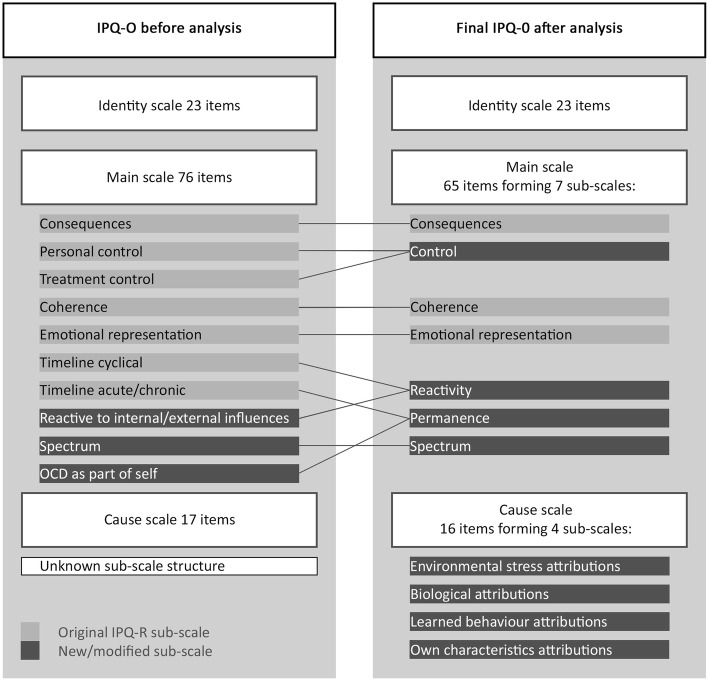
Background: Previous research has shown that our perceptions about illness are important determinants of how we respond and adjust to health threats. To examine whether illness perceptions affect illness responses in OCD (e.g. help-seeking), this study aimed to develop and test the psychometric properties of a new OCD-specific tool to assess illness perceptions, the illness perceptions questionnaire for OCD (IPQ-O). Methods: A cross-sectional questionnaire-based design was used. Following adaptation of the IPQ-R based on qualitative interviews with people with OCD, adults (age ≥ 16) with OCD completed the IPQ-O (online or postal), alongside measures of depression, anxiety, OCD severity, attitudes to seeking mental health services and behaviours (e.g. treatment seeking intentions). A sub-sample re-completed the IPQ-O after two-weeks to obtain test-retest reliability. Factor analysis was used to derive the IPQ-O factor structure; internal consistency of subscales was calculated. Convergent validity was explored. Results: Three hundred forty-eight people with OCD completed the IPQ-O. After factor analysis, seven main sub-scales and four cause sub-scales were identified, explaining 45.5 and 41.6% of the variance after extraction and rotation respectively. Three sub-scales from the original IPQ-R were validated; other dimensions differed from original IPQ-R sub-scales. The new 'spectrum' sub-scale measures the strength of the view that OCD is a trait that presents to varying extents within the general population. The IPQ-O demonstrated internal consistency, test re-test reliability (Kendall's tau =.51-.75) and convergent validity. Illness perceptions were associated with important aspects of adjustment (depression, anxiety) and condition management (receipt of treatment, plans to seek help). In particular, emerging data showed that those who had not received medication for OCD endorsed stronger spectrum beliefs. Though longitudinal study is needed to verify the direction of this association, this raises the question of whether spectrum beliefs deter people with OCD from using pharmacological treatments. Conclusions: The IPQ-O provides a valuable tool for subsequent testing of whether illness perceptions drive outcomes as proposed by the CSM. If perceptions are found to drive adjustment and behaviour, therapists could elicit and subsequently challenge perceptions that have negative effects on adjustment and coping, as part of psychological therapy. © 2019 The Author(s).
Overview
CoChat Summary
## TL;DR
This study developed and psychometrically tested the OCD-specific Illness Perceptions Questionnaire (IPQ-O) in a cross-sectional sample of adults with self-reported OCD. The IPQ-O showed internal consistency, two-week test-retest reliability, and convergent validity, while also revealing some OCD-specific dimensions such as a “spectrum” belief.
## Key findings
- Sample and scale development: 348 people with OCD completed the IPQ-O; factor analysis yielded 7 main sub-scales and 4 cause sub-scales.
- Explained variance: The 7 main sub-scales explained 45.5% of the variance after extraction and rotation; the 4 cause sub-scales explained 41.6% of the variance after extraction and rotation.
- Reliability: Two-week test-retest reliability ranged from Kendall’s τ = .51 to .75, and all sub-scales exceeded the paper’s minimum converted threshold of τ > .49. The identity scale had Cronbach’s α = .87; the spectrum sub-scale was weaker at α = .592.
- Construct validity and associations: Illness perceptions were associated with depression, anxiety, OCD severity, functioning, and treatment-related variables. For example, consequences correlated with anxiety/depression at τ = .39, consequences with functioning at τ = .47, and control with functioning at τ = −.26; spectrum beliefs were lower among those who had received medication, and permanence was associated with plans to seek NHS help.
## Methods
- Design and sample: Cross-sectional questionnaire study of adults aged ≥16 with self-reported clinician diagnosis of OCD and ability to read/write English; no exclusion criteria were stated.
- Measures and procedure: Participants completed the IPQ-O plus measures of OCD severity (SR Y-BOCS), functioning (WSAS), depression (PHQ-9), anxiety (GAD-7), attitudes to mental health service use (IASMHS), and treatment/help-seeking questions; a sub-sample repeated the IPQ-O after two weeks (64 retested).
- Analysis: Principal axis factor analysis with oblique rotation, internal consistency via Cronbach’s α, and non-parametric correlations (Kendall’s τ) for test-retest and convergent/construct validity; Mann-Whitney U tests were used for categorical treatment/help-seeking comparisons.
## Limitations
- Stated by the paper: OCD diagnosis was not verified with a diagnostic tool, so some participants may not have had current OCD; remote completion also meant less control over testing conditions.
- Stated by the paper: The sample may be biased toward help-seeking/treatment-engaged individuals, because recruitment relied heavily on OCD charities and few participants had received no prior treatment.
- Stated by the paper: The sample was relatively long-standing and female (mean OCD duration 18 years; three quarters female), so future studies should recruit more representative samples.
- Evidence from the text: The study is cross-sectional, so it cannot establish whether illness perceptions cause later treatment use or adjustment outcomes; the paper explicitly notes that longitudinal studies are needed.
Model-written summary. Check it against the paper before relying on it.
Integrity signals
Registry
Cites
Statistics
Figures
Verification
Claims the paper makes
9 Valid · 0 Not valid · 17 Not checked · 78 Own results and interpretations
The cited sources support only part of this claim — read each source’s verdict below.
In the paper
“Potential items for the IPQ-O were generated from themes identified from qualitative analysis of 16 interviews with people with OCD [13].”
§ Testing the psychometric properties of the illness perceptions questionnaire for OCD (IPQ-O) > Methods > Materials
What the sources say
- Partly supportedcites [13] Pedley R Bee P Wearden A Berry K Illness perceptions in people with obsessive-compulsive disorder; a qualitative study PLoS One 2019 14 3 e0213495 30893331 PMC6426201 sourceExperimental — accuracy not yet measured
The Materials and methods—Analysis section describes thematic analysis of interviews with people with OCD, and the Results table lists 16 participants. The paper identifies themes but does not say that potential IPQ-O items were generated from them; its discussion of measures concerns the IPQ and IPQ-R. No page numbers were provided in our copy. (LLM, conf=0.85)
plainstates a causen = 16- Asserted: passes — The authors put it forward as true.
- Checkable: passes — It can be checked against evidence.
- Load-bearing: passes — The paper’s conclusions depend on it.
- Based: passes — The paper gives a reason why it holds.
- Partly supported
A result the paper reports from its own data — it cites no other source for it, so there is none to check. The quote shows it is in the paper.
In the paper
“Inconsistent with predictions, there were no significant differences in control beliefs between those who did and did not plan to seek future help (NHS help, ‘other’ help, private therapy).”
§ Testing the psychometric properties of the illness perceptions questionnaire for OCD (IPQ-O) > Results > Relationships with condition management variables
plain- Asserted: passes — The authors put it forward as true.
- Checkable: passes — It can be checked against evidence.
- Load-bearing: unclear — It is unclear whether the paper’s conclusions depend on it.
- Based: passes — The paper gives a reason why it holds.
A result the paper reports from its own data — it cites no other source for it, so there is none to check. The quote shows it is in the paper.
In the paper
“Perceptions of OCD as caused by one’s own characteristics or behaviour were associated with higher depression scores.”
§ Testing the psychometric properties of the illness perceptions questionnaire for OCD (IPQ-O) > Results > Construct validity
plainstates an association- Asserted: passes — The authors put it forward as true.
- Checkable: passes — It can be checked against evidence.
- Load-bearing: passes — The paper’s conclusions depend on it.
- Based: passes — The paper gives a reason why it holds.
A result the paper reports from its own data — it cites no other source for it, so there is none to check. The quote shows it is in the paper.
In the paper
“The IPQ-O demonstrated internal consistency, test re-test reliability (Kendall’s tau = .51–.75) and convergent validity.”
§ Testing the psychometric properties of the illness perceptions questionnaire for OCD (IPQ-O) > Abstract > Results
boostedstates an associationn = 3- Asserted: passes — The authors put it forward as true.
- Checkable: passes — It can be checked against evidence.
- Load-bearing: passes — The paper’s conclusions depend on it.
- Based: passes — The paper gives a reason why it holds.
A result the paper reports from its own data — it cites no other source for it, so there is none to check. The quote shows it is in the paper.
In the paper
“Unexpectedly however, two new items measuring feeling ashamed/embarrassed and worthless, loaded together with consequences (OIP15 and OIP5).”
§ Testing the psychometric properties of the illness perceptions questionnaire for OCD (IPQ-O) > Results > Factor structure and internal reliability
plainstates an association- Asserted: passes — The authors put it forward as true.
- Checkable: passes — It can be checked against evidence.
- Load-bearing: passes — The paper’s conclusions depend on it.
- Based: passes — The paper gives a reason why it holds.
37 more claims
Create a free account to see all 104 claims and to verify the 8 references still open.
- Probably not a substantial claim. 19
- It may state two separate claims as one. 55
- The quote only partly states this claim. 1
Citations
Cites
The PHQ-9: Validity of a brief depression severity measure
Kroenke, K., Spitzer, R. L., & Williams, J. B. W. (2001) · Journal of General Internal Medicine · doi:10.1046/j.1525-1497.2001.016009606.x · Cited by 44,910
A Brief Measure for Assessing Generalized Anxiety Disorder: The GAD-7
Spitzer, R. L., Kroenke, K., Williams, J. B. W., & Löwe, B. (2006) · Archives of Internal Medicine · doi:10.1001/archinte.166.10.1092 · Cited by 31,765
(2017) · Cited by 16,319
Costello, A. B., & Osborne, J. (2005) · University of Massachusetts Amherst · doi:10.7275/jyj1-4868 · Cited by 10,297 · cited 3×
“As it was expected that the resultant sub-scales would correlate, an oblique rotation (direct oblimin) was chosen [21].”
BackgroundMethodInfluentialSpitzer, R. L. (1999) · JAMA · doi:10.1001/jama.282.18.1737 · Cited by 9,802
Cohen, J. (1992) · Psychological Bulletin · doi:10.1037//0033-2909.112.1.155 · Cited by 8,771
The Yale-Brown Obsessive Compulsive Scale: I. Development, Use, and Reliability
Goodman, W. K. (1989) · Archives of General Psychiatry · doi:10.1001/archpsyc.1989.01810110048007 · Cited by 7,712
Kaiser, H. F., & Rice, J. (1974) · Educational and Psychological Measurement · doi:10.1177/001316447403400115 · Cited by 3,423
The revised illness perception questionnaire (IPQ-R)
Moss-Morris, R., Weinman, J., Petrie, K., Horne, R., Cameron, L., & Buick, D. (2002) · Psychology & Health · doi:10.1080/08870440290001494 · Cited by 2,949
The epidemiology of obsessive-compulsive disorder in the National Comorbidity Survey Replication
Ruscio, A. M., Stein, D. J., Chiu, W. T., & Kessler, R. C. (2010) · Molecular Psychiatry · doi:10.1038/mp.2008.94 · Cited by 2,771
The Work and Social Adjustment Scale: a simple measure of impairment in functioning
Mundt, J. C., Marks, I. M., Shear, M. K., & Greist, J. M. (2002) · British Journal of Psychiatry · doi:10.1192/bjp.180.5.461 · Cited by 2,515
Making Sense of Factor Analysis
Pett, M., Lackey, N., & Sullivan, J. (2003) · doi:10.4135/9781412984898 · Cited by 2,168
Sullivan, J., Pett, M. A., & Lackey, N. R. (2003) · Medical Entomology and Zoology · Cited by 1,692
A Meta-Analytic Review of the Common-Sense Model of Illness Representations
Hagger, M. S., & Orbell, S. (2003) · Psychology & Health · doi:10.1080/088704403100081321 · Cited by 1,607
Weinman, J., Petrie, K. J., Moss-morris, R., & Horne, R. (1996) · Psychology & Health · doi:10.1080/08870449608400270 · Cited by 1,541
Gatchel, R. J., Baum, A., & Singer, J. E. (2021) · Routledge eBooks · doi:10.4324/9781003161530 · Cited by 1,321
Illness Representations and Coping With Health Threats
Leventhal, H., Nerenz, D. R., & Steele, D. J. (2020) · Handbook of Psychology and Health (Volume IV) · doi:10.1201/9781003044307-9 · Cited by 558
Perceptions of Health and Illness
Petrie, J. A. W. K. (2013) · doi:10.4324/9781315078908-7 · Cited by 552
Missing data imputation: focusing on single imputation.
Zhang, Z. (2016) · PubMed · doi:10.3978/j.issn.2305-5839.2015.12.38 · Cited by 410 · cited 1×
“To reduce the potential for unpredictable bias resulting from the substantial case loss incurred through list-wise deletion [22], missing data points were imputed through expectationmaximisation (EM).”
MethodPinto, A., Mancebo, M. C., Eisen, J. L., Pagano, M. E., & Rasmussen, S. A. (2006) · The Journal of Clinical Psychiatry · doi:10.4088/jcp.v67n0503 · Cited by 386
The psychological treatment of obsessive-compulsive disorder
Abramowitz, J. S. (2006) · The Canadian Journal of Psychiatry · doi:10.1177/070674370605100702 · Cited by 371
An Adaptation and Extension of the Attitudes Toward Seeking Professional Psychological Help Scale 1
Mackenzie, C. S., Knox, V. J., Gekoski, W. L., & Macaulay, H. L. (2004) · Journal of Applied Social Psychology · doi:10.1111/j.1559-1816.2004.tb01984.x · Cited by 368
The key principles of cognitive behavioural therapy
Fenn, K., & Byrne, M. (2013) · InnovAiT: Education and inspiration for general practice · doi:10.1177/1755738012471029 · Cited by 363
Gilpin, A. R. (1993) · Educational and Psychological Measurement · doi:10.1177/0013164493053001007 · Cited by 222
Quality of Life in Obsessive-Compulsive Disorder: Impact of the Disorder and of Treatment
Subramaniam, M., Soh, P., Vaingankar, J. A., Picco, L., & Chong, S. A. (2013) · CNS Drugs · doi:10.1007/s40263-013-0056-z · Cited by 186
Obsessive-compulsive disorder: Effects on family members.
Cooper, M. (1996) · American Journal of Orthopsychiatry · doi:10.1037/h0080180 · Cited by 170
Zhang, W.-X., Cao, L.-B., Zhao, Y., Li, J., Li, B.-F., Lv, J.-N., Yan, L., & Ma, J.-L. (2021) · Annals of Translational Medicine · doi:10.21037/atm-20-3623 · Cited by 158
García-Soriano, G., Rufer, M., Delsignore, A., & Weidt, S. (2014) · Psychiatry Research · doi:10.1016/j.psychres.2014.07.009 · Cited by 151
Baines, T., & Wittkowski, A. (2013) · Journal of Clinical Psychology in Medical Settings · doi:10.1007/s10880-012-9337-9 · Cited by 147
Skapinakis, P., Caldwell, D., Hollingworth, W., Bryden, P., Fineberg, N., Salkovskis, P., Welton, N., Baxter, H., Kessler, D., Churchill, R., et al. (2016) · Health Technology Assessment · doi:10.3310/hta20430 · Cited by 134
Patient Preferences for Obsessive-Compulsive Disorder Treatment
Patel, S. R., & Simpson, H. B. (2010) · The Journal of Clinical Psychiatry · doi:10.4088/jcp.09m05537blu · Cited by 53
Illness perceptions associated with perinatal depression treatment use
O’Mahen, H., Flynn, H. A., Chermack, S. T., & Marcus, S. M. (2009) · Archives of Women s Mental Health · doi:10.1007/s00737-009-0078-1 · Cited by 43
An exploration of illness beliefs in mothers with postnatal depression
Patel, S., Wittkowski, A., Fox, J. R. E., & Wieck, A. (2013) · Midwifery · doi:10.1016/j.midw.2012.06.012 · Cited by 23
Illness perceptions in people with obsessive-compulsive disorder; A qualitative study
Pedley, R., Bee, P., Wearden, A., & Berry, K. (2019) · PLOS ONE · doi:10.1371/journal.pone.0213495 · Cited by 22
Self-citationde Silva, P. (2009) · Cited by 6
Salkind, N. J. (2005) · Encyclopedia of Human Development · doi:10.4135/9781412952484.n453 · Cited by 6
General principles of psychological therapies
Maguire, N. (2016) · Medicine · doi:10.1016/j.mpmed.2016.09.008 · Cited by 1
Research works printed but not linked: 2
- IBM Corp IBM SPSS statistics for windows. 23.0 ed 2015 Armonk IBM Corp
- Nunnally JC Psychometric theory 1978 New York Mcgraw-Hill
Cited by
A nomological network for misophonia in two German samples using the S-Five model for misophonia
Remmert, N., Jebens, A., Gruzman, R., Gregory, J. E., & Vitoratou, S. (2022) · Frontiers in Psychology · doi:10.3389/fpsyg.2022.902807 · Cited by 33
“, symptom coherence) is associated with internal attributions, but not with external, environmental attributions (Pedley et al., 2019).”
BackgroundResultAgüera, Z., Riesco, N., Valenciano‐Mendoza, E., Granero, R., Sánchez, I., Andreu, A., Jiménez‐Múrcia, S., & Fernández‐Aranda, F. (2021) · Eating and Weight Disorders - Studies on Anorexia Bulimia and Obesity · doi:10.1007/s40519-020-01083-3 · Cited by 16
“Studies carried out on other psychiatric disorders, such as bipolar disorder [15], obsessive–compulsive disorder [16], or mood disorders [17], also corroborate the relevance of illness perception in treatment adherence.”
BackgroundBear, H. A., Moon, Z., Wasil, A. R., Ahuvia, I. L., Edbrooke-Childs, J. H., & Wolpert, M. (2023) · Counselling Psychology Quarterly · doi:10.1080/09515070.2023.2232320 · Cited by 5
“This validation process has been carried out successfully with populations including breast cancer survivors treated with tamoxifen (IPQ-BCS) (Moon, Moss-Morris, Hunter, & Hughes, 2017), patients with atrial fibrillation (AF IPQ-R) (Taylor, O’Neill, Hughes, & Moss-Morris, 2018), adults with obsessive compulsive disord…”
Wongbusarakum, K., Schug, E., Visher, T. C., Sulivan-Pascual, K., Mirkis, M., Rhee, P., & Frank, A. C. (2025) · Journal of Obsessive-Compulsive and Related Disorders · doi:10.1016/j.jocrd.2025.100982 · Cited by 4
Laranjeira, C., Querido, A., & VALENTİM, O. M. M. D. S. (2021) · Journal of Substance Use · doi:10.1080/14659891.2021.1916848 · Cited by 3
“…2012), stress urinary incontinence (Fan et al., 2017), type 2 Diabetes Mellitus (Chew et al., 2017), mild brain injury (Snell et al., 2010), fibromyalgia (van Ittersum et al., 2009), multiple somatic symptoms (Zhang et al., 2018), and mental disorders (Cabassa et al., 2008; Pedley et al., 2019).”
Background
Metadata
- Authors
- Pedley, R., Berry, K., Bee, P., Gellatly, J., & Wearden, A.
- Affiliations
- Manchester Academic Health Science Centre (GB)
- Corresponding author
- Pedley, Rebecca
- Venue
- BMC Psychiatry
- Published
- 2019-07-10
- Volume
- 19
- Issue
- 1
- Pages
- 217-217
- ISSN
- 1471-244X (ISSN-L)
- PMC
- PMC6617616
- OpenAlex
- W2957527707
- Cited by
- 8
- References
- 39
- Citations by year
- 2025: 1 · 2024: 1 · 2023: 2 · 2022: 2 · 2021: 2
- FWCI
- 1.17
- Type
- journal article
- Language
- en
- Open access
- gold
- doi.org
- Licence
- cc-by
- creativecommons.org/licenses/by/4.0/ (tdm)
- creativecommons.org/licenses/by/4.0/ (vor)
- Locations
- BMC Psychiatry (publishedVersion, cc-by)
- Europe PMC (PubMed Central) (publishedVersion, cc-by)
- PubMed Central (publishedVersion, cc-by)
- PubMed (publishedVersion)
- Research Explorer (The University of Manchester) (publishedVersion, cc-by)
- DOAJ (DOAJ: Directory of Open Access Journals) (submittedVersion)
- Topics
- Social Sciences › Psychology › Clinical Psychology › Obsessive-Compulsive Spectrum Disorders
- Social Sciences › Psychology › Experimental and Cognitive Psychology › Anxiety, Depression, Psychometrics, Treatment, Cognitive Processes
- Social Sciences › Decision Sciences › Management Science and Operations Research › Psychometric Methodologies and Testing
- Keywords
- illness perception, obsessive-compulsive disorder, psychometric validation, help-seeking, treatment-seeking intention, depression, anxiety, OCD severity, medication use, factor structure
- MeSH terms
- Adaptation, Psychological, Adolescent, Adult, Attitude to Health, Cross-Sectional Studies, Factor Analysis, Statistical, Female, Humans, Male, Middle Aged, Obsessive-Compulsive Disorder, Patient Acceptance of Health Care, Perception, Psychometrics, Surveys and Questionnaires, Reproducibility of Results, Qualitative Research, Young Adult
About these checks
Registry, retraction, Cites and statistics results are computed, not judged, with one exception: a printed reference that no index lists is read once by a model before it counts as a citation error. Claims are extracted by a model and kept only when their quote appears verbatim in the text; each cited source is then checked, with a model’s help, for whether it says what the claim relies on. Those verdicts can be wrong — read the claim’s quote and the cited source before relying on one.
The claim verdicts this report counts are experimental: their accuracy is not yet measured.
A language model drew the claims from the paper on 2026-10-11, under version 3 of the claim definition (model deepseek-v4.1-flash, prompt extract-v3).
A second model labelled each claim on 2026-10-11 (model jev-1.13-20260917, definition revision gold-guideline-v0.2).
Cited sources are checked with a language model’s help (gpt-6-sol).
Statistics and arithmetic are recomputed, not judged.
Confidence bands are shown only for fields calibrated on our annotated test set. None is calibrated yet, so no band is shown.
What counts as a claim ›How we measure confidence ›How we check this ›
Are you an author, or do you see a problem with this page? Request a review
Data sources
Bibliographic data: Semantic Scholar, OpenAlex, Crossref.
Contains information from the Semantic Scholar Academic Graph Datasets, made available under the ODC Attribution License (ODC-BY 1.0).
Semantic Scholar’s data is described in: Kinney, R., et al. (2023). The Semantic Scholar Open Data Platform. arXiv:2301.10140.
