

Prevalence of problematic smartphone usage and associated mental health outcomes amongst children and young people: a systematic review, meta-analysis and GRADE of the evidence
Open accessThe DOI matches its Crossref record; 75 of the 75 references it cites were found in a registry or an index; 14 of the 29 sources its claims cite were checked for support.
Abstract
Systematic review and meta-analysis of 41 studies assessing problematic smartphone use and mental health outcomes among children and young people.
Overview
CoChat Summary
## TL;DR
This systematic review/meta-analysis found that problematic smartphone use (PSU) affected about 1 in 4 children and young people (median prevalence 23.3%) across 41 studies and was consistently associated with worse mental health. The pooled associations were strongest for depression and anxiety, with elevated odds for depression (OR 3.17) and anxiety (OR 3.05 after accounting for heterogeneity).
## Key findings
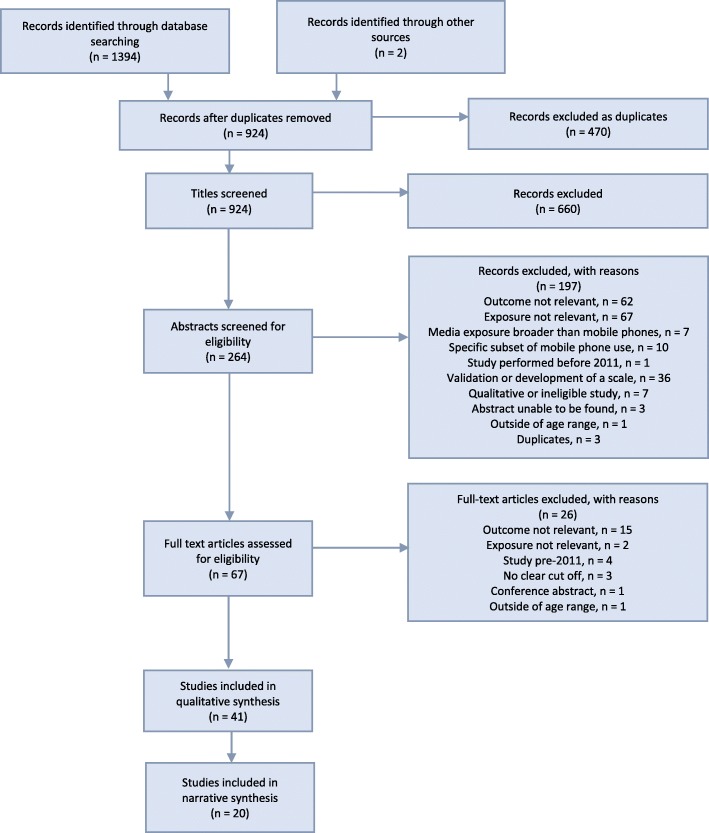
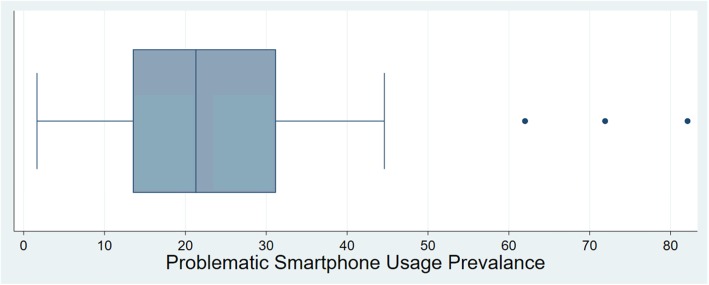
- Across 41 studies with 41,871 participants, the median prevalence of PSU was 23.3% with an interquartile range of 14–31.2%; 31 studies reported prevalence between 10% and 30%.
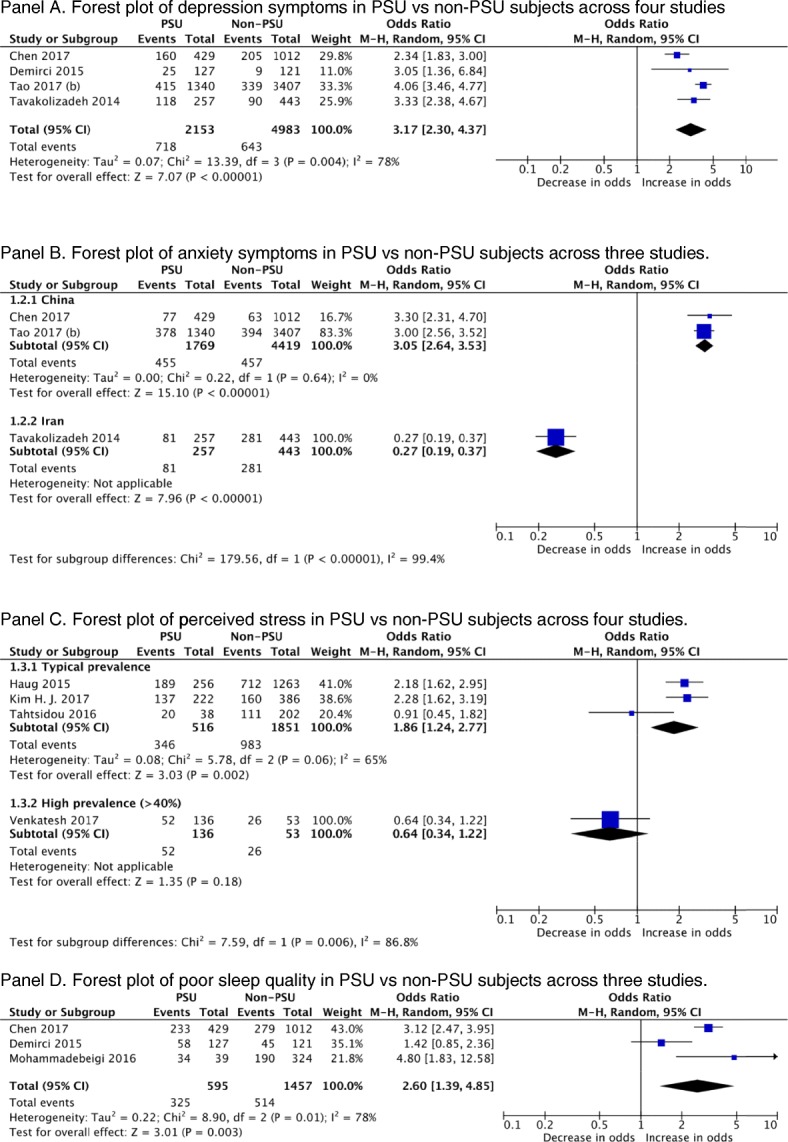
- PSU was associated with increased odds of depression: OR 3.17 (95% CI 2.30–4.37; I² = 78%; 8 studies, 10,099 participants).
- PSU was associated with increased odds of anxiety: OR 3.05 after accounting for heterogeneity (95% CI 2.64–3.53; I² = 0%; 7 studies, 9,359 participants).
- PSU was also associated with perceived stress (OR 1.86, 95% CI 1.24–2.77; I² = 65%; 5 studies, 3,618 participants) and poor sleep (OR 2.60, 95% CI 1.39–4.85; I² = 78%; 7 studies, 4,194 participants).
## Methods
- Systematic review and meta-analysis conducted according to PRISMA, with an a priori PROSPERO protocol (#88800); evidence quality was assessed using GRADE and study quality with a modified Newcastle-Ottawa scale.
- Searched 8 databases from January 1, 2011 to October 15, 2017 with no language restriction; included randomized controlled trials, cohort, cross-sectional, and case-control studies involving children and young people with mean age ≤25 and a clear threshold for PSU.
- Quantitative synthesis used random-effects meta-analysis (Mantel-Haenszel method; generic inverse variance for logistic regression results) and subgroup analyses when heterogeneity exceeded 85%.
## Limitations
- The paper states that included studies were non-randomised and at high risk of bias; 22 studies were judged poor quality and 19 moderate quality.
- PSU definitions and thresholds varied widely, and some were incompletely described, which the paper says weakens implementation.
- Mental health outcomes were based on self-report questionnaires rather than formal diagnoses, and the paper notes that reverse causality cannot be excluded; this is a stated limitation and also an evident issue for causal interpretation.
Model-written summary. Check it against the paper before relying on it.
Integrity signals
Registry
Cites
Statistics
Figures
Verification
Claims the paper makes
9 Valid · 1 Not valid · 12 Not checked · 38 Own results and interpretations
The cited sources support only part of this claim — read each source’s verdict below.
In the paper
“Problematic users reported that social networking was the most important or preferred activity on smartphones [34, 40].”
§ Prevalence of problematic smartphone usage and associated mental health outcomes amongst children and young people: a systematic review, meta-analysis and GRADE of the evidence > Results > Types of PSU usage
What the sources say
- Partly supportedcites [34] Lopez-Fernandez O Kuss DJ Romo L Self-reported dependence on mobile phones in young adults: a European cross-cultural empirical survey J Behav Addict 2017 6 2 168 177 10.1556/2006.6.2017.020 28425777 PMC5520117 sourceExperimental — accuracy not yet measured
In Results > Proportion of highly dependent users and their profile, social networking was the most important online activity for a majority when asked about any technology, not smartphones specifically. On smartphones, messaging and chatting was the most frequently named favorite activity (47.8%), ahead of social networking (32.6%). (LLM, conf=0.88)
- Supportedcites [40] Haug S Castro RP Kwon M Filler A Kowatsch T Schaub MP Smartphone use and smartphone addiction among young people in Switzerland J Behav Addict 2015 4 4 299 307 10.1556/2006.4.2015.037 26690625 PMC4712764 source
The Results table reports that 208 of 256 participants classified as having smartphone addiction (81.3%) selected social networking as their most personally relevant smartphone function. The Methods section confirms that this was a self-reported choice among smartphone functions, supporting the paraphrase about problematic users' preferred activity. (LLM, conf=0.92)
plain- Asserted: passes — The authors put it forward as true.
- Checkable: passes — It can be checked against evidence.
- Load-bearing: unclear — It is unclear whether the paper’s conclusions depend on it.
- Based: passes — The paper gives a reason why it holds.
- Rests on an assumption not shown here.
- Partly supported
A result the paper reports from its own data — it cites no other source for it, so there is none to check. The quote shows it is in the paper.
In the paper
“Eight studies [28, 36, 48, 57–61] reported a significant association between PSU and depression across 10,099 participants.”
§ Prevalence of problematic smartphone usage and associated mental health outcomes amongst children and young people: a systematic review, meta-analysis and GRADE of the evidence > Results > PSU associated with mental health outcomes
plainstates an associationn = 10,099 ·- Asserted: passes — The authors put it forward as true.
- Checkable: passes — It can be checked against evidence.
- Load-bearing: passes — The paper’s conclusions depend on it.
- Based: passes — The paper gives a reason why it holds.
- Rests on 3 assumptions not shown here.
In the paper
“One study reported an increased odds of suicidal ideation amongst those with PSU [62]; however, this was assessed through a single screening question and caution should be taken with this finding.”
§ Prevalence of problematic smartphone usage and associated mental health outcomes amongst children and young people: a systematic review, meta-analysis and GRADE of the evidence > Results > PSU associated with mental health outcomes
What the sources say
- Not checked — no full text of the sourcecites [62] Kim HJ Min JY Kim HJ Min KB Association between psychological and self-assessed health status and smartphone overuse among Korean college students J Ment Health 2017 0 0 1 6 10.1080/09638237.2017.1370641 28868959 source
plainstates an association- Asserted: passes — The authors put it forward as true.
- Checkable: passes — It can be checked against evidence.
- Load-bearing: unclear — It is unclear whether the paper’s conclusions depend on it.
- Based: passes — The paper gives a reason why it holds.
- Rests on 2 assumptions not shown here.
A result the paper reports from its own data — it cites no other source for it, so there is none to check. The quote shows it is in the paper.
In the paper
“The pooled OR for anxiety amongst CYP with PSU was 2.60 (95% CI 1.39, to 4.85; p < 0.001; I2 = 78%).”
§ Prevalence of problematic smartphone usage and associated mental health outcomes amongst children and young people: a systematic review, meta-analysis and GRADE of the evidence > Results > PSU associated with mental health outcomes
plainstates an associationn = 9,359 ·- Asserted: passes — The authors put it forward as true.
- Checkable: passes — It can be checked against evidence.
- Load-bearing: passes — The paper’s conclusions depend on it.
- Based: passes — The paper gives a reason why it holds.
- Rests on 3 assumptions not shown here.
A result the paper reports from its own data — it cites no other source for it, so there is none to check. The quote shows it is in the paper.
In the paper
“Five studies [36, 39, 40, 44, 62] investigated perceived stress across 3618 participants.”
§ Prevalence of problematic smartphone usage and associated mental health outcomes amongst children and young people: a systematic review, meta-analysis and GRADE of the evidence > Results > PSU associated with mental health outcomes
plainn = 3,618- Asserted: passes — The authors put it forward as true.
- Checkable: passes — It can be checked against evidence.
- Load-bearing: unclear — It is unclear whether the paper’s conclusions depend on it.
- Based: passes — The paper gives a reason why it holds.
- Rests on 3 assumptions not shown here.
17 more claims
Create a free account to see all 60 claims and to verify the 1 reference still open.
- It may state two separate claims as one. 31
- Probably not a substantial claim. 16
- The quote only partly states this claim. 1
Citations
Cites
Preferred Reporting Items for Systematic Reviews and Meta-Analyses: the PRISMA statement
Moher, D., Liberati, A., Tetzlaff, J., Altman, D. G., & for the PRISMA Group (2009) · BMJ · doi:10.1136/bmj.b2535 · Cited by 83,823
Preferred Reporting Items for Systematic Reviews and Meta-Analyses: The PRISMA Statement
Moher, D., Liberati, A., Tetzlaff, J., Altman, D. G., & The PRISMA Group (2009) · PLoS Medicine · doi:10.1371/journal.pmed.1000097 · Cited by 64,042
Preferred reporting items for systematic reviews and meta-analyses: the PRISMA Statement.
(2009) · PubMed Central · Cited by 44,859
GRADE: an emerging consensus on rating quality of evidence and strength of recommendations
Guyatt, G. H., Oxman, A. D., Vist, G. E., Kunz, R., Falck-Ytter, Y., Alonso-Coello, P., & Schünemann, H. J. (2008) · BMJ · doi:10.1136/bmj.39489.470347.ad · Cited by 23,305
Wang, G., Ma, R., Qiao, G., Wada, K., Aizawa, Y., & Satoh, T. (2015) · Integrative Medicine International · doi:10.1159/000368408 · Cited by 18,657
Whiteford, H. A., Degenhardt, L., Rehm, J., Baxter, A. J., Ferrari, A. J., Erskine, H. E., Charlson, F. J., Norman, R. E., Flaxman, A. D., Johns, N., et al. (2013) · The Lancet · doi:10.1016/s0140-6736(13)61611-6 · Cited by 6,006
Sawyer, S. M., Azzopardi, P. S., Wickremarathne, D., & Patton, G. C. (2018) · The Lancet Child & Adolescent Health · doi:10.1016/s2352-4642(18)30022-1 · Cited by 3,666
The Smartphone addiction scale: development and validation of a short version for adolescents
Kwon, M., Kim, D.-J., Cho, H., & Yang, S. (2013) · PLoS ONE · doi:10.1371/journal.pone.0083558 · Cited by 2,177
Analysing Data and Undertaking Meta‐Analyses
Deeks, J. J., Higgins, J. P., & Altman, D. G. (2008) · Cochrane Handbook for Systematic Reviews of Interventions · doi:10.1002/9780470712184.ch9 · Cited by 1,800
Mental Health Surveillance Among Children — United States, 2013–2019
Bitsko, R. H., Claussen, A. H., Lichstein, J., Black, L. I., Jones, S. E., Danielson, M. L., Hoenig, J. M., Davis Jack, S. P., Brody, D. J., Gyawali, S., et al. (2022) · MMWR Supplements · doi:10.15585/mmwr.su7102a1 · Cited by 1,723
Research works printed but not linked: 3
- Office for National Statistics Children’s well-being and social relationships, UK 2018
- House of Commons Science and Technology Committee Impact of social media and screen-use on young people’s health: Fourteenth report of Session 2017–2019 2019
- Tahtsidou S Bellali T Alikari V The effect of dependence on mobile phones and computers on the lifestyle and health of nursing students at the University of the Peloponnese Arch Hell Med 2016 33 3 355 367 ER
Cited by
Items 201–300 of 832
Zhang, L., Wang, W., Wang, X., Yuan, X., Luo, Y., Wu, M., & Ma, L. (2024) · Journal of Affective Disorders · doi:10.1016/j.jad.2024.01.052 · Cited by 21
Chen, J., Xiong, Y., Wang, Q., Xu, X., Qin, X., & Ren, P. (2023) · Journal of Adolescence · doi:10.1002/jad.12227 · Cited by 18
Cortical surface variation in individuals with excessive smartphone use
Hirjak, D., Henemann, G. M., Schmitgen, M. M., Götz, L., Wolf, N. D., Kubera, K. M., Sambataro, F., Leménager, T., Koenig, J., & Wolf, R. C. (2022) · Developmental Neurobiology · doi:10.1002/dneu.22872 · Cited by 18
Nuvoli, V., Camanni, M., Mariani, I., Ponte, S., Black, M., & Lazzerini, M. (2025) · Public Health in Practice · doi:10.1016/j.puhip.2025.100653 · Cited by 43
Cui, J., Wang, Y., Liu, D., & Yang, H. (2023) · Frontiers in Psychiatry · doi:10.3389/fpsyt.2023.1306152 · Cited by 36
Self and other ratings of problematic smartphone use: The role of personality and relationship type
Horwood, S., & Anglim, J. (2020) · Computers in Human Behavior · doi:10.1016/j.chb.2020.106634 · Cited by 20
Theopilus, Y., Mahmud, A. A., Davis, H., & Octavia, J. R. (2024) · JMIR Pediatrics and Parenting · doi:10.2196/55364 · Cited by 32
Pham, P. T. T., Thai, T. T., Huynh, H. D. T., Nguyen, L. T. N., Nguyen, A., Duong, M. H. T., & Bui, H. H. T. (2025) · International Journal of Social Psychiatry · doi:10.1177/00207640241311856 · Cited by 21
Neubauer, V., Dale, R., Probst, T., Pieh, C., Janowitz, K., Brühl, D., & Humer, E. C. (2024) · Scientific Reports · doi:10.1038/s41598-024-64359-z · Cited by 21
The reciprocity between psychological need frustration and adolescent problematic smartphone use
Zhang, M. X., Kam, C. C. S., & Wu, A. M. S. (2024) · Journal of Applied Developmental Psychology · doi:10.1016/j.appdev.2024.101634 · Cited by 20
Functional gastrointestinal disorders, lifestyle habits, and smartphone addiction in adolescents
Cinquetti, M., Biasin, M., Ventimiglia, M., Balanzoni, L., Signorelli, D., & Pietrobelli, A. (2021) · La Pediatria Medica e Chirurgica · doi:10.4081/pmc.2021.238 · Cited by 17
Factors Affecting Body Image Distortion in Adolescents
Jung, E.-H., & Jun, M.-K. (2022) · Children · doi:10.3390/children9121944 · Cited by 15
“Nevertheless, alternatives to prevent excessive smartphone use in adolescents are needed because the negative effects on health and mental health due to excessive use of smartphones have already been proven [25].”
BackgroundHökby, S., Westerlund, J., Alvarsson, J., Carli, V., & Hadlaczky, G. (2023) · International Journal of Environmental Research and Public Health · doi:10.3390/ijerph20043771 · Cited by 25
Li, L., Niu, Z., Griffiths, M. D., & Mei, S. (2022) · International Journal of Mental Health and Addiction · doi:10.1007/s11469-022-00857-3 · Cited by 22
Jose, S., Cyriac, M. C., Sebastian, S., Lidiyamol, P. V., & Dhandapani, M. (2024) · International Journal of Nursing Practice · doi:10.1111/ijn.13247 · Cited by 22
Liza, M. M., Iktidar, M. A., Roy, S., Jallow, M., Chowdhury, S., Tabassum, M. N., & Mahmud, T. (2023) · BMJ Paediatrics Open · doi:10.1136/bmjpo-2022-001759 · Cited by 33
Problem gambling during Covid-19
Frisone, F., Alibrandi, A., & Settineri, S. (2020) · Mediterranean Journal of Clinical Psychology · doi:10.6092/2282-1619/mjcp-2457 · Cited by 32
Okada, S., Doi, S., Isumi, A., & Fujiwara, T. (2021) · Psychiatry and Clinical Neurosciences · doi:10.1111/pcn.13283 · Cited by 15
On the Duty to Be an Attention Ecologist
Aylsworth, T., & Castro, C. (2022) · Philosophy & Technology · doi:10.1007/s13347-022-00514-6 · Cited by 21
Zolotareva, A. A., Щебетенко, С., Belousova, S., Danilova, I. G., Цейликман, В. Э., Lapshin, M. S., Sarapultseva, L., Makhniova, S., Sarapultseva, M., Komelkova, M. V., et al. (2022) · International Journal of Environmental Research and Public Health · doi:10.3390/ijerph191710716 · Cited by 15
Digital Media, Cognition, and Brain Development in Adolescence
Marciano, L., Dubicka, B., Magis‐Weinberg, L., Morese, R., Viswanath, K., & Weber, R. (2024) · Springer eBooks · doi:10.1007/978-3-031-69362-5_4 · Cited by 34
Figueredo, P., Barrios, I., O’Higgins, M. G., Amarilla, D., Almirón‐Santacruz, J., Melgarejo, O. J., Ruíz-Díaz, N., Castaldelli-Maia, J. M., Ventriglio, A., & Torales, J. C. (2022) · Scandinavian Journal of Child and Adolescent Psychiatry and Psychology · doi:10.2478/sjcapp-2022-0006 · Cited by 19
Saffari, M., Chen, C., Chen, I., Ruckwongpatr, K., Griffiths, M. D., Potenza, M. N., Wang, X. L., Huang, Y., Chen, J., Tsai, C.-C., et al. (2024) · Comprehensive Psychiatry · doi:10.1016/j.comppsych.2024.152517 · Cited by 17
Haruki, Y., Miyahara, K., Ogawa, K., & Suzuki, K. (2025) · Communications Psychology · doi:10.1038/s44271-025-00225-6 · Cited by 19
Lost in the Net? Broadband Internet and Youth Mental HealthPreprint
Donati, D., Durante, R., Sobbrio, F., & Zejcirovic, D. (2022) · SSRN Electronic Journal · doi:10.2139/ssrn.4082581 · Cited by 35
Li, Q., Wei, S., & Liu, Z. (2024) · Frontiers in Psychiatry · doi:10.3389/fpsyt.2024.1458378 · Cited by 18
The impact of smartphone addiction on attention control and sleep in Egypt—an online survey
Khalifa, D., Magdy, R., Khalil, D. M., Hussein, M., Ismaeel, A. Y., Adel, S., Abdelhamied, N., Abdeltwab, M. A., Eltaweel, M., Essam, A. M., et al. (2023) · Middle East Current Psychiatry · doi:10.1186/s43045-023-00371-9 · Cited by 19
Ong, R. H. S., Sim, H. S., Bergman, M. M., How, C. H., Png, C. A. L., Lim, C. S., Peh, L. H., & Oh, H. C. (2024) · PLoS ONE · doi:10.1371/journal.pone.0315364 · Cited by 22
Liu, S., Hu, W. S., Yang, Y., & Yang, F. (2023) · Frontiers in Psychology · doi:10.3389/fpsyg.2023.1217220 · Cited by 18
Schrijvers, K., Cosma, A. P., Potrebny, T., Thorsteinsson, E., Catunda, C., Reiß, F., Hulbert, S., Kostičová, M., Melkumova, M., Bersia, M., et al. (2024) · International Journal of Public Health · doi:10.3389/ijph.2024.1607774 · Cited by 21
Lost in the Net? Broadband Internet and Youth Mental HealthPreprint
Donati, D., Durante, R., Sobbrio, F., & Zejcirovic, D. (2022) · SSRN Electronic Journal · doi:10.2139/ssrn.4114775 · Cited by 19
Zhou, Y., Zhang, X., Gong, J., Wang, T., Gong, L., Li, K., & Wang, Y. (2024) · Journal of Adolescence · doi:10.1002/jad.12357 · Cited by 18
Technology transfer for social benefit: Ten principles to guide the process
Madl, L., & Radebner, T. (2021) · Cogent Social Sciences · doi:10.1080/23311886.2021.1947560 · Cited by 17
Wong, S. M. Y., Chen, E. Y. H., Suen, Y. N., Ho, W. K. O., Chan, S. K. W., Lee, E. H. M., Chan, K., Lui, S. S. Y., Wong, M. T., & Hui, C. L. M. (2023) · BMC Psychiatry · doi:10.1186/s12888-023-04933-3 · Cited by 13
Zhang, R., Jiang, Q., Cheng, M., & Rhim, Y.-T. (2024) · Psicologia Reflexão e Crítica · doi:10.1186/s41155-024-00308-z · Cited by 37
Bye, A., Carter, B., Leightley, D., Trevillion, K., Liakata, M., Branthonne‐Foster, S., Cross, S., Zenasni, Z., Carr, E., Williamson, G., et al. (2024) · PLoS ONE · doi:10.1371/journal.pone.0299059 · Cited by 13
Self-citationProblematic mobile phone use and cyberbullying perpetration in adolescents
Shin, W., & Kim, H. (2022) · Behaviour and Information Technology · doi:10.1080/0144929x.2022.2104756 · Cited by 18
Gender Differences in Parental Impact on Problematic Smartphone Use among Korean Adolescents
Son, H., Park, S., & Han, G. (2021) · International Journal of Environmental Research and Public Health · doi:10.3390/ijerph18020443 · Cited by 19
Aftab, T., & Khyzer, E. (2023) · Saudi Medical Journal · doi:10.15537/smj.2023.44.10.20230402 · Cited by 22
A School-Based Program for Problematic Internet Use for Adolescents in Japan
Otsuka, Y., Kaneita, Y., Itani, O., & Matsumoto, Y. (2023) · Children · doi:10.3390/children10111754 · Cited by 14
Bae, E. J., & Nam, S. (2023) · Psychology Research and Behavior Management · doi:10.2147/prbm.s401515 · Cited by 18
Increased Salivary IL-1 Beta Level Is Associated with Poor Sleep Quality in University Students
Ballestar‐Tarín, M. L., Valle, V. I.-D., Mafla-España, M. A., Cauli, O., & Navarro-Martínez, R. (2023) · Diseases · doi:10.3390/diseases11040136 · Cited by 17
Vujić, A., Volarov, M., Latas, M. B., Griffiths, M. D., & Szabó, A. (2023) · International Journal of Mental Health and Addiction · doi:10.1007/s11469-023-01013-1 · Cited by 15
Communication in Healthcare: Global challenges in the 21st Century
Etheredge, H. R., & Fabian, J. (2022) · Hämostaseologie · doi:10.1055/a-1685-7096 · Cited by 13
Lost in the net? Broadband internet and youth mental health
Donati, D., Durante, R., Sobbrio, F., & Zejcirovic, D. (2025) · Journal of Health Economics · doi:10.1016/j.jhealeco.2025.103017 · Cited by 35
García-Ortiz, C., Lorenzo-González, M., Fernández-Sánchez, J., Solano-Lizcano, V., Coso, J. D., & Collado‐Mateo, D. (2025) · International Journal of Environmental Research and Public Health · doi:10.3390/ijerph22050753 · Cited by 18
Wang, F. (2025) · Frontiers in Psychology · doi:10.3389/fpsyg.2025.1503607 · Cited by 21
Rao, R., Verma, M., Singh, C., Nirala, S. K., & Naik, B. N. (2023) · Journal of Education and Health Promotion · doi:10.4103/jehp.jehp_1663_22 · Cited by 23
Bae, E. J., Kim, D. E., Sagong, H., & Yoon, J. Y. (2022) · Archives of Psychiatric Nursing · doi:10.1016/j.apnu.2022.04.003 · Cited by 16
Williams, J. R., Sindermann, C., Yang, H., Montag, C., & Elhai, J. D. (2023) · Cyberpsychology Journal of Psychosocial Research on Cyberspace · doi:10.5817/cp2023-5-7 · Cited by 15
Smartphone use, wellbeing, and their association in children
Poulain, T., Meigen, C., Kieß, W., & Vogel, M. (2025) · Pediatric Research · doi:10.1038/s41390-025-04108-8 · Cited by 27
Hwang, W., & Hariyanti, U. (2020) · Sustainability · doi:10.3390/su122310074 · Cited by 20
Examining the Interplay of Smartphone Use Disorder, Mental Health, and Physical Symptoms
Reer, F., Wehden, L.-O., Janzik, R., & Quandt, T. (2022) · Frontiers in Public Health · doi:10.3389/fpubh.2022.834835 · Cited by 16
Smartphone de‐addiction among children and adolescents: An hour of need
Nayak, S. G., & Pai, M. S. (2022) · Journal of Child and Adolescent Psychiatric Nursing · doi:10.1111/jcap.12369 · Cited by 12
A perspective of yoga on smartphone addiction: A narrative review
Putchavayala, C. K., Singh, D., & Sashidharan, R. K. (2022) · Journal of Family Medicine and Primary Care · doi:10.4103/jfmpc.jfmpc_1765_21 · Cited by 24
Vitale, E., Mea, R., Benedetto, A., Capizzello, D., Zacchino, S., Zaminga, M., Russo, M., Ingrosso, F., Mazzarella, C., Maria, G. S., et al. (2023) · Endocrine Metabolic & Immune Disorders - Drug Targets · doi:10.2174/1871530323666230310152747 · Cited by 23
Reduced Volume of a Brainstem Substructure in Adolescents with Problematic Smartphone Use
Cho, I. H., Yoo, J. H., Chun, J., Cho, H., Kim, J.-Y., Choi, J., & Kim, D. (2021) · Journal of korean Academy of Child and Adolescent Psychiatry · doi:10.5765/jkacap.210007 · Cited by 18
Son, H., Yun, J., & Han, G. (2022) · Frontiers in Psychiatry · doi:10.3389/fpsyt.2022.981357 · Cited by 19
Yuan, G. F., Liu, C., Shi, W., & Xu, D. (2025) · Psychology Research and Behavior Management · doi:10.2147/prbm.s529993 · Cited by 14
Effect of fear of missing out on learning burnout in medical students: a moderated mediation
Ye, X., Li, Y., Liu, Y., Zheng, Q., Lin, Z., Zeng, Y., Lin, Z., Zhu, T., Chen, X., Chen, L., et al. (2023) · Frontiers in Psychiatry · doi:10.3389/fpsyt.2023.1289906 · Cited by 28
Childhood Adversity and Adolescent Smartphone Use Across Sexual Orientation and Gender Expression
Zheng, X., Jiang, W., Peng, S., Liu, Q., He, Y., Huang, C., Hua, Y., Lu, C., & Guo, L. (2024) · JAMA Network Open · doi:10.1001/jamanetworkopen.2024.6448 · Cited by 12
Yun, H., & Choi, E. K. (2024) · Child Health Nursing Research · doi:10.4094/chnr.2024.001 · Cited by 16
Multiple Logistic Regression Analysis of Smartphone Use in University Students
Chao, C.-S., Li, M.-H., Chang, S.-P., & Chen, Y. (2022) · Frontiers in Psychology · doi:10.3389/fpsyg.2022.821345 · Cited by 16
Yang, R., Tan, S., Abdukerima, G., Lu, T. R., Chen, C., Song, L., Ji, B., Lv, Y., & Shi, J. (2025) · Frontiers in Psychiatry · doi:10.3389/fpsyt.2024.1473752 · Cited by 15
Screens and brains: multimodal neuroimaging insights into mechanisms of problematic smartphone use
Wolf, N. D., Henemann, G. M., Schmitgen, M. M., Koenig, J., Bach, P., & Wolf, R. C. (2025) · Progress in Neuro-Psychopharmacology and Biological Psychiatry · doi:10.1016/j.pnpbp.2025.111531 · Cited by 19
Lai, C., Cai, P., Liao, J., Li, X., Wang, Y., Wang, M., Ye, P., Chen, X., Hambly, B. D., Yu, X.-P., et al. (2025) · Frontiers in Public Health · doi:10.3389/fpubh.2025.1530947 · Cited by 14
Lin, W., Liang, H., Jiang, H., Nasir, M. A. M., & Zhou, H. (2023) · Psychology Research and Behavior Management · doi:10.2147/prbm.s428167 · Cited by 21
Li, J., Sun, W., Luo, Z., Liu, Y., Huang, X., Jiang, D., Li, S., Meng, J., Gu, F., Zhang, R., et al. (2024) · JMIR Public Health and Surveillance · doi:10.2196/53101 · Cited by 15
Das, P., Saraswathy, K. N., & Chaudhary, V. (2024) · Indian Journal of Community Medicine · doi:10.4103/ijcm.ijcm_288_23 · Cited by 26
Antons, S., Müller, S. M., Thomas, T. A., Schmid, A. M., Kessling, A., Joshi, M., Krikova, K., Kampa, M., Mallon, L., Schmidt, L. D., et al. (2025) · The British Journal of Psychiatry · doi:10.1192/bjp.2025.10379 · Cited by 17
Effects of smartphone restriction on cue-related neural activity
Schmitgen, M. M., Henemann, G. M., Koenig, J., Otte, M., Rosero, J. P., Bach, P., Haage, S. H., Wolf, N. D., & Wolf, R. C. (2025) · Computers in Human Behavior · doi:10.1016/j.chb.2025.108610 · Cited by 18
Mahamid, F., Bdier, D., & Chou, P. (2021) · Psicologia Reflexão e Crítica · doi:10.1186/s41155-021-00198-5 · Cited by 17
Peng, N., Sun, Q., Li, Z., Xia, X., & Li, Y. (2025) · BMC Psychology · doi:10.1186/s40359-025-02470-0 · Cited by 14
Su, S., Cousijn, J., Molenaar, D., Freichel, R., Larsen, H., & Wiers, R. W. H. J. (2024) · Journal of Behavioral Addictions · doi:10.1556/2006.2024.00010 · Cited by 13
Wang, T., Seiger, A., Markowetz, A., Andone, I., Błaszkiewicz, K., & Penzel, T. (2025) · Journal of Medical Internet Research · doi:10.2196/60423 · Cited by 19
Bye, A., Carter, B., Leightley, D., Trevillion, K., Liakata, M., Branthonne‐Foster, S., Williamson, G., Zenasni, Z., & Dutta, R. (2023) · BMJ Open · doi:10.1136/bmjopen-2022-069748 · Cited by 14
Self-citationFiedler, R., Geber, J., Reichert, M., & Kellmann, M. (2024) · Scientific Reports · doi:10.1038/s41598-024-77418-2 · Cited by 25
Huang, D., Yin, W., & Luo, Y. (2024) · Children and Youth Services Review · doi:10.1016/j.childyouth.2024.107977 · Cited by 13
Kim, D., Lee, S., Kim, H., & Shin, Y. (2024) · BMC Public Health · doi:10.1186/s12889-024-19011-w · Cited by 19
Dong, J., He, Y., Jiang, F., Liu, Z., Ni, Y., Tang, Y., Luo, J., Zhang, Z., & Huang, Y. (2024) · Computers in Human Behavior Reports · doi:10.1016/j.chbr.2024.100406 · Cited by 13
Memojis Pain Scale: A novel pain assessment tool
Saikiran, K. V., Elicherla, S. R., Mounika, S. V. M., Kumar, R. H., Kolavali, P. S. P., & Nuvvula, S. (2023) · International Journal of Paediatric Dentistry · doi:10.1111/ipd.13044 · Cited by 14
Wang, K., Ma, Z., & Meng, H. (2024) · Current Psychology · doi:10.1007/s12144-024-05836-6 · Cited by 13
Problematic mobile phone use among youth athletes: a qualitative investigation using focus groups
Ong, N. C. H., Kee, Y. H., Pillai, J. S., Lim, H. B. T., & Lin, Y. C. (2022) · International Journal of Sport and Exercise Psychology · doi:10.1080/1612197x.2022.2152855 · Cited by 11
Perceived Health and Nomophobia among Young Adults: The Mediating Role of Depression and Stress
Notara, V., Vagka, E., Lagiou, A., & Gnardellis, C. (2023) · Sustainability · doi:10.3390/su16010096 · Cited by 16
Zahedi, S., Jaffer, R., & Iyer, A. (2021) · International Journal of Educational Research Open · doi:10.1016/j.ijedro.2021.100094 · Cited by 13
Herrell, C., & Foster, S. D. (2024) · Journal of American College Health · doi:10.1080/07448481.2024.2334068 · Cited by 9
Cerutti, R., Presaghi, F., Spensieri, V., Fontana, A., & Amendola, S. (2021) · International Journal of Environmental Research and Public Health · doi:10.3390/ijerph18052612 · Cited by 14
Gender dysphoria in adolescence: examining the rapid-onset hypothesis
Leonhardt, A., Fuchs, M., Gander, M., & Sevecke, K. (2024) · Neuropsychiatrie · doi:10.1007/s40211-024-00500-8 · Cited by 11
From non-problematic smartphone use to smartphone addiction: Impulsivity-based profiles
Sánchez-Kuhn, A., Puga, J. L., Flores, P., & García, A. M. R. (2024) · Adicciones · doi:10.20882/adicciones.1847 · Cited by 18
Chortatos, A., Henjum, S., Torheim, L. E., Terragni, L., & Gebremariam, M. K. (2020) · PLoS ONE · doi:10.1371/journal.pone.0241887 · Cited by 11
Digital traps: How technology fuels nomophobia and insomnia in Taiwanese college students
Lin, Y., & Huang, P. (2024) · Acta Psychologica · doi:10.1016/j.actpsy.2024.104674 · Cited by 13
Problematic mobile phone use among youth athletes: a topic modelling approach
Ong, N. C. H., Kee, Y. H., Pillai, J. S., Lim, H. B. T., & Chua, J. (2022) · International Journal of Sport and Exercise Psychology · doi:10.1080/1612197x.2022.2078856 · Cited by 12
Scarabottolo, C. C., Tebar, W. R., Guerra, P. H., Martins, C., Ferrari, G., Beretta, V. S., & Christófaro, D. G. D. (2022) · International Journal of Environmental Research and Public Health · doi:10.3390/ijerph192416389 · Cited by 11
Kumar, S., Datta, D., Dong, G., Cai, L., Boukhechba, M., & Barnes, L. E. (2022) · ACM Transactions on Computing for Healthcare · doi:10.1145/3524886 · Cited by 11
Person-Specific Analyses of Smartphone Use and Mental Health: Intensive Longitudinal Study
Cerit, M., Lee, A. Y., Hancock, J. T., Miner, A. S., Cho, M.-J., Muise, D., Torres, A., Haber, N., Ram, N., Robinson, T. N., et al. (2025) · JMIR Formative Research · doi:10.2196/59875 · Cited by 13
Dependencia y adicción al smartphone entre el alumnado universitario: ¿Mito o realidad?
Roig-Vila, R., Padrón, A. L., & Solano, M. E. U. (2023) · Alteridad · doi:10.17163/alt.v18n1.2023.03 · Cited by 28
Detection of heart rate using smartphone gyroscope data: a scoping review
Wu, W., Elgendi, M., Fletcher, R., Bomberg, H., Eichenberger, U., Guan, C., & Menon, C. (2023) · Frontiers in Cardiovascular Medicine · doi:10.3389/fcvm.2023.1329290 · Cited by 9
Boddison, A., & Curran, H. (2021) · Journal of Research in Special Educational Needs · doi:10.1111/1471-3802.12553 · Cited by 12
Raju, V., Sharma, A. D., Shah, R., Tangella, R., Yumnam, S. D., Singh, J., Yadav, J., & Grover, S. (2023) · Indian Journal of Psychiatry · doi:10.4103/indianjpsychiatry.indianjpsychiatry_182_22 · Cited by 13
Metadata
- Authors
- Sohn, S. Y., Rees, P., Wildridge, B., Kalk, N. J., & Carter, B.
- Affiliations
- King's College London (GB)
- University College London (GB)
- University of Nottingham (GB)
- Corresponding author
- Carter, Ben
- Venue
- BMC Psychiatry
- Published
- 2019-11-29
- Volume
- 19
- Issue
- 1
- Pages
- 356-356
- ISSN
- 1471-244X (ISSN-L)
- PMC
- PMC6883663
- OpenAlex
- W2989721356
- Cited by
- 838
- References
- 75
- Citations by year
- 2026: 147 · 2025: 152 · 2024: 139 · 2023: 132 · 2022: 128 · 2021: 89 · 2020: 49 · 2019: 2
- FWCI
- 16.89
- Type
- journal article
- Language
- en
- Update notices
- Open access
- gold
- doi.org
- Licence
- cc-by
- creativecommons.org/licenses/by/4.0/ (tdm)
- creativecommons.org/licenses/by/4.0/ (vor)
- Locations
- BMC Psychiatry (publishedVersion, cc-by)
- PubMed Central (publishedVersion, cc-by)
- PubMed (publishedVersion)
- Research Portal (King's College London) (submittedVersion, cc-by)
- DOAJ (DOAJ: Directory of Open Access Journals) (submittedVersion, cc-by-sa)
- Funders
- National Institute for Health and Care Research (ACF-2018-18-013)
- Topics
- Social Sciences › Sociology and Political Science › Impact of Technology on Adolescents
- Social Sciences › Education › Child Development and Digital Technology
- Social Sciences › Psychology › Clinical Psychology › Sexuality, Behavior, and Technology
- Keywords
- smartphone addiction, children and young people, prevalence, depression, anxiety, perceived stress, sleep quality, educational attainment, adolescent mental health
- MeSH terms
- Smartphone, Adolescent, Anxiety, Child, Depression, Educational Status, Female, Humans, Male, Mental Health, Sleep Wake Disorders, Stress, Psychological, Prevalence, Odds Ratio, Behavior, Addictive, Young Adult, Self Report
About these checks
Registry, retraction, Cites and statistics results are computed, not judged, with one exception: a printed reference that no index lists is read once by a model before it counts as a citation error. Claims are extracted by a model and kept only when their quote appears verbatim in the text; each cited source is then checked, with a model’s help, for whether it says what the claim relies on. Those verdicts can be wrong — read the claim’s quote and the cited source before relying on one.
The claim verdicts this report counts are experimental: their accuracy is not yet measured.
A language model drew the claims from the paper on 2026-10-10, under version 3 of the claim definition (model deepseek-v4.1-flash, prompt extract-v3).
A second model labelled each claim on 2026-10-10 (model jev-1.13-20260917, definition revision gold-guideline-v0.2).
Cited sources are checked with a language model’s help (gpt-6-sol).
Statistics and arithmetic are recomputed, not judged.
Confidence bands are shown only for fields calibrated on our annotated test set. None is calibrated yet, so no band is shown.
What counts as a claim ›How we measure confidence ›How we check this ›
Are you an author, or do you see a problem with this page? Request a review
Data sources
Bibliographic data: Semantic Scholar, OpenAlex, Crossref.
Contains information from the Semantic Scholar Academic Graph Datasets, made available under the ODC Attribution License (ODC-BY 1.0).
Semantic Scholar’s data is described in: Kinney, R., et al. (2023). The Semantic Scholar Open Data Platform. arXiv:2301.10140.
