

Prevalence of problematic smartphone usage and associated mental health outcomes amongst children and young people: a systematic review, meta-analysis and GRADE of the evidence
Open accessThe DOI matches its Crossref record; 75 of the 75 references it cites were found in a registry or an index; 14 of the 29 sources its claims cite were checked for support.
Abstract
Systematic review and meta-analysis of 41 studies assessing problematic smartphone use and mental health outcomes among children and young people.
Overview
CoChat Summary
## TL;DR
This systematic review/meta-analysis found that problematic smartphone use (PSU) affected about 1 in 4 children and young people (median prevalence 23.3%) across 41 studies and was consistently associated with worse mental health. The pooled associations were strongest for depression and anxiety, with elevated odds for depression (OR 3.17) and anxiety (OR 3.05 after accounting for heterogeneity).
## Key findings
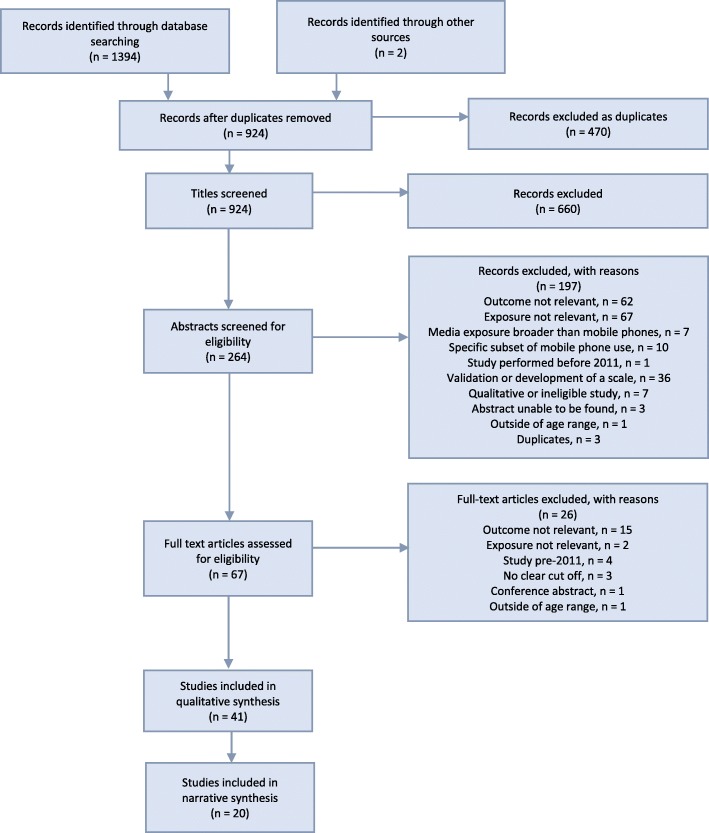
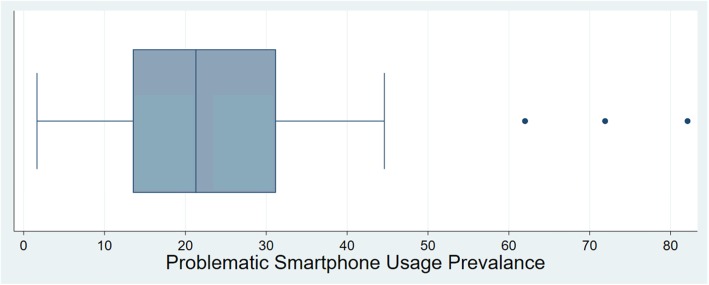
- Across 41 studies with 41,871 participants, the median prevalence of PSU was 23.3% with an interquartile range of 14–31.2%; 31 studies reported prevalence between 10% and 30%.
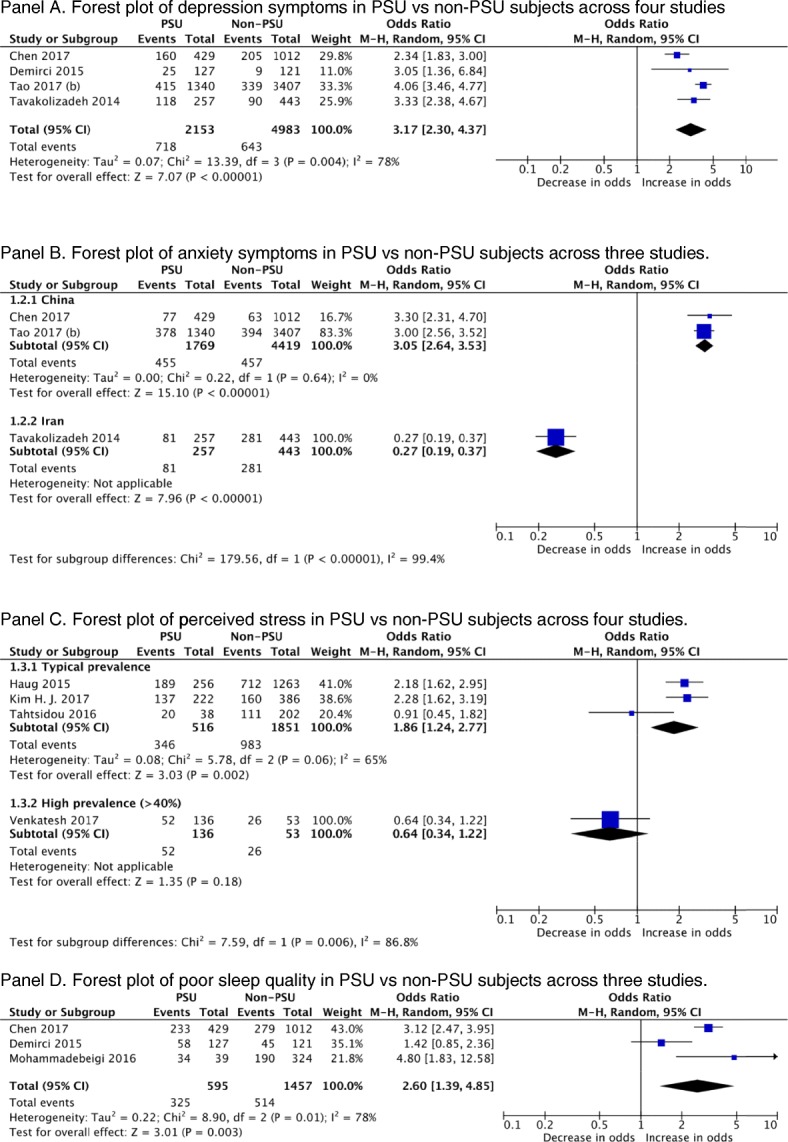
- PSU was associated with increased odds of depression: OR 3.17 (95% CI 2.30–4.37; I² = 78%; 8 studies, 10,099 participants).
- PSU was associated with increased odds of anxiety: OR 3.05 after accounting for heterogeneity (95% CI 2.64–3.53; I² = 0%; 7 studies, 9,359 participants).
- PSU was also associated with perceived stress (OR 1.86, 95% CI 1.24–2.77; I² = 65%; 5 studies, 3,618 participants) and poor sleep (OR 2.60, 95% CI 1.39–4.85; I² = 78%; 7 studies, 4,194 participants).
## Methods
- Systematic review and meta-analysis conducted according to PRISMA, with an a priori PROSPERO protocol (#88800); evidence quality was assessed using GRADE and study quality with a modified Newcastle-Ottawa scale.
- Searched 8 databases from January 1, 2011 to October 15, 2017 with no language restriction; included randomized controlled trials, cohort, cross-sectional, and case-control studies involving children and young people with mean age ≤25 and a clear threshold for PSU.
- Quantitative synthesis used random-effects meta-analysis (Mantel-Haenszel method; generic inverse variance for logistic regression results) and subgroup analyses when heterogeneity exceeded 85%.
## Limitations
- The paper states that included studies were non-randomised and at high risk of bias; 22 studies were judged poor quality and 19 moderate quality.
- PSU definitions and thresholds varied widely, and some were incompletely described, which the paper says weakens implementation.
- Mental health outcomes were based on self-report questionnaires rather than formal diagnoses, and the paper notes that reverse causality cannot be excluded; this is a stated limitation and also an evident issue for causal interpretation.
Model-written summary. Check it against the paper before relying on it.
Integrity signals
Registry
Cites
Statistics
Figures
Verification
Claims the paper makes
9 Valid · 1 Not valid · 12 Not checked · 38 Own results and interpretations
The cited sources support only part of this claim — read each source’s verdict below.
In the paper
“Problematic users reported that social networking was the most important or preferred activity on smartphones [34, 40].”
§ Prevalence of problematic smartphone usage and associated mental health outcomes amongst children and young people: a systematic review, meta-analysis and GRADE of the evidence > Results > Types of PSU usage
What the sources say
- Partly supportedcites [34] Lopez-Fernandez O Kuss DJ Romo L Self-reported dependence on mobile phones in young adults: a European cross-cultural empirical survey J Behav Addict 2017 6 2 168 177 10.1556/2006.6.2017.020 28425777 PMC5520117 sourceExperimental — accuracy not yet measured
In Results > Proportion of highly dependent users and their profile, social networking was the most important online activity for a majority when asked about any technology, not smartphones specifically. On smartphones, messaging and chatting was the most frequently named favorite activity (47.8%), ahead of social networking (32.6%). (LLM, conf=0.88)
- Supportedcites [40] Haug S Castro RP Kwon M Filler A Kowatsch T Schaub MP Smartphone use and smartphone addiction among young people in Switzerland J Behav Addict 2015 4 4 299 307 10.1556/2006.4.2015.037 26690625 PMC4712764 source
The Results table reports that 208 of 256 participants classified as having smartphone addiction (81.3%) selected social networking as their most personally relevant smartphone function. The Methods section confirms that this was a self-reported choice among smartphone functions, supporting the paraphrase about problematic users' preferred activity. (LLM, conf=0.92)
plain- Asserted: passes — The authors put it forward as true.
- Checkable: passes — It can be checked against evidence.
- Load-bearing: unclear — It is unclear whether the paper’s conclusions depend on it.
- Based: passes — The paper gives a reason why it holds.
- Rests on an assumption not shown here.
- Partly supported
A result the paper reports from its own data — it cites no other source for it, so there is none to check. The quote shows it is in the paper.
In the paper
“Eight studies [28, 36, 48, 57–61] reported a significant association between PSU and depression across 10,099 participants.”
§ Prevalence of problematic smartphone usage and associated mental health outcomes amongst children and young people: a systematic review, meta-analysis and GRADE of the evidence > Results > PSU associated with mental health outcomes
plainstates an associationn = 10,099 ·- Asserted: passes — The authors put it forward as true.
- Checkable: passes — It can be checked against evidence.
- Load-bearing: passes — The paper’s conclusions depend on it.
- Based: passes — The paper gives a reason why it holds.
- Rests on 3 assumptions not shown here.
In the paper
“One study reported an increased odds of suicidal ideation amongst those with PSU [62]; however, this was assessed through a single screening question and caution should be taken with this finding.”
§ Prevalence of problematic smartphone usage and associated mental health outcomes amongst children and young people: a systematic review, meta-analysis and GRADE of the evidence > Results > PSU associated with mental health outcomes
What the sources say
- Not checked — no full text of the sourcecites [62] Kim HJ Min JY Kim HJ Min KB Association between psychological and self-assessed health status and smartphone overuse among Korean college students J Ment Health 2017 0 0 1 6 10.1080/09638237.2017.1370641 28868959 source
plainstates an association- Asserted: passes — The authors put it forward as true.
- Checkable: passes — It can be checked against evidence.
- Load-bearing: unclear — It is unclear whether the paper’s conclusions depend on it.
- Based: passes — The paper gives a reason why it holds.
- Rests on 2 assumptions not shown here.
A result the paper reports from its own data — it cites no other source for it, so there is none to check. The quote shows it is in the paper.
In the paper
“The pooled OR for anxiety amongst CYP with PSU was 2.60 (95% CI 1.39, to 4.85; p < 0.001; I2 = 78%).”
§ Prevalence of problematic smartphone usage and associated mental health outcomes amongst children and young people: a systematic review, meta-analysis and GRADE of the evidence > Results > PSU associated with mental health outcomes
plainstates an associationn = 9,359 ·- Asserted: passes — The authors put it forward as true.
- Checkable: passes — It can be checked against evidence.
- Load-bearing: passes — The paper’s conclusions depend on it.
- Based: passes — The paper gives a reason why it holds.
- Rests on 3 assumptions not shown here.
A result the paper reports from its own data — it cites no other source for it, so there is none to check. The quote shows it is in the paper.
In the paper
“Five studies [36, 39, 40, 44, 62] investigated perceived stress across 3618 participants.”
§ Prevalence of problematic smartphone usage and associated mental health outcomes amongst children and young people: a systematic review, meta-analysis and GRADE of the evidence > Results > PSU associated with mental health outcomes
plainn = 3,618- Asserted: passes — The authors put it forward as true.
- Checkable: passes — It can be checked against evidence.
- Load-bearing: unclear — It is unclear whether the paper’s conclusions depend on it.
- Based: passes — The paper gives a reason why it holds.
- Rests on 3 assumptions not shown here.
17 more claims
Create a free account to see all 60 claims and to verify the 1 reference still open.
- It may state two separate claims as one. 31
- Probably not a substantial claim. 16
- The quote only partly states this claim. 1
Citations
Cites
Preferred Reporting Items for Systematic Reviews and Meta-Analyses: the PRISMA statement
Moher, D., Liberati, A., Tetzlaff, J., Altman, D. G., & for the PRISMA Group (2009) · BMJ · doi:10.1136/bmj.b2535 · Cited by 83,823
Preferred Reporting Items for Systematic Reviews and Meta-Analyses: The PRISMA Statement
Moher, D., Liberati, A., Tetzlaff, J., Altman, D. G., & The PRISMA Group (2009) · PLoS Medicine · doi:10.1371/journal.pmed.1000097 · Cited by 64,042
Preferred reporting items for systematic reviews and meta-analyses: the PRISMA Statement.
(2009) · PubMed Central · Cited by 44,859
GRADE: an emerging consensus on rating quality of evidence and strength of recommendations
Guyatt, G. H., Oxman, A. D., Vist, G. E., Kunz, R., Falck-Ytter, Y., Alonso-Coello, P., & Schünemann, H. J. (2008) · BMJ · doi:10.1136/bmj.39489.470347.ad · Cited by 23,305
Wang, G., Ma, R., Qiao, G., Wada, K., Aizawa, Y., & Satoh, T. (2015) · Integrative Medicine International · doi:10.1159/000368408 · Cited by 18,657
Whiteford, H. A., Degenhardt, L., Rehm, J., Baxter, A. J., Ferrari, A. J., Erskine, H. E., Charlson, F. J., Norman, R. E., Flaxman, A. D., Johns, N., et al. (2013) · The Lancet · doi:10.1016/s0140-6736(13)61611-6 · Cited by 6,006
Sawyer, S. M., Azzopardi, P. S., Wickremarathne, D., & Patton, G. C. (2018) · The Lancet Child & Adolescent Health · doi:10.1016/s2352-4642(18)30022-1 · Cited by 3,666
The Smartphone addiction scale: development and validation of a short version for adolescents
Kwon, M., Kim, D.-J., Cho, H., & Yang, S. (2013) · PLoS ONE · doi:10.1371/journal.pone.0083558 · Cited by 2,177
Analysing Data and Undertaking Meta‐Analyses
Deeks, J. J., Higgins, J. P., & Altman, D. G. (2008) · Cochrane Handbook for Systematic Reviews of Interventions · doi:10.1002/9780470712184.ch9 · Cited by 1,800
Mental Health Surveillance Among Children — United States, 2013–2019
Bitsko, R. H., Claussen, A. H., Lichstein, J., Black, L. I., Jones, S. E., Danielson, M. L., Hoenig, J. M., Davis Jack, S. P., Brody, D. J., Gyawali, S., et al. (2022) · MMWR Supplements · doi:10.15585/mmwr.su7102a1 · Cited by 1,723
Development and Validation of a Smartphone Addiction Scale (SAS)
Kwon, M., Lee, J.-Y., Won, W.-Y., Park, J.-W., Min, J.-A., Hahn, C., Gu, X., Choi, J.-H., & Kim, D.-J. (2013) · PLoS ONE · doi:10.1371/journal.pone.0056936 · Cited by 1,670
SHAFFER, D., FISHER, P., DULCAN, M. K., DAVIES, M., PIACENTINI, J., SCHWAB-STONE, M. E., LAHEY, B. B., BOURDON, K., JENSEN, P. S., BIRD, H. R., et al. (1996) · Journal of the American Academy of Child & Adolescent Psychiatry · doi:10.1097/00004583-199607000-00012 · Cited by 1,587
Demirci, K., Akgönül, M., & Akpinar, A. (2015) · Journal of Behavioral Addictions · doi:10.1556/2006.4.2015.010 · Cited by 1,529
Psychological Predictors of Problem Mobile Phone Use
Bianchi, A., & Phillips, J. G. (2005) · CyberPsychology & Behavior · doi:10.1089/cpb.2005.8.39 · Cited by 1,514
The association between adolescent well-being and digital technology use
Orben, A., & Przybylski, A. K. (2019) · Nature Human Behaviour · doi:10.1038/s41562-018-0506-1 · Cited by 1,500 · cited 1×
“Explicitly the debate in the literature has concerned the relationship between amount of screen time, or amount of smartphone use, in CYP and clinically defined, mental health outcomes, with some studies reporting no association and others exhibiting a clear association [9, 10].”
BackgroundNational trends in the prevalence and treatment of depression in adolescents and young adults.
Mojtabai, R., Olfson, M., & Han, B. (2016) · Pediatrics · doi:10.1542/peds.2016-1878 · Cited by 1,424
Exploring the dimensions of nomophobia: Development and validation of a self-reported questionnaire
Yildirim, C., & Correia, A.-P. (2015) · Computers in Human Behavior · doi:10.1016/j.chb.2015.02.059 · Cited by 1,106
Is smartphone addiction really an addiction?
Panova, T., & Carbonell, X. (2018) · Journal of behavioral addictions · doi:10.1556/2006.7.2018.49 · Cited by 976 · cited 1×
“Both the mainstream media and researchers have raised the possibility that people can become addicted to smartphone use, though in the academic realm, this is controversial [12].”
BackgroundSmartphone use and smartphone addiction among young people in Switzerland
Haug, S., Castro, R. P., Kwon, M., Filler, A., Kowatsch, T., & Schaub, M. P. (2015) · Journal of Behavioral Addictions · doi:10.1556/2006.4.2015.037 · Cited by 903
PISA 2015 Results (Volume III): Students' Well-Being
OECD (2017) · PISA · doi:10.1787/9789264273856-en · Cited by 797
Problematic use of the mobile phone: A literature review and a pathways model
Billieux, J. (2012) · Current Psychiatry Reviews · doi:10.2174/157340012803520522 · Cited by 794
(2013) · PubMed · Cited by 770
Carter, B., Rees, P., Hale, L., Bhattacharjee, D., & Paradkar, M. S. (2016) · JAMA Pediatrics · doi:10.1001/jamapediatrics.2016.2341 · Cited by 718
Self-citationMental Health of Children and Young People in England, 2017
Sadler, K., Vizard, T., Ford, T. J., Marchesell, F., Pearce, N., Mandalia, D., Davis, J., Brodie, E., Forbes, N., Goodman, A., et al. (2018) · Digital Education Resource Archive (University College London) · Cited by 674
Bian, M., & Leung, L. (2015) · Social Science Computer Review · doi:10.1177/0894439314528779 · Cited by 669
Chen, B., Liu, F., Ding, S., Ying, X., Wang, L., & Wen, Y. (2017) · BMC Psychiatry · doi:10.1186/s12888-017-1503-z · Cited by 572 · cited 2×
“PSU in males was correlated with use of media applications and games, while in females it was correlated with communication and social networking applications [28].”
BackgroundRiehm, K. E., Feder, K. A., Tormohlen, K. N., Crum, R. M., Young, A. S., Green, K. M., Pacek, L. R., La Flair, L. N., & Mojtabai, R. (2019) · JAMA Psychiatry · doi:10.1001/jamapsychiatry.2019.2325 · Cited by 511 · cited 1×
“Explicitly the debate in the literature has concerned the relationship between amount of screen time, or amount of smartphone use, in CYP and clinically defined, mental health outcomes, with some studies reporting no association and others exhibiting a clear association [9, 10].”
BackgroundDevelopment of Korean Smartphone Addiction Proneness Scale for Youth
Kim, D., Lee, Y., Lee, J., Nam, J. K., & Chung, Y. (2014) · PLoS ONE · doi:10.1371/journal.pone.0097920 · Cited by 434
Long, J., Liu, T.-Q., Liao, Y.-H., Qi, C., He, H.-Y., Chen, S.-B., & Billieux, J. (2016) · BMC Psychiatry · doi:10.1186/s12888-016-1083-3 · Cited by 384
Morgan, C., Webb, R. T., Carr, M. J., Kontopantelis, E., Green, J., Chew-Graham, C. A., Kapur, N., & Ashcroft, D. M. (2017) · BMJ · doi:10.1136/bmj.j4351 · Cited by 374
Hawi, N. S., & Samaha, M. (2016) · Computers & Education · doi:10.1016/j.compedu.2016.03.007 · Cited by 360
A growing fear: Prevalence of nomophobia among Turkish college students
Yildirim, C., Sumuer, E., Adnan, M., & Yildirim, S. (2016) · Information Development · doi:10.1177/0266666915599025 · Cited by 340
Patalay, P., & Gage, S. H. (2019) · International Journal of Epidemiology · doi:10.1093/ije/dyz006 · Cited by 335
Chen, L., Yan, Z., Tang, W., Yang, F., Xie, X., & He, J. (2016) · Computers in Human Behavior · doi:10.1016/j.chb.2015.10.030 · Cited by 334
on behalf of the DEDIPAC consortium, Condello, G., Ling, F. C. M., Bianco, A., Chastin, S., Cardon, G., Ciarapica, D., Conte, D., Cortis, C., De Craemer, M., et al. (2016) · BMC Public Health · doi:10.1186/s12889-016-3800-8 · Cited by 327
The role of stress and motivation in problematic smartphone use among college students
Wang, J.-L., Wang, H.-Z., Gaskin, J., & Wang, L.-H. (2015) · Computers in Human Behavior · doi:10.1016/j.chb.2015.07.005 · Cited by 317
Proposed Diagnostic Criteria for Smartphone Addiction
Lin, Y.-H., Chiang, C.-L., Lin, P.-H., Chang, L.-R., Ko, C.-H., Lee, Y.-H., & Lin, S.-H. (2016) · PLOS ONE · doi:10.1371/journal.pone.0163010 · Cited by 303
Including Non‐Randomized Studies
Reeves, B. C., Deeks, J. J., Higgins, J. P., & Wells, G. A. (2008) · Cochrane Handbook for Systematic Reviews of Interventions · doi:10.1002/9780470712184.ch13 · Cited by 288
Hussain, Z., Griffiths, M. D., & Sheffield, D. (2017) · Journal of Behavioral Addictions · doi:10.1556/2006.6.2017.052 · Cited by 244
Lopez-Fernandez, O., Kuss, D. J., Romo, L., Morvan, Y., Kern, L., Graziani, P., Rousseau, A., Rumpf, H.-J., Bischof, A., Gässler, A.-K., et al. (2017) · Journal of Behavioral Addictions · doi:10.1556/2006.6.2017.020 · Cited by 237
Common and Costly Hospitalizations for Pediatric Mental Health Disorders
Bardach, N. S., Coker, T. R., Zima, B. T., Murphy, J. M., Knapp, P., Richardson, L. P., Edwall, G., & Mangione-Smith, R. (2014) · Pediatrics · doi:10.1542/peds.2013-3165 · Cited by 227
Non-substance addictive behaviors in the context of DSM-5
Potenza, M. N. (2014) · Addictive Behaviors · doi:10.1016/j.addbeh.2013.09.004 · Cited by 225
Sleep Quality in Medical Students; the Impact of Over-Use of Mobile Cell-Phone and Social Networks.
Mohammadbeigi, A., absari, R., Valizadeh, F., saadati, M., Sharifimoghadam, S., Ahmadi, A., Mokhtari, M., & Ansari, H. (2016) · PubMed Central · Cited by 223
Risk Factors for Smartphone Addiction in Korean Adolescents: Smartphone Use Patterns
Lee, H., Kim, J. W., & Choi, T. Y. (2017) · Journal of Korean Medical Science · doi:10.3346/jkms.2017.32.10.1674 · Cited by 200
Prevalence of Mobile Phone Dependence in Secondary School Adolescents
Nikhita, C. S. (2015) · JOURNAL OF CLINICAL AND DIAGNOSTIC RESEARCH · doi:10.7860/jcdr/2015/14396.6803 · Cited by 175
Prevalence and predictors of smartphone addiction proneness among Korean adolescents
Lee, C., & Lee, S.-J. (2017) · Children and Youth Services Review · doi:10.1016/j.childyouth.2017.04.002 · Cited by 169
Population-Attributable Causes of Cancer in Korea: Obesity and Physical Inactivity
Park, S., Kim, Y., Shin, H.-R., Lee, B., Shin, A., Jung, K.-W., Jee, S. H., Kim, D. H., Yun, Y. H., Park, S. K., et al. (2014) · PLoS ONE · doi:10.1371/journal.pone.0090871 · Cited by 158
Nomophobia: A Cross-sectional Study to Assess Mobile Phone Usage Among Dental Students
Prasad, M. (2017) · JOURNAL OF CLINICAL AND DIAGNOSTIC RESEARCH · doi:10.7860/jcdr/2017/20858.9341 · Cited by 141
Exploring Smartphone Addiction: Insights from Long-Term Telemetric Behavioral Measures
Tossell, C., Kortum, P., Shepard, C., Rahmati, A., & Zhong, L. (2015) · International Journal of Interactive Mobile Technologies (iJIM) · doi:10.3991/ijim.v9i2.4300 · Cited by 124
Tao, S., Wu, X., Zhang, Y., Zhang, S., Tong, S., & Tao, F. (2017) · International Journal of Environmental Research and Public Health · doi:10.3390/ijerph14020185 · Cited by 121
Comparing the Self-Report and Measured Smartphone Usage of College Students: A Pilot Study
Lee, H., Ahn, H., Nguyen, T. G., Choi, S.-W., & Kim, D. J. (2017) · Psychiatry Investigation · doi:10.4306/pi.2017.14.2.198 · Cited by 114
de-Sola, J., Talledo, H., Rodríguez de Fonseca, F., & Rubio, G. (2017) · PLOS ONE · doi:10.1371/journal.pone.0181184 · Cited by 113
Lee (2015) · doi:10.1177/0021934714557034 · Cited by 111
Buti, M., Manzano, M. L., Morillas, R. M., García-Retortillo, M., Martín, L., Prieto, M., Gutiérrez, M. L., Suárez, E., Gómez Rubio, M., López, J., et al. (2017) · PLOS ONE · doi:10.1371/journal.pone.0184550 · Cited by 97
Lee, J. E., Jang, S.-I., Ju, Y. J., Kim, W., Lee, H. J., & Park, E.-C. (2017) · Journal of Korean Medical Science · doi:10.3346/jkms.2017.32.7.1166 · Cited by 88
Jiang, Z., & Shi, M. (2016) · BMC Public Health · doi:10.1186/s12889-016-3884-1 · Cited by 87
Jin, Y., Sun, C., An, J., & Li, J. (2017) · International Journal of Mental Health and Addiction · doi:10.1007/s11469-017-9772-9 · Cited by 82
Kim, H.-J., Min, J.-Y., Kim, H.-J., & Min, K.-B. (2019) · Journal of Mental Health · doi:10.1080/09638237.2017.1370641 · Cited by 80
Smart phone usage and addiction among dental students in Saudi Arabia: a cross sectional study
Venkatesh, E., Jemal, M. Y. A., & Samani, A. S. A. (2017) · International Journal of Adolescent Medicine and Health · doi:10.1515/ijamh-2016-0133 · Cited by 75
Jo, H.-S., Na, E., & Kim, D.-J. (2018) · Addiction Research & Theory · doi:10.1080/16066359.2017.1312356 · Cited by 62
Tavakolizadeh, J., Atarodi, A., Ahmadpour, S., & Pourgheisar, A. (2014) · Razavi International Journal of Medicine · doi:10.5812/rijm.15527 · Cited by 60
Uso problemático de Internet, el móvil y los videojuegos en una muestra de adolescentes alicantinos
García‐Oliva, C., Piqueras, J. A., & Marzo, J. C. (2017) · African journal of rhetoric · doi:10.21134/haaj.v17i2.331 · Cited by 58
Kwon, Y.-S., & Paek, K. S. (2016) · Indian Journal of Science and Technology · doi:10.17485/ijst/2016/v9i41/103844 · Cited by 57
de Miguel, C. R. (2016) · Bordón. Revista de pedagogía · doi:10.13042/bordon.2016.68307 · Cited by 46
Tao, S., Wu, X., Zhang, S., Tong, S., Hao, J., & Tao, F. (2017) · Journal of Public Health · doi:10.1007/s10389-016-0766-z · Cited by 39
Eyvazlou, M., Zarei, E., Rahimi, A., & Abazari, M. (2016) · Chronobiology International · doi:10.3109/07420528.2015.1135933 · Cited by 38
Rajanna, S. H., Sharma, M. K., & Palanichamy, T. (2016) · ASEAN Journal of Psychiatry · Cited by 34
Pathological use of mobile phones by secondary school students
Warzecha, K., & Pawlak, A. (2017) · Archives of Psychiatry and Psychotherapy · doi:10.12740/app/67931 · Cited by 26
Li, M., & Lu, L. (2017) · REVISTA ARGENTINA DE CLINICA PSICOLOGICA · doi:10.24205/03276716.2017.1006 · Cited by 19
Assessing mobile phone dependency and teens' everyday life in Hong Kong
Leung, C. (2016) · Australian Journal of Psychology · doi:10.1111/ajpy.12115 · Cited by 18
Mobile phone dependence among undergraduate medical students in Nanded city
Domple, V. K., Wadde, S. K., & Gattani, P. L. (2017) · Annals of Tropical Medicine and Public Health · doi:10.4103/atmph.atmph_71_17 · Cited by 14
Wang, C., Wang, S., Li, W., Dong, X.-M., & Chi, G.-B. (2013) · PubMed · Cited by 13
Bowden‐Jones, H. (2017) · BMJ · doi:10.1136/bmj.j1593 · Cited by 10
Costly Mental Disorders Affect Millions of US Children and Teens
(2013) · JAMA · doi:10.1001/jama.2013.7257 · Cited by 8
Research works printed but not linked: 3
- Office for National Statistics Children’s well-being and social relationships, UK 2018
- House of Commons Science and Technology Committee Impact of social media and screen-use on young people’s health: Fourteenth report of Session 2017–2019 2019
- Tahtsidou S Bellali T Alikari V The effect of dependence on mobile phones and computers on the lifestyle and health of nursing students at the University of the Peloponnese Arch Hell Med 2016 33 3 355 367 ER
Cited by
Global prevalence of digital addiction in general population: A systematic review and meta-analysis
Meng, S.-Q., Cheng, J.-L., Li, Y.-Y., Yang, X.-Q., Zheng, J.-W., Chang, X.-W., Shi, Y., Chen, Y., Lu, L., Sun, Y., et al. (2022) · Clinical Psychology Review · doi:10.1016/j.cpr.2022.102128 · Cited by 622
Stein, D. J., Shoptaw, S. J., Vigo, D. V., Lund, C., Cuijpers, P., Bantjes, J., Sartorius, N., & Maj, M. (2022) · World Psychiatry · doi:10.1002/wps.20998 · Cited by 331
Smartphone Addiction and Associated Health Outcomes in Adult Populations: A Systematic Review
Ratan, Z., Parrish, A.-M., Zaman, S., Alotaibi, M., & Hosseinzadeh, H. (2021) · International Journal of Environmental Research and Public Health · doi:10.3390/ijerph182212257 · Cited by 285
Trott, M., Driscoll, R., Iraldo, E., & Pardhan, S. (2022) · eClinicalMedicine · doi:10.1016/j.eclinm.2022.101452 · Cited by 266
Zhang, M. X., & Wu, A. M. S. (2020) · Addictive Behaviors · doi:10.1016/j.addbeh.2020.106552 · Cited by 265
Metadata
- Authors
- Sohn, S. Y., Rees, P., Wildridge, B., Kalk, N. J., & Carter, B.
- Affiliations
- King's College London (GB)
- University College London (GB)
- University of Nottingham (GB)
- Corresponding author
- Carter, Ben
- Venue
- BMC Psychiatry
- Published
- 2019-11-29
- Volume
- 19
- Issue
- 1
- Pages
- 356-356
- ISSN
- 1471-244X (ISSN-L)
- PMC
- PMC6883663
- OpenAlex
- W2989721356
- Cited by
- 838
- References
- 75
- Citations by year
- 2026: 147 · 2025: 152 · 2024: 139 · 2023: 132 · 2022: 128 · 2021: 89 · 2020: 49 · 2019: 2
- FWCI
- 16.89
- Type
- journal article
- Language
- en
- Update notices
- Open access
- gold
- doi.org
- Licence
- cc-by
- creativecommons.org/licenses/by/4.0/ (tdm)
- creativecommons.org/licenses/by/4.0/ (vor)
- Locations
- BMC Psychiatry (publishedVersion, cc-by)
- PubMed Central (publishedVersion, cc-by)
- PubMed (publishedVersion)
- Research Portal (King's College London) (submittedVersion, cc-by)
- DOAJ (DOAJ: Directory of Open Access Journals) (submittedVersion, cc-by-sa)
- Funders
- National Institute for Health and Care Research (ACF-2018-18-013)
- Topics
- Social Sciences › Sociology and Political Science › Impact of Technology on Adolescents
- Social Sciences › Education › Child Development and Digital Technology
- Social Sciences › Psychology › Clinical Psychology › Sexuality, Behavior, and Technology
- Keywords
- smartphone addiction, children and young people, prevalence, depression, anxiety, perceived stress, sleep quality, educational attainment, adolescent mental health
- MeSH terms
- Smartphone, Adolescent, Anxiety, Child, Depression, Educational Status, Female, Humans, Male, Mental Health, Sleep Wake Disorders, Stress, Psychological, Prevalence, Odds Ratio, Behavior, Addictive, Young Adult, Self Report
About these checks
Registry, retraction, Cites and statistics results are computed, not judged, with one exception: a printed reference that no index lists is read once by a model before it counts as a citation error. Claims are extracted by a model and kept only when their quote appears verbatim in the text; each cited source is then checked, with a model’s help, for whether it says what the claim relies on. Those verdicts can be wrong — read the claim’s quote and the cited source before relying on one.
The claim verdicts this report counts are experimental: their accuracy is not yet measured.
A language model drew the claims from the paper on 2026-10-10, under version 3 of the claim definition (model deepseek-v4.1-flash, prompt extract-v3).
A second model labelled each claim on 2026-10-10 (model jev-1.13-20260917, definition revision gold-guideline-v0.2).
Cited sources are checked with a language model’s help (gpt-6-sol).
Statistics and arithmetic are recomputed, not judged.
Confidence bands are shown only for fields calibrated on our annotated test set. None is calibrated yet, so no band is shown.
What counts as a claim ›How we measure confidence ›How we check this ›
Are you an author, or do you see a problem with this page? Request a review
Data sources
Bibliographic data: Semantic Scholar, OpenAlex, Crossref.
Contains information from the Semantic Scholar Academic Graph Datasets, made available under the ODC Attribution License (ODC-BY 1.0).
Semantic Scholar’s data is described in: Kinney, R., et al. (2023). The Semantic Scholar Open Data Platform. arXiv:2301.10140.
