

Prevalence of problematic smartphone usage and associated mental health outcomes amongst children and young people: a systematic review, meta-analysis and GRADE of the evidence
Open accessThe DOI matches its Crossref record; 75 of the 75 references it cites were found in a registry or an index; 14 of the 29 sources its claims cite were checked for support.
Abstract
Systematic review and meta-analysis of 41 studies assessing problematic smartphone use and mental health outcomes among children and young people.
Overview
CoChat Summary
## TL;DR
This systematic review/meta-analysis found that problematic smartphone use (PSU) affected about 1 in 4 children and young people (median prevalence 23.3%) across 41 studies and was consistently associated with worse mental health. The pooled associations were strongest for depression and anxiety, with elevated odds for depression (OR 3.17) and anxiety (OR 3.05 after accounting for heterogeneity).
## Key findings
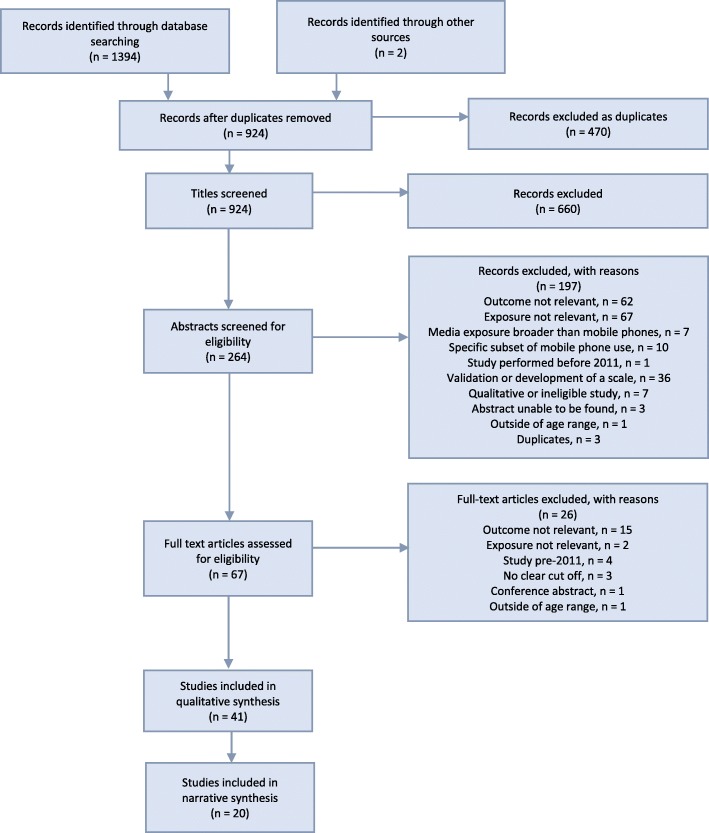
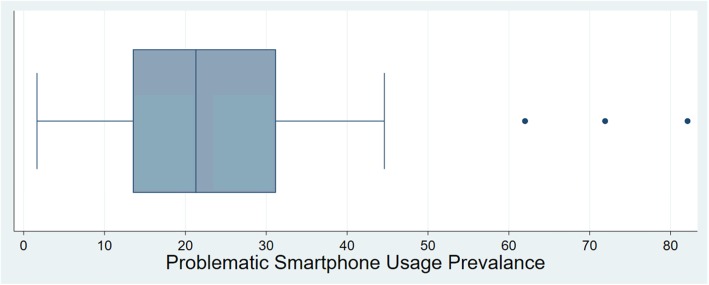
- Across 41 studies with 41,871 participants, the median prevalence of PSU was 23.3% with an interquartile range of 14–31.2%; 31 studies reported prevalence between 10% and 30%.
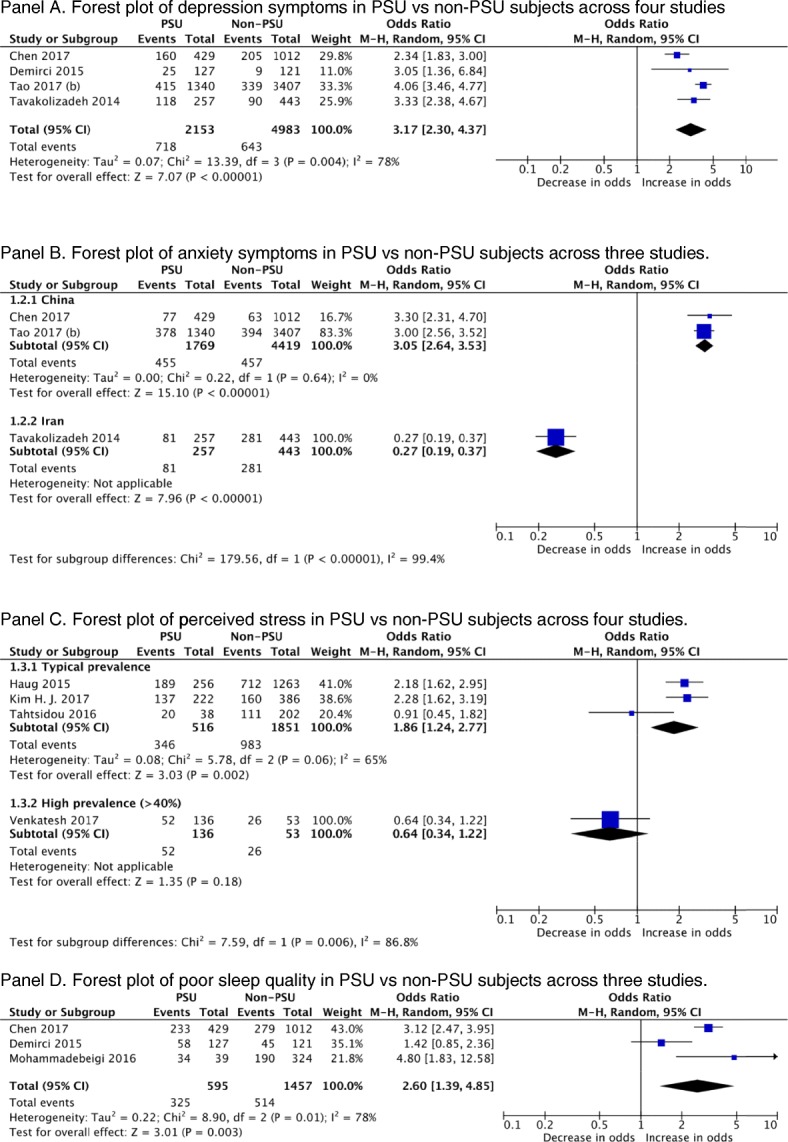
- PSU was associated with increased odds of depression: OR 3.17 (95% CI 2.30–4.37; I² = 78%; 8 studies, 10,099 participants).
- PSU was associated with increased odds of anxiety: OR 3.05 after accounting for heterogeneity (95% CI 2.64–3.53; I² = 0%; 7 studies, 9,359 participants).
- PSU was also associated with perceived stress (OR 1.86, 95% CI 1.24–2.77; I² = 65%; 5 studies, 3,618 participants) and poor sleep (OR 2.60, 95% CI 1.39–4.85; I² = 78%; 7 studies, 4,194 participants).
## Methods
- Systematic review and meta-analysis conducted according to PRISMA, with an a priori PROSPERO protocol (#88800); evidence quality was assessed using GRADE and study quality with a modified Newcastle-Ottawa scale.
- Searched 8 databases from January 1, 2011 to October 15, 2017 with no language restriction; included randomized controlled trials, cohort, cross-sectional, and case-control studies involving children and young people with mean age ≤25 and a clear threshold for PSU.
- Quantitative synthesis used random-effects meta-analysis (Mantel-Haenszel method; generic inverse variance for logistic regression results) and subgroup analyses when heterogeneity exceeded 85%.
## Limitations
- The paper states that included studies were non-randomised and at high risk of bias; 22 studies were judged poor quality and 19 moderate quality.
- PSU definitions and thresholds varied widely, and some were incompletely described, which the paper says weakens implementation.
- Mental health outcomes were based on self-report questionnaires rather than formal diagnoses, and the paper notes that reverse causality cannot be excluded; this is a stated limitation and also an evident issue for causal interpretation.
Model-written summary. Check it against the paper before relying on it.
Integrity signals
Registry
Cites
Statistics
Figures
Verification
Claims the paper makes
9 Valid · 1 Not valid · 12 Not checked · 38 Own results and interpretations
The cited sources support only part of this claim — read each source’s verdict below.
In the paper
“Problematic users reported that social networking was the most important or preferred activity on smartphones [34, 40].”
§ Prevalence of problematic smartphone usage and associated mental health outcomes amongst children and young people: a systematic review, meta-analysis and GRADE of the evidence > Results > Types of PSU usage
What the sources say
- Partly supportedcites [34] Lopez-Fernandez O Kuss DJ Romo L Self-reported dependence on mobile phones in young adults: a European cross-cultural empirical survey J Behav Addict 2017 6 2 168 177 10.1556/2006.6.2017.020 28425777 PMC5520117 sourceExperimental — accuracy not yet measured
In Results > Proportion of highly dependent users and their profile, social networking was the most important online activity for a majority when asked about any technology, not smartphones specifically. On smartphones, messaging and chatting was the most frequently named favorite activity (47.8%), ahead of social networking (32.6%). (LLM, conf=0.88)
- Supportedcites [40] Haug S Castro RP Kwon M Filler A Kowatsch T Schaub MP Smartphone use and smartphone addiction among young people in Switzerland J Behav Addict 2015 4 4 299 307 10.1556/2006.4.2015.037 26690625 PMC4712764 source
The Results table reports that 208 of 256 participants classified as having smartphone addiction (81.3%) selected social networking as their most personally relevant smartphone function. The Methods section confirms that this was a self-reported choice among smartphone functions, supporting the paraphrase about problematic users' preferred activity. (LLM, conf=0.92)
plain- Asserted: passes — The authors put it forward as true.
- Checkable: passes — It can be checked against evidence.
- Load-bearing: unclear — It is unclear whether the paper’s conclusions depend on it.
- Based: passes — The paper gives a reason why it holds.
- Rests on an assumption not shown here.
- Partly supported
A result the paper reports from its own data — it cites no other source for it, so there is none to check. The quote shows it is in the paper.
In the paper
“Eight studies [28, 36, 48, 57–61] reported a significant association between PSU and depression across 10,099 participants.”
§ Prevalence of problematic smartphone usage and associated mental health outcomes amongst children and young people: a systematic review, meta-analysis and GRADE of the evidence > Results > PSU associated with mental health outcomes
plainstates an associationn = 10,099 ·- Asserted: passes — The authors put it forward as true.
- Checkable: passes — It can be checked against evidence.
- Load-bearing: passes — The paper’s conclusions depend on it.
- Based: passes — The paper gives a reason why it holds.
- Rests on 3 assumptions not shown here.
In the paper
“One study reported an increased odds of suicidal ideation amongst those with PSU [62]; however, this was assessed through a single screening question and caution should be taken with this finding.”
§ Prevalence of problematic smartphone usage and associated mental health outcomes amongst children and young people: a systematic review, meta-analysis and GRADE of the evidence > Results > PSU associated with mental health outcomes
What the sources say
- Not checked — no full text of the sourcecites [62] Kim HJ Min JY Kim HJ Min KB Association between psychological and self-assessed health status and smartphone overuse among Korean college students J Ment Health 2017 0 0 1 6 10.1080/09638237.2017.1370641 28868959 source
plainstates an association- Asserted: passes — The authors put it forward as true.
- Checkable: passes — It can be checked against evidence.
- Load-bearing: unclear — It is unclear whether the paper’s conclusions depend on it.
- Based: passes — The paper gives a reason why it holds.
- Rests on 2 assumptions not shown here.
A result the paper reports from its own data — it cites no other source for it, so there is none to check. The quote shows it is in the paper.
In the paper
“The pooled OR for anxiety amongst CYP with PSU was 2.60 (95% CI 1.39, to 4.85; p < 0.001; I2 = 78%).”
§ Prevalence of problematic smartphone usage and associated mental health outcomes amongst children and young people: a systematic review, meta-analysis and GRADE of the evidence > Results > PSU associated with mental health outcomes
plainstates an associationn = 9,359 ·- Asserted: passes — The authors put it forward as true.
- Checkable: passes — It can be checked against evidence.
- Load-bearing: passes — The paper’s conclusions depend on it.
- Based: passes — The paper gives a reason why it holds.
- Rests on 3 assumptions not shown here.
A result the paper reports from its own data — it cites no other source for it, so there is none to check. The quote shows it is in the paper.
In the paper
“Five studies [36, 39, 40, 44, 62] investigated perceived stress across 3618 participants.”
§ Prevalence of problematic smartphone usage and associated mental health outcomes amongst children and young people: a systematic review, meta-analysis and GRADE of the evidence > Results > PSU associated with mental health outcomes
plainn = 3,618- Asserted: passes — The authors put it forward as true.
- Checkable: passes — It can be checked against evidence.
- Load-bearing: unclear — It is unclear whether the paper’s conclusions depend on it.
- Based: passes — The paper gives a reason why it holds.
- Rests on 3 assumptions not shown here.
17 more claims
Create a free account to see all 60 claims and to verify the 2 references still open.
- It may state two separate claims as one. 31
- Probably not a substantial claim. 16
- The quote only partly states this claim. 1
Citations
Cites
Preferred Reporting Items for Systematic Reviews and Meta-Analyses: the PRISMA statement
Moher, D., Liberati, A., Tetzlaff, J., Altman, D. G., & for the PRISMA Group (2009) · BMJ · doi:10.1136/bmj.b2535 · Cited by 83,823
Preferred Reporting Items for Systematic Reviews and Meta-Analyses: The PRISMA Statement
Moher, D., Liberati, A., Tetzlaff, J., Altman, D. G., & The PRISMA Group (2009) · PLoS Medicine · doi:10.1371/journal.pmed.1000097 · Cited by 64,042
Preferred reporting items for systematic reviews and meta-analyses: the PRISMA Statement.
(2009) · PubMed Central · Cited by 44,859
GRADE: an emerging consensus on rating quality of evidence and strength of recommendations
Guyatt, G. H., Oxman, A. D., Vist, G. E., Kunz, R., Falck-Ytter, Y., Alonso-Coello, P., & Schünemann, H. J. (2008) · BMJ · doi:10.1136/bmj.39489.470347.ad · Cited by 23,305
Wang, G., Ma, R., Qiao, G., Wada, K., Aizawa, Y., & Satoh, T. (2015) · Integrative Medicine International · doi:10.1159/000368408 · Cited by 18,657
Whiteford, H. A., Degenhardt, L., Rehm, J., Baxter, A. J., Ferrari, A. J., Erskine, H. E., Charlson, F. J., Norman, R. E., Flaxman, A. D., Johns, N., et al. (2013) · The Lancet · doi:10.1016/s0140-6736(13)61611-6 · Cited by 6,006
Sawyer, S. M., Azzopardi, P. S., Wickremarathne, D., & Patton, G. C. (2018) · The Lancet Child & Adolescent Health · doi:10.1016/s2352-4642(18)30022-1 · Cited by 3,666
The Smartphone addiction scale: development and validation of a short version for adolescents
Kwon, M., Kim, D.-J., Cho, H., & Yang, S. (2013) · PLoS ONE · doi:10.1371/journal.pone.0083558 · Cited by 2,177
Analysing Data and Undertaking Meta‐Analyses
Deeks, J. J., Higgins, J. P., & Altman, D. G. (2008) · Cochrane Handbook for Systematic Reviews of Interventions · doi:10.1002/9780470712184.ch9 · Cited by 1,800
Mental Health Surveillance Among Children — United States, 2013–2019
Bitsko, R. H., Claussen, A. H., Lichstein, J., Black, L. I., Jones, S. E., Danielson, M. L., Hoenig, J. M., Davis Jack, S. P., Brody, D. J., Gyawali, S., et al. (2022) · MMWR Supplements · doi:10.15585/mmwr.su7102a1 · Cited by 1,723
Research works printed but not linked: 3
- Office for National Statistics Children’s well-being and social relationships, UK 2018
- House of Commons Science and Technology Committee Impact of social media and screen-use on young people’s health: Fourteenth report of Session 2017–2019 2019
- Tahtsidou S Bellali T Alikari V The effect of dependence on mobile phones and computers on the lifestyle and health of nursing students at the University of the Peloponnese Arch Hell Med 2016 33 3 355 367 ER
Cited by
Items 301–400 of 832
Hamamura, T., Kurokawa, M., Mishima, K., Konishi, T., Nagata, M., & Honjo, M. (2023) · Addictive Behaviors · doi:10.1016/j.addbeh.2023.107834 · Cited by 11
Rosa, P. J., Miranda, I. P., & Pascoal, P. M. (2025) · International Journal of Human-Computer Interaction · doi:10.1080/10447318.2024.2439637 · Cited by 11
Gao, L., Wang, X., Caselli, G., Li, W., Liu, Q., Chu, X., & Chen, H. (2023) · Addictive Behaviors · doi:10.1016/j.addbeh.2023.107651 · Cited by 10
Yilmaz, S. K., & Bohara, A. K. (2021) · Frontiers in Public Health · doi:10.3389/fpubh.2021.563515 · Cited by 11
He, J., Yang, X., Du, M., Zhao, C., Wang, X., Zhang, G., & Peng, H. (2022) · International Journal of Environmental Research and Public Health · doi:10.3390/ijerph192215355 · Cited by 10
Özbay, S. Ç., Özbay, Ö., Akçam, A., & Kanbay, Y. (2023) · Archives of Psychiatric Nursing · doi:10.1016/j.apnu.2023.04.006 · Cited by 15
Boudard, M., Alexandre, J., Kervran, C., Jakubiec, L., Shmulewitz, D., Hasin, D. S., Fournet, L., Rassis, C., Claverie, P., Serre, F., et al. (2022) · Journal of Medical Internet Research · doi:10.2196/31803 · Cited by 13
Okechukwu, G.-P., Nnam, M. U., Obadimu, C. E., Iloma, D. O., Offu, P. O., Okpata, F., & Nwakanma, E. U. (2022) · Journal of Forensic Psychology Research and Practice · doi:10.1080/24732850.2022.2102956 · Cited by 7
Abo-Ali, E. A., Al-Ghanmi, A., Hadad, H., Etaiwi, J., Bhutta, K., Hadad, N., Almilaibary, A., Ghareeb, W. A., Sanad, A., & Zaytoun, S. (2022) · Journal of Prevention · doi:10.1007/s10935-022-00692-1 · Cited by 11
So close yet so far: Digital wounds from parental phubbing on adolescent digital self-harm
Gu, H., Hu, Y., & Cheng, Y. (2025) · Telematics and Informatics · doi:10.1016/j.tele.2025.102314 · Cited by 9
Zhao, Z., Zhu, L., Liao, J., Xia, J., & Pu, X.-Y. (2024) · Health Communication · doi:10.1080/10410236.2024.2387389 · Cited by 16
Hefter, M. H. (2024) · Scientific Reports · doi:10.1038/s41598-024-67898-7 · Cited by 13
Luo, J., Cai, G., Xiao-Fang, Z., Huang, Q., & Cao, Q. (2025) · Frontiers in Psychiatry · doi:10.3389/fpsyt.2025.1541605 · Cited by 15
Teacher candidates' preparedness to address diverse situations that can threaten pupils’ well-being
Salo, A., & Kajamies, A. (2024) · Teaching and Teacher Education · doi:10.1016/j.tate.2024.104470 · Cited by 23
Barot, N., & Patel, A. M. (2023) · International Journal of Health Sciences and Research · doi:10.52403/ijhsr.20230705 · Cited by 9
Wong, S. M. Y., Lau, T. T. Y., Hui, C. L. M., Suen, Y. N., Chan, S. K. W., Lee, E. H. M., Chan, K. T., Wong, M. T. H., & Chen, E. Y. H. (2023) · Mindfulness · doi:10.1007/s12671-023-02185-6 · Cited by 8
ANDERSON, N. W., Halfon, N., Eisenberg, D., Markowitz, A. J., Moore, K. A., & Zimmerman, F. J. (2023) · Milbank Quarterly · doi:10.1111/1468-0009.12634 · Cited by 9
Brailovskaia, J., Siegel, J., Precht, L.-M., Friedrichs, S., Schillack, H., & Margraf, J. (2024) · Acta Psychologica · doi:10.1016/j.actpsy.2024.104494 · Cited by 26
Ramos, R. F. S., Scatena, A., Kim, H. S. A., de Oliveira, W. A., & Andrade, A. L. M. (2023) · Trends in Psychology · doi:10.1007/s43076-023-00338-z · Cited by 11
Dahlqvist, H. Z., & Gådin, K. G. (2024) · International Journal of Adolescence and Youth · doi:10.1080/02673843.2024.2400500 · Cited by 8
Matthes, J., Neureiter, A., Stević, A., & Noetzel, S. (2024) · Telematics and Informatics · doi:10.1016/j.tele.2024.102119 · Cited by 11
Nguyen, B. T. N., Nguyen, N. P. H., Le, H. D., & Nguyễn, L. T. (2024) · International Journal of Mental Health · doi:10.1080/00207411.2024.2418621 · Cited by 14
Visier‐Alfonso, M. E., López‐Gil, J. F., Mesas, A. E., Jiménez‐López, E., Cekrezi, S., & Martínez‐Vizcaíno, V. (2024) · Cyberpsychology Behavior and Social Networking · doi:10.1089/cyber.2024.0064 · Cited by 10
Song, I. (2021) · DOAJ (DOAJ: Directory of Open Access Journals) · doi:10.15206/ajpor.2021.9.2.106 · Cited by 16
Long, J., Liu, Y., Wang, Y., Pottié, A., Cornil, A., Deleuze, J., Wu, Q., Chen, S., Ma, Y., Wang, Q., et al. (2023) · The Journal of Nervous and Mental Disease · doi:10.1097/nmd.0000000000001738 · Cited by 11
Problematic Smartphone Use and Communication in Families with Adolescents
Merkaš, M., Selak, M. B., & Žulec, A. (2024) · Adolescents · doi:10.3390/adolescents4010008 · Cited by 19
Hu, A., Zhang, Y., Sun, J., Wang, X., Natsuaki, M. N., & Jiang, N. (2025) · Child and Adolescent Psychiatry and Mental Health · doi:10.1186/s13034-025-00937-x · Cited by 10
Lekamge, R. B., Karim, M. N., Chen, L., & Ilić, D. (2025) · BJPsych Open · doi:10.1192/bjo.2024.843 · Cited by 8
Does the smartphone use affect the determination of daily goals: A nursing students’ example?
Demiralp, M., Öksüz, E., Aksu, M., SARIKOÇ, G., Tüzer, H., & Mersin, S. (2020) · Perspectives In Psychiatric Care · doi:10.1111/ppc.12587 · Cited by 9
Are smartphones addictive? An urgent question in the pandemic age
Kalk, N. J., Carter, B., & Sohn, S. Y. (2021) · Health Policy and Technology · doi:10.1016/j.hlpt.2021.02.004 · Cited by 8
Self-citationFerreira, G., Redondo‐Tébar, A., Gonçalves, J. B., Sousa‐Sá, E., Oliveira, O., Lopes, L., & Santos, R. (2025) · British Journal of Health Psychology · doi:10.1111/bjhp.70004 · Cited by 14
Liu, X., Tian, R., Bai, X., Liu, H., Li, T., Zhou, X., & Lei, Y. (2024) · Frontiers in Psychiatry · doi:10.3389/fpsyt.2024.1342521 · Cited by 19
Gupta, D., Bhardwaj, A., Prakash, R., Jose, N. A., & Singh, F. H. D. (2023) · Indian Journal of Social Psychiatry · doi:10.4103/ijsp.ijsp_75_23 · Cited by 10
Wang, C., Hu, J., Zhou, Y., Jiang, L., Chen, J., Xi, J., Fang, J. Q., & Zhang, S. (2025) · Journal of Affective Disorders Reports · doi:10.1016/j.jadr.2025.100907 · Cited by 10
Vaghasiya, S., Rajpopat, N., Parmar, B., Tailor, K. A., Patel, H. V., & Varma, J. R. (2023) · Industrial Psychiatry Journal · doi:10.4103/ipj.ipj_53_23 · Cited by 14
Alqahtani, R. A., AlSaadi, Z. S., Al-Qahtani, Z., Al-Garni, A. M., Shati, A. A., Malik, A. A., Jabbar, I. A., & Mahmood, S. E. (2024) · Technology and Health Care · doi:10.3233/thc-230756 · Cited by 10
Social Media Usage in Children: An Urgent Public Health Problem
Armitage, R. C. (2021) · Public Health · doi:10.1016/j.puhe.2021.09.011 · Cited by 7
„Smartphone addiction”: Fakt oder Fiktion?
Wolf, N. D., & Wolf, R. C. (2020) · Nervenheilkunde · doi:10.1055/a-1191-9747 · Cited by 11
AlSaif, H. I., Alhozaimi, Z., Alrashed, A. S., Alanazi, K. S., Alshibani, M. G., Almigbal, T. H., Alsaad, S. M., Alrasheed, A. A., & Alosaimi, F. D. (2023) · Medicina · doi:10.3390/medicina59081501 · Cited by 13
Krägeloh, C. U., Medvedev, O. N., Alyami, H., Alammar, H. A., Hamdan‐Mansour, A. M., Alyami, E., Alsoudi, S., Henning, M. A., & Alyami, M. M. (2023) · Middle East Current Psychiatry · doi:10.1186/s43045-023-00387-1 · Cited by 14
Internet gaming disorder (IGD) and smartphone addiction: parent intervention trial
Marshall, B., Warburton, W., Kangas, M., & Sweller, N. (2024) · Australian Journal of Psychology · doi:10.1080/00049530.2024.2396961 · Cited by 11
Lost in the Net? Broadband Internet and Youth Mental HealthPreprint
Donati, D., Durante, R., Sobbrio, F., & Zejcirovic, D. (2022) · SSRN Electronic Journal · doi:10.2139/ssrn.3949645 · Cited by 13
Problematic Smartphone Use and Mental Health Problems: A Network Analysis of Romanian Adolescents
Poetar, C.-R., Dobrean, A., & Florean, I. S. (2023) · Youth & Society · doi:10.1177/0044118x231218295 · Cited by 8
The Effect of Digital Gaming Duration on Musculoskeletal System Symptoms: A Systematic Study
SARIKAYA, M., Avcı, P., SATILMIŞ, N., KILINÇARSLAN, G., Bayraktar, I., & Bayrakdar, A. (2023) · International Journal of Disabilities Sports & Health Sciences · doi:10.33438/ijdshs.1332626 · Cited by 12
Rękas, M., & Burzyńska, J. (2024) · Pediatria Polska · doi:10.5114/polp.2024.135825 · Cited by 13
Wei, X., Chu, X., Wang, H., Geng, J., Zeng, P., Ren, L., Liu, C., & Lei, L. (2023) · Current Psychology · doi:10.1007/s12144-023-04776-x · Cited by 10
Awofala, A. O. A. (2020) · IJIE (Indonesian Journal of Informatics Education) · doi:10.20961/ijie.v4i2.40021 · Cited by 8
Lai, X., Nie, C., Huang, S., Yao, Y., Li, Y., Dai, X., & Wang, Y. (2022) · Journal of Applied Developmental Psychology · doi:10.1016/j.appdev.2022.101481 · Cited by 11
US State Policies Regarding Social Media: Do Policies Match the Evidence?
Thimm-Kaiser, M., & Keyes, K. M. (2025) · Milbank Quarterly · doi:10.1111/1468-0009.70021 · Cited by 7
Janssen, T., McGuire, A., López‐Castro, T., Prince, M. A., & Grasso, D. J. (2023) · Psychological Assessment · doi:10.1037/pas0001248 · Cited by 8
Impulsivity and problematic smartphone use: mediating role of self-handicapping
Dadandı, İ., & Kalyon, A. (2024) · Behaviour and Information Technology · doi:10.1080/0144929x.2024.2313705 · Cited by 9
The Prevalence of Nomophobia in Medical Undergraduate Students of Central India
Mohani, M. R., Phansopkar, P. A., Seth, N. H., & Fokmare, P. S. (2024) · Cureus · doi:10.7759/cureus.57056 · Cited by 10
Lee, J., Lee, S., & Shin, Y. (2024) · Journal of Korean Medical Science · doi:10.3346/jkms.2024.39.e254 · Cited by 12
The habitual characteristic of smart phone use under relevant cues among Chinese college students
Li, M., Duan, J., Liu, Y., Zou, J., Yang, X., & Zeng, H. (2023) · Frontiers in Psychology · doi:10.3389/fpsyg.2023.1218886 · Cited by 16
Humer, E. C., Zeldovich, M., Probst, T., & Pieh, C. (2025) · Frontiers in Public Health · doi:10.3389/fpubh.2025.1535074 · Cited by 11
Albacete-Maza, J., Combalia, X. C., & Montañola-Sales, C. (2025) · Humanities and Social Sciences Communications · doi:10.1057/s41599-025-05557-6 · Cited by 8
Mun, I. B. (2024) · Internet Research · doi:10.1108/intr-02-2023-0110 · Cited by 7
Centofanti, S. A., Lushington, K., Wicking, A., Wicking, P., & Dorrian, J. (2024) · Adolescents · doi:10.3390/adolescents4030025 · Cited by 11
Solanki, H. K., Awasthi, S., Kaur, A., & Pamei, G. (2021) · Indian Journal of Community Health · doi:10.47203/ijch.2021.v33i02.023 · Cited by 9
Ballestar‐Tarín, M. L., Simó-Sanz, C., Chover‐Sierra, E., Saus‐Ortega, C., Angulo, C. C., & Martínez‐Sabater, A. (2020) · Preprints.org · doi:10.20944/preprints202001.0331.v1 · Cited by 5
Feys, F., Brokken, S., & Peuter, S. D. (2020) · PsyArXiv (OSF Preprints) · doi:10.31234/osf.io/xczb3 · Cited by 5
Yang, X., Liu, Q., Gao, L., Wang, G., & Liu, T. (2024) · Behavioral Sciences · doi:10.3390/bs14080683 · Cited by 13
Skinner, A., & Foljambe, R. (2025) · Child and Adolescent Mental Health · doi:10.1111/camh.70037 · Cited by 6
Li, N., Liu, W., Su-zhen, Y., & Yang, R. (2025) · Frontiers in Psychology · doi:10.3389/fpsyg.2025.1481013 · Cited by 13
Brailovskaia, J., Duscha, A.-L., Kreyelkamp, G. M., & Margraf, J. (2024) · PLoS ONE · doi:10.1371/journal.pone.0305114 · Cited by 9
Cho, H., Park, J., Lee, D., & Shin, D. W. (2024) · Korean Journal of Family Medicine · doi:10.4082/kjfm.23.0159 · Cited by 9
Palomar-Garcia, C., Fernández-Planells, A., & Sora, C. (2023) · Digital Creativity · doi:10.1080/14626268.2023.2165107 · Cited by 8
Patterns of smartphone usage associated with depressive symptoms in nursing students
Yang, Y., Granlund, M., Tao, F., Tao, S., Zou, L., Wu, X., Hong, J., & Enskär, K. (2023) · Frontiers in Psychiatry · doi:10.3389/fpsyt.2023.1136126 · Cited by 8
Wu, R., Luo, Y., Ren, P., Ran, F., Yang, X., Gu, M., Tuo, A., & Yan, Z. (2023) · Psychology Research and Behavior Management · doi:10.2147/prbm.s420711 · Cited by 9
Juan, N. V. S., Oram, S., Pinfold, V., Temple, R., Foye, U., Simpson, A., Johnson, S., Hardt, S., Abdinasir, K., & Edbrooke-Childs, J. H. (2022) · Frontiers in Psychiatry · doi:10.3389/fpsyt.2022.697346 · Cited by 7
G Protein-Coupled Receptors and the Rise of Type 2 Diabetes in Children
Dallatana, A., Cremonesi, L., Trombetta, M., Fracasso, G., Nocini, R., Giacomello, L., & Innamorati, G. (2023) · Biomedicines · doi:10.3390/biomedicines11061576 · Cited by 7
Zheng, X., Yang, M., Li, W., & Lin, H. (2023) · Preventive Medicine · doi:10.1016/j.ypmed.2023.107842 · Cited by 6
Sun, Y., He, J., Li, Y., Yu, L., Li, W., Wen, J., Fu, Y., Zhang, G., & Wang, Q. (2024) · Current Psychology · doi:10.1007/s12144-024-05699-x · Cited by 6
Promoting users’ smartphone avoidance intention: the role of health beliefs
Hai-ping, Z., Deng, S., Yong, L., Xia, S., Lim, E. T. K., & Tan, C. (2022) · Industrial Management & Data Systems · doi:10.1108/imds-07-2020-0420 · Cited by 6
Gu, H., Chen, Z., Hu, Y., & Cheng, Y. (2026) · Current Psychology · doi:10.1007/s12144-026-09148-9 · Cited by 6
Lioupi, C., Loumakou, M., & Sarafidou, G.-O. (2021) · Current Psychology · doi:10.1007/s12144-021-02228-y · Cited by 4
Problematic Smartphone Use and Its Impact on the Psychology of Adolescents in Malaysia
Hashim, H., Tohid, H., Jamil, T. R., Jaafar, N. R. N., & Shah, S. A. (2023) · Pertanika journal of social science & humanities · doi:10.47836/pjssh.31.2.03 · Cited by 6
A systematic review on relationship between stress and problematic smartphone use
Wong, B. Y., Yeo, K. J., & Handayani, L. (2022) · International Journal of Public Health Science (IJPHS) · doi:10.11591/ijphs.v11i3.22191 · Cited by 6
Álvarez-Mon, M. Á., Sánchez‐Villegas, A., Gutiérrez-Rojas, L., & Martínez‐González, M. Á. (2024) · Journal of Epidemiology & Community Health · doi:10.1136/jech-2023-220577 · Cited by 12
Su, N., Zhang, Z., Chen, J., Li, W., & Long, Y. (2024) · Building and Environment · doi:10.1016/j.buildenv.2024.111720 · Cited by 8
Tsomokos, D. I. (2026) · Social Psychiatry and Psychiatric Epidemiology · doi:10.1007/s00127-025-02999-w · Cited by 5
“Furthermore, the relatively weak prospective direct association between SMU and psychiatric outcomes in the general youth population confirms previ - ous findings in the literature [ 12, 16, 25, 31, 35].”
Theopilus, Y., Mahmud, A. A., Davis, H., Octavia, J. R., & Athalia, N. (2025) · International Journal of Human-Computer Interaction · doi:10.1080/10447318.2025.2527846 · Cited by 7
Dysregulated Use of Mobile/Smartphone
Domoff, S. E., Elhai, J. D., Long, J., López-Fernández, O., Montag, C., Starčević, V., Szabó, A., Abeele, M. V., Demetrovics, Z., & Billieux, J. (2024) · Springer eBooks · doi:10.1007/978-3-031-69362-5_27 · Cited by 12
Perceptions of young adults’ problematic technology use among Australian youth professionals
Keen, B., & Gainsbury, S. (2021) · Cyberpsychology Journal of Psychosocial Research on Cyberspace · doi:10.5817/cp2021-1-8 · Cited by 9
The association between anxiety, activity performance and nomophobia in students
Göktaş, A., & ÜSTÜNDAĞ, A. (2025) · Scientific Reports · doi:10.1038/s41598-025-17419-x · Cited by 7
Me, My Smartphone, and I: Development of the Smartphone Orientation Scale (SOS)
Roberts, J. A., & David, M. E. (2021) · International Journal of Human-Computer Interaction · doi:10.1080/10447318.2021.1990521 · Cited by 6
Ergenlerde Akıllı Telefon Bağımlılığı ve Yaşam Doyumu İlişkisi
Bostan, C., & Kalyon, A. (2024) · Gençlik Araştırmaları Dergisi · doi:10.52528/genclikarastirmalari.1385887 · Cited by 9
Vanluydt, E., van den Eijnden, R. J. J. M., Vonk, L., Putrik, P., van Amelsvoort, T., Delespaul, P., Levels, M., & Huijts, T. (2026) · Journal of Youth and Adolescence · doi:10.1007/s10964-025-02313-6 · Cited by 26
Li, C., Kee, Y. H., Zhang, C., & Fan, R. (2021) · Sustainability · doi:10.3390/su13116027 · Cited by 5
Guo, Z., Qiu, R., Yang, T., Gong, Y., Li, Y., & Zhu, X. (2025) · Addictive Behaviors · doi:10.1016/j.addbeh.2025.108498 · Cited by 8
Nomophobia and Psychological distress among the Saudi Population
Alhusseini, N. K., Alghanem, J., Haque, S., Shahin, S. H., Alsaeed, M., Kalou, W., Kalou, A., Alnasser, S., Ramadan, M. M., & Ateq, K. (2025) · PLOS Digital Health · doi:10.1371/journal.pdig.0000779 · Cited by 7
de Almeida, B. P., Dumith, S. C., & da Silva, M. P. (2025) · Cadernos de Saúde Pública · doi:10.1590/0102-311xen140024 · Cited by 9
Oh, S., & Park, S. (2022) · Journal of School Health · doi:10.1111/josh.13198 · Cited by 8
Peterson, C., Visclosky, T., Flannagan, C. A. C., Mahajan, P., Gabanyicz, A., Bouchard, J.-J., Cervantes, V., Gribbin, W., & Hashikawa, A. N. (2024) · JMIR Formative Research · doi:10.2196/60674 · Cited by 8
La relación entre el uso problemático del smartphone y el fear of missing out: un meta-análisis
Hidalgo-Fuentes, S. (2023) · Psicodebate · doi:10.18682/pd.v23i1.5754 · Cited by 7
Pérez, E. J. P., Mota, G. R., & Hoyas, E. H. (2022) · African journal of rhetoric · doi:10.21134/haaj.v22i1.637 · Cited by 7
Musculoskeletal disorders in smartphone play to earn gamers: A comparative study
Gholami, M., Shoar, A. A., & Kalantari, R. (2025) · Journal of Back and Musculoskeletal Rehabilitation · doi:10.1177/10538127251354965 · Cited by 6
Keeler, J., Ludtke, L. C., Yang, Q., Rameh, V. R., Ward, R., Treasure, J., & Carter, B. (2025) · JMIR Mental Health · doi:10.2196/88572 · Cited by 6
Self-citation
Metadata
- Authors
- Sohn, S. Y., Rees, P., Wildridge, B., Kalk, N. J., & Carter, B.
- Affiliations
- King's College London (GB)
- University College London (GB)
- University of Nottingham (GB)
- Corresponding author
- Carter, Ben
- Venue
- BMC Psychiatry
- Published
- 2019-11-29
- Volume
- 19
- Issue
- 1
- Pages
- 356-356
- ISSN
- 1471-244X (ISSN-L)
- PMC
- PMC6883663
- OpenAlex
- W2989721356
- Semantic Scholar
- 6cddee1b2697db7c77f192ae3b9f926930d035ff
- Cited by
- 838
- References
- 75
- Citations by year
- 2026: 147 · 2025: 152 · 2024: 139 · 2023: 132 · 2022: 128 · 2021: 89 · 2020: 49 · 2019: 2
- FWCI
- 16.89
- Type
- journal article
- Language
- en
- Update notices
- Open access
- gold
- doi.org
- Licence
- cc-by
- creativecommons.org/licenses/by/4.0/ (tdm)
- creativecommons.org/licenses/by/4.0/ (vor)
- Locations
- BMC Psychiatry (publishedVersion, cc-by)
- PubMed Central (publishedVersion, cc-by)
- PubMed (publishedVersion)
- Research Portal (King's College London) (submittedVersion, cc-by)
- DOAJ (DOAJ: Directory of Open Access Journals) (submittedVersion, cc-by-sa)
- Funders
- National Institute for Health and Care Research (ACF-2018-18-013)
- Topics
- Social Sciences › Sociology and Political Science › Impact of Technology on Adolescents
- Social Sciences › Education › Child Development and Digital Technology
- Social Sciences › Psychology › Clinical Psychology › Sexuality, Behavior, and Technology
- Keywords
- smartphone addiction, children and young people, prevalence, depression, anxiety, perceived stress, sleep quality, educational attainment, adolescent mental health
- MeSH terms
- Smartphone, Adolescent, Anxiety, Child, Depression, Educational Status, Female, Humans, Male, Mental Health, Sleep Wake Disorders, Stress, Psychological, Prevalence, Odds Ratio, Behavior, Addictive, Young Adult, Self Report
About these checks
Registry, retraction, Cites and statistics results are computed, not judged, with one exception: a printed reference that no index lists is read once by a model before it counts as a citation error. Claims are extracted by a model and kept only when their quote appears verbatim in the text; each cited source is then checked, with a model’s help, for whether it says what the claim relies on. Those verdicts can be wrong — read the claim’s quote and the cited source before relying on one.
The claim verdicts this report counts are experimental: their accuracy is not yet measured.
A language model drew the claims from the paper on 2026-10-10, under version 3 of the claim definition (model deepseek-v4.1-flash, prompt extract-v3).
A second model labelled each claim on 2026-10-10 (model jev-1.13-20260917, definition revision gold-guideline-v0.2).
Cited sources are checked with a language model’s help (gpt-6-sol).
Statistics and arithmetic are recomputed, not judged.
Confidence bands are shown only for fields calibrated on our annotated test set. None is calibrated yet, so no band is shown.
What counts as a claim ›How we measure confidence ›How we check this ›
Are you an author, or do you see a problem with this page? Request a review
Data sources
Bibliographic data: Semantic Scholar, OpenAlex, Crossref.
Contains information from the Semantic Scholar Academic Graph Datasets, made available under the ODC Attribution License (ODC-BY 1.0).
Semantic Scholar’s data is described in: Kinney, R., et al. (2023). The Semantic Scholar Open Data Platform. arXiv:2301.10140.
