

Prevalence of problematic smartphone usage and associated mental health outcomes amongst children and young people: a systematic review, meta-analysis and GRADE of the evidence
Open accessThe DOI matches its Crossref record; 75 of the 75 references it cites were found in a registry or an index; 14 of the 29 sources its claims cite were checked for support.
Abstract
Systematic review and meta-analysis of 41 studies assessing problematic smartphone use and mental health outcomes among children and young people.
Overview
CoChat Summary
## TL;DR
This systematic review/meta-analysis found that problematic smartphone use (PSU) affected about 1 in 4 children and young people (median prevalence 23.3%) across 41 studies and was consistently associated with worse mental health. The pooled associations were strongest for depression and anxiety, with elevated odds for depression (OR 3.17) and anxiety (OR 3.05 after accounting for heterogeneity).
## Key findings
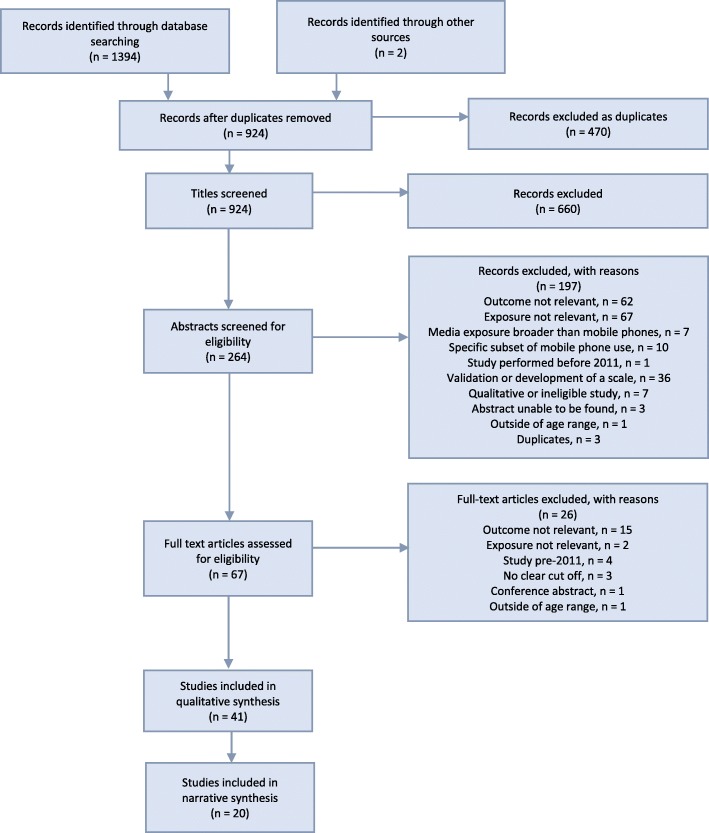
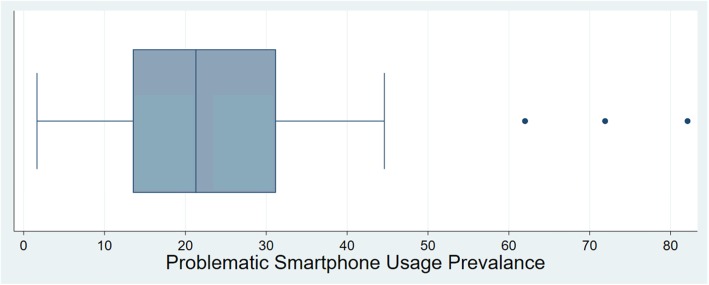
- Across 41 studies with 41,871 participants, the median prevalence of PSU was 23.3% with an interquartile range of 14–31.2%; 31 studies reported prevalence between 10% and 30%.
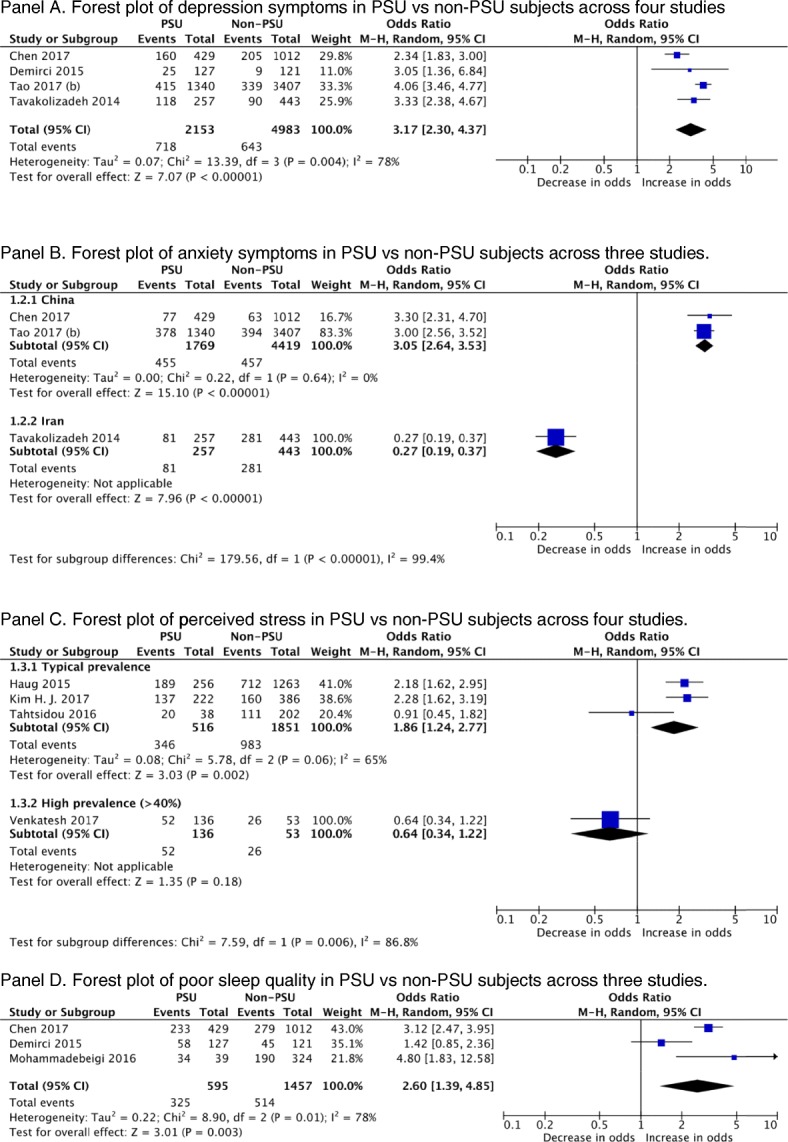
- PSU was associated with increased odds of depression: OR 3.17 (95% CI 2.30–4.37; I² = 78%; 8 studies, 10,099 participants).
- PSU was associated with increased odds of anxiety: OR 3.05 after accounting for heterogeneity (95% CI 2.64–3.53; I² = 0%; 7 studies, 9,359 participants).
- PSU was also associated with perceived stress (OR 1.86, 95% CI 1.24–2.77; I² = 65%; 5 studies, 3,618 participants) and poor sleep (OR 2.60, 95% CI 1.39–4.85; I² = 78%; 7 studies, 4,194 participants).
## Methods
- Systematic review and meta-analysis conducted according to PRISMA, with an a priori PROSPERO protocol (#88800); evidence quality was assessed using GRADE and study quality with a modified Newcastle-Ottawa scale.
- Searched 8 databases from January 1, 2011 to October 15, 2017 with no language restriction; included randomized controlled trials, cohort, cross-sectional, and case-control studies involving children and young people with mean age ≤25 and a clear threshold for PSU.
- Quantitative synthesis used random-effects meta-analysis (Mantel-Haenszel method; generic inverse variance for logistic regression results) and subgroup analyses when heterogeneity exceeded 85%.
## Limitations
- The paper states that included studies were non-randomised and at high risk of bias; 22 studies were judged poor quality and 19 moderate quality.
- PSU definitions and thresholds varied widely, and some were incompletely described, which the paper says weakens implementation.
- Mental health outcomes were based on self-report questionnaires rather than formal diagnoses, and the paper notes that reverse causality cannot be excluded; this is a stated limitation and also an evident issue for causal interpretation.
Model-written summary. Check it against the paper before relying on it.
Integrity signals
Registry
Cites
Statistics
Figures
Verification
Claims the paper makes
9 Valid · 1 Not valid · 12 Not checked · 38 Own results and interpretations
The cited sources support only part of this claim — read each source’s verdict below.
In the paper
“Problematic users reported that social networking was the most important or preferred activity on smartphones [34, 40].”
§ Prevalence of problematic smartphone usage and associated mental health outcomes amongst children and young people: a systematic review, meta-analysis and GRADE of the evidence > Results > Types of PSU usage
What the sources say
- Partly supportedcites [34] Lopez-Fernandez O Kuss DJ Romo L Self-reported dependence on mobile phones in young adults: a European cross-cultural empirical survey J Behav Addict 2017 6 2 168 177 10.1556/2006.6.2017.020 28425777 PMC5520117 sourceExperimental — accuracy not yet measured
In Results > Proportion of highly dependent users and their profile, social networking was the most important online activity for a majority when asked about any technology, not smartphones specifically. On smartphones, messaging and chatting was the most frequently named favorite activity (47.8%), ahead of social networking (32.6%). (LLM, conf=0.88)
- Supportedcites [40] Haug S Castro RP Kwon M Filler A Kowatsch T Schaub MP Smartphone use and smartphone addiction among young people in Switzerland J Behav Addict 2015 4 4 299 307 10.1556/2006.4.2015.037 26690625 PMC4712764 source
The Results table reports that 208 of 256 participants classified as having smartphone addiction (81.3%) selected social networking as their most personally relevant smartphone function. The Methods section confirms that this was a self-reported choice among smartphone functions, supporting the paraphrase about problematic users' preferred activity. (LLM, conf=0.92)
plain- Asserted: passes — The authors put it forward as true.
- Checkable: passes — It can be checked against evidence.
- Load-bearing: unclear — It is unclear whether the paper’s conclusions depend on it.
- Based: passes — The paper gives a reason why it holds.
- Rests on an assumption not shown here.
- Partly supported
A result the paper reports from its own data — it cites no other source for it, so there is none to check. The quote shows it is in the paper.
In the paper
“Eight studies [28, 36, 48, 57–61] reported a significant association between PSU and depression across 10,099 participants.”
§ Prevalence of problematic smartphone usage and associated mental health outcomes amongst children and young people: a systematic review, meta-analysis and GRADE of the evidence > Results > PSU associated with mental health outcomes
plainstates an associationn = 10,099 ·- Asserted: passes — The authors put it forward as true.
- Checkable: passes — It can be checked against evidence.
- Load-bearing: passes — The paper’s conclusions depend on it.
- Based: passes — The paper gives a reason why it holds.
- Rests on 3 assumptions not shown here.
In the paper
“One study reported an increased odds of suicidal ideation amongst those with PSU [62]; however, this was assessed through a single screening question and caution should be taken with this finding.”
§ Prevalence of problematic smartphone usage and associated mental health outcomes amongst children and young people: a systematic review, meta-analysis and GRADE of the evidence > Results > PSU associated with mental health outcomes
What the sources say
- Not checked — no full text of the sourcecites [62] Kim HJ Min JY Kim HJ Min KB Association between psychological and self-assessed health status and smartphone overuse among Korean college students J Ment Health 2017 0 0 1 6 10.1080/09638237.2017.1370641 28868959 source
plainstates an association- Asserted: passes — The authors put it forward as true.
- Checkable: passes — It can be checked against evidence.
- Load-bearing: unclear — It is unclear whether the paper’s conclusions depend on it.
- Based: passes — The paper gives a reason why it holds.
- Rests on 2 assumptions not shown here.
A result the paper reports from its own data — it cites no other source for it, so there is none to check. The quote shows it is in the paper.
In the paper
“The pooled OR for anxiety amongst CYP with PSU was 2.60 (95% CI 1.39, to 4.85; p < 0.001; I2 = 78%).”
§ Prevalence of problematic smartphone usage and associated mental health outcomes amongst children and young people: a systematic review, meta-analysis and GRADE of the evidence > Results > PSU associated with mental health outcomes
plainstates an associationn = 9,359 ·- Asserted: passes — The authors put it forward as true.
- Checkable: passes — It can be checked against evidence.
- Load-bearing: passes — The paper’s conclusions depend on it.
- Based: passes — The paper gives a reason why it holds.
- Rests on 3 assumptions not shown here.
A result the paper reports from its own data — it cites no other source for it, so there is none to check. The quote shows it is in the paper.
In the paper
“Five studies [36, 39, 40, 44, 62] investigated perceived stress across 3618 participants.”
§ Prevalence of problematic smartphone usage and associated mental health outcomes amongst children and young people: a systematic review, meta-analysis and GRADE of the evidence > Results > PSU associated with mental health outcomes
plainn = 3,618- Asserted: passes — The authors put it forward as true.
- Checkable: passes — It can be checked against evidence.
- Load-bearing: unclear — It is unclear whether the paper’s conclusions depend on it.
- Based: passes — The paper gives a reason why it holds.
- Rests on 3 assumptions not shown here.
17 more claims
Create a free account to see all 60 claims and to verify the 2 references still open.
- It may state two separate claims as one. 31
- Probably not a substantial claim. 16
- The quote only partly states this claim. 1
Citations
Cites
Preferred Reporting Items for Systematic Reviews and Meta-Analyses: the PRISMA statement
Moher, D., Liberati, A., Tetzlaff, J., Altman, D. G., & for the PRISMA Group (2009) · BMJ · doi:10.1136/bmj.b2535 · Cited by 83,823
Preferred Reporting Items for Systematic Reviews and Meta-Analyses: The PRISMA Statement
Moher, D., Liberati, A., Tetzlaff, J., Altman, D. G., & The PRISMA Group (2009) · PLoS Medicine · doi:10.1371/journal.pmed.1000097 · Cited by 64,042
Preferred reporting items for systematic reviews and meta-analyses: the PRISMA Statement.
(2009) · PubMed Central · Cited by 44,859
GRADE: an emerging consensus on rating quality of evidence and strength of recommendations
Guyatt, G. H., Oxman, A. D., Vist, G. E., Kunz, R., Falck-Ytter, Y., Alonso-Coello, P., & Schünemann, H. J. (2008) · BMJ · doi:10.1136/bmj.39489.470347.ad · Cited by 23,305
Wang, G., Ma, R., Qiao, G., Wada, K., Aizawa, Y., & Satoh, T. (2015) · Integrative Medicine International · doi:10.1159/000368408 · Cited by 18,657
Whiteford, H. A., Degenhardt, L., Rehm, J., Baxter, A. J., Ferrari, A. J., Erskine, H. E., Charlson, F. J., Norman, R. E., Flaxman, A. D., Johns, N., et al. (2013) · The Lancet · doi:10.1016/s0140-6736(13)61611-6 · Cited by 6,006
Sawyer, S. M., Azzopardi, P. S., Wickremarathne, D., & Patton, G. C. (2018) · The Lancet Child & Adolescent Health · doi:10.1016/s2352-4642(18)30022-1 · Cited by 3,666
The Smartphone addiction scale: development and validation of a short version for adolescents
Kwon, M., Kim, D.-J., Cho, H., & Yang, S. (2013) · PLoS ONE · doi:10.1371/journal.pone.0083558 · Cited by 2,177
Analysing Data and Undertaking Meta‐Analyses
Deeks, J. J., Higgins, J. P., & Altman, D. G. (2008) · Cochrane Handbook for Systematic Reviews of Interventions · doi:10.1002/9780470712184.ch9 · Cited by 1,800
Mental Health Surveillance Among Children — United States, 2013–2019
Bitsko, R. H., Claussen, A. H., Lichstein, J., Black, L. I., Jones, S. E., Danielson, M. L., Hoenig, J. M., Davis Jack, S. P., Brody, D. J., Gyawali, S., et al. (2022) · MMWR Supplements · doi:10.15585/mmwr.su7102a1 · Cited by 1,723
Research works printed but not linked: 3
- Office for National Statistics Children’s well-being and social relationships, UK 2018
- House of Commons Science and Technology Committee Impact of social media and screen-use on young people’s health: Fourteenth report of Session 2017–2019 2019
- Tahtsidou S Bellali T Alikari V The effect of dependence on mobile phones and computers on the lifestyle and health of nursing students at the University of the Peloponnese Arch Hell Med 2016 33 3 355 367 ER
Cited by
Items 701–800 of 832
De-Sola, J., Mestre-Pintó, J. I., Villanueva‐Blasco, V. J., Flores, H. T., Serrano, A., Rubio, G., & de Fonseca, F. R. (2026) · Behavioral Sciences · doi:10.3390/bs16020234 · Cited by 1
Shen, G., Han, Y., Xu, S., Chen, L., Xu, X., Hu, X., Ye, Z., Chen, L., & Li, Y. (2026) · Frontiers in Psychiatry · doi:10.3389/fpsyt.2026.1873653 · Cited by 1
Damar, A., & Önder, İ. (2026) · Chronobiology International · doi:10.1080/07420528.2026.2659921
Park, E. H. (2026) · Osong Public Health and Research Perspectives · doi:10.24171/j.phrp.2025.0510
Etyka Tadeusza Czeżowskiego wobec kultury nowych mediów
Branicki, W. (2021) · Polska Myśl Pedagogiczna · doi:10.4467/24504564pmp.21.014.13944
Wang, H., & Dai, Y. (2026) · Behavioral Sciences · doi:10.3390/bs16091557 · Cited by 1
Khatun, S., Ridoy, M. M. H., Noman, A. H., Sharon, M. M. H., Mia, M. R., Islam, J., Himel, S. H., & Shahrier, M. A. (2026) · PLoS ONE · doi:10.1371/journal.pone.0353865
Technology and Uneasiness in the Globalized Planet: Wasted Widespread Power in Digital Screens
(2023) · Advances in human and social aspects of technology book series · doi:10.4018/978-1-6684-8228-5.ch001
Schröder, R., Hamer, T., Kruzewitz, V., Suhr, R., & König, L. (2026) · Journal of Medical Internet Research · doi:10.2196/96284 · Cited by 2
Dawood, E., Barnawi, N. A., Shereda, H. M. A., Alharbi, A., Aloumi, H., Alqamayza, N., & Alghamdi, A. (2026) · JMIR Formative Research · doi:10.2196/93666
Je, M., & Lee, J.-W. (2023) · Daehan imsang geon-gang jeungjin hakoeji/Daehan imsang geon'gang jeungjin haghoeji · doi:10.15384/kjhp.2023.23.1.37 · Cited by 2
Hidalgo-Fuentes, S., Martínez-Álvarez, I., González-Pérez, E., & Salguero, F. L. (2026) · Psychology Health & Medicine · doi:10.1080/13548506.2026.2731629
Digital Media and Mental Health: A Multifaceted Tool Between Opportunity and Risk
Fiedler, R., & Kellmann, M. (2026) · Springer eBooks · doi:10.1007/978-3-662-73013-3_2
الدين, و. م. س. ع. (2024) · مجلة قطاع الدراسات الإنسانیة · doi:10.21608/jsh.2024.360561
Swit, C. S., Smith, J., Hāpuku, A., Fialele, O., Barclay, F., Hibbert-Schooner, R., Nation, K., & Coyne, S. M. (2025) · Journal of Adolescent Research · doi:10.1177/07435584251398914 · Cited by 1
Kumar, P., Sreekumaran, A., Srinivasan, V., Dhanusia, S., Jayaraj, V., & Manshi, N. (2026) · Fisioterapia em Movimento · doi:10.1590/fm.2026.39131
Fareh, Z., Hassan, S., Tayyab, M., Shabbir, M. B., Rafay, A., Asif, M., Tariq, M. A., Sheikh, G. M., & Rafay, H. (2026) · International Journal of Community Medicine and Public Health · doi:10.18203/2394-6040.ijcmph20260294
Lv, W., Huang, J., Yang, M., Zhang, Y., Wang, J., Lü, H., & Zhu, X. (2026) · Frontiers in Psychology · doi:10.3389/fpsyg.2026.1808905
Ho, M. K. W., Schulz, P. J., & Chang, A. (2025) · JMIR Pediatrics and Parenting · doi:10.2196/75837 · Cited by 3
SYED, N. A. S., Majeed, J., Iguh, C., DHIVAHARAN, M., YASEEN, S., JABER, F., Gyanendra, K., SOFIMIEARI, T. E., HASSAN, H., MANGALOTE, S. L. C., et al. (2025) · Juntendō Igaku/Juntendo igaku · doi:10.14789/ejmj.jmj25-0038-oa · Cited by 1
Soraci, P., Griffiths, M. D., Pisanti, R., Al‐Mamun, F., Mamun, M. A., Bevan, N., & Szabó, A. (2026) · Behaviour and Information Technology · doi:10.1080/0144929x.2026.2699282
Garbarino, S., Veneruso, M., Fedriga, M., Schiavetti, I., Sormani, M. P., Cordani, R., Chiorri, C., Guglielmi, O., & Nobili, L. (2025) · Research Square · doi:10.21203/rs.3.rs-7850909/v1
Sonunkar, P. R., Kamble, B., Alekhya, G., Kusneniwar, G. N., Dhole, S., Kumar, E. S., & Putukuchi, G. (2026) · Cureus · doi:10.7759/cureus.113058
Pharmacologic Management of Insomnia in Adults
Williamson, B. (2026) · Primary Care Clinics in Office Practice · doi:10.1016/j.pop.2026.01.004
Jasper, L., Bischoff, H., & Eichenberg, C. (2024) · doi:10.2196/preprints.68194
From Scarcity to Coverage: Generative Behavioral Modeling for Child Identification on Smartphones
Gao, S., Lin, C., Guo, J., Han, S., & Shen, C. (2026) · IEEE International Conference on Human-Machine Systems (ICHMS) · doi:10.1109/ichms69701.2026.11602394
Duc, T. D., Tuyết, N. T., Ha, V. T., Tam, D., Dung, N. H., Yen, T., Pham, M., & Dung, T. (2025) · SSRN Electronic Journal · doi:10.2139/ssrn.5126343
3º CONGRESSO INTERDISCIPLINAR DA ÁREA MÉDICA
Recima, R. (2022) · RECIMA21 - Revista Científica Multidisciplinar · doi:10.47820/recima21.v3i1.2558
Zhang, C., Lei, H., Wang, Y., Zhang, Z., Ling, F., & Wang, X. (2026) · Psychiatry Research · doi:10.1016/j.psychres.2026.117305
Civilization diseases in childhood – state-of-the- art literature review
Welian-Polus, I., Kurek, M., Bielak, M., Ziółkiewicz, A., Szukała, K., & Chrościńska–Krawczyk, M. (2023) · Journal of Pre-Clinical and Clinical Research · doi:10.26444/jpccr/176910 · Cited by 4
Subudhi, G., Chaudhari, K. H., Chimkar, S. B., & Chandrani, R. (2026) · International Journal of Contemporary Pediatrics · doi:10.18203/2349-3291.ijcp20260094
Padmanabhanunni, A., & Pretorius, T. B. (2026) · Revista de Investigación e Innovación en Ciencias de la Salud · doi:10.46634/riics.593 · Cited by 1
The Duty to Promote Digital Minimalism in Others I: Duties of Virtue
Aylsworth, T., & Castro, C. (2024) · Springer eBooks · doi:10.1007/978-3-031-45638-1_5
Factors contributing to the decline in problematic mobile phone use among Chinese emerging adults
Wu, Z., Ma, M., Bian, T., Li, Y., Chen, H., & Cao, J. (2025) · Addictive Behaviors · doi:10.1016/j.addbeh.2025.108480
Effect of Mobile Usage and Compromise of Rem and Non Rem Sleep Among Medical Students
Hassan, G., Nauman, & Akram, I. (2022) · Pakistan Journal of Medical and Health Sciences · doi:10.53350/pjmhs22167501
Comportamento de Utilização de Aplicativos Móveis entre Adolescentes
Corrêa, M. T. B., Nunes, L. D. L., & Farias, E. D. S. (2024) · Comunicação, Mídia e Consumo · doi:10.18568/cmc.v21i60.2879
A School-Based Four-Week Peer-Mentored Adaptation of the Success4Life Program for Digital WellbeingPreprint
Setia, S., Gilbert, F., & Gupta, A. (2026) · Research Square · doi:10.21203/rs.3.rs-9623045/v1
No, U., & Kim, S. (2026) · International Journal of Mental Health and Addiction · doi:10.1007/s11469-026-01722-3
Temporal patterns and educational use of smartphones among Algerian secondary learners
Cherif, K. M. (2025) · Educational Technology Quarterly · doi:10.55056/etq.956
The mediating effect of impulsivity between mindfulness and smartphone addictionPreprint
Kim, M., Seong, G., Jeon, M.-J., Jung, Y., & Lee, D. (2023) · Research Square · doi:10.21203/rs.3.rs-3240625/v1
PROJETO DE ENFRENTAMENTO A NOMOFOBIA NO AMBIENTE ESCOLAR
Corrêa, M. T. B., Farias, E. D. S., de Pinho, S. T., Gonçalves, L. G. D. O., dos Santos, J. P., de Souza, O. F., & Calheiros, P. R. V. (2023) · Revista Contemporânea · doi:10.56083/rcv3n6-032 · Cited by 1
Özcan, Ö., Gür, G. F., Demir, N., Karaali, H. K., Kayabaşı, İ., & KIliçaslan, E. (2026) · Physiotherapy Theory and Practice · doi:10.1080/09593985.2026.2693558
Yousuf, A., Musa, R., Isa, M., & Arifin, S. R. M. (2020) · medRxiv · doi:10.1101/2020.06.15.20131466
Digital Agency Tools: A Way to Buffer the Negative Effects of Excessive Phone Use?
Nassen, L.-M., & Karsay, K. (2026) · Cyberpsychology Behavior and Social Networking · doi:10.1177/21522715261489910
Khan, M. S., Wahid, E., Ahmad, S., Humayoon, N., Khan, H., Khan, M. I., Waqar, Z., Nisar, A., & Anwar, M. (2025) · medtigo Journal of Medicine · doi:10.63096/medtigo3084236 · Cited by 2
SAS-1: a single-item version of the smartphone addiction scale
Olson, J. A., Langer, E. J., & Martin, L. J. (2026) · Behaviour and Information Technology · doi:10.1080/0144929x.2026.2663508 · Cited by 2
Thasipan, R., Clever, F. R., & Adittan, T. (2026) · International Research Conference on Smart Computing and Systems Engineering (SCSE) · doi:10.1109/scse70081.2026.11499884
Scrolling for a cause: Supporting intentional smartphone use through the Ulysses Donation Pledge
Strömberg, M., & Heitmayer, M. (2026) · Computers in Human Behavior Reports · doi:10.1016/j.chbr.2026.101180
Meijer, D. K. F. (2022) · Advances in media, entertainment and the arts (AMEA) book series · doi:10.4018/978-1-7998-8884-0.ch014
Liu, X., Bao, Y., Yu, S., & Yu, T. (2026) · Current Psychology · doi:10.1007/s12144-026-09696-0
“Feeling unseen”: Generation and psychometric validation of a scale assessing sense of absence
Efrati, Y., & Potenza, M. N. (2026) · Journal of Behavioral Addictions · doi:10.1556/2006.2025.00373 · Cited by 3
Psychological Impact of Using Smartphone on Four- to Ten-Year-Old Children
Yadav, S., & Chakraborty, P. (2022) · Lecture notes in networks and systems · doi:10.1007/978-981-19-2535-1_43 · Cited by 2
Huang, Y., & Lu, J. (2022) · Children · doi:10.3390/children9081186 · Cited by 2
Chen, Y., Tian, X., & Zhou, X. (2025) · Frontiers in Psychiatry · doi:10.3389/fpsyt.2025.1628723 · Cited by 3
Digitale Medien und psychische Gesundheit: Ein facettenreiches Werkzeug zwischen Chance und Risiko
Fiedler, R., & Kellmann, M. (2024) · Springer eBooks · doi:10.1007/978-3-662-68241-8_12-1
Chung, Y., Schulz, P. J., Choi, Y., & Yang, A.-J. (2026) · Media Psychology · doi:10.1080/15213269.2026.2728393
Khalil, A. A. A., Salih, H. S., & Ghalib, A. A. A. (2024) · Journal of Nursing Research Patient Safety and Practise · doi:10.55529/jnrpsp.45.26.38
Kiss, H. (2021) · SZTE Repository of Dissertations (University of Szeged) · doi:10.14232/phd.10810 · Cited by 4
Leśniak, M., Polanowska, K., & Malinowska, E. (2026) · Journal of Social and Clinical Psychology · doi:10.1521/jscp.2026.45.3.275
Associations Between Nature Exposure, Screen Use, and Parent-Child Relations: A Scoping ReviewPreprint
Torjinski, M., Cliff, D. P., & Horwood, S. (2023) · Research Square · doi:10.21203/rs.3.rs-3147553/v1
Mechanismen problematischer Smartphone-Nutzung: Eine Übersicht multimodaler Neurobildgebung
Wolf, N. D., Henemann, G. M., Schmitgen, M. M., & Wolf, R. C. (2025) · Nervenheilkunde · doi:10.1055/a-2625-7090
Ciriza-Barea, E., Carballal-Mariño, M., Díaz-Martínez, F., Núñez-Jiménez, C., Sanchez-Almeida, E., Balaguer-Martínez, J. V., García-Sánchez, J. A., Viver-Gómez, S., Gorrotxategi-Gorrotxategi, P. J., Sampera, E. C., et al. (2026) · Revista Española de Salud Pública · doi:10.67113/resp.v100i1.1544
Crane, K., Hj, M., Weissinger, G., Domoff, S. E., Bernhardt, P. W., Harris, S., Hughes, S., & Yost, J. (2026) · Journal of the American Psychiatric Nurses Association · doi:10.1177/10783903261460003
Smartphone obsession linked behavioural changes among Indian adolescents
Ambiha, R., Sathyapriya, J., Akila, N., Vanitha, R., & Muniyammal, K. (2023) · Bioinformation · doi:10.6026/973206300191025 · Cited by 1
Association of media use with sleep of children and adolescents: an umbrella review
Brozatus, M., Ordnung, M., Sidhu, N., & Genuneit, J. (2026) · Sleep Medicine Reviews · doi:10.1016/j.smrv.2026.102327 · Cited by 4
BIOETHICS AMIDST THE COVID-19 PANDEMICPreprint
Lea, M. (2023) · doi:10.31219/osf.io/zkemb
Wojciechowska, M., Mateja, M., Żaroń, A., Spevan, M., & Šegulja, S. (2026) · Frontiers in Public Health · doi:10.3389/fpubh.2026.1932831
Building Bridges to Wellbeing: Using Trauma-Informed Practices to Promote Student Wellbeing
Bunten, M. G. (2025) · IGI Global eBooks · doi:10.4018/979-8-3693-9466-3.ch007
DİJİTAL EBEVEYNLİK: YENİ NESİL RİSKLERE KARŞI MODERN EBEVEYNLİK STRATEJİLERİ
Asıcı, E. (2025) · Adıyaman üniversitesi sosyal bilimler enstitüsü dergisi/Adıyaman üniversitesi sosyal bilimler enstitisü dergisi · doi:10.14520/adyusbd.1737972
Taneri, E., & Akın-Sarı, B. (2026) · Current Psychology · doi:10.1007/s12144-026-09104-7
Sun, F., & Wang, Y. (2026) · Frontiers in Psychology · doi:10.3389/fpsyg.2026.1729300 · Cited by 1
Mobile Devices and Autonomy: Individual-Level Effects
Aylsworth, T., & Castro, C. (2024) · Springer eBooks · doi:10.1007/978-3-031-45638-1_3
Kuwabara, Y., Imamoto, A., Hori, N., Kim, H., Kinjo, A., & Osaki, Y. (2025) · Pediatrics International · doi:10.1111/ped.70063 · Cited by 2
Ramos-Álvarez, R., Sánchez-Martín, M., Rodríguez-Ruiz, M.-M., & Fausor, R. (2023) · Anales de Psicología · doi:10.6018/analesps.441181 · Cited by 2
The problem of digital overload: cognitive impairments in young people
Shavlovskaya, O. A. (2025) · S S Korsakov Journal of Neurology and Psychiatry · doi:10.17116/jnevro2025125111140
PREVALENCE OF SMARTPHONE ADDICTION AMONG STUDENTS OF COLLEGES OF REHABILITATION SCIENCES
Zahid, M. (2021) · Pakistan Journal of Rehabilitation · doi:10.36283/pjr.zu.10.2/004 · Cited by 2
Kotelnikova, A. V., Serdakova, A. D., Игоревич, Х. И., Yurovskaya, E. E., & Pokushko, I. O. (2026) · The Education and science journal · doi:10.17853/1994-5639-2026-7-149-170
Digitale Medien und psychische Gesundheit: Ein facettenreiches Werkzeug zwischen Chance und Risiko
Fiedler, R., & Kellmann, M. (2025) · Springer eBooks · doi:10.1007/978-3-662-70475-2_12
Nguyen, T. B. T., TRUONG, D. D., Duong, D. T., Ha, V. T., Nguyen, C. D., Trần, M. D., Tran, Q. Y., & Pham, V. M. (2026) · Discover Psychology · doi:10.1007/s44202-026-00685-9 · Cited by 1
Wang, F., Chen, P., Liu, Z., Wang, L., Wang, D., Yang, S., & Zhang, X. (2025) · Current Psychology · doi:10.1007/s12144-025-07812-0
Ma, J., Cheng, Z., Sun, W., Xu, L., Wang, S., & Jiang, B. (2026) · Research Square · doi:10.21203/rs.3.rs-10321561/v1
Belonging and Smartphone Addiction Among Adolescents: The Role of Meaningful Living
Kaya, B., & Sözen, C. (2026) · The Journal of Genetic Psychology · doi:10.1080/00221325.2026.2658639 · Cited by 1
Miklyaeva, A. V., Panferov, V. N., & Gorkovaya, I. A. (2024) · Experimental Psychology (Russia) · doi:10.17759/exppsy.2024170209
Ellis, W. E., Hutchinson, L. R., Dumas, T. M., & Richmond, B. (2026) · BMC Psychology · doi:10.1186/s40359-026-04613-3 · Cited by 3
Wolf, N., Schmitgen, M. M., Henemann, G. M., Haage, S. H., Koenig, J., & Wolf, R. C. (2026) · Computers in Human Behavior Reports · doi:10.1016/j.chbr.2026.101244
Alsawalqa, R. O., & Zawahreh, H. A. R. A. (2025) · Frontiers in Psychiatry · doi:10.3389/fpsyt.2025.1695691 · Cited by 4
Xu, Q., Xu, B., & Yan, J. (2026) · Frontiers in Public Health · doi:10.3389/fpubh.2026.1925515
Liu, D., Ta, N., Yu, M., Liu, M., & Fu, Y. (2026) · Clinical Psychology Review · doi:10.1016/j.cpr.2026.102784
Metadata
- Authors
- Sohn, S. Y., Rees, P., Wildridge, B., Kalk, N. J., & Carter, B.
- Affiliations
- King's College London (GB)
- University College London (GB)
- University of Nottingham (GB)
- Corresponding author
- Carter, Ben
- Venue
- BMC Psychiatry
- Published
- 2019-11-29
- Volume
- 19
- Issue
- 1
- Pages
- 356-356
- ISSN
- 1471-244X (ISSN-L)
- PMC
- PMC6883663
- OpenAlex
- W2989721356
- Semantic Scholar
- 6cddee1b2697db7c77f192ae3b9f926930d035ff
- Cited by
- 838
- References
- 75
- Citations by year
- 2026: 147 · 2025: 152 · 2024: 139 · 2023: 132 · 2022: 128 · 2021: 89 · 2020: 49 · 2019: 2
- FWCI
- 16.89
- Type
- journal article
- Language
- en
- Update notices
- Open access
- gold
- doi.org
- Licence
- cc-by
- creativecommons.org/licenses/by/4.0/ (tdm)
- creativecommons.org/licenses/by/4.0/ (vor)
- Locations
- BMC Psychiatry (publishedVersion, cc-by)
- PubMed Central (publishedVersion, cc-by)
- PubMed (publishedVersion)
- Research Portal (King's College London) (submittedVersion, cc-by)
- DOAJ (DOAJ: Directory of Open Access Journals) (submittedVersion, cc-by-sa)
- Funders
- National Institute for Health and Care Research (ACF-2018-18-013)
- Topics
- Social Sciences › Sociology and Political Science › Impact of Technology on Adolescents
- Social Sciences › Education › Child Development and Digital Technology
- Social Sciences › Psychology › Clinical Psychology › Sexuality, Behavior, and Technology
- Keywords
- smartphone addiction, children and young people, prevalence, depression, anxiety, perceived stress, sleep quality, educational attainment, adolescent mental health
- MeSH terms
- Smartphone, Adolescent, Anxiety, Child, Depression, Educational Status, Female, Humans, Male, Mental Health, Sleep Wake Disorders, Stress, Psychological, Prevalence, Odds Ratio, Behavior, Addictive, Young Adult, Self Report
About these checks
Registry, retraction, Cites and statistics results are computed, not judged, with one exception: a printed reference that no index lists is read once by a model before it counts as a citation error. Claims are extracted by a model and kept only when their quote appears verbatim in the text; each cited source is then checked, with a model’s help, for whether it says what the claim relies on. Those verdicts can be wrong — read the claim’s quote and the cited source before relying on one.
The claim verdicts this report counts are experimental: their accuracy is not yet measured.
A language model drew the claims from the paper on 2026-10-10, under version 3 of the claim definition (model deepseek-v4.1-flash, prompt extract-v3).
A second model labelled each claim on 2026-10-10 (model jev-1.13-20260917, definition revision gold-guideline-v0.2).
Cited sources are checked with a language model’s help (gpt-6-sol).
Statistics and arithmetic are recomputed, not judged.
Confidence bands are shown only for fields calibrated on our annotated test set. None is calibrated yet, so no band is shown.
What counts as a claim ›How we measure confidence ›How we check this ›
Are you an author, or do you see a problem with this page? Request a review
Data sources
Bibliographic data: Semantic Scholar, OpenAlex, Crossref.
Contains information from the Semantic Scholar Academic Graph Datasets, made available under the ODC Attribution License (ODC-BY 1.0).
Semantic Scholar’s data is described in: Kinney, R., et al. (2023). The Semantic Scholar Open Data Platform. arXiv:2301.10140.
