

Prevalence of problematic smartphone usage and associated mental health outcomes amongst children and young people: a systematic review, meta-analysis and GRADE of the evidence
Open accessThe DOI matches its Crossref record; 75 of the 75 references it cites were found in a registry or an index; 14 of the 29 sources its claims cite were checked for support.
Abstract
Systematic review and meta-analysis of 41 studies assessing problematic smartphone use and mental health outcomes among children and young people.
Overview
CoChat Summary
## TL;DR
This systematic review/meta-analysis found that problematic smartphone use (PSU) affected about 1 in 4 children and young people (median prevalence 23.3%) across 41 studies and was consistently associated with worse mental health. The pooled associations were strongest for depression and anxiety, with elevated odds for depression (OR 3.17) and anxiety (OR 3.05 after accounting for heterogeneity).
## Key findings
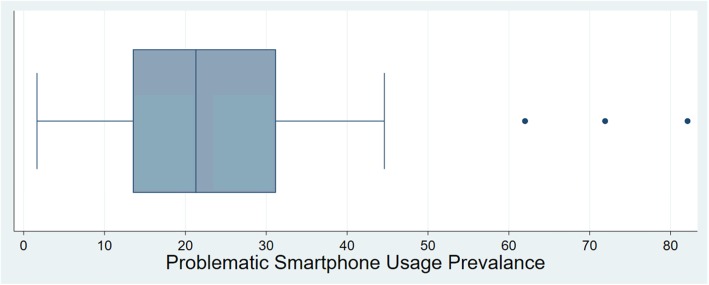
- Across 41 studies with 41,871 participants, the median prevalence of PSU was 23.3% with an interquartile range of 14–31.2%; 31 studies reported prevalence between 10% and 30%.
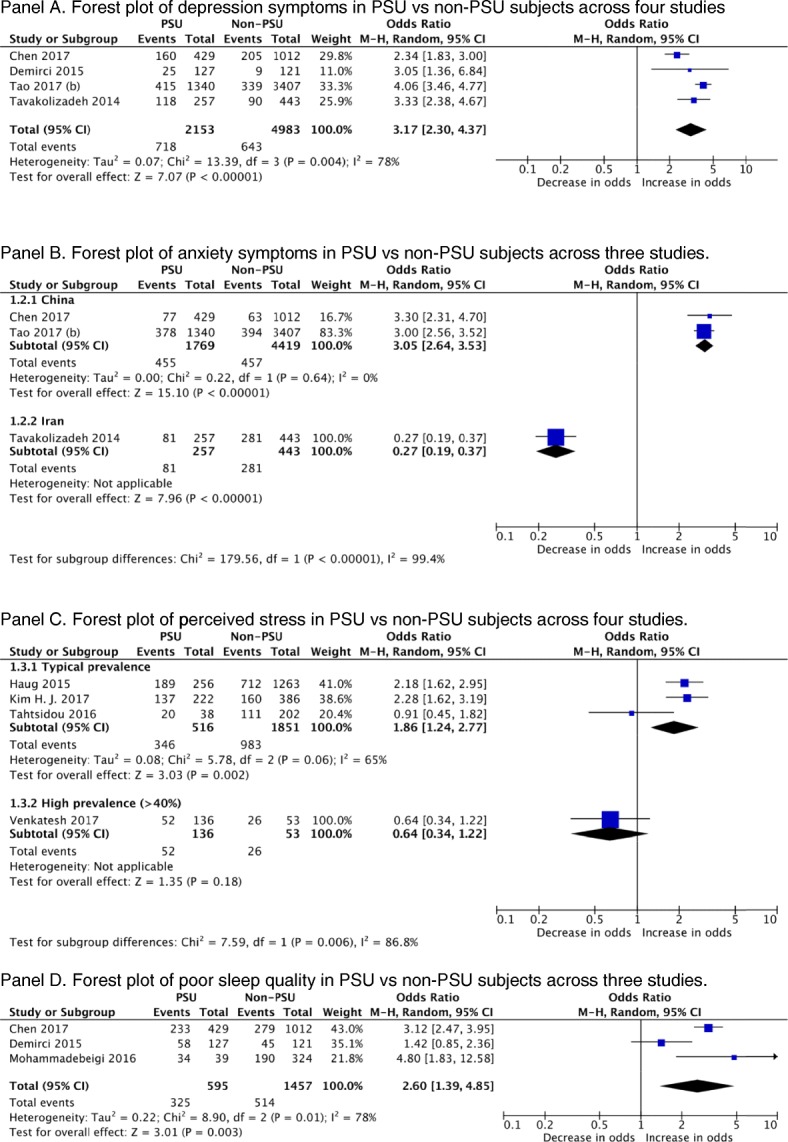
- PSU was associated with increased odds of depression: OR 3.17 (95% CI 2.30–4.37; I² = 78%; 8 studies, 10,099 participants).
- PSU was associated with increased odds of anxiety: OR 3.05 after accounting for heterogeneity (95% CI 2.64–3.53; I² = 0%; 7 studies, 9,359 participants).
- PSU was also associated with perceived stress (OR 1.86, 95% CI 1.24–2.77; I² = 65%; 5 studies, 3,618 participants) and poor sleep (OR 2.60, 95% CI 1.39–4.85; I² = 78%; 7 studies, 4,194 participants).
## Methods
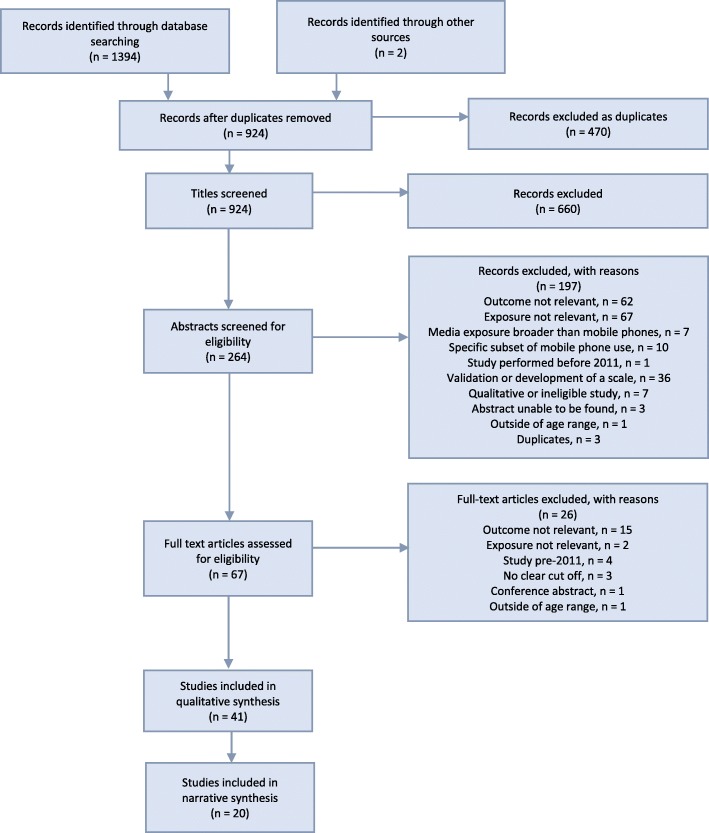
- Systematic review and meta-analysis conducted according to PRISMA, with an a priori PROSPERO protocol (#88800); evidence quality was assessed using GRADE and study quality with a modified Newcastle-Ottawa scale.
- Searched 8 databases from January 1, 2011 to October 15, 2017 with no language restriction; included randomized controlled trials, cohort, cross-sectional, and case-control studies involving children and young people with mean age ≤25 and a clear threshold for PSU.
- Quantitative synthesis used random-effects meta-analysis (Mantel-Haenszel method; generic inverse variance for logistic regression results) and subgroup analyses when heterogeneity exceeded 85%.
## Limitations
- The paper states that included studies were non-randomised and at high risk of bias; 22 studies were judged poor quality and 19 moderate quality.
- PSU definitions and thresholds varied widely, and some were incompletely described, which the paper says weakens implementation.
- Mental health outcomes were based on self-report questionnaires rather than formal diagnoses, and the paper notes that reverse causality cannot be excluded; this is a stated limitation and also an evident issue for causal interpretation.
Model-written summary. Check it against the paper before relying on it.
Integrity signals
Registry
Cites
Statistics
Figures
Verification
Claims the paper makes
9 Valid · 1 Not valid · 12 Not checked · 38 Own results and interpretations
The cited sources support only part of this claim — read each source’s verdict below.
In the paper
“Problematic users reported that social networking was the most important or preferred activity on smartphones [34, 40].”
§ Prevalence of problematic smartphone usage and associated mental health outcomes amongst children and young people: a systematic review, meta-analysis and GRADE of the evidence > Results > Types of PSU usage
What the sources say
- Partly supportedcites [34] Lopez-Fernandez O Kuss DJ Romo L Self-reported dependence on mobile phones in young adults: a European cross-cultural empirical survey J Behav Addict 2017 6 2 168 177 10.1556/2006.6.2017.020 28425777 PMC5520117 sourceExperimental — accuracy not yet measured
In Results > Proportion of highly dependent users and their profile, social networking was the most important online activity for a majority when asked about any technology, not smartphones specifically. On smartphones, messaging and chatting was the most frequently named favorite activity (47.8%), ahead of social networking (32.6%). (LLM, conf=0.88)
- Supportedcites [40] Haug S Castro RP Kwon M Filler A Kowatsch T Schaub MP Smartphone use and smartphone addiction among young people in Switzerland J Behav Addict 2015 4 4 299 307 10.1556/2006.4.2015.037 26690625 PMC4712764 source
The Results table reports that 208 of 256 participants classified as having smartphone addiction (81.3%) selected social networking as their most personally relevant smartphone function. The Methods section confirms that this was a self-reported choice among smartphone functions, supporting the paraphrase about problematic users' preferred activity. (LLM, conf=0.92)
plain- Asserted: passes — The authors put it forward as true.
- Checkable: passes — It can be checked against evidence.
- Load-bearing: unclear — It is unclear whether the paper’s conclusions depend on it.
- Based: passes — The paper gives a reason why it holds.
- Rests on an assumption not shown here.
- Partly supported
A result the paper reports from its own data — it cites no other source for it, so there is none to check. The quote shows it is in the paper.
In the paper
“Eight studies [28, 36, 48, 57–61] reported a significant association between PSU and depression across 10,099 participants.”
§ Prevalence of problematic smartphone usage and associated mental health outcomes amongst children and young people: a systematic review, meta-analysis and GRADE of the evidence > Results > PSU associated with mental health outcomes
plainstates an associationn = 10,099 ·- Asserted: passes — The authors put it forward as true.
- Checkable: passes — It can be checked against evidence.
- Load-bearing: passes — The paper’s conclusions depend on it.
- Based: passes — The paper gives a reason why it holds.
- Rests on 3 assumptions not shown here.
In the paper
“One study reported an increased odds of suicidal ideation amongst those with PSU [62]; however, this was assessed through a single screening question and caution should be taken with this finding.”
§ Prevalence of problematic smartphone usage and associated mental health outcomes amongst children and young people: a systematic review, meta-analysis and GRADE of the evidence > Results > PSU associated with mental health outcomes
What the sources say
- Not checked — no full text of the sourcecites [62] Kim HJ Min JY Kim HJ Min KB Association between psychological and self-assessed health status and smartphone overuse among Korean college students J Ment Health 2017 0 0 1 6 10.1080/09638237.2017.1370641 28868959 source
plainstates an association- Asserted: passes — The authors put it forward as true.
- Checkable: passes — It can be checked against evidence.
- Load-bearing: unclear — It is unclear whether the paper’s conclusions depend on it.
- Based: passes — The paper gives a reason why it holds.
- Rests on 2 assumptions not shown here.
A result the paper reports from its own data — it cites no other source for it, so there is none to check. The quote shows it is in the paper.
In the paper
“The pooled OR for anxiety amongst CYP with PSU was 2.60 (95% CI 1.39, to 4.85; p < 0.001; I2 = 78%).”
§ Prevalence of problematic smartphone usage and associated mental health outcomes amongst children and young people: a systematic review, meta-analysis and GRADE of the evidence > Results > PSU associated with mental health outcomes
plainstates an associationn = 9,359 ·- Asserted: passes — The authors put it forward as true.
- Checkable: passes — It can be checked against evidence.
- Load-bearing: passes — The paper’s conclusions depend on it.
- Based: passes — The paper gives a reason why it holds.
- Rests on 3 assumptions not shown here.
A result the paper reports from its own data — it cites no other source for it, so there is none to check. The quote shows it is in the paper.
In the paper
“Five studies [36, 39, 40, 44, 62] investigated perceived stress across 3618 participants.”
§ Prevalence of problematic smartphone usage and associated mental health outcomes amongst children and young people: a systematic review, meta-analysis and GRADE of the evidence > Results > PSU associated with mental health outcomes
plainn = 3,618- Asserted: passes — The authors put it forward as true.
- Checkable: passes — It can be checked against evidence.
- Load-bearing: unclear — It is unclear whether the paper’s conclusions depend on it.
- Based: passes — The paper gives a reason why it holds.
- Rests on 3 assumptions not shown here.
17 more claims
Create a free account to see all 60 claims and to verify the 1 reference still open.
- It may state two separate claims as one. 31
- Probably not a substantial claim. 16
- The quote only partly states this claim. 1
Citations
Cites
Preferred Reporting Items for Systematic Reviews and Meta-Analyses: the PRISMA statement
Moher, D., Liberati, A., Tetzlaff, J., Altman, D. G., & for the PRISMA Group (2009) · BMJ · doi:10.1136/bmj.b2535 · Cited by 83,823
Preferred Reporting Items for Systematic Reviews and Meta-Analyses: The PRISMA Statement
Moher, D., Liberati, A., Tetzlaff, J., Altman, D. G., & The PRISMA Group (2009) · PLoS Medicine · doi:10.1371/journal.pmed.1000097 · Cited by 64,042
Preferred reporting items for systematic reviews and meta-analyses: the PRISMA Statement.
(2009) · PubMed Central · Cited by 44,859
GRADE: an emerging consensus on rating quality of evidence and strength of recommendations
Guyatt, G. H., Oxman, A. D., Vist, G. E., Kunz, R., Falck-Ytter, Y., Alonso-Coello, P., & Schünemann, H. J. (2008) · BMJ · doi:10.1136/bmj.39489.470347.ad · Cited by 23,305
Wang, G., Ma, R., Qiao, G., Wada, K., Aizawa, Y., & Satoh, T. (2015) · Integrative Medicine International · doi:10.1159/000368408 · Cited by 18,657
Whiteford, H. A., Degenhardt, L., Rehm, J., Baxter, A. J., Ferrari, A. J., Erskine, H. E., Charlson, F. J., Norman, R. E., Flaxman, A. D., Johns, N., et al. (2013) · The Lancet · doi:10.1016/s0140-6736(13)61611-6 · Cited by 6,006
Sawyer, S. M., Azzopardi, P. S., Wickremarathne, D., & Patton, G. C. (2018) · The Lancet Child & Adolescent Health · doi:10.1016/s2352-4642(18)30022-1 · Cited by 3,666
The Smartphone addiction scale: development and validation of a short version for adolescents
Kwon, M., Kim, D.-J., Cho, H., & Yang, S. (2013) · PLoS ONE · doi:10.1371/journal.pone.0083558 · Cited by 2,177
Analysing Data and Undertaking Meta‐Analyses
Deeks, J. J., Higgins, J. P., & Altman, D. G. (2008) · Cochrane Handbook for Systematic Reviews of Interventions · doi:10.1002/9780470712184.ch9 · Cited by 1,800
Mental Health Surveillance Among Children — United States, 2013–2019
Bitsko, R. H., Claussen, A. H., Lichstein, J., Black, L. I., Jones, S. E., Danielson, M. L., Hoenig, J. M., Davis Jack, S. P., Brody, D. J., Gyawali, S., et al. (2022) · MMWR Supplements · doi:10.15585/mmwr.su7102a1 · Cited by 1,723
Research works printed but not linked: 3
- Office for National Statistics Children’s well-being and social relationships, UK 2018
- House of Commons Science and Technology Committee Impact of social media and screen-use on young people’s health: Fourteenth report of Session 2017–2019 2019
- Tahtsidou S Bellali T Alikari V The effect of dependence on mobile phones and computers on the lifestyle and health of nursing students at the University of the Peloponnese Arch Hell Med 2016 33 3 355 367 ER
Cited by
Global prevalence of digital addiction in general population: A systematic review and meta-analysis
Meng, S.-Q., Cheng, J.-L., Li, Y.-Y., Yang, X.-Q., Zheng, J.-W., Chang, X.-W., Shi, Y., Chen, Y., Lu, L., Sun, Y., et al. (2022) · Clinical Psychology Review · doi:10.1016/j.cpr.2022.102128 · Cited by 622
Stein, D. J., Shoptaw, S. J., Vigo, D. V., Lund, C., Cuijpers, P., Bantjes, J., Sartorius, N., & Maj, M. (2022) · World Psychiatry · doi:10.1002/wps.20998 · Cited by 331
Smartphone Addiction and Associated Health Outcomes in Adult Populations: A Systematic Review
Ratan, Z., Parrish, A.-M., Zaman, S., Alotaibi, M., & Hosseinzadeh, H. (2021) · International Journal of Environmental Research and Public Health · doi:10.3390/ijerph182212257 · Cited by 285
Trott, M., Driscoll, R., Iraldo, E., & Pardhan, S. (2022) · eClinicalMedicine · doi:10.1016/j.eclinm.2022.101452 · Cited by 266
Zhang, M. X., & Wu, A. M. S. (2020) · Addictive Behaviors · doi:10.1016/j.addbeh.2020.106552 · Cited by 265
Keyes, K. M., & Platt, J. M. (2024) · Journal of Child Psychology and Psychiatry · doi:10.1111/jcpp.13864 · Cited by 253
Smartphone addiction, sleep quality, depression, anxiety, and stress among medical students
Nikolic, A., Bukurov, B., Kocic, I., Vukovic, M., Ladjevic, N., Vrhovac, M., Pavlović, Z., Grujicic, J., Kisic, D., & Sipetic, S. (2023) · Frontiers in Public Health · doi:10.3389/fpubh.2023.1252371 · Cited by 202
Alimoradi, Z., Lotfi, A., Lin, C.-Y., Griffiths, M. D., & Pakpour, A. H. (2022) · Current Addiction Reports · doi:10.1007/s40429-022-00435-6 · Cited by 187
Li, L., Niu, Z., Mei, S., & Griffiths, M. D. (2022) · Computers in Human Behavior · doi:10.1016/j.chb.2021.107086 · Cited by 179
The Association Between Smartphone Addiction and Sleep: A UK Cross-Sectional Study of Young Adults
Sohn, S. Y., Krasnoff, L., Rees, P., Kalk, N. J., & Carter, B. (2021) · Frontiers in Psychiatry · doi:10.3389/fpsyt.2021.629407 · Cited by 168
Self-citationOsorio-Molina, C., Martos-Cabrera, M. B., Membrive-Jiménez, M. J., Vargas-Roman, K., Suleiman-Martos, N., Ortega-Campos, E., & Gómez-Urquiza, J. L. (2021) · Nurse Education Today · doi:10.1016/j.nedt.2020.104741 · Cited by 149
Opoku Asare, K., Terhorst, Y., Vega, J., Peltonen, E., Lagerspetz, E., & Ferreira, D. (2021) · JMIR mHealth and uHealth · doi:10.2196/26540 · Cited by 145
Mejía, A. L., Gutiérrez‐Ortega, M., Pintado, I. S., & González‐Cabrera, J. M. (2021) · PLoS ONE · doi:10.1371/journal.pone.0250509 · Cited by 200
Geng, J., Lei, L., Ouyang, M., Nie, J., & Wang, P. (2021) · Addictive Behaviors · doi:10.1016/j.addbeh.2021.106995 · Cited by 158
Psychological Risk Factors that Predict Social Networking and Internet Addiction in Adolescents
Peris, M., de la Barrera, U., Schoeps, K., & Montoya-Castilla, I. (2020) · International Journal of Environmental Research and Public Health · doi:10.3390/ijerph17124598 · Cited by 136
Fear of missing out (FoMO) and internet use: A comprehensive systematic review and meta-analysis
(2021) · Journal of Behavioral Addictions · doi:10.1556/2006.2021.00083 · Cited by 134
Problematic Gaming and Sleep: A Systematic Review and Meta-Analysis
Kristensen, J. H., Pallesen, S., King, D. L., Hysing, M., & Erevik, E. K. (2021) · Frontiers in Psychiatry · doi:10.3389/fpsyt.2021.675237 · Cited by 176
Girela-Serrano, B. M., Spiers, A. D. V., Ruotong, L., Gangadia, S., Toledano, M. B., & Di Simplicio, M. (2024) · European Child & Adolescent Psychiatry · doi:10.1007/s00787-022-02012-8 · Cited by 123
Psychological Impact of COVID-19 on Children and Adolescents: A Systematic Review
Chawla, N., Tom, A., Sen, M. S., & Sagar, R. (2021) · Indian Journal of Psychological Medicine · doi:10.1177/02537176211021789 · Cited by 142
Zhong, Y., Ma, H., Liang, Y., Liao, C., Zhang, C., & Jiang, W. (2022) · International Journal of Social Psychiatry · doi:10.1177/00207640221089535 · Cited by 144
Gómez-Galán, J., Martínez-López, J. Á., Lázaro-Pérez, C., & Sarasola Sánchez-Serrano, J. L. (2020) · Sustainability · doi:10.3390/su12187737 · Cited by 113
Goodyear, V. A., Randhawa, A., Adab, P., Al-Janabi, H., Fenton, S., Jones, K., Michail, M., Morrison, B., Patterson, P., Quinlan, J., et al. (2025) · The Lancet Regional Health - Europe · doi:10.1016/j.lanepe.2025.101211 · Cited by 111
“35 There is also scope to consider other methods of data collection to enhance the accuracy of reporting for the outcome measures, such as the use of sleep polysomnography instead of accelerometer or self-reported measures of sleep.”
Validation of smartphone addiction scale – Short version (SAS-SV) in Brazilian adolescents
Andrade, A. L. M., Scatena, A., Martins, G. D. G., Pinheiro, B. D. O., da Silva, A. B., Enes, C. C., de Oliveira, W. A., & Kim, D. (2020) · Addictive Behaviors · doi:10.1016/j.addbeh.2020.106540 · Cited by 120
Throuvala, M. A., Griffiths, M. D., Rennoldson, M., & Kuss, D. J. (2020) · International Journal of Environmental Research and Public Health · doi:10.3390/ijerph17134842 · Cited by 101
Smartphone use patterns and problematic smartphone use among preschool children
Park, J. H., & Park, M.-J. (2021) · PLoS ONE · doi:10.1371/journal.pone.0244276 · Cited by 145
Effects of Mobile Use on Subjective Sleep Quality
Rafique, N., Asoom, L. I. A., Alsunni, A. A., Saudagar, F. N., Almulhim, L. A. A., & Alkaltham, G. K. I. (2020) · Nature and Science of Sleep · doi:10.2147/nss.s253375 · Cited by 147
The digital rainbow: Digital determinants of health inequities
Jahnel, T., Dassow, H.-H., Gerhardus, A., & Schüz, B. (2022) · DIGITAL HEALTH · doi:10.1177/20552076221129093 · Cited by 96
The Overlap Between Problematic Smartphone Use and Problematic Social Media Use: a Systematic Review
Marino, C., Canale, N., Melodia, F., Spada, M. M., & Vieno, A. (2021) · Current Addiction Reports · doi:10.1007/s40429-021-00398-0 · Cited by 98
Sánchez-Fernández, M., & Borda-Mas, M. (2023) · Education and Information Technologies · doi:10.1007/s10639-022-11437-2 · Cited by 98
Shi, X., Wang, A., & Ya, Z. (2023) · Addictive Behaviors · doi:10.1016/j.addbeh.2023.107676 · Cited by 110
Hosen, I., Al‐Mamun, F., Sikder, M. T., Abbasi, A. Z., Zou, L., Guo, T., & Mamun, M. A. (2021) · Risk Management and Healthcare Policy · doi:10.2147/rmhp.s325126 · Cited by 107
Mobile phones: The effect of its presence on learning and memory
Tanil, C. T., & Yong, M. H. (2020) · PLoS ONE · doi:10.1371/journal.pone.0219233 · Cited by 143
Smartphone Use Among University Students During COVID-19 Quarantine: An Ethical Trigger
Saadeh, H., Fayez, R. Q. A., Refaei, A. H. A., Shewaikani, N., Khawaldah, H. A., Abu‐Shanab, S., & Al-Hussaini, M. A. (2021) · Frontiers in Public Health · doi:10.3389/fpubh.2021.600134 · Cited by 105
Social media mindsets: a new approach to understanding social media use and psychological well-being
Lee, A. Y., & Hancock, J. T. (2023) · Journal of Computer-Mediated Communication · doi:10.1093/jcmc/zmad048 · Cited by 82
Smartphone Addiction and Quality of Sleep among Indian Medical Students
Chatterjee, S., & Kar, S. K. (2021) · Psychiatry · doi:10.1080/00332747.2021.1907870 · Cited by 106
Yang, X., Hu, H., Zhao, C., Xu, H., Tu, X., & Zhang, G. (2021) · BMC Psychiatry · doi:10.1186/s12888-021-03265-4 · Cited by 72
Zhao, C., Xu, H., Lai, X., Yang, X., Tu, X., Ding, N., Lv, Y., & Zhang, G. (2021) · Psychology Research and Behavior Management · doi:10.2147/prbm.s302551 · Cited by 89
Chong, S. C., Teo, W. Z., & Shorey, S. (2023) · Pediatric Research · doi:10.1038/s41390-023-02555-9 · Cited by 116
Yang, F., Qi, L., Liu, S., Wen, H., Cao, Q., Liu, Y., Tang, M. F., Lv, Z., Zhou, Z., & Yang, Y. (2022) · Nutrients · doi:10.3390/nu14061281 · Cited by 90
Chen, H., Wang, C., Lu, T., Tao, B., Gao, Y., & Yan, J. (2022) · International Journal of Environmental Research and Public Health · doi:10.3390/ijerph19159286 · Cited by 93
Effects of the COVID-19 lockdown on mental health in a UK student sample
Catling, J. C., Bayley, A., Begum, Z. A., Wardzinski, C., & Wood, A. (2022) · BMC Psychology · doi:10.1186/s40359-022-00732-9 · Cited by 80
Kliesener, T., Meigen, C., Kieß, W., & Poulain, T. (2022) · BMC Psychiatry · doi:10.1186/s12888-022-03815-4 · Cited by 101
Do Age, Gender and Poor Diet Influence the Higher Prevalence of Nomophobia among Young People?
Moreno-Guerrero, A.-J., Díaz, I. A., Reche, M. P. C., & Rodríguez-García, A.-M. (2020) · International Journal of Environmental Research and Public Health · doi:10.3390/ijerph17103697 · Cited by 92
Harris, B., McCredie, M., & Fields, S. (2020) · Computers in Human Behavior Reports · doi:10.1016/j.chbr.2020.100011 · Cited by 62
Wang, A., Wang, Z., Ya, Z., & Shi, X. (2022) · Frontiers in Psychology · doi:10.3389/fpsyg.2022.877277 · Cited by 76
Wang, Y., Yang, H., Montag, C., & Elhai, J. D. (2020) · Current Psychology · doi:10.1007/s12144-020-01052-0 · Cited by 67
Neuroticism and internet addiction: What is next? A systematic conceptual review
Marciano, L., Camerini, A.-L., & Schulz, P. J. (2021) · Personality and Individual Differences · doi:10.1016/j.paid.2021.111260 · Cited by 71
Lu, X., An, X., & Chen, S. (2024) · Cyberpsychology Behavior and Social Networking · doi:10.1089/cyber.2023.0548 · Cited by 74
Preventive Interventions for Internet Addiction in Young Children: Systematic Review
Theopilus, Y., Mahmud, A. A., Davis, H., & Octavia, J. R. (2024) · JMIR Mental Health · doi:10.2196/56896 · Cited by 94
Drummond, D., & Coulet, A. (2022) · Journal of Medical Internet Research · doi:10.2196/39698 · Cited by 64
Mancinelli, E., Ruocco, E., Napolitano, S., & Salcuni, S. (2021) · Comprehensive Psychiatry · doi:10.1016/j.comppsych.2021.152285 · Cited by 58
Smartphone overuse, depression & anxiety in medical students during the COVID-19 pandemic
Santander-Hernández, F. M., Peralta, C. I., Guevara-Morales, M. A., Díaz-Vélez, C., & Valladares-Garrido, M. J. (2022) · PLoS ONE · doi:10.1371/journal.pone.0273575 · Cited by 63
Karaköse, T., Yıldırım, B., Tülübaş, T., & Kardas, A. (2023) · Frontiers in Psychology · doi:10.3389/fpsyg.2023.1126815 · Cited by 84
Basu, S. (2020) · Cambridge Quarterly of Healthcare Ethics · doi:10.1017/s0963180120000821 · Cited by 55
Arrivillaga, C., Rey, L., & Extremera, N. (2021) · Journal of Affective Disorders · doi:10.1016/j.jad.2021.09.021 · Cited by 64
Liu, H., Soh, K. G., Samsudin, S., Rattanakoses, W., & Qi, F. (2022) · Frontiers in Psychology · doi:10.3389/fpsyg.2022.1021285 · Cited by 68
Is distraction on the road associated with maladaptive mobile phone use? A systematic review
Rahmillah, F. I., Tariq, A., King, M., & Oviedo-Trespalacios, Ó. (2022) · Accident Analysis & Prevention · doi:10.1016/j.aap.2022.106900 · Cited by 62
Watson, J. C., Prosek, E. A., & Giordano, A. L. (2021) · Journal of Psychoeducational Assessment · doi:10.1177/07342829211050536 · Cited by 61
Brodersen, K., Hammami, N., & Katapally, T. R. (2022) · Youth · doi:10.3390/youth2010003 · Cited by 65
Hitcham, L., Jackson, H., & James, R. J. E. (2023) · Computers in Human Behavior · doi:10.1016/j.chb.2023.107822 · Cited by 59
Tangmunkongvorakul, A., Musumari, P. M., Tsubohara, Y., Ayood, P., Srithanaviboonchai, K., Techasrivichien, T., Suguimoto, S. P., Ono‐Kihara, M., & Kihara, M. (2020) · PLoS ONE · doi:10.1371/journal.pone.0238459 · Cited by 64
Smartphone gaming induces dry eye symptoms and reduces blinking in school-aged children
Chidi‐Egboka, N. C., Jalbert, I., & Golebiowski, B. (2022) · Eye · doi:10.1038/s41433-022-02122-2 · Cited by 66
Shahidin, S. H., Midin, M., Sidi, H., Choy, C. L., Jaafar, N. R. N., Sahimi, H. M. S., & Roos, N. A. C. (2022) · International Journal of Environmental Research and Public Health · doi:10.3390/ijerph192315848 · Cited by 71
Liu, C., Ren, L., Rotaru, K., Liu, X., Li, K., Yang, W., Li, Y., Wei, X., Yücel, M., & Albertella, L. (2023) · Journal of Behavioral Addictions · doi:10.1556/2006.2022.00093 · Cited by 48
Marciano, L., & Camerini, A.-L. (2022) · PLoS ONE · doi:10.1371/journal.pone.0263815 · Cited by 65
Pardhan, S., Parkin, J., Trott, M., & Driscoll, R. (2022) · Journal of School Health · doi:10.1111/josh.13170 · Cited by 67
Przepiórka, A., Błachnio, A., Cudo, A., & Kot, P. (2021) · Computers & Education · doi:10.1016/j.compedu.2021.104286 · Cited by 72
Mao, B., Chen, S., Wei, M., Luo, Y., & Liu, Y. (2022) · International Journal of Environmental Research and Public Health · doi:10.3390/ijerph191610334 · Cited by 55
Lai, X., Huang, S., Nie, C., Yan, J. J., Li, Y., Wang, Y., & Luo, Y. (2022) · Journal of Behavioral Addictions · doi:10.1556/2006.2022.00047 · Cited by 62
Li, Y., Mu, W., Xie, X., & Kwok, S. Y. C. L. (2023) · Digital Health · doi:10.1177/20552076231158036 · Cited by 53
Zhang, M. X., Zhou, H., Yang, H. M., & Wu, A. M. S. (2021) · Current Psychology · doi:10.1007/s12144-021-01863-9 · Cited by 53
Throuvala, M. A., Griffiths, M. D., Rennoldson, M., & Kuss, D. J. (2021) · International Journal of Environmental Research and Public Health · doi:10.3390/ijerph18094522 · Cited by 69
Throuvala, M. A., Griffiths, M. D., Rennoldson, M., & Kuss, D. J. (2021) · International Journal of Environmental Research and Public Health · doi:10.3390/ijerph18063227 · Cited by 71
Mokhtarinia, H. R., Torkamani, M. H., Farmani, O., Biglarian, A., & Gabel, C. P. (2022) · BMC Pediatrics · doi:10.1186/s12887-022-03748-7 · Cited by 64
Bitar, Z., Akel, M., Salameh, P., Obeïd, S., & Hallit, S. R. (2022) · Current Psychology · doi:10.1007/s12144-022-03104-z · Cited by 55
Wei, X., Ren, L., Jiang, H., Liu, C., Wang, H., Geng, J., Gao, T., Wang, J., & Lei, L. (2022) · Computers in Human Behavior · doi:10.1016/j.chb.2022.107602 · Cited by 46
Soraci, P., Demetrovics, Z., Bevan, N., Pisanti, R., Servidio, R. C., Bernardo, C. D., Chini, E., & Griffiths, M. D. (2025) · International Journal of Mental Health and Addiction · doi:10.1007/s11469-024-01432-8 · Cited by 85
Zhou, H., Xiao, W., Li, X., & Jiang, H. (2022) · Journal of Affective Disorders · doi:10.1016/j.jad.2022.04.051 · Cited by 51
Boredom and digital media use: A systematic review and meta-analysis
Camerini, A.-L., Morlino, S., & Marciano, L. (2023) · Computers in Human Behavior Reports · doi:10.1016/j.chbr.2023.100313 · Cited by 61
Zhang, J., Yuan, G., Guo, H., Zhang, X., Zhang, K., Lu, X., Yang, H., Zhu, Z., Jin, G., Shi, H., et al. (2023) · Addictive Behaviors · doi:10.1016/j.addbeh.2023.107715 · Cited by 51
Toward an integrated framework for examining the addictive use of smartphones among young adults
Tan, C. N.-L. (2023) · Asian Journal of Social Health and Behavior · doi:10.4103/shb.shb_206_23 · Cited by 45
The Prevalence and Predictors of Problematic Mobile Phone Use: a 14-Country Empirical Survey
Kalaitzaki, A. E., Laconi, S., Spritzer, D. T., Hauck, S., Gnisci, A., Sergi, I., Vally, Z., Tudorel, O. I., Vintilă, M., Malik, S., et al. (2022) · International Journal of Mental Health and Addiction · doi:10.1007/s11469-022-00901-2 · Cited by 44
Nomophobia (No Mobile Phone Phobia) and Psychological Health Issues among Young Adult Students
Abdoli, N., Bahmani, D. S., Salari, N., Khodamoradi, M., Farnia, V., Jahangiri, S., Brühl, A. B., Dürsteler, K. M., Stanga, Z. G., & Brand, S. (2023) · European Journal of Investigation in Health Psychology and Education · doi:10.3390/ejihpe13090128 · Cited by 63
Liu, C., Ren, L., Li, K., Yang, W., Li, Y., Rotaru, K., Wei, X., Yücel, M., & Albertella, L. (2022) · Frontiers in Psychiatry · doi:10.3389/fpsyt.2022.917833 · Cited by 40
Brailovskaia, J., Stirnberg, J., Rozgonjuk, D., Margraf, J., & Elhai, J. D. (2021) · PLoS ONE · doi:10.1371/journal.pone.0261023 · Cited by 53
Lee, S., Lee, H., Choi, J., Bang, S.-Y., Park, M.-H., Jung, K.-I., & Kweon, Y. (2020) · International Journal of Environmental Research and Public Health · doi:10.3390/ijerph17134751 · Cited by 42
Sex, Age, and Smartphone Addiction Across 41 Countries
Olson, J. A., Sandra, D. A., Veissière, S. P. L., & Langer, E. J. (2023) · International Journal of Mental Health and Addiction · doi:10.1007/s11469-023-01146-3 · Cited by 51
Ke, Y., Liu, X., Xu, X., He, B., Wang, J., Zuo, L., Wang, H., & Yang, G. (2024) · Frontiers in Psychology · doi:10.3389/fpsyg.2023.1256743 · Cited by 59
Zhang, C., Zeng, P., Tan, J., Sun, S., Zhao, M., Cui, J., Zhang, G., Jia, J., & Liu, D. (2021) · Frontiers in Psychiatry · doi:10.3389/fpsyt.2021.755059 · Cited by 60
Lai, X., Hu, C., Ying, L., Xu, H., Zhao, C., Yang, X., Yu, X., & Zhang, G. (2022) · Psychological Reports · doi:10.1177/00332941221084905 · Cited by 46
Zwilling, M. (2022) · Sustainability · doi:10.3390/su14063229 · Cited by 58
Swit, C. S., Coyne, S. M., Shawcroft, J. E., Gath, M. E., Barr, R., Holmgren, H. G., & Stockdale, L. (2023) · Journal of Children and Media · doi:10.1080/17482798.2023.2230321 · Cited by 44
Camerini, A.-L., Gerosa, T., & Marciano, L. (2020) · New Media & Society · doi:10.1177/1461444820948809 · Cited by 47
Özparlak, A., Karakaya, D., & Özer, Z. (2023) · Journal of Pediatric Nursing · doi:10.1016/j.pedn.2023.09.017 · Cited by 56
Mayerhofer, D., Haider, K., Amon, M., Gächter, A., O’Rourke, T., Dale, R., Humer, E. C., Probst, T., & Pieh, C. (2024) · Healthcare · doi:10.3390/healthcare12060600 · Cited by 56
Fernández, C., Vicente, M. A., Carrillo, I., Guilabert, M., & Mira, J. J. (2020) · Journal of Medical Internet Research · doi:10.2196/19350 · Cited by 45
Sohn, S. Y., Rees, P., Wildridge, B., Kalk, N. J., & Carter, B. (2021) · BMC Psychiatry · doi:10.1186/s12888-020-02986-2 · Cited by 40
Self-citationde Hesselle, L. C., & Montag, C. (2024) · BMC Psychology · doi:10.1186/s40359-024-01611-1 · Cited by 64
Kwon, S., Kim, R., Lee, J.-T., Kim, J., Song, S., Kim, S., & Oh, H. (2022) · JAMA Network Open · doi:10.1001/jamanetworkopen.2022.13237 · Cited by 35
Metadata
- Authors
- Sohn, S. Y., Rees, P., Wildridge, B., Kalk, N. J., & Carter, B.
- Affiliations
- King's College London (GB)
- University College London (GB)
- University of Nottingham (GB)
- Corresponding author
- Carter, Ben
- Venue
- BMC Psychiatry
- Published
- 2019-11-29
- Volume
- 19
- Issue
- 1
- Pages
- 356-356
- ISSN
- 1471-244X (ISSN-L)
- PMC
- PMC6883663
- OpenAlex
- W2989721356
- Cited by
- 838
- References
- 75
- Citations by year
- 2026: 147 · 2025: 152 · 2024: 139 · 2023: 132 · 2022: 128 · 2021: 89 · 2020: 49 · 2019: 2
- FWCI
- 16.89
- Type
- journal article
- Language
- en
- Update notices
- Open access
- gold
- doi.org
- Licence
- cc-by
- creativecommons.org/licenses/by/4.0/ (tdm)
- creativecommons.org/licenses/by/4.0/ (vor)
- Locations
- BMC Psychiatry (publishedVersion, cc-by)
- PubMed Central (publishedVersion, cc-by)
- PubMed (publishedVersion)
- Research Portal (King's College London) (submittedVersion, cc-by)
- DOAJ (DOAJ: Directory of Open Access Journals) (submittedVersion, cc-by-sa)
- Funders
- National Institute for Health and Care Research (ACF-2018-18-013)
- Topics
- Social Sciences › Sociology and Political Science › Impact of Technology on Adolescents
- Social Sciences › Education › Child Development and Digital Technology
- Social Sciences › Psychology › Clinical Psychology › Sexuality, Behavior, and Technology
- Keywords
- smartphone addiction, children and young people, prevalence, depression, anxiety, perceived stress, sleep quality, educational attainment, adolescent mental health
- MeSH terms
- Smartphone, Adolescent, Anxiety, Child, Depression, Educational Status, Female, Humans, Male, Mental Health, Sleep Wake Disorders, Stress, Psychological, Prevalence, Odds Ratio, Behavior, Addictive, Young Adult, Self Report
About these checks
Registry, retraction, Cites and statistics results are computed, not judged, with one exception: a printed reference that no index lists is read once by a model before it counts as a citation error. Claims are extracted by a model and kept only when their quote appears verbatim in the text; each cited source is then checked, with a model’s help, for whether it says what the claim relies on. Those verdicts can be wrong — read the claim’s quote and the cited source before relying on one.
The claim verdicts this report counts are experimental: their accuracy is not yet measured.
A language model drew the claims from the paper on 2026-10-10, under version 3 of the claim definition (model deepseek-v4.1-flash, prompt extract-v3).
A second model labelled each claim on 2026-10-10 (model jev-1.13-20260917, definition revision gold-guideline-v0.2).
Cited sources are checked with a language model’s help (gpt-6-sol).
Statistics and arithmetic are recomputed, not judged.
Confidence bands are shown only for fields calibrated on our annotated test set. None is calibrated yet, so no band is shown.
What counts as a claim ›How we measure confidence ›How we check this ›
Are you an author, or do you see a problem with this page? Request a review
Data sources
Bibliographic data: Semantic Scholar, OpenAlex, Crossref.
Contains information from the Semantic Scholar Academic Graph Datasets, made available under the ODC Attribution License (ODC-BY 1.0).
Semantic Scholar’s data is described in: Kinney, R., et al. (2023). The Semantic Scholar Open Data Platform. arXiv:2301.10140.
