

Prevalence of problematic smartphone usage and associated mental health outcomes amongst children and young people: a systematic review, meta-analysis and GRADE of the evidence
Open accessThe DOI matches its Crossref record; 75 of the 75 references it cites were found in a registry or an index; 14 of the 29 sources its claims cite were checked for support.
Abstract
Systematic review and meta-analysis of 41 studies assessing problematic smartphone use and mental health outcomes among children and young people.
Overview
CoChat Summary
## TL;DR
This systematic review/meta-analysis found that problematic smartphone use (PSU) affected about 1 in 4 children and young people (median prevalence 23.3%) across 41 studies and was consistently associated with worse mental health. The pooled associations were strongest for depression and anxiety, with elevated odds for depression (OR 3.17) and anxiety (OR 3.05 after accounting for heterogeneity).
## Key findings
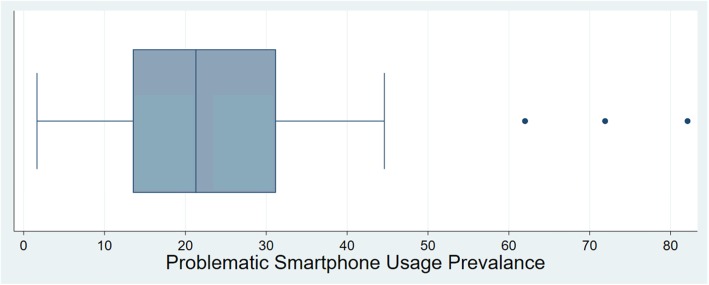
- Across 41 studies with 41,871 participants, the median prevalence of PSU was 23.3% with an interquartile range of 14–31.2%; 31 studies reported prevalence between 10% and 30%.
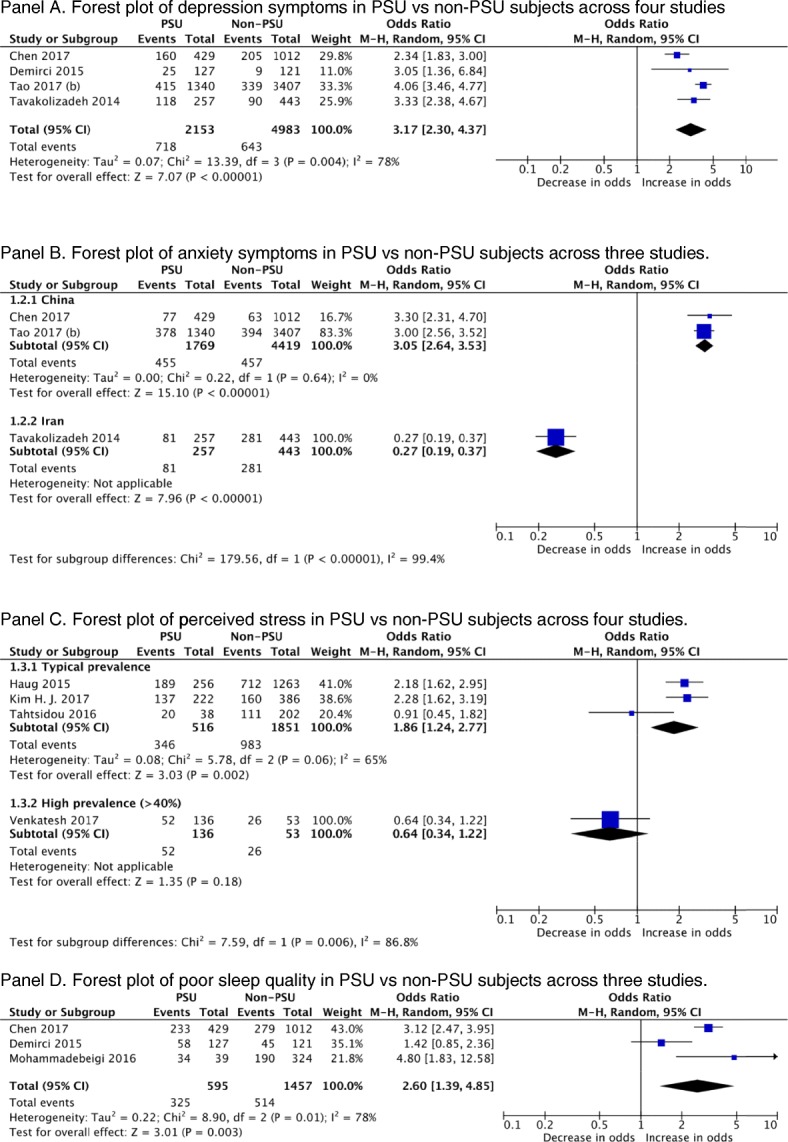
- PSU was associated with increased odds of depression: OR 3.17 (95% CI 2.30–4.37; I² = 78%; 8 studies, 10,099 participants).
- PSU was associated with increased odds of anxiety: OR 3.05 after accounting for heterogeneity (95% CI 2.64–3.53; I² = 0%; 7 studies, 9,359 participants).
- PSU was also associated with perceived stress (OR 1.86, 95% CI 1.24–2.77; I² = 65%; 5 studies, 3,618 participants) and poor sleep (OR 2.60, 95% CI 1.39–4.85; I² = 78%; 7 studies, 4,194 participants).
## Methods
- Systematic review and meta-analysis conducted according to PRISMA, with an a priori PROSPERO protocol (#88800); evidence quality was assessed using GRADE and study quality with a modified Newcastle-Ottawa scale.
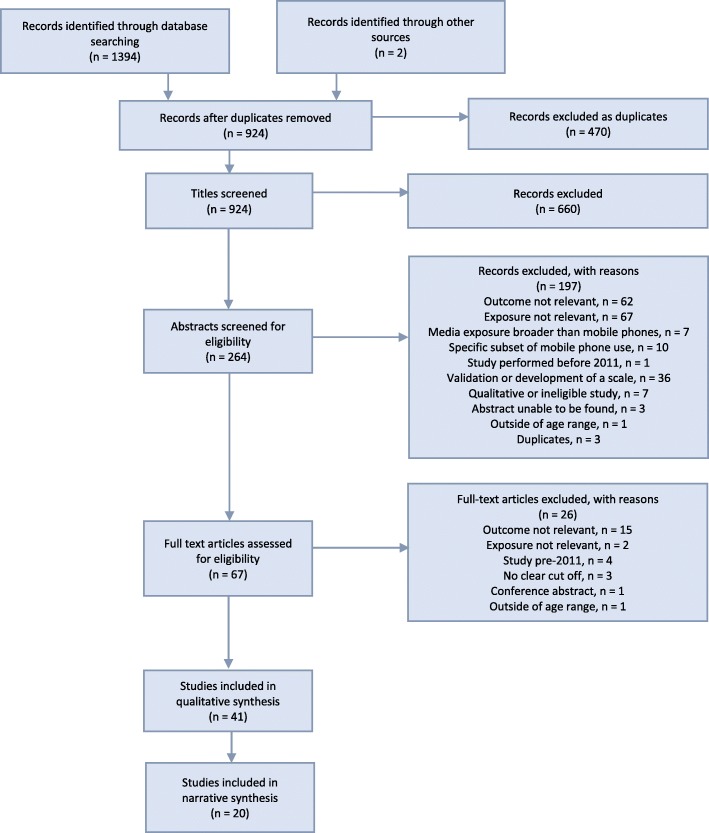
- Searched 8 databases from January 1, 2011 to October 15, 2017 with no language restriction; included randomized controlled trials, cohort, cross-sectional, and case-control studies involving children and young people with mean age ≤25 and a clear threshold for PSU.
- Quantitative synthesis used random-effects meta-analysis (Mantel-Haenszel method; generic inverse variance for logistic regression results) and subgroup analyses when heterogeneity exceeded 85%.
## Limitations
- The paper states that included studies were non-randomised and at high risk of bias; 22 studies were judged poor quality and 19 moderate quality.
- PSU definitions and thresholds varied widely, and some were incompletely described, which the paper says weakens implementation.
- Mental health outcomes were based on self-report questionnaires rather than formal diagnoses, and the paper notes that reverse causality cannot be excluded; this is a stated limitation and also an evident issue for causal interpretation.
Model-written summary. Check it against the paper before relying on it.
Integrity signals
Registry
Cites
Statistics
Figures
Verification
Claims the paper makes
9 Valid · 1 Not valid · 12 Not checked · 38 Own results and interpretations
The cited sources support only part of this claim — read each source’s verdict below.
In the paper
“Problematic users reported that social networking was the most important or preferred activity on smartphones [34, 40].”
§ Prevalence of problematic smartphone usage and associated mental health outcomes amongst children and young people: a systematic review, meta-analysis and GRADE of the evidence > Results > Types of PSU usage
What the sources say
- Partly supportedcites [34] Lopez-Fernandez O Kuss DJ Romo L Self-reported dependence on mobile phones in young adults: a European cross-cultural empirical survey J Behav Addict 2017 6 2 168 177 10.1556/2006.6.2017.020 28425777 PMC5520117 sourceExperimental — accuracy not yet measured
In Results > Proportion of highly dependent users and their profile, social networking was the most important online activity for a majority when asked about any technology, not smartphones specifically. On smartphones, messaging and chatting was the most frequently named favorite activity (47.8%), ahead of social networking (32.6%). (LLM, conf=0.88)
- Supportedcites [40] Haug S Castro RP Kwon M Filler A Kowatsch T Schaub MP Smartphone use and smartphone addiction among young people in Switzerland J Behav Addict 2015 4 4 299 307 10.1556/2006.4.2015.037 26690625 PMC4712764 source
The Results table reports that 208 of 256 participants classified as having smartphone addiction (81.3%) selected social networking as their most personally relevant smartphone function. The Methods section confirms that this was a self-reported choice among smartphone functions, supporting the paraphrase about problematic users' preferred activity. (LLM, conf=0.92)
plain- Asserted: passes — The authors put it forward as true.
- Checkable: passes — It can be checked against evidence.
- Load-bearing: unclear — It is unclear whether the paper’s conclusions depend on it.
- Based: passes — The paper gives a reason why it holds.
- Rests on an assumption not shown here.
- Partly supported
A result the paper reports from its own data — it cites no other source for it, so there is none to check. The quote shows it is in the paper.
In the paper
“Eight studies [28, 36, 48, 57–61] reported a significant association between PSU and depression across 10,099 participants.”
§ Prevalence of problematic smartphone usage and associated mental health outcomes amongst children and young people: a systematic review, meta-analysis and GRADE of the evidence > Results > PSU associated with mental health outcomes
plainstates an associationn = 10,099 ·- Asserted: passes — The authors put it forward as true.
- Checkable: passes — It can be checked against evidence.
- Load-bearing: passes — The paper’s conclusions depend on it.
- Based: passes — The paper gives a reason why it holds.
- Rests on 3 assumptions not shown here.
In the paper
“One study reported an increased odds of suicidal ideation amongst those with PSU [62]; however, this was assessed through a single screening question and caution should be taken with this finding.”
§ Prevalence of problematic smartphone usage and associated mental health outcomes amongst children and young people: a systematic review, meta-analysis and GRADE of the evidence > Results > PSU associated with mental health outcomes
What the sources say
- Not checked — no full text of the sourcecites [62] Kim HJ Min JY Kim HJ Min KB Association between psychological and self-assessed health status and smartphone overuse among Korean college students J Ment Health 2017 0 0 1 6 10.1080/09638237.2017.1370641 28868959 source
plainstates an association- Asserted: passes — The authors put it forward as true.
- Checkable: passes — It can be checked against evidence.
- Load-bearing: unclear — It is unclear whether the paper’s conclusions depend on it.
- Based: passes — The paper gives a reason why it holds.
- Rests on 2 assumptions not shown here.
A result the paper reports from its own data — it cites no other source for it, so there is none to check. The quote shows it is in the paper.
In the paper
“The pooled OR for anxiety amongst CYP with PSU was 2.60 (95% CI 1.39, to 4.85; p < 0.001; I2 = 78%).”
§ Prevalence of problematic smartphone usage and associated mental health outcomes amongst children and young people: a systematic review, meta-analysis and GRADE of the evidence > Results > PSU associated with mental health outcomes
plainstates an associationn = 9,359 ·- Asserted: passes — The authors put it forward as true.
- Checkable: passes — It can be checked against evidence.
- Load-bearing: passes — The paper’s conclusions depend on it.
- Based: passes — The paper gives a reason why it holds.
- Rests on 3 assumptions not shown here.
A result the paper reports from its own data — it cites no other source for it, so there is none to check. The quote shows it is in the paper.
In the paper
“Five studies [36, 39, 40, 44, 62] investigated perceived stress across 3618 participants.”
§ Prevalence of problematic smartphone usage and associated mental health outcomes amongst children and young people: a systematic review, meta-analysis and GRADE of the evidence > Results > PSU associated with mental health outcomes
plainn = 3,618- Asserted: passes — The authors put it forward as true.
- Checkable: passes — It can be checked against evidence.
- Load-bearing: unclear — It is unclear whether the paper’s conclusions depend on it.
- Based: passes — The paper gives a reason why it holds.
- Rests on 3 assumptions not shown here.
17 more claims
Create a free account to see all 60 claims and to verify the 2 references still open.
- It may state two separate claims as one. 31
- Probably not a substantial claim. 16
- The quote only partly states this claim. 1
Citations
Cites
Preferred Reporting Items for Systematic Reviews and Meta-Analyses: the PRISMA statement
Moher, D., Liberati, A., Tetzlaff, J., Altman, D. G., & for the PRISMA Group (2009) · BMJ · doi:10.1136/bmj.b2535 · Cited by 83,823
Preferred Reporting Items for Systematic Reviews and Meta-Analyses: The PRISMA Statement
Moher, D., Liberati, A., Tetzlaff, J., Altman, D. G., & The PRISMA Group (2009) · PLoS Medicine · doi:10.1371/journal.pmed.1000097 · Cited by 64,042
Preferred reporting items for systematic reviews and meta-analyses: the PRISMA Statement.
(2009) · PubMed Central · Cited by 44,859
GRADE: an emerging consensus on rating quality of evidence and strength of recommendations
Guyatt, G. H., Oxman, A. D., Vist, G. E., Kunz, R., Falck-Ytter, Y., Alonso-Coello, P., & Schünemann, H. J. (2008) · BMJ · doi:10.1136/bmj.39489.470347.ad · Cited by 23,305
Wang, G., Ma, R., Qiao, G., Wada, K., Aizawa, Y., & Satoh, T. (2015) · Integrative Medicine International · doi:10.1159/000368408 · Cited by 18,657
Whiteford, H. A., Degenhardt, L., Rehm, J., Baxter, A. J., Ferrari, A. J., Erskine, H. E., Charlson, F. J., Norman, R. E., Flaxman, A. D., Johns, N., et al. (2013) · The Lancet · doi:10.1016/s0140-6736(13)61611-6 · Cited by 6,006
Sawyer, S. M., Azzopardi, P. S., Wickremarathne, D., & Patton, G. C. (2018) · The Lancet Child & Adolescent Health · doi:10.1016/s2352-4642(18)30022-1 · Cited by 3,666
The Smartphone addiction scale: development and validation of a short version for adolescents
Kwon, M., Kim, D.-J., Cho, H., & Yang, S. (2013) · PLoS ONE · doi:10.1371/journal.pone.0083558 · Cited by 2,177
Analysing Data and Undertaking Meta‐Analyses
Deeks, J. J., Higgins, J. P., & Altman, D. G. (2008) · Cochrane Handbook for Systematic Reviews of Interventions · doi:10.1002/9780470712184.ch9 · Cited by 1,800
Mental Health Surveillance Among Children — United States, 2013–2019
Bitsko, R. H., Claussen, A. H., Lichstein, J., Black, L. I., Jones, S. E., Danielson, M. L., Hoenig, J. M., Davis Jack, S. P., Brody, D. J., Gyawali, S., et al. (2022) · MMWR Supplements · doi:10.15585/mmwr.su7102a1 · Cited by 1,723
Research works printed but not linked: 3
- Office for National Statistics Children’s well-being and social relationships, UK 2018
- House of Commons Science and Technology Committee Impact of social media and screen-use on young people’s health: Fourteenth report of Session 2017–2019 2019
- Tahtsidou S Bellali T Alikari V The effect of dependence on mobile phones and computers on the lifestyle and health of nursing students at the University of the Peloponnese Arch Hell Med 2016 33 3 355 367 ER
Cited by
Items 501–600 of 832
Human enhancement, past and present
Moeller, A., & Porras, J. M. A. (2025) · Bioethics News · doi:10.1007/s40592-025-00250-5 · Cited by 2
Wickramasinghe, K. E. T., Albertjanstin, N., Wijethunga, L. P. P. L., Rajapaksha, S., Panduwawala, P., & Harshanath, S. M. B. (2022) · IEEE Region Humanitarian Technology Conference · doi:10.1109/r10-htc54060.2022.9929979 · Cited by 2
Influence of Internet in Shaping the Emotional Maturity of Adolescents: A Review Study
Zaidi, S. S., Sultana, Z., & SZABIST (2023) · doi:10.62681/sprypublishers.sjhss/1/1/4 · Cited by 12
The Long-term impact of Covid-19 on student mental healthPreprint
Catling, J. C. (2022) · Research Square · doi:10.21203/rs.3.rs-2350234/v1 · Cited by 8
Schröder, R., Hamer, T., Kruzewitz, V., Busch, E. C., Suhr, R., & König, L. (2026) · Computers in Human Behavior Reports · doi:10.1016/j.chbr.2026.100948 · Cited by 5
Crespo, M. F., Galve, M. I. R., Sánchez‐Aguadero, N., Sanchez-Sanchez, N., González‐Sánchez, J., Garcia-Yu, I. A., Lee, H., & Recio-Rodriguez, J. I. (2025) · Frontiers in Public Health · doi:10.3389/fpubh.2025.1712564 · Cited by 3
Pablo, J. N., Shires, J., Castellanos, J., Kapila, M., Kemmelmeier, L. L., & Berryhill, M. E. (2025) · Attention Perception & Psychophysics · doi:10.3758/s13414-025-03063-0 · Cited by 3
Chen, S., Jiang, H., & Guan, J. (2022) · Sustainability · doi:10.3390/su14159032 · Cited by 8
Are smartphone use and nature contact predictive of depression in a UK university population?
Dewar, E., & Catling, J. C. (2024) · The Journal of Mental Health Training Education and Practice · doi:10.1108/jmhtep-10-2022-0081 · Cited by 2
Obeidat, M. S., & AL-Shalabi, F. H. (2025) · Theoretical Issues in Ergonomics Science · doi:10.1080/1463922x.2025.2506425 · Cited by 3
Hassaan, M., Jareebi, M. A., AlKaabi, H. A., Hobani, A. H., Alfuhigi, Y. M., Albahli, N. K., Alrashed, H., Alotaibi, S. K., Almadi, A. S., Iskander, O. A., et al. (2024) · Cureus · doi:10.7759/cureus.52922 · Cited by 8
Promoting a More Sustainable and Inclusive World: Wellbeing in a World of Crises
Guðjohnsen, R. Þ., Jónsson, Ó. P., & Aðalbjarnardóttir, S. (2023) · Springer international handbooks of education · doi:10.1007/978-3-031-24420-9_15 · Cited by 1
The relative importance of transdiagnostic factors associated with problematic smartphone use
Roberts, M. Z., Tifft, E. D., Underwood, S. B., & Forsyth, J. P. (2022) · Journal of Contextual Behavioral Science · doi:10.1016/j.jcbs.2022.10.002 · Cited by 1
Winds, K., Plattner, B., Salcher, B., Langthaler, P. B., Kohlböck, G., Fuchs, M., Schaffer, P. C., & Rainer, L. J. (2025) · Comprehensive Psychiatry · doi:10.1016/j.comppsych.2025.152586 · Cited by 4
King, H. C., Fischer, A. J., Houalihan, D. D., Davis, J. L., Radley, K. C., & Jenson, W. R. (2023) · Journal of Behavioral Education · doi:10.1007/s10864-023-09528-2 · Cited by 1
Toxic young adulthood: Therapy and therapeutic ethos
(2020) · doi:10.1080/13642537.2020.1820136 · Cited by 1
Crumly, B., New, O., & Samek, D. R. (2025) · Personality and Individual Differences · doi:10.1016/j.paid.2025.113252 · Cited by 1
Hilpisch, C., Zentgraf, K., & Mutz, M. (2025) · International Journal of Sport and Exercise Psychology · doi:10.1080/1612197x.2025.2563317 · Cited by 3
Canatar, F., & Bilge, Y. (2023) · SOCIAL MENTALITY AND RESEARCHER THINKERS JOURNAL · doi:10.29228/smryj.69106 · Cited by 2
Association between the Taq1A polymorphism and problematic media use in preadolescent children
Emond, J. A., Renier, T. J., Yeum, D., Carlson, D. D., Ballarino, G. A., & Gilbert‐Diamond, D. (2025) · Frontiers in Psychology · doi:10.3389/fpsyg.2024.1395957 · Cited by 2
COVID-19 pandemic: filling the gaps in psychiatry residency programs
da Costa, C. B. F., & Filho, O. C. D. S. (2020) · Trends in Psychiatry and Psychotherapy · doi:10.1590/2237-6089-2020-0051 · Cited by 2
Kibria, G., Islam, T., Sultana, P., Jahan, N., Anannna, S. A., Mohiuddin, G., Roy, M., & Alif, S. M. (2024) · Research Square · doi:10.21203/rs.3.rs-4470589/v1 · Cited by 4
Silke, S., Büssing, A., Krafft, H. S., Streit, B., Boehm, K., Reckert, T., & Martin, D. (2024) · Journal of Woman s Reproductive Health · doi:10.14302/issn.2381-862x.jwrh-24-5099 · Cited by 1
Marini, L., Hendriani, W., & Wulandari, P. Y. (2025) · KnE Social Sciences · doi:10.18502/kss.v10i9.18498 · Cited by 3
Asta, L., Sandoni, L., & Persico, A. M. (2026) · Child Psychiatry & Human Development · doi:10.1007/s10578-026-02052-0 · Cited by 1
Munusamy, K. A. P., & Ghazali, A. H. A. (2022) · International Journal of Academic Research in Business and Social Sciences · doi:10.6007/ijarbss/v12-i7/14426 · Cited by 5
Liu, S., Lin, Y., Hu, W., Meng, Y., & Liu, X. (2026) · Journal of Affective Disorders · doi:10.1016/j.jad.2026.122007 · Cited by 1
Vijayakumar, L., & Balaji, M. (2022) · Springer eBooks · doi:10.1007/978-3-030-42003-1_44 · Cited by 3
Estimating Smartphone Orientation for Visualizing Behavior Around Sleep Periods in PSU Patients
Hayashi, K., Meguro, T., Hamamura, T., Taya, M., Honjo, M., Kobayashi, N., Jitoku, D., & Uchida, M. (2024) · IEEE International Conference on e-Health Networking, Applications and Services (Healthcom) · doi:10.1109/healthcom60970.2024.10880840 · Cited by 1
Smartphone addiction and sleep quality among students
Nikolić, A., & Grujičić, S. Š. (2023) · Medicinski podmladak · doi:10.5937/mp74-42621 · Cited by 7
Lise Öğrencilerinde Kontrolsüz İnternet Kullanımı ve İnternet Bağımlılığının Belirlenmesi
Şahin, A., & Kolaç, N. (2024) · Halk Sağlığı Hemşireliği Dergisi · doi:10.54061/jphn.1475593 · Cited by 2
ERGÖNÜL, E., Keskіn, T., Ergan, M., Başkurt, F., & Başkurt, Z. (2024) · Research Square · doi:10.21203/rs.3.rs-5341122/v1 · Cited by 2
From Necessity to Excess: Temporal Differences in Smartphone App Usage–PSU Links During COVID-19
Ok, C. (2025) · COVID · doi:10.3390/covid5100163 · Cited by 3
Qalawa, S. A. A., Ibrahim, N. M. I., Fadlalmola, H. A., Elmansy, F. M., & Elbqry, M. G. (2024) · The Open Nursing Journal · doi:10.2174/0118744346318586240829103357 · Cited by 2
Study on smartphone addiction among the university students: A cross sectional survey-based stud
Rezwan, A. K. M., Yasmin, N., Abdullah, K., Mohonto, J., & Khan, S. S. (2023) · World Journal of Advanced Research and Reviews · doi:10.30574/wjarr.2023.18.3.1198 · Cited by 6
Analysis of Smartphone Addiction With Anxiety in School-Aged Children
Erindia, F., Yusuf, A., Tristiana, R. D., & Soleha, U. (2024) · Psychiatry Nursing Journal (Jurnal Keperawatan Jiwa) · doi:10.20473/pnj.v6i1.48033 · Cited by 4
Cuestionario de Experiencias Relacionadas con el Móvil: Validación para adultos de Buenos Aires
Ruscio, F. M., & Stover, J. B. (2023) · Revista Evaluar · doi:10.35670/1667-4545.v23.n3.43892 · Cited by 1
Malas, O., Blanch, À., Guazzini, A., & Duradoni, M. (2026) · Human Behavior and Emerging Technologies · doi:10.1155/hbe2/7957318 · Cited by 2
Mobile phone addiction among children aged 5-12 years, a hospital-based study in South Kerala
Sulaiman, R., Shaji, S., Sheela, V. V., & Raheela, A. S. (2021) · International Journal of Community Medicine and Public Health · doi:10.18203/2394-6040.ijcmph20214592 · Cited by 4
Cyberbullying and its Relationship with Smartphone Addiction
Maharjan, R., & Gurung, L. (2022) · Mangal Research Journal · doi:10.3126/mrj.v3i1.51659 · Cited by 2
Ayşin, N., & Koltaş, S. (2026) · BMC Psychology · doi:10.1186/s40359-026-04013-7 · Cited by 5
Loureiro, L. D., Zanin, L., & Flório, F. M. (2021) · ETD - Educação Temática Digital · doi:10.20396/etd.v23i4.8658174 · Cited by 2
Hung, L., Hung, M.-T., Zhou, Q., & Huang, Z. (2025) · Research Square · doi:10.21203/rs.3.rs-6263058/v1 · Cited by 2
DIGITAL CITIZENSHIP AMONG PHYSICAL EDUCATION TEACHING MAJORS
Yon, K., & Saraç, L. (2022) · Nevşehir Hacı Bektaş Veli Üniversitesi SBE Dergisi · doi:10.30783/nevsosbilen.1122035 · Cited by 3
Bai, C., Mo, Q. L., & Bai, B. (2023) · Current Psychology · doi:10.1007/s12144-023-04952-z · Cited by 1
Putchavayala, K. C., Sasidharan, K. R., Krishna, D., & Singh, D. (2023) · Journal of Mental Health and Human Behaviour · doi:10.4103/jmhhb.jmhhb_158_22 · Cited by 2
Zhu, Y., & Wang, Z. (2024) · Journal of Psychology in Africa · doi:10.1080/14330237.2024.2375730 · Cited by 2
Holanda, N., & Carneiro, S. N. V. (2025) · P2P E INOVAÇÃO · doi:10.21728/p2p.2025v11n2e-7247 · Cited by 1
Cruz, G. V., & Rosa, C. D. (2026) · Psychiatry International · doi:10.3390/psychiatryint7040185 · Cited by 1
The Positive and Negative Impact of COVID-19 Smartphone Dependency on Employee Job Performance
Khalid, N. W. (2022) · Advances in human and social aspects of technology book series · doi:10.4018/978-1-6684-6108-2.ch005 · Cited by 1
Zhu, J., & Wang, R. (2025) · Health Communication · doi:10.1080/10410236.2024.2440804 · Cited by 2
Groves, C. I., KWAN, M. Y. W., Witham, B., Faulkner, G., & Brown, D. M. Y. (2024) · Journal of American College Health · doi:10.1080/07448481.2024.2422331 · Cited by 1
Munusamy, K. A. P., & Ghazali, A. H. A. (2022) · International Journal of Academic Research in Business and Social Sciences · doi:10.6007/ijarbss/v12-i13/14599 · Cited by 2
Influence of Problematic Mobile Phone Use on Social and Assertiveness Skills in Adolescents
Dobado-Castañeda, J. C., Díaz, V. M., & Requena, B. E. S. (2025) · Behavioral Sciences · doi:10.3390/bs16010001 · Cited by 5
Special Topic: Potential Harms of Excessive Social Media and Smartphone Use on Youth Mental Health
Colak, B. (2024) · Springer eBooks · doi:10.1007/978-3-031-58141-0_4 · Cited by 2
Kıyak, S., & Batı, S. (2024) · Women & Health · doi:10.1080/03630242.2024.2420215 · Cited by 6
Missed Opportunities Preceding Overdose Death
Beauchamp, G. A., Grim, S. M., Minnich, E. D., Cannon, R. D., & Land, S. D. (2020) · American Journal of Forensic Medicine & Pathology · doi:10.1097/paf.0000000000000624 · Cited by 1
Vijayakumar, L., & Balaji, M. (2022) · Springer eBooks · doi:10.1007/978-3-030-41319-4_44-1 · Cited by 1
Liu, S., Chen, Q., Li, J., Zhu, Y., Guo, X., & Zhao, X. (2025) · International Journal of Methods in Psychiatric Research · doi:10.1002/mpr.70016 · Cited by 2
Rashid, M. A. M., Mridha, N. I., Mia, Z., Hossen, S., Hasan, M. M., & Reaz, M. I. I. (2025) · Research Square · doi:10.21203/rs.3.rs-7228117/v1 · Cited by 2
Imparato, A., Reich, N., Riviere, G., Eliez, S., Graser, C. J., Schneider, M., & Sandini, C. (2026) · medRxiv · doi:10.64898/2026.04.27.26351677 · Cited by 1
Screen use and the mental health of children and young people
Madelaire, L. F., Jeppesen, P., Hansen, A. S., Mainz, J., Bikic, A., Nordentoft, M., & Krantz, M. F. (2024) · Ugeskrift for Læger · doi:10.61409/v05240342 · Cited by 1
Einstein, D. A., Marsh, S., Moshel, M. L., Sinani, T., & Burrell, T. (2026) · International Journal of Environmental Research and Public Health · doi:10.3390/ijerph23030364 · Cited by 3
Jahan, I., Islam, M. S., Dewan, M. A. A., Mahabub, M. S., & Pontes, H. M. (2025) · Emerging Trends in Drugs Addictions and Health · doi:10.1016/j.etdah.2025.100182 · Cited by 8
Karakuş, O. B., Cubukcu, H. T., Basli, M., Baltacioglu, D. B. A., ESİN, İ. S., & Dursun, O. B. (2026) · Current Psychology · doi:10.1007/s12144-026-09337-6 · Cited by 1
To ban or not to ban? Mobile phone use in schools
(2019) · doi:10.12968/bjsn.2019.14.10.510 · Cited by 1
Xie, Z., Zhang, Z., Sun, J., & Han, J. (2025) · Sleep Medicine · doi:10.1016/j.sleep.2025.108694 · Cited by 1
Smartphone Addiction and Sleep Status in Adolescents during COVID-19 Pandemic
Molu, B., Baş, M. T., & Özpulat, F. (2023) · Genel Tıp Dergisi · doi:10.54005/geneltip.1243170 · Cited by 1
A wake-up call for “nightmares”
Mysliwiec, V., Brock, M. S., & Pruiksma, K. E. (2023) · SLEEP · doi:10.1093/sleep/zsad004 · Cited by 1
The Impact of Smartphone Use on the Psychology of Young Children in Parungponteng District
Ibrahim, R. A., Azahra, A. S., & Suhaimi, N. B. A. (2024) · International Journal of Ethno-Sciences and Education Research · doi:10.46336/ijeer.v4i1.566 · Cited by 1
The prevalence, risks and associations of problematic cell phone use and sexting on mental health
Scott, D. A., McCormick, K., Smith, K., Budlong, E., & Vitonis, A. (2020) · Mental Health and Social Inclusion · doi:10.1108/mhsi-08-2020-0053 · Cited by 3
Padmanabhanunni, A., & Pretorius, T. B. (2025) · Healthcare · doi:10.3390/healthcare13233087 · Cited by 3
Mostert-Phipps, N. (2025) · Social Sciences & Humanities Open · doi:10.1016/j.ssaho.2025.101778 · Cited by 4
von Gontard, A., Mosiello, G., Tarcan, T., den Ende, M. V., van Koeveringe, G. A., & Joinson, C. J. (2026) · Neurourology and Urodynamics · doi:10.1002/nau.70219 · Cited by 1
Santos, G. F. S., Souza, G. G. C., Braga, M. F. T., Silva, E. L., Soares, J. P. M., Libanio, M. R., & Soares, E. A. (2024) · Brazilian Journal of Health Review · doi:10.34119/bjhrv7n4-455 · Cited by 6
Bouazza, S., Kinany, S. E., Abbouyi, S., Rhazi, K. E., & Zarrouq, B. (2022) · Research Square · doi:10.21203/rs.3.rs-1662848/v1 · Cited by 1
Herdian, Qolbi, Z. N., Na’imah, T., Meilani, E. R., Nuryana, Z., & Wijaya, T. T. (2026) · Current Psychology · doi:10.1007/s12144-026-09313-0 · Cited by 5
Resch, F., & Parzer, P. (2022) · Springer eBooks · doi:10.1007/978-3-031-15455-3_2 · Cited by 2
Liang, H., Wei, X., Jiang, H., & Li, J. (2025) · International Journal of Mental Health and Addiction · doi:10.1007/s11469-025-01507-0 · Cited by 1
Zhao, H., & Shapka, J. D. (2026) · Computers in Human Behavior · doi:10.1016/j.chb.2026.109050 · Cited by 4
Wu, W., Liu, A., & Gong, S. (2026) · Frontiers in Psychiatry · doi:10.3389/fpsyt.2026.1872025 · Cited by 1
What Personality Dimensions May Influence the Risk of Smartphone Addiction in Children?
Conte, S., Ghiani, C., Casati, L., Truzoli, R., & Nicotra, E. F. (2025) · Children · doi:10.3390/children12030258 · Cited by 2
Psychologists as emergency first responders during a pandemic
Deshpande, A. P., Pešić, A., Boe, O. C., Piotrowski, A., & Rawat, S. (2023) · Vojnosanitetski pregled · doi:10.2298/vsp230202055d · Cited by 1
Associação entre o Uso de Smartphones e a Qualidade do Padrão do Sono de Docentes Universitários
Silva, J. N., Duprat, I. P., de Oliveira, J. M., & Ferreira, W. D. (2023) · Cadernos de Educação Tecnologia e Sociedade · doi:10.14571/brajets.v16.n2.236-243 · Cited by 1
Führungstätigkeiten und Führungsinstrumente
Unger, F., Sann, U., & Martin, C. (2022) · Basiswissen Sozialwirtschaft und Sozialmanagement · doi:10.1007/978-3-658-36119-8_5 · Cited by 1
Evert, L. S., Potupchik, T. V., Kostyuchenko, Y. R., & Tereshchenko, S. Y. (2024) · Сибирский научный медицинский журнал · doi:10.18699/ssmj20240117 · Cited by 1
Nawaz, S., Linden, T., Mitchell, M., & Bhowmik, J. (2026) · Social Sciences & Humanities Open · doi:10.1016/j.ssaho.2026.102569 · Cited by 3
Zhou, Z., Zhang, S., Li, Z., Feng, W., Zhang, F., Wang, A., & Yan, C. (2026) · Frontiers in Psychology · doi:10.3389/fpsyg.2026.1784047 · Cited by 2
Lei, J., Su, Z., & Zhang, H. (2026) · International Journal of Social Welfare · doi:10.1111/ijsw.70090 · Cited by 1
Hong, W., Liu, R., Li, Q., & Zhou, Z. (2025) · Journal of Adolescence · doi:10.1002/jad.70082 · Cited by 3
Faruquee, H. M., Meitei, H. N., Pandey, A., Pahwa, F., Thokchom, M., Sonia, A., Chaudhary, S., Gupta, D. K., Singh, H. L., Haobam, S., et al. (2021) · medRxiv · doi:10.1101/2021.03.30.21254606 · Cited by 1
Jiang, J., Su, Z., Chen, Z., & Fang, Y. (2026) · Journal of Psychiatric Research · doi:10.1016/j.jpsychires.2026.05.022 · Cited by 1
Metadata
- Authors
- Sohn, S. Y., Rees, P., Wildridge, B., Kalk, N. J., & Carter, B.
- Affiliations
- King's College London (GB)
- University College London (GB)
- University of Nottingham (GB)
- Corresponding author
- Carter, Ben
- Venue
- BMC Psychiatry
- Published
- 2019-11-29
- Volume
- 19
- Issue
- 1
- Pages
- 356-356
- ISSN
- 1471-244X (ISSN-L)
- PMC
- PMC6883663
- OpenAlex
- W2989721356
- Semantic Scholar
- 6cddee1b2697db7c77f192ae3b9f926930d035ff
- Cited by
- 838
- References
- 75
- Citations by year
- 2026: 147 · 2025: 152 · 2024: 139 · 2023: 132 · 2022: 128 · 2021: 89 · 2020: 49 · 2019: 2
- FWCI
- 16.89
- Type
- journal article
- Language
- en
- Update notices
- Open access
- gold
- doi.org
- Licence
- cc-by
- creativecommons.org/licenses/by/4.0/ (tdm)
- creativecommons.org/licenses/by/4.0/ (vor)
- Locations
- BMC Psychiatry (publishedVersion, cc-by)
- PubMed Central (publishedVersion, cc-by)
- PubMed (publishedVersion)
- Research Portal (King's College London) (submittedVersion, cc-by)
- DOAJ (DOAJ: Directory of Open Access Journals) (submittedVersion, cc-by-sa)
- Funders
- National Institute for Health and Care Research (ACF-2018-18-013)
- Topics
- Social Sciences › Sociology and Political Science › Impact of Technology on Adolescents
- Social Sciences › Education › Child Development and Digital Technology
- Social Sciences › Psychology › Clinical Psychology › Sexuality, Behavior, and Technology
- Keywords
- smartphone addiction, children and young people, prevalence, depression, anxiety, perceived stress, sleep quality, educational attainment, adolescent mental health
- MeSH terms
- Smartphone, Adolescent, Anxiety, Child, Depression, Educational Status, Female, Humans, Male, Mental Health, Sleep Wake Disorders, Stress, Psychological, Prevalence, Odds Ratio, Behavior, Addictive, Young Adult, Self Report
About these checks
Registry, retraction, Cites and statistics results are computed, not judged, with one exception: a printed reference that no index lists is read once by a model before it counts as a citation error. Claims are extracted by a model and kept only when their quote appears verbatim in the text; each cited source is then checked, with a model’s help, for whether it says what the claim relies on. Those verdicts can be wrong — read the claim’s quote and the cited source before relying on one.
The claim verdicts this report counts are experimental: their accuracy is not yet measured.
A language model drew the claims from the paper on 2026-10-10, under version 3 of the claim definition (model deepseek-v4.1-flash, prompt extract-v3).
A second model labelled each claim on 2026-10-10 (model jev-1.13-20260917, definition revision gold-guideline-v0.2).
Cited sources are checked with a language model’s help (gpt-6-sol).
Statistics and arithmetic are recomputed, not judged.
Confidence bands are shown only for fields calibrated on our annotated test set. None is calibrated yet, so no band is shown.
What counts as a claim ›How we measure confidence ›How we check this ›
Are you an author, or do you see a problem with this page? Request a review
Data sources
Bibliographic data: Semantic Scholar, OpenAlex, Crossref.
Contains information from the Semantic Scholar Academic Graph Datasets, made available under the ODC Attribution License (ODC-BY 1.0).
Semantic Scholar’s data is described in: Kinney, R., et al. (2023). The Semantic Scholar Open Data Platform. arXiv:2301.10140.
