

Psychometric properties of an Arabic translation of the multidimensional social support scale (MSPSS) in a community sample of adults
Open accessPublished version of a preprint
The DOI matches its Crossref record; 112 of the 112 references it cites were found in a registry or an index.
Abstract
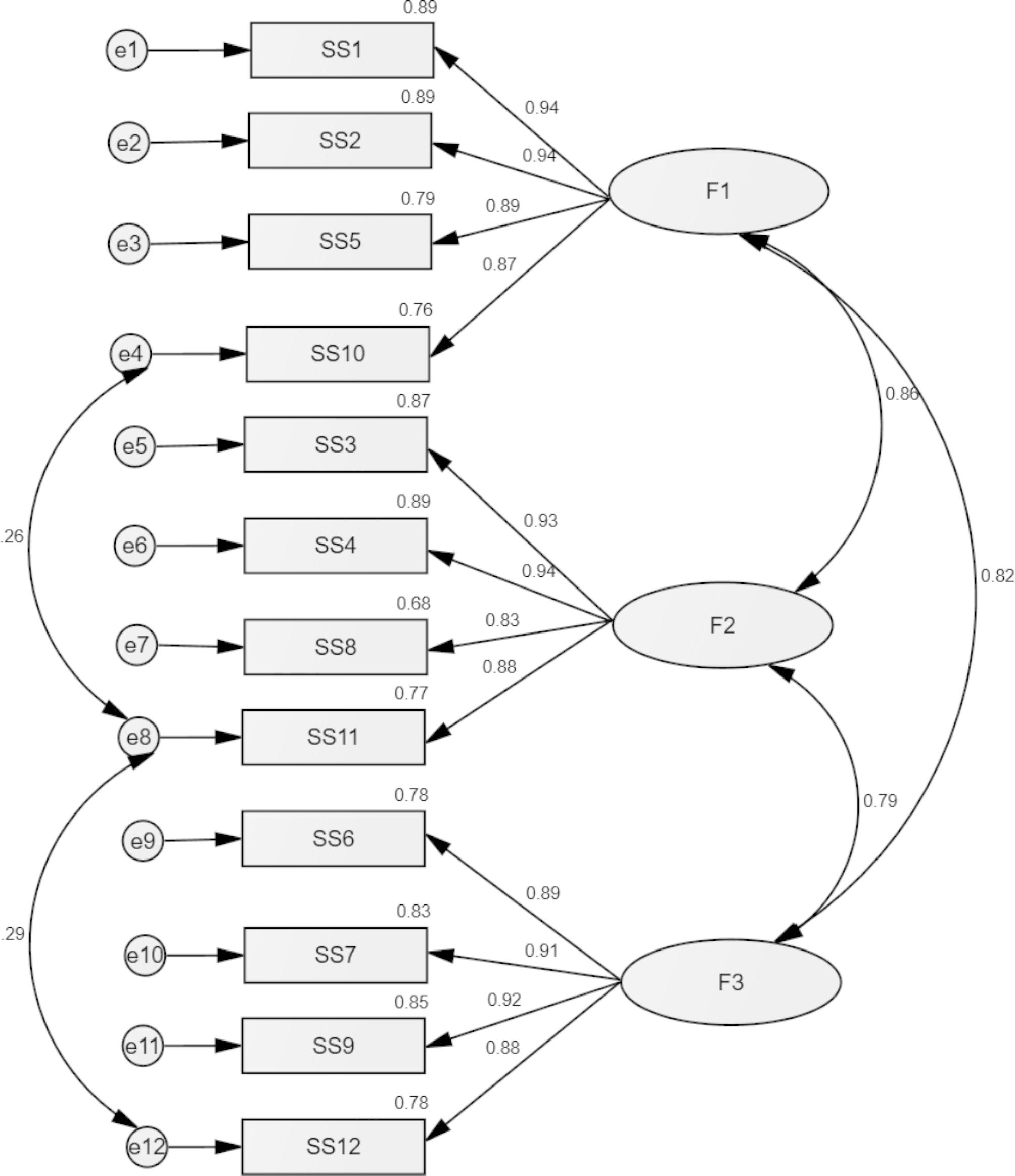
Background: There is a lack of methodologically strong measure to assess perceived social support among Arabic-speaking populations. Our main objective was therefore to examine the psychometric properties of an Arabic translation of the Multidimensional Social Support Scale (MSPSS) in a sample of Arabic-speaking Lebanese adults from the general population. Methods: We adopted a cross-sectional design involving a convenience sample of 387 non-clinical Lebanese adults aged 26.17 ± 11.47 years (58.4% females). Participants were administered a web-based anonymous questionnaire containing the MSPSS, the 10-item Connor-Davidson Resilience Scale, and the Post traumatic growth Inventory-Short Form. The forward-backward translation method was applied. Confirmatory factor analysis (CFA) and gender invariance in the MSPSS were examined. McDonald’s ω coefficients were calculated as internal consistency indicators. Results: The Arabic MSPSS and its subscales have a high internal consistency with McDonald’s ω values between 0.94 and 0.97. CFA indicated that fit of the three-factor model was acceptable. All indices suggested that configural, metric, and scalar invariance was supported across gender. Both genders exhibited no significant difference in all MSPSS dimensions. Convergent validity was supported by showing that all three MSPSS sub-scores and total score correlated significantly and positively with resilience and posttraumatic growth scores. Conclusion: Although further cross-cultural validations involving other Arab countries and communities are still needed, we preliminarily suggest that this scale is applicable to the broad Arabic-speaking people for the measurement of perceived social support in clinical and research contexts.
Overview
The claims and statistics of this paper haven’t been checked yet.
Free: it reads the open-access text and checks the first 5 claims that cite a source we can check. Create a free account to check every claim.
Integrity signals
Registry
Cites
Statistics
Figures
Verification
Claims the paper makes
The claims and statistics of this paper haven’t been checked yet.
Free: it reads the open-access text and checks the first 5 claims that cite a source we can check. Create a free account to check every claim.
Claims other papers make about this one
Each is checked against this paper’s own text: does it say what the citing paper says it does?
The cited source says what the claim attributes to it.
In the citing paper
“The MDSPSS-Arabic version was validated in Lebanon44.”
From Examining burden among caregivers of community-dwelling older adults in Lebanon (2025) · cites this paper as [44]
The cited source says what the claim attributes to it.
In the citing paper
“The Arabic version, previously validated in Lebanon, was used in this study [50].”
From Coping strategies among family caregivers of community-dwelling older adults in Lebanon amid the economic crisis (2026) · cites this paper as [50]
Self-check
Percentages, sums and reported differences re-computed from the paper’s own numbers.
The self-check needs the paper’s full text.
Citations
Cites
Hu, L., & Bentler, P. M. (1999) · Structural Equation Modeling A Multidisciplinary Journal · doi:10.1080/10705519909540118 · Cited by 108,788
Evaluating Goodness-of-Fit Indexes for Testing Measurement Invariance
Cheung, G. W., & Rensvold, R. B. (2002) · Structural Equation Modeling: A Multidisciplinary Journal · doi:10.1207/s15328007sem0902_5 · Cited by 16,280
The Multidimensional Scale of Perceived Social Support
Zimet, G. D., Dahlem, N. W., Zimet, S. G., & Farley, G. K. (1988) · Journal of Personality Assessment · doi:10.1207/s15327752jpa5201_2 · Cited by 13,339
Sensitivity of Goodness of Fit Indexes to Lack of Measurement Invariance
Chen, F. F. (2007) · Structural Equation Modeling: A Multidisciplinary Journal · doi:10.1080/10705510701301834 · Cited by 12,217
Development of a new resilience scale: The Connor-Davidson Resilience Scale (CD-RISC)
Connor, K. M., & Davidson, J. R. T. (2003) · Depression and Anxiety · doi:10.1002/da.10113 · Cited by 11,793 · cited 1×
“The 10-item connor-davidson resilience scale (CD-RISC-10) The CD-RISC-10 comprises a single factor of 10 items [72, 73], each of which are scored on a 5-point scale ranging from 0 (not true at all) to 4 (true nearly all of the time).”
MethodCohen, J. (1992) · Psychological Bulletin · doi:10.1037//0033-2909.112.1.155 · Cited by 8,771
Vandenberg, R. J., & Lance, C. E. (2000) · Organizational Research Methods · doi:10.1177/109442810031002 · Cited by 7,997
Psychometric Characteristics of the Multidimensional Scale of Perceived Social Support
Zimet, G. D., Powell, S. S., Farley, G. K., Werkman, S., & Berkoff, K. A. (1990) · Journal of Personality Assessment · doi:10.1080/00223891.1990.9674095 · Cited by 4,855
Psychometric Characteristics of the Multidimensional Scale of Perceived Social Support
Zimet, G., Powell, S., Farley, G., Werkman, S., & Berkoff, K. (1990) · Journal of Personality Assessment · doi:10.1207/s15327752jpa5503&4_17 · Cited by 4,854
Resilient Individuals Use Positive Emotions to Bounce Back From Negative Emotional Experiences.
Tugade, M. M., & Fredrickson, B. L. (2004) · Journal of Personality and Social Psychology · doi:10.1037/0022-3514.86.2.320 · Cited by 3,947 · cited 1×
“Resilience has been suggested to enable more positive perceptions of resources, which in turn acts as a stress buffer [113, 114].”
BackgroundDunn, T. J., Baguley, T., & Brunsden, V. (2014) · British Journal of Psychology · doi:10.1111/bjop.12046 · Cited by 3,596
Campbell‐Sills, L., & Stein, M. B. (2007) · Journal of Traumatic Stress · doi:10.1002/jts.20271 · Cited by 3,575
Thanks coefficient alpha, we’ll take it from here.
McNeish, D. (2018) · Psychological Methods · doi:10.1037/met0000144 · Cited by 2,533
How to Use a Monte Carlo Study to Decide on Sample Size and Determine Power
Muthén, L. K., & Muthén, B. O. (2002) · Structural Equation Modeling: A Multidisciplinary Journal · doi:10.1207/s15328007sem0904_8 · Cited by 2,362
(2005) · doi:10.1093/acprof:oso/9780198565895.001.0001 · Cited by 2,155
Coping as a mediator of emotion
Folkman, S., & Lazarus, R. S. (1988) · Journal of Personality and Social Psychology · doi:10.1037/0022-3514.54.3.466 · Cited by 2,103 · cited 1×
“Its adequate availability seems essential to provide a buffer for stressful physical and psychosocial events through greater resilience [9, 10], promote self-esteem [11], and mitigate the effects of psychological distress [12].”
BackgroundMinimum Sample Size Recommendations for Conducting Factor Analyses
Mundfrom, D. J., Shaw, D. G., & Ke, T. L. (2005) · International Journal of Testing · doi:10.1207/s15327574ijt0502_4 · Cited by 1,704
Psychological resilience, positive emotions, and successful adaptation to stress in later life.
Ong, A. D., Bergeman, C. S., Bisconti, T. L., & Wallace, K. A. (2006) · Journal of Personality and Social Psychology · doi:10.1037/0022-3514.91.4.730 · Cited by 1,547
Perceived support, received support, and adjustment to stressful life events
Wethington, E., & Kessler, R. C. (1986) · Journal of Health and Social Behavior · doi:10.2307/2136504 · Cited by 1,431
Toward a Theory of Social Support: Closing Conceptual Gaps
Shumaker, S. A., & Brownell, A. (1984) · Journal of Social Issues · doi:10.1111/j.1540-4560.1984.tb01105.x · Cited by 1,425
Testing for Multigroup Invariance Using AMOS Graphics: A Road Less Traveled
Byrne, B. M. (2004) · Structural Equation Modeling: A Multidisciplinary Journal · doi:10.1207/s15328007sem1102_8 · Cited by 1,045
Prati, G., & Pietrantoni, L. (2009) · Journal of Loss and Trauma · doi:10.1080/15325020902724271 · Cited by 978 · cited 1×
“Indeed, a strong evidence exists supporting that social support is a potential attribute of resilience [66] and post-traumatic growth [67, 68].”
BackgroundSocial Support Theory and Measurement
Lakey, B., & Cohen, S. (2000) · Social Support Measurement and Intervention · doi:10.1093/med:psych/9780195126709.003.0002 · Cited by 932
Canty-Mitchell, J., & Zimet, G. D. (2000) · American Journal of Community Psychology · doi:10.1023/a:1005109522457 · Cited by 844
A short form of the Posttraumatic Growth Inventory
Cann, A., Calhoun, L. G., Tedeschi, R. G., Taku, K., Vishnevsky, T., Triplett, K. N., & Danhauer, S. C. (2010) · Anxiety, Stress, & Coping · doi:10.1080/10615800903094273 · Cited by 789 · cited 1×
“The 10-item scale was used in this study [74].”
MethodTardy, C. H. (1985) · American Journal of Community Psychology · doi:10.1007/bf00905728 · Cited by 769
The correlation of social support with mental health: A meta-analysis
Fasihi Harandi, T., Mohammad Taghinasab, M., & Dehghan Nayeri, T. (2017) · Electronic Physician · doi:10.19082/5212 · Cited by 733
Sample size for pre-tests of questionnaires
Perneger, T. V., Courvoisier, D. S., Hudelson, P. M., & Gayet-Ageron, A. (2015) · Quality of Life Research · doi:10.1007/s11136-014-0752-2 · Cited by 639
Quantifying construct validity: Two simple measures.
Westen, D., & Rosenthal, R. (2003) · Journal of Personality and Social Psychology · doi:10.1037//0022-3514.84.3.608 · Cited by 542
Handbook of Multicultural Perspectives on Stress and Coping
(2006) · International and Cultural Psychology · doi:10.1007/b137168 · Cited by 533
How does social support enhance resilience in the trauma-exposed individual?
Sippel, L. M., Pietrzak, R. H., Charney, D. S., Mayes, L. C., & Southwick, S. M. (2015) · Ecology and Society · doi:10.5751/es-07832-200410 · Cited by 509
Chou, K.-L. (2000) · Personality and Individual Differences · doi:10.1016/s0191-8869(99)00098-7 · Cited by 507 · cited 2×
“Other psychometric studies reported a 2-factor structure, with either Family and Significant others [89] or Friends and Significant others [90] subscales merging into one factor.”
BackgroundA systematic review of resilience in the physically ill
Stewart, D. E., & Yuen, T. (2011) · Psychosomatics · doi:10.1016/j.psym.2011.01.036 · Cited by 491 · cited 1×
“These expected patterns of associations are in agreement with previous studies in which social support has consistently been found to be significantly related to both resilience [110] and PTG [111, 112] constructs.”
Resultvan Widenfelt, B. M., Treffers, P. D. A., de Beurs, E., Siebelink, B. M., & Koudijs, E. (2005) · Clinical Child and Family Psychology Review · doi:10.1007/s10567-005-4752-1 · Cited by 471
Recommendations for the Cross-Cultural Adaptation of the DASH & QuickDASH Outcome Measures
Beaton, D., Bombardier, C., Guillemin, F., & Ferraz, M. B. (2007) · Cited by 468
Melki, I. S., Beydoun, H. A., Khogali, M., Tamim, H., & Yunis, K. A. (2004) · Journal of Epidemiology and Community Health · doi:10.1136/jech.2003.012690 · Cited by 387
Psychometric properties of the Multidimensional Scale of Perceived Social Support in youth
Bruwer, B., Emsley, R., Kidd, M., Lochner, C., & Seedat, S. (2008) · Comprehensive Psychiatry · doi:10.1016/j.comppsych.2007.09.002 · Cited by 355
Editorial: Measurement Invariance
Van De Schoot, R., Schmidt, P., De Beuckelaer, A., Lek, K., & Zondervan-Zwijnenburg, M. (2015) · Frontiers in Psychology · doi:10.3389/fpsyg.2015.01064 · Cited by 330
Garcia-Dia, M. J., DiNapoli, J. M., Garcia-Ona, L., Jakubowski, R., & O'Flaherty, D. (2013) · Archives of Psychiatric Nursing · doi:10.1016/j.apnu.2013.07.003 · Cited by 314
Factors contributing to posttraumatic growth: A proposed structural equation model.
Cadell, S., Regehr, C., & Hemsworth, D. (2003) · American Journal of Orthopsychiatry · doi:10.1037/0002-9432.73.3.279 · Cited by 309
Posttraumatic Growth: Conceptual Issues
(1998) · Posttraumatic Growth · doi:10.4324/9781410603401-5 · Cited by 304
Mulaik, S. A., & Millsap, R. E. (2000) · Structural Equation Modeling: A Multidisciplinary Journal · doi:10.1207/s15328007sem0701_02 · Cited by 299
Sentiment analysis in Arabic: A review of the literature
Boudad, N., Faizi, R., Oulad Haj Thami, R., & Chiheb, R. (2018) · Ain Shams Engineering Journal · doi:10.1016/j.asej.2017.04.007 · Cited by 277
Dambi, J. M., Corten, L., Chiwaridzo, M., Jack, H., Mlambo, T., & Jelsma, J. (2018) · Health and Quality of Life Outcomes · doi:10.1186/s12955-018-0912-0 · Cited by 269
Scale quality: alpha is an inadequate estimate and factor-analytic evidence is needed first of all
Crutzen, R., & Peters, G.-J. Y. (2017) · Health Psychology Review · doi:10.1080/17437199.2015.1124240 · Cited by 253
Cheng, S.-T., & Chan, A. C. M. (2004) · Personality and Individual Differences · doi:10.1016/j.paid.2004.01.006 · Cited by 250
Mental health services in the Arab world
OKASHA, A., KARAM, E., & OKASHA, T. (2012) · World Psychiatry · doi:10.1016/j.wpsyc.2012.01.008 · Cited by 235
Posttraumatic Growth and Depreciation as Independent Experiences and Predictors of Well-Being
Cann, A., Calhoun, L. G., Tedeschi, R. G., & Solomon, D. T. (2010) · Journal of Loss and Trauma · doi:10.1080/15325020903375826 · Cited by 233
Bagherian-Sararoudi, R., Hajian, A., Ehsan, H. B., Sarafraz, M. R., & Zimet, G. D. (2013) · PubMed Central · Cited by 199
What's the role of perceived social support and coping styles in depression and anxiety?
Roohafza, H., Afshar, H., Keshteli, A. H., Mohammadi, N., Feizi, A., Taslimi, M., & Adibi, P. (2014) · Europe PMC (PubMed Central) · Cited by 192
Assessing social support among South Asians: The multidimensional scale of perceived social support
Tonsing, K., Zimet, G. D., & Tse, S. (2012) · Asian Journal of Psychiatry · doi:10.1016/j.ajp.2012.02.012 · Cited by 178
Development, validation and translation of psychological tests
Fenn, J., Tan, C.-S., & George, S. (2020) · BJPsych Advances · doi:10.1192/bja.2020.33 · Cited by 177
Shvedko, A., Whittaker, A. C., Thompson, J. L., & Greig, C. A. (2018) · Psychology of Sport and Exercise · doi:10.1016/j.psychsport.2017.10.003 · Cited by 171
Osman, A., Lamis, D. A., Freedenthal, S., Gutierrez, P. M., & McNaughton-Cassill, M. (2014) · Journal of Personality Assessment · doi:10.1080/00223891.2013.838170 · Cited by 168
Wongpakaran, T., Wongpakaran, N., & Ruktrakul, R. (2011) · Clinical Practice & Epidemiology in Mental Health · doi:10.2174/1745017901107010161 · Cited by 168
A New Theoretical Model of Collectivistic Coping
Yeh, C. J., Arora, A. K., & Wu, K. A. (2007) · International and Cultural Psychology · doi:10.1007/0-387-26238-5_3 · Cited by 163
Guilaran, J., de Terte, I., Kaniasty, K. Z., & Stephens, C. V. (2018) · International Journal of Disaster Risk Science · doi:10.1007/s13753-018-0184-7 · Cited by 162
Psychometric properties of the MSPSS in older adults
STANLEY, M. A., BECK, J. G., & ZEBB, B. J. (1998) · Aging & Mental Health · doi:10.1080/13607869856669 · Cited by 161
Ng, C. G., Nordin, A. S. A., Adlan, A. S. A., Zainal, N. Z., & Koh, O. H. (2010) · Asian Journal of Psychiatry · doi:10.1016/j.ajp.2009.12.001 · Cited by 160
Edwards, L. M. (2004) · Hispanic Journal of Behavioral Sciences · doi:10.1177/0739986304264374 · Cited by 152
Qadir, F., Khalid, A., Haqqani, S., Zill-e-Huma, & Medhin, G. (2013) · BMC Public Health · doi:10.1186/1471-2458-13-1150 · Cited by 142
Akhtar, A., Rahman, A., Husain, M., Chaudhry, I. B., Duddu, V., & Husain, N. (2010) · Journal of Obstetrics and Gynaecology Research · doi:10.1111/j.1447-0756.2010.01204.x · Cited by 141
Baqutayan, S. (2011) · Indian Journal of Psychological Medicine · doi:10.4103/0253-7176.85392 · Cited by 138
Stewart, R. C., Umar, E., Tomenson, B., & Creed, F. (2014) · BMC Psychiatry · doi:10.1186/1471-244x-14-180 · Cited by 132
Merhi, R., & Kazarian, S. S. (2012) · Cited by 126
Contextualized Measurement Scale Adaptation: A 4-Step Tutorial for Health Psychology Research
Ambuehl, B., & Inauen, J. (2022) · International Journal of Environmental Research and Public Health · doi:10.3390/ijerph191912775 · Cited by 125
Adaptation of the multidimensional scale of perceived social support in a Ugandan setting.
Nakigudde, J., Musisi, S., Ehnvall, A., Airaksinen, E., & Agren, H. (2009) · African Health Sciences · Cited by 123
Loneliness Research: Basic Concepts and Findings
Peplau, L. A. (1985) · Springer eBooks · doi:10.1007/978-94-009-5115-0_15 · Cited by 117
Banning, M., Hafeez, H., Faisal, S., Hassan, M., & Zafar, A. (2009) · Cancer Nursing · doi:10.1097/ncc.0b013e31819b240f · Cited by 115
Laksmita, O. D., Chung, M.-H., Liao, Y.-M., & Chang, P.-C. (2020) · PLOS ONE · doi:10.1371/journal.pone.0229958 · Cited by 107
Ekbäck, M., Benzein, E., Lindberg, M., & Årestedt, K. (2013) · Health and Quality of Life Outcomes · doi:10.1186/1477-7525-11-168 · Cited by 104
Goldblatt, H., Cohen, M., Azaiza, F., & Manassa, R. (2013) · Psycho-Oncology · doi:10.1002/pon.3078 · Cited by 103
A Revised Thai Multi-Dimensional Scale of Perceived Social Support
Wongpakaran, N., & Wongpakaran, T. (2012) · The Spanish journal of psychology · doi:10.5209/rev_sjop.2012.v15.n3.39434 · Cited by 97
Wang, Y., Wan, Q., Huang, Z., Huang, L. C., & Kong, F. (2017) · Frontiers in Psychology · doi:10.3389/fpsyg.2017.02020 · Cited by 92
Swami, V., Todd, J., Azzi, V., Malaeb, D. N., Dine, A. S. E., Obeïd, S., & Hallit, S. R. (2022) · Body Image · doi:10.1016/j.bodyim.2022.07.008 · Cited by 91
Self-citationResearch Methods in Applied Settings
Gliner, J. A., Morgan, G. A., & Leech, N. L. (2016) · Routledge eBooks · doi:10.4324/9781315723082 · Cited by 91
Veselska, Z., Madarasova Geckova, A., Gajdosova, B., Orosova, O., van Dijk, J. P., & Reijneveld, S. A. (2010) · The European Journal of Public Health · doi:10.1093/eurpub/ckp210 · Cited by 90
Duru, E. (2007) · Social Behavior and Personality An International Journal · doi:10.2224/sbp.2007.35.4.443 · Cited by 89
The Arab Region's Contribution to Global Mental Health Research (2009–2018): A Bibliometric Analysis
Zeinoun, P. A., Akl, E. A., Maalouf, F. T., & Meho, L. I. (2020) · Frontiers in Psychiatry · doi:10.3389/fpsyt.2020.00182 · Cited by 87
Aroian, K., Templin, T. N., & Ramaswamy, V. (2010) · Health Care for Women International · doi:10.1080/07399330903052145 · Cited by 85
Calderón, C., Ferrando, P. J., Lorenzo‐Seva, U., Gómez, D., Montés, A. F., Palacín-Lois, M., Antoñanzas, M., Rogado, J., Manzano-Fernández, A., Ferreira, E., et al. (2021) · PubMed · doi:10.7334/psicothema2020.263 · Cited by 85
Prezza, M., & Giuseppina Pacilli, M. (2002) · Journal of Community & Applied Social Psychology · doi:10.1002/casp.696 · Cited by 84
Ng, C. G., Loh, H. S., Ann, A. Y. H., & Hui, K. O. (2013) · Asia Pacific Journal of Public Health · doi:10.1177/1010539513477684 · Cited by 83
Meadows, S. O. (2007) · Social Forces · doi:10.1353/sof.2007.0048 · Cited by 77
Theofilou, P. (2015) · Health Psychology Research · doi:10.4081/hpr.2015.1061 · Cited by 69
Perceived Social Support, Coping Styles, and Chinese Immigrants’ Cardiovascular Responses to Stress
Lee, Y. S. C., Suchday, S., & Wylie‐Rosett, J. (2011) · International Journal of Behavioral Medicine · doi:10.1007/s12529-011-9156-7 · Cited by 69
Posttraumatic growth and social support in individuals with infertility
Paul, M. S., Berger, R., Berlow, N., Rovner-Ferguson, H., Figlerski, L., Gardner, S., & Malave, A. F. (2010) · Human Reproduction · doi:10.1093/humrep/dep367 · Cited by 67
Ramaswamy, V., Aroian, K. J., & Templin, T. (2009) · American Journal of Community Psychology · doi:10.1007/s10464-008-9220-x · Cited by 62
Psychometric Properties of the Multidimensional Scale of Perceived Social Support
Hardan-Khalil, K., & Mayo, A. M. (2015) · Clinical Nurse Specialist · doi:10.1097/nur.0000000000000148 · Cited by 62
Considerations for Psychotherapy with Immigrant Women of Arab/Middle Eastern Descent
Awad, G. H., Martinez, M. S., & Amer, M. M. (2013) · Women & Therapy · doi:10.1080/02703149.2013.797761 · Cited by 61
Cartwright, A. V., Pione, R. D., Stoner, C. R., & Spector, A. E. (2020) · Aging & Mental Health · doi:10.1080/13607863.2020.1857699 · Cited by 49
Fadiji, A. W., Yendork, J. S., & Somhlaba, N. Z. (2016) · Child Indicators Research · doi:10.1007/s12187-016-9367-1 · Cited by 47
Fekih‐Romdhane, F., Fawaz, M. A., Hallit, R. R., Sawma, T., Obeïd, S., & Hallit, S. R. (2024) · PLoS ONE · doi:10.1371/journal.pone.0293079 · Cited by 44
Self-citationBöge, K., Karnouk, C., Hahn, E. W., Demir, Z., & Bajbouj, M. (2020) · Frontiers in Public Health · doi:10.3389/fpubh.2020.00239 · Cited by 43
Beuckelaer, A. D., Schmidt, P., & van de Schoot, R. (2015) · Frontiers research topics · doi:10.3389/978-2-88919-650-0 · Cited by 41
Beitin, B. K., & Aprahamian, M. (2013) · Springer eBooks · doi:10.1007/978-1-4614-8238-3_4 · Cited by 40
Aloba, O. O., Opakunle, T., & Ogunrinu, O. (2019) · Health Psychology Report · doi:10.5114/hpr.2019.82629 · Cited by 39
Mohammad, A. H., Al-Sadat, N., Yim, L. S., & Chinna, K. (2015) · Iranian Red Crescent Medical Journal · doi:10.5812/ircmj.18776 · Cited by 37
Factors Affecting Health-Promoting Lifestyle Behaviors Among Arab American Women
Hardan-Khalil, K. (2019) · Journal of Transcultural Nursing · doi:10.1177/1043659619859056 · Cited by 36
Alexe, D. I., Sandovici, A., Robu, V., Burgueño, R., Tohănean, D. I., Larion, A. C., & Alexe, C. I. (2021) · Perceptual and Motor Skills · doi:10.1177/00315125211005235 · Cited by 33
Khan, M. N., Chiumento, A., Dherani, M., Bristow, K., Sikander, S., & Rahman, A. (2015) · Conflict and Health · doi:10.1186/s13031-015-0063-4 · Cited by 32
Psychometric Properties of the Multidimensional Scale of Perceived Social Support in Greek Nurses
Tsilika, E., Galanos, A., Polykandriotis, T., Parpa, E., & Mystakidou, K. (2018) · Canadian Journal of Nursing Research · doi:10.1177/0844562118799903 · Cited by 32
Mental Health Issues in the Middle East : An Overview
Pocock, L. (2017) · Middle East Journal of Psychiatry and Alzheimers · doi:10.5742/mepa.2017.93004 · Cited by 31
Kim, M., Yeom, H., & Jung, M. S. (2022) · Asia-Pacific Journal of Oncology Nursing · doi:10.1016/j.apjon.2022.01.004 · Cited by 29
Social Support Is Linked to Post-Traumatic Growth among Tunisian Postoperative Breast Cancer Women
Fekih‐Romdhane, F., Riahi, N., Achouri, L., Jahrami, H., & Cheour, M. (2022) · Healthcare · doi:10.3390/healthcare10091710 · Cited by 23
Self-citationNg, C. G., Ms, N., Hs, L., Yee, A. H. A., & Nz, Z. (2012) · The International Islamic University Malaysia Repository (The International Islamic University Malaysia) · Cited by 23
Park, G., Hwang, Y., Kim, J. H., & Lee, D. H. (2022) · Psychology in the Schools · doi:10.1002/pits.22613 · Cited by 22
Depressive Symptoms Among HIV-Positive Postpartum Women in Thailand
Ross, R., Sawatphanit, W., Mizuno, M., & Takeo, K. (2010) · Archives of Psychiatric Nursing · doi:10.1016/j.apnu.2010.05.003 · Cited by 21
Rose, V. K., & Harris, M. (2014) · Psychology Health & Medicine · doi:10.1080/13548506.2014.897915 · Cited by 20
Ebrahim, M. T., & Alothman, A. A. (2022) · Research in Autism · doi:10.1016/j.rasd.2022.101926 · Cited by 17
Hamza, A. M., Nabilla, B. A. M. A.-S., & Siew, Y. L. (2013) · South African Journal of Occupational Therapy · doi:10.17159/2310-3833/sajot/v42i3a19719 · Cited by 16
Perceived Social Support and Clinical Anger among Drug Addicts of Southern Punjab, Pakistan
Saleem, M., Tahir, M. A., & Ul Huda, N. (2013) · Pakistan Journal of Commerce and Social Sciences · Cited by 14
Research works printed but not linked: 9
- López M, Cooper L. Social support measures review National center for latino child & family research, 2011: p. 81–85.
- Adamczyk K Development and validation of the polish-language version of the Multidimensional Scale of Perceived Social Support (MSPSS) Revue Int de psychologie sociale 2013 26 4 25 48
- Kaur K Beri N Psychometric properties of multidimensional scale of perceived social support (MSPSS): indian adaptation Int J Sci Technol Res 2019 8 11 192 238
- Al-ghzawi HM The impact of wars and conflicts on mental health of arab population Int J Humanit Social Sci 2014 4 6 237 42
- Cann A et al. A short form of the Posttraumatic Growth Inventory Anxiety, Stress, & Coping, 2010. 23(2): p. 127–137. 19582640 · DOI · Paper page
- Malhotra N, Dash S. Marketing Research: An Applied Orientation (; Pearson, Ed.). 2011, Delhi.
- George D. SPSS for windows step by step: a simple study guide and reference, 17.0 update, 10/e. Pearson Education India; 2011.
- Ng CG Validation of the malay version of the Multidimensional Scale of Perceived Social Support (MSPSS-M) among a group of medical students in Faculty of Medicine, University Malaya Asian J Psychiatr 2010 3 1 3 6 10.1016/j.ajp.2009.12.001 23051129 · DOI
- Wongpakaran T Wongpakaran N Ruktrakul R Reliability and validity of the Multidimensional Scale of Perceived Social Support (MSPSS): Thai Version Clin Pract Epidemiol Ment Health 2011 7 161 6 10.2174/1745017901107010161 22114620 PMC3219878 · DOI · Paper page
Cited by
El‐Sayed, M. M., Taha, S. M., Elhay, E. S. A., & Hawash, M. M. (2024) · BMC Nursing · doi:10.1186/s12912-023-01671-5 · Cited by 40
Fekih‐Romdhane, F., Bitar, Z., Rogoza, R., Dine, A. S. E., Malaeb, D. N., Rashid, T., Obeïd, S., & Hallit, S. R. (2023) · BMC Psychiatry · doi:10.1186/s12888-023-04865-y · Cited by 36
Self-citationGerges, S., Hallit, R. R., & Hallit, S. R. (2023) · BMC Psychiatry · doi:10.1186/s12888-023-04833-6 · Cited by 32
Self-citationMahfoud, D., Fawaz, M. A., Obeïd, S., & Hallit, S. R. (2023) · BMC Psychology · doi:10.1186/s40359-023-01102-9 · Cited by 31
Self-citationFekih‐Romdhane, F., Dabbous, M., Hallit, R. R., Malaeb, D. N., Sawma, T., Obeïd, S., & Hallit, S. R. (2022) · Child and Adolescent Psychiatry and Mental Health · doi:10.1186/s13034-022-00533-3 · Cited by 29
Self-citation
Metadata
- Authors
- Fekih-Romdhane, F., Fawaz, M., Hallit, R., Sawma, T., Obeid, S., & Hallit, S.
- Affiliations
- Beirut Arab University (LB)
- Holy Spirit University of Kaslik (LB)
- Lebanese American University (LB)
- Effat University (SA)
- Corresponding author
- Hallit, Souheil
- Venue
- BMC Psychiatry
- Published
- 2023-06-14
- Volume
- 23
- Issue
- 1
- Pages
- 432-432
- ISSN
- 1471-244X (ISSN-L)
- PMC
- PMC10265861
- OpenAlex
- W4380685366
- Semantic Scholar
- 42a06046aa1b13f4834ef901a45707bf0fbd315d
- Cited by
- 62
- References
- 111
- Citations by year
- 2026: 22 · 2025: 13 · 2024: 12 · 2023: 14
- FWCI
- 11.21
- Type
- journal article
- Language
- en
- Open access
- gold
- doi.org
- Licence
- cc-by
- creativecommons.org/licenses/by/4.0 (tdm)
- creativecommons.org/licenses/by/4.0 (vor)
- Locations
- BMC Psychiatry (publishedVersion, cc-by)
- Research Square (acceptedVersion, cc-by)
- PubMed Central (publishedVersion, cc-by)
- PubMed (publishedVersion)
- DOAJ (DOAJ: Directory of Open Access Journals) (submittedVersion, cc-by-sa)
- Topics
- Social Sciences › Decision Sciences › Management Science and Operations Research › Psychometric Methodologies and Testing
- Health Sciences › Nursing › Research and Theory › Health Education and Validation
- Social Sciences › Psychology › Clinical Psychology › Resilience and Mental Health
- Keywords
- perceived social support, Arabic translation, psychometric properties, scale validation, gender invariance, Lebanese adults, resilience, posttraumatic growth, cross-cultural adaptation
- MeSH terms
- Posttraumatic Growth, Psychological, Adult, Cross-Sectional Studies, Factor Analysis, Statistical, Female, Humans, Male, Psychometrics, Social Support
About these checks
Registry, retraction, Cites and statistics results are computed, not judged, with one exception: a printed reference that no index lists is read once by a model before it counts as a citation error. Claims are extracted by a model and kept only when their quote appears verbatim in the text; each cited source is then checked, with a model’s help, for whether it says what the claim relies on. Those verdicts can be wrong — read the claim’s quote and the cited source before relying on one.
Statistics and arithmetic are recomputed, not judged.
Confidence bands are shown only for fields calibrated on our annotated test set. None is calibrated yet, so no band is shown.
What counts as a claim ›How we measure confidence ›How we check this ›
Are you an author, or do you see a problem with this page? Request a review
Data sources
Bibliographic data: Semantic Scholar, OpenAlex, Crossref.
Contains information from the Semantic Scholar Academic Graph Datasets, made available under the ODC Attribution License (ODC-BY 1.0).
Semantic Scholar’s data is described in: Kinney, R., et al. (2023). The Semantic Scholar Open Data Platform. arXiv:2301.10140.
