

The DOI matches its Crossref record; 83 of the 83 references it cites were found in a registry or an index.
Are interventions to promote healthy eating equally effective for all? Systematic review of socioeconomic inequalities in impact
Open accessAbstract
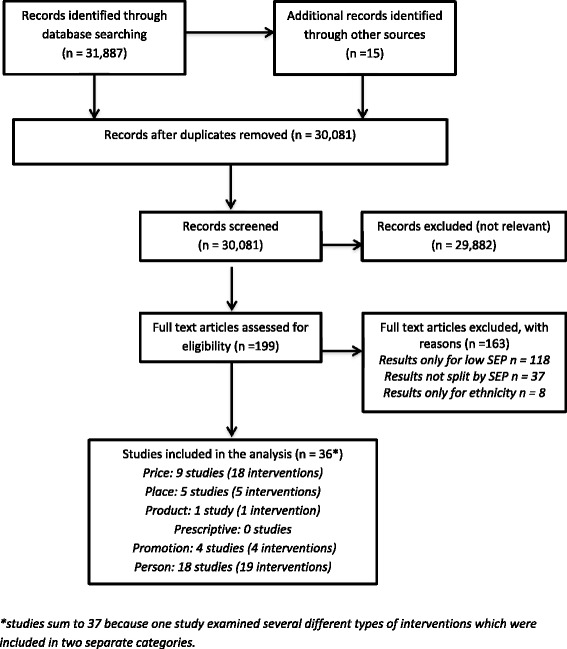
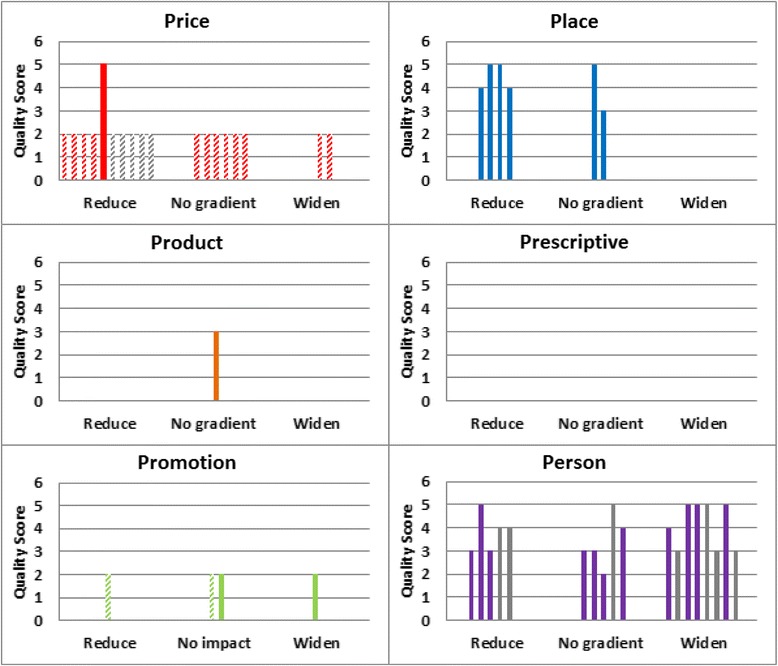
BACKGROUND: Interventions to promote healthy eating make a potentially powerful contribution to the primary prevention of non communicable diseases. It is not known whether healthy eating interventions are equally effective among all sections of the population, nor whether they narrow or widen the health gap between rich and poor. We undertook a systematic review of interventions to promote healthy eating to identify whether impacts differ by socioeconomic position (SEP). METHODS: We searched five bibliographic databases using a pre-piloted search strategy. Retrieved articles were screened independently by two reviewers. Healthier diets were defined as the reduced intake of salt, sugar, trans-fats, saturated fat, total fat, or total calories, or increased consumption of fruit, vegetables and wholegrain. Studies were only included if quantitative results were presented by a measure of SEP. Extracted data were categorised with a modified version of the "4Ps" marketing mix, expanded to 6 "Ps": "Price, Place, Product, Prescriptive, Promotion, and Person". RESULTS: Our search identified 31,887 articles. Following screening, 36 studies were included: 18 "Price" interventions, 6 "Place" interventions, 1 "Product" intervention, zero "Prescriptive" interventions, 4 "Promotion" interventions, and 18 "Person" interventions. "Price" interventions were most effective in groups with lower SEP, and may therefore appear likely to reduce inequalities. All interventions that combined taxes and subsidies consistently decreased inequalities. Conversely, interventions categorised as "Person" had a greater impact with increasing SEP, and may therefore appear likely to reduce inequalities. All four dietary counselling interventions appear likely to widen inequalities. We did not find any "Prescriptive" interventions and only one "Product" intervention that presented differential results and had no impact by SEP. More "Place" interventions were identified and none of these interventions were judged as likely to widen inequalities. CONCLUSIONS: Interventions categorised by a "6 Ps" framework show differential effects on healthy eating outcomes by SEP. "Upstream" interventions categorised as "Price" appeared to decrease inequalities, and "downstream" "Person" interventions, especially dietary counselling seemed to increase inequalities. However the vast majority of studies identified did not explore differential effects by SEP. Interventions aimed at improving population health should be routinely evaluated for differential socioeconomic impact.
Overview
The claims and statistics of this paper haven’t been checked yet.
Run the check — free, no account needed. It reads the open-access text and checks the sources it cites.
Integrity signals
Registry
Cites
Statistics
Figures
Verification
Claims the paper makes
The claims and statistics of this paper haven’t been checked yet.
Run the check — free, no account needed. It reads the open-access text and checks the sources it cites.
Claims other papers make about this one
Each is checked against this paper’s own text: does it say what the citing paper says it does?
In the citing paper
“In addition, population strategies to address diet, such as economic incentives, can reduce socioeconomic-related disparities in health, whereas individual-based approaches may exacerbate inequities.98, 99”
From Dietary and Policy Priorities for Cardiovascular Disease, Diabetes, and Obesity: A Comprehensive Review (2016) · cites this paper as [98]
Self-check
Percentages, sums and reported differences re-computed from the paper’s own numbers.
The self-check needs the paper’s full text.
Citations
Cites
Lim, S. S., Vos, T., Flaxman, A. D., Danaei, G., Shibuya, K., Adair-Rohani, H., AlMazroa, M. A., Amann, M., Anderson, H. R., Andrews, K. G., et al. (2012) · The Lancet · doi:10.1016/s0140-6736(12)61766-8 · Cited by 11,805
Indicators of socioeconomic position (part 1): Figure 1
Galobardes, B., Shaw, M., Lawlor, D. A., Lynch, J. W., & Smith, G. D. (2005) · Journal of Epidemiology & Community Health · doi:10.1136/jech.2004.023531 · Cited by 2,979 · cited 2×
“For each of the included interventions, if the outcome was split by more than one socioeconomic proxy measure, we took the quantitative effect on inequalities from the stratified results that best represented SEP [24,25].”
Socioeconomic factors and cardiovascular disease: a review of the literature.
Kaplan, G. A., & Keil, J. E. (1993) · Circulation · doi:10.1161/01.cir.88.4.1973 · Cited by 1,845
A Framework for Public Health Action: The Health Impact Pyramid
Frieden, T. R. (2010) · American Journal of Public Health · doi:10.2105/ajph.2009.185652 · Cited by 1,535 · cited 2×
“Frieden depicts this difference as a “Health Impact Pyramid” [79].”
(2012) · Choice Reviews Online · doi:10.5860/choice.49-6620 · Cited by 1,284
Evaluating primary care behavioral counseling interventions An evidence-based approach
Whitlock, E. (2002) · American Journal of Preventive Medicine · doi:10.1016/s0749-3797(02)00415-4 · Cited by 1,057 · cited 1×
“Whitlock and colleagues reviewed the effectiveness of counselling interventions on public health [81].”
What types of interventions generate inequalities? Evidence from systematic reviews
Lorenc, T., Petticrew, M., Welch, V., & Tugwell, P. (2013) · Journal of Epidemiology and Community Health · doi:10.1136/jech-2012-201257 · Cited by 927 · cited 1×
“explicitly concluded that “downstream” interventions actually worsen health inequalities [82].”
Self-citationSOCIAL MARKETING IN PUBLIC HEALTH
Grier, S. A., & Bryant, C. A. (2004) · Annual Review of Public Health · doi:10.1146/annurev.publhealth.26.021304.144610 · Cited by 925 · cited 1×
“The “4 Ps” framework is a well-established framework used within the marketing field and translates well to a policy context [31].”
Tackling of unhealthy diets, physical inactivity, and obesity: health effects and cost-effectiveness
Cecchini, M., Sassi, F., Lauer, J. A., Lee, Y. Y., Guajardo-Barron, V., & Chisholm, D. (2010) · The Lancet · doi:10.1016/s0140-6736(10)61514-0 · Cited by 889 · cited 1×
“Preventative interventions are more cost effective when compared to treatment [86].”
Welch, V. A., Petticrew, M. P., Tugwell, P., Moher, D., Petkovic, J., Waters, E., White, H., & the PRISMA-Equity Bellagio group (2012) · PLoS Medicine · doi:10.1371/journal.pmed.1001333 · Cited by 732 · cited 2×
“Upon fulfilling these criteria, studies were assessed utilising a PICOS (Participants, Interventions, Comparators, Outcomes and Study design) [23].”
Self-citation
Research works printed but not linked: 1
- Thomas H. Quality Assessment Tool for Quantitative Studies. Toronto: Effective Public Health Practice Project McMaster University; 2003.
Cited by
Sorted by citations
Items 301–400 of 412
Interventions to prevent obesity in children under 2 years old
Moore, T. H., Phillips, S. M., Heslehurst, N., Hodder, R. K., Dawson, S., Gao, Y., Hesketh, K. R., & Summerbell, C. (2022) · Cochrane Database of Systematic Reviews · doi:10.1002/14651858.cd015324 · Cited by 2
Fjæra, K. E., Lekhal, R., Helseth, S., Hagen, M., & Lekhal, S. (2024) · Food & Nutrition Research · doi:10.29219/fnr.v68.9524 · Cited by 2
“Children from different social classes attend kindergartens; therefore, kinder-gartens are important for promoting healthy habits and reducing social inequalities (32).”
BackgroundLangfield, T., Clarke, K., Sadab, A. A., Jones, A., & Robinson, E. (2024) · Appetite · doi:10.1016/j.appet.2024.107296 · Cited by 2
“…and colleagues found some evidence that certain types of interventions may be less or more effective depending on SEP, though a dearth of evidence overall, arguing that population level interventions “ should be routinely evaluated for differential socioeconomic impact ” (McGill et al., 2015; p.1).”
Vaiciurgis, V. T., Clancy, A. K., Charlton, K. E., Stefoska‐Needham, A., & Beck, E. J. (2024) · Journal of Human Nutrition and Dietetics · doi:10.1111/jhn.13340 · Cited by 2
Bélanger‐Gravel, A., Laferté, M., Therrien, F., Lagarde, F., & Gauvin, L. I. (2021) · Preventive Medicine Reports · doi:10.1016/j.pmedr.2021.101582 · Cited by 2
Interventions to prevent obesity in children aged 2 to 4 years old
Moore, T. H., Phillips, S. M., Hodder, R. K., O’Brien, K. M., Hillier-Brown, F. C., Dawson, S., Gao, Y., & Summerbell, C. (2022) · Cochrane Database of Systematic Reviews · doi:10.1002/14651858.cd015326 · Cited by 2
Tajima, R., Matsumoto, M., Fujiwara, A., Yuan, X., Shinsugi, C., Okada, E., Kurotani, K., Yokoyama, T., & Takimoto, H. (2023) · Journal of Epidemiology · doi:10.2188/jea.je20220220 · Cited by 2
Wittels, P., Kay, T., & Mansfield, L. (2023) · Perspectives in Public Health · doi:10.1177/17579139231205488 · Cited by 2
“…for the adoption of healthy behaviours Peer reView particularly the case in disadvantaged groups that experience multiple barriers to effect change, 9,10 and for mothers who not only tend to prioritise the needs of other family members above their own, but in some circumstances, question the…”
Marsden, A., Hann, M., Barron, E., McGough, B., Murray, E., Valabhji, J., & Cotterill, S. (2023) · medRxiv · doi:10.1101/2023.02.21.23286221 · Cited by 2
Peat, G., Jordan, K. P., Wilkie, R., van der Windt, D., Yu, D., Narle, G., & Ali, N. (2022) · Journal of Public Health · doi:10.1093/pubmed/fdac014 · Cited by 1
Esmat, S., Elhabashi, E. M., & Sabry, H. A. (2023) · Egyptian Journal of Nutrition and Health · doi:10.21608/ejnh.2023.283071 · Cited by 1
Woodward-Lopez, G. M., McLain, A. C., Frongillo, E. A., Colabianchi, N., Collie-Akers, V. L., & Ritchie, L. D. (2025) · Pediatric Obesity · doi:10.1111/ijpo.70043 · Cited by 1
Holly, S., Caruso, O. T., Smaranda, D., McEachern, L. W., Seabrook, J. A., & Gilliland, J. (2025) · Journal of Human Nutrition and Dietetics · doi:10.1111/jhn.70130 · Cited by 1
School food environment interventions for health and sustainability
Leibinger, A., Holliday, N., Klinger, C., Tan, X., Busert, L. K., Schwingshackl, L., Rehfuess, E. A., Durão, S., & von Philipsborn, P. (2026) · Cochrane Database of Systematic Reviews · doi:10.1002/14651858.cd015882 · Cited by 1
Krølner, R. F., Brautsch, L. A. S., Vilhelmsen, M., Hoeeg, D., Pedersen, N. H., Thomsen, L. T., Nielsen, G., Toft, U., Larsen, M. N., Damsgaard, C. T., et al. (2026) · Trials · doi:10.1186/s13063-026-09635-1 · Cited by 2
“Public health interventions sometimes fail in reaching those most in need of interventions [130].”
Muslichah, R., Styles, S. E., Matkin-Hussey, P. A., Love, T. D., & Black, K. E. (2026) · Nutrition Reviews · doi:10.1093/nutrit/nuag032 · Cited by 1
Becker, E., Garnett, E. E., Scarborough, P., Cummins, S., Savory, B., Huse, O., Thompson, C., Brock, J., Clark, M., Renzella, J., et al. (2026) · International Journal of Behavioral Nutrition and Physical Activity · doi:10.1186/s12966-026-01889-x · Cited by 1
“Although availability interventions are generally considered more equitable than information-based approaches [36], we could not quantitatively determine whether effects differed by socio-economic group.”
Self-citationAllotey, J., Coomar, D., Ensor, J., Ogwulu, C. O., Ruiz‐Calvo, G., Monahan, M., Kabeya, V., Mcneill, R., Boath, A., Mahmoud, G., et al. (2025) · Health Technology Assessment · doi:10.3310/gjst1327 · Cited by 1
Norwegian support for tackling health inequalities in Lithuania: the process, pitfalls and results
Stankūnas, M., Kalèdiené, R., Valintėlienė, R., Stukas, R., Veryga, A., Beržanskytė, A., Janonienė, R., Petronytė, G., Šmigelskas, K., Radzevičiūtė, I., et al. (2017) · Journal of Health Inequalities · doi:10.5114/jhi.2017.69155 · Cited by 1
“The recommendations are based on scientific evidence and “best-practice” examples [17-19] and include a list of comprehensively described interventions suitable for implementation at national and local (municipality) level (Table 3).”
BackgroundHennessy, E., Shonkoff, E., Harelick, L., Bakun, P. J., Chui, K. K. H., Roberts, S. B., Folta, S. C., Goldberg, J. P., & Economos, C. D. (2022) · Public Health Nutrition · doi:10.1017/s136898002200163x · Cited by 1
“Moreover, social marketing campaign interventions focused on priority populations such as those described in this studymay also need to be supported by changes to the retail food environment to achieve significance(15,16).”
BackgroundEffect of a Multicomponent Food Pantry Intervention in Client Subgroups
Jia, J., Gombi‐Vaca, M. F., Barsness, C. B., Peterson, H. H., Pratt, R. J., Wolfson, J. A., & Caspi, C. E. (2024) · Nutrients · doi:10.3390/nu16060805 · Cited by 1
“Studies of healthy food nudges in commercial settings suggest that such interventions are often neutral towards or can reduce health disparities [28,29].”
BackgroundInfluentialSMM for Promoting Healthy Eating: Bibliometric Analysis
Ziabina, Y., Kryvych, Y. M., & Pigon, L. (2024) · Marketing and Management of Innovations · doi:10.21272/mmi.2024.4-09 · Cited by 8
Camerini, A. V., Silva, A. E. R., Feldens, C. A., Meucci, R. D., & Prietsch, S. O. M. (2025) · European Archives of Paediatric Dentistry · doi:10.1007/s40368-025-01047-0 · Cited by 1
“In addition to being considered potentially more effective, broader strategies can also contribute to reducing inequality (McGill et al. 2015).”
Myers, C. A., Broyles, S. T., & Martin, C. K. (2019) · Health Equity · doi:10.1089/heq.2019.0019 · Cited by 1
“Although interventions may achieve health improvements in participants of varying SES, SEP health disparities may persist in the context of an intervention and, in turn, an effective intervention can maintain or increase SEP inequities in the health outcome of interest.(14,15) Given this, the objective of this study w…”
BackgroundOlstad, D. L., Beall, R. F., Spackman, E., Dunn, S., Lipscombe, L. L., Williams, K., Oster, R. T., Scott, S., Zimmermann, G. L., McBrien, K., et al. (2021) · Research Square · doi:10.21203/rs.3.rs-180761/v1 · Cited by 1
“nutrition counselling) and is unlikely to substantially change dietary intake in the context of severe economic constraints [84-89].”
BackgroundHealthy and sustainable diets in the 21st century from an individual and societal perspective
Harbers, M. C. (2022) · Utrecht University Repository (Utrecht University) · doi:10.33540/1355 · Cited by 1
van den Bekerom, L., van Gestel, L. C., Schoones, J. W., Bussemaker, J., & Adriaanse, M. A. (2023) · doi:10.31234/osf.io/3jdc5 · Cited by 1
Participatory community health promotion
Wagemakers, A. (2023) · doi:10.18174/646960 · Cited by 1
Keating, G., Jones, R., Monasterio, E., & Freeman, J. (2016) · Applied Health Economics and Health Policy · doi:10.1007/s40258-016-0252-3
Olstad, D. L., Teychenne, M. J., Minaker, L. M., Taber, D. R., Raine, K. D., Nykiforuk, C. I. J., & Ball, K. (2016) · Obesity Reviews · doi:10.1111/obr.12483
Los programas de cribado en tiempos de crisis: ¿inmunes a los recortes?
Bernáldez, J. P. (2017) · FMC - Formación Médica Continuada en Atención Primaria · doi:10.1016/j.fmc.2017.01.001
van Gestel, L. C. (2021) · Utrecht University Repository (Utrecht University) · doi:10.33540/699
تأثیر استخدام مسحوق الفاصولیا الحمراء کبدیل للدهون على جودة برجر لحم البقر
محفوظ, م. ز. (2021) · مجلة البحوث فی مجالات التربیة النوعیة · doi:10.21608/jedu.2021.72760.1327
Akamatsu, R., Ozawa, K., Kushida, O., Kojima, Y., & Abe, K. (2021) · The Japanese Journal of Nutrition and Dietetics · doi:10.5264/eiyogakuzashi.79.355
Economics of noncommunicable diseases in the Americas
VV.AA., V. A. (2018) · Revista Panamericana de Salud Pública · doi:10.26633/rpsp.2018.187 · Cited by 1
Læring gennem mad og måltider i grundskolen: Teori og praksis fra Danmark, Sverige og Norge
Ruge, D., Vik, F. N., Björklund, J., Frödén, S., Berggren, L., Bjørkkjær, T., Dahl, A., Holt, K., Lund, E. K., Olsson, C., et al. (2023) · doi:10.23865/noasp.182 · Cited by 1
Government policies to improve food environments: A population and equity lens
Djojosoeparto, S. K. (2023) · doi:10.33540/1897
Petry, M. L., Menegazzo, G. R., Marques, B. B., Reis, M. D. S., Henriqson, D., & Moraes, R. B. (2024) · Revista de Atenção à Saúde · doi:10.13037/2359-4330.8941
“While approaches that focus on the individual, such as media campaigns, health education, and dietary guidelines, tend to increase health inequalities 23 and favor individuals with better socioeconomic conditions, public policies have the potential to minimize health inequalities 24 .”
BackgroundInsights into European regulatory solutions on implementation of fat tax - a scoping reviewPreprint
Pitas, W., Tyrańska-Fobke, A., & Kamińska-Skrzyńska, W. (2024) · Research Square · doi:10.21203/rs.3.rs-4014122/v1
Silvariño, R., Rico-Fontalvo, J. E., Villavicencio, V., Sánchez-Polo, V., & Rosa-Diez, G. J. (2024) · Nefrología Latinoamericana · doi:10.24875/nefro.m24000022
(2024) · Emerald Group Publishing Limited eBooks · doi:10.1108/978-1-83797-897-720241022
World Kidney Day 2024: promoting equitable access to health care and optimal medication
Silvariño, R., Rico-Fontalvo, J. E., Villavicencio, V., Sánchez-Polo, V., & Rosa-Diez, G. J. (2024) · Nefrología Latinoamericana · doi:10.24875/nefro.m24000034
Braune, T., Livingstone, K. M., Adams, J. M., & Winpenny, E. M. (2024) · Research Square · doi:10.21203/rs.3.rs-4324934/v1
van Kesteren, R., & Evans, A. (2024) · Journal of Consumer Culture · doi:10.1177/14695405241290917
de Mestral, C., Khalatbari‐Soltani, S., Bodenmann, P., Henchoz, Y., & Avendaño, M. (2024) · SSRN Electronic Journal · doi:10.2139/ssrn.5044310
OECD (2024) · OECD health policy studies · doi:10.1787/964ad13f-sl
OECD (2024) · OECD health policy studies · doi:10.1787/0cdc42ae-fr
OECD (2024) · OECD health policy studies · doi:10.1787/c0f28aca-en
Alqahtani, S. M. M., Alqahtani, S., Asiri, F. Y. M., Asiri, A. A. Y., Asiri, T. A. H., Asiri, M. A. M., alqhtani, M. T. M., Mawtah, M. I. B. A., Alzabadani, M. A. H., & Balhareth, A. A. A. (2024) · Journal of Ecohumanism · doi:10.62754/joe.v3i8.5329
Wulandari, M., Hermawan, H., & Nursaidah, N. (2024) · American Journal of Economics and Business Management · doi:10.31150/ajebm.v7i12.3133
Supermarkets and the Sale of Healthy Foods
Bernsdorf, K. A., Golubovic, S., Bjørnsbo, K. S., Thomsen, L. T., Duus, K. S., & Toft, U. (2025) · Springer eBooks · doi:10.1007/978-3-031-32047-7_3-1
Fuelbert, H., Zoromé, S., Millogo, R., Danquah, I., & Herrmann, A. (2025) · Global Health Action · doi:10.1080/16549716.2025.2457193
Nardi, A., Sorge, C., Cascini, S., Davoli, M., Agabiti, N., Zuanna, T. D., & Cesaroni, G. (2025) · BMJ Open · doi:10.1136/bmjopen-2024-091738
Proebstl, S., Vogel, C., Lawrence, W. T., Strömmer, S., Inskip, H. M., Hammond, J., Hart, K., McGill, K., Harvey, N. C., Barker, M. E., et al. (2025) · PLoS ONE · doi:10.1371/journal.pone.0319224
Samfunnsrettet ernæringsarbeid
Medin, A. C., Hillesund, E. R., & Øverby, N. C. (2025) · Norsk tidsskrift for ernæring · doi:10.18261/ntfe.23.3.7
Cottineau, C., Perret, J., Reuillon, R., Coyrehourcq, S. R., & Vallée, J. (2025) · EPJ Data Science · doi:10.1140/epjds/s13688-025-00603-4
Konttinen, H. M., Halmesvaara, O., Fogelholm, M., Saarijärvi, H., Nevalainen, J., & Erkkola, M. (2021) · Figshare · doi:10.6084/m9.figshare.14721953
Czwikla, G., Boen, F., Cook, D. G., de Jong, J., Harris, T., Hilz, L. K., Iliffe, S., Lechner, L., Morris, R., Muellmann, S., et al. (2021) · Figshare · doi:10.6084/m9.figshare.14608372
Czwikla, G., Boen, F., Cook, D. G., de Jong, J., Harris, T., Hilz, L. K., Iliffe, S., Lechner, L., Morris, R. W., Muellmann, S., et al. (2021) · Figshare · doi:10.6084/m9.figshare.14608378
Doustmohammadian, A., & Bazhan, M. (2021) · Figshare · doi:10.6084/m9.figshare.14205186
Czwikla, G., Boen, F., Cook, D. G., de Jong, J., Harris, T., Hilz, L. K., Iliffe, S., Lechner, L., Morris, R. W., Muellmann, S., et al. (2021) · Figshare · doi:10.6084/m9.figshare.14608375
Stuber, J. M., Mackenbach, J. D., de Bruijn, G., Gillebaart, M., Hoenink, J. C., Middel, C. N. H., de Ridder, D. T. D., van der Schouw, Y. T., Smit, E. G., Velema, E., et al. (2024) · Figshare · doi:10.6084/m9.figshare.26675756
Burgaz, C., Van-Dam, I., Garton, K., Swinburn, B. A., Sacks, G., Asiki, G., Claro, R. M., Diouf, A., Bartoletto Martins, A. P., & Vandevijvere, S. (2024) · Figshare · doi:10.6084/m9.figshare.26754535
Burgaz, C., Van-Dam, I., Garton, K., Swinburn, B. A., Sacks, G., Asiki, G., Claro, R. M., Diouf, A., Bartoletto Martins, A. P., & Vandevijvere, S. (2024) · Figshare · doi:10.6084/m9.figshare.26754544
Czwikla, G., Boen, F., Cook, D. G., de Jong, J., Harris, T., Hilz, L. K., Iliffe, S., Lechner, L., Morris, R., Muellmann, S., et al. (2021) · Figshare · doi:10.6084/m9.figshare.14608390
Doustmohammadian, A., & Bazhan, M. (2021) · Figshare · doi:10.6084/m9.figshare.14205183
Gillespie, D., Hatchard, J. L., Squires, H., Gilmore, A., & Brennan, A. (2021) · Figshare · doi:10.6084/m9.figshare.13521010
Self-citationBurgaz, C., Van-Dam, I., Garton, K., Swinburn, B. A., Sacks, G., Asiki, G., Claro, R. M., Diouf, A., Bartoletto Martins, A. P., & Vandevijvere, S. (2024) · Figshare · doi:10.6084/m9.figshare.26754547
Harbers, M. C., Beulens, J. W. J., Rutters, F., de Boer, F. E., Gillebaart, M., Sluijs, I., & van der Schouw, Y. T. (2020) · Figshare · doi:10.6084/m9.figshare.12971997
Burgaz, C., Van-Dam, I., Garton, K., Swinburn, B. A., Sacks, G., Asiki, G., Claro, R. M., Diouf, A., Bartoletto Martins, A. P., & Vandevijvere, S. (2024) · Figshare · doi:10.6084/m9.figshare.26754538
Konttinen, H. M., Halmesvaara, O., Fogelholm, M., Saarijärvi, H., Nevalainen, J., & Erkkola, M. (2021) · Figshare · doi:10.6084/m9.figshare.14721956
Marsden, A., Hann, M., Barron, E., McGough, B., Murray, E., Valabhji, J., & Cotterill, S. (2023) · Figshare · doi:10.6084/m9.figshare.24864114
Czwikla, G., Boen, F., Cook, D. G., de Jong, J., Harris, T., Hilz, L. K., Iliffe, S., Lechner, L., Morris, R. W., Muellmann, S., et al. (2021) · Figshare · doi:10.6084/m9.figshare.14608384
Harbers, M. C., Beulens, J. W. J., Rutters, F., de Boer, F. E., Gillebaart, M., Sluijs, I., & van der Schouw, Y. T. (2020) · Figshare · doi:10.6084/m9.figshare.12972003
Pechey, R., Hollands, G. J., Reynolds, J. P., Jebb, S. A., & Marteau, T. M. (2022) · Figshare · doi:10.6084/m9.figshare.20342453
Pechey, R., Hollands, G. J., Carter, P., & Marteau, T. M. (2020) · Figshare · doi:10.6084/m9.figshare.12580954
Konttinen, H. M., Halmesvaara, O., Fogelholm, M., Saarijärvi, H., Nevalainen, J., & Erkkola, M. (2021) · Figshare · doi:10.6084/m9.figshare.14721950
Czwikla, G., Boen, F., Cook, D. G., de Jong, J., Harris, T., Hilz, L. K., Iliffe, S., Lechner, L., Morris, R., Muellmann, S., et al. (2021) · Figshare · doi:10.6084/m9.figshare.14608387
Arrazat, L., Cambriels, C., Noan, C. L., Nicklaus, S., & Marty, L. (2024) · Figshare · doi:10.6084/m9.figshare.26749343
Dhuria, P., Lawrence, W. T., Crozier, S., Cooper, C. C., Baird, J., & Vogel, C. (2021) · Figshare · doi:10.6084/m9.figshare.14738460
McDonald, M., Dombrowski, S. U., Skinner, R., Calveley, E., Carroll, P., Elders, A., Gray, C. M., Grindle, M., Harris, F. M., Jones, C., et al. (2020) · Figshare · doi:10.6084/m9.figshare.13059793
Arrazat, L., Cambriels, C., Noan, C. L., Nicklaus, S., & Marty, L. (2024) · Figshare · doi:10.6084/m9.figshare.26749346
Doustmohammadian, A., & Bazhan, M. (2021) · Figshare · doi:10.6084/m9.figshare.14205180
Czwikla, G., Boen, F., Cook, D. G., de Jong, J., Harris, T., Hilz, L. K., Iliffe, S., Lechner, L., Morris, R., Muellmann, S., et al. (2021) · Figshare · doi:10.6084/m9.figshare.14608381
Harbers, M. C., Beulens, J. W. J., Rutters, F., de Boer, F. E., Gillebaart, M., Sluijs, I., & van der Schouw, Y. T. (2020) · Figshare · doi:10.6084/m9.figshare.12972000
Gillespie, D., Hatchard, J. L., Squires, H., Gilmore, A., & Brennan, A. (2021) · Figshare · doi:10.6084/m9.figshare.13521004
Self-citationStuber, J. M., Mackenbach, J. D., de Bruijn, G., Gillebaart, M., Hoenink, J. C., Middel, C. N. H., de Ridder, D. T. D., van der Schouw, Y. T., Smit, E. G., Velema, E., et al. (2024) · Figshare · doi:10.6084/m9.figshare.26675753
Stuber, J. M., Mackenbach, J. D., de Bruijn, G., Gillebaart, M., Hoenink, J. C., Middel, C. N. H., de Ridder, D. T. D., van der Schouw, Y. T., Smit, E. G., Velema, E., et al. (2024) · Figshare · doi:10.6084/m9.figshare.26675750
Gillespie, D., Hatchard, J. L., Squires, H., Gilmore, A., & Brennan, A. (2021) · Figshare · doi:10.6084/m9.figshare.13521007
Self-citationCzwikla, G., Boen, F., Cook, D. G., de Jong, J., Harris, T., Hilz, L. K., Iliffe, S., Lechner, L., Morris, R. W., Muellmann, S., et al. (2021) · Figshare · doi:10.6084/m9.figshare.14608393
Czwikla, G., Boen, F., Cook, D. G., de Jong, J., Harris, T., Hilz, L. K., Iliffe, S., Lechner, L., Morris, R. W., Muellmann, S., et al. (2021) · Figshare · doi:10.6084/m9.figshare.14608396
Burgaz, C., Van-Dam, I., Garton, K., Swinburn, B. A., Sacks, G., Asiki, G., Claro, R. M., Diouf, A., Bartoletto Martins, A. P., & Vandevijvere, S. (2024) · Figshare · doi:10.6084/m9.figshare.26754541
Amberntsson, A., Heide, E., Paulsen, M. M., Solberg, S. L., Løvhaug, A. L., Andersen, L. F., & Abel, M. H. (2025) · Food & Nutrition Research · doi:10.29219/fnr.v69.12483
кизи, И. Д. Ф. (2025) · ОБРАЗОВАНИЕ НАУКА И ИННОВАЦИОННЫЕ ИДЕИ В МИРЕ · doi:10.64941/9vjvra41
de Mestral, C., Khalatbari‐Soltani, S., Bodenmann, P., Henchoz, Y., & Avendano, M. (2026) · The Journal of Frailty & Aging · doi:10.1016/j.tjfa.2026.100134
“…public health campaigns play an important role, their effectiveness depends on concurrent structural changes to the food and built environments; without such changes, they may inadvertently widen inequalities by disproportionately benefiting socioeconomically advantaged groups [28,40,42].”
Etudes d'interventions nutritionnelles en populations défavorisées réalisées en Seine-Saint-Denis
Buscail, C. (2018) · theses.fr (ABES) · doi:10.70675/65a147dfza9e3z4132z9942z93811b0ba44d
Santamaria, J., Jahn, B., Sroczynski, G., Tuohy, K. M., Papon, V., Siebert, U., & Mühlberger, N. (2026) · Journal of Public Health · doi:10.1007/s10389-026-02744-w
Metadata
- Authors
- McGill, R., Anwar, E., Orton, L., Bromley, H., Lloyd-Williams, F., O’Flaherty, M., Taylor-Robinson, D., Guzman-Castillo, M., Gillespie, D., Moreira, P., Allen, K., Hyseni, L., Calder, N., Petticrew, M., White, M., Whitehead, M., & Capewell, S.
- Affiliations
- University of Liverpool (GB)
- London School of Hygiene & Tropical Medicine (GB)
- University of Cambridge (GB)
- Corresponding author
- McGill, Rory
- ORCID
- Venue
- BMC Public Health
- Published
- 2015-05-02
- Volume
- 15
- Issue
- 1
- Pages
- 457-457
- ISSN
- 1471-2458 (ISSN-L)
- PMC
- PMC4423493
- OpenAlex
- W4239413439
- Cited by
- 407
- References
- 83
- Citations by year
- 2026: 18 · 2025: 30 · 2024: 48 · 2023: 33 · 2022: 40 · 2021: 63 · 2020: 42 · 2019: 38 · 2018: 37 · 2017: 32 · 2016: 21 · 2015: 5
- FWCI
- 4.07
- Type
- journal article
- Language
- en
- Update notices
- correction (2015-09-15)
- Open access
- gold
- doi.org
- Locations
- BMC Public Health (publishedVersion, cc-by)
- PubMed Central (publishedVersion, cc-by)
- PubMed (publishedVersion)
- LSHTM Research Online (London School of Hygiene and Tropical Medicine) (acceptedVersion)
- Apollo (University of Cambridge) (submittedVersion, cc-by)
- Apollo
- Funders
- London School of Hygiene and Tropical Medicine
- Wellcome Trust (087636/Z/08/Z)
- National Institute for Health and Care Research
- University of Exeter
- University of Sheffield
- National Institutes of Health
- Medical Research Council (MR/K023187/1)
- Economic and Social Research Council (ES/G007462/1, ES/G007470/1)
- School for Public Health Research
- Topics
- Health Sciences › Nursing › Nutrition and Dietetics › Nutrition, Health and Food Behavior
- Health Sciences › Medicine › Public Health, Environmental and Occupational Health › Nutritional Studies and Diet
- Health Sciences › Medicine › Public Health, Environmental and Occupational Health › Obesity, Physical Activity, Diet
- Keywords
- healthy eating interventions, socioeconomic disparities, socioeconomic position, nutrition counseling, non-communicable disease prevention, dietary intake, fruit and vegetable intake, health disparities
- MeSH terms
- Commerce, Diet, Feeding Behavior, Health Education, Health Promotion, Humans, Socioeconomic Factors, Vegetables, Marketing
About these checks
Registry, retraction, Cites and statistics results are computed, not judged, with one exception: a printed reference that no index lists is read once by a model before it counts as a citation error. Claims are extracted by a model and kept only when their quote appears verbatim in the text; each cited source is then checked, with a model’s help, for whether it says what the claim relies on. Those verdicts can be wrong — read the claim’s quote and the cited source before relying on one.
Statistics and arithmetic are recomputed, not judged.
Confidence bands are shown only for fields calibrated on our annotated test set. None is calibrated yet, so no band is shown.
What counts as a claim ›How we measure confidence ›How we check this ›
Are you an author, or do you see a problem with this page? Request a review
