

The DOI matches its Crossref record; 43 of the 43 references it cites were found in a registry or an index.
The association between sedentary behaviour and risk of anxiety: a systematic review
Open accessAbstract
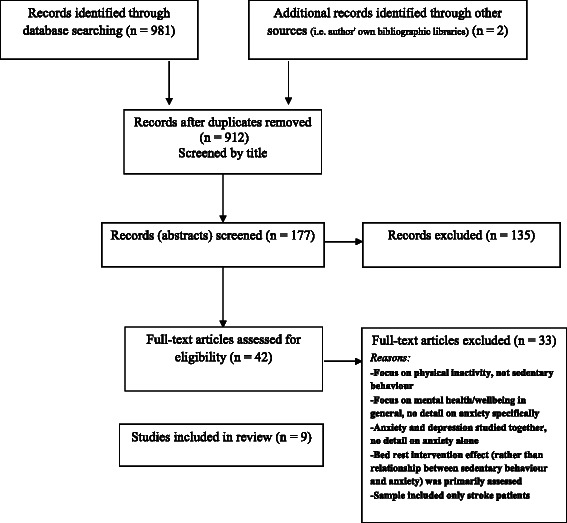
BACKGROUND: Previous research has linked sedentary behaviour (SB) to adverse physical health outcomes in adults and youth. Although evidence for the relationship between SB and mental health outcomes (e.g., depression) is emerging, little is known regarding risk of anxiety. METHODS: A systematic search for original research investigating the association between SB and risk of anxiety was performed using numerous electronic databases. A total of nine observational studies (seven cross-sectional and two longitudinal) were identified. Methodological quality of studies was assessed and a best-evidence synthesis was conducted. RESULTS: One cross-sectional study demonstrated a strong methodological quality, five cross-sectional studies demonstrated a moderate methodological quality and three studies (two cross-sectional one longitudinal) received a weak methodological quality rating. Overall, there was moderate evidence for a positive relationship between total SB and anxiety risk as well as for a positive relationship between sitting time and anxiety risk. There was inconsistent evidence for the relationship between screen time, television viewing time, computer use, and anxiety risk. CONCLUSION: Limited evidence is available on the association between SB and risk of anxiety. However, our findings suggest a positive association (i.e. anxiety risk increases as SB time increases) may exist (particularly between sitting time and risk of anxiety). Further high-quality longitudinal/interventional research is needed to confirm findings and determine the direction of these relationships.
Overview
The claims and statistics of this paper haven’t been checked yet.
Run the check — free, no account needed. It reads the open-access text and checks the sources it cites.
Integrity signals
Registry
Cites
Statistics
Figures
Verification
Claims the paper makes
The claims and statistics of this paper haven’t been checked yet.
Run the check — free, no account needed. It reads the open-access text and checks the sources it cites.
Claims other papers make about this one
Each is checked against this paper’s own text: does it say what the citing paper says it does?
In the citing paper
“Currently, clinical guidelines for metabolic screening upon initiation or continuation of SGAs put forth that blood pressure, body mass index (BMI), blood glucose and lipids should be checked at least every six months.[131][132][133]”
From The Lancet Psychiatry Commission: a blueprint for protecting physical health in people with mental illness (2019) · cites this paper as [133]
In the citing paper
“While positive associations between screen-based sedentary behaviors and emotional disorder symptoms have been previously identified, much of the work to date is cross-sectional (Hoare et al., 2016; Teychenne et al., 2015)”
From Reciprocal associations between screen time and emotional disorder symptoms during adolescence (2019) · cites this paper as Teychenne et al., 2015
In the citing paper
“Conversely, physical inactivity has been identified as a risk factor for the development of anxiety [53] as well as for other conditions such as depression [54–56].”
From Moving to Beat Anxiety: Epidemiology and Therapeutic Issues with Physical Activity for Anxiety (2018) · cites this paper as [53]
In the citing paper
“Factors such as physical inactivity represent a significant, but modifiable cardiovascular risk factor that is widespread in people with mental health problems [107], including anxiety disorders [25•, 53].”
From Moving to Beat Anxiety: Epidemiology and Therapeutic Issues with Physical Activity for Anxiety (2018) · cites this paper as [53]
Self-check
Percentages, sums and reported differences re-computed from the paper’s own numbers.
The self-check needs the paper’s full text.
Citations
Cites
Health benefits of physical activity: the evidence
Warburton, D. E. R. (2006) · Canadian Medical Association Journal · doi:10.1503/cmaj.051351 · Cited by 8,007 · cited 1×
“disease [4], osteoporosis [5], type two diabetes [3], and various cancers [6]).”
BackgroundPhysical activity and mental health in children and adolescents: a review of reviews
Biddle, S. J. H., & Asare, M. (2011) · British Journal of Sports Medicine · doi:10.1136/bjsports-2011-090185 · Cited by 2,447 · cited 1×
“Although research has indicated an inverse association between physical activity and anxiety may exist [24–26], currently the evidence regarding the association between sedentary behaviour and anxiety is unclear.”
BackgroundKraut, R. E., Kiesler, S. B., Boneva, B. S., Cummings, J. N., Helgeson, V. S., & Crawford, A. M. (2002) · Journal of Social Issues · doi:10.1111/1540-4560.00248 · Cited by 2,367 · cited 1×
“There is a small body of literature that suggests some forms of sedentary behaviour may in fact have a positive impact on mental health, specifically depressive symptoms [42, 43], however, further intervention and prospective studies are required to determine the direction of the relationship between sedentary behavio…”
BackgroundSystematic review of sedentary behaviour and health indicators in school-aged children and youth.
Tremblay, M. S., LeBlanc, A. G., Kho, M. E., Saunders, T. J., Larouche, R., Colley, R. C., Goldfield, G., & Gorber, S. (2011) · International Journal of Behavioral Nutrition and Physical Activity · doi:10.1186/1479-5868-8-98 · Cited by 2,085 · cited 1×
“unfavourable body composition, decreased fitness, lowered scores for self-esteem, and pro-social behaviour and decreased academic achievement [9], sleep problems, musculoskeletal pain, depression, and poor psychological well-being [10]).”
BackgroundHu, F. B., Li, T. Y., Colditz, G. A., Willett, W. C., & Manson, J. E. (2003) · JAMA · doi:10.1001/jama.289.14.1785 · Cited by 1,892 · cited 3×
“For example, research has shown sedentary behaviour to be linked to an increased risk of type 2 diabetes [3], a disease which is subsequently associated with poor mental health [23].”
BackgroundSitting time and mortality from all causes, cardiovascular disease, and cancer
KATZMARZYK, P. T., CHURCH, T. S., CRAIG, C. L., & BOUCHARD, C. (2009) · Medicine & Science in Sports & Exercise · doi:10.1249/mss.0b013e3181930355 · Cited by 1,611 · cited 1×
“disease [4], osteoporosis [5], type two diabetes [3], and various cancers [6]).”
BackgroundSedentary Behaviors and Subsequent Health Outcomes in Adults
Thorp, A. A., Owen, N., Neuhaus, M., & Dunstan, D. W. (2011) · American Journal of Preventive Medicine · doi:10.1016/j.amepre.2011.05.004 · Cited by 1,455
Physical activity, exercise, depression and anxiety disorders
Ströhle, A. (2009) · Journal of Neural Transmission · doi:10.1007/s00702-008-0092-x · Cited by 1,269 · cited 1×
“depression), it could be the displacement of physical activity when engaging in sedentary behaviour that explains the relationship with increased anxiety risk, since physical activity has been shown to be beneficial in reducing anxiety in both children/adolescents [38] and adults [39].”
BackgroundAnxiety disorders and comorbid medical illness
Roy-Byrne, P. P., Davidson, K. W., Kessler, R. C., Asmundson, G. J. G., Goodwin, R. D., Kubzansky, L., Lydiard, R. B., Massie, M. J., Katon, W., Laden, S. K., et al. (2008) · General Hospital Psychiatry · doi:10.1016/j.genhosppsych.2007.12.006 · Cited by 668 · cited 1×
“The illness has been shown to be linked to other serious diseases such as increased risk of cardiovascular disease and cancer [19] with estimates that anxiety and depression together contribute to 10 % of the total burden of disease in Australian women [20].”
BackgroundMust, A., & Tybor, D. J. (2005) · International Journal of Obesity · doi:10.1038/sj.ijo.0803064 · Cited by 642 · cited 1×
“Time spent in sedentary behaviour has emerged as a potentially important indicator of health in adult populations [2], independent of achieving sufficient physical activity.”
Background
Research works printed but not linked: 4
- Australian Bureau of Statistics. National Survey of Mental Health and Wellbeing. Canberra: ABS.: Australian Bureau of Statistics; 2008.
- World Health Organisation. Global Health Estimates summary tables, DALYs by cause, age and sex. Geneva, Switzerland: World Health Organisation; 2013. World2011.
- Taintor Z, Rosenthal RN. Microprocessor abuse and internet addiction. 4th ed. Philadelphia: Lippincott Williams & Wilkins; 2009.
- National Collaborating Centre for Methods and Tools. Quality Assessment Tool for Quantitative Studies. Hamilton, ON: McMaster University; 2008.
Cited by
Sorted by citations
Items 101–200 of 350
Assessment of Spanish Food Consumption Patterns during COVID-19 Home Confinement
Maestre, A. M., Sospedra, I., Sanz, J. M. M., Gutiérrez-Hervás, A., Fernández‐Sáez, J., Sánchez, J. A. H., & Norte, A. (2021) · Nutrients · doi:10.3390/nu13114122 · Cited by 28
“That is, the stress generated by home confinement can lead to high consumption of such products, which are associated with greater anxiety and stress, which can also be increased by sedentary behavior [31].”
BackgroundChen, S., Clark, C. C. T., & Ren, Z. (2022) · Frontiers in Public Health · doi:10.3389/fpubh.2022.918234 · Cited by 28
“Studies on anxiety symptoms and TV/movie time in adolescents remain scarce (12), especially in adolescents (22, 23).”
BackgroundA New Look at the Impact of Maximizing on Unhappiness: Two Competing Mediating Effects
Peng, J., Zhang, J., Zhang, Y., Gong, P., Han, B., Sun, H., Cao, F., & Miao, D. (2018) · Frontiers in Psychology · doi:10.3389/fpsyg.2018.00066 · Cited by 27
“…that people with higher achievement motivation, would have stronger decision making confidence, and more tend to take risks under uncertainty Frontiers in Psychology | www.frontiersin.org 5 February 2018 | Volume 9 | Article 66 (Collins et al., 2004; Stewart and Roth, 2007; Teychenne et al., 2015).”
BackgroundA Cost and Cost-Benefit Analysis of the Stand More AT Work (SMArT Work) Intervention
Munir, F., Miller, P., Biddle, S., Davies, M. J., Dunstan, D. W., Esliger, D., Gray, L. J., O'Connell, S. E., Waheed, G., Yates, T. E., et al. (2020) · International Journal of Environmental Research and Public Health · doi:10.3390/ijerph17041214 · Cited by 30
“High levels of sedentary behaviour (sitting time) have been identified as an important modifiable behavioural risk factor for multiple chronic diseases [1–4], poor mental health [5,6] and premature”
BackgroundHutchesson, M., Whatnall, M. C., Fenton, S., Ashton, L., Patterson, A. J., Smith, J. J., Duncan, M. J., KAY‐LAMBKIN, F. J., & Burrows, T. L. (2023) · Journal of American College Health · doi:10.1080/07448481.2023.2201865 · Cited by 33
The Associations Between Screen Time and Mental Health in Adults: A Systematic Review
Santos, R. M. S., Ventura, S. D. A., Nogueira, Y. J. D. A., Mendes, C. G., de Paula, J. J., de Miranda, D. M., & Romano‐Silva, M. A. (2024) · Journal of Technology in Behavioral Science · doi:10.1007/s41347-024-00398-7 · Cited by 38
Drummond, K. D., Waring, M. L., Faulkner, G. J., Blewitt, M. E., Perry, C. J., & Kim, J. H. (2021) · Neurobiology of Stress · doi:10.1016/j.ynstr.2021.100367 · Cited by 26
“Development and persistence of these disorders are closely tied to lifestyle factors such as stress and lack of physical activity (Bélair et al., 2018; Kantomaa et al., 2008; Kingery et al., 2010; Scaini et al., 2014; Schiele and Domschke, 2018; Teychenne et al., 2015).”
Sedentary behaviors and psychological outcomes among older adults: a systematic review
Ramalho, A. L. G., Petrica, J., & Rosado, A. F. B. (2018) · Motricidade · doi:10.6063/motricidade.12223 · Cited by 33
Associations between 24 h Movement Behavior and Mental Health in Office Workers
Larisch, L.-M., Kallings, L., Hagströmer, M., Desai, M., Rosen, P., & Blom, V. (2020) · International Journal of Environmental Research and Public Health · doi:10.3390/ijerph17176214 · Cited by 25
“In contrast, extensive SED may affect these mental health outcomes negatively [11,12], while both too long and too short sleep durations are associated with worse mental health [14,15].”
BackgroundFalk, G. E., Mailey, E. L., Okut, H., Rosenkranz, S. K., Rosenkranz, R. R., Montney, J. L., & Ablah, E. A. (2022) · International Journal of Environmental Research and Public Health · doi:10.3390/ijerph19116401 · Cited by 29
“Mental health may also be negatively impacted by sedentary behavior, as more sedentary time has been associated with a higher risk of experiencing symptoms of depression or anxiety [3,4].”
BackgroundTian, J., Yu, H., & Austin, L. (2022) · Psychology Research and Behavior Management · doi:10.2147/prbm.s384707 · Cited by 30
“50 Researchers in the college population also recommend regular participation in sports and PA to reduce anxiety and depression.”
BackgroundNicolson, G., Hayes, C. B., & Darker, C. D. (2019) · BMC Public Health · doi:10.1186/s12889-019-7447-0 · Cited by 28
“Recent reviews have found that SB is associated with increased risk of depression [67], and suggest positive associations between SB and anxiety risk [68].”
BackgroundMorris, K. A., Arundell, L., Cleland, V. J., & Teychenne, M. J. (2020) · International Journal of Behavioral Nutrition and Physical Activity · doi:10.1186/s12966-020-01015-5 · Cited by 24
Self-citationWearable Technology Reduces Prolonged Bouts of Sedentary Behavior
Ellingson, L. D., Meyer, J. D., & Cook, D. B. (2016) · Translational Journal of the American College of Sports Medicine · doi:10.1249/tjx.0000000000000001 · Cited by 24
“Previous research has demonstrated a link between sedentary time and mental health (46,47), and a small number of interventions suggest that changing sedentary time may influence mental health-related outcomes in generally healthy populations.”
BackgroundHou, M., Herold, F., Werneck, A. O., Teychenne, M. J., Paoli, A. G. D., Taylor, A., Damme, T. V., Kramer, A. F., Hossain, M. M., Yeung, A., et al. (2024) · International Journal of Clinical and Health Psychology · doi:10.1016/j.ijchp.2023.100435 · Cited by 24
“The above-presented findings may be partly attributed to negative social comparisons made on social networking sites which may lead to higher levels of depression and anxiety (Seabrook et al., 2016), which could be exacerbated by prolonged screen-based sitting (Teychenne et al., 2015).”
BackgroundSelf-citationRudnicka, A., Cook, D., Cecchinato, M. E., Gould, S. J. J., Newbold, J. W., & Cox, A. L. (2022) · Annual Symposium on Human-Computer Interaction for Work (CHIWORK) · doi:10.1145/3533406.3533409 · Cited by 31
“[62] suggests the existence of a positive association between sedentary time and anxiety risk, especially when sedentary time is spent sitting.”
BackgroundWeight Status, Physical Activity, and Depression in Korean Older Adults
Cho, J., Jin, Y., & Kang, H. (2018) · Journal of Epidemiology · doi:10.2188/jea.je20170083 · Cited by 25
Kandola, A. A., Lewis, G., Osborn, D., Stubbs, B., & Hayes, J. (2020) · Psychological Medicine · doi:10.1017/s0033291720004948 · Cited by 23
“These results support previous cross-sectional and prospective findings that self-reported high sedentary behaviour is associated with a greater risk of anxiety symptoms in adolescents (Allen et al., 2019; Hoare et al., 2016; Schuch et al., 2019; Teychenne et al., 2015).”
BackgroundResultHousing quality and behavior affect brain health and anxiety in healthy Japanese adults
Pineda, J. C. D., Kokubun, K., Ikaga, T., & Yamakawa, Y. (2021) · Scientific Reports · doi:10.1038/s41598-021-91363-4 · Cited by 24
Draper, C. E., Cook, C. J., Redinger, S., Rochat, T., Prioreschi, A., Rae, D. E., Ware, L. J., Lye, S. J., & Norris, S. A. (2022) · International Journal of Behavioral Nutrition and Physical Activity · doi:10.1186/s12966-022-01325-w · Cited by 27
“Evidence also exists for the inverse relationship between sedentary behaviour and mental health in adults [23, 24] and adolescents [22, 25, 26].”
BackgroundWang, Q., Liu, Y., & Mati, K. A. (2020) · Sleep Medicine · doi:10.1016/j.sleep.2020.01.022 · Cited by 29
Apostolopoulos, M., Hnatiuk, J. A., Maple, J., Olander, E. K., Brennan, L., van der Pligt, P., & Teychenne, M. J. (2021) · BMC Pregnancy and Childbirth · doi:10.1186/s12884-021-03847-w · Cited by 21
Self-citationZhao, M., Hou, M., Herold, F., Chen, Y., Werneck, A. O., Block, M. E., Kramer, A. F., Taylor, A., Cunha, P. M., Chaput, J., et al. (2024) · Journal of Affective Disorders · doi:10.1016/j.jad.2024.05.086 · Cited by 21
Daneshmandi, H., Choobineh, A., Ghaem, H., & Hejazi, N. (2019) · International Journal of Occupational Safety and Ergonomics · doi:10.1080/10803548.2019.1679972 · Cited by 21
“In addition, some studies have pointed out a relationship between prolonged sitting behavior and the risk of burnout [13], depression [14] and anxiety [15].”
BackgroundReciprocal relationship between sedentary behavior and mood in young adults over one-year duration
DeMello, M. M., Pinto, B. M., DUNSIGER, S. I., Shook, R. P., Burgess, S., Hand, G. A., & Blair, S. N. (2017) · Mental health and physical activity · doi:10.1016/j.mhpa.2017.12.001 · Cited by 20
Meyer, J. D., Ellingson, L. D., Buman, M. P., Shook, R. P., Hand, G. A., & Blair, S. N. (2020) · American Journal of Preventive Medicine · doi:10.1016/j.amepre.2020.02.018 · Cited by 21
Wang, J., Li, R., Zhang, L., Gao, X., Zhou, M., Zhang, X., & Ma, Y. (2022) · BMC Public Health · doi:10.1186/s12889-022-12727-7 · Cited by 20
“SBs are a strong risk factor for cardiovascular disease [9], type 2 diabetes [10], cancer [11, 12], and all-cause mortality [13, 14] and can cause many psychological problems, such as depression [15, 16] and anxiety [17, 18].”
BackgroundAlòs, F., Colomer, M. À., Martín-Cantera, C., Muñoz, M. S., Bort‐Roig, J., Saigí, I., Chirveches-Pérez, E., Solà-Gonfaus, M., Molina-Aragonés, J. M., & Puig-Ribera, A. M. (2022) · BMC Public Health · doi:10.1186/s12889-022-13676-x · Cited by 21
Physical Activity, Sedentary Behaviour and Mental Health in Young People: A Review of Reviews
Rodríguez‐Ayllón, M., Estévez‐López, F., Cadenas‐Sánchez, C., Gracia‐Marco, L., Lubans, D. R., Ortega, F. B., & Esteban‐Cornejo, I. (2019) · Springer eBooks · doi:10.1007/978-3-030-25816-0_3 · Cited by 20
The Recent Trend in Diagnosis and Treatment of Chronic Low Back Pain
Kikuchi, S. (2017) · Spine Surgery and Related Research · doi:10.22603/ssrr.1.2016-0022 · Cited by 20
Huang, T., Zheng, K., Li, S., Yang, Y., Kong, L., & Zhao, Y. (2022) · Frontiers in Public Health · doi:10.3389/fpubh.2022.994612 · Cited by 21
“Although previous studies have provided some evidence on the negative associations of prolonged sedentary time on some mental health indicators (25, 26), it remains to elucidate the associations of different types of screen-based sedentary behaviors with anxiety in colleges students.”
ResultBeller, J., Graßhoff, J., & Safieddine, B. (2023) · Journal of Public Health · doi:10.1007/s10389-023-02090-1 · Cited by 21
“Consequently, prolonged sitting has also been found to predict decreased psychological health, including depressiveness, anxiety and cognitive impairment (Teychenne et al. 2010, 2015; Huang et al. 2020).”
Smith, L., Sherratt, F., Barnett, Y., Cao, C., Tully, M. A., Koyanagi, A., Jacob, L., Soysal, P., Sánchez, G. F. L., Shin, J. I., et al. (2021) · Public Health · doi:10.1016/j.puhe.2021.01.018 · Cited by 19
Vancampfort, D., Stubbs, B., Hallgren, M. Å., Veronese, N., Mugisha, J., Probst, M., & Koyanagi, A. (2017) · International Psychogeriatrics · doi:10.1017/s1041610217002216 · Cited by 17
“Moreover, sedentary behavior and less PA are associated with an increased risk of developing anxiety (Pasco et al., 2011; Teychenne et al., 2015) and less PA is associated with greater symptom severity (Hiles et al., 2017).”
BackgroundHoriuchi, M., Takiguchi, C., Kirihara, Y. H., & Horiuchi, Y. (2018) · International Journal of Environmental Research and Public Health · doi:10.3390/ijerph15081710 · Cited by 18
“Nevertheless, links between sedentary behavior (prolonged sitting or television viewing, computer working in the office) and poor mental health have been found [17,18].”
BackgroundPachu, N. S., Strachan, S. M., McMillan, D. E., Ripat, J. D., & Webber, S. C. (2020) · Journal of American College Health · doi:10.1080/07448481.2020.1786098 · Cited by 21
“This is concerning given that high levels of sedentary behavior are associated with an increased risk of cardiovascular disease,(8) type 2 diabetes,(9) cancer,(10) depression,(11) and anxiety.(12) Importantly, some of the health risks associated with sedentary behavior have been shown to be somewhat independent of mod…”
BackgroundRelationships between indices of sedentary behavior and hedonic well-being: A scoping review
Sui, W., Sui, A., & Harry Prapavessis, A. (2021) · Psychology of sport and exercise · doi:10.1016/j.psychsport.2021.101920 · Cited by 17
Koolhaas, C. M., van Rooij, F. J. A., Kocevska, D., Luik, A. I., Ikram, M. A., Franco, O. H., & Tiemeier, H. W. (2019) · Mental health and physical activity · doi:10.1016/j.mhpa.2019.100296 · Cited by 17
The positive impact of physical activity on the reduction of anxiety scores: a pilot study
Alves, D. G. L., Rocha, S. G., Andrade, E. V., Mendes, A. Z., & Cunha, Â. G. J. (2019) · Revista da Associação Médica Brasileira · doi:10.1590/1806-9282.65.3.434 · Cited by 28
Childhood and adolescent television viewing and internalising disorders in adulthood
McAnally, H. M., Young, T. R., & Hancox, R. J. (2019) · Preventive Medicine Reports · doi:10.1016/j.pmedr.2019.100890 · Cited by 16
“There are few studies of television use and anxiety and, although some cross-sectional studies in adults have found a positive association, a recent systematic review found there to be insufficient evidence reach a conclusion on the impact of television viewing on internalising disorders (Teychenne et al., 2015).”
BackgroundResultStoreng, S. H., Sund, E. R., & Krokstad, S. (2020) · BMC Public Health · doi:10.1186/s12889-020-08993-y · Cited by 18
Morris, A. S., Mackintosh, K. A., Dunstan, D., Owen, N., Dempsey, P., Pennington, T., & McNarry, M. A. (2020) · International Journal of Environmental Research and Public Health · doi:10.3390/ijerph17249300 · Cited by 15
“Notably, cardiometabolic changes in both intervention groups occurred following a single-component intervention and may be of importance for future interventions seeking to attenuate cardiometabolic risk factors associated with adverse health outcomes [55].”
BackgroundMa, C., Li, Z., Tong, Y., Zhao, M., Magnussen, C. G., & Xi, B. (2021) · Journal of Affective Disorders · doi:10.1016/j.jad.2021.11.025 · Cited by 16
Teychenne, M. J., & Hinkley, T. (2016) · PLoS ONE · doi:10.1371/journal.pone.0155696 · Cited by 17
“evidence for the relationship of other sedentary behaviours including screen time, television viewing time and computer use with anxiety risk [19].”
BackgroundResultInfluentialSelf-citationPhysical activity correlates in people with anxiety: Data from 46 low- and middle-income countries.
Vancampfort, D., Stubbs, B., & Koyanagi, A. (2017) · General Hospital Psychiatry · doi:10.1016/j.genhosppsych.2017.04.007 · Cited by 14
“Moreover, sedentary behaviour is associated with an increased risk of developing anxiety (8), and less sports participation is associated with greater symptom severity and increased odds of developing an anxiety disorder 2 years later (9).”
BackgroundSkarpsno, E. S., Nilsen, T. I. L., Sand, T., Hagen, K., & Mork, P. J. (2019) · Behavioral Sleep Medicine · doi:10.1080/15402002.2019.1614927 · Cited by 16
Qin, X., Liu, L., Yan, Y., Guo, X., Yang, N., & Li, L. (2025) · Frontiers in Public Health · doi:10.3389/fpubh.2025.1512812 · Cited by 18
Linking sedentary behavior and mental distress in higher education: a cross-sectional study
Subirón‐Valera, A. B., Rodríguez‐Roca, B., Calatayud, E., Gómez‐Soria, I., Andrade-Gómez, E., & Marcén-Román, Y. (2023) · Frontiers in Psychology · doi:10.3389/fpsyg.2023.1205837 · Cited by 14
“In addition, SB may have an impact on mental health and the risk of developing anxiety or depression may increase (Primack et al., 2009; Teychenne et al., 2015) independently of physical activity (Ministerio de Salud, 2017; Jiang et al.”
BackgroundBernstein, E. E., Wolfe, E. C., Huguenel, B. M., & Wilhelm, S. (2023) · JMIR mhealth and uhealth · doi:10.2196/45860 · Cited by 20
Lee, S. J., Jeong, E. J., Choi, J. I., & Park, M. S. (2024) · Frontiers in Psychiatry · doi:10.3389/fpsyt.2024.1353969 · Cited by 14
“Anxiety is known as a psychological state characterized by persistent and excessive worry that interferes with daily activities, accompanied by physiological tension such as palpitations or trembling and negative emotions (56, 57).”
BackgroundGreenwald, R., Hayat, M. J., Barton, J. E., & Lopukhin, A. (2016) · PLoS ONE · doi:10.1371/journal.pone.0147578 · Cited by 14
Vancampfort, D., Stubbs, B., Sallis, J. F., Nabanoba, J., Basangwa, D., Oyeyemi, A. L., Kasoma, S. S., Binder, M. D., Myin‐Germeys, I., & Mugisha, J. (2019) · Journal of Physical Activity and Health · doi:10.1123/jpah.2018-0355 · Cited by 14
Walk with a Doc—a Call to Action for Physician-Led Walking Programs
Sabgir, D., & Dorn, J. M. (2020) · Current Cardiology Reports · doi:10.1007/s11886-020-01297-y · Cited by 15
Xia, D., Han, X., Zeng, Y., Wang, J., Xu, K.-L., Zhang, T.-J., Jiang, Y.-F., Chen, X.-D., Song, H., & Suo, C. (2023) · Acta Psychiatrica Scandinavica · doi:10.1111/acps.13645 · Cited by 13
“Previous studies have also suggested that rheumatoid arthritis 53 and sedentary behavior 54 can increase the risk of anxiety.”
BackgroundRole of Satisfaction with Life, Sex and Body Mass Index in Physical Literacy of Spanish Children
Urbano-Mairena, J., Mendoza-Muñoz, M., Carlos‐Vivas, J., Pastor-Cisneros, R., Castillo-Paredes, A., Rodal, M., & Bermejo, L. M. (2024) · Children · doi:10.3390/children11020181 · Cited by 17
“Cardiovascular diseases, hypertension, type II diabetes [9–11], and mental health issues [12], such as depressive and/or anxiety disorders [13,14], are some of the diseases related to sedentary and inactive lifestyles.”
BackgroundThe relationship between types of physical activity and mental health among U.S. adults
Bafageeh, F., & Loux, T. M. (2022) · Mental Health & Prevention · doi:10.1016/j.mhp.2022.200244 · Cited by 13
Bailey, B. W., Bartholomew, C. L., Summerhays, C., Deru, L. S., Compton, S., Tucker, L. A., LeCheminant, J. D., & Hicks, J. (2019) · Journal of Obesity · doi:10.1155/2019/4036825 · Cited by 14
“While this may not have been sufficient to prevent weight gain, the benefits of decreasing sedentary time have been shown in other studies to reduce cardiometabolic and inflammatory biomarkers [30] as well as reduction in risk of anxiety and depression [31, 32].”
BackgroundRodríguez‐García, L., de la Cruz-Campos, J. C., Martín-Moya, R., & González-Férnandez, F. T. (2022) · Education Sciences · doi:10.3390/educsci12080544 · Cited by 14
Asiamah, N., Petersen, C. J., Kouveliotis, K., & Eduafo, R. (2020) · Journal of Cross-Cultural Gerontology · doi:10.1007/s10823-020-09417-5 · Cited by 12
Liu, S., Coulter, R., Sui, W., Nuss, K. J., & Rhodes, R. E. (2023) · Applied Physiology, Nutrition, and Metabolism · doi:10.1139/apnm-2022-0379 · Cited by 15
Teychenne, M. J., Olstad, D. L., Turner, A. I., Costigan, S. A., & Ball, K. (2018) · International Journal of Environmental Research and Public Health · doi:10.3390/ijerph15040586 · Cited by 12
“, sitting or reclining behaviours that expend minimal energy such as television (TV) viewing, sitting at the computer) with poor mental health, and in particular with anxiety [3] and depressive symptoms [4].”
BackgroundSelf-citationSedentary Behavior and Mental Health
Smith, L., Hamer, M., & Gardner, B. (2018) · Elsevier eBooks · doi:10.1016/b978-0-12-812605-9.00006-x · Cited by 12
Nonworksite Interventions to Reduce Sedentary Behavior among Adults: A Systematic Review
Thraen-Borowski, K. M., Ellingson, L. D., Meyer, J. D., & Cadmus‐Bertram, L. (2017) · Translational Journal of the American College of Sports Medicine · doi:10.1249/tjx.0000000000000036 · Cited by 12
Kishida, M., & Elavsky, S. (2016) · Journal of Happiness Studies · doi:10.1007/s10902-016-9743-z · Cited by 12
“Indeed, this proposed pathway (derived from the social withdrawal theory; Teychenne et al. 2015), may be especially relevant for women, who have a natural tendency to seek social support during times of stress (Taylor et al. 2000).”
BackgroundInfluentialLarisch, L.-M., Kallings, L., Jakobsson, B. T., & Blom, V. (2023) · International Journal of Qualitative Studies on Health and Well-Being · doi:10.1080/17482631.2023.2258564 · Cited by 11
“Increasing physical activity and decreasing sedentary behaviour can improve mental health (Naczenski et al., 2017; Schuch et al., 2018; Stubbs et al., 2017; Teychenne et al., 2015; Zhai et al., 2015).”
BackgroundTekeci, Y., Torpil, B., & Altuntaş, O. (2024) · Children · doi:10.3390/children11040464 · Cited by 28
Beijers, R. J. H. C. G., van Iersel, L. E. J., Schuurman, L., Hageman, R. J. J., Simons, S. O., van Helvoort, A., Gosker, H. R., & Schols, A. M. W. J. (2022) · BMJ Open · doi:10.1136/bmjopen-2021-059252 · Cited by 14
Coletro, H. N., Mendonça, R. D. D., Meireles, A. L., Machado-Coelho, G. L. L., & de Menezes, M. C. (2022) · Frontiers in Nutrition · doi:10.3389/fnut.2022.1042425 · Cited by 11
Dang, K., Ritvo, P., Katz, J. D., Gratzer, D., Knyahnytska, Y., Ortiz, A., Walters, C., Attia, M., Gonzalez‐Torres, C., Lustig, A., et al. (2023) · Interactive Journal of Medical Research · doi:10.2196/46419 · Cited by 12
“baseline anxiety [51,52], and baseline pain [26,53] were selected as covariates given their established relationships with PA and depression improvement).”
MethodYin, X., Chen, M., He, R., Wu, S., Xia, H., Xie, F., & Wang, H. (2020) · The International Journal of Health Planning and Management · doi:10.1002/hpm.3070 · Cited by 12
Carter, S. E., Draijer, R., Stewart, C. E., Moss, A. D., Thijssen, D. H. J., & Hopkins, N. D. (2021) · Sport Sciences for Health · doi:10.1007/s11332-021-00753-8 · Cited by 13
“High amounts of sedentary behaviour (SB), any waking behaviour in a sitting, reclining or lying posture [1], are associated with clinical mood disorders, such as depression [2] and anxiety [3], and decreased cognition [4, 5].”
BackgroundPsychometric properties of the Brunel Mood Scale among athletes and non-athletes in Singapore
Han, C. S. Y., Parsons-Smith, R. L., Fogarty, G. J., & Terry, P. C. (2021) · International Journal of Sport and Exercise Psychology · doi:10.1080/1612197x.2021.1919740 · Cited by 11
“For example, considering the maladaptive psychological effects of sedentary behaviours (e.g., Proper et al., 2011; Teychenne et al., 2015), practitioners and clinicians might consider ways to promote physical activity to inactive clients, and to encourage the maintenance of physical activity among…”
BackgroundShort, M., Martin, K., Livingston, L. A., & Côté, P. (2021) · Psychiatry Research Communications · doi:10.1016/j.psycom.2021.100007 · Cited by 11
Moore, S. A., Flynn, D., Jones, S., Price, C., & Avery, L. (2022) · Pilot and Feasibility Studies · doi:10.1186/s40814-022-01139-4 · Cited by 10
“As sedentary behaviour is a common problem following stroke [2, 28], associated with poor health outcomes [29] and reduced quality of life [30], this finding was somewhat surprising.”
BackgroundPhysical activity and sedentary behaviour in patients admitted with COPD: Associated factors
Esteban, C., Antón-Ladislao, A., Arámburu, A., Chasco, L., Orive, M., Sobradillo, P., Roldan, L. L., Jiménez-Puente, A., de Miguel‐Díez, J., García‐Talavera, I., et al. (2023) · Respiratory Medicine and Research · doi:10.1016/j.resmer.2023.101052 · Cited by 10
Machine learning applications in the analysis of sedentary behavior and associated health risks
Hammad, A. S., Tajammul, A., Dergaa, I., & Al‐Asmakh, M. (2025) · Frontiers in Artificial Intelligence · doi:10.3389/frai.2025.1538807 · Cited by 13
Arabi‐Mianrood, H., Hamzehgardeshi, Z., Jahanfar, S., Moosazadeh, M., Khoori, E., & Shahhosseini, Z. (2020) · Nursing Open · doi:10.1002/nop2.596 · Cited by 9
Pre-existing low-back symptoms impact adversely on sitting time reduction in office workers
Coenen, P., Healy, G. N., WINKLER, E. A. H., Dunstan, D. W., Owen, N. G., Moodie, M., LaMontagne, A. D., Eakin, E., & Straker, L. M. (2017) · International Archives of Occupational and Environmental Health · doi:10.1007/s00420-017-1223-1 · Cited by 12
“…evidence showing that high levels of overall sitting time are associated with adverse health outcomes, including type 2 diabetes and cardiovascular diseases (Biswas et al. 2015), some cancers (Schmid and Leitzmann 2014; Zhang et al. 2014) and depression (Teychenne et al. 2015; Zhai et al. 2014).”
BackgroundRyde, G. C., Dreczkowski, G., Gallagher, I. J., Chesham, R. A., & Gorely, T. (2019) · International Journal of Environmental Research and Public Health · doi:10.3390/ijerph16111906 · Cited by 10
Xiang, M., Zhang, Z.-R., & Liang, H.-G. (2019) · Journal of Affective Disorders · doi:10.1016/j.jad.2019.08.086 · Cited by 9
Öğrencilerin Yazma Kaygılarının Yazma Eğilimleriyle İlişkisi
Deniz, H., & Demir, S. (2019) · Erzincan Üniversitesi Eğitim Fakültesi Dergisi · doi:10.17556/erziefd.520894 · Cited by 11
Claesdotter‐Knutsson, E., & Håkansson, A. (2021) · JMIR Serious Games · doi:10.2196/30747 · Cited by 10
“Excessive screen time use has been shown to be associated with a range of negative mental health outcomes such as anxiety and depression [12-14].”
BackgroundOjo, S. O., Bailey, D. P., Chater, A., & Hewson, D. J. (2022) · Frontiers in Public Health · doi:10.3389/fpubh.2022.832374 · Cited by 9
24-hour movement behaviours and mental health in non-clinical populations: A systematic review
Dale, R., O’Rourke, T., Nußbaumer-Streit, B., & Probst, T. (2025) · PLoS ONE · doi:10.1371/journal.pone.0325445 · Cited by 11
“For example, meta-analyses have revealed physical activity reduces depression and anxiety symptoms [14,15,18], reduced sedentary time lowers anxiety and increases wellbeing [16,17] and better sleep improves a number of mental health measures [19].”
Işıkgöz, M. E. (2025) · PLoS ONE · doi:10.1371/journal.pone.0327393 · Cited by 24
“The sedentary lifestyle that has emerged with the acceleration of digitalization has a negative impact on adolescents’ participation in physical activities, which further increases the importance of motivational processes [5,6].”
McKeon, G., Fitzgerald, C., Furzer, B. J., Rosenbaum, S., Stanton, R., Lederman, O., Harvey, S. B., & Wright, K. E. (2022) · The Journal of Mental Health Training Education and Practice · doi:10.1108/jmhtep-07-2021-0084 · Cited by 9
Szuhany, K. L., Steinberg, M. H., McLaughlin, N. C. R., Mancebo, M. C., Brown, R. A., Greenberg, B. D., Simon, N. M., & Abrantes, A. M. (2023) · Behavior Therapy · doi:10.1016/j.beth.2022.12.010 · Cited by 9
Edwardson, C. L., Maylor, B. D., Biddle, S., Clemes, S. A., Cox, E., Davies, M. J., Dunstan, D. W., Eborall, H., Granat, M. H., Gray, L. J., et al. (2023) · Public Health Research · doi:10.3310/dnyc2141 · Cited by 12
The Descriptive Epidemiology of Sedentary Behaviour
Ahrensberg, H., Petersen, C. B., Jacobsen, J. N. W., Toftager, M., & Bauman, A. E. (2023) · Springer series on epidemiology and public health · doi:10.1007/978-3-031-41881-5_2 · Cited by 10
Complex Dynamics of Meditating Body
Bhardwaj, R., & Bangia, A. (2016) · Indian Journal of Industrial and Applied Mathematics · doi:10.5958/1945-919x.2016.00010.4 · Cited by 9
Shawon, M. S. R., Hossain, F. B., Thabrew, K. A. S., Kabir, S., Mahmood, S., & Islam, S. (2024) · Mental health and physical activity · doi:10.1016/j.mhpa.2024.100665 · Cited by 13
Kim, J. A., Choi, J. I., Lee, S. J., & Jeong, E. J. (2025) · Frontiers in Psychology · doi:10.3389/fpsyg.2025.1539162 · Cited by 8
“Anxiety refers to persistent and excessive worry that leads to physiological tension and negative mood, interfering with normal daily activities (Gale and Oakley-Browne, 2004; Teychenne et al., 2015 ).”
Physical Activity and Depression and Anxiety Disorders in Australia: A Lifetable Analysis
Wanjau, M. N., Möller, H., Haigh, F., Milat, A., Hayek, R., Lucas, P., & Veerman, L. J. (2022) · AJPM Focus · doi:10.1016/j.focus.2022.100030 · Cited by 8
Physical activity and mental health of medical students
Stratakis, K., Terzić-Šupić, Z., Todorović, J., Nešić, D., & Novaković, I. V. (2024) · Central European Journal of Public Health · doi:10.21101/cejph.a8097 · Cited by 8
Evaluating the impact of rock climbing on mental health and emotional well-being in adolescents
Gürer, H., Akçınar, F., Arslan, S. C., AKÇINAR, S., Güllü, M., Eken, Ö., Kurtoğlu, A., Ilkım, M., Alotaibi, M. H., & Elkholi, S. M. A. (2024) · Frontiers in Psychology · doi:10.3389/fpsyg.2024.1426654 · Cited by 15
Lawanont, W., & Inoue, M. (2018) · International Conference on Electronics, Information, and Communication (ICEIC) · doi:10.23919/elinfocom.2018.8330700 · Cited by 8
“[4] suggested that a sedentary workstation and the behavior is associate”
BackgroundPatterns of Objectively Measured Sedentary Time and Emotional Disorder Symptoms Among Youth
Zink, J., Yang, C., McAlister, K. L., Huh, J., Pentz, M. A., Page, K. A., Belcher, B. R., & Dunton, G. F. (2022) · Journal of Pediatric Psychology · doi:10.1093/jpepsy/jsac014 · Cited by 8
Toczko, M., Merrigan, J. J., Boolani, A., Guempel, B., Milani, I., & Martin, J. R. (2022) · Health Promotion Perspectives · doi:10.34172/hpp.2022.10 · Cited by 8
Lu, H., Liang, G., Li, D., Liu, M.-X., Yin, Z.-J., Li, Y.-Z., Zhang, T., & Pan, C.-W. (2023) · Psychology Health & Medicine · doi:10.1080/13548506.2023.2217380 · Cited by 8
“…et al., 2015; Wang et al., 2019; Y. Zhang et al., 2022), frequent screen-based activity increases the risk of low social adaptability (Lissak, 2018) and several negative emotional states, including depression (Wang et al., 2019), anxiety (Teychenne et al., 2015) and stress (Leppänen et al., 2020).”
BackgroundResultInfluentialBurnout, psychological wellbeing, and musculoskeletal complaints in UK GPs: an observational study
Biddle, G. J. H., Thomas, N. P. B., Edwardson, C. L., Clemes, S. A., & Daley, A. (2023) · BJGP Open · doi:10.3399/bjgpo.2023.0007 · Cited by 8
“24,25 This study did not show any differences in burnout, psychological wellbeing, and musculoskeletal complaints between those who work less or more than 9 hours per day, or between those who work for less or more than 3 days per week.”
Background
Metadata
- Authors
- Teychenne, M., Costigan, S. A., & Parker, K.
- Affiliations
- Deakin University (AU)
- University of Newcastle Australia (AU)
- Corresponding author
- Teychenne, Megan
- Venue
- BMC Public Health
- Published
- 2015-06-19
- Volume
- 15
- Issue
- 1
- Pages
- 513-513
- ISSN
- 1471-2458 (ISSN-L)
- PMC
- PMC4474345
- OpenAlex
- W1943532712
- Cited by
- 351
- References
- 43
- Citations by year
- 2026: 15 · 2025: 27 · 2024: 31 · 2023: 37 · 2022: 47 · 2021: 44 · 2020: 47 · 2019: 35 · 2018: 23 · 2017: 20 · 2016: 22 · 2015: 2
- FWCI
- 2.73
- Type
- journal article
- Language
- en
- Open access
- gold
- doi.org
- Locations
- BMC Public Health (publishedVersion, cc-by)
- Europe PMC (PubMed Central) (publishedVersion, cc-by)
- PubMed Central (publishedVersion, cc-by)
- PubMed (publishedVersion)
- Deakin Research Online (Deakin University) (submittedVersion)
- Figshare (submittedVersion, cc-by)
- NOVA (University of Newcastle Australia) (submittedVersion, cc-by)
- Topics
- Health Sciences › Medicine › Public Health, Environmental and Occupational Health › Physical Activity and Health
- Social Sciences › Human Factors and Ergonomics › Ergonomics and Musculoskeletal Disorders
- Social Sciences › Psychology › Experimental and Cognitive Psychology › Anxiety, Depression, Psychometrics, Treatment, Cognitive Processes
- Keywords
- sedentary behavior, anxiety, sitting time, screen time, television viewing, computer use, mental health, physical inactivity
- MeSH terms
- Adolescent, Adult, Anxiety, Humans, Male, Risk Assessment, Sedentary Behavior
About these checks
Registry, retraction, Cites and statistics results are computed, not judged, with one exception: a printed reference that no index lists is read once by a model before it counts as a citation error. Claims are extracted by a model and kept only when their quote appears verbatim in the text; each cited source is then checked, with a model’s help, for whether it says what the claim relies on. Those verdicts can be wrong — read the claim’s quote and the cited source before relying on one.
Statistics and arithmetic are recomputed, not judged.
Confidence bands are shown only for fields calibrated on our annotated test set. None is calibrated yet, so no band is shown.
What counts as a claim ›How we measure confidence ›How we check this ›
Are you an author, or do you see a problem with this page? Request a review
