

The DOI matches its Crossref record; 43 of the 43 references it cites were found in a registry or an index.
The association between sedentary behaviour and risk of anxiety: a systematic review
Open accessAbstract
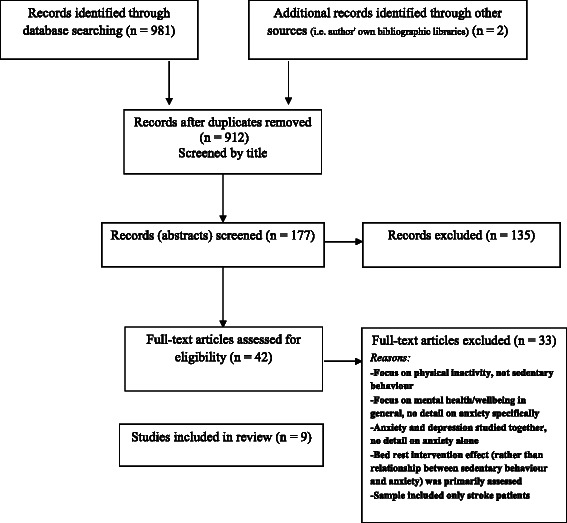
BACKGROUND: Previous research has linked sedentary behaviour (SB) to adverse physical health outcomes in adults and youth. Although evidence for the relationship between SB and mental health outcomes (e.g., depression) is emerging, little is known regarding risk of anxiety. METHODS: A systematic search for original research investigating the association between SB and risk of anxiety was performed using numerous electronic databases. A total of nine observational studies (seven cross-sectional and two longitudinal) were identified. Methodological quality of studies was assessed and a best-evidence synthesis was conducted. RESULTS: One cross-sectional study demonstrated a strong methodological quality, five cross-sectional studies demonstrated a moderate methodological quality and three studies (two cross-sectional one longitudinal) received a weak methodological quality rating. Overall, there was moderate evidence for a positive relationship between total SB and anxiety risk as well as for a positive relationship between sitting time and anxiety risk. There was inconsistent evidence for the relationship between screen time, television viewing time, computer use, and anxiety risk. CONCLUSION: Limited evidence is available on the association between SB and risk of anxiety. However, our findings suggest a positive association (i.e. anxiety risk increases as SB time increases) may exist (particularly between sitting time and risk of anxiety). Further high-quality longitudinal/interventional research is needed to confirm findings and determine the direction of these relationships.
Overview
The claims and statistics of this paper haven’t been checked yet.
Run the check — free, no account needed. It reads the open-access text and checks the sources it cites.
Integrity signals
Registry
Cites
Statistics
Figures
Verification
Claims the paper makes
The claims and statistics of this paper haven’t been checked yet.
Run the check — free, no account needed. It reads the open-access text and checks the sources it cites.
Claims other papers make about this one
Each is checked against this paper’s own text: does it say what the citing paper says it does?
In the citing paper
“Currently, clinical guidelines for metabolic screening upon initiation or continuation of SGAs put forth that blood pressure, body mass index (BMI), blood glucose and lipids should be checked at least every six months.[131][132][133]”
From The Lancet Psychiatry Commission: a blueprint for protecting physical health in people with mental illness (2019) · cites this paper as [133]
In the citing paper
“While positive associations between screen-based sedentary behaviors and emotional disorder symptoms have been previously identified, much of the work to date is cross-sectional (Hoare et al., 2016; Teychenne et al., 2015)”
From Reciprocal associations between screen time and emotional disorder symptoms during adolescence (2019) · cites this paper as Teychenne et al., 2015
In the citing paper
“Conversely, physical inactivity has been identified as a risk factor for the development of anxiety [53] as well as for other conditions such as depression [54–56].”
From Moving to Beat Anxiety: Epidemiology and Therapeutic Issues with Physical Activity for Anxiety (2018) · cites this paper as [53]
In the citing paper
“Factors such as physical inactivity represent a significant, but modifiable cardiovascular risk factor that is widespread in people with mental health problems [107], including anxiety disorders [25•, 53].”
From Moving to Beat Anxiety: Epidemiology and Therapeutic Issues with Physical Activity for Anxiety (2018) · cites this paper as [53]
Self-check
Percentages, sums and reported differences re-computed from the paper’s own numbers.
The self-check needs the paper’s full text.
Citations
Cites
Health benefits of physical activity: the evidence
Warburton, D. E. R. (2006) · Canadian Medical Association Journal · doi:10.1503/cmaj.051351 · Cited by 8,007 · cited 1×
“disease [4], osteoporosis [5], type two diabetes [3], and various cancers [6]).”
BackgroundPhysical activity and mental health in children and adolescents: a review of reviews
Biddle, S. J. H., & Asare, M. (2011) · British Journal of Sports Medicine · doi:10.1136/bjsports-2011-090185 · Cited by 2,447 · cited 1×
“Although research has indicated an inverse association between physical activity and anxiety may exist [24–26], currently the evidence regarding the association between sedentary behaviour and anxiety is unclear.”
BackgroundKraut, R. E., Kiesler, S. B., Boneva, B. S., Cummings, J. N., Helgeson, V. S., & Crawford, A. M. (2002) · Journal of Social Issues · doi:10.1111/1540-4560.00248 · Cited by 2,367 · cited 1×
“There is a small body of literature that suggests some forms of sedentary behaviour may in fact have a positive impact on mental health, specifically depressive symptoms [42, 43], however, further intervention and prospective studies are required to determine the direction of the relationship between sedentary behavio…”
BackgroundSystematic review of sedentary behaviour and health indicators in school-aged children and youth.
Tremblay, M. S., LeBlanc, A. G., Kho, M. E., Saunders, T. J., Larouche, R., Colley, R. C., Goldfield, G., & Gorber, S. (2011) · International Journal of Behavioral Nutrition and Physical Activity · doi:10.1186/1479-5868-8-98 · Cited by 2,085 · cited 1×
“unfavourable body composition, decreased fitness, lowered scores for self-esteem, and pro-social behaviour and decreased academic achievement [9], sleep problems, musculoskeletal pain, depression, and poor psychological well-being [10]).”
BackgroundHu, F. B., Li, T. Y., Colditz, G. A., Willett, W. C., & Manson, J. E. (2003) · JAMA · doi:10.1001/jama.289.14.1785 · Cited by 1,892 · cited 3×
“For example, research has shown sedentary behaviour to be linked to an increased risk of type 2 diabetes [3], a disease which is subsequently associated with poor mental health [23].”
BackgroundSitting time and mortality from all causes, cardiovascular disease, and cancer
KATZMARZYK, P. T., CHURCH, T. S., CRAIG, C. L., & BOUCHARD, C. (2009) · Medicine & Science in Sports & Exercise · doi:10.1249/mss.0b013e3181930355 · Cited by 1,611 · cited 1×
“disease [4], osteoporosis [5], type two diabetes [3], and various cancers [6]).”
BackgroundSedentary Behaviors and Subsequent Health Outcomes in Adults
Thorp, A. A., Owen, N., Neuhaus, M., & Dunstan, D. W. (2011) · American Journal of Preventive Medicine · doi:10.1016/j.amepre.2011.05.004 · Cited by 1,455
Physical activity, exercise, depression and anxiety disorders
Ströhle, A. (2009) · Journal of Neural Transmission · doi:10.1007/s00702-008-0092-x · Cited by 1,269 · cited 1×
“depression), it could be the displacement of physical activity when engaging in sedentary behaviour that explains the relationship with increased anxiety risk, since physical activity has been shown to be beneficial in reducing anxiety in both children/adolescents [38] and adults [39].”
BackgroundAnxiety disorders and comorbid medical illness
Roy-Byrne, P. P., Davidson, K. W., Kessler, R. C., Asmundson, G. J. G., Goodwin, R. D., Kubzansky, L., Lydiard, R. B., Massie, M. J., Katon, W., Laden, S. K., et al. (2008) · General Hospital Psychiatry · doi:10.1016/j.genhosppsych.2007.12.006 · Cited by 668 · cited 1×
“The illness has been shown to be linked to other serious diseases such as increased risk of cardiovascular disease and cancer [19] with estimates that anxiety and depression together contribute to 10 % of the total burden of disease in Australian women [20].”
BackgroundMust, A., & Tybor, D. J. (2005) · International Journal of Obesity · doi:10.1038/sj.ijo.0803064 · Cited by 642 · cited 1×
“Time spent in sedentary behaviour has emerged as a potentially important indicator of health in adult populations [2], independent of achieving sufficient physical activity.”
Background
Research works printed but not linked: 4
- Australian Bureau of Statistics. National Survey of Mental Health and Wellbeing. Canberra: ABS.: Australian Bureau of Statistics; 2008.
- World Health Organisation. Global Health Estimates summary tables, DALYs by cause, age and sex. Geneva, Switzerland: World Health Organisation; 2013. World2011.
- Taintor Z, Rosenthal RN. Microprocessor abuse and internet addiction. 4th ed. Philadelphia: Lippincott Williams & Wilkins; 2009.
- National Collaborating Centre for Methods and Tools. Quality Assessment Tool for Quantitative Studies. Hamilton, ON: McMaster University; 2008.
Cited by
Sorted by citations
Firth, J., Siddiqi, N., Koyanagi, A., Siskind, D., Rosenbaum, S., Galletly, C., Allan, S., Caneo, C., Carney, R., Carvalho, A. F., et al. (2019) · The Lancet Psychiatry · doi:10.1016/s2215-0366(19)30132-4 · Cited by 1,531
Hoare, E., Milton, K., Foster, C., & Allender, S. (2016) · International Journal of Behavioral Nutrition and Physical Activity · doi:10.1186/s12966-016-0432-4 · Cited by 616
“In addition, the conclusions drawn by this review are strengthened by the use of the quality assessment tool [26] and best evidence synthesis consistent with previous literature examining sedentary behaviour and health outcomes [3, 27, 28].”
BackgroundMethodInfluentialPhysical activity in European adolescents and associations with anxiety, depression and well-being
McMahon, E. M., Corcoran, P., O’Regan, G., Keeley, H., Cannon, M., Carli, V., Wasserman, C., Hadlaczky, G., Sarchiapone, M., Apter, A., et al. (2017) · European Child & Adolescent Psychiatry · doi:10.1007/s00787-016-0875-9 · Cited by 636
“A systematic review of randomised controlled trials of exercise interventions for anxiety and depression in children and adolescents reported a small effect in favour of physical activity in reducing depression and anxiety levels in the general population [9], while sedentary behaviour has been reported to be associat…”
BackgroundPhysical activity protects from incident anxiety: A meta‐analysis of prospective cohort studies
Schuch, F. B., Stubbs, B., Meyer, J., Heissel, A., Zech, P., Vancampfort, D., Rosenbaum, S., Deenik, J., Firth, J., Ward, P. B., et al. (2019) · Depression and Anxiety · doi:10.1002/da.22915 · Cited by 427
“Moreover, previous systematic and nonsystematic reviews (Martinsen, 2008; Teychenne et al., 2015) have suggested that higher levels of PA are linked to a decreased risk of future anxiety disorders.”
BackgroundMetabolic Syndrome Pathophysiology and Predisposing Factors
Bovolini, A., Garcia, J., Andrade, M. A., & Duarte, J. A. (2020) · International Journal of Sports Medicine · doi:10.1055/a-1263-0898 · Cited by 446
“The predominance of SB became itself a premature death risk factor independent of sex and type of PA practiced by an individual [174].”
BackgroundOswald, T. K., Rumbold, A. R., Kedzior, S. G. E., & Moore, V. M. (2020) · PLoS ONE · doi:10.1371/journal.pone.0237725 · Cited by 367
Savage, M. J., James, R. M., Magistro, D., Donaldson, J. A., Healy, L. C., Nevill, M. E., & Hennis, P. J. (2020) · Mental health and physical activity · doi:10.1016/j.mhpa.2020.100357 · Cited by 401
How Sedentary Are University Students? A Systematic Review and Meta-Analysis
Castro, Ó., Bennie, J. A., Vergeer, I., Bosselut, G., & Biddle, S. (2020) · Prevention Science · doi:10.1007/s11121-020-01093-8 · Cited by 445
Physical activity and anxiety: A perspective from the World Health Survey
Stubbs, B., Koyanagi, A., Hallgren, M., Firth, J., Richards, J., Schuch, F., Rosenbaum, S., Mugisha, J., Veronese, N., Lahti, J., et al. (2017) · Journal of Affective Disorders · doi:10.1016/j.jad.2016.10.028 · Cited by 324
“At the other end of the physical activity spectrum, recent systematic reviews have suggested that higher levels of sedentary behavior are associated with an increased risk of future anxiety in people without depression (Teychenne et al., 2010, 2015).”
BackgroundWang, X., Li, Y., & Fan, H. (2019) · BMC Public Health · doi:10.1186/s12889-019-7904-9 · Cited by 299
Schuch, F. B., Bulzing, R. A. V., Meyer, J. D., Vancampfort, D., Firth, J., Stubbs, B., Grabovac, I., Willeit, P., Tavares, V. D. D. O., Calegaro, V. C., et al. (2020) · Psychiatry Research · doi:10.1016/j.psychres.2020.113339 · Cited by 323
Moving to Beat Anxiety: Epidemiology and Therapeutic Issues with Physical Activity for Anxiety
Kandola, A., Vancampfort, D., Herring, M., Rebar, A., Hallgren, M., Firth, J., & Stubbs, B. (2018) · Current Psychiatry Reports · doi:10.1007/s11920-018-0923-x · Cited by 291
Trott, M., Driscoll, R., Iraldo, E., & Pardhan, S. (2022) · eClinicalMedicine · doi:10.1016/j.eclinm.2022.101452 · Cited by 266
“124 We agree with Teychenne, Costigan and Parker 124 that large longitudinal studies are needed to comprehensively examine this possible association.”
Effectiveness of the Stand More AT (SMArT) Work intervention: cluster randomised controlled trial
Edwardson, C. L., Yates, T. E., Biddle, S., Davies, M. J., Dunstan, D. W., Esliger, D., Gray, L. J., Jackson, B., O'Connell, S. E., Waheed, G., et al. (2018) · BMJ · doi:10.1136/bmj.k3870 · Cited by 282
Dzakpasu, F. Q. S., Carver, A., Brakenridge, C. J., Cicuttini, F., Urquhart, D. M., Owen, N. G., & Dunstan, D. W. (2021) · International Journal of Behavioral Nutrition and Physical Activity · doi:10.1186/s12966-021-01191-y · Cited by 214
Kandola, A., Ashdown-Franks, G., Stubbs, B., Osborn, D. P. J., & Hayes, J. F. (2019) · Journal of Affective Disorders · doi:10.1016/j.jad.2019.07.088 · Cited by 172
Sedentary behaviour and risk of anxiety: A systematic review and meta-analysis
Allen, M. S., Walter, E. E., & Swann, C. (2019) · Journal of Affective Disorders · doi:10.1016/j.jad.2018.08.081 · Cited by 192
Physical Activity Habits and Determinants, Sedentary Behaviour and Lifestyle in University Students
Fazanes, A. C., Rico-Díaz, J., Barcala‐Furelos, R., Rey, E., Rodríguez-Fernández, J. E., Varela-Casal, C., & Abelairas‐Gómez, C. (2020) · International Journal of Environmental Research and Public Health · doi:10.3390/ijerph17093272 · Cited by 219
“Furthermore, reduced PA [19] has also been associated with an increased risk of depression [20,21] and anxiety [22,23].”
BackgroundIs screen time associated with anxiety or depression in young people? Results from a UK birth cohort
Khouja, J. N., Munafò, M. R., Tilling, K., Wiles, N. J., Joinson, C., Etchells, P. J., John, A., Hayes, F. M., Gage, S. H., & Cornish, R. P. (2019) · BMC Public Health · doi:10.1186/s12889-018-6321-9 · Cited by 161
“are associated, as sedentary behaviour has been shown to be associated with both [4, 31].”
BackgroundInfluentialHiles, S. A., Lamers, F., Milaneschi, Y., & Penninx, B. W. J. H. (2017) · Psychological Medicine · doi:10.1017/s0033291716003548 · Cited by 157
“In general community samples, low sports participation, low general physical activity and high sedentary behavior are cross-sectionally associated with higher depressive or anxious symptoms (Penedo & Dahn, 2005; Teychenne et al. 2008, 2010, 2015).”
BackgroundInfluentialAssociation between anxiety and hypertension in adults: A systematic review and meta-analysis
Lim, L.-F., Solmi, M., & Cortese, S. (2021) · Neuroscience & Biobehavioral Reviews · doi:10.1016/j.neubiorev.2021.08.031 · Cited by 134
Kandola, A., & Stubbs, B. (2020) · Advances in Experimental Medicine and Biology · doi:10.1007/978-981-15-1792-1_23 · Cited by 140
Stubbs, B., Vancampfort, D., Firth, J., Schuch, F. B., Hallgren, M., Smith, L., Gardner, B., Kahl, K. G., Veronese, N., Solmi, M., et al. (2018) · Journal of Affective Disorders · doi:10.1016/j.jad.2017.12.104 · Cited by 138
“(Teychenne et al., 2015).”
Ojo, S. O., Bailey, D. P., Brierley, M. L., Hewson, D. J., & Chater, A. M. (2019) · BMC Public Health · doi:10.1186/s12889-019-7468-8 · Cited by 117
The association between screen time and mental health during COVID-19: A cross sectional study
Smith, L., Jacob, L., Trott, M., Yakkundi, A., Butler, L., Barnett, Y., Armstrong, N., McDermott, D. T., Schuch, F. B., Meyer, J. D., et al. (2020) · Psychiatry Research · doi:10.1016/j.psychres.2020.113333 · Cited by 120
“Excessive screen time use has been shown to be associated with a range of negative mental health outcomes (Allen et al., 2019; Huang et al., 2020; Teychenne et al., 2015).”
Zink, J., Belcher, B. R., Imm, K., & Leventhal, A. M. (2020) · BMC Public Health · doi:10.1186/s12889-020-08572-1 · Cited by 105
Lifestyle factors in the prevention of COVID-19
Lange, K. W., & Nakamura, Y. (2020) · Global Health Journal · doi:10.1016/j.glohj.2020.11.002 · Cited by 119
Hallgren, M. Å., Herring, M. P., Owen, N. G., Dunstan, D. W., Ekblom, Ö. B., Helgadóttir, B., Nakitanda, A. O., & Forsell, Y. (2016) · Frontiers in Psychiatry · doi:10.3389/fpsyt.2016.00036 · Cited by 115
“High levels of sedentary time have been linked detrimentally with cardiovascular disease, diabetes, and premature mortality (21, 22).”
BackgroundPaniccia, M., Paniccia, D., Thomas, S. G., Taha, T., & Reed, N. P. (2017) · Autonomic Neuroscience · doi:10.1016/j.autneu.2017.08.008 · Cited by 102
“Firstly, individuals with mental health issues have been found to be more sedentary compared to those without mental health issues (Boettger et al., 2009; Teychenne et al., 2015) and this could play a role in modulating neurocardiac function (Boettger et al.”
Edwardson, C. L., Biddle, S., Clemes, S. A., Davies, M. J., Dunstan, D. W., Eborall, H., Granat, M. H., Gray, L. J., Healy, G. N., Jaicim, N. B., et al. (2022) · BMJ · doi:10.1136/bmj-2021-069288 · Cited by 109
Silva, L., Seguro, C. S., de Oliveira, C. G. A., Santos, P. O. S., de Oliveira, J. C. M., Filho, L. F. M. D. S., Júnior, C. A. D. P., Gentil, P., & Rebelo, A. C. S. (2020) · Frontiers in Psychiatry · doi:10.3389/fpsyt.2020.565291 · Cited by 101
Firth, J., Stubbs, B., Vancampfort, D., Schuch, F. B., Rosenbaum, S., Ward, P. B., Firth, J. A., Sarris, J. J., & Yung, A. R. (2017) · Schizophrenia Bulletin · doi:10.1093/schbul/sbx149 · Cited by 93
Kandola, A. A., Cruz, B. D. P., Osborn, D., Stubbs, B., Choi, K. W., & Hayes, J. (2021) · BMC Medicine · doi:10.1186/s12916-021-02007-3 · Cited by 105
Edwards, M. K., & Loprinzi, P. D. (2016) · Mayo Clinic Proceedings · doi:10.1016/j.mayocp.2016.03.021 · Cited by 92
Zhang, J., Yang, S. X., Wang, L., Han, L. H., & Wu, X. (2022) · Journal of Affective Disorders · doi:10.1016/j.jad.2022.03.018 · Cited by 99
Edwards, M. K., & Loprinzi, P. D. (2016) · Journal of Affective Disorders · doi:10.1016/j.jad.2016.06.045 · Cited by 88
“Of particular relevance to our present study, a recent systematic review demonstrated a positive association between sedentary behavior and anxiety (Teychenne et al., 2015).”
BackgroundHallgren, M. Å., Nguyen, T.-T.-D., Owen, N. G., Vancampfort, D., Dunstan, D. W., Wallin, P., Andersson, G. B. J., & Ekblom‐Bak, E. (2020) · Preventive Medicine · doi:10.1016/j.ypmed.2020.106021 · Cited by 78
Lee, Y., Malcein, L. A., & Kim, S. C. (2021) · International Journal of Environmental Research and Public Health · doi:10.3390/ijerph18073571 · Cited by 90
“These lifestyle changes during the pandemic have been linked to poor mental health [27], thus confirming the established association between excessive screen time and negative mental health outcomes from pre-pandemic times [28,29].”
BackgroundKoyanagi, A., Stubbs, B., & Vancampfort, D. (2018) · PLoS ONE · doi:10.1371/journal.pone.0202222 · Cited by 79
The association between sedentary behaviour and indicators of stress: a systematic review
Teychenne, M. J., Stephens, L. D., Costigan, S. A., Olstad, D. L., Stubbs, B., & Turner, A. I. (2019) · BMC Public Health · doi:10.1186/s12889-019-7717-x · Cited by 91
Self-citationKandola, A. A., Osborn, D., Stubbs, B., Choi, K. W., & Hayes, J. (2020) · BMC Medicine · doi:10.1186/s12916-020-01782-9 · Cited by 79
Hoare, E., Milton, K. E., Foster, C. E., & Allender, S. E. (2017) · BMC Public Health · doi:10.1186/s12889-017-4272-1 · Cited by 76
Stańczykiewicz, B., Banik, A., Knoll, N., Keller, J., Hohl, D. H., Rosińćzuk, J., & Łuszczyńska, A. (2019) · BMC Public Health · doi:10.1186/s12889-019-6715-3 · Cited by 83
Lifestyle Interventions and Prevention of Suicide
Berardelli, I., Corigliano, V., Hawkins, M., Comparelli, A., Erbuto, D., & Pompili, M. (2018) · Frontiers in Psychiatry · doi:10.3389/fpsyt.2018.00567 · Cited by 80
Hallgren, M. Å., Nguyen, T.-T.-D., Owen, N. G., Vancampfort, D., Smith, L., Dunstan, D. W., Andersson, G. B. J., Wallin, P., & Ekblom‐Bak, E. (2020) · Translational Psychiatry · doi:10.1038/s41398-020-0810-1 · Cited by 78
van Veenendaal, H., Chernova, G., Bouman, C. M. B., van Etten‐Jamaludin, F. S., van Dieren, S., & Ubbink, D. T. (2022) · Patient Education and Counseling · doi:10.1016/j.pec.2022.11.003 · Cited by 71
Ellingson, L. D., Meyer, J. D., Shook, R. P., Dixon, P. M., Hand, G. A., Wirth, M. D., Paluch, A. E., Burgess, S., Hébert, J. R., & Blair, S. N. (2018) · Preventive Medicine Reports · doi:10.1016/j.pmedr.2018.07.013 · Cited by 70
“Sedentary time also negatively influences mental health including increased risk for anxiety (Teychenne et al., 2015), depression (Teychenne et al.”
BackgroundImpact of screen time on mental health problems progression in youth: a 1-year follow-up study
Wu, X., Tao, S., Zhang, S., Zhang, Y., Chen, K., Yang, Y., Hao, J., & Tao, F. (2016) · BMJ Open · doi:10.1136/bmjopen-2016-011533 · Cited by 69
Physical activity and sedentary behavior in patients with Systemic Lupus Erythematosus
Margiotta, D. P. E., Basta, F., Dolcini, G., Batani, V., Vullo, M. L., Vernuccio, A., Navarini, L., & Afeltra, A. (2018) · PLoS ONE · doi:10.1371/journal.pone.0193728 · Cited by 65
Reciprocal associations between screen time and emotional disorder symptoms during adolescence
Zink, J., Belcher, B. R., Kechter, A., Stone, M. D., & Leventhal, A. M. (2019) · Preventive Medicine Reports · doi:10.1016/j.pmedr.2019.01.014 · Cited by 62
“While positive associations between screen-based sedentary behaviors and emotional disorder symptoms have been previously identified, much of the work to date is cross-sectional (Hoare et al., 2016; Teychenne et al., 2015), and thus it is plausible that the associations are reciprocal (Gunnell et al.”
BackgroundOn behalf of the GUSTO Study Group, Padmapriya, N., Bernard, J. Y., Shen, L., Loy, S. L., Shen, Z., Kwek, K. Y. C., Godfrey, K. M., Gluckman, P. D., Chong, Y. S., et al. (2016) · Archives of Women s Mental Health · doi:10.1007/s00737-016-0664-y · Cited by 61
“In addition, previous studies in general populations suggest that SB, including television time, was positively associated with risk of depression and anxiety (de Wit et al. 2011; Granner and Mburia-Mwalili 2010; Rebar Amanda et al. 2014; Teychenne et al. 2015; Teychenne et al. 2010).”
BackgroundInfluentialTea, cocoa, coffee, and affective disorders: vicious or virtuous cycle?
García-Blanco, T., Dávalos, A., & Visioli, F. (2016) · Journal of Affective Disorders · doi:10.1016/j.jad.2016.11.033 · Cited by 57
“Other lifestyle factors such as physical activity also influence the microbiota (Clarke et al., 2014) and there is evidence that exercise or lack of it also influence behavior (Teychenne et al., 2015).”
BackgroundGibson, A., Muggeridge, D. J., Hughes, A. R., Kelly, L. A., & Kirk, A. F. (2017) · PLoS ONE · doi:10.1371/journal.pone.0185143 · Cited by 59
Chu, A. H. Y., van Dam, R. M., Biddle, S., Tan, C. S., Koh, D. S. Q., & Müller‐Riemenschneider, F. (2018) · International Journal of Behavioral Nutrition and Physical Activity · doi:10.1186/s12966-018-0669-1 · Cited by 55
Vancampfort, D., Damme, T. V., Stubbs, B., Smith, L., Firth, J., Hallgren, M. Å., Mugisha, J., & Koyanagi, A. (2019) · Sleep Medicine · doi:10.1016/j.sleep.2019.01.048 · Cited by 56
“Though the mechanisms linking anxiety-induced sleep disturbance and sedentary behavior are not explored yet, there is some evidence from studies in adults that sedentary behavior may induce anxiety [15-18] while it is associated with an increased risk for sleep disturbances [19].”
BackgroundVancampfort, D., Stubbs, B., Herring, M. P., Hallgren, M. Å., & Koyanagi, A. (2017) · General Hospital Psychiatry · doi:10.1016/j.genhosppsych.2017.09.006 · Cited by 50
“analysis, almost exclusively among high-income countries, found a positive relationship between increasing time spent sedentary or sitting and anxiety risk [12].”
BackgroundDietary Patterns and Their Association with Anxiety Symptoms among Older Adults: The ATTICA Study
Masana, M. F., Tyrovolas, S., Kollia, N., Chrysohoou, C. A., Skoumas, J., Haro, J. M., Tousoulis, D. M., Papageorgiou, C., Pitsavos, C. S., & Panagiotakos, D. B. (2019) · Nutrients · doi:10.3390/nu11061250 · Cited by 50
“, sitting time and screen time) is related to an increased risk for anxiety [40], and higher levels of anxiety were associated with increased diabetes risk among women but not among men [41].”
BackgroundBlough, J., & Loprinzi, P. D. (2018) · Journal of Affective Disorders · doi:10.1016/j.jad.2018.07.019 · Cited by 55
Hallgren, M. Å., Kandola, A. A., Stubbs, B., Dung, N. T. T., Wallin, P., Andersson, G. B. J., & Ekblom‐Bak, E. (2020) · Mental health and physical activity · doi:10.1016/j.mhpa.2020.100351 · Cited by 48
“Based on previous evidence of associations of exercise and CRF with depression (Hallgren, Nguyen, et al., 2020b; Zhai, Zhang, & Zhang, 2014) and anxiety (Teychenne, Costigan, & Parker, 2015), the variables listed below were included in the statistical models.”
BackgroundSatisfaction with Online Versus In-Person Yoga During COVID-19
Brinsley, J., Smout, M., & Davison, K. (2021) · The Journal of Alternative and Complementary Medicine · doi:10.1089/acm.2021.0062 · Cited by 47
Varela-Mato, V., O’Shea, O., King, J. A., Yates, T. E., Stensel, D. J., Biddle, S., Nimmo, M. A., & Clemes, S. A. (2017) · BMJ Open · doi:10.1136/bmjopen-2016-013162 · Cited by 48
Throuvala, M. A., Griffiths, M. D., Rennoldson, M., & Kuss, D. J. (2020) · International Journal of Mental Health and Addiction · doi:10.1007/s11469-019-00213-y · Cited by 58
“depression and anxiety) (Asare 2015; Boers et al. 2019; Liu et al. 2015; Teychenne et al. 2015) including severe depressive symptomatology in obese adolescents (Goldfield et al.”
BackgroundŞengel, Ü., Genç, G., Işkın, M., Çevrimkaya, M., Zengin, B., & Sarıışık, M. (2022) · Journal of Hospitality and Tourism Insights · doi:10.1108/jhti-10-2021-0295 · Cited by 53
Exercise Intervention in Treatment of Neuropsychological Diseases: A Review
Chen, Z., Lan, W., Yang, G., Li, Y., Xiang, J., Chen, L., Zhou, Y. N., & Li, S. (2020) · Frontiers in Psychology · doi:10.3389/fpsyg.2020.569206 · Cited by 53
“Sedentary lifestyles increase the risk of developing anxiety disorders (Teychenne et al., 2015) or other mental disorders such as depression (Schuch et al.”
BackgroundAlzahrani, H. A., Alshehri, M. A., Alzhrani, M., Alshehri, Y. S., & Attar, W. S. A. A. (2022) · PeerJ · doi:10.7717/peerj.13127 · Cited by 53
Lewis, R., Roden, L. C., Scheuermaier, K. D., Gómez-Olivé, F. X., Rae, D. E., Iacovides, S., Bentley, A., Davy, J., Christie, C. J.-A., Zschernack, S., et al. (2021) · Scientific Reports · doi:10.1038/s41598-021-02021-8 · Cited by 47
Increased Risks of Mental Disorders: Youth with Inactive Physical Activity
Denche-Zamorano, Á. M., Franco-García, J. M., Carlos‐Vivas, J., Mendoza-Muñoz, M., Pereira-Payo, D., Pastor-Cisneros, R., Merellano-Navarro, E., & Adsuar, J. C. (2022) · Healthcare · doi:10.3390/healthcare10020237 · Cited by 49
“9%); physical inactivity seemed to be related to a higher predisposition to experience mental disorders n Spanish youth, something th t has already been found in ther studies, whe e physical inactivity was related to an increased risk of suffering anxiety [26,48].”
BackgroundVancampfort, D., Vandael, H., Hallgren, M. Å., Probst, M., Hagemann, N., Bouckaert, F., & Damme, T. V. (2018) · Alcohol · doi:10.1016/j.alcohol.2018.07.014 · Cited by 49
Sampasa-Kanyinga, H., Chaput, J.-P., Goldfield, G. S., Janssen, I., Wang, J., Hamilton, H. A., Ferro, M. A., & Colman, I. (2021) · The Canadian Journal of Psychiatry · doi:10.1177/0706743720970863 · Cited by 39
Medical student wellness in the United States during the COVID-19 pandemic: a nationwide survey
Nikolis, A., Wakim, A., Adams, W., & Bajaj, P. (2021) · BMC Medical Education · doi:10.1186/s12909-021-02837-y · Cited by 45
Dillon, K., Rollo, S., & Harry Prapavessis, A. (2021) · Psychology and Health · doi:10.1080/08870446.2021.1900574 · Cited by 39
“High levels of sitting have also been shown to have an impact on mental well-being, such as increased risk of anxiety and depression (Teychenne et al., 2015; Zhai et al., 2015).”
BackgroundHofman, A., Voortman, T., Ikram, M. A., & Luik, A. I. (2021) · Journal of Epidemiology & Community Health · doi:10.1136/jech-2020-215883 · Cited by 40
Skarpsno, E. S., Nilsen, T. I. L., Sand, T., Hagen, K., & Mork, P. J. (2017) · Journal of Sleep Research · doi:10.1111/jsr.12580 · Cited by 38
“The sleep-promoting effect of physical activity is not understood fully, but physical activity can improve psychological health and wellbeing (Park, 2014; Teychenne et al., 2015) which, in”
BackgroundDuncan, F., Baskin, C., McGrath, M., Coker, J. F., Lee, C. Y., Dykxhoorn, J. L., Adams, E. A., Gnani, S., Lafortune, L., Kirkbride, J. B., et al. (2021) · BMC Public Health · doi:10.1186/s12889-021-11741-5 · Cited by 45
Koyanagi, A., Stubbs, B., Smith, L., Gardner, B., & Vancampfort, D. (2017) · PLoS ONE · doi:10.1371/journal.pone.0186992 · Cited by 41
“However, previous research in Western populations has demonstrated that being sedentary may increase the risk of developing anxiety [54], possibly through increasing inflammatory markers [55].”
BackgroundAddictive Eating and Its Relation to Physical Activity and Sleep Behavior
Li, J., Pursey, K., Duncan, M. J., & Burrows, T. L. (2018) · Nutrients · doi:10.3390/nu10101428 · Cited by 42
“There is also some evidence suggesting that greater sitting time and other sedentary behaviors in addition to sleep disorders may also influence mental health outcomes [67] given sleep disorders can be a core symptom of depression [68].”
BackgroundThe impact of sitting time and physical activity on mental health during COVID-19 lockdown
Pears, M., Kola, S., & Azevedo, L. B. (2021) · Sport Sciences for Health · doi:10.1007/s11332-021-00791-2 · Cited by 43
“However, the association between wellbeing and sedentary behaviour is controversial [53, 54], and sedentary behaviour appears to have only a small effect on anxiety [55, 56].”
BackgroundMeyer, J. D., Torres, E. R., Grabow, M., Zgierska, A. E., Teng, H., Coe, C. L., & Barrett, B. P. (2018) · Medicine & Science in Sports & Exercise · doi:10.1249/mss.0000000000001636 · Cited by 36
Temporal Associations of Screen Time and Anxiety Symptoms Among Adolescents
Boers, E., Afzali, M. H., & Conrod, P. (2019) · The Canadian Journal of Psychiatry · doi:10.1177/0706743719885486 · Cited by 36
“Abrégé Il y a des indications que le temps d’écran est associé à des symptômes d’anxiété chez des adolescents (1), mais d’une perspective longitudinale, la magnitude, la spécificité et la préséance temporelle de cette association sont relativement sousexplorées.”
Stroke survivors’ perceptions of their sedentary behaviours three months after stroke
Fitzsimons, C. F., Nicholson, S. L., Morris, J. H., Mead, G. E., CHASTIN, S. F. M., & Niven, A. G. (2020) · Disability and Rehabilitation · doi:10.1080/09638288.2020.1768304 · Cited by 36
Baldanzi, G., Sayols-Baixeras, S., Ekblom‐Bak, E., Ekblom, Ö. B., Dekkers, K. F., Hammar, U., Nguyen, D. T., Ahmad, S., Ericson, U., Arvidsson, D., et al. (2024) · EBioMedicine · doi:10.1016/j.ebiom.2024.104989 · Cited by 37
Computer use at work is associated with self-reported depressive and anxiety disorder
Kim, T., Kang, M.-Y., Yoo, M.-S., Lee, D., & Hong, Y.-C. (2016) · Annals of Occupational and Environmental Medicine · doi:10.1186/s40557-016-0146-8 · Cited by 26
“Recently, systematic reviews investigated that sedentary works including computer work were related with depression and anxiety [26 – 28].”
BackgroundAssociation of objective sedentary behaviour and self-rated health in English older adults
Wilson, J. J., Blackburn, N. E., O’Reilly, R., Kee, F., Caserotti, P., & Tully, M. A. (2019) · BMC Research Notes · doi:10.1186/s13104-019-4050-5 · Cited by 39
Biddle, S., Henson, J. J., Davies, M. J., Khunti, K. K., Sutton, S. R., Yates, T. E., & Edwardson, C. L. (2021) · Journal of Affective Disorders · doi:10.1016/j.jad.2021.03.037 · Cited by 34
Claesdotter‐Knutsson, E., André, F., & Håkansson, A. (2021) · JMIR Serious Games · doi:10.2196/33059 · Cited by 34
“However, excessive screen time has been shown to be associated with a range of negative mental health outcomes, including anxiety and depression, in adolescents considered particularly vulnerable to a problematic use of online media [32-34].”
BackgroundJohnstad, P. G. (2024) · Frontiers in Public Health · doi:10.3389/fpubh.2023.1268339 · Cited by 37
“Reviews have also found evidence of an association between anxiety and sedentary behavior (68–71) and poor diet quality (49, 52).”
BackgroundKleppang, A. L., Thurston, M. N., Hartz, I., & Hagquist, C. (2017) · Scandinavian Journal of Public Health · doi:10.1177/1403494817716374 · Cited by 37
Daily Sedentary Behavior Predicts Pain and Affect in Knee Arthritis
Zhaoyang, R., & Martire, L. M. (2018) · Annals of Behavioral Medicine · doi:10.1093/abm/kay073 · Cited by 35
“Consistent with previous studies [5], we also found evidence that individuals who spent more time in SB in general reported lower positive affect and higher negative affect in general than those who spent less time in SB.”
ResultSvensson, M., Brundin, L., Erhardt, S., Hållmarker, U., James, S. K., & Deierborg, T. (2021) · Frontiers in Psychiatry · doi:10.3389/fpsyt.2021.714014 · Cited by 36
Khazaal, W., Taliani, M., Boutros, C., Abou-Abbas, L., Hosseini, H., Salameh, P., & Sadier, N. S. (2021) · Frontiers in Psychology · doi:10.3389/fpsyg.2021.663267 · Cited by 31
Barbosa, B. C. R., de Menezes-Júnior, L. A. A., de Paula, W., Chagas, C. M. D. S., Machado, E. L., de Freitas, E. D., Cardoso, C. S., Vidigal, F. D. C., Nobre, L. N., da Silva, L. S., et al. (2024) · BMC Public Health · doi:10.1186/s12889-024-19345-5 · Cited by 41
“Indirect mechanisms linking the association of SB and mental health can be explained by intermediate factors such as obesity, unhealthy eating habits, and sleep disorders [15, 44, 45].”
BackgroundTan, S. L., Jetzke, M., Vergeld, V., & Müller, C. (2020) · JMIR Public Health and Surveillance · doi:10.2196/20119 · Cited by 40
“These scenarios could find their rationale in the observation that university students engage in high volumes of ST due to activities like attending lectures and studying that potentially place them at detrimental physical [49] and mental health states [59,60].”
BackgroundCocker, K. A. D., Teychenne, M. J., White, R. L., & Bennie, J. A. (2020) · Preventive Medicine · doi:10.1016/j.ypmed.2020.106192 · Cited by 32
Self-citation24-Hour movement behaviors among visually impaired US children and adolescents
Hou, M., Herold, F., Healy, S., Haegele, J. A., Block, M. E., Ludyga, S., Schuch, F. B., Ng, J. L., Gerber, M., Hossain, M. M., et al. (2023) · Mental health and physical activity · doi:10.1016/j.mhpa.2023.100545 · Cited by 30
Zhao, G., Xiao, L., Chen, Y.-H., Zhang, M., Peng, K.-W., & Wu, H. (2024) · Journal of Affective Disorders · doi:10.1016/j.jad.2024.10.041 · Cited by 32
Chen, L., Zhang, X., Hu, C., Zhang, Y., Zhang, L., Kan, J.-T., Li, B., & Du, J. (2020) · Frontiers in Pharmacology · doi:10.3389/fphar.2020.01320 · Cited by 28
Skarpsno, E. S., Mork, P. J., Nilsen, T. I. L., Jørgensen, M. B., & Holtermann, A. (2017) · Scandinavian Journal of Work Environment & Health · doi:10.5271/sjweh.3688 · Cited by 29
“Furthermore, LTPA can improve psychological health and well-being (46, 47), which in turn may reduce the risk of insomnia (48).”
BackgroundAshdown‐Franks, G., Koyanagi, A., Vancampfort, D., Smith, L., Firth, J., Schuch, F. B., Veronese, N., & Stubbs, B. (2018) · Maturitas · doi:10.1016/j.maturitas.2018.08.005 · Cited by 32
on behalf of the Seniors USP team, Okely, J. A., Čukić, I., Shaw, R. J., CHASTIN, S. F. M., Dall, P., Deary, I. J., Der, G., Dontje, M. L., Skelton, D. A., et al. (2019) · BMC Geriatrics · doi:10.1186/s12877-019-1026-1 · Cited by 28
National Adolescent School-based Health Survey - PeNSE 2015: Sedentary behavior and its correlates
Silva, R. M. A., Andrade, A. C. D. S., Caiaffa, W. T., de Medeiros, D. S., & Bezerra, V. M. (2020) · PLoS ONE · doi:10.1371/journal.pone.0228373 · Cited by 32
“SB has been associated with the occurrence of adverse physical and mental health outcomes, such as diabetes, cancer, metabolic syndrome, obesity, cardiovascular disorders, mortality [2–5], anxiety, self-esteem, and depression [6, 7].”
Background
Metadata
- Authors
- Teychenne, M., Costigan, S. A., & Parker, K.
- Affiliations
- Deakin University (AU)
- University of Newcastle Australia (AU)
- Corresponding author
- Teychenne, Megan
- Venue
- BMC Public Health
- Published
- 2015-06-19
- Volume
- 15
- Issue
- 1
- Pages
- 513-513
- ISSN
- 1471-2458 (ISSN-L)
- PMC
- PMC4474345
- OpenAlex
- W1943532712
- Cited by
- 351
- References
- 43
- Citations by year
- 2026: 15 · 2025: 27 · 2024: 31 · 2023: 37 · 2022: 47 · 2021: 44 · 2020: 47 · 2019: 35 · 2018: 23 · 2017: 20 · 2016: 22 · 2015: 2
- FWCI
- 2.73
- Type
- journal article
- Language
- en
- Open access
- gold
- doi.org
- Locations
- BMC Public Health (publishedVersion, cc-by)
- Europe PMC (PubMed Central) (publishedVersion, cc-by)
- PubMed Central (publishedVersion, cc-by)
- PubMed (publishedVersion)
- Deakin Research Online (Deakin University) (submittedVersion)
- Figshare (submittedVersion, cc-by)
- NOVA (University of Newcastle Australia) (submittedVersion, cc-by)
- Topics
- Health Sciences › Medicine › Public Health, Environmental and Occupational Health › Physical Activity and Health
- Social Sciences › Human Factors and Ergonomics › Ergonomics and Musculoskeletal Disorders
- Social Sciences › Psychology › Experimental and Cognitive Psychology › Anxiety, Depression, Psychometrics, Treatment, Cognitive Processes
- Keywords
- sedentary behavior, anxiety, sitting time, screen time, television viewing, computer use, mental health, physical inactivity
- MeSH terms
- Adolescent, Adult, Anxiety, Humans, Male, Risk Assessment, Sedentary Behavior
About these checks
Registry, retraction, Cites and statistics results are computed, not judged, with one exception: a printed reference that no index lists is read once by a model before it counts as a citation error. Claims are extracted by a model and kept only when their quote appears verbatim in the text; each cited source is then checked, with a model’s help, for whether it says what the claim relies on. Those verdicts can be wrong — read the claim’s quote and the cited source before relying on one.
Statistics and arithmetic are recomputed, not judged.
Confidence bands are shown only for fields calibrated on our annotated test set. None is calibrated yet, so no band is shown.
What counts as a claim ›How we measure confidence ›How we check this ›
Are you an author, or do you see a problem with this page? Request a review
