

The DOI matches its Crossref record; 43 of the 43 references it cites were found in a registry or an index.
The association between sedentary behaviour and risk of anxiety: a systematic review
Open accessAbstract
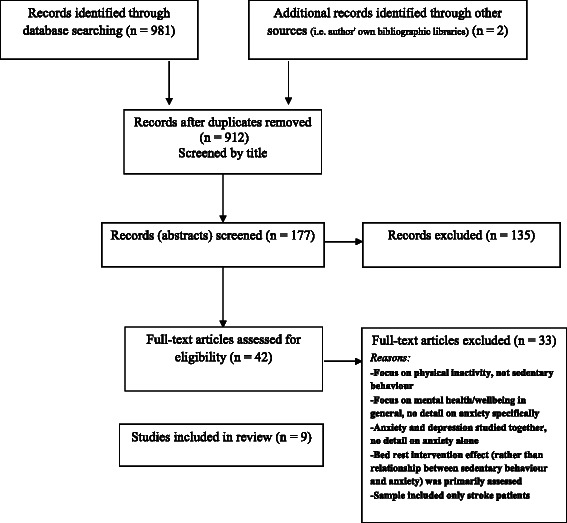
BACKGROUND: Previous research has linked sedentary behaviour (SB) to adverse physical health outcomes in adults and youth. Although evidence for the relationship between SB and mental health outcomes (e.g., depression) is emerging, little is known regarding risk of anxiety. METHODS: A systematic search for original research investigating the association between SB and risk of anxiety was performed using numerous electronic databases. A total of nine observational studies (seven cross-sectional and two longitudinal) were identified. Methodological quality of studies was assessed and a best-evidence synthesis was conducted. RESULTS: One cross-sectional study demonstrated a strong methodological quality, five cross-sectional studies demonstrated a moderate methodological quality and three studies (two cross-sectional one longitudinal) received a weak methodological quality rating. Overall, there was moderate evidence for a positive relationship between total SB and anxiety risk as well as for a positive relationship between sitting time and anxiety risk. There was inconsistent evidence for the relationship between screen time, television viewing time, computer use, and anxiety risk. CONCLUSION: Limited evidence is available on the association between SB and risk of anxiety. However, our findings suggest a positive association (i.e. anxiety risk increases as SB time increases) may exist (particularly between sitting time and risk of anxiety). Further high-quality longitudinal/interventional research is needed to confirm findings and determine the direction of these relationships.
Overview
The claims and statistics of this paper haven’t been checked yet.
Run the check — free, no account needed. It reads the open-access text and checks the sources it cites.
Integrity signals
Registry
Cites
Statistics
Figures
Verification
Claims the paper makes
The claims and statistics of this paper haven’t been checked yet.
Run the check — free, no account needed. It reads the open-access text and checks the sources it cites.
Claims other papers make about this one
Each is checked against this paper’s own text: does it say what the citing paper says it does?
In the citing paper
“Currently, clinical guidelines for metabolic screening upon initiation or continuation of SGAs put forth that blood pressure, body mass index (BMI), blood glucose and lipids should be checked at least every six months.[131][132][133]”
From The Lancet Psychiatry Commission: a blueprint for protecting physical health in people with mental illness (2019) · cites this paper as [133]
In the citing paper
“While positive associations between screen-based sedentary behaviors and emotional disorder symptoms have been previously identified, much of the work to date is cross-sectional (Hoare et al., 2016; Teychenne et al., 2015)”
From Reciprocal associations between screen time and emotional disorder symptoms during adolescence (2019) · cites this paper as Teychenne et al., 2015
In the citing paper
“Conversely, physical inactivity has been identified as a risk factor for the development of anxiety [53] as well as for other conditions such as depression [54–56].”
From Moving to Beat Anxiety: Epidemiology and Therapeutic Issues with Physical Activity for Anxiety (2018) · cites this paper as [53]
In the citing paper
“Factors such as physical inactivity represent a significant, but modifiable cardiovascular risk factor that is widespread in people with mental health problems [107], including anxiety disorders [25•, 53].”
From Moving to Beat Anxiety: Epidemiology and Therapeutic Issues with Physical Activity for Anxiety (2018) · cites this paper as [53]
Self-check
Percentages, sums and reported differences re-computed from the paper’s own numbers.
The self-check needs the paper’s full text.
Citations
Cites
Health benefits of physical activity: the evidence
Warburton, D. E. R. (2006) · Canadian Medical Association Journal · doi:10.1503/cmaj.051351 · Cited by 8,007 · cited 1×
“disease [4], osteoporosis [5], type two diabetes [3], and various cancers [6]).”
BackgroundPhysical activity and mental health in children and adolescents: a review of reviews
Biddle, S. J. H., & Asare, M. (2011) · British Journal of Sports Medicine · doi:10.1136/bjsports-2011-090185 · Cited by 2,447 · cited 1×
“Although research has indicated an inverse association between physical activity and anxiety may exist [24–26], currently the evidence regarding the association between sedentary behaviour and anxiety is unclear.”
BackgroundKraut, R. E., Kiesler, S. B., Boneva, B. S., Cummings, J. N., Helgeson, V. S., & Crawford, A. M. (2002) · Journal of Social Issues · doi:10.1111/1540-4560.00248 · Cited by 2,367 · cited 1×
“There is a small body of literature that suggests some forms of sedentary behaviour may in fact have a positive impact on mental health, specifically depressive symptoms [42, 43], however, further intervention and prospective studies are required to determine the direction of the relationship between sedentary behavio…”
BackgroundSystematic review of sedentary behaviour and health indicators in school-aged children and youth.
Tremblay, M. S., LeBlanc, A. G., Kho, M. E., Saunders, T. J., Larouche, R., Colley, R. C., Goldfield, G., & Gorber, S. (2011) · International Journal of Behavioral Nutrition and Physical Activity · doi:10.1186/1479-5868-8-98 · Cited by 2,085 · cited 1×
“unfavourable body composition, decreased fitness, lowered scores for self-esteem, and pro-social behaviour and decreased academic achievement [9], sleep problems, musculoskeletal pain, depression, and poor psychological well-being [10]).”
BackgroundHu, F. B., Li, T. Y., Colditz, G. A., Willett, W. C., & Manson, J. E. (2003) · JAMA · doi:10.1001/jama.289.14.1785 · Cited by 1,892 · cited 3×
“For example, research has shown sedentary behaviour to be linked to an increased risk of type 2 diabetes [3], a disease which is subsequently associated with poor mental health [23].”
BackgroundSitting time and mortality from all causes, cardiovascular disease, and cancer
KATZMARZYK, P. T., CHURCH, T. S., CRAIG, C. L., & BOUCHARD, C. (2009) · Medicine & Science in Sports & Exercise · doi:10.1249/mss.0b013e3181930355 · Cited by 1,611 · cited 1×
“disease [4], osteoporosis [5], type two diabetes [3], and various cancers [6]).”
BackgroundSedentary Behaviors and Subsequent Health Outcomes in Adults
Thorp, A. A., Owen, N., Neuhaus, M., & Dunstan, D. W. (2011) · American Journal of Preventive Medicine · doi:10.1016/j.amepre.2011.05.004 · Cited by 1,455
Physical activity, exercise, depression and anxiety disorders
Ströhle, A. (2009) · Journal of Neural Transmission · doi:10.1007/s00702-008-0092-x · Cited by 1,269 · cited 1×
“depression), it could be the displacement of physical activity when engaging in sedentary behaviour that explains the relationship with increased anxiety risk, since physical activity has been shown to be beneficial in reducing anxiety in both children/adolescents [38] and adults [39].”
BackgroundAnxiety disorders and comorbid medical illness
Roy-Byrne, P. P., Davidson, K. W., Kessler, R. C., Asmundson, G. J. G., Goodwin, R. D., Kubzansky, L., Lydiard, R. B., Massie, M. J., Katon, W., Laden, S. K., et al. (2008) · General Hospital Psychiatry · doi:10.1016/j.genhosppsych.2007.12.006 · Cited by 668 · cited 1×
“The illness has been shown to be linked to other serious diseases such as increased risk of cardiovascular disease and cancer [19] with estimates that anxiety and depression together contribute to 10 % of the total burden of disease in Australian women [20].”
BackgroundMust, A., & Tybor, D. J. (2005) · International Journal of Obesity · doi:10.1038/sj.ijo.0803064 · Cited by 642 · cited 1×
“Time spent in sedentary behaviour has emerged as a potentially important indicator of health in adult populations [2], independent of achieving sufficient physical activity.”
Background
Research works printed but not linked: 4
- Australian Bureau of Statistics. National Survey of Mental Health and Wellbeing. Canberra: ABS.: Australian Bureau of Statistics; 2008.
- World Health Organisation. Global Health Estimates summary tables, DALYs by cause, age and sex. Geneva, Switzerland: World Health Organisation; 2013. World2011.
- Taintor Z, Rosenthal RN. Microprocessor abuse and internet addiction. 4th ed. Philadelphia: Lippincott Williams & Wilkins; 2009.
- National Collaborating Centre for Methods and Tools. Quality Assessment Tool for Quantitative Studies. Hamilton, ON: McMaster University; 2008.
Cited by
Sorted by citations
Items 201–300 of 350
Smith, L., Sánchez, G. F. L., Soysal, P., Veronese, N., Rahmati, M., Tully, M. A., Yon, D. K., Alghamdi, B. S. A., Butler, L., Ahluwalia, S., et al. (2024) · Journal of Psychiatric Research · doi:10.1016/j.jpsychires.2024.07.052 · Cited by 7
Li, H., Shi, B., Wang, X., Cao, M., Chen, J., Liu, S., Zhan, X., Jin, C., Gui, Z., Jing, J., et al. (2022) · Frontiers in Public Health · doi:10.3389/fpubh.2022.981128 · Cited by 7
“Furthermore, sedentary behavior (SB) may contribute to adverse health outcomes in children independent of PA (19).”
BackgroundRio, F. G., Miravitlles, M., Soriano, J. B., Cosío, B. G., Soler‐Cataluña, J. J., Casanova, C., de Lucas, P., Alfageme, I., González-Moro, J. M. R., Sánchez-Herrero, M. G., et al. (2023) · Respiratory Medicine · doi:10.1016/j.rmed.2023.107115 · Cited by 7
Ding, K., Wang, F., Wang, K., Feng, X.-Z., Yang, M. J., Han, B., Li, G., & Li, S. (2023) · Behavioural Brain Research · doi:10.1016/j.bbr.2023.114710 · Cited by 7
“For example, a previous study showed that screen time-based sedentary behavior not only affects the mental health of adults, such as causing sleep disturbances [5], anxiety disorders [6], and depressive disorders [7], but may also lead to depression, anxiety, and other diseases in adolescents [8].”
Research status and trends of physical activity on depression or anxiety: a bibliometric analysis
Zhang, X., Ye, F., Yin, Z., Li, Y., Bao, Q.-N., Xia, M., Chen, Z., Zhong, W., Wu, K., Yao, J., et al. (2024) · Frontiers in Neuroscience · doi:10.3389/fnins.2024.1337739 · Cited by 8
Rollo, S., & Harry Prapavessis, A. (2020) · Psychology and Health · doi:10.1080/08870446.2020.1838522 · Cited by 7
“The mechanistic pathways linking SB with mental health and well-being are not fully understood, however, may include the time displacement hypothesis, involvement of inflammatory markers, and increased arousal of the central nervous system (Gibson et al., 2017; Teychenne et al., 2015).”
BackgroundGavilán‐Carrera, B., Delgado‐Fernández, M., Sierra-Nieto, E., Acosta‐Manzano, P., Borges‐Cosic, M., Soriano‐Maldonado, A., & Segura‐Jiménez, V. (2022) · Disability and Rehabilitation · doi:10.1080/09638288.2022.2122602 · Cited by 10
Prieto, D. C., Lanza‐León, P., Mencía, P. M., Blázquez‐Fernández, C., Lera, J., Gonzalez-Diego, F.-J., & Rodríguez, I. G. (2023) · PeerJ · doi:10.7717/peerj.14244 · Cited by 7
Romero-Martínez, J., Menescardi, C., García‐Massó, X., & Estevan, I. (2024) · Retos · doi:10.47197/retos.v52.100143 · Cited by 7
The Hubs: Design Insights for Walking Meeting Technology
Damen, I., Vos, S. B., & Lallemand, C. (2021) · Lecture notes in computer science · doi:10.1007/978-3-030-85610-6_35 · Cited by 7
Exercise, physical activity, and mental health
Kern, M. L., & Armstrong, P. (2022) · Elsevier eBooks · doi:10.1016/b978-0-323-91497-0.00237-x · Cited by 8
Zink, J., Berrigan, D. A., Broadney, M. M., Shareef, F., Papachristopoulou, A., Brady, S. M., Bernstein, S. B., Brychta, R. J., Hattenbach, J. D., Tigner, I. L., et al. (2020) · Pediatric Exercise Science · doi:10.1123/pes.2019-0169 · Cited by 8
“A recent review indicates that there is likely an association between sitting time and symptoms of anxiety, such that increasing sitting time may increase risk for anxiety (54).”
BackgroundO’Neill, C. D., Vidal‐Almela, S., Terada, T., Way, K. L., Kamiya, K., Sperlich, B., Düking, P., Chaput, J.-P., Prince, S. A., Pipe, A., et al. (2021) · CJC Open · doi:10.1016/j.cjco.2021.08.010 · Cited by 6
“5,9 Strong evidence supports a positive relationship between greater sedentary behaviour and type 2 diabetes, metabolic syndrome, 10 heightened levels of anxiety 11 and depression, 12 and all-cause mortality.”
Xia, Y., & Shimomura, Y. (2022) · Ergonomics · doi:10.1080/00140139.2022.2087908 · Cited by 6
“…necessary in society, such as sitting for various purposes (e.g. work, driving and travel), performing repetitive and monotonous tasks (e.g. highway driving and production line work) and focussing on screen-based activities (e.g. extensive computer use) (Teychenne, Costigan, and Parker 2015).”
BackgroundDenche-Zamorano, Á. M., Mendoza-Muñoz, D. M., Pastor-Cisneros, R., Adsuar, J. C., Carlos‐Vivas, J., Franco-García, J. M., Pérez‐Gómez, J., & Mendoza-Muñoz, M. (2022) · Healthcare · doi:10.3390/healthcare10081403 · Cited by 7
“Physical inactivity has also been identified as a risk factor for the development of anxiety itself [35].”
BackgroundDuncan, F. H., McGrath, M., Baskin, C., Osborn, D., Dykxhoorn, J. L., Kaner, E., Gnani, S., Lafortune, L., Lee, C. Y., Walters, K. R., et al. (2020) · BMJ Open · doi:10.1136/bmjopen-2020-037631 · Cited by 6
Wang, M., Xiao, D.-M., Liu, M., Yuan-An, L. U., & He, Q. (2020) · PLoS ONE · doi:10.1371/journal.pone.0241303 · Cited by 8
“Additionally, a recent review suggested that sedentary behaviour may be a deleterious factor for anxiety symptoms, independent of physical activity [15].”
BackgroundPhysical activity, physical fitness, and health
Sherar, L. B., & Cumming, S. P. (2017) · Oxford University Press eBooks · doi:10.1093/med/9780198757672.003.0016 · Cited by 6
Wen, X., Zhu, F., Yuan, Z., & Mao, Z. (2022) · Medicine · doi:10.1097/md.0000000000030848 · Cited by 7
“This theory posits that engaging in prolonged sedentary behaviors, such as watching television, using eletronic devices may lead to social solitude and increased anxiety.[24] The current study identified homogenous subtypes of anxiety using LPA that included the 8 anxiety themes.”
BackgroundHuang, Z., Han, J., Jiang, Y., Li, S., Wang, G., Zhou, Z., & Zhu, H. (2025) · Nutrients · doi:10.3390/nu17010176 · Cited by 5
“Besides physical ailments, current research increasingly highlights the interaction between sedentary behavior and mental health outcomes [17,18].”
Cocker, K. A. D., Ketels, M., Bennie, J. A., & Clays, E. (2020) · European Journal of Public Health · doi:10.1093/eurpub/ckaa144 · Cited by 5
Park, K. S. (2023) · Journal of Korean Academy of Psychiatric and Mental Health Nursing · doi:10.12934/jkpmhn.2023.32.4.363 · Cited by 5
“체계 적 문헌고찰에서 청소년의 장시간의 좌식행동은 불안을 악화 시키기도 하나 [15] 다른 체계적 문헌고찰에서는 좌식행동과 불안의 관계성을 확인한 연구가 부족하며 좌식행동과 불안 사 이에 일관성이 없다고 보고하기도 하였다 [16].”
Qu, D., Lin, J., Wu, Z., Cai, T., Yan, J., Aku, Y., Liu, C., Zu, Y., Xi, Y., Chen, R., et al. (2025) · Journal of Affective Disorders · doi:10.1016/j.jad.2025.119451 · Cited by 5
López‐López, D., Carral, J. M. C., Araujo, R. V., Losa‐Iglesias, M. E., Vallejo, R., Rodríguez‐Sanz, D., & Calvo‐Lobo, C. (2019) · Revista da Associação Médica Brasileira · doi:10.1590/1806-9282.65.2.149 · Cited by 5
Peltzer, K., Phaswana-Mafuya, N. R., & Pengpid, S. (2019) · South African Journal of Psychiatry · doi:10.4102/sajpsychiatry.v25i0.1217 · Cited by 5
Quinn, T. D., Perera, S., Conroy, M. B., Jakicic, J. M., Muldoon, M. F., Huber, K., Alansare, A. B., Holmes, A. J., & Gibbs, B. B. (2025) · Occupational and Environmental Medicine · doi:10.1136/oemed-2024-109868 · Cited by 5
Goodie, J. L., Wilfong, K. M., & Kroke, P. C. (2019) · Elsevier eBooks · doi:10.1016/b978-0-12-815015-3.00010-6 · Cited by 5
Song, H., & Lee, K. (2022) · Children · doi:10.3390/children9101548 · Cited by 6
“Meanwhile, sedentary behavior is reported to be highly related to mental diseases [18] and chronic diseases such as obesity, high blood pressure, and hyperlipidemia.”
BackgroundSignorini, G., Scurati, R., Bosio, A., Maestri, G., Rigon, M., Trecroci, A., & Invernizzi, P. L. (2023) · Frontiers in Psychology · doi:10.3389/fpsyg.2023.1254767 · Cited by 5
Liu, Q., Zhu, W.-D., Han, S., Lou, H., Li, B., & Liu, T. (2025) · Frontiers in Public Health · doi:10.3389/fpubh.2025.1696358 · Cited by 4
Association Between Digital Biomarkers of Health and Anxiety: Systematic Review and Meta-Analysis
Lau, Y., Chemas, N., Gokani, H. A., Morrell, R., Phannarus, H., Cooper, C., Walker, Z., Demnitz‐King, H., & Marchant, N. L. (2026) · Journal of Medical Internet Research · doi:10.2196/73812 · Cited by 4
“The observed positive association between sedentary behavior and anxiety symptoms aligns with existing findings [91,92].”
Sedentary Screen Time and Gross Motor Skills of Indonesian Preschoolers in Urban Areas
Fadhli, N. R., Yudasmara, D. S., Taufik, T., Ludyana, E., & I’tamada, E. Z. (2022) · Advances in health sciences research/Advances in Health Sciences Research · doi:10.2991/ahsr.k.220203.031 · Cited by 4
“Children will tend to be more emotional, aggressive, less independent, difficult to get along and communicate with other friends (Bingham et al., 2016; Cliff et al., 2016; Hinkley et al., 2014; Teychenne et al., 2015).”
BackgroundRao, Y.-Q., Zhou, Z., Yang, Z.-Q., Liu, M.-X., Gan, X.-Y., Hu, X., Wang, H.-Y., Li, H., & Li, M. (2025) · Current Medical Science · doi:10.1007/s11596-025-00048-w · Cited by 5
“According to some epidemiological studies, the higher the frequency of physical activity is, the lower the prevalence and severity of anxiety disorders [15–20].”
Pranoto, A., Hidayat, T., Wıtjaksono, A. D., Muḥammad, M., Subagio, I., Kusnanik, N. W., Siantoro, G., Pramono, B. A., Andriana, L. M., & Orhan, B. E. (2025) · Pedagogy of Physical Culture and Sports · doi:10.15561/26649837.2025.0402 · Cited by 5
“Additionally, growing evidence suggests that high levels of sedentary behavior negatively impact mental health, increasing the risk of anxiety and depression [14, 15, 16, 17, 18, 19].”
Stone, J., Barker, F., Gašević, D., & Freak‐Poli, R. (2023) · International Journal of Environmental Research and Public Health · doi:10.3390/ijerph20054514 · Cited by 4
“The benefit of physical activity on reducing psychological distress is irrespective of age, sex, ethnicity or having a medical condition [18,19].”
BackgroundMental Health Conditions and Exercise
Marconcin, P., Gouveia, É. R., Nascimento, M. D. M., Ferrari, G., & Marques, A. (2023) · IntechOpen eBooks · doi:10.5772/intechopen.111505 · Cited by 8
Wang, L., Zhang, T., Huang, W., Gou, L., Zhong, M., Liu, Q., & Liu, Y. (2024) · SAGE Open Medicine · doi:10.1177/20503121241258736 · Cited by 4
“57 One possible reason is that our students generally reported very few sedentary hours.”
BackgroundThe views of GPs about using sit–stand desks: an observational study
Biddle, G. J. H., Thomas, N. P. B., Edwardson, C. L., Clemes, S. A., & Daley, A. (2022) · BJGP Open · doi:10.3399/bjgpo.2021.0203 · Cited by 4
McAlister, K. L., Zhang, D., Moore, K., Chapman, T. M., Zink, J., & Belcher, B. R. (2022) · Pediatric Exercise Science · doi:10.1123/pes.2022-0029 · Cited by 4
Studies About Physical Activity Interventions Including Follow-Up Analysis: A Systematic Review
de Almeida, M. L., Casemiro, F. G., Baba, C. T., Monteiro, D. Q., Fornazieri, M., Cerri, N. C., Fernandes, D. F. M., & Gomes, G. A. D. O. (2018) · Journal of Physical Activity and Health · doi:10.1123/jpah.2016-0580 · Cited by 5
Corepal, R., Hall, J. F., English, C., Farrin, A. J., Fitzsimons, C. F., Förster, A., Lawton, R., Mead, G. E., & Clarke, D. J. (2019) · BMJ Open · doi:10.1136/bmjopen-2019-031291 · Cited by 4
Microbreak Exercise Interventions on Middle-Aged Office Workers: A Systematic ReviewPreprint
Drizi, I., Moutzouri, M., Sourtzi, P., & Sakellari, V. (2023) · Preprints.org · doi:10.20944/preprints202307.0505.v1 · Cited by 3
Volpini, V., Bricca, S., Ubaldi, F., Ghaffar, T., Platania, S., Valeriani, F., & Spica, V. R. (2025) · Sports Medicine and Health Science · doi:10.1016/j.smhs.2025.07.007 · Cited by 6
Systematic review: occupational sedentary behaviour and common mental health symptoms
Jin, M., Swainson, M. G., Wang, C., & Morris, A. S. (2025) · Occupational Medicine · doi:10.1093/occmed/kqaf072 · Cited by 3
Shin, J., & Lee, K. (2024) · Digital Health · doi:10.1177/20552076231225572 · Cited by 3
“15,16 19 Moreover, both aerobic and muscle exercises have been reported to help prevent anxiety disorders.”
BackgroundZhang, D., Zhang, D., Yang, X., López‐Gil, J. F., & Chen, S. (2024) · Complementary Therapies in Clinical Practice · doi:10.1016/j.ctcp.2024.101903 · Cited by 4
The Relationship Between Mental Health and Physical Activity
Melnik, K., Ivanis, A., Gal, B. M., Ćurković, N., & Dodig‐Ćurković, K. (2021) · Socijalna psihijatrija · doi:10.24869/spsih.2021.24 · Cited by 4
Park, D. Y., Kim, E., & Kim, Y. S. (2023) · The Korean Journal of Sports Medicine · doi:10.5763/kjsm.2023.41.1.27 · Cited by 3
Park, K. S. (2023) · Journal of Health Informatics and Statistics · doi:10.21032/jhis.2023.48.3.233 · Cited by 3
“더불어 좌식시간과 스마트폰 사용시간은 불안[24], 스트레스, 우울, 자살[25] 등의 정신건강과도 밀접한 연관성이 있다.”
[Effects of Television Screen Exposure on the Mental Health of Middle-aged and Older Adults].
Hu, Y. H., & Zhang, W. (2023) · PubMed Central · doi:10.12182/20230960504 · Cited by 3
Munir, F., Yarker, J., Duckworth, J., Chen, Y., Brinkley, A., Varela-Mato, V., Lewis, R., & Clemes, S. A. (2021) · Work · doi:10.3233/wor-205180 · Cited by 4
“This is problematic as high levels of occupational sitting are a modifiable risk factor for most non-communicable diseases and premature mortality [6–8], poor mental health [9, 10] and ISSN 1051-9815/$35.00 © 2021 – IOS Press.”
InfluentialEffect of the number of interruptions in the pattern of sedentary behavior on energy expenditure
Cervantes, V. G. A., López-Espinoza, A., Moreno, A. G. M., Cañedo, C. L., Miramontes, E. H. V., Housni, F. E., del Toro, H. B., Castillo, M. G., & Reyes-Castillo, Z. (2016) · Revista Mexicana de Trastornos Alimentarios/Mexican Journal of Eating Disorders · doi:10.1016/j.rmta.2016.02.005 · Cited by 3
Efetividade de intervenções na redução do tempo de tela: Revisão sistemática
de Mendonça, R. G., Vasconcelos, G. M. T., dos Santos, A. D., Tanajura, D. M., & de Menezes, A. F. (2021) · Research Society and Development · doi:10.33448/rsd-v10i9.18023 · Cited by 2
Lee, H., Choi, J. P., Oh, K.-H., Min, J., & Min, K. (2023) · Journal of Preventive Medicine and Public Health · doi:10.3961/jpmph.23.313 · Cited by 2
“In the general population, an inverse correlation has frequent - ly been observed between physical activity and the incidence or symptoms of anxiety disorders [31].”
BackgroundKim, S. H., Kim, G. L., Lee, J. G., Lee, Y. H., Tak, Y. J., Lee, S. H., Ra, Y. J., Lee, S. Y., Park, E. J., Cho, Y. H., et al. (2025) · Korean Journal of Family Medicine · doi:10.4082/kjfm.24.0219 · Cited by 2
“Extensive evidence has indicated that a sedentary lifestyle is associated with an increased risk of anxiety [9].”
Curran, F., Matthews, J. J., & O’Donoghue, G. (2025) · PLoS ONE · doi:10.1371/journal.pone.0338196 · Cited by 2
Spora katılımın ergenlik dönemindeki depresyon ve kaygı düzeylerine etkisi
Şenışık, S., & Kayış, H. (2021) · Ege Tıp Dergisi · doi:10.19161/etd.990261 · Cited by 3
“Yüksek egzersiz düzeylerinin ileri yaşlarda oluşabilecek kaygı bozukluklarının riskinde azalma ile ilişkili olduğu gösterilmiştir (32, 42).”
Liu, X., Herold, F., Werneck, A. O., Chen, Y., Liu, Z., Taylor, A., Kramer, A. F., & Zou, L. (2024) · Mental health and physical activity · doi:10.1016/j.mhpa.2024.100597 · Cited by 2
Kim, E., Park, C., Lee, H., Lee, M. Y., & Cho, S. J. (2024) · Brain Sciences · doi:10.3390/brainsci14070729 · Cited by 2
“…10 h, the risk of anxiety increased by approximately 14% for men and 23% for women compared with sitting for less than 5 h. Numerous studies have explored the association between sedentary behavior and mental health, including depression [4,5,50], anxiety [6,10,50], and cognitive impairment [7].”
Posture and physical activity in dialysis patients
Szałowska-Bojarun, M., & Gawlikowska-Sroka, A. K. (2019) · Pomeranian Journal of Life Sciences · doi:10.21164/pomjlifesci.570 · Cited by 2
“This is not easy, because it requires self-discipline and motivation, but increasig active behaviour significantly improves the patient’s health and quality of life [41, 48, 49, 50, 51, 52, 53].”
BackgroundEffect of sleep, breakfast and physical activity on test anxiety and psychological distress
Aziz, N. (2020) · GSC Biological and Pharmaceutical Sciences · doi:10.30574/gscbps.2020.13.2.0382 · Cited by 2
“[18]Test anxiety is considerably less in physically active students and sedentary behavior increases anxiety risk[19,20] Physical fitness is associated with lower anxiety in children [21] John Ratey from Harvard University explains that exercise increases the neurotransmitters like serotonin,Gamma amonobutyric acid (G…”
BackgroundIhbour, S., Boulhanna, A., Hnini, R., Chigr, F., & Najimi, M. (2022) · Open Access Macedonian Journal of Medical Sciences · doi:10.3889/oamjms.2022.8119 · Cited by 2
“Our results are consistent with other previous studies that have indicated that physical activity has a positive effect on depression, anxiety, and overall mental health, for males and females of different ages [21], [22], [23], [24].”
ResultThe Way to Spend a Workday Matters in School Principals' Somatic and Psychological Discomfort
Ning, B., Li, J., Vandecandelaere, M., & Liu, H. (2023) · Journal of School Health · doi:10.1111/josh.13305 · Cited by 3
Feasibility and acceptability of general practitioners using sit–stand desks: a feasibility trial
Biddle, G. J. H., Thomas, N. P. B., Edwardson, C. L., Clemes, S. A., & Daley, A. (2024) · BMJ Open · doi:10.1136/bmjopen-2024-084085 · Cited by 2
“3 This is of concern because sitting for long periods is associated with higher risks of cardiovascular disease and mortality, 4–7 poorer mental health 8–13 and lower quality of life.”
BackgroundSedentary behavior and mental health in older adults
Yasunaga, A., Shibata, A., Koohsari, M. J., & Oka, K. (2021) · Stress Science Research · doi:10.5058/stresskagakukenkyu.2021005 · Cited by 1
Sleep duration and mental health in middle-aged and older adults: a study on gender differences
Meng, J., Li, D., Sun, F., Tang, L., Wang, J., & Li, H. (2025) · Frontiers in Psychiatry · doi:10.3389/fpsyt.2025.1600300 · Cited by 1
Sewerbidges‐Williams, L. B., Santos, H. D., Oh, J., & Soliman, G. (2025) · Health Science Reports · doi:10.1002/hsr2.71284 · Cited by 1
“The demands of caregiving can significantly affect caregivers' physical and emotional well ‐ being [6].”
Interoceptive Signaling by Circulating Insulin Like Growth Factor I and Neuroprotection by Exercise
Zegarra-Valdivia, J. A., de Sevilla, M. E. F., Pignatelli, J., & Torres‐Alemán, I. (2025) · Advances in neurobiology · doi:10.1007/978-981-95-0066-6_12 · Cited by 1
Wadhen, V., Pavey, L., & Vyas, N. S. (2025) · Applied Psychology · doi:10.1111/apps.70040 · Cited by 3
Associations Between 24-Hour Movement Guidelines and Quality of Life in School Teachers
Furuta, D. T., Tebar, W. R., da Silva, C. C. M., Delfino, L. D., de Carvalho, A. C., Hernández, P. A. F., Silva, S. C. B., Ferrari, G. L. M., & Christófaro, D. G. D. (2025) · Journal of Occupational and Environmental Medicine · doi:10.1097/jom.0000000000003649 · Cited by 1
Kaygının Spor Performansı Üzerindeki Rolü: Sporcular Üzerine Bir Değerlendirme
Kartal, R. (2025) · Özgür Yayınları eBooks · doi:10.58830/ozgur.pub1065.c4793 · Cited by 1
Implications of Sedentary Lifestyle for Designing Dynamic Work in Times of Digital Selfness
Bauer, W., & Vocke, C. (2016) · Advances in intelligent systems and computing · doi:10.1007/978-3-319-41694-6_65 · Cited by 1
Exercise, Depression-Anxiety Disorders and Sex Hormones
Crowley, S. K. (2016) · Springer eBooks · doi:10.1007/978-3-319-44558-8_10 · Cited by 1
Metabolic Syndrome and Psychological Effects of Exercise in Hemodialysis Patients
Hornik, B., Duława, J., & Durmała, J. (2021) · International Journal of Environmental Research and Public Health · doi:10.3390/ijerph182211952 · Cited by 1
“Conversely, lack of physical activity has been identified as a risk factor for the development of anxiety [33].”
Backgroundda Silva, C. S., Teles, G. D. O., Marques, V. A., Silva, M. S., Rebelo, A. C. S., & Fiuza, T. D. S. (2022) · Research Society and Development · doi:10.33448/rsd-v11i1.25000 · Cited by 1
Costa, T. G., Ramos-Urrea, C., Santos, D. D. A. T., Ostolin, T. L. V. D. P., & de Lira, C. A. B. (2022) · Research Society and Development · doi:10.33448/rsd-v11i6.28689 · Cited by 1
Reach and Impact of In-Person and Remote Delivery Formats of Walk with Ease
Mazza, N. Z., Lanou, A. J., & Weisner, S. E. (2023) · INQUIRY The Journal of Health Care Organization Provision and Financing · doi:10.1177/00469580231152314 · Cited by 1
Postural assessment with the moiré technique in dialyzed patients
Szałowska-Bojarun, M., Mularczyk, M., & Gawlikowska-Sroka, A. K. (2023) · Folia Morphologica · doi:10.5603/fm.a2023.0035 · Cited by 1
“This is not easy because it requires self-discipline and motivation, but the achieved benefits improve the patient’s health and quality of life [18,22,25,29,30,50, 65].”
BackgroundCalm Digital Art Installation for Alleviating Sedentary Anxiety: A Case Study
Wang, Q., He, C., & Hu, J. (2024) · Frontiers in artificial intelligence and applications · doi:10.3233/faia240122 · Cited by 1
Wang, J., Teo, W., Burns, S. F., Chung, H. J., Chian, L. K., Sumarta, T. T., Mukherjee, S., Tan, Y. J., & Gooley, J. J. (2024) · International Journal of Sport and Exercise Psychology · doi:10.1080/1612197x.2024.2332292 · Cited by 1
“Sedentary lifestyles were also found to be correlated to psychological issues such as depression (Teychenne et al., 2010), anxiety (Teychenne et al., 2015) and chronic stress (Ellingson et al., 2018).”
EFEITOS DO EXERCÍCIO FÍSICO NO TRANSTORNO DE ANSIEDADE GENERALIZADA
Alves, A. L. D. S., & de Castro, C. B. L. (2024) · Cadernos ESP - Revista Científica da Escola de Saúde Pública do Ceará · doi:10.54620/cadesp.v18i1.1533 · Cited by 1
Narayanan, A., Duncan, S., Smith, C., Le, F., Mackay, L. M., McPhee, J., Chaix, B., & Stewart, T. I. (2025) · International Journal of Behavioral Nutrition and Physical Activity · doi:10.1186/s12966-025-01769-w · Cited by 1
“Sedentary lifestyles, particularly those involving excessive screen time, can lead to decreased social interaction and increased feelings of isolation, which may worsen anxiety symptoms [41].”
The Effect of Watching Television of Children on Behavioural Problems
Bekar, P., & Arıkan, D. (2016) · Turkiye Klinikleri Journal of Nursing Sciences · doi:10.5336/nurses.2016-52061 · Cited by 1
Dealing With Worry and Anxiety
Binns, A., Egger, G. J., & Reznik, R. B. (2017) · Elsevier eBooks · doi:10.1016/b978-0-12-810401-9.00014-0 · Cited by 1
Ross, V.-M. (2015) · QSpace (Queen's University Library) · Cited by 1
Sedentary behaviours, physical activity and cardiovascular health amongst bus and lorry drivers
Varela-Mato, V. (2016) · Loughborough University Institutional Repository (Loughborough University) · Cited by 1
Hall, J. F., Corepal, R., Crocker, T. F., Lam, N., Burton, L.-J., Birch, K. M., Carter, G., Clarke, D. J., English, C., Farrin, A. J., et al. (2021) · medRxiv · doi:10.1101/2021.05.27.21256673 · Cited by 2
“There is evidence for the negative impacts of sedentary behaviour on many health parameters (4, 6, 7), including reduced physical function (8, 9), increased symptoms of depression (10) and anxiety (11), and”
BackgroundPhysical activity interventions
Ussher, M. (2001) · Cambridge University Press eBooks · doi:10.1017/cbo9780511543579.083
Ferguson, W. (2016) · Unitec Research Bank (Unitec Institute of Technology)
Binns, A., Egger, G. J., Sagner, M., & Reznik, R. B. (2017) · Elsevier eBooks · doi:10.1016/b978-3-437-23274-9.00014-9
The effects of sitting on cerebrovascular and cognitive function
Carter, S. (2021) · Liverpool John Moores University · doi:10.24377/ljmu.t.00010348
Obesity and Sedentary Lifestyle as Predictors of Anxiety and Depression
Boykin, C., Seidel, S., & Webre, G. (2019)
de Andrade, M. M., Stefane, C. A., & Sato, T. D. O. (2019) · Revista Brasileira de Saúde Funcional · doi:10.25194/rebrasf.v7i1.1118
Cornwall, N. (2019) · White Rose eTheses Online (University of Leeds, The University of Sheffield, University of York)
Community-based exercise rehabilitation in a diverse chronic disease population
Skelly, F. (2021) · Dublin City University Open Access Institutional Repository (Dublin City University)
Lewis, R., Roden, L. C., Scheuermaier, K. D., Gómez-Olivé, F. X., Rae, D. E., Iacovides, S., Bentley, A., Davy, J., Christie, C. J.-A., Zschernack, S., et al. (2021) · Research Square · doi:10.21203/rs.3.rs-525775/v1
Diniz, D. G. S., Medeiros, C. C. M., & de Carvalho, D. F. (2020) · Revista interdisciplinar em saúde · doi:10.35621/23587490.v7.n1.p1774-1787
Rosseto, P. P., de Araújo, M. P., & Silva, I. (2022) · Research Square · doi:10.21203/rs.3.rs-1968505/v1
Metadata
- Authors
- Teychenne, M., Costigan, S. A., & Parker, K.
- Affiliations
- Deakin University (AU)
- University of Newcastle Australia (AU)
- Corresponding author
- Teychenne, Megan
- Venue
- BMC Public Health
- Published
- 2015-06-19
- Volume
- 15
- Issue
- 1
- Pages
- 513-513
- ISSN
- 1471-2458 (ISSN-L)
- PMC
- PMC4474345
- OpenAlex
- W1943532712
- Cited by
- 351
- References
- 43
- Citations by year
- 2026: 15 · 2025: 27 · 2024: 31 · 2023: 37 · 2022: 47 · 2021: 44 · 2020: 47 · 2019: 35 · 2018: 23 · 2017: 20 · 2016: 22 · 2015: 2
- FWCI
- 2.73
- Type
- journal article
- Language
- en
- Open access
- gold
- doi.org
- Locations
- BMC Public Health (publishedVersion, cc-by)
- Europe PMC (PubMed Central) (publishedVersion, cc-by)
- PubMed Central (publishedVersion, cc-by)
- PubMed (publishedVersion)
- Deakin Research Online (Deakin University) (submittedVersion)
- Figshare (submittedVersion, cc-by)
- NOVA (University of Newcastle Australia) (submittedVersion, cc-by)
- Topics
- Health Sciences › Medicine › Public Health, Environmental and Occupational Health › Physical Activity and Health
- Social Sciences › Human Factors and Ergonomics › Ergonomics and Musculoskeletal Disorders
- Social Sciences › Psychology › Experimental and Cognitive Psychology › Anxiety, Depression, Psychometrics, Treatment, Cognitive Processes
- Keywords
- sedentary behavior, anxiety, sitting time, screen time, television viewing, computer use, mental health, physical inactivity
- MeSH terms
- Adolescent, Adult, Anxiety, Humans, Male, Risk Assessment, Sedentary Behavior
About these checks
Registry, retraction, Cites and statistics results are computed, not judged, with one exception: a printed reference that no index lists is read once by a model before it counts as a citation error. Claims are extracted by a model and kept only when their quote appears verbatim in the text; each cited source is then checked, with a model’s help, for whether it says what the claim relies on. Those verdicts can be wrong — read the claim’s quote and the cited source before relying on one.
Statistics and arithmetic are recomputed, not judged.
Confidence bands are shown only for fields calibrated on our annotated test set. None is calibrated yet, so no band is shown.
What counts as a claim ›How we measure confidence ›How we check this ›
Are you an author, or do you see a problem with this page? Request a review
