

The DOI matches its Crossref record; 43 of the 43 references it cites were found in a registry or an index.
The association between sedentary behaviour and risk of anxiety: a systematic review
Open accessAbstract
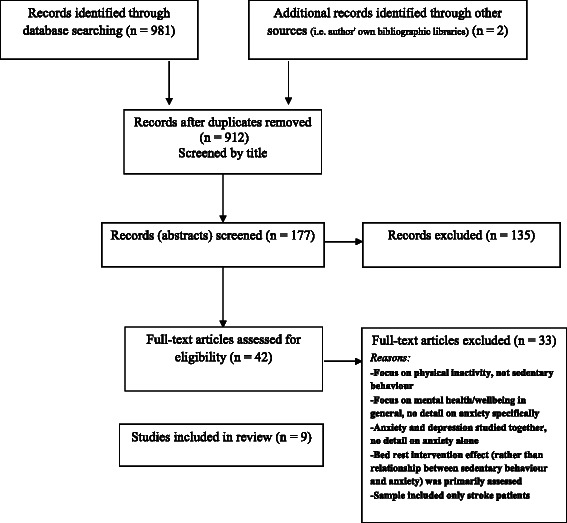
BACKGROUND: Previous research has linked sedentary behaviour (SB) to adverse physical health outcomes in adults and youth. Although evidence for the relationship between SB and mental health outcomes (e.g., depression) is emerging, little is known regarding risk of anxiety. METHODS: A systematic search for original research investigating the association between SB and risk of anxiety was performed using numerous electronic databases. A total of nine observational studies (seven cross-sectional and two longitudinal) were identified. Methodological quality of studies was assessed and a best-evidence synthesis was conducted. RESULTS: One cross-sectional study demonstrated a strong methodological quality, five cross-sectional studies demonstrated a moderate methodological quality and three studies (two cross-sectional one longitudinal) received a weak methodological quality rating. Overall, there was moderate evidence for a positive relationship between total SB and anxiety risk as well as for a positive relationship between sitting time and anxiety risk. There was inconsistent evidence for the relationship between screen time, television viewing time, computer use, and anxiety risk. CONCLUSION: Limited evidence is available on the association between SB and risk of anxiety. However, our findings suggest a positive association (i.e. anxiety risk increases as SB time increases) may exist (particularly between sitting time and risk of anxiety). Further high-quality longitudinal/interventional research is needed to confirm findings and determine the direction of these relationships.
Overview
The claims and statistics of this paper haven’t been checked yet.
Run the check — free, no account needed. It reads the open-access text and checks the sources it cites.
Integrity signals
Registry
Cites
Statistics
Figures
Verification
Claims the paper makes
The claims and statistics of this paper haven’t been checked yet.
Run the check — free, no account needed. It reads the open-access text and checks the sources it cites.
Claims other papers make about this one
Each is checked against this paper’s own text: does it say what the citing paper says it does?
In the citing paper
“Currently, clinical guidelines for metabolic screening upon initiation or continuation of SGAs put forth that blood pressure, body mass index (BMI), blood glucose and lipids should be checked at least every six months.[131][132][133]”
From The Lancet Psychiatry Commission: a blueprint for protecting physical health in people with mental illness (2019) · cites this paper as [133]
In the citing paper
“While positive associations between screen-based sedentary behaviors and emotional disorder symptoms have been previously identified, much of the work to date is cross-sectional (Hoare et al., 2016; Teychenne et al., 2015)”
From Reciprocal associations between screen time and emotional disorder symptoms during adolescence (2019) · cites this paper as Teychenne et al., 2015
In the citing paper
“Conversely, physical inactivity has been identified as a risk factor for the development of anxiety [53] as well as for other conditions such as depression [54–56].”
From Moving to Beat Anxiety: Epidemiology and Therapeutic Issues with Physical Activity for Anxiety (2018) · cites this paper as [53]
In the citing paper
“Factors such as physical inactivity represent a significant, but modifiable cardiovascular risk factor that is widespread in people with mental health problems [107], including anxiety disorders [25•, 53].”
From Moving to Beat Anxiety: Epidemiology and Therapeutic Issues with Physical Activity for Anxiety (2018) · cites this paper as [53]
Self-check
Percentages, sums and reported differences re-computed from the paper’s own numbers.
The self-check needs the paper’s full text.
Citations
Cites
Health benefits of physical activity: the evidence
Warburton, D. E. R. (2006) · Canadian Medical Association Journal · doi:10.1503/cmaj.051351 · Cited by 8,007 · cited 1×
“disease [4], osteoporosis [5], type two diabetes [3], and various cancers [6]).”
BackgroundPhysical activity and mental health in children and adolescents: a review of reviews
Biddle, S. J. H., & Asare, M. (2011) · British Journal of Sports Medicine · doi:10.1136/bjsports-2011-090185 · Cited by 2,447 · cited 1×
“Although research has indicated an inverse association between physical activity and anxiety may exist [24–26], currently the evidence regarding the association between sedentary behaviour and anxiety is unclear.”
BackgroundKraut, R. E., Kiesler, S. B., Boneva, B. S., Cummings, J. N., Helgeson, V. S., & Crawford, A. M. (2002) · Journal of Social Issues · doi:10.1111/1540-4560.00248 · Cited by 2,367 · cited 1×
“There is a small body of literature that suggests some forms of sedentary behaviour may in fact have a positive impact on mental health, specifically depressive symptoms [42, 43], however, further intervention and prospective studies are required to determine the direction of the relationship between sedentary behavio…”
BackgroundSystematic review of sedentary behaviour and health indicators in school-aged children and youth.
Tremblay, M. S., LeBlanc, A. G., Kho, M. E., Saunders, T. J., Larouche, R., Colley, R. C., Goldfield, G., & Gorber, S. (2011) · International Journal of Behavioral Nutrition and Physical Activity · doi:10.1186/1479-5868-8-98 · Cited by 2,085 · cited 1×
“unfavourable body composition, decreased fitness, lowered scores for self-esteem, and pro-social behaviour and decreased academic achievement [9], sleep problems, musculoskeletal pain, depression, and poor psychological well-being [10]).”
BackgroundHu, F. B., Li, T. Y., Colditz, G. A., Willett, W. C., & Manson, J. E. (2003) · JAMA · doi:10.1001/jama.289.14.1785 · Cited by 1,892 · cited 3×
“For example, research has shown sedentary behaviour to be linked to an increased risk of type 2 diabetes [3], a disease which is subsequently associated with poor mental health [23].”
BackgroundSitting time and mortality from all causes, cardiovascular disease, and cancer
KATZMARZYK, P. T., CHURCH, T. S., CRAIG, C. L., & BOUCHARD, C. (2009) · Medicine & Science in Sports & Exercise · doi:10.1249/mss.0b013e3181930355 · Cited by 1,611 · cited 1×
“disease [4], osteoporosis [5], type two diabetes [3], and various cancers [6]).”
BackgroundSedentary Behaviors and Subsequent Health Outcomes in Adults
Thorp, A. A., Owen, N., Neuhaus, M., & Dunstan, D. W. (2011) · American Journal of Preventive Medicine · doi:10.1016/j.amepre.2011.05.004 · Cited by 1,455
Physical activity, exercise, depression and anxiety disorders
Ströhle, A. (2009) · Journal of Neural Transmission · doi:10.1007/s00702-008-0092-x · Cited by 1,269 · cited 1×
“depression), it could be the displacement of physical activity when engaging in sedentary behaviour that explains the relationship with increased anxiety risk, since physical activity has been shown to be beneficial in reducing anxiety in both children/adolescents [38] and adults [39].”
BackgroundAnxiety disorders and comorbid medical illness
Roy-Byrne, P. P., Davidson, K. W., Kessler, R. C., Asmundson, G. J. G., Goodwin, R. D., Kubzansky, L., Lydiard, R. B., Massie, M. J., Katon, W., Laden, S. K., et al. (2008) · General Hospital Psychiatry · doi:10.1016/j.genhosppsych.2007.12.006 · Cited by 668 · cited 1×
“The illness has been shown to be linked to other serious diseases such as increased risk of cardiovascular disease and cancer [19] with estimates that anxiety and depression together contribute to 10 % of the total burden of disease in Australian women [20].”
BackgroundMust, A., & Tybor, D. J. (2005) · International Journal of Obesity · doi:10.1038/sj.ijo.0803064 · Cited by 642 · cited 1×
“Time spent in sedentary behaviour has emerged as a potentially important indicator of health in adult populations [2], independent of achieving sufficient physical activity.”
Background
Research works printed but not linked: 4
- Australian Bureau of Statistics. National Survey of Mental Health and Wellbeing. Canberra: ABS.: Australian Bureau of Statistics; 2008.
- World Health Organisation. Global Health Estimates summary tables, DALYs by cause, age and sex. Geneva, Switzerland: World Health Organisation; 2013. World2011.
- Taintor Z, Rosenthal RN. Microprocessor abuse and internet addiction. 4th ed. Philadelphia: Lippincott Williams & Wilkins; 2009.
- National Collaborating Centre for Methods and Tools. Quality Assessment Tool for Quantitative Studies. Hamilton, ON: McMaster University; 2008.
Cited by
Sorted by citations
Items 301–350 of 350
Forte, C., O'Sullivan, D. T., McDowell, C. P., Hallgren, M. Å., Woods, C. B., & Herring, M. P. (2022) · Research Square · doi:10.21203/rs.3.rs-2096875/v1
dos Santos, U. R. (2022) · Digital Library of Theses and Dissertations (Universidade de São Paulo) · doi:10.11606/d.109.2022.tde-08112022-084835
Six Ways to Well-Being (6W-WeB)
Basarkod, G., Ciarrochi, J., & Sahdra, B. K. (2022) · Springer eBooks · doi:10.1007/978-3-030-77644-2_67-1
Six Ways to Well-Being (6W-WeB)
Basarkod, G., Ciarrochi, J., & Sahdra, B. K. (2023) · Springer eBooks · doi:10.1007/978-3-030-77644-2_67-2
Nadeem, A., Qazi, R., Zafar, A., Batool, S., & Naseer, R. (2023) · Pakistan BioMedical Journal · doi:10.54393/pbmj.v6i3.856
Su, X., Yan, Q., Kovess–Masféty, V., Li, P., Li, M., Yan, G., Yin, H., & Xu, G. (2023) · Research Square · doi:10.21203/rs.3.rs-2900299/v1 · Cited by 1
Effects of sitting time and smoking on perceived stress in adults under 65 years of age
Park, H., & Kim, Y.-H. (2023) · Journal of Korean Biological Nursing Science · doi:10.7586/jkbns.23.0006
“tal health, making individuals prone to anxiety [10], depression [11], and poor emotional well-being [12,13], which are often associated with mental health problems [14].”
BackgroundGarcía, A. A., Victoria, P. V. L., & Flórez-Elvira, L. J. (2023) · Medicina UPB · doi:10.18566/medupb.v42n2.a04
Karartı, C., Özyurt, F., & Özsoy, İ. (2023) · Hacettepe Üniversitesi Sağlık Bilimleri Fakültesi Dergisi · doi:10.21020/husbfd.1088705
Ambarini, F., Melani, V., Utami, D. A., Palupi, K. C., & Nadiyah, N. (2023) · Ilmu Gizi Indonesia · doi:10.35842/ilgi.v7i1.413
Designing Novel Approaches to Personalise Behaviour Change in Intelligent Systems
Scott, D. (2024) · Cronfa (Swansea University) · doi:10.23889/suthesis.65829
Sofia, D., Wibisono, B., Asrumi, A., Salikin, H., & Sariono, A. (2024) · INTERNATIONAL JOURNAL OF MULTIDISCIPLINARY RESEARCH AND ANALYSIS · doi:10.47191/ijmra/v7-i06-11
Bustamante, C. M. V., Coombs, G., Rahimi-Eichi, H., Mair, P., Onnela, J.-P. “., Baker, J. T., & Buckner, R. L. (2024) · doi:10.31219/osf.io/fn3aj
Urbano-Mairena, J., Ríos-Calonge, J. D. L., Mota, S. P., Carvajal-Gil, J., Silveira-Saraiva, E. S., Bustamante, J. G., & Bermejo, L. M. (2024) · Healthcare · doi:10.3390/healthcare12141414 · Cited by 1
Webster, L. R. (2020) · Oxford University Press eBooks · doi:10.1093/med/9780197517277.002.0009
Sports and mind: A systematic review of physical activity and mental well-being in the modern era
Chaeroni, A., Talib, K., Govindasamy, K., Lisna, Y. P., Orhan, B. E., Ahmed, M., & Kurnaz, M. (2024) · doi:10.56984/8zg01a8p7q6
Laxton, P., Healy, S., Brewer, B. C., McCormick, B. P., Orsega-Smith, E. M., Smith, L., Daly, J., & Patterson, F. (2025) · Disability and health journal · doi:10.1016/j.dhjo.2025.101836
Review of Samprapti of Pramehaby Studyingsedentary Lifestyle as a Causative Factor.
Vithale, D. N. S., Purohit, D., & Mishra, P. D. B. (2025) · International Journal of Pharmaceutical Research and Applications · doi:10.35629/4494-1002914918
“Sedentary behavior may also have a detrimental effect on mental health because it has been linked to an increased chance of developing anxious or depressive symptoms 29,30 .”
Amajjar, I., Vergauwen, K., Willigenburg, N. W., Huijnen, I. P. J., Smeets, R., & Ham, S. J. (2025) · Scientific Reports · doi:10.1038/s41598-025-02812-3
“More anxiety was also related to a higher PAL, while in contrast previous studies reported that lower levels of anxiety were related to higher levels of physical activity 46,47 .”
Six Ways to Well-Being (6W-WeB)
Basarkod, G., Ciarrochi, J., & Sahdra, B. K. (2025) · Springer eBooks · doi:10.1007/978-3-031-47219-0_67
Nugroho, P. S., Samutachak, B., Jirapramukpitak, T., Ghozali, G., Fauzi, F. A., & Chamratrithirong, A. (2025) · Acta Psychologica · doi:10.1016/j.actpsy.2025.105616
Apostolopoulos, M., Hnatiuk, J. A., Maple, J.-L., Olander, E. K., Brennan, L., van der Pligt, P., & Teychenne, M. J. (2021) · Figshare · doi:10.6084/m9.figshare.14601932
Self-citationKandola, A. A., del Pozo Cruz, B., Osborn, D. P. J., Stubbs, B., Choi, K. W., & Hayes, J. (2021) · Figshare · doi:10.6084/m9.figshare.14795489
Alòs, F., Colomer, M. À., Martín-Cantera, C., Muñoz, M. S., Bort‐Roig, J., Saigi, I., Chirveches-Pérez, E., Solà-Gonfaus, M., Molina-Aragonés, J. M., & Puig-Ribera, A. (2022) · Figshare · doi:10.6084/m9.figshare.20193936
Alòs, F., Colomer, M. À., Martín-Cantera, C., Muñoz, M. S., Bort‐Roig, J., Saigi, I., Chirveches-Pérez, E., Solà-Gonfaus, M., Molina-Aragonés, J. M., & Puig-Ribera, A. (2022) · Figshare · doi:10.6084/m9.figshare.20193939
Draper, C. E., Cook, C. J., Redinger, S., Rochat, T., Prioreschi, A., Rae, D. E., Ware, L. J., Lye, S., & Norris, S. A. (2022) · Figshare · doi:10.6084/m9.figshare.20291007
Kandola, A. A., Osborn, D., Stubbs, B., Choi, K. W., & Hayes, J. (2020) · Figshare · doi:10.6084/m9.figshare.13219418
Duncan, F., Baskin, C., McGrath, M., Coker, J. F., Lee, C., Dykxhoorn, J. L., Adams, E. A., Gnani, S., Lafortune, L., Kirkbride, J. B., et al. (2021) · Figshare · doi:10.6084/m9.figshare.16633191
Alòs, F., Colomer, M. À., Martín-Cantera, C., Muñoz, M. S., Bort‐Roig, J., Saigi, I., Chirveches-Pérez, E., Solà-Gonfaus, M., Molina-Aragonés, J. M., & Puig-Ribera, A. (2022) · Figshare · doi:10.6084/m9.figshare.20193942
Nikolis, L., Wakim, A., Adams, W., & DO, P. B. (2021) · Figshare · doi:10.6084/m9.figshare.15058081
Nikolis, L., Wakim, A., Adams, W., & DO, P. B. (2021) · Figshare · doi:10.6084/m9.figshare.15058084
Alòs, F., Colomer, M. À., Martín-Cantera, C., Muñoz, M. S., Bort‐Roig, J., Saigi, I., Chirveches-Pérez, E., Solà-Gonfaus, M., Molina-Aragonés, J. M., & Puig-Ribera, A. (2022) · Figshare · doi:10.6084/m9.figshare.20193945
Barwais, F. A. (2026) · The Open Public Health Journal · doi:10.2174/0118749445437492251127094816
Spora katılımın ergenlik dönemindeki depresyon ve kaygı düzeylerine etkisi
Şenışık, S., & Kayış, H. (2020) · DergiPark (Istanbul University)
Sălcudean, A., Ősz, B.-E., Cîmpian, D. M., Popovici, R. A., Bodo, C.-R., Torok, S., Corodan-Comiati, D.-M., Dumache, R., Kiș, A. M., Cincu, M.-G., et al. (2026) · Nutrients · doi:10.3390/nu18030546
“…conducted among adolescents and young adults show positive associations between sedentary time and anxiety and broader mental health concerns, with moderate evidence for increased risk of anxiety related to more sitting time, although findings may vary by domain and measurement [24,26].”
Bretler, T., Shenaar‐Golan, V., Yatzkar, U., Vilner, Y., Reingewirtz, R., Even-Ezra, N., Beer, N., & Wiegler, K. B. (2026) · Child and Adolescent Psychiatry and Mental Health · doi:10.1186/s13034-026-01055-y
“Emerging evidence suggests that low PA and high sedentary behaviors may interact negatively with emotional and mental health outcomes and might be important early modifiable risk factors for depression and anxiety [2, 20, 43].”
Ma, Y., Xu, Y., Liyou, W. U., Guo, J., & Chen, B. J. (2026) · Frontiers in Public Health · doi:10.3389/fpubh.2026.1768160
dos Santos, J. P. R., Tavares, V. D. D. O., Freire, Y. A., Gomes-Júnior, J. D. S., Dantas, L. V., Ramos, A. P., Ohara, D., Cabral, L. L. P., & Browne, R. A. V. (2026) · Health Education & Behavior · doi:10.1177/10901981261425267 · Cited by 1
“For instance, excessive sedentary behavior (SB) and inadequate sleep have been recognized as key factors contributing to anxiety and depressive symptoms in adolescents (Hoare et al., 2016; Sampasa-Kanyinga et al., 2021; Teychenne et al., 2015).”
Riglea, T., Sylvestre, M., Schnitzer, M. E., Sabiston, C. M., & O’Loughlin, J. L. (2026) · Journal of Affective Disorders · doi:10.1016/j.jad.2026.121767
Martins, A., Fernandes, C. Y. P., Gonçalves, C. M., Queiroz, P. D. S., Neves, L. M., Filho, D. G. N., França, C. N., Schuch, F. B., Stubbs, B., Gualano, B., et al. (2026) · International Journal of Clinical Trials · doi:10.18203/2349-3259.ijct20261384
Baliotis, K., Konstanti, Z., Ζαγοριανάκου, Ν., Toti, A., Dragioti, E., Tatsis, F., Mantzoukas, S., Gouva, M., & Kourakos, M. (2026) · Discover Public Health · doi:10.1186/s12982-026-02049-z
“Table 1 provides specifics of the criteria that were modified from well-established frameworks utilized in earlier studies to assess the levels of evidence [23, 25, 26].”
Ademoyegun, A. B., Afonrinwo, I. P., Fabuluje, D. O., Akintayo, N., Okafor, A. C., Akinsole, M. C., Kolade, A. A., & Mbada, C. E. (2026) · Research Square · doi:10.21203/rs.3.rs-9929471/v1
Wood, H. C., Gardner, B., Duncan, M. D., & Dommett, E. J. (2026) · Peer Community Journal · doi:10.24072/pcjournal.754
“…SB has not just been associated with physical health risks but also negative mental health consequences, including an increased risk of anxiety (Teychenne et al., 2015; Allen et al., 2019; Stanczykiewicz et al., 2019) and depression (Teychenne et al., 2010; Zhai et al., 2015; Saunders et al.,…”
Jin, Y., Han, K., & Kim, D. (2026) · Mental health and physical activity · doi:10.1016/j.mhpa.2026.100806
The Effects of Sport on Psychological Health
Akbaş, E. (2026) · IGI Global eBooks · doi:10.4018/979-8-3373-9430-5.ch006
Li, Y., Ma, S., Gong, L., Yu, H., & Feng, J. (2026) · Frontiers in Psychology · doi:10.3389/fpsyg.2026.1936732
Martire, L. M., & Franks, M. M. (2026) · Elsevier eBooks · doi:10.1016/b978-0-443-27490-9.00021-x
Metadata
- Authors
- Teychenne, M., Costigan, S. A., & Parker, K.
- Affiliations
- Deakin University (AU)
- University of Newcastle Australia (AU)
- Corresponding author
- Teychenne, Megan
- Venue
- BMC Public Health
- Published
- 2015-06-19
- Volume
- 15
- Issue
- 1
- Pages
- 513-513
- ISSN
- 1471-2458 (ISSN-L)
- PMC
- PMC4474345
- OpenAlex
- W1943532712
- Cited by
- 351
- References
- 43
- Citations by year
- 2026: 15 · 2025: 27 · 2024: 31 · 2023: 37 · 2022: 47 · 2021: 44 · 2020: 47 · 2019: 35 · 2018: 23 · 2017: 20 · 2016: 22 · 2015: 2
- FWCI
- 2.73
- Type
- journal article
- Language
- en
- Open access
- gold
- doi.org
- Locations
- BMC Public Health (publishedVersion, cc-by)
- Europe PMC (PubMed Central) (publishedVersion, cc-by)
- PubMed Central (publishedVersion, cc-by)
- PubMed (publishedVersion)
- Deakin Research Online (Deakin University) (submittedVersion)
- Figshare (submittedVersion, cc-by)
- NOVA (University of Newcastle Australia) (submittedVersion, cc-by)
- Topics
- Health Sciences › Medicine › Public Health, Environmental and Occupational Health › Physical Activity and Health
- Social Sciences › Human Factors and Ergonomics › Ergonomics and Musculoskeletal Disorders
- Social Sciences › Psychology › Experimental and Cognitive Psychology › Anxiety, Depression, Psychometrics, Treatment, Cognitive Processes
- Keywords
- sedentary behavior, anxiety, sitting time, screen time, television viewing, computer use, mental health, physical inactivity
- MeSH terms
- Adolescent, Adult, Anxiety, Humans, Male, Risk Assessment, Sedentary Behavior
About these checks
Registry, retraction, Cites and statistics results are computed, not judged, with one exception: a printed reference that no index lists is read once by a model before it counts as a citation error. Claims are extracted by a model and kept only when their quote appears verbatim in the text; each cited source is then checked, with a model’s help, for whether it says what the claim relies on. Those verdicts can be wrong — read the claim’s quote and the cited source before relying on one.
Statistics and arithmetic are recomputed, not judged.
Confidence bands are shown only for fields calibrated on our annotated test set. None is calibrated yet, so no band is shown.
What counts as a claim ›How we measure confidence ›How we check this ›
Are you an author, or do you see a problem with this page? Request a review
