

Impact of COVID-19 on life expectancy at birth in India: a decomposition analysis
Open accessThe DOI matches its Crossref record; 92 of the 94 references it cites were found in a registry or an index; 6 of the 80 sources its claims cite were checked for support.
Abstract
Background: Quantifying excess deaths and their impact on life expectancy at birth (e 0) provide a more comprehensive understanding of the burden of coronavirus disease of 2019 (COVID-19) on mortality. The study aims to comprehend the repercussions of the burden of COVID-19 disease on the life expectancy at birth and inequality in age at death in India. Methods: The mortality schedule of COVID-19 disease in the pandemic year 2020 was considered one of the causes of death in the category of other infectious diseases in addition to other 21 causes of death in the non-pandemic year 2019 in the Global Burden of Disease (GBD) data. The measures e 0 and Gini coefficient at age zero (G 0) and then sex differences in e 0 and G 0 over time were analysed by assessing the age-specific contributions based on the application of decomposition analyses in the entire period of 2010–2020. Results: The e 0 for men and women decline from 69.5 and 72.0 years in 2019 to 67.5 and 69.8 years, respectively, in 2020. The e 0 shows a drop of approximately 2.0 years in 2020 when compared to 2019. The sex differences in e 0 and G 0 are negatively skewed towards men. The trends in e 0 and G 0 value reveal that its value in 2020 is comparable to that in the early 2010s. The age group of 35–79 years showed a remarkable negative contribution to Δe 0 and ΔG 0. By causes of death, the COVID-19 disease has contributed − 1.5 and − 9.5%, respectively, whereas cardiovascular diseases contributed the largest value of was 44.6 and 45.9%, respectively, to sex differences in e 0 and G 0 in 2020. The outcomes reveal a significant impact of excess deaths caused by the COVID-19 disease on mortality patterns. Conclusions: The COVID-19 pandemic has negative repercussions on e 0 and G 0 in the pandemic year 2020. It has severely affected the distribution of age at death in India, resulting in widening the sex differences in e 0 and G 0. The COVID-19 disease demonstrates its potential to cancel the gains of six to eight years in e 0 and five years in G 0 and has slowed the mortality transition in India.
Overview
CoChat Summary
TL;DR
This decomposition analysis estimates that including COVID-19 as a cause of death in India in 2020 reduced life expectancy at birth by about 2.0 years for men and 2.3 years for women and increased inequality in age at death. The mortality impact was concentrated at ages 35–79 and reversed recent gains in e0 and G0.
Key findings
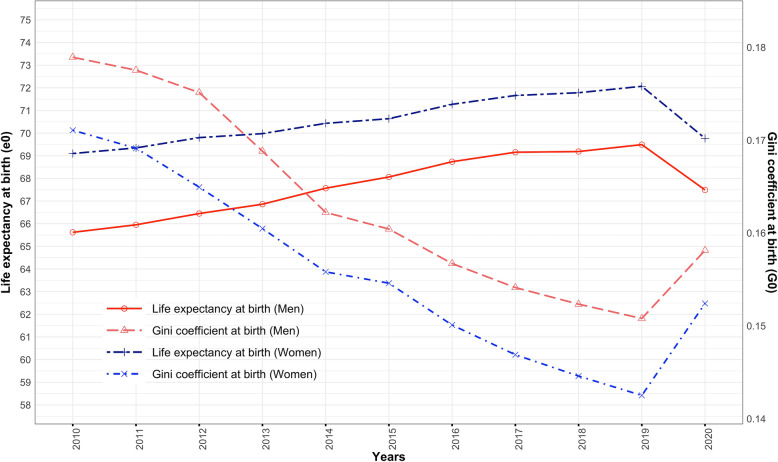
- Life expectancy at birth for men and women fell from 69.5 and 72.0 years in 2019 to 67.5 and 69.8 years in 2020, a drop of 2.0 and 2.3 years; e65 dropped by one year for both sexes. G0 rose from 0.150 and 0.141 in 2019 to 0.159 and 0.153 in 2020 for men and women, respectively.
- The age group 35–79 years showed a remarkable negative contribution to Δe0 and ΔG0; the adult (20–64 years) age group contributed −96.1% in men and −91.2% in women to ΔG0, and 79.2% to the sex difference in e0 in 2020.
- COVID-19 contributed −1.5% and −9.5% to sex differences in e0 and G0, respectively; cardiovascular diseases contributed the largest values, 44.6% and 45.9%, to sex differences in e0 and G0 in 2020.
- The pandemic showed potential to cancel gains of six to eight years in e0 and five years in G0; trends in e0 in 2020 were comparable to the early 2010s, and sex differences in e0 and G0 were negatively skewed towards men.
Methods
- Data came from the COVID19-India API for 30 Jan–31 Dec 2020 and GBD 2019 for 21 causes of death; COVID-19 was added as a cause under other infectious diseases, giving 22 causes, with the same age pattern assumed for the 21 causes in 2020. Projected population until December 2020 and an average seroprevalence of 7.21% were used to adjust infections by age and sex, yielding 94.21 million estimated infections and adjusted age-specific infection fatality rates.
- Abridged life tables for 2010–2020 were constructed using the Chiang method, with SRS 2014–18 life tables for comparison; inequality in age at death was measured by the Gini coefficient at birth (G0).
- Decomposition used Arriaga’s discrete method and the replacement method for e0 and G0, assessing age-specific contributions and sex differences over time, with 2019 as the base year.
Limitations
- The paper states that state- and district-level ASDRs are unreliable because of large missing age-sex mortality data, so analysis is limited to the national level.
- The paper states that explicit information on symptomatic plus asymptomatic SARS-CoV-2 carriers is unavailable; an average seroprevalence from three seroepidemiological surveys using different assays was used, the third survey covered 17 Dec 2020–08 Jan 2021, seroprevalence varied across surveys, and seroprevalence for ages 0–9 was assumed the same as for ages 10–17.
- The paper states that assuming the same age pattern of mortality for the 21 causes in 2020 may not be strictly correct, and notes possible underreporting/missing COVID-19 cases and misclassification of causes of death due to comorbidities and lack of medical care facilities with true records.
Model-written summary. Check it against the paper before relying on it.
Integrity signals
Registry
Cites
Statistics
Figures
Verification
Claims the paper makes
1 Valid · 4 Not valid · 37 Not checked · 128 Own results and interpretations
The cited sources support only part of this claim — read each source’s verdict below.
In the paper
“The missing and unidentified cases or infections warps the mortality estimates of COVID-19 disease [17, 48–53].”
§ Impact of COVID-19 on life expectancy at birth in India: a decomposition analysis > Methods > Data
What the sources say
- Partly supportedcites [17] Kashnitsky I Aburto JM COVID-19 in unequally ageing European regions World Dev 2020 136 105170 10.1016/j.worlddev.2020.105170 32895594 PMC7455200 sourceExperimental — accuracy not yet measured
In the Abstract's limitations passage our copy states that COVID-19 data are of poor quality and that 'Estimates of IFRs move upwards as more outcomes of the infection are known and downwards as more mild cases are registered', i.e. unregistered (missing/unidentified) infections distort fatality estimates, and that the map reflects 'unequal population age structures rather than the precise figures on COVID-19 fatality'. However, the paper offers this only as a caveat on its own modelling assumptions and credits the direction of the bias to Russell et al. (2020) (References, item 10, Diamond Princess IFR/CFR estimate), so it is not the original study of the effect; it also speaks of infection-fatality ratio estimates rather than 'mortality estimates' of COVID-19 generally. (LLM, conf=0.70)
- Supportedcites [48] Sudharsanan N Didzun O Barnighausen T Geldsetzer P The contribution of the age distribution of cases to COVID-19 case fatality across countries: a nine-country demographic study Ann Intern Med 2020 173 9 714 720 10.7326/M20-2973 32698605 PMC7397549 source
The Abstract Conclusion states that 'selective testing and identifying of older cases considerably warps estimates of the lethality of COVID-19 within populations and comparisons across countries,' and the Discussion (opening paragraph) repeats that selective testing/identification plus age-distribution differences 'considerably warp estimates of differences in the lethality of COVID-19.' The Discussion's limitations paragraph makes the missing-case mechanism explicit: where testing was less comprehensive and targeted at severe cases (United States, Italy), observed CFRs 'may be higher than the true values because more severe cases were likely to be detected,' and both adjusted CFRs assume diagnosed and undiagnosed cases have equal age-specific mortality. Thus our copy supports the attributed point, though the paper frames the warp specifically as age- and severity-selective identification rather than missingness in general. (LLM, conf=0.82)
- Partly supportedcites [49] Medford A Trias-Llimós S Population age structure only partially explains the large number of COVID-19 deaths at the oldest ages Demogr Res 2020 43 533 544 10.4054/DemRes.2020.43.19 sourceExperimental — accuracy not yet measured
The Introduction says differences in testing strategies may partly explain disparities in case-fatality rates, and the Discussion says variation in recording COVID-19 deaths affects the comparability of mortality data. The paper does not specifically identify missing or unidentified infections as the cause, and its account is more qualified than saying they warp mortality estimates. (LLM, conf=0.82)
- Partly supportedcites [50] Wu SL Mertens AN Crider YS Nguyen A Pokpongkiat NN Djajadi S Seth A Hsiang MS Colford JM Jr Reingold A Arnold BF Hubbard A Benjamin-Chung J Substantial underestimation of SARS-CoV-2 infection in the United States Nat Commun 2020 11 1 4507 10.1038/s41467-020-18272-4 32908126 PMC7481226 sourceExperimental — accuracy not yet measured
Wu et al. (2020) strongly support the first half of the claim: the Results ('Confirmed COVID-19 case counts underestimate infections', p. ~2) and Abstract document that 89% of U.S. infections were undocumented (6.45M estimated vs 721,245 confirmed) because of incomplete testing and imperfect test accuracy. On the mortality part, the Discussion states only that they did not estimate the infection fatality ratio, because deaths outside hospitals are likely underreported, death registrations may lag, death-reporting rates likely differ between tested and untested individuals, and age-stratified death counts are unavailable — i.e., fatality/mortality estimation is hampered and hard to correct for bias, but the paper attributes the difficulty chiefly to death underreporting and missing age stratification rather than demonstrating that the missing infections themselves warp mortality estimates. The Introduction similarly limits the ascertainment consequence to estimates of transmissibility and burden, not mortality. (LLM, conf=0.72)
- Supportedcites [51] Unnikrishnan J Mangalathu S Kutty RV Estimating under-reporting of COVID-19 cases in Indian states: an approach using a delay-adjusted case fatality ratio BMJ Open 2021 11 1 e042584 10.1136/bmjopen-2020-042584 33472784 PMC7818846 source
The Methods ('Key assumptions and basic technique') state that in regions where cases have been under-reported the adjusted CFR is expected to be significantly higher than the true CFR, and that a naive deaths-to-cases ratio gives an inaccurate estimate of the CFR — i.e. missing/unreported cases distort the fatality (mortality) estimate. The Discussion ('Strengths and limitations') reinforces this by making the disagreement between the adjusted and true CFR the basis for inferring the fraction of cases reported, and by noting that undercounted deaths would likewise bias the estimate. The claim is a broad background paraphrase of the paper's central premise, so it is supported; the only slight looseness is that the paper frames the distortion in terms of the case fatality ratio rather than 'mortality estimates' generally. (LLM, conf=0.85)
- Supportedcites [52] Dyer O Covid-19: study claims real global deaths are twice official figures BMJ. 2021 373 n1188 10.1136/bmj.n1188 33972234 source
The 'Eurasia's hidden toll' section states that 'the commonest reason for underreporting of covid deaths is inadequate testing' (per IHME's Chris Murray), alongside governments attributing deaths in covid patients to comorbid conditions — i.e., missed/unidentified infections and cases distorting counted mortality. The Abstract reinforces this by reporting that true global covid deaths (6.93 million to 3 May) are more than twice official figures (3.27 million), with similar scalars for India (2.96x), Mexico (2.83x), Egypt (12.6x) and Russia (5.43x). Together our copy clearly treats the claim's point: gaps in case/infection detection warp covid mortality estimates. (LLM, conf=0.82)
- Not checked yetcites [53] Anand A, Sandefur J, Subramanian A. Three New Estimates of India’s AllCause Excess Mortality during the COVID-19 Pandemic. CGD Working paper 589. Washington DC; 2021.
Checked before — its earlier verdict is held back until a new check runs.
plainstates a cause- Asserted: passes — The authors put it forward as true.
- Checkable: passes — It can be checked against evidence.
- Load-bearing: passes — The paper’s conclusions depend on it.
- Based: passes — The paper gives a reason why it holds.
- Partly supported
A result the paper reports from its own data — it cites no other source for it, so there is none to check. The quote shows it is in the paper.
In the paper
“The trends in e0 and G0 value reveal that its value in 2020 is comparable to that in the early 2010s.”
§ Impact of COVID-19 on life expectancy at birth in India: a decomposition analysis > Abstract > Results
plain- Asserted: passes — The authors put it forward as true.
- Checkable: passes — It can be checked against evidence.
- Load-bearing: passes — The paper’s conclusions depend on it.
- Based: passes — The paper gives a reason why it holds.
- Rests on an assumption not shown here.
A result the paper reports from its own data — it cites no other source for it, so there is none to check. The quote shows it is in the paper.
In the paper
“The e0 for men and women decline from 69.5 and 72.0 years in 2019 to 67.5 and 69.8 years, respectively, in 2020.”
- Also stated in: § Comparison of life table estimates, the pandemic year 2020 versus previous years · plain
“Table 2 shows e0s for men and women were respectively 69.5 [67.4–71.3]3 years and 72.1 [69.9–73.9] years in 2019. However, in 2020, e0s for men and women were 67.5 [65.4–69.4] years and 69.8 [67.6–71.7] years, respectively.”
§ Impact of COVID-19 on life expectancy at birth in India: a decomposition analysis > Abstract > Results
plain- Asserted: passes — The authors put it forward as true.
- Checkable: passes — It can be checked against evidence.
- Load-bearing: passes — The paper’s conclusions depend on it.
- Based: passes — The paper gives a reason why it holds.
- Rests on an assumption not shown here.
- Also stated in: § Comparison of life table estimates, the pandemic year 2020 versus previous years · plain
A result the paper reports from its own data — it cites no other source for it, so there is none to check. The quote shows it is in the paper.
In the paper
“It is evident that including COVID-19 disease as one of the causes of death led to a drop of 2.0 and 2.3 years in e0 for men and women, respectively.”
§ Impact of COVID-19 on life expectancy at birth in India: a decomposition analysis > Results > Comparison of life table estimates, the pandemic year 2020 versus previous years
boostedstates a cause- Asserted: passes — The authors put it forward as true.
- Checkable: passes — It can be checked against evidence.
- Load-bearing: passes — The paper’s conclusions depend on it.
- Based: passes — The paper gives a reason why it holds.
- Rests on an assumption not shown here.
A result the paper reports from its own data — it cites no other source for it, so there is none to check. The quote shows it is in the paper.
In the paper
“The age group of 35–79 years showed a remarkable negative contribution to Δe0 and ΔG0.”
§ Impact of COVID-19 on life expectancy at birth in India: a decomposition analysis > Abstract > Results
plainstates a cause- Asserted: passes — The authors put it forward as true.
- Checkable: passes — It can be checked against evidence.
- Load-bearing: passes — The paper’s conclusions depend on it.
- Based: passes — The paper gives a reason why it holds.
- Rests on an assumption not shown here.
106 more claims
Create a free account to see all 170 claims and to verify the 71 references still open.
- It may state two separate claims as one. 43
- Probably not a substantial claim. 21
Self-check
Percentages, sums and reported differences re-computed from the paper’s own numbers.
Each contradiction between two passages listed here was confirmed by an independent check.
Rated major: it would touch a result — a value a result rests on, reported and recomputed p-values on opposite sides of the significance level, two passages that conflict with no sign which is right, or a cited work retracted before this paper was published.
In the paper
§ Impact of COVID-19 on life expectancy at birth in India: a decomposition analysis > Abstract > Conclusions
“resulting in widening the sex differences in e0 and G0.”
§ Impact of COVID-19 on life expectancy at birth in India: a decomposition analysis > Results > Comparison of life table estimates, the pandemic year 2020 versus previous years
“Table 2 shows e0s for men and women were respectively 69.5 [67.4–71.3]3 years and 72.1 [69.9–73.9] years in 2019. However, in 2020, e0s for men and women were 67.5 [65.4–69.4] years and 69.8 [67.6–71.7] years, respectively.”
Rated major: it would touch a result — a value a result rests on, reported and recomputed p-values on opposite sides of the significance level, two passages that conflict with no sign which is right, or a cited work retracted before this paper was published.
In the paper
§ Impact of COVID-19 on life expectancy at birth in India: a decomposition analysis > Abstract > Conclusions
“resulting in widening the sex differences in e0 and G0.”
§ Impact of COVID-19 on life expectancy at birth in India: a decomposition analysis > Discussion
“The G0 values of men and women increased from 0.150 and 0.141 in 2019 to 0.159 and 0.153, respectively, in 2020 (Fig. 4).”
Rated minor: it would not touch a result — a value no result rests on, a p-value that stays on the same side of the significance level, or a conflict that is clerical, resolved elsewhere in the paper, or outside its own findings.
In the paper
§ Impact of COVID-19 on life expectancy at birth in India: a decomposition analysis > Abstract > Results
“The e0 for men and women decline from 69.5 and 72.0 years in 2019 to 67.5 and 69.8 years, respectively, in 2020.”
§ Impact of COVID-19 on life expectancy at birth in India: a decomposition analysis > Methods > Data
“| 0–1 | 68.2 | 70.7 | 69.5 | 72.1 | 67.5 | 69.8 |”
Citations
Cites
Age-dependent effects in the transmission and control of COVID-19 epidemics
Davies, N. G., Klepac, P., Liu, Y., Prem, K., Jit, M., CMMID COVID-19 working group, Pearson, C. A. B., Quilty, B. J., Kucharski, A. J., Gibbs, H., et al. (2020) · Nature Medicine · doi:10.1038/s41591-020-0962-9 · Cited by 1,759
Age-specific mortality and immunity patterns of SARS-CoV-2
O’Driscoll, M., Ribeiro Dos Santos, G., Wang, L., Cummings, D. A. T., Azman, A. S., Paireau, J., Fontanet, A., Cauchemez, S., & Salje, H. (2021) · Nature · doi:10.1038/s41586-020-2918-0 · Cited by 1,210 · cited 2×
“O ’ Driscoll, Ribeiro Dos Santos [59] demonstrates the consistency of seroprevalence in seroepidemiological surveys and age distribution of deaths in young population across 45 countries, whereas considerable heterogeneity in fatality rates, especially in old ages.”
BackgroundThe Leading Causes of Death in the US for 2020
Ahmad, F. B., & Anderson, R. N. (2021) · JAMA · doi:10.1001/jama.2021.5469 · Cited by 938
Infectious Disease Threats in the Twenty-First Century: Strengthening the Global Response
Bloom, D. E., & Cadarette, D. (2019) · Frontiers in Immunology · doi:10.3389/fimmu.2019.00549 · Cited by 806
Measuring and explaining the change in life expectancies
Arriaga, E. E. (1984) · Demography · doi:10.2307/2061029 · Cited by 630 · cited 4×
“Age-specific contributions to e0 and G0, India, 2010–2020 Table 3 shows the application of decomposition methods for analysing the age-specific contributions to Δe0 by discrete [77] and the replacement [75] methods [82, 83].”
MethodInfluentialExcess deaths from COVID-19 and other causes, March–April 2020.
Woolf, S. H., Chapman, D. A., Sabo, R. T., Weinberger, D. M., & Hill, L. (2020) · JAMA · doi:10.1001/jama.2020.11787 · Cited by 541
Andrasfay, T., & Goldman, N. (2021) · Proceedings of the National Academy of Sciences · doi:10.1073/pnas.2014746118 · Cited by 496
Weinberger, D. M., Chen, J., Cohen, T., Crawford, F. W., Mostashari, F., Olson, D., Pitzer, V. E., Reich, N. G., Russi, M., Simonsen, L., et al. (2020) · JAMA Internal Medicine · doi:10.1001/jamainternmed.2020.3391 · Cited by 485
Global socio-economic losses and environmental gains from the Coronavirus pandemic
Lenzen, M., Li, M., Malik, A., Pomponi, F., Sun, Y.-Y., Wiedmann, T., Faturay, F., Fry, J., Gallego, B., Geschke, A., et al. (2020) · PLOS ONE · doi:10.1371/journal.pone.0235654 · Cited by 363
Substantial underestimation of SARS-CoV-2 infection in the United States
Wu, S. L., Mertens, A. N., Crider, Y. S., Nguyen, A., Pokpongkiat, N. N., Djajadi, S., Seth, A., Hsiang, M. S., Colford, J. M., Reingold, A., et al. (2020) · Nature Communications · doi:10.1038/s41467-020-18272-4 · Cited by 355
COVID-19 as the Leading Cause of Death in the United States
Woolf, S. H., Chapman, D. A., & Lee, J. H. (2021) · JAMA · doi:10.1001/jama.2020.24865 · Cited by 350
Age groups that sustain resurging COVID-19 epidemics in the United States
Monod, M., Blenkinsop, A., Xi, X., Hebert, D., Bershan, S., Tietze, S., Baguelin, M., Bradley, V. C., Chen, Y., Coupland, H., et al. (2021) · Science · doi:10.1126/science.abe8372 · Cited by 331
Excess Deaths From COVID-19 and Other Causes, March-July 2020
Woolf, S. H., Chapman, D. A., Sabo, R. T., Weinberger, D. M., Hill, L., & Taylor, D. D. H. (2020) · JAMA · doi:10.1001/jama.2020.19545 · Cited by 304
COVID-19: exposing and amplifying inequalities
Marmot, M., & Allen, J. (2020) · Journal of Epidemiology and Community Health · doi:10.1136/jech-2020-214720 · Cited by 285
COVID-19: a need for real-time monitoring of weekly excess deaths
Leon, D. A., Shkolnikov, V. M., Smeeth, L., Magnus, P., Pechholdová, M., & Jarvis, C. I. (2020) · The Lancet · doi:10.1016/s0140-6736(20)30933-8 · Cited by 232
Long-range trends in adult mortality: Models and projection methods
Bongaarts, J. (2005) · Demography · doi:10.1353/dem.2005.0003 · Cited by 228
Pandemic COVID-19 Joins History’s Pandemic Legion
Morens, D. M., Daszak, P., Markel, H., & Taubenberger, J. K. (2020) · mBio · doi:10.1128/mbio.00812-20 · Cited by 223
COVID-19 Pandemic, Unemployment, and Civil Unrest: Underlying Deep Racial and Socioeconomic Divides
Galea, S., & Abdalla, S. M. (2020) · JAMA · doi:10.1001/jama.2020.11132 · Cited by 219
India's escalating burden of non-communicable diseases
Arokiasamy, P. (2018) · The Lancet Global Health · doi:10.1016/s2214-109x(18)30448-0 · Cited by 206
Prevalence of SARS-CoV-2 infection in India: Findings from the national serosurvey, May-June 2020
Murhekar, M. V., Bhatnagar, T., Selvaraju, S., Rade, K., Saravanakumar, V., Vivian Thangaraj, J. W., Kumar, M. S., Shah, N., Sabarinathan, R., Turuk, A., et al. (2020) · Indian Journal of Medical Research · doi:10.4103/ijmr.ijmr_3290_20 · Cited by 202
Self-citationMurhekar, M. V., Bhatnagar, T., Selvaraju, S., Saravanakumar, V, Thangaraj, J. W. V., Shah, N., Kumar, M. S., Rade, K., Sabarinathan, R., Asthana, S., et al. (2021) · The Lancet Global Health · doi:10.1016/s2214-109x(20)30544-1 · Cited by 191
Understanding epidemiological transition in India
Yadav, S., & Arokiasamy, P. (2014) · Global Health Action · doi:10.3402/gha.v7.23248 · Cited by 190
Self-citationShkolnikov, V. M., Andreev, E. M., & Begun, A. Z. (2001) · doi:10.4054/mpidr-wp-2001-017 · Cited by 190
Singh, G., Sharma, M., Kumar, G. A., Rao, N. G., Prasad, K., Mathur, P., Pandian, J. D., Steinmetz, J. D., Biswas, A., Pal, P. K., et al. (2021) · The Lancet Global Health · doi:10.1016/s2214-109x(21)00164-9 · Cited by 179
Sex and Gender Differences in Health: What the COVID-19 Pandemic Can Teach Us
Spagnolo, P. A., Manson, J. E., & Joffe, H. (2020) · Annals of Internal Medicine · doi:10.7326/m20-1941 · Cited by 176
Hernández-Galdamez, D. R., González-Block, M. Á., Romo-Dueñas, D. K., Lima-Morales, R., Hernández-Vicente, I. A., Lumbreras-Guzmán, M., & Méndez‐Hernández, P. (2020) · Archives of Medical Research · doi:10.1016/j.arcmed.2020.07.003 · Cited by 175
COVID-19 Pandemic: A New Chapter in the History of Infectious Diseases
Balkhair, A. (2020) · Oman Medical Journal · doi:10.5001/omj.2020.41 · Cited by 165
Shkolnikov, V., Andreev, E. M., & Begun, A. (2003) · Demographic Research · doi:10.4054/demres.2003.8.11 · Cited by 160
Aburto, J. M., Kashyap, R., Schöley, J., Angus, C., Ermisch, J., Mills, M. C., & Dowd, J. B. (2021) · Journal of Epidemiology and Community Health · doi:10.1136/jech-2020-215505 · Cited by 159 · cited 2×
“The study explores the repercussions of the mortality pattern of COVID-19 disease as one of the causes of death [38] on the life expectancy at birth (e 0 ) and inequality in age at death (G 0 ) [74, 76] for India in the entire period of 2010 – 2020.”
BackgroundInfluentialSalt intakes in sub-Saharan Africa: a systematic review and meta-regression
Oyebode, O., Oti, S., Chen, Y.-F., & Lilford, R. J. (2016) · Population Health Metrics · doi:10.1186/s12963-015-0068-7 · Cited by 153
Azarpazhooh, M. R., Morovatdar, N., Avan, A., Phan, T. G., Divani, A. A., Yassi, N., Stranges, S., Silver, B., Biller, J., Tokazebani Belasi, M., et al. (2020) · Journal of Stroke and Cerebrovascular Diseases · doi:10.1016/j.jstrokecerebrovasdis.2020.105089 · Cited by 144
Pyrkov, T. V., Avchaciov, K., Tarkhov, A. E., Menshikov, L. I., Gudkov, A. V., & Fedichev, P. O. (2021) · Nature Communications · doi:10.1038/s41467-021-23014-1 · Cited by 139
Murhekar, M. V., Bhatnagar, T., Thangaraj, J. W. V., Saravanakumar, V., Kumar, M. S., Selvaraju, S., Rade, K., Kumar, C. P. G., Sabarinathan, R., Turuk, A., et al. (2021) · International Journal of Infectious Diseases · doi:10.1016/j.ijid.2021.05.040 · Cited by 134 · cited 1×
“3% [55] infections, respectively, using Abbott IgG assay.”
Self-citationExcess mortality during the Covid-19 pandemic: Early evidence from England and Wales
Vandoros, S. (2020) · Social Science & Medicine · doi:10.1016/j.socscimed.2020.113101 · Cited by 125
On the Demography of South Asian Famines Part II
Dyson, T. (1991) · Population Studies · doi:10.1080/0032472031000145446 · Cited by 111
Assessing the potential impact of COVID-19 on life expectancy
Marois, G., Muttarak, R., & Scherbov, S. (2020) · PLOS ONE · doi:10.1371/journal.pone.0238678 · Cited by 100
Sudharsanan, N., Didzun, O., Bärnighausen, T., & Geldsetzer, P. (2020) · Annals of Internal Medicine · doi:10.7326/m20-2973 · Cited by 95
Vehicle related injury patterns during the COVID-19 pandemic: What has changed?
Sutherland, M., McKenney, M. G., & Elkbuli, A. (2020) · The American Journal of Emergency Medicine · doi:10.1016/j.ajem.2020.06.006 · Cited by 92
On the Demography of South Asian Famines Part I
Dyson, T. (1991) · Population Studies · doi:10.1080/0032472031000145056 · Cited by 82
High SARS-CoV-2 seroprevalence in children and adults in the Austrian ski resort of Ischgl
Knabl, L., Mitra, T., Kimpel, J., Rössler, A., Volland, A., Walser, A., Ulmer, H., Pipperger, L., Binder, S. C., Riepler, L., et al. (2021) · Communications Medicine · doi:10.1038/s43856-021-00007-1 · Cited by 73
Burden of Disease Methods: A Guide to Calculate COVID-19 Disability-Adjusted Life Years
Wyper, G. M. A., Assunção, R. M. A., Colzani, E., Grant, I., Haagsma, J. A., Lagerweij, G., Von der Lippe, E., McDonald, S. A., Pires, S. M., Porst, M., et al. (2021) · International Journal of Public Health · doi:10.3389/ijph.2021.619011 · Cited by 70
Addressing Influenza Vaccination Disparities During the COVID-19 Pandemic
Grohskopf, L. A., Liburd, L. C., & Redfield, R. R. (2020) · JAMA · doi:10.1001/jama.2020.15845 · Cited by 69
On Constructing Current Life Tables
Chiang, C. L. (1972) · Journal of the American Statistical Association · doi:10.1080/01621459.1972.10481245 · Cited by 68
Gamelon, M., Focardi, S., Baubet, É., Brandt, S., Franzetti, B., Ronchi, F., Venner, S., Sæther, B.-E., & Gaillard, J. (2017) · Oecologia · doi:10.1007/s00442-017-3821-8 · Cited by 66
COVID-19 in unequally ageing European regions
Kashnitsky, I., & Aburto, J. M. (2020) · World Development · doi:10.1016/j.worlddev.2020.105170 · Cited by 66
Alhassan, G. N., Adedoyin, F. F., Bekun, F. V., & Agabo, T. J. (2021) · Journal of Public Affairs · doi:10.1002/pa.2302 · Cited by 62
Trias-Llimós, S., Riffe, T., & Bilal, U. (2020) · PLOS ONE · doi:10.1371/journal.pone.0241952 · Cited by 62
Sharma, N., Sharma, P., Basu, S., Saxena, S., Chawla, R., Dushyant, K., Mundeja, N., Marak, Z., Singh, S. S., Singh, G., et al. (2021) · Transactions of the Royal Society of Tropical Medicine and Hygiene · doi:10.1093/trstmh/trab109 · Cited by 56
Inbaraj, L. R., George, C. E., & Chandrasingh, S. (2021) · PLoS ONE · doi:10.1371/journal.pone.0249247 · Cited by 54
A FORMULA OF GINI'S CONCENTRATION RATIO AND ITS APPLICATION TO LIFE TABLES
Hanada, K. (1983) · 日本統計学会誌 · doi:10.11329/jjss1970.13.95 · Cited by 51
Beyond deaths per capita: comparative COVID-19 mortality indicators
Heuveline, P., & Tzen, M. (2021) · BMJ Open · doi:10.1136/bmjopen-2020-042934 · Cited by 49
Age-specific contributions to changes in the period and cohort life expectancy
Canudas‐Romo, V., & Schoen, R. (2005) · Demographic Research · doi:10.4054/demres.2005.13.3 · Cited by 46
Smallpox in Nineteenth‐Century India
Banthia, J. K., & Dyson, T. (1999) · Population and Development Review · doi:10.1111/j.1728-4457.1999.00649.x · Cited by 42
A new parametric model to assess delay and compression of mortality
de Beer, J., & Janssen, F. (2016) · Population Health Metrics · doi:10.1186/s12963-016-0113-1 · Cited by 42
Spreadsheet for calculation of confidence limits for any life table or healthy-life table quantity
Andreev, E. M., & Shkolnikov, V. M. (2010) · doi:10.4054/mpidr-tr-2010-005 · Cited by 41
COVID-19 pandemic more than a century after the Spanish flu
Javelle, É., & Raoult, D. (2020) · The Lancet Infectious Diseases · doi:10.1016/s1473-3099(20)30650-2 · Cited by 38
Twenty-First-Century India: Population, Economy, Human Development, and the Environment
Pye, L. W., Dyson, T., Cassen, R. H., & Visaria, L. (2005) · Foreign Affairs · doi:10.2307/20034259 · Cited by 37
COVID-19 associated with diabetes and other noncommunicable diseases led to a global health crisis
Barone, M. T. U., Ngongo, B., Harnik, S. B., Xavier, L., Végh, D., de Luca, P. V., Pedrosa, H. C., Giraudo, F., Cardona‐Hernandez, R., Chaudhury, N., et al. (2020) · Diabetes Research and Clinical Practice · doi:10.1016/j.diabres.2020.108587 · Cited by 37
CHANGING AGE PATTERNS OF MORBIDITY VIS-À-VIS MORTALITY IN INDIA
Perianayagam, A., & Yadav, S. (2013) · Journal of Biosocial Science · doi:10.1017/s002193201300062x · Cited by 36
Self-citationBhattacharya, S. K., & Dasgupta, R. (2009) · American Journal of Public Health · doi:10.2105/ajph.2008.135624 · Cited by 34
Life expectancy versus lifespan inequality: A smudge or a clear relationship?
Németh, L. (2017) · PLOS ONE · doi:10.1371/journal.pone.0185702 · Cited by 33
Koh, H. K., Geller, A. C., & VanderWeele, T. J. (2020) · JAMA · doi:10.1001/jama.2020.25381 · Cited by 32
Impact of the COVID-19 pandemic on life expectancy in Madrid (Spain)
Trias-Llimós, S., & Bilal, U. (2020) · Journal of Public Health · doi:10.1093/pubmed/fdaa087 · Cited by 30
McCartney, G., Leyland, A. H., Walsh, D., & Dundas, R. (2020) · Journal of Epidemiology & Community Health · doi:10.1136/jech-2020-214373 · Cited by 27
Estimating the wave 1 and wave 2 infection fatality rates from SARS-CoV-2 in India
Purkayastha, S., Kundu, R., Bhaduri, R., Barker, D., Kleinsasser, M., Ray, D., & Mukherjee, B. (2021) · BMC Research Notes · doi:10.1186/s13104-021-05652-2 · Cited by 26
Medford, A., & Trias-Llimós, S. (2020) · Demographic Research · doi:10.4054/demres.2020.43.19 · Cited by 25
Urbanization in India: Results of the 1981 Census
Crook, N. T., & Dyson, T. (1982) · Population and Development Review · doi:10.2307/1972694 · Cited by 24
Vilibic-Cavlek, T., Stevanovic, V., Ilic, M., Barbic, L., Capak, K., Tabain, I., Krleza, J. L., Ferenc, T., Hruskar, Z., Topic, R. Z., et al. (2021) · Pathogens · doi:10.3390/pathogens10060774 · Cited by 23
Basic Reproduction Rate and Case Fatality Rate of COVID-19: Application of Meta-analysisPreprint
Yadav, S., & Yadav, P. K. (2020) · medRxiv · doi:10.1101/2020.05.13.20100750 · Cited by 21
Self-citationCovid-19: Study claims real global deaths are twice official figures
Dyer, O. (2021) · BMJ · doi:10.1136/bmj.n1188 · Cited by 21
MORTALITY TRANSITION IN INDIA 1970–2005
Ranjan Chaurasia, A. (2010) · Asian Population Studies · doi:10.1080/17441731003603421 · Cited by 20
COVID-19 versus the 1918 influenza pandemic: different virus, different age mortality patterns
Shanks, G. D. (2020) · Journal of Travel Medicine · doi:10.1093/jtm/taaa086 · Cited by 18
Aburto, J. M., Kristensen, F. F., & Sharp, P. (2021) · Economics & Human Biology · doi:10.1016/j.ehb.2020.100937 · Cited by 18
Unnikrishnan, J., Mangalathu, S., & Kutty, R. V. (2021) · BMJ Open · doi:10.1136/bmjopen-2020-042584 · Cited by 17
Currie, J., Boyce, T., Evans, L., Luker, M., Senior, S., Hartt, M., Cottrell, S., Lester, N., Huws, D., Humphreys, C., et al. (2021) · Public Health · doi:10.1016/j.puhe.2021.01.025 · Cited by 17
Impact of the COVID-19 pandemic on the treatment of injuries during lockdown in Norway
Ohm, E., Hauge, L. J., Madsen, C., Grøholt, E. K., Evensen, M., & Reneflot, A. (2021) · Scandinavian Journal of Public Health · doi:10.1177/1403494821993725 · Cited by 16
SARS-CoV-2 Seroprevalence in 12 Cities of India from July-December 2020
Velumani, A., Nikam, C., Suraweera, W., Fu, S. H., Gelband, H., Brown, P., Bogoch, I., Nagelkerke, N., & Jha, P. (2021) · doi:10.1101/2021.03.19.21253429 · Cited by 15
Serological surveys to inform SARS-CoV-2 epidemic curve: a cross-sectional study from Odisha, India
Kshatri, J. S., Bhattacharya, D., Kanungo, S., Giri, S., Palo, S. K., Parai, D., Turuk, J., Mansingh, A., Choudhary, H. R., Pattnaik, M., et al. (2021) · Scientific Reports · doi:10.1038/s41598-021-89877-y · Cited by 15
Venkataraman, A., Balasubramanian, S., Putilibai, S., Lakshan Raj, S., Amperayani, S., Senthilnathan, S., Manoharan, A., Sophi, A., Amutha, R., Sadasivam, K., et al. (2021) · Journal of Tropical Pediatrics · doi:10.1093/tropej/fmab015 · Cited by 14
(2001) · Population and Development Review · doi:10.1111/j.1728-4457.2001.00365.x · Cited by 14
Decelerating Mortality Rates in Older Ages and its Prospects through Lee-Carter Approach
Yadav, A., Yadav, S., & Kesarwani, R. (2012) · PLoS ONE · doi:10.1371/journal.pone.0050941 · Cited by 11
Self-citationProgress of Inequality in Age at Death in India: Role of Adult Mortality
Yadav, S. (2021) · European Journal of Population · doi:10.1007/s10680-021-09577-1 · Cited by 11
Self-citationTracking SARS-CoV-2 infection in India with serology
John, J., & Kang, G. (2021) · The Lancet Global Health · doi:10.1016/s2214-109x(20)30546-5 · Cited by 10
Aburto, J. M., Kashyap, R., Schöley, J., Angus, C., Ermisch, J., Mills, M. C., & Dowd, J. B. (2020) · doi:10.1101/2020.07.16.20155077 · Cited by 10
Covid-19 pandemic has derailed progress on sustainable development goals, says WHO
Thornton, J. (2020) · BMJ · doi:10.1136/bmj.m1969 · Cited by 9
Mortality Compression and Variability in Age at Death in India
Yadav, S., & Perianayagam, A. (2020) · Comparative Population Studies · doi:10.12765/cpos-2020-20 · Cited by 9
Self-citationHealth and Medicine in the Indian Princely States
Ernst, W., Pati, B., & Sekher, T. V. (2017) · Routledge eBooks · doi:10.4324/9781315165875 · Cited by 8
Surface Plots of Age-Specific Contributions to the Increase in Life Expectancy
Rau, R., Bohk-Ewald, C., Muszyńska, M. M., & Vaupel, J. W. (2017) · The Springer series on demographic methods and population analysis · doi:10.1007/978-3-319-64820-0_8 · Cited by 6
Nkhata, S. G., Ngoma, T. N., & Chilenga, P. M. (2020) · Human Ecology · doi:10.1007/s10745-020-00191-z · Cited by 5
Yadav, S., Kishore, M., Unisa, S., & Preeti, D. (2020) · Demography India · Cited by 5
Self-citationMcCartney, G., Leyland, A. H., Walsh, D., & Dundas, R. (2020) · doi:10.1101/2020.05.04.20090761 · Cited by 5
Across regions: Are most COVID-19 deaths above or below life expectancy?
Malik, R. J. (2021) · GERMS · doi:10.18683/germs.2021.1241 · Cited by 4
(1990) · PubMed
(2021) · RePEc: Research Papers in Economics
Research works printed but not linked: 1
- Dandekar K Mortality and longevity in India, 1901-1961 Econ Polit Wkly 1972 7 18 889 892
Cited by
Life expectancy changes since COVID-19
Schöley, J., Aburto, J. M., Kashnitsky, I., Kniffka, M. S., Zhang, L., Jaadla, H., Dowd, J. B., & Kashyap, R. (2022) · Nature Human Behaviour · doi:10.1038/s41562-022-01450-3 · Cited by 282
Maintaining brain health across the lifespan
García‐García, I., Donica, O., Cohen, A. A., Gonseth, S., Heini, A. F., Nusslé, S. C., Pichard, C., Rietschel, E., Tanačković, G., Folli, S., et al. (2023) · Neuroscience & Biobehavioral Reviews · doi:10.1016/j.neubiorev.2023.105365 · Cited by 28
Social Determinants of Remaining Life Expectancy at Age 60: A District-Level Analysis in Germany
Siegel, A., Schug, J. F., & Rieger, M. A. (2022) · International Journal of Environmental Research and Public Health · doi:10.3390/ijerph19031530 · Cited by 19
Impacts of the COVID-19 pandemic on life expectancy at birth in Asia
Mo, Y., Feng, Q., & Gu, D. (2023) · BMC Public Health · doi:10.1186/s12889-023-16426-9 · Cited by 18
A national-level analysis of life expectancy associated with the COVID-19 pandemic in India
Muniyandi, M., Singh, P. K., Aanandh, Y., Karikalan, N., & Padmapriyadarsini, C. (2022) · Frontiers in Public Health · doi:10.3389/fpubh.2022.1000933 · Cited by 14
Metadata
- Authors
- Yadav, S., Yadav, P. K., & Yadav, N.
- Affiliations
- International Institute for Population Sciences (IN)
- Jawaharlal Nehru University (IN)
- Corresponding author
- Yadav, Suryakant
- Venue
- BMC Public Health
- Published
- 2021-10-21
- Volume
- 21
- Issue
- 1
- Pages
- 1906-1906
- ISSN
- 1471-2458 (ISSN-L)
- PMC
- PMC8528662
- OpenAlex
- W3206746138
- Semantic Scholar
- 20de34737c6cac7cecfc16948b362541eb34299e
- Cited by
- 32
- References
- 92
- Citations by year
- 2026: 3 · 2025: 4 · 2024: 7 · 2023: 7 · 2022: 10
- FWCI
- 6.78
- Type
- journal article
- Language
- en
- Open access
- gold
- doi.org
- Licence
- cc-by
- creativecommons.org/licenses/by/4.0 (tdm)
- creativecommons.org/licenses/by/4.0 (vor)
- Locations
- BMC Public Health (publishedVersion, cc-by)
- PubMed Central (publishedVersion, cc-by)
- PubMed (publishedVersion)
- DOAJ (DOAJ: Directory of Open Access Journals) (submittedVersion, cc-by-sa)
- Topics
- Social Sciences › Demography › Insurance, Mortality, Demography, Risk Management
- Physical Sciences › Mathematics › Modeling and Simulation › COVID-19 epidemiological studies
- Health Sciences › Medicine › Oncology › COVID-19 and healthcare impacts
- Keywords
- COVID-19 pandemic, life expectancy at birth, excess mortality, sex differences in mortality, causes of death, cardiovascular mortality, mortality transition, India
- MeSH terms
- COVID-19, SARS-CoV-2, Adult, Aged, Cause of Death, Female, Humans, India, Infant, Newborn, Life Expectancy, Male, Middle Aged, Mortality, Pandemics
About these checks
Registry, retraction, Cites and statistics results are computed, not judged, with one exception: a printed reference that no index lists is read once by a model before it counts as a citation error. Claims are extracted by a model and kept only when their quote appears verbatim in the text; each cited source is then checked, with a model’s help, for whether it says what the claim relies on. Those verdicts can be wrong — read the claim’s quote and the cited source before relying on one.
The claim verdicts this report counts are experimental: their accuracy is not yet measured.
A language model drew the claims from the paper on 2026-11-20, under version 3 of the claim definition (model deepseek-v4.1-flash, prompt extract-v3).
A second model labelled each claim on 2026-11-20 (model jev-1.13-20260917, definition revision gold-guideline-v0.2).
Cited sources are checked with a language model’s help (qwen3.8-omni-flash and gpt-6-sol).
Statistics and arithmetic are recomputed, not judged.
Confidence bands are shown only for fields calibrated on our annotated test set. None is calibrated yet, so no band is shown.
What counts as a claim ›How we measure confidence ›How we check this ›
Are you an author, or do you see a problem with this page? Request a review
Data sources
Bibliographic data: Semantic Scholar, OpenAlex, Crossref.
Contains information from the Semantic Scholar Academic Graph Datasets, made available under the ODC Attribution License (ODC-BY 1.0).
Semantic Scholar’s data is described in: Kinney, R., et al. (2023). The Semantic Scholar Open Data Platform. arXiv:2301.10140.
