

Associations of physical activity with sarcopenia and sarcopenic obesity in middle-aged and older adults: the Louisiana osteoporosis study
Open accessThe DOI matches its Crossref record; 67 of the 67 references it cites were found in a registry or an index.
Abstract
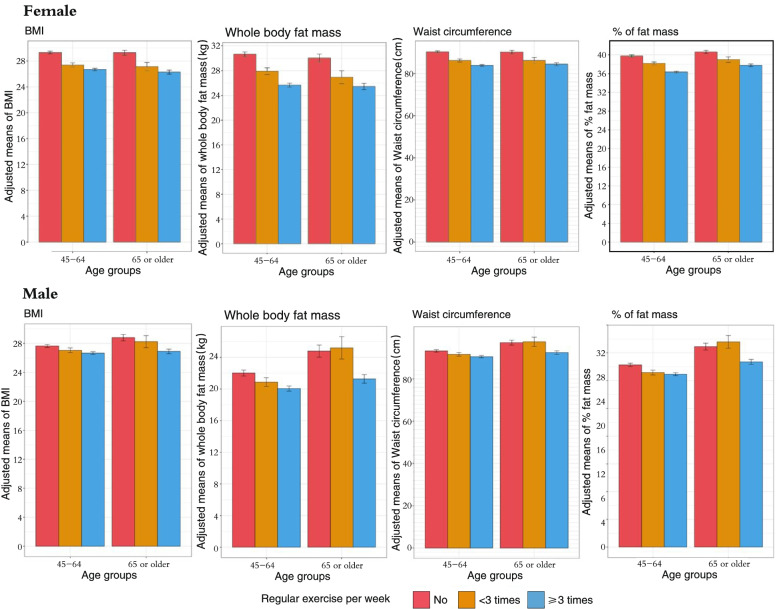
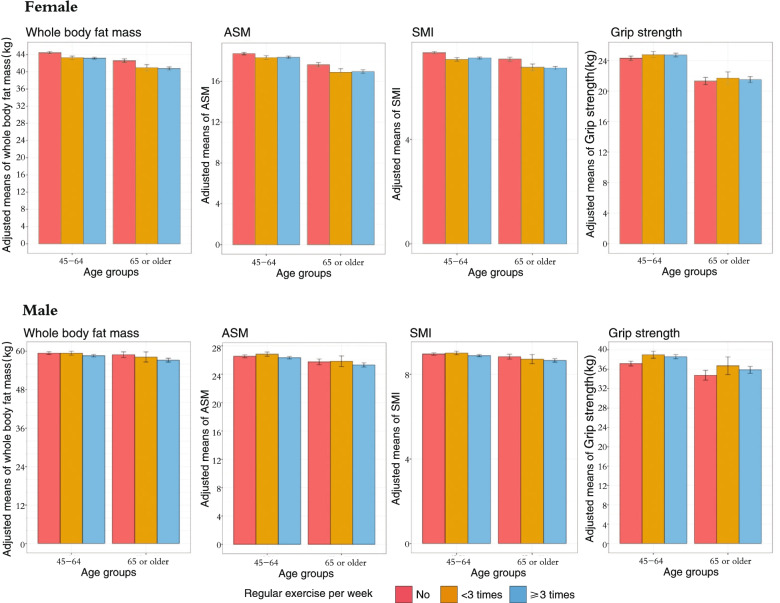
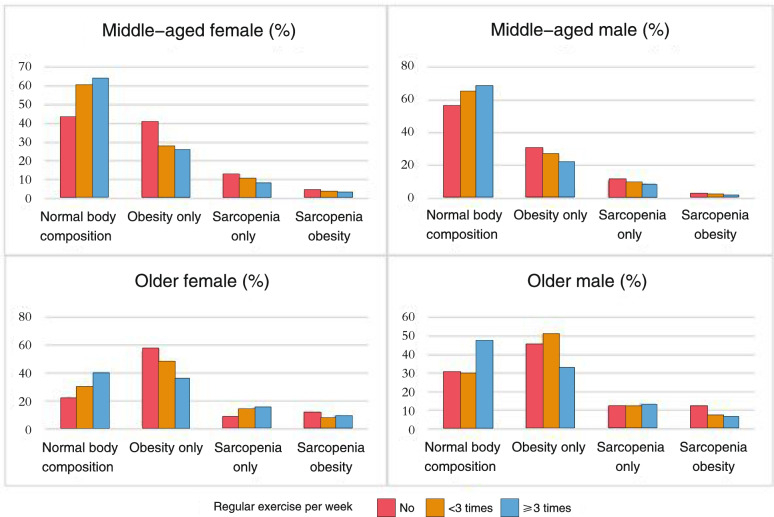
Background: This study examined the associations between physical activity, obesity, and sarcopenia in middle-aged and older adults. Methods: We analyzed the data of 8, 919 study participants aged between 45 to 97 (mean age = 57.2 ± 8.8) from a Southern state in the United States. Self-reported physical activity was classified to regular exercise ≥ 3 times/week, < 3 times/week, and no regular exercise. Associations between physical activity, obesity and sarcopenia were explored with generalized linear models and ordinal logistic regressions stratified by age (middle-aged and older adults) and gender adjusting for covariates. Results: In middle-aged and older adults, all examined obesity related traits (e.g., body mass index, waist circumference) were inversely associated with physical activity levels ( p < 0.01) in both genders. Exercising ≥ 3 times/week was negatively associated with lean mass indicators (e.g., appendicular lean mass) in middle-aged and older females ( p < 0.01), while the negative associations become positive after adjusting for weight. Positive associations between physical activity and grip strength were only found in middle-aged males ( p < 0.05). Ordinal logistic regression revealed that those exercising ≥ 3 times/week were less likely to have obesity, sarcopenia, and sarcopenia obesity in all groups ( p < 0.01), except for sarcopenia in older males and females ( p > 0.05). Positive associations of exercising < 3 times/week with sarcopenia and sarcopenia obesity were only found in middled adults. Conclusion: The associations of exercise frequency with obesity and sarcopenia vary considerably across gender and age groups. Exercise programs need to be individualized to optimize health benefits. Future research exploring physical activity strategies to balance weight reduction and lean mass maintaining is warranted in middle-aged and especially older adults.
Overview
The claims and statistics of this paper haven’t been checked yet.
Free: it reads the open-access text and checks the first 5 claims that cite a source we can check. Create a free account to check every claim.
Integrity signals
Registry
Cites
Statistics
Figures
Verification
Claims the paper makes
The claims and statistics of this paper haven’t been checked yet.
Free: it reads the open-access text and checks the first 5 claims that cite a source we can check. Create a free account to check every claim.
Claims other papers make about this one
Each is checked against this paper’s own text: does it say what the citing paper says it does?
In the citing paper
“Physical inactivity and a sedentary lifestyle are common risk factors for developing sarcopenic obesity87.”
From Sarcopenic obesity in older adults: a clinical overview (2024) · cites this paper as [87]
Self-check
Percentages, sums and reported differences re-computed from the paper’s own numbers.
The self-check needs the paper’s full text.
Citations
Cites
Sarcopenia: revised European consensus on definition and diagnosis
Cruz-Jentoft, A. J., Bahat, G., Bauer, J., Boirie, Y., Bruyère, O., Cederholm, T., Cooper, C., Landi, F., Rolland, Y., Sayer, A. A., et al. (2019) · Age and Ageing · doi:10.1093/ageing/afy169 · Cited by 13,818
The underappreciated role of muscle in health and disease
Wolfe, R. R. (2006) · The American Journal of Clinical Nutrition · doi:10.1093/ajcn/84.3.475 · Cited by 1,537 · cited 3×
“, hypertension, diabetes, stroke) [51].”
BackgroundInternational exercise recommendations in older adults (ICFSR): Expert consensus guidelines
Izquierdo, M., Merchant, R. A., Morley, J. E., Anker, S. D., Aprahamian, I., Arai, H., Aubertin-Leheudre, M., Bernabei, R., Cadore, E. L., Cesari, M., et al. (2021) · The Journal of nutrition, health and aging · doi:10.1007/s12603-021-1665-8 · Cited by 1,247 · cited 2×
“Physical activity is any body movement that increases energy expenditure; exercise is a subcategory of physical activity which is planned, structured, repetitive, and focusing on improvement or maintenance of physical fitness [37].”
BackgroundJohnston, R., Jones, K., & Manley, D. (2018) · Quality & Quantity · doi:10.1007/s11135-017-0584-6 · Cited by 1,181
Sarcopenia in daily practice: assessment and management
Beaudart, C., McCloskey, E., Bruyère, O., Cesari, M., Rolland, Y., Rizzoli, R., Araujo de Carvalho, I., Amuthavalli Thiyagarajan, J., Bautmans, I., Bertière, M.-C., et al. (2016) · BMC Geriatrics · doi:10.1186/s12877-016-0349-4 · Cited by 850
Aerobic or Resistance Exercise, or Both, in Dieting Obese Older Adults
Villareal, D. T., Aguirre, L., Gurney, A. B., Waters, D. L., Sinacore, D. R., Colombo, E., Armamento-Villareal, R., & Qualls, C. (2017) · New England Journal of Medicine · doi:10.1056/nejmoa1616338 · Cited by 754
Muscle tissue changes with aging
Volpi, E., Nazemi, R., & Fujita, S. (2004) · Current Opinion in Clinical Nutrition and Metabolic Care · doi:10.1097/01.mco.0000134362.76653.b2 · Cited by 569
Influence of Resistance Exercise on Lean Body Mass in Aging Adults: A Meta-Analysis
PETERSON, M. D., SEN, A., & GORDON, P. M. (2011) · Medicine & Science in Sports & Exercise · doi:10.1249/mss.0b013e3181eb6265 · Cited by 558 · cited 1×
“Therefore, a personalized lifestyle intervention may yield the best muscle mass outcomes in the aging population [56, 57].”
BackgroundOsteosarcopenia: epidemiology, diagnosis, and treatment—facts and numbers
Kirk, B., Zanker, J., & Duque, G. (2020) · Journal of Cachexia, Sarcopenia and Muscle · doi:10.1002/jcsm.12567 · Cited by 529
The impact of obesity on skeletal muscle strength and structure through adolescence to old age
Tomlinson, D. J., Erskine, R. M., Morse, C. I., Winwood, K., & Onambélé-Pearson, G. (2016) · Biogerontology · doi:10.1007/s10522-015-9626-4 · Cited by 496 · cited 1×
“Previous evidence show that increased adiposity could be a chronic physical overload stimulus on the antigravity muscles, such as quadriceps and calf, thus increasing muscle size and strength [58].”
BackgroundSteffl, M., Bohannon, R. W., Sontakova, L., Tufano, J. J., Shiells, K., & Holmerova, I. (2017) · Clinical Interventions in Aging · doi:10.2147/cia.s132940 · Cited by 480 · cited 3×
“Some possible reasons are that: 1) the previous studies didn’t differentiate sarcopenia and sarcopenic obesity, so different results might be found [20, 62], or the studies were conducted in other countries [22, 23].”
BackgroundResultSedentary behaviour and health in adults: an overview of systematic reviews
Saunders, T. J., McIsaac, T., Douillette, K., Gaulton, N., Hunter, S., Rhodes, R. E., Prince, S. A., Carson, V., Chaput, J.-P., Chastin, S., et al. (2020) · Applied Physiology, Nutrition, and Metabolism · doi:10.1139/apnm-2020-0272 · Cited by 469
O’Donovan, G., Lee, I.-M., Hamer, M., & Stamatakis, E. (2017) · JAMA Internal Medicine · doi:10.1001/jamainternmed.2016.8014 · Cited by 462 · cited 1×
“, 1 to 2 times a week) is associated with health benefits compared to no physical activity [35, 36].”
BackgroundNewman, A. B., Lee, J. S., Visser, M., Goodpaster, B. H., Kritchevsky, S. B., Tylavsky, F. A., Nevitt, M., & Harris, T. B. (2005) · The American Journal of Clinical Nutrition · doi:10.1093/ajcn/82.4.872 · Cited by 445 · cited 2×
“For sarcopenia-related traits, in addition to those covariates adjusted for obesity related traits (model 1 s), we also adjusted for body weight because weight loss may be the result of a decrease in lean mass, especially in older adults [16, 43, 44].”
BackgroundThe Scientific Foundation for the Physical Activity Guidelines for Americans, 2nd Edition
Powell, K. E., King, A. C., Buchner, D. M., Campbell, W. W., DiPietro, L., Erickson, K. I., Hillman, C. H., Jakicic, J. M., Janz, K. F., Katzmarzyk, P. T., et al. (2019) · Journal of Physical Activity and Health · doi:10.1123/jpah.2018-0618 · Cited by 350
Xu, B. Y., Yan, S., Low, L. L., Vasanwala, F. F., & Low, S. G. (2019) · BMC Musculoskeletal Disorders · doi:10.1186/s12891-019-2950-0 · Cited by 303
Stokes, T., Hector, A., Morton, R., McGlory, C., & Phillips, S. (2018) · Nutrients · doi:10.3390/nu10020180 · Cited by 263 · cited 1×
“Additionally, energy restriction along with more exercise was reported to be related to muscle reduction [55].”
BackgroundKim, J. E., O’Connor, L. E., Sands, L. P., Slebodnik, M. B., & Campbell, W. W. (2016) · Nutrition Reviews · doi:10.1093/nutrit/nuv065 · Cited by 238 · cited 1×
“, protein) is essential to lean muscle mass [66], but only calcium rich food consumption was examined in the current study.”
BackgroundYoon, D. H., Lee, J.-Y., & Song, W. (2018) · The Journal of nutrition, health and aging · doi:10.1007/s12603-018-1090-9 · Cited by 232
Healthy strategies for successful weight loss and weight maintenance: a systematic review
Ramage, S., Farmer, A., Apps Eccles, K., & McCargar, L. (2014) · Applied Physiology, Nutrition, and Metabolism · doi:10.1139/apnm-2013-0026 · Cited by 207
Slattery, M., McDonald, A., Bild, D., Caan, B., Hilner, J., Jacobs, D., & Liu, K. (1992) · The American Journal of Clinical Nutrition · doi:10.1093/ajcn/55.5.943 · Cited by 205
Speakman, J. R., & Westerterp, K. R. (2010) · The American Journal of Clinical Nutrition · doi:10.3945/ajcn.2009.28540 · Cited by 198
Oliveira, J. S., Pinheiro, M. B., Fairhall, N., Walsh, S., Chesterfield Franks, T., Kwok, W., Bauman, A., & Sherrington, C. (2020) · Journal of Physical Activity and Health · doi:10.1123/jpah.2020-0323 · Cited by 198 · cited 1×
“In addition, a recent review reported that there is limited evidence of any effect of physical activity on sarcopenia based on clinical trials and prospectus studies, but promising results were found from observational studies [19].”
BackgroundCorona, G., Giagulli, V. A., Maseroli, E., Vignozzi, L., Aversa, A., Zitzmann, M., Saad, F., Mannucci, E., & Maggi, M. (2016) · Journal of Endocrinological Investigation · doi:10.1007/s40618-016-0480-2 · Cited by 185
Effects of Exercise Training on Handgrip Strength in Older Adults: A Meta-Analytical Review
Labott, B. K., Bucht, H., Morat, M., Morat, T., & Donath, L. (2019) · Gerontology · doi:10.1159/000501203 · Cited by 181
Stofan, J. R., DiPietro, L., Davis, D., Kohl, H. W., & Blair, S. N. (1998) · American Journal of Public Health · doi:10.2105/ajph.88.12.1807 · Cited by 180 · cited 1×
“, 1 to 2 times a week) is associated with health benefits compared to no physical activity [35, 36].”
BackgroundStoner, L., Rowlands, D., Morrison, A., Credeur, D., Hamlin, M., Gaffney, K., Lambrick, D., & Matheson, A. (2016) · Sports Medicine · doi:10.1007/s40279-016-0537-6 · Cited by 174
Ryu, M., Jo, J., Lee, Y., Chung, Y.-S., Kim, K.-M., & Baek, W.-C. (2013) · Age and Ageing · doi:10.1093/ageing/aft063 · Cited by 168 · cited 1×
“Some possible reasons are that: 1) the previous studies didn’t differentiate sarcopenia and sarcopenic obesity, so different results might be found [20, 62], or the studies were conducted in other countries [22, 23].”
ResultAune, D., Sen, A., Schlesinger, S., Norat, T., Janszky, I., Romundstad, P., Tonstad, S., Riboli, E., & Vatten, L. J. (2017) · European Journal of Epidemiology · doi:10.1007/s10654-017-0232-4 · Cited by 167 · cited 1×
“Given BMI, fat mass and percent of body fat are closely related to a numerous metabolic and disease outcome [49, 50], our study findings affirm that regular exercise might be an effective way to improve health outcomes, and exercise three times per week may increase the benefits.”
BackgroundToward exercise as personalized medicine.
Buford, T. W., Roberts, M. D., & Church, T. S. (2013) · Sports Medicine · doi:10.1007/s40279-013-0018-0 · Cited by 158
Seimon, R. V., Wild-Taylor, A. L., Keating, S. E., McClintock, S., Harper, C., Gibson, A. A., Johnson, N. A., Fernando, H. A., Markovic, T. P., Center, J. R., et al. (2019) · JAMA Network Open · doi:10.1001/jamanetworkopen.2019.13733 · Cited by 152
Bone and Muscle Crosstalk in Aging
He, C., He, W., Hou, J., Chen, K., Huang, M., Yang, M., Luo, X., & Li, C. (2020) · Frontiers in Cell and Developmental Biology · doi:10.3389/fcell.2020.585644 · Cited by 149
Exercise, energy balance and body composition
Westerterp, K. R. (2018) · European Journal of Clinical Nutrition · doi:10.1038/s41430-018-0180-4 · Cited by 142 · cited 1×
“Engaging in physical activity is beneficial to various health outcomes, including healthier body composition [9, 10].”
BackgroundBody composition data for individuals 8 years of age and older: U.S. population, 1999-2004.
Borrud, L. G., Flegal, K. M., Looker, A. C., Everhart, J. E., Harris, T. B., & Shepherd, J. (2010) · PubMed · Cited by 140
Ramírez‐Vélez, R., Correa‐Bautista, J. E., Tordecilla‐Sanders, A., Ojeda-Pardo, M. L., Cobo-Mejía, E. A., Castellanos-Vega, R. D. P., García‐Hermoso, A., González‐Jiménez, E., Schmidt‐RioValle, J., & González‐Ruíz, K. (2017) · Nutrients · doi:10.3390/nu9091009 · Cited by 127
Changes in physical activity over the lifespan: impact on body composition and sarcopenic obesity
Westerterp, K. R. (2018) · Obesity Reviews · doi:10.1111/obr.12781 · Cited by 118
Aggio, D. A., Sartini, C., Papacosta, O., Lennon, L. T., Ash, S., Whincup, P. H., Wannamethee, S. G., & Jefferis, B. J. (2016) · Preventive Medicine · doi:10.1016/j.ypmed.2016.08.040 · Cited by 110 · cited 1×
“Some possible reasons are that: 1) the previous studies didn’t differentiate sarcopenia and sarcopenic obesity, so different results might be found [20, 62], or the studies were conducted in other countries [22, 23].”
ResultEffect of Physical Activity versus Health Education on Physical Function, Grip Strength and Mobility
Santanasto, A. J., Glynn, N. W., Lovato, L. C., Blair, S. N., Fielding, R. A., Gill, T. M., Guralnik, J. M., Hsu, F., King, A. C., Strotmeyer, E. S., et al. (2017) · Journal of the American Geriatrics Society · doi:10.1111/jgs.14804 · Cited by 103 · cited 1×
“The physical activity effect on grip strength in older adults is inconsistent from current literature [60, 61].”
BackgroundAge-Specific Search Strategies for Medline
Kastner, M., Wilczynski, N. L., Walker-Dilks, C., McKibbon, K. A., & Haynes, B. (2006) · Journal of Medical Internet Research · doi:10.2196/jmir.8.4.e25 · Cited by 95 · cited 2×
“According to muscle declining significantly around one decade starting 30’s, as well as the classification of previous study and the age-specific medical subject heading, age in years was categorized into middle-aged group (45 to 64 years old) and older group (65 and over) [28, 42].”
BackgroundMethodPhysical activity and sarcopenia in older adults
Meier, N. F., & Lee, D.-C. (2019) · Aging Clinical and Experimental Research · doi:10.1007/s40520-019-01371-8 · Cited by 94 · cited 1×
“Some possible reasons are that: 1) the previous studies didn’t differentiate sarcopenia and sarcopenic obesity, so different results might be found [20, 62], or the studies were conducted in other countries [22, 23].”
ResultKim, S.-H., Kim, T., & Hwang, H. (2013) · Archives of Gerontology and Geriatrics · doi:10.1016/j.archger.2012.12.009 · Cited by 92
Du, Y. N., Zhao, L., Xu, Q., Wu, K.-H., & Deng, H. (2017) · Osteoporosis International · doi:10.1007/s00198-017-3951-1 · Cited by 84 · cited 1×
“The detailed inclusion and exclusion criteria can be found in previous publications [30, 31].”
BackgroundSelf-citationOsteoporosis from an Endocrine Perspective: The Role of Hormonal Changes in the Elderly
Cannarella, R., Barbagallo, F., Condorelli, R. A., Aversa, A., Vignera, S. L., & Calogero, A. E. (2019) · Journal of Clinical Medicine · doi:10.3390/jcm8101564 · Cited by 83
Metabolomic profiles associated with bone mineral density in US Caucasian women
Zhao, Q., Shen, H., Su, K., Zhang, J.-G., Tian, Q., Zhao, L., Qiu, C., Zhang, Q., Garrett, T. J., Liu, J., et al. (2018) · Nutrition & Metabolism · doi:10.1186/s12986-018-0296-5 · Cited by 82 · cited 1×
“The physical activity measures have been used in several published scientifical articles [8, 34].”
MethodSelf-citationKim, K.-B., Kim, K., Kim, C., Kang, S.-J., Kim, H. J., Yoon, S., & Shin, Y.-A. (2019) · Journal of Obesity & Metabolic Syndrome · doi:10.7570/jomes.2019.28.4.278 · Cited by 79
Relationship Among Alcohol Intake, Body Fat, and Physical Activity: A Population-Based Study
Liangpunsakul, S., Crabb, D. W., & Qi, R. A. (2010) · Annals of Epidemiology · doi:10.1016/j.annepidem.2010.05.014 · Cited by 75
Later Meal and Sleep Timing Predicts Higher Percent Body Fat
Thomas, E. A., Zaman, A., Cornier, M., Catenacci, V. A., Tussey, E. J., Grau, L., Arbet, J., Broussard, J. L., & Rynders, C. A. (2020) · Nutrients · doi:10.3390/nu13010073 · Cited by 70
Fleury, N., Geldenhuys, S., & Gorman, S. (2016) · International Journal of Environmental Research and Public Health · doi:10.3390/ijerph13100999 · Cited by 69
Radavelli‐Bagatini, S., Zhu, K., Lewis, J. R., Dhaliwal, S. S., & Prince, R. L. (2013) · Journal of the Academy of Nutrition and Dietetics · doi:10.1016/j.jand.2013.05.019 · Cited by 67
von Berens, Å., Obling, S. R., Nydahl, M., Koochek, A., Lissner, L., Skoog, I., Frändin, K., Skoglund, E., Rothenberg, E., & Cederholm, T. (2020) · BMC Geriatrics · doi:10.1186/s12877-020-01578-9 · Cited by 62
Relevance to assess and preserve muscle strength in aging field
Buckinx, F., & Aubertin‐Leheudre, M. (2019) · Progress in Neuro-Psychopharmacology and Biological Psychiatry · doi:10.1016/j.pnpbp.2019.109663 · Cited by 60
Ning, H., Du, Y. N., Zhao, L., Tian, Q., Feng, H., & Deng, H. (2020) · Osteoporosis International · doi:10.1007/s00198-020-05744-y · Cited by 56 · cited 1×
“The detailed inclusion and exclusion criteria can be found in previous publications [30, 31].”
BackgroundSelf-citationKEMMLER, W. K., & von Stengel, S. (2012) · Scandinavian Journal of Medicine and Science in Sports · doi:10.1111/sms.12024 · Cited by 52 · cited 1×
“However, it is evidenced that weekly exercise frequency is essential for health benefits [63, 64].”
BackgroundZeng, P., Han, Y., Pang, J., Wu, S., Gong, H., Zhu, J., Li, J., & Zhang, T. (2016) · BMC Geriatrics · doi:10.1186/s12877-016-0220-7 · Cited by 46
Barrow, D. R., Abbate, L. M., Paquette, M. R., Driban, J. B., Vincent, H. K., Newman, C., Messier, S. P., Ambrose, K. R., & Shultz, S. P. (2019) · BMC Musculoskeletal Disorders · doi:10.1186/s12891-019-3004-3 · Cited by 42 · cited 1×
“The findings are consistent with a widely accepted evidence exercise can decrease BMI and fat mass [46, 47].”
BackgroundGraff‐Iversen, S., Hewitt, S., Forsén, L., Grøtvedt, L., & Ariansen, I. (2019) · BMC Public Health · doi:10.1186/s12889-019-7807-9 · Cited by 40
Park, H., Jung, W., Kim, S.-W., & Lim, K. (2021) · Frontiers in Physiology · doi:10.3389/fphys.2021.706259 · Cited by 40
Veen, J., Rojas, D. M., Nilsson, A. E., & Kadi, F. (2021) · International Journal of Environmental Research and Public Health · doi:10.3390/ijerph18030989 · Cited by 35
Muscle tissue changes with aging.
Pereira, A. F., Silva, A. J., Costa, A. M., Monteiro, A. M., Bastos, E., & Marques, M. C. (2013) · Portuguese National Funding Agency for Science, Research and Technology (RCAAP Project by FCT) · doi:10.20344/amp.542 · Cited by 30
Obesity is a public health emergency
Ayton, A. K., & Ibrahim, A. (2019) · BMJ · doi:10.1136/bmj.l5463 · Cited by 25 · cited 1×
“Therefore, maintenance of muscle mass might have been overlooked or under emphasized for weight loss purpose in middle-aged and older adults in current practice, with the norm that obesity is a major public health emergency and crisis [59].”
BackgroundInvestigating musculoskeletal health and wellbeing; a cohort study protocol
Millar, B., McWilliams, D. F., Abhishek, A., Akin-Akinyosoye, K., Auer, D. P., Chapman, V., Doherty, M., Ferguson, E., Gladman, J. R. F., Greenhaff, P. L., et al. (2020) · BMC Musculoskeletal Disorders · doi:10.1186/s12891-020-03195-4 · Cited by 25
Association of lean body mass to menopausal symptoms: The Study of Women's Health Across the Nation
Woods, R., Hess, R., Biddington, C., & Federico, M. (2020) · Women s Midlife Health · doi:10.1186/s40695-020-00058-9 · Cited by 24 · cited 1×
“, obesity, diabetes, sarcopenia) throughout one’s life span [51, 52].”
Watanabe, D., Yoshida, T., Nakagata, T., Sawada, N., Yamada, Y., Kurotani, K., Tanaka, K., Okabayashi, M., Shimada, H., Takimoto, H., et al. (2021) · BMC Public Health · doi:10.1186/s12889-021-10844-3 · Cited by 23
Trudelle-Jackson, E. J., Jackson, A. W., & Morrow, J. R. (2011) · American Journal of Public Health · doi:10.2105/ajph.2011.300175 · Cited by 22
Strength training and body composition in middle-age women
Burrup, R., Tucker, L. A., LeCheminant, J. D., & Bailey, B. W. (2017) · The Journal of Sports Medicine and Physical Fitness · doi:10.23736/s0022-4707.17.06706-8 · Cited by 19 · cited 1×
“Exercise, especially resistance training, has been evidenced to be an effective approach in increasing muscle mass [51, 54].”
BackgroundZhou, Y., Wu, K., Shen, H., Zhang, J., Deng, H., & Zhao, L. (2019) · Scientific Reports · doi:10.1038/s41598-019-48734-9 · Cited by 13
Self-citationDuração da Terapêutica Antibiótica na Meningite Bacteriana
Pereira, P. R., Borges, F., & Mansinho, K. (2013) · Acta Médica Portuguesa · doi:10.20344/amp.4012 · Cited by 3
Cited by
Sarcopenic obesity in older adults: a clinical overview
Prado, C. M., Batsis, J. A., Donini, L. M., Gonzalez, M. C., & Siervo, M. (2024) · Nature Reviews Endocrinology · doi:10.1038/s41574-023-00943-z · Cited by 355
“Physical inactivity and a sedentary lifestyle are common risk factors for developing sarcopenic obesity 87 .”
Molecular Mechanisms of Inflammation in Sarcopenia: Diagnosis and Therapeutic Update
Jimenez-Gutierrez, G. E., Martínez-Gómez, L. E., Martínez-Armenta, C., Pineda, C., Martínez-Nava, G. A., & Lopez-Reyes, A. (2022) · Cells · doi:10.3390/cells11152359 · Cited by 231
“A lack of physical activity or a sedentary lifestyle leads to secondary sarcopenia in earlier life stages [10,11].”
BackgroundSánchez‐Sánchez, J. L., He, L., Morales, J. S., Barreto, P. D. S., Jiménez‐Pavón, D., Carbonell‐Baeza, A., Herrero, Á. C., Gallardo‐Gómez, D., Lucía, A., Cruz, B. D. P., et al. (2024) · The Lancet Healthy Longevity · doi:10.1016/s2666-7568(23)00241-6 · Cited by 128
Wannamethee, S. G., & Atkins, J. L. (2023) · Current Diabetes Reports · doi:10.1007/s11892-023-01522-2 · Cited by 49
Research progress on sarcopenia in the musculoskeletal system
Mao, X., Lv, K., Qi, W., Cheng, W., Li, T., Sun, Y., Jin, H., Pan, H., & Wang, D. (2025) · Bone Research · doi:10.1038/s41413-025-00455-8 · Cited by 37
“6 9 Age-related skeletal muscle remodeling is characterized by a shift from fast-twitch (type II) to slow-twitch (type I) fi ber composition, accompanied by progressive intramuscular and intermuscular fat in fi ltration (myosteatosis) and a reduction in type II fi ber-associated satellite cell…”
Metadata
- Authors
- Du, Y., Xu, T., Yin, Z., Espinoza, S., Xie, Y., Gentry, C., Tian, Q., Zhao, L.-J., Shen, H., Luo, Z., & Deng, H.-W.
- Affiliations
- The University of Texas at San Antonio Health Science Center (US)
- University of Iowa (US)
- The University of Texas at San Antonio (US)
- Washington University in St. Louis (US)
- Tulane University (US)
- Corresponding author
- Deng, Hong-Wen
- Venue
- BMC Public Health
- Published
- 2022-05-05
- Volume
- 22
- Issue
- 1
- Pages
- 896-896
- ISSN
- 1471-2458 (ISSN-L)
- PMC
- PMC9074188
- OpenAlex
- W4228998251
- Cited by
- 39
- References
- 67
- Citations by year
- 2026: 9 · 2025: 13 · 2024: 8 · 2023: 8 · 2022: 1
- FWCI
- 4.64
- Type
- journal article
- Language
- en
- Open access
- gold
- doi.org
- Licence
- cc-by
- creativecommons.org/licenses/by/4.0 (tdm)
- creativecommons.org/licenses/by/4.0 (vor)
- Locations
- BMC Public Health (publishedVersion, cc-by)
- PubMed Central (publishedVersion, cc-by)
- PubMed (publishedVersion)
- DOAJ (DOAJ: Directory of Open Access Journals) (submittedVersion, cc-by-sa)
- Funders
- Tulane University (U19AG055373, R01AR059781, R01AR069055, R01MH104680)
- National Institutes of Health
- National Institute on Aging (R01AG061917, R01AG026564, U19AG055373)
- National Institute of Mental Health (R01MH104680)
- Fogarty International Center (R03TW008221)
- National Institute of Arthritis and Musculoskeletal and Skin Diseases (R01AR059781, R01AR069055, R01AR057049)
- Topics
- Health Sciences › Medicine › Physiology (medical) › Nutrition and Health in Aging
- Health Sciences › Medicine › Public Health, Environmental and Occupational Health › Physical Activity and Health
- Health Sciences › Medicine › Geriatrics and Gerontology › Frailty in Older Adults
- Keywords
- physical activity, sarcopenia, sarcopenic obesity, obesity, middle-aged adults, older adults, exercise frequency, appendicular lean mass, grip strength, body mass index, waist circumference, sex differences, age differences
- MeSH terms
- Aged, Aged, 80 and over, Body Composition, Female, Humans, Male, Middle Aged, Obesity, Osteoporosis, Exercise, Waist Circumference, Sarcopenia
About these checks
Registry, retraction, Cites and statistics results are computed, not judged, with one exception: a printed reference that no index lists is read once by a model before it counts as a citation error. Claims are extracted by a model and kept only when their quote appears verbatim in the text; each cited source is then checked, with a model’s help, for whether it says what the claim relies on. Those verdicts can be wrong — read the claim’s quote and the cited source before relying on one.
Statistics and arithmetic are recomputed, not judged.
Confidence bands are shown only for fields calibrated on our annotated test set. None is calibrated yet, so no band is shown.
What counts as a claim ›How we measure confidence ›How we check this ›
Are you an author, or do you see a problem with this page? Request a review
Data sources
Bibliographic data: Semantic Scholar, OpenAlex, Crossref.
Contains information from the Semantic Scholar Academic Graph Datasets, made available under the ODC Attribution License (ODC-BY 1.0).
Semantic Scholar’s data is described in: Kinney, R., et al. (2023). The Semantic Scholar Open Data Platform. arXiv:2301.10140.
