

Can mental health treatments help prevent or reduce intimate partner violence in low- and middle-income countries? A systematic review
Open accessThe DOI matches its Crossref record; 64 of the 64 references it cites were found in a registry or an index.
Abstract
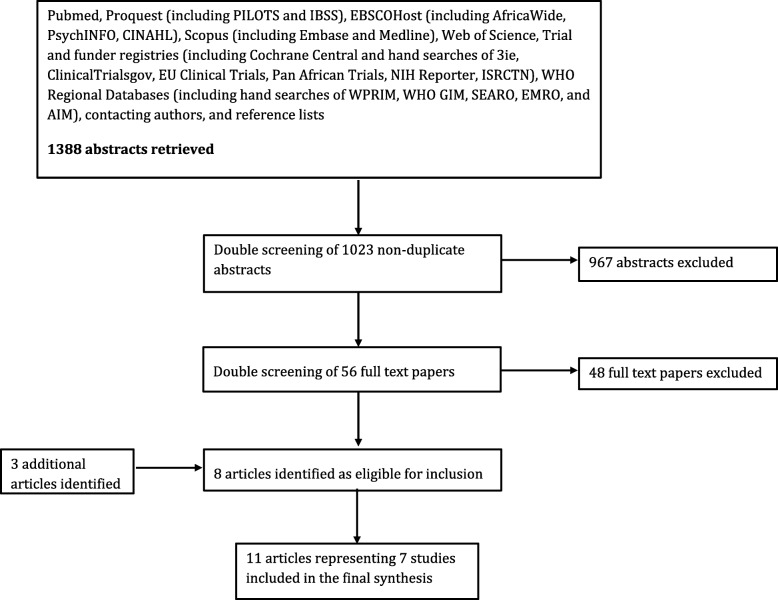
BACKGROUND: Epidemiological research suggests an interrelationship between mental health problems and the (re)occurrence of intimate partner violence (IPV). However, little is known about the impact of mental health treatments on IPV victimization or perpetration, especially in low- and middle-income countries (LMIC). METHODS: We conducted a systematic review to identify prospective, controlled studies of mental health treatments in LMIC. We defined 'mental health treatment' as an intervention for individuals experiencing mental ill health (including substance misuse) including a substantial psychosocial or pharmacological component. Studies had to measure a mental health and IPV outcome. We searched across multi-disciplinary databases using a structured search strategy. Screening of title/abstracts and full-text eligibility assessments were conducted by two researchers independently, data were extracted using a piloted spreadsheet, and a narrative synthesis was generated. RESULTS: We identified seven studies reported in 11 papers conducted in five middle-income countries. With the exception of blinding, studies overall showed acceptable levels of risk of bias. Four of the seven studies focused on dedicated mental health treatments in various populations, including: common mental disorders in earthquake survivors; depression in primary care; alcohol misuse in men; and alcohol misuse in female adult sex workers. The dedicated mental health treatments targeting depression or alcohol misuse consistently reduced levels of these outcomes. The two studies targeting depression also reduced short-term IPV, but no IPV benefits were identified in the two alcohol-focused studies. The other three studies evaluated integrated interventions, in which a focus on substance misuse was part of efforts to reduce HIV/AIDS and violence against particularly vulnerable women. In contrast to the dedicated mental health interventions, the integrated interventions did not consistently reduce mental ill health or alcohol misuse compared to control conditions. CONCLUSIONS: Too few studies have been conducted to judge whether mental health treatments may provide a beneficial strategy to prevent or reduce IPV in LMIC. Key future research questions include: whether promising initial evidence on the effects of depression interventions on reducing IPV hold more broadly, the required intensity of mental health components in integrated interventions, and the identification of mechanisms of IPV that are amenable to mental health intervention.
Overview
The claims and statistics of this paper haven’t been checked yet.
Free: it reads the open-access text and checks the first 5 claims that cite a source we can check. Create a free account to check every claim.
Integrity signals
Registry
Cites
Statistics
Figures
Verification
Claims the paper makes
The claims and statistics of this paper haven’t been checked yet.
Free: it reads the open-access text and checks the first 5 claims that cite a source we can check. Create a free account to check every claim.
Claims other papers make about this one
Each is checked against this paper’s own text: does it say what the citing paper says it does?
The source backs part of the claim, not all of it — or backs it for a different population, condition or comparison.
In the citing paper
“though there are limited numbers of high-quality studies available [14]”
From Psychological Interventions for Survivors of Intimate Partner Violence in Humanitarian Settings: An Overview of the Evidence and Implementation Considerations (2022) · cites this paper as [14]
Experimental — accuracy not yet measuredThe cited source says what the claim attributes to it.
In the citing paper
“involvement in mental health interventions can improve outcomes related to depression, PTS, and substance use problems [13,14]”
The cited source says what the claim attributes to it.
In the citing paper
“There is some evidence that psychological/psychosocial interventions can contribute to reductions in violence [12,14].”
Self-check
Percentages, sums and reported differences re-computed from the paper’s own numbers.
The self-check needs the paper’s full text.
Citations
Cites
Developing and evaluating complex interventions: the new Medical Research Council guidance
Craig, P., Dieppe, P., Macintyre, S., Michie, S., Nazareth, I., & Petticrew, M. (2008) · BMJ · doi:10.1136/bmj.a1655 · Cited by 10,995
The Revised Conflict Tactics Scales (CTS2): Development and Preliminary Psychometric Data
STRAUS, M. A., HAMBY, S. L., BONEY-McCOY, S., & SUGARMAN, D. B. (1996) · Journal of Family Issues · doi:10.1177/019251396017003001 · Cited by 6,923
Physical and mental health effects of intimate partner violence for men and women
Coker, A. L., Davis, K. E., Arias, I., Desai, S., Sanderson, M., Brandt, H. M., & Smith, P. H. (2002) · American Journal of Preventive Medicine · doi:10.1016/s0749-3797(02)00514-7 · Cited by 2,258
Violence Against Women: An Integrated, Ecological Framework
HEISE, L. L. (1998) · Violence Against Women · doi:10.1177/1077801298004003002 · Cited by 2,042
Ellsberg, M., Jansen, H. A., Heise, L., Watts, C. H., & Garcia-Moreno, C. (2008) · The Lancet · doi:10.1016/s0140-6736(08)60522-x · Cited by 1,820 · cited 1×
“Consequences of IPV include physical, reproductive, and mental health issues [3 – 5] and in severe cases, the resulting injuries can be fatal [6].”
BackgroundThe Global Prevalence of Intimate Partner Violence Against Women
Devries, K. M., Mak, J. Y. T., García-Moreno, C., Petzold, M., Child, J. C., Falder, G., Lim, S., Bacchus, L. J., Engell, R. E., Rosenfeld, L., et al. (2013) · Science · doi:10.1126/science.1240937 · Cited by 1,460 · cited 1×
“A comprehensive meta-analysis of 141 studies from 81 countries found that 30% of women and girls aged 15 and older have experienced IPV [2].”
BackgroundDevries, K. M., Mak, J. Y., Bacchus, L. J., Child, J. C., Falder, G., Petzold, M., Astbury, J., & Watts, C. H. (2013) · PLoS Medicine · doi:10.1371/journal.pmed.1001439 · Cited by 1,258 · cited 1×
“Mental health interventions may also reduce further risk for victimization by treating mental health problems among IPV survivors [23 – 25].”
BackgroundThe global prevalence of intimate partner homicide: a systematic review
Stöckl, H., Devries, K., Rotstein, A., Abrahams, N., Campbell, J., Watts, C., & Moreno, C. G. (2013) · The Lancet · doi:10.1016/s0140-6736(13)61030-2 · Cited by 955 · cited 1×
“Consequences of IPV include physical, reproductive, and mental health issues [3 – 5] and in severe cases, the resulting injuries can be fatal [6].”
BackgroundPoverty and mental disorders: breaking the cycle in low-income and middle-income countries
Lund, C., De Silva, M., Plagerson, S., Cooper, S., Chisholm, D., Das, J., Knapp, M., & Patel, V. (2011) · The Lancet · doi:10.1016/s0140-6736(11)60754-x · Cited by 929 · cited 1×
“Together with a university librarian, this search was iteratively refined by examining search strategies from relevant reviews (e.g. [35 – 37] of the impact of mental health interventions and a search of keywords of relevant and retrieved irrelevant articles.”
MethodSelf-citationPrevention of violence against women and girls: what does the evidence say?
Ellsberg, M., Arango, D. J., Morton, M., Gennari, F., Kiplesund, S., Contreras, M., & Watts, C. (2015) · The Lancet · doi:10.1016/s0140-6736(14)61703-7 · Cited by 875 · cited 2×
“, participatory learning activities focused on gender roles and conflict resolution skills), community mobilization interventions, and combined livelihood and training interventions for women [8].”
BackgroundThe health-systems response to violence against women
García-Moreno, C., Hegarty, K., d'Oliveira, A. F. L., Koziol-McLain, J., Colombini, M., & Feder, G. (2015) · The Lancet · doi:10.1016/s0140-6736(14)61837-7 · Cited by 735
Experiences of domestic violence and mental disorders: a systematic review and meta-analysis
Trevillion, K., Oram, S., Feder, G., & Howard, L. M. (2012) · PLoS ONE · doi:10.1371/journal.pone.0051740 · Cited by 729 · cited 1×
“Mental health interventions may also reduce further risk for victimization by treating mental health problems among IPV survivors [23 – 25].”
BackgroundBeydoun, H. A., Beydoun, M. A., Kaufman, J. S., Lo, B., & Zonderman, A. B. (2012) · Social Science & Medicine · doi:10.1016/j.socscimed.2012.04.025 · Cited by 680 · cited 1×
“Consequences of IPV include physical, reproductive, and mental health issues [3 – 5] and in severe cases, the resulting injuries can be fatal [6].”
BackgroundResearching violence against women
Ellsberg, M. C., & Heise, L. (2005) · World Health Organization eBooks · Cited by 634
Fulu, E., Jewkes, R., Roselli, T., & Garcia-Moreno, C. (2013) · The Lancet Global Health · doi:10.1016/s2214-109x(13)70074-3 · Cited by 523
Domestic Violence and Perinatal Mental Disorders: A Systematic Review and Meta-Analysis
Howard, L. M., Oram, S., Galley, H., Trevillion, K., & Feder, G. (2013) · PLoS Medicine · doi:10.1371/journal.pmed.1001452 · Cited by 491
Addressing violence against women: a call to action
García-Moreno, C., Zimmerman, C., Morris-Gehring, A., Heise, L., Amin, A., Abrahams, N., Montoya, O., Bhate-Deosthali, P., Kilonzo, N., & Watts, C. (2015) · The Lancet · doi:10.1016/s0140-6736(14)61830-4 · Cited by 483 · cited 1×
“IPV refers to behavior within an intimate relationship that causes, or has the potential to cause, physical, sexual, or psychological harm, including acts of physical aggression, sexual coercion, psychological abuse, and controlling behaviors [1].”
BackgroundPatel, V., Weobong, B., Weiss, H. A., Anand, A., Bhat, B., Katti, B., Dimidjian, S., Araya, R., Hollon, S. D., King, M., et al. (2017) · The Lancet · doi:10.1016/s0140-6736(16)31589-6 · Cited by 448 · cited 11×
“Second, Patel [45], Weobong [46] and coworkers evaluated a brief psychological treatment (behavioral activation) with men and women ( n = 495) screened for moderate to severe depression in primary care settings in Goa, India.”
BackgroundMethodInfluentialSelf-citationThe Effectiveness of Intervention Programs for Perpetrators and Victims of Intimate Partner Violence
Eckhardt, C. I., Murphy, C. M., Whitaker, D. J., Sprunger, J., Dykstra, R., & Woodard, K. (2013) · Partner Abuse · doi:10.1891/1946-6560.4.2.196 · Cited by 411 · cited 1×
“for couples in which male perpetrators receive treatment for anger dysregulation, alcohol misuse, and/ or common mental disorders [19, 20].”
BackgroundMurray, L. K., Dorsey, S., Haroz, E., Lee, C., Alsiary, M. M., Haydary, A., Weiss, W. M., & Bolton, P. (2014) · Cognitive and Behavioral Practice · doi:10.1016/j.cbpra.2013.06.005 · Cited by 403 · cited 1×
“…interventions, by combining treatment techniques for commonly comorbid mental health concerns, reduce the number of protocols for training health workers, making it more attractive for agencies not specialized in mental health to introduce mental health interventions as part of their work [59, 60].”
BackgroundSelf-citationA Systematic Review of Prevalence Studies of Gender-Based Violence in Complex Emergencies
Stark, L., & Ager, A. (2011) · Trauma, Violence, & Abuse · doi:10.1177/1524838011404252 · Cited by 386 · cited 1×
“, no studies in humanitarian settings or with refugee populations, where rates of IPV are particularly high [53]; no studies with older adolescents; no studies with sexual minorities); (4) limited geographical coverage (e.”
BackgroundRahman, A., Hamdani, S. U., Awan, N. R., Bryant, R. A., Dawson, K. S., Khan, M. F., Azeemi, M. M.-U.-H., Akhtar, P., Nazir, H., Chiumento, A., et al. (2016) · JAMA · doi:10.1001/jama.2016.17165 · Cited by 292 · cited 1×
“For example, transdiagnostic interventions, by combining treatment techniques for commonly comorbid mental health concerns, reduce the number of protocols for training health workers, making it more attractive for agencies not specialized in mental health to introduce mental health interventions as part of their work…”
BackgroundAnger, hostility, and male perpetrators of intimate partner violence: a meta-analytic review
Norlander, B., & Eckhardt, C. (2005) · Clinical Psychology Review · doi:10.1016/j.cpr.2004.10.001 · Cited by 247 · cited 1×
“Hazardous alcohol use [11 – 14], common mental disorders (posttraumatic stress disorder [PTSD], depression, anxiety) [12 – 16], and anger dysregulation [17] are known correlates of IPV perpetration.”
BackgroundThe Efficacy of a Relationship-Based HIV/STD Prevention Program for Heterosexual Couples
El-Bassel, N., Witte, S. S., Gilbert, L., Wu, E., Chang, M., Hill, J., & Steinglass, P. (2003) · American Journal of Public Health · doi:10.2105/ajph.93.6.963 · Cited by 243 · cited 1×
“The sexual risk reduction intervention was based on social cognitive and ecological theory [51, 52] and consisted of four sessions with a relationship focus (the relationship with the paying sexual partner).”
MethodBourey, C., Williams, W., Bernstein, E. E., & Stephenson, R. (2015) · BMC Public Health · doi:10.1186/s12889-015-2460-4 · Cited by 240 · cited 1×
“Together with a university librarian, this search was iteratively refined by examining search strategies from relevant reviews (e.g. [35 – 37] of the impact of mental health interventions and a search of keywords of relevant and retrieved irrelevant articles.”
MethodFleming, P. J., McCleary-Sills, J., Morton, M., Levtov, R., Heilman, B., & Barker, G. (2015) · PLOS ONE · doi:10.1371/journal.pone.0118639 · Cited by 236 · cited 1×
“, witnessing domestic violence in childhood, experiencing child abuse, alcohol abuse) which are strongly and consistently related to IPV [12, 13, 21, 32].”
BackgroundIverson, K. M., Gradus, J. L., Resick, P. A., Suvak, M. K., Smith, K. F., & Monson, C. M. (2011) · Journal of Consulting and Clinical Psychology · doi:10.1037/a0022512 · Cited by 236 · cited 2×
“Similarly, PTSD symptoms such as emotional numbing may challenge survivors’ ability to detect or respond to IPV risks [28, 30].”
BackgroundFulu, E., Miedema, S., Roselli, T., McCook, S., Chan, K. L., Haardörfer, R., Jewkes, R., Fulu, E., Jewkes, R., Warner, X., et al. (2017) · The Lancet Global Health · doi:10.1016/s2214-109x(17)30103-1 · Cited by 236 · cited 1×
“men with histories of childhood trauma and current anger dysregulation concerns, including harsh parenting [63].”
BackgroundNadkarni, A., Weobong, B., Weiss, H. A., McCambridge, J., Bhat, B., Katti, B., Murthy, P., King, M., McDaid, D., Park, A.-L., et al. (2017) · The Lancet · doi:10.1016/s0140-6736(16)31590-2 · Cited by 187 · cited 8×
“[47, 48] studied the benefits of a motivational interviewing-based intervention with male problem drinkers in primary care in Goa, India, and found benefits at 12 months for remission (adjusted prevalence ratio 1.”
BackgroundInfluentialSelf-citationCommunity-level correlates of intimate partner violence against women globally: A systematic review
VanderEnde, K. E., Yount, K. M., Dynes, M. M., & Sibley, L. (2012) · Social Science & Medicine · doi:10.1016/j.socscimed.2012.05.027 · Cited by 176 · cited 1×
“, gender-inequitable social norms and traditional notions of masculinity) [12, 13, 34] which are important correlates of IPV perpetration and victimization.”
BackgroundJewkes, R., Gibbs, A., Jama-Shai, N., Willan, S., Misselhorn, A., Mushinga, M., Washington, L., Mbatha, N., & Skiweyiya, Y. (2014) · BMC Public Health · doi:10.1186/1471-2458-14-1325 · Cited by 175 · cited 8×
“[38, 39] were reported as pilot studies.”
BackgroundMethodInfluentialUn modelo ecológico integrado para comprender la violencia contra las mujeres
Vives‐Cases, C. (2011) · Feminismo/s · doi:10.14198/fem.2011.18.16 · Cited by 159
Cognitive behavioural therapy for men who physically abuse their female partner
Smedslund, G., Dalsbø, T. K., Steiro, A., Winsvold, A., & Clench-Aas, J. (2007) · Cochrane Database of Systematic Reviews · doi:10.1002/14651858.cd006048.pub2 · Cited by 156 · cited 2×
“With regard to IPV perpetrators, there is limited evidence from HIC on cognitive behavioral interventions for male perpetrators of physical IPV [18].”
BackgroundRole of distinct PTSD symptoms in intimate partner reabuse: A prospective study
Krause, E. D., Kaltman, S., Goodman, L., & Dutton, M. A. (2006) · Journal of Traumatic Stress · doi:10.1002/jts.20136 · Cited by 153 · cited 1×
“Similarly, PTSD symptoms such as emotional numbing may challenge survivors’ ability to detect or respond to IPV risks [28, 30].”
BackgroundTsai, A. C., Tomlinson, M., Comulada, W. S., & Rotheram-Borus, M. J. (2016) · PLOS Medicine · doi:10.1371/journal.pmed.1001943 · Cited by 150 · cited 1×
“Longitudinal studies suggest that the relationship between IPV and mental ill health may in fact be cyclical: mental health impacts of IPV put women at increased risk for further abuse [26 – 29].”
BackgroundYount, K. M., Krause, K. H., & Miedema, S. S. (2017) · Social Science & Medicine · doi:10.1016/j.socscimed.2017.08.038 · Cited by 149
Weobong, B., Weiss, H. A., McDaid, D., Singla, D. R., Hollon, S. D., Nadkarni, A., Park, A.-L., Bhat, B., Katti, B., Anand, A., et al. (2017) · PLOS Medicine · doi:10.1371/journal.pmed.1002385 · Cited by 135 · cited 10×
“Second, Patel [45], Weobong [46] and coworkers evaluated a brief psychological treatment (behavioral activation) with men and women ( n = 495) screened for moderate to severe depression in primary care settings in Goa, India.”
BackgroundMethodInfluentialSelf-citationLong-Term Effects of an HIV/STI Sexual Risk Reduction Intervention for Heterosexual Couples
El‐Bassel, N., Witte, S. S., Gilbert, L., Wu, E., Chang, M., Hill, J., & Steinglass, P. (2005) · AIDS and Behavior · doi:10.1007/s10461-005-1677-0 · Cited by 124 · cited 1×
“The sexual risk reduction intervention was based on social cognitive and ecological theory [51, 52] and consisted of four sessions with a relationship focus (the relationship with the paying sexual partner).”
MethodPTSD Compromises Battered Women's Future Safety
Perez, S., & Johnson, D. M. (2008) · Journal of Interpersonal Violence · doi:10.1177/0886260507313528 · Cited by 121
Cases, C. V. (2011) · Dialnet (Universidad de la Rioja) · Cited by 115
An Updated Feminist View of Intimate Partner Violence
George, J., & Stith, S. M. (2014) · Family Process · doi:10.1111/famp.12073 · Cited by 110 · cited 1×
“We follow a multidimensional (“both/and”) perspective, where attention to mental health occurs as part of an analysis of the various factors – both individual and structural -- that contribute to IPV [22].”
BackgroundCapaldi, D. M., & Langhinrichsen-Rohling, J. (2012) · Prevention Science · doi:10.1007/s11121-012-0309-y · Cited by 100 · cited 3×
“, witnessing domestic violence in childhood, experiencing child abuse, alcohol abuse) which are strongly and consistently related to IPV [12, 13, 21, 32].”
BackgroundPredictors of Interpersonal Violence in the Household in Humanitarian Settings: A Systematic Review
Rubenstein, B. L., Lu, L. Z. N., MacFarlane, M., & Stark, L. (2020) · Trauma, Violence, & Abuse · doi:10.1177/1524838017738724 · Cited by 99 · cited 1×
“Hazardous alcohol use [11 – 14], common mental disorders (posttraumatic stress disorder [PTSD], depression, anxiety) [12 – 16], and anger dysregulation [17] are known correlates of IPV perpetration.”
BackgroundWechsberg, W. M., Jewkes, R., Novak, S. P., Kline, T., Myers, B., Browne, F. A., Carney, T., Morgan Lopez, A. A., & Parry, C. (2013) · BMJ Open · doi:10.1136/bmjopen-2013-002622 · Cited by 88 · cited 11×
“The Women’s Health CoOp intervention with vulnerable drug-using women in South Africa [42] did result in significantly greater improvements in drug abstinence in the intervention than the combined control arms (Odds Ratio [OR] = 1.”
BackgroundMethodInfluentialChibanda, D., Cowan, F. M., Healy, J. L., Abas, M., & Lund, C. (2015) · Tropical Medicine & International Health · doi:10.1111/tmi.12500 · Cited by 87
Self-citationL'Engle, K. L., Mwarogo, P., Kingola, N., Sinkele, W., & Weiner, D. H. (2014) · JAIDS Journal of Acquired Immune Deficiency Syndromes · doi:10.1097/qai.0000000000000335 · Cited by 85
Alcohol use and intimate partner violence among women and their partners in sub-Saharan Africa
Greene, M. C., Kane, J. C., & Tol, W. A. (2017) · Global Mental Health · doi:10.1017/gmh.2017.9 · Cited by 85 · cited 1×
“Hazardous alcohol use [11 – 14], common mental disorders (posttraumatic stress disorder [PTSD], depression, anxiety) [12 – 16], and anger dysregulation [17] are known correlates of IPV perpetration.”
BackgroundSelf-citationNadkarni, A., Weiss, H. A., Weobong, B., McDaid, D., Singla, D. R., Park, A.-L., Bhat, B., Katti, B., McCambridge, J., Murthy, P., et al. (2017) · PLOS Medicine · doi:10.1371/journal.pmed.1002386 · Cited by 80 · cited 7×
“[47, 48] studied the benefits of a motivational interviewing-based intervention with male problem drinkers in primary care in Goa, India, and found benefits at 12 months for remission (adjusted prevalence ratio 1.”
BackgroundInfluentialSelf-citationKim, J., & Lee, J. (2013) · Social Science & Medicine · doi:10.1016/j.socscimed.2013.10.014 · Cited by 76 · cited 1×
“Longitudinal studies suggest that the relationship between IPV and mental ill health may in fact be cyclical: mental health impacts of IPV put women at increased risk for further abuse [26 – 29].”
BackgroundTirado-Muñoz, J., Gilchrist, G., Farré, M., Hegarty, K., & Torrens, M. (2014) · Annals of Medicine · doi:10.3109/07853890.2014.941918 · Cited by 72 · cited 1×
“…behavioral and advocacy interventions (which commonly have psychosocial support elements) with IPV survivors in high-income settings identified 12 randomized controlled trials, and found that both showed impacts on physical and psychological but not sexual and combined IPV victimization [62].”
BackgroundIntegrated treatment options for male perpetrators of intimate partner violence
Crane, C. A., & Easton, C. J. (2017) · Drug and Alcohol Review · doi:10.1111/dar.12496 · Cited by 68 · cited 1×
“for couples in which male perpetrators receive treatment for anger dysregulation, alcohol misuse, and/ or common mental disorders [19, 20].”
BackgroundKane, J. C., Skavenski Van Wyk, S., Murray, S. M., Bolton, P., Melendez, F., Danielson, C. K., Chimponda, P., Munthali, S., & Murray, L. K. (2017) · Global Mental Health · doi:10.1017/gmh.2017.10 · Cited by 63 · cited 1×
“Several ongoing studies have begun to do this [56, 57].”
BackgroundSelf-citationCarlson, C. E., Chen, J., Chang, M., Batsukh, A., Toivgoo, A., Riedel, M., & Witte, S. S. (2012) · Journal of Interpersonal Violence · doi:10.1177/0886260511431439 · Cited by 62 · cited 8×
“Two of the seven studies [40, 41, 43, 44] specifically focused on female sex workers, and two studies were conducted with disadvantaged communities, i.”
BackgroundMethodInfluentialParcesepe, A. M., L′Engle, K. L., Martin, S. L., Green, S., Sinkele, W., Suchindran, C., Speizer, I. S., Mwarogo, P., & Kingola, N. (2016) · Drug and Alcohol Dependence · doi:10.1016/j.drugalcdep.2015.12.037 · Cited by 56 · cited 9×
“Two of the seven studies [40, 41, 43, 44] specifically focused on female sex workers, and two studies were conducted with disadvantaged communities, i.”
BackgroundInfluentialHall, B. J., Bolton, P. A., Annan, J., Kaysen, D., Robinette, K., Cetinoglu, T., Wachter, K., & Bass, J. K. (2014) · American Journal of Public Health · doi:10.2105/ajph.2014.301981 · Cited by 52 · cited 1×
“Both for survivors and perpetrators, mental health treatments may have additional indirect benefits for IPV reduction by conferring psychological and social skills strengthening communication, stress management, and anger management skills, and reducing social isolation – that may reduce IPV incidence [31].”
BackgroundSelf-citationWitte, S. S., Altantsetseg, B., Aira, T., Riedel, M., Chen, J., Potocnik, K., El-Bassel, N., Wu, E., Gilbert, L., Carlson, C., et al. (2011) · AIDS and Behavior · doi:10.1007/s10461-011-9984-0 · Cited by 48 · cited 8×
“Two of the seven studies [40, 41, 43, 44] specifically focused on female sex workers, and two studies were conducted with disadvantaged communities, i.”
BackgroundMethodInfluentialBreet, E., Seedat, S., & Kagee, A. (2019) · Journal of Interpersonal Violence · doi:10.1177/0886260516660297 · Cited by 43 · cited 1×
“Hazardous alcohol use [11 – 14], common mental disorders (posttraumatic stress disorder [PTSD], depression, anxiety) [12 – 16], and anger dysregulation [17] are known correlates of IPV perpetration.”
BackgroundJiang, R. F., Tong, H. Q., Delucchi, K. L., Neylan, T. C., Shi, Q., & Meffert, S. M. (2014) · Conflict and Health · doi:10.1186/1752-1505-8-14 · Cited by 41 · cited 9×
“Two studies [45–48] were conducted in Indian primary care, and one study [39] included earthquake survivors in China.”
BackgroundResultInfluentialPeitzmeier, S. M., Kågesten, A., Acharya, R., Cheng, Y., Delany‐Moretlwe, S., Olumide, A. O., Blum, R. W., Sonenstein, F. L., & Decker, M. R. (2016) · Journal of Adolescent Health · doi:10.1016/j.jadohealth.2016.07.019 · Cited by 41 · cited 2×
“, gender-inequitable social norms and traditional notions of masculinity) [12, 13, 34] which are important correlates of IPV perpetration and victimization.”
BackgroundTol, W. A., Augustinavicius, J., Carswell, K., Leku, M. R., Adaku, A., Brown, F. L., García‐Moreno, C., Ventevogel, P., White, R. G., Kogan, C. S., et al. (2018) · World Psychiatry · doi:10.1002/wps.20537 · Cited by 39 · cited 1×
“electronic delivery or self-help formats) may increase feasibility and thereby uptake by non-specialized agencies [61].”
BackgroundSelf-citationAxis I Psychopathology and the Perpetration of Intimate Partner Violence
Crane, C. A., Hawes, S. W., Devine, S., & Easton, C. J. (2013) · Journal of Clinical Psychology · doi:10.1002/jclp.22013 · Cited by 35
Tol, W. A., Greene, M. C., Likindikoki, S., Misinzo, L., Ventevogel, P., Bonz, A. G., Bass, J. K., & Mbwambo, J. K. K. (2017) · BMC Psychiatry · doi:10.1186/s12888-017-1338-7 · Cited by 33 · cited 2×
“Several ongoing studies have begun to do this [56, 57].”
BackgroundSelf-citationThe role of mental health in primary prevention of sexual and gender-based violence
Gevers, A., & Dartnall, E. (2014) · Global Health Action · doi:10.3402/gha.v7.24741 · Cited by 25 · cited 1×
“may be associated with reduced IPV perpetration in adulthood [64].”
Background
Research works printed but not linked: 2
- 10. Fulu E, Heise L. What do we know about violence against women and girls and what more do we need to know to prevent it? A summary of the evidence. WhatWorks to Prevent Violence: Cape Town; 2014.
- 54. Arango DJ, Morton M, Gennari F, Kiplesund S, Ellsberg M. Interventions to prevent or reduce violence against women and girls: a systematic review of reviews (Women's voice and agency research series 2014). Washington, DC: World Bank; 2014. p. 1-60.
Cited by
Barbui, C., Purgato, M., Abdulmalik, J., Acarturk, C., Eaton, J., Gastaldon, C., Gureje, O., Hanlon, C., Jordans, M., Lund, C., et al. (2020) · The Lancet Psychiatry · doi:10.1016/s2215-0366(19)30511-5 · Cited by 349
“For example, systematic reviews that assessed the efficacy of psycho social interventions in reducing intimate partner violence 58 or in reducing psychological distress in people with HIV 59 were excluded, because no meta-analysis was done.”
Self-citationOram, S., Fisher, H. L., Minnis, H., Seedat, S., Walby, S., Hegarty, K., Rouf, K., Angénieux, C., Callard, F., Chandra, P. S., et al. (2022) · The Lancet Psychiatry · doi:10.1016/s2215-0366(22)00008-6 · Cited by 331
Self-citationIntimate partner violence, substance use, and health comorbidities among women: A narrative review
Mehr, J. B., Bennett, E. R., Price, J. L., de Souza, N. L., Buckman, J. F., Wilde, E. A., Tate, D. F., Marshall, A. D., Dams-O’Connor, K., & Esopenko, C. (2023) · Frontiers in Psychology · doi:10.3389/fpsyg.2022.1028375 · Cited by 105
“This sets a potentially cyclical relationship between IPV exposure, substance misuse, and mental health problems, which must be considered in all clinical contexts to reduce the potential for worsening mental health outcomes and the risk for revictimization (Gearon and Bellack, 1999; Tol et al., 2019).”
BackgroundEmezue, C., Chase, J. D., Udmuangpia, T., & Bloom, T. (2022) · Campbell Systematic Reviews · doi:10.1002/cl2.1271 · Cited by 93
Bacchus, L. J., Colombini, M., Pearson, I., Gevers, A., Stöckl, H., & Guedes, A. C. (2024) · The Lancet Public Health · doi:10.1016/s2468-2667(24)00048-3 · Cited by 72
“83,84 Interventions focused on repairing relationships between young children and their parents or caregivers who have not perpetrated IPV or VAC have been effective in aiding children’s recovery from the trauma caused by family violence, although the evidence is predominantly from HICs.”
Background
Metadata
- Authors
- Tol, W. A., Murray, S. M., Lund, C., Bolton, P., Murray, L. K., Davies, T., Haushofer, J., Orkin, K., Witte, M., Salama, L., Patel, V., Thornicroft, G., & Bass, J. K.
- Affiliations
- Johns Hopkins University (US)
- University of Cape Town (ZA)
- National Bureau of Economic Research (US)
- University of Oxford (GB)
- Harvard University (US)
- King's College London (GB)
- Corresponding author
- Tol, W. A.
- ORCID
- Venue
- BMC Women's Health
- Published
- 2019-02-14
- Volume
- 19
- Issue
- 1
- Pages
- 34-34
- ISSN
- 1472-6874 (ISSN-L)
- PMC
- PMC6376658
- OpenAlex
- W2921720327
- Semantic Scholar
- f3b92254bcfb72d8123e38a3e2f479d598849fbd
- Cited by
- 60
- References
- 63
- Citations by year
- 2026: 5 · 2025: 8 · 2024: 9 · 2023: 5 · 2022: 10 · 2021: 11 · 2020: 10 · 2019: 2
- FWCI
- 1.75
- Type
- journal article
- Language
- en
- Open access
- gold
- doi.org
- Licence
- cc-by
- creativecommons.org/licenses/by/4.0/ (tdm)
- Locations
- BMC Women s Health (publishedVersion, cc-by)
- Europe PMC (PubMed Central) (publishedVersion, other-oa)
- PubMed Central (publishedVersion, cc-by)
- PubMed (publishedVersion)
- DOAJ (DOAJ: Directory of Open Access Journals) (submittedVersion, cc-by-sa)
- Research Portal (King's College London) (submittedVersion, cc-by)
- Open University of Cape Town (University of Cape Town) (submittedVersion)
- Funders
- Wellsprings Advisors (NA)
- Topics
- Social Sciences › Health › Intimate Partner and Family Violence
- Health Sciences › Medicine › Epidemiology › Substance Abuse Treatment and Outcomes
- Social Sciences › Sociology and Political Science › Stalking, Cyberstalking, and Harassment
- Keywords
- intimate partner violence, psychotherapy, IPV prevention, IPV perpetration, IPV victimization, depression intervention, alcohol abuse, substance abuse, integrated intervention, HIV prevention, violence against women, earthquake survivors, primary care depression, low- and middle-income countries
- MeSH terms
- Intimate Partner Violence, Adolescent, Adult, Aged, Aged, 80 and over, Mental Disorders, Female, Humans, Male, Middle Aged, Poverty, Prospective Studies, Crime Victims, Young Adult
About these checks
Registry, retraction, Cites and statistics results are computed, not judged, with one exception: a printed reference that no index lists is read once by a model before it counts as a citation error. Claims are extracted by a model and kept only when their quote appears verbatim in the text; each cited source is then checked, with a model’s help, for whether it says what the claim relies on. Those verdicts can be wrong — read the claim’s quote and the cited source before relying on one.
Statistics and arithmetic are recomputed, not judged.
Confidence bands are shown only for fields calibrated on our annotated test set. None is calibrated yet, so no band is shown.
What counts as a claim ›How we measure confidence ›How we check this ›
Are you an author, or do you see a problem with this page? Request a review
Data sources
Bibliographic data: Semantic Scholar, OpenAlex, Crossref.
Contains information from the Semantic Scholar Academic Graph Datasets, made available under the ODC Attribution License (ODC-BY 1.0).
Semantic Scholar’s data is described in: Kinney, R., et al. (2023). The Semantic Scholar Open Data Platform. arXiv:2301.10140.
