

Exploring the integration of AI and national quality courses in China: a study on teaching practices in nursing smart education
Open accessThe DOI matches its Crossref record; 41 of the 42 references it cites were found in a registry or an index; 24 of the 30 sources its claims cite were checked for support.
Abstract
This study utilizes generative AI to develop personalized curriculum enhancement models... A comparative study was conducted to evaluate differences in student satisfaction and academic performance between the two groups. Result The experimental group demonstrated significantly higher satisfaction and academic performance compared to the control group.
Overview
CoChat Summary
TL;DR
This study examined an “AI + National High-Quality Course” blended learning model in a Chinese nursing ethics course, comparing it with traditional teaching in a cluster-randomized/quasi-experimental design. The experimental group showed significantly higher unadjusted examination scores and course satisfaction, but the adjusted group difference in scores was not statistically significant.
Key findings
- Total examination score was higher in the experimental group (93.99 ± 2.81) than the control group (91.28 ± 5.68); Welch’s t(126.47) = 4.07, p < 0.001, mean difference 2.71, 95% CI [1.40, 4.03], Cohen’s d = 0.61. After ANCOVA controlling for entrance scores, gender, and age, the group difference was no longer significant (p = 0.257); the group × gender interaction approached marginal significance (p = 0.056).
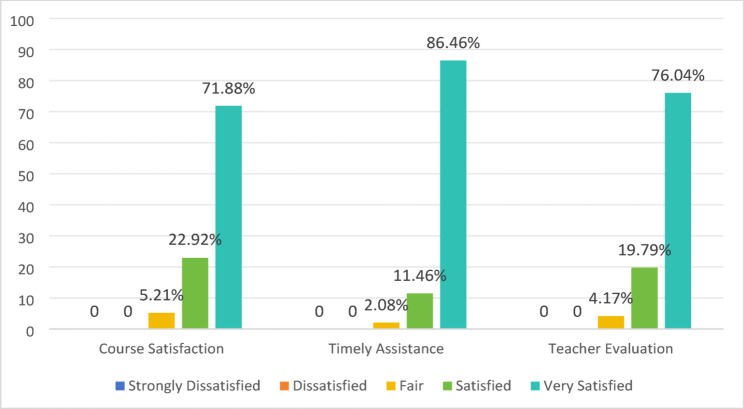
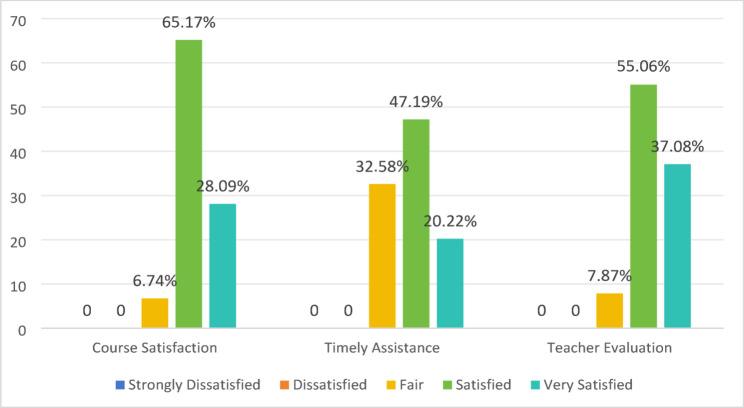
- Course satisfaction was higher in the experimental group (4.67 ± 0.57) than the control group (4.21 ± 0.55); t(182.72) = 5.46, p < 0.001, mean difference 0.45, 95% CI [0.29, 0.62], Cohen’s d = 0.80. Ordinal logistic regression found group a significant predictor (Wald χ² = 29.652, p < 0.001; OR = 0.177, 95% CI [0.095, 0.33]), interpreted as the experimental group being 5.65 times more likely to achieve higher satisfaction; gender, entrance scores, and age were not significant.
- Students used the system 1,244 times collectively, averaging 12.95 uses per person, with total usage time of 512 h and an average of 5 h 20 min per student.
- Questionnaire reliability/validity: Cronbach’s α = 0.873; KMO = 0.704; Bartlett’s test χ² = 340.334, df = 3, p < 0.001; one factor accounted for 81.25% of variance.
Methods
- Cluster randomized controlled trial/quasi-experimental study: all 185 nursing students in four intact 2023 classes (2301–2304; n = 48, 48, 44, 45) were stratified by gender and admission scores, then randomly assigned via SPSS 27.0 to experimental (2301, 2302; n = 96) or control (2303, 2304; n = 89) groups. The same experienced teacher taught both groups; final assessment was blind-graded; the teaching experiment lasted 16 weeks.
- Experimental group received AI-assisted blended learning integrating the “DeepSeek R1 250528” generative AI model with the national high-quality course “Nursing Ethics,” including structured prompts, course knowledge graph, AI-generated cases, Socratic dialogue, personalized learning paths, and AI grading. Assessment was tripartite: theoretical examination 50%, case analysis 30%, situational simulation 20%. Control group used traditional teaching without AI assistance.
- Analysis included independent samples t-tests/Welch’s t-test, ANCOVA controlling for entrance scores, gender, and age, ordinal logistic regression for satisfaction, and questionnaire reliability/validity analyses.
Limitations
- The paper states: the quasi-experimental design rather than individual randomization and the absence of a pre-test using the same assessment tools limit causal inference; the satisfaction questionnaire had only three items, restricted content coverage, and possible social desirability bias; intervention fidelity could not completely eliminate potential information contamination between groups; and the sample came from four classes at a single university, limiting extrapolation and statistical validity.
- Evident in the text: the unadjusted t-test showed a significant score difference, but the ANCOVA-adjusted group effect was not significant (p = 0.257), so the academic-performance finding is not robust to covariate adjustment. Also, Table 10 is labeled as control group but reports a total of 96, while the control group is described elsewhere as n = 89.
Model-written summary. Check it against the paper before relying on it.
Integrity signals
Registry
Cites
Statistics
Figures
Verification
Claims the paper makes
7 Valid · 0 Not valid · 2 Not checked · 66 Own results and interpretations
A result the paper reports from its own data — it cites no other source for it, so there is none to check. The quote shows it is in the paper.
In the paper
“Key covariates (entrance exam scores, gender, age) showed weak direct associations with post-test scores in this sample, aiding future studies in sample size estimation and variable selection.”
§ Exploring the integration of AI and national quality courses in China: a study on teaching practices in nursing smart education > Result
plainstates an association- Asserted: passes — The authors put it forward as true.
- Checkable: passes — It can be checked against evidence.
- Load-bearing: passes — The paper’s conclusions depend on it.
- Based: passes — The paper gives a reason why it holds.
A result the paper reports from its own data — it cites no other source for it, so there is none to check. The quote shows it is in the paper.
In the paper
“Notably, deleting Q2 would increase the Cronbach’s alpha to 0.915, suggesting relatively weaker internal consistency for this item compared to others.”
§ Exploring the integration of AI and national quality courses in China: a study on teaching practices in nursing smart education > Methods > Questionnaire design
hedgedstates a cause- Asserted: passes — The authors put it forward as true.
- Checkable: passes — It can be checked against evidence.
- Load-bearing: unclear — It is unclear whether the paper’s conclusions depend on it.
- Based: passes — The paper gives a reason why it holds.
A result the paper reports from its own data — it cites no other source for it, so there is none to check. The quote shows it is in the paper.
In the paper
“First, its CITC value of 0.680 remains within the acceptable range.”
§ Exploring the integration of AI and national quality courses in China: a study on teaching practices in nursing smart education > Methods > Questionnaire design
plain- Asserted: passes — The authors put it forward as true.
- Checkable: passes — It can be checked against evidence.
- Load-bearing: passes — The paper’s conclusions depend on it.
- Based: passes — The paper gives a reason why it holds.
A result the paper reports from its own data — it cites no other source for it, so there is none to check. The quote shows it is in the paper.
In the paper
“Group emerged as a significant predictor of satisfaction level (Wald χ² = 29.652, p < 0.001).”
§ Exploring the integration of AI and national quality courses in China: a study on teaching practices in nursing smart education > Result
plainstates an association- Asserted: passes — The authors put it forward as true.
- Checkable: passes — It can be checked against evidence.
- Load-bearing: passes — The paper’s conclusions depend on it.
- Based: passes — The paper gives a reason why it holds.
A result the paper reports from its own data — it cites no other source for it, so there is none to check. The quote shows it is in the paper.
In the paper
“As shown in Table 4 , the KMO value was 0.704, exceeding the recommended threshold of 0.7.”
§ Exploring the integration of AI and national quality courses in China: a study on teaching practices in nursing smart education > Methods > Questionnaire design
plain- Asserted: passes — The authors put it forward as true.
- Checkable: passes — It can be checked against evidence.
- Load-bearing: passes — The paper’s conclusions depend on it.
- Based: passes — The paper gives a reason why it holds.
30 more claims
Create a free account to see all 75 claims and every source verdict.
- It may state two separate claims as one. 34
- Probably not a substantial claim. 13
- The quote only partly states this claim. 1
Statistics recomputed
Every reported test result, recomputed from its test statistic and degrees of freedom. A result shows as not adding up only once an independent check has confirmed it.
- Consistentt(126.47) = 4.07reported p < .001 · recomputed p < .001
“t(126.47) = 4.07, p < .001”
- Consistentt(182.72) = 5.46reported p < .001 · recomputed p < .001
“t(182.72) = 5.46, p < .001”
Self-check
Percentages, sums and reported differences re-computed from the paper’s own numbers.
Rated minor: it would not touch a result — a value no result rests on, a p-value that stays on the same side of the significance level, or a conflict that is clerical, resolved elsewhere in the paper, or outside its own findings.
In the paper
“| Total | Total | 96 | 100 |”
§ Exploring the integration of AI and national quality courses in China: a study on teaching practices in nursing smart education > Methods > Questionnaire design
Reported 96 · recomputed 89
Cited works that were retracted
Works this paper cites that were later retracted, from the retraction notices publishers deposit. Major when the notice came out before this paper was published.
A note, not an issue: for example, a cited work that was retracted only after this paper was published, which its authors could not have known.
In the paper
“These studies indicate that the long-term stability of teaching outcomes and the efficiency of translating knowledge comprehension into clinical decision-making capabilities remain critical challenges to be addressed [11–21].”
Cited work 10.1186/s12909-024-06556-y · retracted 2026-05-25 · notice 10.1186/s12909-026-09521-z · this paper published 2025-12-29
Citations
Cites
1 retracted
Khazaei, M. R., Moradi, E., Barry, A., Keshavarzi, M. H., Hashemi, A., Ramezani, G., Zazoly, A. Z., & Farzadnia, F. (2025) · BMC Medical Education · doi:10.1186/s12909-024-06556-y · Cited by 5 · cited 1×
“These studies indicate that the long-term stability of teaching outcomes and the efficiency of translating knowledge comprehension into clinical decision-making capabilities remain critical challenges to be addressed [11–21].”
RetractedChan, K. S., & Zary, N. (2019) · JMIR Medical Education · doi:10.2196/13930 · Cited by 877 · cited 1×
“Currently, AI in medical education primarily supports learning assistance, student assessment, and course optimization [25].”
The impact of artificial intelligence on learner–instructor interaction in online learning
Seo, K., Tang, J., Roll, I., Fels, S., & Yoon, D. (2021) · International Journal of Educational Technology in Higher Education · doi:10.1186/s41239-021-00292-9 · Cited by 788 · cited 1×
“The conference proposed a new educational scenario of a “trinity of teachers, machines, and students”, highlighting that generative AI technologies are pioneering new models for teaching applications [2].”
Alqahtani, T., Badreldin, H. A., Alrashed, M., Alshaya, A. I., Alghamdi, S. S., bin Saleh, K., Alowais, S. A., Alshaya, O. A., Rahman, I., Al Yami, M. S., et al. (2023) · Research in Social and Administrative Pharmacy · doi:10.1016/j.sapharm.2023.05.016 · Cited by 565 · cited 1×
“Personalized Learning Experience: AI allowed students to explore learning content according to their own pace and interests, which was consistent with previous research concluding that personalized instruction enhances engagement [40].”
Artificial Intelligence in Undergraduate Medical Education: A Scoping Review
Lee, J., Wu, A. S., Li, D., & Kulasegaram, K. (. (2021) · Academic Medicine · doi:10.1097/acm.0000000000004291 · Cited by 324
Application Scenarios for Artificial Intelligence in Nursing Care: Rapid Review
Seibert, K., Domhoff, D., Bruch, D., Schulte-Althoff, M., Fürstenau, D., Biessmann, F., & Wolf-Ostermann, K. (2021) · Journal of Medical Internet Research · doi:10.2196/26522 · Cited by 314 · cited 1×
“The nursing profession, both domestically and internationally, has begun exploring the integration of digitalization, knowledge informati-zation, and intelligent nursing scenarios [22], charting a course for intelligent nursing practice [23, 24].”
Wannapiroon, N., & Pimdee, P. (2022) · Education and Information Technologies · doi:10.1007/s10639-021-10849-w · Cited by 246 · cited 1×
“Thai-land has achieved notable success in STEAM education using digital virtual classrooms, surpassing outcomes from traditional teaching methods [6].”
Predicted Influences of Artificial Intelligence on the Domains of Nursing: Scoping Review
Buchanan, C., Howitt, M. L., Wilson, R., Booth, R. G., Risling, T., & Bamford, M. (2020) · JMIR Nursing · doi:10.2196/23939 · Cited by 238 · cited 1×
“While previous research has predominantly focused on AI applications in clinical skills or basic medical sciences [45], this study demonstrated AI’s considerable potential in cultivating higher-order competencies such as critical thinking and ethical judgment in nurses.”
Tam, W., Huynh, T., Tang, A., Luong, S., Khatri, Y., & Zhou, W. (2023) · Nurse Education Today · doi:10.1016/j.nedt.2023.105917 · Cited by 221 · cited 1×
“…personalized, self-paced learning within courses, uncover new insights for targeted interventions, strengthen decision-making processes and clinical reasoning skills in nursing students, provide AI-assisted diagnostics, improve academic writing, and apply these advancements in patient care [26–31].”
The Role of AI in Nursing Education and Practice: Umbrella Review
El Arab, R. A., Al Moosa, O. A., Abuadas, F. H., & Somerville, J. (2025) · Journal of Medical Internet Research · doi:10.2196/69881 · Cited by 202 · cited 1×
“A recently published systematic review on artificial intelligence in nursing education and practice [32] identifies the transformation of nursing education as a critical area.”
Labrague, L. J., Aguilar-Rosales, R., Yboa, B. C., Sabio, J. B., & de los Santos, J. A. (2023) · Nurse Education in Practice · doi:10.1016/j.nepr.2023.103815 · Cited by 196 · cited 1×
“Students’ positive attitudes toward AI [46], as concretely reflected in this study, offer a new and compelling direction for integrating AI-related curricula, training, and practical learning into nursing education.”
Feigerlova, E., Hani, H., & Hothersall-Davies, E. (2025) · BMC Medical Education · doi:10.1186/s12909-025-06719-5 · Cited by 166 · cited 1×
“This mechanism of “on-demand resolution” [38, 39] significantly enhanced learning confidence and experience, serving as the key driver for the nearly 66-percentage-point increase in satisfaction.”
Amiri, H., Peiravi, S., rezazadeh shojaee, S. S., Rouhparvarzamin, M., Nateghi, M. N., Etemadi, M. H., ShojaeiBaghini, M., Musaie, F., Anvari, M. H., & Asadi Anar, M. (2024) · BMC Medical Education · doi:10.1186/s12909-024-05406-1 · Cited by 149 · cited 1×
“Our findings strongly aligned with calls to incorporate artificial intelligence into medical education systems [41–44].”
Xue, M., Sun, H., Xue, J., Zhou, J., Qu, J., Ji, S., Bu, Y., & Liu, Y. (2023) · BMC Medical Education · doi:10.1186/s12909-023-04026-5 · Cited by 119
Roos, J., Kasapovic, A., Jansen, T., & Kaczmarczyk, R. (2023) · JMIR Medical Education · doi:10.2196/46482 · Cited by 98
Ruksakulpiwat, S., Thorngthip, S., Niyomyart, A., Benjasirisan, C., Phianhasin, L., Aldossary, H., Ahmed, B., & Samai, T. (2024) · Journal of Multidisciplinary Healthcare · doi:10.2147/jmdh.s459946 · Cited by 98 · cited 1×
“The nursing profession, both domestically and internationally, has begun exploring the integration of digitalization, knowledge informati-zation, and intelligent nursing scenarios [22], charting a course for intelligent nursing practice [23, 24].”
Nursing Students’ Perceptions and Use of Generative Artificial Intelligence in Nursing Education
Han, S., Kang, H. S., Gimber, P., & Lim, S. (2025) · Nursing Reports · doi:10.3390/nursrep15020068 · Cited by 86
Tseng, L.-P., Huang, L.-P., & Chen, W.-R. (2025) · Nurse Education Today · doi:10.1016/j.nedt.2025.106570 · Cited by 75
Chen, S., Yu, J., Chamouni, S., Wang, Y., & Li, Y. (2024) · BMC Medicine · doi:10.1186/s12916-024-03566-x · Cited by 73
Güneyli, A., Burgul, N. S., Dericioğlu, S., Cenkova, N., Becan, S., Şimşek, Ş. E., & Güneralp, H. (2024) · European Journal of Investigation in Health, Psychology and Education · doi:10.3390/ejihpe14080156 · Cited by 65
Laupichler, M. C., Hadizadeh, D. R., Wintergerst, M. W. M., von der Emde, L., Paech, D., Dick, E. A., & Raupach, T. (2022) · BMC Medical Education · doi:10.1186/s12909-022-03866-x · Cited by 62
Shin, H., De Gagne, J. C., Kim, S. S., & Hong, M. (2024) · CIN: Computers, Informatics, Nursing · doi:10.1097/cin.0000000000001177 · Cited by 47
Masters, K., Herrmann-Werner, A., Festl-Wietek, T., & Taylor, D. (2024) · Medical Teacher · doi:10.1080/0142159x.2024.2387802 · Cited by 46 · cited 1×
“Our findings strongly aligned with calls to incorporate artificial intelligence into medical education systems [41–44].”
A Case-Centered Approach to Nursing Ethics Education: A Qualitative Study
Lee, W., Choi, S., Kim, S., & Min, A. (2020) · International Journal of Environmental Research and Public Health · doi:10.3390/ijerph17217748 · Cited by 46
Learner-Centered Experience-Based Medical Education in an AI-Driven Society: A Literature Review
Komasawa, N., & Yokohira, M. (2023) · Cureus · doi:10.7759/cureus.46883 · Cited by 44
Khaghanizadeh, M., Koohi, A., Ebadi, A., & Vahedian-Azimi, A. (2023) · BMC Medical Ethics · doi:10.1186/s12910-023-00938-5 · Cited by 40
Face-to-face versus 360° VR video: a comparative study of two teaching methods in nursing education
Babaita, A. O., Kako, M., Teramoto, C., Okamoto, M., Hayashi, Y., Ohshimo, S., Sadamori, T., Hattori, M., & Moriyama, M. (2024) · BMC Nursing · doi:10.1186/s12912-024-01866-4 · Cited by 40 · cited 1×
“Japan has experimented with online courses in traditional medical education [7] and introduced Virtual Reality (VR) technology into nursing practice curricula [8].”
Thomae, A. V., Witt, C. M., & Barth, J. (2024) · JMIR Medical Education · doi:10.2196/50545 · Cited by 36 · cited 1×
“…personalized, self-paced learning within courses, uncover new insights for targeted interventions, strengthen decision-making processes and clinical reasoning skills in nursing students, provide AI-assisted diagnostics, improve academic writing, and apply these advancements in patient care [26–31].”
Rahmani, P., Behshid, M., Seif‐Farshad, M., Mousavi, S., & Molaei Tavani, F. (2023) · Nursing Open · doi:10.1002/nop2.1344 · Cited by 27
Izadi, F., Bijani, M., Fereidouni, Z., Karimi, S., Tehranineshat, B., & Dehghan, A. (2020) · The Scientific World Journal · doi:10.1155/2020/5749687 · Cited by 23
Narrative writing as a strategy for nursing ethics education in Japan
Tsuruwaka, M., & Asahara, K. (2018) · International Journal of Medical Education · doi:10.5116/ijme.5b39.d5d2 · Cited by 22 · cited 1×
“These studies indicate that the long-term stability of teaching outcomes and the efficiency of translating knowledge comprehension into clinical decision-making capabilities remain critical challenges to be addressed [11–21].”
Hwu, L., & Pai, H. (2025) · Nursing & Health Sciences · doi:10.1111/nhs.70082 · Cited by 18
Brave spaces in nursing ethics education: Courage through pedagogy
Ford, N. J., Gomes, L. M., & Brown, S. B. (2024) · Nursing Ethics · doi:10.1177/09697330231183075 · Cited by 15
Xiao, L., Peng, D., Zhong, J., Fang, T., Dai, L., Peng, X., Yu, C., & Huang, F. (2025) · Frontiers in Medicine · doi:10.3389/fmed.2025.1587526 · Cited by 12
The Smart Use of Smart Technologies in Teaching and Learning: Where we are and Where we Need to be
Steehler, A. J., Pettitt‐Schieber, B., & Alexander, P. A. (2022) · Ear Nose & Throat Journal · doi:10.1177/01455613231154037 · Cited by 11
Baghbani, R., Rakhshan, M., Zarifsanaiey, N., Nemati, R., & Daneshi, S. (2022) · BMC Medical Education · doi:10.1186/s12909-022-03677-0 · Cited by 10
Franco, H., Caldeira, S., & Nunes, L. (2025) · Nursing Ethics · doi:10.1177/09697330241265409 · Cited by 6 · cited 1×
“The generally small overall sample sizes limit the generalizability and statistical power of the conclusions [33–37].”
Experiences of internship nursing students in confronting ethical issues: a qualitative study
Heidari, T., Jouybari, L., Borhani, F., & Sabzi, Z. (2025) · BMC Medical Ethics · doi:10.1186/s12910-025-01254-w · Cited by 6 · cited 1×
“The generally small overall sample sizes limit the generalizability and statistical power of the conclusions [33–37].”
Akbari, A., Mirshahi, A., Mehravar, F., Rozveh, A. K., & Nasrabadi, A. N. (2025) · Health Science Reports · doi:10.1002/hsr2.71021 · Cited by 5
Tavani, F. M., Behshid, M., Amini, A., Rahmani, A., Rahmani, P., & Mousavi, S. (2024) · BMC Medical Education · doi:10.1186/s12909-024-05846-9 · Cited by 2
Choe, K., Kim, S., Lee, C., & Kim, S. (2022) · International Journal of Environmental Research and Public Health · doi:10.3390/ijerph192013531 · Cited by 2
Nakada, Y., Arai, M., Yamato, I., et al. (2025) · BMC Medical Education · doi:10.1186/s12909-025-06874-9 · Cited by 1 · cited 1×
“Japan has experimented with online courses in traditional medical education [7] and introduced Virtual Reality (VR) technology into nursing practice curricula [8].”
Research works printed but not linked: 2
- The 2024 World MOOC. and Online Education Conference is held in the UK. https://edu.people.com.cn/n1/2024/1213/c1006-40381836.html (Accessed 23.Dec.2024).
- Wu Y, Xia C. Zhang Ye, etc visual analysis of research hotspots and development trends in smart nursing at home and abroad [J]. Military Nurs. 2024;41(05):85–9.
Cited by
Reinstituting teacher agency and classroom resilience amid geopolitics of AI homogenisation
Ficapal‐Cusí, P., Rajmil, D., & Torrent‐Sellens, J. (2026) · Pedagogy Culture and Society · doi:10.1080/14681366.2026.2709075 · Cited by 2
“To conclude, the progressive integration of AI into educational models and Chinese curricula is recognised as both a tool to support learning and an area of knowledge (Shahzad, Xu, and Asif 2025; Zhao and Zang 2025).”
Student-facing conversational AI in primary classrooms: Should it be allowed?
Zulfiqar, M., & Iqbal, U. (2026) · Responsible Enterprise Pedagogy · doi:10.1108/resep-03-2026-0007
Basic Education With AI: Focusing on Quality Cultivation and Integration of Teaching in China
Li, J. (2026) · Exploring Education Policy in a Globalized World · doi:10.1007/978-981-92-2464-7_3
Artificial Intelligence in Nursing Practice Education: A Systematic Review and Meta‐Analysis
Wang, J., Kuang, M., Chen, J., Yan, Y., & Li, Z. (2026) · Journal of Nursing Management · doi:10.1155/jonm/6626865 · Cited by 3
Metadata
- Authors
- Jing, Z., & Mouhong, Z.
- Affiliations
- West Anhui Health Vocational College (CN)
- Corresponding author
- Mouhong, Zang
- Venue
- BMC Medical Education
- Published
- 2025-12-29
- Volume
- 25
- Issue
- 1
- Pages
- 1716-1716
- ISSN
- 1472-6920 (ISSN-L)
- PMC
- PMC12751411
- OpenAlex
- W7117483079
- Cited by
- 4
- References
- 38
- Citations by year
- 2026: 4
- FWCI
- 4.12
- Type
- journal article
- Language
- en
- Open access
- gold
- doi.org
- Licence
- cc-by-nc-nd
- creativecommons.org/licenses/by-nc-nd/4.0 (tdm)
- creativecommons.org/licenses/by-nc-nd/4.0 (vor)
- Locations
- BMC Medical Education (publishedVersion, cc-by-nc-nd)
- PubMed (publishedVersion)
- PubMed Central (publishedVersion, cc-by-nc-nd)
- DOAJ (DOAJ: Directory of Open Access Journals) (submittedVersion, cc-by-sa)
- Funders
- Anhui Provincial Department of Education, China (gxgnfx2022141)
- Topics
- Social Sciences › Education › Artificial Intelligence in Education
- Social Sciences › Education › Educational Technology and Pedagogy
- Health Sciences › Medicine › Health Informatics › Artificial Intelligence in Healthcare and Education
- Keywords
- artificial intelligence in education, nursing ethics education, smart education, blended learning, generative AI, individualized curriculum, student satisfaction, academic performance, nursing education, Chinese education reform
- MeSH terms
- Adult, Artificial Intelligence, China, Curriculum, Education, Nursing, Ethics, Nursing, Female, Humans, Male, Students, Nursing, Teaching, Models, Educational
About these checks
Registry, retraction, Cites and statistics results are computed, not judged, with one exception: a printed reference that no index lists is read once by a model before it counts as a citation error. Claims are extracted by a model and kept only when their quote appears verbatim in the text; each cited source is then checked, with a model’s help, for whether it says what the claim relies on. Those verdicts can be wrong — read the claim’s quote and the cited source before relying on one.
The claim verdicts this report counts are experimental: their accuracy is not yet measured.
A language model drew the claims from the paper on 2026-10-10, under version 3 of the claim definition (model deepseek-v4.1-flash, prompt extract-v3).
A second model labelled each claim on 2026-10-10 (model jev-1.13-20260917, definition revision gold-guideline-v0.2).
Statistics and arithmetic are recomputed, not judged.
Confidence bands are shown only for fields calibrated on our annotated test set. None is calibrated yet, so no band is shown.
What counts as a claim ›How we measure confidence ›How we check this ›
Are you an author, or do you see a problem with this page? Request a review
Data sources
Bibliographic data: Semantic Scholar, OpenAlex, Crossref.
Contains information from the Semantic Scholar Academic Graph Datasets, made available under the ODC Attribution License (ODC-BY 1.0).
Semantic Scholar’s data is described in: Kinney, R., et al. (2023). The Semantic Scholar Open Data Platform. arXiv:2301.10140.
